EP0985657A1 - Procédé amélioré pour la préparation d'acétate de vinyle - Google Patents
Procédé amélioré pour la préparation d'acétate de vinyle Download PDFInfo
- Publication number
- EP0985657A1 EP0985657A1 EP99305876A EP99305876A EP0985657A1 EP 0985657 A1 EP0985657 A1 EP 0985657A1 EP 99305876 A EP99305876 A EP 99305876A EP 99305876 A EP99305876 A EP 99305876A EP 0985657 A1 EP0985657 A1 EP 0985657A1
- Authority
- EP
- European Patent Office
- Prior art keywords
- ethylene
- reactor
- vinyl acetate
- acetic acid
- mol
- Prior art date
- Legal status (The legal status is an assumption and is not a legal conclusion. Google has not performed a legal analysis and makes no representation as to the accuracy of the status listed.)
- Granted
Links
- XTXRWKRVRITETP-UHFFFAOYSA-N Vinyl acetate Chemical compound CC(=O)OC=C XTXRWKRVRITETP-UHFFFAOYSA-N 0.000 title claims abstract description 44
- 238000000034 method Methods 0.000 title claims abstract description 25
- 230000008569 process Effects 0.000 title claims abstract description 22
- 238000004519 manufacturing process Methods 0.000 title claims abstract description 18
- QTBSBXVTEAMEQO-UHFFFAOYSA-N Acetic acid Chemical compound CC(O)=O QTBSBXVTEAMEQO-UHFFFAOYSA-N 0.000 claims abstract description 111
- VGGSQFUCUMXWEO-UHFFFAOYSA-N Ethene Chemical compound C=C VGGSQFUCUMXWEO-UHFFFAOYSA-N 0.000 claims abstract description 90
- 239000005977 Ethylene Substances 0.000 claims abstract description 90
- 239000007789 gas Substances 0.000 claims abstract description 43
- QVGXLLKOCUKJST-UHFFFAOYSA-N atomic oxygen Chemical compound [O] QVGXLLKOCUKJST-UHFFFAOYSA-N 0.000 claims abstract description 26
- 239000001301 oxygen Substances 0.000 claims abstract description 26
- 229910052760 oxygen Inorganic materials 0.000 claims abstract description 26
- 239000003054 catalyst Substances 0.000 claims description 54
- CURLTUGMZLYLDI-UHFFFAOYSA-N Carbon dioxide Chemical compound O=C=O CURLTUGMZLYLDI-UHFFFAOYSA-N 0.000 claims description 50
- IJGRMHOSHXDMSA-UHFFFAOYSA-N Atomic nitrogen Chemical compound N#N IJGRMHOSHXDMSA-UHFFFAOYSA-N 0.000 claims description 34
- 239000001569 carbon dioxide Substances 0.000 claims description 25
- 229910002092 carbon dioxide Inorganic materials 0.000 claims description 25
- 239000000047 product Substances 0.000 claims description 20
- 239000000203 mixture Substances 0.000 claims description 18
- 229910052757 nitrogen Inorganic materials 0.000 claims description 17
- XLYOFNOQVPJJNP-UHFFFAOYSA-N water Substances O XLYOFNOQVPJJNP-UHFFFAOYSA-N 0.000 claims description 16
- 239000000463 material Substances 0.000 claims description 15
- XKRFYHLGVUSROY-UHFFFAOYSA-N Argon Chemical compound [Ar] XKRFYHLGVUSROY-UHFFFAOYSA-N 0.000 claims description 14
- KDLHZDBZIXYQEI-UHFFFAOYSA-N Palladium Chemical compound [Pd] KDLHZDBZIXYQEI-UHFFFAOYSA-N 0.000 claims description 12
- 229910052751 metal Inorganic materials 0.000 claims description 12
- 239000002184 metal Substances 0.000 claims description 12
- 239000007788 liquid Substances 0.000 claims description 10
- 239000011261 inert gas Substances 0.000 claims description 9
- 229910052786 argon Inorganic materials 0.000 claims description 7
- 239000006227 byproduct Substances 0.000 claims description 7
- PXHVJJICTQNCMI-UHFFFAOYSA-N Nickel Chemical compound [Ni] PXHVJJICTQNCMI-UHFFFAOYSA-N 0.000 claims description 6
- 239000000126 substance Substances 0.000 claims description 6
- 239000010931 gold Substances 0.000 claims description 5
- 229910052763 palladium Inorganic materials 0.000 claims description 5
- PCHJSUWPFVWCPO-UHFFFAOYSA-N gold Chemical compound [Au] PCHJSUWPFVWCPO-UHFFFAOYSA-N 0.000 claims description 4
- 229910052737 gold Inorganic materials 0.000 claims description 4
- BWHMMNNQKKPAPP-UHFFFAOYSA-L potassium carbonate Chemical compound [K+].[K+].[O-]C([O-])=O BWHMMNNQKKPAPP-UHFFFAOYSA-L 0.000 claims description 4
- 229910052759 nickel Inorganic materials 0.000 claims description 3
- RYGMFSIKBFXOCR-UHFFFAOYSA-N Copper Chemical compound [Cu] RYGMFSIKBFXOCR-UHFFFAOYSA-N 0.000 claims description 2
- 229910052802 copper Inorganic materials 0.000 claims description 2
- 239000010949 copper Substances 0.000 claims description 2
- 229910052747 lanthanoid Inorganic materials 0.000 claims description 2
- 150000002602 lanthanoids Chemical class 0.000 claims description 2
- 239000012528 membrane Substances 0.000 claims description 2
- 229910000027 potassium carbonate Inorganic materials 0.000 claims description 2
- 238000010791 quenching Methods 0.000 claims description 2
- 230000000171 quenching effect Effects 0.000 claims description 2
- 238000000926 separation method Methods 0.000 claims description 2
- 229910052723 transition metal Inorganic materials 0.000 claims description 2
- 150000003624 transition metals Chemical class 0.000 claims description 2
- 238000006243 chemical reaction Methods 0.000 abstract description 9
- VYPSYNLAJGMNEJ-UHFFFAOYSA-N Silicium dioxide Chemical compound O=[Si]=O VYPSYNLAJGMNEJ-UHFFFAOYSA-N 0.000 description 18
- 238000002474 experimental method Methods 0.000 description 15
- 239000012530 fluid Substances 0.000 description 15
- 239000002245 particle Substances 0.000 description 9
- 239000000377 silicon dioxide Substances 0.000 description 9
- 238000002360 preparation method Methods 0.000 description 8
- 239000000243 solution Substances 0.000 description 8
- 238000010926 purge Methods 0.000 description 7
- 230000000694 effects Effects 0.000 description 6
- SCVFZCLFOSHCOH-UHFFFAOYSA-M potassium acetate Chemical compound [K+].CC([O-])=O SCVFZCLFOSHCOH-UHFFFAOYSA-M 0.000 description 5
- 229910004042 HAuCl4 Inorganic materials 0.000 description 4
- OAKJQQAXSVQMHS-UHFFFAOYSA-N Hydrazine Chemical compound NN OAKJQQAXSVQMHS-UHFFFAOYSA-N 0.000 description 4
- GWEVSGVZZGPLCZ-UHFFFAOYSA-N Titan oxide Chemical compound O=[Ti]=O GWEVSGVZZGPLCZ-UHFFFAOYSA-N 0.000 description 4
- 230000007423 decrease Effects 0.000 description 4
- 238000009826 distribution Methods 0.000 description 4
- 238000002347 injection Methods 0.000 description 4
- 239000007924 injection Substances 0.000 description 4
- VNWKTOKETHGBQD-UHFFFAOYSA-N methane Chemical compound C VNWKTOKETHGBQD-UHFFFAOYSA-N 0.000 description 4
- 239000000376 reactant Substances 0.000 description 4
- 150000003839 salts Chemical class 0.000 description 4
- 229910009112 xH2O Inorganic materials 0.000 description 4
- OKTJSMMVPCPJKN-UHFFFAOYSA-N Carbon Chemical compound [C] OKTJSMMVPCPJKN-UHFFFAOYSA-N 0.000 description 3
- WSFSSNUMVMOOMR-UHFFFAOYSA-N Formaldehyde Chemical compound O=C WSFSSNUMVMOOMR-UHFFFAOYSA-N 0.000 description 3
- 238000006137 acetoxylation reaction Methods 0.000 description 3
- 239000007864 aqueous solution Substances 0.000 description 3
- 230000015572 biosynthetic process Effects 0.000 description 3
- 229940117927 ethylene oxide Drugs 0.000 description 3
- 239000001257 hydrogen Substances 0.000 description 3
- 229910052739 hydrogen Inorganic materials 0.000 description 3
- 239000011148 porous material Substances 0.000 description 3
- 239000011734 sodium Substances 0.000 description 3
- 229910002012 Aerosil® Inorganic materials 0.000 description 2
- OTMSDBZUPAUEDD-UHFFFAOYSA-N Ethane Chemical compound CC OTMSDBZUPAUEDD-UHFFFAOYSA-N 0.000 description 2
- UFHFLCQGNIYNRP-UHFFFAOYSA-N Hydrogen Chemical compound [H][H] UFHFLCQGNIYNRP-UHFFFAOYSA-N 0.000 description 2
- DGAQECJNVWCQMB-PUAWFVPOSA-M Ilexoside XXIX Chemical compound C[C@@H]1CC[C@@]2(CC[C@@]3(C(=CC[C@H]4[C@]3(CC[C@@H]5[C@@]4(CC[C@@H](C5(C)C)OS(=O)(=O)[O-])C)C)[C@@H]2[C@]1(C)O)C)C(=O)O[C@H]6[C@@H]([C@H]([C@@H]([C@H](O6)CO)O)O)O.[Na+] DGAQECJNVWCQMB-PUAWFVPOSA-M 0.000 description 2
- XEEYBQQBJWHFJM-UHFFFAOYSA-N Iron Chemical compound [Fe] XEEYBQQBJWHFJM-UHFFFAOYSA-N 0.000 description 2
- 229910003244 Na2PdCl4 Inorganic materials 0.000 description 2
- ZLMJMSJWJFRBEC-UHFFFAOYSA-N Potassium Chemical compound [K] ZLMJMSJWJFRBEC-UHFFFAOYSA-N 0.000 description 2
- MCMNRKCIXSYSNV-UHFFFAOYSA-N Zirconium dioxide Chemical compound O=[Zr]=O MCMNRKCIXSYSNV-UHFFFAOYSA-N 0.000 description 2
- 239000002253 acid Substances 0.000 description 2
- PNEYBMLMFCGWSK-UHFFFAOYSA-N aluminium oxide Inorganic materials [O-2].[O-2].[O-2].[Al+3].[Al+3] PNEYBMLMFCGWSK-UHFFFAOYSA-N 0.000 description 2
- 229910052788 barium Inorganic materials 0.000 description 2
- DSAJWYNOEDNPEQ-UHFFFAOYSA-N barium atom Chemical compound [Ba] DSAJWYNOEDNPEQ-UHFFFAOYSA-N 0.000 description 2
- 230000003197 catalytic effect Effects 0.000 description 2
- 238000009833 condensation Methods 0.000 description 2
- 230000005494 condensation Effects 0.000 description 2
- 238000010586 diagram Methods 0.000 description 2
- 239000012153 distilled water Substances 0.000 description 2
- 150000002739 metals Chemical class 0.000 description 2
- GPNDARIEYHPYAY-UHFFFAOYSA-N palladium(ii) nitrate Chemical compound [Pd+2].[O-][N+]([O-])=O.[O-][N+]([O-])=O GPNDARIEYHPYAY-UHFFFAOYSA-N 0.000 description 2
- 229910052700 potassium Inorganic materials 0.000 description 2
- 235000011056 potassium acetate Nutrition 0.000 description 2
- 230000009467 reduction Effects 0.000 description 2
- 229910052708 sodium Inorganic materials 0.000 description 2
- 239000007787 solid Substances 0.000 description 2
- 238000003756 stirring Methods 0.000 description 2
- WDJSTKACSQOTNH-UHFFFAOYSA-M C[Au+]C.CC([O-])=O Chemical compound C[Au+]C.CC([O-])=O WDJSTKACSQOTNH-UHFFFAOYSA-M 0.000 description 1
- MYMOFIZGZYHOMD-UHFFFAOYSA-N Dioxygen Chemical compound O=O MYMOFIZGZYHOMD-UHFFFAOYSA-N 0.000 description 1
- 229910020252 KAuCl4 Inorganic materials 0.000 description 1
- VMHLLURERBWHNL-UHFFFAOYSA-M Sodium acetate Chemical compound [Na+].CC([O-])=O VMHLLURERBWHNL-UHFFFAOYSA-M 0.000 description 1
- QAOWNCQODCNURD-UHFFFAOYSA-L Sulfate Chemical compound [O-]S([O-])(=O)=O QAOWNCQODCNURD-UHFFFAOYSA-L 0.000 description 1
- 159000000021 acetate salts Chemical class 0.000 description 1
- 150000001335 aliphatic alkanes Chemical class 0.000 description 1
- 150000001336 alkenes Chemical class 0.000 description 1
- 229910052787 antimony Inorganic materials 0.000 description 1
- WATWJIUSRGPENY-UHFFFAOYSA-N antimony atom Chemical compound [Sb] WATWJIUSRGPENY-UHFFFAOYSA-N 0.000 description 1
- 238000000889 atomisation Methods 0.000 description 1
- 230000009286 beneficial effect Effects 0.000 description 1
- 229910052793 cadmium Inorganic materials 0.000 description 1
- BDOSMKKIYDKNTQ-UHFFFAOYSA-N cadmium atom Chemical compound [Cd] BDOSMKKIYDKNTQ-UHFFFAOYSA-N 0.000 description 1
- 229910052799 carbon Inorganic materials 0.000 description 1
- 239000003638 chemical reducing agent Substances 0.000 description 1
- 150000001875 compounds Chemical class 0.000 description 1
- 230000009849 deactivation Effects 0.000 description 1
- 238000013461 design Methods 0.000 description 1
- 239000003085 diluting agent Substances 0.000 description 1
- 229910001882 dioxygen Inorganic materials 0.000 description 1
- 239000002360 explosive Substances 0.000 description 1
- -1 for example Substances 0.000 description 1
- 150000002344 gold compounds Chemical class 0.000 description 1
- FDWREHZXQUYJFJ-UHFFFAOYSA-M gold monochloride Chemical compound [Cl-].[Au+] FDWREHZXQUYJFJ-UHFFFAOYSA-M 0.000 description 1
- OTCKNHQTLOBDDD-UHFFFAOYSA-K gold(3+);triacetate Chemical compound [Au+3].CC([O-])=O.CC([O-])=O.CC([O-])=O OTCKNHQTLOBDDD-UHFFFAOYSA-K 0.000 description 1
- 150000004820 halides Chemical class 0.000 description 1
- 150000002431 hydrogen Chemical class 0.000 description 1
- 238000005470 impregnation Methods 0.000 description 1
- 229910052500 inorganic mineral Inorganic materials 0.000 description 1
- 230000003993 interaction Effects 0.000 description 1
- 229910052742 iron Inorganic materials 0.000 description 1
- 229910052746 lanthanum Inorganic materials 0.000 description 1
- FZLIPJUXYLNCLC-UHFFFAOYSA-N lanthanum atom Chemical compound [La] FZLIPJUXYLNCLC-UHFFFAOYSA-N 0.000 description 1
- WPBNNNQJVZRUHP-UHFFFAOYSA-L manganese(2+);methyl n-[[2-(methoxycarbonylcarbamothioylamino)phenyl]carbamothioyl]carbamate;n-[2-(sulfidocarbothioylamino)ethyl]carbamodithioate Chemical compound [Mn+2].[S-]C(=S)NCCNC([S-])=S.COC(=O)NC(=S)NC1=CC=CC=C1NC(=S)NC(=O)OC WPBNNNQJVZRUHP-UHFFFAOYSA-L 0.000 description 1
- VUZPPFZMUPKLLV-UHFFFAOYSA-N methane;hydrate Chemical compound C.O VUZPPFZMUPKLLV-UHFFFAOYSA-N 0.000 description 1
- 239000004005 microsphere Substances 0.000 description 1
- 239000011707 mineral Substances 0.000 description 1
- 239000002808 molecular sieve Substances 0.000 description 1
- MUJIDPITZJWBSW-UHFFFAOYSA-N palladium(2+) Chemical compound [Pd+2] MUJIDPITZJWBSW-UHFFFAOYSA-N 0.000 description 1
- PIBWKRNGBLPSSY-UHFFFAOYSA-L palladium(II) chloride Chemical compound Cl[Pd]Cl PIBWKRNGBLPSSY-UHFFFAOYSA-L 0.000 description 1
- YJVFFLUZDVXJQI-UHFFFAOYSA-L palladium(ii) acetate Chemical compound [Pd+2].CC([O-])=O.CC([O-])=O YJVFFLUZDVXJQI-UHFFFAOYSA-L 0.000 description 1
- 239000011591 potassium Substances 0.000 description 1
- 229910002093 potassium tetrachloropalladate(II) Inorganic materials 0.000 description 1
- 238000011027 product recovery Methods 0.000 description 1
- 238000009790 rate-determining step (RDS) Methods 0.000 description 1
- 239000011541 reaction mixture Substances 0.000 description 1
- 238000012552 review Methods 0.000 description 1
- RMAQACBXLXPBSY-UHFFFAOYSA-N silicic acid Chemical compound O[Si](O)(O)O RMAQACBXLXPBSY-UHFFFAOYSA-N 0.000 description 1
- 239000001632 sodium acetate Substances 0.000 description 1
- 235000017281 sodium acetate Nutrition 0.000 description 1
- URGAHOPLAPQHLN-UHFFFAOYSA-N sodium aluminosilicate Chemical compound [Na+].[Al+3].[O-][Si]([O-])=O.[O-][Si]([O-])=O URGAHOPLAPQHLN-UHFFFAOYSA-N 0.000 description 1
- 238000001694 spray drying Methods 0.000 description 1
- 238000005507 spraying Methods 0.000 description 1
- 229910021653 sulphate ion Inorganic materials 0.000 description 1
- 238000012546 transfer Methods 0.000 description 1
Images


Classifications
-
- C—CHEMISTRY; METALLURGY
- C07—ORGANIC CHEMISTRY
- C07C—ACYCLIC OR CARBOCYCLIC COMPOUNDS
- C07C69/00—Esters of carboxylic acids; Esters of carbonic or haloformic acids
- C07C69/007—Esters of unsaturated alcohols having the esterified hydroxy group bound to an acyclic carbon atom
- C07C69/01—Vinyl esters
-
- C—CHEMISTRY; METALLURGY
- C07—ORGANIC CHEMISTRY
- C07C—ACYCLIC OR CARBOCYCLIC COMPOUNDS
- C07C67/00—Preparation of carboxylic acid esters
- C07C67/04—Preparation of carboxylic acid esters by reacting carboxylic acids or symmetrical anhydrides onto unsaturated carbon-to-carbon bonds
- C07C67/05—Preparation of carboxylic acid esters by reacting carboxylic acids or symmetrical anhydrides onto unsaturated carbon-to-carbon bonds with oxidation
- C07C67/055—Preparation of carboxylic acid esters by reacting carboxylic acids or symmetrical anhydrides onto unsaturated carbon-to-carbon bonds with oxidation in the presence of platinum group metals or their compounds
Definitions
- the present invention relates to a process for the production of vinyl acetate.
- Vinyl acetate may be produced by the acetoxylation of ethylene in the presence of a palladium-containing catalyst. In addition to vinyl acetate, carbon dioxide is produced as a by-product.
- vinyl acetate product and unreacted ethylene are recovered from the gases exiting the reaction vessel.
- the unreacted ethylene is recycled, together with fresh ethylene to the reaction vessel.
- the recycled ethylene contains some carbon dioxide and other by-products as well as some inert gases such as nitrogen and/or argon. The presence of these components limits the concentration of ethylene in the feed to the reaction vessel.
- the present invention provides a process for the production of vinyl acetate, said process comprising the steps of:
- the method further comprises the step of recovering the vinyl acetate produced.
- the present invention provides a novel and cost effective route for the production of vinyl acetate at above atmospheric pressure, 0 Pa gauge (0 barg).
- the reaction may be carried out at a pressure of between 5 x 10 4 Pa gauge (0.5 barg) and 2 x 10 6 Pa gauge (20 barg), preferably between 6 x10 5 Pa gauge (6 barg) and 1.4 x10 6 Pa gauge (14 barg) and, most preferably, between 7 x 10 5 Pa gauge (7 barg) and 1.2 x 10 6 Pa gauge (12 barg).
- These pressure conditions are believed to affect the interaction between ethylene and the surface of the catalyst such that an increase in selectivity towards the production of vinyl acetate is observed when the amount of ethylene in the feed is increased above 60 mol%.
- an increase in the amount of ethylene in the feed is also found to reduce the amount of carbon dioxide produced as a by-product. This in turn, can reduce the amount of carbon dioxide which has to be separated from the recovered unreacted ethylene and/or the amount of carbon dioxide recycled to the reactor with the recovered ethylene.
- the catalyst of the present invention may be fixed-bed or fluid-bed catalyst.
- a fluid-bed catalyst is employed in a fluid bed reactor.
- the catalyst suitably comprises a Group VIII metal and a promoter.
- the catalyst further comprises a co-promoter. These compounds are suitably accommodated on a support.
- the preferred metal is palladium.
- the metal may be present in a concentration of greater than 0.2% by weight, preferably greater than 0.5% by weight, especially about 1% by weight based upon total weight of catalyst. The metal concentration may be as high as 10% by weight.
- Suitable sources of palladium include palladium (II) chloride, sodium or potassium tetrachloropalladate (II) (Na 2 PdCI 4 or K 2 PdCI 4 ), palladium acetate, palladium (II) nitrate, H 2 PdCI 4 or palladium (II) sulphate.
- the catalyst comprises a promoter.
- Suitable promoters include gold, copper and/or nickel.
- a preferred promoter is gold.
- Suitable sources of gold include gold chloride, tetrachloroauric acid (HAuCl 4 ), NaAuCl 4 , KAuCl 4 , dimethyl gold acetate, barium acetoaurate or gold acetate.
- the preferred gold compound is HAuCl 4 .
- the promoter metal may be present in an amount of from 0.1 to 10% by weight in the finished catalyst.
- the catalyst composition may comprise a co-promoter material.
- suitable copromoters include Group I, Group II, lanthanide or transition metals, for example cadmium, barium, potassium, sodium, iron, manganese, nickel, antimony, and/or lanthanum, which are present in the finished catalyst as salts, e.g. an acetate salt.
- the preferred salts are potassium or sodium acetate.
- the co-promoter may be present in the catalyst composition in a concentration of up to 15%. Where the catalyst is a fixed bed catalyst, the co-promoter concentration is preferably between 3 and 11 wt %.
- the co-promoter may be present in a concentration of up to 6 wt %, preferably between 3.5 to 5.5 wt % especially 5 wt %.
- the co-promoter may be present in a concentration of up to 11 wt % of the total catalyst.
- the activity of the catalyst may decrease with time.
- the level of co-promoter in the catalyst material decreases with time, thus resulting in loss of catalyst activity.
- fresh co-promoter may be added to the catalyst during the reaction. This may suitably be carried out by adding the co-promoter material to the liquid acetic acid feed or to the liquid recycle acetic acid.
- the additional co-promoter may be introduced as a solution e.g. in water or in acid directly by spraying through a suitable injection means such as a nozzle.
- the catalyst material is a supported catalyst.
- Suitable catalyst supports include porous silica, alumina, silica/alumina, silica/titania, titania, zirconia or carbon.
- the support is silica.
- the support may have a pore volume from 0.2 to 3.5 mL per gram of support, a surface area of 5 to 800 m 2 per gram of support and an apparent bulk density of 0.3 to 1.5 g.mL.
- the support may typically have a particle size distribution such that at least 60% of the catalyst particles have a particle diameter of below 2 x 10 -4 m (200 microns).
- At least 50%, more preferably at least 80% and most preferably at least 90% of the catalyst particles have a particle diameter less than 1.05 x 10 -4 m (105 microns).
- Preferably no more than 40% of the catalyst particles have a diameter of less than 4 x 10 -5 m (40 microns).
- the catalyst may be prepared by any suitable method.
- the first stage of the catalyst preparation process involves impregnation of the support material with a solution containing the required Group VIII metal and the promoter metal in the form of soluble salts.
- soluble salts are soluble halide derivatives.
- the impregnating solution is preferably an aqueous solution and the volume of solution used is such that it corresponds to between 50 and 100% of the pore volume of the support, preferably 50 to 99% of the pore volume.
- the impregnated support is dried at ambient or reduced pressure and from ambient temperature to 150°C, preferably 60 to 130°C prior to metals reduction.
- the impregnated support is treated with a reducing agent such as ethylene, hydrazine, formaldehyde or hydrogen. If hydrogen is used, it will usually be necessary to heat the catalyst to 100 to 850°C in order to effect complete reduction.
- the reduced catalyst is washed with water and then dried.
- the dried carrier is then impregnated with the required amount of co-promoter and thereafter dried.
- the wet, reduced, washed material is impregnated with co-promoter then dried.
- the method of catalyst preparation may be varied to optimise catalyst performance based on maximising vinyl acetate yield and selectivity.
- the process of the present invention comprises reacting ethylene, liquid acetic acid and an oxygen-containing gas in the presence of the catalyst material.
- Ethylene may be used in substantially pure form or admixed with one or more of nitrogen, methane, ethane, carbon dioxide and water in the form of steam or one or more of hydrogen, C 3 /C 4 alkenes or alkanes.
- the amount of ethylene in the combined feed to the reactor is at least 60 mol %.
- the upper limit to the ethylene concentration in the combined feeds is determined by a number of factors including (a) the need to have oxygen and acetic acid reactants in the feed and (b) the loss of ethylene in gas purge from the reactor to remove carbon dioxide and other by-products, and inert gases such as nitrogen and/or argon.
- the amount of ethylene in the combined feed is up to 85 mol %.
- the amount of ethylene in the combined feed is in the range at least 60 mol % to 80 mol %.
- the oxygen-containing gas may suitably be air or a gas richer or poorer in molecular oxygen than air.
- the gas may be oxygen diluted with a suitable diluent, for example, nitrogen, argon or carbon dioxide.
- a suitable diluent for example, nitrogen, argon or carbon dioxide.
- the gas is oxygen.
- the amount of oxygen in the combined feed to the reactor is determined by factors such as conversion and the flammability limits of the gases exiting the reactor.
- the amount of oxygen is the combined feed to the reactor is in the range 4 to 15 mol %, suitably 4 to 12 mol%.
- the acetic acid may be introduced into the reactor in liquid form.
- some acetic acid may be introduced in the vapour form.
- the acetic acid need not be highly purified, that is it may be crude acetic acid.
- the liquid acetic acid may be introduced into the fluid bed reactor by any suitable injection means, for example by a nozzle in which a gas is used to assist in the atomisation of the liquid or, liquid-only spray-type nozzles may be used. Additionally, recycled acetic acid may be introduced into the reactor.
- the re-cycled acetic acid optionally containing small amounts of water may be pre-mixed with the crude acetic acid or may be introduced into the reactor using a separate injection means.
- the amount of acetic acid in the combined feed to the reactor is in the range of 10 to 20 mol % and the amount of water is less than 6 wt%, preferably less than 4 wt%, more preferably less than 3 wt% of the total of acetic acid and water entering the reactor.
- the process is carried out in a reactor and may suitably be operated at a temperature of from 100 to 400°C, preferably 140 to 210°C.
- the process may be carried out in a fixed bed or fluid bed reactor.
- the unreacted ethylene may be recovered from the gases withdrawn from the reactor by the steps of (i) separating condensable products from the gases by condensation and (ii) treating the gases from step (i) to recover ethylene, for example by membrane separation or chemical treatment.
- the condensable products may be separated from the withdrawn gases by condensation for example by using a heat exchanger or by quenching the gases by flowing counter to a flow of liquid acetic acid and/or condensable products which absorbs the vinyl acetate product.
- Chemical treatment may comprise the steps of (a') contacting the gases from step (i) with acetic acid in a scrubber to remove residual vinyl acetate product; (b') treating the product of step (a') with water in a scrubber to remove acetic acid and (c') removing carbon dioxide from the ethylene in the product for step (b') by contacting with potassium carbonate.
- a Benfield system may be used.
- a microspheroidal silica support was prepared by spray-drying a mixture of Nalco silica sol 1060 (obtained from Nalco Chemical Company) and Degussa Aerosil ® silica (obtained from Degussa Chemical Company). In the dried support, 80% of the silica came from the sol and 20% of the silica came from the Aerosil ®. The spray-dried microspheres were calcined in air at 640°C for 4 hours.
- the particle size distribution of the support is as follows: Particle Size (microns) % > 3 x 10 -4 m(> 300) 2 4.4 x 10 -5 m - 3 x 10 -4 m(44 - 300) 68 ⁇ 4.4 x 10 -5 m( ⁇ 44) 30
- the silica support above (1.0kg) was impregnated with a solution of Na 2 PdCl 4 .xH 2 O (containing 21.4g Pd) and HAuCl 4 .xH 2 O (containing 7.23gAu) in distilled H 2 O by incipient wetness. The resulting mixture was mixed thoroughly, left to stand for one hour and dried overnight.
- the impregnated material was then added slowly to a 2% solution of N 2 H 4 in distilled water and the mixture was allowed to stand with occasional stirring. Thereafter, the mixture was filtered and washed with 4 x 8.3 litres distilled H 2 O. The solid was then dried overnight.
- the material was impregnated with an aqueous solution of KOAc (76.7g) by incipient wetness. The resulting mixture was mixed thoroughly, left to stand for 1 hour and dried overnight.
- Vinyl acetate was produced using a 0.0381 m (1.5") diameter fluid bed reactor.
- a schematic diagram of the reactor is shown in Figure 1 below.
- the reactor 10 defines a tubular housing 12 having an outlet 14, and first and second inlets 16, 18.
- the reactor 10 further comprises a sintered grid plate 20 positioned within the housing 12.
- the reactor 10 is charged with 300g of a fluid bed catalyst to form a fluid bed.
- Feed gas comprising ethylene, nitrogen, oxygen, vaporised acetic acid, and optionally vapourised water is introduced into the reactor 10 via the first inlet 16.
- Oxygen and/or nitrogen is introduced into the reactor 10 via the second inlet 18.
- the flow of gas through the inlets 16, 18 is controlled by mass flow controllers (not shown).
- Acetic acid is fed into the reactor 10 at a rate of 273 g/hour.
- Oxygen is introduced via the first and second inlets 16, 18 such that the total rate of oxygen into the reactor 10 is 83.3g/hour.
- the flow of ethylene is varied as shown in Table 1. A constant volumetric gas throughput is maintained by adjusting the flow of nitrogen accordingly.
- the pressure in the reactor 10 is controlled at 8 barg and the reactor temperature is maintained at 152°C (measured at 6 points within the fluid bed). All lines (not shown) leading to and from the reactor 10 are heated and maintained at 160°C to prevent the reactor feeds and/or products from condensing therein.
- the gaseous effluent is analysed on-line using a Chrompack Model CP9000 gas chromatograph equipped with both Flame Ionisation Detector(s) (FID) and Thermal Conductivity Detector(s) (TCD).
- FID Flame Ionisation Detector
- TCD Thermal Conductivity Detector
- Ethylene and carbon dioxide are separated using a Poraplot U column and quantified by TCD.
- Oxygen and nitrogen are separated on a molecular sieve column and quantified by TCD.
- Vinyl acetate and acetic acid and other by-products are separated on a DB 1701 capillary column and quantified with FID.
- Example Mol % Ethylene in feed g/hr Ethylene in feed g/hr Nitrogen in feed gVA/hr in product gCO 2 /hr in product gVA/kg -cat/hr %VA Selectivity 1 20 175 503 118 25.9 393 82.3 2 28 246 433 135 22.7 449 85.8 3 36 316 362 141 21.0 471 87.3 4 40 353 326 149 20.7 496 88.0 5 40 353 326 151 20.8 503 88.1 6 44 387 292 148 19.8 495 88.5 7 52 458 222 158 18.4 525 89.7 8 60 528 151 164 18.5 548 90.1
- Figure 2 shows how the rate of vinyl acetate produced varies as the concentration of ethylene in the feed composition increases.
- the graph shows that as the ethylene concentration is increased from 20 mol % to 60 mol %, the rate of vinyl acetate production increases.
- Figure 3 shows how the rate of production of carbon dioxide varies as the concentration of ethylene in the feed composition increases.
- the graph shows that as the ethylene concentration is increased from 20 mol% to 60 mol%, the rate of carbon dioxide decreases.
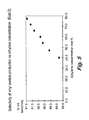
- Figure 4 shows how the selectivity of the process becomes increasingly selective towards the production of vinyl acetate as the concentration of ethylene is increased.
- the fluid bed catalyst support (54.4kg) is impregnated with a solution of Na 2 PdCl 4 .xH 2 O (containing 1000g Pd) and HAuCl 4 .xH 2 O (containing 400g Au) in distilled H 2 O by incipient wetness. The resulting mixture was mixed thoroughly, left to stand for one hour and dried overnight.
- the material was impregnated with an aqueous solution of KOAc (1.3kg) by incipient wetness. The resulting mixture was mixed thoroughly, left to stand for 1 hour and dried overnight.
- Vinyl acetate is prepared using the 0.0381 m (1.5") diameter fluid bed reactor of Experiment 1 above. Acetic acid is introduced into the reactor 10 at a rate of 227g/hour, and oxygen is introduced at a rate of 83.3g/hour.
- Example Mol % Ethylene in feed g/hr Ethylene in feed g/hr
- Selectivity 9 60 529 173 174 18.6 580 90.5 10 66 581 120 169 17.4 562 90.8 11 72 634 67.5 175 17.5 585 91.1 12 77.4 682 19.8 167 16.1 557 91.4 13 60 529 173 164 18.0 548 90.3 14 54 476 226 155 17.4 517 90.1 15 47 414 288 149 17.6 495 89.6 16 40 353 350 144 18.6 479 88.8 17 60 529 173 147 15.8 491 90.5
- Figure 5 shows how the selectivity of the process becomes increasingly selective towards the production of vinyl acetate as the concentration of ethylene is increased beyond 60 mol %.
Landscapes
- Chemical & Material Sciences (AREA)
- Organic Chemistry (AREA)
- Organic Low-Molecular-Weight Compounds And Preparation Thereof (AREA)
- Low-Molecular Organic Synthesis Reactions Using Catalysts (AREA)
- Materials For Medical Uses (AREA)
- Biological Depolymerization Polymers (AREA)
- Addition Polymer Or Copolymer, Post-Treatments, Or Chemical Modifications (AREA)
Applications Claiming Priority (3)
| Application Number | Priority Date | Filing Date | Title |
|---|---|---|---|
| GBGB9817362.8A GB9817362D0 (en) | 1998-08-11 | 1998-08-11 | Improved process for the production if vinyl acetate |
| GB9817362 | 1998-08-11 | ||
| CA002281377A CA2281377C (fr) | 1998-08-11 | 1999-09-07 | Processus ameliore de synthese de l'acetate de vinyle |
Publications (2)
| Publication Number | Publication Date |
|---|---|
| EP0985657A1 true EP0985657A1 (fr) | 2000-03-15 |
| EP0985657B1 EP0985657B1 (fr) | 2003-10-01 |
Family
ID=25681182
Family Applications (1)
| Application Number | Title | Priority Date | Filing Date |
|---|---|---|---|
| EP99305876A Expired - Lifetime EP0985657B1 (fr) | 1998-08-11 | 1999-07-23 | Procédé amélioré pour la préparation d'acétate de vinyle |
Country Status (19)
| Country | Link |
|---|---|
| US (1) | US6342628B1 (fr) |
| EP (1) | EP0985657B1 (fr) |
| JP (1) | JP4500379B2 (fr) |
| KR (1) | KR100696149B1 (fr) |
| CN (1) | CN1144776C (fr) |
| AT (1) | ATE251107T1 (fr) |
| BR (1) | BR9916140A (fr) |
| CA (1) | CA2281377C (fr) |
| DE (1) | DE69911707T2 (fr) |
| ES (1) | ES2209336T3 (fr) |
| GB (1) | GB9817362D0 (fr) |
| ID (1) | ID23271A (fr) |
| NO (1) | NO313278B1 (fr) |
| RU (1) | RU2223942C2 (fr) |
| SA (1) | SA99200623B1 (fr) |
| SG (1) | SG85662A1 (fr) |
| TR (1) | TR199901913A3 (fr) |
| TW (1) | TWI221836B (fr) |
| UA (1) | UA66781C2 (fr) |
Cited By (7)
| Publication number | Priority date | Publication date | Assignee | Title |
|---|---|---|---|---|
| EP1180510A1 (fr) * | 2000-08-18 | 2002-02-20 | BP Chemicals Limited | Procédé de purification de flux gazeux contenant du dioxyde de carbone |
| WO2003074465A1 (fr) * | 2002-03-04 | 2003-09-12 | Bp Chemicals Limited | Procede de production d'un carboxylate d'alcenyle ou d'un carboxylate d'alkyle |
| WO2005100296A1 (fr) * | 2004-04-15 | 2005-10-27 | Wacker Chemie Ag | Procede de recuperation d'ethylene dans un processus a gaz recycle pour produire de l'acetate de vinyle |
| US7030056B2 (en) | 2002-03-27 | 2006-04-18 | Shell Oil Company | Process for preparing a catalyst, the catalyst and a use of the catalyst |
| US7425647B2 (en) | 2001-03-30 | 2008-09-16 | Shell Oil Company | Process for preparing a group V111-metal containing catalyst, use thereof for preparing an alkenyl carboxylate |
| WO2014039304A1 (fr) * | 2012-09-06 | 2014-03-13 | Celanese International Corporation | Procédés pour la production d'acétate de vinyle |
| WO2017143806A1 (fr) * | 2016-02-26 | 2017-08-31 | 盐城市华鸥实业有限公司 | Dispositif en verre pour la récupération et le traitement sur plusieurs niveaux d'eaux polluées chimiquement |
Families Citing this family (13)
| Publication number | Priority date | Publication date | Assignee | Title |
|---|---|---|---|---|
| US6534438B1 (en) * | 2000-07-26 | 2003-03-18 | Bp Chemicals Limited | Catalyst composition |
| GB0205016D0 (en) * | 2002-03-04 | 2002-04-17 | Bp Chem Int Ltd | Process |
| TW201236755A (en) * | 2003-12-19 | 2012-09-16 | Celanese Int Corp | Halide free precursors for catalysts |
| US7465823B2 (en) * | 2004-03-17 | 2008-12-16 | Celanese International Corporation | Utilization of acetic acid reaction heat in other process plants |
| ZA200704864B (en) * | 2004-12-20 | 2008-08-27 | Celanese Int Corp | Modified support materials for catalysts |
| US8227369B2 (en) * | 2005-05-25 | 2012-07-24 | Celanese International Corp. | Layered composition and processes for preparing and using the composition |
| DE102006038689B4 (de) * | 2006-08-17 | 2015-01-22 | Celanese Chemicals Europe Gmbh | Verfahren zur Aufarbeitung von Vinylacetat |
| BRPI0923432A2 (pt) | 2008-12-13 | 2018-09-11 | Celanese Chemicals Europe Gmbh | processo para a fabricacao de acetato de vinila |
| RU2477268C1 (ru) * | 2008-12-13 | 2013-03-10 | Силаниз Кемикалз Юроп Гмбх | Способ получения винилацетата |
| CN102516006B (zh) * | 2011-11-11 | 2014-07-02 | 天津大学 | 醋酸乙烯生产过程乙烯回收方法及装置 |
| CN102381966A (zh) * | 2011-11-11 | 2012-03-21 | 天津大学 | 一种醋酸乙烯生产方法 |
| DE102013225114A1 (de) * | 2013-12-06 | 2015-06-11 | Wacker Chemie Ag | Verfahren zur Herstellung von Vinylacetat mit inhibierter Nebenproduktbildung |
| CN115745794B (zh) | 2022-11-16 | 2023-06-20 | 天津大学 | 乙烯法醋酸乙烯生产工艺及装置 |
Citations (2)
| Publication number | Priority date | Publication date | Assignee | Title |
|---|---|---|---|---|
| EP0685449A1 (fr) * | 1994-06-02 | 1995-12-06 | The Standard Oil Company | Procédé à lit fluide pour l'acétoxylation de l'éthylène en vue de produire de l'acétate de vinyle |
| EP0847982A1 (fr) * | 1996-12-10 | 1998-06-17 | BP Chemicals Limited | Procédé d'acétoxylation d'oléfines |
Family Cites Families (7)
| Publication number | Priority date | Publication date | Assignee | Title |
|---|---|---|---|---|
| FR1598868A (fr) * | 1968-07-22 | 1970-07-06 | ||
| US4158737A (en) * | 1976-12-14 | 1979-06-19 | National Distillers And Chemical Corp. | Vinyl acetate preparation |
| DE2855283A1 (de) | 1978-12-21 | 1980-07-17 | Hoechst Ag | Verfahren zur herstellung von vinylacetat |
| EP0464633B1 (fr) | 1990-07-03 | 1994-01-19 | Kuraray Co., Ltd. | Catalyseur et procédé de production des esters insaturés |
| JP3285605B2 (ja) * | 1992-04-20 | 2002-05-27 | 三井化学株式会社 | フェノールおよび酢酸ビニルの併産法 |
| US5550281A (en) * | 1994-06-02 | 1996-08-27 | Cirjak; Larry M. | Fluid bed process for the acetoxylation of ethylene in the production of vinyl acetate |
| GB9616573D0 (en) * | 1996-08-07 | 1996-09-25 | Bp Chem Int Ltd | Process |
-
1998
- 1998-08-11 GB GBGB9817362.8A patent/GB9817362D0/en not_active Ceased
-
1999
- 1999-07-23 EP EP99305876A patent/EP0985657B1/fr not_active Expired - Lifetime
- 1999-07-23 ES ES99305876T patent/ES2209336T3/es not_active Expired - Lifetime
- 1999-07-23 DE DE69911707T patent/DE69911707T2/de not_active Expired - Lifetime
- 1999-07-23 AT AT99305876T patent/ATE251107T1/de not_active IP Right Cessation
- 1999-07-29 US US09/363,012 patent/US6342628B1/en not_active Expired - Lifetime
- 1999-07-30 TW TW088113059A patent/TWI221836B/zh not_active IP Right Cessation
- 1999-08-05 SG SG9903771A patent/SG85662A1/en unknown
- 1999-08-09 KR KR1019990032617A patent/KR100696149B1/ko not_active Expired - Fee Related
- 1999-08-10 NO NO19993842A patent/NO313278B1/no not_active IP Right Cessation
- 1999-08-10 TR TR1999/01913A patent/TR199901913A3/tr unknown
- 1999-08-10 RU RU99117537/04A patent/RU2223942C2/ru not_active IP Right Cessation
- 1999-08-10 JP JP22699699A patent/JP4500379B2/ja not_active Expired - Fee Related
- 1999-08-11 UA UA99084613A patent/UA66781C2/xx unknown
- 1999-08-11 CN CNB991191137A patent/CN1144776C/zh not_active Expired - Fee Related
- 1999-08-11 ID IDP990779D patent/ID23271A/id unknown
- 1999-08-11 BR BR9916140-0A patent/BR9916140A/pt not_active Application Discontinuation
- 1999-09-07 CA CA002281377A patent/CA2281377C/fr not_active Expired - Fee Related
- 1999-09-28 SA SA99200623A patent/SA99200623B1/ar unknown
Patent Citations (2)
| Publication number | Priority date | Publication date | Assignee | Title |
|---|---|---|---|---|
| EP0685449A1 (fr) * | 1994-06-02 | 1995-12-06 | The Standard Oil Company | Procédé à lit fluide pour l'acétoxylation de l'éthylène en vue de produire de l'acétate de vinyle |
| EP0847982A1 (fr) * | 1996-12-10 | 1998-06-17 | BP Chemicals Limited | Procédé d'acétoxylation d'oléfines |
Cited By (16)
| Publication number | Priority date | Publication date | Assignee | Title |
|---|---|---|---|---|
| US6663692B2 (en) | 2000-08-18 | 2003-12-16 | Bp Chemicals Limited | Process for purifying carbon dioxide-containing gas streams |
| SG101994A1 (en) * | 2000-08-18 | 2004-02-27 | Bp Chem Int Ltd | Process for purifying carbon dioxide-containing gas streams |
| EP1180510A1 (fr) * | 2000-08-18 | 2002-02-20 | BP Chemicals Limited | Procédé de purification de flux gazeux contenant du dioxyde de carbone |
| KR100826486B1 (ko) * | 2000-08-18 | 2008-05-02 | 비피 케미칼즈 리미티드 | 이산화탄소 함유 기체 흐름의 정제방법 |
| US7425647B2 (en) | 2001-03-30 | 2008-09-16 | Shell Oil Company | Process for preparing a group V111-metal containing catalyst, use thereof for preparing an alkenyl carboxylate |
| CN100430365C (zh) * | 2002-03-04 | 2008-11-05 | 英国石油化学品有限公司 | 制备链烯基羧酸酯或烷基羧酸酯的方法 |
| WO2003074465A1 (fr) * | 2002-03-04 | 2003-09-12 | Bp Chemicals Limited | Procede de production d'un carboxylate d'alcenyle ou d'un carboxylate d'alkyle |
| US7211688B2 (en) | 2002-03-04 | 2007-05-01 | Bp Chemicals Limited | Process for the production of an alkenyl carboxylate or an alkyl carboxylate |
| US7030056B2 (en) | 2002-03-27 | 2006-04-18 | Shell Oil Company | Process for preparing a catalyst, the catalyst and a use of the catalyst |
| WO2005100296A1 (fr) * | 2004-04-15 | 2005-10-27 | Wacker Chemie Ag | Procede de recuperation d'ethylene dans un processus a gaz recycle pour produire de l'acetate de vinyle |
| MY139436A (en) * | 2004-04-15 | 2009-09-30 | Wacker Chemie Ag | Method for recovery of ethylene in a recirculating gas process for the production of vinyl acetate |
| US7803965B2 (en) | 2004-04-15 | 2010-09-28 | Wacker Chemie Ag | Method for recovery of ethylene in a recirculating gas process for the production of vinyl acetate |
| WO2014039304A1 (fr) * | 2012-09-06 | 2014-03-13 | Celanese International Corporation | Procédés pour la production d'acétate de vinyle |
| CN104736512A (zh) * | 2012-09-06 | 2015-06-24 | 国际人造丝公司 | 用于产生乙酸乙烯酯的方法 |
| CN104736512B (zh) * | 2012-09-06 | 2017-08-25 | 国际人造丝公司 | 用于产生乙酸乙烯酯的方法 |
| WO2017143806A1 (fr) * | 2016-02-26 | 2017-08-31 | 盐城市华鸥实业有限公司 | Dispositif en verre pour la récupération et le traitement sur plusieurs niveaux d'eaux polluées chimiquement |
Also Published As
| Publication number | Publication date |
|---|---|
| US6342628B1 (en) | 2002-01-29 |
| NO993842L (no) | 2000-02-14 |
| GB9817362D0 (en) | 1998-10-07 |
| UA66781C2 (en) | 2004-06-15 |
| CN1248571A (zh) | 2000-03-29 |
| KR100696149B1 (ko) | 2007-03-19 |
| CA2281377A1 (fr) | 2001-03-07 |
| SG85662A1 (en) | 2002-01-15 |
| CA2281377C (fr) | 2008-12-09 |
| ES2209336T3 (es) | 2004-06-16 |
| CN1144776C (zh) | 2004-04-07 |
| DE69911707T2 (de) | 2004-04-29 |
| RU2223942C2 (ru) | 2004-02-20 |
| EP0985657B1 (fr) | 2003-10-01 |
| ID23271A (id) | 2000-04-05 |
| NO993842D0 (no) | 1999-08-10 |
| BR9916140A (pt) | 2001-07-24 |
| ATE251107T1 (de) | 2003-10-15 |
| TWI221836B (en) | 2004-10-11 |
| JP4500379B2 (ja) | 2010-07-14 |
| SA99200623B1 (ar) | 2006-08-20 |
| TR199901913A2 (xx) | 2000-05-22 |
| DE69911707D1 (de) | 2003-11-06 |
| KR20000017198A (ko) | 2000-03-25 |
| JP2000063326A (ja) | 2000-02-29 |
| TR199901913A3 (tr) | 2000-05-22 |
| NO313278B1 (no) | 2002-09-09 |
Similar Documents
| Publication | Publication Date | Title |
|---|---|---|
| EP0985657B1 (fr) | Procédé amélioré pour la préparation d'acétate de vinyle | |
| US6376706B2 (en) | Catalyst and use thereof in the production of vinyl acetate | |
| NZ522267A (en) | Process for the production of vinyl acetate using palladium and/or nickel based metal complex as catalyst | |
| US7411107B2 (en) | Alkene separation process | |
| US6225496B1 (en) | Process for the production of vinyl acetate utilizing a recycle stream comprising acetic acid and water | |
| US8362292B2 (en) | Process for producing allyl acetate | |
| US6350901B1 (en) | Process for the production of vinyl acetate | |
| US20050085659A1 (en) | Process for the production of an alkenyl carboxylate or an alkyl cabroxylate | |
| US7534910B2 (en) | Process for the production of alkenyl carboxylates | |
| MXPA99008565A (es) | Proceso mejorado para la produccion de acetato devinilo. | |
| MXPA99004722A (en) | Catalyst and use of the same in the production of vinacetate |
Legal Events
| Date | Code | Title | Description |
|---|---|---|---|
| PUAI | Public reference made under article 153(3) epc to a published international application that has entered the european phase |
Free format text: ORIGINAL CODE: 0009012 |
|
| AK | Designated contracting states |
Kind code of ref document: A1 Designated state(s): AT BE CH CY DE DK ES FI FR GB GR IE IT LI LU MC NL PT SE |
|
| AX | Request for extension of the european patent |
Free format text: AL;LT;LV;MK;RO;SI |
|
| 17P | Request for examination filed |
Effective date: 20000805 |
|
| AKX | Designation fees paid |
Free format text: AT BE CH CY DE DK ES FI FR GB GR IE IT LI LU MC NL PT SE |
|
| 17Q | First examination report despatched |
Effective date: 20021028 |
|
| GRAH | Despatch of communication of intention to grant a patent |
Free format text: ORIGINAL CODE: EPIDOS IGRA |
|
| GRAS | Grant fee paid |
Free format text: ORIGINAL CODE: EPIDOSNIGR3 |
|
| GRAA | (expected) grant |
Free format text: ORIGINAL CODE: 0009210 |
|
| AK | Designated contracting states |
Kind code of ref document: B1 Designated state(s): AT BE CH CY DE DK ES FI FR GB GR IE IT LI LU MC NL PT SE |
|
| PG25 | Lapsed in a contracting state [announced via postgrant information from national office to epo] |
Ref country code: LI Free format text: LAPSE BECAUSE OF FAILURE TO SUBMIT A TRANSLATION OF THE DESCRIPTION OR TO PAY THE FEE WITHIN THE PRESCRIBED TIME-LIMIT Effective date: 20031001 Ref country code: CY Free format text: LAPSE BECAUSE OF FAILURE TO SUBMIT A TRANSLATION OF THE DESCRIPTION OR TO PAY THE FEE WITHIN THE PRESCRIBED TIME-LIMIT Effective date: 20031001 Ref country code: CH Free format text: LAPSE BECAUSE OF FAILURE TO SUBMIT A TRANSLATION OF THE DESCRIPTION OR TO PAY THE FEE WITHIN THE PRESCRIBED TIME-LIMIT Effective date: 20031001 Ref country code: AT Free format text: LAPSE BECAUSE OF FAILURE TO SUBMIT A TRANSLATION OF THE DESCRIPTION OR TO PAY THE FEE WITHIN THE PRESCRIBED TIME-LIMIT Effective date: 20031001 |
|
| REG | Reference to a national code |
Ref country code: GB Ref legal event code: FG4D |
|
| REG | Reference to a national code |
Ref country code: CH Ref legal event code: EP |
|
| REG | Reference to a national code |
Ref country code: IE Ref legal event code: FG4D |
|
| REF | Corresponds to: |
Ref document number: 69911707 Country of ref document: DE Date of ref document: 20031106 Kind code of ref document: P |
|
| REG | Reference to a national code |
Ref country code: GR Ref legal event code: EP Ref document number: 20030404847 Country of ref document: GR |
|
| PG25 | Lapsed in a contracting state [announced via postgrant information from national office to epo] |
Ref country code: DK Free format text: LAPSE BECAUSE OF FAILURE TO SUBMIT A TRANSLATION OF THE DESCRIPTION OR TO PAY THE FEE WITHIN THE PRESCRIBED TIME-LIMIT Effective date: 20040101 |
|
| REG | Reference to a national code |
Ref country code: SE Ref legal event code: TRGR |
|
| REG | Reference to a national code |
Ref country code: CH Ref legal event code: PL |
|
| ET | Fr: translation filed | ||
| REG | Reference to a national code |
Ref country code: ES Ref legal event code: FG2A Ref document number: 2209336 Country of ref document: ES Kind code of ref document: T3 |
|
| PG25 | Lapsed in a contracting state [announced via postgrant information from national office to epo] |
Ref country code: LU Free format text: LAPSE BECAUSE OF NON-PAYMENT OF DUE FEES Effective date: 20040723 Ref country code: IE Free format text: LAPSE BECAUSE OF NON-PAYMENT OF DUE FEES Effective date: 20040723 |
|
| PG25 | Lapsed in a contracting state [announced via postgrant information from national office to epo] |
Ref country code: MC Free format text: LAPSE BECAUSE OF NON-PAYMENT OF DUE FEES Effective date: 20040731 |
|
| PLBE | No opposition filed within time limit |
Free format text: ORIGINAL CODE: 0009261 |
|
| STAA | Information on the status of an ep patent application or granted ep patent |
Free format text: STATUS: NO OPPOSITION FILED WITHIN TIME LIMIT |
|
| 26N | No opposition filed |
Effective date: 20040702 |
|
| REG | Reference to a national code |
Ref country code: IE Ref legal event code: MM4A |
|
| PG25 | Lapsed in a contracting state [announced via postgrant information from national office to epo] |
Ref country code: PT Free format text: LAPSE BECAUSE OF NON-PAYMENT OF DUE FEES Effective date: 20040301 |
|
| PGFP | Annual fee paid to national office [announced via postgrant information from national office to epo] |
Ref country code: NL Payment date: 20080724 Year of fee payment: 10 Ref country code: IT Payment date: 20080725 Year of fee payment: 10 Ref country code: FR Payment date: 20080729 Year of fee payment: 10 Ref country code: FI Payment date: 20080730 Year of fee payment: 10 |
|
| PGFP | Annual fee paid to national office [announced via postgrant information from national office to epo] |
Ref country code: GB Payment date: 20080729 Year of fee payment: 10 |
|
| PGFP | Annual fee paid to national office [announced via postgrant information from national office to epo] |
Ref country code: SE Payment date: 20080729 Year of fee payment: 10 Ref country code: BE Payment date: 20080818 Year of fee payment: 10 |
|
| PGFP | Annual fee paid to national office [announced via postgrant information from national office to epo] |
Ref country code: GR Payment date: 20080729 Year of fee payment: 10 |
|
| REG | Reference to a national code |
Ref country code: GB Ref legal event code: 732E Free format text: REGISTERED BETWEEN 20090702 AND 20090708 |
|
| BERE | Be: lapsed |
Owner name: *BP CHEMICALS LTD Effective date: 20090731 |
|
| EUG | Se: european patent has lapsed | ||
| GBPC | Gb: european patent ceased through non-payment of renewal fee |
Effective date: 20090723 |
|
| NLV4 | Nl: lapsed or anulled due to non-payment of the annual fee |
Effective date: 20100201 |
|
| REG | Reference to a national code |
Ref country code: FR Ref legal event code: ST Effective date: 20100331 |
|
| PG25 | Lapsed in a contracting state [announced via postgrant information from national office to epo] |
Ref country code: FR Free format text: LAPSE BECAUSE OF NON-PAYMENT OF DUE FEES Effective date: 20090731 Ref country code: FI Free format text: LAPSE BECAUSE OF NON-PAYMENT OF DUE FEES Effective date: 20090723 |
|
| PG25 | Lapsed in a contracting state [announced via postgrant information from national office to epo] |
Ref country code: GB Free format text: LAPSE BECAUSE OF NON-PAYMENT OF DUE FEES Effective date: 20090723 |
|
| PG25 | Lapsed in a contracting state [announced via postgrant information from national office to epo] |
Ref country code: BE Free format text: LAPSE BECAUSE OF NON-PAYMENT OF DUE FEES Effective date: 20090731 |
|
| PG25 | Lapsed in a contracting state [announced via postgrant information from national office to epo] |
Ref country code: GR Free format text: LAPSE BECAUSE OF NON-PAYMENT OF DUE FEES Effective date: 20100204 |
|
| PG25 | Lapsed in a contracting state [announced via postgrant information from national office to epo] |
Ref country code: IT Free format text: LAPSE BECAUSE OF NON-PAYMENT OF DUE FEES Effective date: 20090723 |
|
| PG25 | Lapsed in a contracting state [announced via postgrant information from national office to epo] |
Ref country code: SE Free format text: LAPSE BECAUSE OF NON-PAYMENT OF DUE FEES Effective date: 20090724 |
|
| PG25 | Lapsed in a contracting state [announced via postgrant information from national office to epo] |
Ref country code: NL Free format text: LAPSE BECAUSE OF NON-PAYMENT OF DUE FEES Effective date: 20100201 |
|
| PGFP | Annual fee paid to national office [announced via postgrant information from national office to epo] |
Ref country code: DE Payment date: 20130729 Year of fee payment: 15 Ref country code: ES Payment date: 20130726 Year of fee payment: 15 |
|
| REG | Reference to a national code |
Ref country code: DE Ref legal event code: R082 Ref document number: 69911707 Country of ref document: DE Representative=s name: LEDERER & KELLER, DE |
|
| REG | Reference to a national code |
Ref country code: DE Ref legal event code: R082 Ref document number: 69911707 Country of ref document: DE Representative=s name: LEDERER & KELLER PATENTANWAELTE PARTNERSCHAFT , DE Effective date: 20131210 Ref country code: DE Ref legal event code: R082 Ref document number: 69911707 Country of ref document: DE Representative=s name: LEDERER & KELLER, DE Effective date: 20131210 Ref country code: DE Ref legal event code: R081 Ref document number: 69911707 Country of ref document: DE Owner name: INEOS SALES (UK) LIMITED, LYNDHURST, GB Free format text: FORMER OWNER: BP CHEMICALS LTD., LONDON, GB Effective date: 20131210 Ref country code: DE Ref legal event code: R081 Ref document number: 69911707 Country of ref document: DE Owner name: INEOS SALES (UK) LIMITED, GB Free format text: FORMER OWNER: BP CHEMICALS LTD., LONDON, GB Effective date: 20131210 |
|
| REG | Reference to a national code |
Ref country code: ES Ref legal event code: PC2A Owner name: INEOS SALES (UK) LIMITED Effective date: 20140505 |
|
| REG | Reference to a national code |
Ref country code: DE Ref legal event code: R119 Ref document number: 69911707 Country of ref document: DE |
|
| PG25 | Lapsed in a contracting state [announced via postgrant information from national office to epo] |
Ref country code: DE Free format text: LAPSE BECAUSE OF NON-PAYMENT OF DUE FEES Effective date: 20150203 |
|
| REG | Reference to a national code |
Ref country code: DE Ref legal event code: R119 Ref document number: 69911707 Country of ref document: DE Effective date: 20150203 |
|
| REG | Reference to a national code |
Ref country code: ES Ref legal event code: FD2A Effective date: 20150826 |
|
| PG25 | Lapsed in a contracting state [announced via postgrant information from national office to epo] |
Ref country code: ES Free format text: LAPSE BECAUSE OF NON-PAYMENT OF DUE FEES Effective date: 20140724 |