EP0987511A2 - Matériau résistant aux vols, balles et fragments - Google Patents
Matériau résistant aux vols, balles et fragments Download PDFInfo
- Publication number
- EP0987511A2 EP0987511A2 EP99660128A EP99660128A EP0987511A2 EP 0987511 A2 EP0987511 A2 EP 0987511A2 EP 99660128 A EP99660128 A EP 99660128A EP 99660128 A EP99660128 A EP 99660128A EP 0987511 A2 EP0987511 A2 EP 0987511A2
- Authority
- EP
- European Patent Office
- Prior art keywords
- protective material
- protective
- shs
- metallic binder
- tic
- Prior art date
- Legal status (The legal status is an assumption and is not a legal conclusion. Google has not performed a legal analysis and makes no representation as to the accuracy of the status listed.)
- Withdrawn
Links
Images

Classifications
-
- C—CHEMISTRY; METALLURGY
- C22—METALLURGY; FERROUS OR NON-FERROUS ALLOYS; TREATMENT OF ALLOYS OR NON-FERROUS METALS
- C22C—ALLOYS
- C22C1/00—Making non-ferrous alloys
- C22C1/04—Making non-ferrous alloys by powder metallurgy
- C22C1/05—Mixtures of metal powder with non-metallic powder
- C22C1/051—Making hard metals based on borides, carbides, nitrides, oxides or silicides; Preparation of the powder mixture used as the starting material therefor
-
- C—CHEMISTRY; METALLURGY
- C22—METALLURGY; FERROUS OR NON-FERROUS ALLOYS; TREATMENT OF ALLOYS OR NON-FERROUS METALS
- C22C—ALLOYS
- C22C29/00—Alloys based on carbides, oxides, nitrides, borides, or silicides, e.g. cermets, or other metal compounds, e.g. oxynitrides, sulfides
-
- F—MECHANICAL ENGINEERING; LIGHTING; HEATING; WEAPONS; BLASTING
- F41—WEAPONS
- F41H—ARMOUR; ARMOURED TURRETS; ARMOURED OR ARMED VEHICLES; MEANS OF ATTACK OR DEFENCE, e.g. CAMOUFLAGE, IN GENERAL
- F41H5/00—Armour; Armour plates
- F41H5/02—Plate construction
-
- F—MECHANICAL ENGINEERING; LIGHTING; HEATING; WEAPONS; BLASTING
- F41—WEAPONS
- F41H—ARMOUR; ARMOURED TURRETS; ARMOURED OR ARMED VEHICLES; MEANS OF ATTACK OR DEFENCE, e.g. CAMOUFLAGE, IN GENERAL
- F41H5/00—Armour; Armour plates
- F41H5/02—Plate construction
- F41H5/04—Plate construction composed of more than one layer
- F41H5/0414—Layered armour containing ceramic material
- F41H5/0428—Ceramic layers in combination with additional layers made of fibres, fabrics or plastics
Definitions
- the present invention relates to a bullet and splinter protection material/burglary protection material as defined in the preamble of claim 1.
- the materials used in protective structures must be capable of stopping various types of splinters and bullets.
- the protective structure itself must not form dangerous splinters or at least they have to be stopped by other structures.
- the material properties required of burglary protection materials are largely the same as those of bullet and splinter protection materials.
- the materials must necessarily have a high degree of hardness so that they cannot be machined e.g. using hard-metal drills or a grinder disk.
- the material must have a high melting point to make it difficult to cut e.g. with a torch.
- the material must be sufficiently tough so that it cannot be broken down e.g. by hammering or chiselling.
- ⁇ protective material' refers to bullet and splinter protection material/burglary protection material.
- the object of the present invention is to eliminate the drawbacks mentioned above.
- a specific object of the present invention is to disclose a hard and tough protective material.
- a further object of the invention is to disclose a light protective material which is easy to produce in pieces of different shapes and sizes.
- the bullet and splinter protection material/burglary protection material of the invention is characterised by what is presented in claim 1.
- the invention is based on research work carried out to study hard-metal type composite materials manufactured by the SHS (Self-Propagating High-Temperature Synthesis) technique. During the research work it was discovered that, in respect of their properties, these materials are remarkably well suited for use as protective materials.
- SHS Self-Propagating High-Temperature Synthesis
- the protective material of the invention is based on a ceramic material and a metallic binding agent.
- the protective material manufactured by the SHS technique is a hard-metal type composite material which contains hard ceramic particles and a metallic binder that binds them together.
- the ceramic material may be titanium carbide TiC, titanium boride TiB, titanium diboride TiB 2 and/or titanium carbide aluminium oxide TiC-Al 2 O 3 . Normally the ceramic material is titanium carbide TiC or titanium carbide aluminium oxide TiC-Al 2 O 3 .
- the metallic binder may be any tough metal.
- the metallic binder is a metal of pendant group 4, 5, 6, 8, 9, 10, 11 and/or 12, a metal of main group 1, 2 and/or 13 and/or a mixture and/or compound of these, such as titanium Ti, zirconium Zr, niobium Nb, chromium Cr, molybdenum Mo, iron Fe, cobalt Co, nickel Ni, copper Cu, zinc Zn, lithium Li, beryllium Be, magnesium Mg and/or aluminium Al and/or a mixture and/or compound of these.
- the material used as a metallic binder is preferably chromium, cobalt, molybdenum, iron, nickel, aluminium and/or a mixture and/or compound of these.
- ⁇ SHS hard metal' refers to a protective material manufactured by the SHS technique and based on titanium carbide TiC, titanium boride TiB, titanium diboride TiB 2 and/or titanium carbide aluminium oxide TiC-Al 2 O 3 and a metallic binder.
- the composition of the protective material manufactured by the SHS technique is selected according to both practical properties and price.
- the practical properties depend on the protection capability required, i.e. hardness and toughness, weight, finish-ability etc., and the price depends on the costs of the protective material and structure.
- a hard, tough and light protective material is e.g. an SHS hard metal based on TiC-Ni.
- Light materials are also SHS hard metals in which the ceramic material is titanium carbide aluminium oxide, e.g. hard metals based on TiC-Al 2 O 3 -Al or TiC-Al 2 O 3 -Fe. These are also advantageous in respect of price because they can be manufactured using cheap raw materials, such as coat pigment TiO 2 , carbon dust, aluminium and/or iron dust.
- the protective material of the invention is a TiC-Ni-based SHS hard metal, e.g. an SHS hard metal based on TiC-NiMo and/or TiC-CoNi.
- the protective material of the invention is a TiC-Al 2 O 3 -based SHS hard metal, e.g. a SHS hard metal based on TiC-Al 2 O 3 -Al or TiC-Al 2 O 3 -Fe.
- the protective material has a binder content in the range of 1 - 60 w-%, depending on the intended use.
- Protective materials having a low binder content are harder and their fracture toughness is lower than the corresponding properties of materials having a high binder content.
- the binder percentage is normally 15 - 50 w-%, preferably 20 - 40 w-%.
- the SHS method is based on an extremely exothermic reaction in which powdery raw materials react with each other after a reaction has been ignited from a suitable point using e.g. an electric resistor or a welding flame. After ignition, no external energy is required for the propagation of the reaction.
- the reaction temporarily produces a very high temperature, at which most of the metals and some of the ceramic materials are in a molten state. From the mixture obtained after the reaction, a compact body is obtained by pressing the mixture in a mould while it is still hot and in a plastic state.
- no separate make-up and sintering operations are needed. By this method, it is possible to produce objects of desired shape and size, e.g. curved or complex shapes.
- the method allows the use of cheap and readily available commercial powders as raw materials.
- the SHS method is described e.g. in the publication Lintula P. and Ruuskanen P., Wear and Corrosion Resistant Metal Matrix Composites Produced by Self-Propagating High-Temperature Synthesis (SHS), Proceedings of the 5 th European conference on Advanced Materials and Processes and Applications, vol. 1, s. 347-350, 1997.
- Protective materials manufactured by the SHS technique can be used in so-called gradient structures and lamellar structures.
- the composition and hardness of the protective material vary as a function of the thickness of the structure.
- the hardness varies as a function of the thickness of the protective material without a sharp boundary surface.
- a change in the hardness of the material is achieved by varying the metallic binder content.
- the protective material is so selected that the material hardness at the surface is very high and the material becomes tougher towards the backing, in other words, the binder content of the protective material is low at the surface and increases as the depth increases.
- Gradient structures are preferably manufactured from TiC-Ni-based SHS hard metal combinations.
- a lamellar structure consists of different protective material layers. Different layers are formed from protective materials in which the composition of the metallic binder and/or ceramic material varies.
- the material has a very hard surface layer, e.g. of a TiC-Ni based SHS hard metal, while the backing material consists of a lighter TiC-Al 2 O 3 based SHS hard metal, e.g. an SHS hard metal in which the metallic binder is iron or aluminium.
- the protective material of the invention manufactured by the SHS technique can be attached to various protective materials and/or protective structures, such as other SHS hard metals, ceramic materials, metal sheets, splinter panels, fibre composite structures, such as aramid fabrics and polymer fibre fabrics, e.g. polyethylene and/or other corresponding materials and/or structures.
- SHS hard metals such as other SHS hard metals, ceramic materials, metal sheets, splinter panels, fibre composite structures, such as aramid fabrics and polymer fibre fabrics, e.g. polyethylene and/or other corresponding materials and/or structures.
- the advantages of the protective material of the invention manufactured by the SHS technique include its hardness and toughness.
- these properties as well as the integral structure formed from the material can be easily varied and optimised for different uses and against different hazards.
- the invention allows a considerable reduction in the weight of protective structures because a hard and tough protective material need not be used in layers as thick as in the case of prior-art materials.
- the materials of the invention allow a considerable reduction in weight.
- a further advantage of the invention is that it allows easy manufacture of objects of desired shape and size for each use.
- An additional advantage of the invention is economical efficiency because no separate make-up and sintering operations are needed in the manufacture of the protective material by the SHS technique. Moreover, the raw materials are cheap commercial powders that are readily available.
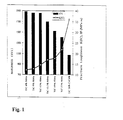
- a TiC-NiMo SHS hard metal with a lower binder content is harder and has a lower fracture toughness than a corresponding TiC-NiMo based SHS hard metal with a lower binder content.
- Fig. 2 presents toughness values of a TiC-NiMo based SHS hard metal manufactured by the SHS technique and commercial ceramic materials.
- the dark part of the column represents the variation between different composition percentages or different manufacturers.
- the toughness values for the ceramic materials have been collected from commercial brochures.
- Fig. 2 shows that the TiC-NiMo based SHS hard metal has a higher fracture toughness than the commercial ceramic materials.
- the bullet in case b) was stopped with a structure having a weight per square metre of 45 kg/m 2 (SHS material 37.2 + Al 8.1 kg/m 2 ) and a structure consisting of a pack of aramid fabric (2x21 layers, 9.2 kg/m 2 ) with 54 kg/m 2 SHS material on top of it.
- a structure having a weight per square metre of 45 kg/m 2 SHS material 37.2 + Al 8.1 kg/m 2
- a bulge of only 0.5 mm appeared in the backing, which means that the bullet could have been stopped using a considerably lighter structure.
- the light TiC-Al 2 O 3 -Fe based SHS hard metal was also well applicable as bullet and splinter protection material for steel-cored armour piercing bullets and normal lead bullets.
Landscapes
- Chemical & Material Sciences (AREA)
- Engineering & Computer Science (AREA)
- Materials Engineering (AREA)
- Mechanical Engineering (AREA)
- Metallurgy (AREA)
- Organic Chemistry (AREA)
- Ceramic Engineering (AREA)
- General Engineering & Computer Science (AREA)
- Aiming, Guidance, Guns With A Light Source, Armor, Camouflage, And Targets (AREA)
- Laminated Bodies (AREA)
- Ceramic Products (AREA)
Applications Claiming Priority (4)
| Application Number | Priority Date | Filing Date | Title |
|---|---|---|---|
| FI981978 | 1998-09-14 | ||
| FI981978A FI981978A0 (fi) | 1998-09-14 | 1998-09-14 | SHS-tekniikalla valmistetut luotisuojamateriaalit |
| FI991019A FI109132B (fi) | 1998-09-14 | 1999-05-04 | SHS-tekniikalla valmistetun materiaalin käyttö luoti ja sirpalesuojamateriaali/murtosuojamateriaalina |
| FI991019 | 1999-05-04 |
Publications (2)
| Publication Number | Publication Date |
|---|---|
| EP0987511A2 true EP0987511A2 (fr) | 2000-03-22 |
| EP0987511A3 EP0987511A3 (fr) | 2000-09-06 |
Family
ID=26160641
Family Applications (1)
| Application Number | Title | Priority Date | Filing Date |
|---|---|---|---|
| EP99660128A Withdrawn EP0987511A3 (fr) | 1998-09-14 | 1999-08-17 | Matériau résistant aux vols, balles et fragments |
Country Status (4)
| Country | Link |
|---|---|
| EP (1) | EP0987511A3 (fr) |
| EE (1) | EE9900265A (fr) |
| FI (1) | FI109132B (fr) |
| NO (1) | NO994130L (fr) |
Cited By (2)
| Publication number | Priority date | Publication date | Assignee | Title |
|---|---|---|---|---|
| WO2002053316A1 (fr) * | 2000-12-20 | 2002-07-11 | Valtion Teknillinen Tutkimuskeskus | Procede permettant la production d'un composite a matrice metallique et composite a matrice metallique |
| CN103789563A (zh) * | 2014-01-17 | 2014-05-14 | 北京理工大学 | 一种TiB/Ti梯度复合材料的制备方法 |
Family Cites Families (7)
| Publication number | Priority date | Publication date | Assignee | Title |
|---|---|---|---|---|
| US3743569A (en) * | 1970-04-02 | 1973-07-03 | Atomic Energy Commission | Armor of cermet with metal therein increasing with depth |
| US3863541A (en) * | 1972-02-07 | 1975-02-04 | Us Army | Beryllium boride armor |
| US4030427A (en) * | 1974-10-30 | 1977-06-21 | The United States Of America As Represented By The Secretary Of The Navy | Armor plate |
| US4140170A (en) * | 1977-09-06 | 1979-02-20 | Baum Charles S | Method of forming composite material containing sintered particles |
| US4988645A (en) * | 1988-12-12 | 1991-01-29 | The United States Of America As Represented By The United States Department Of Energy | Cermet materials prepared by combustion synthesis and metal infiltration |
| US5443917A (en) * | 1991-05-24 | 1995-08-22 | Gte Products Corporation | Ceramic armor |
| EP0852978A4 (fr) * | 1995-09-27 | 2000-03-01 | Ishizuka Research Inst Ltd | Materiau composite granuleux extremement abrasif |
-
1999
- 1999-05-04 FI FI991019A patent/FI109132B/fi not_active IP Right Cessation
- 1999-08-17 EP EP99660128A patent/EP0987511A3/fr not_active Withdrawn
- 1999-08-26 NO NO994130A patent/NO994130L/no not_active Application Discontinuation
- 1999-09-13 EE EEP199900265A patent/EE9900265A/xx unknown
Non-Patent Citations (1)
| Title |
|---|
| None |
Cited By (4)
| Publication number | Priority date | Publication date | Assignee | Title |
|---|---|---|---|---|
| WO2002053316A1 (fr) * | 2000-12-20 | 2002-07-11 | Valtion Teknillinen Tutkimuskeskus | Procede permettant la production d'un composite a matrice metallique et composite a matrice metallique |
| US6818315B2 (en) | 2000-12-20 | 2004-11-16 | Valtion Teknillinen Tutkimuskeskus | Method for the manufacture of a metal matrix composite, and a metal matrix composite |
| CN103789563A (zh) * | 2014-01-17 | 2014-05-14 | 北京理工大学 | 一种TiB/Ti梯度复合材料的制备方法 |
| CN103789563B (zh) * | 2014-01-17 | 2016-03-09 | 北京理工大学 | 一种TiB/Ti梯度复合材料的制备方法 |
Also Published As
| Publication number | Publication date |
|---|---|
| EE9900265A (et) | 2000-04-17 |
| NO994130L (no) | 2000-03-15 |
| NO994130D0 (no) | 1999-08-26 |
| EP0987511A3 (fr) | 2000-09-06 |
| FI991019A0 (fi) | 1999-05-04 |
| FI991019L (fi) | 2000-03-15 |
| FI109132B (fi) | 2002-05-31 |
Similar Documents
| Publication | Publication Date | Title |
|---|---|---|
| Montgomery et al. | Titanium armor applications in combat vehicles | |
| Gooch et al. | Development and ballistic testing of a functionally gradient ceramic/metal applique | |
| KR101345044B1 (ko) | 내마모성 저마찰성 코팅 조성물, 코팅된 구성요소 및 그의 코팅 방법 | |
| Sharma et al. | Ballistic performance of functionally graded boron carbide reinforced Al–Zn–Mg–Cu alloy | |
| US8608822B2 (en) | Composite system | |
| Wu et al. | Reactive‐sintering B4C matrix composite for armor applications | |
| WO2012004294A1 (fr) | Matériau en pcbn, éléments d'outil le comprenant et son procédé d'utilisation | |
| Tuominen et al. | High-speed laser cladding of chromium carbide reinforced Ni-based coatings | |
| Canteli et al. | Cutting performance of TiCN–HSS cermet in dry machining | |
| US20140076140A1 (en) | Armor panel | |
| Іvasishin et al. | MICROSTRUCTURE AND PROPERTIES OF TITANIUM-BASED MATERIALS PROMISING FOR ANTIBALLISTIC PROTECTION. | |
| EP0987511A2 (fr) | Matériau résistant aux vols, balles et fragments | |
| US8936751B2 (en) | Composite system | |
| US3723077A (en) | Sintered alloys | |
| Markovsky et al. | NEW APPROACH FOR MANUFACTURING TI-6AL-4V+ 40% TIC METAL-MATRIX COMPOSITES BY 3D PRINTING USING CONIC ELECTRON BEAM AND CORED WIRE. PT. 2: LAYERED MMC/ALLOY MATERIALS, THEIR MAIN CHARACTERISTICS, AND POSSIBLE APPLICATION AS BALLISTIC RESISTANT MATERIALS. | |
| Gooch et al. | The design and application of titanium alloys to US Army Platforms-2010 | |
| KR101315855B1 (ko) | 장갑용 다층 혼합 표면복합재료 | |
| US8268234B2 (en) | Cermets from molten metal infiltration processing | |
| JPH0584440B2 (fr) | ||
| Hannula et al. | Processing and properties of metal matrix composites synthesized by SHS | |
| US12043901B1 (en) | Composite materials, armor formed therefrom, and methods for making same | |
| Sukumar et al. | Superior Ballistic Performance of Ti–Al3Ti Based Metal–Intermetallic Composites Against 7.62 AP Projectiles | |
| EP2555891B1 (fr) | Système composite | |
| Gooch Jr | Processing and Fabrication Technologies for Current and Potential Titanium Military Applications | |
| Bose et al. | Micro-Infiltrated Macro-Laminated Composite of Nickel/Alumina for Armor Applications |
Legal Events
| Date | Code | Title | Description |
|---|---|---|---|
| PUAI | Public reference made under article 153(3) epc to a published international application that has entered the european phase |
Free format text: ORIGINAL CODE: 0009012 |
|
| AK | Designated contracting states |
Kind code of ref document: A2 Designated state(s): AT BE CH CY DE DK ES FI FR GB GR IE IT LI LU MC NL PT SE |
|
| AX | Request for extension of the european patent |
Free format text: AL;LT;LV;MK;RO;SI |
|
| PUAL | Search report despatched |
Free format text: ORIGINAL CODE: 0009013 |
|
| AK | Designated contracting states |
Kind code of ref document: A3 Designated state(s): AT BE CH CY DE DK ES FI FR GB GR IE IT LI LU MC NL PT SE |
|
| AX | Request for extension of the european patent |
Free format text: AL;LT;LV;MK;RO;SI |
|
| 17P | Request for examination filed |
Effective date: 20010303 |
|
| AKX | Designation fees paid |
Free format text: AT BE CH CY DE DK ES FI FR GB GR IE IT LI LU MC NL PT SE |
|
| AXX | Extension fees paid |
Free format text: AL PAYMENT 20010303;LT PAYMENT 20010303;LV PAYMENT 20010303;MK PAYMENT 20010303;RO PAYMENT 20010303;SI PAYMENT 20010303 |
|
| 17Q | First examination report despatched |
Effective date: 20010518 |
|
| STAA | Information on the status of an ep patent application or granted ep patent |
Free format text: STATUS: THE APPLICATION IS DEEMED TO BE WITHDRAWN |
|
| 18D | Application deemed to be withdrawn |
Effective date: 20021024 |