EP0987567B1 - Polythioéthers et leur utilisation - Google Patents
Polythioéthers et leur utilisation Download PDFInfo
- Publication number
- EP0987567B1 EP0987567B1 EP99307114A EP99307114A EP0987567B1 EP 0987567 B1 EP0987567 B1 EP 0987567B1 EP 99307114 A EP99307114 A EP 99307114A EP 99307114 A EP99307114 A EP 99307114A EP 0987567 B1 EP0987567 B1 EP 0987567B1
- Authority
- EP
- European Patent Office
- Prior art keywords
- polymer
- sulfur
- ether
- thio
- hours
- Prior art date
- Legal status (The legal status is an assumption and is not a legal conclusion. Google has not performed a legal analysis and makes no representation as to the accuracy of the status listed.)
- Expired - Lifetime
Links
- 229910052717 sulfur Inorganic materials 0.000 title claims description 163
- 239000011593 sulfur Substances 0.000 title claims description 145
- NINIDFKCEFEMDL-UHFFFAOYSA-N Sulfur Chemical compound [S] NINIDFKCEFEMDL-UHFFFAOYSA-N 0.000 title claims description 144
- 229920001577 copolymer Polymers 0.000 title claims description 105
- 230000003287 optical effect Effects 0.000 claims description 72
- 125000002887 hydroxy group Chemical group [H]O* 0.000 claims description 35
- 125000003118 aryl group Chemical group 0.000 claims description 29
- 125000004434 sulfur atom Chemical group 0.000 claims description 22
- 125000000217 alkyl group Chemical group 0.000 claims description 21
- 125000002252 acyl group Chemical group 0.000 claims description 17
- 125000000623 heterocyclic group Chemical group 0.000 claims description 17
- 229910052736 halogen Inorganic materials 0.000 claims description 12
- 150000002367 halogens Chemical class 0.000 claims description 12
- QVGXLLKOCUKJST-UHFFFAOYSA-N atomic oxygen Chemical compound [O] QVGXLLKOCUKJST-UHFFFAOYSA-N 0.000 claims description 10
- 239000001257 hydrogen Substances 0.000 claims description 10
- 229910052739 hydrogen Inorganic materials 0.000 claims description 10
- 229910052760 oxygen Inorganic materials 0.000 claims description 10
- 239000001301 oxygen Substances 0.000 claims description 10
- 125000000962 organic group Chemical group 0.000 claims description 9
- 229920003023 plastic Polymers 0.000 claims description 8
- 239000004033 plastic Substances 0.000 claims description 8
- 125000001424 substituent group Chemical group 0.000 claims description 8
- UFHFLCQGNIYNRP-UHFFFAOYSA-N Hydrogen Chemical compound [H][H] UFHFLCQGNIYNRP-UHFFFAOYSA-N 0.000 claims description 5
- 150000002431 hydrogen Chemical class 0.000 claims description 5
- 230000003252 repetitive effect Effects 0.000 claims description 5
- 125000000547 substituted alkyl group Chemical group 0.000 claims description 3
- 229920000642 polymer Polymers 0.000 description 199
- OKKJLVBELUTLKV-UHFFFAOYSA-N Methanol Chemical compound OC OKKJLVBELUTLKV-UHFFFAOYSA-N 0.000 description 195
- RTZKZFJDLAIYFH-UHFFFAOYSA-N Diethyl ether Chemical compound CCOCC RTZKZFJDLAIYFH-UHFFFAOYSA-N 0.000 description 118
- -1 poly(4-methylpentene-1) Polymers 0.000 description 117
- 239000000203 mixture Substances 0.000 description 77
- XLYOFNOQVPJJNP-UHFFFAOYSA-N water Substances O XLYOFNOQVPJJNP-UHFFFAOYSA-N 0.000 description 72
- IJGRMHOSHXDMSA-UHFFFAOYSA-N Atomic nitrogen Chemical compound N#N IJGRMHOSHXDMSA-UHFFFAOYSA-N 0.000 description 62
- 239000012153 distilled water Substances 0.000 description 54
- 229910052757 nitrogen Inorganic materials 0.000 description 49
- 239000011541 reaction mixture Substances 0.000 description 41
- 238000006243 chemical reaction Methods 0.000 description 40
- 239000003795 chemical substances by application Substances 0.000 description 39
- RIOQSEWOXXDEQQ-UHFFFAOYSA-N triphenylphosphine Chemical compound C1=CC=CC=C1P(C=1C=CC=CC=1)C1=CC=CC=C1 RIOQSEWOXXDEQQ-UHFFFAOYSA-N 0.000 description 34
- 239000011347 resin Substances 0.000 description 23
- 229920005989 resin Polymers 0.000 description 23
- 239000000243 solution Substances 0.000 description 22
- ZMANZCXQSJIPKH-UHFFFAOYSA-N Triethylamine Chemical compound CCN(CC)CC ZMANZCXQSJIPKH-UHFFFAOYSA-N 0.000 description 21
- YYROPELSRYBVMQ-UHFFFAOYSA-N 4-toluenesulfonyl chloride Chemical compound CC1=CC=C(S(Cl)(=O)=O)C=C1 YYROPELSRYBVMQ-UHFFFAOYSA-N 0.000 description 20
- WYURNTSHIVDZCO-UHFFFAOYSA-N Tetrahydrofuran Chemical compound C1CCOC1 WYURNTSHIVDZCO-UHFFFAOYSA-N 0.000 description 18
- IISBACLAFKSPIT-UHFFFAOYSA-N bisphenol A Chemical compound C=1C=C(O)C=CC=1C(C)(C)C1=CC=C(O)C=C1 IISBACLAFKSPIT-UHFFFAOYSA-N 0.000 description 18
- 239000011521 glass Substances 0.000 description 18
- JUJWROOIHBZHMG-UHFFFAOYSA-N Pyridine Chemical compound C1=CC=NC=C1 JUJWROOIHBZHMG-UHFFFAOYSA-N 0.000 description 16
- 239000004593 Epoxy Substances 0.000 description 14
- 238000010992 reflux Methods 0.000 description 13
- 239000004793 Polystyrene Substances 0.000 description 12
- 238000006467 substitution reaction Methods 0.000 description 11
- 239000000725 suspension Substances 0.000 description 11
- 229920002223 polystyrene Polymers 0.000 description 10
- BWHMMNNQKKPAPP-UHFFFAOYSA-L potassium carbonate Chemical compound [K+].[K+].[O-]C([O-])=O BWHMMNNQKKPAPP-UHFFFAOYSA-L 0.000 description 10
- GYZLOYUZLJXAJU-UHFFFAOYSA-N diglycidyl ether Chemical compound C1OC1COCC1CO1 GYZLOYUZLJXAJU-UHFFFAOYSA-N 0.000 description 9
- 159000000000 sodium salts Chemical class 0.000 description 9
- YLQBMQCUIZJEEH-UHFFFAOYSA-N tetrahydrofuran Natural products C=1C=COC=1 YLQBMQCUIZJEEH-UHFFFAOYSA-N 0.000 description 9
- 150000003568 thioethers Chemical class 0.000 description 9
- LCFVJGUPQDGYKZ-UHFFFAOYSA-N Bisphenol A diglycidyl ether Chemical compound C=1C=C(OCC2OC2)C=CC=1C(C)(C)C(C=C1)=CC=C1OCC1CO1 LCFVJGUPQDGYKZ-UHFFFAOYSA-N 0.000 description 8
- GBMDVOWEEQVZKZ-UHFFFAOYSA-N methanol;hydrate Chemical compound O.OC GBMDVOWEEQVZKZ-UHFFFAOYSA-N 0.000 description 8
- UMJSCPRVCHMLSP-UHFFFAOYSA-N pyridine Natural products COC1=CC=CN=C1 UMJSCPRVCHMLSP-UHFFFAOYSA-N 0.000 description 8
- 239000000758 substrate Substances 0.000 description 8
- 229920001169 thermoplastic Polymers 0.000 description 8
- 239000004416 thermosoftening plastic Substances 0.000 description 8
- 150000001875 compounds Chemical class 0.000 description 7
- 150000004662 dithiols Chemical class 0.000 description 6
- 238000001746 injection moulding Methods 0.000 description 6
- 239000012258 stirred mixture Substances 0.000 description 6
- 238000007070 tosylation reaction Methods 0.000 description 6
- 229920000402 bisphenol A polycarbonate polymer Polymers 0.000 description 5
- 229920003229 poly(methyl methacrylate) Polymers 0.000 description 5
- 229920002285 poly(styrene-co-acrylonitrile) Polymers 0.000 description 5
- 239000004926 polymethyl methacrylate Substances 0.000 description 5
- 229910000027 potassium carbonate Inorganic materials 0.000 description 5
- 238000007789 sealing Methods 0.000 description 5
- 239000007858 starting material Substances 0.000 description 5
- 0 C*(c1c(*)c(*)c(C)c(*)c1*)c1c(*)c(*)c(C)c(*)c1* Chemical compound C*(c1c(*)c(*)c(C)c(*)c1*)c1c(*)c(*)c(C)c(*)c1* 0.000 description 4
- IDRGFNPZDVBSSE-UHFFFAOYSA-N OCCN1CCN(CC1)c1ccc(Nc2ncc3cccc(-c4cccc(NC(=O)C=C)c4)c3n2)c(F)c1F Chemical compound OCCN1CCN(CC1)c1ccc(Nc2ncc3cccc(-c4cccc(NC(=O)C=C)c4)c3n2)c(F)c1F IDRGFNPZDVBSSE-UHFFFAOYSA-N 0.000 description 4
- MVPPADPHJFYWMZ-UHFFFAOYSA-N chlorobenzene Chemical compound ClC1=CC=CC=C1 MVPPADPHJFYWMZ-UHFFFAOYSA-N 0.000 description 4
- 239000004973 liquid crystal related substance Substances 0.000 description 4
- 125000002496 methyl group Chemical group [H]C([H])([H])* 0.000 description 4
- 229920000570 polyether Polymers 0.000 description 4
- HFRXJVQOXRXOPP-UHFFFAOYSA-N thionyl bromide Chemical compound BrS(Br)=O HFRXJVQOXRXOPP-UHFFFAOYSA-N 0.000 description 4
- NZRWWODKARVQFC-UHFFFAOYSA-N 2-methylsulfanylethanethiol;sodium Chemical compound [Na].CSCCS NZRWWODKARVQFC-UHFFFAOYSA-N 0.000 description 3
- DIFMOXDTKAEVHX-UHFFFAOYSA-N 4-[2-(4-sulfanylphenyl)propan-2-yl]benzenethiol Chemical compound C=1C=C(S)C=CC=1C(C)(C)C1=CC=C(S)C=C1 DIFMOXDTKAEVHX-UHFFFAOYSA-N 0.000 description 3
- ZMXDDKWLCZADIW-UHFFFAOYSA-N N,N-Dimethylformamide Chemical compound CN(C)C=O ZMXDDKWLCZADIW-UHFFFAOYSA-N 0.000 description 3
- 230000004075 alteration Effects 0.000 description 3
- 125000005842 heteroatom Chemical group 0.000 description 3
- RAXXELZNTBOGNW-UHFFFAOYSA-N imidazole Natural products C1=CNC=N1 RAXXELZNTBOGNW-UHFFFAOYSA-N 0.000 description 3
- 239000000463 material Substances 0.000 description 3
- 238000005259 measurement Methods 0.000 description 3
- 238000000034 method Methods 0.000 description 3
- 238000000465 moulding Methods 0.000 description 3
- 229920002578 polythiourethane polymer Polymers 0.000 description 3
- RZWQDAUIUBVCDD-UHFFFAOYSA-M sodium;benzenethiolate Chemical compound [Na+].[S-]C1=CC=CC=C1 RZWQDAUIUBVCDD-UHFFFAOYSA-M 0.000 description 3
- 125000003396 thiol group Chemical group [H]S* 0.000 description 3
- IEAGIQDVKKVLEI-UHFFFAOYSA-N 2,6-dibromo-4-(3,5-dibromo-4-hydroxyphenyl)phenol Chemical group C1=C(Br)C(O)=C(Br)C=C1C1=CC(Br)=C(O)C(Br)=C1 IEAGIQDVKKVLEI-UHFFFAOYSA-N 0.000 description 2
- WISUILQECWFZCN-UHFFFAOYSA-N 2-(oxiran-2-ylmethylsulfanylmethyl)oxirane Chemical compound C1OC1CSCC1CO1 WISUILQECWFZCN-UHFFFAOYSA-N 0.000 description 2
- HRSLYNJTMYIRHM-UHFFFAOYSA-N 2-[[4-[3,5-dimethyl-4-(oxiran-2-ylmethoxy)phenyl]-2,6-dimethylphenoxy]methyl]oxirane Chemical group CC1=CC(C=2C=C(C)C(OCC3OC3)=C(C)C=2)=CC(C)=C1OCC1CO1 HRSLYNJTMYIRHM-UHFFFAOYSA-N 0.000 description 2
- OZRVXYJWUUMVOW-UHFFFAOYSA-N 2-[[4-[4-(oxiran-2-ylmethoxy)phenyl]phenoxy]methyl]oxirane Chemical group C1OC1COC(C=C1)=CC=C1C(C=C1)=CC=C1OCC1CO1 OZRVXYJWUUMVOW-UHFFFAOYSA-N 0.000 description 2
- ZNQVEEAIQZEUHB-UHFFFAOYSA-N 2-ethoxyethanol Chemical compound CCOCCO ZNQVEEAIQZEUHB-UHFFFAOYSA-N 0.000 description 2
- NIBCHVPONGPINH-UHFFFAOYSA-N 2-ethylsulfanylethyl 4-methylbenzenesulfonate Chemical compound CCSCCOS(=O)(=O)C1=CC=C(C)C=C1 NIBCHVPONGPINH-UHFFFAOYSA-N 0.000 description 2
- JKNOLJQZYXEFGB-UHFFFAOYSA-N 2-methylsulfanylethyl 4-methylbenzenesulfonate Chemical compound CSCCOS(=O)(=O)C1=CC=C(C)C=C1 JKNOLJQZYXEFGB-UHFFFAOYSA-N 0.000 description 2
- 125000001541 3-thienyl group Chemical group S1C([H])=C([*])C([H])=C1[H] 0.000 description 2
- WKBOTKDWSSQWDR-UHFFFAOYSA-N Bromine atom Chemical compound [Br] WKBOTKDWSSQWDR-UHFFFAOYSA-N 0.000 description 2
- YCKRFDGAMUMZLT-UHFFFAOYSA-N Fluorine atom Chemical compound [F] YCKRFDGAMUMZLT-UHFFFAOYSA-N 0.000 description 2
- QIGBRXMKCJKVMJ-UHFFFAOYSA-N Hydroquinone Chemical compound OC1=CC=C(O)C=C1 QIGBRXMKCJKVMJ-UHFFFAOYSA-N 0.000 description 2
- FXHOOIRPVKKKFG-UHFFFAOYSA-N N,N-Dimethylacetamide Chemical compound CN(C)C(C)=O FXHOOIRPVKKKFG-UHFFFAOYSA-N 0.000 description 2
- 229910019142 PO4 Inorganic materials 0.000 description 2
- 239000004721 Polyphenylene oxide Substances 0.000 description 2
- 239000000654 additive Substances 0.000 description 2
- 125000001931 aliphatic group Chemical group 0.000 description 2
- 125000004414 alkyl thio group Chemical group 0.000 description 2
- 239000000956 alloy Substances 0.000 description 2
- 229910045601 alloy Inorganic materials 0.000 description 2
- 239000003963 antioxidant agent Substances 0.000 description 2
- 230000003078 antioxidant effect Effects 0.000 description 2
- TZCXTZWJZNENPQ-UHFFFAOYSA-L barium sulfate Chemical compound [Ba+2].[O-]S([O-])(=O)=O TZCXTZWJZNENPQ-UHFFFAOYSA-L 0.000 description 2
- VCCBEIPGXKNHFW-UHFFFAOYSA-N biphenyl-4,4'-diol Chemical group C1=CC(O)=CC=C1C1=CC=C(O)C=C1 VCCBEIPGXKNHFW-UHFFFAOYSA-N 0.000 description 2
- GDTBXPJZTBHREO-UHFFFAOYSA-N bromine Substances BrBr GDTBXPJZTBHREO-UHFFFAOYSA-N 0.000 description 2
- 229910052794 bromium Inorganic materials 0.000 description 2
- 125000001246 bromo group Chemical class Br* 0.000 description 2
- 125000000113 cyclohexyl group Chemical group [H]C1([H])C([H])([H])C([H])([H])C([H])(*)C([H])([H])C1([H])[H] 0.000 description 2
- 125000001495 ethyl group Chemical group [H]C([H])([H])C([H])([H])* 0.000 description 2
- 238000011156 evaluation Methods 0.000 description 2
- 230000001747 exhibiting effect Effects 0.000 description 2
- 229910052731 fluorine Inorganic materials 0.000 description 2
- 239000011737 fluorine Substances 0.000 description 2
- 238000005227 gel permeation chromatography Methods 0.000 description 2
- 125000001449 isopropyl group Chemical group [H]C([H])([H])C([H])(*)C([H])([H])[H] 0.000 description 2
- XHXXWWGGXFUMAJ-UHFFFAOYSA-N methanethiol;sodium Chemical compound [Na].SC XHXXWWGGXFUMAJ-UHFFFAOYSA-N 0.000 description 2
- 125000004372 methylthioethyl group Chemical group [H]C([H])([H])SC([H])([H])C([H])([H])* 0.000 description 2
- 125000004092 methylthiomethyl group Chemical group [H]C([H])([H])SC([H])([H])* 0.000 description 2
- 125000004373 methylthiopropyl group Chemical group [H]C([H])([H])SC([H])([H])C([H])([H])C([H])([H])* 0.000 description 2
- 239000012778 molding material Substances 0.000 description 2
- 239000008188 pellet Substances 0.000 description 2
- NBIIXXVUZAFLBC-UHFFFAOYSA-K phosphate Chemical compound [O-]P([O-])([O-])=O NBIIXXVUZAFLBC-UHFFFAOYSA-K 0.000 description 2
- 239000010452 phosphate Substances 0.000 description 2
- 229920003050 poly-cycloolefin Polymers 0.000 description 2
- 229920000139 polyethylene terephthalate Polymers 0.000 description 2
- 239000005020 polyethylene terephthalate Substances 0.000 description 2
- 229920000306 polymethylpentene Polymers 0.000 description 2
- 229920006380 polyphenylene oxide Polymers 0.000 description 2
- 229920006295 polythiol Polymers 0.000 description 2
- 238000002360 preparation method Methods 0.000 description 2
- 125000000446 sulfanediyl group Chemical group *S* 0.000 description 2
- 229920001187 thermosetting polymer Polymers 0.000 description 2
- 125000000437 thiazol-2-yl group Chemical group [H]C1=C([H])N=C(*)S1 0.000 description 2
- JOXIMZWYDAKGHI-UHFFFAOYSA-N toluene-4-sulfonic acid Chemical compound CC1=CC=C(S(O)(=O)=O)C=C1 JOXIMZWYDAKGHI-UHFFFAOYSA-N 0.000 description 2
- QFOZGTAYTHRTHZ-UHFFFAOYSA-N (4-methylsulfanylphenyl) 4-methylbenzenesulfonate Chemical compound C1=CC(SC)=CC=C1OS(=O)(=O)C1=CC=C(C)C=C1 QFOZGTAYTHRTHZ-UHFFFAOYSA-N 0.000 description 1
- 125000004178 (C1-C4) alkyl group Chemical group 0.000 description 1
- 125000000229 (C1-C4)alkoxy group Chemical group 0.000 description 1
- 125000004169 (C1-C6) alkyl group Chemical group 0.000 description 1
- 238000001644 13C nuclear magnetic resonance spectroscopy Methods 0.000 description 1
- RNFJDJUURJAICM-UHFFFAOYSA-N 2,2,4,4,6,6-hexaphenoxy-1,3,5-triaza-2$l^{5},4$l^{5},6$l^{5}-triphosphacyclohexa-1,3,5-triene Chemical compound N=1P(OC=2C=CC=CC=2)(OC=2C=CC=CC=2)=NP(OC=2C=CC=CC=2)(OC=2C=CC=CC=2)=NP=1(OC=1C=CC=CC=1)OC1=CC=CC=C1 RNFJDJUURJAICM-UHFFFAOYSA-N 0.000 description 1
- HXTSODAFNKOCKF-UHFFFAOYSA-N 2-(2-methylsulfanylethylsulfanyl)ethyl 4-methylbenzenesulfonate Chemical compound CSCCSCCOS(=O)(=O)C1=CC=C(C)C=C1 HXTSODAFNKOCKF-UHFFFAOYSA-N 0.000 description 1
- HUZXIYBGMCJVBH-UHFFFAOYSA-N 2-[[4-[4-(oxiran-2-ylmethylsulfanyl)phenyl]phenyl]sulfanylmethyl]oxirane Chemical group C1OC1CSC(C=C1)=CC=C1C(C=C1)=CC=C1SCC1CO1 HUZXIYBGMCJVBH-UHFFFAOYSA-N 0.000 description 1
- NCKMXMYAGVLLCH-UHFFFAOYSA-N 2-ethylsulfanylethanethiol;sodium Chemical compound [Na].CCSCCS NCKMXMYAGVLLCH-UHFFFAOYSA-N 0.000 description 1
- 125000002941 2-furyl group Chemical group O1C([*])=C([H])C([H])=C1[H] 0.000 description 1
- 125000004204 2-methoxyphenyl group Chemical group [H]C1=C([H])C(*)=C(OC([H])([H])[H])C([H])=C1[H] 0.000 description 1
- 125000000094 2-phenylethyl group Chemical group [H]C1=C([H])C([H])=C(C([H])=C1[H])C([H])([H])C([H])([H])* 0.000 description 1
- KHBMASAQRIKOCQ-UHFFFAOYSA-N 2-propan-2-ylsulfanylethanethiol;sodium Chemical compound [Na].CC(C)SCCS KHBMASAQRIKOCQ-UHFFFAOYSA-N 0.000 description 1
- 125000006275 3-bromophenyl group Chemical group [H]C1=C([H])C(Br)=C([H])C(*)=C1[H] 0.000 description 1
- 125000004800 4-bromophenyl group Chemical group [H]C1=C([H])C(*)=C([H])C([H])=C1Br 0.000 description 1
- 229920000049 Carbon (fiber) Polymers 0.000 description 1
- BRLQWZUYTZBJKN-UHFFFAOYSA-N Epichlorohydrin Chemical compound ClCC1CO1 BRLQWZUYTZBJKN-UHFFFAOYSA-N 0.000 description 1
- 229920012266 Poly(ether sulfone) PES Polymers 0.000 description 1
- 239000004952 Polyamide Substances 0.000 description 1
- 239000004642 Polyimide Substances 0.000 description 1
- GWEVSGVZZGPLCZ-UHFFFAOYSA-N Titan oxide Chemical compound O=[Ti]=O GWEVSGVZZGPLCZ-UHFFFAOYSA-N 0.000 description 1
- 125000002777 acetyl group Chemical group [H]C([H])([H])C(*)=O 0.000 description 1
- 230000002411 adverse Effects 0.000 description 1
- 229910052783 alkali metal Inorganic materials 0.000 description 1
- 125000003545 alkoxy group Chemical group 0.000 description 1
- 125000004448 alkyl carbonyl group Chemical group 0.000 description 1
- 229910052782 aluminium Inorganic materials 0.000 description 1
- XAGFODPZIPBFFR-UHFFFAOYSA-N aluminium Chemical compound [Al] XAGFODPZIPBFFR-UHFFFAOYSA-N 0.000 description 1
- 125000003710 aryl alkyl group Chemical group 0.000 description 1
- 230000004888 barrier function Effects 0.000 description 1
- 239000011324 bead Substances 0.000 description 1
- WYLQRHZSKIDFEP-UHFFFAOYSA-N benzene-1,4-dithiol Chemical compound SC1=CC=C(S)C=C1 WYLQRHZSKIDFEP-UHFFFAOYSA-N 0.000 description 1
- 125000003236 benzoyl group Chemical group [H]C1=C([H])C([H])=C(C([H])=C1[H])C(*)=O 0.000 description 1
- 125000001797 benzyl group Chemical group [H]C1=C([H])C([H])=C(C([H])=C1[H])C([H])([H])* 0.000 description 1
- 230000015572 biosynthetic process Effects 0.000 description 1
- SYFOAKAXGNMQAX-UHFFFAOYSA-N bis(prop-2-enyl) carbonate;2-(2-hydroxyethoxy)ethanol Chemical compound OCCOCCO.C=CCOC(=O)OCC=C SYFOAKAXGNMQAX-UHFFFAOYSA-N 0.000 description 1
- 239000004917 carbon fiber Substances 0.000 description 1
- 238000005266 casting Methods 0.000 description 1
- 239000003054 catalyst Substances 0.000 description 1
- 238000004040 coloring Methods 0.000 description 1
- 238000000748 compression moulding Methods 0.000 description 1
- 125000004122 cyclic group Chemical group 0.000 description 1
- 125000000753 cycloalkyl group Chemical group 0.000 description 1
- VILURLRFQBPHFL-UHFFFAOYSA-N cyclohexanethiol;sodium Chemical compound [Na].SC1CCCCC1 VILURLRFQBPHFL-UHFFFAOYSA-N 0.000 description 1
- 125000006639 cyclohexyl carbonyl group Chemical group 0.000 description 1
- 125000005442 diisocyanate group Chemical group 0.000 description 1
- 235000012489 doughnuts Nutrition 0.000 description 1
- 230000000694 effects Effects 0.000 description 1
- 230000032050 esterification Effects 0.000 description 1
- 238000005886 esterification reaction Methods 0.000 description 1
- QPUSANCBJDDXSA-UHFFFAOYSA-N ethanethiol;sodium Chemical compound [Na].CCS QPUSANCBJDDXSA-UHFFFAOYSA-N 0.000 description 1
- 150000002170 ethers Chemical class 0.000 description 1
- 125000004672 ethylcarbonyl group Chemical group [H]C([H])([H])C([H])([H])C(*)=O 0.000 description 1
- 238000001125 extrusion Methods 0.000 description 1
- 238000010101 extrusion blow moulding Methods 0.000 description 1
- 239000000945 filler Substances 0.000 description 1
- 239000003063 flame retardant Substances 0.000 description 1
- 125000000524 functional group Chemical group 0.000 description 1
- 239000007789 gas Substances 0.000 description 1
- 239000003365 glass fiber Substances 0.000 description 1
- BHEPBYXIRTUNPN-UHFFFAOYSA-N hydridophosphorus(.) (triplet) Chemical class [PH] BHEPBYXIRTUNPN-UHFFFAOYSA-N 0.000 description 1
- 238000005470 impregnation Methods 0.000 description 1
- 125000005647 linker group Chemical group 0.000 description 1
- VNWKTOKETHGBQD-UHFFFAOYSA-N methane Chemical compound C VNWKTOKETHGBQD-UHFFFAOYSA-N 0.000 description 1
- 239000000178 monomer Substances 0.000 description 1
- 125000004108 n-butyl group Chemical group [H]C([H])([H])C([H])([H])C([H])([H])C([H])([H])* 0.000 description 1
- 125000004123 n-propyl group Chemical group [H]C([H])([H])C([H])([H])C([H])([H])* 0.000 description 1
- 125000004957 naphthylene group Chemical group 0.000 description 1
- 125000003261 o-tolyl group Chemical group [H]C1=C([H])C(*)=C(C([H])=C1[H])C([H])([H])[H] 0.000 description 1
- 125000001037 p-tolyl group Chemical group [H]C1=C([H])C(=C([H])C([H])=C1*)C([H])([H])[H] 0.000 description 1
- 125000001997 phenyl group Chemical group [H]C1=C([H])C([H])=C(*)C([H])=C1[H] 0.000 description 1
- 125000000843 phenylene group Chemical group C1(=C(C=CC=C1)*)* 0.000 description 1
- 230000000704 physical effect Effects 0.000 description 1
- 239000000049 pigment Substances 0.000 description 1
- 229920002647 polyamide Polymers 0.000 description 1
- 229920001721 polyimide Polymers 0.000 description 1
- 239000002685 polymerization catalyst Substances 0.000 description 1
- 230000000379 polymerizing effect Effects 0.000 description 1
- 239000005077 polysulfide Substances 0.000 description 1
- 229920001021 polysulfide Polymers 0.000 description 1
- 150000008117 polysulfides Polymers 0.000 description 1
- 229910052700 potassium Inorganic materials 0.000 description 1
- 150000003839 salts Chemical class 0.000 description 1
- 125000002914 sec-butyl group Chemical group [H]C([H])([H])C([H])([H])C([H])(*)C([H])([H])[H] 0.000 description 1
- 229910052708 sodium Inorganic materials 0.000 description 1
- 239000011734 sodium Substances 0.000 description 1
- RPACBEVZENYWOL-XFULWGLBSA-M sodium;(2r)-2-[6-(4-chlorophenoxy)hexyl]oxirane-2-carboxylate Chemical compound [Na+].C=1C=C(Cl)C=CC=1OCCCCCC[C@]1(C(=O)[O-])CO1 RPACBEVZENYWOL-XFULWGLBSA-M 0.000 description 1
- HVNRJCGKBCZHJI-UHFFFAOYSA-N sodium;1,3-thiazolidine-2-thione Chemical compound [Na].S=C1NCCS1 HVNRJCGKBCZHJI-UHFFFAOYSA-N 0.000 description 1
- 125000003107 substituted aryl group Chemical group 0.000 description 1
- 150000003463 sulfur Chemical class 0.000 description 1
- XTQHKBHJIVJGKJ-UHFFFAOYSA-N sulfur monoxide Chemical compound S=O XTQHKBHJIVJGKJ-UHFFFAOYSA-N 0.000 description 1
- 125000006253 t-butylcarbonyl group Chemical group [H]C([H])([H])C(C(*)=O)(C([H])([H])[H])C([H])([H])[H] 0.000 description 1
- 125000000999 tert-butyl group Chemical group [H]C([H])([H])C(*)(C([H])([H])[H])C([H])([H])[H] 0.000 description 1
- 125000004192 tetrahydrofuran-2-yl group Chemical group [H]C1([H])OC([H])(*)C([H])([H])C1([H])[H] 0.000 description 1
- 238000012719 thermal polymerization Methods 0.000 description 1
- 239000003017 thermal stabilizer Substances 0.000 description 1
- 150000003553 thiiranes Chemical group 0.000 description 1
- OGIDPMRJRNCKJF-UHFFFAOYSA-N titanium oxide Inorganic materials [Ti]=O OGIDPMRJRNCKJF-UHFFFAOYSA-N 0.000 description 1
- 239000006097 ultraviolet radiation absorber Substances 0.000 description 1
Classifications
-
- G—PHYSICS
- G02—OPTICS
- G02B—OPTICAL ELEMENTS, SYSTEMS OR APPARATUS
- G02B1/00—Optical elements characterised by the material of which they are made; Optical coatings for optical elements
- G02B1/04—Optical elements characterised by the material of which they are made; Optical coatings for optical elements made of organic materials, e.g. plastics
- G02B1/041—Lenses
-
- C—CHEMISTRY; METALLURGY
- C08—ORGANIC MACROMOLECULAR COMPOUNDS; THEIR PREPARATION OR CHEMICAL WORKING-UP; COMPOSITIONS BASED THEREON
- C08G—MACROMOLECULAR COMPOUNDS OBTAINED OTHERWISE THAN BY REACTIONS ONLY INVOLVING UNSATURATED CARBON-TO-CARBON BONDS
- C08G75/00—Macromolecular compounds obtained by reactions forming a linkage containing sulfur with or without nitrogen, oxygen, or carbon in the main chain of the macromolecule
-
- C—CHEMISTRY; METALLURGY
- C08—ORGANIC MACROMOLECULAR COMPOUNDS; THEIR PREPARATION OR CHEMICAL WORKING-UP; COMPOSITIONS BASED THEREON
- C08G—MACROMOLECULAR COMPOUNDS OBTAINED OTHERWISE THAN BY REACTIONS ONLY INVOLVING UNSATURATED CARBON-TO-CARBON BONDS
- C08G59/00—Polycondensates containing more than one epoxy group per molecule; Macromolecules obtained by polymerising compounds containing more than one epoxy group per molecule using curing agents or catalysts which react with the epoxy groups
- C08G59/18—Macromolecules obtained by polymerising compounds containing more than one epoxy group per molecule using curing agents or catalysts which react with the epoxy groups ; e.g. general methods of curing
- C08G59/20—Macromolecules obtained by polymerising compounds containing more than one epoxy group per molecule using curing agents or catalysts which react with the epoxy groups ; e.g. general methods of curing characterised by the epoxy compounds used
- C08G59/32—Epoxy compounds containing three or more epoxy groups
- C08G59/38—Epoxy compounds containing three or more epoxy groups together with di-epoxy compounds
-
- C—CHEMISTRY; METALLURGY
- C08—ORGANIC MACROMOLECULAR COMPOUNDS; THEIR PREPARATION OR CHEMICAL WORKING-UP; COMPOSITIONS BASED THEREON
- C08G—MACROMOLECULAR COMPOUNDS OBTAINED OTHERWISE THAN BY REACTIONS ONLY INVOLVING UNSATURATED CARBON-TO-CARBON BONDS
- C08G59/00—Polycondensates containing more than one epoxy group per molecule; Macromolecules obtained by polymerising compounds containing more than one epoxy group per molecule using curing agents or catalysts which react with the epoxy groups
- C08G59/18—Macromolecules obtained by polymerising compounds containing more than one epoxy group per molecule using curing agents or catalysts which react with the epoxy groups ; e.g. general methods of curing
- C08G59/40—Macromolecules obtained by polymerising compounds containing more than one epoxy group per molecule using curing agents or catalysts which react with the epoxy groups ; e.g. general methods of curing characterised by the curing agents used
- C08G59/66—Mercaptans
-
- G—PHYSICS
- G02—OPTICS
- G02B—OPTICAL ELEMENTS, SYSTEMS OR APPARATUS
- G02B1/00—Optical elements characterised by the material of which they are made; Optical coatings for optical elements
- G02B1/04—Optical elements characterised by the material of which they are made; Optical coatings for optical elements made of organic materials, e.g. plastics
Definitions
- This invention relates to a sulfur-containing (thio)ether (co)polymer and an optical element made from it.
- a preferred (co)polymer of this invention is a thermoplastic optical resin with excellent optical, mechanical and thermal properties, which can be prepared in a good productivity and is useful for optical elements such as an optical disk substrate; a liquid-crystal plastic substrate; various optical lenses including an eye-glass; and an LED sealing coat.
- An essential property is transparency for an optical material.
- various industrial resins with good transparency are known; for example, polymethyl methacrylate(PMMA), bisphenol-A-polycarbonate (Bis-A-PC), polystyrene (PS), methyl methacrylate-styrene copolymer (MS), styrene-acrylonitrile copolymer (SAN), poly(4-methylpentene-1) (TPX), polycycloolefin (COP), poly(diethyleneglycol bisallylcarbonate) (EGAC) and polythiourethane (PTU).
- PMMA polymethyl methacrylate
- Bis-A-PC bisphenol-A-polycarbonate
- PS polystyrene
- MS methyl methacrylate-styrene copolymer
- SAN styrene-acrylonitrile copolymer
- TPX poly(4-methylpentene-1)
- COP polycycloolefin
- PMMA exhibits good transparency, weather resistance and moldability, but has drawbacks such as a lower refractive index (n d ) of 1.49 and a higher water absorbency.
- Bis-A-PC exhibits good transparency, heat resistance and impact resistance and a higher refractive index, but a larger chromatic aberration, which limits its application.
- PS and MS exhibit good moldability and transparency as well as has a lower water absorbency and a higher refractive index, but exhibit lower impact resistance, weather resistance and heat resistance. They have been, therefore, rarely used as an optical resin in practice.
- SAN is believed to have a relatively higher refractive index and well-balanced mechanical properties, but it is inadequately heat resistant (heat-distortion temperature: 80 to 90 °C) to be used as an optical resin.
- PTU is a thermosetting resin prepared by reaction of a diisocyanate with a polythiol, which is most frequently used for a superhigh refractive index eyeglass. It is an excellent material with good transparency, good impact resistance, a higher refractive index and a lower chromatic aberration, but has only one drawback of a longer duration for thermal-polymerization molding (1 to 3 days); i.e., there is a problem in productivity.
- thermoplastic optical resin with good optical, mechanical and thermal properties as well as a good productivity and a higher refractive index.
- EP-A-0 374 258 discloses a polysulfide lens resin formed from a resin with at least 2 epoxy/episulfide groups (e.g. a condensate of bisphenol A and epichlorohydrin) and a polythiol (e.g. 1,4-dimercaptobenzene).
- GB-A-939 225 discloses a thermoplastic sulfur-containing hydroxyether polymer.
- GB-A-1 513 010 discloses polythiodiethanol millable gums.
- a preferred embodiment of this invention may provide a thermoplastic optical resin with good optical, mechanical and thermal properties as well as a good productivity and a higher refractive index.
- thermoplastic optical resin with good optical, mechanical and thermal properties as well as a good productivity and a higher refractive index.
- This invention provides (1) a sulfur-containing (thio)ether (co)polymer comprising repetitive structural units represented by general formulas 1 and 2: where A and B, which may be the same or different, are bivalent organic group; R 1 and R 2 are independently hydrogen or alkyl; X 1 to X 4 , which may be the same or different, are independently oxygen or sulfur; Y 1 and Y 2 , which may be the same or different, are independently halogen, hydroxy, -OR 3 or -SR 4 , in which R 3 is sulfur-containing alkyl, aryl, heterocycle or acyl optionally having a substituent other than SH; and R 4 is non-substituted or substituted alkyl, aryl, heterocycle or acyl although when at least one of X 1 to X 4 is sulfur, R 3 does not contain a sulfur atom; provided that -OR 3 and/or -SR 4 constitute 10 to 100 % of the total of Y 1 + Y 2 .
- This invention also provides (2) a sulfur-containing (thio)ether (co)polymer as described in the above (1) wherein A and/or B is non-substituted or substituted bivalent aromatic group.
- This invention also provides (3) a sulfur-containing (thio)ether (co)polymer as described in the above (2) wherein A and B are bivalent aromatic groups represented by formulas 3 and 4, respectively: where R, which may be the same or different, is hydrogen, halogen or alkyl; and Z 1 and Z 2 , which may be the same or different, are a single bond, -C(CH 3 ) 2 -, -S- or -SO 2 - linking the two aromatic groups together.
- This invention also provides (4) a sulfur-containing (thio)ether (co)polymer as described in the above (3) wherein R 3 is sulfur-containing alkyl, aryl, heterocycle or acyl containing at least two sulfur atoms or one sulfur atom when at least one of X 1 to X 4 is a sulfur atom; and R 4 is alkyl, aryl, heterocycle or acyl containing at least one sulfur atom.
- This invention also provides (5) a sulfur-containing (thio)ether (co)polymer as described in the above (3) or (4) wherein Z 1 is -C(CH 3 ) 2 -.
- This invention also provides (6) a sulfur-containing (thio)ether (co)polymer as described in the above (5) wherein X 1 and X 2 are oxygen.
- This invention also provides (7) a sulfur-containing (thio)ether (co)polymer as described in the above (5) wherein Z 1 is -C(CH 3 ) 2 - and Z 2 is a single bond or -C(CH 3 ) 2 -.
- This invention also provides (8) a sulfur-containing (thio)ether (co)polymer as described in the above (7) wherein all of X 1 to X 4 are oxygen.
- This invention also provides (9) a sulfur-containing (thio)ether (co)polymer as described in the above (3) or (4) wherein Z 1 is -S-.
- This invention also provides (10) a sulfur-containing (thio)ether (co)polymer as described in the above (9) wherein X 1 and X 2 are sulfur.
- This invention also provides (11) an optical element manufactured using a sulfur-containing (thio)ether (co)polymer as described in any of the above (1) to (3).
- This invention also provides (12) a plastic lens manufactured using a sulfur-containing (thio)ether (co)polymer as described in any of the above (1) to (3).
- a sulfur-containing (thio)ether (co)polymer herein refers to a polymer or copolymer essentially containing a sulfur atom whose principal backbone comprises ether and/or thioether bonds. Therefore, when the principal chain comprises an ether bond, a sulfur atom must be contained in the remaining part other than the ether-bond moiety in the principal backbone; for example, in a pendant group. On the contrary, when the principal backbone comprises a thioether bond, the remaining part other than the thioether-bond moiety in the principal backbone may not necessarily contain a sulfur atom.
- the sulfur-containing (thio)ether (co)polymer of preferred embodiments is a novel (co)polymer comprising repetitive structural units represented by general formulas 1 and 2. It is a thermoplastic optical resin with good optical, mechanical and thermal properties as well as a good productivity and a higher refractive index, which is useful for optical elements such as an optical disk substrate; a liquid-crystal plastic substrate; various optical lenses including an eye-glass; and an LED sealing coat.
- a and B which may be the same or different, are a bivalent organic group.
- a bivalent organic group herein is a bivalent aliphatic or aromatic group or a combination thereof.
- the organic group may have a substituent and a hetero atom such as nitrogen and sulfur. It preferably contain a sulfur atom for improving a refractive index.
- a bivalent organic group is preferably a linear or cyclic aliphatic group or an aromatic group which may contain a hetero atom; more preferably an aromatic group which may contain a hetero atom; particularly phenylene, naphthylene or an aromatic group in which at least two of these groups are linked via a bi-, tri- or tetravalent linking group.
- organic groups may have a substituent such as alkyl, alkoxy, alkylthio or halogen; preferably C 1-4 alkyl, C 1-4 alkoxy, C 1-4 alkylthio or bromine; more preferably methyl, methoxy, methylthio or bromine.
- a and B as a bivalent organic group may include, but not limited to, the following structures.
- a and B are preferably a bivalent aromatic group. More preferably, A and B are the bivalent aromatic groups represented by formulas 3 and 4, respectively: wherein R, which may be the same or different, is hydrogen, halogen or alkyl; and Z 1 and Z 2 , which may be the same or different, are a single bond, -C(CH 3 ) 2 -, -S- or -SO 2 - linking the two aromatic groups together.
- substituents R 1 and R 2 are independently hydrogen or alkyl; preferably hydrogen or C 1-6 alkyl; specifically hydrogen, methyl, ethyl, isopropyl or cyclohexyl.
- R 1 and R 2 are independently hydrogen or methyl.
- X 1 to X 4 which may be the same or different, are independently oxygen or sulfur.
- Y 1 and Y 2 which may be the same or different, are independently halogen, hydroxy, -OR 3 or -SR 4 although -OR 3 and/or -SR 4 constitute 10 to 100 % of the total of Y 1 + Y 2 .
- R 3 is sulfur-containing alkyl, aryl, heterocycle or acyl optionally having a substituent other than SH, although when at least one of X 1 to X 4 is sulfur, R 3 may not contain a sulfur atom; and R 4 is non-substituted or substituted alkyl, aryl, heterocycle or acyl.
- R 3 which may not contain a sulfur atom is equivalent to R 4 .
- sulfur-containing substituent R 3 are, but not limited to, non-substituted or substituted sulfur-containing alkyls such as methylthiomethyl, methylthioethyl, ethylthioethyl, methylthiomethylthiomethyl, methylthioethylthioethyl, methylthiopropyl, methylthiobutyl, methylthiobutylthiomethyl, cyclohexylthioethyl, cyclohexylthioethylthiomethyl, 1-adamanthylthiomethyl, 1-adamanthylthiomethylthiomethyl, benzylthiomethyl, benzylthiomethylthiomethyl, 3-methylthiobenzyl, 3,4-dimethylthiobenzyl, phenethylthiomethyl and phenethylthiomethylthiomethyl; sulfur-containing aryls such as 2-methylthiophenyl, 4-methylthiophen
- R 3 is preferably alkyl, aryl, heterocycle or acyl containing two or more sulfur atoms although when at least one of X 1 to X 4 is a sulfur atom, R 3 has one or more sulfur atom.
- substituent R 4 are, but not limited to, non-substituted or substituted linear, branched or cyclic alkyls such as methyl, ethyl, n-propyl, isopropyl, n-butyl, t-butyl, sec-butyl, cyclohexyl, norbornel, adamanthyl, methoxyethyl, benzyl, phenethyl, methylthiomethyl, methylthioethyl, ethylthioethyl, methylthiomethylthiomethyl, methylthioethylthioethyl, methylthiopropyl, methylthiobutyl, methylthiobutylthiomethyl, cyclohexylthioethyl, cyclohexylthioethylthiomethyl, 1-adamanthylthiomethyl, 1-adamanthylthiomethylthiomethyl
- R 4 is preferably alkyl, aryl, heterocycle or acyl containing at least one sulfur atom; more preferably alkyl, aryl, heterocycle or acyl containing at least two sulfur atoms.
- R 3 or R 4 containing a mercapto group (-SH) in its structure tends to form an intermolecular disulfide bond, i.e., an intermolecular crosslink, which may make injection molding difficult. Such a structure is, therefore, undesirable.
- -OR 3 and/or -SR 4 constitute 10 to 100 %, preferably 20 to 95 %, particularly 50 to 90 % of the total of Y 1 + Y 2 in general formulas 1 and 2.
- -OR 3 and/or -SR 4 constitute less than 10 % of the total of Y 1 + Y 2 , i.e., 90 % or more of the total of Y 1 + Y 2 is constituted by halogen or hydroxy, a resulting polymer is less processable due to its higher melt viscosity and less effective for improving a refractive index.
- a sulfur-containing (thio)ether (co)polymer comprises the repetitive structural units represented by general formulas 1 and 2.
- a and B are preferably represented by general formulas 3 and 4, respectively. More preferably, (a) Z 1 is -C(CH 3 ) 2 - or (b) Z 1 is -S-. More preferably, (c) Z 1 is -C(CH 3 ) 2 - and X 1 and X 2 are oxygen; (d) Z 1 is -S- and X 1 and X 2 are sulfur; or (e) Z 1 is -C(CH 3 ) 2 - and Z 2 is a single bond or -C(CH 3 ) 2 -. Particularly, (f) Z 1 is -C(CH 3 ) 2 -, Z 2 is a single bond or -C(CH 3 ) 2 - and all of X 1 to X 4 are oxygen.
- a sulfur-containing (thio)ether (co)polymer of this invention may be prepared by reacting a starting (thio)ether (co)polymer thereof comprising the repetitive structural units represented by general formulas 1 and 2 where Y 1 and Y 2 are -OH and/or halogen, or a tosylate thereof, with a R 3 - and/or R 4 -introducing agent (hereinafter, referred to as a "pendant-forming agent”), to convert 10 to 100 % of -OH and/or halogen into -OR 3 and/or -SR 4 , i.e., adding an alkyl, aryl, heterocycle or acyl group as a pendant group (hereinafter, referred to as "pendant formation").
- the starting material in which Y 1 and Y 2 are halogen and/or tosylate may be prepared from -OH by a known functional-group conversion process.
- the starting ether (co)polymer may be prepared by reacting and polymerizing (i) a compound represented by general formula 5 with a diglycidyl ether or bis(2-alkylglycidyl) derivative represented by general formula 6, or (ii) a diglycidyl ether or bis(2-alkylglycidyl) derivative of the compound represented by general formula 5 with the compound represented by general formula 6: HX 1 -A-X 2 H HX 3 -A-X 4 H where A, B, X 1 , X 2 , X 3 and X 4 are as defined above, in the presence of an epoxy-polymerization catalyst such as phosphorous compounds including triphenylphosphine and nitrogen-containing organic compounds including imidazole.
- an epoxy-polymerization catalyst such as phosphorous compounds including triphenylphosphine and nitrogen-containing organic compounds including imidazole.
- a hydroxy ether polymer in which A and B are represented by general formulas 3 and 4, respectively, all Rs are hydrogen, both Z 1 and Z 2 are -C(CH 3 ) 2 -, and all of X 1 to X 4 are oxygen, may be prepared according to a known process described in, for example, N.H.Reinking et al., J.Appl.Poly.Sci., 7 , 2135-2144 (1963); idem., 7 , 2145-2152 (1963); idem., 7 , 2153-2160 (1963); or H.C.Silvis et al., J.Appl.Poly.Sci., 44 , 1751-1757 (1992).
- bisphenol-A-diglycidyl ether may be reacted with almost equimolar bisphenol A in dimethylacetamide (DMAc) in the atmosphere of nitrogen at 160 to 170 °C for 5 hours, to provide bisphenol-A-polyhydroxy ether.
- DMAc dimethylacetamide
- the starting (thio)ether (co)polymer thus obtained may be suitably reacted with an optionally sulfur-containing pendant-forming agent, to provide a sulfur-containing (thio)ether (co)polymer of this invention.
- the starting ether when starting with bisphenol-A-polyhydroxy ether, the starting ether may be reacted with methylthioethylthioethyl tosylate in the presence of potassium carbonate, at 120 to 130 °C for 8 hours, to provide methylthioethylthioethylated bisphenol-A-polyether polymer.
- -OR 3 and/or -SR 4 constitute 10 to 100 % of the total of Y 1 + Y 2 .
- the amount may be arbitrarily controlled by adjusting an equivalent ratio between -OH and/or halogen in the starting polyether polymer and the pendant-forming agent.
- An etherified or acylated ether polymer prepared in which a hydroxy group in a polyhydroxy ether is converted into a pendant group by adding an alkyl, cycloalkyl, aralkyl or alkylcarbonyl group, is known.
- Such a compound is described in, for example, J.Appl.Poly.Sci., 7 , 2135-2144 (1963) and JP-A 63-156825, which disclose a compound not containing a sulfur atom in its pendant group.
- J.Appl.Poly.Sci., 7 , 2135-2144 (1963) also describes a polyether polymer having a pendant group from mercaptomethyl carbonyl group.
- the mercaptomethylcarbonylated polyether polymer is subject to injection molding, the mercapto groups in the molecular structure are air-oxydized to form intermolecular disulfide-crosslinks, which significantly reduce melt fluidity and thus make injection molding substantially infeasible.
- a sulfur-containing (thio)ether (co)polymer of this invention comprising a pendant group formed using a sulfur-containing group other than mercapto group is a novel compound and further it is unknown that such a compound exhibits excellent optical properties such as a higher refractive index and a higher Abbe's number.
- the weight-average molecular weight of the sulfur-containing (thio)ether (co)polymer of this invention is generally, but not limited to, 5,000 to 500,000, preferably 10,000 to 400,000, more preferably 50,000 to 300,000.
- An optical element of this invention may be manufactured using the sulfur-containing (thio)ether (co)polymer of this invention; for example, a plastic lens, a variety of optical lenses, an optical disk substrate, a liquid-crystal plastic substrate and an LED sealing coat.
- the sulfur-containing (thio)ether (co)polymer of this invention may be, of course, used alone to form an optical element or plastic lens, or it may be combined, i.e., alloyed with another transparent resin as long as it does not adversely affect a desired effect.
- the content of the sulfur-containing (thio)ether (co)polymer of this invention in such an alloyed resin is generally at least 50 wt%, preferably at least 70 wt% and more preferably at least 80 wt%.
- Additional transparent resins which may be used include polymethyl methacrylate (PMMA), bisphenol-A-polycarbonate (Bis-A-PC), polystyrene (PS), methylmethacrylate-styrene copolymer (MS), styrene-acrylonitrile copolymer (SAN), poly(4-methylpentene-1) (TPX), polycycloolefin (COP), fluorine-containing polyimide (F-PI), fluorine-containing polyamide (F-PA), polyethersulfone (PES), polyethylene terephthalate (PET) and polyphenylene oxide (PPO).
- PMMA polymethyl methacrylate
- Bis-A-PC bisphenol-A-polycarbonate
- PS polystyrene
- MS methylmethacrylate-styrene copolymer
- SAN styrene-acrylonitrile copolymer
- TPX poly(4-methylpentene-1)
- COP
- Additives such as a pigment, a dye, a thermal stabilizer, an antioxidant, an ultraviolet absorber, a mold release, a flame retardant, an alkali-metal sulfonate, glass fiber, glass beads, carbon fiber, barium sulfate and titanium oxide may be added during or after preparing the sulfur-containing (thio)ether (co)polymer of this invention, for using the (co)polymer alone or in combination, i.e., as an alloy, with another transparent resin, as a molding material for, e.g., an optical element.
- the sulfur-containing (thio)ether (co)polymer of this invention alone or in combination (or as an alloy) with another transparent resin, or, if desirable, as a mixture with any of the above additives, may be effectively used as a molding material for forming various products such as the above optical elements, a chassis or housing for an electric device, an electronic element, an automotive product and an alternate material for glass.
- the sulfur-containing (thio)ether (co)polymer of this invention is thermoplastic.
- the molten (co)polymer may be, therefore, readily subject to injection molding, extrusion molding, blow molding and impregnation in a filler, and may be also molded by a variety of known processes such as compression molding and solution casting. Thus, a molding time may be reduced and a productivity may be significantly improved.
- An optical element of this invention thus obtained exhibits excellent optical, mechanical and thermal properties, in particular a significantly improved refractive index, and therefore, is practically quite useful.
- a 0.2 wt% solution of a sulfur-containing (thio)ether (co)polymer in dimethylformamide was measured by G-PC (gel permeation chromatography) [using a chromatograph System-11, Showa Denko] to determine a weight-average molecular weight (MW).
- G-PC gel permeation chromatography
- a measured value is herein a value after conversion to standard polystyrene.
- the polymer was filtered, washed with 1 L of methanol and then 2 L of distilled water, and then dried, to provide 652 g of the polymer, whose esterification rate for hydroxy groups (i.e., pendant-forming rate) was 98 %.
- the sulfur-containing (thio)ether (co)polymer was clear and had a weight-average molecular weight (polystyrene-converted) of 156,000, a refractive index (n d ) of 1.616 and an Abbe's number of 35.1. This polymer had an adequately high heat-distortion temperature of 120 °C or higher.
- One of the aromatic diols shown in Table 1 and its diglycidyl ether were reacted as described in Example 1 to provide a polyhydroxy ether.
- the ether was reacted with a sulfur-containing agent, i.e., a pendant-forming agent, to be alkylated, arylated, heterocyclized or acylated, giving a sulfur-containing (thio)ether (co)polymer.
- a sulfur-containing agent i.e., a pendant-forming agent
- MW PS-converted
- P-rate means a pendant-forming rate of hydroxy groups in an intermediate polyhydroxy ether with a sulfur-containing agent.
- the pendant-forming rate was controlled by adjusting an equivalent ratio between hydroxy groups in the polyhydroxy ether polymer and the pendant-forming agent.
- Example Polymer product Optical properties MW (PS converted) P rate (%) Refractive index (n d ) Abbe's number 2 98,000 97 1.629 35.8 3 122,000 65 1.654 33.1 4 157,000 76 1.620 32.6 5 101,000 83 1.649 34.8 6 85,000 50 1.626 33.0 7 116,000 57 1.655 29.1
- the reaction mixture was added dropwise over 3 hours into vigorously stirred methanol (3 L), to precipitate a polymer.
- the polymer was filtered, washed with 1 L of methanol and then 2 L of distilled water, and then dried.
- the resulting polymer was dissolved in 200 g of tetrahydrofuran, and was added dropwise over 3 hours into vigorously stirred methanol (3 L), to precipitate a polymer.
- the polymer was filtered, washed with 1 L of methanol and then 2 L of distilled water, and then dried, to provide 536 g of the polymer, whose pendant-forming rate was 99 %.
- the sulfur-containing (thio)ether (co)polymer was clear and had a weight-average molecular weight of 182,000, a refractive index of 1.608 and an Abbe's number of 37.2. This polymer had an adequately high heat-distortion temperature of 120 °C or higher.
- One of the aromatic diols shown in Table 3 and an diglycidyl ether of another aromatic diol were reacted as described in Example 8 to provide a polyhydroxy ether.
- the polyhydroxy ether was subject to a pendant-forming reaction with a sulfur-containing agent to provide a sulfur-containing (thio)ether (co)polymer.
- thio sulfur-containing
- co sulfur-containing
- the sulfur-containing (thio)ether (co)polymer was clear and had a weight-average molecular weight of 201,500, a refractive index of 1.596 and an Abbe's number of 32.8. This polymer had an adequately high heat-distortion temperature of 120 °C or higher.
- Example 19 The polyhydroxy ether in Example 19 was subject to a pendant-forming reaction with one of the sulfur-containing agents shown in Table 5, to provide a sulfur-containing (thio)ether (co)polymer.
- thio sulfur-containing
- the resulting polymer was dissolved in 200 g of tetrahydrofuran, and was added dropwise over 3 hours into vigorously stirred methanol (3 L), to precipitate a polymer.
- the polymer was filtered, washed with 1 L of methanol and then 2 L of distilled water, and then dried, to provide 78 g of the polymer, whose pendant-forming rate for hydroxy groups was 99 %.
- the sulfur-containing (thio)ether (co)polymer was clear and had a weight-average molecular weight of 126,000, a refractive index of 1.622 and an Abbe's number of 31.0. This polymer had an adequately high heat-distortion temperature of 120 °C or higher.
- Example 30 The polyhydroxy ether in Example 30 was subject to a pendant-forming reaction with one of the sulfur-containing agents shown in Table 6, to provide a sulfur-containing (thio)ether (co)polymer.
- thio sulfur-containing
- the mixture was stirred at the temperature for additional 3 hours, and then cooled to room temperature.
- the reaction mixture was added to 6 L of vigorously stirred methanol over 3 hours, to precipitate a polymer.
- the polymer was filtered and washed with 1 L of methanol and then 2 L of distilled water.
- the resulting wet cake was stirred and dispersed in 2 L of distilled water, and the suspension was heated to 90 to 100 °C. It was filtered, washed with 2 L of distilled water and dried, to provide 552 g of polymer, whose pendant-forming rate for hydroxy groups was 81 %.
- the sulfur-containing (thio)ether (co)polymer was clear and had a weight-average molecular weight of 231,000, a refractive index of 1.606 and an Abbe's number of 30.1. This polymer had an adequately high heat-distortion temperature of 120 °C or higher.
- Example Polymer product Optical properties MW (PS converted) P rate (%) Refractive index(n d ) Abbe's number 42 182,000 72 1.621 34.6 43 117,000 53 1.678 31.8 44 146,000 45 1.602 34.6 45 107,000 88 1.644 31.5 46 135,000 75 1.680 31.9 47 112,000 66 1.625 32.3 48 125,000 88 1.678 33.1 49 96, 000 45 1. 662 39. 6 50 131,000 55 1.666 28.6
- a polymer (495 g) was prepared as described in Example 41, except that 110 g of hydroquinon, 374 g of bisphenol-S-di-2-methylglycidyl ether and 64 g of isopropylthioethyl mercaptan sodium salt were used as an aromatic diol, a diglycidyl ether of an aromatic diol and a -SNa-containing pendant-forming agent, respectively.
- a pendant-forming rate was 15 %.
- the sulfur-containing (thio)ether (co)polymer was clear and had a weight-average molecular weight of 177,000, a refractive index of 1.602 and an Abbe's number of 32.3. This polymer had an adequately high heat-distortion temperature of 120 °C or higher.
- Example Polymer product Optical properties MW (PS converted) P rate (%) Refractive index(n d ) Abbe's number 52 183,000 81 1.633 32.0 53 142,000 62 1.621 31.3 54 151,000 100 1.666 32.5 55 212,000 70 1.625 33.4 56 173,000 61 1.641 31.1 57 132,000 18 1.610 33.4 58 86,000 77 1.652 30.4 59 148,000 98 1.656 27.9
- Example 19 The starting materials in Example 19 were reacted as described in the example, the reaction mixture was cooled to room temperature and 202 g of triethylamine was added. To the solution at room temperature was added 477 g of tosyl chloride (2.5 mol) over 1 hour, and the solution was stirred at room temperature for additional 10 hours to complete the tosylation reaction. The reaction mixture was added dropwise to a vigorously stirred mixture of water-methanol (4:1) (3 L) over 3 hours, to precipitate a polymer. The polymer was filtered, washed with 1 L of water and dried, to provide a tosylated bisphenol-A-polyhydroxy ether.
- the tosylated bisphenol-A-polyhydroxy ether was dissolved in 2 kg of N,N-dimethyl-2-imidazolidinone (DMi). To the mixture at room temperature was added 345 g of cyclohexanethiol sodium salt (2.5 mol), and the mixture was stirred at room temperature for 12 hours, to complete the reaction. The reaction mixture was added to 10 L of vigorously stirred methanol over 3 hours, to precipitate a polymer. The polymer was filtered and washed with 2 L of methanol and then 3 L of distilled water. The resulting wet cake was stirred and dispersed in 2.5 kg of distilled water, and the suspension was heated to 90 to 100 °C. It was filtered, washed with 2 L of distilled water and dried, to provide 711 g of polymer, whose cyclohexylthio-substitution rate (pendant-forming rate) for hydroxy groups was 85 %.
- DMi N,N-dimethyl-2-imidazolid
- the sulfur-containing (thio)ether (co)polymer was clear and had a weight-average molecular weight of 206,000, a refractive index of 1.595 and an Abbe's number of 33.5. This polymer had an adequately high heat-distortion temperature of 120 °C or higher.
- Example 60 The tosylated bisphenol-A-polyhydroxy ether in Example 60 was subject to pendant-forming reaction with one of the sulfur-containing agents shown in Table 11, as described in Example 60, to provide a sulfur-containing (thio)ether (co)polymer. All of the polymers had excellent optical properties and heat resistance as was for the polymer in Example 60. The results are also summarized in Table 11.
- Example 30 The starting materials in Example 30 were reacted as described in the example, the reaction mixture was cooled to room temperature and 16 g of pyridine was added. To the solution at room temperature was added 11.4 g of tosyl chloride (0.06 mol) over 1 hour, and the solution was stirred at room temperature for additional 10 hours to complete the tosylation reaction. The reaction mixture was added dropwise to a vigorously stirred mixture of water-methanol (4:1) (3 L) over 3 hours, to precipitate a polymer. The polymer was filtered, washed with 1 L of water and dried, to provide a tosylated bisphenol-A-polyhydroxy ether.
- the tosylated bisphenol-A-polyhydroxy ether was dissolved in 150 g of N,N-dimethyl-2-imidazolidinone (DMi). To the mixture at room temperature was added 7.9 g of thiophenol sodium salt (0.06 mol), and the mixture was stirred at room temperature for 13 hours, to complete the reaction.
- DMi N,N-dimethyl-2-imidazolidinone
- the reaction mixture was added to 1 L of vigorously stirred methanol over 3 hours, to precipitate a polymer.
- the polymer was filtered and washed with 200 mL of methanol and then 400 mL of distilled water.
- the resulting wet cake was stirred and dispersed in 250 mL of distilled water, and the suspension was heated to 90 to 100 °C. It was filtered, washed with 200 mL of distilled water and dried, to provide 60 g of polymer, whose phenylthio-substitution rate (pendant-forming rate) for hydroxy groups was 25 %.
- the sulfur-containing (thio)ether (co)polymer was clear and had a weight-average molecular weight of 142,000, a refractive index of 1.600 and an Abbe's number of 30.5. This polymer had an adequately high heat-distortion temperature of 120 °C or higher.
- Example 71 The tosylated bisphenol-A-polyhydroxy ether in Example 71 was subject to pendant-forming reaction with one of the sulfur-containing agents shown in Table 12, as described in Example 71, to provide a sulfur-containing (thio)ether (co)polymer. All of the polymers had excellent optical properties and heat resistance as was for the polymer in Example 71. The results are also summarized in Table 12.
- a tosylated bisphenol-A-polyhydroxy ether was prepared as described in Example 60, except that 30.5 g of tosyl chloride (0.16 mol) was used.
- the tosylated bisphenol-A-polyhydroxy ether was dissolved in 250 g of N,N-dimethyl-2-imidazolidinone (DMi). To the mixture at room temperature was added 20.8 g of methylthioethyl mercaptan sodium salt (0.16 mol), and the mixture was stirred at room temperature for 15 hours, to complete the reaction.
- DMi N,N-dimethyl-2-imidazolidinone
- the reaction mixture was added to 1.5 L of vigorously stirred methanol over 3 hours, to precipitate a polymer.
- the polymer was filtered and washed with 250 mL of methanol and then 400 mL of distilled water.
- the resulting wet cake was stirred and dispersed in 250 mL of distilled water, and the suspension was heated to 90 to 100 °C. It was filtered, washed with 200 mL of distilled water and dried, to provide 65 g of polymer, whose methylthioethylthio-substitution rate (pendant-forming rate) for hydroxy groups was 75 %.
- the sulfur-containing (thio)ether (co)polymer was clear and had a weight-average molecular weight of 182,500, a refractive index of 1.618 and an Abbe's number of 31.2. This polymer had an adequately high heat-distortion temperature of 120 °C or higher.
- Example 77 The tosylated bisphenol-A-polyhydroxy ether in Example 77 was subject to pendant-forming reaction with one of the sulfur-containing agents shown in Table 13, as described in Example 77, to provide a sulfur-containing (thio)ether (co)polymer. All of the polymers had excellent optical properties and heat resistance as was for the polymer in Example 77. The results are also summarized in Table 13.
- N,N'-dimethylacetamide To 350 g of N,N'-dimethylacetamide were added 260 g of 2,2-bis(4-mercaptophenyl)propane (1.0 mol), 340 g of bisphenol-A-diglycidyl ether (1.0 mol) and 1 g of triphenylphosphine, and the mixture was reacted at 100 °C for 5 hours under nitrogen atomosphere. Then, 2500 g of N,N'-dimethylacetamide was added and the mixture was cooled to room temperature. The reaction mixture was slowly added dropwise into vigorously stirred water (10 kg) over 5 hours, to precipitate a polymer. The polymer was filtered, washed with water and dried.
- the resulting polyhydroxy-thio,oxy-ether polymer was dissolved in 5 kg of pyridine. To the solution at room temperature was added 343 g of tosyl chloride (1.8 mol) over 1 hour. The solution was stirred for 5 hours, stirred for additional 5 hours at 60 to 70 °C and then cooled to room temperature.
- the reaction solution was added dropwise to a mixture of water-methanol (3:1) (40 kg) over 3 hours, to precipitate a polymer.
- the polymer was filtered, washed with water and dried.
- the tosylated polyhydroxy-thio,oxy-ether was dissolved in 1kg of N,N-dimethyl-2-imidazolidinone (DMi).
- DMi N,N-dimethyl-2-imidazolidinone
- To the mixture at 80 to 90 °C was added 126 g of methyl mercaptan sodium salt (1.8 mol) over 3 hours.
- the mixture was stirred at the temperature for additional 3 hours, and then cooled to room temperature.
- the reaction mixture was added to 6 L of vigorously stirred methanol over 3 hours, to precipitate a polymer.
- the polymer was filtered and washed with 1 L of methanol and then 2 L of distilled water.
- the resulting wet cake was stirred and dispersed in 2 L of distilled
- the sulfur-containing (thio)ether (co)polymer was clear and had a weight-average molecular weight of 189,000, a refractive index of 1.637 and an Abbe's number of 30.0. This polymer had an adequately high heat-distortion temperature of 120 °C or higher.
- Example 83 One of the dithiols shown in Table 14 and a diglycidyl ether having the same basic structure as the dithiol were reacted as described in Example 83, to provide a tosylated polyhydroxy-thio,oxy-ether, which was then reacted with a pendant-forming agent (Na salt), to give a sulfur-containing (thio)ether (co)polymer. All of the (co)polymers had excellent optical properties and heat resistance as was for the polymer in Example 83. The polymer products and measurements for their optical properties are summarized in Table 15.
- Example polymer product Optical properties MW (PS converted) P rate (%) Refractive index (n d ) Abbe's number 84 173,000 75 1.669 30.6 85 123,000 63 1.634 29.5 86 151,000 54 1.615 33.9 87 132,000 81 1.681 30.9 88 122,000 68 1.637 31.1 89 181,000 88 1.649 29.5 90 162,000 92 1.648 30.7 91 145,000 35 1.625 28.9 92 193,000 57 1.678 28.4 93 152,000 77 1.574 37.8 94 172,000 80 1.659 30.7 95 155,000 71 1.638 29.8 96 182,000 100 1.646 31.5 97 135,000 44 1.600 32.1 98 201,000 65 1.667 27.7 99 143,000 22 1.614 31.7 100 113,000 67 1.640 29.1 101 154,000 97 1.646 27.1 102 118,000 33 1.602 38.8 103 132,000 51 1.611 35.1
- N,N'-dimethylacetamide To 350 g of N,N'-dimethylacetamide were added 260 g of 2,2-bis(4-mercaptophenyl)propane (1.0 mol), 340 g of bisphenol-A-diglycidyl ether (1.0 mol) and 1 g of triphenylphosphine, and the mixture was reacted at 100 to 110 °C for 5 hours under nitrogen atomosphere. Then, 2500 g of N,N'-dimethylacetamide was added and the mixture was cooled to room temperature. The reaction mixture was slowly added dropwise into vigorously stirred water (10 kg) over 5 hours, to precipitate a polymer. The polymer was filtered, washed with water and dried.
- the resulting polyhydroxy-thio,oxy-ether was added to a vigorously stirred solution of thionyl bromide (430 g, 2.1 mol) and pyridine (2.0 g) in chlorobenzene (4 kg) over 3 hours, and the mixture was stirred for 5 hours, stirred for additional 5 hours at 40 to 50 °C and then cooled to room temperature.
- the unreacted thionyl bromide in the reaction solution was evaporated at a reduced pressure and the mixture was added dropwise to 40 kg of methanol over 3 hours.
- the precipitated polymer was filtered, washed with water and dried.
- the polybromo-thio,oxy-ether was dissolved in 1kg of N,N-dimethyl-2-imidazolidinone (DMi).
- the sulfur-containing (thio)ether (co)polymer was clear and had a weight-average molecular weight of 193,000, a refractive index of 1.631 and an Abbe's number of 30.1. This polymer had an adequately high heat-distortion temperature of 120 °C or higher.
- Example Polymer product Optical properties MW (PS converted) P rate (%) Refractive index(n d ) Abbe's number 105 192,000 83 1.635 32.3 106 175,000 72 1.577 37.5 107 198,000 95 1.615 32.6 108 184,000 65 1. 621 35. 6
- the mixture was cooled to 80 to 90 °C, 40.4 g of triethylamine was added and then 50.1 g of 1,3,5-trithiane-2-carboxyl chloride (0.25 mol) was added dropwise over 3 hours.
- the reaction mixture was stirred at the temperature for additional 3 hours, and then cooled to room temperature.
- the reaction mixture was added dropwise over 3 hours into vigorously stirred methanol (3 L), to precipitate a polymer.
- the polymer was filtered, washed with 1 L of methanol and then 2 L of distilled water, and then dried.
- the resulting polymer was dissolved in 200 g of tetrahydrofuran, and was added dropwise over 3 hours into vigorously stirred methanol (3 L), to precipitate a polymer.
- the polymer was filtered, washed with 1 L of methanol and then 2 L of distilled water, and then dried, to provide 76 g of the polymer, whose pendant-forming rate for hydroxy groups was 98 %.
- the sulfur-containing (thio)ether (co)polymer was clear and had a weight-average molecular weight of 186,000, a refractive index of 1.635 and an Abbe's number of 30.9. This polymer had an adequately high heat-distortion temperature of 120 °C or higher.
- Example 109 The polyhydroxy ether in Example 109 was subject to a pendant-forming reaction with one of the sulfur-containing agents shown in Table 18, to provide a sulfur-containing (thio)ether (co)polymer.
- thio sulfur-containing
- Table 18 The polyhydroxy ether in Example 109 was subject to a pendant-forming reaction with one of the sulfur-containing agents shown in Table 18, to provide a sulfur-containing (thio)ether (co)polymer.
- thio)ether co
- All of the polymers had excellent optical properties and heat resistance as was for the polymer in Example 109. The results are also summarized in Table 18.
- the mixture was cooled to 130 to 140 °C, 27 g of potassium carbonate was added and then 57 g of methylthioethyl tosylate (0.25 mol) was added dropwise over 3 hours.
- the reaction mixture was stirred at the temperature for additional 3 hours, and then cooled to room temperature.
- the reaction mixture was added dropwise over 3 hours into vigorously stirred methanol (3 L), to precipitate a polymer.
- the polymer was filtered, washed with 1 L of methanol and then 2 L of distilled water, and then dried.
- the resulting polymer was dissolved in 200 g of tetrahydrofuran, and was added dropwise over 3 hours into vigorously stirred methanol (3 L), to precipitate a polymer.
- the polymer was filtered, washed with 1 L of methanol and then 2 L of distilled water, and then dried, to provide 68 g of the polymer, whose pendant-forming rate for hydroxy groups was 99 %.
- the sulfur-containing (thio)ether (co)polymer was clear and had a weight-average molecular weight of 154,000, a refractive index of 1.610 and an Abbe's number of 31.9.
- This polymer had an adequately high heat-distortion temperature of 120 °C or higher.
- Example 122 The polyhydroxy ether in Example 122 was subject to a pendant-forming reaction with one of the sulfur-containing agents shown in Table 19, to provide a sulfur-containing (thio)ether (co)polymer.
- thio sulfur-containing
- Table 19 The polyhydroxy ether was inadequately reactive, its hydroxy group was converted into sodium salt, and then it was reacted with a sulfur-containing agent. All of the polymers had excellent optical properties and heat resistance as was for the polymer in Example 122. The results are also summarized in Table 19.
- the mixture was cooled to 130 to 140 °C, 27 g of potassium carbonate was added and then 35 g of ethylthioethyl tosylate was added dropwise over 3 hours.
- the reaction mixture was stirred at the temperature for additional 3 hours, and then cooled to room temperature.
- the reaction mixture was added dropwise over 3 hours into vigorously stirred methanol (3 L), to precipitate a polymer.
- the polymer was filtered, washed with 1 L of methanol and then 2 L of distilled water, and then dried.
- the resulting polymer was dissolved in 200 g of tetrahydrofuran, and was added dropwise over 3 hours into vigorously stirred methanol (3 L), to precipitate a polymer.
- the polymer was filtered, washed with 1 L of methanol and then 2 L of distilled water, and then dried, to provide 63 g of the polymer, whose pendant-forming rate for hydroxy groups was 59 %.
- the sulfur-containing (thio)ether (co)polymer was clear and had a weight-average molecular weight of 209,000, a refractive index of 1.585 and an Abbe's number of 32.6.
- This polymer had an adequately high heat-distortion temperature of 120 °C or higher.
- Example 127 The polyhydroxy ether in Example 127 was subject to a pendant-forming reaction with one of the sulfur-containing agents shown in Table 20, to provide a sulfur-containing (thio)ether (co)polymer.
- thio sulfur-containing
- Table 20 The results are also summarized in Table 20.
- the polymer was filtered, washed with 1 L of methanol and then 2 L of distilled water, and then dried, to provide 93 g of the polymer, whose pendant-forming rate for hydroxy groups was 32 %.
- the sulfur-containing (thio)ether (co)polymer was clear and had a weight-average molecular weight of 210,000, a refractive index of 1.631 and an Abbe's number of 30.
- This polymer had an adequately high heat-distortion temperature of 120 °C or higher.
- Example 132 The polyhydroxy ether in Example 132 was subject to a pendant-forming reaction with one of the sulfur-containing agents shown in Table 21, to provide a sulfur-containing (thio)ether (co)polymer.
- thio sulfur-containing
- Table 21 The results are also summarized in Table 21.
- the tosylated bisphenol-A-biphenyl-polyhydroxy ether was dissolved in 1.5 kg of N,N-dimethyl-2-imidazolidinone (DMi).
- DMi N,N-dimethyl-2-imidazolidinone
- To the mixture at room temperature was added 330 g of thiophenol sodium salt (2.5 mol), and the mixture was stirred at room temperature for 12 hours, to complete the reaction.
- the reaction mixture was added to 15 L of vigorously stirred methanol over 3 hours, to precipitate a polymer.
- the polymer was filtered and washed with 2 L of methanol and then 3 L of distilled water.
- the resulting wet cake was stirred and dispersed in 2 L of distilled water, and the suspension was heated to 90 to 100 °C. It was filtered, washed with 4 L of distilled water and dried, to provide 690 g of polymer, whose phenylthio-substitution rate (pendant-forming rate) for
- the sulfur-containing (thio)ether (co)polymer was clear and had a weight-average molecular weight of 196,000, a refractive index of 1.648 and an Abbe's number of 27.5. This polymer had an adequately high heat-distortion temperature of 120 °C or higher.
- Example 137 The tosylated bisphenol-A-biphenyl-polyhydroxy ether in Example 137 was subject to pendant-forming reaction with one of the sulfur-containing agents shown in Table 22, as described in Example 137, to provide a sulfur-containing (thio)ether (co)polymer. All of the polymers had excellent optical properties and heat resistance as was for the polymer in Example 137. The results are also summarized in Table 22.
- the tosylated bisphenol-A-biphenyl-polyhydroxy ether was dissolved in 1.5 kg of N,N-dimethyl-2-imidazolidinone (DMi). To the mixture at room temperature was added 86 g of ethylthioethyl mercaptan sodium salt (0.6 mol), and the mixture was stirred at room temperature for 15 hours, to complete the reaction.
- DMi N,N-dimethyl-2-imidazolidinone
- the reaction mixture was added to 10 L of vigorously stirred methanol over 3 hours, to precipitate a polymer.
- the polymer was filtered and washed with 2 L of methanol and then 4 L of distilled water.
- the resulting wet cake was stirred and dispersed in 2 L of distilled water, and the suspension was heated to 90 to 100 °C. It was filtered, washed with 4 L of distilled water and dried, to provide 574 g of polymer, whose ethylthioethylthio-substitution rate (pendant-forming rate) for hydroxy groups was 20 %.
- the sulfur-containing (thio)ether (co)polymer was clear and had a weight-average molecular weight of 152,000, a refractive index of 1.618 and an Abbe's number of 30.5. This polymer had an adequately high heat-distortion temperature of 120 °C or higher.
- Example 147 The tosylated bisphenol-A-biphenyl-polyhydroxy ether in Example 147 was subject to pendant-forming reaction with one of the sulfur-containing agents shown in Table 23, as described in Example 147, to provide a sulfur-containing (thio)ether (co)polymer. All of the polymers had excellent optical properties and heat resistance as was for the polymer in Example 147. The results are also summarized in Table 23.
- a tosylated bisphenol-A-biphenyl-polyhydroxy ether was prepared as described in Example 148, except that 305 g of tosyl chloride (1.6 mol) was used.
- the tosylated bisphenol-A-biphenyl-polyhydroxy ether was dissolved in 1.5 kg of N,N-dimethyl-2-imidazolidinone (DMi).
- DMi N,N-dimethyl-2-imidazolidinone
- DMi N,N-dimethyl-2-imidazolidinone
- To the mixture at room temperature was added 208 g of methylthioethyl mercaptan sodium salt (1.6 mol), and the mixture was stirred at room temperature for 15 hours, to complete the reaction.
- the reaction mixture was added to 10 L of vigorously stirred methanol over 3 hours, to precipitate a polymer.
- the polymer was filtered and washed with 2 L of methanol and then 4 L of distilled water.
- the resulting wet cake was stirred and dispersed in 2 L of distilled water, and the suspension was heated to 90 to 100 °C. It was filtered, washed with 4 L of distilled water and dried, to provide 667 g of polymer, whose methylthioethylthio-substitution rate (pendant-forming rate) for hydroxy groups was 71 %.
- the sulfur-containing (thio)ether (co)polymer was clear and had a weight-average molecular weight of 175,000, a refractive index of 1.631 and an Abbe's number of 30.4. This polymer had an adequately high heat-distortion temperature of 120 °C or higher.
- Example 153 The tosylated bisphenol-A-biphenyl-polyhydroxy ether in Example 153 was subject to pendant-forming reaction with one of the sulfur-containing agents shown in Table 24, as described in Example 153, to provide a sulfur-containing (thio)ether (co)polymer. All of the polymers had excellent optical properties and heat resistance as was for the polymer in Example 153. The results are also summarized in Table 24.
- the tosylated bisphenol-A-biphenyl-polyhydroxy ether was dissolved in 2.0 kg of N,N-dimethyl-2-imidazolidinone (DMi). To the mixture at room temperature was added 282 g of 2-mercaptothiazoline sodium salt (2.0 mol), and the mixture was stirred at room temperature for 25 hours, to complete the reaction.
- DMi N,N-dimethyl-2-imidazolidinone
- the reaction mixture was added to 15 L of vigorously stirred methanol over 3 hours, to precipitate a polymer.
- the polymer was filtered and washed with 2 L of methanol and then 4 L of distilled water.
- the resulting wet cake was stirred and dispersed in 2 L of distilled water, and the suspension was heated to 90 to 100 °C. It was filtered, washed with 4 L of distilled water and dried, to provide 754 g of polymer, whose thiazoline-2-thio-substitution rate (pendant-forming rate) for hydroxy groups was 81 %.
- the sulfur-containing (thio)ether (co)polymer was clear and had a weight-average molecular weight of 209,500, a refractive index of 1.630 and an Abbe's number of 29.2. This polymer had an adequately high heat-distortion temperature of 120 °C or higher.
- Example 159 The tosylated bisphenol-A-biphenyl-polyhydroxy ether in Example 159 was subject to pendant-forming reaction with one of the sulfur-containing agents shown in Table 25, as described in Example 159, to provide a sulfur-containing (thio)ether (co)polymer. All of the polymers had excellent optical properties and heat resistance as was for the polymer in Example 159. The results are also summarized in Table 25.
- the resulting polymer was added to a vigorously stirred solution of thionyl bromide (430 g, 2.1 mol) and pyridine (2.0 g) in chlorobenzene (4 kg) over 3 hours, and the mixture was stirred for 5 hours, stirred for additional 5 hours at 40 to 50 °C and then cooled to room temperature.
- the unreacted thionyl bromide in the reaction solution was evaporated at a reduced pressure and the mixture was added dropwise to 40 L of methanol over 3 hours, to precipitate a polymer.
- the polymer was filtered, washed with 3 L of methanol and then 2 L of distilled water, and then dried, to give bisphenol-A-3,5,3',5'-tetrabromobiphenyl-polybromo ether.
- the polybromo ether polymer was dissolved in 2.5 kg of N,N-dimethyl-2-imidazolidinone (DMi). To the mixture at 60 to 70 °C was added 260 g of methylthioethyl mercaptan sodium salt (2.0 mol). The mixture was stirred at the temperature for 8 hours, to complete the reaction.
- DMi N,N-dimethyl-2-imidazolidinone
- the reaction mixture was added to 30 L of vigorously stirred methanol over 3 hours, to precipitate a polymer.
- the polymer was filtered and washed with 3 L of methanol and then 2 L of distilled water, and then dried, to give 991 g of polymer, whose methylthioethylthio-substitution rate (pendant-forming rate) for bromines was 88 %.
- the sulfur-containing (thio)ether (co)polymer was clear and had a weight-average molecular weight of 121,000, a refractive index of 1.614 and an Abbe's number of 30.9. This polymer had an adequately high heat-distortion temperature of 120 °C or higher.
- Example 165 The bisphenol-A-3,5,3',5'-tetrabromobiphenyl-polybromo ether in Example 165 was subject to pendant-forming reaction with one of the sulfur-containing agents shown in Table 26, as described in Example 165, to provide a sulfur-containing (thio)ether (co)polymer. All of the polymers had excellent optical properties and heat resistance as was for the polymer in Example 165. The results are also summarized in Table 26.
- the mixture was cooled to an internal temperature of 80 to 90 °C and 404 g of triethylamine was added, and then 421 g of 1,3,5-trithiane-2-carboxyl chloride (2.1 mol) was added dropwise over 3 hours.
- the reaction mixture was stirred at the temperature for additional 3 hours, and then cooled to room temperature.
- the reaction mixture was added dropwise over 3 hours into vigorously stirred methanol (3 L), to precipitate a polymer.
- the polymer was filtered, washed with 1 L of methanol and then 2 L of distilled water, and then dried.
- the resulting polymer was dissolved in 500 g of tetrahydrofuran, and was added dropwise over 3 hours into vigorously stirred methanol (3 L), to precipitate a polymer.
- the polymer was filtered, washed with 1 L of methanol and then 2 L of distilled water, and then dried, to provide 891 g of the polymer, whose pendant-forming rate for hydroxy groups was 95 %.
- the sulfur-containing (thio)ether polymer was clear and had a weight-average molecular weight of 187,000, a refractive index of 1.670 and an Abbe's number of 29.0. This polymer had an adequately high heat-distortion temperature of 120 °C or higher.
- Example 171 the diglycidyl thioether was reacted with one of the dithiols shown in Table 27, to give a polyhydroxy thioether.
- the thioether was subject to a pendant-forming reaction with a sulfur-containing agent, to provide a sulfur-containing thioether polymer.
- the polyhydroxy thioether was inadequately reactive, its hydroxy group was converted into sodium salt, and then it was reacted with a sulfur-containing agent. All of the polymers had excellent optical properties and heat resistance as was for the polymer in Example 171. The results are summarized in Table 28.
- Example Polymer product Optical properties MW (PS converted) P rate (%) Refractive index(n d ) Abbe's number 172 178,000 65 1.662 28,0 173 159,000 52 1.653 29.8 174 188,500 81 1.651 29.0 175 139,000 21 1.665 28.5 176 177,000 75 1.670 29.3 177 129, 500 32 1. 651 29. 8
- Example 171 The starting materials in Example 171 were reacted as described in the example, the reaction mixture was cooled to room temperature and 404 g of triethylamine was added. To the solution at room temperature was added 477 g of tosyl chloride (2.5 mol) over 1 hour, and the solution was stirred at room temperature for additional 10 hours to complete the tosylation reaction. The reaction mixture was added dropwise to a vigorously stirred mixture of water-methanol (4:1) (30 L) over 3 hours, to precipitate a polymer. The polymer was filtered, washed with 10 L of water and dried, to provide a tosylated bisphenol-A-biphenyl-polyhydroxy thioether.
- the tosylated bisphenol-A-biphenyl-polyhydroxy thioether was dissolved in 1.5 kg of N,N-dimethyl-2-imidazolidinone (DMi).
- DMi N,N-dimethyl-2-imidazolidinone
- To the mixture at room temperature was added 330 g of thiophenol sodium salt (2.5 mol), and the mixture was stirred at room temperature for 12 hours, to complete the reaction.
- the reaction mixture was added to 15 L of vigorously stirred methanol over 3 hours, to precipitate a polymer.
- the polymer was filtered and washed with 2 L of methanol and then 3 L of distilled water.
- the resulting wet cake was stirred and dispersed in 2 L of distilled water, and the suspension was heated to 90 to 100 °C. It was filtered, washed with 4 L of distilled water and dried, to provide 898 g of polymer, whose phenylthio-substitution rate (pendant-forming rate)
- the sulfur-containing thioether polymer was clear and had a weight-average molecular weight of 178,000, a refractive index of 1.669 and an Abbe's number of 28.5. This polymer had an adequately high heat-distortion temperature of 120 °C or higher.
- the center part of the disk was punched with an inner diameter of 15 mm to give a doughnut type of disk.
- On one side of the disk was vacuum-deposited aluminum to form a reflective layer 600 nm of thickness.
- a bit error rate for the optical disk was determined using a laser beam with a wavelength of 780 nm, a linear velocity of 8 m/sec and a power of 0.8 mV. A significantly good value, 1 ⁇ 10 -6 , was obtained.
- Example 185 The pellet prepared in Example 185 was injected into a mold cavity in an injection molding machine having a small ball as an inlet-sealing mechanism in its resin inlet under the conditions of resin temperature: 220 °C, mold temperature: 150 °C, resin pressure: 1100 kg/cm 2 , and then the resin inlet was sealed.
- the mold was cooled at a rate of 0.5 °C/min. After the internal pressure of the mold reached an ambient pressure, the molding was removed from the mold to provide a condenser lens with dimensions of 80 mm x 60 mm x 15 mm.
- the condenser lens was found to be clear and excellent lens, exhibiting good surface-profile precision (significantly small curvature difference: 0.1 % from the designed curvature) and no optical distortions.
- thermoplastic optical resin exhibiting good optical, mechanical and thermal properties and a higher refractive index in an improved productivity.
- a sulfur-containing (thio)ether (co)polymer of this invention is useful for optical elements such as an optical disk substrate; a liquid-crystal plastic substrate; various optical lenses including an eye-glass; and an LED sealing coat. In particular, it exhibits good refractivity.
Landscapes
- Chemical & Material Sciences (AREA)
- Physics & Mathematics (AREA)
- Health & Medical Sciences (AREA)
- Chemical Kinetics & Catalysis (AREA)
- Medicinal Chemistry (AREA)
- Polymers & Plastics (AREA)
- Organic Chemistry (AREA)
- General Physics & Mathematics (AREA)
- Optics & Photonics (AREA)
- Polymers With Sulfur, Phosphorus Or Metals In The Main Chain (AREA)
Claims (12)
- Co(polymère) (thio) éther contenant du soufre, comprenant des motifs structurels répétitifs représentés par les formules générales 1 et 2 :
 dans lesquelles A et B, qui peuvent être identiques ou différents, sont un groupe organique bivalent ; R1 et R2 sont indépendamment l'hydrogène ou un groupe alkyle ; X1 à X4, qui peuvent être identiques ou différents, sont indépendamment l'oxygène ou le soufre ; Y1 et Y2, qui peuvent être identiques ou différents, sont indépendamment un halogène, un groupe hydroxy, -OR3 ou -SR4, dans lesquelles R3 est un groupe contenant du soufre, alkyle, aryle, hétérocycle ou acyle ayant éventuellement un substituant différent de SH et R4 est un groupe substitué ou non substitué, alkyle, aryle, hétérocycle ou acyle, bien que lorsque au moins un élément parmi X1 à X4 est le soufre, R3 ne contient pas d'atome de soufre ; à condition que -OR3 et/ou -SR4 constitue(nt) de 10 à 100 % du total de Y1 + Y2.
- Co(polymère) (thio) éther contenant du soufre selon la revendication 1, dans lequel A et/ou B est(sont) un groupe aromatique bivalent substitué ou non substitué.
- Co(polymère) (thio) éther contenant du soufre selon la revendication 2, dans lequel A et B sont des groupes aromatiques bivalents représentés par les formules 3 et 4, respectivement ;
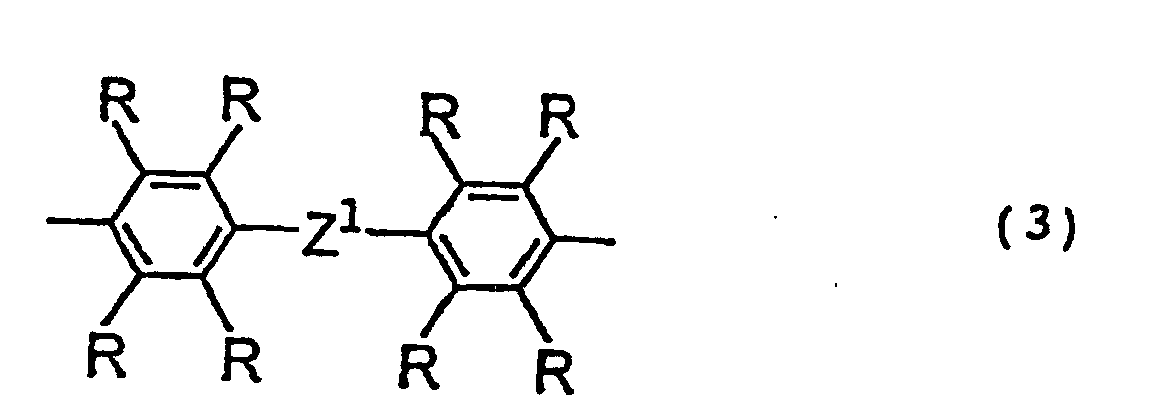 dans lesquelles R, qui peuvent être identiques ou différents, est l'hydrogène, un halogène ou un groupe alkyle ; et Z1 et Z2, qui peuvent être identiques ou différents, sont une liaison simple, -C(CH3)2-, -S- ou -SO2- reliant les deux groupes aromatiques ensemble.
- Co(polymère) (thio) éther contenant du soufre selon la revendication 1, 2 ou 3, dans lequel R3 est un groupe contenant du soufre, alkyle, aryle, hétérocycle ou acyle contenant au moins deux atomes de soufre ou un atome de soufre lorsque au moins un élément parmi X1 à X4 est un atome de soufre ; et R4 est un groupe alkyle, aryle, hétérocycle ou acyle contenant au moins un atome de soufre.
- Co(polymère) (thio) éther contenant du soufre selon la revendication 3 ou 4, dans lequel Z1 est -C(CH3)2-.
- Co(polymère) (thio) éther contenant du soufre selon la revendication 5, dans lequel Z1 est -C(CH3)2- et Z2 est une liaison simple ou -C(CH3)2-.
- Co(polymère) (thio) éther contenant du soufre selon l'une quelconque des revendications précédentes, dans lequel X1 et X2 sont l'oxygène.
- Co(polymère) (thio) éther contenant du soufre selon la revendication 7, dans lequel tous les éléments de X1 à X4 sont l'oxygène.
- Co(polymère) (thio) éther contenant du soufre selon la revendication 3 ou 4, dans lequel Z1 est -S-.
- Co(polymère) (thio) éther contenant du soufre selon la revendication 9, dans lequel X1 et X2 sont le soufre.
- Elément optique fabriqué en utilisant un co(polymère) (thio) éther contenant du soufre selon l'une quelconque des revendications 1 à 10.
- Lentille plastique fabriquée en utilisant un co(polymère) (thio) éther contenant du soufre selon l'une quelconque des revendications 1 à 10.
Applications Claiming Priority (14)
| Application Number | Priority Date | Filing Date | Title |
|---|---|---|---|
| JP25424098 | 1998-09-08 | ||
| JP25424098 | 1998-09-08 | ||
| JP26946798 | 1998-09-24 | ||
| JP26946798 | 1998-09-24 | ||
| JP32062198 | 1998-11-11 | ||
| JP32062198 | 1998-11-11 | ||
| JP5354699 | 1999-03-02 | ||
| JP5354699 | 1999-03-02 | ||
| JP8103599 | 1999-03-25 | ||
| JP8103699 | 1999-03-25 | ||
| JP8103599 | 1999-03-25 | ||
| JP8103699 | 1999-03-25 | ||
| JP9854399 | 1999-04-06 | ||
| JP9854399 | 1999-04-06 |
Publications (2)
| Publication Number | Publication Date |
|---|---|
| EP0987567A1 EP0987567A1 (fr) | 2000-03-22 |
| EP0987567B1 true EP0987567B1 (fr) | 2004-04-07 |
Family
ID=27564828
Family Applications (1)
| Application Number | Title | Priority Date | Filing Date |
|---|---|---|---|
| EP99307114A Expired - Lifetime EP0987567B1 (fr) | 1998-09-08 | 1999-09-07 | Polythioéthers et leur utilisation |
Country Status (5)
| Country | Link |
|---|---|
| US (1) | US6320020B1 (fr) |
| EP (1) | EP0987567B1 (fr) |
| KR (1) | KR100339635B1 (fr) |
| CN (1) | CN1117991C (fr) |
| DE (1) | DE69916195T2 (fr) |
Families Citing this family (22)
| Publication number | Priority date | Publication date | Assignee | Title |
|---|---|---|---|---|
| JP4561946B2 (ja) | 2000-09-14 | 2010-10-13 | 三菱瓦斯化学株式会社 | 光学材料用組成物 |
| US6569517B1 (en) | 2000-11-17 | 2003-05-27 | 3M Innovative Properties Company | Color tailorable pigmented optical bodies with surface metalization |
| US20040171743A1 (en) * | 2003-01-21 | 2004-09-02 | Terry Brewer, Ph.D. | Hybrid organic-inorganic polymer coatings with high refractive indices |
| US7192999B2 (en) | 2003-09-19 | 2007-03-20 | Brewer Science Inc. | Polyimides for use as high refractive index, thin film materials |
| JP2008514764A (ja) * | 2004-09-28 | 2008-05-08 | ブルーワー サイエンス アイ エヌ シー. | 光電子用途に用いる硬化性高屈折率樹脂 |
| KR101225525B1 (ko) | 2004-10-26 | 2013-01-23 | 쇼와 덴코 가부시키가이샤 | 티올 화합물 및 이를 사용한 감광성 조성물 |
| US20060149132A1 (en) * | 2004-12-30 | 2006-07-06 | Given Imaging Ltd. | Device and method for in vivo illumination |
| EP1882714B1 (fr) * | 2005-05-18 | 2017-11-08 | Nagase ChemteX Corporation | Procédé servant à produire une résine époxyde thermiquement fondue renforcée par des fibres |
| TWI367900B (en) * | 2007-10-09 | 2012-07-11 | Ind Tech Res Inst | Encapsulant composition for a light-emitting diode |
| US10465037B2 (en) | 2014-07-22 | 2019-11-05 | Sabic Global Technologies B.V. | High heat monomers and methods of use thereof |
| KR101788382B1 (ko) * | 2015-06-24 | 2017-10-19 | 삼성에스디아이 주식회사 | 화학식 1의 고분자 수지, 이를 포함하는 접착 필름 및 상기 접착 필름에 의해 접속된 반도체 장치 |
| US10533069B2 (en) | 2015-07-31 | 2020-01-14 | Seoul National University R$Db Foudation | Cyclic polysulfane-based polymer, method for preparing same, and film comprising same |
| KR102649126B1 (ko) * | 2015-10-27 | 2024-03-20 | 닛산 가가쿠 가부시키가이샤 | 중합체 및 이것을 포함하는 수지 조성물 |
| JP6606195B2 (ja) | 2015-12-28 | 2019-11-13 | 富士フイルム株式会社 | 化合物、硬化性組成物、硬化物、光学部材及びレンズ |
| WO2017146022A1 (fr) | 2016-02-23 | 2017-08-31 | 富士フイルム株式会社 | Résine de polycarbonate, corps moulé, élément optique et lentille |
| JP6670923B2 (ja) | 2016-02-24 | 2020-03-25 | 富士フイルム株式会社 | ポリカーボネート樹脂、成形体、光学部材及びレンズ |
| US20210047457A1 (en) * | 2018-01-22 | 2021-02-18 | Mitsubishi Gas Chemical Company, Inc. | Compound, resin, composition and pattern formation method |
| CN113056459A (zh) * | 2018-12-13 | 2021-06-29 | 捷恩智株式会社 | 环氧化合物 |
| JP7277126B2 (ja) * | 2018-12-21 | 2023-05-18 | 日鉄ケミカル&マテリアル株式会社 | フェノキシ樹脂、その樹脂組成物、その硬化物、およびその製造方法。 |
| CN115703756B (zh) * | 2021-08-17 | 2024-07-02 | 四川大学 | 可回收聚对二硫环己酮及衍生物及其制备方法 |
| CN113968963B (zh) * | 2021-12-01 | 2023-08-11 | 万华化学集团股份有限公司 | 一种聚碳酸酯及其制备方法、应用 |
| TW202519991A (zh) * | 2023-08-10 | 2025-05-16 | 德商馬克專利公司 | 來自金屬有機抗蝕劑之正型圖案 |
Family Cites Families (12)
| Publication number | Priority date | Publication date | Assignee | Title |
|---|---|---|---|---|
| NL112987C (nl) | 1959-06-15 | 1966-07-15 | Shell Int Research | Verbeterde werkwijze ter bereiding van thermoplastische produkten door reactie van een dihydroxyverbinding met een nagenoeg equimoleculaire hoeveelheid van een diepoxyverbinding |
| US3417036A (en) | 1967-08-07 | 1968-12-17 | Hercules Inc | Polyethers containing polar groups obtained from polymers of epihalohydrins reacted with nucleophilic reagents |
| CA1054294A (fr) | 1974-12-19 | 1979-05-08 | American Cyanamid Company | Elastomeres usinables et vulcanisables par addition de soufre |
| US4594291A (en) * | 1984-07-17 | 1986-06-10 | The Dow Chemical Company | Curable, partially advanced epoxy resins |
| US4647648A (en) | 1985-08-26 | 1987-03-03 | The Dow Chemical Company | Polyhydroxyethers from hydroxybiphenyls |
| JPS63156825A (ja) | 1986-12-19 | 1988-06-29 | Kuraray Co Ltd | 光記録媒体用基体 |
| CN1040810A (zh) | 1988-04-30 | 1990-03-28 | 三井东圧化学株式会社 | 多硫化合物基树脂透镜及其制备方法 |
| US5164472A (en) | 1990-01-18 | 1992-11-17 | The Dow Chemical Company | Hydroxy-functional polyethers as thermoplastic barrier resins |
| FR2687481A1 (fr) | 1992-02-17 | 1993-08-20 | Corning Inc | Lentilles a haut indice en resine epoxy aromatique. |
| JPH06199990A (ja) | 1992-11-10 | 1994-07-19 | Sumitomo Chem Co Ltd | エポキシ樹脂組成物および樹脂封止型半導体装置 |
| US5401814A (en) | 1993-10-13 | 1995-03-28 | The Dow Chemical Company | Process for the preparation of thermoplastic poly(hydroxy ethers) |
| US5945504A (en) | 1996-01-17 | 1999-08-31 | Mitsubishi Gas Chemical Company, Inc. | Episulfide compound |
-
1999
- 1999-09-03 US US09/389,317 patent/US6320020B1/en not_active Expired - Lifetime
- 1999-09-07 DE DE69916195T patent/DE69916195T2/de not_active Expired - Lifetime
- 1999-09-07 EP EP99307114A patent/EP0987567B1/fr not_active Expired - Lifetime
- 1999-09-08 CN CN99122145A patent/CN1117991C/zh not_active Expired - Lifetime
- 1999-09-08 KR KR1019990038224A patent/KR100339635B1/ko not_active Expired - Lifetime
Also Published As
| Publication number | Publication date |
|---|---|
| US6320020B1 (en) | 2001-11-20 |
| EP0987567A1 (fr) | 2000-03-22 |
| DE69916195T2 (de) | 2005-04-14 |
| KR100339635B1 (ko) | 2002-06-03 |
| CN1250060A (zh) | 2000-04-12 |
| CN1117991C (zh) | 2003-08-13 |
| DE69916195D1 (de) | 2004-05-13 |
| KR20000022993A (ko) | 2000-04-25 |
Similar Documents
| Publication | Publication Date | Title |
|---|---|---|
| US6320020B1 (en) | Sulfur-containing (thio)ether (co)polymer and a use thereof | |
| US5961889A (en) | Process of producing polythiol oligomer | |
| AU2007245215B2 (en) | Polymerizable composition, and resin and optical part using the same | |
| CN101616958B (zh) | 金属硫杂环丁烷化合物、含有该化合物的聚合性组合物、树脂及其应用 | |
| JP4271312B2 (ja) | 含硫(チオ)エーテル(共)重合体およびその用途 | |
| EP1316556B1 (fr) | Produit optique contenant un composé thiol | |
| KR20130122966A (ko) | 수지, 광학 재료 및 광학 디바이스 | |
| US8394891B2 (en) | Additive for polymerizable composition, polymerizable composition containing the same and use of the polymerizable composition | |
| JPH1112273A (ja) | エピスルフィド化合物およびその製造方法 | |
| AU2002308979B2 (en) | Acrylic esters and use thereof | |
| JP3628054B2 (ja) | ポリチオール誘導体およびそれを用いたレンズ | |
| EP1334974A1 (fr) | Disulfides cycliques, procédé pour les préparer et produits optiques les contenant | |
| EP2311845B1 (fr) | Composé, composition polymérisable, résine et utilisation de la composition et de la résine | |
| CN116478148B (zh) | 一种环硫化合物及其应用 | |
| AU5353500A (en) | Polymerizable sulfur-containing (meth)acrylate, polymerizable composition and optical lens | |
| JP3862382B2 (ja) | 3官能以上の新規な含セレンポリチオール | |
| JPH05257092A (ja) | ポリチオールポリウレタンを主成分とする眼鏡用レンズ | |
| JPH0343415A (ja) | 硫黄含有ポリエステル樹脂 | |
| JP2003002962A (ja) | 光学部品および含硫ポリ(チオ)エステル(共)重合体 | |
| TWI736539B (zh) | 光學材料用組成物及光學材料 | |
| JP2000044531A (ja) | ポリイソシアネート化合物及びその製造方法 | |
| JP2003292591A (ja) | ポリ(チオ)エステル重合体およびその用途 | |
| CN101443413A (zh) | 聚合性组合物及使用该组合物的树脂、光学部件及透镜 | |
| JP2000044530A (ja) | ポリイソシアネート化合物及びその製造方法 |
Legal Events
| Date | Code | Title | Description |
|---|---|---|---|
| PUAI | Public reference made under article 153(3) epc to a published international application that has entered the european phase |
Free format text: ORIGINAL CODE: 0009012 |
|
| 17P | Request for examination filed |
Effective date: 19990928 |
|
| AK | Designated contracting states |
Kind code of ref document: A1 Designated state(s): DE FR GB |
|
| AX | Request for extension of the european patent |
Free format text: AL;LT;LV;MK;RO;SI |
|
| AKX | Designation fees paid |
Free format text: DE FR GB |
|
| 17Q | First examination report despatched |
Effective date: 20011221 |
|
| GRAP | Despatch of communication of intention to grant a patent |
Free format text: ORIGINAL CODE: EPIDOSNIGR1 |
|
| GRAS | Grant fee paid |
Free format text: ORIGINAL CODE: EPIDOSNIGR3 |
|
| GRAA | (expected) grant |
Free format text: ORIGINAL CODE: 0009210 |
|
| AK | Designated contracting states |
Kind code of ref document: B1 Designated state(s): DE FR GB |
|
| REG | Reference to a national code |
Ref country code: GB Ref legal event code: FG4D |
|
| REF | Corresponds to: |
Ref document number: 69916195 Country of ref document: DE Date of ref document: 20040513 Kind code of ref document: P |
|
| RAP2 | Party data changed (patent owner data changed or rights of a patent transferred) |
Owner name: MITSUI CHEMICALS, INC. |
|
| ET | Fr: translation filed | ||
| PLBE | No opposition filed within time limit |
Free format text: ORIGINAL CODE: 0009261 |
|
| STAA | Information on the status of an ep patent application or granted ep patent |
Free format text: STATUS: NO OPPOSITION FILED WITHIN TIME LIMIT |
|
| 26N | No opposition filed |
Effective date: 20050110 |
|
| PGFP | Annual fee paid to national office [announced via postgrant information from national office to epo] |
Ref country code: GB Payment date: 20080910 Year of fee payment: 10 |
|
| GBPC | Gb: european patent ceased through non-payment of renewal fee |
Effective date: 20090907 |
|
| PG25 | Lapsed in a contracting state [announced via postgrant information from national office to epo] |
Ref country code: GB Free format text: LAPSE BECAUSE OF NON-PAYMENT OF DUE FEES Effective date: 20090907 |
|
| REG | Reference to a national code |
Ref country code: DE Ref legal event code: R082 Ref document number: 69916195 Country of ref document: DE Representative=s name: MAI DOERR BESIER EUROPEAN PATENT ATTORNEYS - E, DE Ref country code: DE Ref legal event code: R082 Ref document number: 69916195 Country of ref document: DE Representative=s name: MAI DOERR BESIER PATENTANWAELTE, DE |
|
| REG | Reference to a national code |
Ref country code: FR Ref legal event code: PLFP Year of fee payment: 17 |
|
| REG | Reference to a national code |
Ref country code: FR Ref legal event code: PLFP Year of fee payment: 18 |
|
| REG | Reference to a national code |
Ref country code: FR Ref legal event code: PLFP Year of fee payment: 19 |
|
| REG | Reference to a national code |
Ref country code: FR Ref legal event code: PLFP Year of fee payment: 20 |
|
| PGFP | Annual fee paid to national office [announced via postgrant information from national office to epo] |
Ref country code: FR Payment date: 20180924 Year of fee payment: 20 Ref country code: DE Payment date: 20180920 Year of fee payment: 20 |
|
| REG | Reference to a national code |
Ref country code: DE Ref legal event code: R071 Ref document number: 69916195 Country of ref document: DE |