EP0987894A2 - Jitterkorrektion und Taktrückgewinnung für audiovisuelle Echtzeitnetzwerkanwendungen - Google Patents
Jitterkorrektion und Taktrückgewinnung für audiovisuelle Echtzeitnetzwerkanwendungen Download PDFInfo
- Publication number
- EP0987894A2 EP0987894A2 EP99304426A EP99304426A EP0987894A2 EP 0987894 A2 EP0987894 A2 EP 0987894A2 EP 99304426 A EP99304426 A EP 99304426A EP 99304426 A EP99304426 A EP 99304426A EP 0987894 A2 EP0987894 A2 EP 0987894A2
- Authority
- EP
- European Patent Office
- Prior art keywords
- buffer
- client
- clock
- data
- data packets
- Prior art date
- Legal status (The legal status is an assumption and is not a legal conclusion. Google has not performed a legal analysis and makes no representation as to the accuracy of the status listed.)
- Granted
Links
Images

Classifications
-
- H—ELECTRICITY
- H04—ELECTRIC COMMUNICATION TECHNIQUE
- H04N—PICTORIAL COMMUNICATION, e.g. TELEVISION
- H04N21/00—Selective content distribution, e.g. interactive television or video on demand [VOD]
- H04N21/60—Network structure or processes for video distribution between server and client or between remote clients; Control signalling between clients, server and network components; Transmission of management data between server and client, e.g. sending from server to client commands for recording incoming content stream; Communication details between server and client
- H04N21/63—Control signaling related to video distribution between client, server and network components; Network processes for video distribution between server and clients or between remote clients, e.g. transmitting basic layer and enhancement layers over different transmission paths, setting up a peer-to-peer communication via Internet between remote STB's; Communication protocols; Addressing
- H04N21/643—Communication protocols
- H04N21/6437—Real-time Transport Protocol [RTP]
-
- H—ELECTRICITY
- H04—ELECTRIC COMMUNICATION TECHNIQUE
- H04N—PICTORIAL COMMUNICATION, e.g. TELEVISION
- H04N21/00—Selective content distribution, e.g. interactive television or video on demand [VOD]
- H04N21/40—Client devices specifically adapted for the reception of or interaction with content, e.g. set-top-box [STB]; Operations thereof
- H04N21/43—Processing of content or additional data, e.g. demultiplexing additional data from a digital video stream; Elementary client operations, e.g. monitoring of home network or synchronising decoder's clock; Client middleware
- H04N21/4302—Content synchronisation processes, e.g. decoder synchronisation
- H04N21/4305—Synchronising client clock from received content stream, e.g. locking decoder clock with encoder clock, extraction of the PCR packets
-
- H—ELECTRICITY
- H04—ELECTRIC COMMUNICATION TECHNIQUE
- H04N—PICTORIAL COMMUNICATION, e.g. TELEVISION
- H04N21/00—Selective content distribution, e.g. interactive television or video on demand [VOD]
- H04N21/40—Client devices specifically adapted for the reception of or interaction with content, e.g. set-top-box [STB]; Operations thereof
- H04N21/43—Processing of content or additional data, e.g. demultiplexing additional data from a digital video stream; Elementary client operations, e.g. monitoring of home network or synchronising decoder's clock; Client middleware
- H04N21/44—Processing of video elementary streams, e.g. splicing a video clip retrieved from local storage with an incoming video stream or rendering scenes according to encoded video stream scene graphs
- H04N21/44004—Processing of video elementary streams, e.g. splicing a video clip retrieved from local storage with an incoming video stream or rendering scenes according to encoded video stream scene graphs involving video buffer management, e.g. video decoder buffer or video display buffer
Definitions
- This invention relates to a method for network dejittering and client/server timing synchronization in network (such as IP network) applications for real-time audio/visual services.
- This technique may be used for the A/V stream (i.e. MPEG stream) decoder to smooth the network jitter and to slave its timing to the encoder by a software approach.
- a client can playback the A/V streams over an IP network with no requirement of a PLL (Phase Lock Loop) circuit in the decoder.
- PLL Phase Lock Loop
- IP networked digital audio/visual system As one of the main requirements for an IP networked digital audio/visual system, people expect that the system will allow the ability to receive or playback audio/visual information over the IP network in a real-time fashion.
- QoS quality of service
- a second problem is that there is a significant amount of delay variation (jitter) presented in an end-to-end system over IP network.
- jitter delay variation
- the real byte data delivery schedule may differ significantly from the intended delivery schedule.
- the third problem is the unmatched clocks (time drift) between server (encoder) and client (decoder).
- the time drift means that the free-running clock in the client will introduce some amount of timing difference over a given period of time when compared to the server's encoding clock since there is no guarantee of clock accuracy.
- the first problem relates to the issue of how to guarantee the bandwidth and delay for the data delivery over an IP network and is currently addressed by the IETF.
- RVP Resource Reservation Protocol
- MPLS Multi-Protocol Label Switching
- this STC value is the same value that the encoder's STC had when the SCR (or PCR) was stored or transmitted. If the decoder's clock frequency matches exactly that of the encoder, then the decoding and presentation of audio/video will automatically have the same rate as those at the encoder. In practice, a decoder's system clock frequency will not precisely match the encoder's system clock frequency.
- the decoder's STC can be made to slave its timing to the encoder using the received SCRs (or PCRs).
- the prototypical method of achieving such synchronization is via a Phase-Locked Loop (PLL).
- PLL Phase-Locked Loop
- the details on the operation of PLL in this context may be found in ISO/IEC International Standard 13818-1. "Generic Coding of Moving Pictures and Associated Audio Information: Systems", July 1995.
- packet delay variation is considered to be quite significant for the MPEG Standard Target Decoder (STD).
- timing jitter at the input to a decoder is reflected in the combination of the values of SCRs (or PCRs) and the times when they are received.
- a significant SCRs (PCRs) jitter may cause the difficulty for the PLL to reach a defined locked state.
- the effect of such clock frequency mismatch between client and server is the gradual and unavoidable increase or decrease of the fullness of the decoder's buffers, such that overflow or underflow would occur eventually with any finite size of decoder buffers, therefore, effecting the system performance of the overall operation.
- a method for clock variation compensation in a real-time audio/visual system in which encoded A/V data in a plurality of data packets are delivered to at least one client over a network from a server at a substantially constant bit rate, said plurality of data packets including data packets containing time stamp data the method comprising the steps of:
- the method includes monitoring the fullness of the second buffer to derive a drift rate, and adjusting the client local clock based on the derived drift rate.
- the present invention also provides a method for clock variation compensation in a real-time audio/visual system in which encoded A/V data in a plurality of data packets are delivered to at least one client over a network from a server at a substantially constant bit rate, said plurality of data packets including data packets containing timestamp data, the method comprising the steps of:
- the method includes monitoring the fullness of the dejittering buffer to derive a clock drift rate, and adjusting the decoding system clock based on the derived drift rate and a network jitter component.
- the present invention further provides a real-time audio/visual system coupled to receive data packets over a network for A/V decoding by an A/V decoder, the system including a clock variation compensation system comprising:
- the technique summarized below is a "software PLL-like" method to address the jitter and time synchronization for a client decoding system. It employs the RTP (Real-Time Transport Protocol) as the transport service and receiver buffering to achieve real-time A/V playback.
- RTP Real-Time Transport Protocol
- the dejittering process can be achieved by a dejittering buffer using the embedded timestamp values in the transport packets and client RTP clock (which runs at the same frequency as the A/V decoder's clock).
- the delay variations of data arriving are removed after the client buffering process, the data packet is shifted to a synchronizing buffer at the scheduled time of server encoder, then feed to the A/V decoder according to the time reference of A/V encoder.
- the clock synchronization (recovery) can be achieved by a synchronizing buffer based on a reference fill position and the movement of the fill position in the buffer (packet index oriented). By monitoring the fullness of the buffer over a given period, the drift rate of clock unsynchronization between client and server can be derived.
- RTP Real-Time Transport Protocol
- RTP Resource Reservation Protocol
- RTP Resource Reservation Protocol
- Civanlar Civanlar; drat-ietf-avt-mpeg-new-01, Internet draft, June 1997.
- RTP Payload Format for Bundled MPEG M.R. Civanlar, G.L Cash, B.G Haskell; draft-civanlar-bmpeg-01, Internet draft, February 1997.
- RSVP Resource ReSerVation Protocol
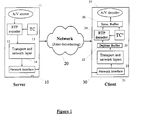
- FIG. 1 A system model for real-time services over a jitter introducing network is illustrated in block diagram form in Figure 1.
- an A/V client server arrangement is shown, wherein a client 30 is connected to a sever 10 via a network 20.
- the server 10 includes a source of audio/video streams 11, a RTP encoder 12, a server encoding system clock 13, transport and network layers 14 and a network interface 15.
- the client 30 includes a network interface 31, transport and network layers 32, a dejittering buffer 33, a RTP decoder 34, a client decoding system clock 35, a time synchronizing buffer 36 and an audio/video decoder 37.
- the network 20 is a jitter introducing network, such as IP-based network. The overall operation of the present invention in this environment is described hereinbelow.
- AV stream source 11 is input to the RTP encoder 12.
- the output of RTP encoder 12 are RTP packets where their payload field contain data from source 11. These packets are timestamped by the server system encoding clock 13, and then sent out to the client through the network 20 at constant bit rate.
- the RTP packets (containing AV stream data in payload field) received from the network are put into the dejittering buffer 33 in sequence.
- the RTP packets in dejittering buffer 33 are decoded by the RTP decoder 34 and client decoding system clock 35, and then shifted into the time synchronizing buffer 36.
- the synchronizing buffer 36 will contain all the original A/V stream data from A/V source 11. These A/V stream data will then be fed into A/V decoder according to their appropriate time scheduling.
- the desirable size of the dejittering buffer depends only on the maximum network jitter J max (peak-to-peak) and the maximum bit rate of A/V streams R max . Assume the difference of clock counting between the server and client over the period of updating ( T , which for example can be default to 1 minute) is t .
- a size of 512 kBytes buffer should be adequate for most situations if a certain level of QoS is also guaranteed.
- FIG. 2 is a block diagram of the dejittering and clock recovering operation in accordance with an embodiment of the present invention. In this diagram, and the following description:
- the dejittering process is done based on the encoded RTP timestamp value and client's RTP clock.
- the client buffer provides the function of buffering by way of dejitter buffer 33, which removes the jitter in terms of client reception.
- the dejitter buffer 33 is coupled to pass data to the synchronizing buffer 36 by way of a shift gate 41.
- the shift gate 41 is controlled by the output of a comparator 42 which has inputs tc n from the client's RTP clock time counter and ts n retrieved from the dejitter buffer.
- the data is shifted to the synchronizing buffer 36 whenever the timestamp value (ts n ) encoded in the packet is equal to the client's time counter value (tc n ).
- the packets in the synchronizing buffer are A/V data packets.
- Such data packets are fed to the A/V decoder (e.g. MPEG decoder) based on their own embedded time schedule. It should be noted here that in the case of a system decoder the decoder internal system buffer can be used as the synchronizing buffer if it is accessible from the client.
- the clock synchronization between client and server is achieved via monitoring the packet position in the synchronizing buffer.
- the size of the synchronizing buffer can be quite small since it only needs to handle the clock drift.
- the operation is illustrated in Figure 3 which is a diagram of buffer monitoring for time synchronization.
- the operation of the clock recovery process is based on the buffer position change compared with the reference position (defined as the buffer half-size position) for a given period T (for example, every minute). If the buffer position is moving in the direction of emptiness, the counter TC' should be upwardly adjusted by adding an offset. If the buffer position is moving in the other direction (fullness), the TC' value should be downwardly adjusted.
- buffer position mentioned above is in terms of packet index offset rather than the byte number offset.
- the present technique can be implemented with the use of one buffer only (no additional synchronizing buffer available).
- data packets are fed into the A/V decoder directly from the dejittering buffer at the scheduled time.
- the above clock drift rate r will include the component of network jitter J and should be eliminated before the TC' is adjusted.
- the interarrival jitter J can be derived from the two sequenced RTP packets.
- the jitter J is defined to be the mean deviation of the difference ( D ) in packet spacing at the receiver compared to the sender for a pair of packets.
- T sa is the RTP timestamp from packet a
- T rb is the time of arrival in RTP timestamp units for packet b
- This algorithm provides an optimal first-order estimator and the gain parameter 1/16 gives a good noise reduction ratio while maintaining a reasonable rate of convergence (see RTP specification and related references).
- the present method is a more independent and less constrained client-based approach. It provides the network adaptability via a simple software solution (can be implemented in hardware as well) for an end system and can be applied in a wide range of network applications.
- the effect of the present technique includes:
Landscapes
- Engineering & Computer Science (AREA)
- Multimedia (AREA)
- Signal Processing (AREA)
- Data Exchanges In Wide-Area Networks (AREA)
- Synchronisation In Digital Transmission Systems (AREA)
- Two-Way Televisions, Distribution Of Moving Picture Or The Like (AREA)
- Communication Control (AREA)
Applications Claiming Priority (2)
| Application Number | Priority Date | Filing Date | Title |
|---|---|---|---|
| SG9803578 | 1998-09-07 | ||
| SG1998003578A SG71835A1 (en) | 1998-09-07 | 1998-09-07 | A dejittering and clock recovery technique for real-time audio/visual network applications |
Publications (3)
| Publication Number | Publication Date |
|---|---|
| EP0987894A2 true EP0987894A2 (de) | 2000-03-22 |
| EP0987894A3 EP0987894A3 (de) | 2000-04-19 |
| EP0987894B1 EP0987894B1 (de) | 2004-03-03 |
Family
ID=20430090
Family Applications (1)
| Application Number | Title | Priority Date | Filing Date |
|---|---|---|---|
| EP19990304426 Expired - Lifetime EP0987894B1 (de) | 1998-09-07 | 1999-06-08 | Jitterkorrektion und Taktrückgewinnung für audiovisuelle Echtzeitnetzwerkanwendungen |
Country Status (4)
| Country | Link |
|---|---|
| EP (1) | EP0987894B1 (de) |
| JP (1) | JP2000092130A (de) |
| DE (1) | DE69915201T2 (de) |
| SG (1) | SG71835A1 (de) |
Cited By (30)
| Publication number | Priority date | Publication date | Assignee | Title |
|---|---|---|---|---|
| WO2002032054A3 (en) * | 2000-10-13 | 2003-03-13 | America Online Inc | Dynamic latency management, dynamic drift correction, and automatic microphone detection |
| WO2004010670A1 (en) * | 2002-07-19 | 2004-01-29 | Koninklijke Philips Electronics N.V. | Jitter compensation method for systems having wall clocks |
| US6880098B1 (en) * | 2001-09-07 | 2005-04-12 | Sprint Communications Company L.P. | Timing recovery in a packet network using a buffer |
| EP1279107A4 (de) * | 2000-04-07 | 2005-08-10 | Artel Video Systems Inc | Senden von aus einem netzwerk mit nicht konstanter verzögerung empfangenen mpeg-datenpaketen |
| EP1585334A1 (de) * | 2004-04-02 | 2005-10-12 | Samsung Electronics Co., Ltd. | Verfahren und Clientapparat zur Wiedergabe eines Videodatenstroms. |
| EP1528724A4 (de) * | 2002-07-30 | 2005-11-30 | Sony Corp | Informationsverarbeitungsgerät und verfahren, speichermedium und programm dafür |
| US7039193B2 (en) | 2000-10-13 | 2006-05-02 | America Online, Inc. | Automatic microphone detection |
| FR2880749A1 (fr) * | 2005-01-11 | 2006-07-14 | Nextream France Sa | Methode de transmission de flux mpeg sur ip et appareil implementant la methode |
| US7084898B1 (en) * | 2003-11-18 | 2006-08-01 | Cisco Technology, Inc. | System and method for providing video conferencing synchronization |
| EP1691514A1 (de) * | 2005-02-11 | 2006-08-16 | Microsoft Corporation | Erkennen der Abweichung von Uhren in vernetzten Geräten durch Überwachung des Füllungsgrades von Pufferspeicher |
| KR100636107B1 (ko) * | 1999-10-27 | 2006-10-18 | 삼성전자주식회사 | 실시간 데이터 처리 장치 및 방법 |
| WO2006108685A3 (en) * | 2005-04-15 | 2006-12-21 | Thomson Licensing | Remote management method of a distant device, and corresponding video device |
| US7231453B2 (en) | 2000-10-13 | 2007-06-12 | Aol Llc | Temporal drift correction |
| US7263110B2 (en) | 2002-09-30 | 2007-08-28 | D&M Holdings Inc. | Synchronizing clock signals of server and client devices in a network system based on power source synchronous pulse signal |
| US7281053B2 (en) | 2000-10-13 | 2007-10-09 | Aol Llc | Method and system for dynamic latency management and drift correction |
| SG143027A1 (en) * | 2003-11-27 | 2008-06-27 | Victor Company Of Japan | A device for synchronising digital data streams in real-time |
| EP2073552A1 (de) | 2007-12-21 | 2009-06-24 | Telefonaktiebolaget L M Ericsson (Publ) | Verfahren und Anordnung zur Kontrolle einer Medienverbrauchsrate eines Empfängers |
| US7571246B2 (en) | 2004-07-29 | 2009-08-04 | Microsoft Corporation | Media transrating over a bandwidth-limited network |
| CN100527712C (zh) * | 2005-11-15 | 2009-08-12 | 联发科技股份有限公司 | 封包串流处理系统及方法 |
| EP1694096A3 (de) * | 2005-02-16 | 2010-04-07 | Adaptec, Inc. | Verfahren und System zur Verminderung der Latenzzeit |
| US7743183B2 (en) | 2005-05-23 | 2010-06-22 | Microsoft Corporation | Flow control for media streaming |
| EP2254342A1 (de) * | 2009-05-18 | 2010-11-24 | Albis Technologies AG | Verfahren zur Audio-/Videosynchronisation |
| EP1553774A4 (de) * | 2002-07-16 | 2011-05-25 | Panasonic Corp | Inhaltsempfangsvorrichtung und inhaltssendevorrichtung |
| US8473572B1 (en) | 2000-03-17 | 2013-06-25 | Facebook, Inc. | State change alerts mechanism |
| WO2017112358A1 (en) * | 2015-12-26 | 2017-06-29 | Intel Corporation | Method and system of rendering late or early audio-video frames |
| US9729489B2 (en) | 2002-11-18 | 2017-08-08 | Facebook, Inc. | Systems and methods for notification management and delivery |
| US9736209B2 (en) | 2000-03-17 | 2017-08-15 | Facebook, Inc. | State change alerts mechanism |
| JP2020039021A (ja) * | 2018-09-03 | 2020-03-12 | 日本電気株式会社 | 通信装置、通信方法及びプログラム |
| CN113259725A (zh) * | 2021-04-14 | 2021-08-13 | 北京数字电视国家工程实验室有限公司 | 一种ts流时钟调整方法、系统、存储介质及电子设备 |
| WO2023164301A3 (en) * | 2022-02-28 | 2023-10-05 | Arris Enterprises Llc | Method of measuring timing holdover performance in an r-phy system |
Families Citing this family (11)
| Publication number | Priority date | Publication date | Assignee | Title |
|---|---|---|---|---|
| EP1204276A3 (de) | 2000-10-10 | 2007-01-03 | Matsushita Electric Industrial Co., Ltd. | Vorrichtung zur Bearbeitung eines digitalen Audio-Video Signals |
| KR20020046816A (ko) * | 2000-12-15 | 2002-06-21 | 조정남 | 실시간 멀티미디어 데이터 전송 방법 및 그 시스템 |
| CN1830224A (zh) * | 2003-08-05 | 2006-09-06 | 皇家飞利浦电子股份有限公司 | 缓冲器管理系统、数字音频接收器、耳机、扬声器、缓冲器管理的方法 |
| JP2005148152A (ja) * | 2003-11-11 | 2005-06-09 | Mitsubishi Electric Corp | メディア送信装置、メディア受信装置、メディア通信装置及びメディア再生装置 |
| JP4361561B2 (ja) | 2004-03-10 | 2009-11-11 | 三菱電機株式会社 | データ受信装置及びデータ受信方法 |
| JP4800250B2 (ja) * | 2007-03-27 | 2011-10-26 | Kddi株式会社 | 必要十分な受信バッファサイズを決定するパケット受信装置、方法及びプログラム |
| JP2009033326A (ja) * | 2007-07-25 | 2009-02-12 | Hitachi Information & Communication Engineering Ltd | パケット伝送装置及び方法 |
| DE102009008092B4 (de) | 2009-02-09 | 2014-10-30 | Atlas Elektronik Gmbh | Verfahren und Vorrichtung zum Kompensieren von Abtastratenschwankungen |
| EP2282427B1 (de) * | 2009-07-31 | 2015-03-04 | Alcatel Lucent | Verfahren zur Synchronisation einer Kundenuhrfrequenz mit einer Serveruhrfrequenz |
| JP6320012B2 (ja) | 2013-12-04 | 2018-05-09 | 株式会社日立情報通信エンジニアリング | 通信装置、通信プログラム、通信方法 |
| KR102463916B1 (ko) | 2021-02-04 | 2022-11-04 | 상명대학교산학협력단 | 시간 동기화 없는 결정론적 네트워크를 위한 지터 상한 보장 방법 |
Family Cites Families (5)
| Publication number | Priority date | Publication date | Assignee | Title |
|---|---|---|---|---|
| WO1995022233A1 (en) * | 1994-02-11 | 1995-08-17 | Newbridge Networks Corporation | Method of dynamically compensating for variable transmission delays in packet networks |
| DE69532228T2 (de) * | 1994-07-05 | 2004-09-16 | Koninklijke Philips Electronics N.V. | Signalverarbeitungssystem |
| US5901149A (en) * | 1994-11-09 | 1999-05-04 | Sony Corporation | Decode and encode system |
| US5790543A (en) * | 1995-09-25 | 1998-08-04 | Bell Atlantic Network Services, Inc. | Apparatus and method for correcting jitter in data packets |
| US5640388A (en) * | 1995-12-21 | 1997-06-17 | Scientific-Atlanta, Inc. | Method and apparatus for removing jitter and correcting timestamps in a packet stream |
-
1998
- 1998-09-07 SG SG1998003578A patent/SG71835A1/en unknown
-
1999
- 1999-06-08 DE DE1999615201 patent/DE69915201T2/de not_active Expired - Lifetime
- 1999-06-08 EP EP19990304426 patent/EP0987894B1/de not_active Expired - Lifetime
- 1999-09-01 JP JP24708699A patent/JP2000092130A/ja active Pending
Cited By (48)
| Publication number | Priority date | Publication date | Assignee | Title |
|---|---|---|---|---|
| KR100636107B1 (ko) * | 1999-10-27 | 2006-10-18 | 삼성전자주식회사 | 실시간 데이터 처리 장치 및 방법 |
| US9736209B2 (en) | 2000-03-17 | 2017-08-15 | Facebook, Inc. | State change alerts mechanism |
| US8473572B1 (en) | 2000-03-17 | 2013-06-25 | Facebook, Inc. | State change alerts mechanism |
| US7031306B2 (en) | 2000-04-07 | 2006-04-18 | Artel Video Systems, Inc. | Transmitting MPEG data packets received from a non-constant delay network |
| EP1279107A4 (de) * | 2000-04-07 | 2005-08-10 | Artel Video Systems Inc | Senden von aus einem netzwerk mit nicht konstanter verzögerung empfangenen mpeg-datenpaketen |
| WO2002032054A3 (en) * | 2000-10-13 | 2003-03-13 | America Online Inc | Dynamic latency management, dynamic drift correction, and automatic microphone detection |
| US7281053B2 (en) | 2000-10-13 | 2007-10-09 | Aol Llc | Method and system for dynamic latency management and drift correction |
| US7039193B2 (en) | 2000-10-13 | 2006-05-02 | America Online, Inc. | Automatic microphone detection |
| US7600032B2 (en) | 2000-10-13 | 2009-10-06 | Aol Llc | Temporal drift correction |
| US7836194B2 (en) | 2000-10-13 | 2010-11-16 | Aol Inc. | Method and system for dynamic latency management and drift correction |
| US7231453B2 (en) | 2000-10-13 | 2007-06-12 | Aol Llc | Temporal drift correction |
| US6880098B1 (en) * | 2001-09-07 | 2005-04-12 | Sprint Communications Company L.P. | Timing recovery in a packet network using a buffer |
| EP1553774A4 (de) * | 2002-07-16 | 2011-05-25 | Panasonic Corp | Inhaltsempfangsvorrichtung und inhaltssendevorrichtung |
| US8503471B2 (en) | 2002-07-16 | 2013-08-06 | Panasonic Corporation | Content receiver and content transmitter |
| WO2004010670A1 (en) * | 2002-07-19 | 2004-01-29 | Koninklijke Philips Electronics N.V. | Jitter compensation method for systems having wall clocks |
| US7526000B2 (en) | 2002-07-19 | 2009-04-28 | Koninklijke Philips Electronics N.V. | Jitter compensation method for systems having wall clocks |
| CN1669290B (zh) * | 2002-07-19 | 2010-04-28 | 皇家飞利浦电子股份有限公司 | 用于具有挂钟的系统的抖动补偿方法 |
| US7558868B2 (en) | 2002-07-30 | 2009-07-07 | Sony Corporation | Information processing device and method, recording medium, and program |
| EP1528724A4 (de) * | 2002-07-30 | 2005-11-30 | Sony Corp | Informationsverarbeitungsgerät und verfahren, speichermedium und programm dafür |
| US7263110B2 (en) | 2002-09-30 | 2007-08-28 | D&M Holdings Inc. | Synchronizing clock signals of server and client devices in a network system based on power source synchronous pulse signal |
| US9769104B2 (en) | 2002-11-18 | 2017-09-19 | Facebook, Inc. | Methods and system for delivering multiple notifications |
| US9729489B2 (en) | 2002-11-18 | 2017-08-08 | Facebook, Inc. | Systems and methods for notification management and delivery |
| US7084898B1 (en) * | 2003-11-18 | 2006-08-01 | Cisco Technology, Inc. | System and method for providing video conferencing synchronization |
| SG143027A1 (en) * | 2003-11-27 | 2008-06-27 | Victor Company Of Japan | A device for synchronising digital data streams in real-time |
| EP1585334A1 (de) * | 2004-04-02 | 2005-10-12 | Samsung Electronics Co., Ltd. | Verfahren und Clientapparat zur Wiedergabe eines Videodatenstroms. |
| US7602812B2 (en) | 2004-04-02 | 2009-10-13 | Samsung Electronics Co., Ltd. | Client for video stream play and method thereof |
| US7571246B2 (en) | 2004-07-29 | 2009-08-04 | Microsoft Corporation | Media transrating over a bandwidth-limited network |
| FR2880749A1 (fr) * | 2005-01-11 | 2006-07-14 | Nextream France Sa | Methode de transmission de flux mpeg sur ip et appareil implementant la methode |
| US7769055B2 (en) | 2005-01-11 | 2010-08-03 | Thomson Licensing | Method of transmitting MPEG streams over IP and corresponding device, receiving method and receiver |
| RU2408149C2 (ru) * | 2005-02-11 | 2010-12-27 | Майкрософт Корпорейшн | Обнаружение отклонения тактирования в сетевых устройствах посредством контроля заполнения клиентского буфера |
| EP1691514A1 (de) * | 2005-02-11 | 2006-08-16 | Microsoft Corporation | Erkennen der Abweichung von Uhren in vernetzten Geräten durch Überwachung des Füllungsgrades von Pufferspeicher |
| EP1694096A3 (de) * | 2005-02-16 | 2010-04-07 | Adaptec, Inc. | Verfahren und System zur Verminderung der Latenzzeit |
| WO2006108685A3 (en) * | 2005-04-15 | 2006-12-21 | Thomson Licensing | Remote management method of a distant device, and corresponding video device |
| EP3503475A1 (de) * | 2005-04-15 | 2019-06-26 | InterDigital CE Patent Holdings | Fernverwaltungsverfahren einer vorrichtung und zugehörige vorrichtung |
| KR101327967B1 (ko) * | 2005-04-15 | 2013-11-13 | 톰슨 라이센싱 | 원거리 디바이스의 원격 관리 방법과 대응하는 비디오 디바이스 |
| EP3054630A1 (de) * | 2005-04-15 | 2016-08-10 | Thomson Licensing | Fernverwaltungsverfahren einer vorrichtung und entsprechende vorrichtung |
| US7865581B2 (en) | 2005-04-15 | 2011-01-04 | Thomson Licensing | Remote management method of a distant device, and corresponding video device |
| US7743183B2 (en) | 2005-05-23 | 2010-06-22 | Microsoft Corporation | Flow control for media streaming |
| CN100527712C (zh) * | 2005-11-15 | 2009-08-12 | 联发科技股份有限公司 | 封包串流处理系统及方法 |
| EP2073552A1 (de) | 2007-12-21 | 2009-06-24 | Telefonaktiebolaget L M Ericsson (Publ) | Verfahren und Anordnung zur Kontrolle einer Medienverbrauchsrate eines Empfängers |
| EP2254342A1 (de) * | 2009-05-18 | 2010-11-24 | Albis Technologies AG | Verfahren zur Audio-/Videosynchronisation |
| WO2017112358A1 (en) * | 2015-12-26 | 2017-06-29 | Intel Corporation | Method and system of rendering late or early audio-video frames |
| JP2020039021A (ja) * | 2018-09-03 | 2020-03-12 | 日本電気株式会社 | 通信装置、通信方法及びプログラム |
| CN113259725A (zh) * | 2021-04-14 | 2021-08-13 | 北京数字电视国家工程实验室有限公司 | 一种ts流时钟调整方法、系统、存储介质及电子设备 |
| CN113259725B (zh) * | 2021-04-14 | 2022-08-05 | 北京数字电视国家工程实验室有限公司 | 一种ts流时钟调整方法、系统、存储介质及电子设备 |
| WO2023164301A3 (en) * | 2022-02-28 | 2023-10-05 | Arris Enterprises Llc | Method of measuring timing holdover performance in an r-phy system |
| US12074692B2 (en) | 2022-02-28 | 2024-08-27 | Arris Enterprises Llc | Method of measuring timing holdover performance in an R-PHY system |
| US12407436B2 (en) | 2022-02-28 | 2025-09-02 | Arris Enterprises Llc | Method of measuring timing holdover performance in an R-PHY system |
Also Published As
| Publication number | Publication date |
|---|---|
| JP2000092130A (ja) | 2000-03-31 |
| EP0987894B1 (de) | 2004-03-03 |
| SG71835A1 (en) | 2000-04-18 |
| DE69915201D1 (de) | 2004-04-08 |
| DE69915201T2 (de) | 2005-01-13 |
| EP0987894A3 (de) | 2000-04-19 |
Similar Documents
| Publication | Publication Date | Title |
|---|---|---|
| EP0987894B1 (de) | Jitterkorrektion und Taktrückgewinnung für audiovisuelle Echtzeitnetzwerkanwendungen | |
| US7680153B2 (en) | Method and device for stream synchronization of real-time multimedia transport over packet network | |
| US7551647B2 (en) | System and method for clock synchronization over packet-switched networks | |
| Benslimane | A multimedia synchronization protocol for multicast groups | |
| KR100994940B1 (ko) | 전송 매체를 통해 송신기로부터 수신기로 데이터 패킷들을 송신하는 방법 및 전송 매체를 통해 상호 결합된 송신기 및 수신기를 포함하는 전송 시스템 | |
| US7774489B2 (en) | Forward error correction and interleaving of network frames | |
| US6636270B2 (en) | Clock slaving methods and arrangements | |
| JP2009010966A (ja) | 非同期ネットワークを介するストリームの受信 | |
| JP3922047B2 (ja) | データ受信装置、および受信データ処理方法、並びにコンピュータ・プログラム | |
| US7397822B2 (en) | Method and system for compensating for timing violations of a multiplex of at least two media packet streams | |
| US9544638B2 (en) | Method for reconstructing system time clock (STC) without carrying PCR | |
| AU2005259240B2 (en) | Method for transmitting packets in a transmission system | |
| US7012982B1 (en) | Method and system for de-jittering of transmitted MPEG-2 and MPEG-4 video | |
| US7769055B2 (en) | Method of transmitting MPEG streams over IP and corresponding device, receiving method and receiver | |
| Hartanto et al. | Effects of interaction between error control and media synchronization on application-level performances | |
| aele Noro et al. | Circuit Emulation over IP Networks |
Legal Events
| Date | Code | Title | Description |
|---|---|---|---|
| PUAI | Public reference made under article 153(3) epc to a published international application that has entered the european phase |
Free format text: ORIGINAL CODE: 0009012 |
|
| PUAL | Search report despatched |
Free format text: ORIGINAL CODE: 0009013 |
|
| AK | Designated contracting states |
Kind code of ref document: A2 Designated state(s): DE FR GB |
|
| AX | Request for extension of the european patent |
Free format text: AL;LT;LV;MK;RO;SI |
|
| AK | Designated contracting states |
Kind code of ref document: A3 Designated state(s): AT BE CH CY DE DK ES FI FR GB GR IE IT LI LU MC NL PT SE |
|
| AX | Request for extension of the european patent |
Free format text: AL;LT;LV;MK;RO;SI |
|
| RIC1 | Information provided on ipc code assigned before grant |
Free format text: 7H 04N 7/24 A, 7H 04L 12/64 B |
|
| 17P | Request for examination filed |
Effective date: 20001009 |
|
| AKX | Designation fees paid |
Free format text: DE FR GB |
|
| 17Q | First examination report despatched |
Effective date: 20030521 |
|
| GRAP | Despatch of communication of intention to grant a patent |
Free format text: ORIGINAL CODE: EPIDOSNIGR1 |
|
| GRAS | Grant fee paid |
Free format text: ORIGINAL CODE: EPIDOSNIGR3 |
|
| GRAA | (expected) grant |
Free format text: ORIGINAL CODE: 0009210 |
|
| AK | Designated contracting states |
Kind code of ref document: B1 Designated state(s): DE FR GB |
|
| REG | Reference to a national code |
Ref country code: GB Ref legal event code: FG4D |
|
| REF | Corresponds to: |
Ref document number: 69915201 Country of ref document: DE Date of ref document: 20040408 Kind code of ref document: P |
|
| ET | Fr: translation filed | ||
| PLBE | No opposition filed within time limit |
Free format text: ORIGINAL CODE: 0009261 |
|
| STAA | Information on the status of an ep patent application or granted ep patent |
Free format text: STATUS: NO OPPOSITION FILED WITHIN TIME LIMIT |
|
| 26N | No opposition filed |
Effective date: 20041206 |
|
| PGFP | Annual fee paid to national office [announced via postgrant information from national office to epo] |
Ref country code: FR Payment date: 20110621 Year of fee payment: 13 |
|
| PGFP | Annual fee paid to national office [announced via postgrant information from national office to epo] |
Ref country code: GB Payment date: 20110608 Year of fee payment: 13 |
|
| PGFP | Annual fee paid to national office [announced via postgrant information from national office to epo] |
Ref country code: DE Payment date: 20110601 Year of fee payment: 13 |
|
| GBPC | Gb: european patent ceased through non-payment of renewal fee |
Effective date: 20120608 |
|
| REG | Reference to a national code |
Ref country code: FR Ref legal event code: ST Effective date: 20130228 |
|
| REG | Reference to a national code |
Ref country code: DE Ref legal event code: R119 Ref document number: 69915201 Country of ref document: DE Effective date: 20130101 |
|
| PG25 | Lapsed in a contracting state [announced via postgrant information from national office to epo] |
Ref country code: DE Free format text: LAPSE BECAUSE OF NON-PAYMENT OF DUE FEES Effective date: 20130101 Ref country code: GB Free format text: LAPSE BECAUSE OF NON-PAYMENT OF DUE FEES Effective date: 20120608 Ref country code: FR Free format text: LAPSE BECAUSE OF NON-PAYMENT OF DUE FEES Effective date: 20120702 |