EP1585334A1 - Verfahren und Clientapparat zur Wiedergabe eines Videodatenstroms. - Google Patents
Verfahren und Clientapparat zur Wiedergabe eines Videodatenstroms. Download PDFInfo
- Publication number
- EP1585334A1 EP1585334A1 EP05251840A EP05251840A EP1585334A1 EP 1585334 A1 EP1585334 A1 EP 1585334A1 EP 05251840 A EP05251840 A EP 05251840A EP 05251840 A EP05251840 A EP 05251840A EP 1585334 A1 EP1585334 A1 EP 1585334A1
- Authority
- EP
- European Patent Office
- Prior art keywords
- packets
- play
- burst error
- time stamps
- video
- Prior art date
- Legal status (The legal status is an assumption and is not a legal conclusion. Google has not performed a legal analysis and makes no representation as to the accuracy of the status listed.)
- Withdrawn
Links
Images

Classifications
-
- H—ELECTRICITY
- H04—ELECTRIC COMMUNICATION TECHNIQUE
- H04N—PICTORIAL COMMUNICATION, e.g. TELEVISION
- H04N21/00—Selective content distribution, e.g. interactive television or video on demand [VOD]
- H04N21/60—Network structure or processes for video distribution between server and client or between remote clients; Control signalling between clients, server and network components; Transmission of management data between server and client, e.g. sending from server to client commands for recording incoming content stream; Communication details between server and client
- H04N21/65—Transmission of management data between client and server
- H04N21/654—Transmission by server directed to the client
-
- H—ELECTRICITY
- H04—ELECTRIC COMMUNICATION TECHNIQUE
- H04N—PICTORIAL COMMUNICATION, e.g. TELEVISION
- H04N21/00—Selective content distribution, e.g. interactive television or video on demand [VOD]
- H04N21/20—Servers specifically adapted for the distribution of content, e.g. VOD servers; Operations thereof
- H04N21/23—Processing of content or additional data; Elementary server operations; Server middleware
- H04N21/234—Processing of video elementary streams, e.g. splicing of video streams or manipulating encoded video stream scene graphs
- H04N21/23406—Processing of video elementary streams, e.g. splicing of video streams or manipulating encoded video stream scene graphs involving management of server-side video buffer
-
- H—ELECTRICITY
- H04—ELECTRIC COMMUNICATION TECHNIQUE
- H04N—PICTORIAL COMMUNICATION, e.g. TELEVISION
- H04N21/00—Selective content distribution, e.g. interactive television or video on demand [VOD]
- H04N21/20—Servers specifically adapted for the distribution of content, e.g. VOD servers; Operations thereof
- H04N21/23—Processing of content or additional data; Elementary server operations; Server middleware
- H04N21/236—Assembling of a multiplex stream, e.g. transport stream, by combining a video stream with other content or additional data, e.g. inserting a URL [Uniform Resource Locator] into a video stream, multiplexing software data into a video stream; Remultiplexing of multiplex streams; Insertion of stuffing bits into the multiplex stream, e.g. to obtain a constant bit-rate; Assembling of a packetised elementary stream
- H04N21/23608—Remultiplexing multiplex streams, e.g. involving modifying time stamps or remapping the packet identifiers
-
- H—ELECTRICITY
- H04—ELECTRIC COMMUNICATION TECHNIQUE
- H04N—PICTORIAL COMMUNICATION, e.g. TELEVISION
- H04N21/00—Selective content distribution, e.g. interactive television or video on demand [VOD]
- H04N21/40—Client devices specifically adapted for the reception of or interaction with content, e.g. set-top-box [STB]; Operations thereof
- H04N21/43—Processing of content or additional data, e.g. demultiplexing additional data from a digital video stream; Elementary client operations, e.g. monitoring of home network or synchronising decoder's clock; Client middleware
- H04N21/434—Disassembling of a multiplex stream, e.g. demultiplexing audio and video streams, extraction of additional data from a video stream; Remultiplexing of multiplex streams; Extraction or processing of SI; Disassembling of packetised elementary stream
-
- H—ELECTRICITY
- H04—ELECTRIC COMMUNICATION TECHNIQUE
- H04N—PICTORIAL COMMUNICATION, e.g. TELEVISION
- H04N21/00—Selective content distribution, e.g. interactive television or video on demand [VOD]
- H04N21/40—Client devices specifically adapted for the reception of or interaction with content, e.g. set-top-box [STB]; Operations thereof
- H04N21/43—Processing of content or additional data, e.g. demultiplexing additional data from a digital video stream; Elementary client operations, e.g. monitoring of home network or synchronising decoder's clock; Client middleware
- H04N21/434—Disassembling of a multiplex stream, e.g. demultiplexing audio and video streams, extraction of additional data from a video stream; Remultiplexing of multiplex streams; Extraction or processing of SI; Disassembling of packetised elementary stream
- H04N21/4344—Remultiplexing of multiplex streams, e.g. by modifying time stamps or remapping the packet identifiers
-
- H—ELECTRICITY
- H04—ELECTRIC COMMUNICATION TECHNIQUE
- H04N—PICTORIAL COMMUNICATION, e.g. TELEVISION
- H04N21/00—Selective content distribution, e.g. interactive television or video on demand [VOD]
- H04N21/40—Client devices specifically adapted for the reception of or interaction with content, e.g. set-top-box [STB]; Operations thereof
- H04N21/43—Processing of content or additional data, e.g. demultiplexing additional data from a digital video stream; Elementary client operations, e.g. monitoring of home network or synchronising decoder's clock; Client middleware
- H04N21/44—Processing of video elementary streams, e.g. splicing a video clip retrieved from local storage with an incoming video stream or rendering scenes according to encoded video stream scene graphs
- H04N21/44004—Processing of video elementary streams, e.g. splicing a video clip retrieved from local storage with an incoming video stream or rendering scenes according to encoded video stream scene graphs involving video buffer management, e.g. video decoder buffer or video display buffer
-
- H—ELECTRICITY
- H04—ELECTRIC COMMUNICATION TECHNIQUE
- H04N—PICTORIAL COMMUNICATION, e.g. TELEVISION
- H04N21/00—Selective content distribution, e.g. interactive television or video on demand [VOD]
- H04N21/40—Client devices specifically adapted for the reception of or interaction with content, e.g. set-top-box [STB]; Operations thereof
- H04N21/43—Processing of content or additional data, e.g. demultiplexing additional data from a digital video stream; Elementary client operations, e.g. monitoring of home network or synchronising decoder's clock; Client middleware
- H04N21/442—Monitoring of processes or resources, e.g. detecting the failure of a recording device, monitoring the downstream bandwidth, the number of times a movie has been viewed, the storage space available from the internal hard disk
- H04N21/4425—Monitoring of client processing errors or hardware failure
-
- H—ELECTRICITY
- H04—ELECTRIC COMMUNICATION TECHNIQUE
- H04N—PICTORIAL COMMUNICATION, e.g. TELEVISION
- H04N21/00—Selective content distribution, e.g. interactive television or video on demand [VOD]
- H04N21/60—Network structure or processes for video distribution between server and client or between remote clients; Control signalling between clients, server and network components; Transmission of management data between server and client, e.g. sending from server to client commands for recording incoming content stream; Communication details between server and client
- H04N21/63—Control signaling related to video distribution between client, server and network components; Network processes for video distribution between server and clients or between remote clients, e.g. transmitting basic layer and enhancement layers over different transmission paths, setting up a peer-to-peer communication via Internet between remote STB's; Communication protocols; Addressing
- H04N21/633—Control signals issued by server directed to the network components or client
- H04N21/6332—Control signals issued by server directed to the network components or client directed to client
Definitions
- the present invention relates generally to video play, and more particularly to a client for playing video stream, method thereof and associated recording media.
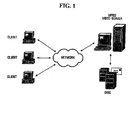
- a conventional streaming system is illustrated in FIG. 1.
- the conventional system includes a streaming server, client terminals (hereinafter referred to as “clients”), and a packet network (hereinafter referred to as a "channel").
- Media are transmitted from the server to the clients using a transport protocol such as a User Datagram Protocol (UDP), Real Time Protocol (RTP), Transmission Control Protocol (TCP), Hypertext Transfer Protocol (HTTP), etc.
- UDP User Datagram Protocol
- RTP Real Time Protocol
- TCP Transmission Control Protocol
- HTTP Hypertext Transfer Protocol
- the system may use a streaming control channel such as a Real Time Streaming Protocol (RTSP), Microsoft Media Server (MMS), etc.
- RTSP Real Time Streaming Protocol
- MMS Microsoft Media Server
- the quality of the video stream received by the client is as important as video data itself since there is no person who wants to view video frames having many errors.
- Main factors that affect the quality of the video stream may be a bandwidth-limited network, packet loss, delay jitter, etc.
- video streams having a low bandwidth may be used.
- the video stream compressed by a codec that supports the scalability it is easy to convert the video stream so that it has a lower bandwidth.
- VOD Video on Demand
- Packets transmitted from a server may be lost and not reach a client. In this case, a video output corresponding to the lost packets does not appear on the client side.
- a user may have difficulty in sensing an error caused by such a packet loss through the use of a proper error concealment algorithm.
- a proper error concealment algorithm For instance, in the MPEG-2 stream, an error concealment algorithm for reconstructing lost motion vectors using adjacent motion vectors may be used.
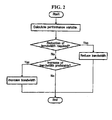
- a client can feed information about the amount of data that remains in a client buffer back to a server. If the level of the client buffer is low, the streaming rate increases, while if the level of the client buffer is high, the streaming rate decreases. Since the client buffer is empty at the initial stage of streaming, the client requests the server to stream more promptly. Accordingly, the startup delay or pre-roll delay of the streaming can be reduced.
- the adaptive media play method is used as an algorithm for the concealment of errors occurring due to a buffer underflow.
- the video play speed becomes slow, but the video play is not stopped. Then, if the buffer level is heightened above the specified threshold value, the video play speed returns to the original speed.
- this method increases the total play time of the media.
- the dynamic bandwidth control algorithm as described above operates properly if a sufficient bandwidth is secured, but does not operate properly if an available bandwidth is narrow.
- a multicast communication in a wireless LAN may serve as an example.
- a wireless interface card limits the available bandwidth to about 10% of the whole available bandwidth.
- the video play may be stopped at times.
- the conventional adaptive media play method refers to a method of a video stream play, which is transmitted at a low speed, without a freezing phenomenon, it has no relation with or is not suitable to the solution of the problems that successive losses or errors occur in packets that constitute the video stream.
- Preferred embodiments of the present invention provide a client for playing video stream and a method thereof that adaptively control the video play in the event that successive losses or errors (i.e., burst errors) of packets occur during the transmission of the video streams.
- Preferred embodiments of the present invention also provide a method and a video server for efficiently performing a packet drop in the event that a transmission bandwidth of a server side is narrower than a bandwidth of a video stream.
- a client for playing video stream comprising a. demultiplexer for generating elementary stream (ES) packets by demultiplexing video streams; a FIFO buffer for temporarily storing the ES packets; a play timing modification unit for reducing a gap of a play time caused by a burst error by modifying time stamps of the ES packets that exist in the FIFO buffer if it is judged that the burst error occurs; and a video decoder for generating an output video by decoding the ES packets of which the time stamps are modified.
- ES elementary stream
- a method for a video stream play which comprises generating elementary stream (ES) packets by demultiplexing video streams; temporarily storing the ES packets; reducing a gap of a play time caused by a burst error by modifying time stamps of the stored ES packets if it is judged that the burst error occurs; and generating an output video by decoding the ES packets of which the time stamps are modified.
- ES elementary stream
- the burst error may occur by partly dropping the packets of the complete video stream through a server side that provides the video stream.
- the packets may be partially dropped if a bit rate of the complete video stream is larger than an available bandwidth of a transmitter side.
- the time stamps may be presentation time stamps (PTS).
- Reduction of the gap of the play time may be performed through the modification of the time stamps so that play times of the ES packets existing in the FIFO buffer are arranged at equal intervals.
- Reduction of the gap of the play time may be performed through the modification of the time stamps so that play times of the ES packets existing in the FIFO buffer are arranged at smaller intervals as a packet loss part becomes more distant.
- Modification of the time stamp may be performed by performing a forward correction routine with respect to the packets before the burst error occurrence among the packets stored in the FIFO buffer and performing a reverse correction routine with respect to the packets after the burst error occurrence.
- Judgment of the burst error occurrence may be based on whether a difference between the time stamps of adjacent packets exceeds a specified threshold value.
- FIG. 1 is a view illustrating a conventional streaming system
- FIG. 2 is a flowchart schematically illustrating a conventional dynamic streaming bandwidth control method
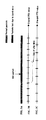
- FIGS. 3A, 3B and 3C are views provided for explaining an adaptive media play method according to an exemplary embodiment of the present invention.
- FIG. 4 is a block diagram illustrating the construction of a client according to an exemplary embodiment of the present invention.
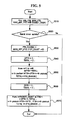
- FIG. 5 is a flowchart illustrating an algorithm for arranging packets so that play times of the packets are arranged at smaller intervals as a packet loss part becomes more distant;
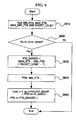
- FIG. 6 is a flowchart illustrating an algorithm for arranging packets so that play times of the packets are arranged at equal intervals
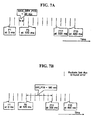
- FIG. 7A is a view illustrating a time interval in a normal video having no error
- FIG. 7B is a view illustrating a time interval in the event that a burst error occurs
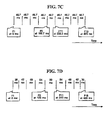
- FIG. 7C is a view illustrating a time interval after the method as illustrated in FIG. 6 is applied to the video as illustrated in FIG. 7B;
- FIG. 7D is a view illustrating a time interval after the method as illustrated in FIG. 5 is applied to the video as illustrated in FIG. 7B.
- the bit rate of a video stream is larger than an available bandwidth of a transmitter side, it should be reduced in the case of streaming an additional video stream. If a codec used to generate the video stream is scalable, it is easy to reduce the bit rate. Otherwise, a transcoding should be performed.
- the transcoding means a process of releasing a compressed video stream and then compressing the released video stream again. This transcoding, however, requires a high computing power.
- a method of selectively dropping the packets may be selected.
- the packets to be dropped should be properly selected so that the drop of the packets does not cause a great amount of distortion (i.e., a difference between the original video and the final video). Since the drop of intra-coded type packets causes a great distortion, it should be avoided if possible.
- the drop of the packets in succession until no transmission error occurs is more advantageous than the drop of the packets not in succession. If the server side performs the successive packet drop as described above, the client side will necessarily experience the burst error.
- Preferred embodiments of the present invention provide an efficient algorithm for dropping the packets in succession.
- An example of such an algorithm is shown in Table 1 below.
- 'PERCENTAGE_PACKET_DROP' i.e., percentage of packet drop
- this value is set to '5', it may be set so that the bandwidth of the video stream after the packet drop is performed coincides with the transmission bandwidth.
- 'iPacketCount' i.e., the number of packets
- 'iPacketDropCount' i.e., the number of packet drops
- the 'iPacketCount' is increased by '1', and one packet is extracted from the transmission buffer. If the 'iPacketDropCount' is not '0', it is continuously decreased.
- the present packet is transmitted. If n.o error occurs during the packet transmission, the process returns to the beginning of the while loop. If an error occurs during the packet transmission, the 'iPacketDropCount' is set to a value obtained by multiplying the present 'iPacketCount" by the percentage of packet drop, and the 'iPacketCount' is updated to '0'. By repeating the above-described processes, the packet drop can be adaptively performed.
- the transmission system if the transmission system is unable to transmit the packets, it starts the packet-dropping process. Since the transmission system does not attempt to transmit the packets during a packet-dropping period, it can take a sufficient time for recovering from the previous error (i.e., error due to the insufficient bandwidth or for other reasons).
- the transmission system may use 'WSASend()' that is a socket function call provided in MICROSOFT WINDOWSTM.
- the 'WSASend()' copies one packet (in the embodiment, a TS (Transport Stream) packet) into a socket buffer. If the socket buffer is full, the 'WSASend()' returns a SOCKET_ERROR value. Since the actual data transmission rate is lower than the ratio of data copy into the socket buffer, the socket buffer is easily full.
- a function named 'GetLastError()' returns a WSAEWOULDBLOCK value if an error occurs during the transmission. If the streaming system senses that it cannot transmit the packets, it applies a packet-dropping algorithm to the packets to be transmitted thereafter.
- the packet-dropping algorithm can be applied to various socket-based transmission mechanisms.
- the burst error occurs on the client side. Also, even if the server side transmits the whole video stream without dropping the packets, the burst error may occur according to the communication protocol or network environment.
- the errors may be classified into a burst error and a non-burst error.
- the burst error means an error that is kept for a fairly long time, and frequently occurs in a wireless network environment.
- Preferred embodiments of the present invention propose an adaptive media play method provided for the case in which the burst error occurs.
- the burst error may cause a stop of the video play on the client side. Accordingly, it is necessary to provide an adaptive media play method for concealing the burst error.
- FIGS. 3A to 3C are views provided for explaining an adaptive media play method according to an exemplary embodiment of the present invention.
- FIG. 3A shows an example of a video stream received on the client side if packets lost due to the burst error exist in succession
- FIG. 3B shows the original PTS values owned by the whole packets
- FIG. 3C shows the PTS values changed by applying the adaptive media play method thereto.
- a user may not recognize a little slow play, which may instantaneously be performed, if the burst error is not great. Also, although the user may recognize a slow play if the burst error is great, it is still more advantageous than the picture freezing that causes the user inconvenience.
- FIG. 4 is a block diagram illustrating the construction of a client according to an exemplary embodiment of the present invention.
- a client 400 reads video streams through a data-receiving unit 410.
- a video stream may appear in diverse forms, TS packets are taken as an example in the embodiment of the present invention.
- the data-receiving unit 410 may be implemented through a socket program.
- the TS packets read by the data-receiving unit 410 are demultiplexed through a demultiplexer 420 to become Elementary Stream (ES) packets.
- ES Elementary Stream
- Each of the ES packets includes video frame data and a Presentation Time Stamp (PTS) that is a time stamp for reporting a video play time.
- PTS Presentation Time Stamp
- the ES packets are temporarily stored in a FIFO buffer 440, and a PTS modification process is performed through a play timing modification unit 430. If a burst error occurs, i.e., if a gap of a play time more than a specified threshold value is produced, the play timing modification unit 430 reduces the gap by modifying the PTS of the ES packets existing in the FIFO memory 440.
- the PTS modification process will be explained later with reference to FIGS. 5 and 6.
- the ES packets which have passed the above-described modification process, are stored in the FIFO memory 440 again, and then input to a video decoder 450 in order.
- the video decoder 450 generates an output video by decoding the inputted ES packets.
- the respective constituent element may be defined as a module.
- the module means software or hardware constituent elements such as FPGA, ASIC and so on, and plays a specified role.
- the module is not limited to the software or hardware.
- the module may be constructed so as to be in a storage medium that can be addressed or to execute one or more processors.
- the module includes constituent elements such as software constituent elements, object-oriented software constituent elements, class constituent elements and task constituent elements, processes, functions, attributes, procedures, subroutines, segments of program codes, drivers, firmware, micro-codes, circuitry, data, databases, data structures, tables, arrays and variables.
- the constituent elements and functions provided in the modules may be combined together to form a smaller number of modules, or may be divided into additional modules.
- the modules may be implemented so as to execute one or more computers in a communication system.
- the PTS modification algorithm which is performed in the play timing modification unit 430, distributes and arranges the packets except for the packets stored in the FIFO buffer, i.e., the packets lost due to the burst error, if the burst error occurs.
- This packet distribution and arrangement method may be classified into a method of arranging the packets so that the packets are arranged at smaller time intervals as the part where the error occurs becomes far off, and a method of arranging the packet at equal intervals.
- the algorithm for arranging the packets at smaller intervals as the packet-loss part becomes far off is illustrated in FIG. 5.
- values of MIN_PTS, MAX_PTS, MAX_DIFF_PTS and PACKET_COUNT are found from the packets stored in the FIFO buffer of the video decoder (operation S510).
- the MIN _PTS value is a PTS value of the first packet stored in the first packet
- the MIN_PTS value is a PTS value of the last packet.
- the MAX_DIFF_PTS is a maximum difference between the PTS values of the adjacent packets, and if the PTSs of the packets are arranged at equal intervals, the MAX_DIFF_PTS value is equal to the equal interval.
- the PTS value becomes the MAX_DIFF_PTS value.
- the PACKET_COUNT means the number of packets stored in the present FIFO buffer.
- the value obtained by dividing the MAX_DIFF_PTS by (TOT_COUNT ⁇ 2) is defined as PTS_CHANGE (operation S530).
- the TOT_COUNT means the total number of packets in the event that no burst error occurs. That is, the TOT_COUNT is a value obtained by adding the PACKET_COUNT to the number of packets lost due to the burst error. The number of packets lost due to the burst error can be easily known by comparing the MAX_DIFF_COUNT with the PTS interval between the packets.
- n is a dummy value that indicates the order of the packet stored in the FIFO buffer 440.
- the forward correction routine includes the operations of updating the value obtained by adding the TOTAL to the DPTS as a new DPTS value, extracting the PTS value from the n-th packet and recording the value obtained by adding the updated DPTS to the PTS value as the PTS value of the n-th packet, and updating the value obtained by adding the PTS_CHANGE to the TOTAL as a new TOTAL.
- the DPTS and TOTAL values are set to '0' (operation. S560).
- the reverse correction routine includes the operations of updating the value obtained by adding the TOTAL to the DPTS as a new DPTS value, extracting the PTS value from the n-th packet and recording the value obtained by subtracting the updated DPTS from the PTS value as the PTS value of the n-th packet, and updating the value obtained by adding the PTS_CHANGE to the TOTAL as a new TOTAL.
- the routine is terminated.
- the method for arranging the packets at smaller intervals as the packet-loss part becomes far off can be implemented by rearranging the packets through other related equations.
- the algorithm for arranging the packets at equal intervals may be used. This algorithm is illustrated in FIG. 6.
- values of MIN_PTS, MAX_PTS, MAX_DIFF_PTS and PACKET_COUNT are found from the packets stored in the FIFO buffer of the video decoder (operation S610).
- the PTS_CHANGE is set to the value obtained by dividing the difference value between the MAX_PTS and the MIN_PTS by (PACKET_COUNT - 1) (step S630). Also, the initial value of the PTS is set to '0' (operation S640).
- An equal-interval correction routine is performed for a period from the first packet to the last packet among the packets stored in the FIFO buffer (operation S650).
- the equal-interval correction routine includes the operations of recording the present PTS value as the PTS value of the n-th packet, and updating the value obtained by adding the PTS_CHANGE to the present PTS value as a new PTS value. After the operation S650, the routine is terminated.
- FIGS. 7A to 7D arc views illustrating examples of the operations as shown in FIGS. 5 and 6.
- the number of packets in a normal video that has no error is 15, the time interval between the respective packets is 30 ms, and the first packet F1 is located at 0 ms. Accordingly, the last packet F15 is located at 420 ms.
- the value of MAX_DIFF_PTS increases as much as the lost period to become 180 ms. If the video is played in this state, the video is stopped for 180 ms after the fifth packet F5 is displayed, and then the video is played again from the eleventh packet F11 that is normally received. Accordingly, the viewer may see the picture-freezing phenomenon.
- the PTS values of the packets which exist adjacent to the part where the lost packets are located, arc modified through the adaptive media play method according to preferred embodiments of the present invention, and thus a picture changeover is performed smoothly.
- the results of arranging the packets at equal intervals and at unequal intervals are shown in FIGS. 7C and 7D.
- the packets are arranged at equal intervals, and the interval is 46.7 ms. Accordingly, for example, the PTS of F5 is modified to 186.7 ms, and the PTS of F11 is modified to 233.3 ms.
- the PTS of F5 is modified to 120 ms
- the PTS of F11 is modified to 240 ms.
- the quality of the video streaming is relatively improved in multimedia communications through a wireless or wire network.
- the present invention is suitable for a peer-to-peer communications of two devices connected in a wireless network. Also, the picture freezing phenomenon appearing when the burst error occurs can be efficiently removed.
- the video streams can be transmitted with the play time maintained using the burst packet drop in the event that the channel bandwidth is not sufficiently secured in the video stream server. That is, the present invention has the effect of providing a pseudo-scalability to the video streams being transmitted.
- Preferred embodiments of the present invention provides cheats for playing video stream, methods thereof and associated recording media that adaptively control the video play in accordance with variable communication environments and the size of the video stream to be transmitted.
Landscapes
- Engineering & Computer Science (AREA)
- Multimedia (AREA)
- Signal Processing (AREA)
- Computer Networks & Wireless Communication (AREA)
- Databases & Information Systems (AREA)
- Two-Way Televisions, Distribution Of Moving Picture Or The Like (AREA)
- Data Exchanges In Wide-Area Networks (AREA)
Applications Claiming Priority (2)
| Application Number | Priority Date | Filing Date | Title |
|---|---|---|---|
| KR1020040022980A KR100643270B1 (ko) | 2004-04-02 | 2004-04-02 | 비디오 스트림을 재생하는 클라이언트 및 재생 방법 |
| KR2004022980 | 2004-04-02 |
Publications (1)
| Publication Number | Publication Date |
|---|---|
| EP1585334A1 true EP1585334A1 (de) | 2005-10-12 |
Family
ID=34910080
Family Applications (1)
| Application Number | Title | Priority Date | Filing Date |
|---|---|---|---|
| EP05251840A Withdrawn EP1585334A1 (de) | 2004-04-02 | 2005-03-24 | Verfahren und Clientapparat zur Wiedergabe eines Videodatenstroms. |
Country Status (3)
| Country | Link |
|---|---|
| US (1) | US7602812B2 (de) |
| EP (1) | EP1585334A1 (de) |
| KR (1) | KR100643270B1 (de) |
Cited By (3)
| Publication number | Priority date | Publication date | Assignee | Title |
|---|---|---|---|---|
| WO2008002298A1 (en) * | 2006-06-27 | 2008-01-03 | Thomson Licensing | Admission control for performance aware peer-to-peer video-on-demand |
| WO2009154529A1 (en) * | 2008-06-16 | 2009-12-23 | Telefonaktiebolaget Lm Ericsson (Publ) | Media stream processing |
| CN104469373A (zh) * | 2014-12-09 | 2015-03-25 | 中国航空工业集团公司第六三一研究所 | 一种音视频编码芯片软件架构 |
Families Citing this family (17)
| Publication number | Priority date | Publication date | Assignee | Title |
|---|---|---|---|---|
| US8866915B2 (en) * | 2005-11-15 | 2014-10-21 | Lawrence Livermore National Security, Llc | High speed, real-time, camera bandwidth converter |
| US20070143729A1 (en) * | 2005-11-15 | 2007-06-21 | The Regents Of The University Of Ca | High speed camera bandwidth converter |
| JP2008005374A (ja) * | 2006-06-26 | 2008-01-10 | Mitsubishi Electric Corp | マルチストリーム対応マルチプレクサ及びデマルチプレクサシステム |
| US8020100B2 (en) | 2006-12-22 | 2011-09-13 | Apple Inc. | Fast creation of video segments |
| US7992097B2 (en) | 2006-12-22 | 2011-08-02 | Apple Inc. | Select drag and drop operations on video thumbnails across clip boundaries |
| US8943410B2 (en) | 2006-12-22 | 2015-01-27 | Apple Inc. | Modified media presentation during scrubbing |
| US8055779B1 (en) | 2007-05-10 | 2011-11-08 | Adobe Systems Incorporated | System and method using data keyframes |
| US9979931B2 (en) * | 2007-05-30 | 2018-05-22 | Adobe Systems Incorporated | Transmitting a digital media stream that is already being transmitted to a first device to a second device and inhibiting presenting transmission of frames included within a sequence of frames until after an initial frame and frames between the initial frame and a requested subsequent frame have been received by the second device |
| FR2916925B1 (fr) * | 2007-05-30 | 2009-07-17 | Alcatel Lucent Sas | Procede et dispositif de tamponnage de paquets de donnees transmis via une communication plesiochrone. |
| EP2302845B1 (de) | 2009-09-23 | 2012-06-20 | Google, Inc. | Verfahren und Vorrichtung zur Bestimmung eines Jitterpuffer-Niveaus |
| US8848746B2 (en) * | 2010-06-30 | 2014-09-30 | Vitesse Semiconductor Corporation | Packet protocol processing with precision timing protocol support |
| US8630412B2 (en) | 2010-08-25 | 2014-01-14 | Motorola Mobility Llc | Transport of partially encrypted media |
| US20120297405A1 (en) | 2011-05-17 | 2012-11-22 | Splendorstream, Llc | Efficiently distributing video content using a combination of a peer-to-peer network and a content distribution network |
| US20120320993A1 (en) * | 2011-06-14 | 2012-12-20 | Google Inc. | Apparatus and method for mitigating the effects of packet loss on digital video streams |
| US10158889B2 (en) * | 2015-01-31 | 2018-12-18 | Intel Corporation | Replaying old packets for concealing video decoding errors and video decoding latency adjustment based on wireless link conditions |
| US10602139B2 (en) * | 2017-12-27 | 2020-03-24 | Omnivision Technologies, Inc. | Embedded multimedia systems with adaptive rate control for power efficient video streaming |
| US12284416B2 (en) | 2020-02-04 | 2025-04-22 | Dolby International Ab | Method and device for adaptive playout of media content |
Citations (4)
| Publication number | Priority date | Publication date | Assignee | Title |
|---|---|---|---|---|
| US5652627A (en) * | 1994-09-27 | 1997-07-29 | Lucent Technologies Inc. | System and method for reducing jitter in a packet-based transmission network |
| EP0987894A2 (de) * | 1998-09-07 | 2000-03-22 | Victor Company Of Japan, Ltd. | Jitterkorrektion und Taktrückgewinnung für audiovisuelle Echtzeitnetzwerkanwendungen |
| US6247072B1 (en) * | 1998-01-27 | 2001-06-12 | Cisco Technology, Inc. | Real-time data rate matching across a medium |
| US20030212997A1 (en) * | 1999-05-26 | 2003-11-13 | Enounce Incorporated | Method and apparatus for controlling time-scale modification during multi-media broadcasts |
Family Cites Families (16)
| Publication number | Priority date | Publication date | Assignee | Title |
|---|---|---|---|---|
| US5726989A (en) * | 1995-11-06 | 1998-03-10 | Stellar One Corporation | Method for ensuring synchronization of MPEG-1 data carried in an MPEG-2 transport stream |
| JPH09298734A (ja) | 1996-04-30 | 1997-11-18 | Matsushita Electric Ind Co Ltd | ビデオオンデマンドシステム |
| US5767746A (en) * | 1996-06-07 | 1998-06-16 | David Sarnoff Research Center, Inc. | Method and apparatus for adjusting phase-lock-loop parameters |
| US6292834B1 (en) | 1997-03-14 | 2001-09-18 | Microsoft Corporation | Dynamic bandwidth selection for efficient transmission of multimedia streams in a computer network |
| US6101195A (en) | 1997-05-28 | 2000-08-08 | Sarnoff Corporation | Timing correction method and apparatus |
| US6188703B1 (en) * | 1997-08-01 | 2001-02-13 | International Business Machines Corp. | Multiplexer for multiple media streams |
| US7031306B2 (en) * | 2000-04-07 | 2006-04-18 | Artel Video Systems, Inc. | Transmitting MPEG data packets received from a non-constant delay network |
| KR100460529B1 (ko) | 2001-11-15 | 2004-12-08 | 박홍성 | 무선 데이터통신망에서 데이터 스트리밍을 위한 데이터 송수신 시스템 및 그 방법 |
| KR100511291B1 (ko) | 2002-03-22 | 2005-08-31 | 엘지전자 주식회사 | 무선통신에서의 영상신호 전송방법 |
| KR100453505B1 (ko) | 2002-04-03 | 2004-10-20 | 주식회사 케이티프리텔 | 무선 네트워크 클라이언트에서 스트리밍 데이터의 멀티비트 레이트 기능 제어 방법 및 그 장치 |
| JP3833571B2 (ja) * | 2002-05-28 | 2006-10-11 | 富士通株式会社 | データ復号器およびデータ復号化方法 |
| US7004018B2 (en) | 2002-08-27 | 2006-02-28 | Nissan Motor Co., Ltd. | Vehicle driving force control apparatus |
| US7953194B2 (en) * | 2002-09-27 | 2011-05-31 | Broadcom Corporation | Handling video transition errors in video on demand streams |
| FR2849328A1 (fr) * | 2002-12-20 | 2004-06-25 | St Microelectronics Sa | Procede et dispositif de synchronisation de la presentation de trames audio et/ou de trames video |
| MXPA05008404A (es) * | 2003-02-18 | 2005-10-05 | Nokia Corp | Metodo de codificacion de imagen. |
| US7298741B2 (en) * | 2003-02-27 | 2007-11-20 | Sharp Laboratories Of America, Inc. | Robust MPEG-2 multiplexing system and method using an adjustable time stamp |
-
2004
- 2004-04-02 KR KR1020040022980A patent/KR100643270B1/ko not_active Expired - Lifetime
-
2005
- 2005-03-24 EP EP05251840A patent/EP1585334A1/de not_active Withdrawn
- 2005-04-04 US US11/097,083 patent/US7602812B2/en not_active Expired - Fee Related
Patent Citations (4)
| Publication number | Priority date | Publication date | Assignee | Title |
|---|---|---|---|---|
| US5652627A (en) * | 1994-09-27 | 1997-07-29 | Lucent Technologies Inc. | System and method for reducing jitter in a packet-based transmission network |
| US6247072B1 (en) * | 1998-01-27 | 2001-06-12 | Cisco Technology, Inc. | Real-time data rate matching across a medium |
| EP0987894A2 (de) * | 1998-09-07 | 2000-03-22 | Victor Company Of Japan, Ltd. | Jitterkorrektion und Taktrückgewinnung für audiovisuelle Echtzeitnetzwerkanwendungen |
| US20030212997A1 (en) * | 1999-05-26 | 2003-11-13 | Enounce Incorporated | Method and apparatus for controlling time-scale modification during multi-media broadcasts |
Non-Patent Citations (2)
| Title |
|---|
| JINYONG JO ET AL: "Evaluation on the performance of adaptive playout for the multicast streaming of stored media", ICC 2003. 2003 IEEE INTERNATIONAL CONFERENCE ON COMMUNICATIONS. ANCHORAGE, AK, MAY 11 - 15, 2003, IEEE INTERNATIONAL CONFERENCE ON COMMUNICATIONS, NEW YORK, NY : IEEE, US, vol. VOL. 1 OF 5, 11 May 2003 (2003-05-11), pages 542 - 546, XP010642808, ISBN: 0-7803-7802-4 * |
| STEINBACH E ET AL: "Adaptive playout for low latency video streaming", 7 October 2001, PROCEEDINGS 2001 INTERNATIONAL CONFERENCE ON IMAGE PROCESSING. ICIP 2001. THESSALONIKI, GREECE, OCT. 7 - 10, 2001, INTERNATIONAL CONFERENCE ON IMAGE PROCESSING, NEW YORK, NY : IEEE, US, PAGE(S) 962-965, ISBN: 0-7803-6725-1, XP010565021 * |
Cited By (8)
| Publication number | Priority date | Publication date | Assignee | Title |
|---|---|---|---|---|
| WO2008002298A1 (en) * | 2006-06-27 | 2008-01-03 | Thomson Licensing | Admission control for performance aware peer-to-peer video-on-demand |
| CN101473651B (zh) * | 2006-06-27 | 2012-04-18 | 汤姆森特许公司 | 用于性能知晓对等视频点播的接纳控制 |
| US8856373B2 (en) | 2006-06-27 | 2014-10-07 | Thomson Licensing | Admission control for performance aware peer-to-peer video-on-demand |
| WO2009154529A1 (en) * | 2008-06-16 | 2009-12-23 | Telefonaktiebolaget Lm Ericsson (Publ) | Media stream processing |
| CN102067551B (zh) * | 2008-06-16 | 2014-04-16 | 艾利森电话股份有限公司 | 媒体流处理 |
| US8831402B2 (en) | 2008-06-16 | 2014-09-09 | Telefonaktiebolaget Lm Ericsson (Publ) | Media stream processing |
| CN104469373A (zh) * | 2014-12-09 | 2015-03-25 | 中国航空工业集团公司第六三一研究所 | 一种音视频编码芯片软件架构 |
| CN104469373B (zh) * | 2014-12-09 | 2018-02-09 | 中国航空工业集团公司第六三一研究所 | 一种音视频编码系统 |
Also Published As
| Publication number | Publication date |
|---|---|
| KR100643270B1 (ko) | 2006-11-10 |
| US20050232290A1 (en) | 2005-10-20 |
| KR20050097738A (ko) | 2005-10-10 |
| US7602812B2 (en) | 2009-10-13 |
Similar Documents
| Publication | Publication Date | Title |
|---|---|---|
| EP1585334A1 (de) | Verfahren und Clientapparat zur Wiedergabe eines Videodatenstroms. | |
| Jo et al. | Synchronized one-to-many media streaming with adaptive playout control | |
| US8300667B2 (en) | Buffer expansion and contraction over successive intervals for network devices | |
| US9426335B2 (en) | Preserving synchronized playout of auxiliary audio transmission | |
| CN100420250C (zh) | 通信设备操作方法、数据呈现方法和设备 | |
| JP4990762B2 (ja) | インターネットプロトコルに用いるストリーミングオーディオとストリーミングビデオとの同期保持 | |
| US7412149B2 (en) | Trick mode generation in video streaming | |
| JP4405689B2 (ja) | データ伝送 | |
| CN101594203B (zh) | 发送装置、发送方法和接收装置 | |
| US7881335B2 (en) | Client-side bandwidth allocation for continuous and discrete media | |
| US9350780B2 (en) | Insertion of graphic overlays into a stream | |
| US10638180B1 (en) | Media timeline management | |
| KR101350754B1 (ko) | 채널 변경 시간을 감소시키고 채널 변경 동안 오디오/비디오 콘텐츠를 동기화하는 방법 | |
| US20020154691A1 (en) | System and process for compression, multiplexing, and real-time low-latency playback of networked audio/video bit streams | |
| US20040049793A1 (en) | Multimedia presentation latency minimization | |
| JP2005523650A (ja) | オーディオおよびビデオストリームの同期のための装置および方法 | |
| CN101917613A (zh) | 一种流媒体采集编码服务系统 | |
| US20060140591A1 (en) | Systems and methods for load balancing audio/video streams | |
| CN115209163B (zh) | 数据处理方法、装置、存储介质及电子设备 | |
| JP5043096B2 (ja) | チャネル変更方法及びデジタル・ビデオ装置 | |
| JP2009512265A (ja) | ネットワーク上の動画データ伝送制御システムとその方法 | |
| JP2011511554A (ja) | ビデオデータをストリーミングするための方法 | |
| US20060161676A1 (en) | Apparatus for IP streaming capable of smoothing multimedia stream | |
| JP4255685B2 (ja) | 画像伝送方法および画像伝送装置 | |
| JP2006295645A (ja) | 特殊再生データ生成方法、配信装置及びビデオ再生システム |
Legal Events
| Date | Code | Title | Description |
|---|---|---|---|
| PUAI | Public reference made under article 153(3) epc to a published international application that has entered the european phase |
Free format text: ORIGINAL CODE: 0009012 |
|
| 17P | Request for examination filed |
Effective date: 20050415 |
|
| AK | Designated contracting states |
Kind code of ref document: A1 Designated state(s): AT BE BG CH CY CZ DE DK EE ES FI FR GB GR HU IE IS IT LI LT LU MC NL PL PT RO SE SI SK TR |
|
| AX | Request for extension of the european patent |
Extension state: AL BA HR LV MK YU |
|
| AKX | Designation fees paid |
Designated state(s): DE FR GB |
|
| STAA | Information on the status of an ep patent application or granted ep patent |
Free format text: STATUS: THE APPLICATION IS DEEMED TO BE WITHDRAWN |
|
| 18D | Application deemed to be withdrawn |
Effective date: 20091001 |