EP0988157B1 - Verfahren zum herstellen und zum prüfen eines sicherheitspapiers - Google Patents
Verfahren zum herstellen und zum prüfen eines sicherheitspapiers Download PDFInfo
- Publication number
- EP0988157B1 EP0988157B1 EP98925816A EP98925816A EP0988157B1 EP 0988157 B1 EP0988157 B1 EP 0988157B1 EP 98925816 A EP98925816 A EP 98925816A EP 98925816 A EP98925816 A EP 98925816A EP 0988157 B1 EP0988157 B1 EP 0988157B1
- Authority
- EP
- European Patent Office
- Prior art keywords
- security
- thread
- article
- security article
- exposed
- Prior art date
- Legal status (The legal status is an assumption and is not a legal conclusion. Google has not performed a legal analysis and makes no representation as to the accuracy of the status listed.)
- Expired - Lifetime
Links
Images

Classifications
-
- B—PERFORMING OPERATIONS; TRANSPORTING
- B42—BOOKBINDING; ALBUMS; FILES; SPECIAL PRINTED MATTER
- B42D—BOOKS; BOOK COVERS; LOOSE LEAVES; PRINTED MATTER CHARACTERISED BY IDENTIFICATION OR SECURITY FEATURES; PRINTED MATTER OF SPECIAL FORMAT OR STYLE NOT OTHERWISE PROVIDED FOR; DEVICES FOR USE THEREWITH AND NOT OTHERWISE PROVIDED FOR; MOVABLE-STRIP WRITING OR READING APPARATUS
- B42D25/00—Information-bearing cards or sheet-like structures characterised by identification or security features; Manufacture thereof
- B42D25/30—Identification or security features, e.g. for preventing forgery
- B42D25/355—Security threads
-
- B—PERFORMING OPERATIONS; TRANSPORTING
- B42—BOOKBINDING; ALBUMS; FILES; SPECIAL PRINTED MATTER
- B42D—BOOKS; BOOK COVERS; LOOSE LEAVES; PRINTED MATTER CHARACTERISED BY IDENTIFICATION OR SECURITY FEATURES; PRINTED MATTER OF SPECIAL FORMAT OR STYLE NOT OTHERWISE PROVIDED FOR; DEVICES FOR USE THEREWITH AND NOT OTHERWISE PROVIDED FOR; MOVABLE-STRIP WRITING OR READING APPARATUS
- B42D15/00—Printed matter of special format or style not otherwise provided for
-
- B—PERFORMING OPERATIONS; TRANSPORTING
- B42—BOOKBINDING; ALBUMS; FILES; SPECIAL PRINTED MATTER
- B42D—BOOKS; BOOK COVERS; LOOSE LEAVES; PRINTED MATTER CHARACTERISED BY IDENTIFICATION OR SECURITY FEATURES; PRINTED MATTER OF SPECIAL FORMAT OR STYLE NOT OTHERWISE PROVIDED FOR; DEVICES FOR USE THEREWITH AND NOT OTHERWISE PROVIDED FOR; MOVABLE-STRIP WRITING OR READING APPARATUS
- B42D25/00—Information-bearing cards or sheet-like structures characterised by identification or security features; Manufacture thereof
- B42D25/30—Identification or security features, e.g. for preventing forgery
- B42D25/36—Identification or security features, e.g. for preventing forgery comprising special materials
- B42D25/373—Metallic materials
-
- B—PERFORMING OPERATIONS; TRANSPORTING
- B42—BOOKBINDING; ALBUMS; FILES; SPECIAL PRINTED MATTER
- B42D—BOOKS; BOOK COVERS; LOOSE LEAVES; PRINTED MATTER CHARACTERISED BY IDENTIFICATION OR SECURITY FEATURES; PRINTED MATTER OF SPECIAL FORMAT OR STYLE NOT OTHERWISE PROVIDED FOR; DEVICES FOR USE THEREWITH AND NOT OTHERWISE PROVIDED FOR; MOVABLE-STRIP WRITING OR READING APPARATUS
- B42D25/00—Information-bearing cards or sheet-like structures characterised by identification or security features; Manufacture thereof
- B42D25/30—Identification or security features, e.g. for preventing forgery
- B42D25/36—Identification or security features, e.g. for preventing forgery comprising special materials
- B42D25/378—Special inks
- B42D25/382—Special inks absorbing or reflecting infrared light
-
- B—PERFORMING OPERATIONS; TRANSPORTING
- B42—BOOKBINDING; ALBUMS; FILES; SPECIAL PRINTED MATTER
- B42D—BOOKS; BOOK COVERS; LOOSE LEAVES; PRINTED MATTER CHARACTERISED BY IDENTIFICATION OR SECURITY FEATURES; PRINTED MATTER OF SPECIAL FORMAT OR STYLE NOT OTHERWISE PROVIDED FOR; DEVICES FOR USE THEREWITH AND NOT OTHERWISE PROVIDED FOR; MOVABLE-STRIP WRITING OR READING APPARATUS
- B42D25/00—Information-bearing cards or sheet-like structures characterised by identification or security features; Manufacture thereof
- B42D25/30—Identification or security features, e.g. for preventing forgery
- B42D25/36—Identification or security features, e.g. for preventing forgery comprising special materials
- B42D25/378—Special inks
- B42D25/387—Special inks absorbing or reflecting ultraviolet light
-
- B42D2035/24—
Definitions
- the invention is concerned with security articles such as cheque guarantee cards, identification cards and the like and such as security paper including bank notes, cheques and the like.
- the present invention also relates to a method of manufacture of security articles and a method of verifying the authenticity of the security article.
- banknotes security threads which are made from a transparent film provided with a continuous reflective metal layer, vacuum deposited aluminium on polyester film being the commonest example.
- Banknotes made from such paper have been in general circulation in many countries for many years.
- British patent specification nos. GB-A-1552853 and GB-A-1604463 describe use of a security thread in a security paper with the thread exposed on one side of the security paper at intervals along the length of the thread, the regions of exposure being referred to as windows.
- the original purpose of providing windows was to produce a strong public security feature (i.e., a security feature readily identified by the general public) which presented a sharp contrast in appearance when viewed in reflected light as opposed to when viewed in transmitted light.
- the security thread appeared as a continuous dark line.
- the portions of the thread visible at the windows appeared silver.
- the windowed thread provided good protection against photocopying because when a bank note with windowed thread is photocopied, the reflective silver surfaces appearing in the windows appear black in the photocopy, because of the reflected light.
- threads have been produced which are laminates of two metallised polyester plies with magnetic material incorporated between them. Some threads have been produced which are in parts demetallised, so that alphanumeric characters, for instance, can be viewed on the thread in transmitted light. Some threads have been produced which change colour with temperature. Some security threads have been produced which have holographic images. Some security threads have been produced which fluoresce under ultra-violet or infra-red light and some of these threads have been produced with alphanumeric characters shown by demetallised portions.
- the aim of incorporating the windowed thread in the bank note was to present a highly reflective image in regions on one face of the bank note, this image being a very noticeable public security feature and also a feature to prevent photocopying.
- the present invention provides a security article having first and second surfaces and a security thread having a first part located between the first and second surfaces and a second part exposed in a window provided in the first surface, the security thread comprising means providing at least one non- public security feature which enables verification of authenticity of the security article and which is not visually detectable when the security thread is exposed only to electro-magnetic radiation in the visible spectrum, wherein the exposure of the second part of the security thread in the window on the first surface enhances detection of the non-public security feature by providing a readily accessible portion of the security thread, characterised in that the whole of the part of the security thread exposed in the window in the first surface has a matt non-reflective appearance and closely matches in colour a portion of the first surface surrounding the window, whereby when the first surface is viewed in reflected light in the visible spectrum the exposed part of the security thread is unobtrusive and does not form a visually striking feature of the appearance of the security article in reflected light in the visible spectrum.
- the present invention has departed from accepted teaching by providing a windowed thread which is not a readily apparent public security feature in reflected light. Since the windowed thread is not readily apparent in reflected light, it does not provide the protection against photocopying which was a prime aim of the previous windowed threads.
- the non-public security feature could be a feature for recognition by a trained inspector or cashier, e.g. using ultra-violet light.
- the non-public security feature is a machine-measurable security feature and the exposure of the second part of the security thread in the window enhances measurement of the machine-measurable security feature.
- a windowed thread is advantageous in presenting a machine-readable element on the surface of, for instance, a bank note, where the security thread is readily accessible to an appropriate detector.
- security threads have not been visible in reflected light, they have been embedded totally within a bank note and then machine-readable features included in the security thread.
- use of a machine-readable luminescent layer on a magnetic thread is disclosed in GB-A-1585533, on fully embedded thread.
- the full embedding of the threads means that the embedded.
- the security article comprises material which allows transmission of light between the first and second surfaces and the security thread is visible in such transmitted light.
- the thread of the present invention can be seen in the security article as an immediately apparent strong continuous line in transmitted light.
- the security article again comprises material which allows transmission of light between the first and second surfaces, but the security thread is nearly transparent and is not readily visible in transmitted light.
- the non-public security feature could be detected by exposing the second exposed part of the security thread to electromagnetic radiation outside of the visible spectrum.
- the detection could be facilitated by the security thread emitting electromagnetic radiation on exposure to the non-visible electromagnetic radiation.
- the emitted radiation could be electromagnetic radiation in the visible region of the electromagnetic spectrum.
- the surface of the security thread exposed in the window has a gloss of 50 units or less as measured by a 60° glossmeter.
- a multi-angle glossmeter could be used to measure the gloss, in which case the measured gloss would preferably be 10 units or less at 20°, 50 units or less at 60° and 120 units or less at 75°.
- the surface of the security thread exposed in the window has a specular reflectance of 5.0% or less as measured by a spectrophotometer operating in a range of 400-700nm of electromagnetic radiation.
- the security article of the present invention has a security thread which comprises a metallised polymeric substrate coated at least in the exposed portion with a matt coating obscuring the metal in the thread.
- the matt coating renders the thread substantially non-reflective.
- the metallised polymeric substrate is opaque.
- the matt coating on the thread is luminescent and provides the non-public security feature of the security thread by emitting measurable light when exposed to ultra-violet radiation.
- a metallised polyester thread could be covered with a matt pale yellow coating on the top surface (in practice on both surfaces so the thread need not be oriented during manufacture, although use of a top coating only is an option).
- the thread presents a machine-readable element on the surface of the note which is readily accessible to an appropriate detector.
- the coating is luminescent and the machine authentication involves exciting the luminescent coating with appropriate wavelengths of ultra-violet light and measuring the subsequent emitted light. Although in principle such detection would be possible with an embedded thread, there is a great practical advantage in using a windowed thread in that the intensity of stimulating light reaching the target and the intensity of emitted light from the target is much greater without the overlying absorbing region of fibre.
- the thread with its matt pale yellow coating is relatively unobtrusive and this is particularly true once the paper has been over-printed.
- the coating matches fairly closely the colour of the bank note paper and once the bank note is printed the windows in the paper become quite difficult to see except at certain angles where some specular reflection occurs from the surface of the thread.
- the luminescent material in the security thread emits light in response to infra-red radiation.
- the luminescent material can provide infra-red radiation stimulated Anti-Stokes luminescence.
- the means providing at least one non-public security feature comprises an infra-red absorbent material which is provided in a chosen pattern on the security thread on at least the second part of the security thread exposed in the window, the chosen pattern being machine detectable when the security article is exposed to infra-red radiation.
- the infra-red absorbent material is coated with a layer of infra-red transparent material, the infra-red transparent material having a colour which matches the portion of the first surface surrounding the window.
- the security thread comprises thermoluminescent material at least in the second exposed part and the thermoluminescent material provides the non-public security feature.
- the security thread comprises triboluminescent material at least in the second exposed part and the triboluminescent material provides the non-public security feature.
- the security article has a thread which has first and second luminescent materials with different characteristics provided on the security thread which together form the means providing at least one non-public security feature, the first and second luminescent materials having a similar appearance and colour when exposed solely to visible light.
- the first and second luminescent materials can emit light of two different wavelengths and/or the two different materials can have phosphorescent decay half lives which are different. These parameters can be measured by machine.
- first and second luminescent materials are provided in a chosen pattern in the security thread.
- the security thread comprises a material provided in the security thread which reflects infra-red radiation, the infra-red reflecting material being present in the security thread in the exposed portion thereof and thereby forming the means providing at least one non-public security feature.
- the means providing the at least one non-public security feature can comprise infra-red absorbent material provided in the security thread at least in the exposed portion thereof.
- the means providing at least one non-public security feature in the security thread comprises ultra-violet reflecting material providing in the security thread at least in the exposed portion thereof.
- the means providing at least one non-public security feature could comprise ultra-violet absorbent material provided in the security thread at least in the exposed portion thereof.
- a graphic design is applied to the first surface of the security article, the graphic design being applied to extend over and at least partially obscure the exposed part of the security thread.
- the present invention has as one of its advantages the fact that it frees up space on the surface of, for instance, a bank note for print designs, foils and holograms.
- the designer of a bank note had to consider the windows in the bank note when making his design, he can now consider the windows in the bank note surface as being continuous with the bank note surface and can create graphic designs which extend over the window, provided that the design does not completely obscure the window with an ink which blocks the absorption, stimulation or emission of radiation required to determine the presence of the security thread.
- the windows in the bank note are further obscured and are made less detectable.
- the security article is a security paper such as a bank note
- the graphic design is printed on the first surface of the security paper with the exposed part of the security thread being at least partly over- printed.
- the exposed part of the security thread would closely match in colour with the surrounding paper.
- the exposed part of the security thread could closely match the colour of print on the surrounding paper.
- the present invention provides a method of manufacture of the security article described above comprising, in any order, the steps of:
- the step of selecting the colour of the exposed portion comprises selecting a coloured coating for the substrate, which colour coating is applied to the substrate to provide the colour of the surface of the exposed part of the security thread.
- the present invention provides various methods of verifying the authenticity of the security articles mentioned above. These methods variously include:
- FIG. 1 there can be seen a bank note 10 according to a first embodiment of the present invention.
- the Figure shows the bank note 10 viewed in reflected light.
- the bank note 10 is printed over the whole of the surface of the bank note shown with a graphic design which comprises the numeral 2,000, two stripes and a human head in profile.
- the bank note 10 comprises a security thread 11 which can be seen as a striking, immediately apparent, strong continuous line when the bank note 10 is viewed in transmitted light as seen in Figure 2.
- the surface of the bank note 10 illustrated in Figures 1, 2 and 3 in fact comprises four windows 12, 13, 14 and 15. In these windows the thread 11 is exposed, but between these windows the thread 11 lies between the top surface 16 of the bank note 10 and a bottom surface 17 of the bank note 10 (see Figure 4).
- the security thread 11 has the four windows 12, 13, 14 and 15 in which the security thread 11 is exposed.
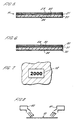
- the security thread 11 comprises in one embodiment (see Figure 5) a polyester substrate 20 which is metallised with a metallic layer 21. Covering the metallic layer 21 is a matt pale yellow coating 22. A final external coating of transparent colourless adhesive 23 is applied over the top of the matt pale yellow coating to provide some protection to the thread and to aid and ease manufacture. A coating 24 of transparent colourless adhesive 23 is also applied to the bottom surface of the security thread 11.
- the matt pale yellow coating 22 matches fairly closely the appearance of the bank note paper 18 surrounding the security thread 11. Thus, the parts of the security thread visible in the windows 12, 13, 14 and 15 become quite difficult to see in reflected light, except at certain angles when some specular reflection occurs from the adhesive external coating of the security thread.
- FIG 1 the illustration of the bank note 10 shows that the windows 12, 13, 14 and 15 are not visible in reflected light.
- the portions of the thread 11 visible in the windows 12, 13, 14 and 15 are even less visible when the bank note paper 18 is over printed with a graphic design, as illustrated in Figure 1.
- the bank note is provided with a surprising optical effect in that the general public will be generally unaware of the presence of a security thread in the bank note 10 until the bank note 10 is held up to a light, when the security thread becomes visible as a dark continuous line as can be seen in Figure 2.
- the security thread 11 presents a machine readable element on the surface of the bank note 10 where it is exposed by the windows 12, 13, 14 and 15.
- the security thread 11 is readily accessible to an appropriate machine detector at the windows 12, 13, 14 and 15.
- the matt pale yellow coating comprises luminescent material and the machine authentication involves exciting the luminescent coating with appropriate wavelengths of ultra-violet light and then measuring the subsequent emitted light.
- the machine authentication involves exciting the luminescent coating with appropriate wavelengths of ultra-violet light and then measuring the subsequent emitted light.
- the bank note 10 provides a new way of utilising windowed thread technology.
- windowed thread technology was used for public identification purposes primarily, now the windowed thread is used primarily for machine authentication purposes and the public effect in reflected light thought so important with existing windowed thread technology is deliberately avoided.
- the bank note of the present invention frees up space on the note surface for the printing of designs and for the affixing of foils and holograms.
- the bank note at the same time also maximises the signal available from a machine readable layer in or on the security thread 11.
- the bank note 10 also includes what becomes an unexpected effect for the general public in that the security thread 11 can be readily perceived in transmitted light.
- the matt coating is applied over the entirety of one surface of the security thread 11, in fact the matt coating could be applied selectively only in those portions which are to be exposed in the windows 12, 13, 14 and 15.
- the coating material 22 is provided on only one side of the polyester substrate 20, the polyester substrate 20 could be provided with the matt coating on both sides and with adhesive top coatings on both sides, in order that the thread need not be oriented to one side only before being embedded in paper stock in the manufacture of the bank note.
- the manufacture of the bank note 10 would follow the steps usual in producing windowed thread bank notes, except that the method would have the additional steps of providing a matt non-reflective surface finish on at least those portions of the security thread which will be exposed in the final bank note and the method includes the step of selecting the matt coating with a colour which matches the colour of the bank note paper.
- the colour of the matt coating is chosen to match the colour of surrounding paper
- the colour of the coating could be chosen to match the colour of ink printed on the regions of the paper surrounding the windows in the paper.
- the security thread 11 is provided with a machine measurable parameter by the use of luminescent material in the matt coating 22, other machine measurable parameters could be used.
- infra-red stimulated Anti-Stokes luminescent material could be used in or on the security thread at least in those portions exposed in the windows 12, 13, 14 and 15, which luminescence could then be detected by a suitable authentication machine.
- the coating 22 could be provided with infra-red reflecting or absorbing material, with the method of authentication of the bank note then comprising analysis of the reflection/absorption of infra-red radiation by the security thread in the bank note.
- ultra-violet reflecting/absorbing material could be used in the security thread 11 and then the bank note 10 irradiated with ultra-violet radiation and the reflection/absorption characteristics monitored for when verifying the authenticity of the bank note.
- thermoluminescent material could be used in the coating and this material would emit light when heated (e.g. through exposure to infra-red radiation). It is also possible to use triboluminescent material and excite the material by applying a mechanical force.
- the polyester substrate 20 is metallised and covered with a metallic layer 21 and is then covered with the infra-red absorbent material 30 which is printed in a characteristic pattern, e.g., in alphanumeric characters.
- the infra-red absorbent material 30 is then covered with an overlying overcoat 31 of an infra-red transparent material of a visible colour closely matching the colour of the surrounding bank note paper or print on the paper.
- the infra-red transparent material would be covered with two coats 23 and 24 of transparent colourless adhesive for protection purposes.
- the infra-red absorbent material could for instance be printed in the numerals 2,000 and in Figure 7 there can be seen an image of a part of a bank note showing a window 12 in which the exposed part of the security thread 11 is printed with infra-red absorbent material in the numerals 2,000, the image shown in Figure 7 then being obtainable by use of suitable infra-red detecting apparatus.
- a security thread can be printed with a characteristic pattern by using two or more inorganic luminescent materials of similar appearance/colour in visible light, but which emit light of different wavelengths and/or are excited by different wavelengths of excitation light and/or have different phosphorescent decay half-lives.
- the appearance/ colour of the luminescent materials in visible light will be chosen to match the parts of the bank notes surrounding the windows.
- the materials could be printed with a pattern showing alphanumeric characters, e.g., the numerals 2,000 as shown in Figure 7.
- the luminescent pattern is machine detectable, but could also be observed by a human observer.
- FIG 8 there can be seen a schematic drawing showing apparatus for use in the methods of authenticating bank note 10.
- An irradiator 40 is used to irradiate bank note 10 with, for instance, ultra-violet or infra-red radiation and the detector 41 then detects what light is emitted from and/or ultra-violet radiation and/ or infra-red radiation is reflected from the surface of the bank note 10.
- the detector 41 will then enable determination of either the luminescent characteristics of material in the security thread in the bank note 10, the infra-red or ultra-violet reflecting characteristics of the security thread in the bank note 10 and/or the infra-red or ultra-violet absorbing characteristics of the security thread in the bank note 10.
- the bank note 10 is only one example of a security article for which the present invention is applicable.
- the present invention could be used for credit cards and debit cards, with the security thread (which terms for the purpose of this specification and claims will be interpreted as encompassing the term security strip, commonly used for cards as opposed to bank notes) partially embedded in a plastic material typically, with portions exposed at one surface.
- security article can also include any form of security paper, for instance cheques and travellers' cheques, bond documents, mortgage documents, in addition to standard bank notes used in currency.
- the exposed portions of the security thread 11 could have a colour which matches the colour at the surrounding material of the security article (e.g. paper, plastics) or the colour of the printing on the portions of surface of the security article surrounding the exposed portions.
- a roll of polyester was vacuum-metallised with aluminium to a metal thickness of approximately 30 nm.
- a coating comprising an inorganic phosphor, e.g. copper-doped zinc sulphide (copper:zinc sulphide ratio between 50 and 100 parts per million) dispersed in an organic binder at a proportion of 15% phosphor:binder by weight was applied to both surfaces of the metallised polyester to a dry coating thickness of 5 microns.
- a further organic protective coat and/or adhesive layer was applied over one or both sides of the phosphor coated metallised film.
- the film was then mechanically reduced by known means to form security threads in the width range typically 0.5 -4.0 mm.
- the security threads were then incorporated into banknote paper by the known technique described in EP-A-0059056 to form a windowed security thread.
- the paper was then printed, cut and issued as banknotes.
- the coating has a pale yellow colour in daylight which closely matches that of the paper into which the thread is incorporated.
- the threads and the coated film from which the threads are cut have a matt appearance.
- the matt appearance of the coated film was characterised by one of several techniques as follows:-
- the coating Under stimulation by UV light at a wavelength of 366 nm, the coating emitted green light.
- Other phosphors may be used, e.g. manganese-doped zinc sulphide, which emits orange light and silver-doped zinc sulphide which emits blue light.
- the banknotes were carried by a transport path through a detection unit comprising a UV light source and optical filter tuned to the emission wavelength of the doped zinc sulphide and an appropriate photodetector.
- a dispersion of magnetic material (gamma ferric oxide) in an organic binder was coated to a dry film thickness of 5 ⁇ m onto the metallised surface of a vacuum aluminised 12 ⁇ m thick polyester.
- a second ply of vacuum aluminised 12 ⁇ m polyester was laminated to the first ply such that both aluminium layers and the magnetic layer were internal to the laminate.
- a coating of luminescent material comprising copper-doped zinc sulphide in an organic binder was applied to each side of the laminate, to a dry thickness of 5 ⁇ m. The film was then adhesive-coated on both sides and processed as described in Example 1. During subsequent used note sorting operations, both the phosphorescent emission and magnetic content of the security thread were measured according to known techniques by appropriate detectors fitted to the sorting machine transport path.
- a layer of copper-doped zinc sulphide pigment incorporated into an organic binder at a proportion of 5% by weight was coated to a dry thickness of 2 ⁇ m onto transparent 12 ⁇ m polyester.
- a layer of transparent adhesive was applied to each side to a dry thickness of 4 ⁇ m and the film converted to security threads as described in Example 1. In contrast to the devices described in Examples 1 and 2, this thread is semitransparent and not readily apparent in the finished article when viewed in transmitted light.
- the presence of the luminescent coating may be determined by a machine, as described in Example 1, or by a human observer when the luminescent component is excited by placing the article under a source of UV light or between a source of UV light and the observer.
- Example 1 As Example 1, except that two different doped zinc sulphide phosphors were incorporated into the organic binder in equal proportions to produce a combined weight of 15% pigment:binder. In use, the different phosphors emitted different wavelengths of light which were detected by photo-detectors fitted with appropriate narrow band optical filters tuned to the emission wavelengths of the two phosphors.
- a security thread was prepared as described in Example 4 except that in this instance phosphors with different half-life decay times were used. To authenticate banknotes incorporating the thread, measurements were made of the different decay properties of the two phosphors.
- Example 1 As Example 1, except that a different zinc phosphor was used with a pale blue colour in visible light, chosen to match the colour of the surrounding ink in the finished banknote prepared from the paper incorporating the security thread.
- Example 1 As Example 1, except that a fluorophor was used instead of an inorganic phosphor as the luminescent pigment. A fluorescence rather than phosphorescence detector was then used to authenticate the banknote on the sorting machine transport system.
- Example 3 except that a lightly coloured IR absorbing pigment, e.g. substituted chloro copper pH Halo cyanine, trade name PROJECT 900NP from the Zeneca company, was incorporated into an organic binder at proportion of 5% pigment binder and used for the coating over the transparent polyester to a dry coating thickness of 2 microns.
- a lightly coloured IR absorbing pigment e.g. substituted chloro copper pH Halo cyanine, trade name PROJECT 900NP from the Zeneca company
- measurement was made of the IR peak of 890nm absorption due to the pigment which contrasted sharply with the IR transmission of the surrounding areas of the security article.
- Example 1 As Example 1, except that an Anti-Stokes pigment such as yttrium oxysulphide was incorporated into the binder in place of the zinc sulphide phosphor at a concentration of 30% pigment:binder and applied at a dry coating thickness of 2 microns. To authenticate the finished banknote, it was placed under a source of IR radiation at 970nm which excited the Anti-Stokes compound which then emitted green light at a wavelength of 540nm discernible to a human observer.
- an Anti-Stokes pigment such as yttrium oxysulphide
- thermoluminescent pigment was incorporated into the binder instead of the zinc sulphide phosphor.
- the security article was heated by an IR source or other heat source and the thermoluminescent material emitted visible light which was detected by a photo-detector equipped with a suitable narrow band optical filter.
- a manganese-doped zinc sulphide phosphor (manganese content 3000 parts per million) was dispersed in an organic binder at a proportion of 30% pigment:binder and coated onto one side of a 12 micron metallised polyester film to produce a triboluminescent coating.
- the other side of the film was coated with an adhesive and the film reduced by mechanical means to dimensions suitable for a banknote security thread, e.g. 1-4mm.
- the thread was inserted into paper according to the process described in EP 0059056 such that the side of the film coated with the phosphor and binder was exposed in the window regions.
- the paper was then printed, cut and issued as banknotes.
- the colour of the ink in the window region of the banknote was selected to match closely that of the phosphor/binder coating such that the presence of the windowed security thread was not readily discernible in reflected light.
- the phosphor coating was stimulated by mechanical action such as rubbing or pressing the surface with a hard transparent plastic rod.
- the phosphor exhibited triboluminescent properties and emitted visible light which was discernible to the human eye.
Landscapes
- Credit Cards Or The Like (AREA)
- Inspection Of Paper Currency And Valuable Securities (AREA)
- Paper (AREA)
- Investigating Materials By The Use Of Optical Means Adapted For Particular Applications (AREA)
Claims (48)
- Sicherheitsgegenstand, der erste und zweite Oberflächen und einen Sicherheitsfaden aufweist, der einen ersten Abschnitt aufweist, der zwischen den ersten und zweiten Oberflächen liegt und einem zweiten Abschnitt, der in einem Fenster offenliegt, das in der ersten Oberfläche vorgesehen ist, und der Sicherheitsfaden Vorrichtungen aufweist, die wenigstens ein nichtöffentliches Sicherheitsmerkmal vorsehen, das die Nachprüfung der Echtheit des Sicherheitsgegenstandes ermöglicht und das nicht visuell erkennbar ist, wenn der Sicherheitsgegenstand nur mit elektromagnetischer Strahlung im sichtbaren Spektrum bestrahlt wird, wobei die Offenlegung vom zweiten Abschnitt des Sicherheitsfadens im Fenster in der ersten Oberfläche die Erkennung des nicht-öffentlichen Sicherheitsmerkmals durch Vorsehen eines leicht zugänglichen Abschnittes des Sicherheitsfadens erhöht,
gekennzeichnet dadurch, daß der ganze Abschnitt des Sicherheitsfadens, der im Fenster in der ersten Oberfläche offengelegt ist, ein mattes, nicht reflektierendes Erscheinen hat und in der Farbe genau mit einem Abschnitt der ersten Oberfläche, der das Fenster umgibt, zusammenpasst, wobei, wenn die erste Oberfläche in reflektiertem Licht des sichtbaren Spektrums betrachtet wird, der offenliegende Abschnitt des Sicherheitsfadens unauffällig ist und kein visuell auffälliges Merkmal der Erscheinung des Sicherheitsgegenstandes in reflektiertem Licht des sichtbaren Spektrums bildet. - Sicherheitsgegenstand wie in Anspruch 1 beansprucht, wobei wenigstens ein nichtöffentliches Sicherheitsmerkmal ein maschinenmeßbares Sicherheitsmerkmal ist, und das Offenlegen des zweiten Abschnittes des Sicherheitsfadens im Fenster die Messung des maschinenmeßbaren Sicherheitsmerkmals verbessert.
- Sicherheitsgegenstand wie in Anspruch 1 oder Anspruch 2 beansprucht, der Material aufweist, das Lichtübertragung zwischen den ersten und zweiten Oberflächen ermöglicht, und wobei der Sicherheitsfaden in dem durchgelassenen Licht sichtbar ist.
- Sicherheitsgegenstand wie in Anspruch 1 oder Anspruch 2 beansprucht, welcher Material aufweist, das Lichtübertragung zwischen den ersten und zweiten Oberflächen ermöglicht und wobei der Sicherheitsfaden fast transparent ist und in durchgelassenem Licht nicht leicht sichtbar ist.
- Sicherheitsgegenstand wie in einem der vorhergehenden Ansprüche beansprucht, wobei das nichtöffentliche Sicherheitsmerkmal erkannt wird, indem der zweite offengelegte Abschnitt des Sicherheitsfadens elektromagnetischer Strahlung außerhalb des sichtbaren Spektrums ausgesetzt wird.
- Sicherheitsgegenstand wie in Anspruch 5 beansprucht, wobei der Sicherheitsfaden elektromagnetische Strahlung ausstrahlt, wenn er der elektromagnetischen Strahlung außerhalb des sichtbaren Spektrums ausgesetzt ist.
- Sicherheitsgegenstand wie in Anspruch 6 beanspucht, wobei die abgegebene elektromagnetische Strahlung im sichtbaren Bereich des elektromagnetischen Spektrums ist.
- Sicherheitsgegenstand wie in einem der vorhergehenden Ansprüche beansprucht, wobei die im Fenster in der ersten Oberfläche des Sicherheitsgegenstandes offengelegte Oberfläche des Sicherheitsfadens einen Glanz von 50 oder weniger Einheiten, gemessen mit einem 60° Glanzmesser, aufweist.
- Sicherheitsgegenstand wie in einem der vorhergehenden Ansprüche beansprucht, wobei die im Fenster in der ersten Oberfläche des Sicherheitsgegenstandes offengelegte Oberfläche des Sicherheitsfadens einen Glanz von 10 oder weniger Einheiten aufweist, wie mit einem mehrwinkligen Glanzmesser, der bei 20° arbeitet, gemessen wurde.
- Sicherheitsgegenstand wie in einem der vorhergehenden Ansprüche beansprucht, wobei die im Fenster in der ersten Oberfläche des Sicherheitsgegenstandes offengelegte Oberfläche des Sicherheitsfadens einen Glanz von 50 oder weniger Einheiten aufweist, wie mit einem mehrwinkligen Glanzmesser, der bei 60° arbeitet, gemessen wurde.
- Sicherheitsgegenstand wie in einem der vorhergehenden Ansprüche beansprucht, wobei die im Fenster in der ersten Oberfläche des Sicherheitsgegenstandes offengelegte Oberfläche des Sicherheitsfadens einen Glanz von 120 oder weniger Einheiten aufweist, wie mit einem mehrwinkligen Glanzmesser, der bei 75° arbeitet, gemessen wurde.
- Sicherheitsgegenstand wie in einem der vorhergehenden Ansprüche beansprucht, wobei die im Fenster in der ersten Oberfläche des Sicherheitsgegenstandes offengelegte Oberfläche des Sicherheitsfadens ein Spiegel-Rückstrahlungsvermögen von 5,0 % oder weniger aufweist, wie mit einem Spektralphotometer gemessen wurde, das in einem Bereich von 400 - 700 nm arbeitet.
- Sicherheitsgegenstand, wie in einem der vorhergehenden Ansprüche beansprucht, wobei der Sicherheitsfaden ein metallisiertes polymeres Substrat aufweist, das wenigstens im offengelegten Abschnitt mit einem matten Überzug überzogen ist, der das Metall im Faden mattiert.
- Sicherheitsgegenstand wie in Anspruch 12 beansprucht, wobei das metallisierte polymere Substrat opak ist.
- Sicherheitsgegenstand wie in Anspruch 13 oder Anspruch 14 beansprucht, wobei der matte Überzug lumineszierend ist und durch Ausstrahlen von meßbarem Licht ein nichtöffentliches Sicherheitsmerkmal des Sicherheitsfadens vorsieht, wenn er ultravioletter Strahlung ausgesetzt ist.
- Sicherheitsgegenstand wie in einem der vorhergehenden Ansprüche beansprucht, wobei der Sicherheitsfaden lumineszierendes Material aufweist, das die Vorrichtung bildet, die mindestens ein nichtöffentliches Sicherheitsmerkmal vorsieht, durch Vorsehen erkennbarer Lumineszenz an dem offengelegten Abschnitt des Sicherheitsfadens.
- Sicherheitsgegenstand wie in Anspruch 16 beansprucht, wobei das lumineszierende Material, ansprechend auf Infrarotstrahlung, sichtbares Licht ausstrahlt.
- Sicherheitsgegenstand wie in Anspruch 17 beansprucht, wobei das lumineszierende Material Infrarotstrahlungs-stimulierte Anti-Stokes sche Lumineszenz vorsieht.
- Sicherheitsgegenstand wie in einem der vorangehenden Ansprüche beansprucht, wobei die Vorrichtung, die wenigstens ein nichtöfentliches Sicherheitsmerkmal vorsieht, ein infrarot-absobierendes Material aufweist, das in einem ausgewählten Muster auf dem Sicherheitsfaden auf wenigstens dem zweiten Abschnitt des Sicherheitsfadens, der im Fenster offengelegt ist, vorgesehen ist, wobei das ausgewählte Muster maschinenerkennbar ist, wenn der Sicherheitsgegenstand der infraroten Strahlung ausgesetzt wird.
- Sicherheitsgegenstand wie in Anspruch 19 beansprucht, wobei das infrarot-absorbierende Material mit einer Schicht von infrarot-transparentem Material überzogen ist, das infrarot-transparente Material eine Farbe besitzt, die zu dem Abschnitt der ersten, das Fenster umgebenden Oberfläche passt.
- Sicherheitsgegenstand wie in einem der vorhergehenden Ansprüche beansprucht, wobei der Sicherheitsfaden wenigstens in dessen im Fenster offengelegten zweiten Abschnitt thermolumineszierendes Material aufweist, wobei das thermolumineszierende Material die Vorrichtung bildet, die wenigstens ein nichtöffentliches Sicherheitsmerkmal vorsieht.
- Sicherheitsgegenstand wie in einem der vorhergehenden Ansprüche beansprucht, wobei der Sicherheitsfaden wenigstens in dessen zweiten, im Fenster offengelegten, Abschnitt tribolumineszierendes Material aufweist, wobei das tribolumineszierende Material die Vorrichtung bildet, die wenigstens ein nichtöffentliches Sicherheitsmerkmal vorsieht.
- Sicherheitsgegenstand wie in einem der vorhergehenden Ansprüche beansprucht, wobei erste und zweite lumineszierende Materialien mit unterschiedlichen Merkmalen auf dem Sicherheitsfaden vorgesehen sind, welche zusammen die Vorrichtung bilden, die wenigstens ein nichtöffentliches Sicherheitsmerkmal vorsieht, wobei das erste und zweite lumineszierende Material das gleiche Erscheinen und die gleiche Farbe haben, wenn sie einzig sichtbarem Licht ausgesetzt sind.
- Sicherheitsgegenstand wie in Anspruch 23 beansprucht, wobei das erste lumineszierende Material Licht von einer ersten Wellenlänge ausstrahlt und das zweite lumineszierende Material Licht von einer zweiten Wellenlänge ausstrahlt, die anders ist, als die erste Wellenlänge.
- Sicherheitsgegenstand wie in Anspruch 23 oder Anspruch 24 beansprucht, wobei das erste lumineszierende Material eine erste Halbwertszeit des phosphoreszierenden Abfalls von einer ersten Dauer besitzt und das zweite lumineszierende Material eine Halwertszeit des phosphoreszierenden Abfalls von einer zweiten Dauer, die sich von der ersten Dauer unterscheidet, aufweist.
- Sicherheitsgegenstand wie in einem der Ansprüche 23 bis 25 beansprucht, wobei die ersten und zweiten lumineszierenden Materialien in einem ausgewählten Muster auf dem Sicherheitsfaden vorgesehen sind.
- Sicherheitsgegenstand wie in einem der Ansprüche 23 bis 26 beansprucht, welcher wenigstens drei lumineszierende Materialien mit einander unterschiedlichen Merkmalen aufweist.
- Sicherheitsgegenstand wie in einem der vorhergehenden Ansprüche beansprucht, wobei der Sicherheitsfaden ein Material aufweist, das vorgesehen ist, Infrarot-Strahlung zu reflektieren, wobei das infrarot-reflektierende Material im Sicherheitsfaden in dessen offengelegtem Abschnitt vorhanden ist und dabei die Vorrichtung bildet, die wenigstens ein nichtöffentliches Sicherheitsmerkmal vorsieht.
- Sicherheitsgegenstand wie in einem der vorhergehenden Ansprüche beansprucht, wobei der Sicherheitsfaden infrarot-absorierendes Material aufweist, das im Sicherheitsfaden wenigstens in dessen zweiten offengelegten Abschnitt vorgesehen ist, wobei das infrarot-absorbierende Material die Vorrichtung bildet, die wenigstens ein nichtöffentliches Sicherheitsmerkmal vorsieht.
- Sicherheitsgegenstand wie in einem der vorhergehenden Ansprüche beansprucht, wobei die Vorrichtung, die das wenigstens eine nichtöffentliche Sicherheitsmerkmal vorsieht, ultraviolettreflektierendes Material im Sicherheitsfaden aufweist, wenigstens in dessen offengelegten Abschnitt.
- Sicherheitsgegenstand wie in einem der vorhergehenden Ansprüche beansprucht, wobei die Vorrichtung, die wenigstens ein nichtöffentliches Sicherheitsmerkmal vorsieht, ultraviolett-absorbierendes Material aufweist, das im Sicherheitsfaden wenigstens in dessen offengelegtem Abschnitt vorgesehen ist.
- Sicherheitsgegenstand wie in einem der vorhergehenden Ansprüche beansprucht, wobei ein graphisches Muster auf die erste Oberfläche des Sicherheitsgegenstandes aufgetragen wird, wobei das graphische Muster so aufgetragen wird, daß es sich über den offengelegten Abschnitt des Sicheheitsfadens erstreckt und ihn wenigstens teilweise verdeckt.
- Sicherheitsgegenstand wie in Anspruch 32 beansprucht, wobei der Sicherheitsgegenstand ein Wertzeichenpapier ist, wie z.B. eine Banknote, wobei das graphische Muster auf der ersten Oberfläche des Wertzeichenpapiers gedruckt ist, wobei der offengelegte Abschnitt des Sicherheitsfadens der wenigstens teilweise überdruckt ist.
- Wertzeichenpapier wie in Anspruch 33 beansprucht, wobei die Farbe des offengelegten Abschnittes des Sicherheitsfadens genau zur Farbe des umgebenden Papiers passt.
- Wertzeichenpapier wie in Anspruch 33 beansprucht, wobei die Farbe des offengelegten Abschnittes des Sicherheitsfadens mit der Farbe des Druckes auf dem umgebenden Papier zusammenpasst.
- Verfahren zur Herstellung des Sicherheitsgegenstandes der in irgendeinem der vorhergehenden Ansprüche beansprucht ist, das in irgendeiner Reihenfolge folgende Schritte aufweist:Herstellen des Sicherheitsgegenstandes mit den ersten und zweiten Oberflächen, während genauem Bestimmen des Fensters in der ersten Oberfläche und Verlegen des Sicherheitsfadens im Sicherheitsgegenstand mit dessen erstem Abschnitt zwischen den ersten und zweiten Oberflächen liegend und dem zweiten Abschnitt im Fenster offengelegt;Vorsehen einer matten, nichtreflekierenden Oberflächengüte auf zumindest dem offengelegten Abschnitt des Sicherheitsfadens; undAuswählen der Farbe des offengelegten Abschnittes des Sicherheitsfadens, damit er zu der Farbe des das Fenster umgebenden Abschnittes des Sicherheitsgegenstandes passt.
- Verfahren wie in Anspruch 36 beansprucht, wobei der Sicherheitsfaden ein polymeres Substrat aufweist und der Schritt des Auswählens der Farbe des offengelegten Abschnitts das Auswählen eines farbigen Überzugs für das Substrat umfasst, dieser farbige Überzug wird auf das Substrat aufgetragen, um die Farbe der Oberfläche des offengelegten Abschnitt des Sicherheitsfadens vorzusehen.
- Verfahren zum Nachprüfen der Echtheit eines Sicherheitsgegenstandes, gekennzeichnet durch die Verwendung eines Sicherheitsgegenstandes wie in Anspruch 15 oder Anspruch 16 beansprucht, der mit ultraviolettem Licht bestrahlt wird, und das von dem lumineszierenden Material ausgestrahlte Licht wird erkannt.
- Verfahren zum Nachprüfen der Echtheit eines Sicherheitsgegenstandes, gekennzeichnet durch die Verwendung eines Sicherheitsgegenstandes wie in Anspruch 18 beansprucht, der mit Infrarot-Strahlung bestrahlt wird, und die Reflektion der Infrarot-Strahlung wird gemessen.
- Verfahren zum Nachprüfen der Echtheit eines Sicherheitsgegenstandes, gekennzeichnet durch die Verwendung eines Sicherheitsgegenstandes wie in Anspruch 29 beansprucht, der mit Infrarot-Strahlung bestrahlt wird, und die Absorption der Infrarot-Strahlung wird gemessen.
- Verfahren zum Nachprüfen der Echtheit eines Sicherheitsgegenstandes, gekennnzeichnet durch die Verwendung eines Sicherheitsgegenstandes wie in Anspruch 30 beansprucht, der mit ulravioletter Strahlung bestrahlt wird, und die Reflektion der ultravioletten Strahlung wird gemessen.
- Verfahren zum Nachprüfen der Echtheit eines Sicherheitsgegenstandes, gekennzeichent durch die Verwendung eines Sicherheitsgegenstandes wie in Anspruch 31 beansprucht, der mit ultravioletter Strahlung bestrahlt wird, und die Absorption der ultravioletten Strahlung wird gemessen.
- Verfahren zum Nachprüfen der Echtheit eines Sicherheitsgegenstandes, gekennzeichnet durch die Verwendung eines Sicherheitsgegenstandes wie in Anspruch 18 beansprucht, der mit Infrarot-Strahlung bestrahlt wird, und das vom lumineszierenden Material ausgestrahlte Licht wird erkannt.
- Verfahren zum Nachprüfen der Echtheit eines Sicherheitsgegenstandes, gekennzeichnet durch die Verwendung eines Sicherheitsgegenstandes wie in Anspruch 19 oder Anspruch 20 beansprucht, der mit Infrarot-Strahlung bestrahlt, und das Muster der Absorption der Infrarot-Strahlung wird erkannt.
- Verfahren zum Nachprüfen der Echtheit eines Sicherheitsgegenstandes, gekennzeichnet durch die Verwendung eines Sicherheitsgegenstandes wie in Anspruch 24 beansprucht, der mit ultravioletter Strahlung bestrahlt wird, die Wellenlängen des durch das erste lumineszierende Material ausgestrahlten Lichtes und die Wellenlänge des durch das zweite lumineszierende Material ausgestrahlten Lichtes werden gemessen.
- Verfahren zum Nachprüfen der Echtheit eines Sicherheitsgegenstandes, gekennzeichnet durch die Verwendung eines Sicherheitsgegenstandes wie in Anspruch 25 beansprucht, der mit ultraviolettem Licht bestrahlt wird und die Halbwertszeiten des phosphoreszierenden Abfalls von dem ersten und zweiten lumineszierenden Material werden gemessen.
- Verfahren zum Nachprüfen der Echtheit eines Sicherheitsgegenstandes, gekennzeichnet durch die Verwendung eines Sicherheitsgegenstandes wie in Anspruch 21 beansprucht, der mit Infrarot-Strahlung bestrahlt wird, sichtbares Licht, das von dem thermolumineszierenden Material ausgestrahlt wird, wird erkannt.
- Verfahren zum Nachprüfen der Echtheit eines Sicherheitsgegenstandes, gekennzeichnet durch die Verwendung eines Sicherheitsgegenstandes wie in Anspruch 22 beansprucht, wobei eine mechanische Kraft am Sicherheitsfaden angelegt wird, und das von dem tribolumineszierenden Material ausgestrahlte sichtbare Licht wird geleitet.
Applications Claiming Priority (3)
| Application Number | Priority Date | Filing Date | Title |
|---|---|---|---|
| GB9711469A GB2325883B (en) | 1997-06-03 | 1997-06-03 | A security article,a method and manufacture of the security article,a method of verifying authenticity of the security article and security paper |
| GB9711469 | 1997-06-03 | ||
| PCT/GB1998/001614 WO1998055333A1 (en) | 1997-06-03 | 1998-06-03 | A method of manufacture and of verification of a security paper |
Publications (2)
| Publication Number | Publication Date |
|---|---|
| EP0988157A1 EP0988157A1 (de) | 2000-03-29 |
| EP0988157B1 true EP0988157B1 (de) | 2002-09-18 |
Family
ID=10813509
Family Applications (1)
| Application Number | Title | Priority Date | Filing Date |
|---|---|---|---|
| EP98925816A Expired - Lifetime EP0988157B1 (de) | 1997-06-03 | 1998-06-03 | Verfahren zum herstellen und zum prüfen eines sicherheitspapiers |
Country Status (15)
| Country | Link |
|---|---|
| EP (1) | EP0988157B1 (de) |
| JP (1) | JP2002508718A (de) |
| KR (1) | KR20010013237A (de) |
| CN (1) | CN1098774C (de) |
| AU (1) | AU734104B2 (de) |
| BR (1) | BR9810404A (de) |
| CA (1) | CA2290586A1 (de) |
| DE (1) | DE69808082T2 (de) |
| ES (1) | ES2184274T3 (de) |
| GB (1) | GB2325883B (de) |
| ID (1) | ID20920A (de) |
| PL (1) | PL337165A1 (de) |
| RU (1) | RU2163197C1 (de) |
| UA (1) | UA49954C2 (de) |
| WO (1) | WO1998055333A1 (de) |
Cited By (1)
| Publication number | Priority date | Publication date | Assignee | Title |
|---|---|---|---|---|
| CN101670725B (zh) * | 2008-09-12 | 2011-09-07 | 中国印钞造币总公司 | 夹芯层含磁性膜的防伪元件、含该元件的纸制品及其各自的制作方法 |
Families Citing this family (42)
| Publication number | Priority date | Publication date | Assignee | Title |
|---|---|---|---|---|
| DE19860093B4 (de) * | 1998-12-23 | 2008-10-09 | Giesecke & Devrient Gmbh | Echtheitsmerkmalskombination für Wertdokumente |
| DE10111848A1 (de) * | 2001-03-01 | 2002-09-12 | Whd Elektron Prueftech Gmbh | Sicherheitsmerkmale |
| GB0119727D0 (en) | 2001-08-14 | 2001-10-03 | Qinetiq Ltd | Photoluminescent compounds |
| GB0119726D0 (en) | 2001-08-14 | 2001-10-03 | Qinetiq Ltd | Triboluminescent materials and devices |
| GB0119729D0 (en) | 2001-08-14 | 2001-10-03 | Qinetiq Ltd | Triboluminescent materials and devices |
| GB2381539B (en) * | 2001-11-05 | 2003-11-05 | Rue De Int Ltd | Paper incorporating a wide elongate impermeable element, and a method of makingof the same |
| ITMI20021575A1 (it) † | 2002-07-17 | 2004-01-19 | Elmiva S A S Di Walter Mantega | Elemento di sicurezza per documenti banconote carte di sicurezza e simili |
| AT413360B (de) * | 2002-08-06 | 2006-02-15 | Hueck Folien Gmbh | Verfahren zur herstellung von fälschungssicheren identifikationsmerkmalen |
| GB2394696B (en) * | 2002-11-01 | 2004-09-29 | Rue De Int Ltd | Improvements in security papers |
| DE10319232A1 (de) | 2003-04-28 | 2004-11-18 | Giesecke & Devrient Gmbh | Flächiges Sicherheitselement und Herstellungsverfahren für dasselbe |
| CN1597334B (zh) | 2003-07-14 | 2011-03-30 | Jds尤尼费斯公司 | 防伪线和在薄板上制造光学可变装置的方法 |
| DE10337331A1 (de) * | 2003-08-12 | 2005-03-17 | Giesecke & Devrient Gmbh | Sicherheitselement mit Dünnschichtelement |
| EP1529653A1 (de) * | 2003-11-07 | 2005-05-11 | Sicpa Holding S.A. | Sicherheitsdokument, Verfahren zur Herstellung eines Sicherheitsdokuments und die Verwendung eines Sicherheitsdocuments |
| DE102004004713A1 (de) * | 2004-01-30 | 2005-09-01 | Leonhard Kurz Gmbh & Co. Kg | Sicherheitselement mit partieller Magnetschicht |
| GB0409747D0 (en) * | 2004-04-30 | 2004-06-09 | Rue De Int Ltd | Improvements in substrates incorporating security devices |
| JP4687060B2 (ja) * | 2004-10-07 | 2011-05-25 | 富士ゼロックス株式会社 | 認証情報生成装置及び認証装置 |
| JP2006116778A (ja) * | 2004-10-20 | 2006-05-11 | Toppan Forms Co Ltd | 真贋判定用物品及び真贋判定装置 |
| JP4526918B2 (ja) * | 2004-10-20 | 2010-08-18 | トッパン・フォームズ株式会社 | 情報表示シート |
| DE502005008885D1 (de) * | 2004-12-23 | 2010-03-04 | Landqart | N zu dessen herstellung |
| ES2264372B1 (es) * | 2005-03-10 | 2007-12-01 | Fabrica Nacional De Moneda Y Timbre - Real Casa De La Moneda | Tira de seguridad, papel de seguridad que incorpora dicha tira y documento de seguridad y billete que incorporan dicho papel. |
| JP4874603B2 (ja) * | 2005-09-06 | 2012-02-15 | 日本電産コパル株式会社 | 鑑別方法及び鑑別装置 |
| RU2333535C1 (ru) * | 2007-05-15 | 2008-09-10 | Валерий Андреевич Базыленко | Способ защиты от подделок и контроля подлинности ценных изделий |
| DE102008029158A1 (de) * | 2007-12-21 | 2009-06-25 | Giesecke & Devrient Gmbh | Sicherheitselement |
| FR2929738B1 (fr) * | 2008-04-04 | 2011-01-28 | Arjowiggins Licensing Sas | Document comportant un dispositif a microcircuit integre et procede de detection de l'atteinte a l'integrite physique du document |
| GB2478537B (en) * | 2010-03-08 | 2013-07-24 | Rue De Int Ltd | Improvements in security documents |
| AU2011301170B2 (en) * | 2010-09-10 | 2014-09-04 | Smart Wave Technologies, Inc. | Signal and detection system for keying applications |
| US8759794B2 (en) * | 2012-07-20 | 2014-06-24 | Honeywell International Inc. | Articles, methods of validating the same, and validation systems employing decay constant modulation |
| FR2999595B1 (fr) * | 2012-12-13 | 2015-11-20 | Oberthur Fiduciaire Sas | Composition pour usage fiduciaire et document de securite qui en fait usage. |
| FR2999764B1 (fr) * | 2012-12-14 | 2017-08-25 | Oberthur Fiduciaire Sas | Procede pour verifier l'authenticite d'un document de securite |
| DE102013016120A1 (de) * | 2013-09-27 | 2015-04-02 | Giesecke & Devrient Gmbh | Verfahren zum Prüfen eines Wertdokuments mit einem Polymersubstrat und einem Durchsichtsfenster und Mittel zur Durchführung des Verfahrens |
| CN103745657A (zh) * | 2013-12-12 | 2014-04-23 | 中山市美高力印刷有限公司 | 一种嵌设有防伪带的商品标贴 |
| KR101573656B1 (ko) * | 2014-12-10 | 2015-12-11 | (주)비티비코리아 | 지폐 처리 장치 및 그를 이용한 위폐 검출 방법 |
| WO2016093441A1 (ko) * | 2014-12-10 | 2016-06-16 | (주)비티비코리아 | 휴대용 위폐 검출 장치, 그를 이용한 위폐 검출 방법 및 시스템 |
| GB2535985B (en) * | 2015-02-24 | 2019-11-06 | Portals De La Rue Ltd | Improvements in security documents |
| JP6540207B2 (ja) * | 2015-05-08 | 2019-07-10 | 大日本印刷株式会社 | 偽造防止用紙 |
| KR102062616B1 (ko) | 2018-03-21 | 2020-01-06 | 한국화학연구원 | 위조방지필름 및 적외선 방사도 조절 방법 |
| US20200071610A1 (en) * | 2018-08-28 | 2020-03-05 | Honeywell International Inc. | Luminescent phosphor systems, methods of preparing the same, and articles including the same |
| CN109799218A (zh) * | 2019-02-28 | 2019-05-24 | 南京前海有芯信息技术有限公司 | 一种防伪检测装置及防伪层 |
| US11788231B2 (en) | 2019-06-24 | 2023-10-17 | International Paper Company | Paper substrates incorporating covert marking pigments, and processes for obtaining and using same |
| DE102024112441A1 (de) * | 2024-05-03 | 2025-11-06 | Bundesdruckerei Gmbh | Dokument mit einem Sicherheitsmerkmal |
| DE102024112439A1 (de) * | 2024-05-03 | 2025-11-06 | Bundesdruckerei Gmbh | Dokument mit einem Sicherheitsmerkmal |
| DE102024112437A1 (de) * | 2024-05-03 | 2025-11-06 | Bundesdruckerei Gmbh | Dokument mit einem Sicherheitsmerkmal |
Family Cites Families (4)
| Publication number | Priority date | Publication date | Assignee | Title |
|---|---|---|---|---|
| US4025673A (en) * | 1972-04-13 | 1977-05-24 | Reinnagel Richard E | Method of forming copy resistant documents by forming an orderly array of fibers extending upward from a surface, coating the fibers and printing the coated fibers and the copy resistant document resulting from said method |
| GB1604463A (en) * | 1976-09-24 | 1981-12-09 | Bank Of England | Security devices |
| DE2838795A1 (de) * | 1978-09-06 | 1980-03-20 | Hoechst Ag | Identifikationskarte |
| US4941687A (en) * | 1989-11-09 | 1990-07-17 | Crane & Co. | Security paper for currency and bank notes |
-
1997
- 1997-06-03 GB GB9711469A patent/GB2325883B/en not_active Expired - Fee Related
-
1998
- 1998-03-06 UA UA99126572A patent/UA49954C2/uk unknown
- 1998-06-01 ID IDP980803A patent/ID20920A/id unknown
- 1998-06-03 BR BR9810404-7A patent/BR9810404A/pt unknown
- 1998-06-03 CA CA002290586A patent/CA2290586A1/en not_active Abandoned
- 1998-06-03 AU AU77793/98A patent/AU734104B2/en not_active Ceased
- 1998-06-03 WO PCT/GB1998/001614 patent/WO1998055333A1/en not_active Ceased
- 1998-06-03 RU RU2000100326/12A patent/RU2163197C1/ru not_active IP Right Cessation
- 1998-06-03 ES ES98925816T patent/ES2184274T3/es not_active Expired - Lifetime
- 1998-06-03 CN CN98805798A patent/CN1098774C/zh not_active Expired - Fee Related
- 1998-06-03 DE DE69808082T patent/DE69808082T2/de not_active Expired - Fee Related
- 1998-06-03 JP JP50184799A patent/JP2002508718A/ja active Pending
- 1998-06-03 PL PL98337165A patent/PL337165A1/xx unknown
- 1998-06-03 EP EP98925816A patent/EP0988157B1/de not_active Expired - Lifetime
- 1998-06-03 KR KR19997011228A patent/KR20010013237A/ko not_active Withdrawn
Cited By (1)
| Publication number | Priority date | Publication date | Assignee | Title |
|---|---|---|---|---|
| CN101670725B (zh) * | 2008-09-12 | 2011-09-07 | 中国印钞造币总公司 | 夹芯层含磁性膜的防伪元件、含该元件的纸制品及其各自的制作方法 |
Also Published As
| Publication number | Publication date |
|---|---|
| DE69808082D1 (de) | 2002-10-24 |
| CN1098774C (zh) | 2003-01-15 |
| CA2290586A1 (en) | 1998-12-10 |
| AU734104B2 (en) | 2001-06-07 |
| RU2163197C1 (ru) | 2001-02-20 |
| GB2325883B (en) | 2000-01-12 |
| GB2325883A (en) | 1998-12-09 |
| ID20920A (id) | 1999-03-25 |
| JP2002508718A (ja) | 2002-03-19 |
| AU7779398A (en) | 1998-12-21 |
| KR20010013237A (ko) | 2001-02-26 |
| BR9810404A (pt) | 2001-12-11 |
| DE69808082T2 (de) | 2003-05-28 |
| WO1998055333A1 (en) | 1998-12-10 |
| UA49954C2 (uk) | 2002-10-15 |
| CN1259092A (zh) | 2000-07-05 |
| GB9711469D0 (en) | 1997-07-30 |
| RU2000100326A (ru) | 2004-03-20 |
| ES2184274T3 (es) | 2003-04-01 |
| EP0988157A1 (de) | 2000-03-29 |
| PL337165A1 (en) | 2000-07-31 |
Similar Documents
| Publication | Publication Date | Title |
|---|---|---|
| EP0988157B1 (de) | Verfahren zum herstellen und zum prüfen eines sicherheitspapiers | |
| US7654581B2 (en) | Security document with ultraviolet authentication security feature | |
| CA2149550C (en) | Document with doped optical safety mark, stratified composite paper for producing the same and device for checking the authenticity of the document | |
| US20210213771A1 (en) | Security element | |
| RU2345419C2 (ru) | Ценный документ с допускающим автоматическое считывание признаком подлинности | |
| US4591707A (en) | Printed security with hallmarks | |
| US20230202224A1 (en) | Machine-readable optical security device | |
| JPH0212197B2 (de) | ||
| MXPA05012789A (es) | Documento de seguridad y procedimiento de fabricacion correspondiente. | |
| EP2946139B1 (de) | Verdeckte beschichtung zur authentifizierung von materialien | |
| US20230226841A1 (en) | Valuable document having a substrate element and a foil element, and method for classifying a valuable document | |
| KR20160093067A (ko) | 보안 구조 | |
| JP2002274000A (ja) | 真偽判定可能な偽造防止印刷媒体と印刷媒体の真偽判定方法 | |
| EP4045329B1 (de) | Sicherheitsdruckmedien | |
| WO2025052155A1 (en) | Security document and system for checking the security document | |
| WO2026082950A1 (en) | Item comprising microlenses and associated method of manufacturing and method of personalizing | |
| JP2000163625A (ja) | 検証機能付き有価証券及び検証方法 |
Legal Events
| Date | Code | Title | Description |
|---|---|---|---|
| PUAI | Public reference made under article 153(3) epc to a published international application that has entered the european phase |
Free format text: ORIGINAL CODE: 0009012 |
|
| 17P | Request for examination filed |
Effective date: 19991122 |
|
| AK | Designated contracting states |
Kind code of ref document: A1 Designated state(s): CH DE DK ES FI FR GB IT LI NL SE |
|
| AX | Request for extension of the european patent |
Free format text: SI PAYMENT 19991122 |
|
| 17Q | First examination report despatched |
Effective date: 20000706 |
|
| GRAG | Despatch of communication of intention to grant |
Free format text: ORIGINAL CODE: EPIDOS AGRA |
|
| GRAG | Despatch of communication of intention to grant |
Free format text: ORIGINAL CODE: EPIDOS AGRA |
|
| GRAH | Despatch of communication of intention to grant a patent |
Free format text: ORIGINAL CODE: EPIDOS IGRA |
|
| GRAH | Despatch of communication of intention to grant a patent |
Free format text: ORIGINAL CODE: EPIDOS IGRA |
|
| RAP1 | Party data changed (applicant data changed or rights of an application transferred) |
Owner name: DE LA RUE INTERNATIONAL LIMITED |
|
| GRAA | (expected) grant |
Free format text: ORIGINAL CODE: 0009210 |
|
| AK | Designated contracting states |
Kind code of ref document: B1 Designated state(s): CH DE DK ES FI FR GB IT LI NL SE |
|
| AX | Request for extension of the european patent |
Free format text: SI PAYMENT 19991122 |
|
| PG25 | Lapsed in a contracting state [announced via postgrant information from national office to epo] |
Ref country code: NL Free format text: LAPSE BECAUSE OF FAILURE TO SUBMIT A TRANSLATION OF THE DESCRIPTION OR TO PAY THE FEE WITHIN THE PRESCRIBED TIME-LIMIT Effective date: 20020918 Ref country code: LI Free format text: LAPSE BECAUSE OF FAILURE TO SUBMIT A TRANSLATION OF THE DESCRIPTION OR TO PAY THE FEE WITHIN THE PRESCRIBED TIME-LIMIT Effective date: 20020918 Ref country code: IT Free format text: LAPSE BECAUSE OF FAILURE TO SUBMIT A TRANSLATION OF THE DESCRIPTION OR TO PAY THE FEE WITHIN THE PRE;WARNING: LAPSES OF ITALIAN PATENTS WITH EFFECTIVE DATE BEFORE 2007 MAY HAVE OCCURRED AT ANY TIME BEFORE 2007. THE CORRECT EFFECTIVE DATE MAY BE DIFFERENT FROM THE ONE RECORDED.SCRIBED TIME-LIMIT Effective date: 20020918 Ref country code: FI Free format text: LAPSE BECAUSE OF FAILURE TO SUBMIT A TRANSLATION OF THE DESCRIPTION OR TO PAY THE FEE WITHIN THE PRESCRIBED TIME-LIMIT Effective date: 20020918 Ref country code: CH Free format text: LAPSE BECAUSE OF FAILURE TO SUBMIT A TRANSLATION OF THE DESCRIPTION OR TO PAY THE FEE WITHIN THE PRESCRIBED TIME-LIMIT Effective date: 20020918 |
|
| REG | Reference to a national code |
Ref country code: GB Ref legal event code: FG4D |
|
| REG | Reference to a national code |
Ref country code: CH Ref legal event code: EP |
|
| REF | Corresponds to: |
Ref document number: 69808082 Country of ref document: DE Date of ref document: 20021024 |
|
| PG25 | Lapsed in a contracting state [announced via postgrant information from national office to epo] |
Ref country code: SE Free format text: LAPSE BECAUSE OF FAILURE TO SUBMIT A TRANSLATION OF THE DESCRIPTION OR TO PAY THE FEE WITHIN THE PRESCRIBED TIME-LIMIT Effective date: 20021218 Ref country code: DK Free format text: LAPSE BECAUSE OF FAILURE TO SUBMIT A TRANSLATION OF THE DESCRIPTION OR TO PAY THE FEE WITHIN THE PRESCRIBED TIME-LIMIT Effective date: 20021218 |
|
| NLV1 | Nl: lapsed or annulled due to failure to fulfill the requirements of art. 29p and 29m of the patents act | ||
| ET | Fr: translation filed | ||
| REG | Reference to a national code |
Ref country code: ES Ref legal event code: FG2A Ref document number: 2184274 Country of ref document: ES Kind code of ref document: T3 |
|
| REG | Reference to a national code |
Ref country code: CH Ref legal event code: PL |
|
| PLBE | No opposition filed within time limit |
Free format text: ORIGINAL CODE: 0009261 |
|
| STAA | Information on the status of an ep patent application or granted ep patent |
Free format text: STATUS: NO OPPOSITION FILED WITHIN TIME LIMIT |
|
| 26N | No opposition filed |
Effective date: 20030619 |
|
| PGFP | Annual fee paid to national office [announced via postgrant information from national office to epo] |
Ref country code: GB Payment date: 20040602 Year of fee payment: 7 |
|
| PGFP | Annual fee paid to national office [announced via postgrant information from national office to epo] |
Ref country code: FR Payment date: 20040608 Year of fee payment: 7 |
|
| PGFP | Annual fee paid to national office [announced via postgrant information from national office to epo] |
Ref country code: DE Payment date: 20040610 Year of fee payment: 7 |
|
| PGFP | Annual fee paid to national office [announced via postgrant information from national office to epo] |
Ref country code: ES Payment date: 20040621 Year of fee payment: 7 |
|
| PG25 | Lapsed in a contracting state [announced via postgrant information from national office to epo] |
Ref country code: GB Free format text: LAPSE BECAUSE OF NON-PAYMENT OF DUE FEES Effective date: 20050603 |
|
| PG25 | Lapsed in a contracting state [announced via postgrant information from national office to epo] |
Ref country code: ES Free format text: LAPSE BECAUSE OF NON-PAYMENT OF DUE FEES Effective date: 20050604 |
|
| PG25 | Lapsed in a contracting state [announced via postgrant information from national office to epo] |
Ref country code: DE Free format text: LAPSE BECAUSE OF NON-PAYMENT OF DUE FEES Effective date: 20060103 |
|
| PG25 | Lapsed in a contracting state [announced via postgrant information from national office to epo] |
Ref country code: FR Free format text: LAPSE BECAUSE OF NON-PAYMENT OF DUE FEES Effective date: 20060228 |
|
| GBPC | Gb: european patent ceased through non-payment of renewal fee |
Effective date: 20050603 |
|
| REG | Reference to a national code |
Ref country code: FR Ref legal event code: ST Effective date: 20060228 |
|
| REG | Reference to a national code |
Ref country code: ES Ref legal event code: FD2A Effective date: 20050604 |