EP0988734B1 - Verfahren zur kommunikation durch direkt zugriff mit binärer rückkopplung - Google Patents
Verfahren zur kommunikation durch direkt zugriff mit binärer rückkopplung Download PDFInfo
- Publication number
- EP0988734B1 EP0988734B1 EP98958241A EP98958241A EP0988734B1 EP 0988734 B1 EP0988734 B1 EP 0988734B1 EP 98958241 A EP98958241 A EP 98958241A EP 98958241 A EP98958241 A EP 98958241A EP 0988734 B1 EP0988734 B1 EP 0988734B1
- Authority
- EP
- European Patent Office
- Prior art keywords
- feedback
- collision
- packets
- packet
- interval
- Prior art date
- Legal status (The legal status is an assumption and is not a legal conclusion. Google has not performed a legal analysis and makes no representation as to the accuracy of the status listed.)
- Expired - Lifetime
Links
- 238000000034 method Methods 0.000 title claims abstract description 67
- 238000004891 communication Methods 0.000 title claims abstract description 47
- 230000005540 biological transmission Effects 0.000 claims abstract description 25
- 238000012545 processing Methods 0.000 claims description 10
- 108091006146 Channels Proteins 0.000 description 25
- 238000010586 diagram Methods 0.000 description 11
- 230000008569 process Effects 0.000 description 4
- 230000007704 transition Effects 0.000 description 4
- 230000008901 benefit Effects 0.000 description 3
- 230000009471 action Effects 0.000 description 2
- 238000005352 clarification Methods 0.000 description 2
- 230000000694 effects Effects 0.000 description 2
- 230000006870 function Effects 0.000 description 2
- 238000001228 spectrum Methods 0.000 description 2
- 238000012360 testing method Methods 0.000 description 2
- 238000013459 approach Methods 0.000 description 1
- 125000004122 cyclic group Chemical group 0.000 description 1
- 230000001419 dependent effect Effects 0.000 description 1
- 230000008520 organization Effects 0.000 description 1
- 238000012552 review Methods 0.000 description 1
- 238000012546 transfer Methods 0.000 description 1
Images

Classifications
-
- H—ELECTRICITY
- H04—ELECTRIC COMMUNICATION TECHNIQUE
- H04W—WIRELESS COMMUNICATION NETWORKS
- H04W74/00—Wireless channel access
- H04W74/08—Non-scheduled access, e.g. ALOHA
- H04W74/0833—Random access procedures, e.g. with 4-step access
- H04W74/0841—Random access procedures, e.g. with 4-step access with collision treatment
-
- H—ELECTRICITY
- H04—ELECTRIC COMMUNICATION TECHNIQUE
- H04L—TRANSMISSION OF DIGITAL INFORMATION, e.g. TELEGRAPHIC COMMUNICATION
- H04L47/00—Traffic control in data switching networks
- H04L47/10—Flow control; Congestion control
-
- H—ELECTRICITY
- H04—ELECTRIC COMMUNICATION TECHNIQUE
- H04L—TRANSMISSION OF DIGITAL INFORMATION, e.g. TELEGRAPHIC COMMUNICATION
- H04L1/00—Arrangements for detecting or preventing errors in the information received
- H04L1/12—Arrangements for detecting or preventing errors in the information received by using return channel
- H04L1/16—Arrangements for detecting or preventing errors in the information received by using return channel in which the return channel carries supervisory signals, e.g. repetition request signals
- H04L1/18—Automatic repetition systems, e.g. Van Duuren systems
-
- H—ELECTRICITY
- H04—ELECTRIC COMMUNICATION TECHNIQUE
- H04W—WIRELESS COMMUNICATION NETWORKS
- H04W72/00—Local resource management
- H04W72/12—Wireless traffic scheduling
Definitions
- the present invention relates to a method for random-access communication with binary feedback. Specifically, the present invention relates to a method for random-access communication with binary feedback in communication networks with time-slotted transmission channels which are accessed by a plurality of terminals, whereby random-access means that users attempt to communicate whenever they have information to transmit, whereby communication networks with time-slotted communication channels are communication networks where data may be transmitted only at regular prescribed time intervals, so called time-slots, and whereby binary feedback means that users of the communication network are provided with information about whether or not a previous time-slot contained a successfully transmitted data packet.
- a single channel as for instance a satellite communication network, a local area network, or a mobile radio network
- a single channel as for instance a satellite communication network, a local area network, or a mobile radio network
- said channel being a collision-type, packet switched, time-slotted transmission channel.
- a collision resolution algorithm for randomly accessing a collision-type channel with feedback is defined as a protocol for the transmission and re-transmission of packets by individual transmitters, all packets involved in the collision eventually being re-transmitted successfully and all transmitters (not only those whose packets collided) eventually and simultaneously becoming aware that these packets have been successfully re-transmitted.
- the collision is considered to be resolved precisely at the point where all the transmitters simultaneously become aware that the colliding packets have all been successfully re-transmitted.
- An interval is considered to be resolved when all the messages generated in that interval have been successfully transmitted. A basic interval commences after a prior interval has been resolved.
- auxiliary user in the context of random accessing systems was introduced in document D2, and adopted in document D5 and in the paper "A Limited Sensing Random-Access Algorithm with Binary Success Failure Feedback," in 1989, in IEEE Transactions on Communications, volume COM-37, pages 526-530 (document D6).
- the auxiliary user is a dummy user who transmits a dummy packet during particular slots.
- the purpose of the auxiliary user's action is to implicitly transform the success/no-success feedback into a ternary idle/success/collision-type feedback by sacrificing one slot.
- a protocol to be a collision resolution algorithm, it is mandatory that all the users recognize the end of a collision resolution.
- these objects are achieved according to the invention in that the order of re-transmitting unsuccessfully transmitted packets, i.e. packets that were involved in a collision, depends on their respective position in an interval, whereby this position is determined by the numeric value of a parameter assigned to each packet, and whereby these numeric values are altered after a negative feedback (no-success feedback) occurred during the time when the collision of packets is being resolved.
- numeric values of parameters determining the order of the re-transmission of these packets are altered and the resolution of the collision is continued.
- the numeric value of said parameter assigned to each packet is based on the generation time of the respective packet.
- said step of altering the numeric values of said parameters is preferably done by randomization.
- a dummy packet to determine whether a negative feedback (no-success feedback) was due to a collision of packets in the respective slot or whether it was due to this slot having been empty, is only transmitted following certain occurrences of negative feedback, namely following the first negative feedback after a prior collision has been (fully) resolved.
- This has the advantage that the number of slots sacrificed for dummy packets can thereby be reduced.
- enabling the re-transmission of said unsuccessfully transmitted packets is determined in the present invention by a predefined parameter dividing said interval into two portions.
- This approach provides an easy means to distinctively enable subsets of the interval containing the colliding packets.
- said predefined parameter is varied depending on the number of collisions. This has the advantage that the method and its efficiency can be adapted dynamically to the current situation of the transmission channel.
- a collision is resolved after two consecutive successful transmissions indicated by two consecutive positive feedback messages (success feedback).
- terminal devices not involved in a collision resolution are preferably only allowed to transmit packets after they have learned that the collision is resolved.
- At least certain of said communication networks are mobile radio networks and at least certain of said terminal devices are mobile telephones.
- the proposed method is intended for random-access communication in communication networks 1, as illustrated in Figure 4, with time-slotted transmission channels which are accessed by a plurality of terminal devices 2, i.e. users 2 of the communication network 1, for instance satellite communication networks, local area networks, or mobile radio networks. Consequently, the transmission channel to a receiving user 2, 3, i.e. the forward channel, is a time-slotted collision type channel. Eventual noise or other disturbances on the forward channel are not considered in this method and are assumed to be handled by other means, e.g. other additional communication protocol layers which are not a subject of the proposed method. It is assumed that a collision between two or more data packets destroys all the information contained therein, i.e. the packets involved in a collision cannot be reconstructed at the receiving user 2, 3. Furthermore, the users 2 are assumed to send packets with a duration of one slot, i.e. only one user 2 can successfully send one packet during one slot.
- participating users 2 in the communication network 1 are provided with binary success/no-success feedback S/ S at the end of every slot, for instance by at least one common receiver 3.
- the users 2 are informed whether that slot contained exactly one packet, which was thus successfully transmitted, or whether that slot did not contain exactly one packet, i.e. the slot was either empty or it contained two or more colliding packets and a collision resolution process must be initiated.
- eventual noise or other disturbances on the feedback channel i.e. the transmission channel for providing the feedback to the users 2 are not considered in this method and are assumed to be handled by other means, e.g. other additional communication protocol layers which are not a subject of the proposed method.
- the common receiver 3 can be implemented in different ways known to one skilled in the art and may depend on the type of communication network 1 used. For instance, in a mobile radio network, the common receiver 3 may be implemented by means of a respective software program in the base stations of the network, in which base stations it is stored in memory or on a data carrier and where it is executed by a processor.
- the forward channel and the feedback channel may be realized through the same communications means, for instance if the feedback is provided by a common receiver 3 implemented in a dedicated device connected to the network 1, or through different communications means, for instance if the feedback is provided by some means located in at least certain terminal devices 2 connected to the network 1.
- the binary feedback S/ S used in the proposed method does not explicitly enable the users 2 to distinguish between empty slots and slots with colliding packets.
- a user 2 who sent a packet in a given slot and who receives a no-success feedback S knows that there has been a collision, a "silent" user 2 is not able to distinguish between an empty slot and a collision.
- the method makes use of at least one auxiliary user 4, who is a dummy user 4 transmitting dummy packets during particular slots as dictated by the collision resolution method of the present invention.
- the purpose of the auxiliary user's 4 action is to implicitly transform the binary success/no-success feedback S/ S into a ternary idle/success/collision-type feedback by sacrificing one slot.
- the auxiliary, or dummy, user 4 can be implemented in different ways known to one skilled in the art and may depend on the type of communication network 1 used. For instance, in a mobile radio network, the auxiliary user 4 may be implemented by means of a respective software program in the base stations, or in a local area network, it may be implemented in a special purpose node of the network.
- the software program may be stored in a memory or on a data carrier, and it may be executed by a processor.
- the common receiver 3 and the auxiliary user 4 may be implemented on the same physical device.
- the proposed method is based on blocked access during collision resolution, i.e. users 2 not involved in the collision resolution process are not allowed to transmit any packets until they have been informed that the respective collision is resolved. Because users 2 who have not transmitted any data cannot distinguish between empty slots and slots with colliding packets, this means that they are not allowed to transmit any packets from the time when a negative feedback S occurred until they have been informed that the negative feedback S was due to an empty slot or that the respective collision is resolved.
- terminal devices 2 connected to the communication network 1, i.e. participating users 2 execute the proposed method, as will be described in more detail in the following paragraphs.
- any (respectively no) communication activity during an enabled interval E t i.e. the binary feedback S/ S indicating whether the corresponding slot contained a successfully transmitted packet or whether that particular slot did not contain a successfully transmitted packet
- the state diagram shown in Figure 1 illustrates the state transitions between the states S 0 , S 1 , S 2 , and S 3 , which state transitions indicate the outcome of an enabled interval E t , i.e. the value of the function ⁇ (E t ).
- the state transitions determine how a subsequent interval E t+1 depends on a previously enabled interval E t and on the outcome ⁇ (E t ) of that interval.
- a participating user 2 i.e. a particular terminal device 2 connected to the communication network 1 and executing the method, this means that, while in state S 0 , it remains in state S 0 as long as it receives a positive feedback S.
- the value of x (x>0) will be determined later.
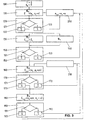
- step 120 the common receiver 3 provides the users 2 with the feedback to the previously enabled interval by checking in step 121 whether or not it received a successfully transmitted data packet. If there was a successfully transmitted data packet, the common receiver 3 provides all the users 2 with a positive feedback S in step 123.
- the common receiver 3 determines in step 121 that it did not receive a successfully transmitted data packet, be it because there was a collision between multiple data packets or be it because the slot was empty, the common receiver 3 provides all the users 2 with a negative feedback S in step 122.
- step 150 the common receiver 3 provides the users 2 with the feedback to the previously re-enabled interval by checking in step 151 whether or not it received a successfully transmitted data packet. If there was a successfully transmitted data packet, i.e. if the dummy packet was delivered without a collision, the common receiver 3 provides all the users 2 with a positive feedback S in step 153. As is illustrated in the state diagram in Figure 1, upon being provided with a positive feedback S in state S 1 the method will move back to state S 0 .
- the common receiver 3 determines in step 151 that it did not receive a successfully transmitted data packet, it provides all the users 2 with a negative feedback S in step 152.
- all the users 2 upon being provided by the common receiver 3 with the negative feedback S in step 152, all the users 2 are aware that the initial negative feedback S provided by the common receiver 3 in step 122 was due to a collision of data packets rather than due to an empty slot.
- E t+1 [a t , a t + ⁇ x) of the previously re-enabled interval.
- the optimal value of ⁇ (1 ⁇ ⁇ 0), the parameter dividing the interval into two portions, will be determined later.
- the common receiver 3 provides the users 2 with the feedback to the re-enabled lower portion of the interval by checking in step 171 whether or not it received a successfully transmitted data packet. If the common receiver 3 determines in step 171 that it did not receive a successfully transmitted data packet, it provides all the users with a negative feedback S in step 172. However, at this stage it is not clear whether the negative feedback is due to a collision of multiple packets in the lower portion of the interval or whether it is due to an empty slot. Rather than sacrificing another slot by issuing another dummy packet and to avoid re-enabling the same empty slot, the method proceeds by changing the positions of the (at least two remaining) packets in the interval.
- step 210 the users 2 involved in the collision resolution randomize the positions of their packets in the interval.
- This can be achieved by random algorithms known to one skilled in the art which are suitable for distributed systems, i.e. algorithms that will not concurrently produce the same identical random values in different terminal devices 2 connected to the communication network 1.
- the method upon being provided with a negative feedback S in state S 2 , the method remains in state S 2 .
- the common receiver 3 determines in step 171 that there was a successfully transmitted data packet, the common receiver 3 provides all the users 2 with a positive feedback S in step 173, indicating that at least one of the colliding packets had now been successfully re-transmitted. As is illustrated in the state diagram in Figure 1, upon being provided with a positive feedback S in state S 2 the method will move to state S 3 .
- the common receiver 3 determines in step 191 that that there was a successfully transmitted data packet, the common receiver 3 provides all the users 2 with a positive feedback S in step 193, indicating that the one remaining data packet had now been successfully re-transmitted.
- the method upon being provided with a positive feedback S in state S 3 , the method will move to state S 0 , and the collision is resolved.
- the resolution of the collision ends after two consecutive successful transmissions, thus all the participating users 2 can detect the end of a collision resolution.
- the respective steps of the method, as illustrated in the flow chart of Figure 3, which are executed by the terminal devices 2 can be implemented as a software program stored by storage means 21 of the terminal device 2, e.g. a programmable memory or the memory of a chipcard, and executed by processing means 22 of the terminal device, e.g. a microprocessor, or of a chipcard.
- processing means 22 of the terminal device e.g. a microprocessor, or of a chipcard.
- all devices participating in this method must also be provided with means for storing the state information, e.g. in a read and write memory of the device or of a chipcard inserted into the device, to keep track of the state transitions.
- t E t State ⁇ (E t ) 1 [0, x) S 0 S 2 [0, x) S 1 S 3 [0, ⁇ x) S 2 S 4 [ ⁇ x, x) S 3 S
- Figure 2 illustrates an example of packets generated for transmission in the interval [0, x).
- the vertical arrows along the time axis t indicate when sources, i.e. participating users 2, have generated packets P1, P2 for transmission.
- the respective feedback ⁇ (E 1 ) is negative S .
- the resulting feedback ⁇ (E 2 ) is again negative S , thus, it is clear that there was a collision.
- the corresponding feedback ⁇ (E 3 ) is positive S, and the method moves to state S 3 .
- the packets are not necessarily transmitted in the same order as they were generated. Hence, the method is not of the type "first-come first-served".
- the performance i.e. the throughput
- the propagation delay for providing the binary feedback is assumed to be negligibly small compared to the duration of a slot, so that the feedback information for a given slot can be effectively used to determine who can transmit in the subsequent slot.
- an interval is considered to be resolved when all the packets generated in this interval have been successfully transmitted.
- a basic interval commences after a prior interval has been resolved.
- Each time period between successive returns to processing basic intervals is a collision resolution interval (CRI).
- CRI collision resolution interval
- the throughput, of the method measured in terms of successful transmissions per channel use, can be found by using the following renewal-theoretic argument.
- the time axis is partitioned into series of collision resolution intervals used by the method and said collision resolution intervals are distinguished according to the number of messages that they contain initially. Because the arrival process is Poisson, it is assumed that the initial distribution of messages within any interval of the real time axis is uniform, so that the probability that k messages are found in the first subinterval of length ⁇ containing i messages is given by:
- Equations (3) and (4) give a numerical procedure for finding the efficiency of the proposed algorithm for any ⁇ x and ⁇ .
- Computational results show a maximum stable throughput of the algorithm of approximately 0.372, which is achieved when ⁇ x is approximately ⁇ x ⁇ 1.40 (rounded to two significant decimal digits) and ⁇ is approximately ⁇ 0.38. If the average arrival rate is less than 0.372 messages per slot, the system will eventually empty itself and thus be stable.
- the proposed method's calculated throughput of 0.372 is higher than any throughput of other random access communication methods with binary success/no-success feedback known in the prior art.
- the proposed method never makes any prior assumptions about the presence of packets of enabled intervals E t . Consequently, the proposed method also operates properly in an environment where new senders are entering the communication system.
- the value of the parameter ⁇ is varied depending on the number of times the method goes through state S 2 , i.e. it is varied depending on the number of collisions. Thereby, the efficiency of the proposed method can be improved even further.
Landscapes
- Engineering & Computer Science (AREA)
- Computer Networks & Wireless Communication (AREA)
- Signal Processing (AREA)
- Mobile Radio Communication Systems (AREA)
- Time-Division Multiplex Systems (AREA)
- Data Exchanges In Wide-Area Networks (AREA)
- Small-Scale Networks (AREA)
- Reduction Or Emphasis Of Bandwidth Of Signals (AREA)
Claims (17)
- Verfahren für die Kommunikation mit wahlfreiem Zugriff in Kommunikationsnetzwerken (1) mit mit Zeitschlitzen versehenen Kommunikationskanälen, auf welche durch eine Vielzahl von Endgerätvorrichtungen (2) zugegriffen wird, wobei die Endgerätvorrichtungen (2) mit binären Rückmeldungen (S/
S ) versorgt werden, wobei die binären Rückmeldungen (S/S ) durch die Endgerätvorrichtungen (2) empfangen werden, wobei eine positive Rückmeldung (S) angibt, dass ein bestimmter Zeitschlitz ein erfolgreich übermitteltes Paket enthielt, oder wobei eine negative Rückmeldung (S ) angibt, dass der bestimmte Zeitschlitz kein erfolgreich übermitteltes Paket enthielt, wobei ein Hilfsbenutzer (4) nach gewissen Erscheinungen von negativen Rückmeldungen (S ) Ersatzpakete übermittelt, um zu bestimmen, ob die genannte negative Rückmeldung (S ) durch eine Kollision von Paketen im betreffenden Schlitz verursacht wurde oder ob sie dadurch verursacht wurde, dass dieser Schlitz leer war, und wobei nicht erfolgreich übermittelte Pakete durch die Endgerätvorrichtungen (2) erneut übermittelt werden, dadurch gekennzeichnet, dass die Reihenfolge der erneuten Übermittlung der genannten, nicht erfolgreich übermittelten Pakete von ihrer betreffenden Position in einem Intervall abhängt, welche Position durch den numerischen Wert eines Parameters bestimmt wird, der durch die Endgerätvorrichtungen (2) jedem Paket zugeordnet wird, und welche numerischen Werte durch die Endgerätvorrichtungen (2) verändert werden (210), nachdem eine negative Rückmeldung (S ) während der Auflösung der genannten Kollision (S2-S3) aufgetreten ist. - Verfahren nach dem vorhergehenden Anspruch, dadurch gekennzeichnet, dass eine genannte gewisse Erscheinung von negativen Rückmeldungen (
S ) die erste negative Rückmeldung (S ) ist, nachdem eine vorherige Kollision aufgelöst worden ist. - Verfahren nach einem der vorhergehenden Ansprüche, dadurch gekennzeichnet, dass mindestens gewisse der genannten numerischen Werte auf Grund der Erzeugungszeit eines Pakets bestimmt werden.
- Verfahren nach einem der vorhergehenden Ansprüche, dadurch gekennzeichnet, dass der genannte Schritt des Änderns (219) des genannten numerischen Werts durch Zufallsverteilung durchgeführt wird.
- Verfahren nach einem der vorhergehenden Ansprüche, dadurch gekennzeichnet, dass die Freigabe der erneuten Übermittlung der genannten nicht erfolgreich übermittelten Pakete durch einen vordefinierten Parameter (α) bestimmt wird, der das genannte Intervall in zwei Teile teilt.
- Verfahren nach dem vorhergehenden Anspruch, dadurch gekennzeichnet, dass der genannte vordefinierte Parameter (α) abhängig von der Anzahl Kollisionen variiert wird.
- Verfahren nach einem der vorhergehenden Ansprüche, dadurch gekennzeichnet, dass eine Kollision nach zwei aufeinander folgenden erfolgreichen Übermittlungen, die durch zwei aufeinander folgende positive Rückmeldungen (S) angegeben wird, aufgelöst ist.
- Verfahren nach einem der vorhergehenden Ansprüche, dadurch gekennzeichnet, dass die Endgerätvorrichtungen (2), die nicht an einer Kollisionsauflösung beteiligt sind, nur Pakete übermitteln dürfen, nachdem sie erfahren haben, dass die Kollision aufgelöst ist.
- Verfahren nach einem der vorhergehenden Ansprüche, dadurch gekennzeichnet, dass mindestens gewisse der genannten Kommunikationsnetzwerke (1) Mobilfunknetze sind und dass mindestens gewisse der genannten Endgerätvorrichtungen (2) mobile Telefone sind.
- Verfahren nach einem der vorhergehenden Ansprüche, dadurch gekennzeichnet, dass die Endgerätvorrichtungen (2) durch mindestens einen gemeinsamen Empfänger (3) mit den genannten binären Rückmeldungen (S/
S ) versorgt werden. - Endgerätvorrichtung (2) für die Kommunikation mit wahlfreiem Zugriff in Kommunikationsnetzwerken (1) mit mit Zeitschlitzen versehenen Kommunikationskanälen, wobei die genannte Endgerätvorrichtung (2) Verarbeitungsmittel (22) und Speichermittel (21) umfasst zum Empfangen von binären Rückmeldungen (S/
S ), wobei eine positive Rückmeldung (S) angibt, dass ein bestimmter Zeitschlitz ein erfolgreich übermitteltes Paket enthielt, oder wobei eine negative Rückmeldung (S ) angibt, dass der bestimmte Zeitschlitz kein erfolgreich übermitteltes Paket enthielt, und zum erneuten Übermitteln von nicht erfolgreich übermittelten Paketen, dadurch gekennzeichnet, dass die genannte Endgerätvorrichtung (2) weitere Verarbeitungsmittel (22) und Speichermittel (21) umfasst, die eingerichtet sind
zum Festsetzen der Reihenfolge der erneuten Übermittlung der genannten, nicht erfolgreich übermittelten Pakete, abhängig von ihrer betreffenden Position in einem Intervall,
zum Zuordnen eines Parameters zu jedem Paket, wobei der numerische Wert des genannten Parameters die genannte Position bestimmt, und
zum Verändern (210) des genannten numerischen Werts, nachdem eine negative Rückmeldung (S ) während der Auflösung einer Kollision von Paketen (S2-S3) aufgetreten ist. - Endgerätvorrichtung (2) nach dem vorhergehenden Anspruch 11, dadurch gekennzeichnet, dass die genannten weiteren Verarbeitungsmittel (22) und Speichermittel (21) eingerichtet sind zum Bestimmen des genannten numerischen Werts auf Grund der Erzeugungszeit eines Pakets.
- Endgerätvorrichtung (2) nach einem der vorhergehenden Ansprüche 11 oder 12, dadurch gekennzeichnet, dass die genannten weiteren Verarbeitungsmittel (22) und Speichermittel (21) eingerichtet sind zum Verändern (210) des genannten numerischen Werts durch Zufallsverteilung.
- Endgerätvorrichtung (2) nach einem der vorhergehenden Ansprüche 11 bis 13, dadurch gekennzeichnet, dass die genannten weiteren Verarbeitungsmittel (22) und Speichermittel (21) eingerichtet sind zum Bestimmen der Freigabe der erneuten Übermittlung des genannten nicht erfolgreich übermittelten Pakets durch einen vordefinierten Parameter (α), der das genannte Intervall in zwei Teile teilt.
- Endgerätvorrichtung (2) nach dem vorhergehenden Anspruch 14, dadurch gekennzeichnet, dass die genannten weiteren Verarbeitungsmittel (22) und Speichermittel (21) eingerichtet sind zum Variieren des genannten vordefinierten Parameters (α) abhängig von der Anzahl Kollisionen.
- Endgerätvorrichtung (2) nach einem der vorhergehenden Ansprüche 11 bis 15, dadurch gekennzeichnet, dass die genannten weiteren Verarbeitungsmittel (22) und Speichermittel (21) eingerichtet sind zum Bestimmen, dass eine Kollision nach zwei aufeinander folgenden erfolgreichen Übermittlungen, die durch zwei aufeinander folgende positive Rückmeldungen (S) angegeben wird, aufgelöst ist.
- Endgerätvorrichtung (2) nach einem der vorhergehenden Ansprüche 11 bis 16, dadurch gekennzeichnet, dass sie ein mobiles Telefon (2) für die Kommunikation in einem Mobilfunknetz (1) ist.
Priority Applications (1)
| Application Number | Priority Date | Filing Date | Title |
|---|---|---|---|
| EP98958241A EP0988734B1 (de) | 1998-03-11 | 1998-10-20 | Verfahren zur kommunikation durch direkt zugriff mit binärer rückkopplung |
Applications Claiming Priority (4)
| Application Number | Priority Date | Filing Date | Title |
|---|---|---|---|
| EP98810209 | 1998-03-11 | ||
| EP98810209 | 1998-03-11 | ||
| PCT/EP1998/006980 WO1999046889A1 (en) | 1998-03-11 | 1998-10-20 | Method for random-access communication with binary feedback |
| EP98958241A EP0988734B1 (de) | 1998-03-11 | 1998-10-20 | Verfahren zur kommunikation durch direkt zugriff mit binärer rückkopplung |
Publications (2)
| Publication Number | Publication Date |
|---|---|
| EP0988734A1 EP0988734A1 (de) | 2000-03-29 |
| EP0988734B1 true EP0988734B1 (de) | 2003-07-30 |
Family
ID=8235983
Family Applications (1)
| Application Number | Title | Priority Date | Filing Date |
|---|---|---|---|
| EP98958241A Expired - Lifetime EP0988734B1 (de) | 1998-03-11 | 1998-10-20 | Verfahren zur kommunikation durch direkt zugriff mit binärer rückkopplung |
Country Status (9)
| Country | Link |
|---|---|
| US (1) | US6449282B1 (de) |
| EP (1) | EP0988734B1 (de) |
| JP (1) | JP3781436B2 (de) |
| AT (1) | ATE246419T1 (de) |
| AU (1) | AU1435299A (de) |
| CA (1) | CA2285991C (de) |
| DE (1) | DE69816820T2 (de) |
| ES (1) | ES2205581T3 (de) |
| WO (1) | WO1999046889A1 (de) |
Families Citing this family (8)
| Publication number | Priority date | Publication date | Assignee | Title |
|---|---|---|---|---|
| AU2617399A (en) * | 1999-01-14 | 2000-08-01 | Nokia Networks Oy | Interception method and system |
| US7102999B1 (en) * | 1999-11-24 | 2006-09-05 | Juniper Networks, Inc. | Switching device |
| KR100384820B1 (ko) * | 2000-12-22 | 2003-05-22 | 주식회사 하이닉스반도체 | 디에스/시디엠에이 기반 슬롯티드-알로하 시스템의 전송확률 제어 방법 및 그 장치 |
| EP1374621B1 (de) * | 2001-03-17 | 2014-04-30 | Koninklijke Philips N.V. | Netzwerk mit gemeinsamen sendekanälen |
| US7330427B2 (en) * | 2003-04-16 | 2008-02-12 | International Business Machines Corporation | MMPP analysis of network traffic using a transition window |
| US8793602B2 (en) | 2004-01-15 | 2014-07-29 | The Mathworks, Inc. | System and method for scheduling the execution of model components using model events |
| JP4770635B2 (ja) * | 2006-08-09 | 2011-09-14 | 株式会社デンソー | 車車間通信システム、車車間通信方法 |
| US10585648B2 (en) | 2016-06-01 | 2020-03-10 | The Mathworks, Inc. | Systems and methods for aggregating implicit and explicit event code of executable models |
Family Cites Families (2)
| Publication number | Priority date | Publication date | Assignee | Title |
|---|---|---|---|---|
| US5390181A (en) * | 1993-06-04 | 1995-02-14 | Illinois Institute Of Technology | Method for detecting collisions on and controlling access to a transmission channel |
| US6009468A (en) * | 1997-06-30 | 1999-12-28 | Ericsson, Inc. | Employing feedback data and congestion ranking to minimize contention delay in a multi-slot Mac protocol |
-
1998
- 1998-10-20 JP JP54528899A patent/JP3781436B2/ja not_active Expired - Lifetime
- 1998-10-20 AU AU14352/99A patent/AU1435299A/en not_active Abandoned
- 1998-10-20 CA CA002285991A patent/CA2285991C/en not_active Expired - Fee Related
- 1998-10-20 EP EP98958241A patent/EP0988734B1/de not_active Expired - Lifetime
- 1998-10-20 DE DE69816820T patent/DE69816820T2/de not_active Expired - Lifetime
- 1998-10-20 ES ES98958241T patent/ES2205581T3/es not_active Expired - Lifetime
- 1998-10-20 US US09/403,858 patent/US6449282B1/en not_active Expired - Lifetime
- 1998-10-20 AT AT98958241T patent/ATE246419T1/de active
- 1998-10-20 WO PCT/EP1998/006980 patent/WO1999046889A1/en not_active Ceased
Also Published As
| Publication number | Publication date |
|---|---|
| JP3781436B2 (ja) | 2006-05-31 |
| EP0988734A1 (de) | 2000-03-29 |
| DE69816820T2 (de) | 2004-05-27 |
| CA2285991A1 (en) | 1999-09-16 |
| JP2001525155A (ja) | 2001-12-04 |
| US6449282B1 (en) | 2002-09-10 |
| WO1999046889A1 (en) | 1999-09-16 |
| ATE246419T1 (de) | 2003-08-15 |
| ES2205581T3 (es) | 2004-05-01 |
| AU1435299A (en) | 1999-09-27 |
| CA2285991C (en) | 2006-07-11 |
| DE69816820D1 (de) | 2003-09-04 |
Similar Documents
| Publication | Publication Date | Title |
|---|---|---|
| USRE40686E1 (en) | Method of addressing messages and communications system | |
| USRE41531E1 (en) | Communications systems for radio frequency identification (RFID) | |
| EP1072128B1 (de) | Verfahren und system zur identifikation von drahtlosen einheiten | |
| US6226300B1 (en) | Method of addressing messages, and establishing communications using a tree search technique that skips levels | |
| EP0988734B1 (de) | Verfahren zur kommunikation durch direkt zugriff mit binärer rückkopplung | |
| Zhou et al. | A k-round elimination contention scheme for WLANs | |
| Garcés et al. | Collision avoidance and resolution multiple access (CARMA) | |
| EP1596544B1 (de) | Verfahren und Vorrichtungen zum Herstellen drahtloser Kommunikation | |
| USRE43382E1 (en) | Method of addressing messages and communications systems | |
| Tiedemann | Channel access protocols for half duplex satellite terminals |
Legal Events
| Date | Code | Title | Description |
|---|---|---|---|
| PUAI | Public reference made under article 153(3) epc to a published international application that has entered the european phase |
Free format text: ORIGINAL CODE: 0009012 |
|
| 17P | Request for examination filed |
Effective date: 20000121 |
|
| AK | Designated contracting states |
Kind code of ref document: A1 Designated state(s): AT CH DE ES FR GB IT LI NL SE |
|
| RAP1 | Party data changed (applicant data changed or rights of an application transferred) |
Owner name: SWISSCOM MOBILE AG |
|
| 17Q | First examination report despatched |
Effective date: 20020516 |
|
| GRAH | Despatch of communication of intention to grant a patent |
Free format text: ORIGINAL CODE: EPIDOS IGRA |
|
| GRAH | Despatch of communication of intention to grant a patent |
Free format text: ORIGINAL CODE: EPIDOS IGRA |
|
| GRAA | (expected) grant |
Free format text: ORIGINAL CODE: 0009210 |
|
| AK | Designated contracting states |
Designated state(s): AT CH DE ES FR GB IT LI NL SE |
|
| REG | Reference to a national code |
Ref country code: GB Ref legal event code: FG4D |
|
| REG | Reference to a national code |
Ref country code: CH Ref legal event code: EP |
|
| REG | Reference to a national code |
Ref country code: CH Ref legal event code: NV Representative=s name: BOVARD AG PATENTANWAELTE |
|
| REF | Corresponds to: |
Ref document number: 69816820 Country of ref document: DE Date of ref document: 20030904 Kind code of ref document: P |
|
| REG | Reference to a national code |
Ref country code: SE Ref legal event code: TRGR |
|
| ET | Fr: translation filed | ||
| REG | Reference to a national code |
Ref country code: ES Ref legal event code: FG2A Ref document number: 2205581 Country of ref document: ES Kind code of ref document: T3 |
|
| PLBE | No opposition filed within time limit |
Free format text: ORIGINAL CODE: 0009261 |
|
| STAA | Information on the status of an ep patent application or granted ep patent |
Free format text: STATUS: NO OPPOSITION FILED WITHIN TIME LIMIT |
|
| 26N | No opposition filed |
Effective date: 20040504 |
|
| REG | Reference to a national code |
Ref country code: CH Ref legal event code: PUE Owner name: SWISSCOM FIXNET AG Free format text: SWISSCOM MOBILE AG#SCHWARZTORSTRASSE 61#3050 BERN (CH) -TRANSFER TO- SWISSCOM FIXNET AG#ALTE TIEFENAUSTRASSE 6 WORBLAUFEN / ITTIGEN#3050 BERN (CH) Ref country code: CH Ref legal event code: PUE Owner name: SWISSCOM AG Free format text: SWISSCOM (SCHWEIZ) AG#ALTE TIEFENAUSTRASSE 6 WORBLAUFEN / ITTIGEN#3050 BERN (CH) -TRANSFER TO- SWISSCOM AG#ALTE TIEFENAUSTRASSE 6 WORBLAUFEN / ITTIGEN#3050 BERN (CH) Ref country code: CH Ref legal event code: PFA Owner name: SWISSCOM (SCHWEIZ) AG Free format text: SWISSCOM FIXNET AG#ALTE TIEFENAUSTRASSE 6 WORBLAUFEN / ITTIGEN#3050 BERN (CH) -TRANSFER TO- SWISSCOM (SCHWEIZ) AG#ALTE TIEFENAUSTRASSE 6 WORBLAUFEN / ITTIGEN#3050 BERN (CH) |
|
| REG | Reference to a national code |
Ref country code: GB Ref legal event code: 732E Free format text: REGISTERED BETWEEN 20091119 AND 20091125 |
|
| NLS | Nl: assignments of ep-patents |
Owner name: SWISSCOM FIXNET AG Effective date: 20091020 Owner name: SWISSCOM AG Effective date: 20091020 |
|
| NLT1 | Nl: modifications of names registered in virtue of documents presented to the patent office pursuant to art. 16 a, paragraph 1 |
Owner name: SWISSCOM (SCHWEIZ) AG |
|
| REG | Reference to a national code |
Ref country code: FR Ref legal event code: TP Ref country code: FR Ref legal event code: CD |
|
| REG | Reference to a national code |
Ref country code: CH Ref legal event code: PFA Owner name: SWISSCOM AG Free format text: SWISSCOM AG#ALTE TIEFENAUSTRASSE 6 WORBLAUFEN / ITTIGEN#3050 BERN (CH) -TRANSFER TO- SWISSCOM AG#ALTE TIEFENAUSTRASSE 6 WORBLAUFEN / ITTIGEN#3050 BERN (CH) |
|
| PGFP | Annual fee paid to national office [announced via postgrant information from national office to epo] |
Ref country code: ES Payment date: 20141028 Year of fee payment: 17 |
|
| PGFP | Annual fee paid to national office [announced via postgrant information from national office to epo] |
Ref country code: AT Payment date: 20141022 Year of fee payment: 17 |
|
| PGFP | Annual fee paid to national office [announced via postgrant information from national office to epo] |
Ref country code: IT Payment date: 20141024 Year of fee payment: 17 |
|
| REG | Reference to a national code |
Ref country code: FR Ref legal event code: PLFP Year of fee payment: 18 |
|
| REG | Reference to a national code |
Ref country code: AT Ref legal event code: MM01 Ref document number: 246419 Country of ref document: AT Kind code of ref document: T Effective date: 20151020 |
|
| PG25 | Lapsed in a contracting state [announced via postgrant information from national office to epo] |
Ref country code: IT Free format text: LAPSE BECAUSE OF NON-PAYMENT OF DUE FEES Effective date: 20151020 |
|
| PG25 | Lapsed in a contracting state [announced via postgrant information from national office to epo] |
Ref country code: AT Free format text: LAPSE BECAUSE OF NON-PAYMENT OF DUE FEES Effective date: 20151020 |
|
| REG | Reference to a national code |
Ref country code: FR Ref legal event code: PLFP Year of fee payment: 19 |
|
| REG | Reference to a national code |
Ref country code: ES Ref legal event code: FD2A Effective date: 20161125 |
|
| PG25 | Lapsed in a contracting state [announced via postgrant information from national office to epo] |
Ref country code: ES Free format text: LAPSE BECAUSE OF NON-PAYMENT OF DUE FEES Effective date: 20151021 |
|
| REG | Reference to a national code |
Ref country code: FR Ref legal event code: PLFP Year of fee payment: 20 |
|
| PGFP | Annual fee paid to national office [announced via postgrant information from national office to epo] |
Ref country code: FR Payment date: 20171024 Year of fee payment: 20 Ref country code: DE Payment date: 20171019 Year of fee payment: 20 |
|
| PGFP | Annual fee paid to national office [announced via postgrant information from national office to epo] |
Ref country code: SE Payment date: 20171019 Year of fee payment: 20 Ref country code: NL Payment date: 20171019 Year of fee payment: 20 Ref country code: GB Payment date: 20171019 Year of fee payment: 20 Ref country code: CH Payment date: 20171019 Year of fee payment: 20 |
|
| REG | Reference to a national code |
Ref country code: DE Ref legal event code: R071 Ref document number: 69816820 Country of ref document: DE |
|
| REG | Reference to a national code |
Ref country code: NL Ref legal event code: MK Effective date: 20181019 |
|
| REG | Reference to a national code |
Ref country code: CH Ref legal event code: PL |
|
| REG | Reference to a national code |
Ref country code: GB Ref legal event code: PE20 Expiry date: 20181019 |
|
| REG | Reference to a national code |
Ref country code: SE Ref legal event code: EUG |
|
| PG25 | Lapsed in a contracting state [announced via postgrant information from national office to epo] |
Ref country code: GB Free format text: LAPSE BECAUSE OF EXPIRATION OF PROTECTION Effective date: 20181019 |