EP0990621A2 - Spinelpulver und Spinelaufschlämmung - Google Patents
Spinelpulver und Spinelaufschlämmung Download PDFInfo
- Publication number
- EP0990621A2 EP0990621A2 EP99119363A EP99119363A EP0990621A2 EP 0990621 A2 EP0990621 A2 EP 0990621A2 EP 99119363 A EP99119363 A EP 99119363A EP 99119363 A EP99119363 A EP 99119363A EP 0990621 A2 EP0990621 A2 EP 0990621A2
- Authority
- EP
- European Patent Office
- Prior art keywords
- spinel powder
- spinel
- hydroxide
- powder
- mgal
- Prior art date
- Legal status (The legal status is an assumption and is not a legal conclusion. Google has not performed a legal analysis and makes no representation as to the accuracy of the status listed.)
- Withdrawn
Links
Images

Classifications
-
- B—PERFORMING OPERATIONS; TRANSPORTING
- B01—PHYSICAL OR CHEMICAL PROCESSES OR APPARATUS IN GENERAL
- B01J—CHEMICAL OR PHYSICAL PROCESSES, e.g. CATALYSIS OR COLLOID CHEMISTRY; THEIR RELEVANT APPARATUS
- B01J21/00—Catalysts comprising the elements, oxides, or hydroxides of magnesium, boron, aluminium, carbon, silicon, titanium, zirconium, or hafnium
- B01J21/005—Spinels
-
- B—PERFORMING OPERATIONS; TRANSPORTING
- B01—PHYSICAL OR CHEMICAL PROCESSES OR APPARATUS IN GENERAL
- B01J—CHEMICAL OR PHYSICAL PROCESSES, e.g. CATALYSIS OR COLLOID CHEMISTRY; THEIR RELEVANT APPARATUS
- B01J23/00—Catalysts comprising metals or metal oxides or hydroxides, not provided for in group B01J21/00
- B01J23/02—Catalysts comprising metals or metal oxides or hydroxides, not provided for in group B01J21/00 of the alkali- or alkaline earth metals or beryllium
-
- B—PERFORMING OPERATIONS; TRANSPORTING
- B01—PHYSICAL OR CHEMICAL PROCESSES OR APPARATUS IN GENERAL
- B01J—CHEMICAL OR PHYSICAL PROCESSES, e.g. CATALYSIS OR COLLOID CHEMISTRY; THEIR RELEVANT APPARATUS
- B01J35/00—Catalysts, in general, characterised by their form or physical properties
- B01J35/40—Catalysts, in general, characterised by their form or physical properties characterised by dimensions, e.g. grain size
-
- B—PERFORMING OPERATIONS; TRANSPORTING
- B01—PHYSICAL OR CHEMICAL PROCESSES OR APPARATUS IN GENERAL
- B01J—CHEMICAL OR PHYSICAL PROCESSES, e.g. CATALYSIS OR COLLOID CHEMISTRY; THEIR RELEVANT APPARATUS
- B01J35/00—Catalysts, in general, characterised by their form or physical properties
- B01J35/40—Catalysts, in general, characterised by their form or physical properties characterised by dimensions, e.g. grain size
- B01J35/45—Nanoparticles
-
- B—PERFORMING OPERATIONS; TRANSPORTING
- B01—PHYSICAL OR CHEMICAL PROCESSES OR APPARATUS IN GENERAL
- B01J—CHEMICAL OR PHYSICAL PROCESSES, e.g. CATALYSIS OR COLLOID CHEMISTRY; THEIR RELEVANT APPARATUS
- B01J35/00—Catalysts, in general, characterised by their form or physical properties
- B01J35/60—Catalysts, in general, characterised by their form or physical properties characterised by their surface properties or porosity
- B01J35/61—Surface area
- B01J35/613—10-100 m2/g
-
- B—PERFORMING OPERATIONS; TRANSPORTING
- B01—PHYSICAL OR CHEMICAL PROCESSES OR APPARATUS IN GENERAL
- B01J—CHEMICAL OR PHYSICAL PROCESSES, e.g. CATALYSIS OR COLLOID CHEMISTRY; THEIR RELEVANT APPARATUS
- B01J35/00—Catalysts, in general, characterised by their form or physical properties
- B01J35/60—Catalysts, in general, characterised by their form or physical properties characterised by their surface properties or porosity
- B01J35/64—Pore diameter
- B01J35/647—2-50 nm
-
- B—PERFORMING OPERATIONS; TRANSPORTING
- B01—PHYSICAL OR CHEMICAL PROCESSES OR APPARATUS IN GENERAL
- B01J—CHEMICAL OR PHYSICAL PROCESSES, e.g. CATALYSIS OR COLLOID CHEMISTRY; THEIR RELEVANT APPARATUS
- B01J35/00—Catalysts, in general, characterised by their form or physical properties
- B01J35/60—Catalysts, in general, characterised by their form or physical properties characterised by their surface properties or porosity
- B01J35/66—Pore distribution
-
- B—PERFORMING OPERATIONS; TRANSPORTING
- B01—PHYSICAL OR CHEMICAL PROCESSES OR APPARATUS IN GENERAL
- B01J—CHEMICAL OR PHYSICAL PROCESSES, e.g. CATALYSIS OR COLLOID CHEMISTRY; THEIR RELEVANT APPARATUS
- B01J35/00—Catalysts, in general, characterised by their form or physical properties
- B01J35/70—Catalysts, in general, characterised by their form or physical properties characterised by their crystalline properties, e.g. semi-crystalline
-
- C—CHEMISTRY; METALLURGY
- C01—INORGANIC CHEMISTRY
- C01F—COMPOUNDS OF THE METALS BERYLLIUM, MAGNESIUM, ALUMINIUM, CALCIUM, STRONTIUM, BARIUM, RADIUM, THORIUM, OR OF THE RARE-EARTH METALS
- C01F7/00—Compounds of aluminium
- C01F7/02—Aluminium oxide; Aluminium hydroxide; Aluminates
- C01F7/16—Preparation of alkaline-earth metal aluminates or magnesium aluminates; Aluminium oxide or hydroxide therefrom
- C01F7/162—Magnesium aluminates
-
- B—PERFORMING OPERATIONS; TRANSPORTING
- B01—PHYSICAL OR CHEMICAL PROCESSES OR APPARATUS IN GENERAL
- B01J—CHEMICAL OR PHYSICAL PROCESSES, e.g. CATALYSIS OR COLLOID CHEMISTRY; THEIR RELEVANT APPARATUS
- B01J2235/00—Indexing scheme associated with group B01J35/00, related to the analysis techniques used to determine the catalysts form or properties
- B01J2235/15—X-ray diffraction
-
- C—CHEMISTRY; METALLURGY
- C01—INORGANIC CHEMISTRY
- C01P—INDEXING SCHEME RELATING TO STRUCTURAL AND PHYSICAL ASPECTS OF SOLID INORGANIC COMPOUNDS
- C01P2002/00—Crystal-structural characteristics
- C01P2002/70—Crystal-structural characteristics defined by measured X-ray, neutron or electron diffraction data
-
- C—CHEMISTRY; METALLURGY
- C01—INORGANIC CHEMISTRY
- C01P—INDEXING SCHEME RELATING TO STRUCTURAL AND PHYSICAL ASPECTS OF SOLID INORGANIC COMPOUNDS
- C01P2004/00—Particle morphology
- C01P2004/60—Particles characterised by their size
- C01P2004/61—Micrometer sized, i.e. from 1-100 micrometer
-
- C—CHEMISTRY; METALLURGY
- C01—INORGANIC CHEMISTRY
- C01P—INDEXING SCHEME RELATING TO STRUCTURAL AND PHYSICAL ASPECTS OF SOLID INORGANIC COMPOUNDS
- C01P2006/00—Physical properties of inorganic compounds
- C01P2006/12—Surface area
-
- C—CHEMISTRY; METALLURGY
- C01—INORGANIC CHEMISTRY
- C01P—INDEXING SCHEME RELATING TO STRUCTURAL AND PHYSICAL ASPECTS OF SOLID INORGANIC COMPOUNDS
- C01P2006/00—Physical properties of inorganic compounds
- C01P2006/14—Pore volume
-
- C—CHEMISTRY; METALLURGY
- C01—INORGANIC CHEMISTRY
- C01P—INDEXING SCHEME RELATING TO STRUCTURAL AND PHYSICAL ASPECTS OF SOLID INORGANIC COMPOUNDS
- C01P2006/00—Physical properties of inorganic compounds
- C01P2006/16—Pore diameter
Definitions
- This invention relates to a spinel powder and a spinel slurry. More particularly, it relates to an MgAl 2 O 4 spinel powder which is excellent in catalytic activity, in particular, NO x -reduction performance and a slurry containing this powder which can form a coating layer scarcely peeling off and being free from cracking and which can be easily applied onto a catalytic base material, for example, a honeycomb construction to form a catalyst having excellent catalytic activity, in particular, NO x -reduction performance.
- JP-A-59-232915 discloses "a method for synthesizing a spinel by adjusting the pH of an aqueous solution of a mixture of a water-soluble magnesium salt and a water-soluble aluminum salt with an alkali in the presence of alcohol to form a precipitate and then drying and calcining this precipitate to thereby synthesize a spinel" (the term "JP-A" as used herein means an unexamined published Japanese patent application").
- the coprecipitation is performed by adjusting the pH in the presence of an alcohol so as to give a spinel powder in the form of fine grains having a low cohesiveness and a low crystallinity.
- the "water-soluble magnesium salt” and the “water-soluble aluminum salt” employed here as the starting materials include chlorides, sulfates and nitrates of magnesium or aluminum, and acetate, carbonate and oxalate of magnesium, etc. It is disclosed that chlorides are preferably employed therefor, since they are available in a highly pure state and compounds contaminating the hydroxide precipitate can be easily washed away in this case.
- a catalytic layer on the surface of a catalytic base material, for example, a honeycomb construction by preparing a slurry containing a noble metal and a powdery support such as a spinel powder and an alumina powder, and applying this slurry onto the catalytic base material (see, JP-A-3-131343, JP-A-7-328454, JP-A-10-99698).
- the present invention has been completed to satisfy the above requirements.
- the first object of the present invention is to provide an MgAl 2 O 4 spinel powder which makes it possible, when employed as a catalytic support, to give a catalyst being excellent in catalytic activity, in particular, NO x -reduction performance when used as an NO x storage-reduction catalyst support.
- the second object of the present invention is to provide a slurry containing the above-described spinel powder which can form a coating layer scarcely peeling off and being free from cracking and which can be easily applied onto a catalytic base material such as a honeycomb construction to form a catalyst having excellent catalytic activity, in particular, NO x -reduction performance achieved when used as a storage-reduction catalyst support.
- the present inventors have found the above second object of the present invention can be achieved by a slurry comprising the above spinel powder.
- the spinel powder according to the first embodiment of the present invention is a spinel powder represented by a chemical formula MgAl 2 O 4 , wherein the spinel powder has a specific surface area of 40 m 2 /g or more, and the average diameter of the spinel powder ranges from 3 to 20 ⁇ m.
- average diameter means the median in the grain size distribution based on the weight of grains which is obtained by using a LASER SCATTERING PARTICLE SIZE DISTRIBUTION ANALYZER LA-910, manufactured by Horiba in accordance with Japanese industrial standards (JIS R-1629).
- the technical significance of the fact that the spinel powder according to the first embodiment of the present invention has a "specific surface area of 40 m 2 /g or more" is as follows. When the specific surface area is less than this value, the noble metal and other storage ingredients cannot be sufficiently dispersed for achieving the catalytic activity required. In this case, therefore, the catalytic activity desired in the present invention can be hardly established.
- the technical significance of the fact that the spinel powder according to the first embodiment of the present invention has an "average diameter of from 3 to 20 ⁇ m" is as follows.
- a spinel powder having an average diameter less than 3 ⁇ m is processed into a pelletized catalyst (i.e., the spinel powder is processed into a slurry which is not applied to a catalytic base material but dried alone to give a pelletized slurry)
- only a poor catalytic activity can be obtained due to the insufficient pores between grains constituting the pellets.
- the average diameter of the spinel powder exceeds 20 ⁇ m in this case, on the contrary, the obtained pellets have a poor strength and are easily disintegrated.
- a spinel powder having an average diameter less than 3 ⁇ m is processed into a slurry and then employed as a coating to be applied onto a catalytic base material, for example, a honeycomb construction
- the coating layer undergoes significantly large drying shrinkage and thus frequently suffers from cracking. In this case, moreover, the coating layer is liable to peel off under the conditions for the utilization as a catalyst.
- the average diameter of the spinel powder exceeds 20 ⁇ m in this case, on the contrary, the dilatancy of the slurry is elevated and thus the fluidity is worsened in coating, which makes it difficult to apply the slurry uniformly onto the catalytic base material.
- the average diameter of spinel powder is from 3 to 20 ⁇ m, preferably from 5 to 15 ⁇ m for the above reasons.
- the specific surface area of the spinel powder is preferably 80 m 2 /g or more.
- the noble metal and other storage ingredients can be well dispersed and thus an improved catalytic activity can be obtained.
- the above-described functional effect is improved with an increase in the specific surface area, an excessively large specific surface area might result in a poor strength and a poor heat-resistance. It is also unfavorable from an economical viewpoint to excessively enlarge the specific surface area. From these points of view, it is preferable that the specific surface area is not more than 200 m 2 /g.
- the spinel powder according to the first embodiment of the present invention preferably has pores, at least 70% total pore volume of the spinel powder is within a range of d ⁇ d/2 from a mean pore diameter d, as determined from a maximum peak in a pore size distribution curve and the diameter d is of 5 nm ⁇ d ⁇ 50 nm.
- the "pore size distribution curve” means a curve drawn, for example, by plotting a value (dv/dD) obtained by differentiating the pore volume (V) with respect to the pore diameter (D).
- the pore diameter at the point at which the value dv/dD of the pore size distribution curve is largest (maximum peak) is called the mean pore diameter.
- the storage ingredient can be held in a uniformly dispersed state and the effective interaction thereof with a noble metal is ensured, thus achieving favorable NO x reduction performance.
- the spinel powder according to the first embodiment of the present invention is obtained by the method specified as follows:
- the spinel powder according to the second embodiment of the present invention is a spinel powder represented by a chemical formula MgAl 2 O 4 , produced by the process of drying a mixture solution containing a water-soluble organic substance having a boiling point of 120°C or above, converting the dried substance into a complex oxide by heating and then milling, wherein the spinel powder has a specific surface area of 55 m 2 /g or more and an average diameter of from 3 to 20 ⁇ m. Still preferable embodiment thereof is characterized by:
- organic substance coexisting with the dried substance can be evaporated off or removed by oxidation simultaneously with the conversion of the dried substance into the spinel.
- This "evaporation or oxidation (thermal decomposition) of the organic substances” can promote the decomposition of the aluminum source and the magnesium source employed as the starting materials for producing the spinel and thus these materials can be converted into the complex oxide (i.e., the spinel) while being maintained in the state of the uniform mixture thereof, thus establishing a functional effect of giving a spinel free from a crystalline phase other than an MgAl 2 O 4 spinel phase.
- the spinel powder according to the third embodiment of the present invention is a spinel powder represented by a chemical formula MgAl 2 O 4 , produced by the process of drying a solution containing an aluminum salt of a water-soluble carboxylic acid and a magnesium salt of a water-soluble carboxylic acid and converting the dried substance into a complex oxide by heating, wherein the spinel powder has a specific surface area of 55 m 2 /g or more and an average diameter of from 3 to 20 ⁇ m.
- a still preferable embodiment thereof is characterized by:
- This spinel powder of the third embodiment can exert the functional effect similar to the one of the second embodiment as described above.
- the spinel powder according to the fourth embodiment of the present invention is a spinel powder comprising MgAl 2 O 4 as a main component produced by the process of mechanically mixing and milling a mixture of hydroxides for producing a spinel powder to convert into a complex hydroxide, heating a mixture composition of the obtained complex hydroxide and an unconverted hydroxide to convert into a complex oxide, wherein the spinel powder has a specific surface area of 42 m 2 /g or more and an average diameter of from 3 to 20 ⁇ m.
- a still preferable thereof is characterized by:
- the spinel powder of the fourth embodiment of the present invention sufficiently high energy is applied to the hydroxide mixture for producing a spinel powder so as to preliminarily convert a part of the mixture into a complex oxide (i.e., a spinel).
- a spinel can be easily formed by heating treatment at a low temperature (110°C or below).
- the spinel powder obtained by the low-temperature heating treatment as described above contains the spinel as the main component, suffers from the formation of little oxides of the starting materials and undergoes uniform solid dissolution.
- a spinel powder having a large surface area can be obtained thereby.
- the spinel slurry according to the present invention which is another technical constitution achieving the second object as described above, is characterized by:
- a precipitate of a complex hydroxide is formed by the synthesis method with coprecipitation (i.e., the coprecipitation method) by starting with hydroxide materials, thermally treating this precipitate to give an MgAl 2 O 4 spinel powder and then milling it to give an average diameter of 3 to 20 ⁇ m.
- an aluminum salt is prepared by dissolving aluminum hydroxide in an acid
- a magnesium salt is prepared by dissolving magnesium hydroxide in an acid. Then the pH of an aqueous solution of the mixture thereof is adjusted with an alkali to form a precipitate. Next, this precipitate is dried and calcined to thereby give an MgAl 2 O 4 spinel powder which is then milled to give an average diameter of 3 to 20 ⁇ m.
- the pH-adjusting agent an arbitrary alkali known per se which is commonly employed in the coprecipitation method can be used. It is preferable to use aqueous ammonia therefor, as in Examples which will be given hereinafter.
- the means for milling is not particularly restricted but may be an arbitrary one. The milling may be carried out under arbitrary conditions, so long as the MgAl 2 O 4 spinel powder can be milled to give an average diameter of 3 to 20 ⁇ m thereby.
- hydroxide materials is used wherein the ratio of the average diameter of aluminum hydroxide "D 1 " to the average diameter of magnesium hydroxide "D 2 " satisfies the requirement 1.85 ⁇ (D 1 /D 2 ) or 0.5>(D 1 /D 2 ).
- Use of such hydroxide materials differing in grain size makes it possible to achieve a remarkable effect of improving the NO x reduction performance of an NO x -storage reduction catalyst.
- the present invention is not restricted to the scope of D 1 /D 2 as defined above but involves those excluded from this scope.
- a "mixture solution (aqueous solution) for producing spinel” is prepared by using a water-soluble inorganic aluminum salt and a water-soluble inorganic magnesium salt as an aluminum source and a magnesium source respectively and adding to this mixture solution (aqueous solution) a water-soluble organic substance having a boiling point of 120°C or above.
- this mixture aqueous solution is dried and the dried substance is heated and calcined, thus evaporating off or removed by oxidation the organic substance and, at the same time, converting the salts into a spinel (complex oxide).
- a water-soluble inorganic aluminum salt and a water-soluble inorganic magnesium salt are dissolved in water.
- a water-soluble organic substance having a boiling point of 120°C or above optionally in the form of an aqueous solution prepared by dissolving the organic substance in water, are added thereto to give a mixture solution (aqueous solution) .
- the obtained mixture solution (aqueous solution) is heated at a drying temperature to thereby evaporate off the water, thus giving a dried substance containing the organic substance.
- this dried substance is calcined by heating so as to decompose the organic substances.
- the aluminum salt and the magnesium salt can be converted into a complex oxide to thereby give an MgAl 2 O 4 spinel.
- the above-described "dried substance containing an organic substance" obtained by heating the mixture solution (aqueous solution) at a drying temperature and thus evaporating the water to a certain degree is in the form of a solution in which the inorganic aluminum salt and the magnesium salt are dissolved or uniformly dispersed in the organic substance.
- the decomposition of the aluminum salt and the magnesium salt is accelerated, as described above.
- these salts can be converted into a complex oxide (i.e., a spinel) while being maintained in the state of the uniform mixture thereof, thus establishing a functional effect of giving a spinel free from a crystalline phase other than an MgAl 2 O 4 spinel phase.
- water-soluble organic substances having a boiling point lower than 120°C coexist. This is because, in such a case, these organic substances are evaporated with the evaporation of water in the drying step prior to the heating/calcining, which makes the coexistence thereof difficult. As a result, the above-described "dried substance containing organic substances" can be hardly obtained.
- a monovalent alcohol for example, 1-butanol having a boiling point of 117.3°C (azeotropic temperature: 92.7°C) is employed in the first embodiment, it is evaporated off together with water in the drying step because 1-butanol and water form a mixture having a low azeotropic temperature and thus cannot coexist with the dried substance. Thus, it is unusable therein.
- the amount of the water-soluble organic substances having a boiling point lower than 120°C to be added in the second embodiment varies depending on the type of the water-soluble organic substances employed. It is preferable to add 1 to 50% by weight of these water-soluble organic substances based on the total of the water-soluble inorganic aluminum salt and the water-soluble magnesium salt.
- the content of the water-soluble organic substances is less than 1% by weight, the dried substance contains insufficient amount of organic substances and thus the desired effect can be hardly established.
- the content thereof exceeds 50% by weight, on the contrary, the calcining temperature is excessively elevated due to the combustion heat of the organic substances. It is also unfavorable in this case that the increase in amount of the starting materials, which would not contribute to the final product, results in an increase in the cost.
- water-soluble organic substances usable in the second embodiment include monohydric alcohols, polyhydric alcohol monomers, dimers, trimers and oligomers each having a boiling point of 120°C or above, water-soluble polymer compounds containing polymers of the polyhydric alcohols having a boiling point of 120°C or above, monosaccharides, disaccharides, polysaccahrides, carbohydrates, carboxylic acids and salts thereof and surfactants. Examples thereof are as follows.
- 1-Pentanol (b.p.: 138.3°C), 1-hexanol (b.p.: 157.9°C), 1-heptanol (b.p.: 175.8°C), 1-octanol (b.p.: 183°C), 2-octanol (b.p.: 179.5°C), monoethanolamine (b.p.: 171°C), diethylene glycol monoethyl ether (b.p.: 218°C), alkyl alcohols and aminoalkyl alcohols having up to 10 carbon atoms and isomers and derivatives thereof.
- Diethanolamine (b.p.:217°C), triethanolamine (b.p.:277°C), ethylene glycol (b.p.:197.5°C), propylene glycol (b.p.:188.2°C), glycerol (b.p.:290°C), 1,5-pentanediol (b.p.:238°C), and polyhydric alcohols wherein two or more hydroxyl groups (-OH) are bonded to an alkyl group having up to 10 carbon atoms.
- Diethylene glycol (b.p.:245°C), ethylenepropylene glycol, derivatives thereof, and dimers formed by condensing other dihydric alcohols.
- Triethylene glycol (b.p.:278.3°C), tripropylene glycol, derivatives thereof, and trimers formed by condensing other dihydric alcohols.
- Polyethylene glycol Polyacrylic acid and derivatives thereof, polyvinyl alcohol and derivatives thereof, and cellulose and derivatives thereof.
- Sorbitol, dextrin, starch, glycogen, pentose, glucose, fructose, galactose, maltose, saccharose, lactose and mannose examples of carboxylic acids and salts thereof:
- Citric acid succinic acid, tartaric acid, malic acid, malonic acid, mannonic acid and salts thereof.
- water-soluble inorganic aluminum salt and the water-soluble inorganic magnesium salt to be employed in the second embodiment use may be arbitrarily made of water-soluble inorganic salts commonly employed such as nitrates, hydrochlorides and sulfates.
- a “mixture solution (aqueous solution) for producing spinel” is prepared by using an aluminum salt of a water-soluble carboxylic acid which is an organic compound having carboxyl group and a magnesium salt of a water-soluble carboxylic acid, respectively as the aluminum source and the magnesium source.
- this mixture solution (aqueous solution) is dried and the resultant dried substance is heated and calcined.
- carboxylic acids are removed by oxidation and, at the same time, the salts are converted into a spinel (i.e., a complex oxide).
- the third embodiment will be illustrated.
- the aluminum salt of a water-soluble carboxylic acid and the magnesium salt of a water-soluble carboxylic acid are dissolved in water to give a mixture solution.
- this mixture solution is dried and water is removed, thus giving a "dried substance containing organic substances".
- this dried substance is heated and calcined.
- the carboxylic acids are removed by oxidation and, at the same time, the aluminum salt and the magnesium salt are thermally decomposed and converted into the complex oxide, thereby giving the MgAl 2 O 4 spinel.
- the carboxylic acids are removed by oxidation, similar to the second embodiment as described above.
- the decomposition of the aluminum salt and the magnesium salt is accelerated and these salts can be converted into a complex oxide (i.e., a spinel) while being maintained in the state of the uniform mixture thereof, thereby establishing a functional effect of giving a spinel free from a crystalline phase other than an MgAl 2 O 4 spinel phase.
- the carboxylic acids (organic compounds having carboxyl group) to be employed in the third embodiment include a monovalent carboxylic acid having a structure of R 1 COOH wherein R 1 represents an alkyl group having 0 to 10 carbon atoms; a divalent carboxylic acid having a structure of R 2 (COOH) 2 wherein R 2 represents an alkyl group having 0 to 10 carbon atoms; and a trivalent carboxylic acid having a structure of R 3 (COOH) 3 wherein R 3 represents an alkyl group having 1 to 10 carbon atoms.
- carboxylic acid More particularly, preferable examples of these carboxylic acid are as follows:
- the spinel powder is produced by the process where a mixture of hydroxides for producing a spinel powder (a mixture of magnesium hydroxide with aluminum hydroxide) is mechanically mixed and milled to thereby impart sufficient mechanical energy to the mixture, thereby converting a portion of the mixture into a complex hydroxide.
- a mixture of hydroxides for producing a spinel powder a mixture of magnesium hydroxide with aluminum hydroxide
- the thus obtained mixture composition containing the complex hydroxide and the unconverted hydroxides i.e., a mixture composition containing magnesium hydroxide and/or aluminum hydroxide and magnesium/aluminum complex hydroxide
- a mixture composition containing magnesium hydroxide and/or aluminum hydroxide and magnesium/aluminum complex hydroxide is converted into a spinel by heating to give a powder containing an MgAl 2 O 4 spinel as the main component.
- the hydroxides for producing a spinel powder is uniformly dispersed in a liquid such as water and mixed. Then the obtained mixture is milled by using a mill in which balls, rollers, rotors, etc. collide with each other under such conditions as applying to the milling medium an acceleration higher by 1.5 times or more, preferably 5 times or more, still preferably 20 times or more and still preferably 200 times or more than the acceleration of gravity.
- the hydroxides for producing a spinel powder is reacted and converted into the complex hydroxide.
- a medium-mixing mill is suitable as the device to be used in the milling, though the present invention is not restricted thereto. Namely, an arbitrary device may be employed therefor, so long as a milling efficiency sufficient for the conversion into the complex hydroxide can be established thereby.
- Two or more metal hydroxide powders can be reacted and converted into a complex hydroxide by applying adequate energy for a sufficient time with the use of, in addition to a medium-mixing mill, a device wherein balls are carried in a container and stirred by externally applying large energy to the container such as vibrating ball mill and planetary ball mill or a device provided with a container consisting of an inner cylinder and an outer one rotating in the opposite directions, thereby stirring balls contained therein.
- milling should be performed for a long time so as to adjust the grain size of the hydroxide powder to the fevorable size. That is to say, the milling is carried out preferably for 25 hours or longer, still preferably 100 hours or longer.
- the "hydroxide mixture composition” thus obtained contains the complex hydroxide (i.e., the conversion product obtained from the hydroxide mixture for producing a spinel powder) and the unconverted metal hydroxides in a uniformly mixed state.
- the unconverted metal hydroxides which are mixed with the above-described complex hydroxide, 80% by weight or more of grains have a grain diameter of 500 nm or less, preferably 100 nm or less and still preferably 50 nm or less.
- the content of the unconverted metal hydroxides can be reduced by mixing the hydroxides for producing a spinel powder as uniformly as possible and applying sufficient mechanical energy to the obtained mixture.
- the "hydroxide mixture composition” thus obtained is then subjected to a heat treatment (i.e., heating at 1100°C or lower) to give a uniform "complex oxide", namely, a “complex oxide (spinel)” suffering from little segregation of oxides originating in the unconverted hydroxides having a large specific surface area.
- a heat treatment i.e., heating at 1100°C or lower
- An aluminum hydroxide powder and a magnesium hydroxide powder are dispersed together in water to give a slurry. Then the aluminum hydroxide is reacted with the magnesium hydroxide by milling together with a medium-mixing mill while applying to the milling medium an acceleration 200 times or more as much as the acceleration of gravity (i.e., the milling is performed until 80% by weight or more the individual grains attain a diameter of 100 nm or less), thus giving a complex hydroxide.
- the "hydroxide mixture composition” contained the complex hydroxide obtained as the conversion product is dried to thereby remove water therefrom. Then it is heated at a temperature of 1100°C or lower to give an MgAl 2 O 4 spinel.
- an acceleration 5 times or more, preferably 20 time or more and still preferably 200 times or more as much as the acceleration of gravity is applied to the milling medium so that, after the completion of the milling, 80% or more of the grains have diameter of 500 nm or less, preferably 100 nm or less.
- Al(OH) 3 is commonly known as the starting aluminum hydroxide, it is also possible to use AlOOH or hydrated salts thereof. Similarly, the magnesium hydroxide may be an appropriate one regardless of the crystalline structure of the presence of crystal water.
- the conversion may be made into any anhydrous salt or hydrated salt having an Mg/Al molar ratio "ranging from 0.5 to 3".
- Mg/Al molar ratio of the converted complex hydroxide crystals exceeds the Mg/Al molar ratio of the starting materials, the coexisting Al(OH) 3 should contain 80% by weight or more of grains having grain diameter of 100 nm or less. It is still preferable that the Al(OH) 3 coexists with the complex hydroxide or Mg(OH) 2 within each grain.
- the coexisting Mg(OH) 2 should contain 80% by weight or more of grains having grain diameter of 100 nm or less. It is still preferable that the Mg(OH) 2 coexists with the complex hydroxide or Al(OH) 3 within each grain.
- Al(OH) 3 or Mg(OH) 2 coexisting with the complex hydroxide has been finely milled so that 80% by weight or more of the grains have grain diameter of 100 nm before mixing.
- the mixture is contaminated with the milling medium. It is therefore necessary to select the milling medium material by taking the composition of the "hydroxide mixture composition", the utilization of the "complex oxide” obtained from the mixture composition, etc. into consideration. Since a milling medium made of 3% Y 2 O 3 -ZrO 2 is employed herein, a 3% Y 2 O 3 -ZrO 2 powder coexists therewith.
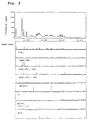
- Fig. 2 is an X-ray diffraction pattern of the mixture composition employed for obtaining an MgAl 2 O 4 spinel in the fourth embodiment of the present invention wherein an Mg/Al complex hydroxide composed of MgAl 2 (OH) 8 , Mg 4 Al 2 (OH) 14 ⁇ 3H 2 O or Mg 2 Al(OH) 10 ⁇ xH 2 O is mixed with Al(OH) 3 , each having a grain diameter of 100 nm or less.
- Fig. 3 is an X-ray diffraction pattern of MgAl 2 O 4 obtained by further calcining the mixture composition at 1,000°C for 5 hours.
- the hydroxide mixture composition of the present invention is a mixture composition of plural hydroxides and a complex hydroxide.
- Fig. 3 clearly indicates that a magnesium aluminate spinel having a stoichiometric composition containing aluminum and magnesium at a proper ratio can be obtained by heating the hydroxide mixture composition of the present invention.
- the MgAl 2 O 4 spinel can be easily formed by heating the above-described mixture composition at a temperature of 1100°C or lower, it is little contaminated with Al 2 O 3 , MgO or both of the same. Thus, an MgAl 2 O 4 spinel showing uniform solid dissolution of Al and Mg and having a large specific surface area can be obtained. The mechanism thereof is seemingly as follows.
- MgAl 2 O 4 spinel i.e., an MgAl 2 O 4 spinel having the same Al/Mg ratio as that of the starting materials
- a "hydroxide mixture composition" containing a complex hydroxide carrying both of Mg and Al is employed as the starting material, which makes it possible to prevent the segregation of MgO.
- the Al component should be further added to give an MgAl 2 O 4 spinel.
- Al(OH) 3 having a high reactivity.
- AlOOH is usable therefor in some cases.
- the "hydroxide mixture composition" to be used in the present invention can be obtained by mechanically milling a mixture of Al(OH) 3 with Mg(OH) 2 . By applying mechanically sufficient energy thereto, an Mg/Al complex hydroxide can be formed and, at the same time, Al(OH) 3 and the Mg/Al complex hydroxide can be mixed in the state of fine grains.
- the Mg/Al complex hydroxide composed of MgAl 2 (OH) 8 , Mg 4 Al 2 (OH) 14 ⁇ 3H 2 O or Mg 2 Al(OH) 10 ⁇ xH 2 O is mixed with Al(OH) 3 , under the condition that 80% by weight or more the grains have diameter of 100 nm or less. Therefore, these components have high reactivity and the segregation of Al 2 O 3 can be prevented.
- An aluminum hydroxide powder and a magnesium hydroxide powder are dispersed together in water to give a slurry. Then the aluminum hydroxide is reacted with the magnesium hydroxide by milling together with a mill wherein the slurry is milled by rotating together with balls in a milling container for a long time while applying to the milling medium an acceleration 1 to 2 times as much as the acceleration of gravity (i.e., the milling is performed until 80% by weight or more the individual grains attain a diameter of 500 nm or less), thus converting it into a complex hydroxide.
- an acceleration 1 to 2 times as much as the acceleration of gravity i.e., the milling is performed until 80% by weight or more the individual grains attain a diameter of 500 nm or less
- the "hydroxide mixture composition” contained the complex hydroxide obtained as the conversion product is dried to thereby remove water therefrom. Then it is heated at a temperature of 1100°C or lower to give an MgAl 2 O 4 spinel.
- an MgAl 2 O 4 spinel can be thus easily prepared, though it cannot be obtained from such a low temperature as in the case with the use of the medium-mixing mill as descried above.
- the obtained complex oxide powder namely, about 90% or more (quantitatively analyzed by powder X-ray diffractometry, hereinafter referred to simply as XRD) and about 99% or more (by XRD) grains are converted into MgAl 2 O 4 spinel respectively at 800°C and 1,000°C and no crystal but MgO is identified other than the spinel.
- the treatment with the ball mill is performed while applying to the milling medium an acceleration 1.5 times or more (preferably 5 times or more and still preferably 20 times or more) as much as the acceleration of gravity.
- the milling is performed until 80% by weight or more the grains attain a diameter of 500 nm or less, preferably 200 nm or less.
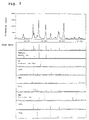
- Fig. 4 is a graph which shows relationships between the heat treatment temperature and specific surface area of MgAl 2 O 4 spinel powders.
- Fig. 4 shows, in each of the composition obtained by merely stirring with a stirrer in water without applying any milling energy as in the conventional method (COMPARATIVE EXAMPLE 1) and the "hydroxide mixture compositions" according to the present invention and the complex oxide powders with the use of the same (EXAMPLES 7 to 9), a large specific surface area of 42 to 57 m 2 /g can be obtained by heating at about 1,000°C.
- the MgAl 2 O 4 spinel can be formed only at a low yield.
- a powder with a high MgAl 2 O 4 spinel content When heated at a high temperature (1,200 to 1,400°C) to obtain a powder with a high MgAl 2 O 4 spinel content, then the specific surface area is reduced to 2 to 7 m 2 /g.
- a powder with a sufficiently high MgAl 2 O 4 spinel content can be obtained by heating at about 1,000°C.
- the fourth embodiment of the present invention provides a means appropriate for obtaining a powder having a large specific surface area and a high MgAl 2 O 4 spinel content.
- an MgAl 2 O 4 spinel is formed only a lower ratio than in the fourth embodiment of the present invention. In the former case, it is also unfavorable that the MgAl 2 O 4 spinel is contaminated with both of Al 2 O 3 and MgO.
- the embodiment of the spinel slurry according to the present invention is a spinel slurry containing a spinel powder according to the present invention as described above (i.e., any of the spinel powders of the first to fourth embodiments), without particular restriction. It is preferable that the content of the spinel powder in the spinel slurry expressed in the non-volatile solid content (Nv) is from 25 to 45%.
- the above-described slurry further contains a binder component.
- the addition of the binder component brings about an advantage that when the slurry is applied onto, for example, a honeycomb construction, the adhesion properties of the spinel powder to the honeycomb construction are improved and thus separation (peel-off) can be prevented.
- binder component use may be preferably made of a basic sol or solution, more particularly, a magnesia/alumina spinel sol or a zirconia sol.
- the solid binder components remaining after the completion of the drying and calcining amount to 3 to 15% based on the total solid content of the coating film.
- the content thereof is less than 3%, grains in the coating film cannot be sufficiently bonded to each other. In this case, it is feared that these grains would be scattered when exposed to a high wind pressure. It is also unfavorable that the content thereof exceeds 15%, since the inherent characteristics of the spinel powder per se as an NO x storage-reduction catalyst support are deteriorated thereby.
- the spinel powder and the spinel slurry according to the present invention are appropriate as a support of catalysts, for example, NO x storage-reduction catalysts and ternary catalysts.
- catalysts for example, NO x storage-reduction catalysts and ternary catalysts.
- NO x storage-reduction catalyst When employed as the support of an NO x storage-reduction catalyst, in particular, it can provide a catalyst having excellent NO x reduction performance.
- Examples 1 to 4 relate to the first embodiment of the present invention.
- hydroxide materials magnesium hydroxide and aluminum hydroxide
- a precipitate was formed by the coprecipitation method. Then the precipitate was heated to give an MgAl 2 O 4 spinel powder which was then milled to give a desired average diameter.
- magnesium hydroxide As the magnesium hydroxide, use was made of the following marketed products:
- magnesium hydroxide of a hydroxide material having a large grain diameter (average diameter: 3.1 ⁇ m, i.e., "SP” manufactured by Naikai Engyo K.K. as described above).
- aluminum hydroxide on the other hand, one having a small grain diameter (average diameter: 1.0 ⁇ m, i.e., "C-301” manufactured by Sumitomo Chemical Co., Ltd. as described above) was employed.
- the aqueous magnesium solution and the aqueous aluminum solution thus prepared were mixed by using a 3 l glass beaker. Then 240 g of a 25 % aqueous ammonia solution was added thereto to give a white precipitate.
- This white precipitate as being contained in the beaker, was introduced into a hot-air dryer and dried at 150°C for 10 hours. Next, the temperature was elevated to 400°C at a speed of 50°C/h and then the dried substance was pre-calcined at 400°C for 5 hours. The powder thus obtained was transferred into a crucible and calcined at 850°C for 5 hours to thereby give an MgAl 2 O 4 spinel powder.
- the spinel powder thus obtained was dispersed in water (non-volatile solid content (Nv): 35%) and then milled to thereby give a slurry containing the MgAl 2 O 4 spinel powder (average diameter: 12 ⁇ m).
- This spinel powder had a specific surface area of 80 m 2 /g.
- This spinel powder had a mean pore diameter (d) of 15 nm and the pores thereof were regular in size, i.e., 85% of the total pore volume falling within a range of d ⁇ d/2.
- magnesium hydroxide of a hydroxide material having a small grain diameter (average diameter: 0.54 ⁇ m, i.e., "MS-4" manufactured by Tomita Pharmaceutical K.K. as described above).
- aluminum hydroxide on the other hand, one having a large grain diameter (average diameter: 12.8 ⁇ m, i.e., "H-WP” manufactured by Showa Denko K.K. as described above) was employed.
- the ratio of the average diameter of aluminum hydroxide "D 1 " to the average diameter of magnesium hydroxide "D 2 " (D 1 /D 2 ) was 23.7.
- an MgAl 2 O 4 spinel powder and a spinel slurry containing the spinel powder having an average diameter of 11 ⁇ m were prepared as in the above Example 1.
- This spinel powder had a specific surface area of 82 m 2 /g.
- This spinel powder had a mean pore diameter (d) of 13 nm and the pores thereof were regular in size, i.e., 80% of the total pore volume falling within a range of d ⁇ d/2.
- a spinel powder and a spinel slurry containing the spinel powder having an average diameter of 11 ⁇ m were prepared as in the above Example 1.
- This spinel powder had a specific surface area of 126 m 2 /g.
- This spinel powder had a mean pore diameter (d) of 14 nm and the pores thereof were regular in size, i.e., 70% of the total pore volume falling within a range of d ⁇ d/2.
- a spinel powder and a spinel slurry containing the spinel powder having an average diameter of 10 ⁇ m were prepared as in the above Example 1.
- This spinel powder had a specific surface area of 87 m 2 /g.
- This spinel powder had a mean pore diameter (d) of 11 nm and the pores thereof were regular in size, i.e., 70% of the total pore volume falling within a range of d ⁇ d/2.
- This Example relates to the second embodiment of the present invention.
- This white powder was transferred into an alumina crucible and calcined at 850°C for 5 hours to thereby give an MgAl 2 O 4 spinel powder having an Mg/Al molar ratio of 1/2.
- this spinel powder was dispersed in water (non-volatile solid content (Nv):35%) as in Example 1 to give a spinel slurry containing the MgAl 2 O 4 spinel powder having an average diameter of 7 ⁇ m.
- This spinel powder had a specific surface area of 68 m 2 /g.
- This spinel powder had a mean pore diameter (d) of 16 nm and the pores thereof were regular in size, i.e., 70% of the total pore volume falling within a range of d ⁇ d/2.
- d mean pore diameter
- This Example relates to the third embodiment of the present invention.
- This white powder was transferred into an alumina crucible and calcined at 850°C for 5 hours to thereby give an MgAl 2 O 4 spinel powder having an Mg/Al molar ratio of 1/2.
- this spinel powder was dispersed in water (non-volatile solid content (Nv):35%) as in Example 1 to give a spinel slurry containing the MgAl 2 O 4 spinel powder having an average diameter of 9 ⁇ m.
- This spinel powder had a specific surface area of 55 m 2 /g.
- This spinel powder had a mean pore diameter (d) of 18 nm and the pores thereof were regular in size, i.e., 70% of the total pore volume falling within a range of d ⁇ d/2 .
- d mean pore diameter
- An aluminum hydroxide powder having an average diameter of 17 ⁇ m and a magnesium hydroxide powder having an average diameter of 19 ⁇ m were mixed together to give an Mg/Al molar ratio of 1/2. 100 g of the resultant mixture was added to 2 1 of water and dispersed therein by stirring with a propeller stirrer for 5 minutes.
- this dispersion was milled by using a medium-mixing mill (Dynomill) provided with a milling medium made of ZrO 2 at 4200 rpm for 20 hours (the acceleration applied to the milling medium being 760 times as much as the acceleration of gravity), thereby converting most of the aluminum hydroxide and most of the magnesium hydroxide into a crystalline complex hydroxide.
- water was removed from the milled substance by drying at 150°C for 10 hours to thereby give a powder.
- ⁇ /g 759.49 .
- the spinel powder thus obtained was an MgAl 2 O 4 spinel powder having an Mg/Al molar ratio of 1/2.
- this spinel powder was dispersed in water (non-volatile solid content (Nv):35%) as in Example 1 and milled to give a spinel slurry containing the MgAl 2 O 4 spinel powder having an average diameter of 12 ⁇ m.
- This spinel powder had a specific surface area of 57 m 2 /g.
- This spinel powder had a mean pore diameter (d) of 18 nm and the pores thereof were regular in size, i.e., 70% of the total pore volume falling within a range of d ⁇ d/2.
- d mean pore diameter
- An aluminum hydroxide powder having an average diameter of 17 ⁇ m and a magnesium hydroxide powder having an average diameter of 19 ⁇ m were mixed together to give an Mg/Al molar ratio of 1/2. 100 g of the resultant mixture was added to 2 1 of water and dispersed therein by stirring with a propeller stirrer for 5 minutes.
- this dispersion was milled by using a medium-mixing mill (Dynomill) provided with a milling medium made of ZrO 2 at 2,000 rpm for 20 hours (the acceleration applied to the milling medium being 172.1 times as much as the acceleration of gravity), thereby converting most of the aluminum hydroxide and most of the magnesium hydroxide into a crystalline complex hydroxide.
- water was removed from the milled substance by drying at 150°C for 10 hours to thereby give a powder.
- ⁇ /g 172.10 .
- the spinel powder thus obtained was an MgAl 2 O 4 spinel powder having an Mg/Al molar ratio of 1/2.
- this spinel powder was dispersed in water (non-volatile solid content (Nv):35%) as in Example 1 and milled to give a spinel slurry containing the MgAl 2 O 4 spinel powder having an average diameter of 11 ⁇ m.
- This spinel powder had a specific surface area of 42 m 2 /g.
- This spinel powder had a mean pore diameter (d) of 25 nm and the pores thereof were regular in size, i.e., 75% of the total pore volume falling within a range of d ⁇ d/2.
- d mean pore diameter
- An aluminum hydroxide powder having an average diameter of 17 ⁇ m and a magnesium hydroxide powder having an average diameter of 19 ⁇ m were mixed together to give an Mg/Al molar ratio of 1/2. 100 g of the resultant mixture was added to 2 1 of water and dispersed therein by stirring with a propeller stirrer for 5 minutes.
- the spinel powder thus obtained was an MgAl 2 O 4 spinel powder having an Mg/Al molar ratio of 1/2.
- this spinel powder was dispersed in water (non-volatile solid content (Nv):35%) as in Example 1 and milled to give a spinel slurry containing the MgAl 2 O 4 spinel powder having an average diameter of 14 ⁇ m.
- This spinel powder had a specific surface area of 46 m 2 /g.
- This spinel powder had a mean pore diameter (d) of 21 nm and the pores thereof were regular in size, i.e., 70% of the total pore volume falling within a range of d ⁇ d/2. It was not contaminated with ZrO 2 powder formed by the abrasion of the milling medium.
- An aluminum hydroxide powder having an average diameter of 17 ⁇ m and a magnesium hydroxide powder having an average diameter of 19 ⁇ m were mixed together to give an Mg/Al molar ratio of 1/2. 100 g of the resultant mixture was added to 2 1 of water and dispersed therein by stirring with a propeller stirrer for 5 minutes.
- the rotation of the mill was stopped at intervals of 1 hour and the pot was cooled by blowing air thereto to thereby prevent the sample from being heated by the exothermic milling.
- the acceleration applied to the milling medium was about 38.2 times as much as the acceleration of gravity. Then, water was removed from the milled substance by drying at 150°C for 10 hours to thereby give a powder.
- Inner diameter of rotating disc 34 cm.
- Acceleration of gravity g 980.6 (cm/s/s) .
- the spinel powder thus obtained was an MgAl 2 O 4 spinel powder having an Mg/Al molar ratio of 1/2.
- this spinel powder was dispersed in water (non-volatile solid content (Nv):35%) as in Example 1 and milled to give a spinel slurry containing the MgAl 2 O 4 spinel powder having an average diameter of 6 ⁇ m.
- This spinel powder had a specific surface area of 47 m 2 /g.
- This spinel powder had a mean pore diameter (d) of 21 nm and the pores thereof were regular in size, i.e., 72% of the total pore volume falling within a range of d ⁇ d/2. It was not contaminated with ZrO 2 powder formed by the abrasion of the milling medium.
- An aluminum hydroxide powder having an average diameter of 17 ⁇ m and a magnesium hydroxide powder having an average diameter of 19 ⁇ m were mixed together to give an Mg/Al molar ratio of 1/2.
- 200 g of the resultant mixture was added to 4 1 of water and dispersed therein by stirring with a propeller stirrer for 5 minutes.
- the rotation of the mill was stopped at intervals of 1 hour and the pot was cooled by blowing air thereto to thereby prevent the sample from being heated by the exothermic milling.
- the acceleration applied to the milling medium was about 10 times as much as the acceleration of gravity.
- water was removed from the milled substance by drying at 150°C for 10 hours to thereby give a powder.
- the spinel powder thus obtained was an MgAl 2 O 4 spinel powder having an Mg/Al molar ratio of 1/2.
- this spinel powder was dispersed in water (non-volatile solid content (Nv):35%) as in Example 1 and milled to give a spinel slurry containing the MgAl 2 O 4 spinel powder having an average diameter of 10 ⁇ m.
- This spinel powder had a specific surface area of 44 m 2 /g.
- This spinel powder had a mean pore diameter (d) of 22 nm and the pores thereof were regular in size, i.e., 70% of the total pore volume falling within a range of d ⁇ d/2. It was not contaminated with ZrO 2 powder formed by the abrasion of the milling medium.
- An aluminum hydroxide powder having an average diameter of 17 ⁇ m and a magnesium hydroxide powder having an average diameter of 19 ⁇ m were mixed together to give an Mg/Al molar ratio of 1/2. 100 g of the resultant mixture was added to 2 l of water and dispersed therein by stirring with a propeller stirrer for 5 minutes. Then, water was removed from the milled substance by drying at 150°C for 10 hours to thereby give a powder.
- Example 7 Comparison of the above-described Example 7 with Comparative Examples 1 and 2 clearly indicates that when a powder composed of hydroxides and a complex hydroxide having a grain diameter of 100 nm or less obtained via conversion into the complex hydroxide by mechanically mixing/milling (as in Example 7) was used, an MgAl 2 O 4 spinel powder could be easily formed by heating at a low temperature of 1000°C (i.e., lower than 1100°C).
- Example 7 When “no such mechanical mixing/milling" was effected as in Example 7, in contrast thereto, the obtained powder was composed of MgO and ⁇ -Al 2 O 3 and the content of MgAl 2 O 4 therein was 5% or less (analyzed by XRD) even though after heating at the same temperature of 1000°C as in Example 7 (Comparative Example 1).
- Table 1 summarizes the physicochemical data (specific surface area, average diameter, a mean pore diameter (d), and pore distribution (the ratio of pores falling within the range of d ⁇ d/2 based on the total pore volume)) of the spinel powders obtained in the above Examples 1 to 11 and Comparative Examples 1 and 2.
- each catalyst was subjected to the high temperature durability treatment as described below and then the "NO x storage capacity after rich spike gas" was determined. Then each catalyst was evaluated based on the comparison of the thus obtained data.
- the NO x storage capacity after rich spike gas at 600°C was determined for each of the above-described catalysts (0.5 g) after the high temperature durability treatment. Namely, NO x in the catalyst was completely removed by the rich treatment and then the lean atmosphere (as defined in Table 3) was introduced into the system. Thus, NO x was stored by the storage ingredients and later attained the saturation. Then the atmosphere was converted into the rich spike gas (as defined in Table 3) for 3 seconds. Thus, the stored NO x was reduced by the reducing agents (HC, CO, H 2 , etc.) in the rich gas and released as nitrogen. Subsequently, the atmosphere was converted into the lean one again and thus NO x was newly stored in the same amount as released above. The amount thus determined corresponds to the "NO x storage capacity after rich spike gas at 600°C".
- Table 4 shows the results of the determination of the NO x stored.
- Lean and Rich Spike Gas Compositions (%) O 2 CO H 2 C 3 H 6 (%C) NO H 2 O He Lean 4.10 0.05 0.02 0.24 0.08 0 the balance Rich Spike 0.00 3.33 1.11 0.40 0.01 0 the balance NO x Storage Capacity After Rich Spike Gas at 600°C Support "D 1 /D 2 Value” NO x Storage capacity After Rich Spike Gas ( ⁇ mol)
- Ex. 3 "D 1 /D 2 1.85" 84.2
- D 1 average diameter of starting aluminum hydroxide.
- D 2 average diameter of starting magnesium hydroxide.
- the MgAl 2 O 4 spinel powder obtained in the above-described Example 1 was dispersed in water to give a slurry sample of non-volatile solid content (Nv) of 35%. 300 cc of this slurry sample was introduced into a zirconia pot (capacity: 500 cc). After setting a planetary ball mill (manufactured by Fritsch) to graduation 5, the slurry was milled by using 200 cc of zirconia ball (diameter: 3 mm) for each period (min) as defined in Table 5.
- Table 5 shows the data of the average diameter ( ⁇ m) of spinel grains in the sample having been milled for each milling time. After the completion of the milling, an alumina plate (thickness: 5 mm, 3x10 cm) was dipped in each slurry sample so as to form a spinel coating layer (a dip coat film) on the surface of the alumina plate. Then the properties of this dip coat film were examined. Table 5 shows the results too.
- the dip coat films formed by using the spinel powders having average diameter of "3 to 20 ⁇ m" as specified in the present invention showed each a certain adhesion thickness and acceptable cracking.
- the milling time as employed herein means the time needed in milling with a planetary ball mill under the conditions as defined above.
- the milling time varies depending on the milling method and conditions employed.
- the present invention is not restricted to a specific milling method or conditions. Namely, it is important to mill the powder until the average diameter attains the definite value (3 to 20 ⁇ m).
- a basic zirconia sol was added as a binder so as to give a solid content of 10% by weight based on the spinel powder. Further, platinum (Pt) and potassium (K), as an NO x -storage ingredient, were added respectively in an amount of 2 g and 0.2 mol per 120 g of the support.
- an alumina plate (thickness: 5 mm, 3x10 cm) was dipped in the thus obtained slurry and thus a catalytic layer was formed on the surface of the alumina plate, thereby giving an NO x reduction catalyst.
- the spinel powder according to present invention can achieve a high catalytic activity when employed as a catalytic support.
- a storage-reduction catalyst When employed as a support of a storage-reduction catalyst, in particular, it can establish an excellent NO x reduction performance.
- the spinel slurry of the present invention can be easily applied onto a catalytic base material, for example, a honeycomb construction to form a coating layer scarcely peeling off and being free from cracking.
- a catalytic base material for example, a honeycomb construction to form a coating layer scarcely peeling off and being free from cracking.
- Use of this slurry as a catalytic support makes it possible to obtain a catalyst which is excellent in catalytic activity.
- a catalyst having an excellent NO x reduction performance can be obtained.
Landscapes
- Chemical & Material Sciences (AREA)
- Organic Chemistry (AREA)
- Engineering & Computer Science (AREA)
- Materials Engineering (AREA)
- Chemical Kinetics & Catalysis (AREA)
- Life Sciences & Earth Sciences (AREA)
- Geology (AREA)
- Inorganic Chemistry (AREA)
- Compounds Of Alkaline-Earth Elements, Aluminum Or Rare-Earth Metals (AREA)
- Catalysts (AREA)
Applications Claiming Priority (6)
| Application Number | Priority Date | Filing Date | Title |
|---|---|---|---|
| JP27865098 | 1998-09-30 | ||
| JP10278650A JP2000103616A (ja) | 1998-09-30 | 1998-09-30 | スピネル製造用混合溶液および該混合溶液を用いてスピネルを製造する方法 |
| JP30189198A JP3666555B2 (ja) | 1998-10-23 | 1998-10-23 | 水酸化物の混合組成物及び複合酸化物粉末の製造方法 |
| JP30189198 | 1998-10-23 | ||
| JP22059599 | 1999-08-04 | ||
| JP22059599A JP4622010B2 (ja) | 1999-08-04 | 1999-08-04 | スピネル粉末およびスピネルスラリー |
Publications (2)
| Publication Number | Publication Date |
|---|---|
| EP0990621A2 true EP0990621A2 (de) | 2000-04-05 |
| EP0990621A3 EP0990621A3 (de) | 2000-06-28 |
Family
ID=27330462
Family Applications (1)
| Application Number | Title | Priority Date | Filing Date |
|---|---|---|---|
| EP99119363A Withdrawn EP0990621A3 (de) | 1998-09-30 | 1999-09-29 | Spinelpulver und Spinelaufschlämmung |
Country Status (2)
| Country | Link |
|---|---|
| US (1) | US6306360B1 (de) |
| EP (1) | EP0990621A3 (de) |
Cited By (8)
| Publication number | Priority date | Publication date | Assignee | Title |
|---|---|---|---|---|
| DE10055351A1 (de) * | 2000-11-08 | 2002-05-29 | Byk Gulden Lomberg Chem Fab | Verfahren zur Rehydratisierung von Magaldratpulver |
| RU2457181C1 (ru) * | 2011-04-27 | 2012-07-27 | Учреждение Российской академии наук Институт химии твердого тела и механохимии Сибирского отделения РАН (ИХТТМ СО РАН) | Способ получения высокодисперсного алюмината магния |
| RU2464227C1 (ru) * | 2011-04-21 | 2012-10-20 | Геннадий Гильфанович Галимов | Композиция на основе гидроксоалюмината хлорида магния, содержащая гидроксид магния, в качестве терапевтического препарата |
| EP2644265A1 (de) * | 2012-03-26 | 2013-10-02 | Samsung Electronics Co., Ltd | Adsorptionsmittel für Kohlendioxid, Herstellungsverfahren dafür und Abscheidungsmodule damit für Kohlendioxid |
| WO2016122838A1 (en) * | 2015-01-28 | 2016-08-04 | Sasol (Usa) Corporation | Method of producing magnesium aluminate spinels |
| CN106854757A (zh) * | 2016-12-12 | 2017-06-16 | 天津理工大学 | 一种镁铝尖晶石的制备方法 |
| CN116793891A (zh) * | 2023-08-21 | 2023-09-22 | 中铁九局集团第五工程有限公司 | 一种骨料比表面积的测试方法 |
| CN116835623A (zh) * | 2022-03-23 | 2023-10-03 | 中国科学院大连化学物理研究所 | γ-AlOOH和/或γ-Al2O3纳米棒或片及合成与应用 |
Families Citing this family (7)
| Publication number | Priority date | Publication date | Assignee | Title |
|---|---|---|---|---|
| US20090220790A1 (en) * | 2008-01-29 | 2009-09-03 | The Government Of The Us As Represented By The Secretary Of The Navy | Spinel Nanopowders |
| DE102009046036B4 (de) | 2009-10-27 | 2014-02-13 | Fraunhofer-Gesellschaft zur Förderung der angewandten Forschung e.V. | Verfahren zur Herstellung von redispergierbaren hochreinen Nanospinellpulvern und redispergierbares hochreines Nanospinellpulver |
| CN102060315A (zh) * | 2010-12-08 | 2011-05-18 | 中国铝业股份有限公司 | 利用一缩二乙二醇生产氢氧化铝的方法 |
| JP6594328B2 (ja) * | 2014-10-02 | 2019-10-23 | 株式会社キャタラー | 排ガス浄化用触媒 |
| CN111315476A (zh) | 2017-11-13 | 2020-06-19 | 三井金属矿业株式会社 | 氮氧化物吸留材料和废气净化用催化剂 |
| CN110540434A (zh) * | 2019-09-06 | 2019-12-06 | 辽宁科技大学 | 一种氧化锆溶胶增强镁铝尖晶石多孔陶瓷的制备方法 |
| CN114538904B (zh) * | 2022-01-12 | 2023-05-05 | 安徽瑞泰新材料科技有限公司 | 一种大型高炉倾注沟用耐火浇注料 |
Family Cites Families (14)
| Publication number | Priority date | Publication date | Assignee | Title |
|---|---|---|---|---|
| GB1253807A (en) | 1967-11-30 | 1971-11-17 | Atomic Energy Authority Uk | Improvements in or relating to preparation of ceramic materials |
| CA936676A (en) | 1968-07-02 | 1973-11-13 | Courty Philippe | Preparation of homogeneous oxides of mixed metallic elements |
| JPS4843040B1 (de) | 1968-12-16 | 1973-12-15 | ||
| US3702882A (en) | 1971-04-15 | 1972-11-14 | Grace W R & Co | Process for the preparation of fine sized magnesium aluminate spinel |
| US4081408A (en) * | 1975-09-22 | 1978-03-28 | Mobil Oil Corporation | Catalyst composition |
| JPS5610334A (en) * | 1979-07-06 | 1981-02-02 | Toyota Motor Corp | Catalyst for cleaning up exhaust gas and manufacture of said catalyst |
| US4495304A (en) * | 1980-07-29 | 1985-01-22 | Atlantic Richfield Company | Catalyst for conversion of hydrocarbons |
| US4474745A (en) | 1982-07-12 | 1984-10-02 | Owens-Corning Fiberglas Corporation | Production of spinel powder |
| JPS5973431A (ja) * | 1982-10-21 | 1984-04-25 | Ngk Insulators Ltd | スピネル微粉末の製造法 |
| US4471070A (en) | 1982-11-29 | 1984-09-11 | Atlantic Richfield Company | Preparative process for alkaline earth metal, aluminum-containing spinels |
| JPS59232915A (ja) | 1983-06-14 | 1984-12-27 | Asahi Chem Ind Co Ltd | 微粉状マグネシウム・アルミニウムスピネル用原料粉体の合成方法 |
| SU1196334A1 (ru) * | 1984-07-03 | 1985-12-07 | Предприятие П/Я А-7125 | Способ получени алюмомагниевой шпинели |
| US5237107A (en) | 1991-05-10 | 1993-08-17 | Sumitomo Chemical Company, Limited | Magnesium, aluminium complex compounds, process for preparing the same and process of aldol condensation dehydration products using the same |
| DE4227720C2 (de) * | 1991-09-18 | 1998-05-20 | Fraunhofer Ges Forschung | Verfahren zur Herstellung von Beschichtungen aus Spinell sowie Verwendung der danach hergestellten Träger |
-
1999
- 1999-09-29 EP EP99119363A patent/EP0990621A3/de not_active Withdrawn
- 1999-09-29 US US09/407,763 patent/US6306360B1/en not_active Expired - Lifetime
Cited By (14)
| Publication number | Priority date | Publication date | Assignee | Title |
|---|---|---|---|---|
| DE10055351A1 (de) * | 2000-11-08 | 2002-05-29 | Byk Gulden Lomberg Chem Fab | Verfahren zur Rehydratisierung von Magaldratpulver |
| RU2464227C1 (ru) * | 2011-04-21 | 2012-10-20 | Геннадий Гильфанович Галимов | Композиция на основе гидроксоалюмината хлорида магния, содержащая гидроксид магния, в качестве терапевтического препарата |
| RU2457181C1 (ru) * | 2011-04-27 | 2012-07-27 | Учреждение Российской академии наук Институт химии твердого тела и механохимии Сибирского отделения РАН (ИХТТМ СО РАН) | Способ получения высокодисперсного алюмината магния |
| CN103357373B (zh) * | 2012-03-26 | 2016-12-28 | 三星电子株式会社 | 二氧化碳吸附剂、其制法、二氧化碳捕获方法和捕获模块 |
| EP2644265A1 (de) * | 2012-03-26 | 2013-10-02 | Samsung Electronics Co., Ltd | Adsorptionsmittel für Kohlendioxid, Herstellungsverfahren dafür und Abscheidungsmodule damit für Kohlendioxid |
| CN103357373A (zh) * | 2012-03-26 | 2013-10-23 | 三星电子株式会社 | 二氧化碳吸附剂、其制法、二氧化碳捕获方法和捕获模块 |
| US9248395B2 (en) | 2012-03-26 | 2016-02-02 | Samsung Electronics Co., Ltd. | Adsorbent for carbon dioxide, method of preparing the same, and capture module for carbon dioxide including the same |
| WO2016122838A1 (en) * | 2015-01-28 | 2016-08-04 | Sasol (Usa) Corporation | Method of producing magnesium aluminate spinels |
| US10118831B2 (en) | 2015-01-28 | 2018-11-06 | Sasol (Usa) Corporation | Method of producing magnesium aluminate spinels |
| CN106854757A (zh) * | 2016-12-12 | 2017-06-16 | 天津理工大学 | 一种镁铝尖晶石的制备方法 |
| CN106854757B (zh) * | 2016-12-12 | 2019-02-19 | 天津理工大学 | 一种镁铝尖晶石的制备方法 |
| CN116835623A (zh) * | 2022-03-23 | 2023-10-03 | 中国科学院大连化学物理研究所 | γ-AlOOH和/或γ-Al2O3纳米棒或片及合成与应用 |
| CN116793891A (zh) * | 2023-08-21 | 2023-09-22 | 中铁九局集团第五工程有限公司 | 一种骨料比表面积的测试方法 |
| CN116793891B (zh) * | 2023-08-21 | 2023-11-14 | 中铁九局集团第五工程有限公司 | 一种骨料比表面积的测试方法 |
Also Published As
| Publication number | Publication date |
|---|---|
| US6306360B1 (en) | 2001-10-23 |
| EP0990621A3 (de) | 2000-06-28 |
Similar Documents
| Publication | Publication Date | Title |
|---|---|---|
| US6306360B1 (en) | Spinel powder and spinel slurry | |
| EP0778071B1 (de) | Teilchen aus fester Lösung von Oxiden, seine Herstellung und Verwendung als Abgasreinigungskatalysator | |
| US6013313A (en) | Methods for making highly dispersed homogeneous compositions | |
| EP0955267B1 (de) | Zirkonium-cerium-verbundoxid, verfahren zur herstellung und cokatalysator zur reingung von abgas | |
| KR880001777B1 (ko) | 촉매 지지체 코우팅용 알루미나 조성물 및 그의 제조방법 | |
| EP0337809A2 (de) | Katalysator zur Abgasreinigung und sein Herstellungsverfahren | |
| Saito et al. | Effects of amorphous and crystalline SiO2 additives on γ‐Al2O3‐to‐alpha‐Al2O3 phase transitions | |
| EP1172139B1 (de) | Katalysator zum Reinigen von Abgas | |
| JP2001506177A (ja) | 排気転化触媒のための高度に分散した実質的に均一な混合した金属―酸化物複合担体 | |
| JP2014522726A (ja) | ランタニドでドープされたジルコニアを含む触媒および製造方法 | |
| Hashimoto et al. | Preparation of aluminum nitride powder from aluminum polynuclear complexes | |
| US5618772A (en) | Method for producing catalyst | |
| EP1154852B1 (de) | Stabilisierung von übergangs-aluminiumoxyd | |
| JP4622010B2 (ja) | スピネル粉末およびスピネルスラリー | |
| JP2000271480A (ja) | 排ガス浄化用触媒 | |
| RU2699652C2 (ru) | ИМЕЮЩИЙ ПОКРЫТИЕ КОМПОЗИЦИОННЫЙ МАТЕРИАЛ, СОДЕРЖАЩИЙ Al2O3-CeO2/ZrO2, И СПОСОБ ЕГО ПОЛУЧЕНИЯ | |
| JP4595383B2 (ja) | 微粒αアルミナの製造法 | |
| EP4295941B1 (de) | Abgasreinigungskatalysator | |
| JP2004002147A (ja) | セリア−ジルコニア固溶体及びその製造方法 | |
| JP2017221933A (ja) | 酸素貯蔵能(osc)を有するドープ触媒担体材料及びそれらの作製方法 | |
| EP1666143B1 (de) | Verfahren zur Herstellung eines Abgasreinigungskatalysators | |
| JPS60226414A (ja) | ランタン・アルミナ系複合酸化物の製造法 | |
| JP7515565B2 (ja) | アルミン酸ストロンチウムの混合酸化物及びその製造方法 | |
| JPH10338525A (ja) | 複合酸化物 | |
| US20040224835A1 (en) | Ceramic carrier and production method thereof |
Legal Events
| Date | Code | Title | Description |
|---|---|---|---|
| PUAI | Public reference made under article 153(3) epc to a published international application that has entered the european phase |
Free format text: ORIGINAL CODE: 0009012 |
|
| 17P | Request for examination filed |
Effective date: 19990929 |
|
| AK | Designated contracting states |
Kind code of ref document: A2 Designated state(s): DE FR |
|
| AX | Request for extension of the european patent |
Free format text: AL;LT;LV;MK;RO;SI |
|
| PUAL | Search report despatched |
Free format text: ORIGINAL CODE: 0009013 |
|
| AK | Designated contracting states |
Kind code of ref document: A3 Designated state(s): AT BE CH CY DE DK ES FI FR GB GR IE IT LI LU MC NL PT SE |
|
| AX | Request for extension of the european patent |
Free format text: AL;LT;LV;MK;RO;SI |
|
| AKX | Designation fees paid |
Free format text: DE FR |
|
| 17Q | First examination report despatched |
Effective date: 20020220 |
|
| STAA | Information on the status of an ep patent application or granted ep patent |
Free format text: STATUS: THE APPLICATION IS DEEMED TO BE WITHDRAWN |
|
| 18D | Application deemed to be withdrawn |
Effective date: 20040401 |