EP0991284A2 - Méthode, contrôleur de services, commutateur de services et noeuds de combination pour fournir des services de télécommunication - Google Patents
Méthode, contrôleur de services, commutateur de services et noeuds de combination pour fournir des services de télécommunication Download PDFInfo
- Publication number
- EP0991284A2 EP0991284A2 EP99440220A EP99440220A EP0991284A2 EP 0991284 A2 EP0991284 A2 EP 0991284A2 EP 99440220 A EP99440220 A EP 99440220A EP 99440220 A EP99440220 A EP 99440220A EP 0991284 A2 EP0991284 A2 EP 0991284A2
- Authority
- EP
- European Patent Office
- Prior art keywords
- service
- lssp
- lscp
- control unit
- functions
- Prior art date
- Legal status (The legal status is an assumption and is not a legal conclusion. Google has not performed a legal analysis and makes no representation as to the accuracy of the status listed.)
- Withdrawn
Links
Images
Classifications
-
- H—ELECTRICITY
- H04—ELECTRIC COMMUNICATION TECHNIQUE
- H04Q—SELECTING
- H04Q3/00—Selecting arrangements
- H04Q3/0016—Arrangements providing connection between exchanges
- H04Q3/0025—Provisions for signalling
Definitions
- the present invention relates to a method for providing telecommunication services in a telecommunication network according to the preamble of claim 1, as well as a service control unit according to the preamble of claim 8 therefor, a service switching center according to the preamble of claim 9 therefor and a combination node according to the preamble of claim 10 therefor .
- IN Intelligent Network
- a global service control node a so-called SCP (S ervice C ontrol P oint) is connected through the central signaling network no. 7 having a plurality of service switching points, so-called SSPs (S ervice S witching oints P).
- the service control node centrally controls the provision of one or more for the service switching centers connected to it Telecommunications services.
- the service switching centers are specially equipped switching centers of a telecommunications network. If one of these switching centers receives a special connection request from a subscriber of the telecommunication network, a service switching function integrated in the switching center is addressed, which then sends a service request message to the global service control node.
- this service request message triggers the service logic assigned to it, which then controls the provision of the telecommunications service, for example by instructing the service switching center to forward the connection request to another destination number or by triggering a service support system which issues voice announcements.
- the SCP functions and SSP functions of the SSCP offer the same range of functions ("service capability") as is the case with separate units SCP and SSP.
- the interfaces of the SSCP to other facilities ("physical entities") of an intelligent network are corresponding to the interfaces of an SSP such other facilities.
- the SSCP behaves functionally within an intelligent network like an SSP.
- the object of the invention is to expand the functionality of a combination node from a service control unit and a service switching center.
- the invention is based on the idea, on the one hand, of providing functional performance features specified by standardization by means of a combination of a service control unit according to the invention and a service switching center according to the invention, and, on the other hand, of performing additional functions which are not defined by standardization.
- This functional expansion is facilitated in particular by the use of an internal interface between the service control unit and the service switching center which is not limited to the standard. Via this internal interface, data can be exchanged between the service switching center and the service control unit independently of a protocol specified by standardization.
- the standardized functions of the service control unit according to the invention are advantageously also made available to other external service switching centers. Doing so in a variant external service switching centers coupled directly to the service control unit. In another variant, however, the service control unit can also use the communication means of the internally coupled service switching center and can communicate with the external service switching centers via this service switching center.
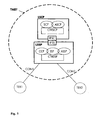
- FIG. 1 shows a service switching point LSSP and a service control unit LSCP, which are connected to one another via an interface unit IFSC on the part of the service control unit LSCP and an interface unit IFSS on the part of the service switching point LSSP.
- the service switching center LSSP fulfills the tasks of a switching center, for example in the function of a local exchange or also a transit switching center.
- the service switching point lssp continue to provide the functions of a so-called S ervice S witching oints P (SSP), so that can be addressed via the service switching point of the intelligent network services lssp and retrieved.
- SSP so-called S ervice S witching oints P
- the service switching center LSSP can be, for example, an Alcatel 1000 S12 switching node.
- the service switching center LSSP has connection modules for connecting subscriber lines or connecting lines to other switching nodes of the telecommunications network TNET, a coupling network for switching connections between the connection modules and a control CTRSSP, which among other things the establishment of connections and the signaling with participants and others Switching node controls. It is also possible for connection modules to be used to connect mobile users.
- a terminal TER1 is connected to the service switching center LSSP by way of example via a communication link CON1 and a terminal TER2 via a communication link CON2.
- the communication connections CON1 and CON2 can each lead via further devices of the telecommunications network TNET, not shown in FIG. 1, e.g. via access facilities and other exchanges.
- FIG. 1 A detailed description of the individual modules of the service switching center LSSP, such as the switching network and the connection modules mentioned are omitted in FIG. 1, since they are known from conventional exchanges. Only the control CTRSSP of the service switching center LSSP is shown specifically in FIG. 1, since, as will become clear later, it fulfills essential functions of the service switching center LSSP in the present exemplary embodiment.
- the CTRSSP controller is based on a computer system that contains a powerful central computer or is made up of several individual computers connected via an internal communication network.
- This Computer system is operated by an operating system that enables the execution of control programs that control the functions of the service switching center LSSP.
- the operating system is advantageously a real-time operating system specially tailored to the requirements of a switching node.
- three interlocking functions CCF, SSF and ASSF are shown schematically in FIG. 1.
- the representation in functions CCF and SSF follows the representation of functions of the same name in the already mentioned ITU-T Recommendation-Q.1215.
- CCF C all C ontrol F unction
- SSF SSF stands for "S ervice S witching F unction", ie for Dien Stan switching functions of the service switching point LSSP with which an intelligent network can be called service functions.
- the closely interlinked interaction of the functions CCF and SSF is indicated by overlapping ellipses.
- Both the functional scope of the CCF function and the functional scope of the SSF function are each defined by standardization.
- the ASSF function is an addition to the SSF function by another, non-standardized function, which will be discussed later. It is also possible for the ASSF function to be integrated into the SSF function, that is to say to expand the SSF function.
- the functions SSF and ASSF are shown in FIG. 1 as separate, but closely interlinked units.
- the service control unit LSCP is coupled to the service switching center LSSP.
- the service control unit LSCP has a control CTRSCP which is formed by one or more interconnected computers. These computers are operated by an operating system, for example a UNIX operating system, which is referred to as "middleware" Software, for example the Alcatel Nectar Telecom middleware, is adapted to the functional requirements of the service control unit LSCP.
- the control system CTRSCP executes control programs, the functions of which, for example, the function SCF and the function ASCF are shown in FIG. 1.
- the function SCF represents a service control function, a so-called "service control function".
- SCF SCF
- the designation "SCF” is based on a function designation of the same name in the ITU-T Recommendation Q.1215 already mentioned.
- the scope of the SCF function is defined by standardization.
- the service control unit LSCP performs further, non-standardized telecommunication service functions. These are shown in the form of the ASCF function in FIG. 1 and are explained in more detail.
- the function ASCF can be an independent function or can also be integrated into the function SCF.
- the SSF function monitors connection requests from subscribers of the telecommunications network TNET, which are routed via the service switching center LSSP. If e.g. If a connection request is sent from the terminal TER1 to the service switching center LSSP, this connection request is initially recorded by the CCF function. The CCF function forwards the connection request to the SSF function. The SSF function then uses the connection request to determine whether the execution of a telecommunications service is required.
- a criterion for a request from a telecommunications service can be, for example, the call number of the called subscriber entered in the connection request or also the call number of the calling subscriber.
- INAP Intelligent Network Applications Protocol
- the IN application messages (INAP messages) exchanged within the framework of this protocol as well as basic services and actions of this protocol are described, for example, in the recommendation ITU-T Q.1219, "Intelligent Network User's Guide for Capability Set 1" in chapter 6.5, "Intelligent Network Applications Protocol (INAP) ", explained on pages 26 to 34.
- ITU-T Q.1219 refers to the so-called Capability Set 1 (CS-1), which defines a certain scope of telecommunication services within an intelligent network and their performance characteristics.
- ITU-T Recommendation Q.1211 "Introduction to Intelligent Network Capability Set 1" provides an introduction to these services.
- the standardization of telecommunication services has advanced to a so-called “Capability Set 2" and is being further developed into further “Capability Sets”.
- the function SCF After the function SCF has received the request from the function SSF via the interface unit IFSC, it interprets it and replies to the function SSF with a response message, likewise, for example, with the INAP protocol mentioned. If the request, for example in connection with the telecommunication service "Call forwarding"("Call forwarding (CF)”), described on page 19 of ITU-T Recommendation Q.121 1, refers to a possible forwarding instead of to the call number of the terminal TER2 to one alternative call number, the function SCF sends the alternative call number in the reply message as a parameter for a further call setup. The SSF function then receives the reply message and instructs the CCF function with the "alternative phone number" parameter so that the CCF function meets the above connection request and the terminal TER1 can connect to a terminal not shown in FIG. 1 under the alternative number.
- Capability Set 1 Other services of the "Capability Set 1" are, for example, identification of malicious callers ("Malicious Call Identification (MCI)”), speed dialing (“Abbreviated Dialing (ABD)”) or payment of a call by the called party ("reverse charging / Freephone (FPH ) ").
- MCI Malignant Call Identification
- ABS Abbreviated Dialing
- FPH Freephone
- the service switching center LSSP and the service control unit LSCP can also be designed for services of the "capability set 2".
- a service of the "Capability Set 2" is, for example, an automatic call back to the caller who called last ("Automatic Call Back (ACB))".
- the service switching point LSSP with the help of the ASSF function and the service control unit LSCP with the help of the ASCF function can also provide other telecommunication services that are not suitable for standardization or that are intended for possible standardization, but still are not standardized. This is made possible in particular by the fact that the interface between the service switching point LSSP and the service control unit LSCP is an internal interface.
- the service switching point LSSP and the service control unit LSCP do not have to adhere to a predetermined protocol, which is understandable for other facilities in the telecommunications network TNET, for example the aforementioned INAP protocol, for the data traffic only affecting them, but can use a proprietary protocol to perform the additional, Exchange non-standardized telecommunication service functions necessary data.
- a proprietary protocol can be interpreted in a manner defined internally between the service switching point LSSP and the service control unit LSCP.
- Such a proprietary protocol can also advantageously be based on the basic structure of the INAP protocol and around some protocol elements Provision of non-standard telecommunications service functions may be expanded.
- the service switching center LSSP and the service control unit LSCP can exchange data instead of with a protocol based on standardized protocol elements via a protocol specifically defined for the communication between the service switching center LSSP and the service control unit LSCP and detached from standards.
- the service switching point LSSP and the service control unit LSCP can also solve telecommunication service functions that are defined by standards in such a proprietary protocol in a manner that is not provided for by a standard in this way.
- a service that is not provided by standardization, which the service switching point LSSP and the service control unit LSCP can provide, is, for example, if, in the case of the call diversion mentioned, it is additionally determined via which route the call to be diverted is to be diverted to the alternative number or at which tariff conditions the call is to be made to be redirected.
- the ASSF function can request the parameters required for this from the ASCF function and then instruct the CCF function with these parameters.
- Further telecommunication services not mentioned here can also be defined and provided by the service switching center LSSP and the service control unit LSCP after adapting the functions ASSF and ASCF.
- Such a functional part consists of machine code that can be executed by a processor and loaded by the CTRSSP controller and integrated into the CCF or SSF functions.
- Such a method is comparable, for example, to the need-based integration of so-called “dynamic link libraries (DLL)" under Microsoft Windows.
- parts of a machine code that can be executed by a processor in the form of functions are only loaded from a storage medium, for example a hard disk, and are incorporated into the machine code that is already being executed when the functions are actually needed.
- the ASCF function can also send function parts to the ASSF function, which then integrates these function parts into the CCF function or the SSF function.
- the call control of the service switching center LSSP can be modified dynamically especially for the provision of a specific telecommunication service.
- the integrated functional parts are carried out by the CTRSSP controller.
- the functional parts can also be written in a program code to be interpreted instead of in a machine code that can be directly executed by the control CTRSSP, for example in the form of so-called applets of the programming language JAVA.
- Such JAVA applets consist of an intermediate code generated from compiled source text, which the CTRSSP controller translates into machine code using a JAVA interpreter. The CTRSSP control then executes this machine code program.
- the function ASCF instructs the function ASSF to take over the further processing of the connection request mentioned instead of the function CCF completely.
- the ASCF function itself can take over the further processing of the connection request from the CCF function, so that the Call processing passes from the service switching center LSSP to the service control unit LSCP.
- the service control unit LSCP uses a service support system, not shown in FIG. 1, for example a voice recognition system for voice announcements or voice recognition.
- TCAP Transport Capabilities Application Part
- SCCP Signaling Connection Control Part
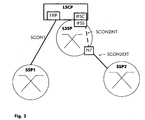
- FIG. 2 shows a further increase in the functionality of the service control unit LSCP known from FIG. 1, alone or in conjunction with the LSSP, likewise known from FIG. 1.
- the functions of the service control unit LSCP are made available to other service switching points SSP1 and SSP2.
- the service switching point SSP1 is connected to the service control unit LSCP via an interface unit EXIF and a connection SCON1.
- the interface EXIF like the interface known from FIG. 1, between the service switching center LSSP and the service control unit LSCP can be an internal interface, so that the service switching center SSP1 can be connected to the service control unit LSCP to a similar extent to the functionality as the service switching center LSSP.
- Such an internal coupling is particularly advantageous when the service switching point LSSP and the service switching point SSP1 form a common switching point in a spatial sense, for example in the same building.
- the service control unit LSCP and the service switching points lssp and SSP1 can then via a LAN (L ocal A rea N etwork) communicate using a TCP / IP protocol (T ransmission C ontrol P rotocol / I nternet P rotocol) to each other, on which the mentioned INAP messages or messages can be transported in a proprietary data format.
- a LAN Local Area Network
- TCP / IP protocol T ransmission C ontrol P rotocol / I nternet P rotocol
- the service switching point SSP1 can provide telecommunication service functions in a similar scope, likewise not defined by standards, as the service switching point LSSP.
- the service switching point SSP1 can also be a service switching point, the functions and interfaces of which to the telecommunications network TNET largely conform to the respective standards of an intelligent network.
- the service switching point SSP1 then performs functions that do the standardized functions SSF and CCF, but not the ASSF function known from FIG Service switching center LSSP correspond.
- the service control unit LSCP in turn offers the standardized function SCF known from FIG. 1 to the service switching point SSP1.
- the connection SCON1 then leads via a signaling channel that is usually used between exchanges, for example on the central signaling network No. 7 already mentioned. For data exchange, the service switching point SSP1 and the service control unit LSCP on the central signaling network No.
- the interface unit EXIF is then a protocol processing unit for the transmission and reception side processing of the aforementioned protocols.
- a switching center usually has a protocol processing unit anyway, by means of which the switching center on the central signaling network can communicate with other switching centers, for example for establishing and clearing a connection.
- the service switching center LSSP in FIG. 2 also has such a protocol processing unit, referred to as "protocol processing unit N7", which the service control unit LSCP can advantageously use for communication with further service switching centers.
- protocol processing unit N7 protocol processing unit
- Such communication of the service control unit LSCP across the service switching point LSSP can take place in FIG. 2 with the service switching point SSP2.
- the service switching point SSP2 performs functions which correspond to the standardized functions SSF and CCF, the service switching point LSSP known from FIG. 1, the service control unit LSCP offers these functions the standardized function SCF for interaction.
- the service switching point SSP2 is connected to the service control unit LSCP via a connection which is in a connecting portion SCON21NT shown by a broken line, and a connecting portion SCON2EXT shown by a solid line.
- the connection section SCON21NT is an internal connection within the service switching center LSSP, which leads from the interface unit IFSS known from FIG. 1 to the protocol processing unit N7. From there, the connection section SCON2EXT continues to the service switching point SSP2.
- the protocols usual on the central signaling network No. 7 are also used on the connection section SCON2EXT, for example the mentioned INAP, TCAP and SCCP protocols.
- the service control unit LSCP for the service switching point SSP2 already largely prepares certain messages for external transmission on the connection section SCON2EXT by the interface unit IFSC Messages, for example, have already been sent to the protocol processing unit N7 in the form of the INAP protocol, better still additionally in the form of the TCAP protocol and the SCCP protocol.
- the service control unit LSCP receives messages from the service switching point SSP2 from the protocol processing unit N7 in these protocols.
- the interface unit EXIF is connected to the interface unit IFSS of the service switching center LSSP instead of the interface unit IFSC.
- the interface unit EXIF then only has to be suitable for processing the protocols higher according to the OSI layer model, for example the INAP protocol and the TCAP protocol.
- the continue according to the OSI layer model protocol levels below are processed by the protocol processing unit N 7.
- the service switching point LSSP can be connected via its interface unit IFSS not only to the service control unit LSCP, but also to other service control units, not shown in FIG. 2, which, like the service control unit LSCP in cooperation with the service switching point LSSP, each also have telecommunication service functions to an extent not defined by standards.
- Such coupling of several service control units to the service switching center LSSP could e.g. done over a LAN. It is then also possible that the service control unit LSCP and the further service control units not only perform telecommunication service functions together with the service switching center LSSP, but also together with other service switching centers that are likewise connected to the LAN.
Landscapes
- Engineering & Computer Science (AREA)
- Computer Networks & Wireless Communication (AREA)
- Telephonic Communication Services (AREA)
- Exchange Systems With Centralized Control (AREA)
Applications Claiming Priority (2)
| Application Number | Priority Date | Filing Date | Title |
|---|---|---|---|
| DE1998144825 DE19844825A1 (de) | 1998-09-30 | 1998-09-30 | Verfahren, Dienststeuerungseinheit, Dienstvermittlungsstelle und Kombinationsknoten zum Bereitstellen von Telekommunikationsdiensten |
| DE19844825 | 1998-09-30 |
Publications (2)
| Publication Number | Publication Date |
|---|---|
| EP0991284A2 true EP0991284A2 (fr) | 2000-04-05 |
| EP0991284A3 EP0991284A3 (fr) | 2000-10-11 |
Family
ID=7882781
Family Applications (1)
| Application Number | Title | Priority Date | Filing Date |
|---|---|---|---|
| EP99440220A Withdrawn EP0991284A3 (fr) | 1998-09-30 | 1999-08-06 | Méthode, contrôleur de services, commutateur de services et noeuds de combination pour fournir des services de télécommunication |
Country Status (2)
| Country | Link |
|---|---|
| EP (1) | EP0991284A3 (fr) |
| DE (1) | DE19844825A1 (fr) |
Family Cites Families (10)
| Publication number | Priority date | Publication date | Assignee | Title |
|---|---|---|---|---|
| DE4412727C2 (de) * | 1994-04-13 | 1997-08-21 | Siemens Ag | Verfahren und Anordnung zum Abrechnen von Gebühren in einem Mobilfunksystem |
| US5664102A (en) * | 1995-02-07 | 1997-09-02 | At&T | Intelligent network internetworking access arrangement |
| WO1997010683A1 (fr) * | 1995-09-15 | 1997-03-20 | Siemens Aktiengesellschaft | Systeme environnemental operationnel pour des applications de services d'un reseau de telecommunication |
| US5761290A (en) * | 1995-10-11 | 1998-06-02 | Bell Atlantic Network Services, Inc. | Alternate service activation |
| WO1997041678A2 (fr) * | 1996-04-30 | 1997-11-06 | Siemens Aktiengesellschaft | Procede d'ecoute d'une ligne de telecommunications |
| EP0836345A3 (fr) * | 1996-08-23 | 2001-03-14 | Siemens Aktiengesellschaft | Réseau intelligent pour commuter des services à bande large |
| WO1998032291A1 (fr) * | 1997-01-15 | 1998-07-23 | British Telecommunications Public Limited Company | Reseau intelligent dote d'une fonction de commande de service repartie |
| ID22292A (id) * | 1997-01-23 | 1999-09-30 | Siemens Ag | Metode untuk mengatur layanan tambahan dalam jaringan komunikasi |
| ATE222442T1 (de) * | 1997-02-21 | 2002-08-15 | Siemens Ag | Verfahren und kommunikationsnetz zur bereitstellung von ansagen |
| US5912954A (en) * | 1997-02-28 | 1999-06-15 | Alcatel Usa Sourcing, L.P. | Method and system for providing billing information in a telecommunications network |
-
1998
- 1998-09-30 DE DE1998144825 patent/DE19844825A1/de not_active Withdrawn
-
1999
- 1999-08-06 EP EP99440220A patent/EP0991284A3/fr not_active Withdrawn
Also Published As
| Publication number | Publication date |
|---|---|
| EP0991284A3 (fr) | 2000-10-11 |
| DE19844825A1 (de) | 2000-04-13 |
Similar Documents
| Publication | Publication Date | Title |
|---|---|---|
| DE69615389T2 (de) | Rückrufdienst für einen bereich mit regulierender einschränkung | |
| DE69831909T2 (de) | Kommunikationssystem zur Wegleitungssteuerung zwischen einem Leitungsvermittlungsnetzwerk und dem Internet | |
| EP0731618A2 (fr) | Procédé pour commander un réseau d'accès et central avec un tel réseau d'accès | |
| DE60130981T2 (de) | Signalisierung in einem telekommunikationsnetz | |
| DE60023207T2 (de) | Vorrichtung und Verfahren zur Umleitung von Anrufen zu einem Internet Service Provider über den nächsten Zugangspunkt in einem Telefonnetzwerk | |
| EP2055112B1 (fr) | Réseau de communication avec commande de commutation de circuits et de paquets | |
| DE60001359T2 (de) | Telekommunikationssystem und verfahren für telekommunikationsdienste mit rufnummerumsetzung | |
| DE10001077A1 (de) | Verfahren, Dienst-Vermittlungsstelle, Dienst-Steuerknoten, Internet-Gateway, Programm-Modul und Internet-Endgerät zum Aufbau einer Ruf-Verbindung zwischen einem Telefonnetz-Endgerät und einem Internet-Endgerät | |
| EP0676905B1 (fr) | Procédé pour établir une connexion avec un abonné par un premier réseau, ainsi qu'un processeur de service, un dispositif de commutation et un terminal | |
| DE60029105T2 (de) | Ip - basiertes fernsprechsystem | |
| EP1269766B1 (fr) | Systeme de telecommunication dote d'un reseau de communication a commutation de paquets et procede permettant de faire fonctionner un tel systeme | |
| DE60004883T2 (de) | Signalisierung in einem telekommunikationsnetz | |
| DE69929629T2 (de) | Verfahren und system zur implementierung eines dienstes in einem telekommunikationssystem | |
| DE60127450T2 (de) | Verfahren zum einrichten von kommunikationswegen zwischen zugriffspunkten eines vermittlungssystems und das verfahren implementierendes vermittlungssystem | |
| EP1305957B1 (fr) | Systeme permettant de connecter un dispositif de telecommunication a un reseau de communication a commutation de paquets | |
| EP0991284A2 (fr) | Méthode, contrôleur de services, commutateur de services et noeuds de combination pour fournir des services de télécommunication | |
| DE69636415T2 (de) | Verbesserungen für nachrichtenübertragungsdienste | |
| DE19852774B4 (de) | Telefonvermittlungssystem zur Eingliederung von Mobilnetzteilnehmern in eine CENTREX-Gruppe | |
| EP1123614B1 (fr) | Architecture de reseau pour reseaux de communication ou de donnees | |
| DE69920036T2 (de) | Verkehrsvermittlung in einem intelligenten netz | |
| DE10040461B4 (de) | Vermittlungssteuerung in einem privaten Netz mit Telekommunikationsanlagen | |
| DE10117366B4 (de) | Verfahren und Anordnung zum Betreiben eines Telekommunikationsnetzes | |
| EP0957645B1 (fr) | Elément de réseau pour un réseau de télécommunication intelligent | |
| DE19964189B4 (de) | Routing-Einrichtung und TK-Einrichtung zum Management der Auslastung von Interconnectanschlüssen | |
| DE19922266C2 (de) | Verfahren und Kommunikationssystem zum Management der Auslastung von Interconnectanschlüssen |
Legal Events
| Date | Code | Title | Description |
|---|---|---|---|
| PUAI | Public reference made under article 153(3) epc to a published international application that has entered the european phase |
Free format text: ORIGINAL CODE: 0009012 |
|
| AK | Designated contracting states |
Kind code of ref document: A2 Designated state(s): AT BE CH CY DE DK ES FI FR GB GR IE IT LI LU MC NL PT SE |
|
| AX | Request for extension of the european patent |
Free format text: AL;LT;LV;MK;RO;SI |
|
| PUAL | Search report despatched |
Free format text: ORIGINAL CODE: 0009013 |
|
| AK | Designated contracting states |
Kind code of ref document: A3 Designated state(s): AT BE CH CY DE DK ES FI FR GB GR IE IT LI LU MC NL PT SE |
|
| AX | Request for extension of the european patent |
Free format text: AL;LT;LV;MK;RO;SI |
|
| 17P | Request for examination filed |
Effective date: 20010228 |
|
| AKX | Designation fees paid |
Free format text: AT BE CH CY DE DK ES FI FR GB GR IE IT LI LU MC NL PT SE |
|
| 17Q | First examination report despatched |
Effective date: 20021015 |
|
| STAA | Information on the status of an ep patent application or granted ep patent |
Free format text: STATUS: THE APPLICATION IS DEEMED TO BE WITHDRAWN |
|
| 18D | Application deemed to be withdrawn |
Effective date: 20030226 |