EP0992214A2 - Für niedrige Sättigung speziell optimierte Pulsoximetermessfühler - Google Patents
Für niedrige Sättigung speziell optimierte Pulsoximetermessfühler Download PDFInfo
- Publication number
- EP0992214A2 EP0992214A2 EP99125853A EP99125853A EP0992214A2 EP 0992214 A2 EP0992214 A2 EP 0992214A2 EP 99125853 A EP99125853 A EP 99125853A EP 99125853 A EP99125853 A EP 99125853A EP 0992214 A2 EP0992214 A2 EP 0992214A2
- Authority
- EP
- European Patent Office
- Prior art keywords
- sensor
- radiation
- tissue
- pulse oximeter
- oxygen saturation
- Prior art date
- Legal status (The legal status is an assumption and is not a legal conclusion. Google has not performed a legal analysis and makes no representation as to the accuracy of the status listed.)
- Granted
Links
Images





Classifications
-
- A—HUMAN NECESSITIES
- A61—MEDICAL OR VETERINARY SCIENCE; HYGIENE
- A61B—DIAGNOSIS; SURGERY; IDENTIFICATION
- A61B5/00—Measuring for diagnostic purposes; Identification of persons
-
- A—HUMAN NECESSITIES
- A61—MEDICAL OR VETERINARY SCIENCE; HYGIENE
- A61B—DIAGNOSIS; SURGERY; IDENTIFICATION
- A61B5/00—Measuring for diagnostic purposes; Identification of persons
- A61B5/145—Measuring characteristics of blood in vivo, e.g. gas concentration or pH-value ; Measuring characteristics of body fluids or tissues, e.g. interstitial fluid or cerebral tissue
- A61B5/1455—Measuring characteristics of blood in vivo, e.g. gas concentration or pH-value ; Measuring characteristics of body fluids or tissues, e.g. interstitial fluid or cerebral tissue using optical sensors, e.g. spectral photometrical oximeters
- A61B5/1464—Measuring characteristics of blood in vivo, e.g. gas concentration or pH-value ; Measuring characteristics of body fluids or tissues, e.g. interstitial fluid or cerebral tissue using optical sensors, e.g. spectral photometrical oximeters specially adapted for foetal tissue
-
- A—HUMAN NECESSITIES
- A61—MEDICAL OR VETERINARY SCIENCE; HYGIENE
- A61B—DIAGNOSIS; SURGERY; IDENTIFICATION
- A61B5/00—Measuring for diagnostic purposes; Identification of persons
- A61B5/145—Measuring characteristics of blood in vivo, e.g. gas concentration or pH-value ; Measuring characteristics of body fluids or tissues, e.g. interstitial fluid or cerebral tissue
- A61B5/14542—Measuring characteristics of blood in vivo, e.g. gas concentration or pH-value ; Measuring characteristics of body fluids or tissues, e.g. interstitial fluid or cerebral tissue for measuring blood gases
-
- A—HUMAN NECESSITIES
- A61—MEDICAL OR VETERINARY SCIENCE; HYGIENE
- A61B—DIAGNOSIS; SURGERY; IDENTIFICATION
- A61B2562/00—Details of sensors; Constructional details of sensor housings or probes; Accessories for sensors
- A61B2562/02—Details of sensors specially adapted for in-vivo measurements
- A61B2562/0233—Special features of optical sensors or probes classified in A61B5/00
- A61B2562/0242—Special features of optical sensors or probes classified in A61B5/00 for varying or adjusting the optical path length in the tissue
-
- A—HUMAN NECESSITIES
- A61—MEDICAL OR VETERINARY SCIENCE; HYGIENE
- A61B—DIAGNOSIS; SURGERY; IDENTIFICATION
- A61B5/00—Measuring for diagnostic purposes; Identification of persons
- A61B5/72—Signal processing specially adapted for physiological signals or for diagnostic purposes
- A61B5/7203—Signal processing specially adapted for physiological signals or for diagnostic purposes for noise prevention, reduction or removal
- A61B5/7207—Signal processing specially adapted for physiological signals or for diagnostic purposes for noise prevention, reduction or removal of noise induced by motion artifacts
-
- H—ELECTRICITY
- H10—SEMICONDUCTOR DEVICES; ELECTRIC SOLID-STATE DEVICES NOT OTHERWISE PROVIDED FOR
- H10W—GENERIC PACKAGES, INTERCONNECTIONS, CONNECTORS OR OTHER CONSTRUCTIONAL DETAILS OF DEVICES COVERED BY CLASS H10
- H10W72/00—Interconnections or connectors in packages
- H10W72/851—Dispositions of multiple connectors or interconnections
- H10W72/874—On different surfaces
- H10W72/884—Die-attach connectors and bond wires
-
- H—ELECTRICITY
- H10—SEMICONDUCTOR DEVICES; ELECTRIC SOLID-STATE DEVICES NOT OTHERWISE PROVIDED FOR
- H10W—GENERIC PACKAGES, INTERCONNECTIONS, CONNECTORS OR OTHER CONSTRUCTIONAL DETAILS OF DEVICES COVERED BY CLASS H10
- H10W90/00—Package configurations
- H10W90/701—Package configurations characterised by the relative positions of pads or connectors relative to package parts
- H10W90/731—Package configurations characterised by the relative positions of pads or connectors relative to package parts of die-attach connectors
- H10W90/736—Package configurations characterised by the relative positions of pads or connectors relative to package parts of die-attach connectors between a chip and a stacked lead frame, conducting package substrate or heat sink
-
- H—ELECTRICITY
- H10—SEMICONDUCTOR DEVICES; ELECTRIC SOLID-STATE DEVICES NOT OTHERWISE PROVIDED FOR
- H10W—GENERIC PACKAGES, INTERCONNECTIONS, CONNECTORS OR OTHER CONSTRUCTIONAL DETAILS OF DEVICES COVERED BY CLASS H10
- H10W90/00—Package configurations
- H10W90/701—Package configurations characterised by the relative positions of pads or connectors relative to package parts
- H10W90/751—Package configurations characterised by the relative positions of pads or connectors relative to package parts of bond wires
- H10W90/756—Package configurations characterised by the relative positions of pads or connectors relative to package parts of bond wires between a chip and a stacked lead frame, conducting package substrate or heat sink
Definitions
- Pulse oximetry is used to continuously monitor the arterial blood oxygen saturation of adults, pediatrics and neonates in the operating room, recovery room, intensive care units, and increasingly on the general floor.
- Pulse oximetry has traditionally been used on patient populations where arterial blood oxygen saturation is typically greater than 90%, i.e. , more than 90% of the functional hemoglobin in the arterial blood is oxyhemoglobin and less than 10% is reduced hemoglobin. Oxygen saturation in this patient population rarely drops below 70%. When it does drop to such a low value, an unhealthy clinical condition is indicated, and intervention is generally called for. In this situation, a high degree of accuracy in the estimate of saturation is not clinically relevant, as much as is the trend over time.
- LEDs Light Emitting Diodes
- transmission pulse oximetry transmission pulse oximetry
- reflectance pulse oximetry Reflectance pulse oximetry
- the LEDs and photodetector are housed in a reusable or disposable sensor which connects to the pulse oximeter electronics and display unit.
- the "pulse" in pulse oximetry comes from the time varying amount of arterial blood in the tissue during the cardiac cycle, and the processed signals from the photodetector create the familiar plethysmographic waveform due to the cycling light attenuation.
- At least one of the two LEDs' primary wavelength must be chosen at some point in the electromagnetic spectrum where the absorption of oxyhemoglobin (HbO 2 ) differs from the absorption of reduced hemoglobin (Hb).
- the second of the two LEDs' wavelength must be at a different point in the spectrum where, additionally, the absorption differences between Hb and HbO 2 are different from those at the first wavelength.
- Commercial pulse oximeters utilize one wavelength in the near red part of the visible spectrum near 660 nanometers (nm), and one in the near infrared part of the spectrum in the range of 880 nm - 940 nm (See Fig. 1).
- red wavelengths or “red” spectrum will refer to the 600-800 nm portion of the electromagnetic spectrum; “near red”, the 600-700 nm portion; “far red”, the 700-800 nm portion; and “infrared” or “near infrared”, the 800-1000 nm portion.
- Photocurrents generated within the photodetector are detected and processed for measuring the modulation ratio of the red to infrared signals.
- This modulation ratio has been observed to correlate well to arterial oxygen saturation as shown in Fig. 2.
- Pulse oximeters and pulse oximetry sensors are empirically calibrated by measuring the modulation ratio over a range of in vivo measured arterial oxygen saturations (SaO 2 ) on a set of patients, healthy volunteers or animals. The observed correlation is used in an inverse manner to estimate saturation (SpO 2 ) based on the real-time measured value of modulation ratios.
- SaO 2 refers to the in vivo measured functional saturation
- SpO 2 is the estimated functional saturation using pulse oximetry.
- emitter wavelengths used in conventional pulse oximeters are based on several factors including, but not limited to, optimum signal transmission through blood perfused tissues, sensitivity to changes in arterial blood oxygen saturation, and the intensity and availability of commercial LEDs at the desired wavelengths.
- one of the two wavelengths is chosen from a region of the absorption spectra (Fig. 1) where the extinction coefficient of HbO 2 is markedly different from Hb.
- the region near 660 nm is where the ratio of light absorption due to reduced hemoglobin to that of oxygenated hemoglobin is greatest. High intensity LEDs in the 660 nm region are also readily available.
- the IR wavelength is typically chosen near 805 nm (the isosbestic point) for numerical convenience, or in the 880-940 nm spectrum where additional sensitivity can be obtained because of the inverse absorption relationship of Hb and HbO 2 .
- pulse oximeters which use LED wavelengths paired from the 660 nm band and 900 nm bands all show diminished accuracy at low oxygen saturations.
- more accurate estimates of low arterial oxygen saturation using pulse oximetry are achieved by optimizing a wavelength spectrum of first and second light sources so that the saturation estimates at low saturation values are improved while the saturation estimates at high saturation values are minimally adversely affected as compared to using conventional first and second wavelength spectrums. It has been discovered that calculations at low saturation can be significantly improved if the anticipated or predicted rates of absorption and scattering of the first wavelength spectrum is brought closer to, optimally equal to, the anticipated or predicted rates of absorption and scattering of the second wavelength spectrum than otherwise exists when conventional wavelength spectrum pairs are chosen, such as when conventionally using a first wavelength centered near 660 nm and a second wavelength centered anywhere in the range of 880 nm - 940 nm.
- the present invention solves a long felt need for a pulse oximeter sensor and system which provides more accurate estimates of arterial oxygen saturation at low oxygen saturations, i.e. saturations equal to or less than 80%, 75%, 70%, 65%, or 60%, than has heretofore existed in the prior art.
- the sensor and system is particularly useful for estimating arterial saturation of a living fetus during labor where the saturation range of principal importance and interest is generally between 15% and 65%, and is particularly useful for estimating arterial saturation of living cardiac patients who experience significant shunting of venous blood into their arteries in their hearts and hence whose saturation range of principle importance and interest is roughly between 50% and 80%.
- a typical healthy human has a saturation greater than 90%.
- the invention has utility whenever the saturation range of interest of a living subject, either human or animal, is low.
- the senor, monitor, and system of the invention further provide better and more accurate oxygen saturation estimates when perturbation induced artifacts exist and are associated with the subject being monitored.
- Perturbation induced artifacts include, but are not limited to, any artifact that has a measurable impact on the relative optical properties of the medium being probed.
- Perturbation induced artifacts include but are not limited to the following:
- the present invention provides a fetal pulse oximeter sensor with a light source optimized for the fetal oxygen saturation range and for maximizing the immunity to perturbation induced artifact.
- a far red and an infrared light source are used, with the far red light source having a mean wavelength between 700-790 nm.
- the infrared light source can have a mean wavelength as in prior art devices used on patients with high saturation, i.e., between 800-1000 nm.
- "high saturation” shall mean an arterial oxygen saturation greater than 70%, preferably greater than 75%, alternatively greater than 80%, optionally greater than 90%.
- the fetal sensor of the present invention is further optimized by arranging the spacing between the location the emitted light enters the tissue and the location the detected light exits the tissue to minimize the sensitivity to perturbation induced artifact.
- electrooptic transducers e.g., LEDs and photodetectors
- the optoelectric transducers are located remote from the tissue, for example in the oximeter monitor, and optical fibers interconnect the transducers and the tissue with the tissue being illuminated from an end of a fiber, and light scattered by the tissue being collected by an end of a fiber. Multiple fibers or fiber bundles are preferred.
- the present invention recognizes that the typical oxygen saturation value for a fetus is in the range of 5-65%, commonly 15-65%, compared to the 90% and above for a typical patient with normal (high) saturation.
- a fetal sensor is subject to increased perturbation induced artifact.
- Another unique factor in fetal oximetry is that the sensor is typically inserted through the vagina and the precise location where it lands is not known in advance.
- the present invention recognizes all of these features unique to fetal oximetry or oximetry for low saturation patients and provides a sensor which optimizes the immunity to perturbation induced artifacts. This optimization is done with a trade-off on the sensitivity to changes in saturation value. This trade-off results in a more reliable calculation that is not obvious to those who practice the prior art methods which attempt to maximize the sensitivity to changes in the saturation value. The improvement in performance that results from these optimizations are applicable to both reflectance and transmission pulse oximetry.
- An example of a fetal transmission pulse oximetry configuration usable with the present invention is described in U.S. Patent Application No. 07/752,168, assigned to the assignee of the present invention, the disclosure of which is incorporated herein by reference.
- An example of a non-fetal transmission pulse oximetry configuration usable with the present invention is described in U.S. Patent No. 4,830,014, assigned to the assignee of the present invention, the disclosure of which is incorporated herein by reference.
- Fig. 3 illustrates the layers of tissue in a typical fetus location where a sensor may be applied. Typically, there would be a first layer of skin 12, perhaps followed by a layer of fat 14, a layer of muscle 16, and a layer of bone 18. This is a simplified view for illustration purposes only.
- the contours and layers can vary at different locations. For instance, bone would be closer to the surface on the forehead, as opposed to closer muscle on the neck. Such variations in sites can produce the first type of perturbation artifact mentioned in the summary--artifact due to variations in tissue composition.
- Arrow 24 shows light which passes almost directly from emitter 20 to detector 22, basically shunted from one to the other, passing through very little blood perfused tissue.
- Arrow 26 illustrates the deeper penetration of another path of the light. The depth of penetration is affected by the wavelength of the light and the saturation. At low saturation, infrared light penetrates deeper than near red, for instance.
- the deeper penetration can result in an undesirable variation between the infrared and red signals, since the IR signal will pass through more different layers.
- FIG. 3 Also illustrated in Fig. 3 is the effect of using an emitter 28 which is spaced on the tissue at a greater distance from a detector 30 than the first pair 20, 22 described. As can be seen, this greater separation results in the penetration of a larger amount of tissue, as indicated by arrows 32 and 34. Thus, the greater spacing increases the depth of penetration, although it will reduce the intensity of the signal received at the detector due to more attenuation from more of the light being absorbed in the tissue and the greater light propagation distances involved.
- the second type of perturbation mentioned in the summary is variations in the concentration of blood in the tissue from patient to patient or over time. A lower concentration results in less absorption, increasing the penetration depth.
- the inventors estimate that the mean penetration depth of photons in a medium is related to the product of the absorption and scattering coefficients, and this estimate is consistent with the findings of Weiss et al., Statistics of Penetration Depth of Photons Re-emitted from Irradiated Tissue , Journal of Modern Optics, 1989, vol. 36, No. 3, 349-359, 354, the disclosure of which is incorporated herein by reference.
- Absorption of light in tissue in the visible and near infrared region of the electromagnetic spectrum is dominated by the absorption characteristics of hemoglobin.
- Absorption coefficients of hemoglobin can be found in the literature, for example Zijlstra, et al., "Absorption spectra of human fetal and adult oxyhemoglobin, de-oxyhemoglobin, carboxyhemoglobin and methemoglobin", Clinical Chemistry , 37/9, 1633-1638, 1991 (incorporated herein by reference).
- Measured scattering coefficients of tissue are influenced by the methodology of measurement and the model used to fit the data, although there is general agreement in the relative sensitivity to wavelength regardless of method.
- Tissue scattering coefficients used by the inventors are based on diffusion theory, and are taken from Schmitt, "Simple photon diffusion analysis of the effects of multiple scattering on pulse oximetry", IEEE Transactions on Biomedical Engineering , Vol. 38, No. 12, December 1991, the disclosure of which is incorporated herein by reference.
- Fig. 4A is a graph showing the product of the absorption and scattering coefficients for 0%, 40%, 85% and 100% saturations for wavelengths between 600 nm and 1,000 nm. For 85-100% tissue oxygen saturation, good balance or correlation exists between the product of the absorption and scattering coefficients of conventionally chosen wavelength pairs (i.e., 660 nm and 892 nm), as illustrated by points A and B on curve 101.
- conventionally chosen wavelength pairs i.e., 660 nm and 892 nm
- points C and D on curve 102 graphically indicate that there is a very significant mismatch between the product of the absorption and scattering coefficients of the 660 nm near red and 892 nm infrared light, with the near red light being more strongly absorbed and scattered.
- This very significant absorption and scattering mismatch results in very different tissue being probed by the near red and infrared light which significantly degrades the accuracy of the arterial oxygen saturation calculation.
- a large range of low arterial oxygen saturations need to be accurately calculated, as when monitoring a fetus during labor where the range of arterial oxygen saturations can extend between 15% and 65%, it is evident from Fig.
- points D and E on curve 102 in Fig. 4A illustrate advantages of a preferred embodiment of the invention of choosing first and second wavelengths, i.e., 732 nm and 892 nm, which have absorption and scattering characteristics which are more closely balanced as compared to the prior art pairing of 660 nm and 892 nm for 40% tissue oxygen saturation.
- first and second wavelengths i.e., 732 nm and 892 nm
- tissue oxygen saturation values shown in Fig. 4A are closely correlated to arterial oxygen saturation values.
- a given value of tissue oxygen saturation corresponds to a higher value of arterial oxygen saturation.
- the inventors estimate that 85% tissue oxygen saturation corresponds to roughly 100% arterial oxygen saturation.
- Another preferred embodiment of the invention is to use the sensor of the invention for cardiac patients whose range of saturation, where accuracy in calculations is important, is from 50% to 80%.
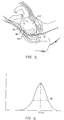
- Fig. 5 illustrates the placement of a sensor 410 on a fetus 412.
- the sensor is connected by a cable 414 to an external pulse oximeter monitor.
- sensor 410 is wedged between a uterine wall 416 and the fetus 412. In this instance, the sensor is on the side of the fetus' forehead. This wedging of the sensor applies a force to the skin immediately below the sensor, which reduces the amount of blood in the local tissue. This reduces the amount of blood the light signal will pass through, thus increasing the difficulty of obtaining an accurate blood oxygenation reading.
- LEDs have a spectral width, and are not a single narrowband wavelength device like a laser.
- Fig. 6 illustrates the spectral spread of one preferred wavelength for a sensor according to the present invention, showing the far red wavelength at 735 nm as being the peak wavelength.
- arrow 510 indicates a distribution of wavelengths which can be approximately 25 nm wide at which the intensity level is approximately 50% of that of the peak wavelength.
- a purchaser specifying a particular wavelength such as a 735 nm wavelength in an embodiment of the present invention, will expect to receive LEDs whose actual mean wavelength can vary by 10, 20 or more nanometers from the specified value.
- a narrow range is typically achieved by testing and sorting.
- Fig. 27 is a block diagram of one embodiment of a pulse oximeter implementing the present invention.
- Light from light source 210 passes into patient tissue 212, and is scattered and detected by photodetector 214.
- a sensor 200 containing the light source and photodetector may also contain an encoder 216 which provides signals indicative of the wavelength of light source 210 to allow the oximeter to select appropriate calibration coefficients for calculating oxygen saturation.
- Encoder 216 may, for instance, be a resistor.
- the oximeter includes a microprocessor 222 connected to an internal bus 224. Also connected to the bus is a RAM memory 226 and a display 228.
- a time processing unit (TPU) 230 provides timing control signals to light drive circuitry 232 which controls when light source 210 is illuminated, and if multiple light sources are used, the multiplexed timing for the different light sources.
- TPU 230 also controls the gating-in of signals from photodetector 214 through an amplifier 233 and a switching circuit 234. These signals are sampled at the proper time, depending upon which of multiple light sources is illuminated, if multiple light sources are used.
- the received signal is passed through an amplifier 236, a low pass filter 238, and an analog-to-digital converter 240.
- the digital data is then stored in a queued serial module (QSM) 242, for later downloading to RAM 26 as QSM 242 fills up.
- QSM queued serial module
- a detector and decoder module 242 determines the wavelength of the light source from encoder 216.
- One embodiment of circuitry for accomplishing this is shown in commonly assigned U.S. Patent No. 4,770,179, the disclosure of which is hereby incorporated by reference.
- microprocessor 222 will calculate the oxygen saturation using well-known algorithms. These algorithms require coefficients, which may be empirically determined, corresponding to, for example, the wavelengths of light used. These are stored in a ROM 246. The particular set of coefficients chosen for any pair of wavelength spectrums is determined by the value indicated by encoder 216 corresponding to a particular light source in a particular sensor 200. In one embodiment, multiple resistor values may be assigned to select different sets of coefficients. In another embodiment, the same resistors are used to select from among the coefficients appropriate for an infrared source paired with either a near red source or far red source.
- Control inputs 254 may be, for instance, a switch on the pulse oximeter, a keyboard, or a port providing instructions from a remote host computer.
- the inventors of the present invention use both modeling and prototypes to achieve the optimized sensor set forth herein.
- the models used by the inventors assume isotropic scattering within a homogeneous tissue bed. Even though this is a simplification of the true nature of light scattering in tissue (tissue is inhomogeneous and light is scattered primarily in the forward direction), these models are useful for predicting behaviors of pulse oximetry, and the sensitivity to many design parameters.
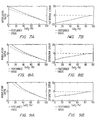
- Figs. 7 through 18 show the predicted errors due to changing the tissue blood volume to one fourth the basis value for a variety of red and IR LED wavelength pairs.
- the A figures (such as 7A) show the modulation ratio vs. SaO 2 .
- the B figures (7B) show the saturation error vs. SaO 2 . This perturbation simulates the effects of blood volume variations within the patient population, anemia, ischemia, or localized exsanguination of blood in the tissue.
- Sensitivity of the calibration to a change in tissue blood concentration is shown for several pairings of red and IR wavelengths. In each case, the LED has no secondary emission, and the perturbation is in going from a nominal 2% blood concentration in the tissue to 0.5%.
- Figs. 7-9 show the type of performance found in conventional pulse oximeters.
- Figs. 10-18 show shifting of the optimum performance region from saturations above 80% to lower saturations when the red LED wavelength is chosen in the 700 nm - 790 nm region of the spectrum.
- Light scattering is minimally affected by changes in oxygenation, but light absorption is significantly affected as reduced hemoglobin in the tissue changes to oxyhemoglobin or vice-versa.
- Pulse oximetry's optimum performance region occurs when there is a balance of the two channels' scattering and absorption properties within blood perfused tissue. Balance occurs when there is a good overlap of the volumes of tissue probed by the two channels, requiring that the penetration depth of light at the two wavelengths be matched.
- this optimum balance occurs with the pairing of wavelengths with a red emitter in the 660 nm band, while at the lower saturations the balance improves with the use of a red emitter in the 730 nm band.
- the variation of the IR LED from 805 to 940 nm does not produce a significant difference in performance.
- the sensitivity of modulation ratio to changes in oxygen saturation i.e. , the slope of the curve in, for example, Fig. 1
- the measurement becomes more robust to changes in the tissue characteristics other than oxygen saturation.
- the bias and deviations due to tissue optical properties become less significant with the proper choice of emitter wavelengths when they are chosen based on the saturation region of primary interest.
- Reflectance pulse oximetry sensors were fabricated using conventional 660 nm - 890 nm LED pairs, and with 735 nm - 890 nm pairs.
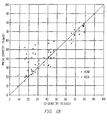
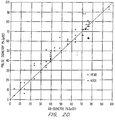
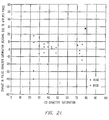
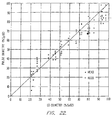
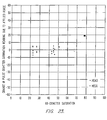
- Figs. 19-23 show that measurements were taken at a range of oxygen saturation values indicated along the X axis from approximately 100% oxygen saturation to less than 10%.
- the plots show the calculated saturation (Sp0 2 ) for each actual saturation (Sa0 2 ) value.
- the actual saturation value is determined by simultaneously drawing blood samples from an arterial catheter placed in the left femoral artery. SaO 2 is measured on a laboratory co-oximeter (Instrument Labs IL 282 or Radiometer OSM-3). This is the value used on the X axis in these figures.
- Figs. 19, 20, and 22 indicate the desired result where the calculated value is equal to the actual value as measured with the catheter.
- the tests illustrated in Figs. 19, 20, and 22 were done with a nominal force of approximately 50 grams applied to the sensor holding it against the skin.
- Fig. 19 shows that sensor calibration is very sensitive to the type of tissue probed. The calibration on the head and neck are very different.
- Fig. 20 illustrates the bias between the head and neck.
- Fig. 21 illustrates the effect of a perturbation induced artifact (sensor applied force).
- Fig. 22 shows the location insensitivity of a 735 nm sensor with a 14 mm center-to-center emitter/detector spacing.
- Fig. 23 shows that this sensor is also insensitive to force applied to the sensor (perturbation induced artifact).
- the force applied to the sensor causes exsanguination of the surface tissue, further magnifying the remaining disparities due to the inhomogeneity of the tissue, or causing shunting of light between the emitter and detector, thus causing errors in the saturation calculation.
- These are compensated for by wider emitter/detector spacing, which results in the light from the red and infrared LEDs penetrating deeper into the tissue, thus increasing the likelihood of their going through, on the average, the same combination of tissue structures, as illustrated in Fig. 3.
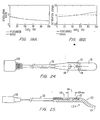
- Fig. 24 is a top view of a sensor according to one embodiment of the present invention.
- the sensor face 110 supports a far red LED 112 and an infrared LED 114. These are spaced by a distance of 14 mm center-to-center from a detector 116. Preferably, the centers of the far red and infrared LEDs are no more than 0.5 mm apart.
- the sensor face is connected by a cable 118 to a connector 120 for connection to the pulse oximeter monitor.
- Fig. 25 shows a side view of the sensor of Fig. 24, illustrating the fulcrum portion 122 of the sensor and sensor back 132. When placed in utero, the uterus will apply a force to the sensor back 132 and deform the fulcrum 122. As can be seen, this technique results in a force being applied to the sensor resulting in good sensor-fetus contact but possibly resulting in local exsanguination of the tissue. It should be noted that any sensor embodiment will have possible local exsan
- Figs. 19-23 illustrate the results of these tests for several prototype sensors.
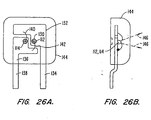
- Figs. 26A and 26B are front and side views of a single package containing emitters 112 and 114 of Figs. 24 and 25. Both emitters are encapsulated in a single semiconductor package, to make the package more compact to provide the miniaturization which is advantageous for a fetal sensor application.
- emitter die 112 is mounted via a conductive epoxy 130 to a substrate 132.
- Substrate 132 takes the form of a metal plating, an exterior portion 134 of which forms the outside lead to the package.
- Emitter 114 is mounted on top of metal substrate 136, an exterior 138 of which forms the second lead.
- the electrical connection to emitter 114 is provided through lead 138 on one side up through the conductive epoxy, and through the other side via a wire bond 140, which connects to the other lead 134.
- lead 134 connects through conductive epoxy 130 to the second emitter 112, with the other side of emitter 112 connected via a wire bond 142 to lead 138.
- Fig. 26B is a side view showing the encapsulated package 144 from the side, and illustrating the emitting light 146 from emitters 112, 114.
- the structure of Figs. 26A-26B is compact and usable for a fetal application.
- the distance between the centers of the two emitter dies 112 and 114 is less than 2mm. This way the package's wiring allows the package to have two leads, as opposed to four leads which would be required by using two separate emitter packages.
- a far red and an infrared LED other methods for producing selected light spectrums of two different wavelengths can be used.
- lasers could be used rather than LEDs.
- a white light or other light source could be used, with the wavelength being optimized at the detector. This could be done by using appropriate filters in front of either the light source or the detector, or by using a wavelength sensitive detector. If filters are used, they could be placed in front of alternate detectors or emitters, or filters could be alternately activated in front of a single emitter or detector.
- a pulse oximeter for use over a broad saturation range can utilize multiple wavelength pairs (e.g. , both 660 nm and 730 nm band emitters coupled with a 900 nm emitter), with the appropriate emitter pair chosen for use in the calculation of SpO 2 based on the estimated value of the oxygen saturation.
- Such a pulse oximeter could be implemented with two or more red LEDs, or alternately could be implemented with a single light source and multiple filters, or multiple wavelength sensitive detectors. Different red wavelength spectrums could be utilized, based on the saturation of the patient.
- the present invention can be embodied in other specific forms without departing from the essential characteristics thereof.
- the wavelength could be varied while still optimizing in accordance with the present invention.
- light pipes, light fibers, multiple filters, or multiple detectors could be used in accordance with the concepts of the present invention.
- Different sensors than the fulcrum structure as set forth in Fig. 25 could be used, such as a bladder structure for inflating and holding the sensor against the fetus. Accordingly, reference should be made to the appended claims for defining the scope of the invention.
Landscapes
- Health & Medical Sciences (AREA)
- Life Sciences & Earth Sciences (AREA)
- Physics & Mathematics (AREA)
- Molecular Biology (AREA)
- Animal Behavior & Ethology (AREA)
- Veterinary Medicine (AREA)
- Biophysics (AREA)
- Pathology (AREA)
- Engineering & Computer Science (AREA)
- Biomedical Technology (AREA)
- Heart & Thoracic Surgery (AREA)
- Medical Informatics (AREA)
- Public Health (AREA)
- Surgery (AREA)
- General Health & Medical Sciences (AREA)
- Optics & Photonics (AREA)
- Pediatric Medicine (AREA)
- Spectroscopy & Molecular Physics (AREA)
- Measurement Of The Respiration, Hearing Ability, Form, And Blood Characteristics Of Living Organisms (AREA)
- Measuring Pulse, Heart Rate, Blood Pressure Or Blood Flow (AREA)
- Other Investigation Or Analysis Of Materials By Electrical Means (AREA)
- Sampling And Sample Adjustment (AREA)
- Investigating Or Analyzing Materials By The Use Of Fluid Adsorption Or Reactions (AREA)
- Investigating Or Analysing Materials By Optical Means (AREA)
Applications Claiming Priority (3)
| Application Number | Priority Date | Filing Date | Title |
|---|---|---|---|
| US08/221,911 US5421329A (en) | 1994-04-01 | 1994-04-01 | Pulse oximeter sensor optimized for low saturation |
| US221911 | 1994-04-01 | ||
| EP95915494A EP0754007B1 (de) | 1994-04-01 | 1995-03-31 | Für niedrige sättigung speziell optimierte pulsoximeter probe |
Related Parent Applications (1)
| Application Number | Title | Priority Date | Filing Date |
|---|---|---|---|
| EP95915494A Division EP0754007B1 (de) | 1994-04-01 | 1995-03-31 | Für niedrige sättigung speziell optimierte pulsoximeter probe |
Publications (3)
| Publication Number | Publication Date |
|---|---|
| EP0992214A2 true EP0992214A2 (de) | 2000-04-12 |
| EP0992214A3 EP0992214A3 (de) | 2003-12-10 |
| EP0992214B1 EP0992214B1 (de) | 2005-01-12 |
Family
ID=22829941
Family Applications (2)
| Application Number | Title | Priority Date | Filing Date |
|---|---|---|---|
| EP95915494A Expired - Lifetime EP0754007B1 (de) | 1994-04-01 | 1995-03-31 | Für niedrige sättigung speziell optimierte pulsoximeter probe |
| EP99125853A Expired - Lifetime EP0992214B1 (de) | 1994-04-01 | 1995-03-31 | Für niedrige Sättigung speziell optimierte Pulsoximetermessfühler |
Family Applications Before (1)
| Application Number | Title | Priority Date | Filing Date |
|---|---|---|---|
| EP95915494A Expired - Lifetime EP0754007B1 (de) | 1994-04-01 | 1995-03-31 | Für niedrige sättigung speziell optimierte pulsoximeter probe |
Country Status (18)
| Country | Link |
|---|---|
| US (3) | US5421329A (de) |
| EP (2) | EP0754007B1 (de) |
| JP (1) | JPH10500323A (de) |
| KR (1) | KR100376649B1 (de) |
| CN (1) | CN1100514C (de) |
| AT (2) | ATE286670T1 (de) |
| AU (1) | AU705934B2 (de) |
| BR (1) | BR9507265A (de) |
| CA (1) | CA2186225C (de) |
| DE (2) | DE69518235T2 (de) |
| DK (2) | DK0754007T3 (de) |
| ES (2) | ES2148509T3 (de) |
| FI (1) | FI963921A7 (de) |
| GR (1) | GR3034711T3 (de) |
| NO (1) | NO964143L (de) |
| NZ (1) | NZ283905A (de) |
| PT (2) | PT754007E (de) |
| WO (1) | WO1995026676A1 (de) |
Cited By (7)
| Publication number | Priority date | Publication date | Assignee | Title |
|---|---|---|---|---|
| WO2002014793A3 (en) * | 2000-08-11 | 2002-05-02 | Elekon Ind Inc | System and method for a self-calibrating non-invasive sensor |
| US6889153B2 (en) | 2001-08-09 | 2005-05-03 | Thomas Dietiker | System and method for a self-calibrating non-invasive sensor |
| US8271063B2 (en) | 2006-06-16 | 2012-09-18 | Medtor Llc | System and method for a non-invasive medical sensor |
| GB2519335A (en) * | 2013-10-17 | 2015-04-22 | Univ Loughborough | Opto-physiological sensor and method of design |
| US9392970B2 (en) | 2011-08-10 | 2016-07-19 | Wristdocs Llc | Biotelemetry system |
| US10448870B2 (en) | 2013-05-20 | 2019-10-22 | Wristdocs Llc | Pulse oximeter sensor |
| US11998298B2 (en) | 2018-02-26 | 2024-06-04 | Biointellisense, Inc. | System and method for a wearable vital signs monitor |
Families Citing this family (178)
| Publication number | Priority date | Publication date | Assignee | Title |
|---|---|---|---|---|
| US5421329A (en) * | 1994-04-01 | 1995-06-06 | Nellcor, Inc. | Pulse oximeter sensor optimized for low saturation |
| US6662033B2 (en) * | 1994-04-01 | 2003-12-09 | Nellcor Incorporated | Pulse oximeter and sensor optimized for low saturation |
| DE19512478C2 (de) * | 1994-08-10 | 2001-05-31 | Bernreuter Peter | Verfahren zur Bestimmung der arteriellen Sauerstoffsättigung |
| DE4442855B4 (de) * | 1994-12-01 | 2004-04-01 | Gerhard Dipl.-Ing. Rall | Verwendung einer Pulsoxymetrie-Sensoreinrichtung |
| US5685301A (en) * | 1995-06-16 | 1997-11-11 | Ohmeda Inc. | Apparatus for precise determination of operating characteristics of optical devices contained in a monitoring probe |
| US5853364A (en) * | 1995-08-07 | 1998-12-29 | Nellcor Puritan Bennett, Inc. | Method and apparatus for estimating physiological parameters using model-based adaptive filtering |
| FI962448A7 (fi) * | 1996-06-12 | 1997-12-13 | Instrumentarium Oy | Menetelmä, laite ja anturi fraktionaalisen happikyllästyksen määrittämistä varten |
| AT404513B (de) * | 1996-07-12 | 1998-12-28 | Avl Verbrennungskraft Messtech | Verfahren und messanordnung zur optischen bestimmung der totalen hämoglobinkonzentration |
| WO1998003847A2 (en) * | 1996-07-19 | 1998-01-29 | Mills Alexander K | Device for noninvasive determination of blood parameters |
| US6018673A (en) * | 1996-10-10 | 2000-01-25 | Nellcor Puritan Bennett Incorporated | Motion compatible sensor for non-invasive optical blood analysis |
| US5851179A (en) * | 1996-10-10 | 1998-12-22 | Nellcor Puritan Bennett Incorporated | Pulse oximeter sensor with articulating head |
| US6002952A (en) | 1997-04-14 | 1999-12-14 | Masimo Corporation | Signal processing apparatus and method |
| CA2303803A1 (en) * | 1997-06-17 | 1998-12-23 | Respironics, Inc. | Fetal oximetry system and sensor |
| WO1999026528A1 (en) * | 1997-11-26 | 1999-06-03 | Somanetics Corporation | Method and apparatus for monitoring fetal cerebral oxygenation during childbirth |
| US6694157B1 (en) | 1998-02-10 | 2004-02-17 | Daedalus I , L.L.C. | Method and apparatus for determination of pH pCO2, hemoglobin, and hemoglobin oxygen saturation |
| WO1999047039A1 (en) * | 1998-03-19 | 1999-09-23 | Jukka Aihonen | Infrared oximeter fitting to its positioning place |
| US6285896B1 (en) * | 1998-07-13 | 2001-09-04 | Masimo Corporation | Fetal pulse oximetry sensor |
| US6463311B1 (en) | 1998-12-30 | 2002-10-08 | Masimo Corporation | Plethysmograph pulse recognition processor |
| US7047054B2 (en) * | 1999-03-12 | 2006-05-16 | Cas Medical Systems, Inc. | Laser diode optical transducer assembly for non-invasive spectrophotometric blood oxygenation monitoring |
| US6675031B1 (en) | 1999-04-14 | 2004-01-06 | Mallinckrodt Inc. | Method and circuit for indicating quality and accuracy of physiological measurements |
| WO2001040776A1 (en) * | 1999-12-02 | 2001-06-07 | Johns Hopkins University | Method of measuring tissue hemoglobin saturation using gaussian decomposition |
| AU2001234590A1 (en) * | 2000-01-28 | 2001-08-07 | The General Hospital Corporation | Fetal pulse oximetry |
| US6453183B1 (en) * | 2000-04-10 | 2002-09-17 | Stephen D. Walker | Cerebral oxygenation monitor |
| PT2322085E (pt) | 2000-04-17 | 2014-06-23 | Covidien Lp | Sensor de oxímetro de pulsação com função por partes |
| US8224412B2 (en) | 2000-04-17 | 2012-07-17 | Nellcor Puritan Bennett Llc | Pulse oximeter sensor with piece-wise function |
| EP1259791B1 (de) | 2000-05-02 | 2013-11-13 | Cas Medical Systems, Inc. | Verfahren zur nicht-invasiven spektrophotometrischen überwachung der sauerstoffsättigung des blutes |
| US6430525B1 (en) | 2000-06-05 | 2002-08-06 | Masimo Corporation | Variable mode averager |
| IL138884A (en) | 2000-10-05 | 2006-07-05 | Conmed Corp | Pulse oximeter and a method of its operation |
| US6512938B2 (en) * | 2000-12-12 | 2003-01-28 | Nelson R. Claure | System and method for closed loop controlled inspired oxygen concentration |
| IL145445A (en) * | 2001-09-13 | 2006-12-31 | Conmed Corp | A method for signal processing and a device for improving signal for noise |
| US6748254B2 (en) | 2001-10-12 | 2004-06-08 | Nellcor Puritan Bennett Incorporated | Stacked adhesive optical sensor |
| US7355512B1 (en) | 2002-01-24 | 2008-04-08 | Masimo Corporation | Parallel alarm processor |
| AU2003211200A1 (en) * | 2002-02-14 | 2003-09-04 | Toshinori Kato | Apparatus for evaluating biological function |
| US6711425B1 (en) | 2002-05-28 | 2004-03-23 | Ob Scientific, Inc. | Pulse oximeter with calibration stabilization |
| JP4167860B2 (ja) * | 2002-07-08 | 2008-10-22 | 株式会社日立製作所 | 生体光計測装置 |
| US7738935B1 (en) | 2002-07-09 | 2010-06-15 | Pacesetter, Inc. | Methods and devices for reduction of motion-induced noise in pulse oximetry |
| US6997879B1 (en) | 2002-07-09 | 2006-02-14 | Pacesetter, Inc. | Methods and devices for reduction of motion-induced noise in optical vascular plethysmography |
| JP4465271B2 (ja) | 2002-07-26 | 2010-05-19 | シーエーエス・メディカル・システムズ・インコーポレイテッド | 対象組織内の血液酸素飽和度を非侵襲的に決定する装置 |
| US6850314B2 (en) * | 2002-08-08 | 2005-02-01 | Board Of Reagents University Of Houston | Method for optical sensing |
| US6879850B2 (en) | 2002-08-16 | 2005-04-12 | Optical Sensors Incorporated | Pulse oximeter with motion detection |
| US6763256B2 (en) | 2002-08-16 | 2004-07-13 | Optical Sensors, Inc. | Pulse oximeter |
| US7190986B1 (en) | 2002-10-18 | 2007-03-13 | Nellcor Puritan Bennett Inc. | Non-adhesive oximeter sensor for sensitive skin |
| US20040082842A1 (en) * | 2002-10-28 | 2004-04-29 | Lumba Vijay K. | System for monitoring fetal status |
| US6948761B2 (en) * | 2002-11-01 | 2005-09-27 | The Colonel's International, Inc. | Tonneau cover apparatus |
| US6970792B1 (en) | 2002-12-04 | 2005-11-29 | Masimo Laboratories, Inc. | Systems and methods for determining blood oxygen saturation values using complex number encoding |
| US7283242B2 (en) * | 2003-04-11 | 2007-10-16 | Thornton Robert L | Optical spectroscopy apparatus and method for measurement of analyte concentrations or other such species in a specimen employing a semiconductor laser-pumped, small-cavity fiber laser |
| US7633621B2 (en) * | 2003-04-11 | 2009-12-15 | Thornton Robert L | Method for measurement of analyte concentrations and semiconductor laser-pumped, small-cavity fiber lasers for such measurements and other applications |
| US20050059869A1 (en) * | 2003-09-15 | 2005-03-17 | John Scharf | Physiological monitoring system and improved sensor device |
| EP1547515A1 (de) * | 2003-12-22 | 2005-06-29 | Barts and The London National Health Service Trust | Pulsoxymeter mit Lichtleiter-Katheter |
| US7162288B2 (en) | 2004-02-25 | 2007-01-09 | Nellcor Purtain Bennett Incorporated | Techniques for detecting heart pulses and reducing power consumption in sensors |
| US7438683B2 (en) | 2004-03-04 | 2008-10-21 | Masimo Corporation | Application identification sensor |
| US20060122520A1 (en) * | 2004-12-07 | 2006-06-08 | Dr. Matthew Banet | Vital sign-monitoring system with multiple optical modules |
| US20070048096A1 (en) * | 2004-12-07 | 2007-03-01 | Hubbs Jonathan W | Soil conditioner |
| WO2006063246A1 (en) | 2004-12-08 | 2006-06-15 | The General Hospital Corporation | System and method for normalized fluorescence or bioluminescence imaging |
| GB0426993D0 (en) * | 2004-12-09 | 2005-01-12 | Council Cent Lab Res Councils | Apparatus for depth-selective raman spectroscopy |
| CN100376669C (zh) | 2005-02-25 | 2008-03-26 | 深圳迈瑞生物医疗电子股份有限公司 | 生物红细胞体积长期稳定的处理方法 |
| JP5328159B2 (ja) | 2005-03-01 | 2013-10-30 | セルカコア・ラボラトリーズ・インコーポレーテッド | 多波長センサ発光体 |
| CN100450437C (zh) | 2005-03-10 | 2009-01-14 | 深圳迈瑞生物医疗电子股份有限公司 | 低灌注下测量血氧的方法 |
| WO2006124455A1 (en) | 2005-05-12 | 2006-11-23 | Cas Medical Systems, Inc. | Improved method for spectrophotometric blood oxygenation monitoring |
| US7657295B2 (en) | 2005-08-08 | 2010-02-02 | Nellcor Puritan Bennett Llc | Medical sensor and technique for using the same |
| US7657294B2 (en) | 2005-08-08 | 2010-02-02 | Nellcor Puritan Bennett Llc | Compliant diaphragm medical sensor and technique for using the same |
| US7590439B2 (en) | 2005-08-08 | 2009-09-15 | Nellcor Puritan Bennett Llc | Bi-stable medical sensor and technique for using the same |
| US20070060808A1 (en) | 2005-09-12 | 2007-03-15 | Carine Hoarau | Medical sensor for reducing motion artifacts and technique for using the same |
| US7869850B2 (en) | 2005-09-29 | 2011-01-11 | Nellcor Puritan Bennett Llc | Medical sensor for reducing motion artifacts and technique for using the same |
| US7904130B2 (en) | 2005-09-29 | 2011-03-08 | Nellcor Puritan Bennett Llc | Medical sensor and technique for using the same |
| US7899510B2 (en) | 2005-09-29 | 2011-03-01 | Nellcor Puritan Bennett Llc | Medical sensor and technique for using the same |
| US8092379B2 (en) | 2005-09-29 | 2012-01-10 | Nellcor Puritan Bennett Llc | Method and system for determining when to reposition a physiological sensor |
| US7483731B2 (en) | 2005-09-30 | 2009-01-27 | Nellcor Puritan Bennett Llc | Medical sensor and technique for using the same |
| US8233954B2 (en) | 2005-09-30 | 2012-07-31 | Nellcor Puritan Bennett Llc | Mucosal sensor for the assessment of tissue and blood constituents and technique for using the same |
| US7881762B2 (en) | 2005-09-30 | 2011-02-01 | Nellcor Puritan Bennett Llc | Clip-style medical sensor and technique for using the same |
| US7486979B2 (en) | 2005-09-30 | 2009-02-03 | Nellcor Puritan Bennett Llc | Optically aligned pulse oximetry sensor and technique for using the same |
| US8062221B2 (en) | 2005-09-30 | 2011-11-22 | Nellcor Puritan Bennett Llc | Sensor for tissue gas detection and technique for using the same |
| US7555327B2 (en) | 2005-09-30 | 2009-06-30 | Nellcor Puritan Bennett Llc | Folding medical sensor and technique for using the same |
| US8050730B2 (en) | 2005-12-23 | 2011-11-01 | Shenzhen Mindray Bio-Medical Electrics Co., Ltd. | Method and apparatus for eliminating interference in pulse oxygen measurement |
| US7522948B2 (en) | 2006-05-02 | 2009-04-21 | Nellcor Puritan Bennett Llc | Medical sensor and technique for using the same |
| US8073518B2 (en) | 2006-05-02 | 2011-12-06 | Nellcor Puritan Bennett Llc | Clip-style medical sensor and technique for using the same |
| US7477924B2 (en) | 2006-05-02 | 2009-01-13 | Nellcor Puritan Bennett Llc | Medical sensor and technique for using the same |
| US7460248B2 (en) * | 2006-05-15 | 2008-12-02 | Carestream Health, Inc. | Tissue imaging system |
| US8145288B2 (en) | 2006-08-22 | 2012-03-27 | Nellcor Puritan Bennett Llc | Medical sensor for reducing signal artifacts and technique for using the same |
| US8219170B2 (en) | 2006-09-20 | 2012-07-10 | Nellcor Puritan Bennett Llc | System and method for practicing spectrophotometry using light emitting nanostructure devices |
| US8396527B2 (en) | 2006-09-22 | 2013-03-12 | Covidien Lp | Medical sensor for reducing signal artifacts and technique for using the same |
| US8175671B2 (en) | 2006-09-22 | 2012-05-08 | Nellcor Puritan Bennett Llc | Medical sensor for reducing signal artifacts and technique for using the same |
| US8190225B2 (en) | 2006-09-22 | 2012-05-29 | Nellcor Puritan Bennett Llc | Medical sensor for reducing signal artifacts and technique for using the same |
| US7869849B2 (en) | 2006-09-26 | 2011-01-11 | Nellcor Puritan Bennett Llc | Opaque, electrically nonconductive region on a medical sensor |
| US8396524B2 (en) * | 2006-09-27 | 2013-03-12 | Covidien Lp | Medical sensor and technique for using the same |
| US8123695B2 (en) * | 2006-09-27 | 2012-02-28 | Nellcor Puritan Bennett Llc | Method and apparatus for detection of venous pulsation |
| US7574245B2 (en) | 2006-09-27 | 2009-08-11 | Nellcor Puritan Bennett Llc | Flexible medical sensor enclosure |
| US7890153B2 (en) | 2006-09-28 | 2011-02-15 | Nellcor Puritan Bennett Llc | System and method for mitigating interference in pulse oximetry |
| US7796403B2 (en) | 2006-09-28 | 2010-09-14 | Nellcor Puritan Bennett Llc | Means for mechanical registration and mechanical-electrical coupling of a faraday shield to a photodetector and an electrical circuit |
| US7476131B2 (en) | 2006-09-29 | 2009-01-13 | Nellcor Puritan Bennett Llc | Device for reducing crosstalk |
| US7680522B2 (en) | 2006-09-29 | 2010-03-16 | Nellcor Puritan Bennett Llc | Method and apparatus for detecting misapplied sensors |
| US8068891B2 (en) | 2006-09-29 | 2011-11-29 | Nellcor Puritan Bennett Llc | Symmetric LED array for pulse oximetry |
| US7684842B2 (en) | 2006-09-29 | 2010-03-23 | Nellcor Puritan Bennett Llc | System and method for preventing sensor misuse |
| US8175667B2 (en) | 2006-09-29 | 2012-05-08 | Nellcor Puritan Bennett Llc | Symmetric LED array for pulse oximetry |
| US8265723B1 (en) | 2006-10-12 | 2012-09-11 | Cercacor Laboratories, Inc. | Oximeter probe off indicator defining probe off space |
| EP1946697A1 (de) * | 2007-01-16 | 2008-07-23 | CSEM Centre Suisse d'Electronique et de Microtechnique SA Recherche et Développement | Vorrichtung zur Überwachung der arteriellen Sauerstoffsättigung |
| US8109882B2 (en) | 2007-03-09 | 2012-02-07 | Nellcor Puritan Bennett Llc | System and method for venous pulsation detection using near infrared wavelengths |
| US7894869B2 (en) | 2007-03-09 | 2011-02-22 | Nellcor Puritan Bennett Llc | Multiple configuration medical sensor and technique for using the same |
| US8221326B2 (en) * | 2007-03-09 | 2012-07-17 | Nellcor Puritan Bennett Llc | Detection of oximetry sensor sites based on waveform characteristics |
| US8265724B2 (en) | 2007-03-09 | 2012-09-11 | Nellcor Puritan Bennett Llc | Cancellation of light shunting |
| US8229530B2 (en) * | 2007-03-09 | 2012-07-24 | Nellcor Puritan Bennett Llc | System and method for detection of venous pulsation |
| US8280469B2 (en) | 2007-03-09 | 2012-10-02 | Nellcor Puritan Bennett Llc | Method for detection of aberrant tissue spectra |
| JP5227525B2 (ja) * | 2007-03-23 | 2013-07-03 | 株式会社日立製作所 | 生体光計測装置 |
| US8781544B2 (en) | 2007-03-27 | 2014-07-15 | Cercacor Laboratories, Inc. | Multiple wavelength optical sensor |
| US8374665B2 (en) | 2007-04-21 | 2013-02-12 | Cercacor Laboratories, Inc. | Tissue profile wellness monitor |
| US8352004B2 (en) | 2007-12-21 | 2013-01-08 | Covidien Lp | Medical sensor and technique for using the same |
| US8346328B2 (en) | 2007-12-21 | 2013-01-01 | Covidien Lp | Medical sensor and technique for using the same |
| US8366613B2 (en) | 2007-12-26 | 2013-02-05 | Covidien Lp | LED drive circuit for pulse oximetry and method for using same |
| US8577434B2 (en) | 2007-12-27 | 2013-11-05 | Covidien Lp | Coaxial LED light sources |
| US8442608B2 (en) | 2007-12-28 | 2013-05-14 | Covidien Lp | System and method for estimating physiological parameters by deconvolving artifacts |
| US20090171176A1 (en) * | 2007-12-28 | 2009-07-02 | Nellcor Puritan Bennett Llc | Snapshot Sensor |
| US8452364B2 (en) | 2007-12-28 | 2013-05-28 | Covidien LLP | System and method for attaching a sensor to a patient's skin |
| US8199007B2 (en) | 2007-12-31 | 2012-06-12 | Nellcor Puritan Bennett Llc | Flex circuit snap track for a biometric sensor |
| US8070508B2 (en) | 2007-12-31 | 2011-12-06 | Nellcor Puritan Bennett Llc | Method and apparatus for aligning and securing a cable strain relief |
| US8897850B2 (en) | 2007-12-31 | 2014-11-25 | Covidien Lp | Sensor with integrated living hinge and spring |
| US8092993B2 (en) | 2007-12-31 | 2012-01-10 | Nellcor Puritan Bennett Llc | Hydrogel thin film for use as a biosensor |
| US8437822B2 (en) | 2008-03-28 | 2013-05-07 | Covidien Lp | System and method for estimating blood analyte concentration |
| US8112375B2 (en) | 2008-03-31 | 2012-02-07 | Nellcor Puritan Bennett Llc | Wavelength selection and outlier detection in reduced rank linear models |
| DE102008017403A1 (de) * | 2008-04-05 | 2009-10-08 | Bluepoint Medical Gmbh & Co. Kg | Messvorrichtung |
| US7880884B2 (en) | 2008-06-30 | 2011-02-01 | Nellcor Puritan Bennett Llc | System and method for coating and shielding electronic sensor components |
| US8071935B2 (en) | 2008-06-30 | 2011-12-06 | Nellcor Puritan Bennett Llc | Optical detector with an overmolded faraday shield |
| US7887345B2 (en) | 2008-06-30 | 2011-02-15 | Nellcor Puritan Bennett Llc | Single use connector for pulse oximetry sensors |
| US20100004518A1 (en) | 2008-07-03 | 2010-01-07 | Masimo Laboratories, Inc. | Heat sink for noninvasive medical sensor |
| US8630691B2 (en) | 2008-08-04 | 2014-01-14 | Cercacor Laboratories, Inc. | Multi-stream sensor front ends for noninvasive measurement of blood constituents |
| US8364220B2 (en) | 2008-09-25 | 2013-01-29 | Covidien Lp | Medical sensor and technique for using the same |
| US8914088B2 (en) | 2008-09-30 | 2014-12-16 | Covidien Lp | Medical sensor and technique for using the same |
| US8417309B2 (en) | 2008-09-30 | 2013-04-09 | Covidien Lp | Medical sensor |
| US8423112B2 (en) * | 2008-09-30 | 2013-04-16 | Covidien Lp | Medical sensor and technique for using the same |
| US20100088957A1 (en) * | 2008-10-09 | 2010-04-15 | Hubbs Jonathan W | Natural turf with binder |
| US20100216639A1 (en) * | 2009-02-20 | 2010-08-26 | Hubbs Jonathon W | Gypsum soil conditioner |
| US8452366B2 (en) | 2009-03-16 | 2013-05-28 | Covidien Lp | Medical monitoring device with flexible circuitry |
| US8221319B2 (en) | 2009-03-25 | 2012-07-17 | Nellcor Puritan Bennett Llc | Medical device for assessing intravascular blood volume and technique for using the same |
| US8509869B2 (en) | 2009-05-15 | 2013-08-13 | Covidien Lp | Method and apparatus for detecting and analyzing variations in a physiologic parameter |
| US8634891B2 (en) | 2009-05-20 | 2014-01-21 | Covidien Lp | Method and system for self regulation of sensor component contact pressure |
| US8311601B2 (en) | 2009-06-30 | 2012-11-13 | Nellcor Puritan Bennett Llc | Reflectance and/or transmissive pulse oximeter |
| US8505821B2 (en) | 2009-06-30 | 2013-08-13 | Covidien Lp | System and method for providing sensor quality assurance |
| US9010634B2 (en) | 2009-06-30 | 2015-04-21 | Covidien Lp | System and method for linking patient data to a patient and providing sensor quality assurance |
| US8391941B2 (en) | 2009-07-17 | 2013-03-05 | Covidien Lp | System and method for memory switching for multiple configuration medical sensor |
| US8417310B2 (en) | 2009-08-10 | 2013-04-09 | Covidien Lp | Digital switching in multi-site sensor |
| US8428675B2 (en) | 2009-08-19 | 2013-04-23 | Covidien Lp | Nanofiber adhesives used in medical devices |
| US9839381B1 (en) | 2009-11-24 | 2017-12-12 | Cercacor Laboratories, Inc. | Physiological measurement system with automatic wavelength adjustment |
| GB2487882B (en) | 2009-12-04 | 2017-03-29 | Masimo Corp | Calibration for multi-stage physiological monitors |
| US20110237910A1 (en) * | 2010-03-23 | 2011-09-29 | Cas Medical Systems, Inc. | Stabilized multi-wavelength laser system for non-invasive spectrophotometric monitoring |
| US7884933B1 (en) | 2010-05-05 | 2011-02-08 | Revolutionary Business Concepts, Inc. | Apparatus and method for determining analyte concentrations |
| US10314650B2 (en) | 2010-06-16 | 2019-06-11 | Biosense Webster (Israel) Ltd. | Spectral sensing of ablation |
| US11490957B2 (en) | 2010-06-16 | 2022-11-08 | Biosense Webster (Israel) Ltd. | Spectral sensing of ablation |
| US20140171806A1 (en) * | 2012-12-17 | 2014-06-19 | Biosense Webster (Israel), Ltd. | Optical lesion assessment |
| US8649838B2 (en) * | 2010-09-22 | 2014-02-11 | Covidien Lp | Wavelength switching for pulse oximetry |
| US9775545B2 (en) | 2010-09-28 | 2017-10-03 | Masimo Corporation | Magnetic electrical connector for patient monitors |
| WO2012050847A2 (en) | 2010-09-28 | 2012-04-19 | Masimo Corporation | Depth of consciousness monitor including oximeter |
| USD663422S1 (en) | 2011-03-24 | 2012-07-10 | First Pulse Medical, Inc. | Fetal pulse oximeter clip |
| US20120253151A1 (en) * | 2011-03-30 | 2012-10-04 | Nellcor Puritan Bennett Llc | Multiple Wavelength Pulse Oximetry With Sensor Redundancy |
| US9649055B2 (en) | 2012-03-30 | 2017-05-16 | General Electric Company | System and methods for physiological monitoring |
| US20130310669A1 (en) * | 2012-05-20 | 2013-11-21 | Jerusalem College Of Technology | Pulmonary pulse oximetry method for the measurement of oxygen saturation in the mixed venous blood |
| CN103784150A (zh) * | 2012-10-30 | 2014-05-14 | 东莞永胜医疗制品有限公司 | 一种血氧饱和度测量方法及测量仪 |
| CN103908262B (zh) * | 2012-12-28 | 2016-04-27 | 财团法人工业技术研究院 | 生理信号测量装置及生理信号测量方法 |
| CN103381094B (zh) * | 2013-05-17 | 2015-01-21 | 王义向 | 胎儿脉搏血氧饱和度监测系统及方法 |
| WO2014188906A1 (ja) * | 2013-05-24 | 2014-11-27 | 国立大学法人浜松医科大学 | 触診用近赤外酸素濃度センサ |
| US9848808B2 (en) | 2013-07-18 | 2017-12-26 | Cas Medical Systems, Inc. | Method for spectrophotometric blood oxygenation monitoring |
| EP3128892A4 (de) | 2014-04-05 | 2018-05-09 | Surgisense Corporation | Vorrichtung, systeme und verfahren zur abbildung von sauerstoffanreicherung von gewebe |
| EP2939593A1 (de) * | 2014-05-02 | 2015-11-04 | Lindberg, Lars-Göran | Vorrichtung und System zur Bestimmung der physiologischen Parameter des Sternumknochens |
| HK1202762A2 (en) | 2014-07-18 | 2015-10-02 | Well Being Digital Limited | A device and method suitable for monitoring arterial blood in a body part |
| US10092197B2 (en) | 2014-08-27 | 2018-10-09 | Apple Inc. | Reflective surfaces for PPG signal detection |
| US10215698B2 (en) * | 2014-09-02 | 2019-02-26 | Apple Inc. | Multiple light paths architecture and obscuration methods for signal and perfusion index optimization |
| US20160081555A1 (en) * | 2014-09-18 | 2016-03-24 | Biosense Webster (Israel) Ltd. | Multi-range optical sensing |
| US10154815B2 (en) | 2014-10-07 | 2018-12-18 | Masimo Corporation | Modular physiological sensors |
| WO2016057042A1 (en) | 2014-10-10 | 2016-04-14 | Medtor Llc | System and method for a non-invasive medical sensor |
| DE102014117879A1 (de) * | 2014-12-04 | 2016-06-09 | Osram Opto Semiconductors Gmbh | Pulsoxymetrie-Vorrichtung und Verfahren zum Betreiben einer Pulsoxymetrie-Vorrichtung |
| KR102415906B1 (ko) | 2015-04-14 | 2022-07-01 | 엘지이노텍 주식회사 | 인체 착용 장치 및 이의 동작 방법 |
| WO2017117280A1 (en) * | 2015-12-30 | 2017-07-06 | Raydiant Oximetry, Inc. | Systems, devices, and methods for performing trans-abdominal fetal oximetry and/or trans-abdominal fetal pulse oximetry |
| DE102016109694B4 (de) * | 2016-05-25 | 2025-07-17 | OSRAM Opto Semiconductors Gesellschaft mit beschränkter Haftung | Sensorvorrichtung |
| US10918322B2 (en) | 2017-02-13 | 2021-02-16 | Apple Inc. | Light restriction designs in optical sensing applications having shared windows |
| KR102396867B1 (ko) | 2017-09-26 | 2022-05-12 | 애플 인크. | 광학적 감지를 위한 동심 아키텍처 |
| CN108420440B (zh) * | 2018-02-28 | 2024-12-27 | 北京维特兴科技有限公司 | 发光光源装置及胎儿血氧光信号采集装置 |
| CN108420442A (zh) * | 2018-04-13 | 2018-08-21 | 南方科技大学 | 一种可穿戴式血氧监测装置及系统、血氧监测方法 |
| PL3823525T4 (pl) | 2018-07-16 | 2025-06-23 | Bbi Medical Innovations, Llc | Pomiar perfuzji i natleniania |
| WO2021195299A1 (en) * | 2020-03-24 | 2021-09-30 | Raydiant Oximetry, Inc. | Systems, devices, and methods for performing fetal oximetry and/or fetal pulse oximetry using a transvaginal fetal oximetry probe, transcervical fetal oximetry probe, and/or transurethral fetal oximetry probe |
| CN112137609A (zh) * | 2020-08-31 | 2020-12-29 | 北京津发科技股份有限公司 | 多生理指标采集装置 |
Citations (2)
| Publication number | Priority date | Publication date | Assignee | Title |
|---|---|---|---|---|
| US4770179A (en) | 1982-09-02 | 1988-09-13 | Nellcor Incorporated | Calibrated optical oximeter probe |
| US4830014A (en) | 1983-05-11 | 1989-05-16 | Nellcor Incorporated | Sensor having cutaneous conformance |
Family Cites Families (28)
| Publication number | Priority date | Publication date | Assignee | Title |
|---|---|---|---|---|
| US3638640A (en) * | 1967-11-01 | 1972-02-01 | Robert F Shaw | Oximeter and method for in vivo determination of oxygen saturation in blood using three or more different wavelengths |
| AU463065B2 (en) * | 1972-02-01 | 1975-07-17 | Oximetrix Inc. | Oximeter and method |
| US4114604A (en) * | 1976-10-18 | 1978-09-19 | Shaw Robert F | Catheter oximeter apparatus and method |
| CA1089252A (en) * | 1976-10-18 | 1980-11-11 | John M. Sperinde | Optical catheter not requiring individual calibration |
| CA1094341A (en) * | 1976-10-18 | 1981-01-27 | Robert F. Shaw | Sterilizable, disposable optical scattering reference medium |
| US4281645A (en) * | 1977-06-28 | 1981-08-04 | Duke University, Inc. | Method and apparatus for monitoring metabolism in body organs |
| US4700708A (en) * | 1982-09-02 | 1987-10-20 | Nellcor Incorporated | Calibrated optical oximeter probe |
| US4623248A (en) * | 1983-02-16 | 1986-11-18 | Abbott Laboratories | Apparatus and method for determining oxygen saturation levels with increased accuracy |
| US5109849A (en) * | 1983-08-30 | 1992-05-05 | Nellcor, Inc. | Perinatal pulse oximetry sensor |
| US4938218A (en) * | 1983-08-30 | 1990-07-03 | Nellcor Incorporated | Perinatal pulse oximetry sensor |
| US4714341A (en) * | 1984-02-23 | 1987-12-22 | Minolta Camera Kabushiki Kaisha | Multi-wavelength oximeter having a means for disregarding a poor signal |
| US4859057A (en) * | 1987-10-13 | 1989-08-22 | Lawrence Medical Systems, Inc. | Oximeter apparatus |
| US4975581A (en) * | 1989-06-21 | 1990-12-04 | University Of New Mexico | Method of and apparatus for determining the similarity of a biological analyte from a model constructed from known biological fluids |
| DE69029152T2 (de) * | 1990-02-15 | 1997-03-06 | Hewlett Packard Gmbh | Verfahren zur nichtinvasiven Messung der Sauerstoffsättigung |
| US5419321A (en) * | 1990-05-17 | 1995-05-30 | Johnson & Johnson Professional Products Limited | Non-invasive medical sensor |
| WO1991018549A1 (en) * | 1990-05-29 | 1991-12-12 | Yue Samuel K | Fetal probe apparatus |
| EP1357481A3 (de) * | 1991-03-07 | 2005-04-27 | Masimo Corporation | Signalverarbeitungsanlage und Verfahren |
| US5247932A (en) * | 1991-04-15 | 1993-09-28 | Nellcor Incorporated | Sensor for intrauterine use |
| EP0597875A4 (de) * | 1991-06-06 | 1995-02-08 | Somanetics Corp | Optisches oximeter für hirngewebe. |
| EP0522674B1 (de) * | 1991-07-12 | 1998-11-11 | Mark R. Robinson | Oximeter zur zuverlässigen klinischen Bestimmung der Blutsauerstoffsättigung in einem Fötus |
| US5413100A (en) * | 1991-07-17 | 1995-05-09 | Effets Biologiques Exercice | Non-invasive method for the in vivo determination of the oxygen saturation rate of arterial blood, and device for carrying out the method |
| EP0527703B1 (de) * | 1991-08-12 | 1995-06-28 | AVL Medical Instruments AG | Einrichtung zur Messung mindestens einer Gassättigung, insbesondere der Sauerstoffsättigung von Blut |
| US5385143A (en) * | 1992-02-06 | 1995-01-31 | Nihon Kohden Corporation | Apparatus for measuring predetermined data of living tissue |
| US5355880A (en) * | 1992-07-06 | 1994-10-18 | Sandia Corporation | Reliable noninvasive measurement of blood gases |
| US5497769A (en) * | 1993-12-16 | 1996-03-12 | I.S.S. (Usa) Inc. | Photosensor with multiple light sources |
| US5421329A (en) * | 1994-04-01 | 1995-06-06 | Nellcor, Inc. | Pulse oximeter sensor optimized for low saturation |
| DE19512478C2 (de) * | 1994-08-10 | 2001-05-31 | Bernreuter Peter | Verfahren zur Bestimmung der arteriellen Sauerstoffsättigung |
| US5782756A (en) * | 1996-09-19 | 1998-07-21 | Nellcor Puritan Bennett Incorporated | Method and apparatus for in vivo blood constituent analysis |
-
1994
- 1994-04-01 US US08/221,911 patent/US5421329A/en not_active Expired - Lifetime
-
1995
- 1995-03-30 US US08/413,578 patent/US5782237A/en not_active Expired - Lifetime
- 1995-03-31 CN CN95193200A patent/CN1100514C/zh not_active Expired - Fee Related
- 1995-03-31 CA CA2186225A patent/CA2186225C/en not_active Expired - Lifetime
- 1995-03-31 PT PT95915494T patent/PT754007E/pt unknown
- 1995-03-31 JP JP7525875A patent/JPH10500323A/ja active Pending
- 1995-03-31 PT PT99125853T patent/PT992214E/pt unknown
- 1995-03-31 AT AT99125853T patent/ATE286670T1/de not_active IP Right Cessation
- 1995-03-31 DK DK95915494T patent/DK0754007T3/da active
- 1995-03-31 AT AT95915494T patent/ATE195063T1/de not_active IP Right Cessation
- 1995-03-31 ES ES95915494T patent/ES2148509T3/es not_active Expired - Lifetime
- 1995-03-31 DK DK99125853T patent/DK0992214T3/da active
- 1995-03-31 EP EP95915494A patent/EP0754007B1/de not_active Expired - Lifetime
- 1995-03-31 NZ NZ283905A patent/NZ283905A/en not_active IP Right Cessation
- 1995-03-31 WO PCT/US1995/004050 patent/WO1995026676A1/en not_active Ceased
- 1995-03-31 DE DE69518235T patent/DE69518235T2/de not_active Expired - Lifetime
- 1995-03-31 ES ES99125853T patent/ES2237028T3/es not_active Expired - Lifetime
- 1995-03-31 BR BR9507265A patent/BR9507265A/pt not_active IP Right Cessation
- 1995-03-31 AU AU22360/95A patent/AU705934B2/en not_active Ceased
- 1995-03-31 KR KR1019960705568A patent/KR100376649B1/ko not_active Expired - Fee Related
- 1995-03-31 EP EP99125853A patent/EP0992214B1/de not_active Expired - Lifetime
- 1995-03-31 DE DE69533927T patent/DE69533927T2/de not_active Expired - Lifetime
-
1996
- 1996-09-30 FI FI963921A patent/FI963921A7/fi unknown
- 1996-09-30 NO NO964143A patent/NO964143L/no not_active Application Discontinuation
-
1998
- 1998-01-06 US US09/003,413 patent/US6272363B1/en not_active Expired - Lifetime
-
2000
- 2000-10-30 GR GR20000402400T patent/GR3034711T3/el not_active IP Right Cessation
Patent Citations (2)
| Publication number | Priority date | Publication date | Assignee | Title |
|---|---|---|---|---|
| US4770179A (en) | 1982-09-02 | 1988-09-13 | Nellcor Incorporated | Calibrated optical oximeter probe |
| US4830014A (en) | 1983-05-11 | 1989-05-16 | Nellcor Incorporated | Sensor having cutaneous conformance |
Cited By (9)
| Publication number | Priority date | Publication date | Assignee | Title |
|---|---|---|---|---|
| WO2002014793A3 (en) * | 2000-08-11 | 2002-05-02 | Elekon Ind Inc | System and method for a self-calibrating non-invasive sensor |
| US7124048B2 (en) | 2000-08-11 | 2006-10-17 | Elekon Industries Usa, Inc. | System and method for a self-calibrating non-invasive sensor |
| US6889153B2 (en) | 2001-08-09 | 2005-05-03 | Thomas Dietiker | System and method for a self-calibrating non-invasive sensor |
| US8271063B2 (en) | 2006-06-16 | 2012-09-18 | Medtor Llc | System and method for a non-invasive medical sensor |
| US9392970B2 (en) | 2011-08-10 | 2016-07-19 | Wristdocs Llc | Biotelemetry system |
| US10448870B2 (en) | 2013-05-20 | 2019-10-22 | Wristdocs Llc | Pulse oximeter sensor |
| GB2519335A (en) * | 2013-10-17 | 2015-04-22 | Univ Loughborough | Opto-physiological sensor and method of design |
| US10327652B2 (en) | 2013-10-17 | 2019-06-25 | Loughborough University | Opto-physiological sensor and method of assembly |
| US11998298B2 (en) | 2018-02-26 | 2024-06-04 | Biointellisense, Inc. | System and method for a wearable vital signs monitor |
Also Published As
Similar Documents
| Publication | Publication Date | Title |
|---|---|---|
| EP0992214B1 (de) | Für niedrige Sättigung speziell optimierte Pulsoximetermessfühler | |
| US7349726B2 (en) | Pulse oximeter and sensor optimized for low saturation | |
| US6285896B1 (en) | Fetal pulse oximetry sensor | |
| CN102641126B (zh) | 用于非侵入式监测受检者的血液特性的传感器、设备和方法 | |
| Mannheimer et al. | Wavelength selection for low-saturation pulse oximetry | |
| EP1322216B1 (de) | Pulsoxymeter und deren verwendungsverfahren | |
| JP3718500B2 (ja) | 脳の血行動態と酸素処理を測定するためのプローブ及び装置 | |
| Neuman | Pulse oximetry: physical principles, technical realization and present limitations | |
| US8788001B2 (en) | Time-division multiplexing in a multi-wavelength photon density wave system | |
| WO2008036217A1 (en) | System and method for practicing spectrophotometry using light emitting nanostructure devices | |
| JP2007532188A (ja) | 空間的に均等のマルチカラーソースを用いたフォトプレチスモグラフィ |
Legal Events
| Date | Code | Title | Description |
|---|---|---|---|
| PUAI | Public reference made under article 153(3) epc to a published international application that has entered the european phase |
Free format text: ORIGINAL CODE: 0009012 |
|
| AC | Divisional application: reference to earlier application |
Ref document number: 754007 Country of ref document: EP |
|
| AK | Designated contracting states |
Kind code of ref document: A2 Designated state(s): AT BE CH DE DK ES FR GB GR IE IT LI LU MC NL PT SE |
|
| AX | Request for extension of the european patent |
Free format text: LT;SI |
|
| RIN1 | Information on inventor provided before grant (corrected) |
Inventor name: RUSKEWICZ, STEPHEN J. Inventor name: NIERLICH, STEVE L. Inventor name: MANNHEIMER, PAUL D. Inventor name: CASCANI, JAMES R. |
|
| RIN1 | Information on inventor provided before grant (corrected) |
Inventor name: RUSKEWICZ, STEPHEN J. Inventor name: NIERLICH, STEVE L. Inventor name: MANNHEIMER, PAUL D. Inventor name: CASCANI, JAMES R. |
|
| PUAL | Search report despatched |
Free format text: ORIGINAL CODE: 0009013 |
|
| AK | Designated contracting states |
Kind code of ref document: A3 Designated state(s): AT BE CH DE DK ES FR GB GR IE IT LI LU MC NL PT SE |
|
| AX | Request for extension of the european patent |
Extension state: LT SI |
|
| 17P | Request for examination filed |
Effective date: 20040429 |
|
| GRAP | Despatch of communication of intention to grant a patent |
Free format text: ORIGINAL CODE: EPIDOSNIGR1 |
|
| AKX | Designation fees paid |
Designated state(s): AT BE CH DE DK ES FR GB GR IE IT LI LU MC NL PT SE |
|
| GRAS | Grant fee paid |
Free format text: ORIGINAL CODE: EPIDOSNIGR3 |
|
| GRAA | (expected) grant |
Free format text: ORIGINAL CODE: 0009210 |
|
| AC | Divisional application: reference to earlier application |
Ref document number: 0754007 Country of ref document: EP Kind code of ref document: P |
|
| AK | Designated contracting states |
Kind code of ref document: B1 Designated state(s): AT BE CH DE DK ES FR GB GR IE IT LI LU MC NL PT SE |
|
| REG | Reference to a national code |
Ref country code: GB Ref legal event code: FG4D |
|
| RIN1 | Information on inventor provided before grant (corrected) |
Inventor name: RUSKEWICZ, STEPHEN J. Inventor name: NIERLICH, STEVE L. Inventor name: MANNHEIMER, PAUL D. Inventor name: CASCANI, JAMES R. |
|
| REG | Reference to a national code |
Ref country code: CH Ref legal event code: EP |
|
| REF | Corresponds to: |
Ref document number: 69533927 Country of ref document: DE Date of ref document: 20050217 Kind code of ref document: P |
|
| REG | Reference to a national code |
Ref country code: IE Ref legal event code: FG4D |
|
| REG | Reference to a national code |
Ref country code: CH Ref legal event code: NV Representative=s name: BOVARD AG PATENTANWAELTE |
|
| PG25 | Lapsed in a contracting state [announced via postgrant information from national office to epo] |
Ref country code: MC Free format text: LAPSE BECAUSE OF NON-PAYMENT OF DUE FEES Effective date: 20050331 Ref country code: LU Free format text: LAPSE BECAUSE OF NON-PAYMENT OF DUE FEES Effective date: 20050331 Ref country code: IE Free format text: LAPSE BECAUSE OF NON-PAYMENT OF DUE FEES Effective date: 20050331 |
|
| REG | Reference to a national code |
Ref country code: PT Ref legal event code: SC4A Free format text: AVAILABILITY OF NATIONAL TRANSLATION Effective date: 20050118 |
|
| PG25 | Lapsed in a contracting state [announced via postgrant information from national office to epo] |
Ref country code: SE Free format text: LAPSE BECAUSE OF FAILURE TO SUBMIT A TRANSLATION OF THE DESCRIPTION OR TO PAY THE FEE WITHIN THE PRESCRIBED TIME-LIMIT Effective date: 20050412 |
|
| REG | Reference to a national code |
Ref country code: DK Ref legal event code: T3 |
|
| REG | Reference to a national code |
Ref country code: GR Ref legal event code: EP Ref document number: 20050401145 Country of ref document: GR |
|
| REG | Reference to a national code |
Ref country code: ES Ref legal event code: FG2A Ref document number: 2237028 Country of ref document: ES Kind code of ref document: T3 |
|
| ET | Fr: translation filed | ||
| PLBE | No opposition filed within time limit |
Free format text: ORIGINAL CODE: 0009261 |
|
| STAA | Information on the status of an ep patent application or granted ep patent |
Free format text: STATUS: NO OPPOSITION FILED WITHIN TIME LIMIT |
|
| REG | Reference to a national code |
Ref country code: IE Ref legal event code: MM4A |
|
| 26N | No opposition filed |
Effective date: 20051013 |
|
| REG | Reference to a national code |
Ref country code: SE Ref legal event code: TRGR |
|
| PGFP | Annual fee paid to national office [announced via postgrant information from national office to epo] |
Ref country code: ES Payment date: 20080326 Year of fee payment: 14 Ref country code: CH Payment date: 20080328 Year of fee payment: 14 |
|
| PGFP | Annual fee paid to national office [announced via postgrant information from national office to epo] |
Ref country code: SE Payment date: 20080327 Year of fee payment: 14 Ref country code: PT Payment date: 20080306 Year of fee payment: 14 Ref country code: NL Payment date: 20080324 Year of fee payment: 14 |
|
| PGFP | Annual fee paid to national office [announced via postgrant information from national office to epo] |
Ref country code: AT Payment date: 20080304 Year of fee payment: 14 |
|
| PGFP | Annual fee paid to national office [announced via postgrant information from national office to epo] |
Ref country code: DK Payment date: 20080331 Year of fee payment: 14 |
|
| PGRI | Patent reinstated in contracting state [announced from national office to epo] |
Ref country code: SE Effective date: 20060629 |
|
| PGFP | Annual fee paid to national office [announced via postgrant information from national office to epo] |
Ref country code: BE Payment date: 20080410 Year of fee payment: 14 |
|
| PGFP | Annual fee paid to national office [announced via postgrant information from national office to epo] |
Ref country code: GR Payment date: 20080328 Year of fee payment: 14 |
|
| BERE | Be: lapsed |
Owner name: *NELLCOR PURITAN BENNETT INC. Effective date: 20090331 |
|
| REG | Reference to a national code |
Ref country code: PT Ref legal event code: MM4A Free format text: LAPSE DUE TO NON-PAYMENT OF FEES Effective date: 20090930 |
|
| PG25 | Lapsed in a contracting state [announced via postgrant information from national office to epo] |
Ref country code: PT Free format text: LAPSE BECAUSE OF NON-PAYMENT OF DUE FEES Effective date: 20090930 Ref country code: AT Free format text: LAPSE BECAUSE OF NON-PAYMENT OF DUE FEES Effective date: 20090331 |
|
| REG | Reference to a national code |
Ref country code: CH Ref legal event code: PL |
|
| REG | Reference to a national code |
Ref country code: DK Ref legal event code: EBP |
|
| NLV4 | Nl: lapsed or anulled due to non-payment of the annual fee |
Effective date: 20091001 |
|
| EUG | Se: european patent has lapsed | ||
| PG25 | Lapsed in a contracting state [announced via postgrant information from national office to epo] |
Ref country code: LI Free format text: LAPSE BECAUSE OF NON-PAYMENT OF DUE FEES Effective date: 20090331 Ref country code: CH Free format text: LAPSE BECAUSE OF NON-PAYMENT OF DUE FEES Effective date: 20090331 |
|
| PG25 | Lapsed in a contracting state [announced via postgrant information from national office to epo] |
Ref country code: NL Free format text: LAPSE BECAUSE OF NON-PAYMENT OF DUE FEES Effective date: 20091001 Ref country code: BE Free format text: LAPSE BECAUSE OF NON-PAYMENT OF DUE FEES Effective date: 20090331 |
|
| PG25 | Lapsed in a contracting state [announced via postgrant information from national office to epo] |
Ref country code: DK Free format text: LAPSE BECAUSE OF NON-PAYMENT OF DUE FEES Effective date: 20090331 |
|
| REG | Reference to a national code |
Ref country code: ES Ref legal event code: FD2A Effective date: 20090401 |
|
| PG25 | Lapsed in a contracting state [announced via postgrant information from national office to epo] |
Ref country code: GR Free format text: LAPSE BECAUSE OF NON-PAYMENT OF DUE FEES Effective date: 20091002 |
|
| PG25 | Lapsed in a contracting state [announced via postgrant information from national office to epo] |
Ref country code: ES Free format text: LAPSE BECAUSE OF NON-PAYMENT OF DUE FEES Effective date: 20090401 |
|
| PG25 | Lapsed in a contracting state [announced via postgrant information from national office to epo] |
Ref country code: SE Free format text: LAPSE BECAUSE OF NON-PAYMENT OF DUE FEES Effective date: 20090401 |
|
| PGFP | Annual fee paid to national office [announced via postgrant information from national office to epo] |
Ref country code: FR Payment date: 20140317 Year of fee payment: 20 Ref country code: IT Payment date: 20140324 Year of fee payment: 20 |
|
| PGFP | Annual fee paid to national office [announced via postgrant information from national office to epo] |
Ref country code: GB Payment date: 20140327 Year of fee payment: 20 |
|
| PGFP | Annual fee paid to national office [announced via postgrant information from national office to epo] |
Ref country code: DE Payment date: 20140327 Year of fee payment: 20 |
|
| REG | Reference to a national code |
Ref country code: DE Ref legal event code: R071 Ref document number: 69533927 Country of ref document: DE |
|
| REG | Reference to a national code |
Ref country code: GB Ref legal event code: PE20 Expiry date: 20150330 |
|
| PG25 | Lapsed in a contracting state [announced via postgrant information from national office to epo] |
Ref country code: GB Free format text: LAPSE BECAUSE OF EXPIRATION OF PROTECTION Effective date: 20150330 |