EP0994192A2 - Transformationskassetten für Hefe - Google Patents
Transformationskassetten für Hefe Download PDFInfo
- Publication number
- EP0994192A2 EP0994192A2 EP99402456A EP99402456A EP0994192A2 EP 0994192 A2 EP0994192 A2 EP 0994192A2 EP 99402456 A EP99402456 A EP 99402456A EP 99402456 A EP99402456 A EP 99402456A EP 0994192 A2 EP0994192 A2 EP 0994192A2
- Authority
- EP
- European Patent Office
- Prior art keywords
- gene
- yeast
- sequences
- marker
- plasmid
- Prior art date
- Legal status (The legal status is an assumption and is not a legal conclusion. Google has not performed a legal analysis and makes no representation as to the accuracy of the status listed.)
- Granted
Links
- 240000004808 Saccharomyces cerevisiae Species 0.000 title claims abstract description 266
- 230000009466 transformation Effects 0.000 title claims abstract description 23
- 108090000623 proteins and genes Proteins 0.000 claims abstract description 190
- 239000003550 marker Substances 0.000 claims abstract description 132
- 239000012634 fragment Substances 0.000 claims abstract description 113
- 108020004414 DNA Proteins 0.000 claims abstract description 64
- 230000014509 gene expression Effects 0.000 claims abstract description 46
- 238000000034 method Methods 0.000 claims abstract description 39
- 108091081062 Repeated sequence (DNA) Proteins 0.000 claims abstract description 25
- 108091029865 Exogenous DNA Proteins 0.000 claims abstract description 15
- 230000001131 transforming effect Effects 0.000 claims abstract description 8
- 230000000415 inactivating effect Effects 0.000 claims abstract description 6
- 239000013612 plasmid Substances 0.000 claims description 179
- 230000010354 integration Effects 0.000 claims description 79
- 241000588724 Escherichia coli Species 0.000 claims description 32
- 230000001939 inductive effect Effects 0.000 claims description 21
- 238000003780 insertion Methods 0.000 claims description 20
- 230000037431 insertion Effects 0.000 claims description 20
- 208000013036 Dopa-responsive dystonia due to sepiapterin reductase deficiency Diseases 0.000 claims description 17
- 201000001195 sepiapterin reductase deficiency Diseases 0.000 claims description 17
- 102000004169 proteins and genes Human genes 0.000 claims description 16
- 241000219195 Arabidopsis thaliana Species 0.000 claims description 15
- 231100000331 toxic Toxicity 0.000 claims description 15
- 230000002588 toxic effect Effects 0.000 claims description 15
- 230000002018 overexpression Effects 0.000 claims description 13
- 230000010076 replication Effects 0.000 claims description 12
- 108091028043 Nucleic acid sequence Proteins 0.000 claims description 11
- 230000008569 process Effects 0.000 claims description 11
- 230000006698 induction Effects 0.000 claims description 10
- 108010033040 Histones Proteins 0.000 claims description 9
- 230000002779 inactivation Effects 0.000 claims description 9
- 101150031411 H1-1 gene Proteins 0.000 claims description 8
- 101150102081 mel1 gene Proteins 0.000 claims description 7
- 241000894007 species Species 0.000 claims description 6
- 241000235070 Saccharomyces Species 0.000 claims description 5
- 239000003242 anti bacterial agent Substances 0.000 claims description 3
- 229940088710 antibiotic agent Drugs 0.000 claims description 2
- 101150038242 GAL10 gene Proteins 0.000 claims 2
- 102100024637 Galectin-10 Human genes 0.000 claims 2
- 235000014680 Saccharomyces cerevisiae Nutrition 0.000 description 227
- 238000010276 construction Methods 0.000 description 41
- 102100038187 RNA binding protein fox-1 homolog 2 Human genes 0.000 description 28
- 101150050575 URA3 gene Proteins 0.000 description 24
- 210000004027 cell Anatomy 0.000 description 24
- 238000012217 deletion Methods 0.000 description 23
- 230000037430 deletion Effects 0.000 description 23
- 206010010144 Completed suicide Diseases 0.000 description 21
- 108700028369 Alleles Proteins 0.000 description 20
- 102000004190 Enzymes Human genes 0.000 description 20
- 108090000790 Enzymes Proteins 0.000 description 20
- 230000006798 recombination Effects 0.000 description 19
- 238000005215 recombination Methods 0.000 description 19
- 239000002609 medium Substances 0.000 description 17
- 108010054576 Deoxyribonuclease EcoRI Proteins 0.000 description 14
- 102100039856 Histone H1.1 Human genes 0.000 description 14
- 101001035402 Homo sapiens Histone H1.1 Proteins 0.000 description 14
- BRZYSWJRSDMWLG-CAXSIQPQSA-N geneticin Natural products O1C[C@@](O)(C)[C@H](NC)[C@@H](O)[C@H]1O[C@@H]1[C@@H](O)[C@H](O[C@@H]2[C@@H]([C@@H](O)[C@H](O)[C@@H](C(C)O)O2)N)[C@@H](N)C[C@H]1N BRZYSWJRSDMWLG-CAXSIQPQSA-N 0.000 description 14
- 239000002299 complementary DNA Substances 0.000 description 12
- 230000029087 digestion Effects 0.000 description 12
- 108091026890 Coding region Proteins 0.000 description 10
- YPHMISFOHDHNIV-FSZOTQKASA-N cycloheximide Chemical compound C1[C@@H](C)C[C@H](C)C(=O)[C@@H]1[C@H](O)CC1CC(=O)NC(=O)C1 YPHMISFOHDHNIV-FSZOTQKASA-N 0.000 description 10
- 238000002744 homologous recombination Methods 0.000 description 10
- 230000006801 homologous recombination Effects 0.000 description 10
- 101100246753 Halobacterium salinarum (strain ATCC 700922 / JCM 11081 / NRC-1) pyrF gene Proteins 0.000 description 9
- 230000000694 effects Effects 0.000 description 9
- 230000014616 translation Effects 0.000 description 9
- ISAKRJDGNUQOIC-UHFFFAOYSA-N Uracil Chemical compound O=C1C=CNC(=O)N1 ISAKRJDGNUQOIC-UHFFFAOYSA-N 0.000 description 8
- 238000013519 translation Methods 0.000 description 8
- 108010042407 Endonucleases Proteins 0.000 description 7
- 229930182830 galactose Natural products 0.000 description 7
- 108020004705 Codon Proteins 0.000 description 6
- 108020004635 Complementary DNA Proteins 0.000 description 6
- RYGMFSIKBFXOCR-UHFFFAOYSA-N Copper Chemical compound [Cu] RYGMFSIKBFXOCR-UHFFFAOYSA-N 0.000 description 6
- WSFSSNUMVMOOMR-UHFFFAOYSA-N Formaldehyde Chemical compound O=C WSFSSNUMVMOOMR-UHFFFAOYSA-N 0.000 description 6
- WQZGKKKJIJFFOK-GASJEMHNSA-N Glucose Natural products OC[C@H]1OC(O)[C@H](O)[C@@H](O)[C@@H]1O WQZGKKKJIJFFOK-GASJEMHNSA-N 0.000 description 6
- 101100454398 Lactiplantibacillus plantarum (strain ATCC BAA-793 / NCIMB 8826 / WCFS1) ldh1 gene Proteins 0.000 description 6
- 230000003321 amplification Effects 0.000 description 6
- 238000010359 gene isolation Methods 0.000 description 6
- 239000008103 glucose Substances 0.000 description 6
- JVTAAEKCZFNVCJ-UHFFFAOYSA-N lactic acid Chemical compound CC(O)C(O)=O JVTAAEKCZFNVCJ-UHFFFAOYSA-N 0.000 description 6
- 101150104734 ldh gene Proteins 0.000 description 6
- 230000035772 mutation Effects 0.000 description 6
- 238000003199 nucleic acid amplification method Methods 0.000 description 6
- 230000004044 response Effects 0.000 description 6
- 230000002441 reversible effect Effects 0.000 description 6
- 238000012163 sequencing technique Methods 0.000 description 6
- 101150094690 GAL1 gene Proteins 0.000 description 5
- 102100028501 Galanin peptides Human genes 0.000 description 5
- 101100121078 Homo sapiens GAL gene Proteins 0.000 description 5
- 108010051210 beta-Fructofuranosidase Proteins 0.000 description 5
- 230000008030 elimination Effects 0.000 description 5
- 238000003379 elimination reaction Methods 0.000 description 5
- 239000013613 expression plasmid Substances 0.000 description 5
- 238000009396 hybridization Methods 0.000 description 5
- 239000001573 invertase Substances 0.000 description 5
- 235000011073 invertase Nutrition 0.000 description 5
- 239000000203 mixture Substances 0.000 description 5
- 108090000765 processed proteins & peptides Proteins 0.000 description 5
- 230000003362 replicative effect Effects 0.000 description 5
- 239000003053 toxin Substances 0.000 description 5
- 231100000765 toxin Toxicity 0.000 description 5
- 108700012359 toxins Proteins 0.000 description 5
- 239000013598 vector Substances 0.000 description 5
- 102100031780 Endonuclease Human genes 0.000 description 4
- 241001465328 Eremothecium gossypii Species 0.000 description 4
- 239000005562 Glyphosate Substances 0.000 description 4
- 102000003855 L-lactate dehydrogenase Human genes 0.000 description 4
- 108700023483 L-lactate dehydrogenases Proteins 0.000 description 4
- OUYCCCASQSFEME-QMMMGPOBSA-N L-tyrosine Chemical compound OC(=O)[C@@H](N)CC1=CC=C(O)C=C1 OUYCCCASQSFEME-QMMMGPOBSA-N 0.000 description 4
- 240000006024 Lactobacillus plantarum Species 0.000 description 4
- 108091034117 Oligonucleotide Proteins 0.000 description 4
- 101150014136 SUC2 gene Proteins 0.000 description 4
- 235000003534 Saccharomyces carlsbergensis Nutrition 0.000 description 4
- 101100454130 Saccharomyces cerevisiae (strain ATCC 204508 / S288c) KSS1 gene Proteins 0.000 description 4
- 101100250396 Saccharomyces cerevisiae (strain ATCC 204508 / S288c) RPL28 gene Proteins 0.000 description 4
- 241001123227 Saccharomyces pastorianus Species 0.000 description 4
- 101100527649 Wickerhamomyces ciferrii (strain ATCC 14091 / BCRC 22168 / CBS 111 / JCM 3599 / NBRC 0793 / NRRL Y-1031 F-60-10) RPL44 gene Proteins 0.000 description 4
- 238000004458 analytical method Methods 0.000 description 4
- 230000000295 complement effect Effects 0.000 description 4
- 239000013604 expression vector Substances 0.000 description 4
- XDDAORKBJWWYJS-UHFFFAOYSA-N glyphosate Chemical compound OC(=O)CNCP(O)(O)=O XDDAORKBJWWYJS-UHFFFAOYSA-N 0.000 description 4
- 229940097068 glyphosate Drugs 0.000 description 4
- SBUJHOSQTJFQJX-NOAMYHISSA-N kanamycin Chemical compound O[C@@H]1[C@@H](O)[C@H](O)[C@@H](CN)O[C@@H]1O[C@H]1[C@H](O)[C@@H](O[C@@H]2[C@@H]([C@@H](N)[C@H](O)[C@@H](CO)O2)O)[C@H](N)C[C@@H]1N SBUJHOSQTJFQJX-NOAMYHISSA-N 0.000 description 4
- 101150002764 purA gene Proteins 0.000 description 4
- 108091008146 restriction endonucleases Proteins 0.000 description 4
- 238000000844 transformation Methods 0.000 description 4
- OUYCCCASQSFEME-UHFFFAOYSA-N tyrosine Natural products OC(=O)C(N)CC1=CC=C(O)C=C1 OUYCCCASQSFEME-UHFFFAOYSA-N 0.000 description 4
- 229940035893 uracil Drugs 0.000 description 4
- OKTJSMMVPCPJKN-UHFFFAOYSA-N Carbon Chemical compound [C] OKTJSMMVPCPJKN-UHFFFAOYSA-N 0.000 description 3
- 101710121765 Endo-1,4-beta-xylanase Proteins 0.000 description 3
- 102000004533 Endonucleases Human genes 0.000 description 3
- 241000233866 Fungi Species 0.000 description 3
- 102100024594 Histone-lysine N-methyltransferase PRDM16 Human genes 0.000 description 3
- 102000006947 Histones Human genes 0.000 description 3
- 101000686942 Homo sapiens Histone-lysine N-methyltransferase PRDM16 Proteins 0.000 description 3
- 235000013965 Lactobacillus plantarum Nutrition 0.000 description 3
- 108010039491 Ricin Proteins 0.000 description 3
- 238000002105 Southern blotting Methods 0.000 description 3
- 230000009471 action Effects 0.000 description 3
- DLRVVLDZNNYCBX-ZZFZYMBESA-N beta-melibiose Chemical compound O[C@@H]1[C@@H](O)[C@@H](O)[C@@H](CO)O[C@@H]1OC[C@@H]1[C@@H](O)[C@H](O)[C@@H](O)[C@H](O)O1 DLRVVLDZNNYCBX-ZZFZYMBESA-N 0.000 description 3
- 229910052799 carbon Inorganic materials 0.000 description 3
- 229910052802 copper Inorganic materials 0.000 description 3
- 239000010949 copper Substances 0.000 description 3
- OPTASPLRGRRNAP-UHFFFAOYSA-N cytosine Chemical compound NC=1C=CNC(=O)N=1 OPTASPLRGRRNAP-UHFFFAOYSA-N 0.000 description 3
- 239000004310 lactic acid Substances 0.000 description 3
- 235000014655 lactic acid Nutrition 0.000 description 3
- 229940072205 lactobacillus plantarum Drugs 0.000 description 3
- 238000004519 manufacturing process Methods 0.000 description 3
- 238000010369 molecular cloning Methods 0.000 description 3
- 108020004707 nucleic acids Proteins 0.000 description 3
- 102000039446 nucleic acids Human genes 0.000 description 3
- 150000007523 nucleic acids Chemical class 0.000 description 3
- 229920001184 polypeptide Polymers 0.000 description 3
- 102000004196 processed proteins & peptides Human genes 0.000 description 3
- 239000003440 toxic substance Substances 0.000 description 3
- VYRYMCNWIVZAGH-QMMMGPOBSA-N (2s)-2-(fluoroamino)-3-phenylpropanoic acid Chemical compound OC(=O)[C@@H](NF)CC1=CC=CC=C1 VYRYMCNWIVZAGH-QMMMGPOBSA-N 0.000 description 2
- 101150028074 2 gene Proteins 0.000 description 2
- QRBLKGHRWFGINE-UGWAGOLRSA-N 2-[2-[2-[[2-[[4-[[2-[[6-amino-2-[3-amino-1-[(2,3-diamino-3-oxopropyl)amino]-3-oxopropyl]-5-methylpyrimidine-4-carbonyl]amino]-3-[(2r,3s,4s,5s,6s)-3-[(2s,3r,4r,5s)-4-carbamoyl-3,4,5-trihydroxy-6-(hydroxymethyl)oxan-2-yl]oxy-4,5-dihydroxy-6-(hydroxymethyl)- Chemical compound N=1C(C=2SC=C(N=2)C(N)=O)CSC=1CCNC(=O)C(C(C)=O)NC(=O)C(C)C(O)C(C)NC(=O)C(C(O[C@H]1[C@@]([C@@H](O)[C@H](O)[C@H](CO)O1)(C)O[C@H]1[C@@H]([C@](O)([C@@H](O)C(CO)O1)C(N)=O)O)C=1NC=NC=1)NC(=O)C1=NC(C(CC(N)=O)NCC(N)C(N)=O)=NC(N)=C1C QRBLKGHRWFGINE-UGWAGOLRSA-N 0.000 description 2
- NYCRCTMDYITATC-UHFFFAOYSA-N 2-fluorophenylalanine Chemical compound OC(=O)C(N)CC1=CC=CC=C1F NYCRCTMDYITATC-UHFFFAOYSA-N 0.000 description 2
- XWHHYOYVRVGJJY-UHFFFAOYSA-N 4-fluorophenylalanine Chemical compound OC(=O)C(N)CC1=CC=C(F)C=C1 XWHHYOYVRVGJJY-UHFFFAOYSA-N 0.000 description 2
- 101150114788 ARO4 gene Proteins 0.000 description 2
- 101100163849 Arabidopsis thaliana ARS1 gene Proteins 0.000 description 2
- -1 Asc I Proteins 0.000 description 2
- 102100027765 Atlastin-2 Human genes 0.000 description 2
- 101100327917 Caenorhabditis elegans chup-1 gene Proteins 0.000 description 2
- 102000016928 DNA-directed DNA polymerase Human genes 0.000 description 2
- 108010014303 DNA-directed DNA polymerase Proteins 0.000 description 2
- 101150115720 DUO1 gene Proteins 0.000 description 2
- 101100224481 Dictyostelium discoideum pole gene Proteins 0.000 description 2
- 241000620209 Escherichia coli DH5[alpha] Species 0.000 description 2
- 108700007698 Genetic Terminator Regions Proteins 0.000 description 2
- 101150009006 HIS3 gene Proteins 0.000 description 2
- 101000936988 Homo sapiens Atlastin-2 Proteins 0.000 description 2
- 101000795074 Homo sapiens Tryptase alpha/beta-1 Proteins 0.000 description 2
- FBOZXECLQNJBKD-ZDUSSCGKSA-N L-methotrexate Chemical compound C=1N=C2N=C(N)N=C(N)C2=NC=1CN(C)C1=CC=C(C(=O)N[C@@H](CCC(O)=O)C(O)=O)C=C1 FBOZXECLQNJBKD-ZDUSSCGKSA-N 0.000 description 2
- 101500023488 Lithobates catesbeianus GnRH-associated peptide 1 Proteins 0.000 description 2
- 102000043136 MAP kinase family Human genes 0.000 description 2
- 108091054455 MAP kinase family Proteins 0.000 description 2
- 241000588621 Moraxella Species 0.000 description 2
- 108010086093 Mung Bean Nuclease Proteins 0.000 description 2
- 241000699729 Muridae Species 0.000 description 2
- 101100059658 Mus musculus Cetn4 gene Proteins 0.000 description 2
- 241000699670 Mus sp. Species 0.000 description 2
- 238000012408 PCR amplification Methods 0.000 description 2
- 229910019142 PO4 Inorganic materials 0.000 description 2
- 101150110488 POL2 gene Proteins 0.000 description 2
- 102000002508 Peptide Elongation Factors Human genes 0.000 description 2
- 108010068204 Peptide Elongation Factors Proteins 0.000 description 2
- LTQCLFMNABRKSH-UHFFFAOYSA-N Phleomycin Natural products N=1C(C=2SC=C(N=2)C(N)=O)CSC=1CCNC(=O)C(C(O)C)NC(=O)C(C)C(O)C(C)NC(=O)C(C(OC1C(C(O)C(O)C(CO)O1)OC1C(C(OC(N)=O)C(O)C(CO)O1)O)C=1NC=NC=1)NC(=O)C1=NC(C(CC(N)=O)NCC(N)C(N)=O)=NC(N)=C1C LTQCLFMNABRKSH-UHFFFAOYSA-N 0.000 description 2
- 108010035235 Phleomycins Proteins 0.000 description 2
- 108091000080 Phosphotransferase Proteins 0.000 description 2
- 101000662819 Physarum polycephalum Terpene synthase 1 Proteins 0.000 description 2
- 108020004511 Recombinant DNA Proteins 0.000 description 2
- 102000018120 Recombinases Human genes 0.000 description 2
- 108010091086 Recombinases Proteins 0.000 description 2
- 101100394989 Rhodopseudomonas palustris (strain ATCC BAA-98 / CGA009) hisI gene Proteins 0.000 description 2
- 235000004443 Ricinus communis Nutrition 0.000 description 2
- 101150104933 SPC42 gene Proteins 0.000 description 2
- 101100010928 Saccharolobus solfataricus (strain ATCC 35092 / DSM 1617 / JCM 11322 / P2) tuf gene Proteins 0.000 description 2
- 101100121129 Saccharomyces cerevisiae (strain ATCC 204508 / S288c) GAP1 gene Proteins 0.000 description 2
- 101100010301 Saccharomyces cerevisiae (strain ATCC 204508 / S288c) POL2 gene Proteins 0.000 description 2
- 101000926253 Saccharomyces cerevisiae (strain ATCC 204508 / S288c) Putative UPF0320 protein YLL065W Proteins 0.000 description 2
- 101100397735 Saccharomyces cerevisiae (strain ATCC 204508 / S288c) TPK2 gene Proteins 0.000 description 2
- 101100314406 Saccharomyces cerevisiae (strain ATCC 204508 / S288c) TPS1 gene Proteins 0.000 description 2
- 241000607142 Salmonella Species 0.000 description 2
- 101100097319 Schizosaccharomyces pombe (strain 972 / ATCC 24843) ala1 gene Proteins 0.000 description 2
- 101150001810 TEAD1 gene Proteins 0.000 description 2
- 101150074253 TEF1 gene Proteins 0.000 description 2
- 101150038925 TPK2 gene Proteins 0.000 description 2
- 241001080024 Telles Species 0.000 description 2
- 102100037495 Thiamin pyrophosphokinase 1 Human genes 0.000 description 2
- 101710203399 Thiamin pyrophosphokinase 1 Proteins 0.000 description 2
- 108010022394 Threonine synthase Proteins 0.000 description 2
- 102100029898 Transcriptional enhancer factor TEF-1 Human genes 0.000 description 2
- 102100029639 Tryptase alpha/beta-1 Human genes 0.000 description 2
- 240000008042 Zea mays Species 0.000 description 2
- 102000005840 alpha-Galactosidase Human genes 0.000 description 2
- 108010030291 alpha-Galactosidase Proteins 0.000 description 2
- 150000001413 amino acids Chemical class 0.000 description 2
- 229940126575 aminoglycoside Drugs 0.000 description 2
- 101150037081 aroA gene Proteins 0.000 description 2
- 229910052793 cadmium Inorganic materials 0.000 description 2
- BDOSMKKIYDKNTQ-UHFFFAOYSA-N cadmium atom Chemical compound [Cd] BDOSMKKIYDKNTQ-UHFFFAOYSA-N 0.000 description 2
- 230000008859 change Effects 0.000 description 2
- 238000006243 chemical reaction Methods 0.000 description 2
- 230000002759 chromosomal effect Effects 0.000 description 2
- 150000001875 compounds Chemical class 0.000 description 2
- 210000004292 cytoskeleton Anatomy 0.000 description 2
- 102000004419 dihydrofolate reductase Human genes 0.000 description 2
- QEWYKACRFQMRMB-UHFFFAOYSA-N fluoroacetic acid Chemical compound OC(=O)CF QEWYKACRFQMRMB-UHFFFAOYSA-N 0.000 description 2
- 230000004927 fusion Effects 0.000 description 2
- 230000009036 growth inhibition Effects 0.000 description 2
- 230000002363 herbicidal effect Effects 0.000 description 2
- 239000004009 herbicide Substances 0.000 description 2
- 101150032598 hisG gene Proteins 0.000 description 2
- 101150045896 ilv-2 gene Proteins 0.000 description 2
- 238000000338 in vitro Methods 0.000 description 2
- 230000002401 inhibitory effect Effects 0.000 description 2
- 230000005764 inhibitory process Effects 0.000 description 2
- 238000002955 isolation Methods 0.000 description 2
- 229930027917 kanamycin Natural products 0.000 description 2
- 229960000318 kanamycin Drugs 0.000 description 2
- 229930182823 kanamycin A Natural products 0.000 description 2
- 231100000225 lethality Toxicity 0.000 description 2
- 229960000485 methotrexate Drugs 0.000 description 2
- 244000005700 microbiome Species 0.000 description 2
- 238000013508 migration Methods 0.000 description 2
- 230000005012 migration Effects 0.000 description 2
- 230000000394 mitotic effect Effects 0.000 description 2
- 239000010452 phosphate Substances 0.000 description 2
- 102000020233 phosphotransferase Human genes 0.000 description 2
- 230000001105 regulatory effect Effects 0.000 description 2
- 238000007363 ring formation reaction Methods 0.000 description 2
- 238000012216 screening Methods 0.000 description 2
- FZMKKCQHDROFNI-UHFFFAOYSA-N sulfometuron Chemical compound CC1=CC(C)=NC(NC(=O)NS(=O)(=O)C=2C(=CC=CC=2)C(O)=O)=N1 FZMKKCQHDROFNI-UHFFFAOYSA-N 0.000 description 2
- 230000004083 survival effect Effects 0.000 description 2
- 238000003786 synthesis reaction Methods 0.000 description 2
- 231100000167 toxic agent Toxicity 0.000 description 2
- 231100000419 toxicity Toxicity 0.000 description 2
- 230000001988 toxicity Effects 0.000 description 2
- 238000013518 transcription Methods 0.000 description 2
- 230000035897 transcription Effects 0.000 description 2
- 238000011144 upstream manufacturing Methods 0.000 description 2
- 238000012795 verification Methods 0.000 description 2
- 210000005253 yeast cell Anatomy 0.000 description 2
- 239000007222 ypd medium Substances 0.000 description 2
- FQVLRGLGWNWPSS-BXBUPLCLSA-N (4r,7s,10s,13s,16r)-16-acetamido-13-(1h-imidazol-5-ylmethyl)-10-methyl-6,9,12,15-tetraoxo-7-propan-2-yl-1,2-dithia-5,8,11,14-tetrazacycloheptadecane-4-carboxamide Chemical compound N1C(=O)[C@@H](NC(C)=O)CSSC[C@@H](C(N)=O)NC(=O)[C@H](C(C)C)NC(=O)[C@H](C)NC(=O)[C@@H]1CC1=CN=CN1 FQVLRGLGWNWPSS-BXBUPLCLSA-N 0.000 description 1
- 102100033350 ATP-dependent translocase ABCB1 Human genes 0.000 description 1
- 229920001817 Agar Polymers 0.000 description 1
- 244000251953 Agaricus brunnescens Species 0.000 description 1
- 235000001674 Agaricus brunnescens Nutrition 0.000 description 1
- 229920000936 Agarose Polymers 0.000 description 1
- 102100034035 Alcohol dehydrogenase 1A Human genes 0.000 description 1
- 241001167018 Aroa Species 0.000 description 1
- 241000228212 Aspergillus Species 0.000 description 1
- 241000894006 Bacteria Species 0.000 description 1
- 108010023063 Bacto-peptone Proteins 0.000 description 1
- UIZUXEFYFUIWMF-UHFFFAOYSA-N CCCC1C(C)(C)CCC1C Chemical compound CCCC1C(C)(C)CCC1C UIZUXEFYFUIWMF-UHFFFAOYSA-N 0.000 description 1
- 101150004278 CYC1 gene Proteins 0.000 description 1
- 108010077544 Chromatin Proteins 0.000 description 1
- 102000008130 Cyclic AMP-Dependent Protein Kinases Human genes 0.000 description 1
- 108010049894 Cyclic AMP-Dependent Protein Kinases Proteins 0.000 description 1
- 102100039116 DNA repair protein RAD50 Human genes 0.000 description 1
- 108090000204 Dipeptidase 1 Proteins 0.000 description 1
- 101100536354 Drosophila melanogaster tant gene Proteins 0.000 description 1
- 101100491986 Emericella nidulans (strain FGSC A4 / ATCC 38163 / CBS 112.46 / NRRL 194 / M139) aromA gene Proteins 0.000 description 1
- 241000702371 Enterobacteria phage f1 Species 0.000 description 1
- YQYJSBFKSSDGFO-UHFFFAOYSA-N Epihygromycin Natural products OC1C(O)C(C(=O)C)OC1OC(C(=C1)O)=CC=C1C=C(C)C(=O)NC1C(O)C(O)C2OCOC2C1O YQYJSBFKSSDGFO-UHFFFAOYSA-N 0.000 description 1
- 108060002716 Exonuclease Proteins 0.000 description 1
- 101150082479 GAL gene Proteins 0.000 description 1
- 101000892220 Geobacillus thermodenitrificans (strain NG80-2) Long-chain-alcohol dehydrogenase 1 Proteins 0.000 description 1
- 101150043522 HO gene Proteins 0.000 description 1
- 101000780443 Homo sapiens Alcohol dehydrogenase 1A Proteins 0.000 description 1
- 101000743929 Homo sapiens DNA repair protein RAD50 Proteins 0.000 description 1
- 101001013405 Homo sapiens Meiosis-specific kinetochore protein Proteins 0.000 description 1
- 101000579123 Homo sapiens Phosphoglycerate kinase 1 Proteins 0.000 description 1
- GRRNUXAQVGOGFE-UHFFFAOYSA-N Hygromycin-B Natural products OC1C(NC)CC(N)C(O)C1OC1C2OC3(C(C(O)C(O)C(C(N)CO)O3)O)OC2C(O)C(CO)O1 GRRNUXAQVGOGFE-UHFFFAOYSA-N 0.000 description 1
- 108091029795 Intergenic region Proteins 0.000 description 1
- 102000003960 Ligases Human genes 0.000 description 1
- 108090000364 Ligases Proteins 0.000 description 1
- 108091036060 Linker DNA Proteins 0.000 description 1
- 101150071913 MDR3 gene Proteins 0.000 description 1
- 102100031175 Meiosis-specific kinetochore protein Human genes 0.000 description 1
- 108010047230 Member 1 Subfamily B ATP Binding Cassette Transporter Proteins 0.000 description 1
- 108010090054 Membrane Glycoproteins Proteins 0.000 description 1
- 102000012750 Membrane Glycoproteins Human genes 0.000 description 1
- 241001465754 Metazoa Species 0.000 description 1
- 244000202563 Meum athamanticum Species 0.000 description 1
- 101100331187 Moraxella sp. (strain B) dehH1 gene Proteins 0.000 description 1
- 108020004485 Nonsense Codon Proteins 0.000 description 1
- KJWZYMMLVHIVSU-IYCNHOCDSA-N PGK1 Chemical compound CCCCC[C@H](O)\C=C\[C@@H]1[C@@H](CCCCCCC(O)=O)C(=O)CC1=O KJWZYMMLVHIVSU-IYCNHOCDSA-N 0.000 description 1
- 102100028251 Phosphoglycerate kinase 1 Human genes 0.000 description 1
- 208000020584 Polyploidy Diseases 0.000 description 1
- 102000001253 Protein Kinase Human genes 0.000 description 1
- MUPFEKGTMRGPLJ-RMMQSMQOSA-N Raffinose Natural products O(C[C@H]1[C@@H](O)[C@H](O)[C@@H](O)[C@@H](O[C@@]2(CO)[C@H](O)[C@@H](O)[C@@H](CO)O2)O1)[C@@H]1[C@H](O)[C@@H](O)[C@@H](O)[C@@H](CO)O1 MUPFEKGTMRGPLJ-RMMQSMQOSA-N 0.000 description 1
- 108020005091 Replication Origin Proteins 0.000 description 1
- 108020001027 Ribosomal DNA Proteins 0.000 description 1
- 101150114113 SFA1 gene Proteins 0.000 description 1
- 101150070511 SUC1 gene Proteins 0.000 description 1
- 101100502339 Saccharomyces cerevisiae (strain ATCC 204508 / S288c) SFA1 gene Proteins 0.000 description 1
- 101000615995 Schizosaccharomyces pombe (strain 972 / ATCC 24843) Malic acid transport protein Proteins 0.000 description 1
- 101000616000 Schizosaccharomyces pombe (strain 972 / ATCC 24843) Putative malic acid transport protein Proteins 0.000 description 1
- 108091081024 Start codon Proteins 0.000 description 1
- 108091081400 Subtelomere Proteins 0.000 description 1
- 101150078565 TEF gene Proteins 0.000 description 1
- 241000897276 Termes Species 0.000 description 1
- 241000223259 Trichoderma Species 0.000 description 1
- 241000499912 Trichoderma reesei Species 0.000 description 1
- MUPFEKGTMRGPLJ-UHFFFAOYSA-N UNPD196149 Natural products OC1C(O)C(CO)OC1(CO)OC1C(O)C(O)C(O)C(COC2C(C(O)C(O)C(CO)O2)O)O1 MUPFEKGTMRGPLJ-UHFFFAOYSA-N 0.000 description 1
- HCHKCACWOHOZIP-UHFFFAOYSA-N Zinc Chemical compound [Zn] HCHKCACWOHOZIP-UHFFFAOYSA-N 0.000 description 1
- 101710185494 Zinc finger protein Proteins 0.000 description 1
- 102100023597 Zinc finger protein 816 Human genes 0.000 description 1
- JLCPHMBAVCMARE-UHFFFAOYSA-N [3-[[3-[[3-[[3-[[3-[[3-[[3-[[3-[[3-[[3-[[3-[[5-(2-amino-6-oxo-1H-purin-9-yl)-3-[[3-[[3-[[3-[[3-[[3-[[5-(2-amino-6-oxo-1H-purin-9-yl)-3-[[5-(2-amino-6-oxo-1H-purin-9-yl)-3-hydroxyoxolan-2-yl]methoxy-hydroxyphosphoryl]oxyoxolan-2-yl]methoxy-hydroxyphosphoryl]oxy-5-(5-methyl-2,4-dioxopyrimidin-1-yl)oxolan-2-yl]methoxy-hydroxyphosphoryl]oxy-5-(6-aminopurin-9-yl)oxolan-2-yl]methoxy-hydroxyphosphoryl]oxy-5-(6-aminopurin-9-yl)oxolan-2-yl]methoxy-hydroxyphosphoryl]oxy-5-(6-aminopurin-9-yl)oxolan-2-yl]methoxy-hydroxyphosphoryl]oxy-5-(6-aminopurin-9-yl)oxolan-2-yl]methoxy-hydroxyphosphoryl]oxyoxolan-2-yl]methoxy-hydroxyphosphoryl]oxy-5-(5-methyl-2,4-dioxopyrimidin-1-yl)oxolan-2-yl]methoxy-hydroxyphosphoryl]oxy-5-(4-amino-2-oxopyrimidin-1-yl)oxolan-2-yl]methoxy-hydroxyphosphoryl]oxy-5-(5-methyl-2,4-dioxopyrimidin-1-yl)oxolan-2-yl]methoxy-hydroxyphosphoryl]oxy-5-(5-methyl-2,4-dioxopyrimidin-1-yl)oxolan-2-yl]methoxy-hydroxyphosphoryl]oxy-5-(6-aminopurin-9-yl)oxolan-2-yl]methoxy-hydroxyphosphoryl]oxy-5-(6-aminopurin-9-yl)oxolan-2-yl]methoxy-hydroxyphosphoryl]oxy-5-(4-amino-2-oxopyrimidin-1-yl)oxolan-2-yl]methoxy-hydroxyphosphoryl]oxy-5-(4-amino-2-oxopyrimidin-1-yl)oxolan-2-yl]methoxy-hydroxyphosphoryl]oxy-5-(4-amino-2-oxopyrimidin-1-yl)oxolan-2-yl]methoxy-hydroxyphosphoryl]oxy-5-(6-aminopurin-9-yl)oxolan-2-yl]methoxy-hydroxyphosphoryl]oxy-5-(4-amino-2-oxopyrimidin-1-yl)oxolan-2-yl]methyl [5-(6-aminopurin-9-yl)-2-(hydroxymethyl)oxolan-3-yl] hydrogen phosphate Polymers Cc1cn(C2CC(OP(O)(=O)OCC3OC(CC3OP(O)(=O)OCC3OC(CC3O)n3cnc4c3nc(N)[nH]c4=O)n3cnc4c3nc(N)[nH]c4=O)C(COP(O)(=O)OC3CC(OC3COP(O)(=O)OC3CC(OC3COP(O)(=O)OC3CC(OC3COP(O)(=O)OC3CC(OC3COP(O)(=O)OC3CC(OC3COP(O)(=O)OC3CC(OC3COP(O)(=O)OC3CC(OC3COP(O)(=O)OC3CC(OC3COP(O)(=O)OC3CC(OC3COP(O)(=O)OC3CC(OC3COP(O)(=O)OC3CC(OC3COP(O)(=O)OC3CC(OC3COP(O)(=O)OC3CC(OC3COP(O)(=O)OC3CC(OC3COP(O)(=O)OC3CC(OC3COP(O)(=O)OC3CC(OC3COP(O)(=O)OC3CC(OC3CO)n3cnc4c(N)ncnc34)n3ccc(N)nc3=O)n3cnc4c(N)ncnc34)n3ccc(N)nc3=O)n3ccc(N)nc3=O)n3ccc(N)nc3=O)n3cnc4c(N)ncnc34)n3cnc4c(N)ncnc34)n3cc(C)c(=O)[nH]c3=O)n3cc(C)c(=O)[nH]c3=O)n3ccc(N)nc3=O)n3cc(C)c(=O)[nH]c3=O)n3cnc4c3nc(N)[nH]c4=O)n3cnc4c(N)ncnc34)n3cnc4c(N)ncnc34)n3cnc4c(N)ncnc34)n3cnc4c(N)ncnc34)O2)c(=O)[nH]c1=O JLCPHMBAVCMARE-UHFFFAOYSA-N 0.000 description 1
- 239000008272 agar Substances 0.000 description 1
- 239000011543 agarose gel Substances 0.000 description 1
- WQZGKKKJIJFFOK-PHYPRBDBSA-N alpha-D-galactose Chemical compound OC[C@H]1O[C@H](O)[C@H](O)[C@@H](O)[C@H]1O WQZGKKKJIJFFOK-PHYPRBDBSA-N 0.000 description 1
- 101150069003 amdS gene Proteins 0.000 description 1
- 230000003322 aneuploid effect Effects 0.000 description 1
- 208000036878 aneuploidy Diseases 0.000 description 1
- 230000000843 anti-fungal effect Effects 0.000 description 1
- 229940121375 antifungal agent Drugs 0.000 description 1
- 239000003429 antifungal agent Substances 0.000 description 1
- 238000013459 approach Methods 0.000 description 1
- 230000008901 benefit Effects 0.000 description 1
- WQZGKKKJIJFFOK-VFUOTHLCSA-N beta-D-glucose Chemical compound OC[C@H]1O[C@@H](O)[C@H](O)[C@@H](O)[C@@H]1O WQZGKKKJIJFFOK-VFUOTHLCSA-N 0.000 description 1
- 102000006635 beta-lactamase Human genes 0.000 description 1
- 230000003115 biocidal effect Effects 0.000 description 1
- 230000015572 biosynthetic process Effects 0.000 description 1
- 101150049515 bla gene Proteins 0.000 description 1
- 230000000903 blocking effect Effects 0.000 description 1
- 229940041514 candida albicans extract Drugs 0.000 description 1
- 230000003197 catalytic effect Effects 0.000 description 1
- 230000001413 cellular effect Effects 0.000 description 1
- 238000005119 centrifugation Methods 0.000 description 1
- 210000002230 centromere Anatomy 0.000 description 1
- 238000012512 characterization method Methods 0.000 description 1
- 239000003795 chemical substances by application Substances 0.000 description 1
- 210000003483 chromatin Anatomy 0.000 description 1
- 238000010367 cloning Methods 0.000 description 1
- 238000007796 conventional method Methods 0.000 description 1
- 229940104302 cytosine Drugs 0.000 description 1
- 101150026864 dehH1 gene Proteins 0.000 description 1
- 230000001419 dependent effect Effects 0.000 description 1
- 238000013461 design Methods 0.000 description 1
- 238000005516 engineering process Methods 0.000 description 1
- 239000003623 enhancer Substances 0.000 description 1
- 230000002255 enzymatic effect Effects 0.000 description 1
- 102000013165 exonuclease Human genes 0.000 description 1
- 238000002474 experimental method Methods 0.000 description 1
- 235000013305 food Nutrition 0.000 description 1
- 108020001507 fusion proteins Proteins 0.000 description 1
- 102000037865 fusion proteins Human genes 0.000 description 1
- 239000000499 gel Substances 0.000 description 1
- PCHJSUWPFVWCPO-UHFFFAOYSA-N gold Chemical compound [Au] PCHJSUWPFVWCPO-UHFFFAOYSA-N 0.000 description 1
- 229910052737 gold Inorganic materials 0.000 description 1
- 239000010931 gold Substances 0.000 description 1
- 239000001963 growth medium Substances 0.000 description 1
- 210000003783 haploid cell Anatomy 0.000 description 1
- HNDVDQJCIGZPNO-UHFFFAOYSA-N histidine Natural products OC(=O)C(N)CC1=CN=CN1 HNDVDQJCIGZPNO-UHFFFAOYSA-N 0.000 description 1
- 101150029559 hph gene Proteins 0.000 description 1
- GRRNUXAQVGOGFE-NZSRVPFOSA-N hygromycin B Chemical compound O[C@@H]1[C@@H](NC)C[C@@H](N)[C@H](O)[C@H]1O[C@H]1[C@H]2O[C@@]3([C@@H]([C@@H](O)[C@@H](O)[C@@H](C(N)CO)O3)O)O[C@H]2[C@@H](O)[C@@H](CO)O1 GRRNUXAQVGOGFE-NZSRVPFOSA-N 0.000 description 1
- 229940097277 hygromycin b Drugs 0.000 description 1
- 229940125721 immunosuppressive agent Drugs 0.000 description 1
- 239000003018 immunosuppressive agent Substances 0.000 description 1
- 230000006872 improvement Effects 0.000 description 1
- 230000036512 infertility Effects 0.000 description 1
- 150000002500 ions Chemical class 0.000 description 1
- 239000007788 liquid Substances 0.000 description 1
- 235000020044 madeira Nutrition 0.000 description 1
- 238000012423 maintenance Methods 0.000 description 1
- 108090000073 malolactic enzyme Proteins 0.000 description 1
- 239000011159 matrix material Substances 0.000 description 1
- 239000012528 membrane Substances 0.000 description 1
- 230000033607 mismatch repair Effects 0.000 description 1
- 238000012986 modification Methods 0.000 description 1
- 230000004048 modification Effects 0.000 description 1
- 235000013379 molasses Nutrition 0.000 description 1
- 238000001823 molecular biology technique Methods 0.000 description 1
- 108090000743 multidrug resistance protein 3 Proteins 0.000 description 1
- 102000004233 multidrug resistance protein 3 Human genes 0.000 description 1
- LWGJTAZLEJHCPA-UHFFFAOYSA-N n-(2-chloroethyl)-n-nitrosomorpholine-4-carboxamide Chemical compound ClCCN(N=O)C(=O)N1CCOCC1 LWGJTAZLEJHCPA-UHFFFAOYSA-N 0.000 description 1
- 239000002773 nucleotide Substances 0.000 description 1
- 125000003729 nucleotide group Chemical group 0.000 description 1
- 210000004940 nucleus Anatomy 0.000 description 1
- 230000008520 organization Effects 0.000 description 1
- 231100000614 poison Toxicity 0.000 description 1
- 230000002265 prevention Effects 0.000 description 1
- 238000012545 processing Methods 0.000 description 1
- 108060006633 protein kinase Proteins 0.000 description 1
- 238000001243 protein synthesis Methods 0.000 description 1
- MUPFEKGTMRGPLJ-ZQSKZDJDSA-N raffinose Chemical compound O[C@H]1[C@H](O)[C@@H](CO)O[C@@]1(CO)O[C@@H]1[C@H](O)[C@@H](O)[C@H](O)[C@@H](CO[C@@H]2[C@@H]([C@@H](O)[C@@H](O)[C@@H](CO)O2)O)O1 MUPFEKGTMRGPLJ-ZQSKZDJDSA-N 0.000 description 1
- 239000012429 reaction media Substances 0.000 description 1
- 230000022532 regulation of transcription, DNA-dependent Effects 0.000 description 1
- 210000003705 ribosome Anatomy 0.000 description 1
- 230000002269 spontaneous effect Effects 0.000 description 1
- 230000028070 sporulation Effects 0.000 description 1
- 230000002194 synthesizing effect Effects 0.000 description 1
- 208000018600 temperature-sensitive lethal mutation Diseases 0.000 description 1
- 238000012360 testing method Methods 0.000 description 1
- 231100000701 toxic element Toxicity 0.000 description 1
- 238000011426 transformation method Methods 0.000 description 1
- 241001515965 unidentified phage Species 0.000 description 1
- 108700026220 vif Genes Proteins 0.000 description 1
- 239000012138 yeast extract Substances 0.000 description 1
- 229910052725 zinc Inorganic materials 0.000 description 1
- 239000011701 zinc Substances 0.000 description 1
Images









Classifications
-
- C—CHEMISTRY; METALLURGY
- C12—BIOCHEMISTRY; BEER; SPIRITS; WINE; VINEGAR; MICROBIOLOGY; ENZYMOLOGY; MUTATION OR GENETIC ENGINEERING
- C12N—MICROORGANISMS OR ENZYMES; COMPOSITIONS THEREOF; PROPAGATING, PRESERVING, OR MAINTAINING MICROORGANISMS; MUTATION OR GENETIC ENGINEERING; CULTURE MEDIA
- C12N15/00—Mutation or genetic engineering; DNA or RNA concerning genetic engineering, vectors, e.g. plasmids, or their isolation, preparation or purification; Use of hosts therefor
- C12N15/09—Recombinant DNA-technology
- C12N15/63—Introduction of foreign genetic material using vectors; Vectors; Use of hosts therefor; Regulation of expression
- C12N15/79—Vectors or expression systems specially adapted for eukaryotic hosts
- C12N15/80—Vectors or expression systems specially adapted for eukaryotic hosts for fungi
- C12N15/81—Vectors or expression systems specially adapted for eukaryotic hosts for fungi for yeasts
Definitions
- the present invention relates to a family of tools for transforming the yeast leaving in the yeast no exogenous DNA fragments other than fragments encoding proteins of interest.
- the present invention relates to an integration-excision cassette allowing to deactivate one or alleles of a gene and / or to insert a new gene by leaving in the host strain only yeast DNA and possibly the new gene.
- the present invention also relates to a multicopy replicative plasmid in the yeast containing no exogenous DNA fragment useless for function sought for yeast.
- the invention also relates to a method for transforming yeasts. using said tools as well as the transformed strains obtained.
- Gene replacement is a molecular biology technique frequently used in yeast.
- a DNA fragment is cloned into a vector and then it is introduced into the cell to be transformed.
- the DNA fragment is integrated by homologous recombination in a targeted region of the recipient genome (Orr-Weaver T., Szostak J. and Rothstein R., 1981, Proc. Natl. Acad. Sci. USA, 78, pp. 6354-6358).
- the recombination event is rare, and only occurs in a few cells. This is why selection markers are inserted between the sequences ensuring recombination in order to allow, after transformation, to isolate cells where the integration of the DNA fragment has occurred by highlighting markers corresponding, for example, to resistance to an antibiotic. But these selection markers are difficult to remove, which has the disadvantage of a apart from not being able to use the same marker again for another transformation, and on the other hand to leave DNA fragments in the host cell exogenous.
- Saccharomyces cerevisiae which are distinguished from laboratory strains by the fact that they are both aneuploid and polyploid, that is to say that many genes are present in several copies: multiple copies in tandem, multiple copies dispersed in the genome, families of genes little different in their sequence and in which no difference in activity has been demonstrated such as the SUC gene for example (Olson M., 1991, Genome Structure and Organization, in Saccharomyces cerevisiae in the Molecular Biology of the Yeast Saccharomyces - Genome Dynamics, Protein Synthesis and Energetics; Ed. Broach, Jones, Pringle, CSHL Press, New York).
- This particular ploidy makes any manipulation aimed at inactivating a gene by disruption or deletion of its alleles because it is necessary to inactivate all copies of the gene, most often by repeating the inactivation process.
- yeasts do not contain no DNA not originating from strains belonging to the same genus, preferably to the same yeast species, with the possible exception of part of a gene of interest coding for a protein not produced naturally by the yeast strain, such as a xylanase, a malate permease, a malolactic enzyme, a lactate dehydrogenase.
- one integration cassette comprises a module comprising at least one marker gene for the yeast and the gene to be integrated, this module being flanked on either side by fragments of DNA homologous to those of the ends of the targeted integration site.
- These fragments will be called hereafter “recombinogenic” because they will ensure double recombination homologous allowing the insertion of the cassette.
- SR Recombinogenic Sequence
- homologous recombination between the recombinogenic sequences of the construction and the regions target gene results in inactivation of the target gene caused by the simultaneous integration of the construct, i.e. the replacement of the target gene by the integration cassette.
- This technique also applies to the inactivation of a gene, which can be disruption / interruption or deletion; in the case of a total deletion, the entire target gene is exchanged, in the event of disruption / interruption the target gene sequence is interrupted, and usually accompanied by a deletion more or less important; this is why we sometimes use the terminology "deletion total or partial "to designate both the deletion and the disruption of a gene, resulting in blocking or changing its expression.
- the cassette to be inserted into the target gene may only contain the marker for selection flanked by homologous recombinogenic fragments.
- an article describes a molecular construction (pNKY51) making it possible to disrupt or delete a yeast gene.
- the vector is an Escherichia coli plasmid containing the URA3 gene (marker) flanked by direct repeat sequences from the Salmonella histidine operon ( hisG ).
- This plasmid is digested to produce a module ( hisG-URA3-hisG ) which is then flanked on each side of recombinogenic homologous sequences of the target gene to be disrupted.
- the cassette thus produced is integrated into the target gene of a Ura - yeast, and the strains which have integrated the cassette can be isolated by selection of the Ura + strains. After excision of the cassette, the strains become Ura - again.
- the construct is used to disrupt or delete the yeast TRP1 , SPO13 , HO, RAD50, LEU2 genes .
- Multiple transformations are carried out either by crossing strains carrying one transformation each, or by a series of transformations by different disruption constructs and by repeated selection cycles Ura + and Ura - in a single strain.
- This method allows you to reuse the marker (auxotrophy marker) for a new transformation.
- Document EP 220009 describes a process allowing the integration of cassettes total or partial deletion in yeast using the "Cre-lox" excision system, this process, developed in animals, can also be used in yeasts, sequences equivalent to direct repeated sequences are in this case sequences so-called "lox" and excision of the DNA sequence between the two "lox" sequences are carried out in the presence of a "Cre” recombinase.
- One of the drawbacks of this system is that one of the remaining "lox" sequences is an exogenous DNA from a bacteriophage.
- the document EP 814 165 describes a system making it possible, here again, to excise a module containing a marker by the action of a specific enzymatic system on sensitive sequences, the system being very similar to the "Cre-lox" system, in the since it uses an SRD-specific recombinase.
- the object of the present invention is to provide processing cassettes yeast leaving no unnecessary exogenous DNA fragments, and which contain share at least one selection marker which is dominant and negative; And on the other hand two non-exogenous, non-recombinogenic direct repeat sequences (SRDs) with the yeast genome, these 2 direct repeating sequences being arranged on the side and other part of the fragment containing the dominant negative marker
- This counter-selection marker dominant is preferably an inducible marker.
- These DNA cassettes, object of the invention preferably comprise a second selection marker.
- An object of the present invention is to provide a cassette integration / excision allowing the integration of a gene of interest and / or inactivation a discomfort from the host, usable in yeasts, which solves the above problems, in particular which makes it possible to obtain integrations free of exogenous DNA by not leaving in place only yeast DNA belonging to the same genus and possibly a gene of interest.
- the expression “exogenous DNA” is intended to denote DNA that comes from a different genus or more specifically from a species different, of the genus or species of the transformed yeast strain.
- This integration / excision cassette allows the total or partial deletion of genes present in the genome of industrial strains of yeast and possibly the simultaneous integration of a new gene without any foreign DNA fragment remains in the genome of the strain thus transformed (except possibly the gene newly cloned if so).
- said integration / excision cassette will be designed to transform several alleles, if not all alleles of a gene one after the other without in principle there is a risk of seeing the transformations happen in the same site. It is systematically verified that the transformation of all alleles or of a determined number of them has indeed taken place.
- the transformation procedure can be repeated several times through the use of minus a different recombinogenic sequence (SR) each time, both SR sequences directing the integration of the cassette.
- SR recombinogenic sequence
- the integration / excision cassette is intended for the integration of a gene of interest, this implies that after excision will remain the gene of interest and a SRD sequence, this set being flanked by the two recombinogenic sequences; when the cassette is intended for gene inactivation, it can be inactivation of a gene by total or partial deletion, in this case, only an SRD sequence remains flanked by the two recombinogenic sequences. It is important, in general, that the SRD sequence is non-coding, in fact located 3 ′ of a sequence recombinogenic, it could be expressed. By non-coding sequence is meant a sequence that is not translated as a peptide.
- Another object of the invention is to provide a multicopy expression plasmid in yeast, not containing unnecessary exogenous DNA, which can be obtained using an E. coli- yeast shuttle plasmid comprising two repeated sequences non-exogenous and non-recombinogenic direct (SRD) with the genome of the host strain.
- SRD non-exogenous and non-recombinogenic direct
- An object of the invention is also a DNA cassette in the form of a yeast multicopy plasmid capable of being obtained after excision of the E. coli- yeast shuttle plasmid defined above and comprising a non-exogenous and non-recombinogenic SRD sequence with the genome of the host strain, an origin of yeast 2 micron replication, a selection marker of yeast origin, an expression system of at least one gene of interest.
- These new cassettes according to the invention preferably comprise two selection markers, one of them then being a dominant negative marker, preferably inducible.
- a dominant marker within the meaning of the present invention is a marker of prototrophic cells (or not auxotrophic with respect to the protein encoded by the marker) allowing, in a particular growth medium adapted to the marker, only the growth of clones having the desired modification .
- a positive dominant marker is a marker whose expression in the host cell ensures survival under certain specific conditions, in most cases it will be a resistance marker, that is to say when the corresponding marker is expressed, it allows the cell to resist, for example antibiotics or other toxic substances.
- negative dominant marker is intended to denote, on the contrary, generally, a marker whose expression is toxic to the host cells under particular conditions. It may especially be a marker made "inducible" coding for a toxic product, as for example the RTA gene (Ricin Toxin A), placed under the control of an inducible promoter strongly repressed by glucose.
- This inducible promoter can for example be a promoter of a GAL gene , or a hybrid promoter such as the promoter GAL10-CYC1 .
- an inducible gene coding for a toxic product like the polypeptide of the A chain of castor toxin according to the present invention is different, because this gene is used as a negative marker allowing a counter selection, that is to say say a second selection of the strains transformed by the integration cassette or the replicative plasmid which is the subject of the invention, but which has lost the excision module.
- a counter selection that is to say say a second selection of the strains transformed by the integration cassette or the replicative plasmid which is the subject of the invention, but which has lost the excision module.
- the survival of the yeast cells transformed in an inducible medium is due to the loss of the excision module and not to a mutation of the RTA gene or of the gene coding for another toxic protein, inactivating the toxin produced. .
- the positive marker makes it possible to directly select the transformed cells then, after culture in an inducing medium, the negative marker allows to directly select the cells from which the excision module has been eliminated by "pop-out" or excision.
- the excision of the module comprising the two markers in the cassette integration / excision is performed thanks to the presence of direct repeated sequences (SRD), the structure of which is also one of the characteristic elements of the present invention.
- SRD direct repeated sequences
- the presence of two markers allows great efficiency to the system constituted by the E. coli- yeast shuttle plasmid.
- the inducible and dominant negative marker makes it possible to select cells containing only one or more plasmids having excised the part used for the construction of the shuttle plasmid by virtue of the presence of direct repeat sequences (SRD), characteristic of the present invention.
- SRD direct repeat sequences
- the excision removes the dominant negative marker, preferably inducible.
- the positive marker of yeast origin which is in the other region of the shuttle plasmid delimited by the 2 SRD sequences, is conserved and serves to maintain a selection pressure for the conservation and the expression of the plasmids yeast multicopy, obtained after excision.
- yeast mosaic sequence is intended to denote a DNA sequence made up of fragments from different DNA sequences of one or more yeast strains, belonging to the same species, even the same subspecies.
- each of these fragments will contain preferably less than 30 ph, and the SRD sequence will be 80 to 300 bp so to provide excision.
- the length of the fragments namely of the order of 10 to 30 bp, does not not allow them to play the role of recombinogenic fragments, on the other hand global SRD sequence made up of these different fragments allows recombination with an identical SRD, and therefore the excision of the DNA fragment between the 2 Identical SRD sequences.
- an SRD sequence comprises approximately 90 to 200 bp or 210 bp. After excision, one of the 2 SRD sequences remains in place in the genome, it is therefore necessary that this sequence is constituted by DNA from yeast, i.e. by DNA belonging to the same genus and preferably to the same species of yeast.
- SRD sequences fragments of a yeast gene which is absent from the industrial host strain of yeast to be transformed.
- the species Saccharomyces cerevisiae is described as assimilating and fermenting melibiose in a variable manner according to the strains. All industrial strains of baker's yeast are melibiose "less”, on the other hand most of the industrial strains of brewer's yeast are melibiosis "more”, while all these strains belong to the species Saccharomyces cerevisiae .
- the MEL1 gene is therefore a good candidate for giving the SRD sequences of a transformation cassette for an industrial strain of baker's yeast, according to the invention.
- the MEL1 gene is described in patent EP 241,044 , it is a gene which codes for the enzyme ⁇ -galactosidase which hydrolyzes melibiose to galactose and glucose. This gene is absent from industrial strains of baking yeast which, for this reason, are not capable of consuming all of the raffinose from molasses. In this case, it is possible to use longer SRD fragments, of the order of 200 bp or 210 bp for example, to facilitate excision, but remembering that the SRD sequence remaining after excision must have been rendered non-coding by any appropriate means such as changing the reading frame or the introduction of stop codons for example.
- the SRD sequences described above are flanked, in 3 'and 5', by DNA sequences recombinogenic, i.e. allowing integration into the target gene by double homologous recombination and which are called SR sequences.
- SR sequences DNA sequences recombinogenic, i.e. allowing integration into the target gene by double homologous recombination and which are called SR sequences.
- successive integration / excision cassettes with at least one recombinogenic sequence which is no longer present in the sites previous recombinants, preferably the recombinogenic sequence not present in the previously recombined site will be chosen 3 'from this site, for example we will choose fragments starting from the 3 ′ end of the target gene for recombination and then approaching the center of said target gene for each successive cassette.
- the 2 SR sequences will be changed each time using this technique applied by choosing different SR fragments from both ends of the target site for recombination in the various successive integration cassettes.
- the integration marker can be any dominant positive marker, i.e. which allows yeasts having it to survive a selection pressure. It will be preferably a resistance marker, that is to say a gene which confers on the strain a resistance to a toxic element.
- auxotrophy marker gene necessary for growth in a nutrient-deprived environment
- the use of an auxotrophy marker will be a solution preferred for maintenance and expression of yeast multicopy plasmids, it requires that the industrial yeasts concerned have been made auxotrophic by targeted disruptions or deletions, such as those made possible by the cassette of integration-excision according to the present invention.
- the second marker namely the negative marker, that is to say the counter-selection marker
- the negative marker that is to say the counter-selection marker
- An advantageous counter-selection marker is the coding part of the RTA gene (Ricin Toxin A), placed under the dependence of an inducible promoter which is both strong and highly repressed by glucose, such as for example the promoter GAL10-CYC1 and d 'a PGK1 terminator.
- the principle of these constructions from a yeast promoter and terminator is to use a promoter and a terminator from different genes, so as to minimize the risks of unwanted recombination in the yeast genome.
- the repeating mosaic sequences of Saccharomyces cerevisiae correspond, in general, to the construction of a sequence of approximately 100 base pairs consisting of fragments of genes existing in principle in the host cell, each of these fragments being of a length such that 'it does not in principle allow any recombination event when they are in a mosaic sequence.
- These sequences are constructed in such a way that no peptide chain can be coded, for example by the introduction of stop codons in judicious places.
- the mosaic sequences can be constructed from elb fragments of genes which are most probably conserved in the different yeast strains and located in zones that are not very variable in these genes. These little variable zones were determined by homology search with other gene banks by the BLASTA program (Altschul et al ., 1997, Nucleic Acids Res., 25, pp. 3389-3402). The intronic sequences known to be very variable are to be avoided.
- the choice of the short fragments composing the mosaic sequence is carried out according to the sequence of the strain of Saccharomyces cerevisiae from MIPS in Kunststoff (Mewes et al ., 1997, Nucleic Acids Res., 25, pp. 28-30). These fragments are also chosen so that the mosaic sequence has nonsense codons, stopping translation in the 6 reading frames (3 direct reading frames, and 3 reverse reading frames).
- the excision module present in the transformation cassette object of the present invention, is that it can be used whatever the integration site chosen in the yeast genome (case of the cassette 'integration / excision) or whatever gene (s) of interest to express. This property is directly dependent on the choice of restriction sites making it possible to introduce the gene (s) of interest and the SR sequences into said transformation cassette. The presence of a specific restriction site in these DNA fragments to be introduced into the cassette excludes that said site can then be used to construct said cassette. So that the excision module can be easily used for any construction, it is necessary that it has at each of its ends at least one restriction site whose frequency in the genome is as low as possible.
- the excision module comprises at least 3 rare sites at its ends and preferably at least 5 rare restriction sites.
- a rare restriction site is a site which is recognized by a type II endonuclease recognizing an octanucleotide sequence or any restriction site having the same characteristic of rarity.
- the frequency of the presence of a specific hexanucleotide is 1 for 4096 and a specific octanucleotide is 1 for 65536.
- the excision module will have at its 5 ′ end the Pac I, Asc I and Pme I sites , and at its 3 ′ end the Fse I and Swa I sites.
- the invention relates to a method for integrating several copies or inactivation of different copies of a gene in yeast, characterized by repeating the process described above with a cassette of integration / excision which includes for each repetition of the process at least one different recombinogenic DNA sequence chosen so that each site with integration cannot, in principle, be recombined with the next cassette.
- Integration / excision cassettes possibly containing a gene of interest corresponding to the definitions given above can be constructed according to the usual methods used in this area by those skilled in the art.
- E. coli-S.cerevisiae shuttle plasmid which makes it possible to obtain, after excision of the construction elements, a replicative or multicopy expression plasmid in yeast, without exogenous DNA other than that of the gene or genes of interest. .
- the principles of construction, the elements of this shuttle plasmid are the same as those above exposed.
- the present invention relates to yeasts transformed by a cassette according to the invention and obtained by a process as described above and which does not contains only yeast DNA, with the possible exception of the coding gene (s) for a protein of interest, the SRD sequences being non-coding.
- the cassette according to the invention is used to inactivate a family of genes, the yeasts according to the present invention will be such that the desired number of copies, ie the desired number alleles of the same gene family, will have been inactivated by integration / excision using cassettes according to the present invention, or possibly all of the copies will have been inactivated, so as to choose with what intensity a gene will be expressed.
- the desired number of copies of this gene can be obtained.
- yeasts which are more particularly advantageous according to the present invention, mention should be made of yeasts of the genus Saccharomyces and in particular Saccharomyces cerevisiae , in particular industrial strains and more particularly those of bread-making yeasts.
- EXAMPLE 2 Construction of an excision module with mosaic sequences
- the two direct repeated sequences allowing excision of the module by homologous recombination are the mosaic sequence defined in the example N ° 1 above.
- the two direct repeat sequences allowing excision of the module by homologous recombination are fragments derived from the MEL1 gene .
- the MEL1 gene is the Saccharomyces cerevisiae variety carlsbergensis gene encoding an alpha-galactosidase which degrades melibiosis. MEL1 is absent in baker's yeasts, which avoids any possible recombination between the SRD MEL sequences and sequences of the genome of bread-making yeast strains.
- the MEL SRD sequences consist of a sequence less than or equal to 300 bp chosen from the coding part of the MEL1 gene and preferably comprising stop codons positioned in the 6 translation reading frames. Thus, any translation of the chosen MEL1 sequence into a chimeric polypeptide is avoided.
- Said excision module with SRD MEL sequences can be constructed by any strategy to meet the above requirements.
- Saccharomyces cerevisiae has several genes dispersed in the genome coding for enzymes having the same invertase activity, called SUC1 , SUC2 , etc. In invasive yeast strains, this invertase activity is sometimes annoying and it is useful to regulate it. To reduce the level of invertase produced, a number of SUC genes responsible for its production must be inactivated using different integration / excision cassettes.
- the excision module according to the invention is assembled between recombinogenic sequences (SR sequences) capable of binding to the targeted chromosomal site and of integrating by recombination with homologous sequences present in the SUC genes of Saccharomyces cerevisiae. .
- a CAS-SUC cassette consists of an excision module and two recombinogenic SR sequences chosen from a region present in the set SUC loci so that the homologous double recombination leading to the integration of the cassette can be carried out in any SUC bous of the genome.
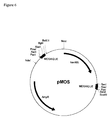
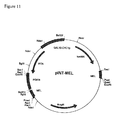
- 3 cassettes are constructed from a plasmid carrying the excision module described in example 2 above, that is to say the excision module carried by the plasmid pINT-MOS.
- the first SR sequence located at one end of the integration cassette is the same and is called SUC-5 '. This approximately 200 bp fragment is homologous to the 5 ′ region of the coding sequence of the SUC2 gene.
- the second SR sequence located at the opposite end of the integration cassette changes for each of the 3 desired integration events and differentiates the three cassettes.
- the SR sequences described above can be easily determined from the sequence of the SUC2 gene, referenced YI9402. 12 in the MIPS database.
- the three cassettes thus obtained are called CAS-SUC-A, CAS-SUC-B and CAS-SUC-C.
- the 3 variants of the CAS-SUC cassette are derived from the pINT-MOS plasmid into which the recombinogenic fragments are inserted on either side of the excision module.
- the fragments SUC-5 ', SUC-3'-A, SUC-3'-B, SUC-3'-C are amplified by PCR using genomic DNA from the laboratory strain CEN.PK122 ( EUROSCARF Strain Collection, Germany).
- a Pac I restriction site is introduced 5 'to the SUC-5' fragment and two STOP codons and the Asc I restriction site are introduced 3 'to the SUC-5' fragment.
- the SUC-5 'recombinogenic sequence obtained by PCR is introduced into the pINT-MOS plasmid 5' to the excision module at the Pac I and Asc I restriction sites to give the pSUC-5 'plasmid. Then, in this plasmid pSUC-5 'are alternately introduced the three fragments SUC-3'-A, SUC-3'-B and SUC-3'-C 3' from the excision module, at the restriction sites Fse I and Swa I.
- the three plasmids obtained pSUC-A (FIG. 12), pSUC-B and pSUC-C carry the three integration / excision cassettes CAS-SUC-A, CAS-SUC-B and CAS-SUC respectively -VS.
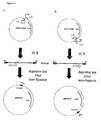
- the first CAS-SUC-A integration / excision cassette is integrated into a SUC locus of the Saccharomyces cerevisiae genome by double homologous recombination. For this, it is extracted from the plasmid pSUC-A by digestion with the enzymes Pac I and Swa I, and purified. A strain of Saccharomyces cerevisiae is transformed by the introduction of the integration / excision cassette in the form of linear DNA into the cells.
- the transformants are spread on YPD medium (1% yeast extract, 2% bactopeptone, 2% glucose) containing geneticin at a rate of 200 ⁇ g per ml of medium.
- YPD medium 1% yeast extract, 2% bactopeptone, 2% glucose
- the excision of the integration / excision module results from a recombination at the level of the 2 SRD sequences and from the excision of the DNA loop thus formed, the strains having performed this excision being selected thanks to the induction of l expression of the RTA gene.
- the transformants are precultured on a liquid medium containing galactose as the only carbon source and then spread on a standard agar "galactose" medium. This medium makes it possible to select the transforming clones which do not produce the toxin encoded by the RTA gene.
- the clones thus selected are replicated on YPD medium containing geneticin (200 ⁇ g / ml) to verify the loss of resistance to geneticin.
- This double selection makes it possible to isolate transforming clones carrying a deletion in a first SUC locus, having excised the selection markers RTA and kanMX.
- the second and third integration / disruption cassettes CAS-SUC-B and CAS-SUC-C are used successively to delete a second copy and then a third genomic copy of the SUC locus, in the strain of Saccharomyces cerevisiae previously constructed, including a first copy of a SUC locus has been disrupted.
- the CAS-SUC-B and CAS-SUC-C cassettes used successively can be integrated at the SUC loci level, preferably at the level of untransformed alleles, taking into account the change in SR to 3 'of the integration site.
- the CAS-SUC-B and CAS-SUC-C cassettes are extracted from the plasmids pSUC-B and pSUC-C by digestion with the enzymes Pac I and Swa I, then purified.
- the integration / excision protocol described above for CAS-SUC-A is repeated successively for CAS-SUC-B then CAS-SUC-C under identical conditions, namely transformation and selection of the transformants having integrated the cassette, selection transformants having excised the selection markers.
- the effect of the deletions at the SUC loci is controlled by assaying the residual invertase activity and the elimination of the selection markers is verified by sequencing and by hybridization (Southern hybridization).
- Another application of the cassette is the construction of an auxotrophic mutant for the uracil of the yeast strain Y55.LD1 (diploid, prototrophic, isogenic strain of the Y55 strain described by McCusker, JH and JE Haber (1988) Cycloheximide-resistant temperature sensitive lethal mutations of Saccharomyces cerevisae . Genetics 119: 303-315).
- the Y55.LD1 strain carries a homozygous deletion of the HO gene, this deletion is described by Hunter, N., Chambers, SR, Louis, E. and RH Borts (1996) The mismatch repair system contributes to meiotic sterility in an interspecific yeast hybrid.
- the excision module according to the invention is assembled between recombinogenic sequences capable of binding to the chromosomal site targeted by recombination with the homologous sequences present in the URA3 gene of S. cerevisiae .
- the two copies of the URA3 gene present in the Y55.LD1 strain are deleted successively with the same integration / excision cassette called CAS-URA.
- the CAS-URA cassette is composed of an excision module and of the two recombinogenic sequences SR chosen in the URA3 gene so double recombination replaces the coding region of the gene with the excision module.
- the first SR sequence located at one end of the integration cassette is a URA3-5 'fragment of approx. 600 bp homologous to the region comprising the promoter of the URA3 gene.
- the second SR sequence located at the opposite end of the integration cassette is a URA3-3 'fragment of approx. 600 bp and is homologous to the terminator region 3 'to the coding region of the URA3 gene.
- the CAS-URA cassette is derived from the pINT-MOS plasmid into which the recombinogenic fragments are inserted on either side of the excision module.
- the fragments URA3-5 'and URA3-3' are amplified by PCR using genomic DNA from the laboratory strain Y55.LD1.
- a Pac I restriction site is introduced 5 'to the URA3-5' fragment and the Asc I restriction site is introduced 3 'to the URA3-5' fragment.
- the PCR amplified URA3-3 ′ fragment is flanked 5 ′ from a Fse I restriction site and 3 ′ from the Swa I restriction site.
- the recombinogenic sequence URA3-5 'obtained by PCR is introduced into the plasmid pINT-MOS 5' from the excision module at the Pac I and Asc I restriction sites to give the plasmid pURA-5 '.
- this plasmid pURA-5 ' is introduced the fragment URA3-3' in 3 'of the excision module, at the restriction sites Fse I and Swa I.
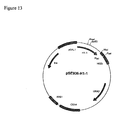
- the plasmid obtained is called pURA (FIG. 15).
- the Y55.LD1 strain is transformed by the introduction of the CAS-URA integration / excision cassette in the form of linear DNA.
- This CAS-URA cassette is extracted from the pURA plasmid by digestion with the restriction enzymes Pac I and Swa I and purified.
- deletions at URA loci is controlled on a Petri dish containing a minimal medium 2% glucose by checking the absence of growth. Elimination of selection markers is verified by sequencing and hybridization (Southern hybridization) on haploid cells of several tetrads obtained after sporulation of the modified diploid strain.
- the strain obtained is called Y55.LD2.
- EXAMPLE 6 Construction and implementation of integration / excision cassettes for the multiple insertion of a gene of interest coding for a protein not produced by Saccharomyces cerevisiae
- a DNA fragment constituted is introduced into the cassette. of the coding part of the gene of interest, or its cDNA, under the promoter and terminator of Saccharomyces cerevisiae , said fragment to be introduced into the integration / excision cassette being flanked at each end of a Pme I site.
- the module composed of two mosaic sequences and the dominant negative marker is used to construct an E. coli- yeast shuttle plasmid with a high copy rate.
- the remaining plasmid includes only yeast sequences and the gene of interest. It can be used for the expression of said gene with a high copy rate in the absence of any DNA foreign to the yeast except that of the gene of interest, if it is a heterologous gene.
- the plasmid pINT-MOS (FIG. 8) serves as the basis for the construction of this shuttle plasmid.
- a linker oligonucleotide (or binding sequence) containing the unique sites Eco RI, Asc I, Pme I, Swa I, Pac I and Hind III is introduced between the two mosaic SRDs of this plasmid. (A single site is a site present only once in a construction).
- Eco RI and Hind III are used respectively for the integration of the sequences of the origin of replication yeast 2 micron and of the gene URA3 .
- the Asc I, Pme I, Swa I and Pac I restriction sites will give potential sites for the integration of an expression cassette. For this, all of these sites already present in the pINT-MOS plasmid must be eliminated.
- the pINT-MOS plasmid is digested with the restriction enzymes Swa I and Eco RV and re-ligated.
- the positive and negative selection markers are then replaced by two linker sequences or linkers (SEQ ID No: 3 and 4) previously hybridized to each other and providing the restriction sites defined above.
- the plasmid is digested with the endonucleases Bgl II and Sac I, the fragment containing the two markers is eliminated and the remaining vector is linked to the fragment consisting of the two linkers defined above and hybridized (or linked) between them.
- the resulting plasmid is named pJB202 ( Figure 16).
- the fragment obtained by hybridization of the 2 sequences SEQ ID No 3 and 4 introduced into this plasmid the restriction sites Eco RI, Asc I, Pme I, Swa I, Pac I and Hind III as well as the sites of restriction Sac I and Bgl II which are reconstituted.
- the URA3 gene is isolated from the plasmid YEp24 (D. Botstein, Falco, SC, Stewart, S., Brennan, M., Scherer, S., Stinchcomb, DT, Struhl, K. and R. Davis (1979) Sterile host yeasts (SHY): a eukaryotic system of biological containment for recombinant DNA experiments. Gene 8: 17-24) after digestion of YEp24 with Hind III. The resulting fragment, of size 1.2 kbp, is inserted at the Hind III site of the plasmid pJB202, giving the plasmid pJB203. The 2 micron fragment is also isolated from the plasmid YEp24.
- the plasmid YEp24 is digested with Eco RI and the 2.2 kbp fragment containing the origin of 2 micron replication is isolated. This fragment is linked to the plasmid pJB203, previously linearized with Eco RI.
- This plasmid pJB204 is digested with the endonuclease Bst EII and linked with the PCR product described in example 2 comprising the RTA module.
- the resulting plasmid is named pJB205 and is shown in FIG. 17. It contains the fragment comprising the origin of replication of E.
- the plasmid pJB205 thus constructed can be used to transform strains of auxotrophic yeasts for uracil.
- This vector can be designed in such a way that it makes it possible to transform prototrophic yeast strains.
- the URA3 gene must be replaced by a dominant positive marker of yeast origin, that is to say homologous for yeast. Such markers are cited above in the description.
- Such a plasmid is hereinafter called pJB208.
- EXAMPLE 8 Expression of the enzyme lactate dehydrogenase in S. cerevisiae on a replicating plasmid giving a high number of copies
- the ldhL gene coding for lactate dehydrogenase, from Lactobacillus plantarum is introduced with the necessary yeast expression elements into the plasmid pJB205 described in Example 7.
- the expression cassette for the ldhL gene of L. plantarum under the control of the promoter and terminator ADH1 is obtained from the plasmid pVT.LDHp.
- This plasmid pVT.LDHp is constructed by introducing into the plasmid pVT 100-U (T. Vernet, D. Dignard and DY Thomas (1987) A family of yeast expression vectors containing the phage f1 intergenic region. Gene 52: 225-233) , at its Xba I site, a PCR product comprising the coding region of the ldhL gene from Lactobacillus plantarum , amplified by PCR of the plasmid pGIT005 (T. Ferain, D. Garmyn, N. Bernard, P. Hols and J. Delcour (1994) Lactobacillus plantarum ldhL Gene: Overexpression and Deletion. J. Bacteriol. 176: 596-601) and an Xba 1 site at its two ends.
- the expression cassette for the ldhL gene is amplified by PCR from the plasmid pVT.LDHp by choosing 2 primers introducing the Pme I site at the 2 ends of the PCR product.
- This last product of the PCR is purified, digested with the endonuclease Pme I and linked to the plasmid pJB205, previously linearized by digestion with Pme I to obtain the plasmid pJB206 (FIG. 18).
- the baker's yeast strain Y55.LD2 (2n ⁇ ura3 :: MOS ) constructed in Example 5 is transformed with the plasmid pJB206.
- the transformants are selected on a minimal medium containing 2% of galactose as carbon source.
- the galactose present in the medium induces the expression of the dominant negative marker, and makes it possible to select the cells carrying one or more plasmids which have lost the DNA fragment carrying this negative marker and the DNA of origin of E. coli by recombination. homologous between the two mosaic fragments.
- This medium makes it possible to select transformants containing the plasmid pJB206-OUT (FIG. 19).
- the plasmid (s) are isolated from a transformant and analyzed by PCR and sequencing.
- the transformant is cultured for 48 hours on minimal medium containing 5% glucose as carbon source up to an OD 600 of 4.
- the cells are eliminated from the medium by centrifugation and the presence of lactic acid is measured by the corresponding kit supplied by Roche Diagnostics (Germany).
- Roche Diagnostics Germany
Landscapes
- Life Sciences & Earth Sciences (AREA)
- Health & Medical Sciences (AREA)
- Genetics & Genomics (AREA)
- Engineering & Computer Science (AREA)
- Zoology (AREA)
- Wood Science & Technology (AREA)
- Biomedical Technology (AREA)
- Organic Chemistry (AREA)
- Biotechnology (AREA)
- General Engineering & Computer Science (AREA)
- Chemical & Material Sciences (AREA)
- Mycology (AREA)
- Bioinformatics & Cheminformatics (AREA)
- Microbiology (AREA)
- Physics & Mathematics (AREA)
- Plant Pathology (AREA)
- Molecular Biology (AREA)
- Biochemistry (AREA)
- General Health & Medical Sciences (AREA)
- Biophysics (AREA)
- Micro-Organisms Or Cultivation Processes Thereof (AREA)
- External Artificial Organs (AREA)
- Immobilizing And Processing Of Enzymes And Microorganisms (AREA)
Applications Claiming Priority (2)
| Application Number | Priority Date | Filing Date | Title |
|---|---|---|---|
| FR9812702A FR2784394B1 (fr) | 1998-10-09 | 1998-10-09 | Cassette d'integration-excision |
| FR9812702 | 1998-10-09 |
Publications (3)
| Publication Number | Publication Date |
|---|---|
| EP0994192A2 true EP0994192A2 (de) | 2000-04-19 |
| EP0994192A3 EP0994192A3 (de) | 2000-04-26 |
| EP0994192B1 EP0994192B1 (de) | 2003-04-23 |
Family
ID=9531399
Family Applications (1)
| Application Number | Title | Priority Date | Filing Date |
|---|---|---|---|
| EP99402456A Expired - Lifetime EP0994192B1 (de) | 1998-10-09 | 1999-10-07 | Transformationskassetten für Hefe |
Country Status (8)
| Country | Link |
|---|---|
| US (1) | US6534315B1 (de) |
| EP (1) | EP0994192B1 (de) |
| AT (1) | ATE238426T1 (de) |
| AU (1) | AU754951B2 (de) |
| CA (1) | CA2285041C (de) |
| DE (1) | DE69907108T2 (de) |
| ES (1) | ES2194426T3 (de) |
| FR (1) | FR2784394B1 (de) |
Cited By (2)
| Publication number | Priority date | Publication date | Assignee | Title |
|---|---|---|---|---|
| WO2012085386A1 (fr) | 2010-12-21 | 2012-06-28 | Lesaffre Et Compagnie | Nouvelles souches de levure de panification |
| US8748129B2 (en) | 2008-02-05 | 2014-06-10 | Institut National De La Recherche Agronomique | Method for the targeted integration of multiple copies of a gene of interest in a yarrowia strain |
Families Citing this family (11)
| Publication number | Priority date | Publication date | Assignee | Title |
|---|---|---|---|---|
| US20030154518A1 (en) * | 2000-06-12 | 2003-08-14 | Signer Ethan R. | Removal of selectable markers from transformed cells |
| SE0102204D0 (sv) * | 2001-06-21 | 2001-06-21 | Leif Isaksson | New method |
| US7252942B2 (en) * | 2002-12-19 | 2007-08-07 | E.I. Du Pont De Nemours And Company | Parallel chromosomal stacking of traits in bacteria |
| CN101006174B (zh) | 2004-06-21 | 2010-05-26 | 诺维信公司 | 以相同取向稳定保持的至少两个orf的多拷贝 |
| US7501275B2 (en) * | 2004-10-27 | 2009-03-10 | The United States Of America As Represented By The Secretary Of Agriculture | Yeast transformation system |
| CA2729626C (fr) * | 2008-07-11 | 2017-12-12 | Jean-Marc Nicaud | Nouvelles souches de levure mutantes capables d'accumuler une grande quantite de lipides |
| FR3028527A1 (fr) | 2014-11-13 | 2016-05-20 | Pivert | Identification de facteurs de transcription de yarrowia lipolytica |
| US11702627B2 (en) * | 2016-02-18 | 2023-07-18 | Tianjin University | High cAMP yielding yeast strain and use thereof |
| EP3728603A2 (de) * | 2017-12-20 | 2020-10-28 | DSM IP Assets B.V. | Verfahren zum genom-editing in einer wirtszelle |
| CN117230102B (zh) * | 2023-09-20 | 2025-05-23 | 天津大学 | 酵母种间穿梭载体及制备方法 |
| CN117587057B (zh) * | 2023-11-27 | 2025-04-11 | 苏州泓迅生物科技股份有限公司 | 一种大片段dna的酵母高效组装方法及其应用 |
Family Cites Families (3)
| Publication number | Priority date | Publication date | Assignee | Title |
|---|---|---|---|---|
| EP0286424B1 (de) * | 1987-04-09 | 1994-03-16 | Delta Biotechnology Limited | Hefevektor |
| FR2615527B1 (fr) * | 1987-05-22 | 1989-08-18 | Lesaffre Soc Ind | Procede d'integration d'une sequence connue d'adn dans les levures ascosporogenes, vecteurs mis en oeuvre et nouvelles souches de levures |
| US5464764A (en) * | 1989-08-22 | 1995-11-07 | University Of Utah Research Foundation | Positive-negative selection methods and vectors |
-
1998
- 1998-10-09 FR FR9812702A patent/FR2784394B1/fr not_active Expired - Fee Related
-
1999
- 1999-10-07 AT AT99402456T patent/ATE238426T1/de not_active IP Right Cessation
- 1999-10-07 EP EP99402456A patent/EP0994192B1/de not_active Expired - Lifetime
- 1999-10-07 DE DE69907108T patent/DE69907108T2/de not_active Expired - Lifetime
- 1999-10-07 ES ES99402456T patent/ES2194426T3/es not_active Expired - Lifetime
- 1999-10-08 CA CA2285041A patent/CA2285041C/fr not_active Expired - Fee Related
- 1999-10-08 AU AU53572/99A patent/AU754951B2/en not_active Ceased
- 1999-10-12 US US09/415,216 patent/US6534315B1/en not_active Expired - Fee Related
Cited By (2)
| Publication number | Priority date | Publication date | Assignee | Title |
|---|---|---|---|---|
| US8748129B2 (en) | 2008-02-05 | 2014-06-10 | Institut National De La Recherche Agronomique | Method for the targeted integration of multiple copies of a gene of interest in a yarrowia strain |
| WO2012085386A1 (fr) | 2010-12-21 | 2012-06-28 | Lesaffre Et Compagnie | Nouvelles souches de levure de panification |
Also Published As
| Publication number | Publication date |
|---|---|
| AU754951B2 (en) | 2002-11-28 |
| EP0994192A3 (de) | 2000-04-26 |
| DE69907108D1 (de) | 2003-05-28 |
| CA2285041C (fr) | 2010-12-14 |
| US6534315B1 (en) | 2003-03-18 |
| ES2194426T3 (es) | 2003-11-16 |
| FR2784394B1 (fr) | 2001-01-05 |
| DE69907108T2 (de) | 2004-03-18 |
| ATE238426T1 (de) | 2003-05-15 |
| FR2784394A1 (fr) | 2000-04-14 |
| EP0994192B1 (de) | 2003-04-23 |
| CA2285041A1 (fr) | 2000-04-09 |
| AU5357299A (en) | 2000-04-13 |
Similar Documents
| Publication | Publication Date | Title |
|---|---|---|
| EP3320091B1 (de) | Guide-rns-assemblierungsvektor | |
| EP3242950B1 (de) | Crispr-cas-system für eine hefe-wirtszelle | |
| EP2250270B1 (de) | Verfahren zur gezielten integration mehrerer kopien eines interessierenden gens in einen yarrowia-stamm | |
| EP3491130B1 (de) | Montagesystem für eine eukaryotische zelle | |
| EP0994192B1 (de) | Transformationskassetten für Hefe | |
| US20180023096A1 (en) | A crispr-cas system for a lipolytic yeast host cell | |
| EP2611923B1 (de) | Nukleinsäuren, zusammensetzungen und verfahren zur exzision von zielnukleinsäuren | |
| Stasyk et al. | Sterol glucosyltransferases have different functional roles inPichia pastoris and Yarrowia lipolytica | |
| FR2626584A1 (fr) | Sequence ars efficace chez yarrowia lipolytica et procede pour sa preparation | |
| CN108738328B (zh) | 用于丝状真菌宿主细胞的crispr-cas系统 | |
| JP4874124B2 (ja) | サッカロマイセス・セレビジエにおける組換え遺伝子の産生 | |
| EP0749489B1 (de) | Expressionskassette, die einen aus dem Schizosaccharomyces pombe-Pho4-Gene stammenden Promotor enthält | |
| EP0575338A1 (de) | "multi site" integrationskassette für das genom einer hefe | |
| Olsson et al. | Silencing MIG1 in Saccharomyces cerevisiae: effects of antisense MIG1 expression and MIG1 gene disruption | |
| EP0166659B1 (de) | Transformationsvektor für Hefe Yarrowia lipolytica, Transformationsverfahren und transformierte Hefe | |
| EP1163350B1 (de) | Polynukleotide zur mutagenese in pilzen, die ein funktionelles magnaporthe gen und ein impala transposon enthalten | |
| Estruch et al. | Construction of a Trp− commercial baker's yeast strain by using food-safe-grade dominant drug resistance cassettes | |
| EP0819175A1 (de) | Neuartige promotoren zur expression van entsprechenden proteinen in der zelle | |
| FR2693475A1 (fr) | Procédé d'identification et/ou de clonage de promoteurs transcriptionnels, et utilisation de ces promoteurs pour l'expression de gènes. | |
| Ma | Heterologous gene expression and transcriptional regulation of manganese peroxidase gene expression in the basidiomycete Phanerochaete chrysosporium | |
| WO1995014774A2 (fr) | Gene de resistance a la toxicite de la melasse, produits relies et leur utilisation pour analyser et ameliorer les microorganismes et les melasses | |
| HK1181070B (en) | Nucleic acids, compositions and methods for the excision of target nucleic acids |
Legal Events
| Date | Code | Title | Description |
|---|---|---|---|
| PUAI | Public reference made under article 153(3) epc to a published international application that has entered the european phase |
Free format text: ORIGINAL CODE: 0009012 |
|
| PUAL | Search report despatched |
Free format text: ORIGINAL CODE: 0009013 |
|
| AK | Designated contracting states |
Kind code of ref document: A2 Designated state(s): AT BE CH CY DE DK ES FI FR GB GR IE IT LI LU MC NL PT SE |
|
| AX | Request for extension of the european patent |
Free format text: AL;LT;LV;MK;RO;SI |
|
| AK | Designated contracting states |
Kind code of ref document: A3 Designated state(s): AT BE CH CY DE DK ES FI FR GB GR IE IT LI LU MC NL PT SE |
|
| AX | Request for extension of the european patent |
Free format text: AL;LT;LV;MK;RO;SI |
|
| RAP1 | Party data changed (applicant data changed or rights of an application transferred) |
Owner name: LA SOCIETE LESAFFRE ET CIE |
|
| K1C3 | Correction of patent application (complete document) published |
Effective date: 20000426 |
|
| 17P | Request for examination filed |
Effective date: 20001011 |
|
| AKX | Designation fees paid |
Free format text: AT BE CH CY DE DK ES FI FR GB GR IE IT LI LU MC NL PT SE |
|
| GRAG | Despatch of communication of intention to grant |
Free format text: ORIGINAL CODE: EPIDOS AGRA |
|
| 17Q | First examination report despatched |
Effective date: 20020424 |
|
| GRAG | Despatch of communication of intention to grant |
Free format text: ORIGINAL CODE: EPIDOS AGRA |
|
| GRAH | Despatch of communication of intention to grant a patent |
Free format text: ORIGINAL CODE: EPIDOS IGRA |
|
| GRAH | Despatch of communication of intention to grant a patent |
Free format text: ORIGINAL CODE: EPIDOS IGRA |
|
| GRAA | (expected) grant |
Free format text: ORIGINAL CODE: 0009210 |
|
| AK | Designated contracting states |
Designated state(s): AT BE CH CY DE DK ES FI FR GB GR IE IT LI LU MC NL PT SE |
|
| PG25 | Lapsed in a contracting state [announced via postgrant information from national office to epo] |
Ref country code: IE Free format text: LAPSE BECAUSE OF NON-PAYMENT OF DUE FEES Effective date: 20030423 Ref country code: FI Free format text: LAPSE BECAUSE OF FAILURE TO SUBMIT A TRANSLATION OF THE DESCRIPTION OR TO PAY THE FEE WITHIN THE PRESCRIBED TIME-LIMIT Effective date: 20030423 Ref country code: AT Free format text: LAPSE BECAUSE OF FAILURE TO SUBMIT A TRANSLATION OF THE DESCRIPTION OR TO PAY THE FEE WITHIN THE PRESCRIBED TIME-LIMIT Effective date: 20030423 |
|
| REG | Reference to a national code |
Ref country code: GB Ref legal event code: FG4D Free format text: NOT ENGLISH |
|
| REG | Reference to a national code |
Ref country code: CH Ref legal event code: EP |
|
| GBT | Gb: translation of ep patent filed (gb section 77(6)(a)/1977) |
Effective date: 20030423 |
|
| REF | Corresponds to: |
Ref document number: 69907108 Country of ref document: DE Date of ref document: 20030528 Kind code of ref document: P |
|
| REG | Reference to a national code |
Ref country code: IE Ref legal event code: FG4D Free format text: FRENCH |
|
| PG25 | Lapsed in a contracting state [announced via postgrant information from national office to epo] |
Ref country code: SE Free format text: LAPSE BECAUSE OF FAILURE TO SUBMIT A TRANSLATION OF THE DESCRIPTION OR TO PAY THE FEE WITHIN THE PRESCRIBED TIME-LIMIT Effective date: 20030723 Ref country code: PT Free format text: LAPSE BECAUSE OF FAILURE TO SUBMIT A TRANSLATION OF THE DESCRIPTION OR TO PAY THE FEE WITHIN THE PRESCRIBED TIME-LIMIT Effective date: 20030723 Ref country code: GR Free format text: LAPSE BECAUSE OF FAILURE TO SUBMIT A TRANSLATION OF THE DESCRIPTION OR TO PAY THE FEE WITHIN THE PRESCRIBED TIME-LIMIT Effective date: 20030723 Ref country code: DK Free format text: LAPSE BECAUSE OF FAILURE TO SUBMIT A TRANSLATION OF THE DESCRIPTION OR TO PAY THE FEE WITHIN THE PRESCRIBED TIME-LIMIT Effective date: 20030723 |
|
| PG25 | Lapsed in a contracting state [announced via postgrant information from national office to epo] |
Ref country code: LU Free format text: LAPSE BECAUSE OF NON-PAYMENT OF DUE FEES Effective date: 20031007 Ref country code: CY Free format text: LAPSE BECAUSE OF FAILURE TO SUBMIT A TRANSLATION OF THE DESCRIPTION OR TO PAY THE FEE WITHIN THE PRESCRIBED TIME-LIMIT Effective date: 20031007 |
|
| PG25 | Lapsed in a contracting state [announced via postgrant information from national office to epo] |
Ref country code: MC Free format text: LAPSE BECAUSE OF NON-PAYMENT OF DUE FEES Effective date: 20031031 Ref country code: LI Free format text: LAPSE BECAUSE OF NON-PAYMENT OF DUE FEES Effective date: 20031031 Ref country code: CH Free format text: LAPSE BECAUSE OF NON-PAYMENT OF DUE FEES Effective date: 20031031 Ref country code: BE Free format text: LAPSE BECAUSE OF NON-PAYMENT OF DUE FEES Effective date: 20031031 |
|
| REG | Reference to a national code |
Ref country code: ES Ref legal event code: FG2A Ref document number: 2194426 Country of ref document: ES Kind code of ref document: T3 |
|
| REG | Reference to a national code |
Ref country code: IE Ref legal event code: FD4D Ref document number: 0994192E Country of ref document: IE |
|
| PLBE | No opposition filed within time limit |
Free format text: ORIGINAL CODE: 0009261 |
|
| STAA | Information on the status of an ep patent application or granted ep patent |
Free format text: STATUS: NO OPPOSITION FILED WITHIN TIME LIMIT |
|
| 26N | No opposition filed |
Effective date: 20040126 |
|
| BERE | Be: lapsed |
Owner name: LA SOC. *LESAFFRE ET CIE Effective date: 20031031 |
|
| REG | Reference to a national code |
Ref country code: CH Ref legal event code: PL |
|
| PGFP | Annual fee paid to national office [announced via postgrant information from national office to epo] |
Ref country code: NL Payment date: 20101009 Year of fee payment: 12 Ref country code: FR Payment date: 20101020 Year of fee payment: 12 |
|
| PGFP | Annual fee paid to national office [announced via postgrant information from national office to epo] |
Ref country code: DE Payment date: 20100929 Year of fee payment: 12 |
|
| PGFP | Annual fee paid to national office [announced via postgrant information from national office to epo] |
Ref country code: IT Payment date: 20101018 Year of fee payment: 12 Ref country code: GB Payment date: 20101006 Year of fee payment: 12 |
|
| PGFP | Annual fee paid to national office [announced via postgrant information from national office to epo] |
Ref country code: ES Payment date: 20101122 Year of fee payment: 12 |
|
| REG | Reference to a national code |
Ref country code: NL Ref legal event code: V1 Effective date: 20120501 |
|
| GBPC | Gb: european patent ceased through non-payment of renewal fee |
Effective date: 20111007 |
|
| REG | Reference to a national code |
Ref country code: FR Ref legal event code: ST Effective date: 20120629 |
|
| PG25 | Lapsed in a contracting state [announced via postgrant information from national office to epo] |
Ref country code: NL Free format text: LAPSE BECAUSE OF NON-PAYMENT OF DUE FEES Effective date: 20120501 Ref country code: DE Free format text: LAPSE BECAUSE OF NON-PAYMENT OF DUE FEES Effective date: 20120501 |
|
| REG | Reference to a national code |
Ref country code: DE Ref legal event code: R119 Ref document number: 69907108 Country of ref document: DE Effective date: 20120501 |
|
| PG25 | Lapsed in a contracting state [announced via postgrant information from national office to epo] |
Ref country code: FR Free format text: LAPSE BECAUSE OF NON-PAYMENT OF DUE FEES Effective date: 20111102 Ref country code: IT Free format text: LAPSE BECAUSE OF NON-PAYMENT OF DUE FEES Effective date: 20111007 Ref country code: GB Free format text: LAPSE BECAUSE OF NON-PAYMENT OF DUE FEES Effective date: 20111007 |
|
| REG | Reference to a national code |
Ref country code: ES Ref legal event code: FD2A Effective date: 20130604 |
|
| PG25 | Lapsed in a contracting state [announced via postgrant information from national office to epo] |
Ref country code: ES Free format text: LAPSE BECAUSE OF NON-PAYMENT OF DUE FEES Effective date: 20111008 |