EP0996979B1 - Boitier pour au moins un corps semi-conducteur - Google Patents
Boitier pour au moins un corps semi-conducteur Download PDFInfo
- Publication number
- EP0996979B1 EP0996979B1 EP98941269A EP98941269A EP0996979B1 EP 0996979 B1 EP0996979 B1 EP 0996979B1 EP 98941269 A EP98941269 A EP 98941269A EP 98941269 A EP98941269 A EP 98941269A EP 0996979 B1 EP0996979 B1 EP 0996979B1
- Authority
- EP
- European Patent Office
- Prior art keywords
- semiconductor body
- housing
- supporting frame
- chip
- package
- Prior art date
- Legal status (The legal status is an assumption and is not a legal conclusion. Google has not performed a legal analysis and makes no representation as to the accuracy of the status listed.)
- Expired - Lifetime
Links
Images


Classifications
-
- H—ELECTRICITY
- H10—SEMICONDUCTOR DEVICES; ELECTRIC SOLID-STATE DEVICES NOT OTHERWISE PROVIDED FOR
- H10W—GENERIC PACKAGES, INTERCONNECTIONS, CONNECTORS OR OTHER CONSTRUCTIONAL DETAILS OF DEVICES COVERED BY CLASS H10
- H10W76/00—Containers; Fillings or auxiliary members therefor; Seals
- H10W76/40—Fillings or auxiliary members in containers, e.g. centering rings
- H10W76/42—Fillings
- H10W76/47—Solid or gel fillings
-
- H—ELECTRICITY
- H10—SEMICONDUCTOR DEVICES; ELECTRIC SOLID-STATE DEVICES NOT OTHERWISE PROVIDED FOR
- H10W—GENERIC PACKAGES, INTERCONNECTIONS, CONNECTORS OR OTHER CONSTRUCTIONAL DETAILS OF DEVICES COVERED BY CLASS H10
- H10W72/00—Interconnections or connectors in packages
- H10W72/071—Connecting or disconnecting
- H10W72/072—Connecting or disconnecting of bump connectors
- H10W72/07251—Connecting or disconnecting of bump connectors characterised by changes in properties of the bump connectors during connecting
-
- H—ELECTRICITY
- H10—SEMICONDUCTOR DEVICES; ELECTRIC SOLID-STATE DEVICES NOT OTHERWISE PROVIDED FOR
- H10W—GENERIC PACKAGES, INTERCONNECTIONS, CONNECTORS OR OTHER CONSTRUCTIONAL DETAILS OF DEVICES COVERED BY CLASS H10
- H10W72/00—Interconnections or connectors in packages
- H10W72/20—Bump connectors, e.g. solder bumps or copper pillars; Dummy bumps; Thermal bumps
Definitions
- the present invention relates to a housing for at least a semiconductor body.
- housing component can, for example, a memory chip be, for example, for mounting on a circuit board assembly is provided.
- I / O ports In the case of complex semiconductor bodies, in particular in the case of memory chips, takes the number of external contacts, the so-called I / O ports, more and more. There are chips with today More than a thousand I / O ports implemented, some are possible thousand I / O ports. To meet this requirement will be in such housing components for reasons of space the I / O ports are usually no longer on the side of the chip led out, but the contacts are from a Surface of the semiconductor body led out. Since the connection pads can not be placed on the edge of the chip Signal advantageously directly from the chip at the point led out where it is produced. Because of this extremely short Such components prove to be especially useful for high-frequency applications - as advantageous. Also offers such a component because of the smallest installation area the smaller connection pads.
- Such a module can be, for example, a so-called Be a flip-chip device.
- the flip chip chip is not housed and belongs to the category of naked chips (English: bare the).
- the connection technology used here is called C4 and stands for Control Collapse Chip Connection.
- the C4 technology has been in variety for over twenty years of products used.
- Figure 1 of the drawing shows a bonded flip chip chip.
- connection elements 5 Located on the front 4 of a semiconductor body 2 bonded connection elements 5.
- the connection elements are spherical.
- the spherical connection elements can, for example, in ball grid array (BGA) technology be bonded to the silicon chip. Not at that Contacted areas of the chip front side 4 is a passivation layer 13 applied.
- BGA ball grid array
- the chip / housing ratio is optimal here.
- components can be process engineering, especially extremely difficult to handle during transport. this has inevitably results in an increased reject rate.
- external influences such as mechanical Stress, moisture, temperature influences, unprotected exposed.
- a non-encapsulated building block can be do not laser mark after production.
- FIG. 2 shows a semiconductor body 2 whose front 4 connection elements 5 are bonded.
- the Edge surface 7 and the back of the chip 8 are each one Housing 1 encased.
- the connecting elements 5, which are spherical in the present example are formed, the semiconductor body 2 with a PCB 10 connectable.
- the housing 1 is usually by pressing a plastic mass onto the semiconductor chip manufactured.
- Such a housing component 19 is in the form of a chip scale package (CSP), often known as a chip size package.
- CSP chip scale package
- This technology seems to be suitable for the technological leap to bridge to flip-chip mounting, as here are some disadvantages the flip-chip technology can be avoided.
- this housing is by a certain factor bigger than the chip.
- a Enclosures can only be referred to as CSP enclosures if there are is at most 0.2 times larger than the chip itself. This value is reflected in the ratio of the housing area Chip area again.
- CSP packages have the advantages over flip-chip components on damage to transport, manufacturing or protected against other external influences are.
- CSP housings can also be laser-marked. Indeed have CSP housing components compared to flip-chip components the disadvantage of a chip / housing ratio of ⁇ 1.
- the encapsulation of a plastic housing is often very complicated and very expensive. Such components also have a higher reject rate because, for example, by a asymmetrical flow of the plastic mass during manufacture of the housing to defects such as cavities or the finest Holes in the plastic can come.
- JP A-02 125633 is a semiconductor device with a known two-part housing, the first part of the housing has a support frame that the edge surfaces of the semiconductor body completely embraced and located on the edge of the semiconductor body from its side surface.
- the second Part of the housing has a flat lid, the area covering the second surface and partly one upper edge of the support frame covered.
- a similar semiconductor device is known from JP-A-56 043748, in which a Semiconductor chip on its flat sides by a support frame is completely surrounded. A passive back of the semiconductor chip remains free.
- a housing for a semiconductor body specify the one compared to CSP technology has significantly higher chip / housing ratio and that is simple and inexpensive to manufacture and does not have the above disadvantages.
- PBCSP package Polymer Bumper Chip Scale Package
- the main advantage of the present invention is that that the two-part PBCSP housing component according to the invention an optimized due to the very thin support frame Has chip / housing ratio. It can be produce the housing in a simple manner and very inexpensively.
- the manufactured housing component is opposite to the outside Influences as well as against damage during transport and manufacture protected.
- the finished housing component can be advantageously laser mark.
- the material of the support frame usually has a very high viscosity.
- the support mass is typically at Room temperature extremely consistent.
- the crowd points of the lid has a much lower viscosity than that Support mass on.
- the support mass is usually applied first and serves as a flow stop in the next process step for the mass of the lid. This prevents that the applied and still liquid during production Lid mass flows over the edge of the semiconductor body.
- a polymer is usually used as the supporting mass.
- the Polymer has a very high viscosity at room temperature and is therefore extremely consistent under normal conditions. This is particularly advantageous if the housing is between mechanically transported or handled the process steps becomes.
- Other common supports can also be used Plastics or similar materials at room temperature have a very high viscosity.
- a so-called glob top is typically used as the cover mass used.
- the glob top can be an epoxy resin, for example or a common other resin. It is also conceivable as Glob-Top to use a gel-like substance or something similar.
- those are not provided with contact points Areas on the front of the chip through a passivation layer protected. In this way the front of the chip against environmental influences such as moisture, mechanical stress, Corrosion, etc. protected.
- a manufacturing method of the invention Housing components is specified in claim 4.
- non-stick material should be that at high temperatures with the material of the Housing component, responds. Typically it is considered non-stick Teflon material used. However, it is also conceivable any other material with similar material properties use.
- the holder for the housing components consists of an m x n matrix. In this way several housing components can be processed at the same time, which increases the manufacturing costs of the housing components drastically lower.
- FIG. 3 shows a PBCSP housing according to the invention. Same or functionally equivalent elements are in accordance with the figures 1 and 2 provided with the same reference numerals.
- the housing component in Figure 3 shows a housing 1, the one Semiconductor body 2 comprises.
- the semiconductor body 2 can for example be a silicon chip.
- About these contact points 3 can be the semiconductor body 2 electrically to contact.
- the contact points 3 of the semiconductor body 2 by partially spherical Connection elements 5 contacted.
- the not contacted Areas of the first surface 4 are present Example with a passivation layer to protect the surface covered.
- About the connection elements 5 can Semiconductor body 2 with corresponding contacts of a circuit board 10 electrically connect. In the present example the areas between the housing component 19 and the contacted Printed circuit board filled up by a filler 12.
- the housing 1 comprises the semiconductor body 2 in such a way that the edge surface 7 of the semiconductor body 2 and the second Surface 8 are covered by the housing 1.
- the housing 1 consists of a support frame 6 and a cover 9th
- the support frame 6 envelops the edge surface 7 over the entire surface of the silicon chip 2.
- the support frame 6 has a width 11 on. It is essential to the invention that the support frame 6 at the edge of the silicon chip 2 from the second surface 8 takes off. On the side of the first surface 4 the closes Support frame 6, however, typically not necessarily with the first surface 4.
- the Cover 9 On the second surface 8 of the silicon chip 2, the Cover 9 all over the silicon chip 2.
- the cover 9 can partially also cover the support frame 6.
- the cross section of the support frame 6 ideally has the shape a rectangle with a width of 11. However, this is not mandatory necessary. In fact, the shape of the cross section of the Support frame 6 depending on material properties or the applied technology.
- the support frame 6 is very thin is in order to achieve the best possible chip-housing ratio guarantee.
- the support frame 6 has a width 11 of a few microns. This allows housing components 19 with a chip-housing ratio of about realize one.
- cover 9 if possible is designed to meet the requirements of a flat housing series correspond to.
- these requirements can be met in this way be that the mass of the support frame 6 a very has high viscosity, while the mass of the lid has a much lower viscosity.
- the preparation of the support frame 6 is first produced.
- the lid 9 is applied to the back of the chip 8.
- the Support frame 6 forms a flow stop for the low-viscosity Dimensions of the lid 9.
- a polymer is typically used as the material of the support frame 6 or a common plastic material used.
- the mass of the support frame 6 is applied at a high temperature. at The mass 1 of the support frame 6 advantageously has room temperature their highest viscosity and is extremely deformation-consistent.
- the material of the lid 9 is typically a common so-called glob-top material or a gel-like material with similar material properties.
- the lid mass will also applied at high temperature, typically by pouring, spraying, draining, or the like. On this ensures that the lid mass is uniform and covering the entire surface of the silicon chip distributed.
- the silicon chip can be used for even distribution 2 also on a rotation chuck at high speed be rotated. After cooling, the viscosity increases, which makes the lid more deformation-consistent. however the cover 9 does not reach the hardness of the support frame 6.
- a temperature step is used to Support frame 6 and the lid 9 hardened.
- This temperature step takes place typically for one hour at 100 ° C oven temperature.
- curing by UV light is also conceivable perform.
- filler 12 between the housing component and circuit board 10 is not absolutely necessary. From mechanical and electrical reasons is the use of a However, filler 12 is preferable, because it is, for example Contact breaks caused by mechanical stress can be avoided. Of further the connection elements 5 and connection pads before Corrosion protected by moisture.
- connection elements of the housing 1 are typically such arranged that they with appropriate connection elements 5 can be contacted on the circuit board 10. Particularly advantageous it is when using a BGA package if the Connection elements have spherical areas. Through the spherical connecting elements 5 it is simple possible solder connections between the semiconductor body 2 and to manufacture the printed circuit board 10.
- the lid 9 is primarily used for mechanical protection Surface or to protect against moisture and external Influences.
- the lid 9 is not suitable for the housing component 19 on the surface of the cover 9, for example is handled for machine transport.
- the support frame 6 is provided, its consistency is much harder than that of the lid 9.
- the support frame 6 is suitable for machine housing 19, for example to be transported without the housing component 19th damage caused by transport or other handling takes.
- Figure 4 (A) shows the cross section of a holder 14 for a with connection elements 5 provided silicon chip 2.
- the holder 14 On the floor the holder 14 are contact element holes 17 for receiving the connection elements 5 of the silicon chip 2 are provided.
- the diameter of the holes 16 for the connection elements 6 is typically marginally larger than the diameter of the Connection elements 5.
- the inner walls of the holder 14 are covered with an entire surface non-stick material 15 covered.
- a non-stick material Teflon is typically used.
- the silicon chip 2 is arranged in the holder 14 in such a way that the Edge surface 7 of the silicon chip 2 from the lateral inner wall 15 of the bracket 14 is spaced. The distance between that Edge 7 of the silicon chip 2 and the inner wall of the holder 14 defines a gap 16 with a width of 11.
- the gap 16 typically but not necessarily has a constant Width 11 in.
- the silicon chip 2 on the holder 14 becomes the supporting mass according to FIG. 4 (B) in the gap 16 20 introduced by machine. This can be done by injecting or pouring at a suitable temperature. Since the Backing mass 20 typically has a very high viscosity Has room temperature, is for the application of the support mass 20 a very high temperature, usually some 100 ° C, required.
- the gap 16 is up to Surface 8 of the silicon chip 2 filled up.
- the gap 16 After the gap 16 has been filled with the supporting mass 20, there is usually a temperature step for curing.
- This curing step is necessary so that the support frame 6 the housing component 19 remains consistent in shape.
- the curing of the support frame 6 is typically carried out at high temperature. However, it is important to ensure that the curing temperature below the melting temperature of the connection elements 5 or the contact points 3 and metallizations.
- the hardening of the support mass 20 can also be done by so-called Rapid curing in air at room temperature or at a slightly elevated temperature. Depending on the material of the Support frame is also conceivable curing by UV light.
- FIG. 4 (C) is then on the surface 8 of the silicon chip 2, the covering compound 21 for the Cover 9 applied.
- the covering compound 21 has a very high much lower viscosity than the mass 20 of the support frame 6.
- the masking compound 21 can advantageously apply at a much lower temperature than the mass 20 of the support frame 6.
- the covering mass 21 can depending on the process machine, either spun on, sprayed on, be infused, etc.
- the curing of the lid 9 is typically carried out similarly to the hardening of the support mass 20th
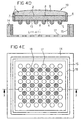
- FIG. 4 (D) After the housing components 19 have hardened sufficiently, they can be pushed out of the holder 14 (see Figure 4 (D)). To eject the housing components 19 from the Bracket 14 are ejection holes 18 in the bottom of the bracket 14 provided. A top view of the bracket is from figure 4 (E) can be seen. By pulling pins through this ejection holes 18 can be the housing component 19 of repel the bracket 14.
- bracket 14 which is in contact with the housing component can come, especially the inner walls 15 of the bracket 14, made of non-stick material. Otherwise, would the housing parts 19 just applied by pushing them out possibly detached from the holder 14 again become.
- a material should be used as the non-stick material not physically or chemically with the material of the housing component 19, in particular at high temperatures, responding. Furthermore, the non-stick material should remain consistent with the high process temperatures used. Teflon is typically used as the non-adhesive material. However, it is also conceivable to use any other material use that meets the above requirements.
- the housing components 19 can then be electrically or be functionally tested. Tested housing components 19 are then typically characterized by a laser marking device.
- the housing components 19 are then contacted on a circuit board 10 or a circuit board. It proves to be advantageous if the areas between housing component 19 and circuit board or printed circuit board 10 be filled up with a common filler 12. Through this Measure ensures that the electrical contacts or the connection elements 5 protected from mechanical stress become. Line breaks can be avoided in this way. Furthermore is ensured by this measure that the connection elements 5 or the metallization of the circuit board 10 and the silicon chip 2 from moisture and thus from corrosion to be protected. This increases reliability and yield the housing components 19.
- the holder 14 for the housing components 19th consist of an m x n matrix, where m is the number of Columns and n denotes the number of rows of the holder 14. In this m x n mounting matrix, m x n can then be Manufacture housing components 19 simultaneously. This advantageously lowers the manufacturing costs of the housing components 19.
- the invention is particularly advantageous when used in a so-called chip-scaled package housing.
- the Semiconductor body 2 for example, a so-called flip-chip technology manufactured semiconductor body.
- the invention is advantageous if the connection elements 5 are spherical and in the form of a matrix the semiconductor body 2 are bonded.
- Such a component is commonly referred to as a ball grid array package (BGA package).
- BGA package ball grid array package
- the use of the is also particularly advantageous BGA housing in combination with CSP technology. In this Case is called the Micro Ball Grid Array case ( ⁇ -BGA).
Landscapes
- Structures Or Materials For Encapsulating Or Coating Semiconductor Devices Or Solid State Devices (AREA)
- Casings For Electric Apparatus (AREA)
Abstract
Claims (7)
- Boítier pour au moins un corps semi-conducteur,(a) le corps semi-conducteur (2) présentant une première et une deuxième surface (4, 8), une surface périphérique (7) entourant le corps semi-conducteur (2) et une multitude de points de contact (3) au niveau de la première surface (4),(b) avec une multitude d'éléments de connexion (5) qui sont au moins partiellement en contact avec les points de contact (3) du corps semi-conducteur (2) et par lesquels le corps semi-conducteur (2) peut être mis en contact électrique avec une carte imprimée (10),(c) le boítier (1) étant réalisé en deux parties,la première partie du boítier (1) présentant un cadre de support (6) fin qui entoure entièrement la surface périphérique (7) du corps semi-conducteur (2) et se détache au niveau de la périphérie du corps semi-conducteur (2) de la deuxième surface (8) du corps semi-conducteur (2), etla deuxième partie du boítier (1) présentant un couvercle (9) de forme plate qui recouvre en superficie la deuxième surface (8) et au moins partiellement le bord supérieur du cadre de support (6),(d) le cadre de support (6) étant constitué d'une première masse (20) et le couvercle d'une deuxième masse (21), la première masse (20) étant constituée au moins partiellement d'un polymère, et la deuxième masse (21) étant constituée au moins partiellement d'une résine.
- Boítier selon la revendication 1, caractérisé en ce que les zones de la première surface (4) du corps semi-conducteur (2) non dotées de points de contact (3) sont recouvertes par une couche de passivation (13).
- Boítier selon la revendication 1 ou 2,
caractérisé en ce que les zones entre les éléments de connexion (5) et la carte imprimée (10) sont remplies au moins partiellement par une matière de charge (12). - Procédé pour fabriquer au moins un boítier selon l'une quelconque des revendications 1 à 3, caractérisé par les étapes de procédé suivantes :a) on fabrique une monture (14) qui est prévue pour recevoir le corps semi-conducteur (2) doté d'éléments de connexion (5),b) le corps semi-conducteur (2) est positionné dans la monture (14) de telle sorte que la surface périphérique (7) du corps semi-conducteur (2) et la monture (14) sont espacées par un interstice (16),(c) dans l'interstice (16) est déposée la première masse (20) pour le cadre de support (6),(d) sur la deuxième surface (8) du corps semi-conducteur (2) est déposée sur toute la surface la deuxième masse (21) pour le couvercle (9),(e) le cadre de support (6) et le couvercle (9) sont cuits,(f) les composants sous boítier (19) sont expulsés de la monture (14).
- Procédé selon la revendication 4, caractérisé en ce que la monture (14) présente une paroi intérieure (15), la paroi intérieure (15) étant constituée au moins partiellement d'une matière non adhérente.
- Procédé selon la revendication 5, caractérisé en ce que la matière non adhérente de la paroi intérieure (15) est du Téflon.
- Procédé selon la revendication 5 ou 6, caractérisé en ce que la monture (14) présente une forme semblable à une matrice.
Applications Claiming Priority (3)
| Application Number | Priority Date | Filing Date | Title |
|---|---|---|---|
| DE19728992A DE19728992C2 (de) | 1997-07-07 | 1997-07-07 | Gehäuse mit zumindest einen Halbleiterkörper |
| DE19728992 | 1997-07-07 | ||
| PCT/DE1998/001851 WO1999003153A2 (fr) | 1997-07-07 | 1998-07-03 | Boitier pour au moins un corps semi-conducteur |
Publications (2)
| Publication Number | Publication Date |
|---|---|
| EP0996979A2 EP0996979A2 (fr) | 2000-05-03 |
| EP0996979B1 true EP0996979B1 (fr) | 2004-10-13 |
Family
ID=7834910
Family Applications (1)
| Application Number | Title | Priority Date | Filing Date |
|---|---|---|---|
| EP98941269A Expired - Lifetime EP0996979B1 (fr) | 1997-07-07 | 1998-07-03 | Boitier pour au moins un corps semi-conducteur |
Country Status (4)
| Country | Link |
|---|---|
| US (1) | US6288335B1 (fr) |
| EP (1) | EP0996979B1 (fr) |
| DE (2) | DE19728992C2 (fr) |
| WO (1) | WO1999003153A2 (fr) |
Families Citing this family (9)
| Publication number | Priority date | Publication date | Assignee | Title |
|---|---|---|---|---|
| DE10017741A1 (de) | 2000-04-10 | 2001-10-25 | Infineon Technologies Ag | Gehäuse für Halbleiterchips |
| DE10024336A1 (de) | 2000-05-17 | 2001-11-22 | Heidenhain Gmbh Dr Johannes | Bauelementanordnung und Verfahren zur Herstellung einer Bauelementanordnung |
| DE10103186B4 (de) | 2001-01-24 | 2007-01-18 | Infineon Technologies Ag | Verfahren zur Herstellung eines elektronischen Bauteils mit einem Halbleiter-Chip |
| DE10156386B4 (de) * | 2001-11-16 | 2007-08-09 | Infineon Technologies Ag | Verfahren zum Herstellen eines Halbleiterchips |
| US7115998B2 (en) * | 2002-08-29 | 2006-10-03 | Micron Technology, Inc. | Multi-component integrated circuit contacts |
| DE10340328A1 (de) * | 2003-08-29 | 2005-03-24 | Endress + Hauser Gmbh + Co. Kg | Vergußschale |
| US9312193B2 (en) | 2012-11-09 | 2016-04-12 | Taiwan Semiconductor Manufacturing Company, Ltd. | Stress relief structures in package assemblies |
| DE102013002629A1 (de) | 2013-02-15 | 2014-08-21 | HKR Seuffer Automotive GmbH & Co. KG | Deckelelement und Gehäusevorrichtung zur Verwendung des Deckelelements |
| US20200118940A1 (en) * | 2018-10-15 | 2020-04-16 | Intel Corporation | Die with bumper for solder joint reliability |
Family Cites Families (14)
| Publication number | Priority date | Publication date | Assignee | Title |
|---|---|---|---|---|
| JPS5643748A (en) * | 1979-09-17 | 1981-04-22 | Seiko Instr & Electronics Ltd | Mounting structure for ic |
| JPH02125633A (ja) * | 1988-11-04 | 1990-05-14 | Nec Corp | 集積回路 |
| US5289346A (en) * | 1991-02-26 | 1994-02-22 | Microelectronics And Computer Technology Corporation | Peripheral to area adapter with protective bumper for an integrated circuit chip |
| US5496775A (en) * | 1992-07-15 | 1996-03-05 | Micron Semiconductor, Inc. | Semiconductor device having ball-bonded pads |
| US5336931A (en) * | 1993-09-03 | 1994-08-09 | Motorola, Inc. | Anchoring method for flow formed integrated circuit covers |
| JPH0817864A (ja) * | 1994-06-24 | 1996-01-19 | New Japan Radio Co Ltd | 半導体パッケ−ジ |
| JPH08236586A (ja) * | 1994-12-29 | 1996-09-13 | Nitto Denko Corp | 半導体装置及びその製造方法 |
| DE19500655B4 (de) * | 1995-01-12 | 2004-02-12 | Fraunhofer-Gesellschaft zur Förderung der angewandten Forschung e.V. | Chipträger-Anordnung zur Herstellung einer Chip-Gehäusung |
| JPH08335653A (ja) * | 1995-04-07 | 1996-12-17 | Nitto Denko Corp | 半導体装置およびその製法並びに上記半導体装置の製造に用いる半導体装置用テープキャリア |
| US5627405A (en) * | 1995-07-17 | 1997-05-06 | National Semiconductor Corporation | Integrated circuit assembly incorporating an anisotropic elecctrically conductive layer |
| JPH09107052A (ja) * | 1995-10-09 | 1997-04-22 | Sony Corp | 半導体装置及びその製造方法 |
| US5720100A (en) * | 1995-12-29 | 1998-02-24 | Motorola, Inc. | Assembly having a frame embedded in a polymeric encapsulant and method for forming same |
| US5981314A (en) * | 1996-10-31 | 1999-11-09 | Amkor Technology, Inc. | Near chip size integrated circuit package |
| US5831561A (en) | 1997-04-29 | 1998-11-03 | Lucent Technologies Inc. | System and method for dynamically optimizing a symbol table and modem employing the same |
-
1997
- 1997-07-07 DE DE19728992A patent/DE19728992C2/de not_active Expired - Fee Related
-
1998
- 1998-07-03 WO PCT/DE1998/001851 patent/WO1999003153A2/fr not_active Ceased
- 1998-07-03 EP EP98941269A patent/EP0996979B1/fr not_active Expired - Lifetime
- 1998-07-03 DE DE1998512125 patent/DE59812125D1/de not_active Expired - Lifetime
-
2000
- 2000-01-07 US US09/479,023 patent/US6288335B1/en not_active Expired - Lifetime
Also Published As
| Publication number | Publication date |
|---|---|
| DE19728992C2 (de) | 2001-08-09 |
| WO1999003153A2 (fr) | 1999-01-21 |
| DE19728992A1 (de) | 1999-01-14 |
| EP0996979A2 (fr) | 2000-05-03 |
| US6288335B1 (en) | 2001-09-11 |
| WO1999003153A3 (fr) | 1999-04-01 |
| DE59812125D1 (de) | 2004-11-18 |
Similar Documents
| Publication | Publication Date | Title |
|---|---|---|
| DE69315451T2 (de) | Chipträgerpackung für gedruckte Schaltungsplatte, wobei der Chip teilweise eingekapselt ist, und deren Herstellung | |
| DE69432968T2 (de) | Gehäuse für elektronische Bauelemente | |
| DE10360708B4 (de) | Halbleitermodul mit einem Halbleiterstapel, Umverdrahtungsplatte, und Verfahren zur Herstellung derselben | |
| DE102009011975B4 (de) | Halbleiteranordnung mit einem lagestabilen überdeckten Element | |
| DE102010016696B4 (de) | Halbleiter-Bauelement | |
| DE19813525A1 (de) | Integriertes Halbleiterbauelement | |
| DE10045043A1 (de) | Halbleiterbauteil und Verfahren zu dessen Herstellung | |
| DE10234951A1 (de) | Halbleiterschaltungsmodul und Verfahren zur Herstellung von Halbleiterschaltungsmodulen | |
| DE102005043557B4 (de) | Verfahren zur Herstellung eines Halbleiterbauteils mit Durchkontakten zwischen Oberseite und Rückseite | |
| DE3688164T2 (de) | Packung mit einem Substrat und mindestens einem elektronischen Bauelement. | |
| DE10156386B4 (de) | Verfahren zum Herstellen eines Halbleiterchips | |
| DE102008010098A1 (de) | Halbleiterpackage mit einer ein Die aufnehmenden durchgehenden Ausnehmung und einer Verbindungsbohrung und ein Verfahren zu deren Herstellung | |
| DE112007003208T5 (de) | Ein Halbleitergehäuse | |
| EP0996979B1 (fr) | Boitier pour au moins un corps semi-conducteur | |
| DE102017223689B4 (de) | Halbleitervorrichtungen mit Hochfrequenzleitungselementen und zugehörige Herstellungsverfahren | |
| DE69722661T2 (de) | Verfahren zur herstellung einer halbleitervorrichtung | |
| DE10124970B4 (de) | Elektronisches Bauteil mit einem Halbleiterchip auf einer Halbleiterchip-Anschlußplatte, Systemträger und Verfahren zu deren Herstellung | |
| DE102006032073B4 (de) | Elektrisch leitfähiger Verbund aus einem Bauelement und einer Trägerplatte | |
| DE10136655C1 (de) | Multichipmodul in COB Bauweise, insbesondere CompactFlash Card mit hoher Speicherkapazität und Verfahren zur Herstellung desselben | |
| DE10162676B4 (de) | Elektronisches Bauteil mit einem Halbleiterchip und einer Umverdrahtungsplatte und Systemträger für mehrere elektronische Bauteile sowie Verfahren zur Herstellung derselben | |
| DE102004036909A1 (de) | Halbleiterbasisbauteil mit Verdrahtungssubstrat und Zwischenverdrahtungsplatte für einen Halbleiterbauteilstapel sowie Verfahren zu deren Herstellung | |
| DE112018001137T5 (de) | Halbleitervorrichtung und verfahren zu ihrer herstellung | |
| WO2020064525A1 (fr) | Procédé pour la fabrication d'un capteur mems | |
| DE19821916C2 (de) | Halbleitereinrichtung mit einem BGA-Substrat | |
| EP1636854B1 (fr) | Capteur et plaquette pour la fabrication dudit capteur |
Legal Events
| Date | Code | Title | Description |
|---|---|---|---|
| PUAI | Public reference made under article 153(3) epc to a published international application that has entered the european phase |
Free format text: ORIGINAL CODE: 0009012 |
|
| 17P | Request for examination filed |
Effective date: 19991217 |
|
| AK | Designated contracting states |
Kind code of ref document: A2 Designated state(s): DE FR GB IT |
|
| 17Q | First examination report despatched |
Effective date: 20010817 |
|
| GRAP | Despatch of communication of intention to grant a patent |
Free format text: ORIGINAL CODE: EPIDOSNIGR1 |
|
| RIN1 | Information on inventor provided before grant (corrected) |
Inventor name: LEE, CHARLES-WEE-MING |
|
| GRAS | Grant fee paid |
Free format text: ORIGINAL CODE: EPIDOSNIGR3 |
|
| GRAA | (expected) grant |
Free format text: ORIGINAL CODE: 0009210 |
|
| AK | Designated contracting states |
Kind code of ref document: B1 Designated state(s): DE FR GB IT |
|
| PG25 | Lapsed in a contracting state [announced via postgrant information from national office to epo] |
Ref country code: IT Free format text: LAPSE BECAUSE OF FAILURE TO SUBMIT A TRANSLATION OF THE DESCRIPTION OR TO PAY THE FEE WITHIN THE PRESCRIBED TIME-LIMIT;WARNING: LAPSES OF ITALIAN PATENTS WITH EFFECTIVE DATE BEFORE 2007 MAY HAVE OCCURRED AT ANY TIME BEFORE 2007. THE CORRECT EFFECTIVE DATE MAY BE DIFFERENT FROM THE ONE RECORDED. Effective date: 20041013 Ref country code: GB Free format text: LAPSE BECAUSE OF FAILURE TO SUBMIT A TRANSLATION OF THE DESCRIPTION OR TO PAY THE FEE WITHIN THE PRESCRIBED TIME-LIMIT Effective date: 20041013 Ref country code: FR Free format text: LAPSE BECAUSE OF FAILURE TO SUBMIT A TRANSLATION OF THE DESCRIPTION OR TO PAY THE FEE WITHIN THE PRESCRIBED TIME-LIMIT Effective date: 20041013 |
|
| REG | Reference to a national code |
Ref country code: GB Ref legal event code: FG4D Free format text: NOT ENGLISH |
|
| REF | Corresponds to: |
Ref document number: 59812125 Country of ref document: DE Date of ref document: 20041118 Kind code of ref document: P |
|
| GBV | Gb: ep patent (uk) treated as always having been void in accordance with gb section 77(7)/1977 [no translation filed] |
Effective date: 20041013 |
|
| PLBE | No opposition filed within time limit |
Free format text: ORIGINAL CODE: 0009261 |
|
| STAA | Information on the status of an ep patent application or granted ep patent |
Free format text: STATUS: NO OPPOSITION FILED WITHIN TIME LIMIT |
|
| 26N | No opposition filed |
Effective date: 20050714 |
|
| EN | Fr: translation not filed | ||
| PGFP | Annual fee paid to national office [announced via postgrant information from national office to epo] |
Ref country code: DE Payment date: 20130919 Year of fee payment: 16 |
|
| REG | Reference to a national code |
Ref country code: DE Ref legal event code: R119 Ref document number: 59812125 Country of ref document: DE |
|
| PG25 | Lapsed in a contracting state [announced via postgrant information from national office to epo] |
Ref country code: DE Free format text: LAPSE BECAUSE OF NON-PAYMENT OF DUE FEES Effective date: 20150203 |
|
| REG | Reference to a national code |
Ref country code: DE Ref legal event code: R119 Ref document number: 59812125 Country of ref document: DE Effective date: 20150203 |