EP0997832A2 - Méthode pour simuler un procédé d'implantation d'ions dans lequel le nombre de particules peut être reduit - Google Patents
Méthode pour simuler un procédé d'implantation d'ions dans lequel le nombre de particules peut être reduit Download PDFInfo
- Publication number
- EP0997832A2 EP0997832A2 EP99120469A EP99120469A EP0997832A2 EP 0997832 A2 EP0997832 A2 EP 0997832A2 EP 99120469 A EP99120469 A EP 99120469A EP 99120469 A EP99120469 A EP 99120469A EP 0997832 A2 EP0997832 A2 EP 0997832A2
- Authority
- EP
- European Patent Office
- Prior art keywords
- simulation
- particles
- particle
- ion
- simulation particle
- Prior art date
- Legal status (The legal status is an assumption and is not a legal conclusion. Google has not performed a legal analysis and makes no representation as to the accuracy of the status listed.)
- Withdrawn
Links
Images
Classifications
-
- G—PHYSICS
- G06—COMPUTING OR CALCULATING; COUNTING
- G06F—ELECTRIC DIGITAL DATA PROCESSING
- G06F30/00—Computer-aided design [CAD]
- G06F30/20—Design optimisation, verification or simulation
- G06F30/23—Design optimisation, verification or simulation using finite element methods [FEM] or finite difference methods [FDM]
-
- G—PHYSICS
- G06—COMPUTING OR CALCULATING; COUNTING
- G06F—ELECTRIC DIGITAL DATA PROCESSING
- G06F2111/00—Details relating to CAD techniques
- G06F2111/08—Probabilistic or stochastic CAD
-
- G—PHYSICS
- G06—COMPUTING OR CALCULATING; COUNTING
- G06F—ELECTRIC DIGITAL DATA PROCESSING
- G06F2111/00—Details relating to CAD techniques
- G06F2111/10—Numerical modelling
Definitions
- the present invention relates to a simulating method of an ion implantation process. More particularly, the present invention is directed to a simulating method of an ion implantation process, in which a simulation calculation quantity can be reduced.
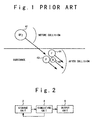
- Fig. 1 is a diagram for describing a conventional simulating method of an ion implantation process when a BF 2 ion is implanted as an example.
- a simulation particle 41 corresponding to the BF 2 ion is to be implanted, the simulation particle 41 corresponding to the BF 2 ion is irradiated.
- the simulation particle 41 corresponding to the BF 2 ion collides with a target or substance, the above mentioned incident simulation particle 41 corresponding to the BF 2 ion is decomposed into a simulation particle 42 corresponding to a B ion and simulation particles 43 and 44 corresponding to F ions, in a case that a condition of ion decomposition is satisfied.
- JP-A-Heisei 8-139049 an implantation method is described in Japanese Laid Open Patent Application (JP-A-Heisei 8-139049).
- the moment of the ion implantation to the crystal is determined in a high precision taking account for the crystal structure of a substrate, when the substrate is not supposed to be amorphous.
- JP-A-Heisei 8-330376 a simulation method is described in Japanese Laid Open Patent Application.
- JP-A-Heisei 8-330376 when the simulation calculation is carried out under the high dose condition such that there is possibility to damage a crystal target due to an ion implantation quantity, the weight of the simulation particle used in a Monte Carlo method is changed step-by-step so that the effective concentration distribution range of the calculation result is expanded and the number of simulation particles necessary finally is reduced.
- JP-A-Heisei 9-270391 Japanese Laid Open Patent Application
- JP-A-Heisei 9-270391 the technique in which for the purpose of omission of preliminary calculation and improvement of statistical precision by knowing a precision lack portion of concentration, a copy is produced on the way of the track of an ion particle, and the operation to distribute the weight in accordance with the number of copies is executed in a plurality of steps, while referring to a distribution function of flight distances in a 3-dimensional space with respect to an ion.
- the simulation time is weighted on the calculation of a F profile which is not important compared with a B profile.
- the simulation calculation is carried out to the simulation particles corresponding to all the F ions which are generated in the decomposition process of the simulation particle corresponding to the BF 2 ion implanted actually.
- the simulating method such as the Monte Carlo method needs enormous calculating time, even if the simulating method is carried out using a computer such as a work station. Thus, the reduction of a calculation quantity is demanded in practical use.
- an object of the present invention is to provide a simulating method of an ion implantation process in which a calculation quantity is possible to be reduced by weighting the calculation to significant ions and by reducing the number of insignificant ions.
- a simulating method of an ion implantation process includes:
- the (b) calculating may include:
- the number of new simulation particles is equal to the number of types of atoms, when the simulation particle is a molecular ion composed of a first type of atomic ion and a second type of atomic ions.
- the attributes of the simulation particles corresponding to a plurality of the ions may be set in the (a) setting, and the plurality of ions may be ions to be implanted into the substance.
- the (b) calculating includes calculating the scattering process of each of the simulation particles with the atom of the substance model based on the set attributes.
- the (c) holding includes:
- the simulation may be executed for each of a plurality of regions, and the number of the simulation particles may be determined depending on a size of each of the plurality of regions.
- a computer-readable recording medium which is recorded with a program for a simulating method of an ion implantation process, includes:
- the computer-readable recording medium may includes the above-mentioned simulation method.
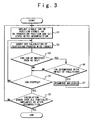
- Fig. 2 is a diagram showing a simulating apparatus for the simulating method of the ion implantation process according to the first embodiment of the present invention.
- the simulating apparatus is composed of a storage unit 2, a simulating unit 4 and an output unit 6.
- the simulating unit 4 reads a program written in a recording medium (not shown) and executes the simulating method using data stored in the storage unit 2 based on the program.
- the simulation result is outputted from the simulating unit 4 to the output unit 6.
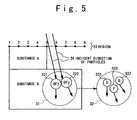
- a simulation particle 1 corresponding to the BF 2 ion is implanted and collides with one of atoms in substance or target so that the simulation particle 1 receive impact.
- the simulation particle 1 is decomposed into a simulation particle 11 corresponding to a B ion and a simulation particle 12 corresponding to F ions.
- the simulation particle 1 corresponding to the BF 2 ion is decomposed into the simulation particle 11 corresponding to the B ion and the simulation particle 12 corresponding to the F ions, in case of simulation calculation, as shown in Fig. 4.
- the weight in the simulation calculation means a quotient obtained by dividing an actual dose quantity, i.e., the number of implantation ions for every unit region by the number of simulation particles. Therefore, in the above case, when the simulation particle corresponding to the B ion represents 10 B atoms, the simulation particle corresponding to the F ions represents 20 F atoms.
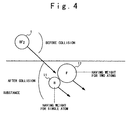
- Fig. 3 is a flow chart for explaining the simulating method of the ion implantation process according to the first embodiment of the present invention will be described taking as an example, the operation of a Monte Carlo method when BF 2 ions are implanted.
- a single simulation particle corresponding to the BF 2 ion is implanted into a target substance, or the simulation particle as a decomposed atom is located on a position where the atom is obtained through the decomposition. Also, a system state is reset after the decomposition. That is, the position, velocity and movement direction of the simulation particle have been stored in the storage unit 2 as the attribute.
- the simulating unit 4 reads one of the attributes from the storage unit 2 and start the simulation.
- the simulation particle 1 first read out from the storage unit 2 corresponds to the implanted ion.
- a step S1 the scattering process of the simulation particle with an atom in the above target substance is calculated.
- the simulating unit 4 decomposes the simulation particle into new atomic simulation particles. Then, the simulation calculation is stopped.
- the attribute of the simulation particle 1 corresponding to the above implanted ion is examined to determine whether or not the implanted ion is an ion of a molecule such as BF 2 .
- the control advances to a step S6.
- step S6 it is determined whether or not the above simulation particle 1 has been decomposed due to the impact of the collision with the atom in the target substance.
- the method of determines whether the energy which the simulation particle corresponding to the BF 2 ion loses through the collision is larger than the binding energy of atoms of F and B can be used, as mentioned above.
- the control advances to a step S4.
- the simulation particle 1 is determined to have been decomposed, the control advances to a step S7.
- the control returns to the step S1.
- step S1 a series of the above-mentioned processes from step S1 are repeated for the next simulation particle whose attribute is read out from the storage unit 2.
- the simulation particle corresponding to the B ion and the simulation particle corresponding to the F ion are produced for one simulation particle corresponding to the BF 2 ion, as mentioned above.
- step S4 it is determined whether or not the simulation particle is stopped in the target substance. If the simulation particle is determined not to be stopped, the control returns to the step S2. Then, a series of the above-mentioned processes from step S2 are repeated. If it is determined that the movement of the simulation particle is stopped, the control advances to a step S5.
- the above stopped simulation particle is mapped into an ion distribution map. Then, it is determined whether calculation for all the simulation particles to be implanted or all the simulation particles after the decomposition is completed in the simulation calculation. If the calculation is completed, the simulating unit 4 ends the simulation calculation and outputs the ion distribution map to the output unit 6. However, if the calculation is not completed, the control goes back to the step S1 to repeat the step S1 and the subsequent steps, while selecting the next one of the simulation particles stored in the storage unit 2.
- the two processes are in the above-mentioned step S1, that is, the process in which a simulation particle corresponding to an ion is implanted into the target substance, and the simulation particle corresponding to an atom ion after the decomposition is located on the position.
- the latter may be separated from the step S1 to be added to the step S5 or a subsequent step.
- Fig. 5 is a diagram showing the simulating method of the ion implantation process according to the second embodiment of the present invention will be described taking as an example, the case when BF 2 ions are implanted.
- the simulation particle 12 corresponds to the F ions.
- equal to or more than two F ions are regarded as a single simulation particle.
- the second embodiment is different from the first embodiment in the step S2 of calculating the scattering process.
- a region 33 is divided into a plurality of sub-regions. All the sub-regions may be equal to each other. In this embodiment, the region 33 is divided in 8 sub-regions by 9 points from 1 to 9.
- one of the sub-regions is selected using a random number or a quasi random number.
- the sub-regions may be selected sequentially.
- the simulation particles corresponding to a plurality of BF 2 ions are implanted from the selected sub-region.
- the simulation particles 321 and 322 corresponding to the BF 2 ions are implanted in a region 31 from the incident direction 34.
- the region 33 is equally divided into the sub-regions
- the number of simulation particles to be implanted from each sub-region is set to be constant over the sub-regions.
- the number of simulation particles is set to be proportional to the incident area of the sub-region.
- each simulation particle is scattered with atoms of the target substance to be decomposed into the ions of B and F.
- the number of simulation particles corresponding to the F ions obtained in the above scattering process are decreased.
- the decreasing method will be described below.
- two simulation particles 321 and 322 corresponding to the two BF 2 ions are decomposed to produce four simulation particles corresponding to the four F ions.
- the center of gravity of the four simulation particles corresponding to the F ions is calculated.
- the center of gravity is set as the position of a new simulation particle corresponding to the F ions.
- the movement direction of the new simulation particle corresponding to the F ion that is, the components of a velocity vector are determined based on the summation of the velocity vectors of the above four simulation particles corresponding to the F ions.
- the velocity of the new simulation particle corresponding to the F ions is calculated from the average of the energies of the above four simulation particles corresponding to the F ions.
- the new imaginary simulation particle corresponding to four F ions is produced.
- the new imaginary simulation particle corresponding to the F ions is manipulated as if the four simulation particles corresponding to F ions after the above decomposition and the subsequent calculation is carried out using the imaginary simulation particle in the simulation calculation shown in Fig. 3.
- Fig. 5 shows the simulation particles 331 and 332 corresponding to the B ions which have been formed by the above decomposition process and the simulation particle 333 corresponding to F ions as the above-mentioned new imaginary simulation particle in the circle 32.
- the program shown as the flow chart in Fig. 3 and executed by a processor may be stored and delivered in the recording medium such as a CD-ROM which can be read by a computer.
- a general purpose computer may read the above program from this recording medium and execute it.
- the simulating method of the ion implantation process according to the present invention although it is necessary to carry out calculation for 3 times of the number of specified simulation particles because a single simulation particle corresponding to the BF 2 ion is decomposed into one simulation particle corresponding to the B ion and two simulation particles corresponding to the F ions in the conventional method, it is sufficient to carry out the calculation for twice of the number of specified simulation particles in the present invention so that the calculating time can be reduced to about 2/3 times, compared with the conventional method.
- the calculation for three simulation particles is carried out for two simulation particles corresponding to the BF 2 ions. Therefore, the calculating time can be reduced to about 3/6, i.e., 1/2 times, compared with the conventional method in which the calculation for six simulation particles is carried out to one simulation particle corresponding to the BF 2 ion.
Landscapes
- Engineering & Computer Science (AREA)
- Physics & Mathematics (AREA)
- Theoretical Computer Science (AREA)
- Computer Hardware Design (AREA)
- Evolutionary Computation (AREA)
- Geometry (AREA)
- General Engineering & Computer Science (AREA)
- General Physics & Mathematics (AREA)
- Management, Administration, Business Operations System, And Electronic Commerce (AREA)
- Physical Vapour Deposition (AREA)
Applications Claiming Priority (2)
| Application Number | Priority Date | Filing Date | Title |
|---|---|---|---|
| JP30565198A JP3266113B2 (ja) | 1998-10-27 | 1998-10-27 | イオン注入プロセスのシミュレーション方法 |
| JP30565198 | 1998-10-27 |
Publications (2)
| Publication Number | Publication Date |
|---|---|
| EP0997832A2 true EP0997832A2 (fr) | 2000-05-03 |
| EP0997832A3 EP0997832A3 (fr) | 2002-01-30 |
Family
ID=17947710
Family Applications (1)
| Application Number | Title | Priority Date | Filing Date |
|---|---|---|---|
| EP99120469A Withdrawn EP0997832A3 (fr) | 1998-10-27 | 1999-10-14 | Méthode pour simuler un procédé d'implantation d'ions dans lequel le nombre de particules peut être reduit |
Country Status (2)
| Country | Link |
|---|---|
| EP (1) | EP0997832A3 (fr) |
| JP (1) | JP3266113B2 (fr) |
Families Citing this family (2)
| Publication number | Priority date | Publication date | Assignee | Title |
|---|---|---|---|---|
| KR100448105B1 (ko) * | 2001-04-11 | 2004-09-10 | 한국과학기술원 | 경로를 알지 못하는 많은 구들간의 효율적인 충돌 검색방법 |
| JP5391558B2 (ja) * | 2008-02-29 | 2014-01-15 | 日本電気株式会社 | イオン注入プロセスのシミュレーション方法 |
Family Cites Families (1)
| Publication number | Priority date | Publication date | Assignee | Title |
|---|---|---|---|---|
| JP3003588B2 (ja) * | 1996-09-18 | 2000-01-31 | 日本電気株式会社 | イオン注入シミュレーション方法 |
-
1998
- 1998-10-27 JP JP30565198A patent/JP3266113B2/ja not_active Expired - Fee Related
-
1999
- 1999-10-14 EP EP99120469A patent/EP0997832A3/fr not_active Withdrawn
Also Published As
| Publication number | Publication date |
|---|---|
| JP3266113B2 (ja) | 2002-03-18 |
| JP2000133608A (ja) | 2000-05-12 |
| EP0997832A3 (fr) | 2002-01-30 |
Similar Documents
| Publication | Publication Date | Title |
|---|---|---|
| CN112036001B (zh) | 自动驾驶测试场景构建方法、装置、设备及可读存储介质 | |
| Heck et al. | CORSIKA: A Monte Carlo code to simulate extensive air showers | |
| Hirai et al. | Three-dimensional resist process simulator PEACE (photo and electron beam lithography analyzing computer engineering system) | |
| Dokshitzer et al. | Coherence and physics of QCD jets | |
| Ghiduk et al. | Generating of Test Data by Harmony Search Against Genetic Algorithms. | |
| Arter et al. | The SMARDDA approach to ray tracing and particle tracking | |
| Trache et al. | Determination of the S 18 astrophysical factor for 8 B (p, γ) 9 C from the breakup of 9 C at intermediate energies | |
| JPH06186340A (ja) | 放射線線量率マップ作成装置 | |
| EP0997832A2 (fr) | Méthode pour simuler un procédé d'implantation d'ions dans lequel le nombre de particules peut être reduit | |
| EP0644497B1 (fr) | Méthode et système pour diviser une région d'analyse dans un simulateur de dispositif | |
| US7424411B2 (en) | Ion implantation simulation apparatus, method, and program | |
| JP2783174B2 (ja) | イオン注入不純物分布のシミュレーション方法 | |
| EP0831407B1 (fr) | Méthode de simulation d'implantation d'iones | |
| Weidemaier et al. | Photoinduced electron transfer and geminate recombination on a micelle surface: Analytical theory and Monte Carlo simulations | |
| Hostikka et al. | Two-model monte carlo simulation of fire scenarios | |
| Inaba et al. | High-accuracy statistical simulation of planetary accretion: I. Test of the accuracy by comparison with the solution to the stochastic coagulation equation | |
| Merrick et al. | Multigrid method for electrostatic computations in numerical density functional theory | |
| Gottlob et al. | Iterating block spin transformations of the O (3) nonlinear σ model | |
| Jabouille et al. | Parallelization of the French meteorological mesoscale model MesoNH | |
| CN118395683B (zh) | 基于非参数解集的太阳能辐照度概率建模方法及装置 | |
| Tolar Jr et al. | A transport condensed history algorithm for electron monte carlo simulations | |
| Park et al. | A COMPREHENSIVE AND COMPUTATIONALLY EFFICIENT MODELING STRATEGY FOR SIMULATION OF BORON ION IMPLANTATION INTO SINGLE‐CRYSTAL SILICON WITH EXPLICIT DOSE AND IMPLANT ANGLE DEPENDENCE | |
| JPH11111633A (ja) | イオン注入シミュレーション方法及びイオン注入シミュレーションプログラムを格納した記録媒体 | |
| Maiorov | Estimates of the bias in the results of monte carlo calculations of reactors and storage sites for nuclear fuel | |
| Kaplan | Semiclassical accuracy in phase space for regular and chaotic dynamics |
Legal Events
| Date | Code | Title | Description |
|---|---|---|---|
| PUAI | Public reference made under article 153(3) epc to a published international application that has entered the european phase |
Free format text: ORIGINAL CODE: 0009012 |
|
| AK | Designated contracting states |
Kind code of ref document: A2 Designated state(s): AT BE CH CY DE DK ES FI FR GB GR IE IT LI LU MC NL PT SE Kind code of ref document: A2 Designated state(s): CH DE FR GB LI |
|
| AX | Request for extension of the european patent |
Free format text: AL;LT;LV;MK;RO;SI |
|
| PUAL | Search report despatched |
Free format text: ORIGINAL CODE: 0009013 |
|
| AK | Designated contracting states |
Kind code of ref document: A3 Designated state(s): AT BE CH CY DE DK ES FI FR GB GR IE IT LI LU MC NL PT SE |
|
| AX | Request for extension of the european patent |
Free format text: AL;LT;LV;MK;RO;SI |
|
| 17P | Request for examination filed |
Effective date: 20020510 |
|
| AKX | Designation fees paid |
Free format text: CH DE FR GB LI |
|
| RAP1 | Party data changed (applicant data changed or rights of an application transferred) |
Owner name: NEC ELECTRONICS CORPORATION |
|
| STAA | Information on the status of an ep patent application or granted ep patent |
Free format text: STATUS: THE APPLICATION HAS BEEN WITHDRAWN |
|
| 18W | Application withdrawn |
Effective date: 20031204 |