EP0998381B2 - prodece pour la fabrication de revetements polyhydroxyalcanoate - Google Patents
prodece pour la fabrication de revetements polyhydroxyalcanoate Download PDFInfo
- Publication number
- EP0998381B2 EP0998381B2 EP98935915A EP98935915A EP0998381B2 EP 0998381 B2 EP0998381 B2 EP 0998381B2 EP 98935915 A EP98935915 A EP 98935915A EP 98935915 A EP98935915 A EP 98935915A EP 0998381 B2 EP0998381 B2 EP 0998381B2
- Authority
- EP
- European Patent Office
- Prior art keywords
- pha
- coating
- molecular weight
- coatings
- polymer
- Prior art date
- Legal status (The legal status is an assumption and is not a legal conclusion. Google has not performed a legal analysis and makes no representation as to the accuracy of the status listed.)
- Expired - Lifetime
Links
- 238000000034 method Methods 0.000 title claims abstract description 41
- 238000000576 coating method Methods 0.000 title claims description 88
- 229920000903 polyhydroxyalkanoate Polymers 0.000 title description 103
- 239000005014 poly(hydroxyalkanoate) Substances 0.000 title description 101
- 239000011248 coating agent Substances 0.000 claims description 54
- 229910052751 metal Inorganic materials 0.000 claims description 14
- 239000002184 metal Substances 0.000 claims description 14
- -1 fatty acid salt Chemical class 0.000 claims description 11
- DBVJJBKOTRCVKF-UHFFFAOYSA-N Etidronic acid Chemical compound OP(=O)(O)C(O)(C)P(O)(O)=O DBVJJBKOTRCVKF-UHFFFAOYSA-N 0.000 claims description 9
- 150000007530 organic bases Chemical class 0.000 claims description 7
- 235000014113 dietary fatty acids Nutrition 0.000 claims description 6
- 239000000194 fatty acid Substances 0.000 claims description 6
- 229930195729 fatty acid Natural products 0.000 claims description 6
- 229910052739 hydrogen Inorganic materials 0.000 claims description 6
- 230000008018 melting Effects 0.000 claims description 6
- 238000002844 melting Methods 0.000 claims description 6
- 150000004665 fatty acids Chemical class 0.000 claims description 4
- ABLZXFCXXLZCGV-UHFFFAOYSA-N phosphonic acid group Chemical group P(O)(O)=O ABLZXFCXXLZCGV-UHFFFAOYSA-N 0.000 claims description 4
- 238000007765 extrusion coating Methods 0.000 claims description 3
- 230000000737 periodic effect Effects 0.000 claims description 2
- 150000002903 organophosphorus compounds Chemical class 0.000 claims 2
- 239000008199 coating composition Substances 0.000 abstract description 10
- 229920000642 polymer Polymers 0.000 description 41
- 238000007789 sealing Methods 0.000 description 30
- 239000002904 solvent Substances 0.000 description 22
- 239000000123 paper Substances 0.000 description 21
- 239000008188 pellet Substances 0.000 description 19
- 239000000203 mixture Substances 0.000 description 18
- 239000002667 nucleating agent Substances 0.000 description 12
- 238000005259 measurement Methods 0.000 description 11
- 150000003839 salts Chemical class 0.000 description 11
- 238000001125 extrusion Methods 0.000 description 10
- 238000004519 manufacturing process Methods 0.000 description 10
- 239000000463 material Substances 0.000 description 10
- 239000000155 melt Substances 0.000 description 10
- OKKJLVBELUTLKV-UHFFFAOYSA-N Methanol Chemical compound OC OKKJLVBELUTLKV-UHFFFAOYSA-N 0.000 description 9
- 238000001816 cooling Methods 0.000 description 8
- QQGYZOYWNCKGEK-UHFFFAOYSA-N 5-[(1,3-dioxo-2-benzofuran-5-yl)oxy]-2-benzofuran-1,3-dione Chemical compound C1=C2C(=O)OC(=O)C2=CC(OC=2C=C3C(=O)OC(C3=CC=2)=O)=C1 QQGYZOYWNCKGEK-UHFFFAOYSA-N 0.000 description 7
- 239000000178 monomer Substances 0.000 description 7
- 239000000047 product Substances 0.000 description 7
- 239000002253 acid Substances 0.000 description 6
- 229920002988 biodegradable polymer Polymers 0.000 description 6
- 239000004621 biodegradable polymer Substances 0.000 description 6
- 230000000694 effects Effects 0.000 description 6
- 108010010718 poly(3-hydroxyalkanoic acid) synthase Proteins 0.000 description 6
- LFQSCWFLJHTTHZ-UHFFFAOYSA-N Ethanol Chemical compound CCO LFQSCWFLJHTTHZ-UHFFFAOYSA-N 0.000 description 5
- 238000009472 formulation Methods 0.000 description 5
- 238000010438 heat treatment Methods 0.000 description 5
- 230000008569 process Effects 0.000 description 5
- CSCPPACGZOOCGX-UHFFFAOYSA-N Acetone Chemical compound CC(C)=O CSCPPACGZOOCGX-UHFFFAOYSA-N 0.000 description 4
- BVKZGUZCCUSVTD-UHFFFAOYSA-L Carbonate Chemical compound [O-]C([O-])=O BVKZGUZCCUSVTD-UHFFFAOYSA-L 0.000 description 4
- 150000007513 acids Chemical class 0.000 description 4
- WNLRTRBMVRJNCN-UHFFFAOYSA-N adipic acid Chemical compound OC(=O)CCCCC(O)=O WNLRTRBMVRJNCN-UHFFFAOYSA-N 0.000 description 4
- 125000000217 alkyl group Chemical group 0.000 description 4
- 230000015572 biosynthetic process Effects 0.000 description 4
- 150000001875 compounds Chemical class 0.000 description 4
- 229920001577 copolymer Polymers 0.000 description 4
- 125000002887 hydroxy group Chemical group [H]O* 0.000 description 4
- 229910000000 metal hydroxide Inorganic materials 0.000 description 4
- 150000004692 metal hydroxides Chemical class 0.000 description 4
- 229910044991 metal oxide Inorganic materials 0.000 description 4
- 150000004706 metal oxides Chemical class 0.000 description 4
- 244000005700 microbiome Species 0.000 description 4
- 230000006911 nucleation Effects 0.000 description 4
- 238000004806 packaging method and process Methods 0.000 description 4
- 239000011087 paperboard Substances 0.000 description 4
- 229920000728 polyester Polymers 0.000 description 4
- 238000012667 polymer degradation Methods 0.000 description 4
- 238000012545 processing Methods 0.000 description 4
- 239000000758 substrate Substances 0.000 description 4
- 238000012360 testing method Methods 0.000 description 4
- 229940070710 valerate Drugs 0.000 description 4
- XLYOFNOQVPJJNP-UHFFFAOYSA-N water Substances O XLYOFNOQVPJJNP-UHFFFAOYSA-N 0.000 description 4
- QTBSBXVTEAMEQO-UHFFFAOYSA-N Acetic acid Chemical compound CC(O)=O QTBSBXVTEAMEQO-UHFFFAOYSA-N 0.000 description 3
- LYCAIKOWRPUZTN-UHFFFAOYSA-N Ethylene glycol Chemical compound OCCO LYCAIKOWRPUZTN-UHFFFAOYSA-N 0.000 description 3
- PEDCQBHIVMGVHV-UHFFFAOYSA-N Glycerine Chemical compound OCC(O)CO PEDCQBHIVMGVHV-UHFFFAOYSA-N 0.000 description 3
- KFZMGEQAYNKOFK-UHFFFAOYSA-N Isopropanol Chemical compound CC(C)O KFZMGEQAYNKOFK-UHFFFAOYSA-N 0.000 description 3
- 239000004698 Polyethylene Substances 0.000 description 3
- 208000037534 Progressive hemifacial atrophy Diseases 0.000 description 3
- DNIAPMSPPWPWGF-UHFFFAOYSA-N Propylene glycol Chemical compound CC(O)CO DNIAPMSPPWPWGF-UHFFFAOYSA-N 0.000 description 3
- 125000001797 benzyl group Chemical group [H]C1=C([H])C([H])=C(C([H])=C1[H])C([H])([H])* 0.000 description 3
- BTANRVKWQNVYAZ-UHFFFAOYSA-N butan-2-ol Chemical compound CCC(C)O BTANRVKWQNVYAZ-UHFFFAOYSA-N 0.000 description 3
- CJZGTCYPCWQAJB-UHFFFAOYSA-L calcium stearate Chemical compound [Ca+2].CCCCCCCCCCCCCCCCCC([O-])=O.CCCCCCCCCCCCCCCCCC([O-])=O CJZGTCYPCWQAJB-UHFFFAOYSA-L 0.000 description 3
- 239000008116 calcium stearate Substances 0.000 description 3
- 235000013539 calcium stearate Nutrition 0.000 description 3
- 239000000470 constituent Substances 0.000 description 3
- 238000007306 functionalization reaction Methods 0.000 description 3
- 238000005227 gel permeation chromatography Methods 0.000 description 3
- 125000002496 methyl group Chemical group [H]C([H])([H])* 0.000 description 3
- 230000000813 microbial effect Effects 0.000 description 3
- BDERNNFJNOPAEC-UHFFFAOYSA-N n-propyl alcohol Natural products CCCO BDERNNFJNOPAEC-UHFFFAOYSA-N 0.000 description 3
- 238000012017 passive hemagglutination assay Methods 0.000 description 3
- 125000001997 phenyl group Chemical group [H]C1=C([H])C([H])=C(*)C([H])=C1[H] 0.000 description 3
- 238000002360 preparation method Methods 0.000 description 3
- 239000011347 resin Substances 0.000 description 3
- 229920005989 resin Polymers 0.000 description 3
- 238000003786 synthesis reaction Methods 0.000 description 3
- 230000007704 transition Effects 0.000 description 3
- PZNSFCLAULLKQX-UHFFFAOYSA-N Boron nitride Chemical compound N#B PZNSFCLAULLKQX-UHFFFAOYSA-N 0.000 description 2
- OYPRJOBELJOOCE-UHFFFAOYSA-N Calcium Chemical compound [Ca] OYPRJOBELJOOCE-UHFFFAOYSA-N 0.000 description 2
- 108090000790 Enzymes Proteins 0.000 description 2
- 102000004190 Enzymes Human genes 0.000 description 2
- FYYHWMGAXLPEAU-UHFFFAOYSA-N Magnesium Chemical compound [Mg] FYYHWMGAXLPEAU-UHFFFAOYSA-N 0.000 description 2
- 229920000331 Polyhydroxybutyrate Polymers 0.000 description 2
- WYURNTSHIVDZCO-UHFFFAOYSA-N Tetrahydrofuran Chemical compound C1CCOC1 WYURNTSHIVDZCO-UHFFFAOYSA-N 0.000 description 2
- 239000001361 adipic acid Substances 0.000 description 2
- 235000011037 adipic acid Nutrition 0.000 description 2
- 150000001298 alcohols Chemical class 0.000 description 2
- 125000003342 alkenyl group Chemical group 0.000 description 2
- 125000003118 aryl group Chemical group 0.000 description 2
- 230000001580 bacterial effect Effects 0.000 description 2
- 229910052788 barium Inorganic materials 0.000 description 2
- DSAJWYNOEDNPEQ-UHFFFAOYSA-N barium atom Chemical compound [Ba] DSAJWYNOEDNPEQ-UHFFFAOYSA-N 0.000 description 2
- 229920001222 biopolymer Polymers 0.000 description 2
- 230000001851 biosynthetic effect Effects 0.000 description 2
- 229910052791 calcium Inorganic materials 0.000 description 2
- 239000011575 calcium Substances 0.000 description 2
- 125000003178 carboxy group Chemical group [H]OC(*)=O 0.000 description 2
- 230000015556 catabolic process Effects 0.000 description 2
- 238000006243 chemical reaction Methods 0.000 description 2
- 239000003795 chemical substances by application Substances 0.000 description 2
- 238000002425 crystallisation Methods 0.000 description 2
- 230000008025 crystallization Effects 0.000 description 2
- 125000000113 cyclohexyl group Chemical group [H]C1([H])C([H])([H])C([H])([H])C([H])(*)C([H])([H])C1([H])[H] 0.000 description 2
- 238000006731 degradation reaction Methods 0.000 description 2
- XBDQKXXYIPTUBI-UHFFFAOYSA-N dimethylselenoniopropionate Natural products CCC(O)=O XBDQKXXYIPTUBI-UHFFFAOYSA-N 0.000 description 2
- 238000009826 distribution Methods 0.000 description 2
- UKMSUNONTOPOIO-UHFFFAOYSA-N docosanoic acid Chemical compound CCCCCCCCCCCCCCCCCCCCCC(O)=O UKMSUNONTOPOIO-UHFFFAOYSA-N 0.000 description 2
- 238000002474 experimental method Methods 0.000 description 2
- IPCSVZSSVZVIGE-UHFFFAOYSA-N hexadecanoic acid Chemical compound CCCCCCCCCCCCCCCC(O)=O IPCSVZSSVZVIGE-UHFFFAOYSA-N 0.000 description 2
- FUZZWVXGSFPDMH-UHFFFAOYSA-N hexanoic acid Chemical compound CCCCCC(O)=O FUZZWVXGSFPDMH-UHFFFAOYSA-N 0.000 description 2
- 150000002484 inorganic compounds Chemical class 0.000 description 2
- 229910010272 inorganic material Inorganic materials 0.000 description 2
- 125000001449 isopropyl group Chemical group [H]C([H])([H])C([H])(*)C([H])([H])[H] 0.000 description 2
- 229910052749 magnesium Inorganic materials 0.000 description 2
- 239000011777 magnesium Substances 0.000 description 2
- HQKMJHAJHXVSDF-UHFFFAOYSA-L magnesium stearate Chemical compound [Mg+2].CCCCCCCCCCCCCCCCCC([O-])=O.CCCCCCCCCCCCCCCCCC([O-])=O HQKMJHAJHXVSDF-UHFFFAOYSA-L 0.000 description 2
- 230000002906 microbiologic effect Effects 0.000 description 2
- UTOPWMOLSKOLTQ-UHFFFAOYSA-N octacosanoic acid Chemical compound CCCCCCCCCCCCCCCCCCCCCCCCCCCC(O)=O UTOPWMOLSKOLTQ-UHFFFAOYSA-N 0.000 description 2
- LYRFLYHAGKPMFH-UHFFFAOYSA-N octadecanamide Chemical compound CCCCCCCCCCCCCCCCCC(N)=O LYRFLYHAGKPMFH-UHFFFAOYSA-N 0.000 description 2
- 239000010893 paper waste Substances 0.000 description 2
- 239000005015 poly(hydroxybutyrate) Substances 0.000 description 2
- 229920000573 polyethylene Polymers 0.000 description 2
- 125000002914 sec-butyl group Chemical group [H]C([H])([H])C([H])([H])C([H])(*)C([H])([H])[H] 0.000 description 2
- 239000007787 solid Substances 0.000 description 2
- 239000007858 starting material Substances 0.000 description 2
- 239000000126 substance Substances 0.000 description 2
- 125000001424 substituent group Chemical group 0.000 description 2
- 229920001169 thermoplastic Polymers 0.000 description 2
- 239000004416 thermosoftening plastic Substances 0.000 description 2
- NQPDZGIKBAWPEJ-UHFFFAOYSA-N valeric acid Chemical compound CCCCC(O)=O NQPDZGIKBAWPEJ-UHFFFAOYSA-N 0.000 description 2
- WRIDQFICGBMAFQ-UHFFFAOYSA-N (E)-8-Octadecenoic acid Natural products CCCCCCCCCC=CCCCCCCC(O)=O WRIDQFICGBMAFQ-UHFFFAOYSA-N 0.000 description 1
- LQJBNNIYVWPHFW-UHFFFAOYSA-N 20:1omega9c fatty acid Natural products CCCCCCCCCCC=CCCCCCCCC(O)=O LQJBNNIYVWPHFW-UHFFFAOYSA-N 0.000 description 1
- SJZRECIVHVDYJC-UHFFFAOYSA-M 4-hydroxybutyrate Chemical compound OCCCC([O-])=O SJZRECIVHVDYJC-UHFFFAOYSA-M 0.000 description 1
- QSBYPNXLFMSGKH-UHFFFAOYSA-N 9-Heptadecensaeure Natural products CCCCCCCC=CCCCCCCCC(O)=O QSBYPNXLFMSGKH-UHFFFAOYSA-N 0.000 description 1
- 229910052582 BN Inorganic materials 0.000 description 1
- 235000021357 Behenic acid Nutrition 0.000 description 1
- VGGSQFUCUMXWEO-UHFFFAOYSA-N Ethene Chemical compound C=C VGGSQFUCUMXWEO-UHFFFAOYSA-N 0.000 description 1
- 239000005977 Ethylene Substances 0.000 description 1
- DGAQECJNVWCQMB-PUAWFVPOSA-M Ilexoside XXIX Chemical compound C[C@@H]1CC[C@@]2(CC[C@@]3(C(=CC[C@H]4[C@]3(CC[C@@H]5[C@@]4(CC[C@@H](C5(C)C)OS(=O)(=O)[O-])C)C)[C@@H]2[C@]1(C)O)C)C(=O)O[C@H]6[C@@H]([C@H]([C@@H]([C@H](O6)CO)O)O)O.[Na+] DGAQECJNVWCQMB-PUAWFVPOSA-M 0.000 description 1
- 239000005642 Oleic acid Substances 0.000 description 1
- ZQPPMHVWECSIRJ-UHFFFAOYSA-N Oleic acid Natural products CCCCCCCCC=CCCCCCCCC(O)=O ZQPPMHVWECSIRJ-UHFFFAOYSA-N 0.000 description 1
- 235000021314 Palmitic acid Nutrition 0.000 description 1
- 239000004793 Polystyrene Substances 0.000 description 1
- 108020004511 Recombinant DNA Proteins 0.000 description 1
- 235000021355 Stearic acid Nutrition 0.000 description 1
- KDYFGRWQOYBRFD-UHFFFAOYSA-N Succinic acid Natural products OC(=O)CCC(O)=O KDYFGRWQOYBRFD-UHFFFAOYSA-N 0.000 description 1
- DKGAVHZHDRPRBM-UHFFFAOYSA-N Tert-Butanol Chemical compound CC(C)(C)O DKGAVHZHDRPRBM-UHFFFAOYSA-N 0.000 description 1
- ATJFFYVFTNAWJD-UHFFFAOYSA-N Tin Chemical compound [Sn] ATJFFYVFTNAWJD-UHFFFAOYSA-N 0.000 description 1
- HCHKCACWOHOZIP-UHFFFAOYSA-N Zinc Chemical compound [Zn] HCHKCACWOHOZIP-UHFFFAOYSA-N 0.000 description 1
- 238000009825 accumulation Methods 0.000 description 1
- 235000011054 acetic acid Nutrition 0.000 description 1
- 239000000853 adhesive Substances 0.000 description 1
- 230000001070 adhesive effect Effects 0.000 description 1
- 230000002411 adverse Effects 0.000 description 1
- 230000032683 aging Effects 0.000 description 1
- 125000001931 aliphatic group Chemical group 0.000 description 1
- 229910052782 aluminium Inorganic materials 0.000 description 1
- XAGFODPZIPBFFR-UHFFFAOYSA-N aluminium Chemical compound [Al] XAGFODPZIPBFFR-UHFFFAOYSA-N 0.000 description 1
- 229910052787 antimony Inorganic materials 0.000 description 1
- WATWJIUSRGPENY-UHFFFAOYSA-N antimony atom Chemical compound [Sb] WATWJIUSRGPENY-UHFFFAOYSA-N 0.000 description 1
- 238000013459 approach Methods 0.000 description 1
- 239000012736 aqueous medium Substances 0.000 description 1
- 239000007900 aqueous suspension Substances 0.000 description 1
- 125000003710 aryl alkyl group Chemical group 0.000 description 1
- 229940116226 behenic acid Drugs 0.000 description 1
- 230000008901 benefit Effects 0.000 description 1
- 238000006065 biodegradation reaction Methods 0.000 description 1
- KDYFGRWQOYBRFD-NUQCWPJISA-N butanedioic acid Chemical compound O[14C](=O)CC[14C](O)=O KDYFGRWQOYBRFD-NUQCWPJISA-N 0.000 description 1
- 239000001913 cellulose Substances 0.000 description 1
- 229920002678 cellulose Polymers 0.000 description 1
- 239000007795 chemical reaction product Substances 0.000 description 1
- 238000009264 composting Methods 0.000 description 1
- 238000003851 corona treatment Methods 0.000 description 1
- 125000000753 cycloalkyl group Chemical group 0.000 description 1
- FBSFTJQYCLLGKH-UHFFFAOYSA-N cyclohexylphosphonic acid Chemical compound OP(O)(=O)C1CCCCC1 FBSFTJQYCLLGKH-UHFFFAOYSA-N 0.000 description 1
- 230000003247 decreasing effect Effects 0.000 description 1
- 230000003413 degradative effect Effects 0.000 description 1
- 239000003599 detergent Substances 0.000 description 1
- 238000002845 discoloration Methods 0.000 description 1
- 238000005516 engineering process Methods 0.000 description 1
- 230000007613 environmental effect Effects 0.000 description 1
- 230000008020 evaporation Effects 0.000 description 1
- 238000001704 evaporation Methods 0.000 description 1
- 238000000855 fermentation Methods 0.000 description 1
- 230000004151 fermentation Effects 0.000 description 1
- 239000000835 fiber Substances 0.000 description 1
- 239000010408 film Substances 0.000 description 1
- 125000000524 functional group Chemical group 0.000 description 1
- 239000008187 granular material Substances 0.000 description 1
- 239000001257 hydrogen Chemical group 0.000 description 1
- 125000004435 hydrogen atom Chemical group [H]* 0.000 description 1
- 230000003301 hydrolyzing effect Effects 0.000 description 1
- 238000011065 in-situ storage Methods 0.000 description 1
- 239000004615 ingredient Substances 0.000 description 1
- 238000009434 installation Methods 0.000 description 1
- QXJSBBXBKPUZAA-UHFFFAOYSA-N isooleic acid Natural products CCCCCCCC=CCCCCCCCCC(O)=O QXJSBBXBKPUZAA-UHFFFAOYSA-N 0.000 description 1
- 239000004816 latex Substances 0.000 description 1
- 229920000126 latex Polymers 0.000 description 1
- 235000019359 magnesium stearate Nutrition 0.000 description 1
- MBKDYNNUVRNNRF-UHFFFAOYSA-N medronic acid Chemical compound OP(O)(=O)CP(O)(O)=O MBKDYNNUVRNNRF-UHFFFAOYSA-N 0.000 description 1
- 150000002739 metals Chemical class 0.000 description 1
- 238000012986 modification Methods 0.000 description 1
- 230000004048 modification Effects 0.000 description 1
- 239000010813 municipal solid waste Substances 0.000 description 1
- WQEPLUUGTLDZJY-UHFFFAOYSA-N n-Pentadecanoic acid Natural products CCCCCCCCCCCCCCC(O)=O WQEPLUUGTLDZJY-UHFFFAOYSA-N 0.000 description 1
- 235000015097 nutrients Nutrition 0.000 description 1
- QIQXTHQIDYTFRH-UHFFFAOYSA-N octadecanoic acid Chemical compound CCCCCCCCCCCCCCCCCC(O)=O QIQXTHQIDYTFRH-UHFFFAOYSA-N 0.000 description 1
- OQCDKBAXFALNLD-UHFFFAOYSA-N octadecanoic acid Natural products CCCCCCCC(C)CCCCCCCCC(O)=O OQCDKBAXFALNLD-UHFFFAOYSA-N 0.000 description 1
- ZQPPMHVWECSIRJ-KTKRTIGZSA-N oleic acid Chemical compound CCCCCCCC\C=C/CCCCCCCC(O)=O ZQPPMHVWECSIRJ-KTKRTIGZSA-N 0.000 description 1
- 238000002103 osmometry Methods 0.000 description 1
- 230000001590 oxidative effect Effects 0.000 description 1
- 239000011101 paper laminate Substances 0.000 description 1
- 239000002245 particle Substances 0.000 description 1
- 230000035699 permeability Effects 0.000 description 1
- ACVYVLVWPXVTIT-UHFFFAOYSA-N phosphinic acid Chemical compound O[PH2]=O ACVYVLVWPXVTIT-UHFFFAOYSA-N 0.000 description 1
- XYORSKKUGAGNPC-UHFFFAOYSA-N phosphonocarbonylphosphonic acid Chemical compound OP(O)(=O)C(=O)P(O)(O)=O XYORSKKUGAGNPC-UHFFFAOYSA-N 0.000 description 1
- FAIAAWCVCHQXDN-UHFFFAOYSA-N phosphorus trichloride Chemical compound ClP(Cl)Cl FAIAAWCVCHQXDN-UHFFFAOYSA-N 0.000 description 1
- 230000000704 physical effect Effects 0.000 description 1
- 239000013502 plastic waste Substances 0.000 description 1
- 239000002861 polymer material Substances 0.000 description 1
- 229920000098 polyolefin Polymers 0.000 description 1
- 229920002223 polystyrene Polymers 0.000 description 1
- 239000002243 precursor Substances 0.000 description 1
- 235000019260 propionic acid Nutrition 0.000 description 1
- 108090000623 proteins and genes Proteins 0.000 description 1
- 102000004169 proteins and genes Human genes 0.000 description 1
- IUVKMZGDUIUOCP-BTNSXGMBSA-N quinbolone Chemical compound O([C@H]1CC[C@H]2[C@H]3[C@@H]([C@]4(C=CC(=O)C=C4CC3)C)CC[C@@]21C)C1=CCCC1 IUVKMZGDUIUOCP-BTNSXGMBSA-N 0.000 description 1
- 238000004064 recycling Methods 0.000 description 1
- 230000029054 response to nutrient Effects 0.000 description 1
- 238000004062 sedimentation Methods 0.000 description 1
- 239000011734 sodium Substances 0.000 description 1
- 229910052708 sodium Inorganic materials 0.000 description 1
- 239000000243 solution Substances 0.000 description 1
- 241000894007 species Species 0.000 description 1
- 229940037312 stearamide Drugs 0.000 description 1
- 239000008117 stearic acid Substances 0.000 description 1
- 229920001059 synthetic polymer Polymers 0.000 description 1
- YLQBMQCUIZJEEH-UHFFFAOYSA-N tetrahydrofuran Natural products C=1C=COC=1 YLQBMQCUIZJEEH-UHFFFAOYSA-N 0.000 description 1
- 229910052718 tin Inorganic materials 0.000 description 1
- 239000011135 tin Substances 0.000 description 1
- 230000002110 toxicologic effect Effects 0.000 description 1
- 231100000723 toxicological property Toxicity 0.000 description 1
- 150000004072 triols Chemical class 0.000 description 1
- 238000004804 winding Methods 0.000 description 1
- 229910052725 zinc Inorganic materials 0.000 description 1
- 239000011701 zinc Substances 0.000 description 1
- XOOUIPVCVHRTMJ-UHFFFAOYSA-L zinc stearate Chemical compound [Zn+2].CCCCCCCCCCCCCCCCCC([O-])=O.CCCCCCCCCCCCCCCCCC([O-])=O XOOUIPVCVHRTMJ-UHFFFAOYSA-L 0.000 description 1
- 229940057977 zinc stearate Drugs 0.000 description 1
Images


Classifications
-
- C—CHEMISTRY; METALLURGY
- C09—DYES; PAINTS; POLISHES; NATURAL RESINS; ADHESIVES; COMPOSITIONS NOT OTHERWISE PROVIDED FOR; APPLICATIONS OF MATERIALS NOT OTHERWISE PROVIDED FOR
- C09D—COATING COMPOSITIONS, e.g. PAINTS, VARNISHES OR LACQUERS; FILLING PASTES; CHEMICAL PAINT OR INK REMOVERS; INKS; CORRECTING FLUIDS; WOODSTAINS; PASTES OR SOLIDS FOR COLOURING OR PRINTING; USE OF MATERIALS THEREFOR
- C09D167/00—Coating compositions based on polyesters obtained by reactions forming a carboxylic ester link in the main chain; Coating compositions based on derivatives of such polymers
- C09D167/04—Polyesters derived from hydroxycarboxylic acids, e.g. lactones
-
- B—PERFORMING OPERATIONS; TRANSPORTING
- B29—WORKING OF PLASTICS; WORKING OF SUBSTANCES IN A PLASTIC STATE IN GENERAL
- B29C—SHAPING OR JOINING OF PLASTICS; SHAPING OF MATERIAL IN A PLASTIC STATE, NOT OTHERWISE PROVIDED FOR; AFTER-TREATMENT OF THE SHAPED PRODUCTS, e.g. REPAIRING
- B29C48/00—Extrusion moulding, i.e. expressing the moulding material through a die or nozzle which imparts the desired form; Apparatus therefor
- B29C48/03—Extrusion moulding, i.e. expressing the moulding material through a die or nozzle which imparts the desired form; Apparatus therefor characterised by the shape of the extruded material at extrusion
- B29C48/05—Filamentary, e.g. strands
-
- B—PERFORMING OPERATIONS; TRANSPORTING
- B29—WORKING OF PLASTICS; WORKING OF SUBSTANCES IN A PLASTIC STATE IN GENERAL
- B29C—SHAPING OR JOINING OF PLASTICS; SHAPING OF MATERIAL IN A PLASTIC STATE, NOT OTHERWISE PROVIDED FOR; AFTER-TREATMENT OF THE SHAPED PRODUCTS, e.g. REPAIRING
- B29C48/00—Extrusion moulding, i.e. expressing the moulding material through a die or nozzle which imparts the desired form; Apparatus therefor
- B29C48/03—Extrusion moulding, i.e. expressing the moulding material through a die or nozzle which imparts the desired form; Apparatus therefor characterised by the shape of the extruded material at extrusion
- B29C48/07—Flat, e.g. panels
- B29C48/08—Flat, e.g. panels flexible, e.g. films
-
- B—PERFORMING OPERATIONS; TRANSPORTING
- B29—WORKING OF PLASTICS; WORKING OF SUBSTANCES IN A PLASTIC STATE IN GENERAL
- B29C—SHAPING OR JOINING OF PLASTICS; SHAPING OF MATERIAL IN A PLASTIC STATE, NOT OTHERWISE PROVIDED FOR; AFTER-TREATMENT OF THE SHAPED PRODUCTS, e.g. REPAIRING
- B29C48/00—Extrusion moulding, i.e. expressing the moulding material through a die or nozzle which imparts the desired form; Apparatus therefor
- B29C48/15—Extrusion moulding, i.e. expressing the moulding material through a die or nozzle which imparts the desired form; Apparatus therefor incorporating preformed parts or layers, e.g. extrusion moulding around inserts
-
- Y—GENERAL TAGGING OF NEW TECHNOLOGICAL DEVELOPMENTS; GENERAL TAGGING OF CROSS-SECTIONAL TECHNOLOGIES SPANNING OVER SEVERAL SECTIONS OF THE IPC; TECHNICAL SUBJECTS COVERED BY FORMER USPC CROSS-REFERENCE ART COLLECTIONS [XRACs] AND DIGESTS
- Y10—TECHNICAL SUBJECTS COVERED BY FORMER USPC
- Y10T—TECHNICAL SUBJECTS COVERED BY FORMER US CLASSIFICATION
- Y10T428/00—Stock material or miscellaneous articles
- Y10T428/31504—Composite [nonstructural laminate]
- Y10T428/31971—Of carbohydrate
- Y10T428/31989—Of wood
-
- Y—GENERAL TAGGING OF NEW TECHNOLOGICAL DEVELOPMENTS; GENERAL TAGGING OF CROSS-SECTIONAL TECHNOLOGIES SPANNING OVER SEVERAL SECTIONS OF THE IPC; TECHNICAL SUBJECTS COVERED BY FORMER USPC CROSS-REFERENCE ART COLLECTIONS [XRACs] AND DIGESTS
- Y10—TECHNICAL SUBJECTS COVERED BY FORMER USPC
- Y10T—TECHNICAL SUBJECTS COVERED BY FORMER US CLASSIFICATION
- Y10T428/00—Stock material or miscellaneous articles
- Y10T428/31504—Composite [nonstructural laminate]
- Y10T428/31971—Of carbohydrate
- Y10T428/31993—Of paper
Definitions
- the present invention relates generally to the fields of biodegradable polymers. More particularly, it concerns methods for the production of polyhydroxyalkanoate (PHA) coatings having excellent heat sealing properties and moisture resistance.
- PHA polyhydroxyalkanoate
- biodegradable polymers There has been considerable interest in recent years in the use of biodegradable polymers to address concerns over plastic waste accumulation.
- the potential worldwide market for biodegradable polymers is enormous (> 4.5 million tonnes/yr (> 10 B lbs/yr)).
- Some of the markets and applications most amenable to the use of such biopolymers involve those having single, short use applications, including packaging, personal hygiene, garbage bags, and others. These applications, although poorly suited for recycling, are ideally suited for biodegradation through composting.
- PHA biopolymers are thermoplastic polyesters produced by numerous microorganisms in response to nutrient limitation.
- the commercial potential for PHA spans many industries, and is derived primarily from certain advantageous properties which distinguish PHA polymers from petrochemical-derived polymers, namely excellent biodegradability and natural renewability.
- PHA is perhaps the most thermosensitive of all commercially available polymers. As such, a dramatic rate of polymer degradation is observed at the temperatures typically required for conventional processing of PHA into end-products such as films, coating, fibers etc.
- An additional limitation of the potential utility of PHA polymers relates to the observation that some characteristics of the polymer (for example, ductility and permeability) diminish over time. This rapid "aging" of certain PHA-derived products is unacceptable for many applications.
- the success of PHA as a viable alternative to both petrochemical-derived polymers and to non-PHA biodegradable polymers will depend upon novel approaches to overcome the unique difficulties associated with PHA polymers and with products derived therefrom.
- biodegradable polymers are in the area of paper coating for packaging and one time use applications. In many applications, coated papers need to be heat sealed. The adhesive strength of the heat sealed material and its stability under different conditions is critical. However, prior to the present disclosure, the production of PHA coating materials having acceptable heat sealability had not been addressed.
- WO 94/16000 discloses a process for preparing a film (or coating) of PHA comprising applying a layer of molten PHA to a surface not substantially above the Tg of the PHA to form a film and subsequently raising the temperature to Tc, the optimum temperature for crystallization, to produce a non-sticky film (or coating).
- a PHBV (10% valerate) containing 1 phr boron nitride (BN) at 180° C was extrusion coated onto paper at a line speed of 60 m/min with the chill roll at 4° C, then passed through an IR-heated zone at 80° C to crystallize the PHA as a 10 micron thick coating, and then wound onto a roll.
- WO 95/15620 discloses a process for making biodegradable film containing at least one layer comprising cellulose and at least one layer comprising PHA, with heating to cause adherence between layers.
- the PHA is applied as a solution or aqueous suspension or latex.
- the reference also discloses a process of laying PHA sides of two films together and heat sealing them.
- WO 95/17454 discloses a process for preparing extruded PHA films and coatings by applying a molten layer of the composition to a surface which is at a temperature in the range from 20°C above to 20°C below the optimum crystallization temperature of the polymer. The process is disclosed as being suitable for producing PHA films at higher line speeds than previously possible in a single stage process.
- the present invention broadly concerns methods of making biodegradable coating compositions, and objects/articles coated with the compositions.
- the coatings produced by the methods of the present invention comprise biodegradable PHA polymers. These coatings exhibit improved properties suitable for use in any coating application where heat sealing strength is important, for example with coated board and paper.
- a method for producing a coating on objects wherein the coating comprises PHA having a molecular weight greater than about 125,000 daltons, more preferably greater than about 150,000 daltons.
- the method comprises melting and extruding coatings onto objects under effective conditions of initial PHA molecular weight, melt temperature and residence time at melt temperatures for producing coatings on objects within the desired molecular weight range.
- such a method by providing PHA pellets wherein the molecular weight of the PHA in said pellets is essentially in the range of 200,000 to 400,000, preferably 250,000 to 350,000, melting the PHA pellets, and extrusion coating the melted PHA to an object to be coated.
- the PHA in coatings so produced has molecular weights greater than about 125,000, more preferably greater than about 150,000.
- the seal strength typical of the PHA-derived coatings of the present invention, as measured using a hot tack test, is greater than 1 N, preferably greater than 3 N, and more preferably greater than 5 N.
- PHAs are biodegradable polymers or copolymers having the following general structure for one or more of the repeating units: where a is 0 to 6, b is 0 to 15, Y is H, F, Cl, Br, CN, OH, CO 2 H, CO 2 R (where R is alkyl, benzyl etc.), methyl, cyclohexyl, phenyl, p-nitrophenoxy, p-cyanophenoxy, phenoxy, acetoxy, vinyl, 2-propyl, 2-butyl, 2-pentyl, 2-hexyl, etc., and n is an integer.
- the pendant groups of the repeating units may contain additional functionalization such as double bonds, epoxidized double bonds, hydroxyl groups, alkyl groups, alkenyl groups etc. or combinations thereof.
- the polymer main chain can contain up to 8 carbons in the repeating units and there may be additional functionalization in or on the main chain such as double bonds, alkyl groups, alkenyl groups, hydroxyl groups etc. or combinations thereof.
- the PHA is preferably one capable of being biologically produced, for example in a plant or microbial organism. Most typically, it is a fermentation product, particularly of a microbiological process, whereby a microorganism lays down polyhydroxyalkanoate during normal or manipulated growth. Manipulation may be achieved by removing or failing to produce one or more nutrients necessary for cell multiplication. Numerous microbiological species are known in the art to be suitable for the production of polyhydroxyalkanoate polymers (see for example, Anderson and Dawes, Micro. Rev. 54 (4): 450-472, 1990 ). The microorganisms may be wild type or mutated or may have the necessary genetic material introduced into it, for example by any of the methods or recombinant DNA technology. It is to be emphasized that it is not necessary for the PHA-producing organism to be a microorganism, but at present such organisms are preferred.
- the PHAs preferably have as constituents hydroxyalkanoates (HA) monomers which are substrates for PHA synthase enzymes.
- HA hydroxyalkanoates
- Biologically-produced PHA polymers are the product of PHA synthase microbial enzymes, and are produced in either a bacterial cell which naturally contains a PHA synthase, or in a bacterial or other cell type, for example a plant cell, which has been genetically engineered to express such an enzyme.
- the microbial PHA synthase enzymes have broad substrate ranges and are capable of incorporating a large number of HA monomers as constituents of biosynthetic PHA depending upon growth conditions, precursor substrate availability, and the source of the PHA synthase enzyme.
- Suitable HA monomers can include those having the following formula: where a is 0 to 6, b is 0 to 15 and Y is H, F, Cl, Br, CN, OH, CO 2 H, CO 2 R (where R is alkyl, benzyl etc.), methyl, cyclohexyl, phenyl, p-nitrophenoxy, p-cyanophenoxy, phenoxy, acetoxy, vinyl, 2-propyl, 2-butyl, 2-pentyl, 2-hexyl, etc. As in the above description, there may be additional functionalization in or on the pendant and/or main chains.
- the monomers can be homopolymerized or copolymerized either biochemically or synthetically to produce the polymer.
- the polymer can also be a blend of two or more PHAs differing in the value of m.
- a particular example contains:
- the polymer is a poly (hydroxybutyrate/valerate) copolymer or blend of copolymers.
- the present invention relates to the production of PHA-derived coating compositions for use in a variety of packaging and other one-time use applications.
- the coating compositions disclosed herein and made in accordance with the present invention display improved heat sealing properties made possible only by the unexpected finding that certain polymer molecular weight characteristics are necessary in order to achieve the desired coating properties.
- molecular weight refers to the weight average molecular weight (Mw) as opposed to the number average molecular weight (Mn).
- Mw weight average molecular weight
- Mn number average molecular weight
- Mw and Mn The most commonly used technique for determining Mw and Mn is by gel permeation chromatography (GPC). This method is capable of determining the entire molecular weight distribution of a polymer sample from which molecular weight averages can be determined.
- GPC gel permeation chromatography
- Other methods known in the art for determining Mw and Mn include osmometry, scattering and sedimentation (See for example, W.R.Sorensen & T.W.Campbell: Preparative Methods of Polymer Chemistry, Interscience Publishers, NY, 1961 )
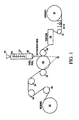
- FIG.1 illustrates a melt-coating process for coating paper or paperboard with PHA in which uncoated paper or board unwinding from reel 10 is dried by infrared heater 12 and passed via roller 14 to a Corona treatment facility 16 for oxidizing and preparing functional groups on the paper that facilitates coating and adhesion of the resulting coat.
- Melt-extruder 24 may have a hopper 26 by which a feedstock, typically of PHA pellets, is introduced into extruder 24 and processed by heated screw 28 which melts the PHA, for example to a temperature in the range of 160-210°C and causes the melted PHA to be extruded via die 30 in the form of a polymer web 32.
- a feedstock typically of PHA pellets
- Polymer web 32 and paper from facility 16 are passed between roller 18, chill roller 20 maintained at a temperature less than that in extruder 24, and roller 34 which together form a cooling and contacting zone 22 under conditions of temperature, pressure and contact time in the zone for producing coated paper of desired characteristics.
- the coated paper is further air cooled by passing over rollers 34 and wound onto take-up reel 36.
- the equipment shown in FIG.1 is but one representation of an extrusion coating operation.
- Other equivalent equipment for paper coating is well known to those of ordinary skill in the art and is also suitable for use in accordance with this invention.
- the method of the present invention produces PHA coatings, for example the PHA coating on paperboard on take up reel 36 of FIG.1 .
- the molecular weight of the PHA in the coatings should be greater than about 125,000, preferably greater than about 150,000. As demonstrated herein, these molecular weights are critical in order to achieve the desired heat sealing properties.
- the seal strength of the coating compositions obtainable by the present invention is greater than 1 N, preferably greater than 3 N, and more preferably greater than 5 N. These values apply for the following conditions used during the hot tack measurements: seal temperature of 130-140°C, seal pressure of 200 KPa, cooling time of 0.3-1.5 sec., seal of board (210 g/m 2 ) against board (210 g/m 2 ). It would be recognized by the skilled individual that altering these conditions could result in absolute values which differ from the minimum and preferred seal strengths disclosed herein, but which are within the scope of the present invention.
- the improved heat seal strength of the present coatings is desirable for applications where good sealing properties are required, such as paper and paperboard applications including cups, tubs, paper waste bags and comparable packaging products. Moreover the improved seal strength allows higher line speeds in the heat sealing operations and can increase yield.
- the third column shows the melt temperature required at a fixed residence time of 300 seconds to obtain a coating with a final molecular weight of 150,000 daltons
- PHA Pellets Mw Residence Time a Temp b 250,000 240 200 350,000 302 203 450,000 358 206 600,000 411 208 750,000 440 210 a Seconds @ 200 deg.C melt temperature b Deg.C @ 300 seconds residence time
- the person skilled in the art can readily determine experimentally the conditions of initial PHA molecular weight, melt temperature, and residence time necessary to obtain coatings having the desired molecular weight of above 125,000 daltons, preferably above 150,000 daltons.
- PHA will require higher melt temperatures or longer residence times, hence lower line speeds, to obtain a desired molecular weight providing sufficient adhesion of the PHA to the paper or paperboard but high enough to provide sufficient heat sealing.
- control of equipment such as extruder 24 will be more difficult due to the excessive shear heating during melting and extrusion.
- the initial molecular weight range of the PHA feedstock materials is preferably in the range of 200,000 to 400,000 although higher initial PHA molecular weight materials can also be used in accordance with the invention by changing the melt temperature and residence time.
- a range of preferred conditions suitable for production of PHA-derived coatings having desirable heat sealing properties are disclosed. Therefore, in a further embodiment of the present invention, there is provided a method of producing a coated object wherein the coating comprises PHA, and wherein the coating exhibits properties suitable for applications where good heat seal strength is desired.
- the molecular weight of the PHA pellets should be between about 200,000 and 400,000, preferably between about 250,000 and 350,000, under the processing conditions disclosed.
- the use of PHA pellets having molecular weights outside of the 200,000-400,000 range typically results in a PHA molecular weight after coating of less than 125,000. As demonstrated herein, such coatings have unacceptable properties such as a poor cohesive strength of the coating itself and of the polymeric seal.
- nucleants are suitable for use in the present coatings. These could include, for example boron nitride ( EP-A-0291024 ), organic phosphonic acid based systems such as the cyclohexylphosphonic acid/zinc-stearate system ( U.S. Patent No. 5, 061,743 ), and other nucleant systems known in the art.
- a preferred nucleant is one having the following structure: where R can be hydroxy, hydrogen, C1-C25 alkyl groups (with or without one or more substituent groups such as -OH, - CO2H, -Cl, -Br, -NH2, -N(alkyl)H or N(alkyl)2), cycloalkyl groups, aryl or arylalkyl groups (such as phenyl, benzyl, etc. with or without substituents on the aromatic rings).
- R can be hydroxy, hydrogen, C1-C25 alkyl groups (with or without one or more substituent groups such as -OH, - CO2H, -Cl, -Br, -NH2, -N(alkyl)H or N(alkyl)2), cycloalkyl groups, aryl or arylalkyl groups (such as phenyl, benzyl, etc. with or without substituents on the aromatic rings).
- Synthesis of such compounds
- the synthesis can also be applied to dibasic acids such as adipic acid, succinic acid, etc. to give the corresponding tetrakis phosphonic acids (i.e., di-ODPAs) which can also be used as nucleants.
- di-ODPAs tetrakis phosphonic acids
- 1,6-dihydroxy-1,6-dihexanediylidene tetraphosphonic acid is obtained (Aus. 599950).
- methylene diphosphonic acid PL 131549
- carbonyl diphosphonic acid CA 93:182031
- ODPAs organodiphosphonic acids
- the ODPAs or di-ODPAs may also be formed in situ, for example by reaction of the corresponding phosphinic acid.
- Preferred ODPAs include 1-hydroxy-lower alkylidene-1,1-diphosphonic acids such as 1-hydroxyethylidene-1,1-diphosphonic acid (HEDP), 1-hydroxypropylidene-1,1-diphosphonic acid, 1-hydroxybutylidene-1,1-phosphonic acid, 1-hydroxycyclohexylidene-1,1-diphosphonic acid.
- HEDP 1-hydroxyethylidene-1,1-diphosphonic acid
- both acid moieties are phosphonic acid moieties
- R1 is a methyl group
- R2 is hydroxy group (i.e., HEDP).
- HEDP is available as a mixture of HEDP in water from Monsanto Company (800 N. Lindbergh, St.
- the ODPA is used in amounts typically in the range of 0.01 - 5.0 phr (parts per hundred resin), preferably about 0.02 - 1.0 phr, most preferably about 0.02 - 0.5 phr.
- the nucleants can further be metallic salts of ODPAs, preferably mono-metallic salts. However, it is generally preferred that not all, e.g., less than 70%, more preferably less than 60% of the phosphonic acid moieties are involved in the salt formation since it has been found that excessive salt formation may adversely influence the effectiveness of certain nucleants of the invention.
- Organic metal salts and/or certain inorganic compounds can be used to further improve nucleation activity and/or reduce the extent of discoloration and/or improve the clarity of PHA-derived products when used in combination with the ODPAs of the invention.
- the organic metal salt is preferably an organic acid salt, more preferably a fatty acid metal salt.
- the inorganic compound is preferably an metal oxide, a metal hydroxide or a metal carbonate. Suitable metals include those selected from Groups I to V of the periodic table, preferably aluminum, antimony, tin, sodium, calcium, magnesium, barium or zinc. Most preferably the metal is one which has benign environmental and toxicological properties such as magnesium, calcium and barium.
- Preferred fatty acids include stearic acid, palmitic acid, acetic acid, propionic acid, caproic acid, oleic acid, behenic acid and montanic acid.
- the fatty acid metal salt of the invention is calcium stearate or magnesium stearate which have proven highly effective in combination with ODPAs in nucleating thermoplastic polyesters.
- the organic metal salt or the inorganic metal oxide, metal hydroxide or metal carbonate is used in an amount typically ranging from 0.001 to 5 phr (parts per hundred of resin), preferably about 0.005 to 2 phr, and most preferably about 0.01 to 0.5 phr.
- a nucleant formulation preferably comprises organic metal salt (or inorganic metal oxide, metal hydroxide or metal carbonate) and ODPA in weight ratios of about 0.01:1 to 10:1, preferably about 0.05:1 to 7.5:1, and more preferably about 0.1:1 to 5:1.
- organic metal salt or inorganic metal oxide, metal hydroxide or metal carbonate
- ODPA in weight ratios of about 0.01:1 to 10:1, preferably about 0.05:1 to 7.5:1, and more preferably about 0.1:1 to 5:1.
- the weak organic base is one which is effective in improving the elongational properties and/or clarity of the polymeric material.
- the weak organic base should be polymer-miscible or -soluble and melt at a sufficiently high temperature so that, if desired, nucleating agent solvent can be readily removed during preparation.
- the weak organic base preferably comprises a mono-, bis-, or tri- fatty acid amide, as these generally exhibit good hydrolytic stability in the presence of ODPAs. More preferably, the weak organic base is a stearamide, for example ethylene bistearamide (EBS), available from Lonza or Henkel under the tradename Acrawax C or Loxamid EBS.
- EBS ethylene bistearamide
- the weak organic base is typically present in the polymeric compositions in an amount between about 0.01 to 9.0 phr, preferably between about 0.05 to 1.0 phr, most preferably about 0.1 to 0.5 phr.
- a most preferred nucleant for use in this invention comprises HEDP/calcium stearate/EBS present in ratios effective for nucleating PHA and producing PHA articles having excellent clarity, color, elongational and tensile properties.
- the constituents of this formulation are present in weight ratios of about 0.8/1.5/1.7 respectively.
- Suitable levels of such a nucleant formulation to be added to the PHA range from about 0.01 to 5.0 parts per hundred of resin (phr).
- the level of the nucleant formulation is about 0.05 - 1.0 phr, and most preferably it is about 0.1 - 0.6 phr.
- the solvent is then removed, for example by evaporation under vacuum, giving rise to solids which are ground, pulverized, or otherwise treated so as to produce particles with diameters less than about 710 microns, preferably less than about 350 microns.
- effective nucleating agent solvent herein means a solvent which dissolves the ODPA and preferably enhances its nucleation activity but which does not intolerably reduce its effectiveness as a nucleant.
- the ODPA prepared using an effective nucleating agent solvent as described herein will have at least as effective nucleation activity, preferably greater nucleation activity, compared to the same ODPA that is not dissolved in an effective nucleating agent solvent during its preparation or use.
- Nucleating agent solvents for use in this invention include but are not limited to C1 to C6 aliphatic mono, di- and tri- ols such as methanol, ethanol, ethylene glycol, 1- or 2-propanol, propylene glycol, glycerol, 2-methyl-2-propanol, 2-butanol and the like, and further including mixtures of such solvents with each other and with water.
- Preferred nucleating agent solvents include methanol, ethanol or another lower alcohols, or mixtures of such alcohols with water to allow for easy solvent removal.
- the nucleating agent solvent needs to be appropriately selected since it has been found that some solvents such as acetone and tetrahydrofuran when used with some ODPAs such as HEDP are not effective nucleating agent solvents.
- mixtures of solvents e.g. methanol and acetone, can serve as effective nucleating agent solvents as defined herein even though one of the solvents in the mixture is not an effective nucleating agent solvent when used alone. While all of the solvents which will be effective nucleating agent solvents has not yet been elucidated, a person skilled in the art can readily determine whether a proposed solvent for an ODPA is "effective" by routine experimentation following the description herein.
- the method by which a coating of the present invention is prepared and applied to an object/article to be coated involves the steps of melting the polymer material, typically in a single screw extruder 24 as illustrated in FIG.1 , extruding the polymer through a T-shaped or a coathanger die 30, and applying the polymer web to the paper sheet surface.
- This polymer-paper laminate is generally supported by a cooling roll which is at a temperature between about 50 and 60° C. Finally the laminate is transferred to a winding installation which is producing rolls of coated board or paper.
- Extrusion temperature can be an important consideration when producing coatings according to the present invention due to its influence on coating seal strength (see FIG. 4 ).
- An excessively high temperature will produce too much polymer degradation resulting in an undesirably low molecular weight of the polymeric coating, and therefore inferior heat sealing properties.
- the rate of degradation of the PHA depends on the temperature of the melt and increases sharply with increasing temperature.
- a low temperature on the other hand, can result in unacceptably high viscosity and poor adhesion of the polymer to the surface.
- the temperature of extrusion can be manipulated in order to effect the molecular weight of the PHA after coating.
- Typical barrel temperatures during extrusion are between about 160 and 210°C. Preferably, they are between about 170 and 190°C.
- the extruder screw speed can also influence coating properties and therefore should be chosen accordingly.
- High screw speed can result in excessive shear heating which results in an increase in the melt temperature.
- a low screw speed can increase the residence time of the product in the extruder which results in enhanced polymer degradation.
- PHA-derived coatings produced by the present invention there are a variety of applications for which the PHA-derived coatings produced by the present invention would be useful. Numerous objects/articles could benefit from such coatings.
- Preferred objects suitable for coating according to the present invention include those in which excellent heat sealing properties would be desirable, including cups, paper, paper waste bags, etc.
- the increased seal strength of the coatings also allows for higher line speeds in the sealing operation, a wider operating window and an increased production yield.
- the temperature of the melt was increased according to the molecular weight of the original pellets. Higher molecular weights may have resulted in increased shear heating, due to the higher viscosity of the polymer melt, leading to an increased rate of polymer degradation.
- Hot tack measurements have also indicated the same order: the hot tack peel strength is comparable for the coatings having molecular weights of 162,000 and 166,000, however the peel strength of the coating having a molecular weight of 128,000 was somewhat lower.
- the peel strength for these three samples was larger than for another sample which had an original MW of 359,540. Coating this material under the same conditions resulted in a coating MW of 118,000. This material did not give acceptable heat sealing. A good heat sealing, however, was obtained using the three samples described in the above table.
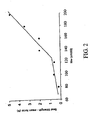
- the hot tack measurements the following experimental conditions were used: 200 kPa seal pressure, 0.3 seconds of cooling time and a bar temperature of 130°C. There was a transition observed in the 125,000 MW range above which the seal strength increased rapidly. This transition occurred very close to the critical molecular weight required for obtaining good heat sealability.
- Hot tack measurements were carried out on several samples showing good and poor heat sealability.
- the heat sealing properties were checked by pouring hot coffee in the cups and checking the occurrence of dark coffee spots on the outside of the cups after 10 minutes. The absence of such spots indicates good heat sealing of the coating.
- hot tack measurements were also carried out on a poly-ethylene coated cup, showing good heat sealing properties. The following observations were made: heat sealing properties seal strength (N) poor 0.7 good 6.0 good 7.7 poor 0.1 good 3.6 poor 0.1 poor 0.12 good 7.9 good - polyethylene 7.6
- Hot tack measurements were obtained on PHA-coated board.
- the seal bar temperature was 138°C.
- the seal strength is presented as a function of cooling time for a sample that had shown good heat sealing properties and for a sample that had shown poor heat sealing properties.
- the hot tack measurements were obtained as described in Example 4. The following observations were made: Sample with: MW after coating Sealing Strength (N) 1.0 sec. cooling 1.5 sec. cooling Good heat sealing 174,000 4.7 6.6 Poor heat sealing 118,000 0.5 0.8
Landscapes
- Engineering & Computer Science (AREA)
- Mechanical Engineering (AREA)
- Chemical & Material Sciences (AREA)
- Chemical Kinetics & Catalysis (AREA)
- Life Sciences & Earth Sciences (AREA)
- Materials Engineering (AREA)
- Wood Science & Technology (AREA)
- Organic Chemistry (AREA)
- Paper (AREA)
- Polyesters Or Polycarbonates (AREA)
- Biological Depolymerization Polymers (AREA)
- Paints Or Removers (AREA)
Claims (15)
- Procédé de production d'un objet revêtu comprenant les étapes consistant à fournir un PHA ayant une masse moléculaire initiale, à faire fondre le PHA et à revêtir par extrusion le PHA à l'état fondu sur un objet à revêtir, dans lequel les conditions de masse moléculaire initiale du PHA, de temps de séjour et de température pendant la fusion sont efficaces pour produire un revêtement ayant une masse moléculaire supérieure à 125 000 daltons.
- Procédé selon la revendication 1, dans lequel la masse moléculaire du revêtement est supérieure à 150 000 daltons.
- Procédé selon la revendication 1, dans lequel la masse moléculaire initiale du PHA est essentiellement dans la plage de 200 000 à 400 000 daltons.
- Procédé selon la revendication 1, dans lequel la masse moléculaire initiale du PHA est essentiellement dans la plage de 250 000 à 350 000 daltons.
- Procédé selon la revendication 1, dans lequel le revêtement a une force d'adhérence supérieure à 1 N.
- Procédé selon la revendication 1, dans lequel le revêtement a une force d'adhérence supérieure à 3 N.
- Procédé selon la revendication 1, dans lequel le revêtement a une force d'adhérence supérieure à 5 N.
- Procédé selon la revendication 1, dans lequel le PHA comprend, en outre, un agent de nucléation.
- Procédé selon la revendication 8, dans lequel l'agent de nucléation comprend un composé organophosphoré contenant au moins deux fragments acide phosphonique.
- Procédé selon la revendication 9, dans lequel le composé organophosphoré est l'acide 1-hydroxy-éthylidène-1,1-diphosphonique.
- Procédé selon la revendication 9, dans lequel l'agent de nucléation comprend, en outre, un sel d'acide gras d'un métal du Groupe I à V de la Classification périodique.
- Procédé selon la revendication 9, dans lequel l'agent de nucléation comprend, en outre, une base organique faible choisie parmi les amides d'acides gras.
- Procédé selon la revendication 1, dans lequel le PHA répond à la formulé :
où a = 1-6, b = 0-15, Y est H, et n est un nombre entier. - Procédé selon la revendication 13, dans lequel a est 1, b est 1 ou 2, Y est H, et n est un nombre entier.
- Procédé selon la revendication 1, dans lequel l'objet revêtu est du papier ou du carton.
Applications Claiming Priority (3)
| Application Number | Priority Date | Filing Date | Title |
|---|---|---|---|
| US5372497P | 1997-07-25 | 1997-07-25 | |
| US53724P | 1997-07-25 | ||
| PCT/US1998/015149 WO1999004948A1 (fr) | 1997-07-25 | 1998-07-24 | Revetements polyhydroxyalcanoate |
Publications (3)
| Publication Number | Publication Date |
|---|---|
| EP0998381A1 EP0998381A1 (fr) | 2000-05-10 |
| EP0998381B1 EP0998381B1 (fr) | 2003-11-19 |
| EP0998381B2 true EP0998381B2 (fr) | 2010-05-05 |
Family
ID=21986134
Family Applications (1)
| Application Number | Title | Priority Date | Filing Date |
|---|---|---|---|
| EP98935915A Expired - Lifetime EP0998381B2 (fr) | 1997-07-25 | 1998-07-24 | prodece pour la fabrication de revetements polyhydroxyalcanoate |
Country Status (6)
| Country | Link |
|---|---|
| US (1) | US6025028A (fr) |
| EP (1) | EP0998381B2 (fr) |
| AT (1) | ATE254531T1 (fr) |
| AU (1) | AU8506898A (fr) |
| DE (1) | DE69819902T3 (fr) |
| WO (1) | WO1999004948A1 (fr) |
Families Citing this family (24)
| Publication number | Priority date | Publication date | Assignee | Title |
|---|---|---|---|---|
| FI105018B (fi) * | 1998-07-20 | 2000-05-31 | Upm Kymmene Corp | Elintarvikepakkauksen kansirakenne |
| US6903053B2 (en) | 2000-06-09 | 2005-06-07 | The Procter & Gamble Company | Agricultural items and agricultural methods comprising biodegradable copolymers |
| ES2271033T3 (es) | 2000-06-09 | 2007-04-16 | THE PROCTER & GAMBLE COMPANY | Guante que comprende un polihidroxialcanoato. |
| US20030217648A1 (en) * | 2000-12-20 | 2003-11-27 | Isao Noda | Biodergradable plastic food service items |
| US7153622B2 (en) * | 2001-04-27 | 2006-12-26 | Canon Kabushiki Kaisha | Electrostatic charge image developing toner, producing method therefor, image forming method and image forming apparatus utilizing the toner, construct and method for making the construct |
| JP3496002B2 (ja) * | 2001-04-27 | 2004-02-09 | キヤノン株式会社 | 新規なポリヒドロキシアルカノエートを含有するバインダー樹脂、該バインダー樹脂を含むトナー;該トナーを用いた画像形成方法および画像形成装置 |
| JP3684175B2 (ja) * | 2001-04-27 | 2005-08-17 | キヤノン株式会社 | 構造体及びその製造方法 |
| TWI290454B (en) * | 2005-07-29 | 2007-11-21 | Via Tech Inc | Electronic device |
| US8637126B2 (en) * | 2006-02-06 | 2014-01-28 | International Paper Co. | Biodegradable paper-based laminate with oxygen and moisture barrier properties and method for making biodegradable paper-based laminate |
| ES2450993T3 (es) * | 2008-07-01 | 2014-03-26 | Amcor Flexibles Transpac N.V. | Envase compuesto |
| US20120041109A1 (en) | 2009-04-06 | 2012-02-16 | Krishnaswamy Rajendra K | Method Of Improving Film Processing And Injection Molding Of Polyhydroxyalkanoate Polymers |
| GB201102035D0 (en) * | 2011-02-04 | 2011-03-23 | Zephyros Inc | Improvements in or relating to extrusion |
| US20120219790A1 (en) * | 2011-02-25 | 2012-08-30 | Frito-Lay North America, Inc. | Compostable film with paper-like, writable surface |
| US9040120B2 (en) | 2011-08-05 | 2015-05-26 | Frito-Lay North America, Inc. | Inorganic nanocoating primed organic film |
| CN102585687B (zh) * | 2012-01-09 | 2014-11-05 | 江苏格桑花涂料有限公司 | 一种聚羟基脂肪酸酯耐高温防腐涂料 |
| US9267011B2 (en) | 2012-03-20 | 2016-02-23 | Frito-Lay North America, Inc. | Composition and method for making a cavitated bio-based film |
| US9162421B2 (en) | 2012-04-25 | 2015-10-20 | Frito-Lay North America, Inc. | Film with compostable heat seal layer |
| US9284104B2 (en) | 2012-06-23 | 2016-03-15 | Frito-Lay North America, Inc. | Deposition of ultra-thin inorganic oxide coatings on packaging |
| US9090021B2 (en) | 2012-08-02 | 2015-07-28 | Frito-Lay North America, Inc. | Ultrasonic sealing of packages |
| US9149980B2 (en) | 2012-08-02 | 2015-10-06 | Frito-Lay North America, Inc. | Ultrasonic sealing of packages |
| CN104672824A (zh) * | 2015-02-09 | 2015-06-03 | 邢鹏 | 一种pbat淋膜的复合材料的制备方法及设备 |
| EP3426490A4 (fr) * | 2016-03-11 | 2019-07-31 | SNP, Inc. | Procédé de séchage à haute énergie pour former un film polyhydroxyalcanoaté continu |
| KR20260056153A (ko) * | 2023-08-25 | 2026-04-24 | 데니머 아이피씨오 엘엘씨 | 생분해성 압출 코팅 공정 |
| CN120209528A (zh) * | 2023-12-27 | 2025-06-27 | 北京微构工场生物技术有限公司 | 一种聚羟基脂肪酸酯专用淋膜料和复合材料 |
Citations (3)
| Publication number | Priority date | Publication date | Assignee | Title |
|---|---|---|---|---|
| WO1994009210A1 (fr) † | 1992-10-16 | 1994-04-28 | Pearlstein, Leonard | Emballage transformable en compost pour recipient de liquides |
| KR960010140B1 (ko) † | 1994-05-30 | 1996-07-26 | 고려합섬 주식회사 | 생분해성 수지를 이용한 코팅 또는 라미네이션된 포장재료의 제조방법 |
| EP0736563A1 (fr) † | 1995-04-07 | 1996-10-09 | SAFTA S.p.A. | Procédé de préparation de films complètement biodegradable avec des caractéristiques mécaniques améliorés, produits obtenus et leurs applications |
Family Cites Families (20)
| Publication number | Priority date | Publication date | Assignee | Title |
|---|---|---|---|---|
| AU603076B2 (en) * | 1985-12-09 | 1990-11-08 | W.R. Grace & Co.-Conn. | Polymeric products and their manufacture |
| US5502158A (en) * | 1988-08-08 | 1996-03-26 | Ecopol, Llc | Degradable polymer composition |
| GB8912388D0 (en) * | 1989-05-30 | 1989-07-12 | Ici Plc | 3-hydroxybutyrate polymer composition |
| US5076983A (en) * | 1990-07-16 | 1991-12-31 | E. I. Du Pont De Nemours And Company | Polyhydroxy acid films |
| CA2090977A1 (fr) * | 1990-09-11 | 1992-03-12 | George J. Ostapchenko | Pellicules a base de polymeres d'acides hydroxyles |
| ATA258390A (de) * | 1990-12-19 | 1997-08-15 | Danubia Petrochem Polymere | Mischung aus vorwiegend einem polyhydroxyalkanoat und einer verbindung, die mindestens zwei reaktive gruppen wie säure- und/oder alkoholgruppen enthält und ein durch schmelzen der mischung hergestelltes polymerisat |
| US5382652A (en) * | 1991-04-01 | 1995-01-17 | Toyo Boseki Kabushiki Kaisha | Polyester resin, compositions thereof and sealant made therefrom |
| US5409772A (en) | 1991-09-27 | 1995-04-25 | Toppan Printing Co., Ltd. | Composite laminate |
| GB9300554D0 (en) * | 1993-01-13 | 1993-03-03 | Zeneca Ltd | Film formation |
| JPH06270368A (ja) | 1993-03-17 | 1994-09-27 | Toppan Printing Co Ltd | 積層体及びその製造方法 |
| GB9325952D0 (en) * | 1993-12-20 | 1994-02-23 | Zeneca Ltd | Process for preparing films and coatings |
| JP3353432B2 (ja) | 1993-12-27 | 2002-12-03 | 凸版印刷株式会社 | 生分解性を有するフィルムおよび積層体 |
| US6146750A (en) | 1994-01-24 | 2000-11-14 | Sumitomo Chemical Co., Ltd. | Bio-degradable resin composition, film and shaped article |
| ZA95627B (en) * | 1994-01-28 | 1995-10-05 | Procter & Gamble | Biodegradable copolymers and plastic articles comprising biodegradable copolymers |
| US5574129A (en) * | 1994-05-10 | 1996-11-12 | The Japan Steel Works, Ltd. | Process for producing lactic acid polymers and a process for the direct production of shaped articles from lactic acid polymers |
| DE4437792A1 (de) * | 1994-10-21 | 1996-04-25 | Inventa Ag | Formmassen auf der Basis von aliphatischen Polyestern |
| JPH09132701A (ja) * | 1995-11-07 | 1997-05-20 | Gunze Ltd | 微生物分解性フィルム |
| AU1354397A (en) * | 1995-12-19 | 1997-07-14 | Kevin H Schilling | Method for determining degradation rates of degradable materials |
| GB9526165D0 (en) | 1995-12-21 | 1996-02-21 | Zeneca Ltd | Oriented polyester |
| JP3369421B2 (ja) | 1996-12-18 | 2003-01-20 | 理化学研究所 | ポリ(3−ヒドロキシブタン酸)からなるフィルム |
-
1998
- 1998-07-24 EP EP98935915A patent/EP0998381B2/fr not_active Expired - Lifetime
- 1998-07-24 DE DE69819902T patent/DE69819902T3/de not_active Expired - Lifetime
- 1998-07-24 AT AT98935915T patent/ATE254531T1/de not_active IP Right Cessation
- 1998-07-24 AU AU85068/98A patent/AU8506898A/en not_active Abandoned
- 1998-07-24 US US09/122,428 patent/US6025028A/en not_active Expired - Lifetime
- 1998-07-24 WO PCT/US1998/015149 patent/WO1999004948A1/fr not_active Ceased
Patent Citations (3)
| Publication number | Priority date | Publication date | Assignee | Title |
|---|---|---|---|---|
| WO1994009210A1 (fr) † | 1992-10-16 | 1994-04-28 | Pearlstein, Leonard | Emballage transformable en compost pour recipient de liquides |
| KR960010140B1 (ko) † | 1994-05-30 | 1996-07-26 | 고려합섬 주식회사 | 생분해성 수지를 이용한 코팅 또는 라미네이션된 포장재료의 제조방법 |
| EP0736563A1 (fr) † | 1995-04-07 | 1996-10-09 | SAFTA S.p.A. | Procédé de préparation de films complètement biodegradable avec des caractéristiques mécaniques améliorés, produits obtenus et leurs applications |
Non-Patent Citations (2)
| Title |
|---|
| HENK VERHOOGT ET AL: "Journal of Applied Polymer", vol. 61, 1996, JOHN WILEY & SONS, article "The Influence of Thermal History", pages: 87 - 96 † |
| YASIN M. ET AL: "Biomaterials al devices", vol. 11, 1990, BUTTERWORTH-HEINEMANN, article "Polymers for biodegradable medical devices", pages: 451 - 454 † |
Also Published As
| Publication number | Publication date |
|---|---|
| ATE254531T1 (de) | 2003-12-15 |
| US6025028A (en) | 2000-02-15 |
| EP0998381A1 (fr) | 2000-05-10 |
| WO1999004948A1 (fr) | 1999-02-04 |
| DE69819902T2 (de) | 2004-09-02 |
| EP0998381B1 (fr) | 2003-11-19 |
| DE69819902D1 (de) | 2003-12-24 |
| AU8506898A (en) | 1999-02-16 |
| DE69819902T3 (de) | 2010-11-04 |
Similar Documents
| Publication | Publication Date | Title |
|---|---|---|
| EP0998381B1 (fr) | Revetements polyhydroxyalcanoate | |
| US6201083B1 (en) | Modified polyhydroxyalkanoates for production of coatings and films | |
| EP1593705B1 (fr) | Utilisation des acides phosphoniques ou phosphiniques organiques, ou des oxides, hydroxides ou des sels des acides carboxyliques comme stabilisateurs de chaleur pour des polyhydroxyalcanoates | |
| EP0996670B1 (fr) | Compositions de pha et leur procede d'utilisation dans la production de films de pha | |
| EP1070097B1 (fr) | Composition et produit de polymere contenant des residus d'acide lactique, et procede de preparation et d'utilisation de ceux-ci | |
| AU733819B2 (en) | Polylactide coated paper | |
| US6111006A (en) | Process for preparing films and coatings | |
| CA2179522C (fr) | Procede de preparation de films et de revetements | |
| JP5736685B2 (ja) | 生分解性樹脂積層体およびその製造方法 | |
| AU761975B2 (en) | Polylactide coated paper | |
| JP4694544B6 (ja) | フィルム及び被膜の製造方法 | |
| HK1036466B (en) | Lactic acid residue containing polymer composition, product method for preparation and use |
Legal Events
| Date | Code | Title | Description |
|---|---|---|---|
| PUAI | Public reference made under article 153(3) epc to a published international application that has entered the european phase |
Free format text: ORIGINAL CODE: 0009012 |
|
| 17P | Request for examination filed |
Effective date: 20000202 |
|
| AK | Designated contracting states |
Kind code of ref document: A1 Designated state(s): AT BE CH CY DE DK ES FI FR GB GR IE IT LI LU MC NL PT SE |
|
| TPAD | Observations filed by third parties |
Free format text: ORIGINAL CODE: EPIDOS TIPA |
|
| RAP1 | Party data changed (applicant data changed or rights of an application transferred) |
Owner name: METABOLIX, INC. |
|
| 17Q | First examination report despatched |
Effective date: 20020719 |
|
| GRAH | Despatch of communication of intention to grant a patent |
Free format text: ORIGINAL CODE: EPIDOS IGRA |
|
| GRAS | Grant fee paid |
Free format text: ORIGINAL CODE: EPIDOSNIGR3 |
|
| GRAA | (expected) grant |
Free format text: ORIGINAL CODE: 0009210 |
|
| AK | Designated contracting states |
Kind code of ref document: B1 Designated state(s): AT BE CH CY DE DK ES FI FR GB GR IE IT LI LU MC NL PT SE |
|
| PG25 | Lapsed in a contracting state [announced via postgrant information from national office to epo] |
Ref country code: NL Free format text: LAPSE BECAUSE OF FAILURE TO SUBMIT A TRANSLATION OF THE DESCRIPTION OR TO PAY THE FEE WITHIN THE PRESCRIBED TIME-LIMIT Effective date: 20031119 Ref country code: LI Free format text: LAPSE BECAUSE OF FAILURE TO SUBMIT A TRANSLATION OF THE DESCRIPTION OR TO PAY THE FEE WITHIN THE PRESCRIBED TIME-LIMIT Effective date: 20031119 Ref country code: CY Free format text: LAPSE BECAUSE OF FAILURE TO SUBMIT A TRANSLATION OF THE DESCRIPTION OR TO PAY THE FEE WITHIN THE PRESCRIBED TIME-LIMIT Effective date: 20031119 Ref country code: CH Free format text: LAPSE BECAUSE OF FAILURE TO SUBMIT A TRANSLATION OF THE DESCRIPTION OR TO PAY THE FEE WITHIN THE PRESCRIBED TIME-LIMIT Effective date: 20031119 Ref country code: AT Free format text: LAPSE BECAUSE OF FAILURE TO SUBMIT A TRANSLATION OF THE DESCRIPTION OR TO PAY THE FEE WITHIN THE PRESCRIBED TIME-LIMIT Effective date: 20031119 |
|
| REG | Reference to a national code |
Ref country code: GB Ref legal event code: FG4D |
|
| REG | Reference to a national code |
Ref country code: CH Ref legal event code: EP |
|
| REF | Corresponds to: |
Ref document number: 69819902 Country of ref document: DE Date of ref document: 20031224 Kind code of ref document: P |
|
| REG | Reference to a national code |
Ref country code: IE Ref legal event code: FG4D |
|
| PG25 | Lapsed in a contracting state [announced via postgrant information from national office to epo] |
Ref country code: SE Free format text: LAPSE BECAUSE OF FAILURE TO SUBMIT A TRANSLATION OF THE DESCRIPTION OR TO PAY THE FEE WITHIN THE PRESCRIBED TIME-LIMIT Effective date: 20040219 Ref country code: GR Free format text: LAPSE BECAUSE OF FAILURE TO SUBMIT A TRANSLATION OF THE DESCRIPTION OR TO PAY THE FEE WITHIN THE PRESCRIBED TIME-LIMIT Effective date: 20040219 Ref country code: DK Free format text: LAPSE BECAUSE OF FAILURE TO SUBMIT A TRANSLATION OF THE DESCRIPTION OR TO PAY THE FEE WITHIN THE PRESCRIBED TIME-LIMIT Effective date: 20040219 |
|
| PG25 | Lapsed in a contracting state [announced via postgrant information from national office to epo] |
Ref country code: ES Free format text: LAPSE BECAUSE OF FAILURE TO SUBMIT A TRANSLATION OF THE DESCRIPTION OR TO PAY THE FEE WITHIN THE PRESCRIBED TIME-LIMIT Effective date: 20040302 |
|
| NLV1 | Nl: lapsed or annulled due to failure to fulfill the requirements of art. 29p and 29m of the patents act | ||
| REG | Reference to a national code |
Ref country code: CH Ref legal event code: PL |
|
| PG25 | Lapsed in a contracting state [announced via postgrant information from national office to epo] |
Ref country code: LU Free format text: LAPSE BECAUSE OF NON-PAYMENT OF DUE FEES Effective date: 20040724 |
|
| PG25 | Lapsed in a contracting state [announced via postgrant information from national office to epo] |
Ref country code: IE Free format text: LAPSE BECAUSE OF NON-PAYMENT OF DUE FEES Effective date: 20040726 |
|
| PG25 | Lapsed in a contracting state [announced via postgrant information from national office to epo] |
Ref country code: MC Free format text: LAPSE BECAUSE OF NON-PAYMENT OF DUE FEES Effective date: 20040731 Ref country code: BE Free format text: LAPSE BECAUSE OF NON-PAYMENT OF DUE FEES Effective date: 20040731 |
|
| ET | Fr: translation filed | ||
| PLBQ | Unpublished change to opponent data |
Free format text: ORIGINAL CODE: EPIDOS OPPO |
|
| PLBI | Opposition filed |
Free format text: ORIGINAL CODE: 0009260 |
|
| 26 | Opposition filed |
Opponent name: THE PROCTER & GAMBLE COMPANY Effective date: 20040816 |
|
| PLAB | Opposition data, opponent's data or that of the opponent's representative modified |
Free format text: ORIGINAL CODE: 0009299OPPO |
|
| PLAX | Notice of opposition and request to file observation + time limit sent |
Free format text: ORIGINAL CODE: EPIDOSNOBS2 |
|
| R26 | Opposition filed (corrected) |
Opponent name: THE PROCTER & GAMBLE COMPANY Effective date: 20040818 |
|
| BERE | Be: lapsed |
Owner name: *METABOLIX INC. Effective date: 20040731 |
|
| PLAX | Notice of opposition and request to file observation + time limit sent |
Free format text: ORIGINAL CODE: EPIDOSNOBS2 |
|
| REG | Reference to a national code |
Ref country code: IE Ref legal event code: MM4A |
|
| PLAQ | Examination of admissibility of opposition: information related to despatch of communication + time limit deleted |
Free format text: ORIGINAL CODE: EPIDOSDOPE2 |
|
| PLAR | Examination of admissibility of opposition: information related to receipt of reply deleted |
Free format text: ORIGINAL CODE: EPIDOSDOPE4 |
|
| PLBQ | Unpublished change to opponent data |
Free format text: ORIGINAL CODE: EPIDOS OPPO |
|
| PLAB | Opposition data, opponent's data or that of the opponent's representative modified |
Free format text: ORIGINAL CODE: 0009299OPPO |
|
| PLAX | Notice of opposition and request to file observation + time limit sent |
Free format text: ORIGINAL CODE: EPIDOSNOBS2 |
|
| PLAF | Information modified related to communication of a notice of opposition and request to file observations + time limit |
Free format text: ORIGINAL CODE: EPIDOSCOBS2 |
|
| R26 | Opposition filed (corrected) |
Opponent name: THE PROCTER & GAMBLE COMPANY Effective date: 20040818 |
|
| PLBB | Reply of patent proprietor to notice(s) of opposition received |
Free format text: ORIGINAL CODE: EPIDOSNOBS3 |
|
| BERE | Be: lapsed |
Owner name: *METABOLIX INC. Effective date: 20040731 |
|
| PG25 | Lapsed in a contracting state [announced via postgrant information from national office to epo] |
Ref country code: PT Free format text: LAPSE BECAUSE OF NON-PAYMENT OF DUE FEES Effective date: 20040419 |
|
| APBM | Appeal reference recorded |
Free format text: ORIGINAL CODE: EPIDOSNREFNO |
|
| APBP | Date of receipt of notice of appeal recorded |
Free format text: ORIGINAL CODE: EPIDOSNNOA2O |
|
| APAH | Appeal reference modified |
Free format text: ORIGINAL CODE: EPIDOSCREFNO |
|
| APBU | Appeal procedure closed |
Free format text: ORIGINAL CODE: EPIDOSNNOA9O |
|
| RTI2 | Title (correction) |
Free format text: METHOD OF PRODUCING POLYHYDROXYALKANOATE COATINGS |
|
| PUAH | Patent maintained in amended form |
Free format text: ORIGINAL CODE: 0009272 |
|
| STAA | Information on the status of an ep patent application or granted ep patent |
Free format text: STATUS: PATENT MAINTAINED AS AMENDED |
|
| 27A | Patent maintained in amended form |
Effective date: 20100505 |
|
| AK | Designated contracting states |
Kind code of ref document: B2 Designated state(s): AT BE CH CY DE DK ES FI FR GB GR IE IT LI LU MC NL PT SE |
|
| REG | Reference to a national code |
Ref country code: ES Ref legal event code: FD2A Effective date: 20040726 |
|
| REG | Reference to a national code |
Ref country code: FR Ref legal event code: PLFP Year of fee payment: 19 |
|
| REG | Reference to a national code |
Ref country code: DE Ref legal event code: R082 Ref document number: 69819902 Country of ref document: DE Representative=s name: FLACH BAUER STAHL PATENTANWAELTE PARTNERSCHAFT, DE Ref country code: DE Ref legal event code: R082 Ref document number: 69819902 Country of ref document: DE Representative=s name: ANDRAE WESTENDORP PATENTANWAELTE PARTNERSCHAFT, DE Ref country code: DE Ref legal event code: R081 Ref document number: 69819902 Country of ref document: DE Owner name: CJ CHEILJEDANG CORPORATION, KR Free format text: FORMER OWNER: METABOLIX, INC., CAMBRIDGE, MASS., US Ref country code: DE Ref legal event code: R081 Ref document number: 69819902 Country of ref document: DE Owner name: CJ RESEARCH CENTER LLC, WOBURN, US Free format text: FORMER OWNER: METABOLIX, INC., CAMBRIDGE, MASS., US |
|
| REG | Reference to a national code |
Ref country code: GB Ref legal event code: 732E Free format text: REGISTERED BETWEEN 20170413 AND 20170419 |
|
| REG | Reference to a national code |
Ref country code: FR Ref legal event code: PLFP Year of fee payment: 20 |
|
| REG | Reference to a national code |
Ref country code: FR Ref legal event code: TP Owner name: CJ RESEARCH CENTER LLC, US Effective date: 20170809 |
|
| PGFP | Annual fee paid to national office [announced via postgrant information from national office to epo] |
Ref country code: IT Payment date: 20170725 Year of fee payment: 20 Ref country code: GB Payment date: 20170727 Year of fee payment: 20 Ref country code: FR Payment date: 20170726 Year of fee payment: 20 Ref country code: FI Payment date: 20170727 Year of fee payment: 20 Ref country code: DE Payment date: 20170727 Year of fee payment: 20 |
|
| REG | Reference to a national code |
Ref country code: DE Ref legal event code: R082 Ref document number: 69819902 Country of ref document: DE Representative=s name: FLACH BAUER STAHL PATENTANWAELTE PARTNERSCHAFT, DE Ref country code: DE Ref legal event code: R082 Ref document number: 69819902 Country of ref document: DE Representative=s name: ANDRAE WESTENDORP PATENTANWAELTE PARTNERSCHAFT, DE Ref country code: DE Ref legal event code: R081 Ref document number: 69819902 Country of ref document: DE Owner name: CJ CHEILJEDANG CORPORATION, KR Free format text: FORMER OWNER: CJ RESEARCH CENTER LLC, WOBURN, MASS., US |
|
| REG | Reference to a national code |
Ref country code: GB Ref legal event code: 732E Free format text: REGISTERED BETWEEN 20180125 AND 20180131 |
|
| REG | Reference to a national code |
Ref country code: FR Ref legal event code: TP Owner name: CJ CHEILJEDANG CORPORATION, KR Effective date: 20180326 |
|
| REG | Reference to a national code |
Ref country code: DE Ref legal event code: R082 Ref document number: 69819902 Country of ref document: DE Representative=s name: FLACH BAUER STAHL PATENTANWAELTE PARTNERSCHAFT, DE |
|
| REG | Reference to a national code |
Ref country code: DE Ref legal event code: R071 Ref document number: 69819902 Country of ref document: DE |
|
| REG | Reference to a national code |
Ref country code: GB Ref legal event code: PE20 Expiry date: 20180723 |
|
| PG25 | Lapsed in a contracting state [announced via postgrant information from national office to epo] |
Ref country code: GB Free format text: LAPSE BECAUSE OF EXPIRATION OF PROTECTION Effective date: 20180723 |