EP0999415A2 - Panneaux de chauffage pour chauffage par le sol - Google Patents
Panneaux de chauffage pour chauffage par le sol Download PDFInfo
- Publication number
- EP0999415A2 EP0999415A2 EP99308771A EP99308771A EP0999415A2 EP 0999415 A2 EP0999415 A2 EP 0999415A2 EP 99308771 A EP99308771 A EP 99308771A EP 99308771 A EP99308771 A EP 99308771A EP 0999415 A2 EP0999415 A2 EP 0999415A2
- Authority
- EP
- European Patent Office
- Prior art keywords
- channels
- panel
- channel
- sections
- panels
- Prior art date
- Legal status (The legal status is an assumption and is not a legal conclusion. Google has not performed a legal analysis and makes no representation as to the accuracy of the status listed.)
- Withdrawn
Links
Images






Classifications
-
- F—MECHANICAL ENGINEERING; LIGHTING; HEATING; WEAPONS; BLASTING
- F24—HEATING; RANGES; VENTILATING
- F24D—DOMESTIC- OR SPACE-HEATING SYSTEMS, e.g. CENTRAL HEATING SYSTEMS; DOMESTIC HOT-WATER SUPPLY SYSTEMS; ELEMENTS OR COMPONENTS THEREFOR
- F24D3/00—Hot-water central heating systems
- F24D3/12—Tube and panel arrangements for ceiling, wall, or underfloor heating
- F24D3/14—Tube and panel arrangements for ceiling, wall, or underfloor heating incorporated in a ceiling, wall or floor
- F24D3/141—Tube mountings specially adapted therefor
- F24D3/142—Tube mountings specially adapted therefor integrated in prefab construction elements
-
- Y—GENERAL TAGGING OF NEW TECHNOLOGICAL DEVELOPMENTS; GENERAL TAGGING OF CROSS-SECTIONAL TECHNOLOGIES SPANNING OVER SEVERAL SECTIONS OF THE IPC; TECHNICAL SUBJECTS COVERED BY FORMER USPC CROSS-REFERENCE ART COLLECTIONS [XRACs] AND DIGESTS
- Y02—TECHNOLOGIES OR APPLICATIONS FOR MITIGATION OR ADAPTATION AGAINST CLIMATE CHANGE
- Y02B—CLIMATE CHANGE MITIGATION TECHNOLOGIES RELATED TO BUILDINGS, e.g. HOUSING, HOUSE APPLIANCES OR RELATED END-USER APPLICATIONS
- Y02B30/00—Energy efficient heating, ventilation or air conditioning [HVAC]
Definitions
- This invention relates to underfloor heating panels and to methods of installing underfloor heating systems using such panels.
- the panel of the present invention has been developed to make it easier to install underfloor heating in floors which are constructed either as a screeded floor over insulation or as a timber floor deck which is fully supported on rigid insulation (normally referred to as a fully-floating floor).
- FIGs 1 and 1a show how rigid insulation panels (a) are covered with steel reinforcing mesh (b) and how the heating pipe (c) is tied to the top of the mesh. Screed (d) is then laid over the whole.
- Figures 2 and 2a show how rigid insulation panels (a) have heating pipe (c) fixed in place using staples (e) which catch into a fabric surface which is bonded to the top surface of the insulation. Screed (d) is then again laid over the whole assemblage.
- Figures 3 and 3a show how rigid insulation panels (a) have fixing rails (f) attached and how the heating pipe (c) is held in place by them. Screed (d) is then laid over the whole assemblage.
- FIGs 4, 4a and 4b show rigid insulation (a) with heat diffuser plates (g) and heating pipe (c) beneath a timber floor deck (h).
- the diffuser plates (g) are typically formed from hard-temper aluminium sheets 0.4 to 0.7 mm. thick and they have channels to accept the heating pipe. The width of the channels corresponds to the outside diameter of the heating pipe (c).
- FIGs 4, 4a and 4b show a configuration having two channels per plate, but it is also common to have a single channel per plate when a plate must be used with larger diameter pipe.
- the diffuser plates (g) are set on top of the grooved insulation (a) in such a way that each preformed diffuser plate (g) engages with the channels formed in the top of the insulation (a).
- the heating pipe (c) is pressed into the channels in the diffuser plate (g) which then acts as a fin to the pipe (c), conducting the heat away from the pipe (c) and spreading it evenly across the underside of the floor deck.
- the floor deck is typically chipboard, plywood, cement-bonded particle board or timber planks.
- an underfloor heating panel which is formed with a channel in which a heating pipe is received, the channel including at least one first section in which the heating pipe is a close fit and at least one second section which is wider than the or each first section, thermally conductive material being introduced into said at least one second section in use of the panel to provide an underfloor heating system.
- the panel is preferably formed with a plurality of parallel channels each of which includes a plurality of first sections and a plurality of second sections.
- a method of installing an underfloor heating system which includes providing at least one underfloor heating panel as defined above, inserting a heating pipe in the channel so that it is held in the channel as a result of its close fit in said at least one first section of the channel, and introducing a thermally conductive material into the at least one second section of the channel.
- heating pipe includes a pipe through which hot water can be passed and a cable which contains an electrical heating element.
- Each panel is preferably formed of a foamed or expanded synthetic plastics material, such as foamed polystyrene, and the channel second sections may be formed using, for example, either a router or a heated wire.
- the installation of an underfloor heating system preferably includes the use of a plurality of panels as defined above in conjunction with other flooring panels which have pipe channels of constant width, the same as the pipe outside diameter, so that the heating pipe is a close fit in the channels of said other panels.
- the thermally conductive material introduced into the second sections of the channels is preferably the screed material.
- the thermally conductive material introduced into the second sections of the channels is preferably a sand/cement mix, the amount of which is such that its upper surface is flush with the upper surface of the associated panel.
- the panel 10 shown in Figure 5 is a panel of rigid insulation, particularly foamed polystyrene, which has a plurality of channels 11 formed in its top surface.
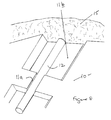
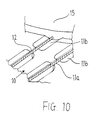
- Each channel 11 includes a number of first sections 11a of a width which is slightly less than the outside diameter of a heating pipe 12 and a plurality of second sections 11b of a width which is considerably greater than the diameter of the pipe 12.
- Each second section 11b has inclined side walls, as shown in Figure 6.
- the panel 10 can be either 40 or 50 mm. in thickness, 2400 mm. in length and 1200 mm. in width.
- the channels 11 can be arranged at 150 mm., 200 mm., 250 mm. or 300 mm. centres. If the channels 11 are arranged at 200 mm. centres, the second sections 11b will typically have a maximum width within the range of from 75 to 100 mm. whereas, if the channels 11 are arranged at 300 mm. centres, the second sections 11b will typically have a maximum width of 100 to 200 mm. If the heating pipe 12 has an outside diameter of 19 mm., the first channel sections 11a will have a width of 18 mm.
- the heating pipe 12 has an outside diameter of 17 mm.
- the first channel sections will have a width of 16 mm.
- Foamed polystyrene has a degree of resilience such that, when the heating pipe 12 is fitted in the channels 11, the heating pipe 12 is held in position by engagement with the channel first sections 11a, without any requirement for a mesh or other fixing devices.
- the panel 10 is used in conjunction with panels 20 constructed as shown in Figure 7.
- the panel 20 is formed of foamed polystyrene and is of the same thickness as the panel 10. It is cut into three portions of equal size, and then trimmed as appropriate, so as to provide connectors for joining together the channels in a plurality of panels 10 in, for example, the manner illustrated in Figure 9.
- Each of the connectors includes a number of curvate channels or balloon ends 21, each of substantially the same width as the first channel sections 11a of the panels 10. The radius of the balloon ends can be adjusted to suit the minimum bending radius of the heating pipe 12.
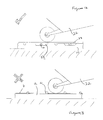
- the screed mix can then be applied using wheelbarrows 22 which are wheeled over duckboards 23, as illustrated in Figure 12, without doing any damage to the heating pipe 12, as opposed to the arrangement shown in Figure 13, which has been used for the known method for the production of screeded floors as illustrated in Figures 1 and 1a.
- the screed 15 is a sand/cement mixture and is introduced, as shown in Figure 8, so that it covers the panel 10 and fills the second channel sections 11b.
- the screed 15 is then levelled and allowed to set.
- a typical screed 15 has a thickness above the upper surface of the panels 10 of between 65 and 75 mm. and, because there are no pipes or other fitments projecting into the thickness of the screed 15, fixings can confidently be drilled into the screed 15 and expansion gaps can be sawn in the screed 15.
- An alternative method of applying the screed involves pumping a very runny liquid over the assembled panels.
- the runny liquid has a self-levelling action and, if this type of screed is to be used, the panels of the underfloor heating system will be provided along their edges with interengaging tongue and groove formations to prevent the runny liquid from escaping through any gaps between adjacent panels.
- each pipe 12 radiates heat through the body of the screed 15 in a particularly efficient manner, with the sand/cement mixture in the second channel sections 11b acting as a heat diffuser.
- FIG. 14 A similar arrangement will be obtained with the floating floor underfloor heating system shown in Figure 14.
- the panel 10 is formed with a series of channels, one only of which is shown.
- Each channel includes a number of first sections 11a in which the heating pipe 12 is a close fit and a number of second sections 11b which are of substantially greater width than the diameter of the pipe 12.
- a sand/cement mixture 16 is introduced into each of the second channel sections 11b, so as to fill the space available within each second channel section 11b, i.e. the upper surface of the sand/cement mixture is flush with the upper surface of the panel 10.
- each channel section 11a, 11b is substantially the same as the diameter of the pipe 12.
- the channel sections 11a and 11b may have a depth of 20 mm.
- the sand/cement mixture is an inexpensive, readily available thermally conductive material, which acts as a heat diffuser. After the sand/cement mixture has set, the flooring 17 is laid on top of the panels 10 and typically comprises chipboard panels or planks having tongue and groove formations along their edges.
- the panels 10 shown in Figure 5 have second channel sections 11b which have planar end walls which extend vertically at right angles to the axis of the respective channel 11.
- This channel configuration is produced by first forming longitudinal channels having configurations corresponding to the first channel sections 11a in a panel 10 and then forming the second channel sections 11b by a cutting process using a heated wire of the appropriate shape.
- the alternative panel construction shown in Figure 10 includes second channel sections 11b which are formed using a routing tool and accordingly have curvate end walls.
- the underfloor heating arrangement shown in Figure 9 is produced using panels 10 and 20. Additional panels which can be used in conjunction with the panels 10 are shown in Figures 15, 16 and 17.
- the panel 25 shown in Figure 15 is formed with a plurality of parallel channels 26 which are of the same spacing and configuration as the first channel sections 11a of panel 10.
- a panel 25 will be used in an area where, for any reason, less heat output is required.
- the panel 27 shown in Figure 16 is intended to be cut in half to form two separate panels, 27a and 27b, each of which contains a plurality of parallel curved channels 28 which receive the heating pipe 12 and enable the pipe 12 to be turned through angles up to and including 90°.
- the panel 29 shown in Figure 17 is intended to be cut in quarters to form four separate panels 29a, 29b, 29c and 29d.
- the panels 29a to 29d each contain a plurality of curved channels 30 which receive the heating pipe 12 and are used when it is desired to turn the pipe 12 through 90° and, at the same time, reduce the spacing between adjacent lengths of pipe. For example, such panels may be used when the heating pipes must be brought to the supply manifold.
- the heat output from this construction method is slightly lower than the output from one which uses aluminium heat diffusers but it is still sufficient to suit the heating requirements of a well-insulated new building which is built in accordance with modern building practice.
- the panel of the present invention makes installation of underfloor heating in a fully floating floor a simple and inexpensive operation. Rigid installation would be installed in such a floor construction in any event, even if a different non-underfloor heating system was to be used. There is very little additional cost associated with fitting the heating pipe and this does not need specialist labour.
- the panel of the present invention can be made inexpensively in large quantities in a factory. It is light in weight and thus easy to handle. The production cost savings arising from this further make it possible to reduce the cost of supplying and installing an underfloor heating system in a screeded floor or in a fully floating floor.
Landscapes
- Engineering & Computer Science (AREA)
- Physics & Mathematics (AREA)
- Thermal Sciences (AREA)
- Chemical & Material Sciences (AREA)
- Combustion & Propulsion (AREA)
- Mechanical Engineering (AREA)
- General Engineering & Computer Science (AREA)
- Steam Or Hot-Water Central Heating Systems (AREA)
- Floor Finish (AREA)
- Domestic Hot-Water Supply Systems And Details Of Heating Systems (AREA)
Applications Claiming Priority (2)
| Application Number | Priority Date | Filing Date | Title |
|---|---|---|---|
| GB9824083 | 1998-11-05 | ||
| GBGB9824083.1A GB9824083D0 (en) | 1998-11-05 | 1998-11-05 | Underfloor heating panels |
Publications (2)
| Publication Number | Publication Date |
|---|---|
| EP0999415A2 true EP0999415A2 (fr) | 2000-05-10 |
| EP0999415A3 EP0999415A3 (fr) | 2002-08-21 |
Family
ID=10841783
Family Applications (1)
| Application Number | Title | Priority Date | Filing Date |
|---|---|---|---|
| EP99308771A Withdrawn EP0999415A3 (fr) | 1998-11-05 | 1999-11-04 | Panneaux de chauffage pour chauffage par le sol |
Country Status (2)
| Country | Link |
|---|---|
| EP (1) | EP0999415A3 (fr) |
| GB (2) | GB9824083D0 (fr) |
Families Citing this family (3)
| Publication number | Priority date | Publication date | Assignee | Title |
|---|---|---|---|---|
| GB2426317B (en) * | 2005-05-18 | 2007-10-17 | Siemens Magnet Technology Ltd | A superconducting magnet structure having a former cooled by a thermally conductive tube retained within a channel formed in the former |
| GB2473259A (en) * | 2009-09-07 | 2011-03-09 | Nicholas Julian Jan Francis Macphail | Underfloor heating panel having heating pipe channels of variable width |
| US9404690B2 (en) * | 2011-08-03 | 2016-08-02 | Haier US Applicance Solutions, Inc. | Condenser coil holder for water heater |
Family Cites Families (3)
| Publication number | Priority date | Publication date | Assignee | Title |
|---|---|---|---|---|
| EP0039446A1 (fr) * | 1980-04-24 | 1981-11-11 | Jiri Elias | Dispositif de construction pour le chauffage surfacique de locaux |
| DE3300607A1 (de) * | 1983-01-11 | 1984-07-12 | Hans Dr.-Ing. 7410 Reutlingen Lutz | Fluessigkeitsflaechenheizung fuer fussboeden |
| SE8902324L (sv) * | 1989-06-27 | 1990-12-28 | Bengt Valdemar Eggemar | Foerfarande och anordning vid vaermevaexling |
-
1998
- 1998-11-05 GB GBGB9824083.1A patent/GB9824083D0/en not_active Ceased
-
1999
- 1999-11-04 EP EP99308771A patent/EP0999415A3/fr not_active Withdrawn
- 1999-11-04 GB GB9926033A patent/GB2343506B/en not_active Expired - Fee Related
Also Published As
| Publication number | Publication date |
|---|---|
| GB2343506B (en) | 2003-05-14 |
| EP0999415A3 (fr) | 2002-08-21 |
| GB9824083D0 (en) | 1998-12-30 |
| GB2343506A (en) | 2000-05-10 |
| GB9926033D0 (en) | 2000-01-12 |
Similar Documents
| Publication | Publication Date | Title |
|---|---|---|
| US6283382B1 (en) | Radiant heating system pipe mounting plate | |
| US5788152A (en) | Floor heating system | |
| US8020783B2 (en) | Radiant mat grid | |
| US6009612A (en) | Apparatus for attaching radiating plate to holders of modular unit for radiant floor and wall hydronic heating systems | |
| US20020136543A1 (en) | Floor heating device with self-regulating cable | |
| CA2185548C (fr) | Systeme de chauffage au sol | |
| EP1055087B1 (fr) | Dispositif de chauffage de sol a cable auto-regulateur | |
| EP0999415A2 (fr) | Panneaux de chauffage pour chauffage par le sol | |
| US20250137266A1 (en) | Insulated Floor System for Grade or Basement Floors | |
| EP0999416A2 (fr) | Procédé pour installer des paneaux de chauffage pour chauffage par le sol | |
| EP1353129A1 (fr) | Système de chauffage par le sol | |
| GB2589105A (en) | A thermal insulation and diffusion floor panel for an underfloor heating or cooling system | |
| EP2148142B1 (fr) | Dispositif de support de tuyau dans une rainure d'un système de contrôle de température intégré dans une surface et son procédé | |
| US11490462B2 (en) | Grooved floor underlayment for radiant heat | |
| JP2700443B2 (ja) | 床暖房装置 | |
| CA2070456C (fr) | Plancher chauffant | |
| KR20220037907A (ko) | 건식 바닥난방을 위한 패널 시공구조 | |
| EP0943873A1 (fr) | Appareil et méthode pour agraffer une plaque de radiation sur le support d'un unité modulaire d'un système de chauffage par le sol ou par le mur | |
| EP4098949B1 (fr) | Procédé de formation d'un panneau de construction | |
| JPH0718558B2 (ja) | 木質系温水式床暖房パネルおよびその施工方法 | |
| GB2460420A (en) | Heat transfer panel with reinforcing layer | |
| EP0959306A2 (fr) | Sol chauffant pour bâtiments | |
| JPH0821074A (ja) | 下地パネル、加温装置、床暖房床および施工方法 | |
| JPH08319712A (ja) | 床暖房構造 | |
| AU701134B2 (en) | Floor heating system |
Legal Events
| Date | Code | Title | Description |
|---|---|---|---|
| PUAI | Public reference made under article 153(3) epc to a published international application that has entered the european phase |
Free format text: ORIGINAL CODE: 0009012 |
|
| AK | Designated contracting states |
Kind code of ref document: A2 Designated state(s): AT BE CH CY DE DK ES FI FR GB GR IE IT LI LU MC NL PT SE |
|
| AX | Request for extension of the european patent |
Free format text: AL;LT;LV;MK;RO;SI |
|
| PUAL | Search report despatched |
Free format text: ORIGINAL CODE: 0009013 |
|
| AK | Designated contracting states |
Kind code of ref document: A3 Designated state(s): AT BE CH CY DE DK ES FI FR GB GR IE IT LI LU MC NL PT SE |
|
| AX | Request for extension of the european patent |
Free format text: AL;LT;LV;MK;RO;SI |
|
| STAA | Information on the status of an ep patent application or granted ep patent |
Free format text: STATUS: THE APPLICATION IS DEEMED TO BE WITHDRAWN |
|
| 18D | Application deemed to be withdrawn |
Effective date: 20020601 |