EP1000180B1 - Verfahren zum einsatzhärten - Google Patents
Verfahren zum einsatzhärten Download PDFInfo
- Publication number
- EP1000180B1 EP1000180B1 EP98933803A EP98933803A EP1000180B1 EP 1000180 B1 EP1000180 B1 EP 1000180B1 EP 98933803 A EP98933803 A EP 98933803A EP 98933803 A EP98933803 A EP 98933803A EP 1000180 B1 EP1000180 B1 EP 1000180B1
- Authority
- EP
- European Patent Office
- Prior art keywords
- article
- titanium
- zirconium
- temperature
- oxygen
- Prior art date
- Legal status (The legal status is an assumption and is not a legal conclusion. Google has not performed a legal analysis and makes no representation as to the accuracy of the status listed.)
- Expired - Lifetime
Links
- 238000000034 method Methods 0.000 title claims abstract description 47
- QVGXLLKOCUKJST-UHFFFAOYSA-N atomic oxygen Chemical compound [O] QVGXLLKOCUKJST-UHFFFAOYSA-N 0.000 claims abstract description 27
- 239000001301 oxygen Substances 0.000 claims abstract description 27
- 229910052760 oxygen Inorganic materials 0.000 claims abstract description 27
- 239000010936 titanium Substances 0.000 claims abstract description 25
- RTAQQCXQSZGOHL-UHFFFAOYSA-N Titanium Chemical compound [Ti] RTAQQCXQSZGOHL-UHFFFAOYSA-N 0.000 claims abstract description 23
- QCWXUUIWCKQGHC-UHFFFAOYSA-N Zirconium Chemical compound [Zr] QCWXUUIWCKQGHC-UHFFFAOYSA-N 0.000 claims abstract description 23
- 229910052719 titanium Inorganic materials 0.000 claims abstract description 22
- 229910001069 Ti alloy Inorganic materials 0.000 claims abstract description 21
- 229910001093 Zr alloy Inorganic materials 0.000 claims abstract description 14
- 229910052726 zirconium Inorganic materials 0.000 claims abstract description 13
- 230000007935 neutral effect Effects 0.000 claims abstract description 6
- 238000010438 heat treatment Methods 0.000 claims description 20
- IJGRMHOSHXDMSA-UHFFFAOYSA-N Atomic nitrogen Chemical compound N#N IJGRMHOSHXDMSA-UHFFFAOYSA-N 0.000 claims description 18
- 229910045601 alloy Inorganic materials 0.000 claims description 9
- 239000000956 alloy Substances 0.000 claims description 9
- 229910052757 nitrogen Inorganic materials 0.000 claims description 9
- 229910052751 metal Inorganic materials 0.000 claims description 4
- 239000002184 metal Substances 0.000 claims description 4
- 239000002783 friction material Substances 0.000 claims description 2
- 230000001590 oxidative effect Effects 0.000 abstract 1
- 239000010410 layer Substances 0.000 description 18
- 238000011282 treatment Methods 0.000 description 16
- 239000000463 material Substances 0.000 description 15
- 230000003647 oxidation Effects 0.000 description 14
- 238000007254 oxidation reaction Methods 0.000 description 14
- 230000008569 process Effects 0.000 description 13
- 238000009792 diffusion process Methods 0.000 description 12
- 230000000694 effects Effects 0.000 description 8
- 229910000883 Ti6Al4V Inorganic materials 0.000 description 7
- XKRFYHLGVUSROY-UHFFFAOYSA-N Argon Chemical compound [Ar] XKRFYHLGVUSROY-UHFFFAOYSA-N 0.000 description 6
- 238000000576 coating method Methods 0.000 description 6
- 239000011248 coating agent Substances 0.000 description 4
- 238000005480 shot peening Methods 0.000 description 4
- 230000001464 adherent effect Effects 0.000 description 3
- 229910052786 argon Inorganic materials 0.000 description 3
- 238000001816 cooling Methods 0.000 description 3
- 239000011162 core material Substances 0.000 description 3
- 230000035515 penetration Effects 0.000 description 3
- GWEVSGVZZGPLCZ-UHFFFAOYSA-N titanium dioxide Inorganic materials O=[Ti]=O GWEVSGVZZGPLCZ-UHFFFAOYSA-N 0.000 description 3
- 229910001040 Beta-titanium Inorganic materials 0.000 description 2
- CWYNVVGOOAEACU-UHFFFAOYSA-N Fe2+ Chemical compound [Fe+2] CWYNVVGOOAEACU-UHFFFAOYSA-N 0.000 description 2
- 230000015572 biosynthetic process Effects 0.000 description 2
- 229910052799 carbon Inorganic materials 0.000 description 2
- 238000005121 nitriding Methods 0.000 description 2
- 238000004381 surface treatment Methods 0.000 description 2
- OKTJSMMVPCPJKN-UHFFFAOYSA-N Carbon Chemical compound [C] OKTJSMMVPCPJKN-UHFFFAOYSA-N 0.000 description 1
- MYMOFIZGZYHOMD-UHFFFAOYSA-N Dioxygen Chemical compound O=O MYMOFIZGZYHOMD-UHFFFAOYSA-N 0.000 description 1
- BQCADISMDOOEFD-UHFFFAOYSA-N Silver Chemical compound [Ag] BQCADISMDOOEFD-UHFFFAOYSA-N 0.000 description 1
- 238000005275 alloying Methods 0.000 description 1
- 230000009286 beneficial effect Effects 0.000 description 1
- 230000000903 blocking effect Effects 0.000 description 1
- 238000006243 chemical reaction Methods 0.000 description 1
- 150000001875 compounds Chemical class 0.000 description 1
- 239000000356 contaminant Substances 0.000 description 1
- 238000010894 electron beam technology Methods 0.000 description 1
- 238000005516 engineering process Methods 0.000 description 1
- 238000005530 etching Methods 0.000 description 1
- 238000002474 experimental method Methods 0.000 description 1
- 239000011521 glass Substances 0.000 description 1
- 239000011261 inert gas Substances 0.000 description 1
- 229910000734 martensite Inorganic materials 0.000 description 1
- 238000005088 metallography Methods 0.000 description 1
- 150000002739 metals Chemical class 0.000 description 1
- 239000000203 mixture Substances 0.000 description 1
- 150000004767 nitrides Chemical class 0.000 description 1
- 125000004433 nitrogen atom Chemical group N* 0.000 description 1
- 230000002035 prolonged effect Effects 0.000 description 1
- 230000009467 reduction Effects 0.000 description 1
- 230000000979 retarding effect Effects 0.000 description 1
- 238000001878 scanning electron micrograph Methods 0.000 description 1
- 229910052709 silver Inorganic materials 0.000 description 1
- 239000004332 silver Substances 0.000 description 1
- 239000007787 solid Substances 0.000 description 1
- 239000006104 solid solution Substances 0.000 description 1
- 239000000758 substrate Substances 0.000 description 1
- 239000002344 surface layer Substances 0.000 description 1
- 230000009466 transformation Effects 0.000 description 1
- 230000007704 transition Effects 0.000 description 1
- 238000009489 vacuum treatment Methods 0.000 description 1
Images

Classifications
-
- C—CHEMISTRY; METALLURGY
- C23—COATING METALLIC MATERIAL; COATING MATERIAL WITH METALLIC MATERIAL; CHEMICAL SURFACE TREATMENT; DIFFUSION TREATMENT OF METALLIC MATERIAL; COATING BY VACUUM EVAPORATION, BY SPUTTERING, BY ION IMPLANTATION OR BY CHEMICAL VAPOUR DEPOSITION, IN GENERAL; INHIBITING CORROSION OF METALLIC MATERIAL OR INCRUSTATION IN GENERAL
- C23C—COATING METALLIC MATERIAL; COATING MATERIAL WITH METALLIC MATERIAL; SURFACE TREATMENT OF METALLIC MATERIAL BY DIFFUSION INTO THE SURFACE, BY CHEMICAL CONVERSION OR SUBSTITUTION; COATING BY VACUUM EVAPORATION, BY SPUTTERING, BY ION IMPLANTATION OR BY CHEMICAL VAPOUR DEPOSITION, IN GENERAL
- C23C8/00—Solid state diffusion of only non-metal elements into metallic material surfaces; Chemical surface treatment of metallic material by reaction of the surface with a reactive gas, leaving reaction products of surface material in the coating, e.g. conversion coatings, passivation of metals
- C23C8/06—Solid state diffusion of only non-metal elements into metallic material surfaces; Chemical surface treatment of metallic material by reaction of the surface with a reactive gas, leaving reaction products of surface material in the coating, e.g. conversion coatings, passivation of metals using gases
- C23C8/08—Solid state diffusion of only non-metal elements into metallic material surfaces; Chemical surface treatment of metallic material by reaction of the surface with a reactive gas, leaving reaction products of surface material in the coating, e.g. conversion coatings, passivation of metals using gases only one element being applied
- C23C8/10—Oxidising
-
- C—CHEMISTRY; METALLURGY
- C23—COATING METALLIC MATERIAL; COATING MATERIAL WITH METALLIC MATERIAL; CHEMICAL SURFACE TREATMENT; DIFFUSION TREATMENT OF METALLIC MATERIAL; COATING BY VACUUM EVAPORATION, BY SPUTTERING, BY ION IMPLANTATION OR BY CHEMICAL VAPOUR DEPOSITION, IN GENERAL; INHIBITING CORROSION OF METALLIC MATERIAL OR INCRUSTATION IN GENERAL
- C23C—COATING METALLIC MATERIAL; COATING MATERIAL WITH METALLIC MATERIAL; SURFACE TREATMENT OF METALLIC MATERIAL BY DIFFUSION INTO THE SURFACE, BY CHEMICAL CONVERSION OR SUBSTITUTION; COATING BY VACUUM EVAPORATION, BY SPUTTERING, BY ION IMPLANTATION OR BY CHEMICAL VAPOUR DEPOSITION, IN GENERAL
- C23C8/00—Solid state diffusion of only non-metal elements into metallic material surfaces; Chemical surface treatment of metallic material by reaction of the surface with a reactive gas, leaving reaction products of surface material in the coating, e.g. conversion coatings, passivation of metals
- C23C8/80—After-treatment
Definitions
- This invention relates to a method of case hardening and is more particularly concerned with a method of case hardening an article formed of titanium, zirconium or an alloy of titanium and/or zirconium.
- a hardness profile in the direction normal to the surface, which has a sigmoid shape (see, for example, the OD curve in accompanying Fig 2), consisting of a region of relatively high hardness maintained to a certain depth below the surface before dropping more steeply and then gradually to the hardness of the untreated core material.
- Oxidising titanium alloys at a high oxidation temperature for an extended period of time can also produce a deep hardened case.
- simple oxidation at higher temperatures greater than 700°C
- the present invention relates to a method which avoids this by oxidation treatment at an elevated temperature effected for a relatively short period of time, followed by a subsequent heat treatment operation.
- a method of surface hardening titanium by oxygen is disclosed by A. Takamura (Trans JIM, 1962, Vol. 3, pages 10-14).
- samples of commercial titanium are annealed, polished and degreased and are then oxidised in dry oxygen at 850°C for 1 or 1.5 hours.
- a thin oxide scale is formed on the surface of the samples.
- the thus-oxidised samples are subjected to a diffusion treatment at 850°C for 24 hours in argon so as to cause oxygen to diffuse into the sample.
- the oxidised samples are diffusion treated first in argon and then in nitrogen or are diffusion treated in nitrogen. In no case, however, is the desirable sigmoid-shaped hardness profile achieved.
- a method of case hardening an article formed of titanium, zirconium or an alloy of titanium and/or zirconium comprising the steps of (a) heat-treating the article formed of titanium, zirconium or alloy of titanium and/or zirconium in an oxidising atmosphere containing both oxygen and nitrogen at a temperature in the range of 700 to 1000°C so as to form an oxide layer on the article; and (b) further heat-treating the article in a vacuum or in a neutral or an inert atmosphere at a temperature in the range of 700 to 1000°C so as to cause oxygen from the oxide layer to diffuse into the article.
- a method of case hardening an article formed of titanium, zirconium or an alloy of titanium and/or zirconium comprising the steps of (a) heat-treating the article formed of titanium, zirconium or alloy of titanium and/or zirconium in an oxidising atmosphere at a temperature in the range of 700 to 1000 °C so as to form an oxide layer on the article; and (b) further heat-treating the article in a vacuum or in a neutral or an inert atmosphere at a temperature in the range of 700 to 1000°C so as to cause oxygen from the oxide layer to diffuse into the article whereby to produce a sigmoid-shaped hardness profile.
- the time for heat-treatment in step (a) is relatively short and depends, inter alia, upon the nature of the oxidising medium and the intended use of the article. Typically, the time may be, for example, from 0.1 to 1 hour, preferably 0.3 to 0.6 hour.
- step (a) The heat-treatment in step (a) is conveniently effected at atmospheric pressure.
- Steps (a) and (b) may be repeated at least once.
- the oxidising atmosphere in step (a) preferably comprises oxygen as well as nitrogen, as this improves the adhesion of the predominantly oxide scale thus formed.
- the oxidising atmosphere in step (a) is preferably air.
- the temperature in step (a) is preferably 700 to 900 °C, more preferably 800 to 900 °C, and most preferably about 850 °C.
- the temperature in step (b) is preferably 700 to 900 °C, more preferably about 800 to 900 °C, and most preferably about 850 °C. It is most preferred to effect treatment step (b) in a vacuum, in which case the pressure is preferably not more than 1.3 x 10 -2 Pa (1 x 10 -4 Torr) Pa, and is conveniently about 1.3 x 10 -4 Pa (1 x 10 -6 Torr). The use of a vacuum is much preferred because it reduces the risk of unwanted contaminants being accidently introduced into the surface of the article during step (b).
- step (b) it is important to prevent gaseous oxygen from reaching the solid surface during step (b) where it may dissolve or react so as to cause excessive hardness and potential embrittlement.
- any non-oxidising and non-reducing atmosphere may be employed, such as argon or other inert gas, provided that it contains no or only a low partial pressure of oxygen.
- the time required for the heat treatment in step (b) is typically in the range of 10 to 50 hours and may conveniently be about 20 to 30 hours.
- Such process basically involves the gaseous oxidation of the article at a temperature in the range of 500 to 725 °C for 0.5 to 100 hours, the temperature and time being selected such as to produce an adherent and essentially pore-free surface compound layer containing at least 50 % by weight of oxides of titanium having a rutile structure and thickness of 0.2 to 2 ⁇ m on a solid solution - strengthened diffusion zone where the diffusing element is oxygen and the diffusion zone has a depth of 5 to 50 ⁇ m.
- the present invention is applicable to commercially pure grades of titanium, titanium alloys ( ⁇ , ⁇ + ⁇ , or ⁇ alloys), commercially pure grades of zirconium, zirconium alloys and to alloys of zirconium and titanium.
- the article may be subjected to a mechanical surface treatment, such as shot peening, after heat treatment in order to restore the fatigue properties which may be reduced by the heat treatment operation.
- a mechanical surface treatment such as shot peening
- the depth of the hardened case is greater than 50 ⁇ m, and is typically in the range 200 to 500 ⁇ m, but may be as great as 1 mm.
- a further layer of low-friction material for example, a nitride, diamondlike-carbon or an oxide layer as described in our co-pending PCT Publication No. WO98/02595, may be provided on top of the hardened case.
- Samples of Ti6Al4V in the form of cylindrical coupons of 5 mm thickness, cut from a 25 mm diameter bar were used.
- the steps of (a) thermal oxidation and (b) further heat treatment can be carried out in a single vacuum furnace, step (a) being effected in air and step (b) being effected at 1.3 x 10 -4 Pa after evacuation of the air.
- FIG. 1 A hardened layer was produced which was which was estimated from the transition in morphology to have a depth of about 300 ⁇ m and appeared (from the different etching effects) to consist of two sub-layers, the first sub-layer having a depth of about 80 ⁇ m and the second sub-layer, lying under the first sub-layer, having a depth of about 220 ⁇ m.
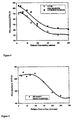
- FIG. 2 A typical microhardness profile for the above-treated samples is illustrated in Fig 2 where, for comparison purposes, microhardness profiles are also given for samples of the same Ti6Al4V material treated by one of three processes, namely oxidation at 850 °C for 30 minutes, oxidation at 850°C for 20.5 hours and plasma nitriding at 850°C for 20 hours in an atmosphere of 25% N 2 and 75% H 2 .
- the OD material treated in accordance with the present invention showed the desired sigmoid hardness profile with a more pronounced hardening effect in terms of higher hardness and deep-hardened zone than the thermally oxidised material with the same thermal cycle (850 °C/20.5 hours).
- the microhardness profile for the OD material in accordance with the present invention is in good agreement with the observed microstructural features illustrated in Fig 1.
- the OD samples produced in accordance with the present invention had a high hardness (greater than 700 HV 0.05 ) in the first 80 ⁇ m and a total hardened layer of about 300 ⁇ m in depth.
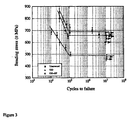
- OD treatment in accordance with the present invention reduces the fatigue properties of Ti6Al4V.
- the reduction in the fatigue limit was totally restored and slightly elevated by about 30 MPa over the untreated material by shot peening.
- the shot peening was effected using C glass shot with an Almen density of 0.15-0.029N.
- the samples treated in accordance with the present invention possessed a significantly greater depth of hardening effect than a direct oxidation treatment at the same temperature and for the same total time (850 °C/20.5 hours).
- the treatment in accordance with the present invention not only avoids the formation of an undesirable scale, which always occurs as a result of oxidation treatment at high temperature, but also confers a greater case hardening effect.
- the above phenomenon is caused by the retarding effect of nitrogen (from the air) on the diffusion of oxygen.
- nitrogen from the air
- a build-up of nitrogen atoms may occur at the oxide/metal interface (see A.M. Chaze et al, Journal of Less-Common Metals, 124 (1986) pages 73 to 84) and may act as a block on the inward diffusion of oxygen.
- no further nitrogen is admitted during vacuum treatment and the blocking effect is therefore much reduced.
- Samples of C.P titanium in the form of rectangular blocks of 20x10x10mm, cut from a 10mm thick sheet, were used. The samples were degreased and then thermally oxidised in air at 850 °C for 20-30 minutes. After cooling, the samples were subjected to a further heat treatment operation at 850 °C for 22 hours in a vacuum furnace (about 1x10 -6 Torr about 1.3x10 -4 Pa).
- Timet551 in the form of rectangular blocks of 30x10x10mm, cut from a 90mm diameter bar, were used.
- Timet10-2-3 in the form of rectangular blocks of 30x10x10mm, cut from a 260 mm diameter forged disc, were used.
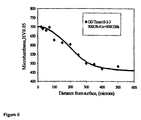
- the C.P and Timet551 hardness profiles exhibit the same type of sigmoid shape as Fig. 2 (OD) but 20 ⁇ m deeper penetration in the case of Timet551 (c.f. Fig. 2); the slightly lower hardness and deeper penetration being attributed to the 20 hour 900 °C diffusion step.
- the metastable ⁇ material has developed a much deeper hardening compared with the ⁇ + ⁇ titanium alloys.
- the deeper penetration of the oxygen can firstly be attributed to the higher diffusivity of oxygen in the ⁇ phase (see Z. Liu and Welsch, Metallurgical Trans. A, Vol. 19A, April 1988, pg1121-1125) and also to a much thicker oxide layer which developed during step (a), compared with the ⁇ + ⁇ titanium alloys.
- thermochemical treatment carried out in step (a) and/or step (b) of the case hardening process may alter the microstructure and mechanical properties of the core material.
- a further heat treatment may be carried out after the case hardening process in order to restore or optimise the core properties.
- the scale formed during step (a) should remain adherent to the surface in order to provide the oxygen reservoir required for step (b).
- the adhesion of the scale during step (a) can be affected not only by the time and temperature employed but also by the nature of the oxidising atmosphere and by the surface finish and geometrical shape of the surface treated.
- the scale formed is significantly more adherent if the oxidising atmosphere is air rather than pure oxygen, and a model has been proposed to explain this as an effect of the presence of nitrogen.
- Our experiments have confirmed the superiority of an air atmosphere over oxygen in this respect, and it is therefore not only more economical but also a technically preferred option to use air as the oxidising atmosphere in step (a).
- the surface finish applied to all samples here described was obtained by finishing on 1200 grade SiC paper and this generally gave good adhesion.
- case hardening process results in a relatively deep case of hardened material which enables it to withstand the sub-surface Hertzian stresses developed by high contact loads.
- the resultant surface has therefore a high load-bearing capacity, but this does not, of itself, confer good wear resistance to the surface.
- Coatings which have successfully been applied to the case hardened surface, include plasma nitriding, a diamond-like carbon coating, and the coating produced by the process described in our copending PCT Publication WO98/02595.
Landscapes
- Chemical & Material Sciences (AREA)
- Chemical Kinetics & Catalysis (AREA)
- Engineering & Computer Science (AREA)
- Materials Engineering (AREA)
- Mechanical Engineering (AREA)
- Metallurgy (AREA)
- Organic Chemistry (AREA)
- Solid-Phase Diffusion Into Metallic Material Surfaces (AREA)
- Secondary Cells (AREA)
- Discharge Heating (AREA)
- Sealing Battery Cases Or Jackets (AREA)
- Treatment Of Sludge (AREA)
Claims (19)
- Verfahren zum Einsatzhärten eines aus Titan, Zirconium oder einer Legierung von Titan und/oder Zirconium erzeugten Gegenstandes, welches Verfahren die Schritte umfasst: (a) Wärmebehandeln des aus Titan, Zirconium oder Legierung von Titan und/oder Zirconium erzeugten Gegenstandes in einer oxidierenden Atmosphäre, die sowohl Sauerstoff als auch Stickstoff enthält, bei einer Temperatur in Bereich von 700° bis 1.000°C, um so eine Oxidschicht auf dem Gegenstand zu erzeugen; sowie (b) weiteres Wärmebehandeln des Gegenstandes in einem Vakuum oder in einer neutralen oder inerten Atmosphäre bei einer Temperatur im Bereich von 700° bis 1.000°C, um so zu bewirken, dass Sauerstoff aus der Oxidschicht in den Gegenstand diffundiert.
- Verfahren zum Einsatzhärten eines aus Titan, Zirconium oder einer Legierung von Titan und/oder Zirconium erzeugten Gegenstandes, welches Verfahren die Schritte umfasst: (a) Wärmebehandeln des aus Titan, Zirconium oder Legierung von Titan und/oder Zirconium erzeugten Gegenstandes in einer oxidierenden Atmosphäre bei einer Temperatur in Bereich von 700° bis 1.000°C, um so eine Oxidschicht auf dem Gegenstand zu erzeugen; sowie (b) weiteres Wärmebehandeln des Gegenstandes in einem Vakuum oder in einer neutralen oder inerten Atmosphäre bei einer Temperatur im Bereich von 700° bis 1.000°C, um so zu bewirken, dass Sauerstoff aus der Oxidschicht in den Gegenstand diffundiert, um dadurch ein S-förmiges Härteprofil zu erzeugen.
- Verfahren nach Anspruch 2, bei welchem die oxidierende Atmosphäre sowohl Sauerstoff als auch Stickstoff enthält.
- Verfahren nach Anspruch 1 oder 3, bei welchem die oxidierende Atmosphäre in Schritt (a) Luft ist.
- Verfahren nach einem der vorgenannten Ansprüche, bei welchem die Zeit für die Wärmebehandlung in Schritt (a) 0,1 bis Stunde beträgt.
- Verfahren nach einem der vorgenannten Ansprüche, bei welchem die Zeit für die Wärmebehandlung in Schritt (a) 0,3 bis 0,6 Stunden beträgt.
- Verfahren nach einem der vorgenannten Ansprüche, bei welchem die Wärmebehandlung in Schritt (a) bei Atmosphärendruck ausgeführt wird.
- Verfahren nach einem der vorgenannten Ansprüche, bei welchem die Schritte (a) und (b) mindestens einmal wiederholt werden.
- Verfahren nach einem der vorgenannten Ansprüche, bei welchem die Temperatur in Schritt (a) 700° bis 900°C beträgt.
- Verfahren nach Anspruch 9, bei welchem die Temperatur in Schritt (a) 800° bis 900°C beträgt.
- Verfahren nach einem der vorgenannten Ansprüche, bei welchem die Temperatur in Schritt (b) 700° bis 900°C beträgt.
- Verfahren nach Anspruch 11, bei welchem die Temperatur in Schritt (b) 800° bis 900°C beträgt.
- Verfahren nach einem der vorgenannten Ansprüche, bei welchem die Wärmebehandlung in Schritt (b) bei einem Druck von nicht mehr als 1,3 x 10⁻² Pa (1 x 10⁻⁴ Torr) ausgeführt wird.
- Verfahren nach Anspruch 13, bei welchem die Wärmebehandlung in Schritt (b) bei einem Druck von etwa 1,3 x 10⁻⁴ Pa (1 x 10⁻⁶ Torr) ausgeführt wird.
- Verfahren nach einem der vorgenannten Ansprüche, bei welchem die Wärmebehandlung in Schritt (b) für eine Zeitdauer im Bereich von 10 bis 30 Stunden ausgeführt wird.
- Gegenstand, erzeugt aus einem Metall oder einer Legierung, ausgewählt aus Titan, Zirconium, Legierungen von Titan und Legierungen von Zirconium, wobei der Gegenstand eine gehärtete metallische Einsatzschicht aufweist, die durch diffundierten Sauerstoff gehärtet ist; wobei der Gegenstand quer zu dieser gehärteten Einsatzschicht über ein S-förmiges Härteprofil verfügt.
- Gegenstand nach Anspruch 16, bei welchem die Tiefe der gehärteten Einsatzschicht größer ist als 50 Mikrometer.
- Gegenstand nach Anspruch 16, bei welchem die Tiefe der gehärteten Einsatzschicht im Bereich von 200 bis 500 Mikrometer liegt.
- Gegenstand nach Anspruch 16, 17 oder 18, bei welchem auf der Oberseite der gehärteten Einsatzschicht ferner ein Schicht aus friktionsarmem Material vorgesehen wird.
Applications Claiming Priority (3)
| Application Number | Priority Date | Filing Date | Title |
|---|---|---|---|
| GB9715175 | 1997-07-19 | ||
| GB9715175A GB9715175D0 (en) | 1997-07-19 | 1997-07-19 | Method of case hardening |
| PCT/GB1998/002082 WO1999004055A1 (en) | 1997-07-19 | 1998-07-15 | Method of case hardening |
Publications (2)
| Publication Number | Publication Date |
|---|---|
| EP1000180A1 EP1000180A1 (de) | 2000-05-17 |
| EP1000180B1 true EP1000180B1 (de) | 2001-12-19 |
Family
ID=10816078
Family Applications (1)
| Application Number | Title | Priority Date | Filing Date |
|---|---|---|---|
| EP98933803A Expired - Lifetime EP1000180B1 (de) | 1997-07-19 | 1998-07-15 | Verfahren zum einsatzhärten |
Country Status (8)
| Country | Link |
|---|---|
| US (1) | US6833197B1 (de) |
| EP (1) | EP1000180B1 (de) |
| JP (1) | JP2001510241A (de) |
| AT (1) | ATE211187T1 (de) |
| DE (1) | DE69803076T2 (de) |
| ES (1) | ES2166607T3 (de) |
| GB (1) | GB9715175D0 (de) |
| WO (1) | WO1999004055A1 (de) |
Families Citing this family (25)
| Publication number | Priority date | Publication date | Assignee | Title |
|---|---|---|---|---|
| US6478888B1 (en) * | 1997-12-23 | 2002-11-12 | United Technologies Corporation | Preheat method for EBPVD coating |
| GB0216527D0 (en) * | 2002-07-16 | 2002-08-28 | Boc Group Plc | Thermal treatment method |
| US7445679B2 (en) * | 2003-05-16 | 2008-11-04 | Cabot Corporation | Controlled oxygen addition for metal material |
| US7473278B2 (en) | 2004-09-16 | 2009-01-06 | Smith & Nephew, Inc. | Method of surface oxidizing zirconium and zirconium alloys and resulting product |
| CN1314827C (zh) * | 2004-12-08 | 2007-05-09 | 中国科学院金属研究所 | 一种钛合金渗氧-扩散固溶复合表面强化处理方法 |
| CA2597266A1 (en) * | 2005-02-16 | 2006-08-24 | Mitsubishi Heavy Industries, Ltd. | Surface treatment method of titanium alloy member for aerospace equipment |
| AU2013251247B2 (en) * | 2005-12-15 | 2015-11-12 | Smith & Nephew, Inc. | Diffusion-hardened medical implant |
| AU2021245211B2 (en) * | 2005-12-15 | 2022-12-15 | Smith & Nephew, Inc. | Diffusion-Hardened Medical Implant |
| CA2633096C (en) * | 2005-12-15 | 2014-09-02 | Smith & Nephew, Inc. | Diffusion-hardened medical implant |
| AU2016200939B9 (en) * | 2005-12-15 | 2017-02-16 | Smith & Nephew, Inc. | Diffusion-Hardened Medical Implant |
| US8795441B2 (en) * | 2006-04-26 | 2014-08-05 | Smith & Nephew, Inc. | Reworking of surface oxidized and nitrided components |
| EP2170222B1 (de) * | 2007-06-11 | 2022-02-23 | Smith & Nephew, Inc. | Medizinisches implantat mit keramikschicht |
| GB0805224D0 (en) * | 2008-03-20 | 2008-04-30 | Minebea Co Ltd | An aerospace bearing component |
| GB2458507A (en) | 2008-03-20 | 2009-09-23 | Tecvac Ltd | Oxidation of non ferrous metal components |
| GB0813667D0 (en) | 2008-07-25 | 2008-09-03 | Boc Group Plc | Case hardening titanium and its alloys |
| US8361381B2 (en) * | 2008-09-25 | 2013-01-29 | Smith & Nephew, Inc. | Medical implants having a porous coated surface |
| US9248020B2 (en) * | 2010-11-17 | 2016-02-02 | Zimmer, Inc. | Ceramic monoblock implants with osseointegration fixation surfaces |
| JP5623917B2 (ja) * | 2011-01-12 | 2014-11-12 | 本田技研工業株式会社 | 耐フレッティング摩耗性チタン部材 |
| WO2014090949A1 (de) * | 2012-12-14 | 2014-06-19 | Sigmarc Gmbh | Medizinprodukte mit thermisch oxidierter metalloberfläche für den temporären oder permanenten verbleib im menschlichen körper |
| JP6515379B2 (ja) * | 2014-10-20 | 2019-05-22 | 日本製鉄株式会社 | 耐溶損性に優れる低融点溶融金属処理部材及びその製造方法 |
| US11492691B2 (en) | 2019-07-25 | 2022-11-08 | The Boeing Company | Case hardened titanium parts and method for making the same |
| JP7753196B2 (ja) * | 2019-08-23 | 2025-10-14 | エロス・メドテック・パイノール・エー/エス | チタンの低温硬化 |
| EP4018010A1 (de) * | 2019-08-23 | 2022-06-29 | Elos Medtech Pinol A/S | Oberflächenhärtung für ein dentalimplantat |
| CN114107879A (zh) * | 2021-11-30 | 2022-03-01 | 河南科技大学 | 一种提高钛合金乏油润滑条件下耐磨性能的表面处理方法 |
| EP4634422A2 (de) | 2023-05-04 | 2025-10-22 | Rolex Sa | Gegenstand aus einer binären ti-hf oder zr-hf legierung mit dunkler oxidschicht |
Family Cites Families (12)
| Publication number | Priority date | Publication date | Assignee | Title |
|---|---|---|---|---|
| JPS6169556A (ja) * | 1984-09-10 | 1986-04-10 | 株式会社 ナシヨナルマリンプラスチツク | 保形用支持部材を備えた輸送袋 |
| JPS61207568A (ja) | 1985-03-11 | 1986-09-13 | Nippon Steel Corp | チタン又はチタン合金の表面処理方法 |
| JPS62256956A (ja) | 1986-04-30 | 1987-11-09 | Honda Motor Co Ltd | チタン系製品の表面処理方法 |
| JPH0336256A (ja) * | 1989-06-30 | 1991-02-15 | Mitsubishi Motors Corp | チタンおよびチタン合金の酸化処理方法 |
| US5611347A (en) | 1989-07-25 | 1997-03-18 | Smith & Nephew, Inc. | Zirconium oxide and zirconium nitride coated percutaneous devices |
| JPH03294471A (ja) | 1989-12-26 | 1991-12-25 | Kobe Steel Ltd | チタン板の製造方法 |
| US5316594A (en) * | 1990-01-18 | 1994-05-31 | Fike Corporation | Process for surface hardening of refractory metal workpieces |
| DE69325042T2 (de) * | 1992-02-07 | 1999-11-18 | Smith & Nephew, Inc. | Oberflächengehärtetes bioverträgliches medizinisches Metallimplantat |
| AU5295396A (en) | 1995-01-31 | 1996-08-21 | Smith & Nephew Richards Inc. | Wear resistant tribosystem |
| JP3179787B2 (ja) * | 1996-03-26 | 2001-06-25 | シチズン時計株式会社 | チタンまたはチタン合金部材とその表面処理方法 |
| DE69731101T2 (de) * | 1996-07-18 | 2006-02-23 | Citizen Watch Co., Ltd., Nishitokyo | Dekorationsteil aus titanbasis und verfahren zum härten |
| EP1033633B1 (de) * | 1999-03-03 | 2003-10-08 | Rolex Sa | Vorrichtung zur dichten Befestigung eines Uhrglases an einem Uhrengehäuse |
-
1997
- 1997-07-19 GB GB9715175A patent/GB9715175D0/en active Pending
-
1998
- 1998-07-15 EP EP98933803A patent/EP1000180B1/de not_active Expired - Lifetime
- 1998-07-15 JP JP2000503259A patent/JP2001510241A/ja active Pending
- 1998-07-15 DE DE69803076T patent/DE69803076T2/de not_active Expired - Lifetime
- 1998-07-15 WO PCT/GB1998/002082 patent/WO1999004055A1/en not_active Ceased
- 1998-07-15 ES ES98933803T patent/ES2166607T3/es not_active Expired - Lifetime
- 1998-07-15 US US09/463,042 patent/US6833197B1/en not_active Expired - Fee Related
- 1998-07-15 AT AT98933803T patent/ATE211187T1/de active
Also Published As
| Publication number | Publication date |
|---|---|
| US6833197B1 (en) | 2004-12-21 |
| DE69803076T2 (de) | 2002-07-18 |
| WO1999004055A1 (en) | 1999-01-28 |
| JP2001510241A (ja) | 2001-07-31 |
| EP1000180A1 (de) | 2000-05-17 |
| GB9715175D0 (en) | 1997-09-24 |
| ES2166607T3 (es) | 2002-04-16 |
| ATE211187T1 (de) | 2002-01-15 |
| DE69803076D1 (de) | 2002-01-31 |
Similar Documents
| Publication | Publication Date | Title |
|---|---|---|
| EP1000180B1 (de) | Verfahren zum einsatzhärten | |
| US6210807B1 (en) | Surface oxidation of a titanium or titanium alloy article | |
| EP2262919B1 (de) | Behandlung von metallkomponenten | |
| EP2103707B1 (de) | Flugzeuglagerelement | |
| Bloyce et al. | Surface engineering of titanium and titanium alloys | |
| EP2278038A1 (de) | Verfahren zur Aktivierung eines Artikels eines passiven eisenhaltigen oder nichteisenhaltigen Metalls vor dem Aufkohlen, Nitrieren und/oder Nitroaufkohlen | |
| Bloyce | Surface engineering of titanium alloys for wear protection | |
| EP1413631A2 (de) | Verbesserte Ausbereitungseigenschaften vor Lagers aus Einsatzstahl M50 und M50NIL | |
| EP1288327B1 (de) | Oberflächenbehandlung einer Titaniumlegierung | |
| Gammeltoft-Hansen et al. | Characterization of thermochemically surface-hardened titanium by light optical microscopy | |
| WO1990004044A1 (en) | Surface treatment of metals and alloys | |
| EP2154263A1 (de) | Gehäusehärtendes Titanium und seine Legierungen | |
| JP2773092B2 (ja) | 表面被覆鋼製品 | |
| Tóth | Effect of heat treatment on the properties of tool steel | |
| US8092915B2 (en) | Products produced by a process for diffusing titanium and nitride into a material having generally compact, granular microstructure | |
| KR100594998B1 (ko) | 티타늄계 금속의 질화 방법 | |
| WO1996023908A1 (en) | Wear resistant tribosystem | |
| Huang et al. | Evaluation of duplex coatings produced with a pulsed Nd: YAG laser and filtered arc | |
| Korwin et al. | Thermomechanical Treatment of Machinery Components for Improved Corrosion Resistance | |
| Whittle et al. | Improving the wear resistance of austenitic alloys by surface treatment | |
| Jacquot | Nitriding, boriding and carburizing of steels | |
| KR19980069660A (ko) | 저탄소 합금강의 표면처리방법 | |
| JPS62284064A (ja) | 鋼表面の耐摩耗性向上方法 | |
| HK1059806B (en) | Pressing iron soleplate having a hardened and coated surface | |
| JPH04218669A (ja) | 潤滑性に優れた耐摩耗性TiまたはTi基合金部材 |
Legal Events
| Date | Code | Title | Description |
|---|---|---|---|
| PUAI | Public reference made under article 153(3) epc to a published international application that has entered the european phase |
Free format text: ORIGINAL CODE: 0009012 |
|
| 17P | Request for examination filed |
Effective date: 20000214 |
|
| AK | Designated contracting states |
Kind code of ref document: A1 Designated state(s): AT BE CH CY DE DK ES FI FR GB GR IE IT LI LU MC NL PT SE |
|
| GRAG | Despatch of communication of intention to grant |
Free format text: ORIGINAL CODE: EPIDOS AGRA |
|
| GRAG | Despatch of communication of intention to grant |
Free format text: ORIGINAL CODE: EPIDOS AGRA |
|
| GRAH | Despatch of communication of intention to grant a patent |
Free format text: ORIGINAL CODE: EPIDOS IGRA |
|
| 17Q | First examination report despatched |
Effective date: 20010523 |
|
| GRAH | Despatch of communication of intention to grant a patent |
Free format text: ORIGINAL CODE: EPIDOS IGRA |
|
| GRAA | (expected) grant |
Free format text: ORIGINAL CODE: 0009210 |
|
| AK | Designated contracting states |
Kind code of ref document: B1 Designated state(s): AT BE CH CY DE DK ES FI FR GB GR IE IT LI LU MC NL PT SE |
|
| PG25 | Lapsed in a contracting state [announced via postgrant information from national office to epo] |
Ref country code: NL Free format text: LAPSE BECAUSE OF FAILURE TO SUBMIT A TRANSLATION OF THE DESCRIPTION OR TO PAY THE FEE WITHIN THE PRESCRIBED TIME-LIMIT Effective date: 20011219 Ref country code: LI Free format text: LAPSE BECAUSE OF FAILURE TO SUBMIT A TRANSLATION OF THE DESCRIPTION OR TO PAY THE FEE WITHIN THE PRESCRIBED TIME-LIMIT Effective date: 20011219 Ref country code: IT Free format text: LAPSE BECAUSE OF FAILURE TO SUBMIT A TRANSLATION OF THE DESCRIPTION OR TO PAY THE FEE WITHIN THE PRESCRIBED TIME-LIMIT;WARNING: LAPSES OF ITALIAN PATENTS WITH EFFECTIVE DATE BEFORE 2007 MAY HAVE OCCURRED AT ANY TIME BEFORE 2007. THE CORRECT EFFECTIVE DATE MAY BE DIFFERENT FROM THE ONE RECORDED. Effective date: 20011219 Ref country code: GR Free format text: LAPSE BECAUSE OF FAILURE TO SUBMIT A TRANSLATION OF THE DESCRIPTION OR TO PAY THE FEE WITHIN THE PRESCRIBED TIME-LIMIT Effective date: 20011219 Ref country code: FI Free format text: LAPSE BECAUSE OF FAILURE TO SUBMIT A TRANSLATION OF THE DESCRIPTION OR TO PAY THE FEE WITHIN THE PRESCRIBED TIME-LIMIT Effective date: 20011219 Ref country code: CH Free format text: LAPSE BECAUSE OF FAILURE TO SUBMIT A TRANSLATION OF THE DESCRIPTION OR TO PAY THE FEE WITHIN THE PRESCRIBED TIME-LIMIT Effective date: 20011219 Ref country code: BE Free format text: LAPSE BECAUSE OF FAILURE TO SUBMIT A TRANSLATION OF THE DESCRIPTION OR TO PAY THE FEE WITHIN THE PRESCRIBED TIME-LIMIT Effective date: 20011219 Ref country code: AT Free format text: LAPSE BECAUSE OF FAILURE TO SUBMIT A TRANSLATION OF THE DESCRIPTION OR TO PAY THE FEE WITHIN THE PRESCRIBED TIME-LIMIT Effective date: 20011219 |
|
| REF | Corresponds to: |
Ref document number: 211187 Country of ref document: AT Date of ref document: 20020115 Kind code of ref document: T |
|
| REG | Reference to a national code |
Ref country code: CH Ref legal event code: EP |
|
| REG | Reference to a national code |
Ref country code: GB Ref legal event code: IF02 |
|
| REG | Reference to a national code |
Ref country code: IE Ref legal event code: FG4D |
|
| REF | Corresponds to: |
Ref document number: 69803076 Country of ref document: DE Date of ref document: 20020131 |
|
| PG25 | Lapsed in a contracting state [announced via postgrant information from national office to epo] |
Ref country code: SE Free format text: LAPSE BECAUSE OF FAILURE TO SUBMIT A TRANSLATION OF THE DESCRIPTION OR TO PAY THE FEE WITHIN THE PRESCRIBED TIME-LIMIT Effective date: 20020319 Ref country code: PT Free format text: LAPSE BECAUSE OF FAILURE TO SUBMIT A TRANSLATION OF THE DESCRIPTION OR TO PAY THE FEE WITHIN THE PRESCRIBED TIME-LIMIT Effective date: 20020319 Ref country code: DK Free format text: LAPSE BECAUSE OF FAILURE TO SUBMIT A TRANSLATION OF THE DESCRIPTION OR TO PAY THE FEE WITHIN THE PRESCRIBED TIME-LIMIT Effective date: 20020319 |
|
| REG | Reference to a national code |
Ref country code: ES Ref legal event code: FG2A Ref document number: 2166607 Country of ref document: ES Kind code of ref document: T3 |
|
| NLV1 | Nl: lapsed or annulled due to failure to fulfill the requirements of art. 29p and 29m of the patents act | ||
| REG | Reference to a national code |
Ref country code: CH Ref legal event code: PL |
|
| PG25 | Lapsed in a contracting state [announced via postgrant information from national office to epo] |
Ref country code: LU Free format text: LAPSE BECAUSE OF NON-PAYMENT OF DUE FEES Effective date: 20020715 |
|
| PG25 | Lapsed in a contracting state [announced via postgrant information from national office to epo] |
Ref country code: CY Free format text: LAPSE BECAUSE OF FAILURE TO SUBMIT A TRANSLATION OF THE DESCRIPTION OR TO PAY THE FEE WITHIN THE PRESCRIBED TIME-LIMIT Effective date: 20020731 |
|
| PLBE | No opposition filed within time limit |
Free format text: ORIGINAL CODE: 0009261 |
|
| STAA | Information on the status of an ep patent application or granted ep patent |
Free format text: STATUS: NO OPPOSITION FILED WITHIN TIME LIMIT |
|
| 26N | No opposition filed | ||
| PG25 | Lapsed in a contracting state [announced via postgrant information from national office to epo] |
Ref country code: MC Free format text: LAPSE BECAUSE OF NON-PAYMENT OF DUE FEES Effective date: 20030201 |
|
| NLV1 | Nl: lapsed or annulled due to failure to fulfill the requirements of art. 29p and 29m of the patents act | ||
| GBPC | Gb: european patent ceased through non-payment of renewal fee |
Effective date: 20040715 |
|
| REG | Reference to a national code |
Ref country code: GB Ref legal event code: 728V |
|
| PGFP | Annual fee paid to national office [announced via postgrant information from national office to epo] |
Ref country code: IE Payment date: 20050713 Year of fee payment: 8 |
|
| REG | Reference to a national code |
Ref country code: GB Ref legal event code: 732E |
|
| REG | Reference to a national code |
Ref country code: GB Ref legal event code: 728Y |
|
| REG | Reference to a national code |
Ref country code: FR Ref legal event code: TP |
|
| PG25 | Lapsed in a contracting state [announced via postgrant information from national office to epo] |
Ref country code: IE Free format text: LAPSE BECAUSE OF NON-PAYMENT OF DUE FEES Effective date: 20060717 |
|
| REG | Reference to a national code |
Ref country code: IE Ref legal event code: MM4A |
|
| PGFP | Annual fee paid to national office [announced via postgrant information from national office to epo] |
Ref country code: FR Payment date: 20110729 Year of fee payment: 14 |
|
| PGFP | Annual fee paid to national office [announced via postgrant information from national office to epo] |
Ref country code: DE Payment date: 20110725 Year of fee payment: 14 Ref country code: ES Payment date: 20110728 Year of fee payment: 14 |
|
| REG | Reference to a national code |
Ref country code: FR Ref legal event code: ST Effective date: 20130329 |
|
| PG25 | Lapsed in a contracting state [announced via postgrant information from national office to epo] |
Ref country code: DE Free format text: LAPSE BECAUSE OF NON-PAYMENT OF DUE FEES Effective date: 20130201 Ref country code: FR Free format text: LAPSE BECAUSE OF NON-PAYMENT OF DUE FEES Effective date: 20120731 |
|
| REG | Reference to a national code |
Ref country code: DE Ref legal event code: R119 Ref document number: 69803076 Country of ref document: DE Effective date: 20130201 |
|
| REG | Reference to a national code |
Ref country code: ES Ref legal event code: FD2A Effective date: 20131021 |
|
| PG25 | Lapsed in a contracting state [announced via postgrant information from national office to epo] |
Ref country code: ES Free format text: LAPSE BECAUSE OF NON-PAYMENT OF DUE FEES Effective date: 20120716 |
|
| PGFP | Annual fee paid to national office [announced via postgrant information from national office to epo] |
Ref country code: GB Payment date: 20131011 Year of fee payment: 16 |
|
| GBPC | Gb: european patent ceased through non-payment of renewal fee |
Effective date: 20140715 |
|
| PG25 | Lapsed in a contracting state [announced via postgrant information from national office to epo] |
Ref country code: GB Free format text: LAPSE BECAUSE OF NON-PAYMENT OF DUE FEES Effective date: 20140715 |