EP1000947A2 - Précurseurs à base d'éthylène contenant un métal, et leur préparation - Google Patents
Précurseurs à base d'éthylène contenant un métal, et leur préparation Download PDFInfo
- Publication number
- EP1000947A2 EP1000947A2 EP99308236A EP99308236A EP1000947A2 EP 1000947 A2 EP1000947 A2 EP 1000947A2 EP 99308236 A EP99308236 A EP 99308236A EP 99308236 A EP99308236 A EP 99308236A EP 1000947 A2 EP1000947 A2 EP 1000947A2
- Authority
- EP
- European Patent Office
- Prior art keywords
- precursor
- substituted ethylene
- copper
- metal
- hfac
- Prior art date
- Legal status (The legal status is an assumption and is not a legal conclusion. Google has not performed a legal analysis and makes no representation as to the accuracy of the status listed.)
- Granted
Links
Images
Classifications
-
- C—CHEMISTRY; METALLURGY
- C07—ORGANIC CHEMISTRY
- C07C—ACYCLIC OR CARBOCYCLIC COMPOUNDS
- C07C11/00—Aliphatic unsaturated hydrocarbons
- C07C11/02—Alkenes
- C07C11/04—Ethene
-
- C—CHEMISTRY; METALLURGY
- C23—COATING METALLIC MATERIAL; COATING MATERIAL WITH METALLIC MATERIAL; CHEMICAL SURFACE TREATMENT; DIFFUSION TREATMENT OF METALLIC MATERIAL; COATING BY VACUUM EVAPORATION, BY SPUTTERING, BY ION IMPLANTATION OR BY CHEMICAL VAPOUR DEPOSITION, IN GENERAL; INHIBITING CORROSION OF METALLIC MATERIAL OR INCRUSTATION IN GENERAL
- C23C—COATING METALLIC MATERIAL; COATING MATERIAL WITH METALLIC MATERIAL; SURFACE TREATMENT OF METALLIC MATERIAL BY DIFFUSION INTO THE SURFACE, BY CHEMICAL CONVERSION OR SUBSTITUTION; COATING BY VACUUM EVAPORATION, BY SPUTTERING, BY ION IMPLANTATION OR BY CHEMICAL VAPOUR DEPOSITION, IN GENERAL
- C23C16/00—Chemical coating by decomposition of gaseous compounds, without leaving reaction products of surface material in the coating, i.e. chemical vapour deposition [CVD] processes
- C23C16/06—Chemical coating by decomposition of gaseous compounds, without leaving reaction products of surface material in the coating, i.e. chemical vapour deposition [CVD] processes characterised by the deposition of metallic material
- C23C16/18—Chemical coating by decomposition of gaseous compounds, without leaving reaction products of surface material in the coating, i.e. chemical vapour deposition [CVD] processes characterised by the deposition of metallic material from metallo-organic compounds
-
- C—CHEMISTRY; METALLURGY
- C07—ORGANIC CHEMISTRY
- C07F—ACYCLIC, CARBOCYCLIC OR HETEROCYCLIC COMPOUNDS CONTAINING ELEMENTS OTHER THAN CARBON, HYDROGEN, HALOGEN, OXYGEN, NITROGEN, SULFUR, SELENIUM OR TELLURIUM
- C07F1/00—Compounds containing elements of Groups 1 or 11 of the Periodic Table
- C07F1/08—Copper compounds
Definitions
- This invention relates generally to integrated circuit processes and fabrication, and more particularly, to a precursor and synthesis method, having a substituted ethylene ligand, such as 2-methyl-1-butene, which improves liquid phase stability, and which is capable of depositing copper at high deposition rates, low resistivity, and with good adhesion on selected integrated circuit surfaces.
- a substituted ethylene ligand such as 2-methyl-1-butene
- interconnects and vias there is a need for interconnects and vias to have both low resistivity, and the ability to withstand process environments of volatile ingredients.
- Aluminum and tungsten metals are often used in the production of integrated circuits for making interconnections or vias between electrically active areas. These metals are popular because they are easy to use in a production environment, unlike copper which requires special handling.
- Copper would appear to be a natural choice to replace aluminum in the effort to reduce the size of lines and vias in an electrical circuit.
- the conductivity of copper is approximately twice that of aluminum and over three times that of tungsten. As a result, the same current can be carried through a copper line having nearly half the width of an aluminum line.
- the electromigration characteristics of copper are also much superior to those of aluminum.
- Aluminum is approximately ten times more susceptible than copper to degradation and breakage due to electromigration.
- a copper line even one having a much smaller cross-section than an aluminum line, is better able to maintain electrical integrity.
- the technique is not selective with regard to surfaces.
- adjoining non-conductive surfaces must either be masked or etched clean in a subsequent process step.
- photoresist masks and some other adjoining IC structures are potentially damaged at the high temperatures at which copper is processed.
- the CVD technique is an improvement over PVD because it is more selective as to which surfaces copper is deposited on.
- the CVD technique is selective because it is designed to rely on a chemical reaction between the metallic surface and the copper vapor to cause the deposition of copper on the metallic surface.
- copper is combined with a ligand, or organic compound, to help insure that the copper compound becomes volatile, and eventually decomposes, at consistent temperatures. That is, copper becomes an element in a compound that is vaporized into a gas, and later deposited as a solid when the gas decomposes. Selected surfaces of an integrated circuit, such as diffusion barrier material, are exposed to the copper gas, or precursor, in an elevated temperature environment. When the copper gas compound decomposes, copper is left behind on the selected surface.
- ligand or organic compound
- Copper metal thin films have been prepared via chemical vapor deposition by using many different kinds of copper precursors.
- these copper precursors are solids, which can not be used in the liquid delivery system for copper thin film CVD processing.
- the copper films often contain contamination of carbon and phosphorus, which can not be used as interconnectors in microprocessors.
- Cu 2+ (hfac) 2 , or copper (II) hexafluoroacetylacetonate, precursors have previously been used to apply CVD copper to IC substrates and surfaces.
- these Cu 2+ precursors are notable for leaving contaminates in the deposited copper, and for the relatively high temperatures that must be used to decompose the precursor into copper.
- Copper(I) fluorinated ⁇ -diketonate complexes were first synthesized by Gerald Doyle, U.S. Pat. No. 4,385,005 (1983) and 4,425,281 (1984), in which he presented the synthesis method and their application in the separation of unsaturated organic hydrocarbons.
- Thomas H. Baum, et at. claimed the application of these copper(I) fluorinated ⁇ -diketonate complexes as copper precursors for CVD copper thin film preparation. Copper thin films have been prepared via chemical vapor deposition using these precursors.
- the copper thin films deposited using (DMCOD)Cu(hfac) have very good adhesion to metal or metal nitride substrates, but a high resistivity (2.5 ⁇ cm) and a low deposition rate.
- Copper films deposited using a liquid copper precursor, (hfac)Cu(TMVS), where TMVS trimethylvinylsilane, have low resistivities and reasonably adhesion to substrates.
- This precursor is useful because it can be used at relatively low temperatures, approximately 200°C.
- This liquid copper precursor has been used for the preparation of copper metal thin films via CVD for some time, but there are still some drawbacks: stability, the adhesion of copper films, and cost for the trimethylvinylsilane stabilizer. Also, the precursor is not especially stable, and can have a relatively short shelf life if not refrigerated.
- a Cu precursor comprising a ligand of methoxy and methyl groups is disclosed in co-pending application Serial No. 08/779,640, filed Jan. 7, 1997, entitled “Precursor with (Methoxy)(methyl)silylolefin Ligands to Deposit Cu and Method for Same", invented by Senzaki et al., and assigned to the same assignee as the instant patent.
- the disclosed precursor permits either one or two methoxy groups to be bonded to the silicon atom of the ligand. That is, the precursor can be "fine tuned” using ligands having more methoxy groups than tmvs, but less than tmovs are provided.
- the oxygen atoms in the methoxy groups contribute electrons to the Cu atoms, to strengthen the Cu-olefin bond, and so, prevent the premature decomposition of the precursor in storage, or as the precursor is heated for the application of Cu to an IC surface.
- hydrocarbon groups of one carbon atom, CH 3 (methyl) and OCH 3 (methoxy) are disclosed.
- a Cu precursor comprising a ligand of alkyl and alkyl groups is disclosed in U.S. Patent 5,767,301, entitled “Precursor with (Alkyloxy)(Alkyl)silylolefin Ligands to Deposit Copper", invented by Senzaki et al.
- the disclosed precursor describes alkyl groups bonded to the silicon atom of the ligand with alkoxyl groups.
- the search continues for even more effective copper precursors.
- a Cu precursor comprising a ligand of a substituted phenylethylene ligand is disclosed in co-pending application Serial No. 09/210,099, entitled “Substituted Phenylethylene Precursor and Synthesis Method", invented by Zhuang et al., and filed on December 11, 1998.
- the disclosed precursor is practical for use in the deposition of CVD copper, but more volatile precursors are also desirable.
- a volatile metal (M) precursor compound for the chemical vapor deposition (CVD) of metal to selected surfaces is provided.
- the metal is selected from the group consisting of copper (Cu), silver (Ag), and iridium (Ir).
- the precursor compound comprises: M +1 (hexafluoroacetylacetonate); and a substituted ethylene ligand with a first carbon atom including a first and second bond.
- the first and second bonds are selected from groups independent of each other.
- the first bond is selected from a group consisting of C 1 to C 8 alkyl, C 1 to C 8 haloalkyl, and C 1 to C 8 alkoxyl.
- the second bond is selected from a group consisting of H, C 1 to C 8 alkyl, C 1 to C 8 haloalkyl, and C 1 to C 8 alkoxyl.
- a second carbon atom includes a third and fourth bond. The third and fourth bonds are selected, independent of each other, from the group consisting of H, C 1 to C 8 alkyl, C 1 to C 8 haloalkyl, and C 1 to C 8 alkoxyl. In this manner, a stable precursor capable of high metal deposition rates is formed.
- the first bond is CH 3
- the second bond is CH 2 CH 3
- the third and fourth bonds are H, whereby an 2-methyl-1-butene ligand is formed.
- the compound includes an additive to create a precursor blend, and in which the precursor blend further comprises: less than approximately 10% substituted ethylene, as measured by weight ratio of the precursor compound, to facilitate a stable liquid phase precursor.
- the precursor blend further comprises approximately 5.04% substituted ethylene, as measured by weight ratio of the precursor compound.
- a method for synthesizing a metal(hfac) [M(hfac)] substituted ethylene precursor comprising the steps of:
- Step e 1 includes adding less than approximately 10%, by weight ratio, of the substituted ethylene used in Step b) to the solution, whereby the liquid phase stability of the precursor is improved.
- Step e 1 ) includes adding approximately 5.04% substituted ethylene.
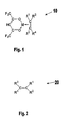
- Fig. 1 is a schematic representation of the present invention precursor with a substituted ethylene ligand.
- Fig. 2 is a schematic representation of a substituted ethylene ligand.
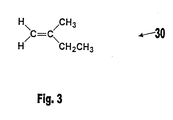
- Fig. 3 is a schematic representation of the preferred embodiment 2-methyl-1-butene ligand.
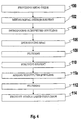
- Fig. 4 is a flowchart illustrating steps in a method for synthesizing a copper(hfac) substituted ethylene precursor.
- the substituted ethylene ligand copper precursor disclosed below, is inexpensive to synthesize.
- the precursor is stable at room temperature for easy storage and handling. Despite retaining its liquid phase at room temperature, it is highly volatile at higher temperatures. Therefore, no decomposition occurs in the CVD liquid delivery line and vaporizer. Further, the precursor has excellent adhesion to metal and metal nitride substrates, such as W, Ti, TiN, Ta, TaN, Al, Pt, WN, and similar barrier materials.
- the copper deposited with precursor has low resistivity ( ⁇ 1.9 ⁇ cm), high electromigration resistance, and excellent conformality to severe surface morphology.
- Fig. 1 is a schematic representation of the present invention precursor with a substituted ethylene ligand.
- Volatile metal (M) precursor compound 10 is used for the chemical vapor deposition (CVD) of metal (M) to selected surfaces.
- the metal is selected from the group consisting of copper (Cu), silver (Ag), and iridium (Ir).
- Precursor compound 10 comprises M +1 (hexafluoroacetylacetonate) and a substituted ethylene ligand.
- Fig. 2 is a schematic representation of substituted ethylene ligand 20.
- Substituted ethylene ligand 20 comprises a first carbon atom including a first and second bond.
- the first bond is selected from a group consisting of C 1 to C 8 alkyl, C 1 to C 8 haloalkyl, and C 1 to C 8 alkoxyl.
- the second bond is selected from a group consisting of H, C 1 to C 8 alkyl, C 1 to C 8 haloalkyl, and C 1 to C 8 alkoxyl.
- Substituted ethylene ligand 20 also comprises a second carbon atom including a third and fourth bond.
- the third and fourth bonds are selected from the group consisting of H, C 1 to C 8 alkyl, C 1 to C 8 haloalkyl, and C 1 to C 8 alkoxyl. In this manner, a stable precursor capable of high metal deposition rates is formed.
- the first (R 1 ), second (R 2 ), third (R 3 ), and fourth (R 4 ) vary independently from each other. That is, the choice of an specific R group is not dependent on the specific choice of any other R group.
- Fig. 3 is a schematic representation of the preferred embodiment 2-methyl-1-butene ligand 30.
- First bond (R 1 ) is CH 3
- the second bond (R 2 ) is CH 2 CH 3
- the third bond (R 3 ) is H
- the fourth bond (R 4 ) is H. In this manner, a 2-methyl-1-butene ligand is formed.
- compound 10 includes an additive to create a precursor blend.
- the precursor blend further comprises less than approximately 10% substituted ethylene 20 (see Fig. 2), as measured by weight ratio of the precursor compound.
- the precursor blend further comprises approximately 5.04% substituted ethylene, as measured by weight ratio of the precursor compound, to facilitate a stable liquid phase precursor.
- R 1 is CH 3 , in which R 2 is CH 2 CH 3 , R 3 is H, and R 4 is H, whereby an 2-methyl-1-butene ligand is formed.
- the compound includes an additive to create a metal precursor blend.
- the combined additive is less than approximately 10% by weight ratio of the precursor blend.
- the additive is 2-methyl-1-butene, at approximately 5.04% by weight of the precursor blend.
- the substituted ethylene ligand selected to form the precursor is the same substituted ethylene ligand used as the additive to from the precursor blend.
- Fig. 4 is a flowchart illustrating steps in a method for synthesizing a metal(hfac) [M(hfac)] substituted ethylene precursor.
- Step 100 provides M 2 O.
- the metal is selected from the group consisting of copper and silver.
- Precursor synthesis procedures specific to iridium are still in development.
- Step 102 forms a uniformly mixed solution of M 2 O in a solvent.
- Step 102 includes using a solvent selected from the group consisting of dichloromethane and tetrahydrofuran (THF), although dichloromethane is preferred.
- Step 104 introduces a substituted ethylene to the solution of Step 102, and forms a uniformly mixed solution.
- Step 104 includes the substituted ethylene being 2-methyl-1-butene.
- Step 106 introduces hexafluoroacetylacetone (hfac) to the solution of Step 104, and forms a uniformly mixed solution.
- Step 108 filters the solution to remove solid materials, whereby any excess M 2 O is removed. It is typical to add excess M 2 O in Step 102 of the procedure. M 2 O is inexpensive and an excess amount produces a higher yield of precursor. At this step in the process other solids such as impurities are removed.
- celite SiO 2
- Step 108 includes removing solid material larger than approximately 25 microns.
- Step 110 removes the solvent from the solution.
- Step 112 filters to remove the solid material.
- Step 112 includes filtering solid material having a size greater than approximately 1 micron. In small batches, a 1 micron size filter on a syringe opening, was used to extract the solution.
- Step 114 is a product, a liquid phase precursor.
- Step 102 includes the M 2 O being, in proportion, 0.120 mol
- Step 104 includes the substituted ethylene being, in proportion, 0.170 mol
- Step 106 includes the hfac being, in proportion, 0.170 mol.
- Step 110a adds less than approximately 10%, by weight ratio, of the substituted ethylene used in Step 104 to the solution, whereby the liquid phase stability of the precursor is improved.
- Step 110a includes adding approximately 5.04% of a substituted ethylene such as 2-methyl-1-butene.
- the ligand introduced in Step 104 is the same ligand added in Step 110a.
- a new and improved copper precursor, and synthesis method for the copper precursor has been disclosed above.
- the precursor especially the 2-methyl-1-butene ligand precursor, is stable a room temperature, and extremely volatile at higher temperatures. Copper deposited with the precursor has low resistivity and high adhesive characteristics. Finally, the precursor can be deposited at high deposition rates, because of the high volatility.
- a synthesis method has been disclosed which produces a high yield of the above-described precursor.
Landscapes
- Chemical & Material Sciences (AREA)
- Organic Chemistry (AREA)
- General Chemical & Material Sciences (AREA)
- Chemical Kinetics & Catalysis (AREA)
- Engineering & Computer Science (AREA)
- Materials Engineering (AREA)
- Mechanical Engineering (AREA)
- Metallurgy (AREA)
- Chemical Vapour Deposition (AREA)
- Electrodes Of Semiconductors (AREA)
Applications Claiming Priority (4)
| Application Number | Priority Date | Filing Date | Title |
|---|---|---|---|
| US10789298P | 1998-11-10 | 1998-11-10 | |
| US107892P | 1998-11-10 | ||
| US215921 | 1998-12-18 | ||
| US09/215,921 US5994571A (en) | 1998-11-10 | 1998-12-18 | Substituted ethylene precursor and synthesis method |
Publications (3)
| Publication Number | Publication Date |
|---|---|
| EP1000947A2 true EP1000947A2 (fr) | 2000-05-17 |
| EP1000947A3 EP1000947A3 (fr) | 2000-05-31 |
| EP1000947B1 EP1000947B1 (fr) | 2003-08-20 |
Family
ID=26805296
Family Applications (1)
| Application Number | Title | Priority Date | Filing Date |
|---|---|---|---|
| EP99308236A Expired - Lifetime EP1000947B1 (fr) | 1998-11-10 | 1999-10-19 | Précurseurs à base de 2-méthyl-1-butène contenant un métal, et leur préparation |
Country Status (6)
| Country | Link |
|---|---|
| US (1) | US5994571A (fr) |
| EP (1) | EP1000947B1 (fr) |
| JP (1) | JP3894354B2 (fr) |
| KR (1) | KR100354793B1 (fr) |
| DE (1) | DE69910528T2 (fr) |
| TW (1) | TW498060B (fr) |
Cited By (3)
| Publication number | Priority date | Publication date | Assignee | Title |
|---|---|---|---|---|
| EP1185538A4 (fr) * | 1999-05-25 | 2002-07-24 | Advanced Tech Materials | Compositions reactives a base de cuivre et leur procede d'elaboration et d'utilisation pour des structures de dispositif microelectronique |
| RU2322447C2 (ru) * | 2002-06-24 | 2008-04-20 | Басф Акциенгезельшафт | Комплексы оксалата димеди (i) в качестве веществ-предшественников для нанесения металлической меди |
| EP2696008A2 (fr) | 2012-08-11 | 2014-02-12 | Hymer-Leichtmetallbau GmbH & Co. KG | Echafaudage télescopable et procédé de fonctionnement d'un échafaudage télescopable |
Families Citing this family (12)
| Publication number | Priority date | Publication date | Assignee | Title |
|---|---|---|---|---|
| US5994571A (en) * | 1998-11-10 | 1999-11-30 | Sharp Laboratories Of America, Inc. | Substituted ethylene precursor and synthesis method |
| US6090963A (en) * | 1998-11-10 | 2000-07-18 | Sharp Laboratories Of America, Inc. | Alkene ligand precursor and synthesis method |
| JP3480488B2 (ja) | 1999-01-13 | 2003-12-22 | 三菱マテリアル株式会社 | 有機金属化学蒸着用の銅薄膜形成用溶液原料 |
| KR100358045B1 (ko) * | 1999-12-22 | 2002-10-25 | 주식회사 하이닉스반도체 | 반도체 소자의 구리 금속 배선 형성 방법 |
| KR100347838B1 (ko) * | 2000-03-07 | 2002-08-07 | 학교법인 포항공과대학교 | 액상 유기구리 전구체의 열적 안정성 향상방법 |
| US6589329B1 (en) | 2000-03-09 | 2003-07-08 | Advanced Technology Materials, Inc. | Composition and process for production of copper circuitry in microelectronic device structures |
| US6596344B2 (en) * | 2001-03-27 | 2003-07-22 | Sharp Laboratories Of America, Inc. | Method of depositing a high-adhesive copper thin film on a metal nitride substrate |
| US6579793B2 (en) | 2001-03-27 | 2003-06-17 | Sharp Laboratories Of America, Inc. | Method of achieving high adhesion of CVD copper thin films on TaN Substrates |
| KR100502882B1 (ko) * | 2002-07-11 | 2005-07-25 | 한국과학기술연구원 | 초전도체 박막 제조용 구리 전구체 |
| US6838573B1 (en) | 2004-01-30 | 2005-01-04 | Air Products And Chemicals, Inc. | Copper CVD precursors with enhanced adhesion properties |
| US7166732B2 (en) | 2004-06-16 | 2007-01-23 | Advanced Technology Materials, Inc. | Copper (I) compounds useful as deposition precursors of copper thin films |
| US7750173B2 (en) | 2007-01-18 | 2010-07-06 | Advanced Technology Materials, Inc. | Tantalum amido-complexes with chelate ligands useful for CVD and ALD of TaN and Ta205 thin films |
Family Cites Families (9)
| Publication number | Priority date | Publication date | Assignee | Title |
|---|---|---|---|---|
| US4385005A (en) * | 1981-07-13 | 1983-05-24 | Exxon Research And Engineering Co. | Process for separating unsaturated hydrocarbons using copper or silver complexes with fluorinated diketonates |
| US4425281A (en) * | 1981-07-13 | 1984-01-10 | Exxon Research And Engineering Co. | Copper or silver complexes with fluorinated diketones and unsaturated ligands |
| US4434317A (en) * | 1983-05-06 | 1984-02-28 | Exxon Research And Engineering Company | Separation and recovery of unsaturated hydrocarbons by copper (I) complexes |
| US5028724A (en) * | 1990-03-30 | 1991-07-02 | Air Products And Chemicals, Inc. | Synthesis of volatile fluorinated and non-fluorinated metal-beta-ketonate and metal-beta-ketoiminato complexes |
| US5096737A (en) * | 1990-10-24 | 1992-03-17 | International Business Machines Corporation | Ligand stabilized +1 metal beta-diketonate coordination complexes and their use in chemical vapor deposition of metal thin films |
| US5085731A (en) * | 1991-02-04 | 1992-02-04 | Air Products And Chemicals, Inc. | Volatile liquid precursors for the chemical vapor deposition of copper |
| US5144049A (en) * | 1991-02-04 | 1992-09-01 | Air Products And Chemicals, Inc. | Volatile liquid precursors for the chemical vapor deposition of copper |
| US5441766A (en) * | 1994-08-25 | 1995-08-15 | Korea Institute Of Science And Technology | Method for the production of highly pure copper thin films by chemical vapor deposition |
| US5994571A (en) * | 1998-11-10 | 1999-11-30 | Sharp Laboratories Of America, Inc. | Substituted ethylene precursor and synthesis method |
-
1998
- 1998-12-18 US US09/215,921 patent/US5994571A/en not_active Expired - Lifetime
-
1999
- 1999-07-30 JP JP21800399A patent/JP3894354B2/ja not_active Expired - Fee Related
- 1999-09-03 TW TW088115226A patent/TW498060B/zh not_active IP Right Cessation
- 1999-10-19 EP EP99308236A patent/EP1000947B1/fr not_active Expired - Lifetime
- 1999-10-19 DE DE69910528T patent/DE69910528T2/de not_active Expired - Lifetime
- 1999-11-08 KR KR1019990049272A patent/KR100354793B1/ko not_active Expired - Fee Related
Cited By (4)
| Publication number | Priority date | Publication date | Assignee | Title |
|---|---|---|---|---|
| EP1185538A4 (fr) * | 1999-05-25 | 2002-07-24 | Advanced Tech Materials | Compositions reactives a base de cuivre et leur procede d'elaboration et d'utilisation pour des structures de dispositif microelectronique |
| RU2322447C2 (ru) * | 2002-06-24 | 2008-04-20 | Басф Акциенгезельшафт | Комплексы оксалата димеди (i) в качестве веществ-предшественников для нанесения металлической меди |
| EP2696008A2 (fr) | 2012-08-11 | 2014-02-12 | Hymer-Leichtmetallbau GmbH & Co. KG | Echafaudage télescopable et procédé de fonctionnement d'un échafaudage télescopable |
| DE102012015987A1 (de) | 2012-08-11 | 2014-02-13 | Hymer-Leichtmetallbau Gmbh & Co. Kg | Teleskopierbares Arbeitsgerüst und Verfahren zum Betrieb eines teleskopierbaren Arbeitsgerüstes |
Also Published As
| Publication number | Publication date |
|---|---|
| JP2000143669A (ja) | 2000-05-26 |
| EP1000947B1 (fr) | 2003-08-20 |
| TW498060B (en) | 2002-08-11 |
| JP3894354B2 (ja) | 2007-03-22 |
| DE69910528T2 (de) | 2004-06-17 |
| KR20000035304A (ko) | 2000-06-26 |
| EP1000947A3 (fr) | 2000-05-31 |
| US5994571A (en) | 1999-11-30 |
| KR100354793B1 (ko) | 2002-10-05 |
| DE69910528D1 (de) | 2003-09-25 |
Similar Documents
| Publication | Publication Date | Title |
|---|---|---|
| EP1000947B1 (fr) | Précurseurs à base de 2-méthyl-1-butène contenant un métal, et leur préparation | |
| US5767301A (en) | Precursor with (alkyloxy)(alkyl)-silylolefin ligand to deposit copper | |
| US6090963A (en) | Alkene ligand precursor and synthesis method | |
| EP0852229B1 (fr) | Précurseur contenant des ligands méthoxymethylsilyloléfine pour le dépôt de cuivre | |
| US6015918A (en) | Allyl-derived precursor and synthesis method | |
| US6245261B1 (en) | Substituted phenylethylene precursor and synthesis method | |
| EP1000948B1 (fr) | Précurseurs à base de phénylethylène substitué et cuivre, et procédé pour le préparer | |
| EP0855399B1 (fr) | Précurseur contenant un alkylaminosilylolefine ligand pour le dépôt de cuivre | |
| EP1047807B1 (fr) | PROCEDE DE DEPOSITION POUR L'UTILISATION D'UN Cu(hfac)-PRECURSEUR AVEC UN PHENYLETHYLENE LIGAND | |
| EP0987346A1 (fr) | Procédé de dépôt de cuivre par l'intermédiaire d'un précurseur contenant des ligands de type (alkyloxy)(alkyl)silyloléfine |
Legal Events
| Date | Code | Title | Description |
|---|---|---|---|
| PUAI | Public reference made under article 153(3) epc to a published international application that has entered the european phase |
Free format text: ORIGINAL CODE: 0009012 |
|
| PUAL | Search report despatched |
Free format text: ORIGINAL CODE: 0009013 |
|
| AK | Designated contracting states |
Kind code of ref document: A2 Designated state(s): DE FR GB |
|
| AX | Request for extension of the european patent |
Free format text: AL;LT;LV;MK;RO;SI |
|
| AK | Designated contracting states |
Kind code of ref document: A3 Designated state(s): AT BE CH CY DE DK ES FI FR GB GR IE IT LI LU MC NL PT SE |
|
| AX | Request for extension of the european patent |
Free format text: AL;LT;LV;MK;RO;SI |
|
| 17P | Request for examination filed |
Effective date: 20000724 |
|
| AKX | Designation fees paid |
Free format text: AT BE CH LI |
|
| REG | Reference to a national code |
Ref country code: DE Ref legal event code: 8566 |
|
| RBV | Designated contracting states (corrected) |
Designated state(s): DE FR GB |
|
| 17Q | First examination report despatched |
Effective date: 20011018 |
|
| GRAH | Despatch of communication of intention to grant a patent |
Free format text: ORIGINAL CODE: EPIDOS IGRA |
|
| RTI1 | Title (correction) |
Free format text: METAL CONTAINING 2-METHYL-1-BUTENE PRECURSORS AND SYNTHESIS METHOD |
|
| GRAS | Grant fee paid |
Free format text: ORIGINAL CODE: EPIDOSNIGR3 |
|
| GRAA | (expected) grant |
Free format text: ORIGINAL CODE: 0009210 |
|
| AK | Designated contracting states |
Designated state(s): DE FR GB |
|
| REG | Reference to a national code |
Ref country code: GB Ref legal event code: FG4D |
|
| REF | Corresponds to: |
Ref document number: 69910528 Country of ref document: DE Date of ref document: 20030925 Kind code of ref document: P |
|
| ET | Fr: translation filed | ||
| PLBE | No opposition filed within time limit |
Free format text: ORIGINAL CODE: 0009261 |
|
| STAA | Information on the status of an ep patent application or granted ep patent |
Free format text: STATUS: NO OPPOSITION FILED WITHIN TIME LIMIT |
|
| 26N | No opposition filed |
Effective date: 20040524 |
|
| PGFP | Annual fee paid to national office [announced via postgrant information from national office to epo] |
Ref country code: DE Payment date: 20121017 Year of fee payment: 14 Ref country code: FR Payment date: 20121018 Year of fee payment: 14 |
|
| PGFP | Annual fee paid to national office [announced via postgrant information from national office to epo] |
Ref country code: GB Payment date: 20121017 Year of fee payment: 14 |
|
| GBPC | Gb: european patent ceased through non-payment of renewal fee |
Effective date: 20131019 |
|
| REG | Reference to a national code |
Ref country code: DE Ref legal event code: R119 Ref document number: 69910528 Country of ref document: DE Effective date: 20140501 |
|
| PG25 | Lapsed in a contracting state [announced via postgrant information from national office to epo] |
Ref country code: GB Free format text: LAPSE BECAUSE OF NON-PAYMENT OF DUE FEES Effective date: 20131019 |
|
| REG | Reference to a national code |
Ref country code: FR Ref legal event code: ST Effective date: 20140630 |
|
| PG25 | Lapsed in a contracting state [announced via postgrant information from national office to epo] |
Ref country code: DE Free format text: LAPSE BECAUSE OF NON-PAYMENT OF DUE FEES Effective date: 20140501 Ref country code: FR Free format text: LAPSE BECAUSE OF NON-PAYMENT OF DUE FEES Effective date: 20131031 |