EP1001076A1 - Procédé et installation de production de pâtes à papier - Google Patents
Procédé et installation de production de pâtes à papier Download PDFInfo
- Publication number
- EP1001076A1 EP1001076A1 EP99480116A EP99480116A EP1001076A1 EP 1001076 A1 EP1001076 A1 EP 1001076A1 EP 99480116 A EP99480116 A EP 99480116A EP 99480116 A EP99480116 A EP 99480116A EP 1001076 A1 EP1001076 A1 EP 1001076A1
- Authority
- EP
- European Patent Office
- Prior art keywords
- wood
- impregnation
- tank
- liquid
- mixture
- Prior art date
- Legal status (The legal status is an assumption and is not a legal conclusion. Google has not performed a legal analysis and makes no representation as to the accuracy of the status listed.)
- Granted
Links
- 238000004519 manufacturing process Methods 0.000 title claims abstract description 27
- 238000000034 method Methods 0.000 title claims description 33
- 229920001131 Pulp (paper) Polymers 0.000 title abstract description 8
- 239000002023 wood Substances 0.000 claims abstract description 67
- 238000005470 impregnation Methods 0.000 claims abstract description 58
- 239000000203 mixture Substances 0.000 claims abstract description 51
- 239000007788 liquid Substances 0.000 claims abstract description 48
- 238000002156 mixing Methods 0.000 claims abstract description 31
- 239000012071 phase Substances 0.000 claims abstract description 23
- 239000000835 fiber Substances 0.000 claims abstract description 22
- 239000007791 liquid phase Substances 0.000 claims abstract description 13
- CWYNVVGOOAEACU-UHFFFAOYSA-N Fe2+ Chemical compound [Fe+2] CWYNVVGOOAEACU-UHFFFAOYSA-N 0.000 claims abstract description 12
- 238000011144 upstream manufacturing Methods 0.000 claims abstract description 5
- 239000002657 fibrous material Substances 0.000 claims abstract description 4
- 238000009434 installation Methods 0.000 claims description 24
- 238000003860 storage Methods 0.000 claims description 24
- 238000007670 refining Methods 0.000 claims description 12
- 239000002994 raw material Substances 0.000 claims description 10
- 238000011084 recovery Methods 0.000 claims description 7
- XLYOFNOQVPJJNP-UHFFFAOYSA-N water Substances O XLYOFNOQVPJJNP-UHFFFAOYSA-N 0.000 claims description 7
- 230000005415 magnetization Effects 0.000 claims description 4
- 238000005086 pumping Methods 0.000 claims description 4
- 238000004064 recycling Methods 0.000 claims description 4
- 239000000654 additive Substances 0.000 claims description 3
- 230000001131 transforming effect Effects 0.000 claims description 3
- 230000000996 additive effect Effects 0.000 claims description 2
- 150000001875 compounds Chemical class 0.000 claims description 2
- 238000000926 separation method Methods 0.000 abstract description 5
- 239000000463 material Substances 0.000 abstract description 4
- 239000002184 metal Substances 0.000 abstract 2
- 238000003756 stirring Methods 0.000 abstract 1
- 239000000126 substance Substances 0.000 description 13
- 239000000123 paper Substances 0.000 description 9
- 238000010908 decantation Methods 0.000 description 6
- 229920005610 lignin Polymers 0.000 description 6
- 208000031968 Cadaver Diseases 0.000 description 4
- HEMHJVSKTPXQMS-UHFFFAOYSA-M Sodium hydroxide Chemical compound [OH-].[Na+] HEMHJVSKTPXQMS-UHFFFAOYSA-M 0.000 description 3
- 239000002671 adjuvant Substances 0.000 description 3
- 238000002360 preparation method Methods 0.000 description 3
- 230000000903 blocking effect Effects 0.000 description 2
- 239000011111 cardboard Substances 0.000 description 2
- 238000010924 continuous production Methods 0.000 description 2
- 238000004090 dissolution Methods 0.000 description 2
- 230000008030 elimination Effects 0.000 description 2
- 238000003379 elimination reaction Methods 0.000 description 2
- 238000005265 energy consumption Methods 0.000 description 2
- 230000006698 induction Effects 0.000 description 2
- 238000009830 intercalation Methods 0.000 description 2
- 230000002687 intercalation Effects 0.000 description 2
- 239000011087 paperboard Substances 0.000 description 2
- 235000015927 pasta Nutrition 0.000 description 2
- 238000012545 processing Methods 0.000 description 2
- UFHFLCQGNIYNRP-UHFFFAOYSA-N Hydrogen Chemical compound [H][H] UFHFLCQGNIYNRP-UHFFFAOYSA-N 0.000 description 1
- 238000009825 accumulation Methods 0.000 description 1
- QVGXLLKOCUKJST-UHFFFAOYSA-N atomic oxygen Chemical compound [O] QVGXLLKOCUKJST-UHFFFAOYSA-N 0.000 description 1
- -1 basis of the pulp Substances 0.000 description 1
- 230000009286 beneficial effect Effects 0.000 description 1
- 230000033228 biological regulation Effects 0.000 description 1
- 238000004061 bleaching Methods 0.000 description 1
- 239000007795 chemical reaction product Substances 0.000 description 1
- 239000003153 chemical reaction reagent Substances 0.000 description 1
- 239000011248 coating agent Substances 0.000 description 1
- 238000000576 coating method Methods 0.000 description 1
- 230000001143 conditioned effect Effects 0.000 description 1
- 239000000470 constituent Substances 0.000 description 1
- 238000005520 cutting process Methods 0.000 description 1
- 230000005484 gravity Effects 0.000 description 1
- 239000001257 hydrogen Substances 0.000 description 1
- 229910052739 hydrogen Inorganic materials 0.000 description 1
- 238000011900 installation process Methods 0.000 description 1
- 230000014759 maintenance of location Effects 0.000 description 1
- 239000001301 oxygen Substances 0.000 description 1
- 229910052760 oxygen Inorganic materials 0.000 description 1
- 235000011837 pasties Nutrition 0.000 description 1
- 150000002978 peroxides Chemical class 0.000 description 1
- 239000012429 reaction media Substances 0.000 description 1
- 238000012958 reprocessing Methods 0.000 description 1
- 238000002791 soaking Methods 0.000 description 1
- 239000007787 solid Substances 0.000 description 1
- 238000009987 spinning Methods 0.000 description 1
- 230000009466 transformation Effects 0.000 description 1
Images
Classifications
-
- D—TEXTILES; PAPER
- D21—PAPER-MAKING; PRODUCTION OF CELLULOSE
- D21B—FIBROUS RAW MATERIALS OR THEIR MECHANICAL TREATMENT
- D21B1/00—Fibrous raw materials or their mechanical treatment
- D21B1/02—Pretreatment of the raw materials by chemical or physical means
- D21B1/021—Pretreatment of the raw materials by chemical or physical means by chemical means
-
- D—TEXTILES; PAPER
- D21—PAPER-MAKING; PRODUCTION OF CELLULOSE
- D21B—FIBROUS RAW MATERIALS OR THEIR MECHANICAL TREATMENT
- D21B1/00—Fibrous raw materials or their mechanical treatment
- D21B1/04—Fibrous raw materials or their mechanical treatment by dividing raw materials into small particles, e.g. fibres
- D21B1/12—Fibrous raw materials or their mechanical treatment by dividing raw materials into small particles, e.g. fibres by wet methods, by the use of steam
- D21B1/14—Disintegrating in mills
- D21B1/16—Disintegrating in mills in the presence of chemical agents
-
- D—TEXTILES; PAPER
- D21—PAPER-MAKING; PRODUCTION OF CELLULOSE
- D21C—PRODUCTION OF CELLULOSE BY REMOVING NON-CELLULOSE SUBSTANCES FROM CELLULOSE-CONTAINING MATERIALS; REGENERATION OF PULPING LIQUORS; APPARATUS THEREFOR
- D21C1/00—Pretreatment of the finely-divided materials before digesting
Definitions
- the present invention relates to a method for producing pasta used as raw material in the paper industry. She also relates to an installation for implementing the process.
- paper pulp is made conventionally from pieces of wood, in particular from recycling.
- the manufacture of such pulp includes different stages and in particular a defibration stage and a stage of delignification.
- the processes and facilities for making pasta existing paper are heavy consumers of water, chemical additives and electrical energy.
- Such pulp making processes are characterized by a preliminary impregnation phase requiring high intake of chemicals. These chemicals are necessary for effective impregnation to the delignification of wood.
- Another disadvantage of current methods is that they realize an almost total dissolution of lignin by the contribution important chemicals and high temperature. Therefore, additional reprocessing of the liquid charged in lignin is required.
- the object of the present invention is to overcome the drawbacks current methods and devices and presents, to do this, a process for producing dough used as a raw material in the paper industry which fights the current prejudice according to which defibration and delignification are two stages distinct which cannot be harmonized so as to synergy.
- the invention by interposing the defibration step between two impregnation steps, achieves such synergy.
- the impregnation prior to defibration limits the power and energy consumption required for refining allowing defibration.
- the defibration carried out opens the fibers and consequently increases the contact surface between the impregnating liquid and the fibers. Thereby, the attack of the wood by the impregnating liquid is more effective that is to say faster and less greedy in chemicals.
- Another object of the invention is to allow the elimination and the recovery of any foreign body originally present in the pieces of wood.
- the present method and the present installation have the advantage allow the recovery of a large part of these bodies foreigners whether ferrous or not.
- Another object of the invention is to improve the treatment of the water downstream of the impregnation. She has, for This has the advantage of separating the lignin from the fibers not requiring complete dissolution of lignin in the impregnation liquid. It follows that the step of liquid treatment to purify water is highly simplified.
- Another object of the invention is to allow, at the end impregnation, separation of the fibrous phase, basis of the pulp, and liquid phase, by little means consumer of electrical energy.
- the impregnation is finalized in at least two tanks of storage supplied alternately.
- a decantation is carried out in order to separate the fibrous phase from the liquid phase and from the bodies residual foreigners.
- the fibrous material produced is wrung out to dry it and collects the reinjectable liquid as impregnation liquid.
- It includes, downstream of the storage tanks, a decantation to separate the fibrous phase from the phase liquid and residual foreign bodies.
- the bottom of the settling tank receives means for pumping capable of evacuating the liquid phase and foreign bodies decanted residuals.
- the fibrous phase obtained in the settling tank is pumped to a desiccator to get the dehydrated fibers and recover a part of the impregnation liquid.
- the tanks include means for continuous or continuous mixing. discontinuous of their content.
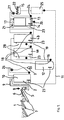
- Figure 1 shows an overview of the installation for the production of paper pulp according to the invention in a mode particular achievement.
- the invention relates to the field of pulp production used as a raw material in the paper industry.
- Pulp produced will not necessarily be paper pulp end products used to make the paper itself.
- the wood constituting the raw material usable according to the pulp production installation process described here could be of any type and in particular be made of recycled wood.
- the method according to the invention implements different steps in particular making it possible to greatly reduce the energy consumption of water and chemicals to achieve defibration and delignification.
- the impregnation liquid may consist of different manners and is usually formed of water with possible adjuvants chemicals such as sodium hydroxide or peroxide hydrogen.
- the function of the impregnating liquid 11 is to impregnate the wood or soak it so as to increase its volume and proceed to delignification.
- the refining operation carried out here has the advantage of being exothermic and allows the installation to be brought to a temperature of the order of 60 to 70 ° C without additional heat supply.
- a preparation is preferably carried out pieces of wood 1.
- the means of routing used may be constituted in different ways and in particular by treadmills 7 such as illustrated in figure 1.
- the time required to complete the impregnation is depending on the nature of the wood. This point can be troublesome for continuous production of dough used as raw material in the paper industry.
- the tanks 4a, 4b formed in parallel allow masked time work and impregnation and therefore continuous production.
- the refined mixture 12 is oriented, by means of a intermediate tank 16.
- the fibrous phase 13 is oriented above the liquid phase 14.
- the settling of foreign bodies has the advantage of not being conditioned by the character ferrous or not of these bodies.
- the spinning of the fibrous phase 13 makes it possible to obtain dry fibers, constituting the raw material commonly used for the production of the final paper pulp.
- the present invention also relates to an installation for the implementation of the process.
- This installation includes for mixing wood 1 with the impregnating liquid 11, a mixing tank 2.
- This tank 2 as illustrated in FIG. 1, can be commonly used like the other tanks used in the present installation.
- the wood is defibred by means of a refiner 3 receiving the mixture 10.
- a refiner 3 can be used.
- the impregnation requires variable working time and, to do this, the refined mixture 12 is received in at least one storage tank 4a, 4b.
- FIG 1 illustrates the realization of two storage tanks 4a, 4b placed in parallel and capable of alternately receiving the refined mixture 12. In this way, an impregnation is alternately achievable in both tanks for production continuous dough.
- the installation according to the invention comprises preferably an intermediate tank 16 orienting the mixture refined 12 to one or other of the storage tanks 4a, 4b.
- the intermediate tank 16 is therefore positioned at the outlet of the refiner 3 and is connected, at its outlet, to the two storage tanks 4a, 4b as presented in FIG. 1.
- the shredder 5 used may in particular be a refiner with discs. Further processing of the pieces of wood 1 can be carried out by means of a matchstick cutout 9 shown in Figure 1.
- These wood preparation means 1 allow obtaining wood chips of uniform size and reduced favoring their impregnation.
- the installation comprises downstream of the storage tanks 4a, 4b, a storage tank decantation 17.
- This tank 17 makes it possible to separate the fibrous phase 13 of the liquid phase 14 and residual foreign bodies such as presented in figure 1.
- the latter can receive pumping means 10 as illustrated in figure 1.
- a filter 21 will allow the retention of foreign bodies.
- the fibrous phase 13 can, for its part, be pumped towards a desiccator 22 to obtain dehydrated fibers 15. We can also, in this way, recover a part of the liquid impregnation 11.
- a doser 27 can be installed between the settling tank 17 and the desiccator 22.
- the impregnation liquid 11 recovered at the outlet of the desiccator 22 will preferably be received in a tank 25 before re-injecting it into the mixing tank 2.
- transfer means To carry out transfers between the different tanks that involves installation, transfer means will be used.
- mixing means 23 can be used.
- These mixing means 23 will be actuated at will in continuous or discontinuous depending on the nature of the desired mixture.
- the storage tanks 4a, 4b will include reinjection means 28 ensuring cooperation with the mixing means 22, to homogenize the refined mixture 12 stored in the tanks 4a, 4b.
- a metering device 26 can be used between the mixture 2 and the refiner 3 to regulate the flow in direction of the refiner 3.
- Figure 1 illustrates, in dotted lines, the transfer of the liquid impregnation 11 reinjected from the outlet of the desiccator 22 in the mixing tank 2.
- the invention allows a transfer of the mixture (10) between tanks without requiring valve or valve circuits who have the disadvantage of risking blocking the installation by accumulation of solid matter.
Landscapes
- Engineering & Computer Science (AREA)
- Chemical & Material Sciences (AREA)
- Chemical Kinetics & Catalysis (AREA)
- General Chemical & Material Sciences (AREA)
- Mechanical Engineering (AREA)
- Life Sciences & Earth Sciences (AREA)
- Wood Science & Technology (AREA)
- Paper (AREA)
Abstract
Description
- FR-A-2.406.022 qui présente un procédé pour la fabrication de papiers ou de cartons à partir de matériaux devant subir un défibrage pour fournir les éléments fibreux cellulosiques constitutifs des papiers et des cartons. Il comprend, préalablement au déchiquetage mécanique de ces matériaux, un traitement comprenant la réalisation d'une ou plusieurs étapes de mis sous vide profond des matériaux à déchiqueter ; l'introduction du liquide d'imprégnation dans au moins la première étape ou l'étape unique de mise sous vide profond, et éventuellement l'intercalation entre ces étapes et/ou après la dernière d'au moins une étape de mise sous pression, et le retour à la pression normale avant l'opération de déchiquetage mécanique.
- WO 94/18382 : qui présente un procédé de fabrication de pâtes à papier chimicothermomécaniques (CTMP), qui consiste tout d'abord, à tremper des copeaux de bois dans des réactifs chimiques ; à puis à défibrer mécaniquement ces copeaux (raffinage primaire) sous atmosphère de vapeur d'eau sous pression de sorte à obtenir une pâte brute ; et enfin à raffiner ladite pâte (raffinage secondaire) caractérisé en ce que pendant au moins une des deux heures de raffinage, on introduit de l'oxygène dans le milieu réactionnel comprenant lesdits copeaux ou ladite pâte brute.
- on mélange le bois avec un liquide d'imprégnation ;
- on raffine le mélange pour défibrer le bois ;
- on finalise l'imprégnation en cuve de stockage. Le mélange préalable au raffinage réduisant l'énergie nécessaire au défibrage, et l'importante surface de contact entre le bois et le liquide d'imprégnation produite par le défibrage optimisant la finalisation de l'imprégnation,
- une cuve de mélange du bois avec un liquide d'imprégnation,
- un raffineur recevant le mélange pour défibrer le bois,
- au moins une cuve de stockage recevant le mélange raffiné pour finaliser l'imprégnation.
- on déchiquette les morceaux de bois en copeaux
- on élimine les corps étrangers ferreux par aimantation
- on achemine les copeaux de bois jusqu'à une cuve de mélange du bois avec le liquide d'imprégnation.
- au moins un déchiqueteur transformant les morceaux de bois en copeaux ;
- au moins un dispositif magnétique pour la récupération des corps étrangers ferreux ;
- au moins un tapis roulant pour l'acheminement du bois vers la cuve de mélange.
- au moins deux cuves de stockage du mélange raffiné ;
- une cuve intermédiaire orientant le mélange raffiné vers l'une ou l'autre des cuves de stockage.
- de pompes ;
- de canalisations.
- on déchiquette les morceaux de bois 1 en copeaux ; cette opération prépare le bois et facilite la première étape d'imprégnation.
- on élimine les corps étrangers ferreux par aimantation.
- On achemine les copeaux de bois jusqu'à une cuve de mélange 2 du bois 1 avec le liquide d'imprégnation 11.
- on finalise l'imprégnation dans au moins deux cuves de stockage (Aa,4b) alimentées alternativement.
- un déchiqueteur 5 réalisant une transformation des morceaux de bois 1 en copeaux ;
- au moins un dispositif magnétique 6 pour la récupération des corps étrangers ferreux ;ce dispositif magnétique 6 pourra être constitué notamment par des moyens d'aimantation sous forme de bobine d'induction ;
- au moins un tapis roulant 7, comme illustré en figure 1, permettant l'acheminement du bois 1 vers la cuve de mélange 2.
- de pompes 18
- de canalisations 19
Claims (13)
- Procédé de production de pâtes utilisées comme matière première dans l'industrie du papier, à partir de morceau (1) de bois, notamment de recyclage, permettant le défibrage et la délignification du bois caractérisé par le fait qu'il comprend les étapes successives suivantes :pour la fabrication d'une pâte avec de faibles consommations en énergie, en adjuvants et en eau.on déchiquette les morceaux de bois (1) en copeauxon mélange le bois (1) avec un liquide d'imprégnation (11) ;on raffine le mélange (10) pour défibrer le bois (1) ;on finalise l'imprégnation en cuve de stockage (4a,4b), le mélange préalable au raffinage réduisant l'énergie nécessaire au défibrage, et l'importante surface de contact entre le bois (1) et le liquide d'imprégnation (11) produite par le défibrage optimisant la finalisation de l'imprégnation,
- Procédé selon la revendication 1 caractérisé par le fait qu'avant le mélange :on élimine les corps étrangers ferreux par aimantationon achemine les copeaux de bois jusqu'à une cuve de mélange (2) du bois (1) avec le liquide d'imprégnation (11)
- Procédé selon l'une quelconque des revendications 1 ou 2 caractérisé par le faitqu'on finalise l'imprégnation dans au moins deux cuves de stockage (4a,4b) alimentées alternativement,qu'on oriente le mélange raffiné (12) vers l'une ou l'autre des cuves de stockage (4a,4b) par le biais d'une cuve intermédiaire (16).
- Procédé selon l'une quelconque des revendications 1 à 3 caractérisé par le fait
qu'en fin d'imprégnation, on réalise une décantation afin de séparer la phase fibreuse (13) de la phase liquide (14) et des corps étrangers résiduels. - Procédé selon l'une quelconque des revendications 1 à 4 caractérisé par le fait
qu'on essore la matière fibreuse(13) produite pour l'assécher et on récupère le liquide réinjectable comme liquide d'imprégnation. - Installation pour la mise en oeuvre du procédé selon l'une quelconque des revendications 1 à 5 caractérisée par le fait
qu'elle présente :une cuve de mélange (2) du bois (1) avec un liquide d'imprégnation (11),au moins un déchiqueteur (5) transformant les morceaux de bois (1) en copeaux, en amont de la cuve de mélange (2) ;un raffineur (3) recevant le mélange (10) pour défibrer le bois (1),au moins une cuve de stockage 4a,4b) recevant le mélange raffiné (12) pour finaliser l'imprégnation. - Installation pour la mise en oeuvre du procédé selon la revendication 6 caractérisée par le fait
qu'elle comprend en amont de la cuve de mélange (2)au moins un dispositif magnétique (6) pour la récupération des corps étrangers ferreuxau moins un tapis roulant (7) pour l'acheminement du bois (1) vers la cuve de mélange (2). - Installation pour la mise en oeuvre du procédé selon l'une quelconque des revendications 6 et 7 caractérisée par le fait
qu'elle présenteau moins deux cuves de stockage (4a,4b) du mélange raffiné (12)une cuve intermédiaire (16) orientant le mélange raffiné (12) vers l'une ou l'autre des cuves (4a,4b) de stockage. - Installation pour la mise en oeuvre du procédé selon l'une quelconque des revendications 6 à 8 caractérisée par le fait
qu'elle comprend, en aval des cuves de stockage (4a,4b), une cuve de décantation (17) permettant de séparer la phase fibreuse (13) de la phase liquide (14) et des corps étrangers résiduels. - Installation pour la mise en oeuvre du procédé selon l'une quelconque des revendications 6 à 9 caractérisée par le fait
que le mélange (12) est transporté entre les différentes cuves par des moyens de transfert composés :de pompes (18) ;de canalisations (19)évitant l'utilisation de valves et les risques de bouchage des canalisations(19). - Installation pour la mise en oeuvre du procédé selon la revendication 9 caractérisée par le fait
que le fond de la cuve de décantation (17) reçoit des moyens de pompage (20) aptes à évacuer la phase liquide (14) et les corps étrangers résiduels décantés. - Installation pour la mise en oeuvre du procédé selon l'une quelconque des revendications 6 à 11 caractérisée par le fait
que la phase fibreuse (13) obtenue dans la cuve de décantation (17) est pompée vers un dessiccateur (22) pour obtenir les fibres déshydratées (15) et récupérer une part du liquide d'imprégnation. - Installation pour la mise en oeuvre du procédé selon l'une quelconque des revendications 6 à 12 caractérisée par le fait
que les cuves (2, 4a, 4b, 16, 17) comportent des moyens de mélange (23) en continu ou en discontinu de leur contenu.
Applications Claiming Priority (2)
| Application Number | Priority Date | Filing Date | Title |
|---|---|---|---|
| FR9814326A FR2785917B1 (fr) | 1998-11-16 | 1998-11-16 | Procede et installation de production de pates a papier |
| FR9814326 | 1998-11-16 |
Publications (2)
| Publication Number | Publication Date |
|---|---|
| EP1001076A1 true EP1001076A1 (fr) | 2000-05-17 |
| EP1001076B1 EP1001076B1 (fr) | 2006-04-26 |
Family
ID=9532738
Family Applications (1)
| Application Number | Title | Priority Date | Filing Date |
|---|---|---|---|
| EP99480116A Expired - Lifetime EP1001076B1 (fr) | 1998-11-16 | 1999-11-12 | Procédé et installation de production de pâtes à papier |
Country Status (4)
| Country | Link |
|---|---|
| EP (1) | EP1001076B1 (fr) |
| AT (1) | ATE324483T1 (fr) |
| DE (1) | DE69931007T2 (fr) |
| FR (1) | FR2785917B1 (fr) |
Cited By (2)
| Publication number | Priority date | Publication date | Assignee | Title |
|---|---|---|---|---|
| CN101929087A (zh) * | 2009-08-04 | 2010-12-29 | 江苏华机环保设备有限责任公司 | 蔗渣高效除杂工艺 |
| CN109914137A (zh) * | 2019-04-18 | 2019-06-21 | 丹东东方轻工机械有限公司 | 自然纤维类植物原料制浆浸渍备料系统 |
Citations (3)
| Publication number | Priority date | Publication date | Assignee | Title |
|---|---|---|---|---|
| SU979554A1 (ru) * | 1981-06-30 | 1982-12-07 | Центральный научно-исследовательский институт бумаги | Способ получени древесной массы |
| EP0181028A2 (fr) * | 1984-11-09 | 1986-05-14 | SICEM - SAGA S.p.A. | Dispositif et procédé pour produire des pâtes de bois chimio-mécaniques brutes ou blanchies par un procédé continu d'imprégnation |
| US4900399A (en) * | 1985-03-13 | 1990-02-13 | Eka Ab | Method of manufacturing bleached chemi-mechanical and semichemical fibre pulp by a two-stage impregnation process |
Family Cites Families (4)
| Publication number | Priority date | Publication date | Assignee | Title |
|---|---|---|---|---|
| GB1016872A (en) * | 1961-07-14 | 1966-01-12 | Defibrator Ab | Improvements in and relating to production of chips from cellulose and similar materials |
| US3273807A (en) * | 1963-08-05 | 1966-09-20 | Bauer Bros Co | Refiner system |
| US3597310A (en) * | 1966-04-25 | 1971-08-03 | Kokusaku Pulp Ind Co Ltd | Method of producing high yield pulp by disc refining at ph of 12 to 14 |
| US3873412A (en) * | 1974-04-01 | 1975-03-25 | Bauer Bros Co | Mechanically refining a mixture of kraft and semichemical pulp |
-
1998
- 1998-11-16 FR FR9814326A patent/FR2785917B1/fr not_active Expired - Fee Related
-
1999
- 1999-11-12 DE DE69931007T patent/DE69931007T2/de not_active Expired - Lifetime
- 1999-11-12 AT AT99480116T patent/ATE324483T1/de not_active IP Right Cessation
- 1999-11-12 EP EP99480116A patent/EP1001076B1/fr not_active Expired - Lifetime
Patent Citations (3)
| Publication number | Priority date | Publication date | Assignee | Title |
|---|---|---|---|---|
| SU979554A1 (ru) * | 1981-06-30 | 1982-12-07 | Центральный научно-исследовательский институт бумаги | Способ получени древесной массы |
| EP0181028A2 (fr) * | 1984-11-09 | 1986-05-14 | SICEM - SAGA S.p.A. | Dispositif et procédé pour produire des pâtes de bois chimio-mécaniques brutes ou blanchies par un procédé continu d'imprégnation |
| US4900399A (en) * | 1985-03-13 | 1990-02-13 | Eka Ab | Method of manufacturing bleached chemi-mechanical and semichemical fibre pulp by a two-stage impregnation process |
Non-Patent Citations (1)
| Title |
|---|
| DATABASE WPI Section Ch Week 8340, Derwent World Patents Index; Class F09, AN 83-781803, XP002114298 * |
Cited By (4)
| Publication number | Priority date | Publication date | Assignee | Title |
|---|---|---|---|---|
| CN101929087A (zh) * | 2009-08-04 | 2010-12-29 | 江苏华机环保设备有限责任公司 | 蔗渣高效除杂工艺 |
| CN101929087B (zh) * | 2009-08-04 | 2013-02-20 | 江苏华机环保设备有限责任公司 | 蔗渣高效除杂工艺 |
| CN109914137A (zh) * | 2019-04-18 | 2019-06-21 | 丹东东方轻工机械有限公司 | 自然纤维类植物原料制浆浸渍备料系统 |
| CN109914137B (zh) * | 2019-04-18 | 2023-09-15 | 丹东东方轻工机械有限公司 | 自然纤维类植物原料制浆浸渍备料系统的使用方法 |
Also Published As
| Publication number | Publication date |
|---|---|
| DE69931007T2 (de) | 2006-11-30 |
| ATE324483T1 (de) | 2006-05-15 |
| FR2785917B1 (fr) | 2001-01-12 |
| EP1001076B1 (fr) | 2006-04-26 |
| DE69931007D1 (de) | 2006-06-01 |
| FR2785917A1 (fr) | 2000-05-19 |
Similar Documents
| Publication | Publication Date | Title |
|---|---|---|
| EP0336842B1 (fr) | Procédé pour la fabrication d'une pâte à papier à usage fiduciaire | |
| JP5759384B2 (ja) | プロセス反応器への物質の送込み方法および装置 | |
| CN106929117A (zh) | 产生颗粒或压块的方法 | |
| CA3047963A1 (fr) | Procede de traitement de biomasse ligno-cellulosique | |
| EP3565868B1 (fr) | Procédé et dispositif de production de produits énergétiques par craquage catalytique d'un matériau solide hydrocarboné sans formation de coke | |
| FR3003181A1 (fr) | Procede et installation d'extraction de produits biologiques par micro-ondes. | |
| EP0092478A1 (fr) | Procédé et dispositif d'hydrolyse d'une matière cellulosique | |
| WO2020089187A1 (fr) | Procede de fabrication en continu d'une matiere combustible pour chaudiere industrielle, matiere et installation correspondantes | |
| FR2550550A1 (fr) | Procede pour hydrolyser sans acide de la biomasse lignocellulosique | |
| EP3899001A1 (fr) | Procédé de nettoyage d'un réacteur de traitement d'une biomasse lignocellulosique | |
| FR2575198A1 (fr) | Procede de fabrication de pate de cellulose | |
| EP1001076B1 (fr) | Procédé et installation de production de pâtes à papier | |
| JP2000515205A (ja) | 特に廃紙を含んだ木材パルプをブリーチ処理する方法及び装置 | |
| EP4444827A1 (fr) | Procédé d'extrusion de granulés de bois, extrudeuse bi-vis corotative pour l'extrusion de granulés de bois, et granulés de bois correspondants | |
| FR2885371A1 (fr) | Installation pour la mise en oeuvre d'un procede de production de pate a papier, de lignines et de sucres et procede de production au moyen d'une telle installation | |
| AU2022304349B2 (en) | Solid fuel production system and solid fuel production method | |
| FR2544757A1 (fr) | Procede et appareil de digestion pour la production de pulpe de haute qualite | |
| EP0991808A1 (fr) | Procede et installation de preparation en continu d'une pate a papier a partir de fibres textiles lignocellulosiques | |
| WO2023175269A1 (fr) | Procédé et installation de traitement de déchets de panneaux de fibres de bois et panneau fabriqué à partir de telles fibres recyclables | |
| EP0698681A1 (fr) | Procédé de démoellage de plantes à moelle, en particulier sorgho | |
| FR2465026A1 (fr) | Procede pour reduire la teneur en resine pendant la preparation de pates de cellulose provenant de matieres lignocellulosiques et appareil pour sa mise en oeuvre | |
| FR2594135A1 (fr) | Procede de carbonisation de matieres ligno-cellulosiques et dispositif pour sa mise en oeuvre | |
| WO2020104767A1 (fr) | Presse améliorée | |
| EP0722010A1 (fr) | Procédé de blanchiment d'une poudre végétale micronisée | |
| FR2801326A1 (fr) | Pulpeur destine au defibrage de matieres premieres du type papiers, cartons ou celluloses, et installation pour la remise en pate de vieux papiers mettant en oeuvre le pulpeur |
Legal Events
| Date | Code | Title | Description |
|---|---|---|---|
| PUAI | Public reference made under article 153(3) epc to a published international application that has entered the european phase |
Free format text: ORIGINAL CODE: 0009012 |
|
| AK | Designated contracting states |
Kind code of ref document: A1 Designated state(s): AT BE CH CY DE DK ES FI FR GB GR IE IT LI LU MC NL PT SE |
|
| AX | Request for extension of the european patent |
Free format text: AL;LT;LV;MK;RO;SI |
|
| 17P | Request for examination filed |
Effective date: 20000913 |
|
| AKX | Designation fees paid |
Free format text: AT BE CH CY DE DK ES FI FR GB GR IE IT LI LU MC NL PT SE |
|
| RAP1 | Party data changed (applicant data changed or rights of an application transferred) |
Owner name: SICEM SAGA SPA |
|
| 17Q | First examination report despatched |
Effective date: 20031021 |
|
| GRAP | Despatch of communication of intention to grant a patent |
Free format text: ORIGINAL CODE: EPIDOSNIGR1 |
|
| GRAS | Grant fee paid |
Free format text: ORIGINAL CODE: EPIDOSNIGR3 |
|
| GRAA | (expected) grant |
Free format text: ORIGINAL CODE: 0009210 |
|
| AK | Designated contracting states |
Kind code of ref document: B1 Designated state(s): AT BE CH CY DE DK ES FI FR GB GR IE IT LI LU MC NL PT SE |
|
| PG25 | Lapsed in a contracting state [announced via postgrant information from national office to epo] |
Ref country code: NL Free format text: LAPSE BECAUSE OF FAILURE TO SUBMIT A TRANSLATION OF THE DESCRIPTION OR TO PAY THE FEE WITHIN THE PRESCRIBED TIME-LIMIT Effective date: 20060426 Ref country code: IT Free format text: LAPSE BECAUSE OF FAILURE TO SUBMIT A TRANSLATION OF THE DESCRIPTION OR TO PAY THE FEE WITHIN THE PRESCRIBED TIME-LIMIT;WARNING: LAPSES OF ITALIAN PATENTS WITH EFFECTIVE DATE BEFORE 2007 MAY HAVE OCCURRED AT ANY TIME BEFORE 2007. THE CORRECT EFFECTIVE DATE MAY BE DIFFERENT FROM THE ONE RECORDED. Effective date: 20060426 Ref country code: IE Free format text: LAPSE BECAUSE OF FAILURE TO SUBMIT A TRANSLATION OF THE DESCRIPTION OR TO PAY THE FEE WITHIN THE PRESCRIBED TIME-LIMIT Effective date: 20060426 Ref country code: GB Free format text: LAPSE BECAUSE OF FAILURE TO SUBMIT A TRANSLATION OF THE DESCRIPTION OR TO PAY THE FEE WITHIN THE PRESCRIBED TIME-LIMIT Effective date: 20060426 Ref country code: FI Free format text: LAPSE BECAUSE OF FAILURE TO SUBMIT A TRANSLATION OF THE DESCRIPTION OR TO PAY THE FEE WITHIN THE PRESCRIBED TIME-LIMIT Effective date: 20060426 Ref country code: AT Free format text: LAPSE BECAUSE OF FAILURE TO SUBMIT A TRANSLATION OF THE DESCRIPTION OR TO PAY THE FEE WITHIN THE PRESCRIBED TIME-LIMIT Effective date: 20060426 |
|
| REG | Reference to a national code |
Ref country code: GB Ref legal event code: FG4D Free format text: NOT ENGLISH |
|
| REG | Reference to a national code |
Ref country code: IE Ref legal event code: FG4D Free format text: LANGUAGE OF EP DOCUMENT: FRENCH |
|
| REF | Corresponds to: |
Ref document number: 69931007 Country of ref document: DE Date of ref document: 20060601 Kind code of ref document: P |
|
| PG25 | Lapsed in a contracting state [announced via postgrant information from national office to epo] |
Ref country code: SE Free format text: LAPSE BECAUSE OF FAILURE TO SUBMIT A TRANSLATION OF THE DESCRIPTION OR TO PAY THE FEE WITHIN THE PRESCRIBED TIME-LIMIT Effective date: 20060726 Ref country code: DK Free format text: LAPSE BECAUSE OF FAILURE TO SUBMIT A TRANSLATION OF THE DESCRIPTION OR TO PAY THE FEE WITHIN THE PRESCRIBED TIME-LIMIT Effective date: 20060726 |
|
| PG25 | Lapsed in a contracting state [announced via postgrant information from national office to epo] |
Ref country code: ES Free format text: LAPSE BECAUSE OF FAILURE TO SUBMIT A TRANSLATION OF THE DESCRIPTION OR TO PAY THE FEE WITHIN THE PRESCRIBED TIME-LIMIT Effective date: 20060806 |
|
| PG25 | Lapsed in a contracting state [announced via postgrant information from national office to epo] |
Ref country code: PT Free format text: LAPSE BECAUSE OF FAILURE TO SUBMIT A TRANSLATION OF THE DESCRIPTION OR TO PAY THE FEE WITHIN THE PRESCRIBED TIME-LIMIT Effective date: 20060926 |
|
| NLV1 | Nl: lapsed or annulled due to failure to fulfill the requirements of art. 29p and 29m of the patents act | ||
| REG | Reference to a national code |
Ref country code: IE Ref legal event code: FD4D |
|
| GBV | Gb: ep patent (uk) treated as always having been void in accordance with gb section 77(7)/1977 [no translation filed] |
Effective date: 20060426 |
|
| PG25 | Lapsed in a contracting state [announced via postgrant information from national office to epo] |
Ref country code: MC Free format text: LAPSE BECAUSE OF NON-PAYMENT OF DUE FEES Effective date: 20061130 Ref country code: LI Free format text: LAPSE BECAUSE OF NON-PAYMENT OF DUE FEES Effective date: 20061130 Ref country code: CH Free format text: LAPSE BECAUSE OF NON-PAYMENT OF DUE FEES Effective date: 20061130 Ref country code: BE Free format text: LAPSE BECAUSE OF NON-PAYMENT OF DUE FEES Effective date: 20061130 |
|
| PLBE | No opposition filed within time limit |
Free format text: ORIGINAL CODE: 0009261 |
|
| STAA | Information on the status of an ep patent application or granted ep patent |
Free format text: STATUS: NO OPPOSITION FILED WITHIN TIME LIMIT |
|
| 26N | No opposition filed |
Effective date: 20070129 |
|
| REG | Reference to a national code |
Ref country code: CH Ref legal event code: PL |
|
| BERE | Be: lapsed |
Owner name: SICEM SAGA S.P.A. Effective date: 20061130 |
|
| PG25 | Lapsed in a contracting state [announced via postgrant information from national office to epo] |
Ref country code: GR Free format text: LAPSE BECAUSE OF FAILURE TO SUBMIT A TRANSLATION OF THE DESCRIPTION OR TO PAY THE FEE WITHIN THE PRESCRIBED TIME-LIMIT Effective date: 20060727 |
|
| PG25 | Lapsed in a contracting state [announced via postgrant information from national office to epo] |
Ref country code: LU Free format text: LAPSE BECAUSE OF NON-PAYMENT OF DUE FEES Effective date: 20061112 |
|
| PG25 | Lapsed in a contracting state [announced via postgrant information from national office to epo] |
Ref country code: CY Free format text: LAPSE BECAUSE OF FAILURE TO SUBMIT A TRANSLATION OF THE DESCRIPTION OR TO PAY THE FEE WITHIN THE PRESCRIBED TIME-LIMIT Effective date: 20060426 |
|
| PGFP | Annual fee paid to national office [announced via postgrant information from national office to epo] |
Ref country code: DE Payment date: 20121107 Year of fee payment: 14 |
|
| REG | Reference to a national code |
Ref country code: DE Ref legal event code: R119 Ref document number: 69931007 Country of ref document: DE Effective date: 20140603 |
|
| PG25 | Lapsed in a contracting state [announced via postgrant information from national office to epo] |
Ref country code: DE Free format text: LAPSE BECAUSE OF NON-PAYMENT OF DUE FEES Effective date: 20140603 |
|
| REG | Reference to a national code |
Ref country code: FR Ref legal event code: PLFP Year of fee payment: 17 |
|
| PGFP | Annual fee paid to national office [announced via postgrant information from national office to epo] |
Ref country code: FR Payment date: 20151126 Year of fee payment: 17 |
|
| REG | Reference to a national code |
Ref country code: FR Ref legal event code: ST Effective date: 20170731 |
|
| PG25 | Lapsed in a contracting state [announced via postgrant information from national office to epo] |
Ref country code: FR Free format text: LAPSE BECAUSE OF NON-PAYMENT OF DUE FEES Effective date: 20161130 |