EP1001175A2 - Axial verschiebbare unverlierbare Schraube - Google Patents
Axial verschiebbare unverlierbare Schraube Download PDFInfo
- Publication number
- EP1001175A2 EP1001175A2 EP99121974A EP99121974A EP1001175A2 EP 1001175 A2 EP1001175 A2 EP 1001175A2 EP 99121974 A EP99121974 A EP 99121974A EP 99121974 A EP99121974 A EP 99121974A EP 1001175 A2 EP1001175 A2 EP 1001175A2
- Authority
- EP
- European Patent Office
- Prior art keywords
- passage
- shaft
- head
- screw
- cylindrical
- Prior art date
- Legal status (The legal status is an assumption and is not a legal conclusion. Google has not performed a legal analysis and makes no representation as to the accuracy of the status listed.)
- Withdrawn
Links
Images


Classifications
-
- F—MECHANICAL ENGINEERING; LIGHTING; HEATING; WEAPONS; BLASTING
- F16—ENGINEERING ELEMENTS AND UNITS; GENERAL MEASURES FOR PRODUCING AND MAINTAINING EFFECTIVE FUNCTIONING OF MACHINES OR INSTALLATIONS; THERMAL INSULATION IN GENERAL
- F16B—DEVICES FOR FASTENING OR SECURING CONSTRUCTIONAL ELEMENTS OR MACHINE PARTS TOGETHER, e.g. NAILS, BOLTS, CIRCLIPS, CLAMPS, CLIPS OR WEDGES; JOINTS OR JOINTING
- F16B5/00—Joining sheets or plates, e.g. panels, to one another or to strips or bars parallel to them
- F16B5/02—Joining sheets or plates, e.g. panels, to one another or to strips or bars parallel to them by means of fastening members using screw-thread
-
- F—MECHANICAL ENGINEERING; LIGHTING; HEATING; WEAPONS; BLASTING
- F16—ENGINEERING ELEMENTS AND UNITS; GENERAL MEASURES FOR PRODUCING AND MAINTAINING EFFECTIVE FUNCTIONING OF MACHINES OR INSTALLATIONS; THERMAL INSULATION IN GENERAL
- F16B—DEVICES FOR FASTENING OR SECURING CONSTRUCTIONAL ELEMENTS OR MACHINE PARTS TOGETHER, e.g. NAILS, BOLTS, CIRCLIPS, CLAMPS, CLIPS OR WEDGES; JOINTS OR JOINTING
- F16B2200/00—Constructional details of connections not covered for in other groups of this subclass
- F16B2200/40—Clamping arrangements where clamping parts are received in recesses of elements to be connected
- F16B2200/403—Threaded clamping parts
-
- F—MECHANICAL ENGINEERING; LIGHTING; HEATING; WEAPONS; BLASTING
- F16—ENGINEERING ELEMENTS AND UNITS; GENERAL MEASURES FOR PRODUCING AND MAINTAINING EFFECTIVE FUNCTIONING OF MACHINES OR INSTALLATIONS; THERMAL INSULATION IN GENERAL
- F16B—DEVICES FOR FASTENING OR SECURING CONSTRUCTIONAL ELEMENTS OR MACHINE PARTS TOGETHER, e.g. NAILS, BOLTS, CIRCLIPS, CLAMPS, CLIPS OR WEDGES; JOINTS OR JOINTING
- F16B2200/00—Constructional details of connections not covered for in other groups of this subclass
- F16B2200/40—Clamping arrangements where clamping parts are received in recesses of elements to be connected
- F16B2200/406—Clamping parts being collars, bushings or wedges
-
- Y—GENERAL TAGGING OF NEW TECHNOLOGICAL DEVELOPMENTS; GENERAL TAGGING OF CROSS-SECTIONAL TECHNOLOGIES SPANNING OVER SEVERAL SECTIONS OF THE IPC; TECHNICAL SUBJECTS COVERED BY FORMER USPC CROSS-REFERENCE ART COLLECTIONS [XRACs] AND DIGESTS
- Y10—TECHNICAL SUBJECTS COVERED BY FORMER USPC
- Y10T—TECHNICAL SUBJECTS COVERED BY FORMER US CLASSIFICATION
- Y10T403/00—Joints and connections
- Y10T403/16—Joints and connections with adjunctive protector, broken parts retainer, repair, assembly or disassembly feature
- Y10T403/1608—Holding means or protector functioning only during transportation, assembly or disassembly
Definitions
- This invention relates to captivated jackscrews, and, more particularly, to a new, more rugged and improved captivated jackscrew design.
- Mating or connecting two metal panels or frames together is easily accomplished with standard fastener's, such as machine screws.
- one of the panels includes a clearance hole which allows the machine screw's threaded shaft to pass through, but not the screw head. The screw is then screwed into an associated threaded hole formed in the second panel.
- Another elementary alternative to the foregoing is the conventional bolt and nut arrangement. The bolt is extended through drilled clearance holes in the two metal panels and a threaded nut is threaded onto the bolt shaft and tightened, compressing the panels between the bolt head and the nut.
- the captivated jack screw was designed to avoid the problem of separating metal sheets where such circumstances are anticipated.
- the conventional jackscrew which the present invention improves upon, includes a narrow slot peripherally extending about the screw's shaft, a reduced diameter shaft portion in the machine screw's shaft, located at an axial position below the screw's head, typically by a distance equal to the thickness of the panel, and an E-clip, a somewhat U-shaped flat spring steel member that fits into that reduced diameter slot.
- the machine screw's shaft is extended through the hole in the panel member, leaving the screw's head on one side of the panel, unable to pass through the hole, and positioning the narrow slot on the other side of the panel member.
- the e-clip is forced into place laterally in the narrow slot, its arms, under the spring force, gripping the shaft.
- the e-clip is larger in size than the panel's screw hole. Hence, the clip prevents the machine screw from being withdrawn from the hole. In effect, the screw is captured on the panel, and cannot fall off. Further, the e-clip does not prevent rotational movement of the screw shaft, the shaft and e-clips may rotate as a set within the panel or independently. With the screw thus captured, using a machine screw driver, the screw's threaded shaft is screwed into the threaded hole in the second panel. When the screw is tightened, the two panels are fastened together with the sides of the e-clip in between and generally located in a small recess in either panel. The clip does not contact either panel when the two are fastened together.
- the machine screw is turned in the opposite direction than before, counterclockwise, for example, withdrawing the screw from its mating threaded hole in the second panel.
- the shaft in turn moves the reduced diameter portion in which the e-clip is fixed, but permitting clip rotation, and, hence, also carries the e-clip axially out with the shaft. Since one side of the clip abuts the underside of the first panel, the clip, which is fixed in axial position on the screw shaft, is forced by the screw shaft to push the first panel away from the second.
- the screw type jack used to raise a home off its foundation easily recognize that in separating the two panels, the foregoing screw and e-clip structure forms a jack arrangement, wherein the side of the e-clip serves as the jack's table.
- the screw type jack obtains a mechanical advantage, multiplying the smaller torque required to rotate the screw threads to a larger force exerted along the axis of the screw shaft. Ideally such a force breaks any naturally formed binding between the panels. In reality its functionality is limited.
- Captivated jackscrews have served in many applications.
- the foregoing description describes one example of the captivated jack screw's use in connecting two panels, it also serves to mate or join mating male and female multi-contact electrical connectors and to de-mate those connectors.
- multi-contact electrical connectors are used to join the many electrical wires within an electrical cable or on one electrical component to a mating electrical connector on electrical equipment, placing the wires into the proper electrical circuits within the equipment.
- Those connectors are typically fastened together with clips or screws, and some of the latter may be captivated jack screws.
- the female contacts in a connector are designed to grip the associated male contacts of the other connector with a significant force. With large numbers of such contacts the total force required is quite large. This gripping action produces a binding between the mating connectors. Thus, great force is required both to mate or fully insert one connector into its mate and, later, to de-mate or separate the connectors. With the captivated jackscrew arrangement, unscrewing the machine screw pushes one connector away from the mating connector to perform de-mating disconnection, minimizing the user's effort. This feature is particularly helpful if the connectors are located in places that are difficult to access or difficult to grip by hand, and especially in applications in which mating and de-mating of the connectors is required frequently.
- the e-clip and necked machine screw design attains a functional limit as a jack when the binding forces are quite large.
- the "necked" design for the machine screw in which the screw shaft is modified to contain a constricted diameter portion weakens the screw shaft. Inadvertently exceeding the torque applied to the screw during the jacking operation could break the shaft and cause an expensive and time consuming on-site repair. More likely, the overly great forces applied to the sides of the e-clip during the jacking operation causes this thin spring steel member to twist and distort its geometry, withdrawing the ends thereof from the neck in the machine screw holding the e-clip in place on the screw. With those gripping ends released, the e-clip comes free. Once released from the fastener shaft, it may be exceedingly difficult to separate the two panels.
- the present invention does not employ such frail clips and is able to handle greater torques than the foregoing e-clip design. It also avoids the necessity of necking the machine screw and weakening the screw shaft, making use instead of a standard, unmodified fastener.
- a principal object of the invention is to provide a more rugged and reliable captivated jackscrew design, one that can handle greater loads than existing e-clip designs.
- a further object of the invention is to provide a captivated jackscrew design that uses a standard fastener, such as a machine screw, avoiding the necessity for "necked" screws and concomitant weakening of the machine screw shaft.
- the novel captivated jackscrew of the present invention is characterized by the formation of an internal cavity within one of the two bodies that are to be connected together and an access passage to that cavity; one end of the cavity, located at one end of the body is open, and the access passage extends through the other end of the body into the other end of that cavity.
- a standard machine screw is installed head first within the cavity, with the screw shaft, being of greater length than the cavity, protruding from the end of the body.
- a barrier is provided to prevent withdrawal of the machine screw head, but permit the screw head and shaft to move a limited distance axially.
- the screw head is oriented in the cavity to permit a screw driver, such as an Allen wrench, to access the screw head through the access passage.
- a screw driver such as an Allen wrench
- the screw shaft being greater in length than the access passage, is positioned extending through and beyond the end of the access passage; and driver access to the machine screw head is provided through the barrier.
- a portion of the internal cavity walls contains a screw thread and the barrier is of a cylindrical shape containing mating screw threads along the outer wall and a central passage there through. The diameter of that central passage is smaller than the head of the machine screw. The barrier is thus screwed into place plugging the open end of the cavity and "captivating" or preventing withdrawal of the screw head.
- a backstop is included in the cavity adjacent the end containing the access passage.
- the backstop prevents the machine screw head from rubbing directly against the body, particularly the end wall of the cavity.
- the system includes a cap head type screw 1 of conventional structure that contains a head 3 and a threaded shaft 5; a barrier or, as alternatively termed, insert member 7; and a backstop member 9, all of which are of metal, as example stainless steel.
- the foregoing components are illustrated in the relationship with which they are to be assembled together and incorporated within one of the two metal bodies or structures intended to be fastened or connected together, later herein described.
- the screw shaft extends through an axial passage in insert member 7.
- the left end of the insert member contains a pair of notches or slots 6 and 8, extending in line diametrically across the member's end, which assist to thread the insert member into a threaded hole in one of those bodies, as later herein described.
- the central cylindrical passage 10 formed axially through insert member 7 is larger in diameter than machine screw shaft 5, permitting the shaft to easily slip through the passage.
- that passage is smaller in diameter or size than machine screw head 3, which is blocked from passing through the passage, the right end of the insert member serving as an abutment or barrier.
- Backstop member 9 is essentially a hollow cylinder, resembling an inverted bowl or cup with a hole in the bottom.
- the cylinder is open at one end and partially closed at the opposite end by a washer shaped wall 11.
- the latter wall includes a central circular opening 12.
- the front edge 13 of the backstop member defines a circular rim and serves as an abutment.
- the outer diameter of backstop member 9 is less than the diameter of insert member 7.
- cylindrical passage 12 is slightly greater than the six sided hexagonal notch recessed in the upper surface of the machine screw 3, and, for greater versatility later herein discussed in connection with an alternative embodiment, is, preferably, larger in diameter than shaft 5.
- Passage 12 allows a hex head wrench to access head 3 in order to rotate the machine screw 1.
- Fig. 4 illustrating a metal frame structure 16, which is an example of the structure that employs one or more of the fasteners. That frame structure forms a framework that, as example, supports multiple electronic circuit boards, not illustrated, and multiple electronic connectors, not illustrated.
- Frame structure 16 includes three parallel extending spaced frame members 18, 20 and 22 and a bottom cross bar 24 along one side. Electrical connectors are supported on an attached circuit board near the cross bar with their contacts facing the same direction as the ends of frame members 18, 20 and 22. Frame structure 16 is to be attached at a right angle to another metal frame member, not illustrated, essentially making an "edge" connection.
- frame member 16 incorporates the captivated jackscrew system, including the elements presented in Figs. 1-3.
- each leg 16, 20 and 22 includes at the outer end one of the captivated jackscrew systems.
- machine screw 1 projects from leg 20; and corresponding machine screws 1' and 1'' project from legs 18 and 22, respectively.
- the second frame member not illustrated, contains tapped holes in the frame member that are aligned with the foregoing machine screws.
- the second frame member also contains mating electrical connectors that are to mate with those electrical connectors on frame 16 and also supports one or more electrical circuit boards, some times referred to as the "mother board". When the two frames are connected together the electrical connectors mate and interconnect the electrical circuits.
- Fig. 5 presents an exploded view of one of the jackscrew elements earlier described.
- the end of leg 20 contains a cylindrical cavity 15 containing a screw thread on the inner cylindrical wall. That cavity is large enough in diameter and deep enough to receive both backstop member 9 and insert member 7, with the head of machine screw 1 captured there between.
- backstop member 9 is dropped into cavity 15, and screw 1 is placed through the central opening in insert member 7.
- the insert member is rotated or screwed into place within the threaded cavity, suitably until stopped by the backstop, member 9, as the insert touches surface 13.
- the insert will be flush with the surface of leg 20 or recessed slightly within the leg, the exact position not being critical.
- member 7 is accomplished by inserting a screwdriver into one of the slots 6 and 8, illustrated in Fig. 2, or by a specially constructed key containing two spaced prongs that fit within the respective notches.
- a screwdriver into one of the slots 6 and 8, illustrated in Fig. 2, or by a specially constructed key containing two spaced prongs that fit within the respective notches.
- the length of the screw shaft 5 is greater than the height of the internal cavity 15, a portion of the machine screw's threaded shaft 5 extends out of the end of the insert member 7, such as was shown in Fig. 4.
- leg 20 The particular details of the internal cavity and other structure within leg 20 is better illustrated in the section view of the leg end drawn in a slightly larger scale presented in Fig. 6 to which reference is made.
- cavity 15 contains threads 14 along the bottom portion of the cavity height or, as variously termed, length, essentially to a depth within the cavity that is sufficient to permit insert member 7 to be fully installed.
- a narrow cylindrical passage 17, referred to as an access passage, formed within the leg 20 opens into the closed end of cavity 15 and is coaxial therewith. That passage extends in a straight line to the other end of the leg.
- a machine screw driver such as a hex head wrench with a long shaft, can be inserted into this passage for driving connection with the head of the machine screw as hereinafter described in greater detail.
- Fig. 7 illustrating in section the foregoing captivated jackscrew system connecting one structure, partially illustrated, which may represent leg 20 and associated frame work earlier illustrated in Fig. 4 or any other metal body, to a second metal body 21.
- insert member 7 is screwed into place in the threaded cavity 15 and on one side abuts an end edge of backstop member 9, essentially forming a smaller cavity within cavity 15 that confines the head 3 of machine screw 1.
- the machine screw is captured with a portion of shaft 5 extending from the end of body 20. Placing body 20 in proper alignment so that screw shaft 5 is coaxial with the tapped hole in the second body 21, screw 1 is screwed into body 21 and tightened.
- the latter is accomplished by inserting a hex head torque wrench of the appropriate shaft length through passage 17, and through the hole 12 in the end of backstop member 11, into engagement with socket formed in head 3, and turning the wrench clockwise.
- the threads in the tapped hole applies force that extends through screw shaft 5 to the machine screw head 3 and through that head, imposes a downward force on insert 7.
- the insert couples that force through the threads into a downward force on body 20 to press the end of body 20 against, or in the direction of, the surface of the second body 21. In that way the two bodies are essentially mechanically connected together.
- the two bodies are shown to be in contact. However, it is realized that actual contact is not necessary to mechanically connect or couple the two illustrated bodies together. In some instances the connection would be between accessory articles carried at the edges of the two bodies that are clamped together by those bodies and it may not be necessary to provide the additional support affording by permitting the two bodies to be in contact. However, the preferred way is to have the two bodies in contact.
- insert 7 is screwed into place within the cavity and tightened to a torque greater than the torque to which machine screw 1 is tightened. That prevents the machine screw, which, when tightened down, is in frictional contact with the end of insert 7, from inadvertently rotating insert 7 out of its position.
- machine screw 1 is withdrawn a certain axial extent from the tapped hole in metal body 21, which releases the clamping force between the bodies 20 and 21.
- the machine screw has been withdrawn to a position that abuts the end wall of the backstop member 9.
- merely removing the clamping pressure by loosening of the machine screw does not detach or decouple, as variously termed, bodies 20 and 21. External elements or forces, not illustrated, likely continue to bind the two bodies together.
- Such a binding force may be exerted by the many connector contacts in the electrical connectors that have been joined together in the example earlier given in connection with the discussion of Fig. 4.
- the gripping force of those contacts is sufficient to hold the two members together, notwithstanding the release of screw pressure.
- body 20 may support four multi-contact electrical connectors which together may contain in total 1824 contacts. With each contact exerting a gripping force of about two ounces, as example, about 228 pounds of force is required to separate the four connectors, and, hence bodies 20 and 21 in the illustration of Figs. 7-9. It is difficult or impossible for a normal individual to be able to grip the two bodies by hand and exert that level of force to pull the bodies apart.
- the machine screw now functions as a jack.
- the machine screw's head 3 is pressed harder against the inner side of the end wall of backstop 9. The user is required to exert greater torque at this time.
- the machine screw head presses axially vertically on backstop 9 and lifts the backstop, and the frame structure, forcefully overcoming any force holding body 20 to body 21, such as, as example, the electrical connectors in the example earlier given or the corrosion referenced in the background to this specification.
- the frame structure 20 is thereby lifted off of and de-coupled from the second body 21.
- the user is provided with a mechanical advantage, converting the incremental turning torque to an axial force that is magnified in dependence upon the number of turns per axial inch in the thread.
- the amount of torque required to turn the machine screw is again reduced. The user continues to turn the screw until the shaft is entirely withdrawn from the tapped hole in body 21 and body 20 may be fully separated and removed to another location.
- FIG. 10 illustrates an alternative embodiment in section view as applied to join a pair of metal bodies 26 and 28.
- Fig. 10 illustrates an alternative embodiment in section view as applied to join a pair of metal bodies 26 and 28.
- the same cylindrical internal cavity and cylindrical access passage is formed in the thicker body 26 as in the preceding embodiment, but in this the access passage 17' is shorter. A portion of the length of that internal cavity is threaded.
- the shaft 5 of machine screw 1 is of significantly greater length than the length of that access passage.
- machine screw 1 is inserted through the passage through backstop member 9 and the backstop and screw are put into place with the screw shaft extending through and out access passage 17' in body 26.
- the insert member 7 is then screwed into place within the mating threaded cavity, thereby captivating the machine screw head 3 within the inner formed cavity.
- Torquing and untorquing of screw 1 is accomplished by inserting the hex head torque wrench through the central passage 19 in insert member 7.
- the jack type action in this embodiment occurs when the screw head 5 is backed off and pressed against the side of insert member 7, to push body 26 away from body 28.
- This particular embodiment is useful in those instances in which body 26 is much more thin than that illustrated in the prior embodiment, although it must have sufficient thickness to hold both the insert member 7 and backstop 9.
- the backstop member, insert member and machine screw were constructed of stainless steel, which is both hard and strong, and the body that is modified to accept those elements in accordance with the preceding description can be formed of a softer metal such as aluminum.
- the machine screw head rubs against a steel member, either the side of the backstop member or of the insert member, depending on the particular embodiment. Being strong, that rubbing or scraping action does not scrape off any of the steel, a process referred to as "culling".
- the bodies being fastened serve to hold sensitive electronic members and have very fine interconnection lines, dropping minute scraps of metal onto those circuit boards could create electrical short-circuits and otherwise damage the equipment. The foregoing embodiments thus protect against that unwanted occurrence.
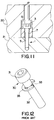
- a more simplified structure for the captivated jackscrew is possible, such as illustrated in the embodiment of Fig. 11 to which reference is next made.
- the elements are presented in section as fastened and applied to bodies 20 and 21.
- the same numeral is used for identification.
- the structure is identical with the structure presented in the embodiment of Fig. 1, except that backstop 9 is omitted.
- body 20 is formed of Aluminum and head 3 of Stainless Steel, some particles of Aluminum will necessarily be culled.
- the existing e-clip type of fasteners were earlier described, and, to ensure an understanding of the advantages to the invention, it is helpful to illustrate that fastener.
- the e-clip type fastener is illustrated in perspective in Fig. 12 to which reference may be made. As shown, the fastener is very simple in structure. That fastener contains two parts a machine screw 30 with a cap head 31 containing a hexagonal notch, a threaded shaft 32, and a reduced diameter or constricted diameter portion 33 at a position along the shaft, forming a slot about the shaft periphery. An e-clip 35 is fitted into the constricted portion.
- the e-clip is pushed into place on the modified machine screw. Pushed from the back the open ends spread side ways and enter the slotted section. Being formed of spring steel material, the inherent elasticity, the restoring spring force, forces the ends of those arms inwardly to grip the reduced diameter section of the screw and hold the clip in place. A third short arm, not visible in the figure, located in between the two arms on the back end also fits within the constricted diameter slot. As one appreciates, the reduced diameter section permits less torque than would be possible with the full diameter of the shaft. Further one can easily see how the clip can be lifted out of the slot by a large force directed in the axial direction against one or both of the clip's arms.
Landscapes
- Engineering & Computer Science (AREA)
- General Engineering & Computer Science (AREA)
- Mechanical Engineering (AREA)
- Connection Of Plates (AREA)
- Screw Conveyors (AREA)
Applications Claiming Priority (2)
| Application Number | Priority Date | Filing Date | Title |
|---|---|---|---|
| US190715 | 1998-11-12 | ||
| US09/190,715 US6406210B1 (en) | 1998-11-12 | 1998-11-12 | Captivated jackscrew design |
Publications (2)
| Publication Number | Publication Date |
|---|---|
| EP1001175A2 true EP1001175A2 (de) | 2000-05-17 |
| EP1001175A3 EP1001175A3 (de) | 2000-11-29 |
Family
ID=22702462
Family Applications (1)
| Application Number | Title | Priority Date | Filing Date |
|---|---|---|---|
| EP99121974A Withdrawn EP1001175A3 (de) | 1998-11-12 | 1999-11-10 | Axial verschiebbare unverlierbare Schraube |
Country Status (2)
| Country | Link |
|---|---|
| US (1) | US6406210B1 (de) |
| EP (1) | EP1001175A3 (de) |
Cited By (31)
| Publication number | Priority date | Publication date | Assignee | Title |
|---|---|---|---|---|
| WO2004043549A1 (en) * | 2002-11-08 | 2004-05-27 | Taylor Made Golf Company, Inc. | Golf club head having a removable weight |
| US7407447B2 (en) | 2002-11-08 | 2008-08-05 | Taylor Made Golf Company, Inc. | Movable weights for a golf club head |
| US7419441B2 (en) | 2002-11-08 | 2008-09-02 | Taylor Made Golf Company, Inc. | Golf club head weight reinforcement |
| US7448963B2 (en) | 2002-11-08 | 2008-11-11 | Taylor Made Golf Company, Inc. | Golf club head having movable weights |
| US7731603B2 (en) | 2007-09-27 | 2010-06-08 | Taylor Made Golf Company, Inc. | Golf club head |
| US7744484B1 (en) | 2002-11-08 | 2010-06-29 | Taylor Made Golf Company, Inc. | Movable weights for a golf club head |
| US7753806B2 (en) | 2007-12-31 | 2010-07-13 | Taylor Made Golf Company, Inc. | Golf club |
| US7771291B1 (en) | 2007-10-12 | 2010-08-10 | Taylor Made Golf Company, Inc. | Golf club head with vertical center of gravity adjustment |
| US8353786B2 (en) | 2007-09-27 | 2013-01-15 | Taylor Made Golf Company, Inc. | Golf club head |
| US8430763B2 (en) | 2010-12-28 | 2013-04-30 | Taylor Made Golf Company, Inc. | Fairway wood center of gravity projection |
| WO2013173041A1 (en) * | 2012-05-16 | 2013-11-21 | Ge Intelligent Platforms, Inc. | Captured threaded connector system and method for mechanically coupling components |
| US8591353B1 (en) | 2008-01-10 | 2013-11-26 | Taylor Made Golf Company, Inc. | Fairway wood golf club head |
| US8801541B2 (en) | 2007-09-27 | 2014-08-12 | Taylor Made Golf Company, Inc. | Golf club |
| US8821312B2 (en) | 2010-06-01 | 2014-09-02 | Taylor Made Golf Company, Inc. | Golf club head having a stress reducing feature with aperture |
| US8827831B2 (en) | 2010-06-01 | 2014-09-09 | Taylor Made Golf Company, Inc. | Golf club head having a stress reducing feature |
| US8888607B2 (en) | 2010-12-28 | 2014-11-18 | Taylor Made Golf Company, Inc. | Fairway wood center of gravity projection |
| US9089749B2 (en) | 2010-06-01 | 2015-07-28 | Taylor Made Golf Company, Inc. | Golf club head having a shielded stress reducing feature |
| US9168428B2 (en) | 2010-06-01 | 2015-10-27 | Taylor Made Golf Company, Inc. | Hollow golf club head having sole stress reducing feature |
| US9220953B2 (en) | 2010-12-28 | 2015-12-29 | Taylor Made Golf Company, Inc. | Fairway wood center of gravity projection |
| US9707457B2 (en) | 2010-12-28 | 2017-07-18 | Taylor Made Golf Company, Inc. | Golf club |
| US9861864B2 (en) | 2013-11-27 | 2018-01-09 | Taylor Made Golf Company, Inc. | Golf club |
| US9943734B2 (en) | 2004-11-08 | 2018-04-17 | Taylor Made Golf Company, Inc. | Golf club |
| JP2020024025A (ja) * | 2018-08-08 | 2020-02-13 | ナブテスコ株式会社 | 緩み止め具、緩み止め機構、固定装置、締結構造および産業機械 |
| US10639524B2 (en) | 2010-12-28 | 2020-05-05 | Taylor Made Golf Company, Inc. | Golf club head |
| US10653926B2 (en) | 2018-07-23 | 2020-05-19 | Taylor Made Golf Company, Inc. | Golf club heads |
| US11406881B2 (en) | 2020-12-28 | 2022-08-09 | Taylor Made Golf Company, Inc. | Golf club heads |
| USD960697S1 (en) | 2016-12-14 | 2022-08-16 | Franz Baur | Connecting device |
| US11614113B2 (en) * | 2016-02-17 | 2023-03-28 | Franz Baur | Connecting means and method for connecting two components |
| US11759685B2 (en) | 2020-12-28 | 2023-09-19 | Taylor Made Golf Company, Inc. | Golf club heads |
| US11975247B2 (en) | 2016-09-13 | 2024-05-07 | Taylor Made Golf Company, Inc. | Golf club head and golf club |
| US12629570B2 (en) | 2023-07-26 | 2026-05-19 | Taylor Made Golf Company, Inc. | Golf club head and golf club |
Families Citing this family (13)
| Publication number | Priority date | Publication date | Assignee | Title |
|---|---|---|---|---|
| DE10120004C1 (de) * | 2001-04-23 | 2003-02-20 | Dorma Gmbh & Co Kg | Befestigungselement für stangenartige Bauteile |
| US20050025565A1 (en) * | 2003-07-28 | 2005-02-03 | Lg Electronics Inc. | Securing device for a spring |
| US20070173095A1 (en) * | 2006-01-20 | 2007-07-26 | Rifael Bin-Nun | Reusable block and fastener system |
| US7967538B1 (en) * | 2006-06-19 | 2011-06-28 | Coope Robert L | Captured screw assembly |
| AU2010319537A1 (en) * | 2009-11-10 | 2012-05-31 | Smith & Nephew, Inc. | Controlling bone compression |
| US8794882B2 (en) * | 2010-07-08 | 2014-08-05 | Chase 'Em Back Tools LLC | Releasable thread chaser |
| US8424925B2 (en) | 2011-06-03 | 2013-04-23 | The Pipe Line Development Company | Split fitting for pipe |
| US9441654B2 (en) * | 2014-06-03 | 2016-09-13 | Modern Industries, Inc. | Precision positioning and fastening system |
| US10367297B2 (en) | 2014-07-09 | 2019-07-30 | Te Connectivity Corporation | Integrated securing guide pin for an electrical connector assembly |
| EP3363722A1 (de) * | 2017-02-21 | 2018-08-22 | Brake Force One GmbH | Halterungsanordnung für eine komponente an einem fahrzeug |
| DE102018103514A1 (de) * | 2018-02-16 | 2019-08-22 | Airbus Operations Gmbh | Befestigungssystem zum Befestigen von Einbauten an einer Schiene in einem Fahrzeug |
| CN109040375B (zh) * | 2018-09-11 | 2024-05-07 | 深圳达闼科技控股有限公司 | 手机及其手机壳 |
| US11905986B1 (en) * | 2020-09-01 | 2024-02-20 | Blue Origin Llc | Quick-access fastener assembly for high temperature applications |
Family Cites Families (21)
| Publication number | Priority date | Publication date | Assignee | Title |
|---|---|---|---|---|
| US2376089A (en) * | 1943-11-11 | 1945-05-15 | Frederick L Savageau | Fastening device |
| GB828194A (en) * | 1955-09-20 | 1960-02-17 | Nat Res Dev | Captive screw fasteners |
| US3109663A (en) * | 1962-03-27 | 1963-11-05 | American Carbide Company | Die assemblies |
| US3164354A (en) * | 1963-03-06 | 1965-01-05 | American Metal Climax Inc | Stadium rail |
| US3263549A (en) * | 1964-05-25 | 1966-08-02 | Acme Ind Products Inc | Retainer for die or punch members |
| US3812895A (en) * | 1970-02-17 | 1974-05-28 | Dayton Progress Corp | Fastener and retainer assembly |
| FR2374547A1 (fr) * | 1976-12-15 | 1978-07-13 | Commissariat Energie Atomique | Dispositif d'assemblage de deux pieces |
| US4105058A (en) * | 1977-03-31 | 1978-08-08 | Ball Valve Company, Inc. | Screw locking arrangement |
| JPS5655107Y2 (de) * | 1977-07-12 | 1981-12-22 | ||
| US4436445A (en) * | 1981-11-03 | 1984-03-13 | Peterson Manufacturing Co. | Stud anchor for securing a hollow non-round extension base |
| IT8223772U1 (it) | 1982-12-23 | 1984-06-23 | Dropsa Spa | Dispositivo di collegamento di elementi blocchetti formi in genere, in particolare per oleodinamica. |
| US4540304A (en) * | 1983-03-08 | 1985-09-10 | The United States Of America As Represented By The United States Department Of Energy | Metal-to-ceramic attachment device |
| US4711760A (en) * | 1986-02-27 | 1987-12-08 | Westinghouse Electric Corp. | Nuclear reactor incorporating locking device for threaded bolt connections |
| US4863326A (en) * | 1986-12-11 | 1989-09-05 | Southco, Inc. | Captive fastener |
| US4869694A (en) * | 1988-05-23 | 1989-09-26 | Brunswick Corporation | Mounting device for marine propellers and the like |
| ES2044618T3 (es) * | 1989-11-18 | 1994-01-01 | Muellenberg Ralph | Grupo de apriete conico. |
| DE4129490C2 (de) * | 1991-09-05 | 1994-08-25 | Ralph Muellenberg | Konusspannanordnung |
| DE4410227A1 (de) * | 1994-03-24 | 1995-09-28 | Jamann Gmbh | Bauelement wie Verkettungsanschlußplatte, Zwischenplattenventil, Steuergehäuse u. dgl. zum vertikalen und/oder horizontalen, modularen Aufbau hydraulischer oder pneumatischer Steuereinheiten |
| DE19540051A1 (de) * | 1995-10-27 | 1997-04-30 | Asea Brown Boveri | Schraubensicherung |
| US5857798A (en) * | 1997-04-03 | 1999-01-12 | Eagle One Golf Products Inc | Golf flag theft protection |
| US5941669A (en) * | 1998-06-18 | 1999-08-24 | Southco, Inc. | Jack-out captivated screw |
-
1998
- 1998-11-12 US US09/190,715 patent/US6406210B1/en not_active Expired - Lifetime
-
1999
- 1999-11-10 EP EP99121974A patent/EP1001175A3/de not_active Withdrawn
Cited By (132)
| Publication number | Priority date | Publication date | Assignee | Title |
|---|---|---|---|---|
| US9919190B2 (en) | 2002-11-08 | 2018-03-20 | Taylor Made Gold Company, Inc. | Golf club head having movable weights |
| US7407447B2 (en) | 2002-11-08 | 2008-08-05 | Taylor Made Golf Company, Inc. | Movable weights for a golf club head |
| US7410425B2 (en) | 2002-11-08 | 2008-08-12 | Taylor Made Golf Company, Inc. | Golf club head having removable weight |
| US7410426B2 (en) | 2002-11-08 | 2008-08-12 | Taylor Made Golf Company, Inc. | Golf club head having removable weight |
| US7419441B2 (en) | 2002-11-08 | 2008-09-02 | Taylor Made Golf Company, Inc. | Golf club head weight reinforcement |
| US7448963B2 (en) | 2002-11-08 | 2008-11-11 | Taylor Made Golf Company, Inc. | Golf club head having movable weights |
| US7452285B2 (en) | 2002-11-08 | 2008-11-18 | Taylor Made Golf Company, Inc. | Weight kit for golf club head |
| US7632194B2 (en) | 2002-11-08 | 2009-12-15 | Taylor Made Golf Company, Inc. | Movable weights for a golf club head |
| US7713142B2 (en) | 2002-11-08 | 2010-05-11 | Taylor Made Golf Company, Inc. | Golf club head weight reinforcement |
| US10420994B2 (en) | 2002-11-08 | 2019-09-24 | Taylor Made Golf Company, Inc. | Golf club head having movable weights |
| US7744484B1 (en) | 2002-11-08 | 2010-06-29 | Taylor Made Golf Company, Inc. | Movable weights for a golf club head |
| US10058749B2 (en) | 2002-11-08 | 2018-08-28 | Taylor Made Golf Company, Inc. | Golf club head having movable weights |
| WO2004043549A1 (en) * | 2002-11-08 | 2004-05-27 | Taylor Made Golf Company, Inc. | Golf club head having a removable weight |
| US7846041B2 (en) | 2002-11-08 | 2010-12-07 | Taylor Made Golf Company, Inc. | Movable weights for a golf club head |
| US9789372B2 (en) | 2002-11-08 | 2017-10-17 | Taylor Made Golf Company, Inc. | Golf club head having movable weights |
| US10729951B2 (en) | 2002-11-08 | 2020-08-04 | Taylor Made Golf Company, Inc. | Golf club head having movable weights |
| US8562457B2 (en) | 2002-11-08 | 2013-10-22 | Taylor Made Golf Company, Inc. | Golf club head having movable weights |
| US8888609B2 (en) | 2002-11-08 | 2014-11-18 | Taylor Made Golf Company, Inc. | Golf club head having movable weights |
| US9452327B2 (en) | 2004-02-23 | 2016-09-27 | Taylor Made Golf Company, Inc. | Golf club head with vertical center of gravity adjustment |
| US9675849B2 (en) | 2004-02-23 | 2017-06-13 | Taylor Made Golf Company, Inc. | Golf club |
| US9943734B2 (en) | 2004-11-08 | 2018-04-17 | Taylor Made Golf Company, Inc. | Golf club |
| US10610747B2 (en) | 2004-11-08 | 2020-04-07 | Taylor Made Golf Company, Inc. | Golf club |
| US8353786B2 (en) | 2007-09-27 | 2013-01-15 | Taylor Made Golf Company, Inc. | Golf club head |
| US8647216B2 (en) | 2007-09-27 | 2014-02-11 | Taylor Made Golf Company, Inc. | Golf club head |
| US9452324B2 (en) | 2007-09-27 | 2016-09-27 | Taylor Made Golf Company, Inc. | Golf club head |
| US12226678B2 (en) | 2007-09-27 | 2025-02-18 | Taylor Made Golf Company, Inc. | Golf club head |
| US8801541B2 (en) | 2007-09-27 | 2014-08-12 | Taylor Made Golf Company, Inc. | Golf club |
| US10576338B2 (en) | 2007-09-27 | 2020-03-03 | Taylor Made Golf Company, Inc. | Golf club head |
| US10874918B2 (en) | 2007-09-27 | 2020-12-29 | Taylor Made Golf Company, Inc. | Golf club head |
| US11278773B2 (en) | 2007-09-27 | 2022-03-22 | Taylor Made Golf Company, Inc. | Golf club head |
| US12208318B2 (en) | 2007-09-27 | 2025-01-28 | Taylor Made Golf Company, Inc. | Golf club head |
| US9849353B2 (en) | 2007-09-27 | 2017-12-26 | Taylor Made Golf Company, Inc. | Golf club head |
| US11724163B2 (en) | 2007-09-27 | 2023-08-15 | Taylor Made Golf Company, Inc. | Golf club head |
| US10220270B2 (en) | 2007-09-27 | 2019-03-05 | Taylor Made Golf Company, Inc. | Golf club head |
| US7731603B2 (en) | 2007-09-27 | 2010-06-08 | Taylor Made Golf Company, Inc. | Golf club head |
| US7771291B1 (en) | 2007-10-12 | 2010-08-10 | Taylor Made Golf Company, Inc. | Golf club head with vertical center of gravity adjustment |
| US8579725B1 (en) | 2007-10-12 | 2013-11-12 | Taylor Made Golf Company, Inc. | Golf club head with vertical center of gravity adjustment |
| US8262507B1 (en) | 2007-10-12 | 2012-09-11 | Taylor Made Golf Company, Inc. | Golf club head with vertical center of gravity adjustment |
| US8900072B1 (en) | 2007-10-12 | 2014-12-02 | Taylor Made Golf Company, Inc. | Golf club head with vertical center of gravity adjustment |
| US7753806B2 (en) | 2007-12-31 | 2010-07-13 | Taylor Made Golf Company, Inc. | Golf club |
| US7887434B2 (en) | 2007-12-31 | 2011-02-15 | Taylor Made Golf Company, Inc. | Golf club |
| US8118689B2 (en) | 2007-12-31 | 2012-02-21 | Taylor Made Golf Company, Inc. | Golf club |
| US8663029B2 (en) | 2007-12-31 | 2014-03-04 | Taylor Made Golf Company | Golf club |
| US9220956B2 (en) | 2007-12-31 | 2015-12-29 | Taylor Made Golf Company, Inc. | Golf club |
| US8591353B1 (en) | 2008-01-10 | 2013-11-26 | Taylor Made Golf Company, Inc. | Fairway wood golf club head |
| US10335649B2 (en) | 2008-01-10 | 2019-07-02 | Taylor Made Golf Company, Inc. | Golf club |
| US10625125B2 (en) | 2008-01-10 | 2020-04-21 | Taylor Made Golf Company, Inc. | Golf club |
| US12005323B2 (en) | 2008-01-10 | 2024-06-11 | Taylor Made Golf Company, Inc. | Golf club |
| US9586103B2 (en) | 2008-01-10 | 2017-03-07 | Taylor Made Golf Company, Inc. | Golf club head and golf club |
| US10058747B2 (en) | 2008-01-10 | 2018-08-28 | Taylor Made Golf Company, Inc | Golf club |
| US9168431B2 (en) | 2008-01-10 | 2015-10-27 | Taylor Made Golf Company, Inc. | Fairway wood golf club head |
| US11491376B2 (en) | 2008-01-10 | 2022-11-08 | Taylor Made Golf Company, Inc. | Golf club |
| US10974106B2 (en) | 2008-01-10 | 2021-04-13 | Taylor Made Golf Company, Inc. | Golf club |
| US9687700B2 (en) | 2008-01-10 | 2017-06-27 | Taylor Made Golf Company, Inc. | Golf club head |
| US11865416B2 (en) | 2010-06-01 | 2024-01-09 | Taylor Made Golf Company, Inc. | Golf club head having a shaft connection system socket |
| US9656131B2 (en) | 2010-06-01 | 2017-05-23 | Taylor Made Golf Company, Inc. | Golf club head having a stress reducing feature and shaft connection system socket |
| US11478685B2 (en) | 2010-06-01 | 2022-10-25 | Taylor Made Golf Company, Inc. | Iron-type golf club head |
| US9610483B2 (en) | 2010-06-01 | 2017-04-04 | Taylor Made Golf Company, Inc | Iron-type golf club head having a sole stress reducing feature |
| US9610482B2 (en) | 2010-06-01 | 2017-04-04 | Taylor Made Golf Company, Inc | Golf club head having a stress reducing feature with aperture |
| US11364421B2 (en) | 2010-06-01 | 2022-06-21 | Taylor Made Golf Company, Inc. | Golf club head having a shaft connection system socket |
| US9566479B2 (en) | 2010-06-01 | 2017-02-14 | Taylor Made Golf Company, Inc. | Golf club head having sole stress reducing feature |
| US9265993B2 (en) | 2010-06-01 | 2016-02-23 | Taylor Made Golf Company, Inc | Hollow golf club head having crown stress reducing feature |
| US9950222B2 (en) | 2010-06-01 | 2018-04-24 | Taylor Made Golf Company, Inc. | Golf club having sole stress reducing feature |
| US9950223B2 (en) | 2010-06-01 | 2018-04-24 | Taylor Made Golf Company, Inc. | Golf club head having a stress reducing feature with aperture |
| US9956460B2 (en) | 2010-06-01 | 2018-05-01 | Taylor Made Golf Company, Inc | Golf club head having a stress reducing feature and shaft connection system socket |
| US11771964B2 (en) | 2010-06-01 | 2023-10-03 | Taylor Made Golf Company, Inc. | Multi-material iron-type golf club head |
| US9174101B2 (en) | 2010-06-01 | 2015-11-03 | Taylor Made Golf Company, Inc. | Golf club head having a stress reducing feature |
| US9168428B2 (en) | 2010-06-01 | 2015-10-27 | Taylor Made Golf Company, Inc. | Hollow golf club head having sole stress reducing feature |
| US11351425B2 (en) | 2010-06-01 | 2022-06-07 | Taylor Made Golf Company, Inc. | Multi-material iron-type golf club head |
| US10245485B2 (en) | 2010-06-01 | 2019-04-02 | Taylor Made Golf Company Inc. | Golf club head having a stress reducing feature with aperture |
| US9168434B2 (en) | 2010-06-01 | 2015-10-27 | Taylor Made Golf Company, Inc. | Golf club head having a stress reducing feature with aperture |
| US10300350B2 (en) | 2010-06-01 | 2019-05-28 | Taylor Made Golf Company, Inc. | Golf club having sole stress reducing feature |
| US9089749B2 (en) | 2010-06-01 | 2015-07-28 | Taylor Made Golf Company, Inc. | Golf club head having a shielded stress reducing feature |
| US10369429B2 (en) | 2010-06-01 | 2019-08-06 | Taylor Made Golf Company, Inc. | Golf club head having a stress reducing feature and shaft connection system socket |
| US9011267B2 (en) | 2010-06-01 | 2015-04-21 | Taylor Made Golf Company, Inc. | Golf club head having a stress reducing feature and shaft connection system socket |
| US11045696B2 (en) | 2010-06-01 | 2021-06-29 | Taylor Made Golf Company, Inc. | Iron-type golf club head |
| US12042702B2 (en) | 2010-06-01 | 2024-07-23 | Taylor Made Golf Company, Inc. | Iron-type golf club head |
| US10556160B2 (en) | 2010-06-01 | 2020-02-11 | Taylor Made Golf Company, Inc. | Golf club head having a stress reducing feature with aperture |
| US8827831B2 (en) | 2010-06-01 | 2014-09-09 | Taylor Made Golf Company, Inc. | Golf club head having a stress reducing feature |
| US10843050B2 (en) | 2010-06-01 | 2020-11-24 | Taylor Made Golf Company, Inc. | Multi-material iron-type golf club head |
| US8821312B2 (en) | 2010-06-01 | 2014-09-02 | Taylor Made Golf Company, Inc. | Golf club head having a stress reducing feature with aperture |
| US10792542B2 (en) | 2010-06-01 | 2020-10-06 | Taylor Made Golf Company, Inc | Golf club head having a stress reducing feature and shaft connection system socket |
| US12296238B2 (en) | 2010-06-01 | 2025-05-13 | Taylor Made Golf Company, Inc. | Multi-material iron-type golf club head |
| US12357883B2 (en) | 2010-06-01 | 2025-07-15 | Taylor Made Golf Company, Inc. | Golf club head having a shaft connection system socket |
| US8900069B2 (en) | 2010-12-28 | 2014-12-02 | Taylor Made Golf Company, Inc. | Fairway wood center of gravity projection |
| US9211447B2 (en) | 2010-12-28 | 2015-12-15 | Taylor Made Golf Company, Inc. | Golf club |
| US10639524B2 (en) | 2010-12-28 | 2020-05-05 | Taylor Made Golf Company, Inc. | Golf club head |
| US10603555B2 (en) | 2010-12-28 | 2020-03-31 | Taylor Made Golf Company, Inc. | Golf club head |
| US8430763B2 (en) | 2010-12-28 | 2013-04-30 | Taylor Made Golf Company, Inc. | Fairway wood center of gravity projection |
| US8753222B2 (en) | 2010-12-28 | 2014-06-17 | Taylor Made Golf Company, Inc. | Fairway wood center of gravity projection |
| US8888607B2 (en) | 2010-12-28 | 2014-11-18 | Taylor Made Golf Company, Inc. | Fairway wood center of gravity projection |
| US10898764B2 (en) | 2010-12-28 | 2021-01-26 | Taylor Made Golf Company, Inc. | Golf club head |
| US10905929B2 (en) | 2010-12-28 | 2021-02-02 | Taylor Made Golf Company, Inc. | Golf club head |
| US10478679B2 (en) | 2010-12-28 | 2019-11-19 | Taylor Made Golf Company, Inc. | Golf club head |
| US10974102B2 (en) | 2010-12-28 | 2021-04-13 | Taylor Made Golf Company, Inc. | Golf club head |
| US8956240B2 (en) | 2010-12-28 | 2015-02-17 | Taylor Made Golf Company, Inc. | Fairway wood center of gravity projection |
| US10434384B2 (en) | 2010-12-28 | 2019-10-08 | Taylor Made Golf Company, Inc. | Golf club head |
| US11148021B2 (en) | 2010-12-28 | 2021-10-19 | Taylor Made Golf Company, Inc. | Golf club head |
| US11202943B2 (en) | 2010-12-28 | 2021-12-21 | Taylor Made Golf Company, Inc. | Golf club head |
| US10252119B2 (en) | 2010-12-28 | 2019-04-09 | Taylor Made Golf Company, Inc. | Golf club |
| US11298599B2 (en) | 2010-12-28 | 2022-04-12 | Taylor Made Golf Company, Inc. | Golf club head |
| US9186560B2 (en) | 2010-12-28 | 2015-11-17 | Taylor Made Golf Company, Inc. | Golf club |
| US9220953B2 (en) | 2010-12-28 | 2015-12-29 | Taylor Made Golf Company, Inc. | Fairway wood center of gravity projection |
| US9700769B2 (en) | 2010-12-28 | 2017-07-11 | Taylor Made Golf Company, Inc. | Fairway wood center of gravity projection |
| US11654336B2 (en) | 2010-12-28 | 2023-05-23 | Taylor Made Golf Company, Inc. | Golf club head |
| US9700763B2 (en) | 2010-12-28 | 2017-07-11 | Taylor Made Golf Company, Inc. | Golf club |
| US9707457B2 (en) | 2010-12-28 | 2017-07-18 | Taylor Made Golf Company, Inc. | Golf club |
| WO2013173041A1 (en) * | 2012-05-16 | 2013-11-21 | Ge Intelligent Platforms, Inc. | Captured threaded connector system and method for mechanically coupling components |
| US9861864B2 (en) | 2013-11-27 | 2018-01-09 | Taylor Made Golf Company, Inc. | Golf club |
| US10828540B2 (en) | 2013-11-27 | 2020-11-10 | Taylor Made Golf Company, Inc. | Golf club |
| US10569145B2 (en) | 2013-11-27 | 2020-02-25 | Taylor Made Golf Company, Inc. | Golf club |
| US12121781B2 (en) | 2013-11-27 | 2024-10-22 | Taylor Made Golf Company, Inc. | Golf club |
| US10226671B2 (en) | 2013-11-27 | 2019-03-12 | Taylor Made Golf Company, Inc. | Golf club |
| US11944878B2 (en) | 2013-11-27 | 2024-04-02 | Taylor Made Golf Company, Inc. | Golf club |
| US11369846B2 (en) | 2013-11-27 | 2022-06-28 | Taylor Made Golf Company, Inc. | Golf club |
| US11426639B2 (en) | 2013-12-31 | 2022-08-30 | Taylor Made Golf Company, Inc. | Golf club |
| US11885356B2 (en) | 2016-02-17 | 2024-01-30 | Franz Baur | Connecting means and method for connecting two components |
| US11614113B2 (en) * | 2016-02-17 | 2023-03-28 | Franz Baur | Connecting means and method for connecting two components |
| US11629741B2 (en) | 2016-02-17 | 2023-04-18 | Franz Baur | Connecting device and method for connecting two components |
| US11975247B2 (en) | 2016-09-13 | 2024-05-07 | Taylor Made Golf Company, Inc. | Golf club head and golf club |
| USD960697S1 (en) | 2016-12-14 | 2022-08-16 | Franz Baur | Connecting device |
| US11400350B2 (en) | 2018-07-23 | 2022-08-02 | Taylor Made Golf Company, Inc. | Golf club heads |
| US11771963B2 (en) | 2018-07-23 | 2023-10-03 | Taylor Made Golf Company, Inc. | Golf club heads |
| US11013965B2 (en) | 2018-07-23 | 2021-05-25 | Taylor Made Golf Company, Inc. | Golf club heads |
| US10653926B2 (en) | 2018-07-23 | 2020-05-19 | Taylor Made Golf Company, Inc. | Golf club heads |
| JP2020024025A (ja) * | 2018-08-08 | 2020-02-13 | ナブテスコ株式会社 | 緩み止め具、緩み止め機構、固定装置、締結構造および産業機械 |
| JP7201362B2 (ja) | 2018-08-08 | 2023-01-10 | ナブテスコ株式会社 | 緩み止め具、緩み止め機構、固定装置、締結構造および産業機械 |
| US11975248B2 (en) | 2020-12-28 | 2024-05-07 | Taylor Made Golf Company, Inc. | Golf club heads |
| US11759685B2 (en) | 2020-12-28 | 2023-09-19 | Taylor Made Golf Company, Inc. | Golf club heads |
| US11406881B2 (en) | 2020-12-28 | 2022-08-09 | Taylor Made Golf Company, Inc. | Golf club heads |
| US12390703B2 (en) | 2020-12-28 | 2025-08-19 | Taylor Made Golf Company, Inc. | Golf club heads |
| US12629570B2 (en) | 2023-07-26 | 2026-05-19 | Taylor Made Golf Company, Inc. | Golf club head and golf club |
Also Published As
| Publication number | Publication date |
|---|---|
| US6406210B1 (en) | 2002-06-18 |
| EP1001175A3 (de) | 2000-11-29 |
Similar Documents
| Publication | Publication Date | Title |
|---|---|---|
| US6406210B1 (en) | Captivated jackscrew design | |
| US9374900B2 (en) | Two-piece unmate-assist standoff | |
| US7699669B2 (en) | Screw assembly for electrical connectors | |
| US3848953A (en) | Device for inserting and clamping a printed circuit board | |
| US20040161317A1 (en) | Rapid fastening screw apparatus and method | |
| US5256019A (en) | Washerless self-captivating screw | |
| US5223674A (en) | Locking standoff for circuit boards | |
| US6364688B1 (en) | Thumbscrew with automatic torque-limiting feature | |
| US6498730B2 (en) | Apparatus and method for inserting, retaining and extracting printed circuit boards | |
| JP2024526398A (ja) | ナット連結機構体 | |
| EP0427560A2 (de) | Entfernung eines Mehrstiftskomponenten, der in Buchsen auf einer Schaltungsplatte montiert ist | |
| JPWO1996018221A1 (ja) | 端子台 | |
| JP2006507450A (ja) | 前面取付型保持機構 | |
| CN117212323A (zh) | 一种锁紧螺母及其锁紧使用方法 | |
| US11251547B2 (en) | Grounding cross connectors including clamping pads for coupling at least two conductors | |
| JPH1050367A (ja) | 端子装置 | |
| JP2555592Y2 (ja) | ボルト締め型コネクタ | |
| US4623212A (en) | Twist-tightened electrical terminal connector | |
| CN105723568A (zh) | 两片式辅助分离间隙器 | |
| CN118336442A (zh) | 一种表贴连接器拆装工具及连接器组件 | |
| JPH09123069A (ja) | 端子金具矯正板用取外具 | |
| JPH0243099Y2 (de) | ||
| US20260055790A1 (en) | Tamper-resistant fastener-head cover | |
| JPH0227508Y2 (de) | ||
| JP2004356079A (ja) | プラグの抜け止め具 |
Legal Events
| Date | Code | Title | Description |
|---|---|---|---|
| PUAI | Public reference made under article 153(3) epc to a published international application that has entered the european phase |
Free format text: ORIGINAL CODE: 0009012 |
|
| AK | Designated contracting states |
Kind code of ref document: A2 Designated state(s): DE FR GB |
|
| AX | Request for extension of the european patent |
Free format text: AL;LT;LV;MK;RO;SI |
|
| PUAL | Search report despatched |
Free format text: ORIGINAL CODE: 0009013 |
|
| AK | Designated contracting states |
Kind code of ref document: A3 Designated state(s): AT BE CH CY DE DK ES FI FR GB GR IE IT LI LU MC NL PT SE |
|
| AX | Request for extension of the european patent |
Free format text: AL;LT;LV;MK;RO;SI |
|
| 17P | Request for examination filed |
Effective date: 20010126 |
|
| AKX | Designation fees paid |
Free format text: DE FR GB |
|
| STAA | Information on the status of an ep patent application or granted ep patent |
Free format text: STATUS: THE APPLICATION HAS BEEN WITHDRAWN |
|
| 18W | Application withdrawn |
Effective date: 20021216 |