EP1001437A1 - Auf Eisen basierte weichmagnetisch Legierung,Magnetkern davon,und Herstellungsverfahren - Google Patents
Auf Eisen basierte weichmagnetisch Legierung,Magnetkern davon,und Herstellungsverfahren Download PDFInfo
- Publication number
- EP1001437A1 EP1001437A1 EP99308538A EP99308538A EP1001437A1 EP 1001437 A1 EP1001437 A1 EP 1001437A1 EP 99308538 A EP99308538 A EP 99308538A EP 99308538 A EP99308538 A EP 99308538A EP 1001437 A1 EP1001437 A1 EP 1001437A1
- Authority
- EP
- European Patent Office
- Prior art keywords
- atomic percent
- alloy
- soft magnetic
- based soft
- iron
- Prior art date
- Legal status (The legal status is an assumption and is not a legal conclusion. Google has not performed a legal analysis and makes no representation as to the accuracy of the status listed.)
- Withdrawn
Links
Images

































Classifications
-
- H—ELECTRICITY
- H01—ELECTRIC ELEMENTS
- H01F—MAGNETS; INDUCTANCES; TRANSFORMERS; SELECTION OF MATERIALS FOR THEIR MAGNETIC PROPERTIES
- H01F1/00—Magnets or magnetic bodies characterised by the magnetic materials therefor; Selection of materials for their magnetic properties
- H01F1/01—Magnets or magnetic bodies characterised by the magnetic materials therefor; Selection of materials for their magnetic properties of inorganic materials
- H01F1/03—Magnets or magnetic bodies characterised by the magnetic materials therefor; Selection of materials for their magnetic properties of inorganic materials characterised by their coercivity
- H01F1/12—Magnets or magnetic bodies characterised by the magnetic materials therefor; Selection of materials for their magnetic properties of inorganic materials characterised by their coercivity of soft-magnetic materials
- H01F1/14—Magnets or magnetic bodies characterised by the magnetic materials therefor; Selection of materials for their magnetic properties of inorganic materials characterised by their coercivity of soft-magnetic materials metals or alloys
- H01F1/147—Alloys characterised by their composition
- H01F1/153—Amorphous metallic alloys, e.g. glassy metals
- H01F1/15308—Amorphous metallic alloys, e.g. glassy metals based on Fe/Ni
-
- C—CHEMISTRY; METALLURGY
- C22—METALLURGY; FERROUS OR NON-FERROUS ALLOYS; TREATMENT OF ALLOYS OR NON-FERROUS METALS
- C22C—ALLOYS
- C22C45/00—Amorphous alloys
- C22C45/02—Amorphous alloys with iron as the major constituent
Definitions
- Typical magnetic characteristics required for soft magnetic alloys which are used in magnetic heads, transformers and choke coils include high magnetic flux density, high permeability, and low coercive force.
- soft magnetic alloys for transformers require low iron loss.
- Silicon steel generally used in transformers has an iron loss of 1.0 W/kg at 1.7 T and 50 Hz, and a saturation magnetic flux density of 2.0 T. Thus, the iron loss must be further decreased to satisfy the above requirements.
- the present inventors have applied for patents on Fe-based soft magnetic alloys having high saturation magnetic flux density, in view of the above, as disclosed in Japanese Examined Patent Publication (Kokoku) No. 7-65145 and Japanese Unexamined Patent Publication (Kokai) No. 5-93249.
- desired soft magnetic characteristics are achieved by adding other elements and controlling the compositions.
- Production processes are also essential factors for achieving desired soft magnetic characteristics.
- the annealing conditions for the resulting amorphous alloy significantly affect properties of the alloy. That is, the properties of the alloy are affected by the annealing temperature and the heating program or heating rate up to the annealing temperature. Also, the temperature of the alloy melt ejected through the nozzle (the ejection temperature) significantly affects properties of the resulting alloy.
- the present inventors have developed Fe-based soft magnetic alloys having various compositions, and have discovered that specific Zr and Nb content in the alloy contribute to superior soft magnetic characteristics of the alloy. That is, an alloy of the specific Zr and Nb content has significantly decreased iron loss in a frequency range of several hundreds Hz or less. Accordingly, the present inventors have completed the present invention.
- a Fe-based soft magnetic alloy having high saturation magnetic flux density and low iron loss, represented by the following formula and having a fine crystalline texture formed by annealing an amorphous alloy substantially composed of an amorphous phase; at least 50% of the fine crystalline texture being composed of a bcc-Fe phase (body-centered-cubic-Fe phase) as the major component having an average crystal grain size of 100 nm or less: Fe a Zr x Nb y B z wherein the subscripts satisfy the relationships; 80 atomic percent ⁇ a; 5 atomic percent ⁇ x + y ⁇ 7 atomic percent; 1.5/6 ⁇ x/(x+y) ⁇ 2.5/6; and 5 atomic percent ⁇ z ⁇ 12.5 atomic percent.
- the subscripts satisfy the relationships 83 atomic percent ⁇ a; 5.7 atomic percent ⁇ x + y ⁇ 6.5 atomic percent; 1.5/6 ⁇ x/(x+y) ⁇ 2.5/6; and 6 atomic percent ⁇ z ⁇ 9.5 atomic percent.
- the crystallization temperature T X1 of the bcc-Fe phase, the crystallization temperature T X2 of a compound phase which is crystallized at a temperature higher than T X1 , and the difference ⁇ T X T X2 - T X1 of the crystallization temperatures satisfy the relationship 200°C ⁇ ⁇ T X .
- This Fe-based soft magnetic alloy has improved permeability and saturation magnetic flux density and decreased iron loss.
- iron loss and the change rate of iron loss are significantly decreased in a low-frequency region of several hundreds Hz or less.
- the above-specified B content suppresses the formation of a FeB compound during the deposition of the fine crystalline texture in an annealing treatment of the alloy and can maintain soft magnetic characteristics at high levels.
- a difference ⁇ T X in crystallization temperatures of 200°C or more facilitates annealing the alloy at an optimized temperature which promotes precipitation of only the bcc-Fe phase and suppresses precipitation of the other compound phases.
- the alloy has improved soft magnetic characteristics.
- the Fe-based soft magnetic alloy is represented by the following formula and has a fine crystalline texture comprising at least 50% of fine bcc-Fe crystal grains having an average crystal grain size of 100 nm or less and the balance being an amorphous phase; the bcc-Fe crystal grains being precipitated by heating to a temperature higher than the crystallization temperature and then cooling a substantially single amorphous phase which is formed by quenching an alloy melt: (Fe 1-a Q a ) b Zr x Nb y B t Zn z wherein Q is at least one of Co and Ni; the subscripts satisfy the relationships 0 ⁇ a ⁇ 0.05, 80 atomic percent ⁇ b; 1.5 atomic percent ⁇ x ⁇ 2.5 atomic percent; 3.5 atomic percent ⁇ y ⁇ 5.0 atomic percent; 5 atomic percent ⁇ t ⁇ 12.5 atomic percent, 0.025 atomic percent ⁇ z ⁇ 0.2 atomic percent; 5.0 atomic percent ⁇ x
- the saturation magnetic flux density of the Fe-based soft magnetic alloy is at least 1.5 T
- the iron loss, when a magnetic flux of 1.4 T at a frequency of 50 Hz is applied is 0.15 W/kg or less
- the change in iron loss after aging at 200°C for 500 hours is 10% or less.
- the magnetic core comprises an annular ring formed by winding a ribbon of the Fe-based soft magnetic alloy.
- a first Fe-based soft magnetic alloy having high saturation magnetic flux density and low iron loss in accordance with the present invention will now be described.
- a saturation magnetic flux density of 1.5 T or more is achieved by adding as much Fe as possible in consideration of the preferred concentrations of other components. That is, a saturation magnetic flux density of 1.4 T or more is achieved by adding 80 atomic percent or more of Fe and a saturation magnetic flux density of 1.6 T or more is achieved by adding 85 atomic percent or more of Fe.
- the alloy can be annealed at optimized conditions so as to precipitate only the bcc-Fe phase and to suppress precipitation of the compound phase.
- the resulting Fe-based soft magnetic alloy has high saturation magnetic flux density and low iron loss.
- the preferred annealing temperature T a of the alloy lies in a range of T X1 ⁇ T a ⁇ T X2 .
- the Fe-based soft magnetic alloy (hereinafter referred to as a second alloy), having high saturation magnetic flux density and low iron loss, of the second embodiment is represented by the following formula: (Fe 1-a Q a ) b B x M y Zn z wherein Q is at least one of Co and Ni; M is at least one selected from the group consisting of Ti, Zr, Hf, V, Nb, Ta, Mo and W; the subscripts satisfy the relationships 0 ⁇ a ⁇ 0.05, 80 atomic percent ⁇ b; 5 atomic percent ⁇ x ⁇ 12.5 atomic percent; 5 atomic percent ⁇ y ⁇ 7 atomic percent; and 0.025 atomic percent ⁇ z ⁇ 0.2 atomic percent.
- At least one of Zr, Hf and Nb is preferably used. These elements have further facilitates the formation of the amorphous phase.
- the Zr, Hf or Nb may be partly replaced with Ti, V, Ta, Mo or W among Groups IVA to VIA elements.
- Fig. 1 is a schematic view of an apparatus for making a ribbon of a soft magnetic alloy in accordance with the present invention.
- a copper or steel cooling roller 3 is placed in a chamber 2.
- the chamber 2 can be evacuated through an evacuation pipe la connected to a vacuum pump 1.
- a crucible 6 having a nozzle 5 made of, for example, quartz is placed on the cooling roller 3.
- the crucible 6 is connected to a gas feeder 7 by a gas supply pipe 7a so as to supply argon gas and to pressurize the interior of the crucible 6.
- the chamber 2 is connected to a gas feeder 8 by a gas supply pipe 8a so as to supply a nonoxidative gas, such as argon gas.
- the crucible 6 has a lid connected to the gas supply pipe 7a, so that the internal pressure of the crucible 6 and the internal pressure of the chamber 2 are independently adjustable.
- the film is preferably deposited using a target or an evaporation source containing zinc in an excess amount.
- the Fe content or the total content of Fe, Co and Ni in the Fe-based soft magnetic alloy is preferably 80 atomic percent or more. In addition, it is preferable that the content be less than 90 atomic percent. When the content exceeds 90 atomic percent, the Fe-based soft magnetic alloy does not have high permeability. It is more preferable that the content be in a range of 83 to 87 atomic percent, and most preferably 85 to 86 atomic percent in order to achieve a saturation magnetic flux density of 1.55 T or more. A desired saturation magnetic flux density is achieved when the Fe content is at least 80 atomic percent.
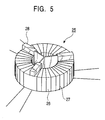
- Fig. 5 is an isometric view of a magnet core of the present invention, which is applied to a common-mode choke coil.
- a choke coil 25 for three phases is used as a noise filter etc., and includes a magnetic core 26 of a wound ribbon of the low-iron-loss Fe-based soft magnetic alloy covered with a resin, three coils 27 wound on the magnetic core 26, and a bobbin 28 mounted in the magnetic core 26.
- the magnetic core has satisfactory soft magnetic characteristics and low iron loss, and is used as magnetic cores of various transformers, such as low-frequency transformers, pulse transformers, power transformers, and pole-mounted transformers, and of various coils, such as choke coils and inductance coils.
- a compound phase or second crystalline phase which is composed of Fe 3 B and Fe 3 Zr in the case of the Zr-containing alloy, is deposited.
- the temperature at which such a compound phase is precipitated is called a second crystallization temperature.
- the second crystallization temperature depends on the composition of the alloy, and generally lies in a range of approximately 740 to 810.
- the compound phase causes deterioration of soft magnetic characteristics.
- the annealing temperature during the first annealing treatment of the amorphous alloy ribbon is preferably set to be in a range of 500 to 800°C so as to facilitate deposition of the bcc-Fe fine crystalline phase and to inhibit precipitation of the compound phase, in view of the alloy composition.
- the heating rate of the amorphous alloy ribbon from room temperature to the annealing temperature is 10°C or more, more preferably in a range of 10 to 200°C, and most preferably 30 to 100°C. Although a higher heating rate is preferable in view of the production time, it is difficult to achieve a heating rate of more than 200°C/min as long as a currently available heating apparatus is used.
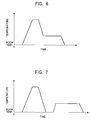
- the alloy ribbon After the first annealing treatment, the alloy ribbon is cooled to a predetermined temperature, is subjected to a second heating treatment, and is then cooled by air cooling or the like to room temperature.
- This method including the second annealing treatment in the middle of the cooling process after the first annealing is referred to as a two-stage annealing.
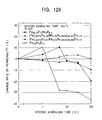
- the two-stage cooling step causes significant improvement in soft magnetic characteristics and slight changes in magnetic characteristics over time when the Fe-based soft magnetic alloy is allowed to stand at high temperatures for long periods.
- the second annealing treatment further improves soft magnetic characteristics of the Fe-based soft magnetic alloy, and the resulting alloy has slight changes in magnetic characteristics when the alloy is allowed to stand at high temperatures for long periods.
- the magnetocrystalline anisotropy is not sufficiently moderated and the soft magnetic characteristics are deteriorated.
- the Fe-based soft magnetic alloy preferably contains Fe as the major component; at least one metal M selected from the group consisting of Ti, Zr, Hf, V, Nb, Ta, Mo, W and Mn; and B.
- the third method is preferably applied to production of the above first to third Fe-based soft magnetic alloys.
- the third method is also preferably applicable to alloys represented by the following formulas: (Fe 1-a Z a ) b B x M y (Fe 1-a Z a ) b B x M y X z (Fe 1-a Z a ) b B x M y T t (Fe 1-a Z a ) b B x M y X z T t
- Z is at least one of Ni and Co
- M is at least one selected from the group consisting of Ti, Zr, Hf, V, Nb, Ta, Mo, W and Mn
- T is at least one selected from the group consisting of Cu, Ag, Au, Pd and Pt
- X is at least one selected from the group consisting of Si, Al, Ge and Ga
- subscripts a, b, x, y, t and z satisfy the relationships 0 ⁇ a ⁇ 0.1; 75 atomic percent ⁇ b ⁇ 93 atomic percent; 0.5 atomic percent
- An alloy ribbon essentially composed of an amorphous phase was prepared by a single-roller liquid quenching process.
- a melt was jetted onto a rotating steel roller through a nozzle by pressure of argon gas to form a ribbon by quenching.
- the resulting ribbon had a width of approximately 15 mm and a thickness of approximately 20 ⁇ m.
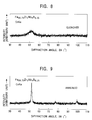
- Fig. 8 shows an X-ray diffraction pattern of a quenched soft magnetic alloy ribbon having a composition of Fe 86.76 Zr 2 Nb 4 B 8.25 which is formed by quenching a melt
- Fig. 9 shows an X-ray diffraction pattern of the annealed soft magnetic alloy ribbon having the same composition.
- the Fe-based soft magnetic alloy having the above composition has a fine crystalline texture primarily composed of fine crystal grains which are formed by annealing of the amorphous alloy.
- the soft magnetic alloys Fe 86 Zr 2 Nb 4 B 8 , Fe 85.75 Zr 2 Nb 4 B 8.25 and Fe 85.5 Zr 2 Nb 4 B 8.5 containing specific amounts of zirconium and niobium have a higher permeability ( ⁇ ') and a lower coercive force (Hc) than those of alloys for comparison containing either zirconium or niobium.
- the Fe-based soft magnetic alloys in accordance with the present invention have satisfactory soft magnetic characteristics.
- the alloy Fe 85.75 Zr 2 Nb 4 B 8.25 has a significantly high permeability ( ⁇ ') of 57,800 and a significantly low coercive force (Hc) of 0.043 Oe, and has superior soft magnetic characteristics.
- soft magnetic alloys in which the total amount of zirconium and niobium is 5.5 atomic percent have permeabilities ( ⁇ ') of 8,400 to 25,400.
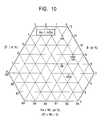
- the graph suggests that the permeability ( ⁇ ') depends on the relative contents of Fe, Zr and Nb, but does not depend on the content of boron.
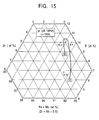
- the alloys having permeabilities ( ⁇ ') of 10,000 or more have compositions of not more than 90.5 atomic percent in total of iron and niobium, and not less than 0.5 atomic percent of zirconium.
- the alloys having permeabilities ( ⁇ ') of 20,000 or more have compositions of not more than 89 atomic percent in total of iron and niobium, and not less than 1 atomic percent of zirconium.
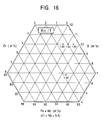
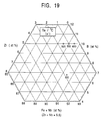
- the graphs shown in Figs. 18 and 19 suggest that alloy ribbons containing not less than 1 atomic percent of zirconium, 10 atomic percent of boron, and 88.5 to 89 atomic percent in total of iron and niobium have optimized coercive force (Hc) and optimized permeability ( ⁇ ') even when the ribbons are annealed at 550°C or less. Thus, the fine crystalline soft magnetic alloys have high productivity.
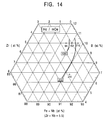
- the optimized composition range shown in Figs. 18 and 19 substantially includes the optimized composition range for coercive force (Hc) and permeability ( ⁇ ') shown in Figs. 14 and 15, respectively.
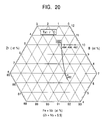
- Fig. 20 shows the crystallization temperature (T X1 ) of the bcc-Fe phase
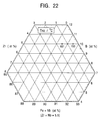
- Fig. 22 shows the crystallization temperature (T X2 ) of a compound phase
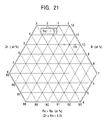
- Fig. 21 shows the crystallization temperature (T X1' ) of another compound phase.
- These crystallization temperatures satisfy the relationship T X1 ⁇ T X1 , ⁇ T X2 .
- the alloys represented by Fe 84.5 Zr 1 Nb 4.5 B 10 and Fe 84.5 Zr 1.5 Nb 4 B 10 have superior soft magnetic characteristics.
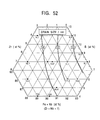
- the alloys having coercive forces (Hc) less than 50 mOe have compositions of 1.5 to 3.5 atomic percent of zirconium, 6.5 to 9.5 atomic percent and preferably 6.5 to 9 atomic percent of boron, and 89 to 90 atomic percent in total of iron and niobium (84.5 to 87.5 atomic percent of iron).
- the alloys having coercive forces (Hc) less than 40 mOe have compositions of 1.5 to 2.5 atomic percent and preferably 2.0 atomic percent of zirconium, 8 to 9 atomic percent of boron, and 89 to 89.5 atomic percent and preferably 89.5 atomic percent in total of iron and niobium (85 to 86 atomic percent of iron).
- ⁇ ' high permeability
- Hc coercive force
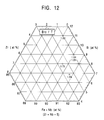
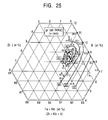
- soft magnetic alloys in which the total amount of zirconium and niobium is 6 atomic percent have remanent magnetizations (Br) of 0.39 to 1.19 T.
- the relationship between the remanent magnetization (Br) and the relative contents of Fe, Zr, Nb and B is not clear.
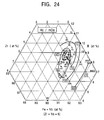
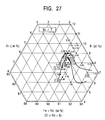
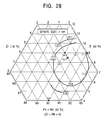
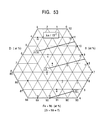
- a soft magnetic alloy having an average crystal grain size of 11 nm or less contains not more than 4 atomic percent of zirconium, 5.5 to 10 atomic percent and preferably 6 to 9 atomic percent of boron, and 88 to 92 atomic percent and preferably 90 to 92 atomic percent in total of iron and niobium (84 to 88.5 atomic percent and preferably 85 to 88 atomic percent of iron).
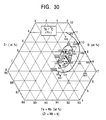
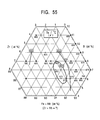
- Fig. 30 shows optimized annealing temperatures of soft magnetic alloys to achieve minimum coercive forces (Hc) in which the total amount of zirconium and niobium is 6 atomic percent.
- the alloy ribbons having minimum coercive forces (Hc) at a temperature of 525°C or less contain 1 to 3 atomic percent of zirconium, 7.5 to 9.5 atomic percent of boron, and 89 to 90 atomic percent in total of iron and niobium (84.5 to 86.5 atomic percent of iron).
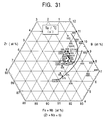
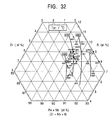
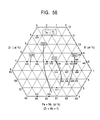
- Fig. 32 shows the crystallization temperature (T X1 ) of the bcc-Fe phase
- Fig. 33 shows the crystallization temperature (T X2 ) of a compound phase
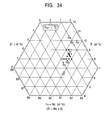
- Fig. 34 shows the crystallization temperature (T X1' ) of another compound phase.
- These crystallization temperatures satisfy the relationship T X1 ⁇ T X1' ⁇ T X2 .
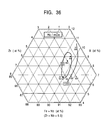
- the alloys represented by Fe 85.5 Zr 2 Nb 4 B 8.5 , Fe 85 Zr 1.75 Nb 4.25 B 9 , Fe 85.25 Zr 1.75 Nb 4.25 B 8.75 , and Fe 85.75 Zr 2.25 Nb 3.75 B 8.25 have superior soft magnetic characteristics.
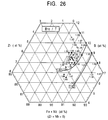
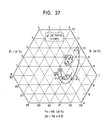
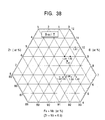
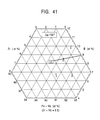
- soft magnetic alloys in which the total amount of zirconium and niobium is 6.5 atomic percent have saturation magnetic flux densities (B 10 ) of 1.5 to 1.6 T.
- soft magnetic alloys in which the total amount of zirconium and niobium is 6.5 atomic percent have small magnetostriction constants ( ⁇ s ) in a desirable range of -3 ⁇ 10 -7 to 6 ⁇ 10 -7 .
- the magnetostriction constant ( ⁇ s ) tends to depend on the B content and is substantially zero when the B content is in a range of 8 to 9 atomic percent.
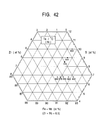
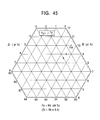
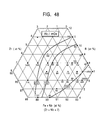
- Fig. 44 shows the crystallization temperature (T X1 ) of the bcc-Fe phase
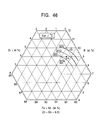
- Fig. 46 shows the crystallization temperature (T X2 ) of a compound phase
- Fig. 45 shows the crystallization temperature (T X1' ) of another compound phase.
- These crystallization temperatures satisfy the relationship T X1 ⁇ T X1 , ⁇ T X2 .
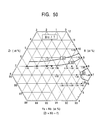
- the difference in the crystallization temperature ( ⁇ T X ) lies in a range of 305 to 325°C.
- These alloys have large differences in the crystallization temperatures ( ⁇ T X ) which increase as the B content decreases.
- the alloys have large differences in the crystallization temperatures ( ⁇ T X ) of more than 320°C in a range of 1.6 to 2.5 atomic percent of zirconium, 8.5 to 9 atomic percent of boron, and 90.5 atomic percent in total of iron and niobium, and only the bcc-Fe phase can be precipitated during annealing while precipitation of the compound phase which deteriorates soft magnetic characteristics of the alloys can be suppressed.
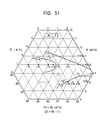
- the alloy ribbons having maximum permeabilities ( ⁇ ') at a temperature of 600°C or less contain not less than 2.5 atomic percent and preferably 3 to 3.5 atomic percent of zirconium, not less than 5.5 atomic percent and preferably 6 to 8 atomic percent of boron, and 89 to 91 atomic percent in total of iron and niobium (not more than 87.5 atomic percent and preferably 85 to 87 atomic percent of iron).
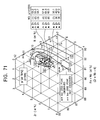
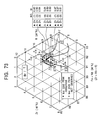
- Fig. 60 is a graph showing the relationship between the coercive force (Hc) and the relative contents of the Zr and Nb of soft magnetic alloys (Fe 85.75 Zr x Nb 5.75-x B 8.5 ) containing 5.75 atomic percent in total of zirconium and niobium, and 8.5 atomic percent of boron, soft magnetic alloys (Fe a Zr x Nb 6-x B z , wherein "a” is 85 to 86 and “z” is 8 to 9) containing 6 atomic percent in total of zirconium and niobium, and 8 to 9 atomic percent of boron, soft magnetic alloys (Fe 85.5 Zr x Nb 6.25-x B 8.25 ) containing 6.25 atomic percent in total of zirconium and niobium, and 8.25 atomic percent of boron, soft magnetic alloys (Fe 85 Zr x Nb 6.5-x B 8.5 ) containing 6.5 atomic percent in total of zi
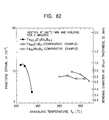
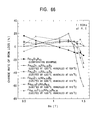
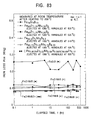
- Tables 2 and 3 show that the cores in accordance with the present invention show slight decreases in permeability ( ⁇ ') and slight increases in coercive force (Hc). Thus, deterioration of these cores is significantly reduced.
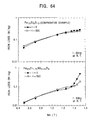
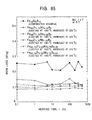
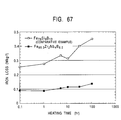
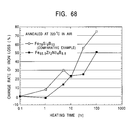
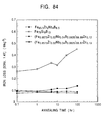
- the Fe 78 Si 9 B 13 amorphous alloy has a large iron loss and a significant change in iron loss with the heating time.
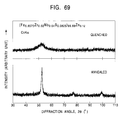
- Fig. 69 is a graph of X-ray diffraction patterns of an alloy of the present invention represented by (Fe 0.8575 Zr 0.02 Nb 0.04 B 0.0825 ) 99.88 Zn 0.12 before annealing and after annealing.
- a broad halo pattern characteristic to an amorphous phase is observed in the quenched alloy ribbon, whereas a diffraction pattern assigned to the bcc-Fe is observed in the annealed ribbon.
- the results in Fig. 69 demonstrate that the texture of the alloy changes from the amorphous phase to the bcc crystalline phase during annealing.
- a composition having a total content of zirconium and niobium in accordance with the present invention has a high saturation magnetic flux density of more than 1.5 T.
- the alloys (1) to (9) containing 0.034 to 0.142 atomic percent of zinc also show saturation magnetic flux densities of more than 1.6 T.
- the saturation magnetic flux density does not substantially change when zinc is added within a range of the present invention and is maintained at high levels.
- the first crystallization temperature, the intermediate crystallization temperature, and the second crystallization temperature will now be described.
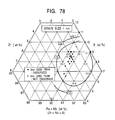
- Fig. 78 is a triangular diagram of the crystal grain size in the alloys having compositions, which are similar to the composition in accordance with the present invention, and not containing zinc. When zinc in an amount in accordance with the present invention is added to these compositions, the crystal grain size decreases slightly, as will be described later.
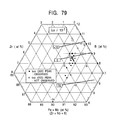
- the alloy in accordance with the present invention has crystal grains having grain sizes of 12 nm or less and preferably 11 nm or less.
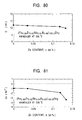
- Fig. 80 is a graph of the dependence of the crystal grain size (D) on the zinc content in zinc-containing alloys in accordance with the present invention.
- the crystal grain size (D) slightly decreases by the addition of zinc.
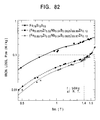
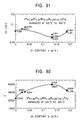
- Fig. 81 is a graph of the dependence of the magnetostriction ( ⁇ s) on the zinc content in zinc-containing alloys in accordance with the present invention.
- the magnetostriction decreases distinctly but moderately by the addition of zinc.
- the fracture strain was determined as follows. A ribbon was fasten with two rods, and the rods were moved close to each other so as to bend the ribbon in a "U" shape.
- the fracture strain ( ⁇ f ) was defined as the ratio t/(L-t) wherein L is the distance between the rods when the ribbon is fractured by bending and t is the thickness of the ribbon.
- the magnetic core When the above-described soft magnetic alloy is used as a magnetic core, the magnetic core has low iron loss and satisfactory workability and can be made compact.
- Rings having an outer diameter of 10 mm and an inner diameter of 6 mm were formed from the soft magnetic alloy ribbon and stacked.
- a coil was wound around the stacked rings and the permeability ⁇ ' (real part of complex permeability) of the ribbon was measured using an impedance analyzer at 5 mOe and 1 KHz.
- the coercive force Hc and the saturation magnetic flux densities B 10 were measured at 10 Oe using a DC H-H loop tracer.
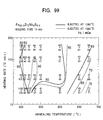
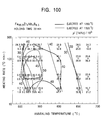
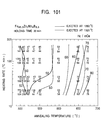
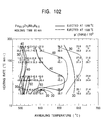
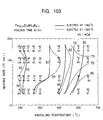
- the permeability ⁇ ' is approximately 50,000 in a region near the intersection of the heating rate of 30 to 90°C/min and the annealing temperature Ta of approximately 500 to 600°C for the ejection temperature of 1,320°C, and in a slightly narrower region for the ejection temperature of 1,280°C.
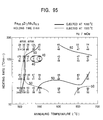
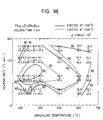
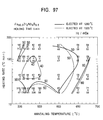
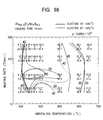
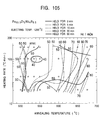
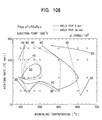
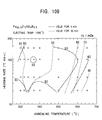
- Figs. 104 and 105 are graphs of the permeability ⁇ ' and coercive force Hc, respectively, of the Fe 85.5 Zr 2 Nb 4 B 8.5 annealed alloy at various heating rates, various annealing temperatures, and various holding times of 0 to 60 minutes.
- the ejection temperature is 1,280°C.
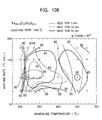
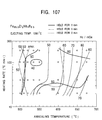
- Figs. 106 and 107 data for the holding times of 0, 10 and 60 minutes is extracted from Figs. 104 and 105.
- Figs. 108 and 109 data for the holding times of 5 and 30 minutes is extracted from Figs. 104 and 105.
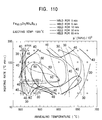
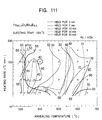
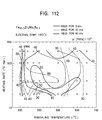
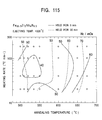
- Figs. 110 to 115 are graphs for the ejection temperature of 1,320°C, and corresponds to Figs. 104 to 109, respectively.
- the method in accordance with the present invention has the following two advantages. Since the Fe-based soft magnetic alloy can be produced at such a low heating rate, the alloy can be annealed using inexpensive facilities including a furnace. Furthermore, the alloy is gradually heated during the annealing process, and the annealing can be uniformly performed. Thus, in a preferred embodiment, a heating rate may be as low as possible.
- the Fe 85.5 Zr 2 Nb 4 B 8.5 alloy corresponds to the above-mentioned first soft magnetic alloy.
- the contents of these constituents satisfy the relationships specified in the first embodiment. That is, the iron content of 85.5 atomic percent is higher than 80 atomic percent; the total content of zirconium and niobium, 6 atomic percent, is in a range of 5 to 7 atomic percent and more preferably 5.7 to 6.5 atomic percent; the ratio x/(x+y), 2/6, is in a range of 1.5/6 to 2.5/6; and the boron content 8.5 atomic percent is in a range of 5 to 12 atomic percent.
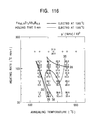
- the permeability ⁇ ' lies in a range of 700 to 39,800.
- a particularly high permeability ⁇ ' of at least 35,000 for the ejection temperature of 1,260°C is achieved in regions defined by the heating rate of 30 to 100°C/min or 200°C/min and the annealing temperature Ta of 510 to 550°C.
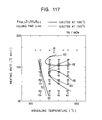
- the permeability ⁇ ' lies in a range of 800 to 55,700 and is higher than 30,000 in substantially the entire region.
- the maximum value is higher than that in Fig. 116.
- the coercive force Hc in Fig. 119 lies in a range of 37 to 670 mOe, and the minimum value is lower than that in Fig. 117.
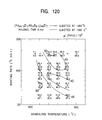
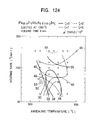
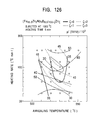
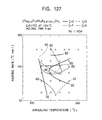
- These drawings show that the addition of zinc contributes to improved soft magnetic characteristics and that the permeability ⁇ ' and the coercive force Hc are at satisfactory levels over the entire region.
- the preferable regions in Figs. 118 and 119 are very similar to the preferable regions in Figs. 116 and 117.
- Figs. 120 to 123 are substantially the same as the regions shown in Figs. 118 and 119 and in Figs. 116 and 117.
- the permeability ⁇ ' is in a range of 40,968 to 49,672 at the start position or 41,508 to 49,649 at the end position for the alloys ejected at a temperature less than 1,350°C, and of 23,812 to 24,739 at the start position or 25,594 to 38,191 at the end position for the alloys ejected at a temperature of 1,350°C or more.
- preferred alloys are produced at an ejection temperature less than 1,350°C.
- the saturation magnetic flux densities B 10 at an ejection temperature less than 1,350°C is 1.5 T or more over the start and end positions. Accordingly, the alloy ejected at a temperature less than 1,350°C has superior soft magnetic characteristics.
- the coercive force Hc lies in a range of 0.038 to 0.116 Oe at the start position, or of 0.043 to 0.114 Oe at the end position, in Tables 11 to 14. In most cases, the coercive force Hc lies in the order of 0.04 Oe.
- the saturation magnetic flux densities B 10 is 1.5 T or more in most cases (except for the end positions of lots RQ6-108 and RQ6-111 in Table 12 and the start position of lot RQ6-148 in Table 14).
- the permeability ⁇ ' is higher than 30,000 in most cases except for some lots.
Landscapes
- Chemical & Material Sciences (AREA)
- Engineering & Computer Science (AREA)
- Materials Engineering (AREA)
- Mechanical Engineering (AREA)
- Metallurgy (AREA)
- Organic Chemistry (AREA)
- Physics & Mathematics (AREA)
- Electromagnetism (AREA)
- Dispersion Chemistry (AREA)
- Power Engineering (AREA)
- Soft Magnetic Materials (AREA)
Applications Claiming Priority (20)
| Application Number | Priority Date | Filing Date | Title |
|---|---|---|---|
| JP31966298 | 1998-11-10 | ||
| JP10319663A JP2000144346A (ja) | 1998-11-10 | 1998-11-10 | 高飽和磁束密度低鉄損Fe系軟磁性合金 |
| JP31966298 | 1998-11-10 | ||
| JP31966498 | 1998-11-10 | ||
| JP31966498 | 1998-11-10 | ||
| JP31966398 | 1998-11-10 | ||
| JP10331775A JP2000156313A (ja) | 1998-11-20 | 1998-11-20 | 低鉄損Fe系軟磁性合金磁心 |
| JP33177498 | 1998-11-20 | ||
| JP10331762A JP2000160241A (ja) | 1998-11-20 | 1998-11-20 | Fe基軟磁性合金の製造方法 |
| JP10331774A JP2000156312A (ja) | 1998-11-20 | 1998-11-20 | 低鉄損Fe系軟磁性合金磁心 |
| JP33177398 | 1998-11-20 | ||
| JP33177598 | 1998-11-20 | ||
| JP33177298 | 1998-11-20 | ||
| JP10331773A JP2000160243A (ja) | 1998-11-20 | 1998-11-20 | Fe系軟磁性合金の製造方法 |
| JP33176298 | 1998-11-20 | ||
| JP10331772A JP2000160242A (ja) | 1998-11-20 | 1998-11-20 | Fe系軟磁性合金の製造方法 |
| JP34347498 | 1998-12-02 | ||
| JP10343473A JP2000204451A (ja) | 1998-11-10 | 1998-12-02 | 高飽和磁束密度低鉄損Fe系軟磁性合金 |
| JP10343474A JP2000208315A (ja) | 1998-11-10 | 1998-12-02 | 高飽和磁束密度低鉄損Fe系軟磁性合金 |
| JP34347398 | 1998-12-02 |
Publications (1)
| Publication Number | Publication Date |
|---|---|
| EP1001437A1 true EP1001437A1 (de) | 2000-05-17 |
Family
ID=27580505
Family Applications (1)
| Application Number | Title | Priority Date | Filing Date |
|---|---|---|---|
| EP99308538A Withdrawn EP1001437A1 (de) | 1998-11-10 | 1999-10-28 | Auf Eisen basierte weichmagnetisch Legierung,Magnetkern davon,und Herstellungsverfahren |
Country Status (3)
| Country | Link |
|---|---|
| EP (1) | EP1001437A1 (de) |
| KR (1) | KR100366827B1 (de) |
| CN (1) | CN1253364A (de) |
Cited By (7)
| Publication number | Priority date | Publication date | Assignee | Title |
|---|---|---|---|---|
| WO2002077300A1 (fr) * | 2001-03-21 | 2002-10-03 | Ohnishi, Kazumasa | Production d'un corps magnetique doux a permeablite elevee et a densite de flux magnetique a saturation elevee |
| US7141127B2 (en) * | 2003-01-17 | 2006-11-28 | Hitachi Metals, Ltd. | Low core loss magnetic alloy with high saturation magnetic flux density and magnetic parts made of same |
| CN105743232A (zh) * | 2014-12-09 | 2016-07-06 | 上海新跃仪表厂 | 微型磁力矩器及其非晶棒材的制造方法 |
| US20200279678A1 (en) * | 2019-02-28 | 2020-09-03 | Tdk Corporation | Coil component |
| CN112430720A (zh) * | 2020-11-13 | 2021-03-02 | 沈阳航天新光集团有限公司 | 一种软磁合金退火工艺 |
| CN113770537A (zh) * | 2021-10-25 | 2021-12-10 | 吉林大学 | 纳秒激光辐照制备铁基非晶合金表面纳米结构的方法 |
| CN120340986A (zh) * | 2025-06-20 | 2025-07-18 | 中国电力科学研究院有限公司 | 一种高磁导率纳米晶软磁合金、带材及其制备方法和应用 |
Families Citing this family (14)
| Publication number | Priority date | Publication date | Assignee | Title |
|---|---|---|---|---|
| JP5756825B2 (ja) * | 2013-04-22 | 2015-07-29 | オムロン株式会社 | 電磁継電器 |
| CN103614671B (zh) * | 2013-12-19 | 2016-01-20 | 江苏南方永磁科技有限公司 | 一种高磁通密度纳米晶质薄带合金材料及制备方法 |
| CN103632789B (zh) * | 2013-12-19 | 2016-01-20 | 江苏南方永磁科技有限公司 | 一种高剩磁钕铁硼永磁材料及其制备方法 |
| CN105730717A (zh) * | 2014-12-09 | 2016-07-06 | 上海新跃仪表厂 | 微型磁力矩器及其非晶棒材的制造方法 |
| CN107123498A (zh) * | 2017-06-29 | 2017-09-01 | 成都磁动势科技有限公司 | 新型磁性材料 |
| JP6667727B2 (ja) * | 2017-08-10 | 2020-03-18 | 住友電気工業株式会社 | 圧粉磁心の製造方法、電磁部品の製造方法 |
| CN108597795B (zh) * | 2018-04-13 | 2020-11-06 | 河南宝泉电力设备制造有限公司 | 非晶干式变压器 |
| JP6680309B2 (ja) * | 2018-05-21 | 2020-04-15 | Tdk株式会社 | 軟磁性粉末、圧粉体および磁性部品 |
| CN110438308B (zh) * | 2019-09-16 | 2021-04-13 | 哈尔滨工业大学 | 一种FeCo-1.1V软磁合金的多级热处理方法 |
| US11887760B2 (en) * | 2020-11-12 | 2024-01-30 | Tdk Corporation | Soft magnetic alloy, magnetic core, and magnetic component |
| CN114823030A (zh) * | 2021-01-22 | 2022-07-29 | 日立金属株式会社 | 软磁性合金、软磁性合金薄带及其制造方法、磁芯、以及部件 |
| CN117980522A (zh) * | 2021-09-17 | 2024-05-03 | 阿莫绿色技术有限公司 | 铁基软磁合金及其制备方法 |
| CN114147191B (zh) * | 2021-10-27 | 2023-02-07 | 宁波雄海稀土速凝技术有限公司 | 一种锆铁铸片的浇铸甩带工艺 |
| CN114360883B (zh) * | 2021-12-31 | 2022-11-01 | 华南理工大学 | 一种基于非晶晶化双功能基元的高磁感磁粉芯及其制备方法与应用 |
Citations (4)
| Publication number | Priority date | Publication date | Assignee | Title |
|---|---|---|---|---|
| WO1992015998A2 (en) * | 1991-03-06 | 1992-09-17 | Allied-Signal Inc. | Fe-ni based soft magnetic alloys having nanocrystalline structure |
| JPH07201599A (ja) * | 1993-12-28 | 1995-08-04 | Alps Electric Co Ltd | 積層磁心 |
| US5474624A (en) * | 1992-09-14 | 1995-12-12 | Alps Electric Co., Ltd. | Method of manufacturing Fe-base soft magnetic alloy |
| US5935347A (en) * | 1993-12-28 | 1999-08-10 | Alps Electric Co., Ltd. | FE-base soft magnetic alloy and laminated magnetic core by using the same |
-
1999
- 1999-10-28 EP EP99308538A patent/EP1001437A1/de not_active Withdrawn
- 1999-11-09 KR KR10-1999-0049478A patent/KR100366827B1/ko not_active Expired - Fee Related
- 1999-11-10 CN CN99122492A patent/CN1253364A/zh active Pending
Patent Citations (4)
| Publication number | Priority date | Publication date | Assignee | Title |
|---|---|---|---|---|
| WO1992015998A2 (en) * | 1991-03-06 | 1992-09-17 | Allied-Signal Inc. | Fe-ni based soft magnetic alloys having nanocrystalline structure |
| US5474624A (en) * | 1992-09-14 | 1995-12-12 | Alps Electric Co., Ltd. | Method of manufacturing Fe-base soft magnetic alloy |
| JPH07201599A (ja) * | 1993-12-28 | 1995-08-04 | Alps Electric Co Ltd | 積層磁心 |
| US5935347A (en) * | 1993-12-28 | 1999-08-10 | Alps Electric Co., Ltd. | FE-base soft magnetic alloy and laminated magnetic core by using the same |
Non-Patent Citations (2)
| Title |
|---|
| HASEGAWA N ET AL: "MAGNETIC DOMAIN STRUCTURE OF NANOCRYSTALLINE FE-M-B (M=ZR,NB) ALLOYS REVEALED BY LORENTZ ELECTRON MICROSCOPY", JOURNAL OF MAGNETISM AND MAGNETIC MATERIALS,NL,ELSEVIER SCIENCE PUBLISHERS, AMSTERDAM, vol. 160, 1 July 1996 (1996-07-01), pages 249 - 250, XP000625253, ISSN: 0304-8853 * |
| PATENT ABSTRACTS OF JAPAN vol. 1995, no. 11 26 December 1995 (1995-12-26) * |
Cited By (8)
| Publication number | Priority date | Publication date | Assignee | Title |
|---|---|---|---|---|
| WO2002077300A1 (fr) * | 2001-03-21 | 2002-10-03 | Ohnishi, Kazumasa | Production d'un corps magnetique doux a permeablite elevee et a densite de flux magnetique a saturation elevee |
| US7141127B2 (en) * | 2003-01-17 | 2006-11-28 | Hitachi Metals, Ltd. | Low core loss magnetic alloy with high saturation magnetic flux density and magnetic parts made of same |
| CN105743232A (zh) * | 2014-12-09 | 2016-07-06 | 上海新跃仪表厂 | 微型磁力矩器及其非晶棒材的制造方法 |
| CN105743232B (zh) * | 2014-12-09 | 2019-11-05 | 上海新跃仪表厂 | 微型磁力矩器及其非晶棒材的制造方法 |
| US20200279678A1 (en) * | 2019-02-28 | 2020-09-03 | Tdk Corporation | Coil component |
| CN112430720A (zh) * | 2020-11-13 | 2021-03-02 | 沈阳航天新光集团有限公司 | 一种软磁合金退火工艺 |
| CN113770537A (zh) * | 2021-10-25 | 2021-12-10 | 吉林大学 | 纳秒激光辐照制备铁基非晶合金表面纳米结构的方法 |
| CN120340986A (zh) * | 2025-06-20 | 2025-07-18 | 中国电力科学研究院有限公司 | 一种高磁导率纳米晶软磁合金、带材及其制备方法和应用 |
Also Published As
| Publication number | Publication date |
|---|---|
| KR100366827B1 (ko) | 2003-01-06 |
| KR20000035340A (ko) | 2000-06-26 |
| CN1253364A (zh) | 2000-05-17 |
Similar Documents
| Publication | Publication Date | Title |
|---|---|---|
| US8007600B2 (en) | Soft magnetic thin strip, process for production of the same, magnetic parts, and amorphous thin strip | |
| CN101627140B (zh) | 磁性合金、非晶形合金薄带及磁性部件 | |
| EP0271657B1 (de) | Weichmagnetische Legierung auf Eisenbasis und Herstellungsverfahren | |
| JP3233313B2 (ja) | パルス減衰特性に優れたナノ結晶合金の製造方法 | |
| JP4210986B2 (ja) | 磁性合金ならびにそれを用いた磁性部品 | |
| JPH044393B2 (de) | ||
| KR100366827B1 (ko) | 고포화 자속밀도 저철손 Fe 기 연자성 합금 및 그것을사용한 자심 및 그 제조방법 | |
| CA2210017C (en) | Method for making fe-base soft magnetic alloy | |
| EP0429022B1 (de) | Magnetlegierung mit ultrakleinen Kristallkörnern und Herstellungsverfahren | |
| JPH06322472A (ja) | Fe基軟磁性合金の製造方法 | |
| JP3231149B2 (ja) | ノイズフィルタ | |
| JP2848667B2 (ja) | 極薄軟磁性合金薄帯の製造方法 | |
| JP2713373B2 (ja) | 磁 心 | |
| JPH0917623A (ja) | ナノ結晶合金磁心およびその製造方法 | |
| JPH1046301A (ja) | Fe基磁性合金薄帯ならびに磁心 | |
| JP4310738B2 (ja) | 軟磁性合金並びに磁性部品 | |
| JP4003166B2 (ja) | Co基磁性合金ならびにそれを用いた磁性部品 | |
| JP2877452B2 (ja) | Fe基軟磁性合金とその製造方法およびそれを用いた磁心 | |
| JP2000160241A (ja) | Fe基軟磁性合金の製造方法 | |
| JP3850623B2 (ja) | 微細結晶組織を有する軟磁性合金の製造方法 | |
| JPH0578794A (ja) | 超微結晶合金薄帯及び粉末並びにこれを用いた磁心 | |
| JPH08948B2 (ja) | Fe基磁性合金 | |
| JPH108224A (ja) | 高飽和磁束密度高透磁率磁性合金ならびにそれを用いた磁心 | |
| JP2008150637A (ja) | 磁性合金、アモルファス合金薄帯、および磁性部品 | |
| JP2000156313A (ja) | 低鉄損Fe系軟磁性合金磁心 |
Legal Events
| Date | Code | Title | Description |
|---|---|---|---|
| PUAI | Public reference made under article 153(3) epc to a published international application that has entered the european phase |
Free format text: ORIGINAL CODE: 0009012 |
|
| 17P | Request for examination filed |
Effective date: 20000318 |
|
| AK | Designated contracting states |
Kind code of ref document: A1 Designated state(s): DE FR GB SE |
|
| AX | Request for extension of the european patent |
Free format text: AL;LT;LV;MK;RO;SI |
|
| AKX | Designation fees paid |
Free format text: DE FR GB SE |
|
| 17Q | First examination report despatched |
Effective date: 20030108 |
|
| STAA | Information on the status of an ep patent application or granted ep patent |
Free format text: STATUS: THE APPLICATION IS DEEMED TO BE WITHDRAWN |
|
| 18D | Application deemed to be withdrawn |
Effective date: 20030520 |