EP1001553A2 - Annuleur de diaphonie et d'écho en mode mixte pour signaux d'impulsion modulés en amplitude - Google Patents
Annuleur de diaphonie et d'écho en mode mixte pour signaux d'impulsion modulés en amplitude Download PDFInfo
- Publication number
- EP1001553A2 EP1001553A2 EP99308675A EP99308675A EP1001553A2 EP 1001553 A2 EP1001553 A2 EP 1001553A2 EP 99308675 A EP99308675 A EP 99308675A EP 99308675 A EP99308675 A EP 99308675A EP 1001553 A2 EP1001553 A2 EP 1001553A2
- Authority
- EP
- European Patent Office
- Prior art keywords
- signal
- crosstalk
- tap
- error
- mixed
- Prior art date
- Legal status (The legal status is an assumption and is not a legal conclusion. Google has not performed a legal analysis and makes no representation as to the accuracy of the status listed.)
- Withdrawn
Links
- 238000000034 method Methods 0.000 claims abstract description 16
- 230000003247 decreasing effect Effects 0.000 claims abstract description 7
- 238000004891 communication Methods 0.000 claims description 6
- 238000010586 diagram Methods 0.000 description 4
- 238000013507 mapping Methods 0.000 description 4
- 238000007493 shaping process Methods 0.000 description 4
- 238000012886 linear function Methods 0.000 description 2
- 230000001360 synchronised effect Effects 0.000 description 2
- 230000006978 adaptation Effects 0.000 description 1
- 230000005540 biological transmission Effects 0.000 description 1
- 238000004364 calculation method Methods 0.000 description 1
- 238000006243 chemical reaction Methods 0.000 description 1
- 230000007812 deficiency Effects 0.000 description 1
- 230000001934 delay Effects 0.000 description 1
- 230000002452 interceptive effect Effects 0.000 description 1
- 238000012986 modification Methods 0.000 description 1
- 230000004048 modification Effects 0.000 description 1
- 238000011084 recovery Methods 0.000 description 1
- 238000004513 sizing Methods 0.000 description 1
- 230000003068 static effect Effects 0.000 description 1
- 238000012549 training Methods 0.000 description 1
Images



Classifications
-
- H—ELECTRICITY
- H04—ELECTRIC COMMUNICATION TECHNIQUE
- H04B—TRANSMISSION
- H04B3/00—Line transmission systems
- H04B3/02—Details
- H04B3/20—Reducing echo effects or singing; Opening or closing transmitting path; Conditioning for transmission in one direction or the other
- H04B3/23—Reducing echo effects or singing; Opening or closing transmitting path; Conditioning for transmission in one direction or the other using a replica of transmitted signal in the time domain, e.g. echo cancellers
Definitions
- the present invention relates generally to crosstalk cancellation techniques, and more particularly, to methods and apparatus for reducing near-end crosstalk (NEXT) and echo crosstalk in the continuous time domain.
- NXT near-end crosstalk
- FIG. 1 illustrates a hybrid transceiver 100 that transmits and receives signals on the same twisted pair (TP) 110.
- the hybrid transceiver 100 is commonly associated with a local area network (LAN) or digital subscriber loops (xDSL).
- the main sources of crosstalk in such a transceiver 100 are usually near-end crosstalk (NEXT) and Echo crosstalk.
- Each hybrid transceiver, such as the transceiver 100 transmits a first signal, V 1 , and receives a different signal, V 2 , on the same twisted pair 110.
- Near-end crosstalk results from transmitting and receiving different signals on different twisted pairs 110 and having a signal on one twisted pair interfering with the signal on another twisted pair.
- V 1 corresponds to the transmitted signal generated by the transceiver 100.
- V 2 corresponds to the received signal generated by a second transceiver 120. Since the transceiver 100 knows the transmitted signal, V 1 , that it has generated, the transceiver 100 can subtract the transmitted signal, V 1 , from the voltage (V 1 + V 2 ) on the twisted pair (TP) 110, to obtain the voltage corresponding to the received signal V 2 .
- Echo crosstalk is the result of crosstalk on the same twisted pair 110 and of discontinuous impedances along a given path, for example, at each connector.
- each impedance discontinuity along the path causes the transceiver 100 to receive a wave or echo back.
- FIG. 2 corresponds to the impulse response 200 of an impulse signal transmitted along the twisted pair (TP) 110 by the transceiver 100.
- each peak 210-213 in the impulse response 200 corresponds to a different connector (not shown) on the twisted pair (TP) 110.
- the impulse response 200 is utilized to obtain the echo path and then adjust the taps of an echo canceller (not shown) to the peaks of the echo impulse response.
- the taps are adjusted, for example, using the well known least mean square (LMS) algorithm, to match the energy and delay of the echo canceller to the peaks of the echo impulse response.
- LMS least mean square
- the echo impulse response is not dynamic, the tap values converge and remain constant.
- the impulse response is static and coincides with the symbol rate.
- the echo canceller can be implemented using low cost, low power digital circuitry.
- the transmitter and receiver are not synchronized and the resulting impulse response is dynamic. In such an asynchronous communication system, a frequency offset exists between the transmitter and the receiver.
- FIR finite impulse response
- a mixed-mode crosstalk canceller that performs crosstalk cancellation in the continuous time domain.
- the disclosed mixed-mode crosstalk canceller processes the pulse amplitude modulated (PAM) digital signal to be transmitted as well as the received signal to compensate for the crosstalk between the transmit and receive signals.
- the output of the crosstalk canceller is subtracted from the received signal in the continuous time domain.
- the transmit symbol clock and the receive symbol clock can be asynchronous.
- the tap weights for the crosstalk cancellation are obtained using a modified version of the least mean square (LMS) algorithm for discrete time signals.
- the modified least mean square (LMS) algorithm is applied for continuous time signals that are derived from different clocks, using the following equation:
- the LMS algorithm requires a costly multiplication of the error signal, e(t), and the digital transmit signal, x k (t). Since it is only necessary to go in the direction of the gradient with the steepest decent, however, computational gains are achieved in accordance with the present invention using a correlation multiplier that quantizes e(t) and x k (t) with only one or two bits, and performs the correlation multiplication using an asynchronous logic circuit.
- the correlation multiplier receives a 2 bit quantized representation of the digital transmit signal, x k (t), and a 1 bit quantized version of the error signal, e(t).
- the quantized version of the error signal, e(t) indicates the sign of the error (positive or negative) and is obtained in the illustrative embodiment by comparing the error signal to zero.
- a crosstalk canceller that updates each tap weight utilizing the disclosed correlation multiplier that provides a signal indicating whether the ta; weight needs to be increased or decreased to a charge pump that produces a current in the proper direction.
- a mixed-mode crosstalk canceller that allows crosstalk cancellation in the continuous time domain.
- the present invention permits asynchronous signals to be processed. It is noted that a number of modem standards, such as 100 Base Tx, allow the transmitter and receiver to be asynchronous, making digital crosstalk cancellation difficult.
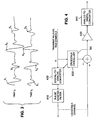
- FIG. 3 shows a stream of asynchronous crosstalk pulses at two different instants of time, t 1 and t 2 . Due to the frequency offset between the transmit clock and the receive clock, the crosstalk impulses are sampled at different phases, s 1 through s 4 , for times t 1 and t 2 . Thus, the received signal is sampled by the transceiver 100 with a time-varying phase.
- FIG. 4 shows a schematic block diagram of a mixed-mode crosstalk canceller 400 in accordance with the present invention.
- the input, X, of the mixed-mode crosstalk canceller 400 is a digital number representing an N-level pulse amplitude modulated (PAM) signal to be transmitted.
- a pulse-shaping filter 410 can be placed before or after the digital-to-analog converter (DAC) 420, depending on whether the pulse shaping is performed on the signal in digital or analog form.
- the architecture of the mixed-mode crosstalk canceller 400 is independent of the pulse shaping, since the pulse-shaping filter 410 can be considered part of the crosstalk channel.
- the mixed-mode crosstalk canceller 400 also includes a track and hold amplifier 430 and an analog-to-digital converter (ADC) 440.
- ADC analog-to-digital converter
- the mixed-mode crosstalk canceller 400 includes a crosstalk canceller 600, discussed further below in conjunction with FIG. 6, to compensate for the crosstalk between the transmit and receive signals. Since the output of the crosstalk canceller 600 is subtracted from the received signal in the continuous time domain, the transmit symbol clock and the receive symbol clock can be asynchronous.
- x k and e can be asynchronous signals.
- the continuous time tap adaptation algorithm can be derived by rewriting the expression of the gradient in the continuous-time domain:
- Equation 2 requires the knowledge of a reference signal.
- R is available at start-up.
- updates can usually not be performed during a normal data transmission mode.
- An alternative solution is to use a modified error signal, :
- Equation 6 the second term is equal to zero since R and x are uncorrelated signals (receive symbols and transmit symbols are uncorrelated). Therefore, the conventional tap update algorithm can be modified to: where ⁇ is a small constant, called step size. Equation 7 is very similar to the expression of the LMS tap update for discrete time signals, with (t) and x k (t) being continuous time, sampled and held cyclostationary signals that are derived from different clocks. Since it is difficult to multiply (t) times x k (t), and it is only necessary to go in the direction of the gradient with the steepest decent, (t) and x k (t) can be quantized with a small number of bits, and the correlation multiplication can be performed using an asynchronous logic circuit.
- FIGS. 5A and 5B show an illustrative implementation of a correlation multiplier 500 for implementing Equation 5, where 1 bit is used to represent the sign of the error signal, (t), and x k (t) is represented by 2 bits ( ⁇ 1, 0).
- the mapping for the correlation multiplier 500 is shown in FIG. 5A and the corresponding logic circuitry is shown in FIG. 5B.
- the correlation multiplier 500 includes a pair of exclusive OR gates 510, 515, a pair of inverters 520, 525, and a pair of AND gates 530, 535.
- the input to the correlation multiplier 500 can be continuous.
- FIG. 6 illustrates an analog implementation of the crosstalk canceller 600, discussed above in conjunction with FIG. 4.
- the crosstalk canceller 600 includes a quantizer 610 to reduce the N-level digital symbol X to a few bits.
- the quantizer 610 quantizes the X value to 2 bits (a o a 1 ).
- the quantized value is then applied to an update circuit 700-702, such as the update circuit 700 discussed below in conjunction with FIG. 7.
- the update circuit 700 updates the corresponding tap value by dynamically determining the appropriate tap weight, w N .
- the crosstalk canceller 600 includes subtractor circuitry for implementing equation 6.
- the subtractor circuitry includes an op-amp 620 and an analog comparator 630 that produce a one-bit value representative of the sign of the error signal.
- the crosstalk canceller 600 also includes a number of digital delays, D, in a known manner.
- FIG. 7 illustrates an update circuit 700 of FIG. 6.
- the update circuit 700 includes a correlation multiplier 500, discussed above in conjunction with FIG. 5B.
- the correlation multiplier 500 determines the optimum tap weights by generating a signal indicating whether the tap weight values need to be increased or decreased to move in the direction of the gradient.
- the charge pump 710 may be embodied as a charge pump used for phase locked loop (PLL) circuits that generates a positive or negative current in response to the signal from the correlation multiplier 500.
- PLL phase locked loop
- the step size of the least mean square (LMS) algorithm can be adjusted by sizing the current in the charge pump 710.
- the loop filter 720 is a proportional plus integral loop filter.
- FIG. 8 illustrates the analog tap 800 of FIG. 6.
- the analog tap 800 includes two cross-coupled multiplying digital to analog converters (MDAC) 900, 901 to generate signed weight values, w k , by current subtraction.
- MDAC multipliing digital to analog converters
- the output current of the analog tap 800, lout equals Iout p minus Iout n and is approximately proportional to (Vctrl minus Vref) multiplied by X, where X is the digital input with thermometer representation a 0 ,a 1 ,...,a N-1 .
- Vctrl - Vref For large large voltage differences (Vctrl - Vref) the relation between lout and (Vctrl - Vref) may be a non-linear function, F.
- F non-linear function
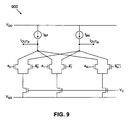
- the multiplying digital-to-analog converter (DAC) 900 of FIG. 8 can be implemented using the well-known current steering DAC circuitry of FIG. 9.
- the MDAC 900 creates an N-level voltage.
- the feedback of FIG. 9 eliminates the digital-to-analog conversion, with the current eventually settling to the proper value.
- the multiplying digital-to-analog converter (MDAC) 900 includes N parallel tail current sources 910-912 controlled by the control voltage Vc. Each tail current is "steered” either towards the positive or negative output terminal of the MDAC depending on the value of the thermometer code digits a 0 ,a 1 ,...,a N-1 .
- the resulting differential output current, Iout equals Iout p minus Iout n and is proportional to X (a digital input with thermometer code representation a 0 ,a 1 ,...,a N-1 ).
- the common mode output current (Iout p +Iout n )/2 can be set to a desired value (typically 0) by adjusting the load currents (I BP , I BN ) relative to the tail currents.
Landscapes
- Engineering & Computer Science (AREA)
- Computer Networks & Wireless Communication (AREA)
- Signal Processing (AREA)
- Cable Transmission Systems, Equalization Of Radio And Reduction Of Echo (AREA)
Applications Claiming Priority (2)
| Application Number | Priority Date | Filing Date | Title |
|---|---|---|---|
| US188625 | 1998-11-09 | ||
| US09/188,625 US6584159B1 (en) | 1998-11-09 | 1998-11-09 | Mixed-mode next/echo canceller for pulse amplitude modulated (PAM) signals |
Publications (2)
| Publication Number | Publication Date |
|---|---|
| EP1001553A2 true EP1001553A2 (fr) | 2000-05-17 |
| EP1001553A3 EP1001553A3 (fr) | 2000-06-28 |
Family
ID=22693923
Family Applications (1)
| Application Number | Title | Priority Date | Filing Date |
|---|---|---|---|
| EP99308675A Withdrawn EP1001553A3 (fr) | 1998-11-09 | 1999-11-02 | Annuleur de diaphonie et d'écho en mode mixte pour signaux d'impulsion modulés en amplitude |
Country Status (4)
| Country | Link |
|---|---|
| US (1) | US6584159B1 (fr) |
| EP (1) | EP1001553A3 (fr) |
| CN (1) | CN1258965A (fr) |
| CA (1) | CA2284232A1 (fr) |
Cited By (1)
| Publication number | Priority date | Publication date | Assignee | Title |
|---|---|---|---|---|
| EP1443675A3 (fr) * | 2003-01-28 | 2004-09-01 | Agere Systems Inc. | Méthode et appareil pour la réduction de bruit dans un canal asymmétrique au moyen de la composante de mode commun |
Families Citing this family (10)
| Publication number | Priority date | Publication date | Assignee | Title |
|---|---|---|---|---|
| US6934387B1 (en) | 1999-12-17 | 2005-08-23 | Marvell International Ltd. | Method and apparatus for digital near-end echo/near-end crosstalk cancellation with adaptive correlation |
| US7366231B2 (en) * | 2003-10-28 | 2008-04-29 | Teranetics, Inc. | Sub-block domain transformation multiple signal processing |
| US7471670B1 (en) * | 2004-01-20 | 2008-12-30 | Marvell International Ltd. | Method and apparatus for reducing echo and crosstalk in a communication system |
| KR100520300B1 (ko) * | 2004-02-02 | 2005-10-13 | 삼성전자주식회사 | 고속신호 인터페이스 방법 |
| US7782852B2 (en) * | 2005-10-11 | 2010-08-24 | Teranetics, Inc. | Multiple modulation rate 10Gbase-T transmission |
| KR20080112813A (ko) * | 2007-06-22 | 2008-12-26 | 주식회사 동부하이텍 | 능동 인덕터를 이용한 전압제어 발진기 |
| GB0800891D0 (en) * | 2008-01-17 | 2008-02-27 | Cambridge Silicon Radio Ltd | Method and apparatus for cross-talk cancellation |
| DE112008003632B4 (de) * | 2008-01-28 | 2023-04-06 | Uchiya Thermostat Co., Ltd. | Hitzeschutz |
| TWI410065B (zh) * | 2008-12-31 | 2013-09-21 | Ind Tech Res Inst | 傳輸方法及其多輸入多輸出無線通訊系統 |
| JP5846183B2 (ja) * | 2013-11-11 | 2016-01-20 | 株式会社デンソー | 通信装置 |
Family Cites Families (8)
| Publication number | Priority date | Publication date | Assignee | Title |
|---|---|---|---|---|
| WO1989007370A1 (fr) | 1988-02-01 | 1989-08-10 | Concord Data Systems, Inc. | Procede et appareil d'elimination de tele-echos |
| US5181198A (en) * | 1991-03-12 | 1993-01-19 | Bell Communications Research, Inc. | Coordinated transmission for two-pair digital subscriber lines |
| JP2576767B2 (ja) * | 1993-09-10 | 1997-01-29 | 日本電気株式会社 | エコー消去方法およびエコーキャンセラ |
| US5852661A (en) * | 1995-02-17 | 1998-12-22 | Advanced Micro Devices, Inc. | Adaptive echo cancellation used with echo suppression to reduce short and long duration echoes |
| US5657384A (en) * | 1995-03-10 | 1997-08-12 | Tandy Corporation | Full duplex speakerphone |
| US5828657A (en) * | 1995-09-29 | 1998-10-27 | Paradyne Corporation | Half-duplex echo canceler training using a pilot signal |
| US5937060A (en) * | 1996-02-09 | 1999-08-10 | Texas Instruments Incorporated | Residual echo suppression |
| US5835486A (en) * | 1996-07-11 | 1998-11-10 | Dsc/Celcore, Inc. | Multi-channel transcoder rate adapter having low delay and integral echo cancellation |
-
1998
- 1998-11-09 US US09/188,625 patent/US6584159B1/en not_active Expired - Lifetime
-
1999
- 1999-09-28 CA CA002284232A patent/CA2284232A1/fr not_active Abandoned
- 1999-11-02 EP EP99308675A patent/EP1001553A3/fr not_active Withdrawn
- 1999-11-08 CN CN99123681.5A patent/CN1258965A/zh active Pending
Cited By (2)
| Publication number | Priority date | Publication date | Assignee | Title |
|---|---|---|---|---|
| EP1443675A3 (fr) * | 2003-01-28 | 2004-09-01 | Agere Systems Inc. | Méthode et appareil pour la réduction de bruit dans un canal asymmétrique au moyen de la composante de mode commun |
| US8126078B2 (en) | 2003-01-28 | 2012-02-28 | Agere Systems Inc. | Method and apparatus for reducing noise in an unbalanced channel using common mode component |
Also Published As
| Publication number | Publication date |
|---|---|
| EP1001553A3 (fr) | 2000-06-28 |
| CN1258965A (zh) | 2000-07-05 |
| US6584159B1 (en) | 2003-06-24 |
| CA2284232A1 (fr) | 2000-05-09 |
Similar Documents
| Publication | Publication Date | Title |
|---|---|---|
| US5157690A (en) | Adaptive convergent decision feedback equalizer | |
| US4539675A (en) | Echo canceller | |
| US4999830A (en) | Communication system analog-to-digital converter using echo information to improve resolution | |
| US5793801A (en) | Frequency domain signal reconstruction compensating for phase adjustments to a sampling signal | |
| US4766589A (en) | Data transmission system | |
| US5396517A (en) | Transversal filter useable in echo canceler, decision feedback equalizer applications for minimizing non-linear distortion in signals conveyed over full duplex two-wire communication link | |
| US7843859B1 (en) | Analog echo canceller with filter banks | |
| EP0145022B1 (fr) | Procédé et dispositif pour la compensation d'écho | |
| JPH0697729B2 (ja) | 自己適応型イコライザ | |
| JPS62128627A (ja) | データ伝送装置における同期維持方法 | |
| US5577027A (en) | Apparatus and method for effectively eliminating the echo signal of transmitting signal in a modem | |
| US6584159B1 (en) | Mixed-mode next/echo canceller for pulse amplitude modulated (PAM) signals | |
| US4769808A (en) | Method of cancelling echoes in full-duplex data transmission system | |
| US4334128A (en) | Echo canceler for homochronous data transmission systems | |
| US6404809B1 (en) | Method and apparatus for training equalizer structures in a digital communication system having periodic digital impairments | |
| JPH0773182B2 (ja) | ディジタル信号伝送用濾波器の等化器及び等化方法 | |
| US6965578B1 (en) | Echo canceling method and apparatus for digital data communication system | |
| CA1194944A (fr) | Normalisation de mise a jour pour filtre adaptatif | |
| US4982428A (en) | Arrangement for canceling interference in transmission systems | |
| US4964118A (en) | Apparatus and method for echo cancellation | |
| JP2928801B2 (ja) | エコー相殺方法および加入者ラインオーディオ処理回路 | |
| US4468640A (en) | Adaptive filter update normalization | |
| US7236463B2 (en) | Transceiver for echo and near-end crosstalk cancellation without loop timing configuration | |
| GB2102255A (en) | Two-wire line for digital communication | |
| KR880001981B1 (ko) | 반향제거기 |
Legal Events
| Date | Code | Title | Description |
|---|---|---|---|
| PUAI | Public reference made under article 153(3) epc to a published international application that has entered the european phase |
Free format text: ORIGINAL CODE: 0009012 |
|
| PUAL | Search report despatched |
Free format text: ORIGINAL CODE: 0009013 |
|
| AK | Designated contracting states |
Kind code of ref document: A2 Designated state(s): ES |
|
| AX | Request for extension of the european patent |
Free format text: AL;LT;LV;MK;RO;SI |
|
| AK | Designated contracting states |
Kind code of ref document: A3 Designated state(s): AT BE CH CY DE DK ES FI FR GB GR IE IT LI LU MC NL PT SE |
|
| AX | Request for extension of the european patent |
Free format text: AL;LT;LV;MK;RO;SI |
|
| 17P | Request for examination filed |
Effective date: 20001214 |
|
| AKX | Designation fees paid |
Free format text: ES |
|
| 17Q | First examination report despatched |
Effective date: 20070705 |
|
| REG | Reference to a national code |
Ref country code: DE Ref legal event code: 8566 |
|
| RAP3 | Party data changed (applicant data changed or rights of an application transferred) |
Owner name: LUCENT TECHNOLOGIES INC. |
|
| GRAP | Despatch of communication of intention to grant a patent |
Free format text: ORIGINAL CODE: EPIDOSNIGR1 |
|
| STAA | Information on the status of an ep patent application or granted ep patent |
Free format text: STATUS: THE APPLICATION IS DEEMED TO BE WITHDRAWN |
|
| 18D | Application deemed to be withdrawn |
Effective date: 20100324 |