EP1001596B1 - Terminal multimédia de téléphonie permettant des connexions multipointes - Google Patents
Terminal multimédia de téléphonie permettant des connexions multipointes Download PDFInfo
- Publication number
- EP1001596B1 EP1001596B1 EP99122764.6A EP99122764A EP1001596B1 EP 1001596 B1 EP1001596 B1 EP 1001596B1 EP 99122764 A EP99122764 A EP 99122764A EP 1001596 B1 EP1001596 B1 EP 1001596B1
- Authority
- EP
- European Patent Office
- Prior art keywords
- terminal
- terminals
- multipoint
- teb
- connection
- Prior art date
- Legal status (The legal status is an assumption and is not a legal conclusion. Google has not performed a legal analysis and makes no representation as to the accuracy of the status listed.)
- Expired - Lifetime
Links
- 230000011664 signaling Effects 0.000 claims description 14
- 239000000203 mixture Substances 0.000 claims description 8
- 238000004891 communication Methods 0.000 description 14
- 230000005540 biological transmission Effects 0.000 description 5
- 238000000034 method Methods 0.000 description 3
- 238000010276 construction Methods 0.000 description 2
- 238000010586 diagram Methods 0.000 description 2
- 230000003993 interaction Effects 0.000 description 2
- 241001136792 Alle Species 0.000 description 1
- 238000013475 authorization Methods 0.000 description 1
- 238000009826 distribution Methods 0.000 description 1
- 230000000977 initiatory effect Effects 0.000 description 1
- 230000010076 replication Effects 0.000 description 1
- 239000011369 resultant mixture Substances 0.000 description 1
Images

Classifications
-
- H—ELECTRICITY
- H04—ELECTRIC COMMUNICATION TECHNIQUE
- H04L—TRANSMISSION OF DIGITAL INFORMATION, e.g. TELEGRAPHIC COMMUNICATION
- H04L65/00—Network arrangements, protocols or services for supporting real-time applications in data packet communication
- H04L65/60—Network streaming of media packets
- H04L65/65—Network streaming protocols, e.g. real-time transport protocol [RTP] or real-time control protocol [RTCP]
-
- H—ELECTRICITY
- H04—ELECTRIC COMMUNICATION TECHNIQUE
- H04M—TELEPHONIC COMMUNICATION
- H04M3/00—Automatic or semi-automatic exchanges
- H04M3/42—Systems providing special services or facilities to subscribers
- H04M3/56—Arrangements for connecting several subscribers to a common circuit, i.e. affording conference facilities
- H04M3/567—Multimedia conference systems
-
- H—ELECTRICITY
- H04—ELECTRIC COMMUNICATION TECHNIQUE
- H04L—TRANSMISSION OF DIGITAL INFORMATION, e.g. TELEGRAPHIC COMMUNICATION
- H04L65/00—Network arrangements, protocols or services for supporting real-time applications in data packet communication
- H04L65/40—Support for services or applications
- H04L65/403—Arrangements for multi-party communication, e.g. for conferences
- H04L65/4046—Arrangements for multi-party communication, e.g. for conferences with distributed floor control
-
- H—ELECTRICITY
- H04—ELECTRIC COMMUNICATION TECHNIQUE
- H04M—TELEPHONIC COMMUNICATION
- H04M7/00—Arrangements for interconnection between switching centres
- H04M7/006—Networks other than PSTN/ISDN providing telephone service, e.g. Voice over Internet Protocol (VoIP), including next generation networks with a packet-switched transport layer
-
- H—ELECTRICITY
- H04—ELECTRIC COMMUNICATION TECHNIQUE
- H04M—TELEPHONIC COMMUNICATION
- H04M2203/00—Aspects of automatic or semi-automatic exchanges
- H04M2203/50—Aspects of automatic or semi-automatic exchanges related to audio conference
- H04M2203/5018—Initiating a conference during a two-party conversation, i.e. three-party service or three-way call
-
- H—ELECTRICITY
- H04—ELECTRIC COMMUNICATION TECHNIQUE
- H04M—TELEPHONIC COMMUNICATION
- H04M3/00—Automatic or semi-automatic exchanges
- H04M3/42—Systems providing special services or facilities to subscribers
- H04M3/428—Arrangements for placing incoming calls on hold
-
- H—ELECTRICITY
- H04—ELECTRIC COMMUNICATION TECHNIQUE
- H04M—TELEPHONIC COMMUNICATION
- H04M3/00—Automatic or semi-automatic exchanges
- H04M3/42—Systems providing special services or facilities to subscribers
- H04M3/58—Arrangements for transferring received calls from one subscriber to another; Arrangements affording interim conversations between either the calling or the called party and a third party
Definitions
- the invention relates to a multimedia terminal for telephony according to the ITU-T H.323 standard for enabling multipoint connections to several other terminals.
- Multipoint connections between multiple subscribers of a communication network are known as conference circuits controlled by a central conference circuit controller provided in the communication network.
- multi-point control units are known, so-called multipoint control units MCU.
- terminals each have a point-to-point connection to the multipoint control unit.
- This multipoint control unit performs a multipoint function called multipoint processing.
- the data streams of the individual point-to-point connections are treated, wherein others are mixed together coming from the individual terminals data streams and each resulting mixture is transmitted to the individual terminals.
- Such a procedure is described for example in the standard ITU-T H.323, clause 6.8.1, under the name "Centralized conference".
- a multipoint communication with distributed control in which a multipoint control is provided only for the execution of a multi-point signaling.
- a distributed multipoint control can be realized for example in a terminal or a multipoint control unit.
- each of the participating terminals sends the payload to a predetermined by the multipoint control multicast address, the multipoint control several different multicast addresses assigns and tells each terminal a multicast address for its information to be sent.
- Each terminal thus sends to a specific multicast address and receives the information sent to the other multicast addresses assigned by the multipoint control.
- all participating terminals must support multicast functions.
- multi-unicast can also be provided. In this multi-unicast method, the terminals send the data streams to be transmitted in each case to the other terminals involved in the multipoint connection, using multiple point-to-point connections.
- a gatekeeper is a logical function to fulfill standard functions such as address resolution or bandwidth management. Address resolution here means that a calling endpoint sends to the gatekeeper an alias address of an endpoint to be called and receives from the gatekeeper the transport address, ie the Internet Protocol address and the port number.
- the gatekeeper knows the traffic volume in terms of real-time applications within the network area for which he is responsible.
- the subscriber A or B which causes a call to another caller C during the existence of a call between the participants A and B, usually already set up when establishing this consultation call, whether the subscriber to be consulted C in the call between the Participants A and B to be integrated with a multipoint connection.
- H.323 conferencing system for controlling conference signaling and for mixing and distributing the data streams of the conference participants.
- MCU Multipoint Control Unit
- the access possibilities of the terminals provided there to the MCU are limited to the control protocols provided in accordance with H.323 recommendation.
- each terminal participating in the conference transmits the self-originating media streams by multicast to all other conference participants.
- no mixing device for mixing the media streams to be sent is required.
- the disclosed conferencing system also includes central and remote conference mixers on.
- participating terminals have a replication and combination function, wherein the data streams originating from the respective other of these terminals are mixed by the combination function of a respectively considered terminal in order to use the mixing result for the terminal in question.
- the other terminals then not the mixing result, but the unmixed own data stream of the considered terminal is transmitted.
- Object of the present invention is to enable a flexible construction of multipoint communication between terminals.
- a new multimedia terminal for telephony according to the ITU-T H.323 standard for realizing multipoint connections to a first other terminal and a second other terminal from an active connection to the first terminal.
- a terminal has a controller for processing signaling for point-to-multipoint connections. It also includes means for merging data streams originating from the multimedia terminal and from the other terminals involved in the multipoint connection, and for providing a resultant mixture of these data streams to these terminals.
- the multimedia terminal is further configured to place the first terminal in a hold state, to establish a consultation connection to the second terminal in the form of logical channels and to return the first terminal to the active state and to reuse the already opened logical channels.
- the point-to-multipoint connection signaling control allows the establishment of point-to-point connections to several other devices simultaneously.
- this control allows the establishment of a point-to-multipoint connection constellation that is shared by all those involved with the aid of the means for merging data streams originating from the terminals involved in the multipoint connection and providing data stream mixtures to these terminals Terminals is a multipoint-to-multipoint connection acts
- the means for mixing provides for each of the terminals involved in the multipoint connection a data stream mixture of the data streams originating from the remaining terminals involved in the multipoint connection, it is ensured that each of the terminals participating in a multipoint connection receives the information from all other terminals.
- the establishment of point-to-point connections can be done, for example, using the regular setup message according to ITU-T H.323. If one or more point-to-point connections already exist between a terminal according to the invention and remote endpoints, these connections can be established before setting up a new point-to-point connection by means of a message "near end hold) or far-end hold according to Draft Recommendation ITU-T H.450.4.
- the point-to-point connection to another terminal can then take place, for example, using a standard setup message according to ITU-T H.323.
- the controller of the multimedia terminal according to the invention transmits, for example, a facility message "ConferenceIndication.Invoke" with the request to display an existing conference call.
- this controller can also output control channel messages of the type "MultipointConference” or "CommunicationModeCommand” according to the standard ITU-T H.242 (see Appendix I of ITU-T H.323V2).
- the message "CommunicationModeCommand" may be issued to cause a remote endpoint to which a point-to-point connection exists to close one transmission channel and open another transmission channel.
- One reason for this could be that an embodiment of a multimedia terminal according to the invention is not able to mix the output signals of different audio codecs.
- another subscriber may be requested to close a transmission channel for data coded according to ITU-T G.723.1 and to another transmission channel according to ITU-T G.711 encoded data.
- CommunicationModeCommand Another reason for issuing a message "CommunicationModeCommand" may be that the endpoints of a scheduled conference call are multicasting.
- the CommunicationModeCommand message may contain the multicast addresses to which the endpoints should send their payload. In doing so, the terminals at all endpoints would have to be able to receive and mix the data streams before passing them on to the appropriate subscriber. The mixing device of the terminal according to the invention would not provide data stream mixtures for the remaining endpoints.
- the setting up of a conference call can be initiated by changing an existing connection with the aid of the mentioned message "CommunicationModeCommand". Again, the endpoint to which a point-to-point connection exists would use the message "CommunicationModeCommand" to convey the address to which it would like to receive information arriving from that endpoint.
- TerminalCapabilitySet a terminal usually tells another terminal what communication options it has. The limits of these possibilities can be determined technically - due to non-existent hardware or software - or by defined authorizations.
- the controller may, for example, send each of these terminals a TerminalCapabilitySet message stating that the respective other terminal has no communication options available. The two terminals each recognize these messages as sent by the other terminal message. Since each of these terminals has been informed that the terminal to which logical channels are opened has no communication capabilities, these logical channels are degraded.
- the means for mixing data streams originating from the terminals involved in the multipoint connection and for providing data stream mixtures to these terminals makes it possible to set up a conference circuit on the basis of several point-to-point connections between a multimedia terminal according to the invention and other terminals.
- the other end devices do not require any special multipoint functionality or multitask functionality.
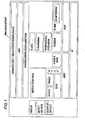
- FIG. 1 an embodiment of an inventive multimedia terminal MM terminal is shown in a schematic block diagram in the form of its extended protocol layer model.
- the communication of the terminal MM terminal based on the Internet Protocol IP.
- FIG. 1 displayed on the right side of the protocol stack of the call control handling signaling.
- a function module H.225.0 based on the Internet Protocol IP and the signaling protocol TCP, a function module H.225.0 according to the ITU-T H.225.0 protocol is provided for signaling the basic call control in H.323 networks.
- Example messages of this function module H.225.0 are SETUP or CONNECT.
- a function module H.245 is provided in accordance with the ITU-T H.245 control protocol.
- this function module H.245 is used for exchanging TerminalCapability messages, ie for issuing and receiving information regarding terminal capabilities.
- this function module H.245 is used to define task distributions such as master or slave functions and to open and close logical channels used for payload data transmission.
- the function module H.245 is also responsible for messages such as MultipointConference, CommunicationModeCommand or EnableDecentralizedConference in a network according to ITU-T H.323, which is for above described, known methods for realizing a multipoint conference are required and can optionally be used in a multimedia terminal according to the invention.
- Function modules on the function module H.225.0 add additional feature control functions such as, for example, the control module CONFERENCE CONTROL, which corresponds to a controller for processing signaling for point-to-multipoint connections in the sense of the present invention.
- Further functional modules of additional performance control systems are, for example, a H.450 HOLD function module for realizing a HOLD function in accordance with ITU-T H.450 and a further H.450 function module with further variants arranged by dots according to the ITU-T H.450 standard in FIG FIG. 1 shown.
- a payload stack is shown. This is also based on the Internet Protocol IP, on the UDP and then again a real-time protocol RTP (from the English term Real Time Protocol) is set up.
- RTP from the English term Real Time Protocol
- a real-time control protocol RTCP and the registry, administration and status-related part H.225.0 RAS of the control protocol according to ITU-T H.225.0 are also supported on the protocol UDP.
- AUDIO Based on the real-time protocol RTP codecs or at least decoders for audio and video are provided in the FIG. 1 labeled AUDIO, VIDEO.
- Such audio codecs AUDIO are designed, for example, according to one of the standards ITU-T G.711, ITU-T G.723.1, ITU-T G.728.
- ISO MPEG4 defines audio decoder AUDIO.
- ISO MPEG4 also defines appropriate video decoder VIDEO. If decoders according to ISO MPEG4 are used, proprietary coders are optionally contained in a multimedia terminal MM-ENDGER ⁇ T according to the invention.
- the real-time control protocol RTCP and the codecs or decoders for audio and video AUDIO, VIDEO are controlled by a media control MEDIA CONTROL, which among other things for the interplay of provided in the multimedia terminal MM-DEVICE media input means INPUT-DEVICE and media output means OUTPUT DEVICE is responsible.
- media input means INPUT-DEVICE are (in FIG. 1 not explicitly shown) cameras for video data, microphones for audio data or interfaces to data sources not contained in the multimedia terminal MM-ENDGER ⁇ T.
- Output means OUTPUT-DEVICE are for example (in FIG. 1 not explicitly shown) a screen for video data, speakers for audio data or interfaces to not in the multimedia terminal MM-DEVICE contained output means such as printers or mass storage.
- the media controller MEDIA CONTROL also controls a device for mixing data streams originating from terminals involved in a multipoint connection and for providing data stream mixtures to these terminals.
- a mixing device for mixing data streams originating from terminals involved in a multipoint connection and for providing data stream mixtures to these terminals.
- the described stack for the payload data handling RTP, RTCP, H.225.0, AUDIO, VIDEO and MEDIA CONTROL and the described stack for the signaling treatment H.245, H.225.0, CONFERENCE CONTROL, H.450Halten, H.450 are via a coordination function COORDINATION FUNCTION coupled to an application programming interface API.
- the coordination function COORDINATION FUNCTION coordinates the interaction of the units of these stacks with the application program interface API (API stands for the Application Programming Interface). Examples of an application programming interface API are TAPI or CAPI.
- the application program interface API mediates between application programs or a user interface and the coordination function COORDINATION FUNCTION.
- FIG. 2 shown initial state, there is an active connection between the terminals TeA and TeB two participants A and B.
- the terminal TeA to the extent a multimedia device MM-END DEVICE according to FIG. 1 in that a function module CONFERENCE CONTROL is provided as a controller for executing a signaling for point-to-multipoint connections and a device MIXER for mixing data streams originating from terminals involved in a multipoint connection.
- a function module CONFERENCE CONTROL is provided as a controller for executing a signaling for point-to-multipoint connections and a device MIXER for mixing data streams originating from terminals involved in a multipoint connection.
- the subscriber A sets from the terminal TeA a setup message according to ITU-T H.323 to a terminal TeC of a subscriber C.
- a feature message FAC to the terminal TeB of the subscriber B are sent to put the terminal TeB in the state "hold".
- the terminal TeC confirmed with a Connect message to the terminal TeA the previously received from this setup message. Then, a consultation connection in the form of logical channels is established between the terminals TeA and TeC. If the subscriber A desires a conference call from the terminal TeA at this time, the terminal TeA transmits to the terminals TeB and TeC each a feature message FAC (ConverenceIndication.inv) to indicate that a conference call is being called. If the terminal TeA had sent a message FAC (HoldNotific.inv) to the terminal TeB before sending a setup message to the terminal TeC, the terminal TeB can be stopped from the state "Hold” by a message FAC (RetrieveNotific.inv) received from the terminal TeA. be put back into an active state. The logical channels between the terminals TeA, TeB and Te, which were already open prior to the initiation of the conference, will continue to be used.
- FAC ConverenceIndication.inv
Landscapes
- Engineering & Computer Science (AREA)
- Multimedia (AREA)
- Signal Processing (AREA)
- Computer Networks & Wireless Communication (AREA)
- Telephonic Communication Services (AREA)
- Data Exchanges In Wide-Area Networks (AREA)
- Two-Way Televisions, Distribution Of Moving Picture Or The Like (AREA)
Claims (1)
- Terminal multimédia (TeA, TERMINAL MM) pour la téléphonie selon la norme ITU-T H.323 pour la réalisation d'une liaison multipoints avec un premier autre terminal (TeB) et un second autre terminal (TeC) à partir d'une liaison active avec le premier terminal (TeB), avec- une commande (COMMANDER CONFERENCE) destinée à exécuter une signalisation pour des liaisons points à multipoints et- un dispositif de mélange (MELANGEUR) destiné à mélanger les flux de données provenant du terminal multimédia et des autres terminaux (TeB, TeC) participant à la liaison multimédia ainsi qu'à mettre à disposition un mélange en résultant de ces flux de données sur ces terminaux (TeA, TeB, TeC),
le terminal multimédia (TeA, TERMINAL MM) étant configuré pour- amener le premier terminal (TeB) dans un état d'arrêt,- établir une liaison de consultation avec le second terminal (TeC) sous la forme de canaux logiques et- ramener le premier terminal (TeB) à l'état actif et poursuivre l'utilisation des canaux logiques déjà ouverts.
Applications Claiming Priority (4)
| Application Number | Priority Date | Filing Date | Title |
|---|---|---|---|
| DE19852782 | 1998-11-16 | ||
| DE19852782 | 1998-11-16 | ||
| DE19859145 | 1998-12-21 | ||
| DE19859145 | 1998-12-21 |
Publications (3)
| Publication Number | Publication Date |
|---|---|
| EP1001596A2 EP1001596A2 (fr) | 2000-05-17 |
| EP1001596A3 EP1001596A3 (fr) | 2003-07-30 |
| EP1001596B1 true EP1001596B1 (fr) | 2013-10-02 |
Family
ID=26050186
Family Applications (1)
| Application Number | Title | Priority Date | Filing Date |
|---|---|---|---|
| EP99122764.6A Expired - Lifetime EP1001596B1 (fr) | 1998-11-16 | 1999-11-16 | Terminal multimédia de téléphonie permettant des connexions multipointes |
Country Status (3)
| Country | Link |
|---|---|
| US (1) | US7158487B1 (fr) |
| EP (1) | EP1001596B1 (fr) |
| CN (1) | CN100393092C (fr) |
Families Citing this family (8)
| Publication number | Priority date | Publication date | Assignee | Title |
|---|---|---|---|---|
| AU2001293542A1 (en) * | 2000-09-18 | 2002-04-02 | Nortel Networks Limited | Packet-based conferencing |
| DE10226901B3 (de) * | 2002-06-17 | 2004-02-26 | Siemens Ag | Verfahren zur Verbindungssteuerung in einem paketorientierten Kommunikationsnetz sowie Anordnungen zu seiner Durchführung |
| US7627629B1 (en) * | 2002-10-30 | 2009-12-01 | Cisco Technology, Inc. | Method and apparatus for multipoint conferencing |
| US20050018652A1 (en) * | 2003-07-21 | 2005-01-27 | Siemens Information And Communication Networks, Inc. | System and method for proxy gatekeeper in H.323 based IP telephony systems |
| US7499969B1 (en) * | 2004-06-25 | 2009-03-03 | Apple Inc. | User interface for multiway audio conferencing |
| US7460495B2 (en) * | 2005-02-23 | 2008-12-02 | Microsoft Corporation | Serverless peer-to-peer multi-party real-time audio communication system and method |
| DE102005043003A1 (de) * | 2005-09-09 | 2007-03-22 | Infineon Technologies Ag | Telekommunikationskonferenz-Server, Telekommunikations-Endgerät, Verfahren zum Erzeugen einer Telekommunikationskonferenz-Steuernachricht, Verfahren zum Steuern einer Telekommunikationskonferenz, computerlesbare Speichermedien und Computerprogrammelemente |
| DE102017108017A1 (de) | 2017-04-13 | 2018-10-18 | Unify Patente Gmbh & Co. Kg | Verfahren zum Führen einer Audio- und/oder Videokonferenz |
Family Cites Families (14)
| Publication number | Priority date | Publication date | Assignee | Title |
|---|---|---|---|---|
| US543896A (en) * | 1895-08-06 | Fire-alarm | ||
| US5689553A (en) * | 1993-04-22 | 1997-11-18 | At&T Corp. | Multimedia telecommunications network and service |
| EP0827663A1 (fr) * | 1995-05-16 | 1998-03-11 | Minnesota Mining And Manufacturing Company | Teleconference avec transmission de donnees entre des participants eloignes |
| GB9609148D0 (en) * | 1996-05-01 | 1996-07-03 | Plessey Telecomm | Multi-party communication |
| US5828838A (en) * | 1996-06-20 | 1998-10-27 | Intel Corporation | Method and apparatus for conducting multi-point electronic conferences |
| US5963547A (en) * | 1996-09-18 | 1999-10-05 | Videoserver, Inc. | Method and apparatus for centralized multipoint conferencing in a packet network |
| US5922047A (en) * | 1996-10-22 | 1999-07-13 | Motorola, Inc. | Apparatus, method and system for multimedia control and communication |
| US6011579A (en) * | 1996-12-10 | 2000-01-04 | Motorola, Inc. | Apparatus, method and system for wireline audio and video conferencing and telephony, with network interactivity |
| US6205124B1 (en) * | 1996-12-31 | 2001-03-20 | Compaq Computer Corporation | Multipoint digital simultaneous voice and data system |
| TW351789B (en) * | 1997-10-28 | 1999-02-01 | Inventec Corp | Multiple point network system and its trouble shooting |
| US6163531A (en) * | 1997-10-31 | 2000-12-19 | Intel Corporation | Method and apparatus to throttle connections to a H.323 multipoint controller by receiver terminals in a loosely-coupled conference |
| US6380968B1 (en) * | 1998-01-06 | 2002-04-30 | Intel Corporation | Method and apparatus for controlling a remote video camera in a video conferencing system |
| US6105068A (en) * | 1998-02-10 | 2000-08-15 | 3Com Corporation | Method and apparatus for determining a protocol type on a network connection using error detection values stored within internetworking devices |
| US6457043B1 (en) * | 1998-10-23 | 2002-09-24 | Verizon Laboratories Inc. | Speaker identifier for multi-party conference |
-
1999
- 1999-11-16 EP EP99122764.6A patent/EP1001596B1/fr not_active Expired - Lifetime
- 1999-11-16 CN CNB991244583A patent/CN100393092C/zh not_active Expired - Fee Related
- 1999-11-16 US US09/441,535 patent/US7158487B1/en not_active Expired - Fee Related
Also Published As
| Publication number | Publication date |
|---|---|
| CN100393092C (zh) | 2008-06-04 |
| US7158487B1 (en) | 2007-01-02 |
| EP1001596A2 (fr) | 2000-05-17 |
| EP1001596A3 (fr) | 2003-07-30 |
| CN1256575A (zh) | 2000-06-14 |
Similar Documents
| Publication | Publication Date | Title |
|---|---|---|
| DE60014234T2 (de) | System und Verfahren zum Ermöglichen von Fehlertolerante Systeme | |
| EP2834967B1 (fr) | Procédé de transmission d'une commande d'une communication multiple existante à une application de commande d'une conférence et produit logiciel informatique servant à réaliser ce procédé | |
| DE10329084A1 (de) | Verfahren und Anordnung zum Zugriff auf ein erstes Endgerät eines ersten Kommunikationsnetzwerkes durch einen Kommunikationsknoten in einem zweiten Kommunikationsnetzwerk | |
| DE102005016587B4 (de) | Verfahren zum Bilden einer gemeinsamen Kommunikationssitzung, Verfahren zum Bilden einer ersten Kommunikationssitzung und einer zweiten Kommunikationssitzung aus einer gemeinsamen Kommunikationssitzung und Kommunikationssitzungs-Steuerungs-Server | |
| EP1001596B1 (fr) | Terminal multimédia de téléphonie permettant des connexions multipointes | |
| EP1388996B1 (fr) | Procédé et dispositif pour commander un circuit de conférence dans un réseau de communication par paquets | |
| EP1014665A2 (fr) | Méthode pour réaliser un transfert d'appel à partir de l'état actif dans un réseau de communication selon le standard ITU-T H.323 | |
| EP1014666A1 (fr) | Procédé pour réaliser des connections multipoints entre plusieurs terminaux d'un réseau de communication de données H.323 | |
| DE102008062982A1 (de) | Abrechnungsstelle zum Publizieren/Abonnieren der von verteilten Telekommunikationssystemen ausgehenden Zustandsdaten | |
| WO2005027487A1 (fr) | Interfonctionnement de protocoles dans des reseaux multimedia hybrides | |
| EP1525756A1 (fr) | Passerelle media permettant de fournir les services pstn/isdn dans des reseaux de la prochaine generation | |
| EP1309165A1 (fr) | Procédé de commutation entre transmission de voix et transmission de télécopie, dispositif et progiciel | |
| EP1714473A1 (fr) | Etablissement d'une liaison multimedia de transmission par paquets au moyen d'un systeme de reponse vocale interactif | |
| EP1227632B1 (fr) | Procédé pour faire fonctionner un réseau de communications multimedia | |
| DE102005049077B4 (de) | Verfahren zum Übertragen von Mediendaten, Kommunikationsnetzwerk-Einheit und Computerprogrammelement | |
| EP1855437A1 (fr) | Procédé pour établir une connection de communication de type 'Push-to-Talk' | |
| EP3610642A1 (fr) | Procédé de conduite d'une audioconférence et/ou visioconférence | |
| DE10354947A1 (de) | Verfahren zur Übermittlung von Kommunikationsdaten in einem Kommunikationssystem | |
| DE10226901B3 (de) | Verfahren zur Verbindungssteuerung in einem paketorientierten Kommunikationsnetz sowie Anordnungen zu seiner Durchführung | |
| DE60221073T2 (de) | Signalisierungsrouter zum Aufbau von mehrteiligen Multimedia-Sitzungen | |
| EP1294147A1 (fr) | Système pour interconnecte une système de radio simplex avec un abonnent connecte par fil | |
| EP1398935A1 (fr) | Procédé pour établir une connexion des données entre deux points terminaux dans un système VoIP | |
| DE10125884A1 (de) | Konferenzeinheit zur Mehrpunktkommunikation | |
| EP1282314A2 (fr) | Méthode et terminal pour la télécommunication multipoint | |
| DE19906381A1 (de) | Peer-to-Peer-Koferenzsystem und -verfahren |
Legal Events
| Date | Code | Title | Description |
|---|---|---|---|
| PUAI | Public reference made under article 153(3) epc to a published international application that has entered the european phase |
Free format text: ORIGINAL CODE: 0009012 |
|
| AK | Designated contracting states |
Kind code of ref document: A2 Designated state(s): AT BE CH CY DE DK ES FI FR GB GR IE IT LI LU MC NL PT SE |
|
| AX | Request for extension of the european patent |
Free format text: AL;LT;LV;MK;RO;SI |
|
| PUAL | Search report despatched |
Free format text: ORIGINAL CODE: 0009013 |
|
| AK | Designated contracting states |
Designated state(s): AT BE CH CY DE DK ES FI FR GB GR IE IT LI LU MC NL PT SE |
|
| AX | Request for extension of the european patent |
Extension state: AL LT LV MK RO SI |
|
| 17P | Request for examination filed |
Effective date: 20030818 |
|
| AKX | Designation fees paid |
Designated state(s): BE DE FR GB IT |
|
| 17Q | First examination report despatched |
Effective date: 20050331 |
|
| 17Q | First examination report despatched |
Effective date: 20050331 |
|
| RAP1 | Party data changed (applicant data changed or rights of an application transferred) |
Owner name: SIEMENS ENTERPRISE COMMUNICATIONS GMBH & CO. KG |
|
| GRAP | Despatch of communication of intention to grant a patent |
Free format text: ORIGINAL CODE: EPIDOSNIGR1 |
|
| INTG | Intention to grant announced |
Effective date: 20130419 |
|
| GRAS | Grant fee paid |
Free format text: ORIGINAL CODE: EPIDOSNIGR3 |
|
| GRAA | (expected) grant |
Free format text: ORIGINAL CODE: 0009210 |
|
| AK | Designated contracting states |
Kind code of ref document: B1 Designated state(s): BE DE FR GB IT |
|
| REG | Reference to a national code |
Ref country code: GB Ref legal event code: FG4D Free format text: NOT ENGLISH |
|
| REG | Reference to a national code |
Ref country code: DE Ref legal event code: R082 Ref document number: 59915388 Country of ref document: DE Representative=s name: FRITZSCHE PATENT, DE |
|
| REG | Reference to a national code |
Ref country code: DE Ref legal event code: R096 Ref document number: 59915388 Country of ref document: DE Effective date: 20131128 |
|
| RAP2 | Party data changed (patent owner data changed or rights of a patent transferred) |
Owner name: UNIFY GMBH & CO. KG |
|
| REG | Reference to a national code |
Ref country code: DE Ref legal event code: R082 Ref document number: 59915388 Country of ref document: DE Representative=s name: FRITZSCHE PATENTANWAELTE, DE Effective date: 20131112 Ref country code: DE Ref legal event code: R082 Ref document number: 59915388 Country of ref document: DE Representative=s name: FRITZSCHE PATENT, DE Effective date: 20131112 Ref country code: DE Ref legal event code: R081 Ref document number: 59915388 Country of ref document: DE Owner name: UNIFY GMBH & CO. KG, DE Free format text: FORMER OWNER: SIEMENS ENTERPRISE COMMUNICATIONS GMBH & CO. KG, 81379 MUENCHEN, DE Effective date: 20131112 Ref country code: DE Ref legal event code: R081 Ref document number: 59915388 Country of ref document: DE Owner name: UNIFY GMBH & CO. KG, DE Free format text: FORMER OWNER: SIEMENS AKTIENGESELLSCHAFT, 80333 MUENCHEN, DE Effective date: 20131002 |
|
| REG | Reference to a national code |
Ref country code: GB Ref legal event code: 746 Effective date: 20140319 |
|
| REG | Reference to a national code |
Ref country code: DE Ref legal event code: R084 Ref document number: 59915388 Country of ref document: DE Effective date: 20140320 |
|
| BERE | Be: lapsed |
Owner name: SIEMENS ENTERPRISE COMMUNICATIONS G.M.B.H. & CO. K Effective date: 20131130 |
|
| REG | Reference to a national code |
Ref country code: DE Ref legal event code: R097 Ref document number: 59915388 Country of ref document: DE |
|
| PLBE | No opposition filed within time limit |
Free format text: ORIGINAL CODE: 0009261 |
|
| STAA | Information on the status of an ep patent application or granted ep patent |
Free format text: STATUS: NO OPPOSITION FILED WITHIN TIME LIMIT |
|
| 26N | No opposition filed |
Effective date: 20140703 |
|
| PG25 | Lapsed in a contracting state [announced via postgrant information from national office to epo] |
Ref country code: BE Free format text: LAPSE BECAUSE OF NON-PAYMENT OF DUE FEES Effective date: 20131130 |
|
| REG | Reference to a national code |
Ref country code: DE Ref legal event code: R097 Ref document number: 59915388 Country of ref document: DE Effective date: 20140703 |
|
| REG | Reference to a national code |
Ref country code: FR Ref legal event code: PLFP Year of fee payment: 17 |
|
| PGFP | Annual fee paid to national office [announced via postgrant information from national office to epo] |
Ref country code: DE Payment date: 20151119 Year of fee payment: 17 Ref country code: GB Payment date: 20151123 Year of fee payment: 17 Ref country code: IT Payment date: 20151124 Year of fee payment: 17 |
|
| PGFP | Annual fee paid to national office [announced via postgrant information from national office to epo] |
Ref country code: FR Payment date: 20151124 Year of fee payment: 17 |
|
| REG | Reference to a national code |
Ref country code: DE Ref legal event code: R082 Ref document number: 59915388 Country of ref document: DE Representative=s name: FRITZSCHE PATENTANWAELTE, DE Ref country code: DE Ref legal event code: R081 Ref document number: 59915388 Country of ref document: DE Owner name: UNIFY GMBH & CO. KG, DE Free format text: FORMER OWNER: UNIFY GMBH & CO. KG, 81379 MUENCHEN, DE |
|
| REG | Reference to a national code |
Ref country code: DE Ref legal event code: R119 Ref document number: 59915388 Country of ref document: DE |
|
| GBPC | Gb: european patent ceased through non-payment of renewal fee |
Effective date: 20161116 |
|
| REG | Reference to a national code |
Ref country code: FR Ref legal event code: ST Effective date: 20170731 |
|
| PG25 | Lapsed in a contracting state [announced via postgrant information from national office to epo] |
Ref country code: IT Free format text: LAPSE BECAUSE OF NON-PAYMENT OF DUE FEES Effective date: 20161116 Ref country code: FR Free format text: LAPSE BECAUSE OF NON-PAYMENT OF DUE FEES Effective date: 20161130 |
|
| PG25 | Lapsed in a contracting state [announced via postgrant information from national office to epo] |
Ref country code: DE Free format text: LAPSE BECAUSE OF NON-PAYMENT OF DUE FEES Effective date: 20170601 Ref country code: GB Free format text: LAPSE BECAUSE OF NON-PAYMENT OF DUE FEES Effective date: 20161116 |