EP1001995B1 - Verfahren zur gasphasenpolymerisation von dienen mit einem preaktivierten nickelkatalysator - Google Patents
Verfahren zur gasphasenpolymerisation von dienen mit einem preaktivierten nickelkatalysator Download PDFInfo
- Publication number
- EP1001995B1 EP1001995B1 EP98938444A EP98938444A EP1001995B1 EP 1001995 B1 EP1001995 B1 EP 1001995B1 EP 98938444 A EP98938444 A EP 98938444A EP 98938444 A EP98938444 A EP 98938444A EP 1001995 B1 EP1001995 B1 EP 1001995B1
- Authority
- EP
- European Patent Office
- Prior art keywords
- nickel
- group
- polymer
- polymerization
- butadiene
- Prior art date
- Legal status (The legal status is an assumption and is not a legal conclusion. Google has not performed a legal analysis and makes no representation as to the accuracy of the status listed.)
- Expired - Lifetime
Links
- 239000003054 catalyst Substances 0.000 title claims description 49
- 150000002815 nickel Chemical class 0.000 title claims description 7
- 238000004519 manufacturing process Methods 0.000 title description 4
- PXHVJJICTQNCMI-UHFFFAOYSA-N Nickel Chemical compound [Ni] PXHVJJICTQNCMI-UHFFFAOYSA-N 0.000 claims description 77
- 229920000642 polymer Polymers 0.000 claims description 55
- 238000006116 polymerization reaction Methods 0.000 claims description 46
- 238000000034 method Methods 0.000 claims description 44
- 239000000178 monomer Substances 0.000 claims description 40
- KAKZBPTYRLMSJV-UHFFFAOYSA-N Butadiene Chemical compound C=CC=C KAKZBPTYRLMSJV-UHFFFAOYSA-N 0.000 claims description 39
- 230000008569 process Effects 0.000 claims description 37
- 150000001875 compounds Chemical class 0.000 claims description 36
- 239000000203 mixture Substances 0.000 claims description 35
- 229910052759 nickel Inorganic materials 0.000 claims description 35
- 239000007789 gas Substances 0.000 claims description 30
- RRHGJUQNOFWUDK-UHFFFAOYSA-N Isoprene Chemical compound CC(=C)C=C RRHGJUQNOFWUDK-UHFFFAOYSA-N 0.000 claims description 25
- 239000005062 Polybutadiene Substances 0.000 claims description 20
- 229920002857 polybutadiene Polymers 0.000 claims description 19
- 125000000217 alkyl group Chemical group 0.000 claims description 17
- 239000011236 particulate material Substances 0.000 claims description 15
- PPBRXRYQALVLMV-UHFFFAOYSA-N Styrene Chemical compound C=CC1=CC=CC=C1 PPBRXRYQALVLMV-UHFFFAOYSA-N 0.000 claims description 14
- 125000004432 carbon atom Chemical group C* 0.000 claims description 14
- 150000001993 dienes Chemical class 0.000 claims description 14
- XLYOFNOQVPJJNP-UHFFFAOYSA-N water Substances O XLYOFNOQVPJJNP-UHFFFAOYSA-N 0.000 claims description 14
- VYPSYNLAJGMNEJ-UHFFFAOYSA-N Silicium dioxide Chemical compound O=[Si]=O VYPSYNLAJGMNEJ-UHFFFAOYSA-N 0.000 claims description 12
- 125000002877 alkyl aryl group Chemical group 0.000 claims description 12
- 125000003710 aryl alkyl group Chemical group 0.000 claims description 12
- 125000003118 aryl group Chemical group 0.000 claims description 12
- 125000000753 cycloalkyl group Chemical group 0.000 claims description 12
- RTZKZFJDLAIYFH-UHFFFAOYSA-N Diethyl ether Chemical compound CCOCC RTZKZFJDLAIYFH-UHFFFAOYSA-N 0.000 claims description 11
- 239000002245 particle Substances 0.000 claims description 11
- 239000011347 resin Substances 0.000 claims description 11
- 229920005989 resin Polymers 0.000 claims description 11
- 239000006229 carbon black Substances 0.000 claims description 10
- LFQSCWFLJHTTHZ-UHFFFAOYSA-N Ethanol Chemical compound CCO LFQSCWFLJHTTHZ-UHFFFAOYSA-N 0.000 claims description 9
- -1 alkylaluminum halide Chemical class 0.000 claims description 8
- 229920001195 polyisoprene Polymers 0.000 claims description 8
- 229920001577 copolymer Polymers 0.000 claims description 7
- 229910052782 aluminium Inorganic materials 0.000 claims description 6
- XAGFODPZIPBFFR-UHFFFAOYSA-N aluminium Chemical compound [Al] XAGFODPZIPBFFR-UHFFFAOYSA-N 0.000 claims description 6
- 150000001735 carboxylic acids Chemical class 0.000 claims description 6
- 239000001257 hydrogen Substances 0.000 claims description 6
- 229910052739 hydrogen Inorganic materials 0.000 claims description 6
- 239000000377 silicon dioxide Substances 0.000 claims description 6
- YCKRFDGAMUMZLT-UHFFFAOYSA-N Fluorine atom Chemical compound [F] YCKRFDGAMUMZLT-UHFFFAOYSA-N 0.000 claims description 5
- ISWSIDIOOBJBQZ-UHFFFAOYSA-N Phenol Chemical compound OC1=CC=CC=C1 ISWSIDIOOBJBQZ-UHFFFAOYSA-N 0.000 claims description 5
- 239000004793 Polystyrene Substances 0.000 claims description 5
- 150000001412 amines Chemical class 0.000 claims description 5
- 150000002148 esters Chemical class 0.000 claims description 5
- 239000011737 fluorine Substances 0.000 claims description 5
- 229910052731 fluorine Inorganic materials 0.000 claims description 5
- 150000002576 ketones Chemical class 0.000 claims description 5
- 150000002825 nitriles Chemical class 0.000 claims description 5
- 229920002223 polystyrene Polymers 0.000 claims description 5
- 239000011541 reaction mixture Substances 0.000 claims description 5
- UVPKUTPZWFHAHY-UHFFFAOYSA-L 2-ethylhexanoate;nickel(2+) Chemical compound [Ni+2].CCCCC(CC)C([O-])=O.CCCCC(CC)C([O-])=O UVPKUTPZWFHAHY-UHFFFAOYSA-L 0.000 claims description 4
- UFHFLCQGNIYNRP-UHFFFAOYSA-N Hydrogen Chemical compound [H][H] UFHFLCQGNIYNRP-UHFFFAOYSA-N 0.000 claims description 4
- 150000001298 alcohols Chemical class 0.000 claims description 4
- 150000002894 organic compounds Chemical class 0.000 claims description 4
- 230000000379 polymerizing effect Effects 0.000 claims description 4
- 229920003048 styrene butadiene rubber Polymers 0.000 claims description 4
- ZOXJGFHDIHLPTG-UHFFFAOYSA-N Boron Chemical group [B] ZOXJGFHDIHLPTG-UHFFFAOYSA-N 0.000 claims description 3
- 239000004927 clay Substances 0.000 claims description 3
- 229910052570 clay Inorganic materials 0.000 claims description 3
- 150000002170 ethers Chemical class 0.000 claims description 3
- 239000000454 talc Substances 0.000 claims description 3
- 229910052623 talc Inorganic materials 0.000 claims description 3
- 150000003568 thioethers Chemical class 0.000 claims description 3
- RRKODOZNUZCUBN-CCAGOZQPSA-N (1z,3z)-cycloocta-1,3-diene Chemical compound C1CC\C=C/C=C\C1 RRKODOZNUZCUBN-CCAGOZQPSA-N 0.000 claims description 2
- RBOZTFPIXJBLPK-WGDLNXRISA-N (NZ)-N-[(2Z)-1,2-bis(furan-2-yl)-2-hydroxyiminoethylidene]hydroxylamine Chemical compound O\N=C(\C(=N\O)\c1ccco1)/c1ccco1 RBOZTFPIXJBLPK-WGDLNXRISA-N 0.000 claims description 2
- MWUXSHHQAYIFBG-UHFFFAOYSA-N Nitric oxide Chemical group O=[N] MWUXSHHQAYIFBG-UHFFFAOYSA-N 0.000 claims description 2
- MQRWBMAEBQOWAF-UHFFFAOYSA-N acetic acid;nickel Chemical compound [Ni].CC(O)=O.CC(O)=O MQRWBMAEBQOWAF-UHFFFAOYSA-N 0.000 claims description 2
- 125000003545 alkoxy group Chemical group 0.000 claims description 2
- 125000005234 alkyl aluminium group Chemical group 0.000 claims description 2
- LAXIOTUSRGRRNA-UHFFFAOYSA-N cyclopenta-1,3-diene nickel Chemical compound [Ni].C1C=CC=C1.C1C=CC=C1 LAXIOTUSRGRRNA-UHFFFAOYSA-N 0.000 claims description 2
- TWKFYCJMKMVFCV-UHFFFAOYSA-N cyclopenta-1,3-diene;nickel Chemical compound [Ni].C=1C=C[CH-]C=1 TWKFYCJMKMVFCV-UHFFFAOYSA-N 0.000 claims description 2
- LXHKZDOLHOQBTR-UHFFFAOYSA-L hexadecanoate;nickel(2+) Chemical compound [Ni+2].CCCCCCCCCCCCCCCC([O-])=O.CCCCCCCCCCCCCCCC([O-])=O LXHKZDOLHOQBTR-UHFFFAOYSA-L 0.000 claims description 2
- 229920001519 homopolymer Polymers 0.000 claims description 2
- UIEKYBOPAVTZKW-UHFFFAOYSA-L naphthalene-2-carboxylate;nickel(2+) Chemical compound [Ni+2].C1=CC=CC2=CC(C(=O)[O-])=CC=C21.C1=CC=CC2=CC(C(=O)[O-])=CC=C21 UIEKYBOPAVTZKW-UHFFFAOYSA-L 0.000 claims description 2
- 229940078494 nickel acetate Drugs 0.000 claims description 2
- BMGNSKKZFQMGDH-FDGPNNRMSA-L nickel(2+);(z)-4-oxopent-2-en-2-olate Chemical compound [Ni+2].C\C([O-])=C\C(C)=O.C\C([O-])=C\C(C)=O BMGNSKKZFQMGDH-FDGPNNRMSA-L 0.000 claims description 2
- GAIQJSWQJOZOMI-UHFFFAOYSA-L nickel(2+);dibenzoate Chemical compound [Ni+2].[O-]C(=O)C1=CC=CC=C1.[O-]C(=O)C1=CC=CC=C1 GAIQJSWQJOZOMI-UHFFFAOYSA-L 0.000 claims description 2
- JMWUYEFBFUCSAK-UHFFFAOYSA-L nickel(2+);octadecanoate Chemical compound [Ni+2].CCCCCCCCCCCCCCCCCC([O-])=O.CCCCCCCCCCCCCCCCCC([O-])=O JMWUYEFBFUCSAK-UHFFFAOYSA-L 0.000 claims description 2
- VEUMANXWQDHAJV-UHFFFAOYSA-N 2-[2-[(2-hydroxyphenyl)methylideneamino]ethyliminomethyl]phenol Chemical compound OC1=CC=CC=C1C=NCCN=CC1=CC=CC=C1O VEUMANXWQDHAJV-UHFFFAOYSA-N 0.000 claims 1
- YACTXGRTJNKUDC-UHFFFAOYSA-N 2-hydroxybenzaldehyde;nickel Chemical compound [Ni].OC1=CC=CC=C1C=O.OC1=CC=CC=C1C=O YACTXGRTJNKUDC-UHFFFAOYSA-N 0.000 claims 1
- WTEOIRVLGSZEPR-UHFFFAOYSA-N boron trifluoride Chemical compound FB(F)F WTEOIRVLGSZEPR-UHFFFAOYSA-N 0.000 description 36
- 239000000243 solution Substances 0.000 description 24
- KRHYYFGTRYWZRS-UHFFFAOYSA-N Fluorane Chemical compound F KRHYYFGTRYWZRS-UHFFFAOYSA-N 0.000 description 19
- 229910000040 hydrogen fluoride Inorganic materials 0.000 description 18
- 239000007788 liquid Substances 0.000 description 16
- 229910015900 BF3 Inorganic materials 0.000 description 14
- YXFVVABEGXRONW-UHFFFAOYSA-N Toluene Chemical compound CC1=CC=CC=C1 YXFVVABEGXRONW-UHFFFAOYSA-N 0.000 description 12
- VLKZOEOYAKHREP-UHFFFAOYSA-N n-Hexane Chemical compound CCCCCC VLKZOEOYAKHREP-UHFFFAOYSA-N 0.000 description 11
- 229910052799 carbon Inorganic materials 0.000 description 9
- 238000006243 chemical reaction Methods 0.000 description 9
- 239000012530 fluid Substances 0.000 description 9
- IJGRMHOSHXDMSA-UHFFFAOYSA-N Atomic nitrogen Chemical compound N#N IJGRMHOSHXDMSA-UHFFFAOYSA-N 0.000 description 8
- 239000002904 solvent Substances 0.000 description 8
- 239000003426 co-catalyst Substances 0.000 description 7
- 238000012685 gas phase polymerization Methods 0.000 description 7
- 239000000126 substance Substances 0.000 description 7
- 230000000694 effects Effects 0.000 description 6
- IMNFDUFMRHMDMM-UHFFFAOYSA-N N-Heptane Chemical compound CCCCCCC IMNFDUFMRHMDMM-UHFFFAOYSA-N 0.000 description 5
- CPOFMOWDMVWCLF-UHFFFAOYSA-N methyl(oxo)alumane Chemical compound C[Al]=O CPOFMOWDMVWCLF-UHFFFAOYSA-N 0.000 description 5
- OFBQJSOFQDEBGM-UHFFFAOYSA-N Pentane Chemical compound CCCCC OFBQJSOFQDEBGM-UHFFFAOYSA-N 0.000 description 4
- WYURNTSHIVDZCO-UHFFFAOYSA-N Tetrahydrofuran Chemical compound C1CCOC1 WYURNTSHIVDZCO-UHFFFAOYSA-N 0.000 description 4
- YTPLMLYBLZKORZ-UHFFFAOYSA-N Thiophene Chemical compound C=1C=CSC=1 YTPLMLYBLZKORZ-UHFFFAOYSA-N 0.000 description 4
- QVGXLLKOCUKJST-UHFFFAOYSA-N atomic oxygen Chemical compound [O] QVGXLLKOCUKJST-UHFFFAOYSA-N 0.000 description 4
- 150000001721 carbon Chemical group 0.000 description 4
- 150000001732 carboxylic acid derivatives Chemical class 0.000 description 4
- 125000004122 cyclic group Chemical group 0.000 description 4
- AFABGHUZZDYHJO-UHFFFAOYSA-N dimethyl butane Natural products CCCC(C)C AFABGHUZZDYHJO-UHFFFAOYSA-N 0.000 description 4
- 238000009472 formulation Methods 0.000 description 4
- 229930195733 hydrocarbon Natural products 0.000 description 4
- 150000002430 hydrocarbons Chemical class 0.000 description 4
- QWTDNUCVQCZILF-UHFFFAOYSA-N isopentane Chemical compound CCC(C)C QWTDNUCVQCZILF-UHFFFAOYSA-N 0.000 description 4
- 229910052751 metal Inorganic materials 0.000 description 4
- 239000002184 metal Substances 0.000 description 4
- 229910052757 nitrogen Inorganic materials 0.000 description 4
- 239000001301 oxygen Substances 0.000 description 4
- 229910052760 oxygen Inorganic materials 0.000 description 4
- 239000002002 slurry Substances 0.000 description 4
- 239000007787 solid Substances 0.000 description 4
- YLQBMQCUIZJEEH-UHFFFAOYSA-N tetrahydrofuran Natural products C=1C=COC=1 YLQBMQCUIZJEEH-UHFFFAOYSA-N 0.000 description 4
- MCULRUJILOGHCJ-UHFFFAOYSA-N triisobutylaluminium Chemical compound CC(C)C[Al](CC(C)C)CC(C)C MCULRUJILOGHCJ-UHFFFAOYSA-N 0.000 description 4
- ZWEHNKRNPOVVGH-UHFFFAOYSA-N 2-Butanone Chemical compound CCC(C)=O ZWEHNKRNPOVVGH-UHFFFAOYSA-N 0.000 description 3
- QTBSBXVTEAMEQO-UHFFFAOYSA-N Acetic acid Chemical compound CC(O)=O QTBSBXVTEAMEQO-UHFFFAOYSA-N 0.000 description 3
- CSCPPACGZOOCGX-UHFFFAOYSA-N Acetone Chemical compound CC(C)=O CSCPPACGZOOCGX-UHFFFAOYSA-N 0.000 description 3
- WEVYAHXRMPXWCK-UHFFFAOYSA-N Acetonitrile Chemical compound CC#N WEVYAHXRMPXWCK-UHFFFAOYSA-N 0.000 description 3
- QMMFVYPAHWMCMS-UHFFFAOYSA-N Dimethyl sulfide Chemical compound CSC QMMFVYPAHWMCMS-UHFFFAOYSA-N 0.000 description 3
- XEKOWRVHYACXOJ-UHFFFAOYSA-N Ethyl acetate Chemical compound CCOC(C)=O XEKOWRVHYACXOJ-UHFFFAOYSA-N 0.000 description 3
- OKKJLVBELUTLKV-UHFFFAOYSA-N Methanol Chemical compound OC OKKJLVBELUTLKV-UHFFFAOYSA-N 0.000 description 3
- MUBZPKHOEPUJKR-UHFFFAOYSA-N Oxalic acid Chemical compound OC(=O)C(O)=O MUBZPKHOEPUJKR-UHFFFAOYSA-N 0.000 description 3
- UCKMPCXJQFINFW-UHFFFAOYSA-N Sulphide Chemical compound [S-2] UCKMPCXJQFINFW-UHFFFAOYSA-N 0.000 description 3
- ZMANZCXQSJIPKH-UHFFFAOYSA-N Triethylamine Chemical compound CCN(CC)CC ZMANZCXQSJIPKH-UHFFFAOYSA-N 0.000 description 3
- JFDZBHWFFUWGJE-UHFFFAOYSA-N benzonitrile Chemical compound N#CC1=CC=CC=C1 JFDZBHWFFUWGJE-UHFFFAOYSA-N 0.000 description 3
- 230000000052 comparative effect Effects 0.000 description 3
- 238000009833 condensation Methods 0.000 description 3
- 230000005494 condensation Effects 0.000 description 3
- YNLAOSYQHBDIKW-UHFFFAOYSA-M diethylaluminium chloride Chemical compound CC[Al](Cl)CC YNLAOSYQHBDIKW-UHFFFAOYSA-M 0.000 description 3
- 238000005243 fluidization Methods 0.000 description 3
- 230000014759 maintenance of location Effects 0.000 description 3
- IJDNQMDRQITEOD-UHFFFAOYSA-N n-butane Chemical compound CCCC IJDNQMDRQITEOD-UHFFFAOYSA-N 0.000 description 3
- 229920006395 saturated elastomer Polymers 0.000 description 3
- VOITXYVAKOUIBA-UHFFFAOYSA-N triethylaluminium Chemical compound CC[Al](CC)CC VOITXYVAKOUIBA-UHFFFAOYSA-N 0.000 description 3
- 239000004711 α-olefin Substances 0.000 description 3
- AZQWKYJCGOJGHM-UHFFFAOYSA-N 1,4-benzoquinone Chemical compound O=C1C=CC(=O)C=C1 AZQWKYJCGOJGHM-UHFFFAOYSA-N 0.000 description 2
- PAYRUJLWNCNPSJ-UHFFFAOYSA-N Aniline Chemical compound NC1=CC=CC=C1 PAYRUJLWNCNPSJ-UHFFFAOYSA-N 0.000 description 2
- XKRFYHLGVUSROY-UHFFFAOYSA-N Argon Chemical compound [Ar] XKRFYHLGVUSROY-UHFFFAOYSA-N 0.000 description 2
- 239000004215 Carbon black (E152) Substances 0.000 description 2
- LCGLNKUTAGEVQW-UHFFFAOYSA-N Dimethyl ether Chemical compound COC LCGLNKUTAGEVQW-UHFFFAOYSA-N 0.000 description 2
- OTMSDBZUPAUEDD-UHFFFAOYSA-N Ethane Chemical compound CC OTMSDBZUPAUEDD-UHFFFAOYSA-N 0.000 description 2
- QUSNBJAOOMFDIB-UHFFFAOYSA-N Ethylamine Chemical compound CCN QUSNBJAOOMFDIB-UHFFFAOYSA-N 0.000 description 2
- KRHYYFGTRYWZRS-UHFFFAOYSA-M Fluoride anion Chemical compound [F-] KRHYYFGTRYWZRS-UHFFFAOYSA-M 0.000 description 2
- 241001441571 Hiodontidae Species 0.000 description 2
- KFZMGEQAYNKOFK-UHFFFAOYSA-N Isopropanol Chemical compound CC(C)O KFZMGEQAYNKOFK-UHFFFAOYSA-N 0.000 description 2
- OFOBLEOULBTSOW-UHFFFAOYSA-N Malonic acid Chemical compound OC(=O)CC(O)=O OFOBLEOULBTSOW-UHFFFAOYSA-N 0.000 description 2
- LRHPLDYGYMQRHN-UHFFFAOYSA-N N-Butanol Chemical compound CCCCO LRHPLDYGYMQRHN-UHFFFAOYSA-N 0.000 description 2
- ATUOYWHBWRKTHZ-UHFFFAOYSA-N Propane Chemical compound CCC ATUOYWHBWRKTHZ-UHFFFAOYSA-N 0.000 description 2
- YRKCREAYFQTBPV-UHFFFAOYSA-N acetylacetone Chemical compound CC(=O)CC(C)=O YRKCREAYFQTBPV-UHFFFAOYSA-N 0.000 description 2
- 230000004913 activation Effects 0.000 description 2
- RDOXTESZEPMUJZ-UHFFFAOYSA-N anisole Chemical compound COC1=CC=CC=C1 RDOXTESZEPMUJZ-UHFFFAOYSA-N 0.000 description 2
- 150000005840 aryl radicals Chemical class 0.000 description 2
- WPYMKLBDIGXBTP-UHFFFAOYSA-N benzoic acid Chemical compound OC(=O)C1=CC=CC=C1 WPYMKLBDIGXBTP-UHFFFAOYSA-N 0.000 description 2
- WGQKYBSKWIADBV-UHFFFAOYSA-N benzylamine Chemical compound NCC1=CC=CC=C1 WGQKYBSKWIADBV-UHFFFAOYSA-N 0.000 description 2
- 229910052796 boron Inorganic materials 0.000 description 2
- 239000001273 butane Substances 0.000 description 2
- 239000012159 carrier gas Substances 0.000 description 2
- 238000001816 cooling Methods 0.000 description 2
- MHDVGSVTJDSBDK-UHFFFAOYSA-N dibenzyl ether Chemical compound C=1C=CC=CC=1COCC1=CC=CC=C1 MHDVGSVTJDSBDK-UHFFFAOYSA-N 0.000 description 2
- LJSQFQKUNVCTIA-UHFFFAOYSA-N diethyl sulfide Chemical compound CCSCC LJSQFQKUNVCTIA-UHFFFAOYSA-N 0.000 description 2
- GGSUCNLOZRCGPQ-UHFFFAOYSA-N diethylaniline Chemical compound CCN(CC)C1=CC=CC=C1 GGSUCNLOZRCGPQ-UHFFFAOYSA-N 0.000 description 2
- USIUVYZYUHIAEV-UHFFFAOYSA-N diphenyl ether Chemical compound C=1C=CC=CC=1OC1=CC=CC=C1 USIUVYZYUHIAEV-UHFFFAOYSA-N 0.000 description 2
- DMBHHRLKUKUOEG-UHFFFAOYSA-N diphenylamine Chemical compound C=1C=CC=CC=1NC1=CC=CC=C1 DMBHHRLKUKUOEG-UHFFFAOYSA-N 0.000 description 2
- 238000009826 distribution Methods 0.000 description 2
- MTZQAGJQAFMTAQ-UHFFFAOYSA-N ethyl benzoate Chemical compound CCOC(=O)C1=CC=CC=C1 MTZQAGJQAFMTAQ-UHFFFAOYSA-N 0.000 description 2
- 238000010574 gas phase reaction Methods 0.000 description 2
- 150000002431 hydrogen Chemical class 0.000 description 2
- 239000011261 inert gas Substances 0.000 description 2
- 150000002500 ions Chemical class 0.000 description 2
- NNPPMTNAJDCUHE-UHFFFAOYSA-N isobutane Chemical compound CC(C)C NNPPMTNAJDCUHE-UHFFFAOYSA-N 0.000 description 2
- BDAGIHXWWSANSR-UHFFFAOYSA-N methanoic acid Natural products OC=O BDAGIHXWWSANSR-UHFFFAOYSA-N 0.000 description 2
- 125000002496 methyl group Chemical group [H]C([H])([H])* 0.000 description 2
- CRSOQBOWXPBRES-UHFFFAOYSA-N neopentane Chemical compound CC(C)(C)C CRSOQBOWXPBRES-UHFFFAOYSA-N 0.000 description 2
- 150000002816 nickel compounds Chemical class 0.000 description 2
- TVMXDCGIABBOFY-UHFFFAOYSA-N octane Chemical compound CCCCCCCC TVMXDCGIABBOFY-UHFFFAOYSA-N 0.000 description 2
- 239000013618 particulate matter Substances 0.000 description 2
- FDPIMTJIUBPUKL-UHFFFAOYSA-N pentan-3-one Chemical compound CCC(=O)CC FDPIMTJIUBPUKL-UHFFFAOYSA-N 0.000 description 2
- 125000001997 phenyl group Chemical group [H]C1=C([H])C([H])=C(*)C([H])=C1[H] 0.000 description 2
- SUSQOBVLVYHIEX-UHFFFAOYSA-N phenylacetonitrile Chemical compound N#CCC1=CC=CC=C1 SUSQOBVLVYHIEX-UHFFFAOYSA-N 0.000 description 2
- XNGIFLGASWRNHJ-UHFFFAOYSA-N phthalic acid Chemical compound OC(=O)C1=CC=CC=C1C(O)=O XNGIFLGASWRNHJ-UHFFFAOYSA-N 0.000 description 2
- 239000002685 polymerization catalyst Substances 0.000 description 2
- 238000002360 preparation method Methods 0.000 description 2
- BDERNNFJNOPAEC-UHFFFAOYSA-N propan-1-ol Chemical compound CCCO BDERNNFJNOPAEC-UHFFFAOYSA-N 0.000 description 2
- 229910052761 rare earth metal Inorganic materials 0.000 description 2
- 150000002910 rare earth metals Chemical class 0.000 description 2
- 150000003839 salts Chemical class 0.000 description 2
- 229930195734 saturated hydrocarbon Natural products 0.000 description 2
- 238000003756 stirring Methods 0.000 description 2
- 229910052717 sulfur Inorganic materials 0.000 description 2
- RAOIDOHSFRTOEL-UHFFFAOYSA-N tetrahydrothiophene Chemical compound C1CCSC1 RAOIDOHSFRTOEL-UHFFFAOYSA-N 0.000 description 2
- 229930192474 thiophene Natural products 0.000 description 2
- CKGKXGQVRVAKEA-UHFFFAOYSA-N (2-methylphenyl)-phenylmethanone Chemical compound CC1=CC=CC=C1C(=O)C1=CC=CC=C1 CKGKXGQVRVAKEA-UHFFFAOYSA-N 0.000 description 1
- SVJIEGOVQBGOSU-UHFFFAOYSA-N (4-methylphenyl)-propan-2-ylalumane Chemical compound C1(=CC=C(C=C1)[AlH]C(C)C)C SVJIEGOVQBGOSU-UHFFFAOYSA-N 0.000 description 1
- PRPLGWFQYUPYBN-UHFFFAOYSA-N (4-methylphenyl)-propylalumane Chemical compound C1(=CC=C(C=C1)[AlH]CCC)C PRPLGWFQYUPYBN-UHFFFAOYSA-N 0.000 description 1
- OJOWICOBYCXEKR-KRXBUXKQSA-N (5e)-5-ethylidenebicyclo[2.2.1]hept-2-ene Chemical compound C1C2C(=C/C)/CC1C=C2 OJOWICOBYCXEKR-KRXBUXKQSA-N 0.000 description 1
- RYHBNJHYFVUHQT-UHFFFAOYSA-N 1,4-Dioxane Chemical compound C1COCCO1 RYHBNJHYFVUHQT-UHFFFAOYSA-N 0.000 description 1
- DURPTKYDGMDSBL-UHFFFAOYSA-N 1-butoxybutane Chemical compound CCCCOCCCC DURPTKYDGMDSBL-UHFFFAOYSA-N 0.000 description 1
- AOPDRZXCEAKHHW-UHFFFAOYSA-N 1-pentoxypentane Chemical compound CCCCCOCCCCC AOPDRZXCEAKHHW-UHFFFAOYSA-N 0.000 description 1
- JOZDADPMWLVEJK-UHFFFAOYSA-N 1-pentylsulfanylpentane Chemical compound CCCCCSCCCCC JOZDADPMWLVEJK-UHFFFAOYSA-N 0.000 description 1
- UENGQMOTDCLRTI-UHFFFAOYSA-N 2-butylcycloheptan-1-one Chemical compound CCCCC1CCCCCC1=O UENGQMOTDCLRTI-UHFFFAOYSA-N 0.000 description 1
- VXEUGLRMYAXWKM-UHFFFAOYSA-N 3-phenyl-1h-imidazole-2-thione Chemical compound S=C1NC=CN1C1=CC=CC=C1 VXEUGLRMYAXWKM-UHFFFAOYSA-N 0.000 description 1
- OSWFIVFLDKOXQC-UHFFFAOYSA-N 4-(3-methoxyphenyl)aniline Chemical compound COC1=CC=CC(C=2C=CC(N)=CC=2)=C1 OSWFIVFLDKOXQC-UHFFFAOYSA-N 0.000 description 1
- VNBCIRBFLBYHCW-UHFFFAOYSA-L 7,7-dimethyloctanoate;nickel(2+) Chemical compound [Ni+2].CC(C)(C)CCCCCC([O-])=O.CC(C)(C)CCCCCC([O-])=O VNBCIRBFLBYHCW-UHFFFAOYSA-L 0.000 description 1
- NLHHRLWOUZZQLW-UHFFFAOYSA-N Acrylonitrile Chemical compound C=CC#N NLHHRLWOUZZQLW-UHFFFAOYSA-N 0.000 description 1
- QGZKDVFQNNGYKY-UHFFFAOYSA-N Ammonia Chemical class N QGZKDVFQNNGYKY-UHFFFAOYSA-N 0.000 description 1
- 239000005711 Benzoic acid Substances 0.000 description 1
- 239000007848 Bronsted acid Substances 0.000 description 1
- HTIRHQRTDBPHNZ-UHFFFAOYSA-N Dibutyl sulfide Chemical compound CCCCSCCCC HTIRHQRTDBPHNZ-UHFFFAOYSA-N 0.000 description 1
- ZAFNJMIOTHYJRJ-UHFFFAOYSA-N Diisopropyl ether Chemical compound CC(C)OC(C)C ZAFNJMIOTHYJRJ-UHFFFAOYSA-N 0.000 description 1
- VGGSQFUCUMXWEO-UHFFFAOYSA-N Ethene Chemical compound C=C VGGSQFUCUMXWEO-UHFFFAOYSA-N 0.000 description 1
- 239000005977 Ethylene Substances 0.000 description 1
- 239000002841 Lewis acid Substances 0.000 description 1
- XOBKSJJDNFUZPF-UHFFFAOYSA-N Methoxyethane Chemical compound CCOC XOBKSJJDNFUZPF-UHFFFAOYSA-N 0.000 description 1
- 229910052779 Neodymium Inorganic materials 0.000 description 1
- OZBDFBJXRJWNAV-UHFFFAOYSA-N Rimantadine hydrochloride Chemical compound Cl.C1C(C2)CC3CC2CC1(C(N)C)C3 OZBDFBJXRJWNAV-UHFFFAOYSA-N 0.000 description 1
- 239000002174 Styrene-butadiene Substances 0.000 description 1
- NINIDFKCEFEMDL-UHFFFAOYSA-N Sulfur Chemical compound [S] NINIDFKCEFEMDL-UHFFFAOYSA-N 0.000 description 1
- 235000011054 acetic acid Nutrition 0.000 description 1
- 230000003213 activating effect Effects 0.000 description 1
- OFHCOWSQAMBJIW-AVJTYSNKSA-N alfacalcidol Chemical compound C1(/[C@@H]2CC[C@@H]([C@]2(CCC1)C)[C@H](C)CCCC(C)C)=C\C=C1\C[C@@H](O)C[C@H](O)C1=C OFHCOWSQAMBJIW-AVJTYSNKSA-N 0.000 description 1
- 150000001336 alkenes Chemical class 0.000 description 1
- 229910052786 argon Inorganic materials 0.000 description 1
- 150000004945 aromatic hydrocarbons Chemical class 0.000 description 1
- 239000003849 aromatic solvent Substances 0.000 description 1
- 125000004429 atom Chemical group 0.000 description 1
- 239000002585 base Substances 0.000 description 1
- 230000008901 benefit Effects 0.000 description 1
- DULCUDSUACXJJC-UHFFFAOYSA-N benzeneacetic acid ethyl ester Natural products CCOC(=O)CC1=CC=CC=C1 DULCUDSUACXJJC-UHFFFAOYSA-N 0.000 description 1
- 235000010233 benzoic acid Nutrition 0.000 description 1
- RWCCWEUUXYIKHB-UHFFFAOYSA-N benzophenone Chemical compound C=1C=CC=CC=1C(=O)C1=CC=CC=C1 RWCCWEUUXYIKHB-UHFFFAOYSA-N 0.000 description 1
- 239000012965 benzophenone Substances 0.000 description 1
- LBKYCOGBBDATCR-UHFFFAOYSA-N benzyl(diethyl)alumane Chemical compound CC[Al](CC)CC1=CC=CC=C1 LBKYCOGBBDATCR-UHFFFAOYSA-N 0.000 description 1
- YLJFTSZNOGBPOG-UHFFFAOYSA-N benzyl(ethyl)alumane Chemical compound C(C1=CC=CC=C1)[AlH]CC YLJFTSZNOGBPOG-UHFFFAOYSA-N 0.000 description 1
- AIWXNWDZGADCFW-UHFFFAOYSA-N benzyl(propan-2-yl)alumane Chemical compound C(C1=CC=CC=C1)[AlH]C(C)C AIWXNWDZGADCFW-UHFFFAOYSA-N 0.000 description 1
- YGHMTLQLIZMTLJ-UHFFFAOYSA-N benzyl(propyl)alumane Chemical compound C(C1=CC=CC=C1)[AlH]CCC YGHMTLQLIZMTLJ-UHFFFAOYSA-N 0.000 description 1
- LUFPJJNWMYZRQE-UHFFFAOYSA-N benzylsulfanylmethylbenzene Chemical compound C=1C=CC=CC=1CSCC1=CC=CC=C1 LUFPJJNWMYZRQE-UHFFFAOYSA-N 0.000 description 1
- SIPUZPBQZHNSDW-UHFFFAOYSA-N bis(2-methylpropyl)aluminum Chemical compound CC(C)C[Al]CC(C)C SIPUZPBQZHNSDW-UHFFFAOYSA-N 0.000 description 1
- LLHTVHHWJJDSSP-UHFFFAOYSA-N bis(4-methylphenyl)alumane Chemical compound C1(=CC=C(C=C1)[AlH]C1=CC=C(C=C1)C)C LLHTVHHWJJDSSP-UHFFFAOYSA-N 0.000 description 1
- VLLYOYVKQDKAHN-UHFFFAOYSA-N buta-1,3-diene;2-methylbuta-1,3-diene Chemical compound C=CC=C.CC(=C)C=C VLLYOYVKQDKAHN-UHFFFAOYSA-N 0.000 description 1
- 125000002091 cationic group Chemical group 0.000 description 1
- 238000005119 centrifugation Methods 0.000 description 1
- 229920003211 cis-1,4-polyisoprene Polymers 0.000 description 1
- LDHQCZJRKDOVOX-NSCUHMNNSA-N crotonic acid Chemical compound C\C=C\C(O)=O LDHQCZJRKDOVOX-NSCUHMNNSA-N 0.000 description 1
- 150000004292 cyclic ethers Chemical class 0.000 description 1
- 150000003997 cyclic ketones Chemical class 0.000 description 1
- HPXRVTGHNJAIIH-UHFFFAOYSA-N cyclohexanol Chemical compound OC1CCCCC1 HPXRVTGHNJAIIH-UHFFFAOYSA-N 0.000 description 1
- 230000003247 decreasing effect Effects 0.000 description 1
- XYWDPYKBIRQXQS-UHFFFAOYSA-N di-isopropyl sulphide Natural products CC(C)SC(C)C XYWDPYKBIRQXQS-UHFFFAOYSA-N 0.000 description 1
- RAABOESOVLLHRU-UHFFFAOYSA-N diazene Chemical compound N=N RAABOESOVLLHRU-UHFFFAOYSA-N 0.000 description 1
- 229910000071 diazene Inorganic materials 0.000 description 1
- OTACYDLCOLOKPA-UHFFFAOYSA-N dibenzyl(ethyl)alumane Chemical compound C=1C=CC=CC=1C[Al](CC)CC1=CC=CC=C1 OTACYDLCOLOKPA-UHFFFAOYSA-N 0.000 description 1
- DODCHQVKECHKRP-UHFFFAOYSA-N dibenzylalumane Chemical compound C(C1=CC=CC=C1)[AlH]CC1=CC=CC=C1 DODCHQVKECHKRP-UHFFFAOYSA-N 0.000 description 1
- CNVSZTZIUKEUHV-UHFFFAOYSA-M dibutyl(fluoro)alumane Chemical compound [F-].CCCC[Al+]CCCC CNVSZTZIUKEUHV-UHFFFAOYSA-M 0.000 description 1
- VTZJFPSWNQFPCQ-UHFFFAOYSA-N dibutylaluminum Chemical compound CCCC[Al]CCCC VTZJFPSWNQFPCQ-UHFFFAOYSA-N 0.000 description 1
- MVGUIMCFFQICHB-UHFFFAOYSA-N diethyl(phenyl)alumane Chemical compound CC[Al](CC)C1=CC=CC=C1 MVGUIMCFFQICHB-UHFFFAOYSA-N 0.000 description 1
- FGXMZMRKLKQDDX-UHFFFAOYSA-N diethyl-(2-methylphenyl)alumane Chemical compound CC[Al](CC)C1=CC=CC=C1C FGXMZMRKLKQDDX-UHFFFAOYSA-N 0.000 description 1
- HJXBDPDUCXORKZ-UHFFFAOYSA-N diethylalumane Chemical compound CC[AlH]CC HJXBDPDUCXORKZ-UHFFFAOYSA-N 0.000 description 1
- HRXSKIOIHQEGAI-UHFFFAOYSA-M diethylalumanylium;fluoride Chemical compound CC[Al](F)CC HRXSKIOIHQEGAI-UHFFFAOYSA-M 0.000 description 1
- HPNMFZURTQLUMO-UHFFFAOYSA-N diethylamine Chemical compound CCNCC HPNMFZURTQLUMO-UHFFFAOYSA-N 0.000 description 1
- LTYMSROWYAPPGB-UHFFFAOYSA-N diphenyl sulfide Chemical compound C=1C=CC=CC=1SC1=CC=CC=C1 LTYMSROWYAPPGB-UHFFFAOYSA-N 0.000 description 1
- HIVRDDZUKVNKAO-UHFFFAOYSA-N diphenylalumane Chemical compound C1(=CC=CC=C1)[AlH]C1=CC=CC=C1 HIVRDDZUKVNKAO-UHFFFAOYSA-N 0.000 description 1
- UWSPXSJXTPKKMG-UHFFFAOYSA-M diphenylalumanylium;fluoride Chemical compound [F-].C=1C=CC=CC=1[Al+]C1=CC=CC=C1 UWSPXSJXTPKKMG-UHFFFAOYSA-M 0.000 description 1
- XOCWTYIVWYOSGQ-UHFFFAOYSA-N dipropylalumane Chemical compound C(CC)[AlH]CCC XOCWTYIVWYOSGQ-UHFFFAOYSA-N 0.000 description 1
- 238000004090 dissolution Methods 0.000 description 1
- 229920001971 elastomer Polymers 0.000 description 1
- 239000000806 elastomer Substances 0.000 description 1
- 239000000839 emulsion Substances 0.000 description 1
- 238000007720 emulsion polymerization reaction Methods 0.000 description 1
- GCPCLEKQVMKXJM-UHFFFAOYSA-N ethoxy(diethyl)alumane Chemical compound CCO[Al](CC)CC GCPCLEKQVMKXJM-UHFFFAOYSA-N 0.000 description 1
- XGAIERUWZADBAO-UHFFFAOYSA-N ethoxy-bis(2-methylpropyl)alumane Chemical compound CCO[Al](CC(C)C)CC(C)C XGAIERUWZADBAO-UHFFFAOYSA-N 0.000 description 1
- SMCMEVQBOQDRPJ-UHFFFAOYSA-N ethyl(diphenyl)alumane Chemical compound C=1C=CC=CC=1[Al](CC)C1=CC=CC=C1 SMCMEVQBOQDRPJ-UHFFFAOYSA-N 0.000 description 1
- ZQRUUFPMUMMECD-UHFFFAOYSA-N ethyl(phenyl)alumane Chemical compound C1(=CC=CC=C1)[AlH]CC ZQRUUFPMUMMECD-UHFFFAOYSA-N 0.000 description 1
- XLFSJFNMOZJHDV-UHFFFAOYSA-N ethyl-(4-methylphenyl)alumane Chemical compound C1(=CC=C(C=C1)[AlH]CC)C XLFSJFNMOZJHDV-UHFFFAOYSA-N 0.000 description 1
- NEPIVOURWZEXGS-UHFFFAOYSA-N ethyl-bis(4-methylphenyl)alumane Chemical compound C=1C=C(C)C=CC=1[Al](CC)C1=CC=C(C)C=C1 NEPIVOURWZEXGS-UHFFFAOYSA-N 0.000 description 1
- 238000001704 evaporation Methods 0.000 description 1
- 230000009969 flowable effect Effects 0.000 description 1
- ZCRIVANPXCEGKD-UHFFFAOYSA-M fluoro(dihexyl)alumane Chemical compound [F-].CCCCCC[Al+]CCCCCC ZCRIVANPXCEGKD-UHFFFAOYSA-M 0.000 description 1
- TULBULMLBPIASY-UHFFFAOYSA-M fluoro(dioctyl)alumane Chemical compound [F-].CCCCCCCC[Al+]CCCCCCCC TULBULMLBPIASY-UHFFFAOYSA-M 0.000 description 1
- XGUDRKDVGHHPKV-UHFFFAOYSA-M fluoro(dipropyl)alumane Chemical compound [F-].CCC[Al+]CCC XGUDRKDVGHHPKV-UHFFFAOYSA-M 0.000 description 1
- 235000019253 formic acid Nutrition 0.000 description 1
- 238000010528 free radical solution polymerization reaction Methods 0.000 description 1
- 239000011491 glass wool Substances 0.000 description 1
- 229910052736 halogen Inorganic materials 0.000 description 1
- 150000002367 halogens Chemical class 0.000 description 1
- 150000004678 hydrides Chemical class 0.000 description 1
- 125000004435 hydrogen atom Chemical group [H]* 0.000 description 1
- 125000002887 hydroxy group Chemical group [H]O* 0.000 description 1
- 230000006698 induction Effects 0.000 description 1
- 239000012442 inert solvent Substances 0.000 description 1
- 239000004615 ingredient Substances 0.000 description 1
- 238000002347 injection Methods 0.000 description 1
- 239000007924 injection Substances 0.000 description 1
- 239000001282 iso-butane Substances 0.000 description 1
- 125000000959 isobutyl group Chemical group [H]C([H])([H])C([H])(C([H])([H])[H])C([H])([H])* 0.000 description 1
- 150000002596 lactones Chemical class 0.000 description 1
- 239000003446 ligand Substances 0.000 description 1
- 238000005259 measurement Methods 0.000 description 1
- PIQQNNMVCKCWAB-UHFFFAOYSA-N methoxy(dipropyl)alumane Chemical compound [O-]C.CCC[Al+]CCC PIQQNNMVCKCWAB-UHFFFAOYSA-N 0.000 description 1
- UZKWTJUDCOPSNM-UHFFFAOYSA-N methoxybenzene Substances CCCCOC=C UZKWTJUDCOPSNM-UHFFFAOYSA-N 0.000 description 1
- IOPLHGOSNCJOOO-UHFFFAOYSA-N methyl 3,4-diaminobenzoate Chemical compound COC(=O)C1=CC=C(N)C(N)=C1 IOPLHGOSNCJOOO-UHFFFAOYSA-N 0.000 description 1
- 239000003607 modifier Substances 0.000 description 1
- 125000001624 naphthyl group Chemical group 0.000 description 1
- QEFYFXOXNSNQGX-UHFFFAOYSA-N neodymium atom Chemical compound [Nd] QEFYFXOXNSNQGX-UHFFFAOYSA-N 0.000 description 1
- DVTHIMLUHWEZOM-UHFFFAOYSA-L nickel(2+);octanoate Chemical compound [Ni+2].CCCCCCCC([O-])=O.CCCCCCCC([O-])=O DVTHIMLUHWEZOM-UHFFFAOYSA-L 0.000 description 1
- 150000007524 organic acids Chemical class 0.000 description 1
- 239000013110 organic ligand Substances 0.000 description 1
- 235000006408 oxalic acid Nutrition 0.000 description 1
- 125000004430 oxygen atom Chemical group O* 0.000 description 1
- 238000002161 passivation Methods 0.000 description 1
- WVDDGKGOMKODPV-ZQBYOMGUSA-N phenyl(114C)methanol Chemical compound O[14CH2]C1=CC=CC=C1 WVDDGKGOMKODPV-ZQBYOMGUSA-N 0.000 description 1
- ZKGDHJAHOGRQEP-UHFFFAOYSA-N phenyl(propyl)alumane Chemical compound C1(=CC=CC=C1)[AlH]CCC ZKGDHJAHOGRQEP-UHFFFAOYSA-N 0.000 description 1
- 229940049953 phenylacetate Drugs 0.000 description 1
- WLJVXDMOQOGPHL-UHFFFAOYSA-N phenylacetic acid Chemical compound OC(=O)CC1=CC=CC=C1 WLJVXDMOQOGPHL-UHFFFAOYSA-N 0.000 description 1
- 229920000098 polyolefin Polymers 0.000 description 1
- 239000002243 precursor Substances 0.000 description 1
- 239000001294 propane Substances 0.000 description 1
- 238000010298 pulverizing process Methods 0.000 description 1
- 238000010926 purge Methods 0.000 description 1
- 239000000376 reactant Substances 0.000 description 1
- 230000035484 reaction time Effects 0.000 description 1
- 230000009467 reduction Effects 0.000 description 1
- SMQUZDBALVYZAC-UHFFFAOYSA-N salicylaldehyde Chemical compound OC1=CC=CC=C1C=O SMQUZDBALVYZAC-UHFFFAOYSA-N 0.000 description 1
- 239000003381 stabilizer Substances 0.000 description 1
- 238000010561 standard procedure Methods 0.000 description 1
- 239000011593 sulfur Substances 0.000 description 1
- 125000004434 sulfur atom Chemical group 0.000 description 1
- ZERULLAPCVRMCO-UHFFFAOYSA-N sulfure de di n-propyle Natural products CCCSCCC ZERULLAPCVRMCO-UHFFFAOYSA-N 0.000 description 1
- 238000010557 suspension polymerization reaction Methods 0.000 description 1
- LDHQCZJRKDOVOX-UHFFFAOYSA-N trans-crotonic acid Natural products CC=CC(O)=O LDHQCZJRKDOVOX-UHFFFAOYSA-N 0.000 description 1
- 229910052723 transition metal Inorganic materials 0.000 description 1
- 150000003624 transition metals Chemical class 0.000 description 1
- MCWWHQMTJNSXPX-UHFFFAOYSA-N tribenzylalumane Chemical compound C=1C=CC=CC=1C[Al](CC=1C=CC=CC=1)CC1=CC=CC=C1 MCWWHQMTJNSXPX-UHFFFAOYSA-N 0.000 description 1
- SQBBHCOIQXKPHL-UHFFFAOYSA-N tributylalumane Chemical compound CCCC[Al](CCCC)CCCC SQBBHCOIQXKPHL-UHFFFAOYSA-N 0.000 description 1
- ZIYNWDQDHKSRCE-UHFFFAOYSA-N tricyclohexylalumane Chemical compound C1CCCCC1[Al](C1CCCCC1)C1CCCCC1 ZIYNWDQDHKSRCE-UHFFFAOYSA-N 0.000 description 1
- ORYGRKHDLWYTKX-UHFFFAOYSA-N trihexylalumane Chemical compound CCCCCC[Al](CCCCCC)CCCCCC ORYGRKHDLWYTKX-UHFFFAOYSA-N 0.000 description 1
- JLTRXTDYQLMHGR-UHFFFAOYSA-N trimethylaluminium Chemical compound C[Al](C)C JLTRXTDYQLMHGR-UHFFFAOYSA-N 0.000 description 1
- LFXVBWRMVZPLFK-UHFFFAOYSA-N trioctylalumane Chemical compound CCCCCCCC[Al](CCCCCCCC)CCCCCCCC LFXVBWRMVZPLFK-UHFFFAOYSA-N 0.000 description 1
- JOJQVUCWSDRWJE-UHFFFAOYSA-N tripentylalumane Chemical compound CCCCC[Al](CCCCC)CCCCC JOJQVUCWSDRWJE-UHFFFAOYSA-N 0.000 description 1
- JQPMDTQDAXRDGS-UHFFFAOYSA-N triphenylalumane Chemical compound C1=CC=CC=C1[Al](C=1C=CC=CC=1)C1=CC=CC=C1 JQPMDTQDAXRDGS-UHFFFAOYSA-N 0.000 description 1
- CNWZYDSEVLFSMS-UHFFFAOYSA-N tripropylalumane Chemical compound CCC[Al](CCC)CCC CNWZYDSEVLFSMS-UHFFFAOYSA-N 0.000 description 1
- WSITXTIRYQMZHM-UHFFFAOYSA-N tris(4-methylphenyl)alumane Chemical compound C1=CC(C)=CC=C1[Al](C=1C=CC(C)=CC=1)C1=CC=C(C)C=C1 WSITXTIRYQMZHM-UHFFFAOYSA-N 0.000 description 1
- 229930195735 unsaturated hydrocarbon Natural products 0.000 description 1
- 238000011144 upstream manufacturing Methods 0.000 description 1
- 238000012725 vapour phase polymerization Methods 0.000 description 1
- 125000000391 vinyl group Chemical group [H]C([*])=C([H])[H] 0.000 description 1
- 229920002554 vinyl polymer Polymers 0.000 description 1
- 238000005303 weighing Methods 0.000 description 1
Classifications
-
- C—CHEMISTRY; METALLURGY
- C08—ORGANIC MACROMOLECULAR COMPOUNDS; THEIR PREPARATION OR CHEMICAL WORKING-UP; COMPOSITIONS BASED THEREON
- C08F—MACROMOLECULAR COMPOUNDS OBTAINED BY REACTIONS ONLY INVOLVING CARBON-TO-CARBON UNSATURATED BONDS
- C08F36/00—Homopolymers and copolymers of compounds having one or more unsaturated aliphatic radicals, at least one having two or more carbon-to-carbon double bonds
- C08F36/02—Homopolymers and copolymers of compounds having one or more unsaturated aliphatic radicals, at least one having two or more carbon-to-carbon double bonds the radical having only two carbon-to-carbon double bonds
- C08F36/04—Homopolymers and copolymers of compounds having one or more unsaturated aliphatic radicals, at least one having two or more carbon-to-carbon double bonds the radical having only two carbon-to-carbon double bonds conjugated
-
- C—CHEMISTRY; METALLURGY
- C08—ORGANIC MACROMOLECULAR COMPOUNDS; THEIR PREPARATION OR CHEMICAL WORKING-UP; COMPOSITIONS BASED THEREON
- C08F—MACROMOLECULAR COMPOUNDS OBTAINED BY REACTIONS ONLY INVOLVING CARBON-TO-CARBON UNSATURATED BONDS
- C08F2/00—Processes of polymerisation
- C08F2/34—Polymerisation in gaseous state
-
- C—CHEMISTRY; METALLURGY
- C08—ORGANIC MACROMOLECULAR COMPOUNDS; THEIR PREPARATION OR CHEMICAL WORKING-UP; COMPOSITIONS BASED THEREON
- C08F—MACROMOLECULAR COMPOUNDS OBTAINED BY REACTIONS ONLY INVOLVING CARBON-TO-CARBON UNSATURATED BONDS
- C08F4/00—Polymerisation catalysts
- C08F4/42—Metals; Metal hydrides; Metallo-organic compounds; Use thereof as catalyst precursors
- C08F4/44—Metals; Metal hydrides; Metallo-organic compounds; Use thereof as catalyst precursors selected from light metals, zinc, cadmium, mercury, copper, silver, gold, boron, gallium, indium, thallium, rare earths or actinides
- C08F4/60—Metals; Metal hydrides; Metallo-organic compounds; Use thereof as catalyst precursors selected from light metals, zinc, cadmium, mercury, copper, silver, gold, boron, gallium, indium, thallium, rare earths or actinides together with refractory metals, iron group metals, platinum group metals, manganese, rhenium technetium or compounds thereof
- C08F4/70—Iron group metals, platinum group metals or compounds thereof
- C08F4/7095—Cobalt, nickel or compounds thereof
- C08F4/7098—Nickel or compounds thereof
-
- Y—GENERAL TAGGING OF NEW TECHNOLOGICAL DEVELOPMENTS; GENERAL TAGGING OF CROSS-SECTIONAL TECHNOLOGIES SPANNING OVER SEVERAL SECTIONS OF THE IPC; TECHNICAL SUBJECTS COVERED BY FORMER USPC CROSS-REFERENCE ART COLLECTIONS [XRACs] AND DIGESTS
- Y10—TECHNICAL SUBJECTS COVERED BY FORMER USPC
- Y10S—TECHNICAL SUBJECTS COVERED BY FORMER USPC CROSS-REFERENCE ART COLLECTIONS [XRACs] AND DIGESTS
- Y10S526/00—Synthetic resins or natural rubbers -- part of the class 520 series
- Y10S526/901—Monomer polymerized in vapor state in presence of transition metal containing catalyst
-
- Y—GENERAL TAGGING OF NEW TECHNOLOGICAL DEVELOPMENTS; GENERAL TAGGING OF CROSS-SECTIONAL TECHNOLOGIES SPANNING OVER SEVERAL SECTIONS OF THE IPC; TECHNICAL SUBJECTS COVERED BY FORMER USPC CROSS-REFERENCE ART COLLECTIONS [XRACs] AND DIGESTS
- Y10—TECHNICAL SUBJECTS COVERED BY FORMER USPC
- Y10T—TECHNICAL SUBJECTS COVERED BY FORMER US CLASSIFICATION
- Y10T428/00—Stock material or miscellaneous articles
- Y10T428/29—Coated or structually defined flake, particle, cell, strand, strand portion, rod, filament, macroscopic fiber or mass thereof
- Y10T428/2982—Particulate matter [e.g., sphere, flake, etc.]
-
- Y—GENERAL TAGGING OF NEW TECHNOLOGICAL DEVELOPMENTS; GENERAL TAGGING OF CROSS-SECTIONAL TECHNOLOGIES SPANNING OVER SEVERAL SECTIONS OF THE IPC; TECHNICAL SUBJECTS COVERED BY FORMER USPC CROSS-REFERENCE ART COLLECTIONS [XRACs] AND DIGESTS
- Y10—TECHNICAL SUBJECTS COVERED BY FORMER USPC
- Y10T—TECHNICAL SUBJECTS COVERED BY FORMER US CLASSIFICATION
- Y10T428/00—Stock material or miscellaneous articles
- Y10T428/29—Coated or structually defined flake, particle, cell, strand, strand portion, rod, filament, macroscopic fiber or mass thereof
- Y10T428/2982—Particulate matter [e.g., sphere, flake, etc.]
- Y10T428/2991—Coated
- Y10T428/2998—Coated including synthetic resin or polymer
Definitions
- This invention relates to a polymerization process for producing polydienes in gas phase. More particularly, the invention relates to a process for producing polydienes, such as polybutadiene and polyisoprene, in a gas phase reactor using a pre-activated nickel catalyst which is highly active for production of these dienes.
- Nickel and rare earth metal containing catalysts have been widely used commercially to make polybutadiene (BR) in solution and slurry polymerizations.
- Commercial facilities employ solution and slurry processes which are energy intensive. These processes produce polymer in a bale-like form which must be subsequently pulverized or ground.
- polydienes such as polybutadiene and polyisoprene can be produced in gas phase, e.g., fluidized bed, reactors.
- gas phase e.g., fluidized bed, reactors.
- Such processes are described, for example, in U.S. Patent Nos. 4,994,534 and 5,453,471; and in WO 96/04322 and 96/04323. These processes operate at lower cost as compared to solution and slurry processes and produce a polymer which is granular and flowable upon leaving the gas phase reactor. The polymer does not require subsequent pulverization steps.
- the gas phase production is also more environmentally acceptable due to the absence of a solvent removal step.
- nickel catalysts are inexpensive and readily available.
- nickel catalysts which are sometimes employed to produce polybutadiene and polyisoprene in solution and slurry processes have not been sufficiently active for the production of these polymers in gas phase, fluidized reactions. They can have long induction periods and short life spans for producing polymer, and can produce a product such as polybutadiene having less desirable levels of 1,4-cis butadiene units (i.e., less than 90%).
- WO 97/082111 describes a process for the vapour phase polymerization of isoprenes into cis-1,4-polyisoprene. The process described in this reference does not require the presence of water.
- the present invention provides a highly active and productive catalyst for gas phase polymerization. Accordingly, there is provided a process for the polymerization of a diene and/or a vinyl-substituted compound selected from the group of monomers consisting of butadiene, isoprene, styrene, and mixtures thereof comprising: polymerizing at least one of the monomers in a gas phase reactor with a pre-activated catalyst system, under polymerization conditions, wherein the pre-activated catalyst system comprises a reaction mixture of:
- the polymerization is conducted in the presence of an inert particulate material.
- the polymers produced by the present invention can include polybutadiene, polyisoprene, polystyrene, butadiene-isoprene copolymers, butadiene-styrene copolymers, and isoprene-styrene copolymers.
- the polymer molecular weights, particularly those of polybutadiene can vary from a weighted average of molecular weight of 200,000 to 2,000,000.
- the dispersity index can vary between 2 and 20.
- the polymers produced by the process of the invention may be in the form of granular, particulate, free-flowing resin particles, comprising an outer shell having a mixture of an inert particulate material and a polymer, said inert particulate material being present in said outer shell in an amount higher than 75% by weight based on the weight of said outer shell, and an inner core having a mixture of polymer and inert particulate material, said polymer being present in the inner core in an amount higher than 90% by weight based on the weight of said inner core, wherein said polymer is a homopolymer or copolmer of a conjugated diene, a vinyl-substituted compound, or a mixture thereof, and which resin particle has a residue of nickel in an amount ranging from 1 ppm to 240 ppm, preferably from 2 ppm to 60 ppm; a residue of fluorine ranging in an amount from 0.6 ppm to 47,000 ppm, preferably 0.6 ppm to 20,000 pp
- the resin When BF 3 is employed as the promoter, the resin has a residue of fluorine ranging in an amount from .1 ppm to 47,000 ppm, preferably 6 ppm to 2,200 ppm based upon total polymer weight, Additionally, the resin has a boron residue ranging from 0.2 ppm to 9,000 ppm, preferably 1 ppm to 420 ppm, based upon the total polymer weight. These polymers having a reduced viscosity ranging from 1 to 15 decliter/gram (dl/g), preferably from 2.5 to 4.5 dl/g. Further, the 1,4-cis content of the polymer (e.g., polybutadiene) is greater than 90% cis, preferably greater than 96% in 1,4-cis content.
- Monomers employed in the process of the present invention include butadiene (e.g., 1,3-butadiene), isoprene, styrene, and mixtures thereof.
- the present invention is not limited to any specific type of stirred or fluidized gas phase polymerization reaction and can be carried out in a single reactor or multiple reactors (two or more reactors preferably connected in series).
- "condensed mode” including the so-called “induced condensed mode”
- "liquid monomer” operation of a gas phase polymerization reactor can be employed.
- a conventional fluidized bed process for producing resins is practised by passing a gaseous stream containing one or more monomers, usually one monomer, continuously through a fluidized bed reactor under reactive conditions in the presence of a nickel catalyst.
- Product is withdrawn from the reactor.
- a gaseous stream of unreacted monomer is withdrawn from the reactor continuously and recycled into the reactor along with make-up monomer added to the recycle stream.
- Conventional gas phase polymerizations are disclosed, for example, in U.S. Patent Nos. 3,922,322; 4,035,560; and 4,994,534.
- a conventional polymerization of the present invention is conducted in the presence of one or more inert particulate materials as described in U.S. Patent No. 4,994,534.
- Condensed mode polymerizations are disclosed in U.S. Patent Nos. 4,543,399; 4,588,790; 4,994,534; 5,352,749; and 5,462,999. Condensing mode processes are employed to achieve higher cooling capacities and, hence, higher reactor productivity.
- a recycle stream, or a portion thereof can be cooled to a temperature below the dew point in a fluidized bed polymerization process, resulting in condensing all or a portion of the recycle stream.
- the recycle stream is returned to the reactor.
- the dew point of the recycle stream can be increased by increasing the operating pressure of the reaction/recycle system and/or increasing the percentage of condensable fluids and decreasing the percentage of non-condensable gases in the recycle stream.
- the condensable fluid may be inert to the catalyst, reactants and the polymer product produced; it may also include monomers and comonomers.
- the condensing fluid can be introduced into the reaction/recycle system at any point in the system. Condensable fluids include saturated or unsaturated hydrocarbons. In addition to condensable fluids of the polymerization process itself, other condensable fluids, inert to the polymerization can be introduced to "induce" condensing mode operation.
- suitable condensable fluids may be selected from liquid saturated hydrocarbons containing 2 to 8 carbon atoms (e.g., ethane, propane, n-butane, isobutane, n-pentane, isopentane, neopentane, n-hexane, isohexane, and other saturated C 6 hydrocarbons, n-heptane, n-octane and other saturated C 7 and C 8 hydrocarbons, and mixtures thereof).
- liquid saturated hydrocarbons containing 2 to 8 carbon atoms e.g., ethane, propane, n-butane, isobutane, n-pentane, isopentane, neopentane, n-hexane, isohexane, and other saturated C 6 hydrocarbons, n-heptane, n-octane and other saturated C 7 and C 8 hydrocarbons, and mixtures thereof).
- Condensable fluids may also include polymerizable condensable comonomers such as olefins, alpha-olefins, diolefins, diolefins containing at least one alpha olefin, and mixtures thereof. In condensing mode, it is desirable that the liquid entering the fluidized bed is dispersed and vaporized quickly.
- Liquid monomer polymerization mode is disclosed in U.S. Patent No. 5,453,471; U.S. Serial No. 510,375; PCT 95/09826 (US) and PCT 95/09827 (US).
- liquid monomer present in the bed is adsorbed on or absorbed in solid particulate matter present in the bed, such as in/on polymer being produced or fluidization aids, also known as inert particulate materials (e.g., carbon black, silica, clay, talc, and mixtures thereof) present in the bed, so long as there is no substantial amount of free liquid monomer present.
- Liquid mode makes it possible to produce polymers in a gas phase reactor using monomers having condensation temperatures much higher than the temperatures at which conventional polyolefins are produced.
- a liquid monomer process is conducted in a stirred bed or gas fluidized bed reaction vessel having a polymerization zone containing a bed of growing polymer particles.
- the process comprises continuously introducing a stream of one or more monomers and optionally one or more inert gases into the polymerization zone optionally in the presence of one or more inert particulate materials; continuously or intermittently introducing a pre-activated nickel polymerization catalyst as described herein into the polymerization zone; continuously or intermittently withdrawing polymer product from the polymerization zone; and continuously withdrawing unreacted gases from the zone; compressing and cooling the gases while maintaining the temperature within the zone below the dew point of at least one monomer present in the zone.
- liquid monomer mode is the preferred polymerization mode for polydienes.
- the elastomers are produced in a gas-phase fluidized reactor at or above the softening or sticking temperature of the polymer product optionally and preferably in the presence of an inert particulate material selected from the group consisting of carbon black, silica, clay, talc, and mixtures thereof.
- an inert particulate material selected from the group consisting of carbon black, silica, clay, talc, and mixtures thereof.
- carbon black, silica, and a mixture thereof are preferred, with carbon black being most preferred.
- the inert particulate material is employed in the gas-phase polymerization in an amount ranging from 0.3 to 80 weight percent, preferably 5 to 75 weight percent, most preferably 5 to 50 weight percent based on the weight of the final elastomeric polymer product.
- a gas phase fluidized bed made up of or containing a "seed bed" of polymer which is the same or different from the polymer product being produced.
- the bed is preferably made up of the same granular resin that is to be produced in the reactor.
- the bed comprises formed polymer particles, growing polymer particles, and catalyst particles fluidized by polymerizing and modifying gaseous components introduced at a flow rate or velocity sufficient to cause the particles to separate and act as a fluid.
- the fluidizing gas is made up of the initial feed, make-up feed, and cycle (recycle) gas, i.e., monomers, and, if desired, modifiers and/or an inert carrier gas (e.g., nitrogen, argon, or inert hydrocarbon (e.g., a C 1 -C 20 alkane such as ethane or butane), with nitrogen and/or butane being preferred).
- cycle gas e.g., nitrogen, argon, or inert hydrocarbon (e.g., a C 1 -C 20 alkane such as ethane or butane), with nitrogen and/or butane being preferred).
- a typical cycle gas is comprised of one or more monomers, inert carrier gas(es), and optionally hydrogen, either alone or in combination.
- the process can be carried out in a batch or continuous manner, the latter being preferred.
- the essential parts of the reactor are the vessel, the bed, the gas distribution plate, inlet and outlet piping, at least one compressor, at least one cycle gas cooler or heat exchanger, and a product discharge system.
- the vessel above the bed, there is a velocity reduction zone, and in the bed, a reaction zone. Both are above the gas distribution plate.
- Variations in the reactor can be introduced if desired.
- Polymerization can also be conducted by charging one monomer initially, allowing it to polymerize, and then adding a second monomer, and allowing it to polymerize in a single polymerization vessel.
- two or more polymerization vessels preferably connected in series, can be used to polymerize with two or more monomers.
- one monomer can be polymerized in the first reactor, and additional monomers can be polymerized in second or subsequent reactors.
- the polymerization conditions in the gas phase reactor are such that the temperature ranges from 0° to 120°C, preferably 40° to 100°C, and most preferably 50° to 80°C. Partial pressure will vary depending upon the particular monomer employed and the temperature of the polymerization, and it can range from 69 to 862 kPa (1 to 125 psi). Condensation temperatures of the monomers are well known. In general, it is preferred to operate at a partial pressure slightly above to slightly below (that is, ⁇ 69 kPa (10 psi)) the dew point of the monomer.
- the partial pressure ranges from 69 to 690 kPa (10 to 100 psi) and isoprene partial pressure ranges from 69 to 345 kPa (10 to 50 psi).
- the liquid monomer (isoprene) is maintained at a concentration of 1 to 30 wt/% of isoprene monomer to polymer in the reactor.
- Total reactor pressure ranges from 690 to 3450 kPa (100 to 500 psi).
- styrene is polymerized analogous to other diene polymerizations such as those of butadiene or ethylidene norbornene.
- the process of this invention is operated to have a space-time-yield ratio (STY) of about 1:10. That is, they generally require a longer residence time than alpha olefin polymerizations. The higher the space-time-yield ratio the faster the polymer product is produced in the reactor.
- the pre-activated catalyst comprises reaction mixture of (i) an organonickel compound, (ii) an organoaluminum; and (iii) at least one BF 3 complex or HF complex, wherein components (i), (ii) and (iii) are mixed together while in the presence of a small amount of at least one component (iv). Water is added to the pre-activated catalyst reaction mixture (components (i) through (iii) or components (i) through (iv)).
- the catalyst employed in the polymerization contains a nickel compound.
- Nickel compounds of the catalyst are organonickel compounds of nickel with mono- or bi- dentate organic ligands containing up to 20 carbon atoms.
- Ligand is defined as an ion or molecule bound to and considered bonded to a metal atom or ion.
- Mono-dentate means having one position through which covalent or coordinate bonds with the metal may be formed; bi-dentate means having two positions through which covalent or coordinate bonds with the metal may be formed.
- the organonickel compounds are generally soluble in inert solvents. Thus, any salt of an organic acid containing from 1 to 20 carbon atoms may be employed.
- organonickel compounds are nickel benzoate, nickel acetate, nickel naphthenate, nickel octanoate, nickel neodecanoate, nickel 2-ethylhexanoate, bis( ⁇ -allyl nickel), bis( ⁇ -cycloocta-1,5-diene), bis( ⁇ -allyl nickel trifluoroacetate), bis( ⁇ -furyl dioxime) nickel, nickel palmitate, nickel stearate, nickel acetylacetonate, nickel salicaldehyde, bis(salicyladehyde) ethylene diimine nickel, bis(cyclopentadiene) nickel, cyclopentadienylnickel, nitrosyl and nickel tetracarbonyl.
- the preferred nickel is a nickel salt of a carboxylic acid or an organic complex compound of nickel.
- Co-catalysts that can be employed with the component containing nickel are organoaluminum compounds. Any organoaluminum having the formula: wherein R 1 is selected from the group consisting of alkyl, cycloalkyl, aryl, alkaryl, arylalkyl, alkoxy, hydrogen and fluorine; R 2 and R 3 are the same or different and are selected from the group consisting of alkyl, cycloalkyl, aryl, alkaryl, and arylalkyl.
- the ratio of Al/Ni may be varied from 1:1 to 500:1, preferably from 2:1 to 100:1, and most preferably 5:1 to 25:1.
- Representative of compounds corresponding to the formula are diethyl aluminum fluoride, di-n-propyl aluminum fluoride, di-n-butyl aluminum fluoride, diisobutyl aluminum fluoride, dihexyl aluminum fluoride, dioctyl aluminum fluoride, and diphenyl aluminum fluoride.
- diethyl aluminum hydride di-n-propyl aluminum hydride, di-n-butyl aluminum hydride, diisobutyl aluminum hydride, diphenyl aluminum hydride, di-p-tolyl aluminum hydride, dibenzyl aluminum hydride, phenyl ethyl aluminum hydride, phenyl-n-propyl aluminum hydride, p-tolyl ethyl aluminum hydride, p-tolyl n-propyl aluminum hydride, p-tolyl isopropyl aluminum, benzyl ethyl aluminum hydride, benzyl n-propyl aluminum hydride, and benzyl isopropyl aluminum hydride and other organoaluminum hydrides.
- trimethyl aluminum triethyl aluminum, tri-n-propyl aluminum, triisopropyl aluminum, tri-n-butyl aluminum, triisobutyl aluminum, tripentyl aluminum, trihexyl aluminum, tricyclohexyl aluminum, trioctyl aluminum, triphenyl aluminum, tri-p-tolyl aluminum, tribenzyl aluminum, ethyl diphenyl aluminum, ethyl di-p-tolyl aluminum, ethyl dibenzyl aluminum, diethyl phenyl aluminum, diethyl --tolyl aluminum, diethyl benzyl aluminum and other triorganoaluminum compounds.
- diethylaluminum ethoxide diethylaluminum ethoxide, diisobutylaluminum ethoxide and dipropylaluminum methoxide.
- Mixtures of these organoaluminum compounds can also be employed in the invention.
- organoaluminum compounds triethylaluminum (TEAL), triisobutylaluminum (TIBA), diethyl aluminum chloride (DEAC), partially hydrolyzed DEAC, methylaluminoxane (MAO), modified methylaluminoxane (MMAO), and mixtures of them are preferred:
- MAO or MMAO When MAO or MMAO is employed as the co-catalyst, it may be activated by one of the following: (a) branched or cyclic oligomeric poly(hydrocarbylaluminum oxide)s which contain repeating units of the general formula -(Al(R''')O)-, where R''' is hydrogen, an alkyl radical containing from 1 to 12 carbon atoms, or an aryl radical such as a substituted or unsubstituted phenyl or naphthyl group; (b) ionic salts of the general formula [A + ][BR* 4 -], where A + is a cationic Lewis or Bronsted acid capable of abstracting an alkyl, halogen, or hydrogen from the transition metal component of the catalyst, B is boron, and R* is a substituted aromatic hydrocarbon, preferably a perfluorophenyl radical; and (c) boron alkyls of the general formula BR*
- Aluminoxanes are well known in the art and comprise oligomeric linear alkyl aluminoxanes represented by the formula: and oligomeric cyclic alkyl aluminoxanes of the formula: wherein s is 1 to 40, preferably 10 to 20; p is 3 to 40, preferably 3 to 20; and R''' is an alkyl group containing 1 to 12 carbon atoms, preferably methyl or an aryl radical such as a substituted or unsubstituted phenyl or naphthyl radical.
- Modified methylaluminoxane is formed by substituting 20-80 wt% of the methyl groups with a C 2 to C 12 group, preferably with isobutyl groups, using techniques known to those skilled in the art.
- Promoters that can be used with the component containing nickel are hydrogen fluoride (HF) and borontrifluoride (BF 3 ) as a complex.
- the ratio of HF:Al or BF 3 :Al may be varied from 0.5:1 to 3.5:1.
- the HF:Al ratio may be varied from 0.5:1 to 3.5:1, preferably 1:1 to 2.5:1, and most preferably 1.5:1 to 2.5:1
- the BF 3 :Al ratio may be varied from 0.5:1 to 3:1, preferably 0.5:1 to 2:1, and most preferably 0.6:1 to 1.5:1. Representative of these complexes are well known and are disclosed, for example, in U.S. Patent Nos.
- An ether is a substance that has two organic residues bonded to the same oxygen atom, R ⁇ O ⁇ R', where R and R' represent alkyl, cycloalkyl, aryl, alkaryl, and arylalkyl containing 1 to 30 carbon atoms; where R and R' may be the same or different. R and R' may also be joined together through a common carbon bond to form a cyclic ether with the ether oxygen being a part of the cyclic structure such as tetrahydrofuran, furan, and dioxane.
- ethers that may be used in the HF or BF 3 complexes in this invention are dimethyl ether, diethyl ether, dibutyl ether, diamyl ether, diisopropyl ether, diphenyl ether, dibenzyl ether, ethyl methyl ether, tetrahydrofuran and anisole.
- An alcohol is a substance that has a carbon atom attached by a single bond to oxygen which is in turn attached to a hydrogen by a single bond, R ⁇ O ⁇ H, where R represents alkyl, cycloalkyl, aryl, alkaryl, and arylalkyl containing 1 to 30 carbon atoms.
- Representative but not exhaustive of alcohols that may be used in the HF or BF 3 complexes in this invention are methanol, ethanol, n-propanol, isopropanol, benzyl alcohol, cyclohexanol, butanol and phenol.
- Preferred among these alcohols is a phenol.
- a ketone is a substance that has a carbon atom attached by a double bond to oxygen, where R and R' represent alkyl, cycloalkyl, aryl, alkaryl, and arylalkyl containing 1 to about 30 carbon atoms; where R and R' may be the same or different. Rand R' may also be joined together through a common carbon bond to form a cyclic ketone.
- ketones that may be used in the HF or BF 3 complexes in this invention are acetone, diethyl ketone, methylethyl ketone, 2,4-pentandione, butyl cycloheptanone, benzophenone, phenyltolyl ketone and quinone.
- a nitrile is a substance that has a carbon atom attached to a nitrogen by a triple bond, R ⁇ C ⁇ N, where R represents alkyl, cycloalkyl, aryl, alkaryl, and arylalkyl containing 1 to 30 carbon atoms.
- Representative but not exhaustive of nitriles that may be used in the HF or BF 3 complexes in this invention are acetonitrile, acrylonitrile, benzonitrile, tolylnitrile and phenylacetonitrile.
- a carboxylic acid is a substance that has a carbon atom attached to a oxygen by a double bond and a hydroxyl group by a single bond, where R represents alkyl, cycloalkyl, aryl, alkaryl, and arylalkyl containing 1 to 30 carbon atoms.
- Representative but not exhaustive of carboxylic acids that may be used in the HF or BF 3 complexes in this invention are formic acid, acetic acid, oxalic acid, malonic acid, crotonic acid, benzoic acid and phthalic acid.
- An ester is a substance that has a combination of carboxylic acid and alcohol, where R and R' represent alkyl, cycloalkyl, aryl, alkaryl, and arylalkyl containing 1 to 30 carbon atoms; where R and R' may be the same or different. R and R' may also be joined together through a common carbon bond to form a lactone.
- esters that may be used in the HF or BF 3 complexes in this invention are ethyl acetate, ethyl benzoate and phenyl acetate.
- An amine is an organic derivative of ammonia with one, two or three hydrogen atoms being replaced by one, two or three organic residues, where R, R' and R" represent alkyl, cycloalkyl, aryl, alkaryl, and arylalkyl containing 1 to 30 carbon atoms; where R, R' and R" may be the same or different. R, R' and R" may also be joined together through a common carbon bond to form a cyclic amine.
- Representative but not exhaustive of amines that may be used in the HF or BF 3 complexes in this invention are ethylamine, diethylamine, triethylamine, aniline, benzylamine, diphenylamine and diethylphenylamine.
- a sulfide is a substance that has two organic residues bonded to the same sulfur atom, R ⁇ S ⁇ R', where R and R' represent alkyl, cycloalkyl, aryl, alkaryl, and arylalkyl containing 1 to 30 carbon atoms; where R and R' may be the same or different. R and R' may also be joined together through a common carbon bond to form a cyclic sulfide with the sulfur being a part of the cyclic structure such as tetrahydrothiophene and thiophene.
- sulfides that may be used in the HF or BF 3 complexes in this invention are dimethyl sulfide, diethyl sulfide, dibutyl sulfide, diamyl sulfide, diisopropyl sulfide, diphenyl sulfide, dibenzyl sulfide, ethyl methyl sulfide, tetrahydrothiophene, and thiophene.
- the catalyst components can be added in any order directly to the solution, emulsion, or suspension polymerization, although some sequences may be preferred. No pre-activation is required.
- Catalysts for diene polymerization reactions of the present invention employ a pre-activated catalyst system comprising a reaction mixture of (i) an organonickel compound; (ii) an organoaluminum; and (iii) at least one BF 3 or HF complex, wherein components (i), (ii) and (iii) are mixed together while in the presence of a small amount of at least component (iv).
- Water (v) is included. It is preferably added as the last ingredient to the combination of components (i)-(iiii) or components (i)-(iv).
- the amount of water used is calculated base upon the amount of aluminum employed.
- the molar ratio of water to aluminum varies from 0.1: to 1:1, preferably from 0.1:1 to 0.5:1.
- Components (i), (ii), and (iii) can be mixed together in any order while in the presence of a small amount of component (iv).
- Component (iv) can be the same or different from the diene(s) or vinyl compound to be polymerized.
- component (iv) is the same as at least one of the dienes to be polymerized. That is, component (iv) is selected preferably from the group consisting of butadiene, isoprene, and styrene. Most preferably component (iv) is butadiene (usually 1,3-butadiene) or isoprene, and not a mixture of the two.
- component (iv)'s which can be used include polybutadiene, polyisoprene, 1,3-cycloooctadiene, polystyrene, and styrene-butadiene copolymer (SBR).
- SBR styrene-butadiene copolymer
- component (iv) e.g., 1,3-butadiene
- component (iv) is either dissolved in at least one inert hydrocarbon or aromatic solvent or used in bulk as a solvent itself.
- suitable solvents are well known and can include, for example, hexane, isopentane, heptane, and toluene.
- component (iv) is used as the solvent an additional solvent is not required.
- component (iv) After component (iv) is dissolved, the most preferred order of addition is organoaluminum and organonickel components followed by the addition of the promoter (BF 3 and/or HF complex). Water is added last. If desired, the organoaluminum and organonickel compounds may be mixed together before they are added to the dissolved component (iv). Ambient temperature and pressure can be employed, since there is no advantage gained by using higher temperatures and pressures.
- the amount of component (iv) used, expressed as a mole ratio of component (iv) to nickel, for pre-activating can be within the range of 1:1 to 1,000:1.
- Preferred mole ratio of component (iv) to nickel is 5:1 to 300:1. It is most preferred to use 10:1 to 150:1.
- the pre-activated, four- or five- component nickel catalyst has activity over a wide range of catalyst concentrations and catalyst ratios.
- the four or five components inter-react to form an active catalyst.
- the active catalyst mixture (to be called prepoly solution) is ready to be fed to a polymerization reactor.
- the prepoly solution has a shelf life of about a month.
- the prepoly solution of active catalyst mixture can be fed to the reactor as a solution, isolated as a solid, or can be first placed on a suitable support and fed as a solid to the reactor.
- the prepoly nickel solution is introduced to the reactor in accordance with procedures set forth in U.S. Patent Nos. 5,317,036 to Brady et al., 5,616,661 to Eisinger et al., and/or U.
- Nickel Catalyst Preparation Procedure A The following catalyst preparation procedure is typical of that used in the examples below. The catalysts and co-catalyst were used as purchased. The fluoride source was always in complex form. HF dibutyletherate, BF 3 diethyletherate, and BF 3 -phenol complex were specifically used.
- 1,3-Butadiene Polymerization Procedure The polymerization of 1,3-butadiene is carried out in gas phase according to the following procedure: A one liter stirred autoclave is charged with 32 gram of dry carbon black N-650 used as flow aid. The reactor is dried with a flow purge of N 2 at 90-100°C. The internal reactor temperature is adjusted to the preferred reaction temperature. The reactor is pressure purged with butadiene and the reactor is then pressurized with 151 kPa gauge (22 psig) of monomer. The catalyst solution is injected into the reactor to initiate polymerization. A typical catalyst charge is between 0.025 and 0.1 mmole of nickel. The monomer is continuously fed to maintain the initial reactor pressure during the reaction time.
- the reaction is terminated by injection of a stabilizer package dissolved in alcohol. Conditions and results are set forth in Table 1.
- the weight of the polymer and flow aid is obtained and the polymer yield determined by subtracting the amount of residual flow aid present as measured by ash content.
- the polymer microstructure is measured via infrared analysis and polymer molecular weight is measured via either reduced viscosity or GPC analysis.
- Reduced viscosity is a measure of the ability of a polymer to increase the viscosity of a solvent. It is the ratio of the specific viscosity of a solution to the concentration of (c) of the solute. In a diluted polymer solution, c is usually expressed as grams of polymer per deciliter (dl) of solution.
- Reduced viscosity is expressed in the unit of dl/g.
- the concentration c was determined by evaporating solvent from an aliquot of 25 mL of the solution and weighing the polymer residue in an aluminum dish.
- Comparative Examples 1 - 6 These examples employ BF 3 etherate as the fluoride source. Good catalyst productivity is achieved over a wide range of BF 3 /Al ratios. The polymers produced with these catalysts have desirable properties.
- Comparative Example 4 the nickel precursor was used without pre-dissolution in toluene. This shows the catalyst solutions and polymerization reaction can be conducted entirely free from aromatics.
- Examples 1 - 6 The catalysts employed in these examples are the same as those used in Comparative Examples 1-6 except that water has been added to the mixture after the catalyst solution has been formed. The addition of water increases the catalyst activity and polymer molecular weight based on polymer reduced viscosity values.
- the gas phase polybutadienes can be further characterized by the Mooney viscosity and Mooney relaxation behavior of a polymer/carbon black/oil compound having a fixed composition.
- gas phase polybutadiene produced with N650 carbon black as a fluidization aid can be compounded with additional N650 black plus an ASTM Type 103 naphthenic oil, to give an overall composition of 100 parts polybutadiene polymer, 100 parts N650 black, and 60 parts oil.
- ASTM Type 103 naphthenic oil ASTM Type 103 naphthenic oil
- the Mooney viscosity of conventional solution-polymerized cis -polybutadiene in the 100/60 formulation is approximately. the same as the Mooney viscosity of the neat polymer.
- Mooney viscosity means the quantity ML 1+4 @ 100°C, measured according to ASTM Standard Method D1646.
- RP Relaxation parameter
- M60 residual torque 60 seconds after stopping the rotor
- ML Mooney viscosity (i.e., the torque immediately prior to stopping the rotor).
- RP is the fraction of the Mooney viscosity that persists in the torque signal 60 seconds after stopping the rotor.
- gas phase polybutadienes (in the 100/60 formulation) produced in this invention have RP/ML values typically within the range of 0.0017 to 0.0023.
Landscapes
- Chemical & Material Sciences (AREA)
- Polymers & Plastics (AREA)
- Health & Medical Sciences (AREA)
- Chemical Kinetics & Catalysis (AREA)
- Medicinal Chemistry (AREA)
- Organic Chemistry (AREA)
- Materials Engineering (AREA)
- Engineering & Computer Science (AREA)
- Transition And Organic Metals Composition Catalysts For Addition Polymerization (AREA)
- Addition Polymer Or Copolymer, Post-Treatments, Or Chemical Modifications (AREA)
- Polymerisation Methods In General (AREA)
- Graft Or Block Polymers (AREA)
- Organic Low-Molecular-Weight Compounds And Preparation Thereof (AREA)
Claims (16)
- Verfahren zur Polymerisation eines Diens und/oder einer vinylsubstituierten Verbindung, ausgewählt aus der Monomerengruppe bestehend aus Butadien, Isopren, Styrol und Mischungen davon, umfassend: Polymerisieren wenigstens eines der Monomere in einem Gasphasenreaktor mit einem voraktivierten Katalysatorsystem unter Polymerisierungsbedingungen, wobei das voraktivierte Katalysatorsystem umfasst eine Reaktionsmischung aus:wobei die Komponenten (i), (ii) und (iii) in Anwesenheit von wenigstens einer Komponente (iv), ausgewählt aus der Gruppe bestehend aus Butadien, Isopren, Styrol, Polybutadien, Polyisopren, 1,3-Cyclooktadien, Polystyrol und einem Styrol-Butadien-Copolymer, zusammengemischt werden,(i) einer Organonickelverbindung;(ii) einer Organoaluminiumverbindung; und(iii) wenigstens einem Komplex aus BF3 oder HF und einer organischen Verbindung ausgewählt aus der Gruppe bestehend aus Ethem, Alkoholen, Ketonen, Nitrilen, Carbonsäuren, Estern, Aminen und Sulfiden,
wobei das Molverhältnis von Komponente (iv) zu Nickel von 1:1 bis zu 1000:1 beträgt und wobei das voraktivierte Katalysatorsystem ebenso (v) Wasser in einem molaren Verhältnis von Wasser zu Aluminium von 0,1:1 bis 1:1 umfasst, wobei das Wasser als letztes zu dem Katalysatorsystem hinzugefügt wird, wenn es zu der Polymerisation hinzugefügt wird. - Verfahren nach Anspruch 1, wobei die Polymerisation in Anwesenheit eines inerten teilchenförmigen Materials, ausgewählt aus der Gruppe bestehend aus Karbonschwarz, Silica, Talkum, Ton oder Mischungen davon, durchgeführt wird.
- Verfahren nach Anspruch 1, wobei die Polymerisation bei Temperaturen von 20 °C bis 120 °C durchgeführt wird.
- Verfahren nach einem der vorstehenden Ansprüche, wobei Komponente (iv) gleich mit oder verschieden zu dem Monomer ist, das polymerisiert wird.
- Verfahren nach einem der Ansprüche 1 bis 3, wobei Komponente (iv) mit wenigstens einem der Monomere gleich ist, die polymerisiert werden.
- Verfahren nach einem der vorstehenden Ansprüche, wobei (i) die Organonickelverbindung ausgewählt wird aus der Gruppe bestehend aus Nickelsalzen von Carbonsäuren, organischen Komplexverbindungen von Nickel, Nickeltetracarbonyl und Mischungen davon; und (ii) die Organoaluminiumverbindung ausgewählt wird aus der Gruppe bestehend aus einem Alkylaluminium, einem Alkylaluminiumhalogenid, einem Alkylaluminiumhydrid und einem Alumoxan.
- Verfahren nach einem der vorstehenden Ansprüche, wobei die Organonickelverbindung ausgewählt wird aus der Gruppe bestehend aus Nickelbenzoat, Nickelacetat, Nickelnaphthenat, Nickeloktoat, Nickelneodekanoat, Nickel-2-ethylhexanoat, Bis-(π-allylnickel), Bis-(π-cyclookta-1,5-dien), Bis-(π-allylnickeltrifluoracetat), Bis-(α-furyldioxim)nickel, Nickelpalmitat, Nickelstearat, Nickelacetylacetonat, Nickelsalicylaldehyd, Bis-(salicylaldehyd)ethylendiiminnickel, Bis-(cyclopentadien)nickel, Cyclopentadienylnickel, Nitrosyl- und Nickeltetracarbonyl; wobei die Organoaluminiumverbindung die Formel hat ausgewählt aus der Gruppe bestehend aus (a)wobei R1 ausgewählt wird aus der Gruppe bestehend aus Alkyl, Cycloalkyl, Aryl, Alkaryl, Arylalkyl, Alkoxy, Wasserstoff und Fluor; R2 und R3 gleich oder verschieden sind und ausgewählt werden aus der Gruppe bestehend aus Alkyl, Cycloalkyl, Aryl, Alkaryl, und Arylalkyl; und (b) oligomeren linearen Alkylaluminoxanen dargestellt durch die Formel:
 und oligomeren cyclischen Alkylaluminoxanen der Formel:
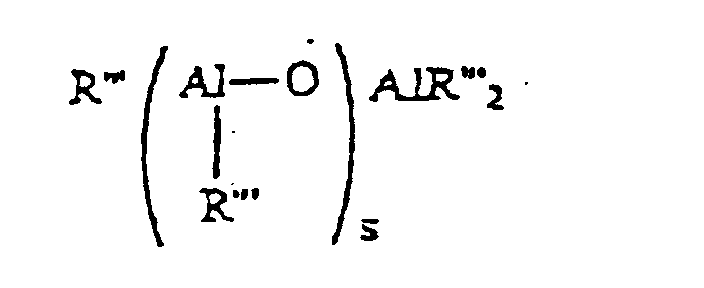 wobei s 1 bis 40 beträgt, vorzugsweise 10 bis 20; p 3 bis 40 beträgt, vorzugsweise 3 bis 20; und R''' eine Alkylgruppe enthaltend 1 bis 12 Kohlenstoffatome ist.
- Verfahren nach einem der vorstehenden Ansprüche, wobei (i) die Organonickelverbindung ausgewählt wird aus der Gruppe bestehend aus Nickelsalzen von Carbonsäuren, organischen Komplexverbindungen von Nickel und Mischungen davon; (ii) die Organoaluminiumverbindung ein Trialkylaluminium ist; (iii) der Promotor ein HF-Komplex ist; und Komponente (iv) Butadien ist, wobei das molare Verhältnis von Al/Ni zwischen 5 und 30 ist und das molare Verhältnis von HF/Al zwischen 1,5 und 3,5 ist.
- Verfahren nach einem der Ansprüche 1 bis 7, wobei (i) die Organonickelverbindung ausgewählt wird aus der Gruppe bestehend aus Nickelsalzen von Carbonsäuren, organischen Komplexverbindungen von Nickel und Mischungen davon; (ii) die Organoaluminiumverbindung ein Trialkylaluminium ist; (iii) der Promotor ein BF3-Komplex ist; und Komponente (iv) Butadien ist, wobei das molare Verhältnis von Al/Ni zwischen 5 und 30 ist und das molare Verhältnis von BF3/Al zwischen 0,5 und 2,5 ist.
- Verfahren nach Anspruch 9, wobei der Promotor ein Komplex von BF3 und einer organischen Verbindung ausgewählt aus der Gruppe bestehend aus einem Ether oder einem Alkohol ist.
- Verfahren nach Anspruch 10, wobei der Alkohol ein Phenol ist.
- Verfahren nach einem der Ansprüche 9 bis 11, wobei das molare Verhältnis von H2O/Al bis zu 1 beträgt.
- Verfahren nach Anspruch 1, wobei Harzpartikel hergestellt werden, die granuliert und rieselfähig sind, umfassend eine äußere Hülle enthaltend eine Mischung eines inerten teilchenförmigen Materials und eines Polymers, wobei das inerte teilchenförmige Material in der äußeren Hülle in einem Anteil größer als 75 Gew.-% basierend auf dem Gewicht der äußeren Hülle vorhanden ist, und einen inneren Kern enthaltend eine Mischung eines Polymers und eines inerten teilchenförmigen Materials, wobei das Polymer in dem inneren Kern in einem Anteil größer als 90 Gew.-% basierend auf dem Gewicht des inneren Kerns vorhanden ist, wobei das Polymer ein Homopolymer oder Copolymer eines konjugierten Diens, einer vinylsubstituierten Verbindung oder eines Gemisches davon ist, und der Harzpartikel einen Nickelrückstand in einer Menge von 1 ppm bis 240 ppm und einen Fluorrückstand in einer Menge von 0,6 ppm bis 47000 ppm basierend auf dem Gesamtgewicht des Polymers enthält.
- Verfahren nach Anspruch 13, wobei das Harz zusätzlich einen Borrückstand von 0,2 ppm bis 9000 ppm basierend auf dem Gesamtgewicht des Polymers enthält.
- Verfahren nach Anspruch 14, wobei der Harzpartikel eine verminderte Viskosität von 2 bis 6 dl/g hat.
- Verfahren nach einem der Ansprüche 13 bis 15, wobei das Polymer ausgewählt wird aus der Gruppe bestehend aus Polybutadien, Polyisopren, Polystyrol, Butadien-Isopren-Copolymeren, Butadien-Styrol-Copolymeren und Isopren-Styrol-Copolymeren und wobei das inerte teilchenförmige Material ausgewählt wird aus Karbonschwarz, Silica und Mischungen davon.
Applications Claiming Priority (3)
| Application Number | Priority Date | Filing Date | Title |
|---|---|---|---|
| US907765 | 1992-06-30 | ||
| US08/907,765 US6004677A (en) | 1997-08-08 | 1997-08-08 | Gas phase production of polydienes with pre-activated nickel catalysts |
| PCT/US1998/016443 WO1999007745A1 (en) | 1997-08-08 | 1998-08-07 | Gas phase production of polydienes with pre-activated nickel catalysts |
Publications (2)
| Publication Number | Publication Date |
|---|---|
| EP1001995A1 EP1001995A1 (de) | 2000-05-24 |
| EP1001995B1 true EP1001995B1 (de) | 2004-01-28 |
Family
ID=25424607
Family Applications (1)
| Application Number | Title | Priority Date | Filing Date |
|---|---|---|---|
| EP98938444A Expired - Lifetime EP1001995B1 (de) | 1997-08-08 | 1998-08-07 | Verfahren zur gasphasenpolymerisation von dienen mit einem preaktivierten nickelkatalysator |
Country Status (15)
| Country | Link |
|---|---|
| US (1) | US6004677A (de) |
| EP (1) | EP1001995B1 (de) |
| JP (1) | JP3425133B2 (de) |
| KR (1) | KR20010022666A (de) |
| CN (1) | CN1274363A (de) |
| AU (1) | AU8697198A (de) |
| BR (1) | BR9811087A (de) |
| CA (1) | CA2299375A1 (de) |
| DE (1) | DE69821363T2 (de) |
| ES (1) | ES2210793T3 (de) |
| HU (1) | HUP0003543A3 (de) |
| PL (1) | PL338580A1 (de) |
| TR (1) | TR200000359T2 (de) |
| WO (1) | WO1999007745A1 (de) |
| ZA (1) | ZA986726B (de) |
Families Citing this family (11)
| Publication number | Priority date | Publication date | Assignee | Title |
|---|---|---|---|---|
| EP1103566A1 (de) * | 1999-11-23 | 2001-05-30 | Union Carbide Chemicals & Plastics Technology Corporation | Nickel enthaltender Katalysator und Verfahren zur Gasphasenpolymerisation von Polybutadien |
| EP1103567A1 (de) * | 1999-11-23 | 2001-05-30 | Union Carbide Chemicals & Plastics Technology Corporation | Verfahren zur Erhöhung des Molekulargewichts von Polybutadien oder Polyisopren hergestellt durch Polymerisation mit Katalysator in der Gasphase |
| US6576732B1 (en) * | 2000-11-28 | 2003-06-10 | Conocophillips Co. | Drag-reducing polymers and drag-reducing polymer suspensions and solutions |
| US6987152B1 (en) | 2005-01-11 | 2006-01-17 | Univation Technologies, Llc | Feed purification at ambient temperature |
| US7714082B2 (en) | 2005-10-04 | 2010-05-11 | Univation Technologies, Llc | Gas-phase polymerization process to achieve a high particle density |
| US7585805B2 (en) * | 2005-11-22 | 2009-09-08 | Bridgestone Corporation | Nickel-based catalyst composition |
| JP4637075B2 (ja) * | 2006-10-03 | 2011-02-23 | 宇部興産株式会社 | 変性ポリブタジエンの製造方法 |
| US8372925B2 (en) | 2007-04-10 | 2013-02-12 | Bridgestone Corporation | Nickel-based catalyst composition |
| TW200936564A (en) * | 2007-11-15 | 2009-09-01 | Univation Tech Llc | Methods for the removal of impurities from polymerization feed streams |
| TWI579306B (zh) * | 2016-05-25 | 2017-04-21 | Cpc Corp | Preparation of Propylene and Butene by Ethylene Oligomerization at Low Pressure Catalyzed by Organic Acid |
| FR3054221A1 (fr) * | 2016-07-25 | 2018-01-26 | Compagnie Generale Des Etablissements Michelin | Systeme catalytique preforme comprenant un metallocene de terre rare |
Family Cites Families (7)
| Publication number | Priority date | Publication date | Assignee | Title |
|---|---|---|---|---|
| US4102817A (en) * | 1973-07-18 | 1978-07-25 | The Goodyear Tire & Rubber Company | Catalyst composition for the preparation of butadiene |
| US4155880A (en) * | 1971-11-24 | 1979-05-22 | The Goodyear Tire & Rubber Company | Catalyst composition comprising an organoaluminum compound/an organonickel compound/a hydrogen fluoride complex compound |
| US4994534A (en) * | 1989-09-28 | 1991-02-19 | Union Carbide Chemicals And Plastics Company Inc. | Process for producing sticky polymers |
| US5304588A (en) * | 1989-09-28 | 1994-04-19 | Union Carbide Chemicals & Plastics Technology Corporation | Core-shell resin particle |
| US5453471B1 (en) * | 1994-08-02 | 1999-02-09 | Carbide Chemicals & Plastics T | Gas phase polymerization process |
| US5412045A (en) * | 1994-09-16 | 1995-05-02 | Polysar Rubber Corporation | Preparation of high cis-1,4-polybutadiene with reduced gel |
| US5652304A (en) * | 1995-08-31 | 1997-07-29 | The Goodyear Tire & Rubber Company | Vapor phase synthesis of rubbery polymers |
-
1997
- 1997-08-08 US US08/907,765 patent/US6004677A/en not_active Expired - Fee Related
-
1998
- 1998-07-28 ZA ZA986726A patent/ZA986726B/xx unknown
- 1998-08-07 CN CN98809963A patent/CN1274363A/zh active Pending
- 1998-08-07 TR TR2000/00359T patent/TR200000359T2/xx unknown
- 1998-08-07 CA CA002299375A patent/CA2299375A1/en not_active Abandoned
- 1998-08-07 EP EP98938444A patent/EP1001995B1/de not_active Expired - Lifetime
- 1998-08-07 BR BR9811087-0A patent/BR9811087A/pt unknown
- 1998-08-07 KR KR1020007001261A patent/KR20010022666A/ko not_active Withdrawn
- 1998-08-07 JP JP2000506243A patent/JP3425133B2/ja not_active Expired - Fee Related
- 1998-08-07 WO PCT/US1998/016443 patent/WO1999007745A1/en not_active Ceased
- 1998-08-07 HU HU0003543A patent/HUP0003543A3/hu unknown
- 1998-08-07 PL PL98338580A patent/PL338580A1/xx not_active Application Discontinuation
- 1998-08-07 ES ES98938444T patent/ES2210793T3/es not_active Expired - Lifetime
- 1998-08-07 DE DE69821363T patent/DE69821363T2/de not_active Expired - Fee Related
- 1998-08-07 AU AU86971/98A patent/AU8697198A/en not_active Abandoned
Also Published As
| Publication number | Publication date |
|---|---|
| AU8697198A (en) | 1999-03-01 |
| HUP0003543A3 (en) | 2003-03-28 |
| US6004677A (en) | 1999-12-21 |
| CN1274363A (zh) | 2000-11-22 |
| CA2299375A1 (en) | 1999-02-18 |
| KR20010022666A (ko) | 2001-03-26 |
| EP1001995A1 (de) | 2000-05-24 |
| BR9811087A (pt) | 2000-08-29 |
| PL338580A1 (en) | 2000-11-06 |
| JP3425133B2 (ja) | 2003-07-07 |
| TR200000359T2 (tr) | 2000-05-22 |
| HUP0003543A2 (hu) | 2001-02-28 |
| ES2210793T3 (es) | 2004-07-01 |
| WO1999007745A1 (en) | 1999-02-18 |
| DE69821363T2 (de) | 2004-12-09 |
| JP2001512750A (ja) | 2001-08-28 |
| DE69821363D1 (de) | 2004-03-04 |
| ZA986726B (en) | 1999-02-02 |
Similar Documents
| Publication | Publication Date | Title |
|---|---|---|
| US5652304A (en) | Vapor phase synthesis of rubbery polymers | |
| JP3741760B2 (ja) | シス−1,4−ポリブタジエンの分子量を減じ、そしてその加工性を改善するための技術 | |
| US6627715B2 (en) | Group IIa metal containing catalyst system | |
| US5879805A (en) | Gas phase polymerization of vinylpolybutadiene | |
| JPH027327B2 (de) | ||
| EP1001995B1 (de) | Verfahren zur gasphasenpolymerisation von dienen mit einem preaktivierten nickelkatalysator | |
| EP0935615B1 (de) | Beendung der gasphasenpolymerisation von konjugierten dienen, vinylaromatischen verbindungen und mischungen davon | |
| US5100982A (en) | Technique for reducing the molecular weight and broadening the molecular weight distribution of high cis-1,4-polybutadiene | |
| US6001478A (en) | Resin particle produced by diene polymerization with rare earth and transition metal catalysts | |
| JP2000327703A (ja) | 共役ジエンの懸濁重合方法 | |
| US3464965A (en) | Process for producing polybutadienes having reduced cold flow tendency | |
| JPH0215564B2 (de) | ||
| US5859156A (en) | Vapor phase synthesis of rubbery polymers | |
| JP2002525402A (ja) | ジエン重合用触媒成分、それから得られる触媒、および同触媒を用いるポリジエン製造法 | |
| EP1103567A1 (de) | Verfahren zur Erhöhung des Molekulargewichts von Polybutadien oder Polyisopren hergestellt durch Polymerisation mit Katalysator in der Gasphase | |
| EP1103566A1 (de) | Nickel enthaltender Katalysator und Verfahren zur Gasphasenpolymerisation von Polybutadien | |
| JP2002501092A (ja) | 共役ジエンの気相重合用触媒系 | |
| EP0745618A1 (de) | Herstellung von kristallinem Polybutadien mit hohem 1,4-Transgehalt | |
| EP1116729A2 (de) | Synthese von Kautschukpolymeren in der Dampfphase | |
| CZ2000465A3 (cs) | Způsob získávání polydienů v plynné fázi s pomocí předaktivovaných niklových katalyzátorů | |
| MXPA00002353A (en) | Gas phase polymerization of vinylpolybutadiene |
Legal Events
| Date | Code | Title | Description |
|---|---|---|---|
| PUAI | Public reference made under article 153(3) epc to a published international application that has entered the european phase |
Free format text: ORIGINAL CODE: 0009012 |
|
| 17P | Request for examination filed |
Effective date: 20000131 |
|
| AK | Designated contracting states |
Kind code of ref document: A1 Designated state(s): BE DE ES FR GB IT NL SE |
|
| RIN1 | Information on inventor provided before grant (corrected) |
Inventor name: ZHANG, MINGHUI Inventor name: CANN, KEVIN, JOSEPH Inventor name: APECETCHE, ANGELICA, MARIA |
|
| 17Q | First examination report despatched |
Effective date: 20020325 |
|
| GRAH | Despatch of communication of intention to grant a patent |
Free format text: ORIGINAL CODE: EPIDOS IGRA |
|
| GRAS | Grant fee paid |
Free format text: ORIGINAL CODE: EPIDOSNIGR3 |
|
| GRAA | (expected) grant |
Free format text: ORIGINAL CODE: 0009210 |
|
| AK | Designated contracting states |
Kind code of ref document: B1 Designated state(s): BE DE ES FR GB IT NL SE |
|
| REG | Reference to a national code |
Ref country code: GB Ref legal event code: FG4D |
|
| REF | Corresponds to: |
Ref document number: 69821363 Country of ref document: DE Date of ref document: 20040304 Kind code of ref document: P |
|
| PG25 | Lapsed in a contracting state [announced via postgrant information from national office to epo] |
Ref country code: SE Free format text: LAPSE BECAUSE OF FAILURE TO SUBMIT A TRANSLATION OF THE DESCRIPTION OR TO PAY THE FEE WITHIN THE PRESCRIBED TIME-LIMIT Effective date: 20040428 |
|
| PGFP | Annual fee paid to national office [announced via postgrant information from national office to epo] |
Ref country code: DE Payment date: 20040525 Year of fee payment: 7 |
|
| PGFP | Annual fee paid to national office [announced via postgrant information from national office to epo] |
Ref country code: FR Payment date: 20040528 Year of fee payment: 7 |
|
| PGFP | Annual fee paid to national office [announced via postgrant information from national office to epo] |
Ref country code: NL Payment date: 20040530 Year of fee payment: 7 |
|
| PGFP | Annual fee paid to national office [announced via postgrant information from national office to epo] |
Ref country code: GB Payment date: 20040628 Year of fee payment: 7 |
|
| REG | Reference to a national code |
Ref country code: ES Ref legal event code: FG2A Ref document number: 2210793 Country of ref document: ES Kind code of ref document: T3 |
|
| PGFP | Annual fee paid to national office [announced via postgrant information from national office to epo] |
Ref country code: BE Payment date: 20040714 Year of fee payment: 7 |
|
| PGFP | Annual fee paid to national office [announced via postgrant information from national office to epo] |
Ref country code: ES Payment date: 20040803 Year of fee payment: 7 |
|
| ET | Fr: translation filed | ||
| PLBE | No opposition filed within time limit |
Free format text: ORIGINAL CODE: 0009261 |
|
| STAA | Information on the status of an ep patent application or granted ep patent |
Free format text: STATUS: NO OPPOSITION FILED WITHIN TIME LIMIT |
|
| 26N | No opposition filed |
Effective date: 20041029 |
|
| PG25 | Lapsed in a contracting state [announced via postgrant information from national office to epo] |
Ref country code: IT Free format text: LAPSE BECAUSE OF NON-PAYMENT OF DUE FEES Effective date: 20050807 Ref country code: GB Free format text: LAPSE BECAUSE OF NON-PAYMENT OF DUE FEES Effective date: 20050807 |
|
| PG25 | Lapsed in a contracting state [announced via postgrant information from national office to epo] |
Ref country code: ES Free format text: LAPSE BECAUSE OF NON-PAYMENT OF DUE FEES Effective date: 20050808 |
|
| PG25 | Lapsed in a contracting state [announced via postgrant information from national office to epo] |
Ref country code: BE Free format text: LAPSE BECAUSE OF NON-PAYMENT OF DUE FEES Effective date: 20050831 |
|
| PG25 | Lapsed in a contracting state [announced via postgrant information from national office to epo] |
Ref country code: NL Free format text: LAPSE BECAUSE OF NON-PAYMENT OF DUE FEES Effective date: 20060301 Ref country code: DE Free format text: LAPSE BECAUSE OF NON-PAYMENT OF DUE FEES Effective date: 20060301 |
|
| GBPC | Gb: european patent ceased through non-payment of renewal fee |
Effective date: 20050807 |
|
| PG25 | Lapsed in a contracting state [announced via postgrant information from national office to epo] |
Ref country code: FR Free format text: LAPSE BECAUSE OF NON-PAYMENT OF DUE FEES Effective date: 20060428 |
|
| NLV4 | Nl: lapsed or anulled due to non-payment of the annual fee |
Effective date: 20060301 |
|
| REG | Reference to a national code |
Ref country code: FR Ref legal event code: ST Effective date: 20060428 |
|
| REG | Reference to a national code |
Ref country code: ES Ref legal event code: FD2A Effective date: 20050808 |
|
| BERE | Be: lapsed |
Owner name: *UNION CARBIDE CHEMICALS & PLASTICS TECHNOLOGY COR Effective date: 20050831 |