EP1002143B1 - Alkalische bandpassivierung - Google Patents
Alkalische bandpassivierung Download PDFInfo
- Publication number
- EP1002143B1 EP1002143B1 EP98942626A EP98942626A EP1002143B1 EP 1002143 B1 EP1002143 B1 EP 1002143B1 EP 98942626 A EP98942626 A EP 98942626A EP 98942626 A EP98942626 A EP 98942626A EP 1002143 B1 EP1002143 B1 EP 1002143B1
- Authority
- EP
- European Patent Office
- Prior art keywords
- ions
- free
- passivation
- alkaline
- points
- Prior art date
- Legal status (The legal status is an assumption and is not a legal conclusion. Google has not performed a legal analysis and makes no representation as to the accuracy of the status listed.)
- Expired - Lifetime
Links
- 238000002161 passivation Methods 0.000 title claims abstract description 27
- 239000000243 solution Substances 0.000 claims abstract description 32
- 238000000034 method Methods 0.000 claims abstract description 21
- -1 iron (III) ions Chemical class 0.000 claims abstract description 16
- 229910052751 metal Inorganic materials 0.000 claims abstract description 15
- 239000002184 metal Substances 0.000 claims abstract description 15
- XEEYBQQBJWHFJM-UHFFFAOYSA-N Iron Chemical compound [Fe] XEEYBQQBJWHFJM-UHFFFAOYSA-N 0.000 claims abstract description 14
- 229910052782 aluminium Inorganic materials 0.000 claims abstract description 13
- XAGFODPZIPBFFR-UHFFFAOYSA-N aluminium Chemical compound [Al] XAGFODPZIPBFFR-UHFFFAOYSA-N 0.000 claims abstract description 13
- 229910052742 iron Inorganic materials 0.000 claims abstract description 7
- 239000007864 aqueous solution Substances 0.000 claims abstract description 6
- JLVVSXFLKOJNIY-UHFFFAOYSA-N Magnesium ion Chemical compound [Mg+2] JLVVSXFLKOJNIY-UHFFFAOYSA-N 0.000 claims abstract description 5
- 229910001425 magnesium ion Inorganic materials 0.000 claims abstract description 5
- 239000004411 aluminium Substances 0.000 claims abstract 5
- PXHVJJICTQNCMI-UHFFFAOYSA-N Nickel Chemical compound [Ni] PXHVJJICTQNCMI-UHFFFAOYSA-N 0.000 claims description 19
- XLYOFNOQVPJJNP-UHFFFAOYSA-N water Substances O XLYOFNOQVPJJNP-UHFFFAOYSA-N 0.000 claims description 9
- 229910001429 cobalt ion Inorganic materials 0.000 claims description 7
- XLJKHNWPARRRJB-UHFFFAOYSA-N cobalt(2+) Chemical compound [Co+2] XLJKHNWPARRRJB-UHFFFAOYSA-N 0.000 claims description 7
- 229910001453 nickel ion Inorganic materials 0.000 claims description 7
- 229910000838 Al alloy Inorganic materials 0.000 claims description 6
- 229910001335 Galvanized steel Inorganic materials 0.000 claims description 6
- 239000008397 galvanized steel Substances 0.000 claims description 6
- 239000008139 complexing agent Substances 0.000 claims description 4
- 239000012141 concentrate Substances 0.000 claims description 4
- RTAQQCXQSZGOHL-UHFFFAOYSA-N Titanium Chemical compound [Ti] RTAQQCXQSZGOHL-UHFFFAOYSA-N 0.000 claims description 3
- 229910021485 fumed silica Inorganic materials 0.000 claims description 3
- 150000002500 ions Chemical class 0.000 claims description 3
- CWYNVVGOOAEACU-UHFFFAOYSA-N iron (II) ion Substances [Fe+2] CWYNVVGOOAEACU-UHFFFAOYSA-N 0.000 claims description 3
- 239000010936 titanium Substances 0.000 claims description 3
- 229910052719 titanium Inorganic materials 0.000 claims description 3
- NIXOWILDQLNWCW-UHFFFAOYSA-M Acrylate Chemical compound [O-]C(=O)C=C NIXOWILDQLNWCW-UHFFFAOYSA-M 0.000 claims description 2
- QCWXUUIWCKQGHC-UHFFFAOYSA-N Zirconium Chemical compound [Zr] QCWXUUIWCKQGHC-UHFFFAOYSA-N 0.000 claims description 2
- 229940050410 gluconate Drugs 0.000 claims description 2
- 229910052726 zirconium Inorganic materials 0.000 claims description 2
- 239000012895 dilution Substances 0.000 claims 1
- 238000010790 dilution Methods 0.000 claims 1
- 150000002222 fluorine compounds Chemical class 0.000 claims 1
- VYZAMTAEIAYCRO-UHFFFAOYSA-N Chromium Chemical compound [Cr] VYZAMTAEIAYCRO-UHFFFAOYSA-N 0.000 abstract description 5
- 125000002924 primary amino group Chemical group [H]N([H])* 0.000 abstract description 5
- 229910052804 chromium Inorganic materials 0.000 abstract description 4
- 239000011651 chromium Substances 0.000 abstract description 4
- 229910000831 Steel Inorganic materials 0.000 abstract 1
- 239000010959 steel Substances 0.000 abstract 1
- HEMHJVSKTPXQMS-UHFFFAOYSA-M Sodium hydroxide Chemical compound [OH-].[Na+] HEMHJVSKTPXQMS-UHFFFAOYSA-M 0.000 description 8
- 230000007797 corrosion Effects 0.000 description 7
- 238000005260 corrosion Methods 0.000 description 7
- 239000002253 acid Substances 0.000 description 5
- 229910017052 cobalt Inorganic materials 0.000 description 4
- 239000010941 cobalt Substances 0.000 description 4
- GUTLYIVDDKVIGB-UHFFFAOYSA-N cobalt atom Chemical compound [Co] GUTLYIVDDKVIGB-UHFFFAOYSA-N 0.000 description 4
- 229910052749 magnesium Inorganic materials 0.000 description 4
- 239000011777 magnesium Substances 0.000 description 4
- 229910052759 nickel Inorganic materials 0.000 description 4
- 239000003973 paint Substances 0.000 description 4
- 150000003839 salts Chemical class 0.000 description 4
- 231100000331 toxic Toxicity 0.000 description 4
- 230000002588 toxic effect Effects 0.000 description 4
- 229910001385 heavy metal Inorganic materials 0.000 description 3
- VEXZGXHMUGYJMC-UHFFFAOYSA-N Hydrochloric acid Chemical compound Cl VEXZGXHMUGYJMC-UHFFFAOYSA-N 0.000 description 2
- FYYHWMGAXLPEAU-UHFFFAOYSA-N Magnesium Chemical compound [Mg] FYYHWMGAXLPEAU-UHFFFAOYSA-N 0.000 description 2
- QAOWNCQODCNURD-UHFFFAOYSA-N Sulfuric acid Chemical compound OS(O)(=O)=O QAOWNCQODCNURD-UHFFFAOYSA-N 0.000 description 2
- 125000004432 carbon atom Chemical group C* 0.000 description 2
- 238000007865 diluting Methods 0.000 description 2
- 238000001035 drying Methods 0.000 description 2
- 230000000694 effects Effects 0.000 description 2
- 150000004673 fluoride salts Chemical class 0.000 description 2
- 150000002739 metals Chemical class 0.000 description 2
- 150000002823 nitrates Chemical class 0.000 description 2
- 238000010422 painting Methods 0.000 description 2
- 159000000000 sodium salts Chemical class 0.000 description 2
- 239000007921 spray Substances 0.000 description 2
- 238000005507 spraying Methods 0.000 description 2
- DGAQECJNVWCQMB-PUAWFVPOSA-M Ilexoside XXIX Chemical compound C[C@@H]1CC[C@@]2(CC[C@@]3(C(=CC[C@H]4[C@]3(CC[C@@H]5[C@@]4(CC[C@@H](C5(C)C)OS(=O)(=O)[O-])C)C)[C@@H]2[C@]1(C)O)C)C(=O)O[C@H]6[C@@H]([C@H]([C@@H]([C@H](O6)CO)O)O)O.[Na+] DGAQECJNVWCQMB-PUAWFVPOSA-M 0.000 description 1
- 229910002651 NO3 Inorganic materials 0.000 description 1
- VEQPNABPJHWNSG-UHFFFAOYSA-N Nickel(2+) Chemical compound [Ni+2] VEQPNABPJHWNSG-UHFFFAOYSA-N 0.000 description 1
- 229910004298 SiO 2 Inorganic materials 0.000 description 1
- 229910001297 Zn alloy Inorganic materials 0.000 description 1
- 150000007513 acids Chemical class 0.000 description 1
- 239000013543 active substance Substances 0.000 description 1
- 238000007605 air drying Methods 0.000 description 1
- 230000001476 alcoholic effect Effects 0.000 description 1
- 229910045601 alloy Inorganic materials 0.000 description 1
- 239000000956 alloy Substances 0.000 description 1
- 150000001450 anions Chemical class 0.000 description 1
- 239000007900 aqueous suspension Substances 0.000 description 1
- 230000015572 biosynthetic process Effects 0.000 description 1
- 229910052793 cadmium Inorganic materials 0.000 description 1
- 229910052799 carbon Inorganic materials 0.000 description 1
- BVKZGUZCCUSVTD-UHFFFAOYSA-N carbonic acid Chemical class OC(O)=O BVKZGUZCCUSVTD-UHFFFAOYSA-N 0.000 description 1
- 150000001735 carboxylic acids Chemical class 0.000 description 1
- 238000012512 characterization method Methods 0.000 description 1
- 239000011248 coating agent Substances 0.000 description 1
- 238000000576 coating method Methods 0.000 description 1
- 230000000536 complexating effect Effects 0.000 description 1
- 239000008367 deionised water Substances 0.000 description 1
- 229910021641 deionized water Inorganic materials 0.000 description 1
- 238000007598 dipping method Methods 0.000 description 1
- 231100000086 high toxicity Toxicity 0.000 description 1
- 125000002887 hydroxy group Chemical group [H]O* 0.000 description 1
- 230000008595 infiltration Effects 0.000 description 1
- 238000001764 infiltration Methods 0.000 description 1
- 159000000014 iron salts Chemical class 0.000 description 1
- 239000004922 lacquer Substances 0.000 description 1
- 150000002681 magnesium compounds Chemical class 0.000 description 1
- 229910052748 manganese Inorganic materials 0.000 description 1
- 238000004519 manufacturing process Methods 0.000 description 1
- 229910052750 molybdenum Inorganic materials 0.000 description 1
- 229920000728 polyester Polymers 0.000 description 1
- 230000008092 positive effect Effects 0.000 description 1
- 238000001556 precipitation Methods 0.000 description 1
- 238000002360 preparation method Methods 0.000 description 1
- 238000005096 rolling process Methods 0.000 description 1
- 229910052708 sodium Inorganic materials 0.000 description 1
- 239000011734 sodium Substances 0.000 description 1
- 229910052718 tin Inorganic materials 0.000 description 1
- 150000003755 zirconium compounds Chemical class 0.000 description 1
Classifications
-
- C—CHEMISTRY; METALLURGY
- C23—COATING METALLIC MATERIAL; COATING MATERIAL WITH METALLIC MATERIAL; CHEMICAL SURFACE TREATMENT; DIFFUSION TREATMENT OF METALLIC MATERIAL; COATING BY VACUUM EVAPORATION, BY SPUTTERING, BY ION IMPLANTATION OR BY CHEMICAL VAPOUR DEPOSITION, IN GENERAL; INHIBITING CORROSION OF METALLIC MATERIAL OR INCRUSTATION IN GENERAL
- C23C—COATING METALLIC MATERIAL; COATING MATERIAL WITH METALLIC MATERIAL; SURFACE TREATMENT OF METALLIC MATERIAL BY DIFFUSION INTO THE SURFACE, BY CHEMICAL CONVERSION OR SUBSTITUTION; COATING BY VACUUM EVAPORATION, BY SPUTTERING, BY ION IMPLANTATION OR BY CHEMICAL VAPOUR DEPOSITION, IN GENERAL
- C23C22/00—Chemical surface treatment of metallic material by reaction of the surface with a reactive liquid, leaving reaction products of surface material in the coating, e.g. conversion coatings, passivation of metals
- C23C22/05—Chemical surface treatment of metallic material by reaction of the surface with a reactive liquid, leaving reaction products of surface material in the coating, e.g. conversion coatings, passivation of metals using aqueous solutions
- C23C22/60—Chemical surface treatment of metallic material by reaction of the surface with a reactive liquid, leaving reaction products of surface material in the coating, e.g. conversion coatings, passivation of metals using aqueous solutions using alkaline aqueous solutions with pH greater than 8
-
- C—CHEMISTRY; METALLURGY
- C23—COATING METALLIC MATERIAL; COATING MATERIAL WITH METALLIC MATERIAL; CHEMICAL SURFACE TREATMENT; DIFFUSION TREATMENT OF METALLIC MATERIAL; COATING BY VACUUM EVAPORATION, BY SPUTTERING, BY ION IMPLANTATION OR BY CHEMICAL VAPOUR DEPOSITION, IN GENERAL; INHIBITING CORROSION OF METALLIC MATERIAL OR INCRUSTATION IN GENERAL
- C23C—COATING METALLIC MATERIAL; COATING MATERIAL WITH METALLIC MATERIAL; SURFACE TREATMENT OF METALLIC MATERIAL BY DIFFUSION INTO THE SURFACE, BY CHEMICAL CONVERSION OR SUBSTITUTION; COATING BY VACUUM EVAPORATION, BY SPUTTERING, BY ION IMPLANTATION OR BY CHEMICAL VAPOUR DEPOSITION, IN GENERAL
- C23C22/00—Chemical surface treatment of metallic material by reaction of the surface with a reactive liquid, leaving reaction products of surface material in the coating, e.g. conversion coatings, passivation of metals
- C23C22/05—Chemical surface treatment of metallic material by reaction of the surface with a reactive liquid, leaving reaction products of surface material in the coating, e.g. conversion coatings, passivation of metals using aqueous solutions
- C23C22/06—Chemical surface treatment of metallic material by reaction of the surface with a reactive liquid, leaving reaction products of surface material in the coating, e.g. conversion coatings, passivation of metals using aqueous solutions using aqueous acidic solutions with pH less than 6
- C23C22/34—Chemical surface treatment of metallic material by reaction of the surface with a reactive liquid, leaving reaction products of surface material in the coating, e.g. conversion coatings, passivation of metals using aqueous solutions using aqueous acidic solutions with pH less than 6 containing fluorides or complex fluorides
-
- C—CHEMISTRY; METALLURGY
- C23—COATING METALLIC MATERIAL; COATING MATERIAL WITH METALLIC MATERIAL; CHEMICAL SURFACE TREATMENT; DIFFUSION TREATMENT OF METALLIC MATERIAL; COATING BY VACUUM EVAPORATION, BY SPUTTERING, BY ION IMPLANTATION OR BY CHEMICAL VAPOUR DEPOSITION, IN GENERAL; INHIBITING CORROSION OF METALLIC MATERIAL OR INCRUSTATION IN GENERAL
- C23C—COATING METALLIC MATERIAL; COATING MATERIAL WITH METALLIC MATERIAL; SURFACE TREATMENT OF METALLIC MATERIAL BY DIFFUSION INTO THE SURFACE, BY CHEMICAL CONVERSION OR SUBSTITUTION; COATING BY VACUUM EVAPORATION, BY SPUTTERING, BY ION IMPLANTATION OR BY CHEMICAL VAPOUR DEPOSITION, IN GENERAL
- C23C22/00—Chemical surface treatment of metallic material by reaction of the surface with a reactive liquid, leaving reaction products of surface material in the coating, e.g. conversion coatings, passivation of metals
- C23C22/05—Chemical surface treatment of metallic material by reaction of the surface with a reactive liquid, leaving reaction products of surface material in the coating, e.g. conversion coatings, passivation of metals using aqueous solutions
- C23C22/60—Chemical surface treatment of metallic material by reaction of the surface with a reactive liquid, leaving reaction products of surface material in the coating, e.g. conversion coatings, passivation of metals using aqueous solutions using alkaline aqueous solutions with pH greater than 8
- C23C22/66—Treatment of aluminium or alloys based thereon
-
- C—CHEMISTRY; METALLURGY
- C23—COATING METALLIC MATERIAL; COATING MATERIAL WITH METALLIC MATERIAL; CHEMICAL SURFACE TREATMENT; DIFFUSION TREATMENT OF METALLIC MATERIAL; COATING BY VACUUM EVAPORATION, BY SPUTTERING, BY ION IMPLANTATION OR BY CHEMICAL VAPOUR DEPOSITION, IN GENERAL; INHIBITING CORROSION OF METALLIC MATERIAL OR INCRUSTATION IN GENERAL
- C23C—COATING METALLIC MATERIAL; COATING MATERIAL WITH METALLIC MATERIAL; SURFACE TREATMENT OF METALLIC MATERIAL BY DIFFUSION INTO THE SURFACE, BY CHEMICAL CONVERSION OR SUBSTITUTION; COATING BY VACUUM EVAPORATION, BY SPUTTERING, BY ION IMPLANTATION OR BY CHEMICAL VAPOUR DEPOSITION, IN GENERAL
- C23C22/00—Chemical surface treatment of metallic material by reaction of the surface with a reactive liquid, leaving reaction products of surface material in the coating, e.g. conversion coatings, passivation of metals
- C23C22/73—Chemical surface treatment of metallic material by reaction of the surface with a reactive liquid, leaving reaction products of surface material in the coating, e.g. conversion coatings, passivation of metals characterised by the process
-
- C—CHEMISTRY; METALLURGY
- C23—COATING METALLIC MATERIAL; COATING MATERIAL WITH METALLIC MATERIAL; CHEMICAL SURFACE TREATMENT; DIFFUSION TREATMENT OF METALLIC MATERIAL; COATING BY VACUUM EVAPORATION, BY SPUTTERING, BY ION IMPLANTATION OR BY CHEMICAL VAPOUR DEPOSITION, IN GENERAL; INHIBITING CORROSION OF METALLIC MATERIAL OR INCRUSTATION IN GENERAL
- C23C—COATING METALLIC MATERIAL; COATING MATERIAL WITH METALLIC MATERIAL; SURFACE TREATMENT OF METALLIC MATERIAL BY DIFFUSION INTO THE SURFACE, BY CHEMICAL CONVERSION OR SUBSTITUTION; COATING BY VACUUM EVAPORATION, BY SPUTTERING, BY ION IMPLANTATION OR BY CHEMICAL VAPOUR DEPOSITION, IN GENERAL
- C23C22/00—Chemical surface treatment of metallic material by reaction of the surface with a reactive liquid, leaving reaction products of surface material in the coating, e.g. conversion coatings, passivation of metals
- C23C22/82—After-treatment
- C23C22/83—Chemical after-treatment
Definitions
- the invention relates to a method for the alkaline passivation of galvanized and galvanized steel surfaces as well as aluminum and its Alloys in conveyor systems. This passivation creates a Corrosion protection layer, which is the basis for subsequent painting can serve.
- Alkaline passivation processes are used to treat the above Metal surfaces have been known for a long time.
- the treatment solutions usually toxic heavy metals such as nickel ions and / or Cobalt ions.
- nickel ions and / or Cobalt ions By suitable complexing agents, these ions are among the alkaline conditions kept in solution. Examples of such Passivation solutions are given in EP-A-405 340.
- the invention therefore has as its object a method for to provide alkaline passivation of suitable metal surfaces, which has a similar performance to processes containing nickel or cobalt has, but no toxic heavy metals used.
- GB-A-1 042 108 describes an alkaline, chromate-free treatment bath for galvanized or coated with a zinc alloy surface, which preferably has a pH in the range from 12.6 to 13.3.
- the bath contains 0.002 to 0.5% of a metal from the group Mg, Cd, Al, Sn, Ti, Sb, Mo, Cr, Ce, W, Mn, Co, Fe and Ni as well as an amount of an organic complexing agent to the metal to keep complex solutions.
- the surfaces are treated for 20 to 60 seconds at a temperature of 90 to 200 ° F.
- the bath contains 3% NaOH, 0.2% sodium hexahydroxyheptoate, 0.008% Fe 3+ and 0.042% Mg. Baths which hold two or more metals in solution in complex form are preferred; preferred metals are iron and cobalt.
- Aluminum alloys which contain more than 50% by weight of aluminum.
- Alkaline means that the treatment solutions have a pH from above 9.5, preferably in the range from 10 to 13. to In practice, the characterization of the treatment baths serves less the pH values, but the levels of free alkalinity and total alkalinity.
- the free Alkalinity is determined by diluting 2 ml bath solution, preferably to 50 ml, with a 0.1 N acid such as hydrochloric acid or sulfuric acid titrated to a pH of 8.5. The consumption of acid solution in ml gives the Score of free alkalinity.
- the overall alkalinity is determined accordingly, by adding 2 ml of treatment solution, diluted to 50 ml, with 0.1N acid up to titrated to a pH of 4.0. This inevitably means that the total alkalinity is higher than the free alkalinity.
- the treatment solution can contain additional active substances that have a positive effect on the formation of layers and corrosion protection.
- contents from about 0.001 to about 20 g / l of finely divided SiO 2 , for example pyrogenic silica, may be mentioned.
- BET specific surface area
- Aqueous suspensions of such silicas are commercially available.
- Another optional component of the treatment solution is about 0.001 to about 10 g / l of monomeric or oligomeric acrylate and / or methacrylate ions.
- This can be as soluble salts, for example sodium salts, or in the form of the free Acid can be added to the treatment solution.
- Drying step at the latest when baking an applied lacquer, polymerize these ions and thereby improve the layer properties.
- the amino or hydroxy carboxylate ions serve to prevent the precipitation of iron and magnesium compounds at the alkaline pH of the treatment solution to prevent.
- all amino or hydroxy carboxylate ions are for this suitable that produce this effect. They can be in the form of soluble salts such as for example sodium salts or as free acids in the treatment solution be introduced.
- Monobasic hydroxycarboxylic acids are preferred with at least 4 carbon atoms and at least 2 alcoholic hydroxyl groups.
- Gluconate ions or those longer by one carbon atom are particularly preferred Glucoheptanationen.
- the treatment solutions also contain the anions of the salts than that of the magnesium and iron (III) ions in the treatment solution have been introduced.
- the nitrates are preferably used here, since Nitrate ions have no negative influence on corrosion protection.
- the process is designed for the treatment of running metal strips, so that the treatment time depending on the belt speed and length of the Treatment zone is in the range of a few seconds.
- the Treatment time is about 3 to about 30 seconds and is preferably in Range from 5 to 15 seconds.
- aqueous treatment solution becomes the end of the desired exposure time rinsed.
- the corrosion protection effect can be further improved if the undergoes post-passivation of alkaline passivated metal surfaces.
- Post-passivation after an alkaline passivation is state of the art Processes containing chromium are widely used.
- a post passivation containing chrome is also as an aftertreatment after the alkaline passivation according to the invention suitable.
- chrome-free Post-passivation solutions are particularly suitable for aqueous solutions, the titanium and / or zirconium compounds, in particular complex fluorides thereof Contains items.
- such a post-passivation solution a total of 0.4 to 10 g / l complex fluorides of titanium and / or zirconium contain.
- the pH of this chrome-free post-passivation solution is preferably in the range of about 2 to about 4.
- the alkaline passivation step according to the invention thus represents a Treatment stage of a multi-stage treatment chain, in which the metal strips are usually first degreased and rinsed. This is followed by the Alkaline passivation according to the invention, usually followed by the steps Rinsing, re-passivation, usually rinsing again, drying (at about 60 up to about 100 ° C object temperature), painting.
- the procedure is preferably such that first magnesium and iron salts, preferably nitrates, until the required Dissolves the concentration in water, then adds the complexing carboxylic acid and only then by adding lye, for example sodium hydroxide solution, the alkaline pH established.
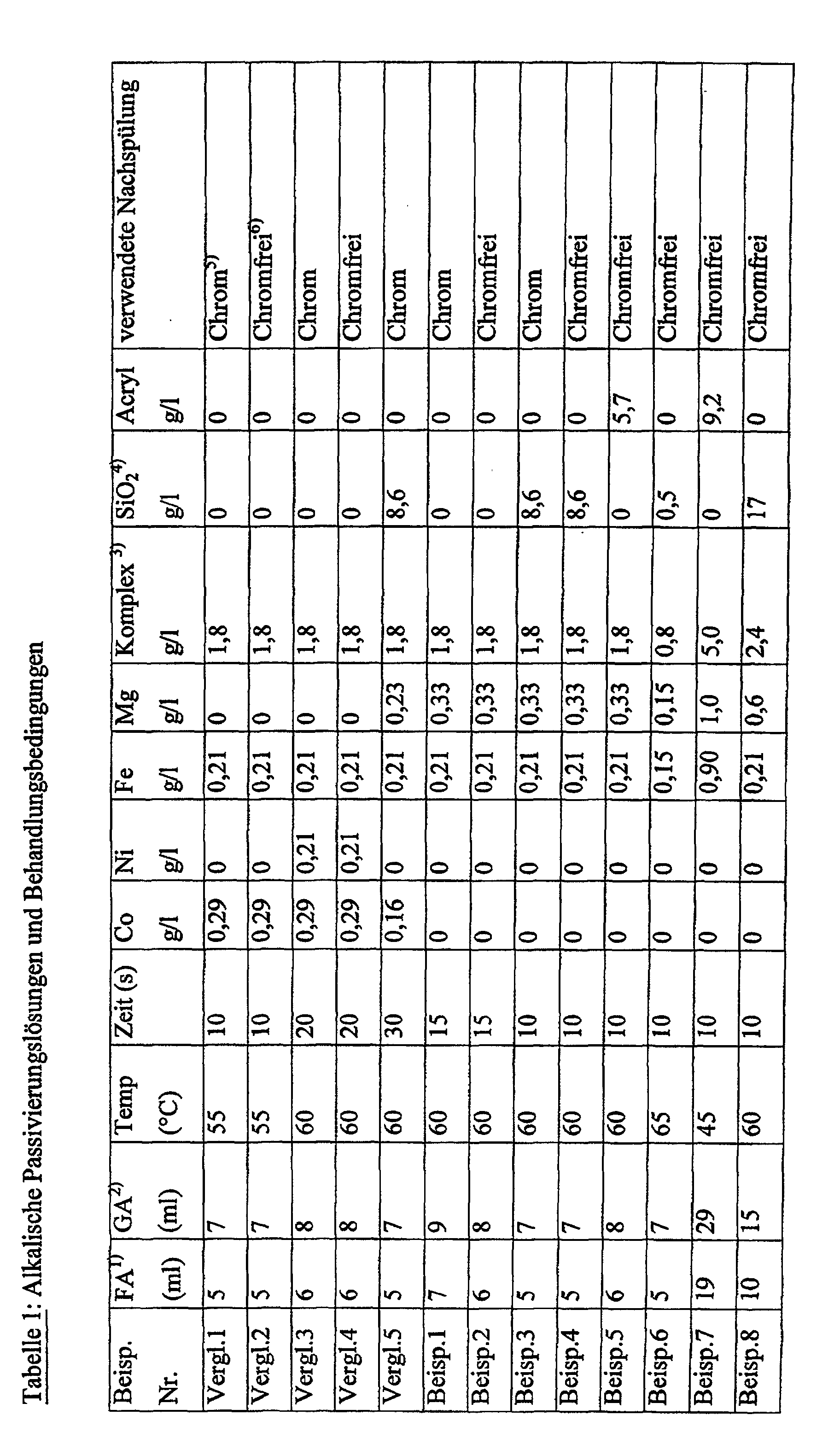
- the following exemplary embodiments show that the alkaline passivation process according to the invention leads to similar corrosion protection results as comparison processes according to the prior art which contain toxic nickel and / or cobalt ions.
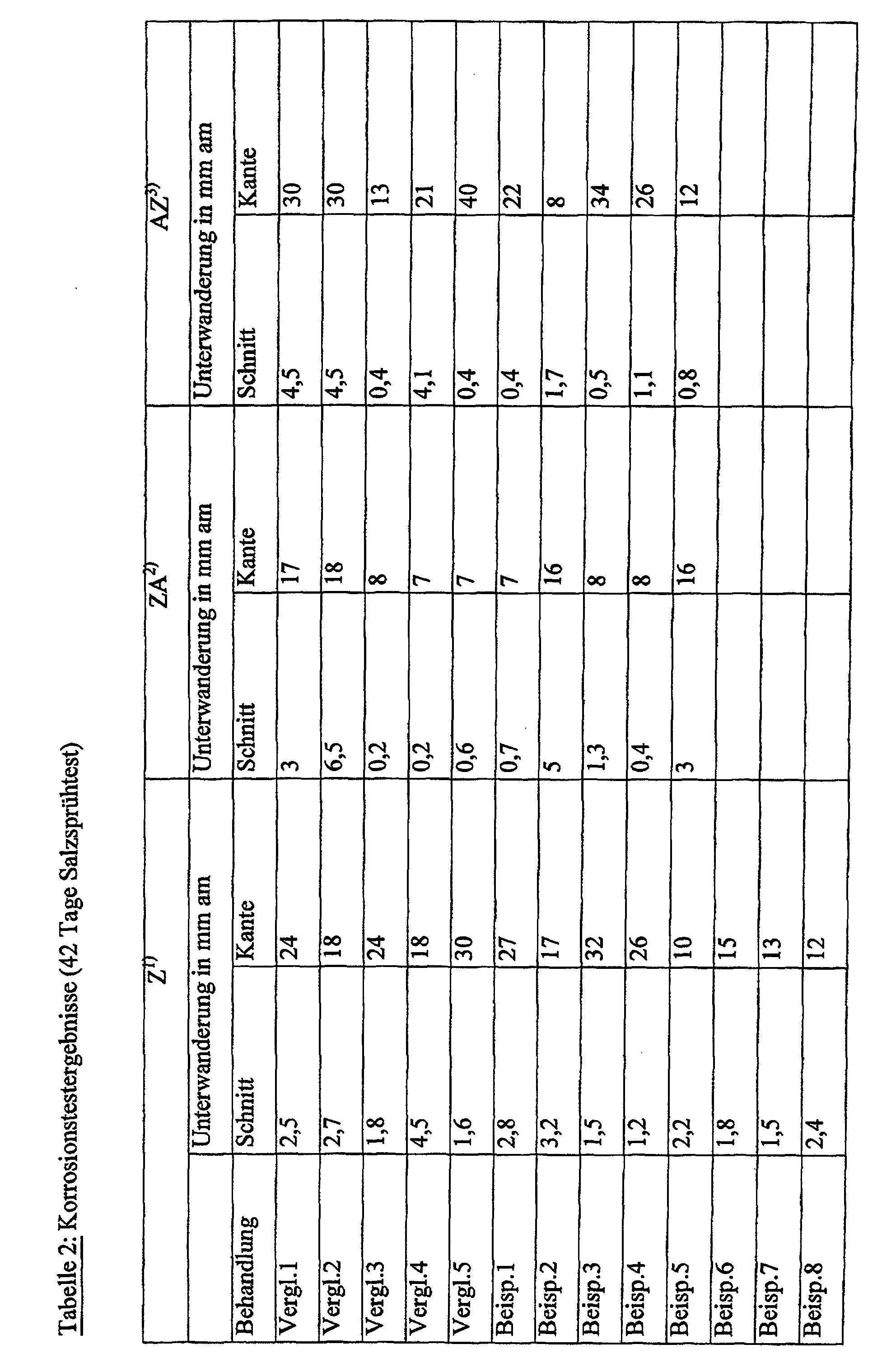
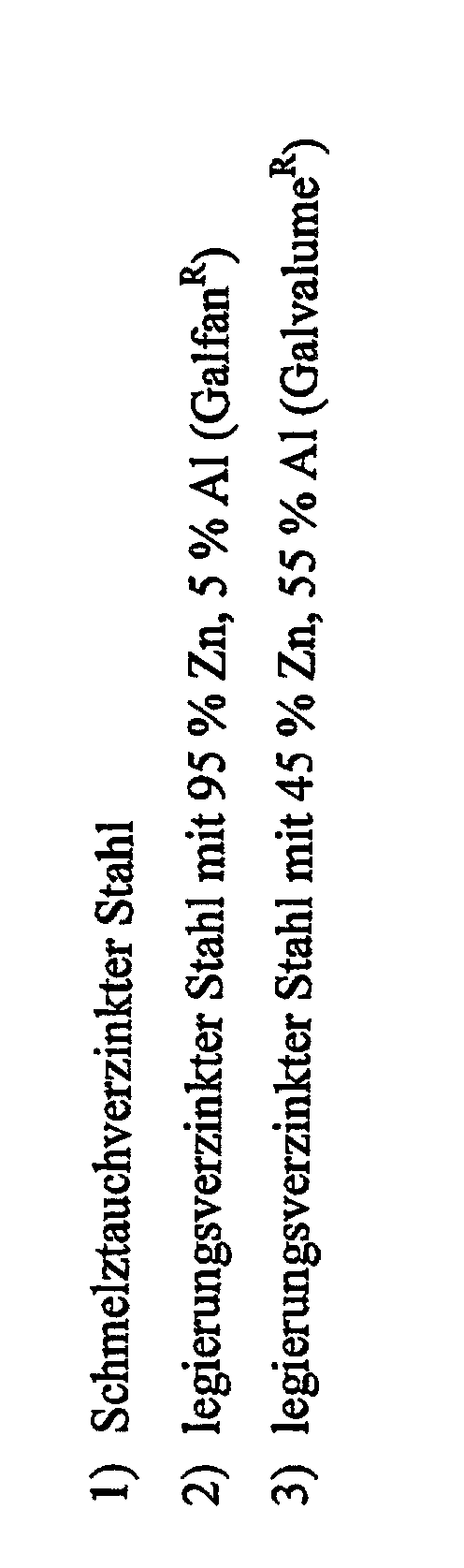
- the galvanized and alloy-galvanized steel sheets listed in Table 2 were alkaline passivated according to Table 1, rinsed for 5 seconds with water, re-passivated with chrome-containing or chrome-free rinse solutions (treatment time: 5 seconds spraying), rinsed for 2 seconds with deionized water and in a circulating air Drying cabinet dried at a cabinet temperature of 70 ° C.
- 5 ⁇ m primer and 18 ⁇ m top coat, each based on polyester, were applied and baked at 216 and 249 ° C, respectively.
- test panels were then subjected to a 42-day salt spray test in accordance with the German standard DIN 50 021 SS.
- the results (paint infiltration in mm at the cut or at the edge) are shown in Table 2.
- the paint adhesion was examined after a T-Bend test. There were no significant differences between the method according to the invention and the nickel and / or cobalt-containing comparison methods.
Landscapes
- Chemical & Material Sciences (AREA)
- General Chemical & Material Sciences (AREA)
- Chemical Kinetics & Catalysis (AREA)
- Engineering & Computer Science (AREA)
- Materials Engineering (AREA)
- Mechanical Engineering (AREA)
- Metallurgy (AREA)
- Organic Chemistry (AREA)
- Chemical Treatment Of Metals (AREA)
- Preventing Corrosion Or Incrustation Of Metals (AREA)
Abstract
Description

Claims (7)
- Verfahren zur alkalischen Passivierung von verzinkten und legierungsverzinkten Stahloberflächen sowie von Aluminium oder Aluminiumlegierungen, die zu mehr als 50 Gew.-% Aluminium enthalten, in Bandanlagen, wobei man die Metalloberflächen mit einer alkalischen, komplexbildner- und eisenhaltigen wäßrigen Lösung in Kontakt bringt, die frei ist von zugesetzten Nickel- und Cobaltionen und dieeine freie Alkalität im Bereich von 5 bis 20 Punkten undeine Gesamtalkalität im Bereich von 7 bis 30 Punkten aufweist und0,1 bis 1 g/l Magnesiumionen,0,1 bis 1 g/l Eisen(III)ionen und0,5 bis 5 g/l Amino- oder Hydroxycarboxylationen enthält.
- Verfahren nach Anspruch 1, dadurch gekennzeichnet, daß die wäßrige Lösung zusätzlich 0,001 bis 20 g/l pyrogene Kieselsäure enthält.
- Verfahren nach einem oder beiden der Ansprüche 1 und 2, dadurch gekennzeichnet, daß die wäßrige Lösung zusätzlich insgesamt 0,001 bis 10 g/l Acrylat- und/oder Methacrylationen enthält.
- Verfahren nach einem oder mehreren der Ansprüche 1 bis 3, dadurch gekennzeichnet, daß die Hydroxycarboxylationen ausgewählt sind aus Gluconationen und Glucoheptanationen.
- Verfahren nach einem oder mehreren der Ansprüche 1 bis 4, dadurch gekennzeichnet, daß die Metalloberflächen für eine Zeitdauer im Bereich von 3 bis 30 Sekunden mit der wäßrigen Behandlungslösung in Kontakt gebracht werden, die eine Temperatur im Bereich von 40 bis 70 °C aufweist.
- Verfahren nach einem oder mehreren der Ansprüche 1 bis 5, dadurch gekennzeichnet, man die Metalloberflächen nach dem Kontakt mit der wäßrigen Behandlungslösung mit Wasser abspült und anschließend mit einer chromfreien Nachpassivierungslösung behandelt, die insgesamt 0,4 bis 10 g/l komplexe Fluoride von Titan und/oder Zirkonium enthält.
- Wäßriges Konzentrat, das beim Verdünnen mit Wasser um einen Faktor im Bereich von 7 bis 15 eine wäßrige Behandlungslösung zur alkalischen Passivierung von verzinkten und legierungsverzinkten Stahloberflächen sowie von Aluminium oder Aluminiumlegierungen, die zu mehr als 50 Gew.-% Aluminium enthalten, in Bandanlagen ergibt, die frei ist von zugesetzten Nickel- und Cobaltionen und dieeine freie Alkalität im Bereich von 5 bis 20 Punkten undeine Gesamtalkalität im Bereich von 7 bis 30 Punkten aufweist und0,1 bis 1 g/l Magnesiumionen,0,1 bis 1 g/l Eisen(III)ionen und0,5 bis 5 g/l Amino- oder Hydroxycarboxylationen enthält.
Applications Claiming Priority (3)
| Application Number | Priority Date | Filing Date | Title |
|---|---|---|---|
| DE19733972 | 1997-08-06 | ||
| DE19733972A DE19733972A1 (de) | 1997-08-06 | 1997-08-06 | Alkalische Bandpassivierung |
| PCT/EP1998/004670 WO1999007917A1 (de) | 1997-08-06 | 1998-07-25 | Alkalische bandpassivierung |
Publications (2)
| Publication Number | Publication Date |
|---|---|
| EP1002143A1 EP1002143A1 (de) | 2000-05-24 |
| EP1002143B1 true EP1002143B1 (de) | 2002-04-03 |
Family
ID=7838122
Family Applications (1)
| Application Number | Title | Priority Date | Filing Date |
|---|---|---|---|
| EP98942626A Expired - Lifetime EP1002143B1 (de) | 1997-08-06 | 1998-07-25 | Alkalische bandpassivierung |
Country Status (9)
| Country | Link |
|---|---|
| US (1) | US6346295B1 (de) |
| EP (1) | EP1002143B1 (de) |
| AR (1) | AR015142A1 (de) |
| AU (1) | AU730256B2 (de) |
| CA (1) | CA2300275A1 (de) |
| DE (2) | DE19733972A1 (de) |
| ES (1) | ES2175763T3 (de) |
| WO (1) | WO1999007917A1 (de) |
| ZA (1) | ZA987032B (de) |
Cited By (1)
| Publication number | Priority date | Publication date | Assignee | Title |
|---|---|---|---|---|
| DE102005045034A1 (de) * | 2005-09-21 | 2007-03-29 | Rasselstein Gmbh | Verfahren zur Passivierung der Oberfläche von beschichteten Metallbändern und Vorrichtung für das Aufbringen der Passivschicht auf ein metallisch beschichtetes Stahlband |
Families Citing this family (16)
| Publication number | Priority date | Publication date | Assignee | Title |
|---|---|---|---|---|
| DE102007006450A1 (de) * | 2007-02-05 | 2008-08-07 | Henkel Ag & Co. Kgaa | Verfahren zur Gewinnung von entsalztem Wasser aus Zirkoniumhaltigem Spülwasser |
| DE102007021364A1 (de) * | 2007-05-04 | 2008-11-06 | Henkel Ag & Co. Kgaa | Metallisierende Vorbehandlung von Zinkoberflächen |
| DE102010001686A1 (de) | 2010-02-09 | 2011-08-11 | Henkel AG & Co. KGaA, 40589 | Zusammensetzung für die alkalische Passivierung von Zinkoberflächen |
| MX361013B (es) * | 2011-02-08 | 2018-11-26 | Henkel Ag & Co Kgaa | Procesos y composiciones para mejorar el desempeño anti-corrosión de superficies de zinc pretratadas con óxido de zirconio. |
| EP2503025B1 (de) * | 2011-03-22 | 2013-07-03 | Henkel AG & Co. KGaA | Mehrstufige korrosionsschützende Behandlung metallischer Bauteile, die zumindest teilweise Oberflächen von Zink oder Zinklegierungen aufweisen |
| EP2532769A1 (de) * | 2011-06-10 | 2012-12-12 | Amcor Flexibles Kreuzlingen Ltd. | Verfahren zur Herstellung von Chrom-frei Konversionsschicht auf einer Oberfläche von Aluminium- oder Aluminiumlegierungsband |
| MX353928B (es) | 2011-10-24 | 2018-02-06 | Chemetall Gmbh | Metodo para recubrir superficies metalicas con una composicion acuosa con multiples componentes. |
| DE102012000414B4 (de) | 2012-01-12 | 2014-03-20 | Thyssenkrupp Rasselstein Gmbh | Verfahren zur Passivierung von Weißblech, sowie verzinntes Stahlband oder -blech |
| EP2631333A1 (de) | 2012-02-24 | 2013-08-28 | Henkel AG & Co. KGaA | Vorbehandlung von Zinkoberflächen vor einer Passivierung |
| DE102012215679A1 (de) * | 2012-09-04 | 2014-05-15 | Henkel Ag & Co. Kgaa | Verfahren zur korrosionsschützenden Oberflächenbehandlung von metallischen Bauteilen in Serie |
| EP3569734A1 (de) | 2018-05-18 | 2019-11-20 | Henkel AG & Co. KGaA | Passivierungszusammensetzung auf basis von dreiwertigem chrom |
| FI3663435T3 (fi) | 2018-12-05 | 2024-05-24 | Henkel Ag & Co Kgaa | Fosfori- ja fosfonihappojen seoksiin perustuva passivointikoostumus |
| WO2021139955A1 (en) | 2020-01-06 | 2021-07-15 | Henkel Ag & Co. Kgaa | Passivation composition suitable for inner surfaces of zinc coated steel tanks storing hydrocarbons |
| EP4274865B1 (de) | 2021-01-06 | 2024-12-11 | Henkel AG & Co. KGaA | Verbesserte cr(iii)-basierte passivierung für zink-aluminium-beschichteten stahl |
| GB2603194A (en) | 2021-02-01 | 2022-08-03 | Henkel Ag & Co Kgaa | Improved cr(iii) based dry-in-place coating composition for zinc coated steel |
| CN119411113A (zh) * | 2024-11-01 | 2025-02-11 | 凯密特尔有限责任公司 | 一种金属卷材表面预处理用的含水碱性组合物及其用途 |
Family Cites Families (12)
| Publication number | Priority date | Publication date | Assignee | Title |
|---|---|---|---|---|
| SE316668B (de) * | 1963-09-23 | 1969-10-27 | Parker Ste Continentale | |
| US3349043A (en) * | 1966-01-19 | 1967-10-24 | Manning Dev Corp | Methods and compositions for controlling oxidation of metal surfaces |
| US3444007A (en) * | 1967-03-13 | 1969-05-13 | Hooker Chemical Corp | Process of forming paint-base coatings on zinc and zinc alloy surfaces |
| US3895970A (en) * | 1973-06-11 | 1975-07-22 | Pennwalt Corp | Sealing rinse for phosphate coatings of metal |
| GB8608508D0 (en) * | 1986-04-08 | 1986-05-14 | Pyrene Chemical Services Ltd | Coating metal surfaces |
| JPH0331484A (ja) | 1989-06-27 | 1991-02-12 | Nippon Parkerizing Co Ltd | 亜鉛または亜鉛系メッキ材料の黒色化処理法 |
| US5294266A (en) | 1989-07-28 | 1994-03-15 | Metallgesellschaft Aktiengesellschaft | Process for a passivating postrinsing of conversion layers |
| DE4017186A1 (de) * | 1990-05-29 | 1991-12-05 | Metallgesellschaft Ag | Erzeugung von konversionsueberzuegen auf zink- oder zinklegierungsoberflaechen |
| FR2654440B1 (fr) * | 1989-11-16 | 1993-07-30 | Produits Ind Cie Fse | Procede de conversion chimique de substrats metalliques, bain mis en óoeuvre dans ce procede et concentre pour la preparation du bain. |
| DE3938087A1 (de) | 1989-11-16 | 1991-05-23 | Madeker Heinz | Schuh-haft-sohle als zusatzsohle fuer strassenschuhe im innenbereich |
| DE4317217A1 (de) * | 1993-05-24 | 1994-12-01 | Henkel Kgaa | Chromfreie Konversionsbehandlung von Aluminium |
| US5531820A (en) * | 1993-08-13 | 1996-07-02 | Brent America, Inc. | Composition and method for treatment of phosphated metal surfaces |
-
1997
- 1997-08-06 DE DE19733972A patent/DE19733972A1/de not_active Withdrawn
-
1998
- 1998-07-25 ES ES98942626T patent/ES2175763T3/es not_active Expired - Lifetime
- 1998-07-25 CA CA002300275A patent/CA2300275A1/en not_active Abandoned
- 1998-07-25 WO PCT/EP1998/004670 patent/WO1999007917A1/de not_active Ceased
- 1998-07-25 AU AU90693/98A patent/AU730256B2/en not_active Ceased
- 1998-07-25 US US09/485,275 patent/US6346295B1/en not_active Expired - Fee Related
- 1998-07-25 EP EP98942626A patent/EP1002143B1/de not_active Expired - Lifetime
- 1998-07-25 DE DE59803640T patent/DE59803640D1/de not_active Expired - Fee Related
- 1998-08-05 ZA ZA987032A patent/ZA987032B/xx unknown
- 1998-08-05 AR ARP980103868A patent/AR015142A1/es unknown
Cited By (1)
| Publication number | Priority date | Publication date | Assignee | Title |
|---|---|---|---|---|
| DE102005045034A1 (de) * | 2005-09-21 | 2007-03-29 | Rasselstein Gmbh | Verfahren zur Passivierung der Oberfläche von beschichteten Metallbändern und Vorrichtung für das Aufbringen der Passivschicht auf ein metallisch beschichtetes Stahlband |
Also Published As
| Publication number | Publication date |
|---|---|
| ZA987032B (en) | 1999-02-08 |
| EP1002143A1 (de) | 2000-05-24 |
| DE59803640D1 (de) | 2002-05-08 |
| AR015142A1 (es) | 2001-04-18 |
| AU730256B2 (en) | 2001-03-01 |
| WO1999007917A1 (de) | 1999-02-18 |
| US6346295B1 (en) | 2002-02-12 |
| AU9069398A (en) | 1999-03-01 |
| DE19733972A1 (de) | 1999-02-11 |
| ES2175763T3 (es) | 2002-11-16 |
| CA2300275A1 (en) | 1999-02-18 |
Similar Documents
| Publication | Publication Date | Title |
|---|---|---|
| DE69503069T2 (de) | Zinkphosphaturlösung enthaltend oxim als beschleuniger | |
| DE102008014465B4 (de) | Mittel zur optimierten Passivierung auf Ti-/Zr-Basis für Metalloberflächen und Verfahren zur Konversionsbehandlung | |
| DE69012665T2 (de) | Verfahren zur Bildung eines Zinkphosphatfilmes auf einer Metallfläche. | |
| DE69116111T2 (de) | Chromfreie Abschlussspülung für phosphatiertes Metall | |
| DE19733972A1 (de) | Alkalische Bandpassivierung | |
| EP2507408B1 (de) | Mehrstufiges vorbehandlungsverfahren für metallische bauteile mit zink- und eisenoberflächen | |
| EP0056881B1 (de) | Verfahren zur Phosphatierung von Metallen | |
| DE102005059314A1 (de) | Verfahren und Produkt zur Korrosionsschutzbehandlung von Metalloberflächen, insbesondere von Stahloberflächen | |
| DE1184588B (de) | Verfahren und Loesung zum Aufbringen von festhaftenden UEberzuegen aus Polyvinylphosphonsaeure auf Metallteilen | |
| DE3629382A1 (de) | Verfahren zur erzeugung von konversionsschichten auf zink und/oder zinklegierungen | |
| WO2001059181A2 (de) | Korrosionsschutzmittel und korrosionsschutzverfahren für metalloberflächen | |
| EP0796356B1 (de) | Verfahren zum aufbringen von phosphatüberzügen auf metalloberflächen | |
| EP0328908B1 (de) | Verfahren zum Aufbringen von Konversionsüberzügen | |
| DE69423647T2 (de) | Zusammensetzung und verfahren zur behandlung von magnesiumenthaltenden metallen und daraus hergestelltes produkt | |
| DE2100021A1 (de) | Verfahren zum Aufbringen von Phos phatschichten auf Stahl, Eisen und Zinkoberflachen | |
| EP4073289A1 (de) | Verfahren zum herstellen eines stahlflachprodukts mit einer metallischen schutzschicht auf basis von zink und einer auf einer oberfläche der metallischen schutzschicht erzeugten phosphatierschicht und derartiges stahlflachprodukt | |
| DE3631667A1 (de) | Schichtbildende passivierung bei multimetall-verfahren | |
| DE4041091A1 (de) | Verfahren zur nachspuelung von konversionsschichten | |
| DE3245411C2 (de) | ||
| DE3875459T2 (de) | Verfahren zum phosphatieren von metalloberflaechen. | |
| WO1999024638A1 (de) | Korrosionsschutz von verzinkten und legierungsverzinkten stahlbändern | |
| EP0209143B1 (de) | Verfahren zur Oberflächenbehandlung von mit einer Zink/Aluminium-Legierung versehenem Stahlblech | |
| EP0459549B1 (de) | Erzeugung von Konversionsüberzügen auf Zink- oder Zinklegierungsoberflächen | |
| DE2521737C3 (de) | Verfahren und Lösung zum Phosphatieren von Eisen- und Stahloberflächen | |
| DE102012017438A1 (de) | Behandlungslösung und Verfahren zur Beschichtung von Metalloberflächen |
Legal Events
| Date | Code | Title | Description |
|---|---|---|---|
| PUAI | Public reference made under article 153(3) epc to a published international application that has entered the european phase |
Free format text: ORIGINAL CODE: 0009012 |
|
| 17P | Request for examination filed |
Effective date: 20000129 |
|
| AK | Designated contracting states |
Kind code of ref document: A1 Designated state(s): BE DE ES FR GB IT SE |
|
| 17Q | First examination report despatched |
Effective date: 20010205 |
|
| GRAG | Despatch of communication of intention to grant |
Free format text: ORIGINAL CODE: EPIDOS AGRA |
|
| GRAG | Despatch of communication of intention to grant |
Free format text: ORIGINAL CODE: EPIDOS AGRA |
|
| GRAH | Despatch of communication of intention to grant a patent |
Free format text: ORIGINAL CODE: EPIDOS IGRA |
|
| GRAH | Despatch of communication of intention to grant a patent |
Free format text: ORIGINAL CODE: EPIDOS IGRA |
|
| REG | Reference to a national code |
Ref country code: GB Ref legal event code: IF02 |
|
| GRAA | (expected) grant |
Free format text: ORIGINAL CODE: 0009210 |
|
| AK | Designated contracting states |
Kind code of ref document: B1 Designated state(s): BE DE ES FR GB IT SE |
|
| REF | Corresponds to: |
Ref document number: 59803640 Country of ref document: DE Date of ref document: 20020508 |
|
| ET | Fr: translation filed | ||
| GBT | Gb: translation of ep patent filed (gb section 77(6)(a)/1977) |
Effective date: 20020806 |
|
| REG | Reference to a national code |
Ref country code: ES Ref legal event code: FG2A Ref document number: 2175763 Country of ref document: ES Kind code of ref document: T3 |
|
| PLBE | No opposition filed within time limit |
Free format text: ORIGINAL CODE: 0009261 |
|
| STAA | Information on the status of an ep patent application or granted ep patent |
Free format text: STATUS: NO OPPOSITION FILED WITHIN TIME LIMIT |
|
| 26N | No opposition filed |
Effective date: 20030106 |
|
| PGFP | Annual fee paid to national office [announced via postgrant information from national office to epo] |
Ref country code: SE Payment date: 20040706 Year of fee payment: 7 |
|
| PGFP | Annual fee paid to national office [announced via postgrant information from national office to epo] |
Ref country code: FR Payment date: 20040708 Year of fee payment: 7 |
|
| PGFP | Annual fee paid to national office [announced via postgrant information from national office to epo] |
Ref country code: ES Payment date: 20040719 Year of fee payment: 7 |
|
| PGFP | Annual fee paid to national office [announced via postgrant information from national office to epo] |
Ref country code: GB Payment date: 20040721 Year of fee payment: 7 |
|
| PGFP | Annual fee paid to national office [announced via postgrant information from national office to epo] |
Ref country code: DE Payment date: 20040806 Year of fee payment: 7 |
|
| PGFP | Annual fee paid to national office [announced via postgrant information from national office to epo] |
Ref country code: BE Payment date: 20040910 Year of fee payment: 7 |
|
| PG25 | Lapsed in a contracting state [announced via postgrant information from national office to epo] |
Ref country code: IT Free format text: LAPSE BECAUSE OF NON-PAYMENT OF DUE FEES;WARNING: LAPSES OF ITALIAN PATENTS WITH EFFECTIVE DATE BEFORE 2007 MAY HAVE OCCURRED AT ANY TIME BEFORE 2007. THE CORRECT EFFECTIVE DATE MAY BE DIFFERENT FROM THE ONE RECORDED. Effective date: 20050725 Ref country code: GB Free format text: LAPSE BECAUSE OF NON-PAYMENT OF DUE FEES Effective date: 20050725 |
|
| PG25 | Lapsed in a contracting state [announced via postgrant information from national office to epo] |
Ref country code: SE Free format text: LAPSE BECAUSE OF NON-PAYMENT OF DUE FEES Effective date: 20050726 Ref country code: ES Free format text: LAPSE BECAUSE OF NON-PAYMENT OF DUE FEES Effective date: 20050726 |
|
| PG25 | Lapsed in a contracting state [announced via postgrant information from national office to epo] |
Ref country code: BE Free format text: LAPSE BECAUSE OF NON-PAYMENT OF DUE FEES Effective date: 20050731 |
|
| PG25 | Lapsed in a contracting state [announced via postgrant information from national office to epo] |
Ref country code: DE Free format text: LAPSE BECAUSE OF NON-PAYMENT OF DUE FEES Effective date: 20060201 |
|
| EUG | Se: european patent has lapsed | ||
| GBPC | Gb: european patent ceased through non-payment of renewal fee |
Effective date: 20050725 |
|
| PG25 | Lapsed in a contracting state [announced via postgrant information from national office to epo] |
Ref country code: FR Free format text: LAPSE BECAUSE OF NON-PAYMENT OF DUE FEES Effective date: 20060331 |
|
| REG | Reference to a national code |
Ref country code: FR Ref legal event code: ST Effective date: 20060331 |
|
| REG | Reference to a national code |
Ref country code: ES Ref legal event code: FD2A Effective date: 20050726 |
|
| BERE | Be: lapsed |
Owner name: *HENKEL K.G.A.A. Effective date: 20050731 |