EP1003126A2 - Système d'identification optique d'un objet - Google Patents
Système d'identification optique d'un objet Download PDFInfo
- Publication number
- EP1003126A2 EP1003126A2 EP99309101A EP99309101A EP1003126A2 EP 1003126 A2 EP1003126 A2 EP 1003126A2 EP 99309101 A EP99309101 A EP 99309101A EP 99309101 A EP99309101 A EP 99309101A EP 1003126 A2 EP1003126 A2 EP 1003126A2
- Authority
- EP
- European Patent Office
- Prior art keywords
- light
- light receiving
- diffraction grating
- receiving unit
- polarizing filter
- Prior art date
- Legal status (The legal status is an assumption and is not a legal conclusion. Google has not performed a legal analysis and makes no representation as to the accuracy of the status listed.)
- Granted
Links
Images





Classifications
-
- B—PERFORMING OPERATIONS; TRANSPORTING
- B42—BOOKBINDING; ALBUMS; FILES; SPECIAL PRINTED MATTER
- B42D—BOOKS; BOOK COVERS; LOOSE LEAVES; PRINTED MATTER CHARACTERISED BY IDENTIFICATION OR SECURITY FEATURES; PRINTED MATTER OF SPECIAL FORMAT OR STYLE NOT OTHERWISE PROVIDED FOR; DEVICES FOR USE THEREWITH AND NOT OTHERWISE PROVIDED FOR; MOVABLE-STRIP WRITING OR READING APPARATUS
- B42D25/00—Information-bearing cards or sheet-like structures characterised by identification or security features; Manufacture thereof
- B42D25/30—Identification or security features, e.g. for preventing forgery
- B42D25/328—Diffraction gratings; Holograms
-
- B—PERFORMING OPERATIONS; TRANSPORTING
- B42—BOOKBINDING; ALBUMS; FILES; SPECIAL PRINTED MATTER
- B42D—BOOKS; BOOK COVERS; LOOSE LEAVES; PRINTED MATTER CHARACTERISED BY IDENTIFICATION OR SECURITY FEATURES; PRINTED MATTER OF SPECIAL FORMAT OR STYLE NOT OTHERWISE PROVIDED FOR; DEVICES FOR USE THEREWITH AND NOT OTHERWISE PROVIDED FOR; MOVABLE-STRIP WRITING OR READING APPARATUS
- B42D25/00—Information-bearing cards or sheet-like structures characterised by identification or security features; Manufacture thereof
-
- B—PERFORMING OPERATIONS; TRANSPORTING
- B42—BOOKBINDING; ALBUMS; FILES; SPECIAL PRINTED MATTER
- B42D—BOOKS; BOOK COVERS; LOOSE LEAVES; PRINTED MATTER CHARACTERISED BY IDENTIFICATION OR SECURITY FEATURES; PRINTED MATTER OF SPECIAL FORMAT OR STYLE NOT OTHERWISE PROVIDED FOR; DEVICES FOR USE THEREWITH AND NOT OTHERWISE PROVIDED FOR; MOVABLE-STRIP WRITING OR READING APPARATUS
- B42D25/00—Information-bearing cards or sheet-like structures characterised by identification or security features; Manufacture thereof
- B42D25/30—Identification or security features, e.g. for preventing forgery
- B42D25/36—Identification or security features, e.g. for preventing forgery comprising special materials
- B42D25/364—Liquid crystals
-
- G—PHYSICS
- G06—COMPUTING OR CALCULATING; COUNTING
- G06K—GRAPHICAL DATA READING; PRESENTATION OF DATA; RECORD CARRIERS; HANDLING RECORD CARRIERS
- G06K19/00—Record carriers for use with machines and with at least a part designed to carry digital markings
- G06K19/06—Record carriers for use with machines and with at least a part designed to carry digital markings characterised by the kind of the digital marking, e.g. shape, nature, code
- G06K19/08—Record carriers for use with machines and with at least a part designed to carry digital markings characterised by the kind of the digital marking, e.g. shape, nature, code using markings of different kinds or more than one marking of the same kind in the same record carrier, e.g. one marking being sensed by optical and the other by magnetic means
- G06K19/10—Record carriers for use with machines and with at least a part designed to carry digital markings characterised by the kind of the digital marking, e.g. shape, nature, code using markings of different kinds or more than one marking of the same kind in the same record carrier, e.g. one marking being sensed by optical and the other by magnetic means at least one kind of marking being used for authentication, e.g. of credit or identity cards
- G06K19/16—Record carriers for use with machines and with at least a part designed to carry digital markings characterised by the kind of the digital marking, e.g. shape, nature, code using markings of different kinds or more than one marking of the same kind in the same record carrier, e.g. one marking being sensed by optical and the other by magnetic means at least one kind of marking being used for authentication, e.g. of credit or identity cards the marking being a hologram or diffraction grating
-
- G—PHYSICS
- G06—COMPUTING OR CALCULATING; COUNTING
- G06K—GRAPHICAL DATA READING; PRESENTATION OF DATA; RECORD CARRIERS; HANDLING RECORD CARRIERS
- G06K7/00—Methods or arrangements for sensing record carriers, e.g. for reading patterns
- G06K7/10—Methods or arrangements for sensing record carriers, e.g. for reading patterns by electromagnetic radiation, e.g. optical sensing; by corpuscular radiation
- G06K7/12—Methods or arrangements for sensing record carriers, e.g. for reading patterns by electromagnetic radiation, e.g. optical sensing; by corpuscular radiation using a selected wavelength, e.g. to sense red marks and ignore blue marks
-
- B42D2033/26—
Definitions
- the present invention relates to a system for preventing forgery of two-dimensional and three-dimensional objects such as passports, cards, security notes, gift certificates, pictures, public transportation tickets, and betting tickets, and in particular to a system for verifying the authenticity of an object by optically and mechanically recognizing a security medium affixed to the object.
- Cholesteric liquid crystals normally have a layered structure, and the axial directions of the molecules in each layer are parallel to each other as well to the plane of each layer. Each layer is slightly twisted relative to the adjacent layer so that a three-dimensional spiral structure is produced.
- the left-handed circularly polarized component of the incident light having the wavelength of ⁇ is reflected while the right-handed circularly polarized component passes through.
- the light having any other wavelength passes through.
- a cholesteric liquid crystal material having a property to reflect red light having the wavelength of ⁇ R is placed on a material which absorbs light in the visible range, and a random light such as sunlight is radiated thereon, the transmitted light is all absorbed, and only a left-handed circularly polarized light having the wavelength of ⁇ R is reflected.
- Japanese patent laid-open publication (kokai) No. 4-144796 discloses a system in which random light is radiated upon a cholesteric liquid crystal layer, and the reflected circularly polarized light is passed through a band pass filter and a quarter-wave plate to convert the incident light into a linearly polarized light.
- the linearly polarized light is divided by a beam splitter, and a right-handed circularly polarized light or a left-handed circularly polarized light is detected by using a suitable polarizing plate.
- the hologram technology has become so readily available that illicit duplication of hologram which is hardly distinguishable from an authentic hologram can now be made without any significant difficulty.
- the hologram has become less effective in discouraging illicit duplication.
- a light beam diffracted by a hologram or diffraction grating is typically detected by comparing its intensity with the intensity of a light beam obtained elsewhere and determining if the difference is greater than a prescribed threshold level or not.
- an additional light receiving unit to be placed at a position other than that for the diffracted light beam, an increase in both size and cost was unavoidable. Also, any irregular reflection and/or insufficient reflection due to surface contamination could cause detection errors.
- a primary object of the present invention is to provide an optical identification system which is highly difficult to illicitly duplicate.
- a second object of the present invention is to provide an optical identification system which is capable of producing highly distinct results, and hence is highly reliable in use.
- a third object of the present invention is to provide an optical identification system which is economical enough to be affixed to inexpensive commercial goods.
- a fourth object of the present invention is to provide an optical identification system which uses durable identification media highly resistant to contamination.
- a system for optically identifying the authenticity of an object comprising: a diffraction grating affixed to an object, the diffraction grating comprising a high polymer cholesteric liquid crystal layer for a reflective layer of the diffraction grating; a light source for impinging an incident light beam onto the diffraction grating; a first light receiving unit placed at a position for receiving a diffracted light beam from the diffraction grating and providing an output signal; a circularly polarizing filter placed between the first light receiving unit and the diffraction grating; and a second tight receiving unit placed at a different position for receiving a diffracted light beam from the diffraction grating and providing a reference signal therefrom.
- the high polymer cholesteric liquid crystal provides an inexpensive identification medium, and the use of the second light receiving unit for providing a reference signal provides a high S/N output signal which is highly distinct and resistant to the contamination of the identification medium. Also, the elimination of the need for expensive optical elements such as beam splitters also contributes to the reduction of cost.
- distinct output signals can be obtained also by the use of a second pair of light receiving units placed at positions for receiving diffracted light beams from the diffraction grating, and a circularly polarizing filter of an opposite sense placed between only one of the second pair of light receiving units and the diffraction grating, or a pair of circularly polarizing filter of mutually opposite senses each placed between a corresponding one of the second pair of light receiving units and the diffraction grating, as the case may be.
- band pass filters also contributes to producing distinct outputs.
- the two pairs of light receiving units may be adapted to simultaneously receive diffracted light from a common spot in the diffraction grating.
- the security of the system can be also enhanced by placing an additional circularly polarizing filter between the light source and the diffraction grating.
- the diffraction grating may comprises small regions having at least two different diffractive properties, the small regions being sized and distributed so that a plurality of regions including those of different diffractive properties may be simultaneously accessed by each of the light receiving units. This also enhances the security of the system.
- the high polymer cholesteric liquid crystal material used for the present invention should be capable of retaining a shape as a solid substance, and should have a molecular weight which is required to be used as a reflective layer in a hologram or diffraction grating.
- the high polymer cholesteric liquid crystal material has an optical property which is highly stable when exposed to a magnetic field, electric field and temperature, as opposed to the low polymer cholesteric liquid crystal material.
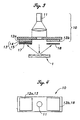
- FIG. 1 is a perspective view of an identification system embodying the present invention which comprises a hologram foil 1 serving as an identification medium 1 and an identification device 10.
- the hologram foil 1 may be affixed to a selected location, two or more locations or the entire surface of an object X such as a card, passport, security note or gift certificate, by a hot stamping process.
- the hot stamping process consists of transferring an ornamental film onto the surface of an article with an instantaneous application of heat and pressure.
- the hologram foil 1 is formed by laminating a bonding layer 2 for the surface of an object X, a high-polymer cholesteric liquid crystal layer 3 serving as a reflective layer, a hologram forming layer 4 and a protective layer 5, and is adapted to be transferred onto the object X by the protective layer 5 serving as a peel layer separating it from a base film not shown in the drawing by heat and pressure during the hot stamping process.
- the identification device 10 is provided with a centrally located light source 11 for emitting a random light beam, and a pair of light receiving units 12a and 12b located at symmetric positions with respect to the light source 11.
- a circularly polarizing filter 13 consisting of a polarizing filter 14 and a quarter-wave plate 15 is placed between the hologram foil 1 and one of the light receiving units 12a at the time of identification or only in front of one of the light receiving units 12a.
- a pair of band pass filters 17 are 18 for passing only light of a proscribed wavelength, for instance only green light, are placed in front of the circularly polarizing filter 13 of one of the light receiving units 12a and in front of the other light receiving unit 12b.
- band pass filters 17 and 18 are optional, and improve the identification performance particularly in environments where a light source of a special wavelength is employed or where noises of prescribed wavelengths are required to be eliminated.
- the two light receiving units 12a and 12b are adapted to individually detect the received light, and the output signals thereof are forwarded to a control unit 16 for processing these output signals (see Figure 1).
- the identification device 10 is stationary while the object X is transported in the direction indicated by the arrow in Figure 1 so that the identification device 10 may scan the hologram foil 1.
- the hologram foil 1 may also consist of diffraction grating, and the term "diffraction grating" as used in the claims of this application should be understood as covering hologram, diffraction grating and any other optical elements which demonstrate a selective reflective directivity produced by making use of optical diffraction.
- the grid lines extend perpendicularly to the direction of transportation or scanning so that the incident light directed perpendicularly to the foil surface is diffracted obliquely in the fore-and-aft direction of the scanning direction, and symmetrically with respect to the optical center line of the incident light beam.
- the light receiving units 12a and 12b are arranged along the scanning direction so as to capture the diffracted light beams.
- the direction of the grid lines of the hologram foil 1 as well as the positions of the light receiving units 12a and 12b can be arbitrarily selected as long as the light receiving units 12a and 12b are arranged so as to be symmetric to each other with respect to the light source 11 and to capture the diffracted light beams.
- the arrangement is such that the incident light beam impinging upon the hologram foil 1 from a perpendicular direction is diffracted laterally with respect to the scanning direction, it may be relatively easy to simulate the diffraction with other optical elements such as mirrors and prisms.
- the high polymer cholesteric liquid crystal layer 3 of the hologram foil 1 reflects only right-handed circularly polarized light, and the circularly polarizing filter 13 transmits only right-handed circularly polarized light while shutting off left-handed circularly polarized light.
- the high polymer cholesteric liquid crystal layer 3 of the hologram foil 1 likewise reflects only right-handed circularly polarized light, but the circularly polarizing filter 13 transmits only left-handed circularly polarized light while shutting off right-handed circularly polarized light.
- the mode of operation of these patterns is described in the following.
- the right and left senses in the circular polarization of the first and second patterns are mutually interchangeable, and description of such obvious variations is omitted.
- various other combinations of the right and left senses in the circular polarization of the first and second patterns should be understood as being included in the overall all concept and spirit of the present invention.
- the high polymer cholesteric liquid crystal layer 3 of the hologram foil 1 reflects only right-handed circularly polarized light, and the circularly polarizing filter 13 transmits only right-handed circularly polarized light while shutting off left-handed circularly polarized light, as the object X is transported and the hologram foil 1 is scanned, because the light diffracted onto the light receiving unit 12a is not prevented, the intensity A of the light received by the light receiving unit 12a is substantially equal to the intensity B of the light received by the other light receiving unit 12b (A/B ⁇ 1).
- the intensity A of the light received by the light receiving unit 12a is only about one half the intensity B of the light received by the other light receiving unit 12b (A/B ⁇ 1/2). Therefore, the authenticity of the object can be readily determined.
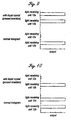
- the intensities of the light received by the light receiving units 12a and 12b in this case are indicated in Figure 5. Obviously, when the light is reflected by normal optical elements, the reflected light would not be normally received by the light receiving units 12a and 12b.
- the high polymer cholesteric liquid crystal layer 3 of the hologram foil 1 likewise reflects only right-handed circularly polarized light, but the circularly polarizing filter 13 transmits only left-handed circularly polarized light while shutting off right-handed circularly polarized light; as the object X is transported and the hologram foil 1 is scanned, because the light diffracted onto the light receiving unit 12a is shut off, the intensity A of the light received by the light receiving unit 12a is significantly smaller than the intensity B of the light received by the other light receiving unit 12b (A/B ⁇ 0)as shown in the graph of Figure 6.
- the intensity A of the light received by the light receiving unit 12a is only about one half the intensity B of the light received by the other light receiving unit 12b (A/B ⁇ 1/2).
- the intensities of the light received by the light receiving units 12a and12b in this case are also indicated in Figure 6. Therefore, the authenticity of the object can be readily determined.
- the circularly polarizing filter was provided on only one of each pair of light receiving units in the above described embodiments but it is also possible to provide circularly polarizing filters of opposite senses on corresponding ones of each pair of light receiving units and effect a similar identification process.
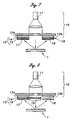
- the light receiving unit 12a is provided with a first circularly polarizing filter 13
- the other light receiving unit 12b is provided with a second circularly polarizing filter 16 of an opposite sense.
- the circularly polarizing filter 13 shuts of the left-handed circularly polarized light (first pattern) while the second circularly polarizing filter 16 placed in front of the light receiving unit 12b shuts of the right-handed circularly polarized light (second pattern).
- the intensity A of the light received by the light receiving unit 12a is significantly smaller than the intensity B of the light received by the other light receiving unit 12b (A/B ⁇ 0).
- a hologram or diffraction grating not provided with a high polymer cholesteric liquid crystal layer is used, because the right-handed circularly polarized light is shut off from the light receiving unit 12a, and the left-handed circularly polarized light is shut off from the light receiving units 12b so that the intensity A of the light received by the light receiving units 12a is substantially equal to the intensity B of the light received by the light receiving unit 12b (A/B ⁇ 1).
- the light source 11 may be turned into the right-handed circularly polarized light by placing a circularly polarizing filter 19, which transmits only the right-handed circularly polarized light, and shuts off the left-handed circularly polarized light, between the hologram foil land the light source 11.
- the intensity A of the light received by the light receiving unit 12a is substantially equal to the intensity B of the light received by the other light receiving unit 12b (A/B ⁇ 1).
- the circularly polarizing filter 19 consists of an integral extension of the circularly polarizing filter 13 for the first light receiving unit 12a.
- the hologram or diffraction grating When the hologram or diffraction grating is not provided with a high polymer cholesteric liquid crystal layer, because the diffraction grating converts the incident right-handed circularly polarized light into left-handed circularly polarized light, and the diffracted light directed to the light receiving unit 12a is therefore totally shut off, the intensity A of the light received by the light receiving unit 12a is significantly smaller than the intensity B of the light received by the other light receiving unit 12b (A/B ⁇ 0). Therefore, the authenticity of the object can be readily determined.
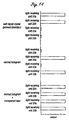
- the intensities of the light received by the light receiving units 12a and 12b in this case are indicated in Figure 9.
- the circularly polarizing filter 16 for the light source must be provided separately from the circularly polarizing filter 13 for the first light receiving unit 12a.
- the intensity A of the light received by the light receiving unit 12a is significantly smaller than the intensity B of the light received by the other light receiving unit 12b (A/B ⁇ 0).
- the intensity A of the light received by the light receiving unit 12a is substantially equal to the intensity B of the light received by the other light receiving unit 12b (A/B ⁇ 1). Therefore, the authenticity of the object can be readily determined.
- the intensities of the light received by the light receiving units 12a and 12b in this case are indicated in Figure 10.
- the output results of the first pattern and the second pattern are simply reversed.
- the light source consists of circularly polarized light, instead of random light, the difference between the outputs of the two light receiving units 12a and 12b is amplified, and the S/N ratio of the output is increased. Therefore, a more reliable detection is made possible without being interfered by contamination. The same is true with the following embodiments although exhaustive description of such combinations are omitted from description.
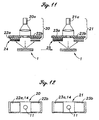
- Figures 11 and 12 show a fourth embodiment of the present invention.
- an identification device 20 based on the first pattern where only the right-handed circularly polarized light is transmitted while the left-handed circularly polarized light is shut off and another identification device 21 based on the second pattern where only the left-handed circularly polarized light is transmitted while the right-handed circularly polarized light is shut off are arranged in series along the scanning direction so that the identification action may occur sequentially.
- the two identification devices 20 and 21 in this case are provided with separate light sources 20a and 21a, respectively.
- the high polymer cholesteric liquid crystal layer 3 reflects only the right-handed circularly polarized light.
- the diffracted light directed to the light receiving unit 22a is not shut off by the circularly polarizing filter 24 so that the intensity A of the light received by the light receiving unit 22a is substantially equal to the intensity B of the light received by the other light receiving unit 22b (A/B ⁇ 1).
- the diffracted light directed to the light receiving unit 23a is totally shut off by the circularly polarizing filter 25 so that the intensity C of the light received by the light receiving unit 23a is significantly smaller than the intensity D of the light received by the other light receiving unit 23b (C/D ⁇ 0).
- the intensity A of the light received by the light receiving unit 22a is only about half the intensity B of the light received by the other light receiving unit 22b (A/B ⁇ 1/2) while the intensity C of the light received by the light receiving unit 23a is only about half the intensity D of the light received by the other light receiving unit 23b (C/D ⁇ 1/2).
- the authenticity of the object can be determined from these results.
- each of the grids of the diffraction grating is formed in the shape of a saw tooth so that one side of the saw tooth is parallel to the incident light and the other side is inclined, and the diffracted light may be substantially entirely directed to the light receiving units 22b and 23b.
- the intensity C of the light received by the light receiving unit 23a is significantly smaller than the intensity D of the light received by the other light receiving unit 23b (C/D ⁇ 0)
- the intensity A of the light received by the light receiving unit 22a is significantly smaller than the intensity B of the light received by the other light receiving unit 22b (A/B ⁇ 0) so that the determination of the authenticity of the hologram foil 1 can be readily accomplished.
- the hologram or diffraction grating is constructed in such a manner that the diffracted light may be substantially entirely directed to the light receiving unit 22a and 23a, even though the intensity A of the light received by the light receiving unit 22a is substantially equal to the intensity B of the light received by the other light receiving unit 22b (A/B ⁇ 1), because the intensity C of the light received by the light receiving unit 23a is also substantially equal to the intensity B of the light received by the other light receiving unit 23b (C/D ⁇ 1), the authenticity of the hologram foil 1 can be again readily determined.
- any one of the embodiments of the present invention can readily detect such an arrangement because of the use of the polarized light for identification.
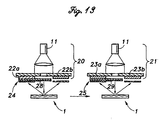
- Figure 13 shows a fifth embodiment of the present invention.
- a circularly polarizing filter 28 which transmits only the right-handed circularly polarized light while shutting off the left-handed circularly polarized light is interposed between the hologram foil 1 and the light source 20a of a first identification device 20 based on the first pattern where the circularly polarizing filter 24 transmits only the right-handed circularly polarized light, and shuts off the left-handed circularly polarized light.
- a circularly polarizing filter 29 which transmits only the left-handed circularly polarized light while shutting off the right-handed circularly polarized light is interposed between the hologram foil 1 and the light source 21a of a second identification device 21 based on the second pattern where the circularly polarizing filter 25 transmits only the left-handed circularly polarized light, and shuts off the right-handed circularly polarized light.
- the high polymer cholesteric liquid crystal layer 3 of the hologram foil 1 reflects only the right-handed circularly polarized light.
- the diffracted light directed to the light receiving unit 22a is not shut off by the circularly polarizing filter 24, and the intensity A of the light received by the light receiving unit 22a is substantially equal to the intensity B of the light received by the other light receiving unit 22b (A/B ⁇ 1).
- the other identification device 21 executes an identification process, because the light from the light source 21a consists only of the left-handed circularly polarized light, no diffracted light is emitted from the hologram foil 1, and the intensity C of the light received by the light receiving unit 23a and the intensity D of the light received by the other light receiving unit 23b are both substantially zero (C ⁇ 0, D ⁇ 0). The authenticity of the object can be readily determined from these results.
- the circularly polarizing filter 24 substantially shuts off the diffracted light directed to the light receiving unit 22a so that the intensity A of the light received by the light receiving unit 22a is significantly smaller than the intensity B of the light received by the other light receiving unit 22b (A/B ⁇ 0).
- the diffracted light directed to the light receiving unit 23a is substantially shut off by the circularly polarizing filter 25 so that the intensity C of the light received by the light receiving unit 23a is significantly smaller than the intensity D of the light received by the other light receiving unit 23b (C/D ⁇ 0).
- the authenticity of the object can be readily determined from these results.
- the S/N ratio of the output signal can be raised as mentioned earlier by using a light source for producing right-handed circularly polarized light.
- a transparent tape is affixed to the surface of the hologram or diffraction grating not provided with a high polymer cholesteric liquid crystal layer so as to produce a half-wave phase difference, because the diffracted light consists of right-handed circularly polarized light in the same way as the hologram or the diffraction grating is provided with a high polymer liquid crystal layer so that the output is not different from that would be obtained from the hologram foil 1 of the present invention.
- a plurality of identification devices having light sources of circularly polarized light of opposite senses are used, it is possible to detect a use of a plastic tape which causes a half-wave phase difference while maintaining a high S/N ratio.
- the intensity C of the light received by the light receiving unit 23a is substantially equal to the intensity D of the light received by the other light receiving unit 23b (C/D ⁇ 1).
- a pair of sensors having an identical structure are used in the above described embodiment and this is more economical than using a pair of sensors having different strictures.
- the identification process was sequentially executed by the first identification device 20 and the second identification device 21 with a certain time lag. Therefore, it is conceivable that an attempt may be made to deceive the identification system by changing the identification medium during the process. It can be avoided by a sixth embodiment illustrated in Figures 15 and 16 in which a pair of identification devices 20 and 21 are arranged in slanted orientations so that the incident light beam from each of the light sources 20a and 21a may be directed to the other light receiving unit, and the diffracted light beams may be simultaneously received by the light receiving units 22a, 22b, 23a and 23b of the other identification devices 20 and 21. This modification can be applied also to the embodiments described in the following.
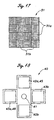
- Figure 17 is a plan view schematically illustrating the structure of the hologram foil 31 serving as the identification medium for a seventh embodiment of the present invention
- Figure 18 is a bottom view of an identification device 40 for this hologram foil 31.
- a large number of rectangular small regions 31a and 31b of two different diffractive directions but of a same diffractive angle are arranged in a checkerboard pattern in an alternate fashion. These regions 31a and 31b are small enough for a spot of the light beam from a light source 41 to simultaneously cover a large number of these regions.
- the grid lines of the diffraction grating of the regions 31a extend perpendicularly to the scanning direction so that the incident light beam impinging upon the hologram foil in a perpendicular direction diffracts obliquely upward in the fore-and-aft direction with respect to the scanning direction, and symmetrically with respect to the incident light beam.
- the grid lines of the diffraction grating of the other regions 31b extend in parallel with the scanning direction so that the incident light beam impinging upon the hologram foil in a perpendicular direction diffracts laterally and obliquely with respect to the scanning direction, and symmetrically with respect to the incident light beam.
- the high polymer cholesteric liquid crystal layer serving as the reflective layer of the hologram foil 31 likewise only reflects right-handed circularly polarized light.
- the identification device 40 is provided with two pairs of light receiving units 42a, 42b, 43a and 43b arranged in an orthogonal cross pattern centered around a light source 41.
- the light receiving units 42a and 42b are arranged along the scanning direction so as to receive the light diffracted from the regions 31a.
- the receiving units 43a and 43b are arranged perpendicular to the scanning direction so as to receive the light diffracted from the regions 31b.
- One of the paired light receiving units 42a is provided with a circularly polarizing filter 45 in front thereof so as to transmit only the right-handed circularly polarized light while shutting off the left-handed circularly polarized light (the first pattern).
- One of the other paired light receiving units 43a is provided with a circularly polarizing filter 46 in front thereof so as to transmit only the left-handed circularly polarized light while shutting off the right-handed circularly polarized light (the second pattern).
- the first paired light receiving units 42a and 42b receive right-handed circularly polarized light from the regions 31a. This light is not shut off by the circularly polarizing filter 45 so that the intensity A of the light received by the light receiving wilt 42a is substantially equal to the intensity B of the light received by the other light receiving unit 42b (A/B ⁇ 1).
- the second paired light receiving units 43a and 43b receive right-handed circularly polarized light from the regions 31b.
- This light is however totally shut off by the circularly polarizing filter 46 so that the intensity C of the light received by the light receiving unit 43a is significantly smaller than the intensity D of the light received by the other light receiving unit 43b (C/D ⁇ 0). The authenticity can be thus readily determined from these results.
- the intensities A and C of the light received by the light receiving units 42a and 43a are only about one half the intensities B and D of the light received by the other light receiving units 42b and 43b, respectively, (A/B ⁇ C/D ⁇ 1/2).
- the hologram or diffraction grating is not provided with a high polymer cholesteric liquid crystal layer, and the shape of the diffraction grating is selected such that the diffracted light is directed only to one of the paired light receiving units, either A/B or C/D is approximately 1/2, instead of the relationship of A/B ⁇ 1 between the intensities A and B of the light received by the light receiving units 42a and 42b, and C/D ⁇ 0 between the intensities C and D of the light received by the light receiving units 43a and 43b, respectively.
- the authenticity of the hologram foil 31 can be thus readily determined from these results.
- the directions of diffraction in the above described embodiment were directed in the scanning direction and the direction perpendicular thereto, but it is obvious that arbitrary directions can be used. Also, three or more directions of diffraction may be selected while the paired light receiving units are arranged accordingly.
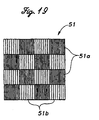
- Figure 19 is a plan view schematically illustrating the structure of the hologram foil 51 serving as the identification medium for an eighth embodiment of the present invention
- Figure 20 and 21 illustrate the identification device 60 for this hologram foil 51.
- a large number of rectangular small regions 51a and 51b of a same diffractive direction but of different diffractive angles or of different grid pitches are arranged in a checkerboard pattern in an alternate fashion. These regions 51a and 51b are small enough for a spot of the light beam form a light source 61 to simultaneously cover a large number of these regions.
- the grid lines of the diffraction grating of the regions 51a extend perpendicularly to the scanning direction, similarly as the regions 31a of the previous embodiment, so that the incident light beam impinging upon the hologram foil 51 in a perpendicular direction diffracts obliquely upward in the fore-and-aft direction with respect to the scanning direction, and symmetrically with respect to the incident light beam.
- the grid lines of the diffraction grating of the other regions 51b give rise to a same diffraction direction as the regions 51a, but are more widely spaced than the regions 51a so that the diffracted light is angularly directed further away from the incident light beam.
- the high polymer cholesteric liquid crystal layer serving as the reflective layer of the hologram foil 51 in this case likewise only reflects right-handed circularly polarized light.
- the identification device 60 is provided with a first pair of light receiving units 62a and 62b which are arranged along the scanning direction at mutually symmetric positions with respect to the light source 61 to receive the light diffracted from the regions 51a.
- a second pair of light receiving units 63a and 63b are arranged along the scanning direction at mutually symmetric positions with respect to the light source 61 on the outside of the aforementioned light receiving units 62a and 62b to receive the light diffracted from the regions 51b.
- One of the first paired light receiving units 62a is provided with a circularly polarizing filter 65 in front thereof so as to transmit only the right-handed circularly polarized light while shutting off the left-handed circularly polarized light (the first pattern).
- One of the second paired light receiving units 63a is provided with a circularly polarizing filter 66 in front thereof so as to transmit only the left-handed circularly polarized light while shutting off the right-handed circularly polarized light (the second pattern).
- the first paired light receiving units 62a and 62b receive right-handed circularly polarized light from the regions 51a. This light is not shut off by the circularly polarizing filter 65 so that the intensity A of the light received by the light receiving unit 62a is substantially equal to the intensity B of the light received by the other light receiving unit 62b (A/B ⁇ 1).
- the second paired light receiving units 63a and 63b receive right-handed circularly polarized light from the regions 31b.
- This light is totally shut off by the circularly polarizing filter 66 so that the intensity C of the light received by the light receiving unit 63a is significantly smaller than the intensity D of the light received by the other light receiving unit 63b (C/D ⁇ 0). The authenticity can be thus readily determined from these results.
- the intensities A and C of the light received by the light receiving units 62a and 63a are only about one half the intensities B and D of the light received by the other light receiving units 62b and 63b, respectively, (A/B ⁇ C/D ⁇ 1/2).
- the hologram or diffraction grating is not provided with a high polymer cholesteric liquid crystal layer, and the shape of the diffraction grating is selected such that the diffracted light is directed only to one of the paired light receiving units, either A/B or C/D is approximately 1/2, instead of the relationships of A/B ⁇ 1 between the intensities A and B of the light received by the light receiving units 62a and 62b, and C/D ⁇ 1 between the intensities C and D of the light received by the light receiving units 63a and 63b, respectively.
- the authenticity of the hologram foil 51 can be thus readily determined from these results.
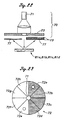
- Figures 22 and 23 illustrate an identification device 70 for a ninth embodiment of the present invention.
- the identification device 70 of this embodiment comprises a centrally placed light source 71 for emitting random light, and a disk-shaped light receiving element 72 surrounding the light source 71.
- This disk-shaped light receiving element 72 is divided into eight identical sector-shaped light receiving units 72a, 72b, 72c, 72d, 72e, 72f, 72g and 72h.
- These sector-shaped light receiving units 72a, 72b, 72c, 72d, 72e, 72f, 72g and 72h are arranged symmetrically with respect to the light source 71and form four pairs, light receiving units 72a and 72e, light receiving wilts 72b and 72f, light receiving units 72c and 72g and light receiving units 72d and 72h, each pair being adapted to simultaneously receive the diffracted light from the hologram foils 81.
- one of each pair of the light receiving units 72a, 72b, 72c and 72d is provided with a circularly polarizing filter 73 of the first pattern in front thereof, the circularly polarizing filter 73 transmitting only the right-handed circularly polarized light while shutting off the left-handed circularly polarized light.
- a band pass filter 77 covering the entire surface of the light receiving element 72 is placed between the circularly polarizing filter 73 and the hologram foil 1.
- the object X is provided with four hologram foils 81a, 81b, 81c and 81d as identification media.
- These hologram foils 81a, 81b, 81c and 81d are adapted to diffract light in four different directions corresponding to the four pairs of light receiving units.
- the high polymer cholesteric liquid crystal layer serving as the reflective layer for these hologram foils 81a, 81b, 81c and 81d reflects only the right circularly polarized light.
- the hologram foils 81a, 81b, 81c and 81d are sequentially scanned. Then, the right-handed circularly polarized light is diffracted from the hologram foil 81a to the paired light receiving units 72a and 72e, for instance. Because this light is not shut off by the circularly polarizing filter 73, the intensity A of the light received by the light receiving unit 72a is substantially equal to the intensity E of the light received by the other light receiving unit 72e (A/E ⁇ 1). Then, the right-handed circularly polarized light is diffracted from the hologram foil 81b to the paired light receiving units 72b and 72f, for instance.
- the intensity B of the light received by the light receiving unit 72b is substantially equal to the intensity E of the light received by the other light receiving unit 72f(B/F ⁇ 1).
- the intensity C of the light received by the light receiving unit 72c is substantially equal to the intensity G of the light received by the other light receiving unit 72g (C/G ⁇ 1)
- the intensity D of the light received by the light receiving unit 72d is substantially equal to the intensity H of the light received by the other light receiving unit 72h (D/H ⁇ 1).
- the intensity A of the light received by the light receiving units 72a is only about one half the intensity E of the light received by the other light receiving unit 72e (A/E ⁇ 1/2).
- the output of one of the remaining pairs of light receiving units is also about one half of the output of the other (B/F ⁇ 1/2, C/G ⁇ 1/2 and D/H ⁇ 1/2).
- the hologram foil 81a is associated with the paired light receiving units 72a and 72e
- the hologram foil 81b is associated with the paired light receiving units 72b and 72f
- the hologram foil 81c is associated with the paired light receiving units 72c and 72g
- the hologram foil 81d is associated with the paired light receiving units 72d and 72h, but other combinations are also possible.
- the object X may also be provided with a larger number of hologram foils, and the light receiving element 72 may be divided into a larger number of light receiving units.
- the hologram foils may serve the purpose of determining ID and carrying various forms of data by using various combinations of these hologram foils. The above arrangement used only one identification device, but an even more reliable identification is possible if the light from the light source consists of circularly polarized light of two opposite senses and two identification devices are arranged along the direction of transportation as in the fourth embodiment.
- the light source consisted of random light in the above described embodiments, but may also consist of laser light.
- the object is affixed with an identification medium comprising a reflective layer consisting of a reflective hologram or diffraction grating which diffracts incident light from a light source onto a pair of or a plurality of pairs of symmetric positions with respect to the optical center of the incident light, the reflective layer being formed by a high polymer cholesteric liquid crystal layer, and a light beam is impinged thereon.
- a reflective layer consisting of a reflective hologram or diffraction grating which diffracts incident light from a light source onto a pair of or a plurality of pairs of symmetric positions with respect to the optical center of the incident light
- the reflective layer being formed by a high polymer cholesteric liquid crystal layer, and a light beam is impinged thereon.
- One of a pair of diffracted light beams is received via a circularly polarizing filter consisting of a polarizing filter and a wave plate, and the other of the pair of the diffracted light beams
- one of a pair of diffracted light beams is received via a first circularly polarizing filter having a first circularly polarizing property while the other of the pair of diffracted light beams is received via a second circularly polarizing filter having a second circularly polarizing property which is an opposite of the first circularly polarizing property.
- the authenticity of the object can be determined by comparing the results of receiving the light beams.
- the polarizing property of the cholesteric liquid crystal layer and the diffractive property of hologram are symbiotically combined so as to improve the performance of identification. Because the circularly polarized light is detected, instead of normal reflected light, undesirable influences from irregular reflections can be minimized.
- the light beam is in effect split by the identification medium through diffraction, the identification device is not required to be provided with expensive beam splitters. Therefore, the necessary number of component parts can be minimized, compact and light-weight design of the system is made possible, and the cost is minimized.
Landscapes
- Physics & Mathematics (AREA)
- Engineering & Computer Science (AREA)
- Theoretical Computer Science (AREA)
- General Physics & Mathematics (AREA)
- Toxicology (AREA)
- General Health & Medical Sciences (AREA)
- Artificial Intelligence (AREA)
- Computer Vision & Pattern Recognition (AREA)
- Electromagnetism (AREA)
- Health & Medical Sciences (AREA)
- Crystallography & Structural Chemistry (AREA)
- Chemical & Material Sciences (AREA)
- Credit Cards Or The Like (AREA)
- Liquid Crystal (AREA)
- Diffracting Gratings Or Hologram Optical Elements (AREA)
- Inspection Of Paper Currency And Valuable Securities (AREA)
- Holo Graphy (AREA)
- Investigating Or Analysing Materials By Optical Means (AREA)
- Polarising Elements (AREA)
Applications Claiming Priority (5)
| Application Number | Priority Date | Filing Date | Title |
|---|---|---|---|
| JP32708298 | 1998-11-17 | ||
| JP32708298 | 1998-11-17 | ||
| JP31716899A JP4336008B2 (ja) | 1998-11-17 | 1999-11-08 | 対象物の識別構造及び識別方法 |
| JP31716899 | 1999-11-08 | ||
| US09/440,683 US6301047B1 (en) | 1998-11-17 | 1999-11-16 | System for optically identifying an object |
Publications (3)
| Publication Number | Publication Date |
|---|---|
| EP1003126A2 true EP1003126A2 (fr) | 2000-05-24 |
| EP1003126A3 EP1003126A3 (fr) | 2004-01-07 |
| EP1003126B1 EP1003126B1 (fr) | 2006-07-05 |
Family
ID=27339582
Family Applications (1)
| Application Number | Title | Priority Date | Filing Date |
|---|---|---|---|
| EP99309101A Expired - Lifetime EP1003126B1 (fr) | 1998-11-17 | 1999-11-16 | Système d'identification optique d'un objet |
Country Status (3)
| Country | Link |
|---|---|
| US (1) | US6301047B1 (fr) |
| EP (1) | EP1003126B1 (fr) |
| JP (1) | JP4336008B2 (fr) |
Cited By (7)
| Publication number | Priority date | Publication date | Assignee | Title |
|---|---|---|---|---|
| EP1203967A1 (fr) * | 2000-11-03 | 2002-05-08 | Rolic AG | Film polarisant |
| RU2219580C2 (ru) * | 2001-06-25 | 2003-12-20 | ОАО Концерн "Российские защитные технологии" | Устройство для идентификации документов |
| WO2003077193A3 (fr) * | 2002-03-14 | 2004-02-05 | Consortium General Textile | Dispositif de detection optique de marques de securite constituees d'un materiau cristallin liquide |
| US8613471B2 (en) | 2007-12-20 | 2013-12-24 | Giesecke & Devrient Gmbh | Security element and method for the production thereof |
| US8733797B2 (en) | 2007-12-20 | 2014-05-27 | Giesecke & Devrient Gmbh | Security element and method for the production thereof |
| US8794674B2 (en) | 2008-03-07 | 2014-08-05 | Giesecke & Devrient Gmbh | Security element and method for the production thereof |
| US9007669B2 (en) | 2008-02-15 | 2015-04-14 | Giesecke & Devrient Gmbh | Security element and method for producing the same |
Families Citing this family (50)
| Publication number | Priority date | Publication date | Assignee | Title |
|---|---|---|---|---|
| JP2002127647A (ja) * | 2000-10-19 | 2002-05-08 | Nhk Spring Co Ltd | 対象物の識別媒体及びその製造方法 |
| CN1245715C (zh) * | 2000-12-11 | 2006-03-15 | 皇家菲利浦电子有限公司 | 用于读和/或写记录载体的设备 |
| JP2002283775A (ja) * | 2001-03-27 | 2002-10-03 | Topcon Corp | カードの真贋判定装置 |
| JP2002288604A (ja) * | 2001-03-27 | 2002-10-04 | Topcon Corp | カードの真贋判定装置 |
| JP4724952B2 (ja) * | 2001-06-01 | 2011-07-13 | 凸版印刷株式会社 | プリズムアレイパターン |
| KR100588262B1 (ko) * | 2001-10-16 | 2006-06-12 | 가부시키가이샤 나나오 | 액정표시장치 |
| US7030972B2 (en) * | 2002-02-12 | 2006-04-18 | Xerox Corporation | System and method for identifying objects |
| JP2003231380A (ja) * | 2002-02-12 | 2003-08-19 | Nhk Spring Co Ltd | 対象物の識別媒体及び識別方法 |
| AU2003209915B8 (en) * | 2002-04-04 | 2008-09-18 | Landqart | Device for checking security elements |
| DE10233928A1 (de) * | 2002-07-25 | 2004-02-12 | Giesecke & Devrient Gmbh | Verfahren und Vorrichtung zur Echtheitsprüfung eines Sicherheitselements |
| JP2005536769A (ja) | 2002-08-20 | 2005-12-02 | シヴェラ コーポレイション | 回折格子をベースとする光学同定要素 |
| US7619819B2 (en) | 2002-08-20 | 2009-11-17 | Illumina, Inc. | Method and apparatus for drug product tracking using encoded optical identification elements |
| US7508608B2 (en) | 2004-11-17 | 2009-03-24 | Illumina, Inc. | Lithographically fabricated holographic optical identification element |
| US7399643B2 (en) | 2002-09-12 | 2008-07-15 | Cyvera Corporation | Method and apparatus for aligning microbeads in order to interrogate the same |
| US7872804B2 (en) | 2002-08-20 | 2011-01-18 | Illumina, Inc. | Encoded particle having a grating with variations in the refractive index |
| US7900836B2 (en) | 2002-08-20 | 2011-03-08 | Illumina, Inc. | Optical reader system for substrates having an optically readable code |
| US7923260B2 (en) | 2002-08-20 | 2011-04-12 | Illumina, Inc. | Method of reading encoded particles |
| US7441703B2 (en) | 2002-08-20 | 2008-10-28 | Illumina, Inc. | Optical reader for diffraction grating-based encoded optical identification elements |
| US7901630B2 (en) | 2002-08-20 | 2011-03-08 | Illumina, Inc. | Diffraction grating-based encoded microparticle assay stick |
| US7190522B2 (en) | 2002-09-12 | 2007-03-13 | Cyvera Corporation | Chemical synthesis using diffraction grating-based encoded optical elements |
| US7164533B2 (en) | 2003-01-22 | 2007-01-16 | Cyvera Corporation | Hybrid random bead/chip based microarray |
| EP1540591A1 (fr) | 2002-09-12 | 2005-06-15 | Cyvera Corporation | Microparticules codees sur la base d'un reseau de diffraction pour experimentations multiplexees |
| CA2499037A1 (fr) | 2002-09-12 | 2004-03-25 | Cyvera Corporation | Procede et appareil d'etiquetage utilisant des elements d'identification optique codes a reseau de diffraction |
| US20100255603A9 (en) | 2002-09-12 | 2010-10-07 | Putnam Martin A | Method and apparatus for aligning microbeads in order to interrogate the same |
| US7092160B2 (en) | 2002-09-12 | 2006-08-15 | Illumina, Inc. | Method of manufacturing of diffraction grating-based optical identification element |
| DE10318157A1 (de) * | 2003-04-17 | 2004-11-11 | Leonhard Kurz Gmbh & Co. Kg | Folie und optisches Sicherungselement |
| JP4392826B2 (ja) * | 2003-05-16 | 2010-01-06 | 日本発條株式会社 | 対象物の識別媒体及び識別方法 |
| GB0401060D0 (en) | 2004-01-19 | 2004-02-18 | Ezra David | Optical devices |
| US7433123B2 (en) | 2004-02-19 | 2008-10-07 | Illumina, Inc. | Optical identification element having non-waveguide photosensitive substrate with diffraction grating therein |
| EP2194485B1 (fr) | 2004-11-16 | 2012-10-17 | Illumina, Inc. | Procédés et appareils pour la lecture de microbilles codées |
| US7604173B2 (en) | 2004-11-16 | 2009-10-20 | Illumina, Inc. | Holographically encoded elements for microarray and other tagging labeling applications, and method and apparatus for making and reading the same |
| WO2006055735A2 (fr) | 2004-11-16 | 2006-05-26 | Illumina, Inc | Scanner dote d'un modulateur spatial de lumiere |
| US8797392B2 (en) * | 2005-01-05 | 2014-08-05 | Avantis Medical Sytems, Inc. | Endoscope assembly with a polarizing filter |
| US8182422B2 (en) | 2005-12-13 | 2012-05-22 | Avantis Medical Systems, Inc. | Endoscope having detachable imaging device and method of using |
| US8235887B2 (en) | 2006-01-23 | 2012-08-07 | Avantis Medical Systems, Inc. | Endoscope assembly with retroscope |
| US8872906B2 (en) | 2005-01-05 | 2014-10-28 | Avantis Medical Systems, Inc. | Endoscope assembly with a polarizing filter |
| US8289381B2 (en) | 2005-01-05 | 2012-10-16 | Avantis Medical Systems, Inc. | Endoscope with an imaging catheter assembly and method of configuring an endoscope |
| TW200641784A (en) * | 2005-05-27 | 2006-12-01 | Phison Electronics Corp | Electronic product with data display |
| US7623624B2 (en) | 2005-11-22 | 2009-11-24 | Illumina, Inc. | Method and apparatus for labeling using optical identification elements characterized by X-ray diffraction |
| JP4967415B2 (ja) | 2006-03-31 | 2012-07-04 | 大日本印刷株式会社 | 真正性判定システム |
| US7830575B2 (en) | 2006-04-10 | 2010-11-09 | Illumina, Inc. | Optical scanner with improved scan time |
| US8287446B2 (en) | 2006-04-18 | 2012-10-16 | Avantis Medical Systems, Inc. | Vibratory device, endoscope having such a device, method for configuring an endoscope, and method of reducing looping of an endoscope |
| JP2009537283A (ja) | 2006-05-19 | 2009-10-29 | アヴァンティス メディカル システムズ インコーポレイテッド | ビデオアーチファクトの影響を低減するための装置および方法 |
| CH699046B1 (de) * | 2006-11-16 | 2010-01-15 | Baumer Electric Ag | Optischer Sensor, Verfahren zum Herstellen eines optischen Sensors und Verfahren zum Erfassen eines Objekts mit einem optischen Sensor. |
| US8064666B2 (en) | 2007-04-10 | 2011-11-22 | Avantis Medical Systems, Inc. | Method and device for examining or imaging an interior surface of a cavity |
| JP4983504B2 (ja) * | 2007-09-21 | 2012-07-25 | 凸版印刷株式会社 | 情報記録媒体及び情報読取装置 |
| JP5644077B2 (ja) * | 2009-08-31 | 2014-12-24 | 大日本印刷株式会社 | 真正性識別体、真正性判定シート及び真正性判定方法 |
| GEP20125395B (en) | 2009-12-16 | 2012-02-10 | Method of code recording for protection of product against falsification and device for its identification | |
| US9279927B2 (en) | 2013-02-15 | 2016-03-08 | Opsec Security Group, Inc. | Security device having optically variable device portion and method of making the same |
| EP4145200B1 (fr) * | 2021-09-03 | 2025-05-28 | Galina Dr. Georgieva | Élément optique |
Family Cites Families (9)
| Publication number | Priority date | Publication date | Assignee | Title |
|---|---|---|---|---|
| US4514085A (en) * | 1982-06-28 | 1985-04-30 | Beckman Instruments, Inc. | Marking and authenticating documents with liquid crystal materials |
| JPH07113985B2 (ja) * | 1988-10-28 | 1995-12-06 | 株式会社日本コンラックス | 紙幣識別方法 |
| US5442433A (en) * | 1989-08-11 | 1995-08-15 | Nhk Spring Co., Ltd. | Identification system for an article having individually attached patches |
| US5291006A (en) * | 1989-08-11 | 1994-03-01 | Nhk Spring Co., Ltd. | Authenticity identifying system for information storage cards |
| DE3942663A1 (de) * | 1989-12-22 | 1991-06-27 | Gao Ges Automation Org | Datentraeger mit einem fluessigkristall-sicherheitselement |
| US6034753A (en) * | 1991-11-27 | 2000-03-07 | Reveo, Inc. | Circularly polarizing reflective material having super broad-band reflection and transmission characteristics and method of fabricating and using same in diverse applications |
| JPH0797388B2 (ja) * | 1992-09-29 | 1995-10-18 | 日本発条株式会社 | 対象物の識別構造 |
| US5541419A (en) * | 1994-03-21 | 1996-07-30 | Intermec Corporation | Symbology reader wth reduced specular reflection |
| DE69832574T2 (de) * | 1997-07-29 | 2006-06-14 | Nhk Spring Co Ltd | Optisches Identifizierungssystem mit cholesterischen Flüssigkristallen |
-
1999
- 1999-11-08 JP JP31716899A patent/JP4336008B2/ja not_active Expired - Fee Related
- 1999-11-16 EP EP99309101A patent/EP1003126B1/fr not_active Expired - Lifetime
- 1999-11-16 US US09/440,683 patent/US6301047B1/en not_active Expired - Lifetime
Cited By (8)
| Publication number | Priority date | Publication date | Assignee | Title |
|---|---|---|---|---|
| EP1203967A1 (fr) * | 2000-11-03 | 2002-05-08 | Rolic AG | Film polarisant |
| WO2002037147A1 (fr) * | 2000-11-03 | 2002-05-10 | Rolic Ag | Film de polarisation |
| RU2219580C2 (ru) * | 2001-06-25 | 2003-12-20 | ОАО Концерн "Российские защитные технологии" | Устройство для идентификации документов |
| WO2003077193A3 (fr) * | 2002-03-14 | 2004-02-05 | Consortium General Textile | Dispositif de detection optique de marques de securite constituees d'un materiau cristallin liquide |
| US8613471B2 (en) | 2007-12-20 | 2013-12-24 | Giesecke & Devrient Gmbh | Security element and method for the production thereof |
| US8733797B2 (en) | 2007-12-20 | 2014-05-27 | Giesecke & Devrient Gmbh | Security element and method for the production thereof |
| US9007669B2 (en) | 2008-02-15 | 2015-04-14 | Giesecke & Devrient Gmbh | Security element and method for producing the same |
| US8794674B2 (en) | 2008-03-07 | 2014-08-05 | Giesecke & Devrient Gmbh | Security element and method for the production thereof |
Also Published As
| Publication number | Publication date |
|---|---|
| JP2000211300A (ja) | 2000-08-02 |
| JP4336008B2 (ja) | 2009-09-30 |
| US6301047B1 (en) | 2001-10-09 |
| EP1003126B1 (fr) | 2006-07-05 |
| EP1003126A3 (fr) | 2004-01-07 |
Similar Documents
| Publication | Publication Date | Title |
|---|---|---|
| EP1003126B1 (fr) | Système d'identification optique d'un objet | |
| US6061122A (en) | Optical identification system using cholesteric liquid crystals | |
| US5497227A (en) | System for determining the authenticity of an object | |
| US6927885B2 (en) | Label with a diffractive bar code and reading arrangement for such labels | |
| EP0568185B1 (fr) | Système d'identification d'authenticité d'un article | |
| US20100148050A1 (en) | Security mark | |
| AU738610B2 (en) | Apparatus for the recognition of optical-diffraction markings | |
| JP3652487B2 (ja) | 対象物の識別用媒体及び識別構造及び識別方法 | |
| RU2443004C2 (ru) | Защитный маркировочный оптический элемент, способ изготовления такого элемента, система, содержащая такой элемент, и считывающее устройство для проверки такого элемента | |
| US8582088B2 (en) | Authentication apparatus and methods | |
| CN1265214A (zh) | 衍射表面图形 | |
| PL202809B1 (pl) | Element zabezpieczający | |
| JP3652476B2 (ja) | 対象物の識別構造及びその構造が設けられた対象物 | |
| EP0552564B1 (fr) | Structure pour identifier l'authenticité d'un article | |
| JP3689237B2 (ja) | 対象物の識別構造 | |
| JP5245294B2 (ja) | 情報記録媒体および情報読取り装置 | |
| JPH09161121A (ja) | 物体の表面状態検出装置 | |
| JP2742360B2 (ja) | 貨幣パターン検出装置 | |
| GB2212445A (en) | Data carriers | |
| JP4774687B2 (ja) | ブレーズド格子を含む物品の検証方法及び装置及び物品 | |
| KR20200144829A (ko) | 광기능성 패턴 구조체를 포함하는 바코드 표시 장치 및 이를 포함하는 진위 판별 장치 |
Legal Events
| Date | Code | Title | Description |
|---|---|---|---|
| PUAI | Public reference made under article 153(3) epc to a published international application that has entered the european phase |
Free format text: ORIGINAL CODE: 0009012 |
|
| AK | Designated contracting states |
Kind code of ref document: A2 Designated state(s): AT BE CH CY DE DK ES FI FR GB GR IE IT LI LU MC NL PT SE |
|
| AX | Request for extension of the european patent |
Free format text: AL;LT;LV;MK;RO;SI |
|
| PUAL | Search report despatched |
Free format text: ORIGINAL CODE: 0009013 |
|
| AK | Designated contracting states |
Kind code of ref document: A3 Designated state(s): AT BE CH CY DE DK ES FI FR GB GR IE IT LI LU MC NL PT SE |
|
| AX | Request for extension of the european patent |
Extension state: AL LT LV MK RO SI |
|
| RIC1 | Information provided on ipc code assigned before grant |
Ipc: 7G 06K 7/10 B Ipc: 7B 42D 15/10 B Ipc: 7G 06K 19/18 B Ipc: 7G 06K 19/16 A |
|
| 17P | Request for examination filed |
Effective date: 20040705 |
|
| AKX | Designation fees paid |
Designated state(s): DE FR GB |
|
| 17Q | First examination report despatched |
Effective date: 20050519 |
|
| GRAP | Despatch of communication of intention to grant a patent |
Free format text: ORIGINAL CODE: EPIDOSNIGR1 |
|
| GRAS | Grant fee paid |
Free format text: ORIGINAL CODE: EPIDOSNIGR3 |
|
| GRAA | (expected) grant |
Free format text: ORIGINAL CODE: 0009210 |
|
| AK | Designated contracting states |
Kind code of ref document: B1 Designated state(s): DE FR GB |
|
| REG | Reference to a national code |
Ref country code: GB Ref legal event code: FG4D |
|
| REF | Corresponds to: |
Ref document number: 69932215 Country of ref document: DE Date of ref document: 20060817 Kind code of ref document: P |
|
| ET | Fr: translation filed | ||
| PLBE | No opposition filed within time limit |
Free format text: ORIGINAL CODE: 0009261 |
|
| STAA | Information on the status of an ep patent application or granted ep patent |
Free format text: STATUS: NO OPPOSITION FILED WITHIN TIME LIMIT |
|
| 26N | No opposition filed |
Effective date: 20070410 |
|
| REG | Reference to a national code |
Ref country code: FR Ref legal event code: PLFP Year of fee payment: 17 |
|
| PGFP | Annual fee paid to national office [announced via postgrant information from national office to epo] |
Ref country code: DE Payment date: 20151110 Year of fee payment: 17 Ref country code: GB Payment date: 20151111 Year of fee payment: 17 |
|
| PGFP | Annual fee paid to national office [announced via postgrant information from national office to epo] |
Ref country code: FR Payment date: 20151008 Year of fee payment: 17 |
|
| REG | Reference to a national code |
Ref country code: DE Ref legal event code: R119 Ref document number: 69932215 Country of ref document: DE |
|
| GBPC | Gb: european patent ceased through non-payment of renewal fee |
Effective date: 20161116 |
|
| REG | Reference to a national code |
Ref country code: FR Ref legal event code: ST Effective date: 20170731 |
|
| PG25 | Lapsed in a contracting state [announced via postgrant information from national office to epo] |
Ref country code: FR Free format text: LAPSE BECAUSE OF NON-PAYMENT OF DUE FEES Effective date: 20161130 |
|
| PG25 | Lapsed in a contracting state [announced via postgrant information from national office to epo] |
Ref country code: DE Free format text: LAPSE BECAUSE OF NON-PAYMENT OF DUE FEES Effective date: 20170601 Ref country code: GB Free format text: LAPSE BECAUSE OF NON-PAYMENT OF DUE FEES Effective date: 20161116 |