EP1003184B1 - Procédé de fabriquer et traiter des comprimés magnétiques verts - Google Patents
Procédé de fabriquer et traiter des comprimés magnétiques verts Download PDFInfo
- Publication number
- EP1003184B1 EP1003184B1 EP99122338A EP99122338A EP1003184B1 EP 1003184 B1 EP1003184 B1 EP 1003184B1 EP 99122338 A EP99122338 A EP 99122338A EP 99122338 A EP99122338 A EP 99122338A EP 1003184 B1 EP1003184 B1 EP 1003184B1
- Authority
- EP
- European Patent Office
- Prior art keywords
- green compacts
- rare earth
- earth metal
- support plate
- alloy powder
- Prior art date
- Legal status (The legal status is an assumption and is not a legal conclusion. Google has not performed a legal analysis and makes no representation as to the accuracy of the status listed.)
- Expired - Lifetime
Links
Images




Classifications
-
- H—ELECTRICITY
- H01—ELECTRIC ELEMENTS
- H01F—MAGNETS; INDUCTANCES; TRANSFORMERS; SELECTION OF MATERIALS FOR THEIR MAGNETIC PROPERTIES
- H01F1/00—Magnets or magnetic bodies characterised by the magnetic materials therefor; Selection of materials for their magnetic properties
- H01F1/01—Magnets or magnetic bodies characterised by the magnetic materials therefor; Selection of materials for their magnetic properties of inorganic materials
- H01F1/03—Magnets or magnetic bodies characterised by the magnetic materials therefor; Selection of materials for their magnetic properties of inorganic materials characterised by their coercivity
- H01F1/032—Magnets or magnetic bodies characterised by the magnetic materials therefor; Selection of materials for their magnetic properties of inorganic materials characterised by their coercivity of hard-magnetic materials
- H01F1/04—Magnets or magnetic bodies characterised by the magnetic materials therefor; Selection of materials for their magnetic properties of inorganic materials characterised by their coercivity of hard-magnetic materials metals or alloys
- H01F1/047—Alloys characterised by their composition
- H01F1/053—Alloys characterised by their composition containing rare earth metals
- H01F1/055—Alloys characterised by their composition containing rare earth metals and magnetic transition metals, e.g. SmCo5
- H01F1/057—Alloys characterised by their composition containing rare earth metals and magnetic transition metals, e.g. SmCo5 and IIIa elements, e.g. Nd2Fe14B
- H01F1/0571—Alloys characterised by their composition containing rare earth metals and magnetic transition metals, e.g. SmCo5 and IIIa elements, e.g. Nd2Fe14B in the form of particles, e.g. rapid quenched powders or ribbon flakes
- H01F1/0575—Alloys characterised by their composition containing rare earth metals and magnetic transition metals, e.g. SmCo5 and IIIa elements, e.g. Nd2Fe14B in the form of particles, e.g. rapid quenched powders or ribbon flakes pressed, sintered or bonded together
- H01F1/0577—Alloys characterised by their composition containing rare earth metals and magnetic transition metals, e.g. SmCo5 and IIIa elements, e.g. Nd2Fe14B in the form of particles, e.g. rapid quenched powders or ribbon flakes pressed, sintered or bonded together sintered
-
- H—ELECTRICITY
- H01—ELECTRIC ELEMENTS
- H01F—MAGNETS; INDUCTANCES; TRANSFORMERS; SELECTION OF MATERIALS FOR THEIR MAGNETIC PROPERTIES
- H01F41/00—Apparatus or processes specially adapted for manufacturing or assembling magnets, inductances or transformers; Apparatus or processes specially adapted for manufacturing materials characterised by their magnetic properties
- H01F41/02—Apparatus or processes specially adapted for manufacturing or assembling magnets, inductances or transformers; Apparatus or processes specially adapted for manufacturing materials characterised by their magnetic properties for manufacturing cores, coils, or magnets
- H01F41/0253—Apparatus or processes specially adapted for manufacturing or assembling magnets, inductances or transformers; Apparatus or processes specially adapted for manufacturing materials characterised by their magnetic properties for manufacturing cores, coils, or magnets for manufacturing permanent magnets
Definitions
- the present invention relates to a process for making and handling a green compact made by a press machine from a rare earth metal-based magnetic alloy powder such as an Fe-B-R based magnetic alloy powder, wherein R comprises at least one rare earth element.
- the present invention also relates to a rare earth metal-based magnet produced through such handling process.
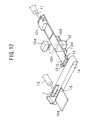
- a press machine 10 and a sintering support plate 15 shown in Fig.12 are used for the handling of the green compacts made from the rare earth metal-based magnetic alloy powder by the press machine to transport the green compacts to the sintering support plate.
- the green compacts 1 formed into a predetermined shape from the rare earth metal-based magnetic alloy powder by the press machine are pushed out onto a stage 12 by a push-out means 11 such as pusher and subjected to a powder removing treatment in which a surplus magnetic powder around the green compacts 1 is blown away by a nitrogen gas or the like blown out of a powder removing device 13. Then, the green compacts are pushed out onto a transporting belt 14 by the push-out means 11.
- the green compacts are transported to near the sintering support plate 15 by the transporting belt 14 and then pushed out onto the sintering support plate 15 from the transporting belt 14 by a push-out means 16 such as a pusher.
- a large number of the green compacts can be arranged efficiently on the narrow sintering support plate of a simple construction and hence, the above-described steps are repeated, thereby allowing the succeeding green compacts 1 to sequentially push the already transported preceding green compacts to slide them on the sintering support plate 15, as shown in Figs.13 and 14 . In this manner, all the green compacts 1 are arranged in a final transport position on the sintering support plate 15.
- reference character 10a designates an upper punch of the press machine 10
- reference character 10b designates a die of the press machine 10
- reference character 10c designates a box (feeder) for supplying the magnetic alloy powder to the press machine 10
- reference character 10d designates a magnetic field generating coil.
- the rare earth metal-based alloy powder such as the Fe-B-R (R comprising at least one rare earth element) based magnetic alloy powder has a large hardness as compared with ferrite. For this reason, if such powder is pressed too strongly, the die is worn. If the powder is pressed at a high pressure, the orientation tends to be disordered, resulting in a degraded magnetic characteristic. Therefore, in order to provide a higher magnetic characteristic pressing force, the pressing pressure can be less risen and hence, the green compacts are liable to brittle and destroyed, as compared with ferrite.
- a rare earth metal-based magnetic alloy powder made by the strip casting process and having an excellent magnetic characteristic has a small average particle size and moreover, has a narrow and sharp particle size distribution. Therefore, green compacts produced from such rare earth metal-based magnetic alloy powder are soft, a poor shaping property, and difficult to handle, as compared with a powder which is made by a mold-casting process and whose particle size distribution varied widely.
- a green compact made by pressing from a powder containing a lubricant such as an ester of an aliphatic acid added thereto is further brittle.
- the green compacts are brittle as described above, it is necessary to handle the green compacts carefully by a transporting means such as a transporting belt, a pusher, a robot and the like. Especially, there is a problem that the powder removing treatment is time-consuming, and unless the powder removing treatment for the green compacts made in advance by pressing is finished, the pressing of the subsequent powder cannot be started, resulting in a significantly degraded efficiency of operation of the press machine.
- the use of the sintering support plate having a high friction coefficient is preferred in order to ensure that the green compacts are prevented from slipping on the sintering support plate to come into close contact with another green compact, or to become fallen, during transportation of the sintering support plate to the sintering furnace.
- the R-Fe-B based magnet is produced in a liquid-phase sintering manner. For this reason, if a very smooth support plate is used, neodymium (Nd) eluted during the sintering is deposited onto the support plate and hence, it is necessary to use a support plate having a high friction coefficient.
- a process for making and handling green compacts made from a rare earth metal-based magnetic alloy powder comprising the step of sliding, on a sintering support plate, green compacts made from a rare earth metal-based magnetic alloy powder by a press machine, wherein the support plate used has a surface roughness degree Ra in a range of 0.6 to 47 ⁇ m.
- the rare earth metal-based magnetic alloy powder for forming the green compacts contains a lubricant added thereto.
- the rare earth metal-based magnetic alloy powder for forming the green compacts is produced by a strip casting process.
- the rare earth metal-based magnetic alloy powder for forming the green compacts is produced by a strip casting process.
- a process for making and handling green compacts made from a rare earth metal-based magnetic alloy powder by a press machine comprising the step of transporting the green compacts made from the rare earth metal-based magnetic alloy powder by a press machine once onto a turn table, subjecting the green compacts to a powder removing treatment on the turn table, and transporting the green compacts to a sintering support plate.
- the green compacts made from the rare earth metal-based magnetic alloy powder can be sintered without occurrence of the deposition of the green compacts to the support plate, and handled without occurrence of the chipping of the green compacts and the like.
- the efficiency of operation of the press machine can be increased.
- a process for making and handling green compacts made from a rare earth metal-based magnetic alloy powder by a press machine to slide, on a sintering support plate, the green compacts made from the rare earth metal-based magnetic alloy powder by the press machine comprising a first step of disposing the green compacts in a first position near a final transport position, and a second step of sliding the green compacts disposed in the first position on the sintering support plate and disposing the green compacts in the final transport position.
- the distance of sliding movement can be shortened and hence, the cracking and chipping of the green compacts are difficult to occur.
- the support plate used has a surface roughness degree Ra in a range of 0.6 to 47 ⁇ m.
- the rare earth metal-based magnetic alloy powder for forming the green compacts contains a lubricant added thereto.
- the rare earth metal-based magnetic alloy powder for forming the green compacts is produced by a strip casting process.
- the green compacts made from the rare earth metal-based magnetic alloy powder can be sintered without generation of the deposition of the green compacts to the support plate, and handled without generation of the chipping of the green compacts and the like.
- the efficiency of operation of the press machine can be increased.
- the first position at the first step is established on the sintering support plate.
- the final transport position is selected in such a way that the green compacts slid at the second step does not push the green compacts already disposed to slide them.
- the first position at the first step is established on a thin member mounted on the sintering support plate.
- the green compacts slid at the second step does not push the green compacts already disposed to slide them.
- a rare earth metal-based magnetic alloy power used in this example was prepared in the following manner:
- an alloy produced in the known process and having a composition comprising 30 % by weight of Nd, 1.0 % by weight of B, 1.2 % by weight of Dy, 0.2 % by weight of Al, 0.9 % by weight of Co, the balance of Fe and inevitable impurities was subjected to a high-frequency melting to provide a molten metal.
- This molten metal was maintained at 1,350°C and then, quenched on a single roll under conditions of a roll peripheral speed of about 1 mm/sec, a cooling rate of 500°C/sec and a super-cooling degree of 200°C, thereby providing a flake-shaped alloy ingot.
- the alloy ingot was coarsely pulverized in a hydrogen-inclusion manner and then finely pulverized in an atmosphere of nitrogen gas using a jet mill, thereby producing an alloy powder having an average particle size of 3.5 ⁇ m.
- a solution made by diluting an ester of an aliphatic acid used as a lubricant by a solvent such as a petroleum solvent was added in an amount of 0.3 % by weight based on the lubricant to the produced alloy powder and mixed with the latter in a rocking mixer, whereby the lubricant was coated onto a surface of the alloy powder.
- a solvent such as a petroleum solvent
- methyl caproate was used as the ester of the aliphatic acid
- iso-paraffin was used as the petroleum solvent.
- the weight ratio of methyl caproate to iso-paraffin was set at 1:9.
- composition of the rare earth metal-based alloy described in US Patent No.4.770.723 can be employed beside the above-described composition.
- a cylindrical rare earth metal-based magnetic alloy powder green compact having an inside diameter of 2 mm, an outside diameter of 4 mm and a height of 6 mm was produced using the produced rare earth metal-based magnetic alloy powder.
- the pressing conditions are a magnetic field of 1.0 T and a compact density of 4.4 g/cm 3 .
- the type of the lubricant is particularly not limited, and for example, a lubricant made by diluting an ester of an aliphatic acid with a solvent can be used.
- esters of the aliphatic acids are methyl caproate, methyl caprylate, methyl laurate, methyl laurylate and the like.
- solvents which may be used are petroleum solvents such as iso-paraffin and naphthenic solvent.
- a blend of an ester of an aliphatic acid and a solvent mixed together at a weight ratio of 1:20 to 1:1 may be used.
- Arachidic acid may be contained in an amount of 1.0 % by weight in the aliphatic acid.
- a solid lubricant such as zinc stearate may also be used in place of, or along with the liquid lubricant.
- the cylindrical green compacts were arranged five at one time in a row on each of the support plates as the samples (1) to (8) and pushed out sequentially in the order of from the rearmost to the foremost using an apparatus shown in Figs.12 to 14 , whereby the 30 green compacts in total were arranged in rows on each of the support plate.
- This support plate was placed into a sintering furnace, where it was subjected to a sintering treatment for 2 hours at 1,100°C in an atmosphere of argon.
- the samples (1) to (8) used are those described below.
- the surface roughness degree was adjusted by controlling the particle size of particles to be flame-sprayed.
- sample (1) it was found that when the sintered products were intended to be removed from the sintering plate after the sintering treatment, most of them were deposited on the sintering support plate. A portion of an deposited area of the sintered product included a granular portion and was deposited strongly. Some of the sintered products could not be peeled off, unless they were broken or destroyed.
- the rare earth metal-based magnetic alloy powder green compacts could be handled and sintered without depositing and chipping by using the support plate having a surface roughness degree Ra in a range of 0.6 to 47 ⁇ m.
- the support plate has a surface roughness degree Rmax in a range of 8.9 to 210 ⁇ m.
- the rare earth metal-based magnetic alloy powder green compacts could be reliably handled without occurrence of chipping and sintered without being deposited and with no elution, by using the support plate having a surface roughness degree Ra in a range of 2.3 to 13.4 ⁇ m and a surface roughness degree Rmax in a range of 23 to 66 ⁇ m.
- the structure around a press machine 10 is particularly not different from that in the prior art. Therefore, members or components corresponding to those in the prior art are designated by like reference characters, and the description of them is omitted.
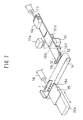
- the green compacts are transferred from the press machine 10 onto the sintering support plate 15 through a turn table 20 which is disposed between the press machine 15 and the sintering support plate 15 and rotated through 90 degree at one time.
- the green compacts are subjected a powder removing treatment carried out by a powder removing device 13 comprising an air jet in a powder removing position 20b on the turn table 20 which has been rotated through 90 degree from a receiving position 20a from the press machine 10.
- Reference character 20c in Fig.1 indicates a stand-by position provided between the powder removing position 20b and a transport position 20d.
- the green compacts 1 are grasped by an air chuck 30a of a transporting robot 30 and transported onto the sintering support plate 15.
- the green compacts 1 required to be handled carefully is subjected to the powder removing treatment by the powder removing device 13 after being once transported sequentially onto the turn table 20 from the press machine 10. Therefore, it is possible to advance to a next pressing operation without waiting for the completion of the powder removing treatment which is now being conducted, and hence, the pressing operation can be carried out continuously and smoothly by the press machine 10.
- the period of time taken for one run of the pressing operation can be shortened by 25 % as compared with the prior art, leading to an enhanced productivity.
- the green compacts are disposed in a first position near a final transport position.
- the green compacts disposed in the first position are slid on the sintering support plate and disposed in the final transport position.
- the first position at the first step is established on the sintering support plate.
- the green compacts 1 in one row are once transported sequentially to as near as possible to the final transporting portion 15a on the sintering support plate 15 as shown in Fig.2 with a range of movement of the robot taken into consideration.
- the distance between the green compacts 1 and the final transport position is 2 cm.
- the sintering support plate 15 is moved toward a stationary member 17, whereby the green compacts 1 in one row are put into abutment against the stationary member 17 and located in the final transport position 15a on the sintering support plate 15.
- the green compacts 1 in one row are transported sequentially in the same manner to near the final transport position 15a on the sintering support plate 15.
- the green compacts 1 in the second row are brought into abutment against the stationary member 17 by moving the sintering support plate 15 toward the stationary member 17, and then slid on the sintering support plate 15 to the final transport position 15a, whereby they are put into abutment slightly against the green compacts which have been transported in advance.
- the green compacts in the second row do not push and slide the compacts already transported. Accordingly, the compacts cannot be pushed to be cruched due to the friction force.
- Such transporting operation is repeated to transport all of the green compacts 1 to the final transport position 15a on the sintering support plate 15.
- the compacts in the first row moved through the maximum distance are slid through about 20 cm, but in this embodiment, the distance of sliding movement of the green compacts 1 in each row is 2 cm.
- the distance of movement of the green compacts 1 on the sintering support plate 15 can be shortened extremely.
- the green compacts arranged in more rear row cannot be depressed.
- the yield can be increased by 40 %, as compared with the prior art.
- the support plate 15 with compacts 1 in all-rows arranged thereon is transported along with a base plate 15c and an adsorbing device 15d by a transporting device 15b and then transported by a support plate transporting belt 15e after releasing of the adsorption of the support plate.
- a control system is comprised of a transporting-robot driving circuit A, a motor driving circuit B, a support plate position sensor C, a press/turn table control circuit D and a general control circuit E.
- the transporting-robot driving circuit A controls the grasping of the green compacts 1 in the air chuck 30a of the transporting robot 30 and the position of the air chuck 30a.
- the motor driving circuit B which comprises a pulse generating circuit, controls the driving of a stepping motor 50 for moving a roller 40 adapted to support the sintering support plate 15 for transportation.
- the roller 40 is described in Fig.6 as being drive in abutment against sintering plate 15 unlike Fig.1 .
- the support plate position sensor C comprises a photo-interrupter and delivers an output which is supplied to an I/F section in an A/D converted form.
- the press/turn table control circuit D controls the operations of the press machine including an upper punch 10a, a die 10b, a supply box 10c and a magnetic field generating coil 10d and of the turn table 20.
- the general control circuit E comprises an ROM having a controlling program accommodated therein, a CPU adapted to conduct the calculation based on the program accommodated in the ROM, an RAM which serves as a work area and has control data accommodated therein, an operation panel for selecting the control program according to the compact to be pressed by an operator, an I/F section adapted to provide an interface with another hardware, and a bus for connecting these components.
- the support plate 15 is disposed on the roller 40, and a manufacture program is selected by the operator.
- a start button is pushed down, an initializing operation is started in the entire apparatus.
- the support plate 15 is moved by the motor control circuit B controlled by the general control circuit E, and is then set at a predetermined location.
- the CPU indicates it to the motor drive circuit B through the I/F section that the support plate 15 is driven in a direction indicated by R after detection of the fact that the support plate 15 is not in a position to block the interrupter.
- the CPU periodically checks by the support plate position sensor C that the support plate 15 have reached to the position to block the interrupter.
- the support plate 15 is returned in a direction indicated by L through a predetermined distance and set in a position in which the first green compacts 1 are placed on the support plate 15.
- an initializing operation such as the detection of the position of the air chuck 30a is carried out. Further, a similar initializing operation is also carried out in the press/turn table control circuit D.
- the CPU indicates the starting of the pressing to the press/turn table control circuit D.
- a transporting command signal is transmitted to the I/F section.
- the CPU When the CPU has detected this signal, it indicates the transportation of the green compacts 1 to the transporting robot drive circuit A, whereby the green compacts 1 are transported onto the support plate 15.
- the CPU stores the number of transportation runs of the green compacts 1 on the RAM and indicates a transported position at every time based on the number of transportation runs.
- the CPU detects that the number of transportation runs does not still reach a predetermined value.
- the support plate 15 is moved by the motor drive circuit B, as shown in Figs.2 to 5 , and the green compacts 1 are disposed on the support plate 15.
- the CPU stores the number of disposing runs, i.e., the number of rows of the green compacts 1.
- the CPU indicates that the support plate is transported by the support plate transporting belt.
- the green compacts are disposed at a first position near a final transport position.
- the green compacts disposed in the first position are slid on the sintering support plate and disposed in the final transport position.
- the first position at the first step is established on a thin member mounted on the sintering support plate.
- the sintering support plate 15 is constructed so that it can be moved by a drive means 15b, and the movement of the green compacts to the sintering support plate 15 is carried out after movement of the sintering support plate 15 to the final transport position near the green compacts 1, as shown in Fig.7 , as in the above-described embodiment.
- the sintering support plate 15 is placed into the transporting belt 14 having an extremely small thickness on the order of 0.5 mm, as shown in Fig.8 .
- the sintering support plate 15 is moved by the drive means 15b to the final transport position 15a adjacent the transporting belt 14.
- the green compacts 1 are pushed from the transporting belt 14 onto the sintering support plate 15 by a push-out means 16, as shown in Fig.9 .
- the sintering support plate 15 is moved to a new final transport position 15a adjacent the transporting belt 14 and then, as shown in Fig.11 , the operation for pushing the green compacts 1 from the transporting belt 14 onto the sintering support plate 15 is repeated, thereby all the green compacts 1 to the final transport position 16a of the sintering support plate 15.
- the green compacts 1 can be moved in the above-described manner without little sliding movement on the sintering support plate 15.
- Each of the green compacts used in this embodiment is in the form of a thin disk having an outside diameter of 45 mm, an inside diameter of 25 mm and a thickness of 2 mm. In this case, a difference in level is produced by the transporting belt, but the distance of sliding movement of the green compacts can be minimized. Therefore, this embodiment is suitable for the arrangement of green compacts which are difficult to be fallen.
- the powder removing treatment can be carried out using the turn table, as in the previously described embodiment. It is desirable that the transporting belt is thinner in order to eliminate the difference in level, but it is obvious that the thickness of the transporting belt should be determined with the durability taken into consideration.
- a thin plate of a stainless steel may be provided between the transporting belt and the sintering support plate to reduce the friction.
- a support on which the rare earth metal-based magnetic alloy powder green compacts cannot be deposited and which has a surface roughness degree Ra in a range of 0.6 to 47 ⁇ m and a surface roughness degree Rmax in a range of 8.9 to 210.
- control system is particularly not described, but a control similar to that described in the previously described embodiment can be carried out by the CPU using a sensor as described in the previously described embodiment.
- the green compacts disposed on the sintering support plate in the above-described manner are transported into a sintering furnace, where they are subjected to a sintering treatment at 1050°C for two hours in an atmosphere of argon and further subjected to an aging treatment at 600°C for one hour in the atmosphere of argon, thereby producing a sintered magnet as shown in US Patent No.4,770,423 .
Landscapes
- Engineering & Computer Science (AREA)
- Power Engineering (AREA)
- Chemical & Material Sciences (AREA)
- Crystallography & Structural Chemistry (AREA)
- Inorganic Chemistry (AREA)
- Manufacturing & Machinery (AREA)
- Powder Metallurgy (AREA)
- Manufacturing Cores, Coils, And Magnets (AREA)
Claims (13)
- Procédé destiné à fabriquer et à traiter des comprimés magnétiques verts (1) constitués d'une poudre d'alliage magnétique à base de métaux de terres rares,
ledit procédé comprenant l'étape consistant à faire glisser, sur une plaque de support de frittage (15), un comprimé magnétique vert constitué d'une poudre d'alliage magnétique à base de métaux de terres rares par une machine de presse (10), dans lequel la plaque de support (15) utilisée a un degré d'irrégularité de surface Ra compris dans une plage de 0,6 à 47 µm. - Procédé destiné à fabriquer et à traiter des comprimés magnétiques verts (1) constitués d'une poudre d'alliage magnétique à base de métaux de terres rares selon la revendication 1, dans lequel la poudre d'alliage magnétique à base de métaux de terres rares pour former lesdits comprimés magnétiques verts (1) contient un lubrifiant qui lui est ajouté.
- Procédé destiné à fabriquer et à traiter des comprimés magnétiques verts constitués d'une poudre d'alliage magnétique à base de métaux de terres rares selon la revendication 1, dans lequel la poudre d'alliage magnétique à base de métaux de terres rares pour former lesdits comprimés magnétiques verts (1) est produite par un procédé de coulée en bande.
- Procédé destiné à fabriquer et à traiter des comprimés magnétiques verts constitués d'une poudre d'alliage magnétique à base de métaux de terres rares selon la revendication 2, dans lequel la poudre d'alliage magnétique à base de métaux de terres rares pour former lesdits comprimés magnétiques verts (1) est produite par un procédé de coulée en bande.
- Procédé destiné à fabriquer et à traiter des comprimés magnétiques verts (1) constitués d'une poudre d'alliage magnétique à base de métaux de terres rares par une machine de presse (10),
ledit procédé comprenant l'étape consistant à transporter lesdits comprimés magnétiques verts (1) constitués de la poudre d'alliage magnétique à base de métaux de terres rares par la machine de presse (10) une fois sur une table tournante, l'étape consistant à soumettre lesdits comprimés magnétiques verts (1) à un traitement d'enlèvement de poudre sur ladite table tournante, et l'étape consistant à transporter lesdits comprimés magnétiques verts (1) sur une plaque de support de frittage (15). - Procédé destiné à fabriquer et à traiter des comprimés magnétiques verts (1) constitués d'une poudre d'alliage magnétique à base de métaux de terres rares par une machine de presse (10) pour faire glisser, sur une plaque de support de frittage (15), les comprimés magnétiques verts (1) constitués de la poudre d'alliage métallique à base de métaux de terres rares par la machine de presse (10),
ledit procédé comprenant une première étape consistant à disposer lesdits comprimés magnétiques verts (1) à une première position à proximité d'une position de transport finale, et une deuxième étape consistant à faire glisser lesdits comprimés magnétiques verts (1) disposés à la première position sur la plaque de support de frittage (15) et à disposer lesdits comprimés magnétiques verts (1) à la position de transport finale. - Procédé destiné à fabriquer et à traiter des comprimés magnétiques verts constitués d'une poudre d'alliage magnétique à base de métaux de terres rares par une machine de presse selon la revendication 6, dans lequel la plaque de support (15) utilisée a un degré d'irrégularité de surface Ra dans une plage de 0,6 à 47 µm.
- Procédé destiné à fabriquer et à traiter des comprimés magnétiques verts constitués d'une poudre d'alliage magnétique à base de métaux de terres rares par une machine de presse selon la revendication 7, dans lequel la poudre d'alliage magnétique à base de métaux de terres rares pour former lesdits comprimés magnétiques verts (1) contient un lubrifiant qui lui est ajouté.
- Procédé destiné à fabriquer et à traiter des comprimés magnétiques verts constitués d'une poudre d'alliage magnétique à base de métaux de terres rares par une machine de presse selon la revendication 8, dans lequel la poudre d'alliage magnétique à base de métaux de terres rares pour former lesdits comprimés magnétiques verts (1) est produite par un procédé de coulée en bande.
- Procédé destiné à fabriquer et à traiter des comprimés magnétiques verts constitués d'une poudre d'alliage magnétique à base de métaux de terres rares par une machine de presse selon la revendication 6, dans lequel ladite première position à ladite première étape est établie sur la plaque de support de frittage (15).
- Procédé destiné à fabriquer et à traiter des comprimés magnétiques verts constitués d'une poudre d'alliage magnétique à base de métaux de terres rares par une machine de presse selon la revendication 10, dans lequel ladite position de transport finale est sélectionnée de manière à ce que lesdits comprimés magnétiques verts (1) glissés à la deuxième étape ne poussent pas les comprimés magnétiques verts (1) déjà disposés sur la plaque de support de frittage (15).
- Procédé destiné à fabriquer et à traiter des comprimés magnétiques verts constitués d'une poudre d'alliage magnétique à base de métaux de terres rares par une machine de presse selon la revendication 6, dans lequel ladite première position à ladite première étape est établie sur un membre fin monté sur la plaque de support de frittage (15).
- Procédé destiné à fabriquer et à traiter des comprimés magnétiques verts constitués d'une poudre d'alliage magnétique à base de métaux de terres rares par une machine de presse selon la revendication 12, dans lequel lesdits comprimés magnétiques verts (1) glissés à ladite deuxième étape ne poussent pas les comprimés magnétiques verts (1) déjà disposés pour les faire glisser.
Applications Claiming Priority (2)
| Application Number | Priority Date | Filing Date | Title |
|---|---|---|---|
| JP34355298 | 1998-11-17 | ||
| JP34355298 | 1998-11-17 |
Publications (3)
| Publication Number | Publication Date |
|---|---|
| EP1003184A2 EP1003184A2 (fr) | 2000-05-24 |
| EP1003184A3 EP1003184A3 (fr) | 2000-11-02 |
| EP1003184B1 true EP1003184B1 (fr) | 2009-09-16 |
Family
ID=18362412
Family Applications (1)
| Application Number | Title | Priority Date | Filing Date |
|---|---|---|---|
| EP99122338A Expired - Lifetime EP1003184B1 (fr) | 1998-11-17 | 1999-11-09 | Procédé de fabriquer et traiter des comprimés magnétiques verts |
Country Status (4)
| Country | Link |
|---|---|
| US (2) | US6537488B1 (fr) |
| EP (1) | EP1003184B1 (fr) |
| CN (1) | CN1176474C (fr) |
| DE (1) | DE69941420D1 (fr) |
Families Citing this family (8)
| Publication number | Priority date | Publication date | Assignee | Title |
|---|---|---|---|---|
| US6649124B2 (en) * | 2000-07-17 | 2003-11-18 | Sumitomo Special Metals Co., Ltd. | Powder pressing apparatus and powder pressing method |
| ES2279992T3 (es) * | 2003-03-28 | 2007-09-01 | Mitsubishi Materials Corporation | Metodo para fabricar una punta desechable y aparato para alinear comprimido crudo. |
| CN100351053C (zh) * | 2005-12-19 | 2007-11-28 | 南京东部精密机械有限公司 | 全自动排坯机 |
| US11616806B1 (en) | 2015-05-08 | 2023-03-28 | F5, Inc. | Methods for protecting web based resources from D/DoS attacks and devices thereof |
| JP6502765B2 (ja) * | 2015-06-29 | 2019-04-17 | 住友電工焼結合金株式会社 | 焼結体の製造装置、及び焼結体の製造方法 |
| CN111940725A (zh) * | 2020-04-10 | 2020-11-17 | 中磁科技股份有限公司 | 二合一自动磁场压机 |
| US12401685B2 (en) | 2021-10-14 | 2025-08-26 | F5, Inc. | Methods for mitigating DDoS attack using hardware device and devices thereof |
| EP4643499A1 (fr) | 2022-12-30 | 2025-11-05 | F5, Inc. | Procédés de détection d'attaques par inondation icmp |
Family Cites Families (9)
| Publication number | Priority date | Publication date | Assignee | Title |
|---|---|---|---|---|
| US4075042A (en) * | 1973-11-16 | 1978-02-21 | Raytheon Company | Samarium-cobalt magnet with grain growth inhibited SmCo5 crystals |
| JPS60141103A (ja) | 1983-12-27 | 1985-07-26 | Fuji Electric Co Ltd | 電気車の駆動電動機の接続方法 |
| JPS61125114A (ja) * | 1984-11-22 | 1986-06-12 | Matsushita Electric Works Ltd | 希土類磁石の製法 |
| JPH01299123A (ja) | 1988-05-24 | 1989-12-01 | Taiyo Yuden Co Ltd | リング状粉末成形体のチャッキング装置 |
| DE69318998T2 (de) * | 1992-02-15 | 1998-10-15 | Santoku Metal Ind | Legierungsblock für einen Dauermagnet, anisotropes Pulver für einen Dauermagnet, Verfahren zur Herstellung eines solchen und Dauermagneten |
| DE59508447D1 (de) * | 1994-09-15 | 2000-07-13 | Basf Ag | Verfahren zur Herstellung metallischer Formteile durch Pulverspritzguss |
| JPH08316074A (ja) | 1995-05-11 | 1996-11-29 | Tokin Corp | 自動脱粉装置 |
| DE10022717C2 (de) * | 1999-05-11 | 2003-08-28 | Sumitomo Spec Metals | Vorrichtung und Verfahren zum Pressen eines Pulvers einer seltenen Erdmetalllegierung |
| US6432158B1 (en) * | 1999-10-25 | 2002-08-13 | Sumitomo Special Metals Co., Ltd. | Method and apparatus for producing compact of rare earth alloy powder and rare earth magnet |
-
1999
- 1999-11-09 DE DE69941420T patent/DE69941420D1/de not_active Expired - Lifetime
- 1999-11-09 EP EP99122338A patent/EP1003184B1/fr not_active Expired - Lifetime
- 1999-11-15 US US09/440,100 patent/US6537488B1/en not_active Expired - Lifetime
- 1999-11-17 CN CNB991244370A patent/CN1176474C/zh not_active Expired - Lifetime
-
2003
- 2003-02-04 US US10/357,355 patent/US7025930B2/en not_active Expired - Lifetime
Also Published As
| Publication number | Publication date |
|---|---|
| EP1003184A3 (fr) | 2000-11-02 |
| US6537488B1 (en) | 2003-03-25 |
| CN1176474C (zh) | 2004-11-17 |
| US20030143100A1 (en) | 2003-07-31 |
| US7025930B2 (en) | 2006-04-11 |
| CN1255710A (zh) | 2000-06-07 |
| EP1003184A2 (fr) | 2000-05-24 |
| DE69941420D1 (de) | 2009-10-29 |
Similar Documents
| Publication | Publication Date | Title |
|---|---|---|
| EP1845535B1 (fr) | Procédé de préparation d'un matériau pour aimant permanent | |
| EP1512526B1 (fr) | Procédé et appareil pour l' alimentation en poudre à base d' alliage de métal en terre-rare | |
| EP1788594B1 (fr) | Procede de production pour aimant fritte de terre rare d'anisotropie magnetique | |
| EP2671958B1 (fr) | Procédé pour la production d'aimant fritté de type r-t-b | |
| EP0513891B1 (fr) | Aimant pressé à chaud dans des presses ouvertes à l'air | |
| EP1003184B1 (fr) | Procédé de fabriquer et traiter des comprimés magnétiques verts | |
| EP2667391A1 (fr) | Procédé de production d'un aimant fritté en r-t-b | |
| EP0334478B1 (fr) | Fabrication de fractions à large volume du type RE-Fe-B, matériau magnétiquement aligné, par écrasement | |
| EP3514813B1 (fr) | Procédé et appareil pour la fabrication d'un aimant r-fe-b fritté | |
| JPH06346102A (ja) | 原料粉の成形装置及びこれを用いた希土類磁石の製造方法及びその装置 | |
| JP3301743B2 (ja) | 希土類合金粉末圧縮成形体の取扱方法 | |
| EP0503966A2 (fr) | Procédé pour la préparation d'articles frittés | |
| JP2006156425A (ja) | 希土類焼結磁石の製造方法、磁場中成形装置、金型 | |
| JPS61268006A (ja) | 異方性磁石 | |
| US20190131066A1 (en) | Grain boundary diffusion technology for rare earth magnets | |
| JP4556236B2 (ja) | 希土類磁石焼結用敷板及びそれを用いた希土類磁石の製造方法 | |
| EP4138101B1 (fr) | Procédé de fabrication d'un aimant fritté de terres rares | |
| EP3913644A1 (fr) | Aimant fritté aux terres rares et procédé de fabrication | |
| JP2597843B2 (ja) | 希土類磁石とその製造方法 | |
| JP7135377B2 (ja) | 希土類磁石の製造方法 | |
| JP2006041295A (ja) | 希土類焼結磁石の製造方法及びvcm用磁石の製造方法 | |
| JP4662046B2 (ja) | 希土類焼結磁石の製造方法 | |
| KR101878999B1 (ko) | 희토류 영구 자석 및 희토류 영구 자석의 제조 방법 | |
| JP2002305122A (ja) | 希土類焼結磁石の製造方法 | |
| KR20240119443A (ko) | 희토류 영구자석의 제조방법 |
Legal Events
| Date | Code | Title | Description |
|---|---|---|---|
| PUAI | Public reference made under article 153(3) epc to a published international application that has entered the european phase |
Free format text: ORIGINAL CODE: 0009012 |
|
| AK | Designated contracting states |
Kind code of ref document: A2 Designated state(s): DE |
|
| AX | Request for extension of the european patent |
Free format text: AL;LT;LV;MK;RO;SI |
|
| PUAL | Search report despatched |
Free format text: ORIGINAL CODE: 0009013 |
|
| AK | Designated contracting states |
Kind code of ref document: A3 Designated state(s): AT BE CH CY DE DK ES FI FR GB GR IE IT LI LU MC NL PT SE |
|
| AX | Request for extension of the european patent |
Free format text: AL;LT;LV;MK;RO;SI |
|
| 17P | Request for examination filed |
Effective date: 20001129 |
|
| AKX | Designation fees paid |
Free format text: DE |
|
| RAP1 | Party data changed (applicant data changed or rights of an application transferred) |
Owner name: NEOMAX CO., LTD. |
|
| 17Q | First examination report despatched |
Effective date: 20060113 |
|
| RAP1 | Party data changed (applicant data changed or rights of an application transferred) |
Owner name: HITACHI METALS, LTD. |
|
| RTI1 | Title (correction) |
Free format text: PROCESS FOR MAKING AND HANDLING MAGNETIC POWDER GREEN COMPACTS |
|
| GRAP | Despatch of communication of intention to grant a patent |
Free format text: ORIGINAL CODE: EPIDOSNIGR1 |
|
| GRAS | Grant fee paid |
Free format text: ORIGINAL CODE: EPIDOSNIGR3 |
|
| GRAA | (expected) grant |
Free format text: ORIGINAL CODE: 0009210 |
|
| AK | Designated contracting states |
Kind code of ref document: B1 Designated state(s): DE |
|
| REF | Corresponds to: |
Ref document number: 69941420 Country of ref document: DE Date of ref document: 20091029 Kind code of ref document: P |
|
| PLBE | No opposition filed within time limit |
Free format text: ORIGINAL CODE: 0009261 |
|
| STAA | Information on the status of an ep patent application or granted ep patent |
Free format text: STATUS: NO OPPOSITION FILED WITHIN TIME LIMIT |
|
| 26N | No opposition filed |
Effective date: 20100617 |
|
| PGFP | Annual fee paid to national office [announced via postgrant information from national office to epo] |
Ref country code: DE Payment date: 20181030 Year of fee payment: 20 |
|
| REG | Reference to a national code |
Ref country code: DE Ref legal event code: R071 Ref document number: 69941420 Country of ref document: DE |