EP1003336A1 - Compression d'images vidéo et codage avec étape décisoire pour le codage du type DCT en ce qui concerne le choix trame/image et le choix des vecteurs de mouvements - Google Patents
Compression d'images vidéo et codage avec étape décisoire pour le codage du type DCT en ce qui concerne le choix trame/image et le choix des vecteurs de mouvements Download PDFInfo
- Publication number
- EP1003336A1 EP1003336A1 EP98830689A EP98830689A EP1003336A1 EP 1003336 A1 EP1003336 A1 EP 1003336A1 EP 98830689 A EP98830689 A EP 98830689A EP 98830689 A EP98830689 A EP 98830689A EP 1003336 A1 EP1003336 A1 EP 1003336A1
- Authority
- EP
- European Patent Office
- Prior art keywords
- macroblock
- intra
- field
- mode
- fields
- Prior art date
- Legal status (The legal status is an assumption and is not a legal conclusion. Google has not performed a legal analysis and makes no representation as to the accuracy of the status listed.)
- Withdrawn
Links
- 239000013598 vector Substances 0.000 title claims description 13
- 230000006835 compression Effects 0.000 title description 5
- 238000007906 compression Methods 0.000 title description 5
- 238000000034 method Methods 0.000 claims abstract description 29
- 230000002123 temporal effect Effects 0.000 claims abstract description 13
- 238000000354 decomposition reaction Methods 0.000 claims abstract description 9
- 230000009977 dual effect Effects 0.000 claims description 2
- 230000015654 memory Effects 0.000 description 8
- 238000004364 calculation method Methods 0.000 description 6
- 238000010586 diagram Methods 0.000 description 3
- 239000011159 matrix material Substances 0.000 description 3
- 238000013139 quantization Methods 0.000 description 3
- 230000006870 function Effects 0.000 description 2
- 230000009466 transformation Effects 0.000 description 2
- 230000000593 degrading effect Effects 0.000 description 1
- 238000011156 evaluation Methods 0.000 description 1
- RXOIEVSUURELPG-UHFFFAOYSA-N fenozolone Chemical compound O1C(NCC)=NC(=O)C1C1=CC=CC=C1 RXOIEVSUURELPG-UHFFFAOYSA-N 0.000 description 1
- 238000005070 sampling Methods 0.000 description 1
- 238000010187 selection method Methods 0.000 description 1
- 230000017105 transposition Effects 0.000 description 1
- 238000011144 upstream manufacturing Methods 0.000 description 1
Images





Classifications
-
- H—ELECTRICITY
- H04—ELECTRIC COMMUNICATION TECHNIQUE
- H04N—PICTORIAL COMMUNICATION, e.g. TELEVISION
- H04N19/00—Methods or arrangements for coding, decoding, compressing or decompressing digital video signals
- H04N19/10—Methods or arrangements for coding, decoding, compressing or decompressing digital video signals using adaptive coding
- H04N19/169—Methods or arrangements for coding, decoding, compressing or decompressing digital video signals using adaptive coding characterised by the coding unit, i.e. the structural portion or semantic portion of the video signal being the object or the subject of the adaptive coding
- H04N19/18—Methods or arrangements for coding, decoding, compressing or decompressing digital video signals using adaptive coding characterised by the coding unit, i.e. the structural portion or semantic portion of the video signal being the object or the subject of the adaptive coding the unit being a set of transform coefficients
-
- H—ELECTRICITY
- H04—ELECTRIC COMMUNICATION TECHNIQUE
- H04N—PICTORIAL COMMUNICATION, e.g. TELEVISION
- H04N19/00—Methods or arrangements for coding, decoding, compressing or decompressing digital video signals
- H04N19/10—Methods or arrangements for coding, decoding, compressing or decompressing digital video signals using adaptive coding
- H04N19/102—Methods or arrangements for coding, decoding, compressing or decompressing digital video signals using adaptive coding characterised by the element, parameter or selection affected or controlled by the adaptive coding
- H04N19/103—Selection of coding mode or of prediction mode
- H04N19/107—Selection of coding mode or of prediction mode between spatial and temporal predictive coding, e.g. picture refresh
-
- H—ELECTRICITY
- H04—ELECTRIC COMMUNICATION TECHNIQUE
- H04N—PICTORIAL COMMUNICATION, e.g. TELEVISION
- H04N19/00—Methods or arrangements for coding, decoding, compressing or decompressing digital video signals
- H04N19/10—Methods or arrangements for coding, decoding, compressing or decompressing digital video signals using adaptive coding
- H04N19/102—Methods or arrangements for coding, decoding, compressing or decompressing digital video signals using adaptive coding characterised by the element, parameter or selection affected or controlled by the adaptive coding
- H04N19/103—Selection of coding mode or of prediction mode
- H04N19/112—Selection of coding mode or of prediction mode according to a given display mode, e.g. for interlaced or progressive display mode
-
- H—ELECTRICITY
- H04—ELECTRIC COMMUNICATION TECHNIQUE
- H04N—PICTORIAL COMMUNICATION, e.g. TELEVISION
- H04N19/00—Methods or arrangements for coding, decoding, compressing or decompressing digital video signals
- H04N19/10—Methods or arrangements for coding, decoding, compressing or decompressing digital video signals using adaptive coding
- H04N19/102—Methods or arrangements for coding, decoding, compressing or decompressing digital video signals using adaptive coding characterised by the element, parameter or selection affected or controlled by the adaptive coding
- H04N19/124—Quantisation
-
- H—ELECTRICITY
- H04—ELECTRIC COMMUNICATION TECHNIQUE
- H04N—PICTORIAL COMMUNICATION, e.g. TELEVISION
- H04N19/00—Methods or arrangements for coding, decoding, compressing or decompressing digital video signals
- H04N19/10—Methods or arrangements for coding, decoding, compressing or decompressing digital video signals using adaptive coding
- H04N19/134—Methods or arrangements for coding, decoding, compressing or decompressing digital video signals using adaptive coding characterised by the element, parameter or criterion affecting or controlling the adaptive coding
- H04N19/136—Incoming video signal characteristics or properties
- H04N19/137—Motion inside a coding unit, e.g. average field, frame or block difference
-
- H—ELECTRICITY
- H04—ELECTRIC COMMUNICATION TECHNIQUE
- H04N—PICTORIAL COMMUNICATION, e.g. TELEVISION
- H04N19/00—Methods or arrangements for coding, decoding, compressing or decompressing digital video signals
- H04N19/10—Methods or arrangements for coding, decoding, compressing or decompressing digital video signals using adaptive coding
- H04N19/134—Methods or arrangements for coding, decoding, compressing or decompressing digital video signals using adaptive coding characterised by the element, parameter or criterion affecting or controlling the adaptive coding
- H04N19/136—Incoming video signal characteristics or properties
- H04N19/137—Motion inside a coding unit, e.g. average field, frame or block difference
- H04N19/139—Analysis of motion vectors, e.g. their magnitude, direction, variance or reliability
-
- H—ELECTRICITY
- H04—ELECTRIC COMMUNICATION TECHNIQUE
- H04N—PICTORIAL COMMUNICATION, e.g. TELEVISION
- H04N19/00—Methods or arrangements for coding, decoding, compressing or decompressing digital video signals
- H04N19/10—Methods or arrangements for coding, decoding, compressing or decompressing digital video signals using adaptive coding
- H04N19/134—Methods or arrangements for coding, decoding, compressing or decompressing digital video signals using adaptive coding characterised by the element, parameter or criterion affecting or controlling the adaptive coding
- H04N19/136—Incoming video signal characteristics or properties
- H04N19/14—Coding unit complexity, e.g. amount of activity or edge presence estimation
-
- H—ELECTRICITY
- H04—ELECTRIC COMMUNICATION TECHNIQUE
- H04N—PICTORIAL COMMUNICATION, e.g. TELEVISION
- H04N19/00—Methods or arrangements for coding, decoding, compressing or decompressing digital video signals
- H04N19/10—Methods or arrangements for coding, decoding, compressing or decompressing digital video signals using adaptive coding
- H04N19/134—Methods or arrangements for coding, decoding, compressing or decompressing digital video signals using adaptive coding characterised by the element, parameter or criterion affecting or controlling the adaptive coding
- H04N19/146—Data rate or code amount at the encoder output
- H04N19/149—Data rate or code amount at the encoder output by estimating the code amount by means of a model, e.g. mathematical model or statistical model
-
- H—ELECTRICITY
- H04—ELECTRIC COMMUNICATION TECHNIQUE
- H04N—PICTORIAL COMMUNICATION, e.g. TELEVISION
- H04N19/00—Methods or arrangements for coding, decoding, compressing or decompressing digital video signals
- H04N19/10—Methods or arrangements for coding, decoding, compressing or decompressing digital video signals using adaptive coding
- H04N19/134—Methods or arrangements for coding, decoding, compressing or decompressing digital video signals using adaptive coding characterised by the element, parameter or criterion affecting or controlling the adaptive coding
- H04N19/146—Data rate or code amount at the encoder output
- H04N19/152—Data rate or code amount at the encoder output by measuring the fullness of the transmission buffer
-
- H—ELECTRICITY
- H04—ELECTRIC COMMUNICATION TECHNIQUE
- H04N—PICTORIAL COMMUNICATION, e.g. TELEVISION
- H04N19/00—Methods or arrangements for coding, decoding, compressing or decompressing digital video signals
- H04N19/10—Methods or arrangements for coding, decoding, compressing or decompressing digital video signals using adaptive coding
- H04N19/134—Methods or arrangements for coding, decoding, compressing or decompressing digital video signals using adaptive coding characterised by the element, parameter or criterion affecting or controlling the adaptive coding
- H04N19/157—Assigned coding mode, i.e. the coding mode being predefined or preselected to be further used for selection of another element or parameter
- H04N19/159—Prediction type, e.g. intra-frame, inter-frame or bidirectional frame prediction
-
- H—ELECTRICITY
- H04—ELECTRIC COMMUNICATION TECHNIQUE
- H04N—PICTORIAL COMMUNICATION, e.g. TELEVISION
- H04N19/00—Methods or arrangements for coding, decoding, compressing or decompressing digital video signals
- H04N19/10—Methods or arrangements for coding, decoding, compressing or decompressing digital video signals using adaptive coding
- H04N19/169—Methods or arrangements for coding, decoding, compressing or decompressing digital video signals using adaptive coding characterised by the coding unit, i.e. the structural portion or semantic portion of the video signal being the object or the subject of the adaptive coding
- H04N19/17—Methods or arrangements for coding, decoding, compressing or decompressing digital video signals using adaptive coding characterised by the coding unit, i.e. the structural portion or semantic portion of the video signal being the object or the subject of the adaptive coding the unit being an image region, e.g. an object
- H04N19/172—Methods or arrangements for coding, decoding, compressing or decompressing digital video signals using adaptive coding characterised by the coding unit, i.e. the structural portion or semantic portion of the video signal being the object or the subject of the adaptive coding the unit being an image region, e.g. an object the region being a picture, frame or field
-
- H—ELECTRICITY
- H04—ELECTRIC COMMUNICATION TECHNIQUE
- H04N—PICTORIAL COMMUNICATION, e.g. TELEVISION
- H04N19/00—Methods or arrangements for coding, decoding, compressing or decompressing digital video signals
- H04N19/10—Methods or arrangements for coding, decoding, compressing or decompressing digital video signals using adaptive coding
- H04N19/169—Methods or arrangements for coding, decoding, compressing or decompressing digital video signals using adaptive coding characterised by the coding unit, i.e. the structural portion or semantic portion of the video signal being the object or the subject of the adaptive coding
- H04N19/17—Methods or arrangements for coding, decoding, compressing or decompressing digital video signals using adaptive coding characterised by the coding unit, i.e. the structural portion or semantic portion of the video signal being the object or the subject of the adaptive coding the unit being an image region, e.g. an object
- H04N19/176—Methods or arrangements for coding, decoding, compressing or decompressing digital video signals using adaptive coding characterised by the coding unit, i.e. the structural portion or semantic portion of the video signal being the object or the subject of the adaptive coding the unit being an image region, e.g. an object the region being a block, e.g. a macroblock
-
- H—ELECTRICITY
- H04—ELECTRIC COMMUNICATION TECHNIQUE
- H04N—PICTORIAL COMMUNICATION, e.g. TELEVISION
- H04N19/00—Methods or arrangements for coding, decoding, compressing or decompressing digital video signals
- H04N19/60—Methods or arrangements for coding, decoding, compressing or decompressing digital video signals using transform coding
- H04N19/61—Methods or arrangements for coding, decoding, compressing or decompressing digital video signals using transform coding in combination with predictive coding
Definitions
- This invention relates to video picture compression techniques and in particular to hardware implemented algorithms for optimizing the performance of systems of motion estimation and of discrete cosine transformation of the video data in compression and coding phases.
- the set of pixels of a field of a picture may be placed in a position of the subsequent picture obtained by translating the preceding one.
- these transpositions of objects may expose to the video camera parts that were not visible before as well as changes of their contours (e.g. zooming and the like).
- motion estimation The family of algorithms suitable to identify and associate these portions of images is generally referred to as "motion estimation”. Such an association permits to calculate the portion of difference image by removing the redundant temporal information making more effective the subsequent process of compression by discrete cosine transform (DCT), quantization and entropy coding.
- DCT discrete cosine transform
- FIG. 1 A typical block diagram of a video MPEG-2 coder is depicted in figure 1.
- Such a system is made up of the following functional blocks:
- This block is composed of one or several field memories outputting the fields in the coding order required by the MPEG standard. For example, if the input sequence is I B B P B B P etc., the output orders will be I P B B P B B... .
- Each frame buffer in the format 4:2:0 occupies the following memory space:
- this functional block operates only on the most energetic components, thus richest of picture information, of the sequence to be coded, such as the luminance component.
- the I picture and the error pictures P and B are divided in 8*8 blocks of pixels Y, U, V onto which the DCT transform is performed.
- An 8*8 block resulting from the DCT transform is then divided by a quantizing matrix in order to reduce more or less drastically the magnitude of the DCT coefficients.
- the information associated to the highest frequencies, less visible to human sight, tends to be removed.
- the result is reordered and sent to the successive block.
- VLC Variable Length Coding
- the codification words output from the quantizer tend to contain null coefficients in a more or less large number, followed by non null values.
- the null values preceding the first non null value are counted and the count figure constitutes the first portion of a codification word, the second portion of which represents the non null coefficient.
- Data generated by the variable length coder, the quantizing matrices, the motion vectors and other syntactic elements are assembled for constructing the final syntax contemplated by the MPEG-2 standard.
- the resulting bitstream is stored in a memory buffer, the limit size of which is defined by the MPEG-2 standard and cannot be overflow.
- the quantizer block Q attends to the respect of such a limit, by making more or less drastic the division of the DCT 8*8 blocks depending on how far to the filling limit of such a memory buffer the system is and on the energy of the 8*8 source block taken upstream of the motion estimation and DCT transform process.
- variable length coding functions specified above are executed in an inverse order.
- the words output by the I-VLC block are reordered in the 8*8 block structure, which is multiplied by the same quantizing matrix that was used for its precedent coding.
- the DCT transform function is inverted and applied to the 8*8 block output by the inverse quantization process. This permits to pass from the domain of spatial frequencies to the pixel domain.
- At the output of the I-DCT block may alternatively be present:
- field memories are generally distinct from the field memories that are used for re-arranging the blocks.
- This unit converts the pictures from the format 4:2:0 to the format 4:2:2 and generates the interlaced format for displaying the images.
- This first subblock searches the predictors of each macroblock, according to a certain estimation algorithm and decides, amongst the different predicting options described by the standard, the one that yields the best results; it supplies the successive block and the final buffer with the motion vectors and the type of prediction selected.
- This sub block is the part of the estimator that selects the coding mode of the single macroblocks, as well as the transform mode in the domain of the frequencies of the prediction errors relative to each one of them.
- the different coding modes are:
- each macroblock will be coded according o the "Intra" mode.
- Intra fields it is necessary to decide only how to apply the DCT transform to the different blocks (in a field or frame mode), while non Intra fields (P and B) it is also necessary to establish how to predict the single macroblock being considered.
- the procedure is the same for all types of fields and macroblocks.
- This procedure is based on estimations of variance and correlation among samples of the detected predicted error.
- the procedure is based on variance estimates the selection of prediction mode considers the variance estimates.
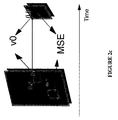
- the current macroblock being processed will be coded without motion estimation ('Intra') if: where "MSE” is the mean square error, whereas 'var' is the sampling variance of the reference macroblock, that is: where p i,j is the value of the pixel of the current macroblock.
- the coder will not consider the values of its single pixels directly as samples that will be thereafter transformed and quantized, but will perform these operations on samples obtained from the pixels, by subtracting from them the value "128" that is at the middle of the variability field.
- the system simply updates the structure predisposed to contain the motion vectors with the so found and selected values.
- the coder may decide to code the macroblock with or without "motion compensation" (MC/no-MC). To do this, it calculates the mean square error between the reference macroblock and the one placed on the field on which the prediction is based with the same absolute coordinates of the first (referred to as V 0 ) and compares it with the previously found mean square error (MSE). The coder will decide to use the motion estimation result if, and only if, the following two conditions are simultaneously verified:
- Figure 2c illustrates the scheme of the decision algorithm according to the known technique.
- the procedure contemplates the calculation of the product of the variance estimates of the prediction errors of the two fields separately where ⁇ Top is the prediction error of the "Top field” (composed of the even lines of the field: 0, 2, 4, 7), ⁇ Bot is the predicting error of the "Bottom field” (composed of the odd lines of the field: 1, 3, 5, ).
- the prediction error is calculated in respect to an hypothetical block whose pixels have all the same value (equal to 128) which is at the center of the variability range of the pixel values (0-255).
- the prediction error associated to at least one of the two fields is uniform and thus it is convenient to compute a DCT field (only one coefficient after DC1).
- at least one of the two fields has a null variance so the two fields are uncorrelated and the DCT is then computed in a "Field” mode, that is independently on the two semifields that make up the Y, U and V blocks.
- the correlation index should be calculated among the prediction errors on two fields:
- the DCT When such an index is high (that is greater than a predefined threshold), the DCT is calculated in a "Frame” mode. By contrast, if it is small (less than a predefined threshold), the prediction error among the two fields is uncorrelated, thus the DCT is calculated in a "Field” mode.
- the selection of the prediction method and of the discrete cosine transformation mode is carried out through an algorithm which requires a remarkably complex processing, requiring the calculation of variance and correlation indexes through the execution of multiplication, square root, division operations etc. For these reasons a hardware implementation of the algorithm is rather burdensome and costly.
- the main objective of the present invention is to provide a method for coding video data of simpler hardware implementation than the known method and in particular to devise an algorithm of selection of the prediction method and of the DCT mode simpler than the algorithm of the prior art and less burdensome to be implemented by hardware means.
- the method of the present invention is not based on the calculation of variance and correlation indexes but rather on the evaluation of differences between adjacent pixels so identifying a complexity index, and on processing spread indexes of mean absolute prediction errors.
- This value, SMA p, is calculated in respect to the macroblock being estimated a whose prediction of which is being sought.
- the E operator indicates an average operation and ⁇ indicates the average value of the pixels.
- the field to which the macroblock belongs is a B field, and both the above conditions are not complied with, no further control is performed, and the obtained predictor will be inserted in the bit stream together with the motion vectors that characterize it, the prediction method ("Forward”, “Backward”, or “Interpolated") and the quantized prediction error.
- SMA ⁇ 0 is the absolute mean spread calculated in respect to the macroblock identified by the null vector.
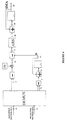
- Figure 3 shows a flow chart of the above described method and figure 4 shows a possible hardware architecture for calculating the "absolute mean spread”.
- block complexity it is intended the maximum of all the absolute differences between two horizontally adjacent pixels (belonging to the same line) and vertically adjacent pixels. By adding the maxima of the differences calculated for all the blocks composing a certain macroblock, a total macroblock complexity is obtained.
- the calculation is repeated twice, once on the blocks obtained as though the successive DCT transform would be done in a "frame" mode, therefore with the lines of the blocks belonging to different semifields, and a second time by supposing that the DCT transform would be done in a "field” mode, and therefore with the lines of the blocks belonging to the same semifields.
- the method of the invention is particularly useful in application such as coders for DVD recording, camcorders and the like.
Landscapes
- Engineering & Computer Science (AREA)
- Multimedia (AREA)
- Signal Processing (AREA)
- Physics & Mathematics (AREA)
- Algebra (AREA)
- General Physics & Mathematics (AREA)
- Mathematical Analysis (AREA)
- Mathematical Optimization (AREA)
- Pure & Applied Mathematics (AREA)
- Compression Or Coding Systems Of Tv Signals (AREA)
Priority Applications (3)
| Application Number | Priority Date | Filing Date | Title |
|---|---|---|---|
| EP98830689A EP1003336A1 (fr) | 1998-11-17 | 1998-11-17 | Compression d'images vidéo et codage avec étape décisoire pour le codage du type DCT en ce qui concerne le choix trame/image et le choix des vecteurs de mouvements |
| JP11319144A JP2000165884A (ja) | 1998-11-17 | 1999-11-10 | フィ―ルド/フレ―ムに対する決定ステップ及び運動ベクトルdctを有するビデオピクチャ圧縮及びコ―ディング |
| US09/438,853 US6556718B1 (en) | 1998-11-17 | 1999-11-12 | Video pictures compression and coding with decision step for field/frame and motion vectors DCT |
Applications Claiming Priority (1)
| Application Number | Priority Date | Filing Date | Title |
|---|---|---|---|
| EP98830689A EP1003336A1 (fr) | 1998-11-17 | 1998-11-17 | Compression d'images vidéo et codage avec étape décisoire pour le codage du type DCT en ce qui concerne le choix trame/image et le choix des vecteurs de mouvements |
Publications (1)
| Publication Number | Publication Date |
|---|---|
| EP1003336A1 true EP1003336A1 (fr) | 2000-05-24 |
Family
ID=8236886
Family Applications (1)
| Application Number | Title | Priority Date | Filing Date |
|---|---|---|---|
| EP98830689A Withdrawn EP1003336A1 (fr) | 1998-11-17 | 1998-11-17 | Compression d'images vidéo et codage avec étape décisoire pour le codage du type DCT en ce qui concerne le choix trame/image et le choix des vecteurs de mouvements |
Country Status (3)
| Country | Link |
|---|---|
| US (1) | US6556718B1 (fr) |
| EP (1) | EP1003336A1 (fr) |
| JP (1) | JP2000165884A (fr) |
Cited By (3)
| Publication number | Priority date | Publication date | Assignee | Title |
|---|---|---|---|---|
| WO2009056978A3 (fr) * | 2007-11-01 | 2009-07-09 | Tandberg Television Asa | Codage paff (picture adaptive frame/field) pour mpeg2 |
| EP1515563A3 (fr) * | 2003-08-14 | 2009-11-04 | Corel Inc. | Systèmes et procédures de selection de modes dans un codeur vidéo |
| CN113196780A (zh) * | 2019-01-12 | 2021-07-30 | 韦勒斯标准与技术协会公司 | 使用多变换核处理视频信号的方法和设备 |
Families Citing this family (16)
| Publication number | Priority date | Publication date | Assignee | Title |
|---|---|---|---|---|
| US6760378B1 (en) * | 1999-06-30 | 2004-07-06 | Realnetworks, Inc. | System and method for generating video frames and correcting motion |
| JP3662171B2 (ja) * | 2000-06-05 | 2005-06-22 | 三菱電機株式会社 | 符号化装置及び符号化方法 |
| US20030058942A1 (en) * | 2001-06-01 | 2003-03-27 | Christian Hentschel | Method of running an algorithm and a scalable programmable processing device |
| US6765964B1 (en) | 2000-12-06 | 2004-07-20 | Realnetworks, Inc. | System and method for intracoding video data |
| US20030099294A1 (en) * | 2001-11-27 | 2003-05-29 | Limin Wang | Picture level adaptive frame/field coding for digital video content |
| US7170937B2 (en) * | 2002-05-01 | 2007-01-30 | Texas Instruments Incorporated | Complexity-scalable intra-frame prediction technique |
| US7386048B2 (en) * | 2002-05-28 | 2008-06-10 | Sharp Laboratories Of America, Inc. | Methods and systems for image intra-prediction mode organization |
| JP3548765B1 (ja) * | 2003-03-11 | 2004-07-28 | オムロン株式会社 | 最大電力追従制御装置 |
| EP1585061A1 (fr) * | 2004-04-07 | 2005-10-12 | Deutsche Thomson-Brandt Gmbh | Procede de codage predictif adapte aux blocs |
| US8687710B2 (en) * | 2005-05-17 | 2014-04-01 | Broadcom Corporation | Input filtering in a video encoder |
| JP4561701B2 (ja) * | 2006-07-04 | 2010-10-13 | 日本ビクター株式会社 | 動画像符号化装置 |
| US9654792B2 (en) | 2009-07-03 | 2017-05-16 | Intel Corporation | Methods and systems for motion vector derivation at a video decoder |
| KR101452860B1 (ko) | 2009-08-17 | 2014-10-23 | 삼성전자주식회사 | 영상의 부호화 방법 및 장치, 영상 복호화 방법 및 장치 |
| CN101867816A (zh) * | 2010-05-10 | 2010-10-20 | 南京邮电大学 | 一种基于人眼视觉特性的立体视频非对称压缩编码方法 |
| US9378185B2 (en) * | 2010-09-30 | 2016-06-28 | Texas Instruments Incorporated | Transform and quantization architecture for video coding and decoding |
| US8811756B2 (en) | 2011-07-11 | 2014-08-19 | International Business Machines Corporation | Image compression |
Citations (2)
| Publication number | Priority date | Publication date | Assignee | Title |
|---|---|---|---|---|
| EP0695097A2 (fr) * | 1994-07-29 | 1996-01-31 | Sharp Kabushiki Kaisha | Dispositif pour le codage vidéo |
| US5666461A (en) * | 1992-06-29 | 1997-09-09 | Sony Corporation | High efficiency encoding and decoding of picture signals and recording medium containing same |
Family Cites Families (2)
| Publication number | Priority date | Publication date | Assignee | Title |
|---|---|---|---|---|
| JP3954656B2 (ja) * | 1994-09-29 | 2007-08-08 | ソニー株式会社 | 画像符号化装置及び方法 |
| US5978029A (en) * | 1997-10-10 | 1999-11-02 | International Business Machines Corporation | Real-time encoding of video sequence employing two encoders and statistical analysis |
-
1998
- 1998-11-17 EP EP98830689A patent/EP1003336A1/fr not_active Withdrawn
-
1999
- 1999-11-10 JP JP11319144A patent/JP2000165884A/ja active Pending
- 1999-11-12 US US09/438,853 patent/US6556718B1/en not_active Expired - Lifetime
Patent Citations (2)
| Publication number | Priority date | Publication date | Assignee | Title |
|---|---|---|---|---|
| US5666461A (en) * | 1992-06-29 | 1997-09-09 | Sony Corporation | High efficiency encoding and decoding of picture signals and recording medium containing same |
| EP0695097A2 (fr) * | 1994-07-29 | 1996-01-31 | Sharp Kabushiki Kaisha | Dispositif pour le codage vidéo |
Non-Patent Citations (2)
| Title |
|---|
| ISO/IEC JTC1/SC29/WG11: "M3464: MPEG-4 video verification model 10.1", March 1998, ISO/IEC, XP001091544 * |
| ZHANG X.M. ET AL: "Adaptive field/frame selection for high compression coding", SPIE CONFERENCE ON IMAGE AND VIDEO COMMUNICATIONS AND PROCESSING, January 2003 (2003-01-01), pages 583 - 593, XP001091545 * |
Cited By (4)
| Publication number | Priority date | Publication date | Assignee | Title |
|---|---|---|---|---|
| EP1515563A3 (fr) * | 2003-08-14 | 2009-11-04 | Corel Inc. | Systèmes et procédures de selection de modes dans un codeur vidéo |
| WO2009056978A3 (fr) * | 2007-11-01 | 2009-07-09 | Tandberg Television Asa | Codage paff (picture adaptive frame/field) pour mpeg2 |
| CN113196780A (zh) * | 2019-01-12 | 2021-07-30 | 韦勒斯标准与技术协会公司 | 使用多变换核处理视频信号的方法和设备 |
| US12192503B2 (en) | 2019-01-12 | 2025-01-07 | Humax Co., Ltd. | Method and device for processing video signal using multiple transform kernels |
Also Published As
| Publication number | Publication date |
|---|---|
| JP2000165884A (ja) | 2000-06-16 |
| US6556718B1 (en) | 2003-04-29 |
Similar Documents
| Publication | Publication Date | Title |
|---|---|---|
| US6556718B1 (en) | Video pictures compression and coding with decision step for field/frame and motion vectors DCT | |
| US5648819A (en) | Motion estimation using half-pixel refinement of frame and field vectors | |
| KR101192026B1 (ko) | 소스 픽쳐의 시퀀스를 코딩하는 방법 또는 장치 | |
| KR100626994B1 (ko) | 가변 비트 레이트 비디오 코딩 방법 및 대응 비디오 코더 | |
| EP1262073B1 (fr) | Procede et appareil d'estimation de mouvement a l'aide de macroblocs voisins | |
| US8023562B2 (en) | Real-time video coding/decoding | |
| US8553768B2 (en) | Image encoding/decoding method and apparatus | |
| US6519005B2 (en) | Method of concurrent multiple-mode motion estimation for digital video | |
| US5438374A (en) | System and method for filtering video signals | |
| US8170355B2 (en) | Image encoding/decoding method and apparatus | |
| US5508744A (en) | Video signal compression with removal of non-correlated motion vectors | |
| US20030053543A1 (en) | Motion estimation technique for digital video encoding applications | |
| WO2008020687A1 (fr) | Procédé et appareil de codage/décodage d'images | |
| EP1024456A2 (fr) | Evaluation de mouvement par correspondence de blocs de domaine d'une transformee orthogonale | |
| WO2007108640A2 (fr) | Procédé et appareil de codage et de décodage d'images | |
| WO1996041482A1 (fr) | Estimation de mouvement hybride hierarchique/recherche complete pour codeur mpeg | |
| US6829373B2 (en) | Automatic setting of optimal search window dimensions for motion estimation | |
| EP0979011A1 (fr) | Détection d'un changement de scène dans un estimateur de mouvement d'un encodeur vidéo | |
| Yeh et al. | Motion compensation of motion vectors | |
| US20070092007A1 (en) | Methods and systems for video data processing employing frame/field region predictions in motion estimation | |
| US6545727B1 (en) | Method for recognizing a progressive or an interlaced content in a video sequence | |
| US20050005301A1 (en) | Method and apparatus for determining motion compensation mode | |
| EP0865199A1 (fr) | Méthode d'estimation de mouvement pour des séquences d'images, appliqué en particulier dans le domaine du traitement de signal vidéo | |
| KR20000018311A (ko) | 영상 시스템의 움직임 추정방법 및 장치 | |
| EP1083751A1 (fr) | Mesure de l'activité d'images vidéo dans le domaine DCT |
Legal Events
| Date | Code | Title | Description |
|---|---|---|---|
| PUAI | Public reference made under article 153(3) epc to a published international application that has entered the european phase |
Free format text: ORIGINAL CODE: 0009012 |
|
| AK | Designated contracting states |
Kind code of ref document: A1 Designated state(s): DE FR GB IT |
|
| AX | Request for extension of the european patent |
Free format text: AL;LT;LV;MK;RO;SI |
|
| 17P | Request for examination filed |
Effective date: 20000529 |
|
| AKX | Designation fees paid |
Free format text: DE FR GB IT |
|
| 17Q | First examination report despatched |
Effective date: 20050211 |
|
| 17Q | First examination report despatched |
Effective date: 20050211 |
|
| GRAP | Despatch of communication of intention to grant a patent |
Free format text: ORIGINAL CODE: EPIDOSNIGR1 |
|
| STAA | Information on the status of an ep patent application or granted ep patent |
Free format text: STATUS: THE APPLICATION HAS BEEN WITHDRAWN |
|
| 18W | Application withdrawn |
Effective date: 20071128 |