EP1003673B1 - Procede et appareil pour tordre un lien arme sans fil - Google Patents
Procede et appareil pour tordre un lien arme sans fil Download PDFInfo
- Publication number
- EP1003673B1 EP1003673B1 EP98967063A EP98967063A EP1003673B1 EP 1003673 B1 EP1003673 B1 EP 1003673B1 EP 98967063 A EP98967063 A EP 98967063A EP 98967063 A EP98967063 A EP 98967063A EP 1003673 B1 EP1003673 B1 EP 1003673B1
- Authority
- EP
- European Patent Office
- Prior art keywords
- ribbon
- assembly
- twister
- bag
- tails
- Prior art date
- Legal status (The legal status is an assumption and is not a legal conclusion. Google has not performed a legal analysis and makes no representation as to the accuracy of the status listed.)
- Expired - Lifetime
Links
Images





Classifications
-
- B—PERFORMING OPERATIONS; TRANSPORTING
- B65—CONVEYING; PACKING; STORING; HANDLING THIN OR FILAMENTARY MATERIAL
- B65B—MACHINES, APPARATUS OR DEVICES FOR, OR METHODS OF, PACKAGING ARTICLES OR MATERIALS; UNPACKING
- B65B51/00—Devices for, or methods of, sealing or securing package folds or closures; Devices for gathering or twisting wrappers, or necks of bags
- B65B51/04—Applying separate sealing or securing members, e.g. clips
- B65B51/08—Applying binding material, e.g. to twisted bag necks
Definitions
- the invention relates to a method and apparatus for twisting a wireless ribbon around the gathered neck of a bag for closing and sealing the bag.
- Richardson and Greg P. Coxsey entitled "RIBBON SENSING DEVICE FOR BAG TYER” disclose automatic bag closing and tying machines used for closing a flexible bag by attaching and twisting a wire-like ribbon about the neck of the bag.
- Bag tying devices of the type disclosed in the aforementioned patents are commercially available from Burford Corporation of Maysville, Oklahoma.
- the tying devices are generally constructed to receive packages such as loaves of bread at speeds of for example one hundred (100) packages per minute.
- a ribbon of wire, encased in a covering of paper or plastic, is pulled from a roll, wrapped around the neck of the bag, cut and twisted to form a reclosable seal.
- U.S. Patent No. 4,797,313 discloses an essentially organic, non-metallic ribbon for use as a twist tie comprising polymeric material exhibiting glass/rubber transitional behaviour.
- Polymeric ribbons deformed under tensile stress at 25 degree(s) exhibit yield stress between about 3,44 MPa and 62 MPa (500 and 9,000 psi).
- Discrete lengths of ribbon are capable of being disengagedly formed into fastly held twist ties by rotationally deforming terminal ends of said lengths about each other.
- the ribbons can comprise polymers, such as polyalkylene terephthalates, polyvinylchlorides, styrene-acrylonitrile copolymers and polystyrenes.
- Optional polymeric materials include elastomeric impact modifiers and plasticizers.
- the patent states that the ribbon was utilised in an automatic bag closing and tying machine (model 50-7, Burford Corporation) at packaging rate of 60 bags per minute. The machine produced tight ties having between 1 and 11 ⁇ 2 twists.
- U.S. Patent No. 5,342,687 discloses a non-metallic coreless twist-tie formed by extruding polymeric material and then drawing the material at a rate of more than about 2.5 times.
- the polymer is described as being formed from polymeric resin having a degree of crystallization of about 10% to 60% at a crystallized temperature range of about 100 degree(s) C. to 250 degree(s) C. and can also include a quantity of fine glass beads.
- U.S. Patent No. 4,907,392 and U.S. Patent No. 4,005,563 both disclose a bag neck tying apparatus comprising a source of ribbon for dispensing a strand of ribbon having a free end and a central portion, a holder-shearer assembly for holding the free end of said ribbon, a twister assembly having a hook adjacent said holder-shearer assembly, a needle assembly for engaging and positioning said central portion of said ribbon adjacent said holder-shearer assembly, and means for rotating said twister assembly for engaging and twisting said ribbon to form a tie.
- Non-metallic coreless twist-tie ribbon has a different cross-sectional profile and physical characteristics that may result is slippage of the ribbon in the twister hook, loose ties and some times disengagement of the end of the ribbon from the holder.
- the present invention provides a method for closing and securing a bag comprising the steps of: gathering an open end of the bag to form a gathered neck; encircling the gathered neck with a ribbon strand having first and second ribbon tails; deflecting the ribbon tails relative to the ribbon strand at an angle sufficient to prevent longitudinal movement of the ribbon tails; and rotating the ribbon tails relative to the ribbon strand to twist the ribbon strand to form a tie; characterised by: the steps of deflecting the ribbon tails relative to the ribbon and twisting the tails into a tie comprising the step of: rotating a twister hook on a twister shaft adjacent a laterally extending ribbon guide surface, such that the ribbon extends generally parallel to the twister shaft and said ribbon tails are drawn by the twister hook across the ribbon guide surface and extend generally perpendicular to said twister shaft and to said twister hook.
- the present invention also provides a Bag neck tying apparatus comprising: a source of ribbon for dispensing a strand of ribbon having a free end and a central portion; a holder-shear assembly for holding the free end of said ribbon; a twister assembly having a hook adjacent said holder-shear assembly; a needle assembly for engaging and positioning said central portion of said ribbon; and means for rotating said twister assembly for engaging and twisting said ribbon to form a tie; characterised by: said twisted assembly further comprising a ribbon guide providing an upper surface extending transversely relative to said hook; wherein said needle assembly is for engaging and positioning said central portion of said ribbon adjacent said ribbon guide and adjacent said holder-shear assembly; and wherein upon rotating said twister assembly, said ribbon guide deflects a portion of said ribbon relative to the direction defined by said hook and said shear holder assembly.
- an improved holder shear assembly incorporates a V-shaped groove formed in the holder and a V-shaped rib formed on a gripper finger such that the ribbon is contacted at several different areas before the ribbon is cut.
- a gripper finger As the gripper finger is rotated it pushes the ribbon into the comer of a holder cutting area. Tension on the ribbon extrudes the ribbon and grabs to pre-hold the ribbon.
- the gripper finger As the gripper finger rotates further, the ribbon is moulded and bent over a cutting edge on the holder. This causes the ribbon to be securely held between surfaces on the gripper finger and the holder before the ribbon is cut.
- the V-shaped groove in the holder and the V-shaped rib on the gripper finger are not parallel to each other.
- a shuttle bar connected for moving the gripper finger is mounted in a resilient bushing such that different gauges of wire or wireless ribbon can be used with the holder shear assembly without requiring adjustment of cams and other actuating mechanisms.
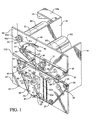
- the wire tying device generally designated by the numeral 10, in FIGS. 1 and 2 of the drawing is preferably of the type disclosed in U.S. Patent No. 5,483,134, that issued January 9, 1996, to Frazier, et al.
- improvements in the twister hook assembly 50 and a holder-shear assembly 60 are incorporated into the device to provide improved performance when different types of ribbon or ribbon constructed of different materials are used to tie bags.
- the wire tying device is mounted adjacent the side of a conveyor 300 of the type disclosed in Burford U.S. Pat. No. 3,138,904 and Burford U.S. Pat. No. 3,919,829.
- Conveyor 300 carries for example, loaves 125 of bread to, through and out of wire tying device 10 in rapid succession.
- Conveyor 300 is well known to persons skilled in the art and further description thereof is not deemed necessary except in connection with the drive mechanism as will be hereinafter more fully explained. It should be appreciated that other and further structures may form the conveyor.
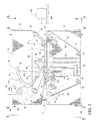
- the numeral 20 generally designates a bag gathering apparatus for moving a bag 125 along a path 12 to a position adjacent a needle assembly 40, a twister hook assembly 50 and a holder-shear assembly 60.
- the free end of a ribbon 15 is gripped in a holder-shear assembly 60.
- the neck of the bag moves through a slot 122 between upper face plate 16 and lower face plate 17 for drawing the bag 125 to a controlled tension about the contents.
- Needle assembly 40 wraps the ribbon 15 about the gathered neck of the bag and twister hook 50 is actuated for twisting a portion of the ribbon 15 about the neck of the bag 125.
- the ribbon 15 may be constructed of wire enclosed in paper or plastic or it may comprise a ribbon of plastic or any other material.
- the strand of ribbon 15 extends around one or more pulleys 41, 41a and 41b, mounted on shafts 41a', from a spool 41c of tie material.
- the mounting for spool 41c is similar to that disclosed in U. S. Patent No. 3,919,829 entitled "APPARATUS FOR TYING PACKAGES AND WRAPPING MATERIALS".
- spool 41c of tie material is mounted on a shaft and the ribbon 15 is fed from spool 14c, routed around rollers 41b, 41a and 41, around needle roller 44 and the cad of the ribbon 15 is gripped in the holder-shear assembly 60, as best illustrated in Figure I of the drawing.
- Spool 41c is mounted on a shaft engaged by a brake (not shown).
- needle 42 forms a loop of tie material around the gathered neck of a bag
- the force of inertia and force exerted by the brake cause the spool 41c to remain stationary momentarily as a crank arm, on which roller 41a is mounted, is rotated.
- one of the pulleys 41, 41a or 41b is preferably equipped with a sensor device which is capable of calculating the amount of ribbon 15 dispensed from spool 41c.
- the sensor apparatus determines whether or not a bag neck is present. As needle 41 moves from the full outline position illustrated in Figure 2 to the dashed outline position, if a bag neck is not positioned in the path of the ribbon, the cycle of operation will be interrupted so that the holder-shear assembly 60 will not be actuated and the twister hook assembly 50 will not rotate. This prevents actuation of the holder-shear assembly which would have resulted in the ribbon being dropped or released if a bag neck was not present.
- the frame of the bag tying device may assume many configurations.
- upper and lower face plates 16 and 17 are supported on forward edges of vertically extending end plates 18 and 19 having slots formed therein to permit passage of a bag neck.
- a horizontal mounting plate 19a extends between lower portions of end plates 18 and 19 and a vertical mounting plate 16a extends outwardly from end plate 18.
- a motor M1, having an encoder E1 mounted the rear end of motor M1 is mounted on an upper portion of the vertical mounting plate 16a for driving the gathering assembly 20.
- a motor M2, having an encoder E2 mounted the rear end and a gear box 46 mounted on the front end of motor M2, is mounted on an upper portion of the rear surface of face plate 16 for driving the needle assembly 40.
- a motor M3, having an encoder E3 mounted the rear end of motor M3, is mounted vertically on horizontally extending mounting plate 19a for driving the twister hook assembly 50.
- a motor M4, having an encoder E4 mounted the rear end of motor M4, is mounted on a lower portion of end plate 18, and in the illustrated embodiment extends below motor M2, for driving the holder-shear assembly 60.
- bag neck gathering apparatus 20 comprises, in a preferred embodiment of the invention, an upper gathering belt 22 routed around a driven pulley 24 and idler pulleys 26, 27 and 28.
- the bag neck gathering mechanism 20 further comprises a lower gathering belt 32 routed around a driven pulley 34 and idler pulleys 36, 37 and 38.
- the portion 29 of the upper gathering belt 22, extending between idler pulleys 27 and 28, is substantially parallel and closely spaced relative to the portion 39 of the lower gathering belt 32 which extends between driven pulley 34 and idler pulley 36.
- gathering belts 22 and 32 move a bag neck along path 12 in a plane P as illustrated in Figure 2.
- driven shaft 25 having driven pulley 24 mounted on one end, has a pulley 23 mounted on its opposite end.
- a pulley 30 mounted on the drive shaft of motor M1 drives pulleys 23 and 33 through a belt 31 such that driven pulley 24 rotates in a clockwise direction while driven pulley 34 rotates in a counter-clockwise direction, as viewed in Figure 2 of the drawing.
- Belt guards 16a and 16b and 17a preferably extend between the gathering belts and products on the conveyor.
- the bag neck is moved into a slot in the belt guard by brushes (not shown) and the product in the bag engages the belt guards when the neck of the bag is drawn by gathering belts 22 and 32 around a bag stop lever 80. It should be appreciated that other and further gathering structures may be used to form a gathered neck on a bag.
- motor M1 is driven by a solid state DC motor controller 91 which is capable of varying the speed of motor M1 to substantially synchronize movement of upper gathering belt 22 and lowering gathering belt 33 with the speed of a conveyor 300 moving packages 125 adjacent the bag gathering mechanism 20.
- the conveyer 3 00 would preferably bring bags to and through the tier at a speed of approximately 91.44 meters per minute (300 feet per minute) and the gathering belts 22 and 32 would preferably be driven at a speed of, for example 92.96 meter per minute (305 feet per minute), so that the neck of the bag would be accelerated for gathering the neck, stopped momentarily while it is being tied with a ribbon and then discharged in a substantially continuous operation.
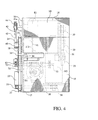
- the gathering assembly 20 also includes a bag stop lever 80, illustrated in Figures 2 and 3, mounted on shaft 85 for rotary movement about a horizontal axis, in the illustrated embodiment.
- Shaft 85 extends through an electric brake 82, which momentarily locks lever 80 in a lowered position extending across path 12 such that gathering belts 22 and 32 move the bag neck into engagement with lever 80.
- the electric brake 82 is released and the gathered neck, carried between belts 22 and 32, urges the lever 80 upwardly such that it does not obstruct movement of the gathered neck.
- the lever 80 moves back to the illustrated position extending across path 12.
- a needle assembly 40 is positioned for wrapping a strand 15 of ribbon material around a gathered neck of a bag.
- the needle assembly 40 comprises a needle 42 carrying idler rollers 44,44a and 44b.
- the needle 42 is mounted on the output shaft 45 of a gear box 46 driven by motor M2.
- Needle 42 is shown in its home position in Figures 1 and 2 of the drawing. Motor M2 moves needle 42 from the full outline position to the dashed outline position, illustrated in Figure 2 of the drawing, and then reverses for moving the needle 42 back to the position illustrated in full outline in Figure 2.
- a twister hook assembly 50 comprises a twister shaft 52 rotatably mounted in a bearing 53 having a hook 54 on one end thereof and a pulley 55 on the other end.
- a drive pulley 56 is mounted on the drive shaft of motor M3 and drives pulley 55 through a belt 58.
- a ribbon guide plate 59 is mounted on the upper end of a support plate 57 secured to bearing block 53 and extending generally parallel to shaft 52.
- the ribbon guide plate 59 has an opening which encircles shaft 52 to provide an upper surface extending generally transversely of twister hook 54. Tails of ribbon 15 extend upwardly from holder shear assembly 66 and are engaged by hook 54 when shaft 52 is rotated.
- the tails of the severed section of ribbon are drawn across guide surface 59 and deflected relative to twister hook 54 at an angle of approximately 90°. This reduces the tendency of the tails of the severed ribbon to slip relative to the twister hook.
- the loop portion of ribbon 15 extends above hook 54 mounted on shaft 52.
- Ribbon guide plate 59 mounted immediately below twister hook 54 pulls the tails 15a and 15b across the upper surface of ribbon guide 58 which forms a"kink" where hook 54 engages tails 15a and 15b to at least partially wrap the ribbon around the surface of hook 54 and pull it into a groove between hook portion 54 and shaft 52. Rotation of shaft 52 and hook 54 causes the ribbon material above hook 54 to be twisted.
- ribbon guide plate 59 is positioned between twister hook 54 and the holder shear assembly 60.
- a ribbon holder-shear assembly comprises a holder and shear assembly of the type disclosed in U. S. Design Patent No. 307,281 to Charles E. Burford and U. S. Patent No. 4,856,258 entitled WIRE TYING DEVICE, which issued August 15,1989, to Charles E. Burford and Jimmy R Frazier.
- the holder-shear assembly 60 comprises a gripper arm 62 having a gripper finger 64 on one end thereof rotatably secured to a mounting plate 66 by bolt 65.
- a pair of anvils 68 and 69 are formed on the end of mounting plate 66, each being associated with shear surfaces 68a and 69a to grip and cut a strand of ribbon as will be hereinafter more fully explained.
- the gripper finger has ribs 64a and 64b having surfaces that are angularly disposed at the same angle as surfaces 69c and 69d on anvil 69. However, the edge of the rib 64a and the inner section 69d between surfaces 69c and 69e are not parallel. As illustrated in Figure 13, the surface of the rib forms a tapered slot 67 of diverging cross-section to make a pinch angle. As the ribbon 15 is pulled out of the cutting area, this causes the ribbon to be pinched tighter as tension increases.
- Gripper finger 62 is oscillated between anvils 68 and 69 by a shuttle rod 75 having a cylindrical end 75a with a resilient bushing 75b through which a bolt 75c extends.
- the device operates effectively with wire or wireless ribbon 15 and also different gauges of wire or wireless ribbon because resilient bushing 75b is compressed and deforms to accommodate different size ribbon in slot 67.
- Profile of cam 75 is shaped to permit rotation of the cam through an angle of a few degrees when the cam and shuttle bar are in home positions without changing the cam follower position. This is done so that the cam may be rotated quickly and if the motor over-shoots the home position it can back the cams to the desired home position.
- a cam 70 is mounted on the shaft of motor M4 and is configured to engage cam-followers 72 and 74 on spaced arms 71 and 73 secured to a shuttle rod 75 mounted for reciprocating movement in bearings 76.
- a link 75a secures the end of gripper arm 62 to shuttle rod 75.
- cam 70 will exert force through cam-followers 72 and 74 for moving shuttle rod 75 for pivoting the actuating arm 62 about bolt 65.
- the free end of the ribbon is gripped between the end of gripper finger 64 and anvil 68 or 69, depending on which direction the gripper finger 64 is shifted.
- the ribbon will be positioned between gripper finger 64 and the other anvil 68 or 69.
- gripper finger 64 is shifted to its opposite position, the ribbon will be cut and the free end of the strand of ribbon will be gripped between gripper finger 64 and anvil 68 or 69.
- roller 41 has a plurality of index points 41x.
- the index points are formed by steel dowel pins circumferentially spaced around the axis about which roller 41 rotates.
- a proximity switch is positioned near index pointers 41x for making an electrical circuit when the presence of an indexing pin 41x is sensed.
- the proximity switch is of conventional design and is connected through a suitable power supply and amplifier to the CPU 96.
- the CPU monitors the proximity output and counts the pulses produced by index pins 41x in roller 41.
- the CPU 96 calculates the amount of ribbon dispensed to determine whether or not a bag neck is present as needle 42 moves from the full outline position illustrated in Figure 2 of the drawing toward the dashed outline position illustrated in Figure 2 of the drawing. If needle 42 did not wrap ribbon around a bag neck, the CPU will terminate a portion of the remainder of the cycle of operation so that holder-shear 65 will not be actuated to prevent releasing the end of ribbon 15 which is gripped between gripper finger 64 and anvil 68 or 69.
- a bag stop lever 80 is mounted on a shaft 85 for rotary movement about a horizontal axis.
- Shaft 85 extends through an electric brake 82 and has a crank arm 85a secured thereto which is resiliently urged in a clockwise direction, as viewed in Figure 3, by a spring 83.
- a switch 86 is actuated by switch arm 88, which actuates a timer for energizing electric brake 82 which momentarily locks bag stop 80 in a fixed position for a predetermined period of time, for example 0.25 seconds for restraining the leading edge of a bag neck, such that gathering belts 22 and 32 will gather the neck adjacent bag stop 80.
- electric brake 82 At the expiration of the predetermined period of time, electric brake 82 will be de-energized so that linear movement of the bag neck will rotate bag stop 80 upwardly to release the bag so that it will be moved away by the conveyor.
- Bag stop 80 is biased toward the position illustrated in Figure 3 of the drawing by a spring 83. It should be readily apparent that the spring 83 may be replaced by a counter-weight, air cylinder or other suitable biasing mechanism to resiliently urge bag stop 80 toward its home position.
- Motors M1, M2, M3 and M4 are bi-directional, permanent magnet, DC brush-type servomotors having outputs proportional to the voltage applied across the armatures. Such motors are commercially available from Groschopp, Inc. of Sioux Center, Iowa as a "Power Master 8304" 24 volt DC continuous power motor. At 1500 rpm the motor generates 0.113 Nm (16 oz-in) torque and has an output of 67,1 Watts (090 horsepower) at 4.2 Ampere. At 2450 rpm the torque is 0.332 Nm (47 oz-in) and the output is 84.26 Watts (113 horsepower) at 5 Ampere. At 5400 rpm the torque is 0.261 Nm (37 oz-in) and the output is 146,9 Watts (197 horsepower) at 8.2 Ampere.
- motors and motors of other sizes may be provided to facilitate driving the various assemblies.
- smaller motors would be used in a counter top model used for gathering and fastening materials such as coils of electrical cord, water hose, tubing, or yarn, and bundles of cable, rods, or carrots and other produce.
- One side of the armature winding of each motor M1, M2, M3 and M4 is connected to ground such that reversing the polarity of current through the armature winding reverses the direction of rotation of the motor.
- Each of the motors M1, M2, M3 and M4 has an encoder E1, E2, E3 or E4 mounted on its drive shaft which delivers an electrical signal to a decoder D1, D2, D3 or D4 which is representative of the position of the motor shaft
- the numeral 90 generally designates a power supply for delivering electric current to motor controller 91 and to motor M1 in the bag neck gathering mechanism 20; motor controller 92 and motor M2 in the needle assembly 40; motor controller 93 and motor M3 in the twister assembly 50; and motor controller 94 and motor M4 in the holder-shear assembly 60.
- the system is controlled by a computer 95, diagrammatically illustrated in Figure 7, which receives and stores a set of instructions and then acts upon the instructions in a predetermined and predictable fashion.
- a microprocessor 96 is attached to a printed circuit board into which a thin layer of metal has been applied and then etched away to form traces.
- the electronic components of the central processing unit are attached to the board with solder so that they can change electronic signals through the etched traces on the board.
- a suitable 32-bit integrated microcontroller 96 is the MC68332 which is commercially available from Motorola, Inc. of Schaumburg, Illinois as a product referred to as "MC68332 SIM" System Integrated Module.
- the MC68332 microcontroller 96 contains intelligent peripheral modules such as the time processor unit (TPU) which provides 16 microcoded channels for performing time-related activities for simple input capture or output capture to complicated motor control or pulse width modulation.
- TPU time processor unit
- High-speed serial communications are provided by the queued serial module (QSM) with synchronous and asynchronous protocols available.
- QSM queued serial module
- Two kilobytes of fully static standby RAM allow fast two-cycle access for system and data stacks and variable storage with provision for battery backup. Twelve chip selects enhance system integration for fast external memory or peripheral access.
- IMB intermodule bus
- the CPU board is connected to an auxiliary board 98 through a connector header which carries data signals and address signals.
- Driver circuits C1-C4 which generate pulse width modulated (PWM) signals, are mounted on the auxiliary board along with the decoders D1-D4.
- PWM pulse width modulated
- the pulse width modulated signals from driver circuits C1-C4 are sent to the motor drivers 91-94 selectively delivering positive or negative DC power to control the operation of motors M1-M4.
- the circuits carrying input signals from the encoders E1-E4 to decoders D1-D4; the circuit carrying pulse width modulated signals from driver circuits C1-C4 to motor drivers 91-94; and the circuits carrying power from the motor drivers 91-94 to motors M1-M4 form a closed loop control system.
- the closed loop control system depends upon the feedback concept for operation and the output PWM signals are forced to a pre-assigned function of the reference input of the microcontroller of the central processing unit.
- the microcontroller 96 sends control PWM signals determined by the programmed movements stored in RAM memory in a pre-assigned order as a function of time after switch arm 88 returns to its home position illustrated in Figure 3.
- the control PWM signals are delivered to the control circuit.
- the control PWM signals delivered to each control circuit C1-C4 are delivered to motor drivers 91-94.
- the quadrature signals from decoders D1-D4 are read to adjust the control PWM signals.
- Drivers 92, 93 and 94 which control the delivery of power to motors M2, M3 and M4, respectively, for controlling the needle assembly 40, twister hook assembly 50 and holder-shear mechanism 60 are substantially identical.
- One side of the winding of each of the motors M2, M3 and M4 is connected to ground.
- Drivers 92, 93 and 94 deliver either positive or negative power to the other side of the motor winding for driving motors M2, M3 and M4 in opposite directions. For example, when positive 34 volt direct current is delivered to the winding of motor M2, its shaft is driven in a clock-wise direction. If negative 34 volt direct current is delivered to the winding of motor M2, its shaft will be driven in a counter-clockwise direction.
- the driver 91 for motor M1 connected to the bag gathering assembly 20, is similar to drivers 92, 93 and 94 except that driver 91 is not provided with the capability of delivering negative direct current because it is not necessary for motor M1 to be driven in reverse.
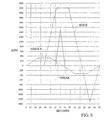
- FIG 11 is a graphic representation of the sequence of operation of the needle, hook and shear assemblies during a complete cycle of operation.
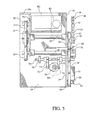
- the microcontroller 96 is initially programmed by a computer through a serial port RS for storing a program which will initiate movement of needle 42 from its home position illustrated in Figure 3 and the speed of movement toward the dashed outline position illustrated in Figure 3 controlled by signals delivered through control circuit C2 to motor M2.
- switch arm 88 will be moved downwardly from the position illustrated in Figure 3 which will energize electric brake 82 so that belts 22 and 32 will move the neck of the bag into engagement with bag stop 80 causing the neck to be gathered.
- switch arm 88 will move back to the position illustrated in Figure 3 causing switch 86 to send a signal to the microcontroller for starting a new tying cycle.
Landscapes
- Engineering & Computer Science (AREA)
- Mechanical Engineering (AREA)
- Package Closures (AREA)
- Control Of El Displays (AREA)
- Basic Packing Technique (AREA)
Claims (16)
- Procédé permettant de fermer et d'attacher un sac, comprenant les étapes consistant :caractérisé par les étapes consistant :à froncer une extrémité ouverte du sac, pour former un col froncé ;à entourer le col froncé, d'une bande de ruban (15) ayant une première et une seconde queues de ruban (15a, 15b) ;à dévier les queues de ruban par rapport à la bande de ruban (15), suivant un angle suffisant pour empêcher le mouvement longitudinal des queues de ruban ; età faire tourner les queues de ruban par rapport à la bande de ruban, pour torsader la bande de ruban et former un lien ;à dévier les queues de ruban par rapport aux rubans et à torsader les queues pour former un lien, comprenant l'étape consistant :à faire tourner un crochet de tordoir (54) sur un axe de tordoir (52), de façon adjacente à une surface (59) de guidage du ruban s'étendant latéralement, de sorte que le ruban (15) s'étend généralement de façon parallèle à l'axe de tordoir (52), et lesdites queues de ruban sont tirées par le crochet de tordoir (54) à travers la surface (59) de guidage du ruban et s'étendent généralement de façon perpendiculaire audit axe de tordoir (52) et audit crochet de tordoir (54).
- Procédé permettant de fermer et d'attacher des sacs selon la revendication 1, l'étape consistant à dévier les queues de ruban par rapport au ruban, comprenant l'étape consistant à dévier les queues de ruban (15a, 15b) par rapport au ruban (15), suivant un angle variant dans une plage comprise entre environ 70 degrés et 120 degrés.
- Procédé permettant de fermer et d'attacher des sacs selon la revendication 2, l'étape consistant à dévier les queues de ruban (15a, 15b) suivant un angle variant dans une plage comprise entre environ 70 degrés et 120 degrés, par rapport au ruban (15), comprenant l'étape consistant :à déplacer les queues de ruban à travers la surface (59) de guidage du ruban, pour enrouler lesdites queues de ruban autour d'un crochet de tordoir (54), pour fixer les queues de ruban (15a, 15b) par rapport audit crochet de tordoir (54), au fur et à mesure que la bande de ruban (15) est torsadée.
- Procédé permettant de fermer et d'attacher des sacs selon la revendication 1, l'étape consistant à entourer le col froncé, d'un ruban (15) ayant une première et une seconde queues de ruban, comprend l'étape consistant :à positionner les queues de ruban dans une fente placée dans un ensemble formant un tordoir (50), englobant ledit axe de tordoir (52) s'étendant à travers un passage dans ladite surface (59) de guidage du ruban, ledit crochet de tordoir (54) s'étendant généralement de façon parallèle à ladite surface (59) de guidage du ruban.
- Procédé permettant de fermer et d'attacher un sac selon la revendication 1, l'étape consistant à entourer le col froncé, d'un ruban (15) ayant une première et une seconde queues de ruban, comprenant les étapes consistant :à engager l'extrémité libre d'un ruban (15) - formant une première queue de ruban - entre un bras de cisaillement (62) et une des enclumes d'une paire d'enclumes supports (68, 69) formée sur l'extrémité d'une plaque de montage (66) ;à déplacer l'extrémité courante du ruban (15), entre le bras de cisaillement (62) et l'autre enclume de la paire d'enclumes supports (68, 69) ; età déplacer le bras de cisaillement (62) vers l'autre enclume support (68, 69), pour couper le ruban (15) et former une seconde queue de ruban sur la bande de ruban, et pour saisir l'extrémité libre du ruban (15), de sorte que la bande de ruban coupée forme une boucle autour du col froncé et a des queues de ruban (15a, 15b) sur des extrémités opposées de la bande de ruban.
- Procédé permettant de fermer et d'attacher un sac selon la revendication 5, l'étape de déplacement du bras de cisaillement comprenant les étapes consistant :à faire tourner ledit bras de cisaillement (62) ayant une surface profilée, vers des surfaces de supports (68, 69), pour pousser successivement le ruban (15) dans une partie angulaire (68d, 69d) formée entre des parties d'intersection (68c et 68e, 69c et 69e) de la surface du support, de manière telle que la tension sur le ruban refoule et maintienne le ruban (15) ;à mouler le ruban autour d'un point (68b, 69b) pour continuer à maintenir le ruban ;à recourber le ruban par-dessus un bord de coupe (68a, 69a) du support (68, 69) ; età couper le ruban.
- Procédé permettant de fermer et d'attacher des sacs selon la revendication 1, l'étape consistant à entourer le col froncé, d'un ruban ayant une première et une seconde queues de ruban, comprenant l'étape consistant :à entourer le col froncé, d'un ruban de fil enrobé dans un revêtement de papier.
- Procédé permettant de fermer et d'attacher des sacs selon la revendication 1, l'étape consistant à entourer le col froncé, d'un ruban ayant une première et une seconde queues de ruban, comprenant l'étape consistant :à entourer le col froncé, d'un ruban de fil enrobé dans un revêtement de matière plastique.
- Procédé permettant de fermer et d'attacher des sacs selon la revendication 1, l'étape consistant à entourer le col froncé, d'un ruban ayant une première et une seconde queues de ruban, comprenant l'étape consistant :à entourer le col froncé, d'un ruban constitué d'une matière non métallique.
- Appareil servant à lier un col de sac, comprenant :caractérisé par ledit ensemble formant tordoir (50) comprenant en outre un guide de ruban (59) fournissant une surface supérieure s'étendant de façon transversale par rapport audit crochet (54) ;une source de ruban servant à distribuer une bande de ruban (15) ayant une extrémité libre et une partie centrale ;un ensemble formant support de cisaillement (60) pour maintenir l'extrémité libre dudit ruban (15) ;un ensemble formant tordoir (50) comportant un crochet (54) adjacent audit ensemble formant support de cisaillement (60) ;un ensemble formant aiguille (40) pour engager et positionner ladite partie centrale dudit ruban (15) ; etdes moyens servant à faire tourner ledit ensemble formant tordoir (50), afin d'engager et de torsader ledit ruban (15) pour former un lien ;
où ledit ensemble formant aiguille est prévu pour engager et positionner ladite partie centrale dudit ruban, de façon adjacente audit guide de ruban et de façon adjacente audit ensemble formant support de cisaillement (60) ; et
où, lors de la rotation dudit ensemble formant tordoir (50), ledit guide de ruban (59) dévie une partie dudit ruban (15) par rapport à la direction définie par ledit crochet (54) et par ledit ensemble formant support de cisaillement (60). - Appareil servant à lier un col de sac selon la revendication 10, lesdits moyens servant à faire tourner ledit ensemble formant tordoir (50), afin d'engager et de torsader ledit ruban (15) pour former un lien, comprenant :un moteur électrique ayant un arbre d'entraínement relié à chacun des ensembles tels que l'ensemble formant support de cisaillement (60), l'ensemble formant aiguille (40) et l'ensemble formant tordoir (50).
- Appareil servant à lier un col de sac selon la revendication 11, ledit ensemble formant tordoir comprenant :un arbre de tordoir (52) ;un crochet (54) monté sur ledit arbre de tordoir (52) ; etdes moyens (56) reliant ledit arbre d'entraínement dudit moteur (M3) audit arbre de tordoir (52).
- Appareil servant à lier un col de sac selon la revendication 11, ledit ensemble formant aiguille (40) comprenant :une aiguille (42) ;un rouleau tendeur (44) monté sur ladite aiguille (42) ; etune boíte de vitesses (46) reliant ladite aiguille (42), par entraínement, à l'arbre de sortie dudit moteur.
- Appareil servant à lier un col de sac selon la revendication 11, ledit ensemble formant support de cisaillement (60) comprenant :une plaque de montage (66) ;un bras de cisaillement (62) ;un doigt préhenseur (64) monté sur une extrémité dudit bras de cisaillement (62) ;des moyens (65) permettant de fixer en rotation ledit bras de cisaillement (62) sur ladite plaque de montage (66) ; etune paire d'enclumes supports (68, 69) placées sur ladite plaque de montage (66), chacune desdites enclumes supports étant associée à des surfaces de cisaillement (68a, 69a) pour prendre et couper une bande de ruban positionnée entre l'une desdites enclumes supports et ledit doigt préhenseur.
- Appareil servant à lier un col de sac selon la revendication 11, comprenant en outre :un ensemble collecteur de matière (20) servant à collecter de la matière se déplaçant vers ledit ruban de matière du lien, ledit ensemble collecteur étant positionné de façon adjacente audit ensemble formant support de cisaillement (60).
- Appareil servant à lier un col de sac selon la revendication 15, ledit ensemble collecteur de matière (20) comprenant :un levier d'arrêt de sac (80) monté sur un arbre (85) pour un mouvement rotatif autour d'un axe ;un frein (82) servant à verrouiller momentanément ledit levier (80) dans une position s'étendant à travers un trajet tel, que le col du sac se déplace en s'engageant avec ledit levier (80), pour collecter de la matière se déplaçant vers ledit ruban de matière du lien.
Applications Claiming Priority (3)
| Application Number | Priority Date | Filing Date | Title |
|---|---|---|---|
| US5932997P | 1997-09-19 | 1997-09-19 | |
| US59329P | 1997-09-19 | ||
| PCT/US1998/019392 WO1999025615A1 (fr) | 1997-09-19 | 1998-09-17 | Procede et appareil pour tordre un lien arme sans fil |
Publications (3)
| Publication Number | Publication Date |
|---|---|
| EP1003673A1 EP1003673A1 (fr) | 2000-05-31 |
| EP1003673A4 EP1003673A4 (fr) | 2002-02-13 |
| EP1003673B1 true EP1003673B1 (fr) | 2004-02-18 |
Family
ID=22022277
Family Applications (1)
| Application Number | Title | Priority Date | Filing Date |
|---|---|---|---|
| EP98967063A Expired - Lifetime EP1003673B1 (fr) | 1997-09-19 | 1998-09-17 | Procede et appareil pour tordre un lien arme sans fil |
Country Status (8)
| Country | Link |
|---|---|
| EP (1) | EP1003673B1 (fr) |
| JP (1) | JP4275745B2 (fr) |
| AT (1) | ATE259740T1 (fr) |
| AU (1) | AU3284999A (fr) |
| CA (1) | CA2272879C (fr) |
| DE (1) | DE69821770D1 (fr) |
| ES (1) | ES2213936T3 (fr) |
| WO (1) | WO1999025615A1 (fr) |
Families Citing this family (2)
| Publication number | Priority date | Publication date | Assignee | Title |
|---|---|---|---|---|
| JP4490146B2 (ja) * | 2004-03-24 | 2010-06-23 | 旭化成エンジニアリング株式会社 | 自動充填包装機 |
| CN105730774B (zh) * | 2016-03-28 | 2016-11-16 | 华中科技大学 | 一种编织袋开袋设备 |
Family Cites Families (13)
| Publication number | Priority date | Publication date | Assignee | Title |
|---|---|---|---|---|
| US2913015A (en) * | 1949-01-12 | 1959-11-17 | British Plaster Board Ltd | Wire tying device |
| US3059670A (en) | 1958-02-04 | 1962-10-23 | Charles E Burford | Wire twisting tool |
| US3138904A (en) | 1963-03-26 | 1964-06-30 | Burford Company | Method and apparatus for tying packages and wrapping materials |
| US3919829A (en) | 1971-05-26 | 1975-11-18 | Leonard W Burford | Apparatus for tying packages and wrapping materials |
| US3825039A (en) * | 1972-06-05 | 1974-07-23 | Domain Ind Inc | Twist-tie bag closing machine |
| US3760850A (en) * | 1972-08-14 | 1973-09-25 | Royal Industries | Tying machine |
| US4005563A (en) * | 1975-09-24 | 1977-02-01 | Nitsch J Leonard | Holder and shear ledger plate for package tying machines |
| US4797313A (en) | 1985-11-08 | 1989-01-10 | Monsanto Company | Non-metallic polymeric twist tie |
| US4907392A (en) * | 1986-07-03 | 1990-03-13 | Peter S. Miravalle | Machine for applying twist-type ties |
| US4856258A (en) | 1986-11-21 | 1989-08-15 | Burford Corp. | Wire tying device |
| JP2813994B2 (ja) | 1989-10-06 | 1998-10-22 | 株式会社 共和 | 無芯ツイストタイおよびその製造方法 |
| US5483134A (en) * | 1993-09-30 | 1996-01-09 | Burford Corporation | Ribbon sensing device for bag tyer |
| JP2858728B2 (ja) * | 1994-03-24 | 1999-02-17 | 矢崎総業株式会社 | 自動結束機 |
-
1998
- 1998-09-17 WO PCT/US1998/019392 patent/WO1999025615A1/fr not_active Ceased
- 1998-09-17 JP JP51831699A patent/JP4275745B2/ja not_active Expired - Lifetime
- 1998-09-17 AT AT98967063T patent/ATE259740T1/de not_active IP Right Cessation
- 1998-09-17 AU AU32849/99A patent/AU3284999A/en not_active Abandoned
- 1998-09-17 EP EP98967063A patent/EP1003673B1/fr not_active Expired - Lifetime
- 1998-09-17 CA CA002272879A patent/CA2272879C/fr not_active Expired - Lifetime
- 1998-09-17 DE DE69821770T patent/DE69821770D1/de not_active Expired - Lifetime
- 1998-09-17 ES ES98967063T patent/ES2213936T3/es not_active Expired - Lifetime
Also Published As
| Publication number | Publication date |
|---|---|
| AU3284999A (en) | 1999-06-07 |
| CA2272879C (fr) | 2007-03-20 |
| JP2001511751A (ja) | 2001-08-14 |
| ES2213936T3 (es) | 2004-09-01 |
| WO1999025615A1 (fr) | 1999-05-27 |
| HK1026405A1 (en) | 2000-12-15 |
| JP4275745B2 (ja) | 2009-06-10 |
| EP1003673A1 (fr) | 2000-05-31 |
| DE69821770D1 (de) | 2004-03-25 |
| EP1003673A4 (fr) | 2002-02-13 |
| ATE259740T1 (de) | 2004-03-15 |
| CA2272879A1 (fr) | 1999-05-27 |
Similar Documents
| Publication | Publication Date | Title |
|---|---|---|
| EP0147972B1 (fr) | Procédé et appareil pour fixer un ruban sur un sachet | |
| US4856258A (en) | Wire tying device | |
| EP0460880B1 (fr) | Dispositif d'alimentation en lien de cerclage | |
| EP1016591B1 (fr) | Appareil d'attache de l'ouverture rétrécie d'un sac | |
| US4054160A (en) | Tying machine | |
| CA2272879C (fr) | Procede et appareil pour tordre un lien arme sans fil | |
| RU2314236C2 (ru) | Пакетоизготавливающее и упаковочное устройство | |
| US4005563A (en) | Holder and shear ledger plate for package tying machines | |
| HK1026405B (en) | Method and apparatus for twisting a wireless twist tie | |
| US6115993A (en) | Tag presenter | |
| US6837156B2 (en) | Twist tie feed device | |
| EP0290576B1 (fr) | Dispositif d'attache d'un fil metallique | |
| AU700783B2 (en) | Bag neck tying device | |
| CN213566827U (zh) | 包装封口模块及中药包装机 | |
| CN213168672U (zh) | 电动捆扎机 | |
| JPH08156923A (ja) | 袋結束機の結束具捩回装置 | |
| WO1999015412A1 (fr) | Languette de fermeture pour machine a lier des sacs | |
| SU1261843A1 (ru) | Устройство дл обв зки изделий проволокой | |
| AU738018B2 (en) | A method for producing packages |
Legal Events
| Date | Code | Title | Description |
|---|---|---|---|
| PUAI | Public reference made under article 153(3) epc to a published international application that has entered the european phase |
Free format text: ORIGINAL CODE: 0009012 |
|
| 17P | Request for examination filed |
Effective date: 19990618 |
|
| AK | Designated contracting states |
Kind code of ref document: A1 Designated state(s): AT BE CH DE DK ES FI FR GB GR IE IT LI LU MC NL PT SE |
|
| A4 | Supplementary search report drawn up and despatched |
Effective date: 20020103 |
|
| AK | Designated contracting states |
Kind code of ref document: A4 Designated state(s): AT BE CH DE DK ES FI FR GB GR IE IT LI LU MC NL PT SE |
|
| 17Q | First examination report despatched |
Effective date: 20020809 |
|
| GRAH | Despatch of communication of intention to grant a patent |
Free format text: ORIGINAL CODE: EPIDOS IGRA |
|
| GRAS | Grant fee paid |
Free format text: ORIGINAL CODE: EPIDOSNIGR3 |
|
| GRAA | (expected) grant |
Free format text: ORIGINAL CODE: 0009210 |
|
| AK | Designated contracting states |
Kind code of ref document: B1 Designated state(s): AT BE CH DE DK ES FI FR GB GR IE IT LI LU MC NL PT SE |
|
| PG25 | Lapsed in a contracting state [announced via postgrant information from national office to epo] |
Ref country code: NL Free format text: LAPSE BECAUSE OF FAILURE TO SUBMIT A TRANSLATION OF THE DESCRIPTION OR TO PAY THE FEE WITHIN THE PRESCRIBED TIME-LIMIT Effective date: 20040218 Ref country code: LI Free format text: LAPSE BECAUSE OF FAILURE TO SUBMIT A TRANSLATION OF THE DESCRIPTION OR TO PAY THE FEE WITHIN THE PRESCRIBED TIME-LIMIT Effective date: 20040218 Ref country code: FR Free format text: LAPSE BECAUSE OF FAILURE TO SUBMIT A TRANSLATION OF THE DESCRIPTION OR TO PAY THE FEE WITHIN THE PRESCRIBED TIME-LIMIT Effective date: 20040218 Ref country code: FI Free format text: LAPSE BECAUSE OF FAILURE TO SUBMIT A TRANSLATION OF THE DESCRIPTION OR TO PAY THE FEE WITHIN THE PRESCRIBED TIME-LIMIT Effective date: 20040218 Ref country code: CH Free format text: LAPSE BECAUSE OF FAILURE TO SUBMIT A TRANSLATION OF THE DESCRIPTION OR TO PAY THE FEE WITHIN THE PRESCRIBED TIME-LIMIT Effective date: 20040218 Ref country code: BE Free format text: LAPSE BECAUSE OF FAILURE TO SUBMIT A TRANSLATION OF THE DESCRIPTION OR TO PAY THE FEE WITHIN THE PRESCRIBED TIME-LIMIT Effective date: 20040218 Ref country code: AT Free format text: LAPSE BECAUSE OF FAILURE TO SUBMIT A TRANSLATION OF THE DESCRIPTION OR TO PAY THE FEE WITHIN THE PRESCRIBED TIME-LIMIT Effective date: 20040218 |
|
| REG | Reference to a national code |
Ref country code: GB Ref legal event code: FG4D |
|
| REG | Reference to a national code |
Ref country code: CH Ref legal event code: EP |
|
| REG | Reference to a national code |
Ref country code: IE Ref legal event code: FG4D |
|
| REF | Corresponds to: |
Ref document number: 69821770 Country of ref document: DE Date of ref document: 20040325 Kind code of ref document: P |
|
| PG25 | Lapsed in a contracting state [announced via postgrant information from national office to epo] |
Ref country code: SE Free format text: LAPSE BECAUSE OF FAILURE TO SUBMIT A TRANSLATION OF THE DESCRIPTION OR TO PAY THE FEE WITHIN THE PRESCRIBED TIME-LIMIT Effective date: 20040518 Ref country code: GR Free format text: LAPSE BECAUSE OF FAILURE TO SUBMIT A TRANSLATION OF THE DESCRIPTION OR TO PAY THE FEE WITHIN THE PRESCRIBED TIME-LIMIT Effective date: 20040518 Ref country code: DK Free format text: LAPSE BECAUSE OF FAILURE TO SUBMIT A TRANSLATION OF THE DESCRIPTION OR TO PAY THE FEE WITHIN THE PRESCRIBED TIME-LIMIT Effective date: 20040518 |
|
| PG25 | Lapsed in a contracting state [announced via postgrant information from national office to epo] |
Ref country code: DE Free format text: LAPSE BECAUSE OF FAILURE TO SUBMIT A TRANSLATION OF THE DESCRIPTION OR TO PAY THE FEE WITHIN THE PRESCRIBED TIME-LIMIT Effective date: 20040519 |
|
| REG | Reference to a national code |
Ref country code: HK Ref legal event code: GR Ref document number: 1026405 Country of ref document: HK |
|
| NLV1 | Nl: lapsed or annulled due to failure to fulfill the requirements of art. 29p and 29m of the patents act | ||
| REG | Reference to a national code |
Ref country code: CH Ref legal event code: PL |
|
| REG | Reference to a national code |
Ref country code: ES Ref legal event code: FG2A Ref document number: 2213936 Country of ref document: ES Kind code of ref document: T3 |
|
| PG25 | Lapsed in a contracting state [announced via postgrant information from national office to epo] |
Ref country code: LU Free format text: LAPSE BECAUSE OF NON-PAYMENT OF DUE FEES Effective date: 20040917 Ref country code: IE Free format text: LAPSE BECAUSE OF NON-PAYMENT OF DUE FEES Effective date: 20040917 |
|
| PG25 | Lapsed in a contracting state [announced via postgrant information from national office to epo] |
Ref country code: MC Free format text: LAPSE BECAUSE OF NON-PAYMENT OF DUE FEES Effective date: 20040930 |
|
| PLBE | No opposition filed within time limit |
Free format text: ORIGINAL CODE: 0009261 |
|
| STAA | Information on the status of an ep patent application or granted ep patent |
Free format text: STATUS: NO OPPOSITION FILED WITHIN TIME LIMIT |
|
| EN | Fr: translation not filed | ||
| 26N | No opposition filed |
Effective date: 20041119 |
|
| REG | Reference to a national code |
Ref country code: IE Ref legal event code: MM4A |
|
| PG25 | Lapsed in a contracting state [announced via postgrant information from national office to epo] |
Ref country code: PT Free format text: LAPSE BECAUSE OF NON-PAYMENT OF DUE FEES Effective date: 20040718 |
|
| PGFP | Annual fee paid to national office [announced via postgrant information from national office to epo] |
Ref country code: GB Payment date: 20170727 Year of fee payment: 20 Ref country code: IT Payment date: 20170928 Year of fee payment: 20 |
|
| PGFP | Annual fee paid to national office [announced via postgrant information from national office to epo] |
Ref country code: ES Payment date: 20171002 Year of fee payment: 20 |
|
| REG | Reference to a national code |
Ref country code: GB Ref legal event code: PE20 Expiry date: 20180916 |
|
| PG25 | Lapsed in a contracting state [announced via postgrant information from national office to epo] |
Ref country code: GB Free format text: LAPSE BECAUSE OF EXPIRATION OF PROTECTION Effective date: 20180916 |
|
| REG | Reference to a national code |
Ref country code: ES Ref legal event code: FD2A Effective date: 20200721 |
|
| PG25 | Lapsed in a contracting state [announced via postgrant information from national office to epo] |
Ref country code: ES Free format text: LAPSE BECAUSE OF EXPIRATION OF PROTECTION Effective date: 20180918 |