EP1003711B1 - Neue lipopolyamine, deren darstellung und anwendung - Google Patents
Neue lipopolyamine, deren darstellung und anwendung Download PDFInfo
- Publication number
- EP1003711B1 EP1003711B1 EP98946333A EP98946333A EP1003711B1 EP 1003711 B1 EP1003711 B1 EP 1003711B1 EP 98946333 A EP98946333 A EP 98946333A EP 98946333 A EP98946333 A EP 98946333A EP 1003711 B1 EP1003711 B1 EP 1003711B1
- Authority
- EP
- European Patent Office
- Prior art keywords
- case
- compounds
- octadecyl
- hexadecenyl
- tetradecenyl
- Prior art date
- Legal status (The legal status is an assumption and is not a legal conclusion. Google has not performed a legal analysis and makes no representation as to the accuracy of the status listed.)
- Expired - Lifetime
Links
- 238000002360 preparation method Methods 0.000 title claims description 3
- 108020004414 DNA Proteins 0.000 claims abstract description 49
- 108090000623 proteins and genes Proteins 0.000 claims abstract description 20
- 102000004169 proteins and genes Human genes 0.000 claims abstract description 19
- 108090000765 processed proteins & peptides Proteins 0.000 claims abstract description 17
- 150000003839 salts Chemical class 0.000 claims abstract description 17
- 102000004196 processed proteins & peptides Human genes 0.000 claims abstract description 14
- 108091032973 (ribonucleotides)n+m Proteins 0.000 claims abstract description 12
- 108090000994 Catalytic RNA Proteins 0.000 claims abstract description 12
- 102000053642 Catalytic RNA Human genes 0.000 claims abstract description 12
- 108091092562 ribozyme Proteins 0.000 claims abstract description 12
- 238000001727 in vivo Methods 0.000 claims abstract description 10
- 108020004491 Antisense DNA Proteins 0.000 claims abstract description 9
- 239000003816 antisense DNA Substances 0.000 claims abstract description 9
- 210000003527 eukaryotic cell Anatomy 0.000 claims abstract description 9
- 101001007348 Arachis hypogaea Galactose-binding lectin Proteins 0.000 claims abstract description 8
- 238000000338 in vitro Methods 0.000 claims abstract description 7
- 150000001875 compounds Chemical class 0.000 claims description 57
- 239000000203 mixture Substances 0.000 claims description 51
- -1 hexadecenyl Chemical group 0.000 claims description 31
- 238000000034 method Methods 0.000 claims description 19
- 125000004079 stearyl group Chemical group [H]C([*])([H])C([H])([H])C([H])([H])C([H])([H])C([H])([H])C([H])([H])C([H])([H])C([H])([H])C([H])([H])C([H])([H])C([H])([H])C([H])([H])C([H])([H])C([H])([H])C([H])([H])C([H])([H])C([H])([H])C([H])([H])[H] 0.000 claims description 16
- 125000001421 myristyl group Chemical group [H]C([*])([H])C([H])([H])C([H])([H])C([H])([H])C([H])([H])C([H])([H])C([H])([H])C([H])([H])C([H])([H])C([H])([H])C([H])([H])C([H])([H])C([H])([H])C([H])([H])[H] 0.000 claims description 14
- 125000005064 octadecenyl group Chemical group C(=CCCCCCCCCCCCCCCCC)* 0.000 claims description 14
- 125000000913 palmityl group Chemical group [H]C([*])([H])C([H])([H])C([H])([H])C([H])([H])C([H])([H])C([H])([H])C([H])([H])C([H])([H])C([H])([H])C([H])([H])C([H])([H])C([H])([H])C([H])([H])C([H])([H])C([H])([H])C([H])([H])[H] 0.000 claims description 14
- 125000005063 tetradecenyl group Chemical group C(=CCCCCCCCCCCCC)* 0.000 claims description 14
- 125000005066 dodecenyl group Chemical group C(=CCCCCCCCCCC)* 0.000 claims description 13
- SNRUBQQJIBEYMU-UHFFFAOYSA-N Dodecane Natural products CCCCCCCCCCCC SNRUBQQJIBEYMU-UHFFFAOYSA-N 0.000 claims description 12
- 125000003438 dodecyl group Chemical group [H]C([H])([H])C([H])([H])C([H])([H])C([H])([H])C([H])([H])C([H])([H])C([H])([H])C([H])([H])C([H])([H])C([H])([H])C([H])([H])C([H])([H])* 0.000 claims description 12
- 108010043958 Peptoids Proteins 0.000 claims description 8
- HVYWMOMLDIMFJA-DPAQBDIFSA-N cholesterol Chemical compound C1C=C2C[C@@H](O)CC[C@]2(C)[C@@H]2[C@@H]1[C@@H]1CC[C@H]([C@H](C)CCCC(C)C)[C@@]1(C)CC2 HVYWMOMLDIMFJA-DPAQBDIFSA-N 0.000 claims description 8
- 239000003623 enhancer Substances 0.000 claims description 7
- 239000003153 chemical reaction reagent Substances 0.000 claims description 6
- SNKAWJBJQDLSFF-NVKMUCNASA-N 1,2-dioleoyl-sn-glycero-3-phosphocholine Chemical compound CCCCCCCC\C=C/CCCCCCCC(=O)OC[C@H](COP([O-])(=O)OCC[N+](C)(C)C)OC(=O)CCCCCCC\C=C/CCCCCCCC SNKAWJBJQDLSFF-NVKMUCNASA-N 0.000 claims description 5
- 239000000969 carrier Substances 0.000 claims description 5
- YGPZWPHDULZYFR-DPAQBDIFSA-N (3s,8s,9s,10r,13r,14s,17r)-10,13-dimethyl-17-[(2r)-6-methylheptan-2-yl]-2,3,4,7,8,9,11,12,14,15,16,17-dodecahydro-1h-cyclopenta[a]phenanthren-3-amine Chemical compound C1C=C2C[C@@H](N)CC[C@]2(C)[C@@H]2[C@@H]1[C@@H]1CC[C@H]([C@H](C)CCCC(C)C)[C@@]1(C)CC2 YGPZWPHDULZYFR-DPAQBDIFSA-N 0.000 claims description 4
- 235000012000 cholesterol Nutrition 0.000 claims description 4
- 239000003814 drug Substances 0.000 claims description 4
- 125000004432 carbon atom Chemical group C* 0.000 claims description 3
- 229920006395 saturated elastomer Polymers 0.000 claims description 3
- 239000000654 additive Substances 0.000 claims description 2
- 239000002671 adjuvant Substances 0.000 claims description 2
- 125000001095 phosphatidyl group Chemical group 0.000 claims 1
- 230000003139 buffering effect Effects 0.000 abstract description 2
- 239000011149 active material Substances 0.000 abstract 1
- YMWUJEATGCHHMB-UHFFFAOYSA-N Dichloromethane Chemical compound ClCCl YMWUJEATGCHHMB-UHFFFAOYSA-N 0.000 description 48
- 210000004027 cell Anatomy 0.000 description 44
- 150000002632 lipids Chemical class 0.000 description 39
- 229910052739 hydrogen Inorganic materials 0.000 description 27
- OKKJLVBELUTLKV-UHFFFAOYSA-N Methanol Chemical compound OC OKKJLVBELUTLKV-UHFFFAOYSA-N 0.000 description 24
- 239000002502 liposome Substances 0.000 description 24
- LFQSCWFLJHTTHZ-UHFFFAOYSA-N Ethanol Chemical compound CCO LFQSCWFLJHTTHZ-UHFFFAOYSA-N 0.000 description 23
- DTQVDTLACAAQTR-UHFFFAOYSA-N Trifluoroacetic acid Chemical compound OC(=O)C(F)(F)F DTQVDTLACAAQTR-UHFFFAOYSA-N 0.000 description 22
- 238000001890 transfection Methods 0.000 description 22
- XLYOFNOQVPJJNP-UHFFFAOYSA-N water Substances O XLYOFNOQVPJJNP-UHFFFAOYSA-N 0.000 description 20
- 125000002091 cationic group Chemical group 0.000 description 19
- 210000002966 serum Anatomy 0.000 description 19
- 230000015572 biosynthetic process Effects 0.000 description 18
- 0 CN(C)*CCN(CCCN)CCCN Chemical compound CN(C)*CCN(CCCN)CCCN 0.000 description 17
- 239000000243 solution Substances 0.000 description 17
- HEMHJVSKTPXQMS-UHFFFAOYSA-M Sodium hydroxide Chemical compound [OH-].[Na+] HEMHJVSKTPXQMS-UHFFFAOYSA-M 0.000 description 15
- 238000005481 NMR spectroscopy Methods 0.000 description 14
- 238000009472 formulation Methods 0.000 description 14
- 229920000768 polyamine Polymers 0.000 description 14
- HEDRZPFGACZZDS-UHFFFAOYSA-N Chloroform Chemical compound ClC(Cl)Cl HEDRZPFGACZZDS-UHFFFAOYSA-N 0.000 description 12
- JGFZNNIVVJXRND-UHFFFAOYSA-N N,N-Diisopropylethylamine (DIPEA) Chemical compound CCN(C(C)C)C(C)C JGFZNNIVVJXRND-UHFFFAOYSA-N 0.000 description 12
- 238000003786 synthesis reaction Methods 0.000 description 11
- HEDRZPFGACZZDS-MICDWDOJSA-N Trichloro(2H)methane Chemical compound [2H]C(Cl)(Cl)Cl HEDRZPFGACZZDS-MICDWDOJSA-N 0.000 description 10
- NLHHRLWOUZZQLW-UHFFFAOYSA-N Acrylonitrile Chemical compound C=CC#N NLHHRLWOUZZQLW-UHFFFAOYSA-N 0.000 description 9
- ZMXDDKWLCZADIW-UHFFFAOYSA-N N,N-Dimethylformamide Chemical compound CN(C)C=O ZMXDDKWLCZADIW-UHFFFAOYSA-N 0.000 description 9
- ZMANZCXQSJIPKH-UHFFFAOYSA-N Triethylamine Chemical compound CCN(CC)CC ZMANZCXQSJIPKH-UHFFFAOYSA-N 0.000 description 9
- 150000001408 amides Chemical class 0.000 description 9
- 239000000693 micelle Substances 0.000 description 9
- 239000012096 transfection reagent Substances 0.000 description 9
- VEXZGXHMUGYJMC-UHFFFAOYSA-N Hydrochloric acid Chemical compound Cl VEXZGXHMUGYJMC-UHFFFAOYSA-N 0.000 description 8
- KFZMGEQAYNKOFK-UHFFFAOYSA-N Isopropanol Chemical compound CC(C)O KFZMGEQAYNKOFK-UHFFFAOYSA-N 0.000 description 8
- SJRJJKPEHAURKC-UHFFFAOYSA-N N-Methylmorpholine Chemical compound CN1CCOCC1 SJRJJKPEHAURKC-UHFFFAOYSA-N 0.000 description 8
- 230000000694 effects Effects 0.000 description 8
- 238000005516 engineering process Methods 0.000 description 8
- 125000002924 primary amino group Chemical group [H]N([H])* 0.000 description 8
- PFNFFQXMRSDOHW-UHFFFAOYSA-N spermine Chemical compound NCCCNCCCCNCCCN PFNFFQXMRSDOHW-UHFFFAOYSA-N 0.000 description 8
- 150000001412 amines Chemical class 0.000 description 7
- MWRBNPKJOOWZPW-CLFAGFIQSA-N dioleoyl phosphatidylethanolamine Chemical compound CCCCCCCC\C=C/CCCCCCCC(=O)OCC(COP(O)(=O)OCCN)OC(=O)CCCCCCC\C=C/CCCCCCCC MWRBNPKJOOWZPW-CLFAGFIQSA-N 0.000 description 7
- 239000000047 product Substances 0.000 description 7
- WEVYAHXRMPXWCK-UHFFFAOYSA-N Acetonitrile Chemical compound CC#N WEVYAHXRMPXWCK-UHFFFAOYSA-N 0.000 description 6
- XEKOWRVHYACXOJ-UHFFFAOYSA-N Ethyl acetate Chemical compound CCOC(C)=O XEKOWRVHYACXOJ-UHFFFAOYSA-N 0.000 description 6
- 241000700605 Viruses Species 0.000 description 6
- 125000003277 amino group Chemical group 0.000 description 6
- 238000003818 flash chromatography Methods 0.000 description 6
- 238000001415 gene therapy Methods 0.000 description 6
- 229910052757 nitrogen Inorganic materials 0.000 description 6
- 230000003612 virological effect Effects 0.000 description 6
- WSULSMOGMLRGKU-UHFFFAOYSA-N 1-bromooctadecane Chemical compound CCCCCCCCCCCCCCCCCCBr WSULSMOGMLRGKU-UHFFFAOYSA-N 0.000 description 5
- 108010005774 beta-Galactosidase Proteins 0.000 description 5
- 238000006243 chemical reaction Methods 0.000 description 5
- 229920002521 macromolecule Polymers 0.000 description 5
- 125000004433 nitrogen atom Chemical group N* 0.000 description 5
- 239000012074 organic phase Substances 0.000 description 5
- 239000002904 solvent Substances 0.000 description 5
- 125000006850 spacer group Chemical group 0.000 description 5
- ASOKPJOREAFHNY-UHFFFAOYSA-N 1-Hydroxybenzotriazole Chemical compound C1=CC=C2N(O)N=NC2=C1 ASOKPJOREAFHNY-UHFFFAOYSA-N 0.000 description 4
- LMDZBCPBFSXMTL-UHFFFAOYSA-N 1-ethyl-3-(3-dimethylaminopropyl)carbodiimide Chemical compound CCN=C=NCCCN(C)C LMDZBCPBFSXMTL-UHFFFAOYSA-N 0.000 description 4
- LRHPLDYGYMQRHN-UHFFFAOYSA-N N-Butanol Chemical compound CCCCO LRHPLDYGYMQRHN-UHFFFAOYSA-N 0.000 description 4
- PMZURENOXWZQFD-UHFFFAOYSA-L Sodium Sulfate Chemical compound [Na+].[Na+].[O-]S([O-])(=O)=O PMZURENOXWZQFD-UHFFFAOYSA-L 0.000 description 4
- 150000001347 alkyl bromides Chemical class 0.000 description 4
- 125000000217 alkyl group Chemical group 0.000 description 4
- 230000029936 alkylation Effects 0.000 description 4
- 238000005804 alkylation reaction Methods 0.000 description 4
- 229910052799 carbon Inorganic materials 0.000 description 4
- 125000003178 carboxy group Chemical group [H]OC(*)=O 0.000 description 4
- 239000012043 crude product Substances 0.000 description 4
- 201000010099 disease Diseases 0.000 description 4
- 208000037265 diseases, disorders, signs and symptoms Diseases 0.000 description 4
- 150000002148 esters Chemical class 0.000 description 4
- 238000005984 hydrogenation reaction Methods 0.000 description 4
- 238000004519 manufacturing process Methods 0.000 description 4
- HWBABUFLTDQOQD-UHFFFAOYSA-N n'-(3-aminopropyl)-n'-[2-(dioctadecylamino)ethyl]propane-1,3-diamine Chemical compound CCCCCCCCCCCCCCCCCCN(CCN(CCCN)CCCN)CCCCCCCCCCCCCCCCCC HWBABUFLTDQOQD-UHFFFAOYSA-N 0.000 description 4
- 229910052938 sodium sulfate Inorganic materials 0.000 description 4
- 235000011152 sodium sulphate Nutrition 0.000 description 4
- UCSJYZPVAKXKNQ-HZYVHMACSA-N streptomycin Chemical compound CN[C@H]1[C@H](O)[C@@H](O)[C@H](CO)O[C@H]1O[C@@H]1[C@](C=O)(O)[C@H](C)O[C@H]1O[C@@H]1[C@@H](NC(N)=N)[C@H](O)[C@@H](NC(N)=N)[C@H](O)[C@H]1O UCSJYZPVAKXKNQ-HZYVHMACSA-N 0.000 description 4
- 239000000126 substance Substances 0.000 description 4
- IOKGWQZQCNXXLD-UHFFFAOYSA-N tert-butyl n-(3-bromopropyl)carbamate Chemical compound CC(C)(C)OC(=O)NCCCBr IOKGWQZQCNXXLD-UHFFFAOYSA-N 0.000 description 4
- RQOHILYYSYHRAR-UHFFFAOYSA-N 2,5-bis(3-aminopropylamino)-n-[2-(dioctadecylamino)ethyl]pentanamide Chemical compound CCCCCCCCCCCCCCCCCCN(CCNC(=O)C(CCCNCCCN)NCCCN)CCCCCCCCCCCCCCCCCC RQOHILYYSYHRAR-UHFFFAOYSA-N 0.000 description 3
- CSCPPACGZOOCGX-UHFFFAOYSA-N Acetone Chemical compound CC(C)=O CSCPPACGZOOCGX-UHFFFAOYSA-N 0.000 description 3
- 108020005544 Antisense RNA Proteins 0.000 description 3
- 108091003079 Bovine Serum Albumin Proteins 0.000 description 3
- 230000002152 alkylating effect Effects 0.000 description 3
- 239000012062 aqueous buffer Substances 0.000 description 3
- 102000005936 beta-Galactosidase Human genes 0.000 description 3
- 210000000170 cell membrane Anatomy 0.000 description 3
- 239000003184 complementary RNA Substances 0.000 description 3
- 125000004093 cyano group Chemical group *C#N 0.000 description 3
- 150000004985 diamines Chemical class 0.000 description 3
- 239000012894 fetal calf serum Substances 0.000 description 3
- 230000002163 immunogen Effects 0.000 description 3
- 239000003960 organic solvent Substances 0.000 description 3
- 229940063675 spermine Drugs 0.000 description 3
- QQWYQAQQADNEIC-RVDMUPIBSA-N tert-butyl [(z)-[cyano(phenyl)methylidene]amino] carbonate Chemical compound CC(C)(C)OC(=O)O\N=C(/C#N)C1=CC=CC=C1 QQWYQAQQADNEIC-RVDMUPIBSA-N 0.000 description 3
- VWLXNLCOWCJTIU-UHFFFAOYSA-N tert-butyl n-[2-(dioctadecylamino)ethyl]carbamate Chemical compound CCCCCCCCCCCCCCCCCCN(CCNC(=O)OC(C)(C)C)CCCCCCCCCCCCCCCCCC VWLXNLCOWCJTIU-UHFFFAOYSA-N 0.000 description 3
- YBJHBAHKTGYVGT-ZKWXMUAHSA-N (+)-Biotin Chemical compound N1C(=O)N[C@@H]2[C@H](CCCCC(=O)O)SC[C@@H]21 YBJHBAHKTGYVGT-ZKWXMUAHSA-N 0.000 description 2
- GGTYBZJRPHEQDG-WCCKRBBISA-N (2s)-2,5-diaminopentanoic acid hydrochloride Chemical compound Cl.NCCC[C@H](N)C(O)=O GGTYBZJRPHEQDG-WCCKRBBISA-N 0.000 description 2
- 238000001644 13C nuclear magnetic resonance spectroscopy Methods 0.000 description 2
- LAGUSEHJTGJJRJ-UHFFFAOYSA-N 2,5-bis(3-aminopropylamino)-n-[2-(dioctadecylamino)-2-oxoethyl]pentanamide Chemical class CCCCCCCCCCCCCCCCCCN(C(=O)CNC(=O)C(CCCNCCCN)NCCCN)CCCCCCCCCCCCCCCCCC LAGUSEHJTGJJRJ-UHFFFAOYSA-N 0.000 description 2
- BFSVOASYOCHEOV-UHFFFAOYSA-N 2-diethylaminoethanol Chemical compound CCN(CC)CCO BFSVOASYOCHEOV-UHFFFAOYSA-N 0.000 description 2
- UYMROLFXJXCPSB-UHFFFAOYSA-N 3-[2-cyanoethyl-[2-(dioctadecylamino)ethyl]amino]propanenitrile Chemical compound CCCCCCCCCCCCCCCCCCN(CCN(CCC#N)CCC#N)CCCCCCCCCCCCCCCCCC UYMROLFXJXCPSB-UHFFFAOYSA-N 0.000 description 2
- ILBCSMHIEBDGJY-UHFFFAOYSA-N 3-[4-(3-aminopropylamino)butylamino]propylcarbamic acid Chemical compound NCCCNCCCCNCCCNC(O)=O ILBCSMHIEBDGJY-UHFFFAOYSA-N 0.000 description 2
- IJGRMHOSHXDMSA-UHFFFAOYSA-N Atomic nitrogen Chemical compound N#N IJGRMHOSHXDMSA-UHFFFAOYSA-N 0.000 description 2
- 125000006847 BOC protecting group Chemical group 0.000 description 2
- MQBQQGMNYWVYHX-UHFFFAOYSA-N CC(C)(C)OC(=O)NCCN.CC(C)(C)OC(=O)NCCN Chemical compound CC(C)(C)OC(=O)NCCN.CC(C)(C)OC(=O)NCCN MQBQQGMNYWVYHX-UHFFFAOYSA-N 0.000 description 2
- SGSHSXQYSDJRJK-UHFFFAOYSA-N CN(CCCNCCCN)CCCN(CCCN)CCCN Chemical compound CN(CCCNCCCN)CCCN(CCCN)CCCN SGSHSXQYSDJRJK-UHFFFAOYSA-N 0.000 description 2
- 241000282472 Canis lupus familiaris Species 0.000 description 2
- 229920002307 Dextran Polymers 0.000 description 2
- RTZKZFJDLAIYFH-UHFFFAOYSA-N Diethyl ether Chemical compound CCOCC RTZKZFJDLAIYFH-UHFFFAOYSA-N 0.000 description 2
- PIICEJLVQHRZGT-UHFFFAOYSA-N Ethylenediamine Chemical compound NCCN PIICEJLVQHRZGT-UHFFFAOYSA-N 0.000 description 2
- 102000003886 Glycoproteins Human genes 0.000 description 2
- 108090000288 Glycoproteins Proteins 0.000 description 2
- ZDXPYRJPNDTMRX-VKHMYHEASA-N L-glutamine Chemical compound OC(=O)[C@@H](N)CCC(N)=O ZDXPYRJPNDTMRX-VKHMYHEASA-N 0.000 description 2
- WHXSMMKQMYFTQS-UHFFFAOYSA-N Lithium Chemical compound [Li] WHXSMMKQMYFTQS-UHFFFAOYSA-N 0.000 description 2
- CSNNHWWHGAXBCP-UHFFFAOYSA-L Magnesium sulfate Chemical compound [Mg+2].[O-][S+2]([O-])([O-])[O-] CSNNHWWHGAXBCP-UHFFFAOYSA-L 0.000 description 2
- 229930182555 Penicillin Natural products 0.000 description 2
- JGSARLDLIJGVTE-MBNYWOFBSA-N Penicillin G Chemical compound N([C@H]1[C@H]2SC([C@@H](N2C1=O)C(O)=O)(C)C)C(=O)CC1=CC=CC=C1 JGSARLDLIJGVTE-MBNYWOFBSA-N 0.000 description 2
- 229920002873 Polyethylenimine Polymers 0.000 description 2
- 108010039918 Polylysine Proteins 0.000 description 2
- NPXOKRUENSOPAO-UHFFFAOYSA-N Raney nickel Chemical compound [Al].[Ni] NPXOKRUENSOPAO-UHFFFAOYSA-N 0.000 description 2
- DKGAVHZHDRPRBM-UHFFFAOYSA-N Tert-Butanol Chemical compound CC(C)(C)O DKGAVHZHDRPRBM-UHFFFAOYSA-N 0.000 description 2
- 102000004338 Transferrin Human genes 0.000 description 2
- 108090000901 Transferrin Proteins 0.000 description 2
- DTQVDTLACAAQTR-UHFFFAOYSA-M Trifluoroacetate Chemical compound [O-]C(=O)C(F)(F)F DTQVDTLACAAQTR-UHFFFAOYSA-M 0.000 description 2
- 238000003149 assay kit Methods 0.000 description 2
- WQZGKKKJIJFFOK-FPRJBGLDSA-N beta-D-galactose Chemical compound OC[C@H]1O[C@@H](O)[C@H](O)[C@@H](O)[C@H]1O WQZGKKKJIJFFOK-FPRJBGLDSA-N 0.000 description 2
- 230000015556 catabolic process Effects 0.000 description 2
- 238000001816 cooling Methods 0.000 description 2
- 230000002950 deficient Effects 0.000 description 2
- 238000011161 development Methods 0.000 description 2
- LOKCTEFSRHRXRJ-UHFFFAOYSA-I dipotassium trisodium dihydrogen phosphate hydrogen phosphate dichloride Chemical compound P(=O)(O)(O)[O-].[K+].P(=O)(O)([O-])[O-].[Na+].[Na+].[Cl-].[K+].[Cl-].[Na+] LOKCTEFSRHRXRJ-UHFFFAOYSA-I 0.000 description 2
- 238000004520 electroporation Methods 0.000 description 2
- 230000012202 endocytosis Effects 0.000 description 2
- 230000002255 enzymatic effect Effects 0.000 description 2
- 150000002170 ethers Chemical class 0.000 description 2
- 238000001704 evaporation Methods 0.000 description 2
- 230000008020 evaporation Effects 0.000 description 2
- 238000004992 fast atom bombardment mass spectroscopy Methods 0.000 description 2
- 239000011521 glass Substances 0.000 description 2
- 239000003102 growth factor Substances 0.000 description 2
- 125000004435 hydrogen atom Chemical group [H]* 0.000 description 2
- 230000028993 immune response Effects 0.000 description 2
- NOESYZHRGYRDHS-UHFFFAOYSA-N insulin Chemical compound N1C(=O)C(NC(=O)C(CCC(N)=O)NC(=O)C(CCC(O)=O)NC(=O)C(C(C)C)NC(=O)C(NC(=O)CN)C(C)CC)CSSCC(C(NC(CO)C(=O)NC(CC(C)C)C(=O)NC(CC=2C=CC(O)=CC=2)C(=O)NC(CCC(N)=O)C(=O)NC(CC(C)C)C(=O)NC(CCC(O)=O)C(=O)NC(CC(N)=O)C(=O)NC(CC=2C=CC(O)=CC=2)C(=O)NC(CSSCC(NC(=O)C(C(C)C)NC(=O)C(CC(C)C)NC(=O)C(CC=2C=CC(O)=CC=2)NC(=O)C(CC(C)C)NC(=O)C(C)NC(=O)C(CCC(O)=O)NC(=O)C(C(C)C)NC(=O)C(CC(C)C)NC(=O)C(CC=2NC=NC=2)NC(=O)C(CO)NC(=O)CNC2=O)C(=O)NCC(=O)NC(CCC(O)=O)C(=O)NC(CCCNC(N)=N)C(=O)NCC(=O)NC(CC=3C=CC=CC=3)C(=O)NC(CC=3C=CC=CC=3)C(=O)NC(CC=3C=CC(O)=CC=3)C(=O)NC(C(C)O)C(=O)N3C(CCC3)C(=O)NC(CCCCN)C(=O)NC(C)C(O)=O)C(=O)NC(CC(N)=O)C(O)=O)=O)NC(=O)C(C(C)CC)NC(=O)C(CO)NC(=O)C(C(C)O)NC(=O)C1CSSCC2NC(=O)C(CC(C)C)NC(=O)C(NC(=O)C(CCC(N)=O)NC(=O)C(CC(N)=O)NC(=O)C(NC(=O)C(N)CC=1C=CC=CC=1)C(C)C)CC1=CN=CN1 NOESYZHRGYRDHS-UHFFFAOYSA-N 0.000 description 2
- 238000001638 lipofection Methods 0.000 description 2
- 229910052744 lithium Inorganic materials 0.000 description 2
- 231100000053 low toxicity Toxicity 0.000 description 2
- 239000002609 medium Substances 0.000 description 2
- 239000012528 membrane Substances 0.000 description 2
- 238000000520 microinjection Methods 0.000 description 2
- 150000002825 nitriles Chemical class 0.000 description 2
- 238000011275 oncology therapy Methods 0.000 description 2
- 229960003244 ornithine hydrochloride Drugs 0.000 description 2
- 229940049954 penicillin Drugs 0.000 description 2
- 239000002953 phosphate buffered saline Substances 0.000 description 2
- 239000013612 plasmid Substances 0.000 description 2
- 229920000656 polylysine Polymers 0.000 description 2
- 239000002243 precursor Substances 0.000 description 2
- 230000010837 receptor-mediated endocytosis Effects 0.000 description 2
- 238000010992 reflux Methods 0.000 description 2
- 230000002441 reversible effect Effects 0.000 description 2
- 238000012552 review Methods 0.000 description 2
- ATHGHQPFGPMSJY-UHFFFAOYSA-N spermidine Chemical compound NCCCCNCCCN ATHGHQPFGPMSJY-UHFFFAOYSA-N 0.000 description 2
- 239000008174 sterile solution Substances 0.000 description 2
- 229960005322 streptomycin Drugs 0.000 description 2
- AOCSUUGBCMTKJH-UHFFFAOYSA-N tert-butyl n-(2-aminoethyl)carbamate Chemical compound CC(C)(C)OC(=O)NCCN AOCSUUGBCMTKJH-UHFFFAOYSA-N 0.000 description 2
- 230000001225 therapeutic effect Effects 0.000 description 2
- 239000012581 transferrin Substances 0.000 description 2
- 230000032258 transport Effects 0.000 description 2
- 239000002691 unilamellar liposome Substances 0.000 description 2
- OPCHFPHZPIURNA-MFERNQICSA-N (2s)-2,5-bis(3-aminopropylamino)-n-[2-(dioctadecylamino)acetyl]pentanamide Chemical compound CCCCCCCCCCCCCCCCCCN(CC(=O)NC(=O)[C@H](CCCNCCCN)NCCCN)CCCCCCCCCCCCCCCCCC OPCHFPHZPIURNA-MFERNQICSA-N 0.000 description 1
- QNIVNAGTIRXNAU-INIZCTEOSA-N (2s)-2,5-bis[bis(2-cyanoethyl)amino]pentanoic acid Chemical compound N#CCCN(CCC#N)[C@H](C(=O)O)CCCN(CCC#N)CCC#N QNIVNAGTIRXNAU-INIZCTEOSA-N 0.000 description 1
- UZPQCQAITVLNND-ZDUSSCGKSA-N (2s)-5-[bis(2-cyanoethyl)amino]-2-(2-cyanoethylamino)pentanoic acid Chemical compound N#CCCN[C@H](C(=O)O)CCCN(CCC#N)CCC#N UZPQCQAITVLNND-ZDUSSCGKSA-N 0.000 description 1
- WHTVZRBIWZFKQO-AWEZNQCLSA-N (S)-chloroquine Chemical compound ClC1=CC=C2C(N[C@@H](C)CCCN(CC)CC)=CC=NC2=C1 WHTVZRBIWZFKQO-AWEZNQCLSA-N 0.000 description 1
- HTTKZSMIJFKKSE-UHFFFAOYSA-N 17-[3-(dimethylamino)propylamino]-18-hydroxytetratriacontane-16,19-dione Chemical compound C(CCCCCCCCCCCCCCC)(=O)C(C(O)C(CCCCCCCCCCCCCCC)=O)NCCCN(C)C HTTKZSMIJFKKSE-UHFFFAOYSA-N 0.000 description 1
- 125000000022 2-aminoethyl group Chemical group [H]C([*])([H])C([H])([H])N([H])[H] 0.000 description 1
- 125000001731 2-cyanoethyl group Chemical group [H]C([H])(*)C([H])([H])C#N 0.000 description 1
- IQUPABOKLQSFBK-UHFFFAOYSA-N 2-nitrophenol Chemical compound OC1=CC=CC=C1[N+]([O-])=O IQUPABOKLQSFBK-UHFFFAOYSA-N 0.000 description 1
- PQIYSSSTRHVOBW-UHFFFAOYSA-N 3-bromopropan-1-amine;hydron;bromide Chemical compound Br.NCCCBr PQIYSSSTRHVOBW-UHFFFAOYSA-N 0.000 description 1
- 102100033312 Alpha-2-macroglobulin Human genes 0.000 description 1
- RVMSSIIPDAOOQC-WRBBJXAJSA-N C(CCCCCCC\C=C/CCCCCCCC)(=O)C(C(O)C(CCCCCCC\C=C/CCCCCCCC)=O)NCCCN(C)C Chemical compound C(CCCCCCC\C=C/CCCCCCCC)(=O)C(C(O)C(CCCCCCC\C=C/CCCCCCCC)=O)NCCCN(C)C RVMSSIIPDAOOQC-WRBBJXAJSA-N 0.000 description 1
- SMGLLZNMFIPPIT-UHFFFAOYSA-N CCCN(C)CCCN Chemical compound CCCN(C)CCCN SMGLLZNMFIPPIT-UHFFFAOYSA-N 0.000 description 1
- XIUPQXPHSGULNX-UHFFFAOYSA-N CCCN(C)CCCN(CCCN)CCCNC Chemical compound CCCN(C)CCCN(CCCN)CCCNC XIUPQXPHSGULNX-UHFFFAOYSA-N 0.000 description 1
- CEOSDLJUWBEOKY-UHFFFAOYSA-N CCCN(CNCCCN)[IH]C Chemical compound CCCN(CNCCCN)[IH]C CEOSDLJUWBEOKY-UHFFFAOYSA-N 0.000 description 1
- YOJUJZNMRNAWOE-UHFFFAOYSA-N CN(CCCN(CCCN)CCCN)CCCN(CCCN)CCN Chemical compound CN(CCCN(CCCN)CCCN)CCCN(CCCN)CCN YOJUJZNMRNAWOE-UHFFFAOYSA-N 0.000 description 1
- KMBPCQSCMCEPMU-UHFFFAOYSA-N CN(CCCN)CCCN Chemical compound CN(CCCN)CCCN KMBPCQSCMCEPMU-UHFFFAOYSA-N 0.000 description 1
- HPZOQQHJSJGNCE-UHFFFAOYSA-N CN(CCCN)CCCN(CCCN)CCCN Chemical compound CN(CCCN)CCCN(CCCN)CCCN HPZOQQHJSJGNCE-UHFFFAOYSA-N 0.000 description 1
- VZWKEWMJFMHCPN-UHFFFAOYSA-N CN(CCCN)CCCNCCCN Chemical compound CN(CCCN)CCCNCCCN VZWKEWMJFMHCPN-UHFFFAOYSA-N 0.000 description 1
- RNOWLZYGCXSADG-UHFFFAOYSA-N CN(CCCNCCCN)CCCNCCCN Chemical compound CN(CCCNCCCN)CCCNCCCN RNOWLZYGCXSADG-UHFFFAOYSA-N 0.000 description 1
- NJBAAKXYXSHKRH-UHFFFAOYSA-N COCC(CCCN(CCCN)CCCN)N(CCCN)CCCN Chemical compound COCC(CCCN(CCCN)CCCN)N(CCCN)CCCN NJBAAKXYXSHKRH-UHFFFAOYSA-N 0.000 description 1
- 102000055006 Calcitonin Human genes 0.000 description 1
- 108060001064 Calcitonin Proteins 0.000 description 1
- KXDHJXZQYSOELW-UHFFFAOYSA-M Carbamate Chemical compound NC([O-])=O KXDHJXZQYSOELW-UHFFFAOYSA-M 0.000 description 1
- 206010010099 Combined immunodeficiency Diseases 0.000 description 1
- 108010026206 Conalbumin Proteins 0.000 description 1
- 201000003883 Cystic fibrosis Diseases 0.000 description 1
- NBSCHQHZLSJFNQ-QTVWNMPRSA-N D-Mannose-6-phosphate Chemical compound OC1O[C@H](COP(O)(O)=O)[C@@H](O)[C@H](O)[C@@H]1O NBSCHQHZLSJFNQ-QTVWNMPRSA-N 0.000 description 1
- WQZGKKKJIJFFOK-QTVWNMPRSA-N D-mannopyranose Chemical compound OC[C@H]1OC(O)[C@@H](O)[C@@H](O)[C@@H]1O WQZGKKKJIJFFOK-QTVWNMPRSA-N 0.000 description 1
- 102000016607 Diphtheria Toxin Human genes 0.000 description 1
- 108010053187 Diphtheria Toxin Proteins 0.000 description 1
- 239000006144 Dulbecco’s modified Eagle's medium Substances 0.000 description 1
- 102000003951 Erythropoietin Human genes 0.000 description 1
- 108090000394 Erythropoietin Proteins 0.000 description 1
- VGGSQFUCUMXWEO-UHFFFAOYSA-N Ethene Chemical compound C=C VGGSQFUCUMXWEO-UHFFFAOYSA-N 0.000 description 1
- 239000005977 Ethylene Substances 0.000 description 1
- 102000001690 Factor VIII Human genes 0.000 description 1
- 108010054218 Factor VIII Proteins 0.000 description 1
- 102000004457 Granulocyte-Macrophage Colony-Stimulating Factor Human genes 0.000 description 1
- 108010017213 Granulocyte-Macrophage Colony-Stimulating Factor Proteins 0.000 description 1
- 208000031220 Hemophilia Diseases 0.000 description 1
- 208000009292 Hemophilia A Diseases 0.000 description 1
- 241000238631 Hexapoda Species 0.000 description 1
- 208000035150 Hypercholesterolemia Diseases 0.000 description 1
- XQFRJNBWHJMXHO-RRKCRQDMSA-N IDUR Chemical compound C1[C@H](O)[C@@H](CO)O[C@H]1N1C(=O)NC(=O)C(I)=C1 XQFRJNBWHJMXHO-RRKCRQDMSA-N 0.000 description 1
- 108090001061 Insulin Proteins 0.000 description 1
- 102000004877 Insulin Human genes 0.000 description 1
- 102000014150 Interferons Human genes 0.000 description 1
- 108010050904 Interferons Proteins 0.000 description 1
- 102000015696 Interleukins Human genes 0.000 description 1
- 108010063738 Interleukins Proteins 0.000 description 1
- 229930182816 L-glutamine Natural products 0.000 description 1
- 108090001090 Lectins Proteins 0.000 description 1
- 102000004856 Lectins Human genes 0.000 description 1
- 102000008072 Lymphokines Human genes 0.000 description 1
- 108010074338 Lymphokines Proteins 0.000 description 1
- 241001465754 Metazoa Species 0.000 description 1
- 206010028980 Neoplasm Diseases 0.000 description 1
- 101710163270 Nuclease Proteins 0.000 description 1
- 102000043276 Oncogene Human genes 0.000 description 1
- 108700020796 Oncogene Proteins 0.000 description 1
- 201000011252 Phenylketonuria Diseases 0.000 description 1
- 239000004793 Polystyrene Substances 0.000 description 1
- KWYUFKZDYYNOTN-UHFFFAOYSA-M Potassium hydroxide Chemical compound [OH-].[K+] KWYUFKZDYYNOTN-UHFFFAOYSA-M 0.000 description 1
- 108010015078 Pregnancy-Associated alpha 2-Macroglobulins Proteins 0.000 description 1
- 102000007327 Protamines Human genes 0.000 description 1
- 108010007568 Protamines Proteins 0.000 description 1
- 239000007868 Raney catalyst Substances 0.000 description 1
- 229910000564 Raney nickel Inorganic materials 0.000 description 1
- 108010039491 Ricin Proteins 0.000 description 1
- 102000006601 Thymidine Kinase Human genes 0.000 description 1
- 108020004440 Thymidine kinase Proteins 0.000 description 1
- 102000003978 Tissue Plasminogen Activator Human genes 0.000 description 1
- 108090000373 Tissue Plasminogen Activator Proteins 0.000 description 1
- 102000011409 Transcobalamins Human genes 0.000 description 1
- 108010023603 Transcobalamins Proteins 0.000 description 1
- 108060008682 Tumor Necrosis Factor Proteins 0.000 description 1
- 102000044209 Tumor Suppressor Genes Human genes 0.000 description 1
- 108700025716 Tumor Suppressor Genes Proteins 0.000 description 1
- 238000002835 absorbance Methods 0.000 description 1
- 230000004913 activation Effects 0.000 description 1
- 239000004480 active ingredient Substances 0.000 description 1
- 239000013543 active substance Substances 0.000 description 1
- 201000009628 adenosine deaminase deficiency Diseases 0.000 description 1
- 150000001298 alcohols Chemical class 0.000 description 1
- 125000005263 alkylenediamine group Chemical group 0.000 description 1
- WQZGKKKJIJFFOK-PHYPRBDBSA-N alpha-D-galactose Chemical compound OC[C@H]1O[C@H](O)[C@H](O)[C@@H](O)[C@H]1O WQZGKKKJIJFFOK-PHYPRBDBSA-N 0.000 description 1
- 125000000129 anionic group Chemical group 0.000 description 1
- 230000002421 anti-septic effect Effects 0.000 description 1
- 230000000840 anti-viral effect Effects 0.000 description 1
- 239000007864 aqueous solution Substances 0.000 description 1
- 125000004429 atom Chemical group 0.000 description 1
- 208000036556 autosomal recessive T cell-negative B cell-negative NK cell-negative due to adenosine deaminase deficiency severe combined immunodeficiency Diseases 0.000 description 1
- 230000009286 beneficial effect Effects 0.000 description 1
- 230000008901 benefit Effects 0.000 description 1
- 208000005980 beta thalassemia Diseases 0.000 description 1
- 239000011230 binding agent Substances 0.000 description 1
- 230000003115 biocidal effect Effects 0.000 description 1
- 229960002685 biotin Drugs 0.000 description 1
- 235000020958 biotin Nutrition 0.000 description 1
- 239000011616 biotin Substances 0.000 description 1
- 230000000903 blocking effect Effects 0.000 description 1
- 210000004204 blood vessel Anatomy 0.000 description 1
- 238000009835 boiling Methods 0.000 description 1
- KTUQUZJOVNIKNZ-UHFFFAOYSA-N butan-1-ol;hydrate Chemical compound O.CCCCO KTUQUZJOVNIKNZ-UHFFFAOYSA-N 0.000 description 1
- BBBFJLBPOGFECG-VJVYQDLKSA-N calcitonin Chemical compound N([C@H](C(=O)N[C@@H](CC(C)C)C(=O)NCC(=O)N[C@@H](CCCCN)C(=O)N[C@@H](CC(C)C)C(=O)N[C@@H](CO)C(=O)N[C@@H](CCC(N)=O)C(=O)N[C@@H](CCC(O)=O)C(=O)N[C@@H](CC(C)C)C(=O)N[C@@H](CC=1NC=NC=1)C(=O)N[C@@H](CCCCN)C(=O)N[C@@H](CC(C)C)C(=O)N[C@@H](CCC(N)=O)C(=O)N[C@@H]([C@@H](C)O)C(=O)N[C@@H](CC=1C=CC(O)=CC=1)C(=O)N1[C@@H](CCC1)C(=O)N[C@@H](CCCNC(N)=N)C(=O)N[C@@H]([C@@H](C)O)C(=O)N[C@@H](CC(N)=O)C(=O)N[C@@H]([C@@H](C)O)C(=O)NCC(=O)N[C@@H](CO)C(=O)NCC(=O)N[C@@H]([C@@H](C)O)C(=O)N1[C@@H](CCC1)C(N)=O)C(C)C)C(=O)[C@@H]1CSSC[C@H](N)C(=O)N[C@@H](CO)C(=O)N[C@@H](CC(N)=O)C(=O)N[C@@H](CC(C)C)C(=O)N[C@@H](CO)C(=O)N[C@@H]([C@@H](C)O)C(=O)N1 BBBFJLBPOGFECG-VJVYQDLKSA-N 0.000 description 1
- 229960004015 calcitonin Drugs 0.000 description 1
- 238000009566 cancer vaccine Methods 0.000 description 1
- 229940022399 cancer vaccine Drugs 0.000 description 1
- 210000000234 capsid Anatomy 0.000 description 1
- 238000004113 cell culture Methods 0.000 description 1
- 210000002421 cell wall Anatomy 0.000 description 1
- 230000001413 cellular effect Effects 0.000 description 1
- 229960003677 chloroquine Drugs 0.000 description 1
- WHTVZRBIWZFKQO-UHFFFAOYSA-N chloroquine Natural products ClC1=CC=C2C(NC(C)CCCN(CC)CC)=CC=NC2=C1 WHTVZRBIWZFKQO-UHFFFAOYSA-N 0.000 description 1
- 230000000536 complexating effect Effects 0.000 description 1
- 238000007278 cyanoethylation reaction Methods 0.000 description 1
- 210000000172 cytosol Anatomy 0.000 description 1
- 231100000599 cytotoxic agent Toxicity 0.000 description 1
- 239000002619 cytotoxin Substances 0.000 description 1
- 230000006378 damage Effects 0.000 description 1
- 238000013461 design Methods 0.000 description 1
- VILAVOFMIJHSJA-UHFFFAOYSA-N dicarbon monoxide Chemical compound [C]=C=O VILAVOFMIJHSJA-UHFFFAOYSA-N 0.000 description 1
- 229940079593 drug Drugs 0.000 description 1
- 238000001035 drying Methods 0.000 description 1
- 210000001163 endosome Anatomy 0.000 description 1
- 229940105423 erythropoietin Drugs 0.000 description 1
- 239000003797 essential amino acid Substances 0.000 description 1
- 235000020776 essential amino acid Nutrition 0.000 description 1
- VFRSADQPWYCXDG-LEUCUCNGSA-N ethyl (2s,5s)-5-methylpyrrolidine-2-carboxylate;2,2,2-trifluoroacetic acid Chemical compound OC(=O)C(F)(F)F.CCOC(=O)[C@@H]1CC[C@H](C)N1 VFRSADQPWYCXDG-LEUCUCNGSA-N 0.000 description 1
- 238000002474 experimental method Methods 0.000 description 1
- 238000001125 extrusion Methods 0.000 description 1
- 229960000301 factor viii Drugs 0.000 description 1
- 125000001153 fluoro group Chemical group F* 0.000 description 1
- 229940014144 folate Drugs 0.000 description 1
- OVBPIULPVIDEAO-LBPRGKRZSA-N folic acid Chemical compound C=1N=C2NC(N)=NC(=O)C2=NC=1CNC1=CC=C(C(=O)N[C@@H](CCC(O)=O)C(O)=O)C=C1 OVBPIULPVIDEAO-LBPRGKRZSA-N 0.000 description 1
- 235000019152 folic acid Nutrition 0.000 description 1
- 239000011724 folic acid Substances 0.000 description 1
- 239000012634 fragment Substances 0.000 description 1
- 230000000799 fusogenic effect Effects 0.000 description 1
- 229930182830 galactose Natural products 0.000 description 1
- 208000006454 hepatitis Diseases 0.000 description 1
- 231100000283 hepatitis Toxicity 0.000 description 1
- 229940088597 hormone Drugs 0.000 description 1
- 239000005556 hormone Substances 0.000 description 1
- 150000004677 hydrates Chemical class 0.000 description 1
- 239000001257 hydrogen Substances 0.000 description 1
- 230000002519 immonomodulatory effect Effects 0.000 description 1
- 230000005764 inhibitory process Effects 0.000 description 1
- 229940125396 insulin Drugs 0.000 description 1
- 229940047124 interferons Drugs 0.000 description 1
- 229940047122 interleukins Drugs 0.000 description 1
- 239000002523 lectin Substances 0.000 description 1
- 210000003712 lysosome Anatomy 0.000 description 1
- 230000001868 lysosomic effect Effects 0.000 description 1
- 239000011777 magnesium Substances 0.000 description 1
- 229910052943 magnesium sulfate Inorganic materials 0.000 description 1
- 235000019341 magnesium sulphate Nutrition 0.000 description 1
- 210000004962 mammalian cell Anatomy 0.000 description 1
- 230000007246 mechanism Effects 0.000 description 1
- 201000003694 methylmalonic acidemia Diseases 0.000 description 1
- 239000012982 microporous membrane Substances 0.000 description 1
- 238000002156 mixing Methods 0.000 description 1
- NKAAEMMYHLFEFN-UHFFFAOYSA-M monosodium tartrate Chemical compound [Na+].OC(=O)C(O)C(O)C([O-])=O NKAAEMMYHLFEFN-UHFFFAOYSA-M 0.000 description 1
- 201000006938 muscular dystrophy Diseases 0.000 description 1
- ZJFMNTLLWZDIMS-UHFFFAOYSA-N n',n'-dioctadecylethane-1,2-diamine Chemical compound CCCCCCCCCCCCCCCCCCN(CCN)CCCCCCCCCCCCCCCCCC ZJFMNTLLWZDIMS-UHFFFAOYSA-N 0.000 description 1
- HKUFIYBZNQSHQS-UHFFFAOYSA-N n-octadecyloctadecan-1-amine Chemical compound CCCCCCCCCCCCCCCCCCNCCCCCCCCCCCCCCCCCC HKUFIYBZNQSHQS-UHFFFAOYSA-N 0.000 description 1
- 210000002569 neuron Anatomy 0.000 description 1
- 102000039446 nucleic acids Human genes 0.000 description 1
- 108020004707 nucleic acids Proteins 0.000 description 1
- 150000007523 nucleic acids Chemical class 0.000 description 1
- 125000003729 nucleotide group Chemical group 0.000 description 1
- 230000003204 osmotic effect Effects 0.000 description 1
- 125000004430 oxygen atom Chemical group O* 0.000 description 1
- 230000001717 pathogenic effect Effects 0.000 description 1
- 230000035699 permeability Effects 0.000 description 1
- 239000012071 phase Substances 0.000 description 1
- 230000000704 physical effect Effects 0.000 description 1
- 229920000962 poly(amidoamine) Polymers 0.000 description 1
- 229920002223 polystyrene Polymers 0.000 description 1
- 239000011148 porous material Substances 0.000 description 1
- OXCMYAYHXIHQOA-UHFFFAOYSA-N potassium;[2-butyl-5-chloro-3-[[4-[2-(1,2,4-triaza-3-azanidacyclopenta-1,4-dien-5-yl)phenyl]phenyl]methyl]imidazol-4-yl]methanol Chemical compound [K+].CCCCC1=NC(Cl)=C(CO)N1CC1=CC=C(C=2C(=CC=CC=2)C2=N[N-]N=N2)C=C1 OXCMYAYHXIHQOA-UHFFFAOYSA-N 0.000 description 1
- 239000002244 precipitate Substances 0.000 description 1
- 238000001556 precipitation Methods 0.000 description 1
- 230000002265 prevention Effects 0.000 description 1
- 201000004012 propionic acidemia Diseases 0.000 description 1
- WGYKZJWCGVVSQN-UHFFFAOYSA-N propylamine Chemical group CCCN WGYKZJWCGVVSQN-UHFFFAOYSA-N 0.000 description 1
- QQONPFPTGQHPMA-UHFFFAOYSA-N propylene Natural products CC=C QQONPFPTGQHPMA-UHFFFAOYSA-N 0.000 description 1
- 125000004805 propylene group Chemical group [H]C([H])([H])C([H])([*:1])C([H])([H])[*:2] 0.000 description 1
- 229950008679 protamine sulfate Drugs 0.000 description 1
- 238000000746 purification Methods 0.000 description 1
- 102000005962 receptors Human genes 0.000 description 1
- 108020003175 receptors Proteins 0.000 description 1
- 230000009467 reduction Effects 0.000 description 1
- 230000010076 replication Effects 0.000 description 1
- 230000001850 reproductive effect Effects 0.000 description 1
- 239000007787 solid Substances 0.000 description 1
- 238000001228 spectrum Methods 0.000 description 1
- 229940063673 spermidine Drugs 0.000 description 1
- 238000003756 stirring Methods 0.000 description 1
- 239000006228 supernatant Substances 0.000 description 1
- 239000006188 syrup Substances 0.000 description 1
- 235000020357 syrup Nutrition 0.000 description 1
- KRFFSEBHEHYLHE-UHFFFAOYSA-N tert-butyl n-[2-[bis(2-cyanoethyl)amino]ethyl]carbamate Chemical compound CC(C)(C)OC(=O)NCCN(CCC#N)CCC#N KRFFSEBHEHYLHE-UHFFFAOYSA-N 0.000 description 1
- 125000005931 tert-butyloxycarbonyl group Chemical group [H]C([H])([H])C(OC(*)=O)(C([H])([H])[H])C([H])([H])[H] 0.000 description 1
- 238000012360 testing method Methods 0.000 description 1
- 125000000383 tetramethylene group Chemical group [H]C([H])([*:1])C([H])([H])C([H])([H])C([H])([H])[*:2] 0.000 description 1
- WROMPOXWARCANT-UHFFFAOYSA-N tfa trifluoroacetic acid Chemical compound OC(=O)C(F)(F)F.OC(=O)C(F)(F)F WROMPOXWARCANT-UHFFFAOYSA-N 0.000 description 1
- 238000002560 therapeutic procedure Methods 0.000 description 1
- 238000009210 therapy by ultrasound Methods 0.000 description 1
- 229960000187 tissue plasminogen activator Drugs 0.000 description 1
- 231100000331 toxic Toxicity 0.000 description 1
- 230000002588 toxic effect Effects 0.000 description 1
- 231100000419 toxicity Toxicity 0.000 description 1
- 230000001988 toxicity Effects 0.000 description 1
- 238000013518 transcription Methods 0.000 description 1
- 230000035897 transcription Effects 0.000 description 1
- 238000003151 transfection method Methods 0.000 description 1
- 230000001052 transient effect Effects 0.000 description 1
- 238000013519 translation Methods 0.000 description 1
- 230000007723 transport mechanism Effects 0.000 description 1
- 238000011282 treatment Methods 0.000 description 1
- 102000003390 tumor necrosis factor Human genes 0.000 description 1
- 238000002604 ultrasonography Methods 0.000 description 1
- 238000002255 vaccination Methods 0.000 description 1
- 229960005486 vaccine Drugs 0.000 description 1
Classifications
-
- A—HUMAN NECESSITIES
- A61—MEDICAL OR VETERINARY SCIENCE; HYGIENE
- A61K—PREPARATIONS FOR MEDICAL, DENTAL OR TOILETRY PURPOSES
- A61K9/00—Medicinal preparations characterised by special physical form
- A61K9/10—Dispersions; Emulsions
- A61K9/127—Synthetic bilayered vehicles, e.g. liposomes or liposomes with cholesterol as the only non-phosphatidyl surfactant
- A61K9/1271—Non-conventional liposomes, e.g. PEGylated liposomes or liposomes coated or grafted with polymers
- A61K9/1272—Non-conventional liposomes, e.g. PEGylated liposomes or liposomes coated or grafted with polymers comprising non-phosphatidyl surfactants as bilayer-forming substances, e.g. cationic lipids or non-phosphatidyl liposomes coated or grafted with polymers
-
- A—HUMAN NECESSITIES
- A61—MEDICAL OR VETERINARY SCIENCE; HYGIENE
- A61K—PREPARATIONS FOR MEDICAL, DENTAL OR TOILETRY PURPOSES
- A61K47/00—Medicinal preparations characterised by the non-active ingredients used, e.g. carriers or inert additives; Targeting or modifying agents chemically bound to the active ingredient
- A61K47/50—Medicinal preparations characterised by the non-active ingredients used, e.g. carriers or inert additives; Targeting or modifying agents chemically bound to the active ingredient the non-active ingredient being chemically bound to the active ingredient, e.g. polymer-drug conjugates
- A61K47/51—Medicinal preparations characterised by the non-active ingredients used, e.g. carriers or inert additives; Targeting or modifying agents chemically bound to the active ingredient the non-active ingredient being chemically bound to the active ingredient, e.g. polymer-drug conjugates the non-active ingredient being a modifying agent
- A61K47/54—Medicinal preparations characterised by the non-active ingredients used, e.g. carriers or inert additives; Targeting or modifying agents chemically bound to the active ingredient the non-active ingredient being chemically bound to the active ingredient, e.g. polymer-drug conjugates the non-active ingredient being a modifying agent the modifying agent being an organic compound
-
- A—HUMAN NECESSITIES
- A61—MEDICAL OR VETERINARY SCIENCE; HYGIENE
- A61K—PREPARATIONS FOR MEDICAL, DENTAL OR TOILETRY PURPOSES
- A61K47/00—Medicinal preparations characterised by the non-active ingredients used, e.g. carriers or inert additives; Targeting or modifying agents chemically bound to the active ingredient
- A61K47/50—Medicinal preparations characterised by the non-active ingredients used, e.g. carriers or inert additives; Targeting or modifying agents chemically bound to the active ingredient the non-active ingredient being chemically bound to the active ingredient, e.g. polymer-drug conjugates
- A61K47/51—Medicinal preparations characterised by the non-active ingredients used, e.g. carriers or inert additives; Targeting or modifying agents chemically bound to the active ingredient the non-active ingredient being chemically bound to the active ingredient, e.g. polymer-drug conjugates the non-active ingredient being a modifying agent
- A61K47/54—Medicinal preparations characterised by the non-active ingredients used, e.g. carriers or inert additives; Targeting or modifying agents chemically bound to the active ingredient the non-active ingredient being chemically bound to the active ingredient, e.g. polymer-drug conjugates the non-active ingredient being a modifying agent the modifying agent being an organic compound
- A61K47/543—Lipids, e.g. triglycerides; Polyamines, e.g. spermine or spermidine
-
- A—HUMAN NECESSITIES
- A61—MEDICAL OR VETERINARY SCIENCE; HYGIENE
- A61K—PREPARATIONS FOR MEDICAL, DENTAL OR TOILETRY PURPOSES
- A61K48/00—Medicinal preparations containing genetic material which is inserted into cells of the living body to treat genetic diseases; Gene therapy
-
- C—CHEMISTRY; METALLURGY
- C07—ORGANIC CHEMISTRY
- C07C—ACYCLIC OR CARBOCYCLIC COMPOUNDS
- C07C211/00—Compounds containing amino groups bound to a carbon skeleton
- C07C211/01—Compounds containing amino groups bound to a carbon skeleton having amino groups bound to acyclic carbon atoms
- C07C211/02—Compounds containing amino groups bound to a carbon skeleton having amino groups bound to acyclic carbon atoms of an acyclic saturated carbon skeleton
- C07C211/14—Amines containing amino groups bound to at least two aminoalkyl groups, e.g. diethylenetriamines
-
- C—CHEMISTRY; METALLURGY
- C07—ORGANIC CHEMISTRY
- C07C—ACYCLIC OR CARBOCYCLIC COMPOUNDS
- C07C217/00—Compounds containing amino and etherified hydroxy groups bound to the same carbon skeleton
- C07C217/02—Compounds containing amino and etherified hydroxy groups bound to the same carbon skeleton having etherified hydroxy groups and amino groups bound to acyclic carbon atoms of the same carbon skeleton
- C07C217/04—Compounds containing amino and etherified hydroxy groups bound to the same carbon skeleton having etherified hydroxy groups and amino groups bound to acyclic carbon atoms of the same carbon skeleton the carbon skeleton being acyclic and saturated
- C07C217/42—Compounds containing amino and etherified hydroxy groups bound to the same carbon skeleton having etherified hydroxy groups and amino groups bound to acyclic carbon atoms of the same carbon skeleton the carbon skeleton being acyclic and saturated having etherified hydroxy groups and at least two amino groups bound to the carbon skeleton
-
- C—CHEMISTRY; METALLURGY
- C07—ORGANIC CHEMISTRY
- C07C—ACYCLIC OR CARBOCYCLIC COMPOUNDS
- C07C219/00—Compounds containing amino and esterified hydroxy groups bound to the same carbon skeleton
- C07C219/02—Compounds containing amino and esterified hydroxy groups bound to the same carbon skeleton having esterified hydroxy groups and amino groups bound to acyclic carbon atoms of the same carbon skeleton
- C07C219/04—Compounds containing amino and esterified hydroxy groups bound to the same carbon skeleton having esterified hydroxy groups and amino groups bound to acyclic carbon atoms of the same carbon skeleton the carbon skeleton being acyclic and saturated
- C07C219/06—Compounds containing amino and esterified hydroxy groups bound to the same carbon skeleton having esterified hydroxy groups and amino groups bound to acyclic carbon atoms of the same carbon skeleton the carbon skeleton being acyclic and saturated having the hydroxy groups esterified by carboxylic acids having the esterifying carboxyl groups bound to hydrogen atoms or to acyclic carbon atoms of an acyclic saturated carbon skeleton
-
- C—CHEMISTRY; METALLURGY
- C07—ORGANIC CHEMISTRY
- C07C—ACYCLIC OR CARBOCYCLIC COMPOUNDS
- C07C229/00—Compounds containing amino and carboxyl groups bound to the same carbon skeleton
- C07C229/02—Compounds containing amino and carboxyl groups bound to the same carbon skeleton having amino and carboxyl groups bound to acyclic carbon atoms of the same carbon skeleton
- C07C229/04—Compounds containing amino and carboxyl groups bound to the same carbon skeleton having amino and carboxyl groups bound to acyclic carbon atoms of the same carbon skeleton the carbon skeleton being acyclic and saturated
- C07C229/06—Compounds containing amino and carboxyl groups bound to the same carbon skeleton having amino and carboxyl groups bound to acyclic carbon atoms of the same carbon skeleton the carbon skeleton being acyclic and saturated having only one amino and one carboxyl group bound to the carbon skeleton
- C07C229/10—Compounds containing amino and carboxyl groups bound to the same carbon skeleton having amino and carboxyl groups bound to acyclic carbon atoms of the same carbon skeleton the carbon skeleton being acyclic and saturated having only one amino and one carboxyl group bound to the carbon skeleton the nitrogen atom of the amino group being further bound to acyclic carbon atoms or to carbon atoms of rings other than six-membered aromatic rings
- C07C229/16—Compounds containing amino and carboxyl groups bound to the same carbon skeleton having amino and carboxyl groups bound to acyclic carbon atoms of the same carbon skeleton the carbon skeleton being acyclic and saturated having only one amino and one carboxyl group bound to the carbon skeleton the nitrogen atom of the amino group being further bound to acyclic carbon atoms or to carbon atoms of rings other than six-membered aromatic rings to carbon atoms of hydrocarbon radicals substituted by amino or carboxyl groups, e.g. ethylenediamine-tetra-acetic acid, iminodiacetic acids
-
- C—CHEMISTRY; METALLURGY
- C07—ORGANIC CHEMISTRY
- C07C—ACYCLIC OR CARBOCYCLIC COMPOUNDS
- C07C237/00—Carboxylic acid amides, the carbon skeleton of the acid part being further substituted by amino groups
- C07C237/02—Carboxylic acid amides, the carbon skeleton of the acid part being further substituted by amino groups having the carbon atoms of the carboxamide groups bound to acyclic carbon atoms of the carbon skeleton
- C07C237/04—Carboxylic acid amides, the carbon skeleton of the acid part being further substituted by amino groups having the carbon atoms of the carboxamide groups bound to acyclic carbon atoms of the carbon skeleton the carbon skeleton being acyclic and saturated
- C07C237/10—Carboxylic acid amides, the carbon skeleton of the acid part being further substituted by amino groups having the carbon atoms of the carboxamide groups bound to acyclic carbon atoms of the carbon skeleton the carbon skeleton being acyclic and saturated having the nitrogen atom of at least one of the carboxamide groups bound to an acyclic carbon atom of a hydrocarbon radical substituted by nitrogen atoms not being part of nitro or nitroso groups
-
- C—CHEMISTRY; METALLURGY
- C12—BIOCHEMISTRY; BEER; SPIRITS; WINE; VINEGAR; MICROBIOLOGY; ENZYMOLOGY; MUTATION OR GENETIC ENGINEERING
- C12N—MICROORGANISMS OR ENZYMES; COMPOSITIONS THEREOF; PROPAGATING, PRESERVING, OR MAINTAINING MICROORGANISMS; MUTATION OR GENETIC ENGINEERING; CULTURE MEDIA
- C12N15/00—Mutation or genetic engineering; DNA or RNA concerning genetic engineering, vectors, e.g. plasmids, or their isolation, preparation or purification; Use of hosts therefor
- C12N15/09—Recombinant DNA-technology
- C12N15/87—Introduction of foreign genetic material using processes not otherwise provided for, e.g. co-transformation
-
- Y—GENERAL TAGGING OF NEW TECHNOLOGICAL DEVELOPMENTS; GENERAL TAGGING OF CROSS-SECTIONAL TECHNOLOGIES SPANNING OVER SEVERAL SECTIONS OF THE IPC; TECHNICAL SUBJECTS COVERED BY FORMER USPC CROSS-REFERENCE ART COLLECTIONS [XRACs] AND DIGESTS
- Y10—TECHNICAL SUBJECTS COVERED BY FORMER USPC
- Y10S—TECHNICAL SUBJECTS COVERED BY FORMER USPC CROSS-REFERENCE ART COLLECTIONS [XRACs] AND DIGESTS
- Y10S977/00—Nanotechnology
- Y10S977/902—Specified use of nanostructure
- Y10S977/904—Specified use of nanostructure for medical, immunological, body treatment, or diagnosis
- Y10S977/915—Therapeutic or pharmaceutical composition
Definitions
- Positively charged lipids are in the form of liposomes, micelles or as such for the introduction of biologically active substances such as peptides, peptoids, proteins, PNA, antiviral active ingredients, but especially DNA, RNA , Antisense DNA / RNA or ribozymes in eukariotic cells (for example mammalian, plant or insect cells).
- Lipopolyamines are a special class of cationic lipids that show comparatively excellent transfection properties. Transfection is the introduction of genetic material into eukaryotic cells.
- RNA or related classes of substances such as antisense-DNA / RNA or ribozymes into eukariotic cells in order to be able to successfully operate gene therapy, for example, has led to the development of a variety of transfection methods.
- nucleic acids for the introduction of nucleic acids in eukaryotic and in particular in mammalian cells, a large number of methods, such as, for example, the CaPO 4 precipitation method, the DEAE dextran method, synthetic polyamines (polyethyleneimine, polylysine, PAMAM dendrimers) are methods which use receptor-mediated endocytosis use, electroporation, microbombardment, microinjection and methods using viral capsids as DNA carriers are known. Another method is called lipofection (PL Felgner et al., Proc. Natl. Acad. Sci. USA 74, 7413 1987).
- Liposomes are usually spherical arrangements of lipids in aqueous solutions with a "bilayer structure" and are typically divided into three classifications (see NY Academy Sciences Meeting: “Liposomes and their use in Biology and Medicine” from December 1977): Multilamellar vesicles ( MLV, up to 10000 nm), small unilamellar vesicles (SUV, 20-50 nm) and large unilamellar vesicles (LUV, 600-30000 nm).
- MLV Multilamellar vesicles
- SUV small unilamellar vesicles
- LUV large unilamellar vesicles
- lipids are typically also produced in the following way: The lipids are taken up in an organic solvent. Evaporation of the solvent under a stream of nitrogen creates a thin lipid film on the glass vessel wall. Adding water or aqueous buffer solution hydrates this film. The solution obtained is finally treated with ultrasound. Cationic lipids are becoming increasingly important in gene therapy.
- Body cells are transfected in vivo using various methods by administering complexes of carrier and DNA intradermally, intramuscularly, intraperitoneally, intravenously, subcutaneously, intranasally, in CSF rooms or directly in tumors, or by removing, transfecting and re-implanting body cells.
- a method preferred in this context was the introduction of the genetic material by viral carriers.
- this method runs the risk of being mutated back to a pathogenic virus.
- the inserted DNA is stably incorporated into the genetic material, so that it is no longer possible to control the therapy or to return the cells to their original state.
- viral carriers have restrictions on the size of the DNA to be introduced. Modified DNA or RNA is not transmitted by viruses.
- transfection with cationic lipids is not subject to these restrictions.
- the transfection is usually transient, that is to say the transfected DNA or RNA is only expressed for a certain time, since it is not incorporated into the genetic material and is broken down over time by nucleases. In this way, gene therapy can be dosed and made reversible.
- modified DNA or RNA eg antiseptic DNA / RNA or ribozymes stabilized by incorporating modified nucleotides
- Non-dividing cells such as nerve cells, can also be transfected by cationic lipids.
- no immunogenic behavior of cationic lipids has been found in in vivo experiments. While the in vivo application of microinjection and electroporation does not appear to be possible for procedural reasons, the CaPO 4 and DEAE dextran methods have a poorer transfection efficiency compared to lipofection.
- lipopolyamines There is a class of cationic lipids that use the known high affinity between polyamines (eg spermine, spermidine) and DNA for transfection, so-called lipopolyamines.
- the polyamines are linear or branched and contain ethylene; Propylene; or butylene groups between the amino functions.
- the polyamines are linked to a lipophilic residue in many different ways. For example, the spermine positively charged at physiological pH is linked to a hydrophilic residue, in some cases via a spacer. Spermin forms stable complexes with DNA and similar compounds by being hydrogen bonded in the groove of the DNA.
- the first such lipospermine derivatives were from Behr, JP et al. (Proc. Natl. Acad. Sci.
- DOGS 5-carboxyspermylglycine dioctadecylamide
- DPES dipalmitoylphosphatidylethanolamine-5-carboxyspermylamide
- lipospermine derivative is from PL Felgner et al. in WO 9116024 under the name L-spermine-5-carboxyl-3- (DL-1,2-dioleoyldimethylaminopropyl- ⁇ -hydroxyethylamine).
- L-spermine-5-carboxyl-3- DL-1,2-dipalmitoyl-dimethylaminopropyl- ⁇ -hydroxyethylamine
- Important aspects to be considered for the design of such lipids should therefore be their physical properties with regard to the formation of liposomes or micelles, the properties of the liposomes or micelles formed, the toxicity towards the target cells to be transfected, furthermore the stability of the lipids, their metabolizability and the possibility of one be in vivo application.
- the object to be achieved according to the invention was therefore to find new cationic lipids with high effectiveness and the broadest possible spectrum of activity in combination with good stability and low toxicity.
- the combination of polyamines as the head group with a special lipophilic radical leads to particularly good properties with regard to efficiency and stability:
- the radicals R are saturated or unsaturated linear or branched alkyl chains, preferably having 10 to 20 carbon atoms.
- the following hypotheses may serve as an explanation.
- the formation of a so-called DNA-lipid complex has proven to be particularly important for successful transfection.
- DNA and cationic lipids come together, which are used as liposome or micelle formulations, the DNA spontaneously condenses with the breakdown of the liposomal or micelle-like organizational structure of the cationic lipids.
- a DNA-lipid complex is formed in which the DNA is embedded in a multilamellar complex with a “bilayer structure” from the said lipids (JO Rädler et al. Science, 275, 810, 1997).
- the flexibility and symmetry of the remaining part of the molecule is of particular importance, since the alkyl groups must be able to align themselves as parallel as possible in order to use Van -to be able to develop stable "bilayer structures".
- the previously proposed compounds are generally not very symmetrical, which makes parallel alignment of the alkyl radicals more difficult, and all of them contain esters, ethers or amide linkages between the alkyl radicals and a basic structure or a spacer. These compounds are therefore flexible in terms of the specified bond angle and in the case of amide linkages (for example for compounds from G. Byk et al, J. Med. Chem., 41, 224-235, 1998, EP 0394111, WO 9618372, WO 9746223 , WO 9802190 and WO 9802191) are severely restricted due to existing resonance structures.
- the O atom carries a negative charge and the amide N atom carries a positive charge.
- the result is a planar arrangement of the atoms involved in the amide bond. Free rotation of the amide bond between carbonyl carbon and the nitrogen atom is not possible.
- This property has a very special effect on the structure of proteins, for example. (Secondary, tertiary and quaternary structure), whose peptide bonds are nothing more than amide linkages. Only the rigid, inflexible amide linkages give the protein its biologically necessary structure.
- the compounds according to the invention (see also below) link the alkyl radicals R 2 and R3 via a tertiary nitrogen atom (amine).
- g > 1.
- compositions or formulations containing at least one of the compounds of the invention or without colipids, e.g. Dioleoylphosphatidylethanolamine (DOPE), dioleoylphosphatidylcholine Contain cholesterol or cholesterylamine.
- DOPE Dioleoylphosphatidylethanolamine
- the compositions or formulations can be conventional additives, carriers, adjuvants etc. included.
- compositions or formulations with the (biologically active) compounds to be introduced complexed and the resulting complexes with eukaryotic cells in vivo or in vitro in Be brought in contact are preferred methods for introducing biologically active Compounds such as DNA, RNA, ribozymes, antisense DNA, PNA, peptides, peptoids and Proteins in eukaryotic cells.
- biologically active Compounds such as DNA, RNA, ribozymes, antisense DNA, PNA, peptides, peptoids and Proteins
- compositions or formulations for the manufacture of a medicament or Reagent for introducing biologically active compounds, such as DNA, RNA, ribozymes, Antisense DNA, PNA, peptides, peptoids and proteins in eukariotic cells in vivo or in vitro.
- biologically active compounds such as DNA, RNA, ribozymes, Antisense DNA, PNA, peptides, peptoids and proteins in eukariotic cells in vivo or in vitro.
- compositions or formulations for the manufacture of a medicament or Reagent
- biologically active compounds such as DNA, RNA, ribozymes, Antisense DNA, PNA, peptides, peptoids and proteins in eukariotic cells in vivo or in vitro in combination with so-called “enhancers”, which have the effect of the invention Reinforce connections.
- the lipids according to the invention thus contain polyamines as DNA-affine head groups, which are optionally bound to a special lipophilic residue via a spacer.
- a particular value of the lipids according to the invention lies in their stability in solution, with at the same time low toxicity for the cell in combination with exceptionally good transfection properties. It was thus possible to show that the compounds according to the invention have better transfection properties when compared to Lipofectamin TM (Gribco-BRL: Life Technologies Inc.), the most effective transfection reagent from the group of lipopolyamines recognized to date in the art, if they have the same head group wear. The transfection efficiency is not only higher in the serum-free and serum-containing milieu, but it also shows that a high level of transfection efficiency can be achieved via a much broader DNA-lipid ratio.
- the compounds according to the invention can be prepared in that an amino group a diamine, optionally in the presence of a base, with an alkylating reagent implemented and the other amino group with an optionally BOC-protected carboxypolyalkylamine is coupled.
- the other amino group is preferably in the first reaction step e.g. protected with a BOC group prior to reaction with the carboaypolyalkylamine Will get removed.
- An alkyl bromide such as stearyl bromide can be used as the alkylating reagent used and as a base e.g. Triethylamine or 4-methylmorpholine can be used.
- the starting point is alkylenediamine, in which an amino group is protected with N-tert-butyloxycarbonyl (BOC protected).
- BOC protected N-tert-butyloxycarbonyl
- the free amino group is derivatized by alkyl bromides such as stearyl bromide in the presence of a base.
- the protected amino function is then unblocked in a conventional manner and coupled in a conventional manner to all (reactive) amino functions BOC-protected carboxypolyalkylamine (here BOC-protected carboxyspermine). After this head group has been unblocked in a conventional manner, the desired compounds are obtained, depending on the working up, as a free amine or in the form of their salts.
- an alkylating reagent such as stearyl bromide
- a further preferred compound namely N, N-bis (3-aminopropyl) -N ', N'-dioctadecylethylenediamine, can thus be prepared.
- This compound is obtained starting from N-tert-butyloxycarbonylethylenediamine (BOC-ethylenediamine) by reaction with acrylonitrile, alkylation with alkyl bromide and subsequent hydrogenation. The subsequent steps are for purification.
- the polyamine head groups can be extended or branched polyamine head groups can also be generated. It is possible to create the head group individually and then to couple it to the lipophilic residue or to extend already coupled head groups to the molecule.
- the following reaction scheme known per se which is also included in the previous example, can be used:
- the implementation of omithin with acrylonitrile is to serve as an explicit example.
- the desired product can be obtained as the main amount via the amount of acrylonitrile and the correct choice of the reaction temperature.
- the hydrogenation of the nitriles to the amines and their protection by the BOC protective group are described in JP Behr et al. Proc. Natl. Acad. Sci., USA, 86, pp. 6982-6986, 1989 carried out analogously to the synthesis of tetra-BOC-carboxyspermine.
- Another possibility for extending and branching the polyamine head groups is to alkylate amines with N- (tert-butyloxycarbonyl) -3-bromopropylamine:
- lipids listed can be obtained using the methods listed in the examples above and below (blocking and deblocking of amino functions with the BOC protecting group, alkylation of amino functions with alkyl bromides, formation of amide bonds using anonymous peptide chemistry, cyanoethylation of amino functions via acrylonitrile, hydrogenation of cyano functions to amines) or well-known methods known to organic chemists (alkylation of alcohols, formation of ester bonds, reduction of esters to ethers or amides to amines via lithium alanate).
- blocking and deblocking of amino functions with the BOC protecting group alkylation of amino functions with alkyl bromides, formation of amide bonds using anonymous peptide chemistry, cyanoethylation of amino functions via acrylonitrile, hydrogenation of cyano functions to amines
- organic chemists alkylation of alcohols, formation of ester bonds, reduction of esters to ethers or amides to amines via lithium alanate.
- esters and amides can be reduced to ethem and amines with lithium alanate without attacking the BOC protecting group. In this way, such connections result from the corresponding precursors.
- the compounds according to the invention can be used as such in aqueous or aqueous buffer or ethanolic solution.
- liposomes or micelles
- lysosomatotropic substances such as chloroquine or lysosomatropically acting proteins derived from viruses.
- enhancers in combination with the cationic lipids. Enhancers enhance the effects of the cationic lipids. There are enhancers that have no transfecting properties themselves, and those that can be used for transfection even without cationic lipids. In the first case, the transfection efficiency of the cationic lipids is simply amplified.
- Enhancers usually work by precondensing the DNA to be transfected or they increase the permeability of the cell membrane to be penetrated.
- enhancers are polyethyleneimine, transferrin, protamine sulfate, polyhistones, fusogenic peptides, virus envelopes, viral surface peptides, replication-deficient viruses, etc.
- the lipopolyamines according to the invention are positively charged at physiological pH and can therefore form stable aggregates with negatively charged macromolecules, in particular with DNA and related classes of substances.
- the macromolecules which are coated and positively coated with the lipopolyamines, interact with the negatively charged cell membrane in a manner which leads to the macromolecules being introduced into the cell.
- polycations which are also called DNA binders (for example polylysine, etc.)
- internalization factors for example Glycoproteins
- a targeted delivery by the lipids according to the invention or their liposome formulations can be achieved by balancing the charges of lipids and the biomolecules to be transported and additionally adding internalization factors to the aggregate between the biomolecule and lipids.
- This can be achieved, for example, by liposome formulation with colipids if the colipids carry such internalizing factors as the head group.
- Another possibility is an aggregate of biomolecule, lipids and internalization factors that is tailored to charge neutrality. So-called internalization factors are transferrin, galactose, mannose, mannose-6-phosphate, asialglycoprotein, conalbumin, lectins, transcobalamin, ⁇ -2-macroglobulin, biotin, folate, mannosylated glycoproteins.
- cell-specific antibodies can also be used.
- the compounds according to the invention can be used for therapeutic purposes.
- such compounds can be used for the gene therapy of, for example, cystic fibrosis, muscular dystrophy, phenylketonuria, aoma syrup disease, propionic acidemia, methylmalonic acidemia, adenosine deaminase deficiency, hypercholesterolemia, hemophilia and ⁇ -thalassemia.
- Gene therapy treatment methods are also of interest if hormones, growth factors, cytotoxins or immunomodulating proteins are to be synthesized in the organism.
- DNA fragments can be brought into cells by means of these lipids in which this DNA has the desired effect.
- the desired effect can be the replacement of missing or defective DNA regions or the inhibition of DNA regions (for example antisense DNA / RNA) which trigger the disease in the diseased cell type.
- tumor-suppressing genes can be used in cancer therapy or, by introducing cholesterol-regulating genes, can contribute to the prevention of heart and blood vessel diseases.
- DNA encoding ribozymes or ribozymes themselves can also be introduced into diseased cells. The translation of that DNA creates active ribozymes that catalytically cleave m-RNA at specific sites and thus prevent transcription.
- viral m-RNA can be specifically cleaved without affecting another cellular m-RNA.
- the reproductive cycle of viruses eg HIV, herpes, hepatitis
- Transfection for the production of cancer vaccines also plays an increasingly important role in cancer therapy.
- This field is therefore also a possible area of application for the compounds according to the invention.
- a further application of such lipids can be found, for example, in vaccination methods which function in the body of humans and animals on the basis of the expression of DNA which encodes immunogenic peptides. For this, lipid / DNA complexes are used as vaccines. The introduction of the DNA into the body cells leads to the expression of the immunogenic peptide and thus triggers the immune response.
- RNA In addition to DNA, other macromolecules, such as PNA, peptides, peptoids or proteins, can also be introduced into cells.
- they can be coated with the lipopolyamines according to the invention as such or enclosed in liposomes which contain the lipopolyamines according to the invention as a component or adsorbed on their surface if a negative net charge is present. If such aggregates are brought into contact with cells, these molecules are transported through the cell wall.
- Therapeutic peptides have a beneficial effect on numerous diseases.
- Such peptides or proteins are, for example, lymphokines, interleukins, tumor necrosis factors or interferons, further growth factors, tissue plasminogen activator, factor VIII: c, granulocyte macrophage colony stimulating factor, erythropoietin, insulin, calcitonin, thymidine kinase and others.
- Toxic peptides such as ricin, diphtheria toxin and others can also be used therapeutically in this way in a profitable manner.
- Peptoids can be successfully used as peptide analogues to prevent rapid enzymatic breakdown in the body. Because of their positive charge, the lipids according to the invention are mainly used to complex negatively charged molecules because of their negative charge and to introduce them into cells.
- So-called "self assembling systems” can, however, also be used to transport positively charged molecules by first complexing negatively charged liposomes with this positively charged molecule. If the ratios are chosen so that a negative net charge remains, these complexes can be positively as such or in the form of liposomes with these lipopolyamines according to the invention by bringing the oppositely charged components into contact. The resulting positively charged overall complexes are taken up by the cells.
- cationic lipids can be found in the publications WO 9011092, WO 9116024, WO 9303768, Science 258, 744-746, 1992, which are incorporated herein by reference. Examples of sequences of genetic material that are currently believed to be therapeutically promising can be found in the review by FWAnderson, Science 256, 808, 1992, which are also incorporated herein by reference.
- Dioleoylphosphatidylethanolamine, dioleoylphosphatidylcholine, cholesterol or cholesterylamine are dissolved in an organic solvent (e.g. chloroform).
- the lipid from example 1 is used as such or in the form of its salt, for example trifluoroacetate salt in one organic solvents (e.g. chloroform) dissolved.
- the different solutions are different compositions from Colipids and cat.
- Lipid made. In a glass flask, a thin one is made using a rotary evaporator Lipid film created. This is freed from solvent residues in a high vacuum. The film is hydrated with so much water or aqueous buffer solution that the concentration is 2 mg Lipid per ml of solution. Thereafter, ultrasound treatment (3 ⁇ 15 min) is used while cooling. The formulation is sterile filtered through a filter (pore size 0.2 ⁇ m).
- the cell lines CV-1, Hela S3 and NIH 3T3 are in "Dulbecco's-modified Eagle's medium” (DMEM), the 10% fetal calf serum (FBS), 2 mM L-glutamine (Gln), 0.1 mM non-essential amino acids (NEAA) , Contains 100 U / ml penicillin and 100 ⁇ g / ml streptomycin in an incubator (5% CO 2 atmosphere).
- DMEM Dulbecco's-modified Eagle's medium
- FBS fetal calf serum
- Gln 2 mM L-glutamine
- NEAA non-essential amino acids
- the cells are plated on a 12-well microtiter plate with a density of 1-1.5 x 10 5 and incubated overnight at approximately 60-80% confluency.
- 1.5 ⁇ g of pCMV ⁇ Sport> ⁇ -Gal are dissolved in 50 ⁇ l serum and antibiotic-free DMEM.
- the cationic lipid (eg 3,6,9,12 ⁇ l) as an ethanol solution or liposome formulation is also dissolved in 50 ⁇ l serum and antibiotic-free DMEM.
- the two solutions are mixed in a polystyrene container and left for 10-15 minutes to allow the formation of the lipid / DNA complex.
- the cells are washed once with PBS (phosphate buffered saline).
- 0.4 ml of antibiotic-free DMEM with or without serum is added to the cells.
- the DNA / lipid complex is added directly to the cells and incubated in the incubator for 6 hours. Then it is made up to 1 ml with serum and antibiotic-containing DMEM in such a way that the medium contains a final concentration of 10% serum.
- the cells are cultivated for a further 20 h. Thereafter, testing is carried out for ⁇ -galactosidase according to the manufacturer's instructions for the ⁇ -galactosidase assay kit.
- the developed O-nitrophenol is measured photometrically at 405 nm.
Landscapes
- Chemical & Material Sciences (AREA)
- Health & Medical Sciences (AREA)
- Organic Chemistry (AREA)
- Life Sciences & Earth Sciences (AREA)
- Engineering & Computer Science (AREA)
- General Health & Medical Sciences (AREA)
- Genetics & Genomics (AREA)
- Molecular Biology (AREA)
- Pharmacology & Pharmacy (AREA)
- Epidemiology (AREA)
- Animal Behavior & Ethology (AREA)
- Medicinal Chemistry (AREA)
- Public Health (AREA)
- Veterinary Medicine (AREA)
- Bioinformatics & Cheminformatics (AREA)
- Biotechnology (AREA)
- Biophysics (AREA)
- Zoology (AREA)
- Biomedical Technology (AREA)
- General Engineering & Computer Science (AREA)
- Wood Science & Technology (AREA)
- Dispersion Chemistry (AREA)
- Plant Pathology (AREA)
- Microbiology (AREA)
- Physics & Mathematics (AREA)
- Biochemistry (AREA)
- Pharmaceuticals Containing Other Organic And Inorganic Compounds (AREA)
- Medicines That Contain Protein Lipid Enzymes And Other Medicines (AREA)
- Medicinal Preparation (AREA)
- Detergent Compositions (AREA)
- Organic Low-Molecular-Weight Compounds And Preparation Thereof (AREA)
- Peptides Or Proteins (AREA)
- Medicines Containing Material From Animals Or Micro-Organisms (AREA)
Description
Die Notwendigkeit DNA (zum Beispiel Plasmide, Cosmide, einzelsträngig oder doppelsträngig), RNA oder verwandte Stoffklassen, wie Antisense-DNA/RNA oder Ribozyme in eukariotische Zellen einzuführen, um beispielsweise erfolgreich Gentherapie betreiben zu können, führte zur Entwicklung einer Vielzahl von Transfektionsmethoden. Zur Einführung von Nukleinsäuren in eukariotische und insbesondere in Säugerzellen ist eine Vielzahl von Verfahren, wie zum Beispiel die CaPO4-Präzipitationsmethode, die DEAE-Dextran-Methode, synthetische Polyamine (Polyethylenimin, Polylysin, PAMAM-Dendrimere), Methoden, welche die rezeptorvermittelte Endocytose nutzen, Elektroporation, Mikrobombardement, Mikroinjektion und Verfahren, die virale Capside als DNA-Carrier benutzen, bekannt. Eine weitere Methode wird Lipofektion (P. L. Felgner et al., Proc. Natl. Acad. Sci. USA 74, 7413 1987) genannt. Diese nützt die Tatsache, daß synthetische kationische Lipide in Form von Liposomen, Micellen oder als solche mit der negativ geladenen DNA Komplexe bilden. Stellt man die Mengenverhältnisse von DNA und kationischem Lipid so ein, daß die resultierenden Komplexe eine positive Nettoladung tragen, so besitzen sie eine hohe Affinität zu der negativ geladenen Membranoberfläche eukariotischer Zellen. Treffen solche DNA/Lipid-Komplexe auf Zellen, so kommt es zu einer Einschleusung des genetischen Materials in die Zelle. Der genaue Mechanismus, wie die DNA in die Zellen gelangt, ist noch weitgehend unbekannt, man vermutet jedoch, daß es entweder zu einer Fusionierung der kationischen Lipide mit der anionischen Zellmembran bei gleichzeitiger Ausschüttung der DNA in das Zellinnere kommt, oder daß die DNA/Lipid-Komplexe als ganzes über einen natürlichen Transportmechanismus der Zellen, die sogenannte Endozytose, in die Zelle gelangen und danach die DNA freigesetzt wird.
Liposomen sind in der Regel kugelartige Anordnungen von Lipiden in wäßrigen Lösungen mit "Bilayer-Struktur" und werden typischerweise in drei Klassifikationen eingeteilt (siehe N.Y. Academy Sciences Meeting: "Liposomes and their use in Biology and Medicine" von Dezember 1977): Multilamellare Vesikel (MLV, bis zu 10000 nm), kleine unilamellare Vesikel (SUV, 20-50 nm) und große unilamellare Vesikel (LUV, 600-30000 nm). Eine Reihe von Herstellungsmethoden für Liposomen ist bekannt und in "Liposome Technology" (Gregoriadis, CFC Press, N.Y. 1984) ,in "Liposomes" (Ostro, Marcel Dekker, N.Y. 1987) oder in Übersichtsartikeln von Lichtenberg et al. (Methods Biochem. Anal. 33, 337-462, 1988), Pagano und Weinstein (Ann. Rev. Biophysic. Bioeng. 7, 435-68, 1978), oder Szoka und Papahadjopoulos (Ann. Rev. Biophysic. Bioeng. 9, 467-508, 1980) beschrieben. Bekannte Methoden sind beispielsweise die "reverse-phase evaporation"-Methode und die Extrusionsmethode, bei der eine Lipidlösung durch eine mikroporöse Membran gepresst wird.
Liposomen werden typischerweise auch auf folgendem Weg hergestellt: Die Lipide werden in einem organischen Lösungsmittel aufgenommen. Durch Verdampfen des Lösungsmittels unter einem Strom von Stickstoff wird an der Glasgefäßwand ein dünner Lipidfilm erzeugt. Zugabe von Wasser oder wässriger Pufferlösung hydratisiert diesen Film. Die erhaltene Lösung wird zuletzt mit Ultraschall behandelt.
Kationische Lipide gewinnen zunehmende Bedeutung in der Gentherapie. Dabei werden in vivo mit verschiedenen Verfahren Körperzellen transfektiert, indem Komplexe aus Carrier und DNA intradermal, intramuskulär, intraperitoneal, intravenös, subkutan, intranasal, in Liquorräume oder direkt in Tumore verabreicht werden oder Körperzellen entnommen, transfektiert und wieder reimplantiert werden. Eine in diesem Zusammenhang favorisierte Methode war bis vor einiger Zeit die Einbringung des genetischen Materials durch virale Carrier. Diese Methode besitzt jedoch die Gefahr der Rückmutation zu einem pathogenen Virus. Desweiteren wird die eingeschleuste DNA stabil in das Erbgut eingebaut, so daß eine Steuerung der Therapie oder eine Rückführung der Zellen in ihren ursprünglichen Zustand nicht mehr möglich ist. Zudem besitzen virale Carrier Restriktionen bezüglich der Größe der einzuschleusenden DNA. Modifizierte DNA oder RNA wird durch Viren nicht übertragen. Außerdem können nur sich teilende Zellen auf diesem Wege transfektiert werden.
Weitere Gefahren, die bei der Anwendung von viralen Carriersystemen zu berücksichtigen sind, sind die mögliche Aktivierung von Oncogenen und eine Immunreaktion des behandelten Organismus.
Die Transfektion mit kationischen Lipiden ist diesen Restriktionen hingegen nicht unterworfen. Die Transfektion verläuft in der Regel transient, das heißt, die transfektierte DNA oder RNA wird nur für eine bestimmte Zeit exprimiert, da sie nicht in das Erbgut eingebaut wird und durch Nukleasen mit der Zeit abgebaut wird. Auf diese Weise kann Gentherapie dosiert und reversibel gemacht werden. Restriktionen bezüglich der Größe der DNA bestehen nicht und auch modifizierte DNA oder RNA (z.B. Antiseuse-DNA/RNA oder durch Einbau modifizierter Nukleotide stabilisierte Ribozyme) kann mittels kationischer Lipide in Zellen eingeschleust werden. Auch sich nicht teilende Zellen, wie zum Beispiel Nervenzellen, können durch kationische Lipide transfektiert werden. Desweiteren wurde bisher kein immunogenes Verhalten von kationischen Lipiden bei in vivo Versuchen gefunden.
Während die in vivo-Anwendung von Mikroinjektion und Elektroporation aus Verfahrensgründen nicht möglich erscheint, besitzen die CaPO4- und DEAE-Dextran-Methoden verglichen mit der Lipofektion eine schlechtere Transfektionseffizienz.
Unter den kationischen Lipiden gibt es eine Klasse, die die bekannt hohe Affinität zwischen Polyaminen (z.B. Spermin, Spermidin) und DNA zur Transfektion ausnützen, sogenannte Lipopolyamine. Die Polyamine sind dabei linear oder verzweigt aufgebaut und enthalten Ethylen; Propylen-; oder Butylengruppen zwischen den Aminofunktionen. Die Polyamine sind auf unterschiedlichste Weise mit einem lipophilen Rest verbunden.
Beispielsweise wird das bei physiologischem pH-Wert positiv geladene Spermin mit einem hydrophilen Rest, in manchen Fällen über einen Spacer, verknüpft. Spermin bildet stabile Komplexe mit DNA und ähnlichen Verbindungen, indem es über Wasserstoffbrückenbindung in der Furche der DNA gebunden wird.
Die ersten solchen Liposperminderivate wurden von Behr, J. P.et al. (Proc. Natl. Acad. Sci. USA 86: 6982-6986; 1989; EP 0394111) synthetisiert. Dabei verknüpften sie Carboxyspermin über einen Spacer mit zwei unterschiedlichen hydrophilen Resten. Die Struktur des dabei erhaltenen 5-Carboxyspermylglycindioctadecylamid (DOGS) ist:

Die zweite von Behr et al. entwickelte Verbindung ist Dipalmitoylphosphatidylethanolamin-5-carboxyspermylamid (DPPES):

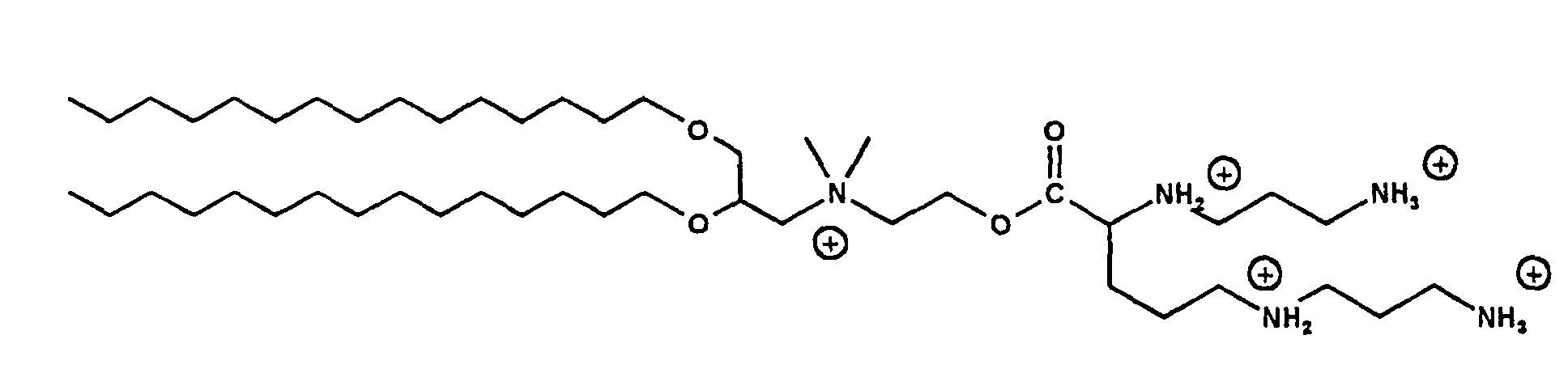


Auch verzweigte Polyamine wurden beschrieben (G. Byk et al, J. Med. Chem, 41, 224-235, 1998).
Da über den eigentlichen Transfektionsschritt bis heute noch wenig bekannt ist, ist die Entwicklung von neuen kationischen Lipiden weitgehend empirisch. Wichtige zu beachtende Gesichtspunkte für das Design solcher Lipide sollten daher ihre physikalischen Eigenschaften bezüglich der Ausbildung von Liposomen oder Micellen, die Eigenschaften der gebildeten Liposomen oder Micellen, die Toxizität gegenüber den zu transfektierenden Zielzellen, desweiteren die Stabilität der Lipide, deren Metabolisierbarkeit und die Möglichkeit einer in vivo-Anwendung sein.
Die erfindungsgemäß zu lösende Aufgabe bestand daher darin, neue kationische Lipide mit hoher Wirksamkeit und möglichst breitem Wirkungsspektrum in Kombination mit guter Stabilität und geringer Toxizität zu finden. Bei der vorliegenden Erfindung wurde nun überraschenderweise gefunden, daß die Kombination von Polyaminen als Kopfgruppe mit einem speziellen lipohilen Rest zu besonders guten Eigenschaften in Hinblick auf Effizienz und Stabilität führt:

Als Erklärung mögen folgende Hypothesen dienen. Von besonderer Bedeutung für eine erfolgreiche Transfektion hat sich die Bildung eines sogenannten DNA-Lipid-Komplexes erwiesen. Beim Zusammentreffen von DNA und kationischen Lipiden, die als Liposomen- oder Micellenformulierungen eingesetzt werden, kommt es zu einer spontanen Kondensation der DNA unter Zusammenbruch der liposomalen oder micellenartigen Organisationsstruktur der kationischen Lipide. Es bildet sich ein DNA-Lipid-Komplex aus, in dem die DNA in einem multilamellaren Komplex mit "Bilayerstruktur" aus den besagten Lipiden eingebettet ist (J. O. Rädler et al. Science, 275, 810, 1997). Ist z.B. die Spermingruppe als DNA-affine Kopfgruppe erst einmal an die DNA gebunden, kommt somit der Flexibilität und Symmetrie des restlichen Molekülteils (lipophiler Rest) besondere Bedeutung zu, da die Alkylgruppen in der Lage sein müssen, sich möglichst parallel auszurichten, um über Van-der-Waals-Kräfte stabile "Bilayer-Strukturen" ausbilden zu können.
Die bisher vorgeschlagenen Verbindungen sind in der Regel wenig symmetrisch aufgebaut, was eine parallele Ausrichtung der Alkylreste erschwert, und beinhalten allesamt Ester, Ether oder Amidverknüpfungen zwischen den Alkylresten und einem Grundgerüst bzw. einem Spacer. Diese Verbindungen sind daher in ihrer Flexibilität aufgrund der festgelegten Bindungswinkel und im Falle von Amidverknüpfungen (z.B. bei Verbindungen aus G. Byk et al, J. Med. Chem., 41, 224-235, 1998, EP 0394111, WO 9618372, WO 9746223,WO 9802190 und WO 9802191) aufgrund vorhandener Resonanzstrukturen stark eingeschränkt.

Die erfindungsgemäßen Verbindungen (siehe auch unten) verknüpfen die Alkylreste R2 und R3 über ein tertiäres Stickstoffatom (Amin). Damit ist eine hohe Symmetrie und durch die Möglichkeit des "Durchschwingens" des freien Elektronenpaares (Pseudorotation) am Stickstoffatom maximale Flexibilität gewährleistet. Somit besteht bei diesen Verbindungen die optimale Voraussetzung zur parallelen Ausrichtung der Alkylreste (trotz an der DNA fest verankerter Kopfgruppen) und somit zur Bildung stabiler DNA-Lipid-Komplexe. Die Stabilität wird insbesondere auch durch eine große Überlappung der van der Waals-Regionen der Alkylgruppen bewirkt.
Eine weitere Erklärungsmöglichkeit für die besonders guten Eigenschaften der beanspruchten Verbindungen besteht darin, daß diese Verbindungen aufgrund des nicht an der DNA-Komplexbildung beteiligten basischen Stickstoffatoms, welches die Alkylreste trägt, Pufferungsvermögen im physiologischen pH-Bereich besitzen. Diese Eigenschaft fördert auf dem Weg der Endozytose die osmotischen Zerstörung der Endosomen, so daß die DNA um so besser in das Zytosol freigesetzt wird (J. P. Behr, Gene Therapy, 3,1010-1017, 1996).




oder
wobei m = 0 und n = 1 sind und für diesen Fall g = 1,2,3,4,5,6,7 oder 8, a = 0,1,2,3,4,5 oder 6, b = 0,1,2,3,4,5 oder 6, c = 0,1,2,3,4,5 oder 6, d = 0,1,2,3,4,5 oder 6, e = 0,1,2,3,4,5 oder 6, f = 0,1,2,3,4,5 oder 6, h = 0,1,2,3,4,5 oder 6, r = 0,1,2,3,4,5 oder 6, k = 0,1,2,3,4,5 oder 6 und 1 = 0,1,2,3,4,5 oder 6 sein können,
oder
wobei m = 0 und n = 2 sind and für diesen Fall g = 1,2,3,4,5,6,7 oder 8, a = 0,1,2,3,4,5 oder 6, b = 0,1,2,3,4,5 oder 6, c = 0,1,2,3,4,5 oder 6, d = 0,1,2,3,4,5 oder 6, e = 0,1,2,3,4,5 oder 6, f = 0,1,2,3,4,5 oder 6, h = 0,1,2,3,4,5 oder 6, r = 0,1,2,3,4,5 oder 6, k = 0,1,2,3,4,5 oder 6 und 1 = 0,1,2,3,4,5 oder 6 sein können,
oder
wobei m = 1 und n = 1 sind und für diesen Fall g = 1,2,3,4,5,6,7 oder 8, a = 0,1,2,3,4,5 oder 6, b = 0,1,2,3,4,5 oder 6, c = 0,1,2,3,4,5 oder 6, d = 0,1,2,3,4,5 oder 6, e = 0,1,2,3,4,5 oder 6, f = 0,1,2,3,4,5 oder 6, h = 0,1,2,3,4,5 oder 6, r = 0,1,2,3,4,5 oder 6, k = 0,1,2,3,4,5 oder 6 und 1 = 0,1,2,3,4,5 oder 6 sein können,
oder
wobei m = 1 und n = 2 sind und für diesen Fall g = 1,2,3,4,5,6,7 oder 8, a = 0,1,2,3,4,5 oder 6, b = 0,1,2,3,4,5 oder 6, c = 0,1,2,3,4,5 oder 6, d = 0,1,2,3,4,5 oder 6, e = 0,1,2,3,4,5 oder 6, f = 0,1,2,3,4,5 oder 6, h = 0,1,2,3,4,5 oder 6, r = 0,1,2,3,4,5 oder 6, k = 0,1,2,3,4,5 oder 6 und 1 = 0,1,2,3,4,5 oder 6 sein können,
oder
wobei m = 2 und n = 2 sind und fiir diesen Fall g = 1,2,3,4,5,6,7 oder 8, a = 0,1,2,3,4,5 oder 6, b = 0,1,2,3,4,5 oder 6, c = 0,1,2,3,4,5 oder 6, d = 0,1,2,3,4,5 oder 6, e = 0,1,2,3,4,5 oder 6, f = 0,1,2,3,4,5 oder 6, h = 0,1,2,3,4,5 oder 6, r = 0,1,2,3,4,5 oder 6, k = 0,1,2,3,4,5 oder 6 und 1 = 0,1,2,3,4,5 oder 6 sein können, wobei vorzugsweise maximal 50%, besonders bevorzugt 30%, der H-atome durch F-Atome ersetzt sind.


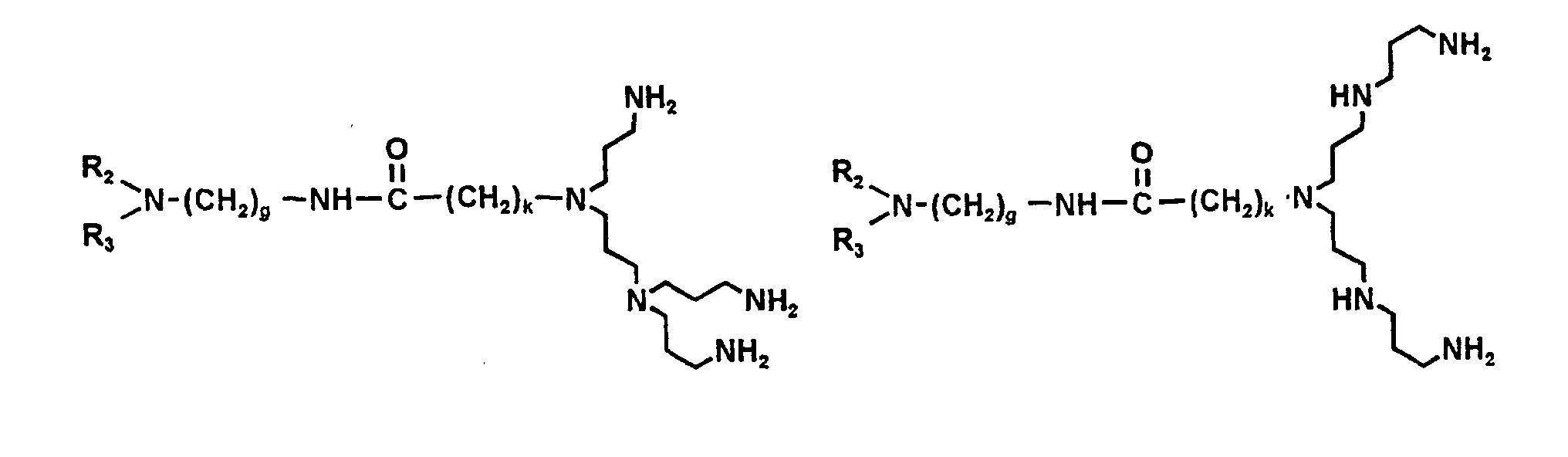


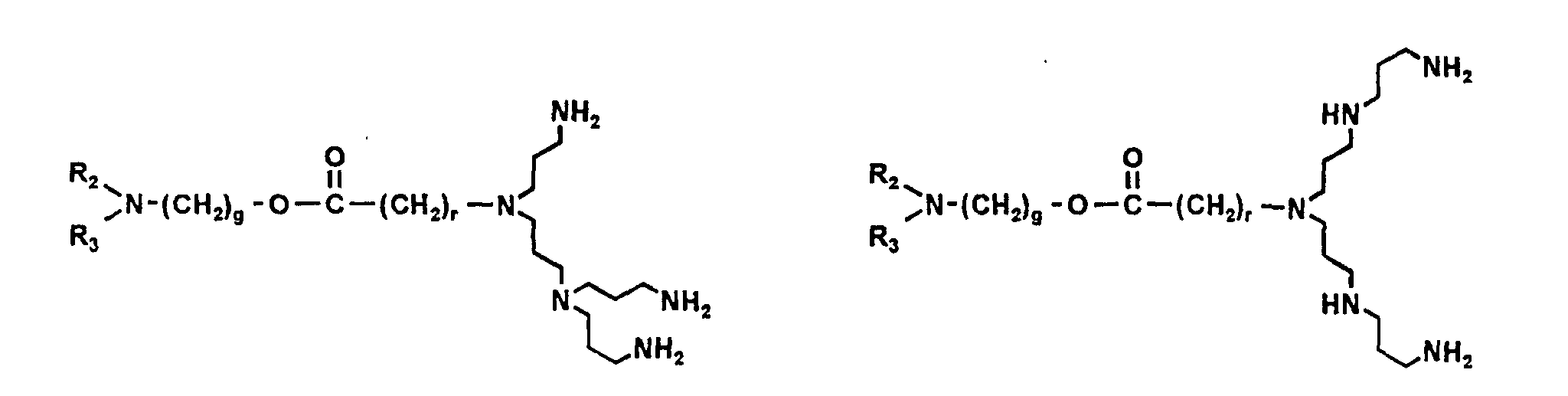





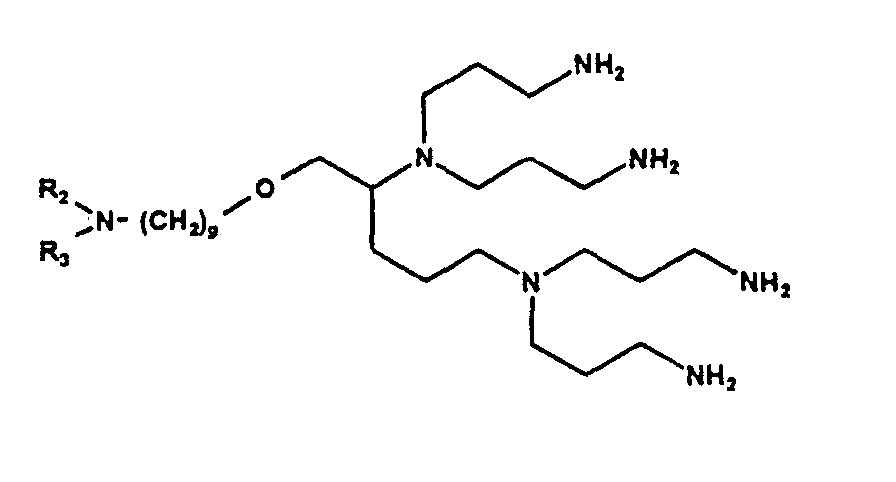


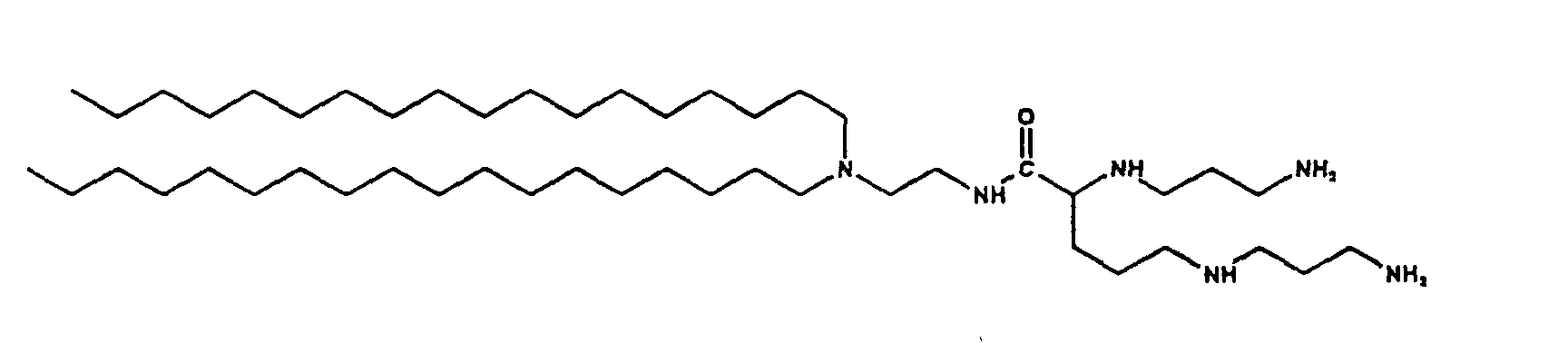
Ein besonderer Wert der erfindungsgemäßen Lipide liegt in ihrer Stabilität in Lösung, bei gleichzeitiger geringer Toxizität für die Zelle in Kombination mit außergewöhnlich guten Transfektionseigenschaften.
So konnte gezeigt werden, daß die erfindungsgemäßen Verbindungen, im Vergleich mit Lipofectamin™ (Gribco-BRL : Life Technologies Inc.), dem bis dato in der Fachwelt anerkannt wirksamsten Transfektionsreagenz aus der Gruppe der Lipopolyamine, bessere Transfektionseigenschaften besitzen, wenn sie die gleiche Kopfgruppe tragen. Die Transfektionseffizienz ist dabei nicht nur jeweils im serumfreien und serumhaltigen Milieu höher, sondern es zeigt sich auch, daß ein hohes Niveau der Transfektionseffizienz über ein wesentlich breiteres DNA-Lipid-Verhältnis erreicht werden kann.


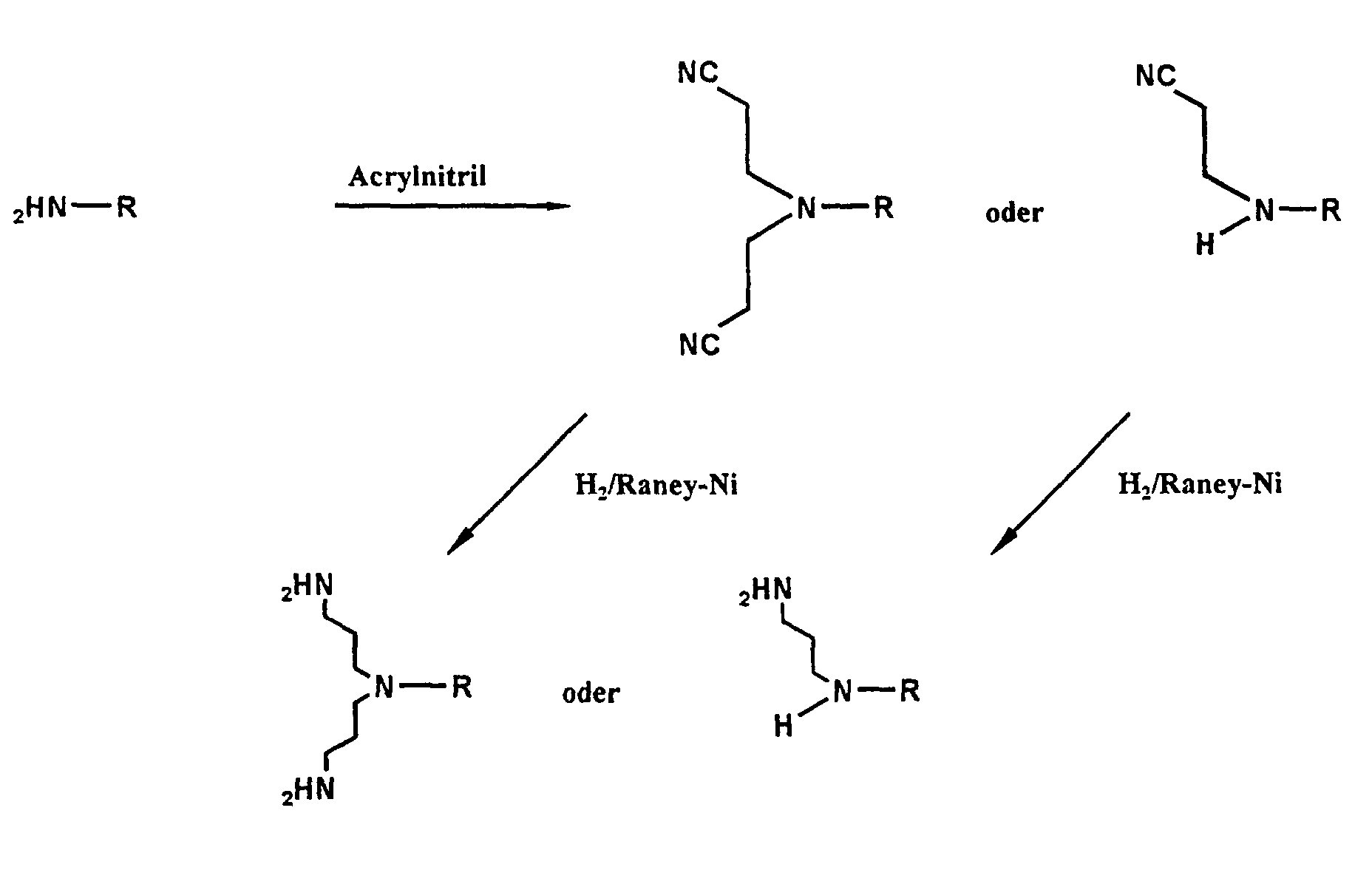


Bezüglich der Herstellung der Verbindungen, die die zwei zuletzt beschriebenen Spacer enthalten, sei auf WO 9802191 verwiesen. Hier wird beschrieben, wie Ester und Amide mit Lithiumalanat zu Ethem und Aminen reduziert werden können, ohne die BOC-Schutzgruppe anzugreifen. Auf diesem Wege resultieren solche Verbindungen aus den entsprechenden Vorläufern.
Die erfindungsgemäßen Verbindungen können als solche in wässriger oder wässriger Puffer-oder ethanolischer Lösung angewendet werden. Es können jedoch auch Liposomen (oder Micellen) mit den oben genannten Lipiden allein, oder in Kombination mit anderen Lipiden wie zum Beispiel Cholesterol, Cholesterylamin, Dioleoylphosphatidylethanolamin (DOPE) oder Dioleoylphosphatidylcholin (DOPC) formuliert werden.
Um die Transfektionseffizienz der erfindungsgemäßen Lipide zu steigern, besteht die Möglichkeit, Zellen in Gegenwart von Substanzen zu transfektieren, die die enzymatische Aktivität in den Lysosomen inhibieren, sogenannte lysosomatotrope Substanzen, wie zum Beispiel Chloroquin oder von Viren abgeleitete lysosomatropisch wirkende Proteine.
Weiter besteht die Möglichkeit, sogenannte Enhancer in Kombination mit den kationischen Lipiden einzusetzen. Enhancer verstärken die Wirkung der kationischen Lipide. Dabei gibt es Enhancer, die selbst keine transfizierenden Eigenschaften besitzen, und solche, die auch ohne kationische Lipide zur Transfektion verwendet werden können. Im ersten Fall kommt es zu einer einfachen Verstärkung (Amplifikation) der Transfektionseffizienz der kationischen Lipide. In letzterem Fall zeigt sich in kombinierter Anwendung eine Transfektionseffizienz, die größer ist als bei Einzelanwendung. Die Kombinationswirkung kommt daher durch einen Synergieeffekt zustande. Enhancer entfalten ihre Wirkung in der Regel durch eine Vorkondensation der zu transfizierenden DNA oder sie Erhöhen die Permeabilisierbarkeit der zu durchdringenden Zellmembran. Beispiele für Enhancer sind Polyethylenimin, Transferrin, Protaminsulfat, Polyhistone, fusogene Peptide, Virushüllen, virale Oberflächenpeptide, replikationsdefiziente Viren usw.
Die erfindungsgemäßen Lipopolyamine sind bei physiologischem pH positiv geladen und können daher mit negativ geladenen Makromolekülen, insbesondere mit DNA und verwandten Stoffklassen stabile Aggregate bilden. Die mit den Lipopolyaminen bemäntelten und positivierten Makromoleküle wechselwirken mit der negativ geladenen Zellmembran auf eine Weise, die zu einer Einschleusung der Makromoleküle in die Zelle führt. Dabei sind in vitro als auch in vivo Anwendungen möglich.
Im Vergleich zur zielgerichteten rezeptorvermittelten Endocytose (Wu et al., J. Chem. 262, 4429-4432, 1987), in denen Polykationen, welche auch DNA-Binder genannt werden (zum Beispiel Polylysin etc.) an sogenannte Internalisierungsfaktoren (zum Beispiel bestimmte Glykoproteine) gebunden sind, die zielgerichtet an Oberflächenrezeptoren bestimmter Zellen binden, besitzen die erfindungsgemäßen Lipide, bzw. deren Liposomenformulierungen keine Zellspezifität. Eine zielgerichtete Lieferung durch die erfindungsgemäßen Lipide bzw. deren Liposomenformulierungen kann dadurch erreicht werden, daß die Ladungen von Lipiden und den zu transportierenden Biomolekülen ausgeglichen werden und zusätzlich an das Aggregat zwischen Biomolekül und Lipiden Internalisierungsfaktoren angebracht werden. Dies kann zum Beispiel durch Liposomenformulierung mit Colipiden erreicht werden, falls die Colipide als Kopfgruppe solche Internalisierungsfaktoren tragen. Eine andere Möglichkeit ist ein auf Ladungsneutralität abgestimmtes Aggregat aus Biomolekül, Lipiden und Internalisierung-faktoren. Sogenannte Internalisierungsfaktoren sind Transferrin, Galactose, Mannose, Mannose-6-phosphat, Asialglycoprotein, Conalbumin, Lectine, Transcobalamin, α-2-Makroglobulin, Biotin, Folat, mannosylierte Glycoproteine. Weitere sind in EP 0535576, EP 0544292, WO 9421808 zu entnehmen, die hierin unter Bezugnahme aufgenommen werden.
Analog wie Internalisierungsfaktoren, können auch zellspezifische Antikörper eingesetzt werden.
Die erfindungsgemäßen Verbindungen können zu Therapiezwecken eingesetzt werden. Insbesondere können solche Verbindungen für die Gentherapie von zum Beispiel Cystischer Fibrose, Muskeldystrophie, Phenylketonurie, Ahomsirupkrankheit, Propionazidämie, Methylmalonazidämie, Adenosindeaminasemangel, Hypercholesterinämie, Hämophilie und β-Thalassämie genutzt werden. Gentherapeutische Behandlungsmethoden sind weiters interessant, wenn Hormone, Wachstumsfaktoren, Cytotoxine oder immunomodulierend wirkende Proteine im Organismus synthetisiert werden sollen. Für die oben genannten Zwecke können DNA-Fragmente mittels dieser Lipide in Zellen gebracht werden, in denen diese DNA die gewünschte Wirkung entfaltet. Die gewünschte Wirkung kann der Ersatz fehlender oder defekter DNA-Bereiche oder die Inhibition von DNA-Bereichen ( zum Beispiel Antisense-DNA / RNA), die die Erkrankung auslösen, im erkrankten Zelltyp sein. Auf diese Weise können tumorunterdrückende Gene in der Krebs-Therapie eingesetzt werden oder durch die Einführung cholesterolregulierender Gene ein Beitrag zur Vorbeugung von Herz- und Blutgefäßkrankheiten leisten. Weiter kann DNA, welche Ribozyme kodiert, oder Ribozyme selbst in erkrankte Zellen eingeschleust werden. Die Translation jener DNA erzeugt aktive Ribozyme, die an spezifischen Stellen m-RNA katalytisch spalten und auf diese Weise die Transkription verhindern. Auf diese Weise kann zum Beispiel virale m-RNA spezifisch gespalten werden, ohne eine andere zelluläre m-RNA in Mitleidenschaft zu ziehen. Der Vermehrungszyklus von Viren (z.B. HIV, Herpes, Hepatitis) kann auf diesem Wege unterbrochen werden.
Auch in der Krebstherapie spielt Transfektion zur Herstellung von Krebsvakzinen eine immer größer werdende Rolle. Damit ist dieses Feld auch mögliches Anwendungsgebiet fiir die erfindungsgemäßen Verbindungen.
Eine weitere Anwendung können solche Lipide zum Beispiel in Impfverfahren finden, die auf der Basis der Expression von DNA, welche immunogene Peptide kodiert, im Körper von Mensch und Tier funktionieren. Dazu werden Lipid / DNA-Komplexe als Impfstoffe benutzt. Die Einschleusung der DNA in die Körperzellen führt zur Expression des immunogenen Peptids und löst somit die Immunantwort aus.
Abgesehen von DNA können auch andere Makromoleküle, wie zum Beispiel PNA, Peptide, Peptoide oder Proteine, in Zellen eingeschleust werden. Zu diesem Zweck können sie mit den erfindungsgemäßen Lipopolyaminen als solche bemäntelt werden oder in Liposomen, welche als Komponente die erfindungsgemäßen Lipopolyamine enthalten, eingeschlossen oder an deren Oberfläche adsorbiert werden, falls eine negative Nettoladung vorhanden ist. Bringt man derartige Aggregate mit Zellen in Kontakt, so findet ein Transport dieser Moleküle durch die Zellwand statt. Therapeutische Peptide haben einen günstigen Einfluß auf zahlreiche Erkrankungen. Solche Peptide oder Proteine sind zum Beispiel Lymphokine, Interleukine, Tumore Nekrose Faktoren oder Interferone, weiterhin Wachstumsfaktoren, Gewebeplasminogenaktivator, Faktor-VIII:c, Granulocyten-Makrophagen-Kolonie-stimulierender Faktor, Erythropoietin, Insulin, Calcitonin, Thymidinkinase und andere. Auch toxische Peptide wie Ricin, Diphteriatoxin und andere können therapeutisch auf diese Weise gewinnbringend eingesetzt werden. Peptoide können erfolgreich als Peptidanaloga zur Verhinderung eines schnellen enzymatischen Abbaus im Körper eingesetzt werden.
Die erfindungsgemäßen Lipide werden aufgrund ihrer positiven Ladung vorwiegend dazu eingesetzt, negativ geladene Moleküle wegen ihrer negativen Ladung zu komplexieren und in Zellen einzuschleusen. Durch sogenannte "self assembling systems" können jedoch auch positiv geladene Moleküle transportiert werden, in dem zunächst negativ geladene Liposomen mit diesem positiv geladenen Molekülen komplexiert werden. Wählt man die Verhältnisse so, daß eine negative Nettoladung verbleibt, können diese Komplexe mit diesen erfindungsgemäßen Lipopolyaminen als solche oder in Form von Liposomen positiviert werden, in dem die gegensätzlich geladenen Komponenten in Kontakt gebracht werden. Die resultierenden positiv geladenen Gesamtkomplexe werden von den Zellen aufgenommen.
Weitere Anwendungsmöglichkeiten für kationische Lipide sind den Veröffentlichungen WO 9011092, WO 9116024, WO 9303768, Science 258, 744-746, 1992 zu entnehmen, die hierin unter Bezugnahme aufgenommen werden.
Beispiele für derzeit als therapeutisch aussichtsreich anzunehmende Sequenzen genetischen Materials sind in der Übersicht von F.W.Anderson, Science 256, 808, 1992 entnehmbar, die ebenfalls hierin unter Bezugnahme aufgenommen werden.
MG 664.12
Rf= 0.44 (9:1 v/v Chloroform/Methanol)
MS (FAB): 665.7 (M +1)
0.88 (tr, 6 H, CH3); 1.26 ("s", 60 H, CH2); 1.40 (m, 4 H, N-CH2CH 2); 1.44 (s, 9 H, CH3BOC); 2.40 (tr, 4 H, N-CH2); 2.50 (tr, 2 H, N-CH2); 3.15 (m, 2 H, OCO-N-CH2).
13.1 (CH3); 22.7, 27.0, 25.5 (CH2); 28.5 (CH3BOC); 29.4, 29.6 29.7, 29.7 (CH2); 53.2 (N-CH2); 54.0 (N- CH2); 78.9 (CqBOC); 156.1 (OCO).
MG 977.65
Rf = 0.40 (9: 1 v/v Methylenchlorid/Methanol)
0.88 (tr, 6 H, CH3); 1.25 ("s", 64 H, CH2); 1.44 (m, 36 H, CH3BOC); 1.67 (m, 8 H, Spermin: CH2CH 2CH2); 2.36 (mr, 4 H, Stearyl: N-CH2); 2.51 (m, 2 H, Ethylendiamin: N-CH2); 3.1-3.25 (m, 10 H, OC-N-CH2).
C53H104ON6 (x 4 CF3COOH)
MG 793.52 (+ 4 x 114 = 1249.52)
Ausbeute: 100%
C13H22O2N4
MG 266.34
Rf = 0.69 (9:1 v/v Chloroform/Ethanol)
Ausbeute: 660 mg (80%)
MG 671.16
Rf = 0.42 (9:1 v/v Methylenchlorid/Methanol)
0.88 (tr, 6 H, CH3); 1,26 ("s", 60 H, CH2); 1.42 (m, 4 H, N- CH2CH 2) 2.42 (m, 4 H, N- CH2); 2.48 (tr, 4 H, CH2-CN); 2.50 (m, 2 H, N- CH2); 2.50 (m, 2 H, N- CH2); 2.92 (tr, 4 H, N-CH2).
MG 679.21 (+4 x 114 = 1135.21)
MS (ESI): 680.2
MG 238.31
Rf= 0.84 (9:1 v/v Methylenchlorid/Methanol)
1.36 (br s, 9 H, CH3BOC); 1.98 (m, 2 H, C-CH2-C); 3.19 (m, 2 H, Br-CH 2); 3.38 (m, 2 H, N-CH2); 4.90 (br s, 1 H, N-H).
28.2 (CH3); 30.6,32.6,38.8 (CH2); 79.1 (Cq); 155.8 (C=O).
MG 679.21 (+4 x 114 = 1135.21)
MS (ESI): 680.2
MG 327.82
Rf = 0.71 (1:1:1 v/v/v Isopropanol/Ethanol/Wasser)
1.58 (m, 2 H, CH 2-CHOm); 1.90 (m, 2 H, CH2Om); 2.61 (m, 6 H, NC-CH 2); 2.86 (tr, 4 H, N-CH2); 2.98 (tr, 2 H, N-CH2-CH 2); 3.39 (tr, 2 H, , N-CH2); 368 (tr, 1 H,CHOm).
MG 344.4182
Rf = 0.84(1:1:1 v/v/v Isopropanol/Ethanol/Wasser)
1.60 (m, 2 H, CH 2-CHOm); 1.92 (m, 2 H, CH2Om); 2.52 (m, 8 H, NC-CH 2); 2.61 (tr, 4 H, CH2Om); 2.87 (tr, 4 H, , N-CH2); 3.03 (tr, 4 H, N-CH2); 3.38 (m, 1 H, CHOm).
Währendessen werden die Zellen einmal mit PBS (phosphate buffered saline) gewaschen. Je nach gewünschten Bedingungen (Transfektion im serumfreien oder serumhaltigen Milieu) werden 0.4 ml antibiotikafreies DMEM mit oder ohne Serum zu den Zellen gegeben. Der DNA/Lipid-Komplex wird direkt zu den Zellen gegeben und im Brutschrank 6 h inkubiert. Danach wird mit serum und antibiotikahaltigem DMEM in der Weise auf 1ml aufgefüllt, daß das Medium eine Endkonzentration von 10 % Serum enthält. Die Zellen werden weitere 20 h kultiviert. Danach wird auf β-Galactosidase nach den Angaben des Herstellers des β-Galaktosidase-Assay-Kits getestet. Das entwickelte O-Nitrophenol wird photometrisch bei 405 nm vermessen.
N-[2,5-Bis((3-aminopropyl)amino)-1-oxopentyl]-N',N'-dioctadecylethylen-diamin (TFA-Salz) wurde als Liposomenformulierung mit 25 Mol % Dioleoylphosphatidylethanolamin in wässriger steriler Lösung eingesetzt. Gesamtlipidmenge: 2 mg/ml.
N',N'-Bis-(3-aminopropyl)- N,N-dioctadecylethylendiamin (TFA-Salz) wurde als Liposomenformulierung mit 50 Mol % Dioleoylphosphatidylethanolamin in wässriger steriler Lösung eingesetzt. Gesamtlipidmenge: 2 mg/ml.
Lipofectamin™ (Gibco-BRL : Life Technologies Inc.) wurde vom Hersteller erworben.
| Absorbtionswerte bei 405 nm: | ||||||
| Transfektionsreagenz 1 | Transfektionsreagenz 2 | Transfektionsreagenz 3 | ||||
| mit Serum | ohne Serum | mit Serum | ohne Serum | mit Serum | ohne Serum | |
| 3 µl | 1.61 | 1.92 | 0.63 | 1.65 | 0.81 | 1.93 |
| 6 µl | 2.40 | 2.40 | 0.71 | 0.80 | 0.30 | 1.65 |
| 9 µl | 2.10 | 1.68 | 0.95 | 0.58 | 0.19 | 0.44 |
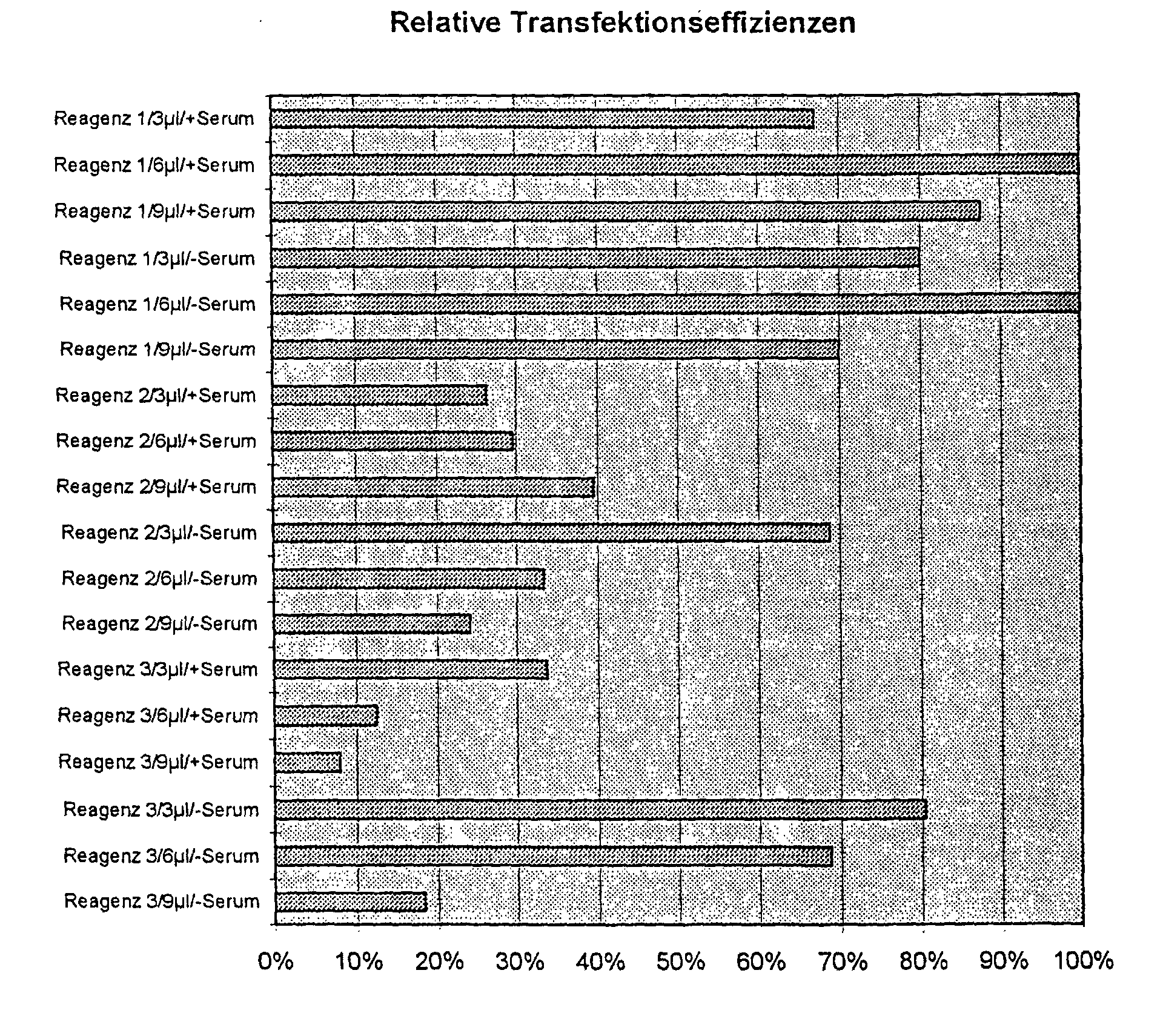
Claims (17)
- Verbindungen der allgemeinen Formel I:die bei Vorhandensein eines Asymmetriezentrums in der D-,L- oder DL-Form vorliegen, einschließlich ihrer Salze, wobei
 R1 ein lipophiler Rest folgender allgemeiner Formel ist:in welcher R2 und R3 unabhängig voneinander Dodecyl, Dodecenyl, Tetradecyl, Tetradecenyl, Hexadecyl, Hexadecenyl, Octadecyl, Octadecenyl sind, oder andere Alkylreste, die gesättigt oder ungesättigt, verzweigt oder unverzweigt, fluoriert oder nicht fluoriert sein können, und aus 5, 6, 7, 8, 9, 10, 11, 12, 13, 14, 15, 16, 17, 18, 19, 20, 21, 22, 23, 24, 25, 26, 27, 28, 29 oder 30 Kohlenstoffatomen aufgebaut sind,
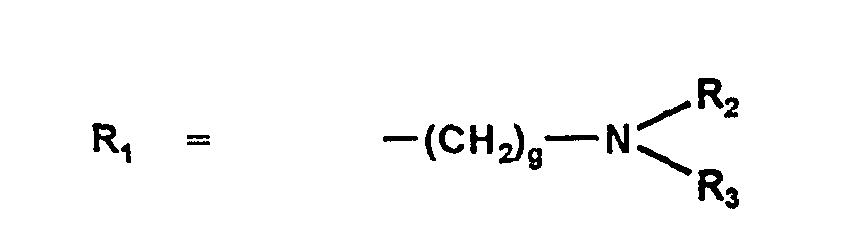 und X eine der folgenden Gruppierungen ist:wobei m = 0 und n = 0 sind und für diesen Fall g = 1,2,3,4,5,6,7 oder 8, a = 0,1,2,3,4,5 oder 6, b = 0,1,2,3,4,5 oder 6, c = 0,1,2,3,4,5 oder 6, d = 0,1,2,3,4,5 oder 6, e = 0,1,2,3,4,5 oder 6, f = 0,1,2,3,4,5 oder 6 sein können, oder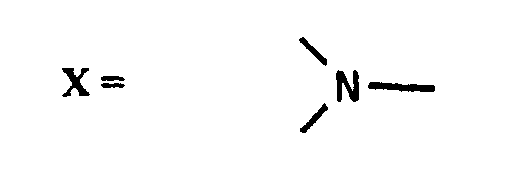
wobei m = 0 und n = 1 sind und fiir diesen Fall g = 1,2,3,4,5,6,7 oder 8, a = 0,1,2,3,4,5 oder 6, b = 0,1,2,3,4,5 oder 6, c = 0,1,2,3,4,5 oder 6, d = 0,1,2,3,4,5 oder 6, e = 0,1,2,3,4,5 oder 6, f = 0,1,2,3,4,5 oder 6 sein können, oder
wobei m = 0 und n = 2 sind und für diesen Fall g = 1,2,3,4,5,6,7 oder 8, a = 0,1,2,3,4,5 oder 6, b = 0,1,2,3,4,5 oder 6, c = 0,1,2,3,4,5 oder 6, d = 0,1,2,3,4,5 oder 6, e = 0,1,2,3,4,5 oder 6, f = 0,1,2,3,4,5 oder 6 sein können, oder
wobei m = 1 und n = 1 sind und fiir diesen Fall g = 1,2,3,4,5,6,7 oder 8, a = 0,1,2,3,4,5 oder 6, b = 0,1,2,3,4,5 oder 6, c = 0,1,2,3,4,5 oder 6, d = 0,1,2,3,4,5 oder 6, e = 0,1,2,3,4,5 oder 6, f = 0,1,2,3,4,5 oder 6 sein können, oder
wobei m = 1 und n = 2 sind und für diesen Fall g = 1,2,3,4,5,6,7 oder 8, a = 0,1,2,3,4,5 oder 6, b = 0,1,2,3,4,5 oder 6, c = 0,1,2,3,4,5 oder 6, d = 0,1,2,3,4,5 oder 6, e = 0,1,2,3,4,5 oder 6, f = 0,1,2,3,4,5 oder 6 sein können, oder
wobei m = 2 und n = 2 sind und fiir diesen Fall g = 1,2,3,4,5,6,7 oder 8, a = 0,1,2,3,4,5 oder 6, b = 0,1,2,3,4,5 oder 6, c = 0,1,2,3,4,5 oder 6, d = 0,1,2,3,4,5 oder 6, e = 0,1,2,3,4,5 oder 6, f = 0,1,2,3,4,5 oder 6 sein können,
oderwobei m = 0 und n = 0 sind und für diesen Fall g = 1,2,3,4,5,6,7 oder 8, a = 0,1,2,3,4,5 oder 6, b = 0,1,2,3,4,5 oder 6, c = 0,1,2,3,4,5 oder 6, d = 0,1,2,3,4,5 oder 6, e = 0,1,2,3,4,5 oder 6, f = 0,1,2,3,4,5 oder 6 und h = 0,1,2,3,4,5 oder 6 sein können, oder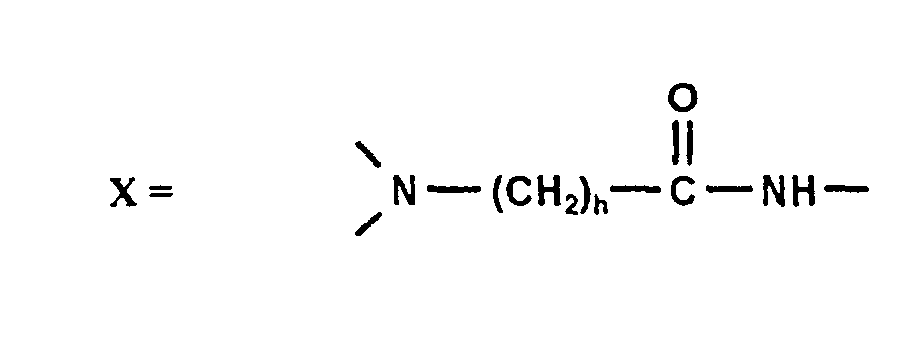
wobei m = 0 und n = 1 sind und für diesen Fall g = 1,2,3,4,5,6,7 oder 8, a = 0,1,2,3,4,5 oder 6, b = 0,1,2,3,4,5 oder 6, c = 0,1,2,3,4,5 oder 6, d = 0,1,2,3,4,5 oder 6, e = 0,1,2,3,4,5 oder 6, f = 0,1,2,3,4,5 oder 6 und h = 0,1,2,3,4,5 oder 6 sein können, oder
wobei m = 0 und n = 2 sind und für diesen Fall g = 1,2,3,4,5,6,7 oder 8, a = 0,1,2,3,4,5 oder 6, b = 0,1,2,3,4,5 oder 6, c = 0,1,2,3,4,5 oder 6, d = 0,1,2,3,4,5 oder 6, e = 0,1,2,3,4,5 oder 6, f = 0,1,2,3,4,5 oder 6 und h = 0,1,2,3,4,5 oder 6 sein können, oder
wobei m = 1 und n = 1 sind und für diesen Fall g = 1,2,3,4,5,6,7 oder 8, a = 0,1,2,3,4,5 oder 6, b = 0,1,2,3,4,5 oder 6, c = 0,1,2,3,4,5 oder 6, d = 0,1,2,3,4,5 oder 6, e = 0,1,2,3,4,5 oder 6, f = 0,1,2,3,4,5 oder 6 und h = 0,1,2,3,4,5 oder 6 sein können, oder
wobei m = 1 und n = 2 sind und für diesen Fall g = 1,2,3,4,5,6,7 oder 8, a = 0,1,2,3,4,5 oder 6, b = 0,1,2,3,4,5 oder 6, c = 0,1,2,3,4,5 oder 6, d = 0,1,2,3,4,5 oder 6, e = 0,1,2,3,4,5 oder 6, f = 0,1,2,3,4,5 oder 6 und h = 0,1,2,3,4,5 oder 6 sein können, oder
wobei m = 2 und n = 2 sind und für diesen Fall g = 1,2,3,4,5,6,7 oder 8, a = 0,1,2,3,4,5 oder 6, b = 0,1,2,3,4,5 oder 6, c = 0,1,2,3,4,5 oder 6, d = 0,1,2,3,4,5 oder 6, e = 0,1,2,3,4,5 oder 6, f = 0,1,2,3,4,5 oder 6 und h = 0,1,2,3,4,5 oder 6 sein können, oderwobei m = 0 und n = 0 sind und für diesen Fall g = 1,2,3,4,5,6,7 oder 8, a = 0,1,2,3,4,5 oder 6, b = 0,1,2,3,4,5 oder 6, c = 0,1,2,3,4,5 oder 6, d = 0,1,2,3,4,5 oder 6, e = 0,1,2,3,4,5 oder 6, f = 0,1,2,3,4,5 oder 6 and r = 0,1,2,3,4,5 oder 6 sein können,
oder
wobei m = 0 und n = 1 sind und fiir diesen Fall g = 1,2,3,4,5,6,7 oder 8, a = 0,1,2,3,4,5 oder 6, b = 0,1,2,3,4,5 oder 6, c = 0,1,2,3,4,5 oder 6, d = 0,1,2,3,4,5 oder 6, e = 0,1,2,3,4,5 oder 6, f = 0,1,2,3,4,5 oder 6 und r = 0,1,2,3,4,5 oder 6 sein können,
oder
wobei m = 0 und n = 2 sind und für diesen Fall g = 1,2,3,4,5,6,7 oder 8, a = 0,1,2,3,4,5 oder 6, b = 0,1,2,3,4,5 oder 6, c = 0,1,2,3,4,5 oder 6, d = 0,1,2,3,4,5 oder 6, e = 0,1,2,3,4,5 oder 6, f = 0,1,2,3,4,5 oder 6 und r = 0,1,2,3,4,5 oder 6 sein können,
oder
wobei m = 1 und n = 1 sind und fiir diesen Fall g = 1,2,3,4,5,6,7 oder 8, a = 0,1,2,3,4,5 oder 6, b = 0,1,2,3,4,5 oder 6, c = 0,1,2,3,4,5 oder 6, d = 0,1,2,3,4,5 oder 6, e = 0,1,2,3,4,5 oder 6, f = 0,1,2,3,4,5 oder 6 und r = 0,1,2,3,4,5 oder 6 sein können,
oder
wobei m = 1 und n = 2 sind und fiir diesen Fall g = 1,2,3,4,5,6,7 oder 8, a = 0,1,2,3,4,5 oder 6, b = 0,1,2,3,4,5 oder 6, c = 0,1,2,3,4,5 oder 6, d = 0,1,2,3,4,5 oder 6, e = 0,1,2,3,4,5 oder 6, f = 0,1,2,3,4,5 oder 6 und r = 0,1,2,3,4,5 oder 6 sein können,
oder
wobei m = 2 und n = 2 sind und für diesen Fall g = 1,2,3,4,5,6,7 oder 8, a = 0,1,2,3,4,5 oder 6, b = 0,1,2,3,4,5 oder 6, c = 0,1,2,3,4,5 oder 6, d = 0,1,2,3,4,5 oder 6, e = 0,1,2,3,4,5 oder 6, f = 0,1,2,3,4,5 oder 6 und r = 0,1,2,3,4,5 oder 6 sein können,
oderwobei m = 0 und n = 0 sind und für diesen Fall g = 1,2,3,4,5,6,7 oder 8, a = 0,1,2,3,4,5 oder 6, b = 0,1,2,3,4,5 oder 6, c = 0,1,2,3,4,5 oder 6, d = 0,1,2,3,4,5 oder 6, e = 0,1,2,3,4,5 oder 6, f = 0,1,2,3,4,5 oder 6 , k = 0,1,2,3,4,5 oder 6 sein können, oder
wobei m = 0 und n = 1 sind und für diesen Fall g = 1,2,3,4,5,6,7 oder 8, a = 0,1,2,3,4,5 oder 6, b = 0,1,2,3,4,5 oder 6, c = 0,1,2,3,4,5 oder 6, d = 0,1,2,3,4,5 oder 6, e = 0,1,2,3,4,5 oder 6, f = 0,1,2,3,4,5 oder 6 , k = 0,1,2,3,4,5 oder 6 sein können, oder
wobei m = 0 und n = 2 sind und fiir diesen Fall g = 1,2,3,4,5,6,7 oder 8, a = 0,1,2,3,4,5 oder 6, b = 0,1,2,3,4,5 oder 6, c = 0,1,2,3,4,5 oder 6, d = 0,1,2,3,4,5 oder 6, e = 0,1,2,3,4,5 oder 6, f = 0,1,2,3,4,5 oder 6 , k = 0,1,2,3,4,5 oder 6 sein können, oder
wobei m = 1 und n = 1 sind und fiir diesen Fall g = 1,2,3,4,5,6,7 oder 8, a = 0,1,2,3,4,5 oder 6, b = 0,1,2,3,4,5 oder 6, c = 0,1,2,3,4,5 oder 6, d = 0,1,2,3,4,5 oder 6, e = 0,1,2,3,4,5 oder 6, f = 0,1,2,3,4,5 oder 6 , k = 0,1,2,3,4,5 oder 6 sein können, oder
wobei m = 1 und n = 2 sind und für diesen Fall g = 1,2,3,4,5,6,7 oder 8, a = 0,1,2,3,4,5 oder 6, b = 0,1,2,3,4,5 oder 6, c = 0,1,2,3,4,5 oder 6, d = 0,1,2,3,4,5 oder 6, e = 0,1,2,3,4,5 oder 6, f = 0,1,2,3,4,5 oder 6, k = 0,1,2,3,4,5 oder 6 sein können, oder
wobei m = 2 und n = 2 sind und für diesen Fall g = 1,2,3,4,5,6,7 oder 8, a = 0,1,2,3,4,5 oder 6, b = 0,1,2,3,4,5 oder 6, c = 0,1,2,3,4,5 oder 6, d = 0,1,2,3,4,5 oder 6, e = 0,1,2,3,4,5 oder 6, f = 0,1,2,3,4,5 oder 6 , k = 0,1,2,3,4,5 oder 6 sein können,
oderwobei m = 0 und n = 0 sind und für diesen Fall g = 1,2,3,4,5,6,7 oder 8, a = 0,1,2,3,4,5 oder 6, b = 0,1,2,3,4,5 oder 6, c = 0,1,2,3,4,5 oder 6, d = 0,1,2,3,4,5 oder 6, e = 0,1,2,3,4,5 oder 6, f = 0,1,2,3,4,5 oder 6 , k = 0,1,2,3,4,5 oder 6 sein können, oder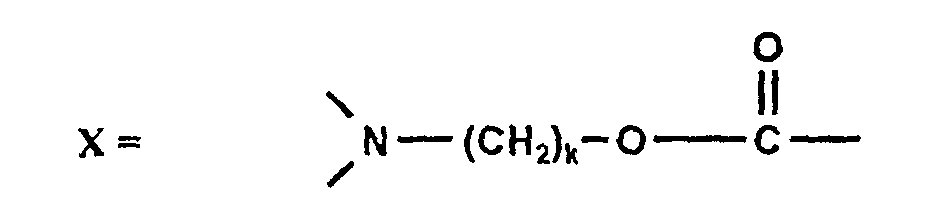
wobei m = 0 und n = 1 sind und für diesen Fall g = 1,2,3,4,5,6,7 oder 8, a = 0,1,2,3,4,5 oder 6, b = 0,1,2,3,4,5 oder 6, c = 0,1,2,3,4,5 oder 6, d = 0,1,2,3,4,5 oder 6, e = 0,1,2,3,4,5 oder 6, f = 0,1,2,3,4,5 oder 6, k = 0,1,2,3,4,5 oder 6 sein können, oder
wobei m = 0 und n = 2 sind und für diesen Fall g = 1,2,3,4,5,6,7 oder 8, a = 0,1,2,3,4,5 oder 6, b = 0,1,2,3,4,5 oder 6, c = 0,1,2,3,4,5 oder 6, d = 0,1,2,3,4,5 oder 6, e = 0,1,2,3,4,5 oder 6, f = 0,1,2,3,4,5 oder 6, k = 0,1,2,3,4,5 oder sein können, oder
wobei m = 1 and n = 1 sind und für diesen Fall g = 1,2,3,4,5,6,7 oder 8, a = 0,1,2,3,4,5 oder 6, b = 0,1,2,3,4,5 oder 6, c = 0,1,2,3,4,5 oder 6, d = 0,1,2,3,4,5 oder 6, e = 0,1,2,3,4,5 oder 6, f = 0,1,2,3,4,5 oder 6, k = 0,1,2,3,4,5 oder 6 sein können, oder
wobei m = 1 und n = 2 sind und fiir diesen Fall g = 1,2,3,4,5,6,7 oder 8, a = 0,1,2,3,4,5 oder 6, b = 0,1,2,3,4,5 oder 6, c = 0,1,2,3,4,5 oder 6, d = 0,1,2,3,4,5 oder 6, e = 0,1,2,3,4,5 oder 6, f = 0,1,2,3,4,5 oder 6 , k = 0,1,2,3,4,5 oder 6 sein können, oder
wobei m = 2 und n = 2 sind und fiir diesen Fall g = 1,2,3,4,5,6,7 oder 8, a = 0,1,2,3,4,5 oder 6, b = 0,1,2,3,4,5 oder 6, c = 0,1,2,3,4,5 oder 6, d = 0,1,2,3,4,5 oder 6, e = 0,1,2,3,4,5 oder 6, f = 0,1,2,3,4,5 oder 6, k = 0,1,2,3,4,5 oder 6 sein können,
oderwobei m = 0 und n = 0 sind und für diesen Fall g = 1,2,3,4,5,6,7 oder 8, a = 0,1,2,3,4,5 oder 6, b = 0,1,2,3,4,5 oder 6, c = 0,1,2,3,4,5 oder 6, d = 0,1,2,3,4,5 oder 6, e = 0,1,2,3,4,5 oder 6, f = 0,1,2,3,4,5 oder 6 sein können,
oder
wobei m = 0 und n = 1 sind und fiir diesen Fall g = 1,2,3,4,5,6,7 oder 8, a = 0,1,2,3,4,5 oder 6, b = 0,1,2,3,4,5 oder 6, c = 0,1,2,3,4,5 oder 6, d = 0,1,2,3,4,5 oder 6, e = 0,1,2,3,4,5 oder 6, f = 0,1,2,3,4,5 oder 6 sein können,
oder
wobei m = 0 und n = 2 sind und fiir diesen Fall g = 1,2,3,4,5,6,7 oder 8, a = 0,1,2,3,4,5 oder 6, b = 0,1,2,3,4,5 oder 6, c = 0,1,2,3,4,5 oder 6, d = 0,1,2,3,4,5 oder 6, e = 0,1,2,3,4,5 oder 6, f = 0,1,2,3,4,5 oder 6 sein können,
oder
wobei m = 1 und n = 1 sind und für diesen Fall g = 1,2,3,4,5,6,7 oder 8, a = 0,1,2,3,4,5 oder 6, b = 0,1,2,3,4,5 oder 6, c = 0,1,2,3,4,5 oder 6, d = 0,1,2,3,4,5 oder 6, e = 0,1,2,3,4,5 oder 6, f = 0,1,2,3,4,5 oder 6 sein können,
oder
wobei m = 1 und n = 2 sind und fiir diesen Fall g = 1,2,3,4,5,6,7 oder 8, a = 0,1,2,3,4,5 oder 6, b = 0,1,2,3,4,5 oder 6, c = 0,1,2,3,4,5 oder 6, d = 0,1,2,3,4,5 oder 6, e = 0,1,2,3,4,5 oder 6, f = 0,1,2,3,4,5 oder 6 sein können,
oder
wobei m = 2 und n = 2 sind und für diesen Fall g = 1,2,3,4,5,6,7 oder 8, a = 0,1,2,3,4,5 oder 6, b = 0,1,2,3,4,5 oder 6, c = 0,1,2,3,4,5 oder 6, d = 0,1,2,3,4,5 oder 6, e = 0,1,2,3,4,5 oder 6, f = 0,1,2,3,4,5 oder 6 sein können,
oderwobei m = 0 und n = 0 sind und für diesen Fall g = 1,2,3,4,5,6,7 oder 8, a = 0,1,2,3,4,5 oder 6, b = 0,1,2,3,4,5 oder 6, c = 0,1,2,3,4,5 oder 6, d = 0,1,2,3,4,5 oder 6, e = 0,1,2,3,4,5 oder 6, f = 0,1,2,3,4,5 oder 6 sein können,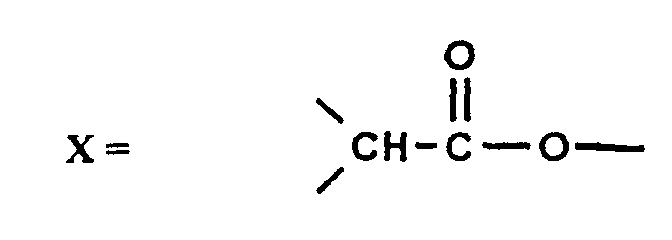
oder
wobei m = 0 und n = 1 sind und für diesen Fall g = 1,2,3,4,5,6,7 oder 8, a = 0,1,2,3,4,5 oder 6, b = 0,1,2,3,4,5 oder 6, c = 0,1,2,3,4,5 oder 6, d = 0,1,2,3,4,5 oder 6, e = 0,1,2,3,4,5 oder 6, f = 0,1,2,3,4,5 oder 6 sein können,
oder
wobei m = 0 und n = 2 sind und fiir diesen Fall g = 1,2,3,4,5,6,7 oder 8, a = 0,1,2,3,4,5 oder 6, b = 0,1,2,3,4,5 oder 6, c = 0,1,2,3,4,5 oder 6, d = 0,1,2,3,4,5 oder 6, e = 0,1,2,3,4,5 oder 6, f = 0,1,2,3,4,5 oder 6 sein können,
oder
wobei m = 1 und n = 1 sind und für diesen Fall g = 1,2,3,4,5,6,7 oder 8, a = 0,1,2,3,4,5 oder 6, b = 0,1,2,3,4,5 oder 6, c = 0,1,2,3,4,5 oder 6, d = 0,1,2,3,4,5 oder 6, e = 0,1,2,3,4,5 oder 6, f = 0,1,2,3,4,5 oder 6 sein können,
oder
wobei m = 1 und n = 2 sind und fiir diesen Fall g = 1,2,3,4,5,6,7 oder 8, a = 0,1,2,3,4,5 oder 6, b = 0,1,2,3,4,5 oder 6, c = 0,1,2,3,4,5 oder 6, d = 0,1,2,3,4,5 oder 6, e = 0,1,2,3,4,5 oder 6, f = 0,1,2,3,4,5 oder 6 sein können, oder
wobei m = 2 und n = 2 sind und für diesen Fall g = 1,2,3,4,5,6,7 oder 8, a = 0,1,2,3,4,5 oder 6, b = 0,1,2,3,4,5 oder 6, c = 0,1,2,3,4,5 oder 6, d = 0,1,2,3,4,5 oder 6, e = 0,1,2,3,4,5 oder 6, f = 0,1,2,3,4,5 oder 6 sein können,
oderwobei m = 0 und n = 0 sind und für diesen Fall g = 1,2,3,4,5,6,7 oder 8, a = 0,1,2,3,4,5 oder 6, b = 0,1,2,3,4,5 oder 6, c = 0,1,2,3,4,5 oder 6, d = 0,1,2,3,4,5 oder 6, e = 0,1,2,3,4,5 oder 6, f = 0,1,2,3,4,5 oder 6 und 1 = 0,1,2,3,4,5 oder 6 sein können, oder
wobei m = 0 und n = 1 sind und für diesen Fall g = 1,2,3,4,5,6,7 oder 8, a = 0,1,2,3,4,5 oder 6, b = 0,1,2,3,4,5 oder 6, c = 0,1,2,3,4,5 oder 6, d = 0,1,2,3,4,5 oder 6, e = 0,1,2,3,4,5 oder 6, f = 0,1,2,3,4,5 oder 6 und 1= 0,1,2,3,4,5 oder 6 sein können, oder
wobei m = 0 und n = 2 sind und für diesen Fall g = 1,2,3,4,5,6,7 oder 8, a = 0,1,2,3,4,5 oder 6, b = 0,1,2,3,4,5 oder 6, c = 0,1,2,3,4,5 oder 6, d = 0,1,2,3,4,5 oder 6, e = 0,1,2,3,4,5 oder 6, f = 0,1,2,3,4,5 oder 6 und 1 = 0,1,2,3,4,5 oder 6 sein können, oder
wobei m = 1 und n = 1 sind und für diesen Fall g = 1,2,3,4,5,6,7 oder 8, a = 0,1,2,3,4,5 oder 6, b = 0,1,2,3,4,5 oder 6, c = 0,1,2,3,4,5 oder 6, d = 0,1,2,3,4,5 oder 6, e = 0,1,2,3,4,5 oder 6, f = 0,1,2,3,4,5 oder 6 und 1 = 0,1,2,3,4,5 oder 6 sein können, oder
wobei m = 1 und n = 2 sind und fiir diesen Fall g = 1,2,3,4,5,6,7 oder 8, a = 0,1,2,3,4,5 oder 6, b = 0,1,2,3,4,5 oder 6, c = 0,1,2,3,4,5 oder 6, d = 0,1,2,3,4,5 oder 6, e = 0,1,2,3,4,5 oder 6, f = 0,1,2,3,4,5 oder 6 und 1 = 0,1,2,3,4,5 oder 6 sein können, oder
wobei m = 2 und n = 2 sind und für diesen Fall g = 1,2,3,4,5,6,7 oder 8, a = 0,1,2,3,4,5 oder 6, b = 0,1,2,3,4,5 oder 6, c = 0,1,2,3,4,5 oder 6, d = 0,1,2,3,4,5 oder 6, e = 0,1,2,3,4,5 oder 6, f = 0,1,2,3,4,5 oder 6 und 1 = 0,1,2,3,4,5 oder 6 sein können,
oderwobei m = 0 und n = 0 sind und fiir diesen Fall g = 1,2,3,4,5,6,7 oder 8, a = 0,1,2,3,4,5 oder 6, b = 0,1,2,3,4,5 oder 6, c = 0,1,2,3,4,5 oder 6, d = 0,1,2,3,4,5 oder 6, e = 0,1,2,3,4,5 oder 6, f = 0,1,2,3,4,5 oder 6 sein können,
oder
wobei m = 0 und n = 1 sind und für diesen Fall g = 1,2,3,4,5,6,7 oder 8, a = 0,1,2,3,4,5 oder 6, b = 0,1,2,3,4,5 oder 6, c = 0,1,2,3,4,5 oder 6, d = 0,1,2,3,4,5 oder 6, e = 0,1,2,3,4,5 oder 6, f = 0,1,2,3,4,5 oder 6 sein können,
oder
wobei m = 0 und n = 2 sind und für diesen Fall g = 1,2,3,4,5,6,7 oder 8, a = 0,1,2,3,4,5 oder 6, b = 0,1,2,3,4,5 oder 6, c = 0,1,2,3,4,5 oder 6, d = 0,1,2,3,4,5 oder 6, e = 0,1,2,3,4,5 oder 6, f = 0,1,2,3,4,5 oder 6 sein können,
oder
wobei m = 1 und n = 1 sind und für diesen Fall g = 1,2,3,4,5,6,7 oder 8, a = 0,1,2,3,4,5 oder 6, b = 0,1,2,3,4,5 oder 6, c = 0,1,2,3,4,5 oder 6, d = 0,1,2,3,4,5 oder 6, e = 0,1,2,3,4,5 oder 6, f = 0,1,2,3,4,5 oder 6 sein können,
oder
wobei m = 1 und n = 2 sind und fiir diesen Fall g = 1,2,3,4,5,6,7 oder 8, a = 0,1,2,3,4,5 oder 6, b = 0,1,2,3,4,5 oder 6, c = 0,1,2,3,4,5 oder 6, d = 0,1,2,3,4,5 oder 6, e = 0,1,2,3,4,5 oder 6, f = 0,1,2,3,4,5 oder 6 sein können,
oder
wobei m = 2 and n = 2 sind und für diesen Fall g = 1,2,3,4,5,6,7 oder 8, a = 0,1,2,3,4,5 oder 6, b = 0,1,2,3,4,5 oder 6, c = 0,1,2,3,4,5 oder 6, d = 0,1,2,3,4,5 oder 6, e = 0,1,2,3,4,5 oder 6, f = 0,1,2,3,4,5 oder 6 sein können, oderwobei m = 0 und n = 0 sind und für diesen Fall g = 1,2,3,4,5,6,7 oder 8, a = 0,1,2,3,4,5 oder 6, b = 0,1,2,3,4,5 oder 6, c = 0,1,2,3,4,5 oder 6, d = 0,1,2,3,4,5 oder 6, e = 0,1,2,3,4,5 oder 6, f = 0,1,2,3,4,5 oder 6 sein können,
oder
wobei m = 0 und n = 1 sind und für diesen Fall g = 1,2,3,4,5,6,7 oder 8, a = 0,1,2,3,4,5 oder 6, b = 0,1,2,3,4,5 oder 6, c = 0,1,2,3,4,5 oder 6, d = 0,1,2,3,4,5 oder 6, e = 0,1,2,3,4,5 oder 6, f = 0,1,2,3,4,5 oder 6 sein können,
oder
wobei m = 0 und n = 2 sind und für diesen Fall g = 1,2,3,4,5,6,7 oder 8, a = 0,1,2,3,4,5 oder 6, b = 0,1,2,3,4,5 oder 6, c = 0,1,2,3,4,5 oder 6, d = 0,1,2,3,4,5 oder 6, e = 0,1,2,3,4,5 oder 6, f = 0,1,2,3,4,5 oder 6 sein können,
oder
wobei m = 1 and n = 1 sind und für diesen Fall g = 1,2,3,4,5,6,7 oder 8, a = 0,1,2,3,4,5 oder 6, b = 0,1,2,3,4,5 oder 6, c = 0,1,2,3,4,5 oder 6, d = 0,1,2,3,4,5 oder 6, e = 0,1,2,3,4,5 oder 6, f = 0,1,2,3,4,5 oder 6 sein können,
oder
wobei m = 1 and n = 2 sind und für diesen Fall g = 1,2,3,4,5,6,7 oder 8, a = 0,1,2,3,4,5 oder 6, b = 0,1,2,3,4,5 oder 6, c = 0,1,2,3,4,5 oder 6, d = 0,1,2,3,4,5 oder 6, e = 0,1,2,3,4,5 oder 6, f = 0,1,2,3,4,5 oder 6 sein können,
oder
wobei m = 2 und n = 2 sind und für diesen Fall g = 1,2,3,4,5,6,7 oder 8, a = 0,1,2,3,4,5 oder 6, b = 0,1,2,3,4,5 oder 6, c = 0,1,2,3,4,5 oder 6, d = 0,1,2,3,4,5 oder 6, e = 0,1,2,3,4,5 oder 6, f = 0,1,2,3,4,5 oder 6 sein können, mit der Maßgabe, daß in allen vorstehenden Fällen b kleiner oder gleich 1 ist, wenn a = 0 ist und f kleiner oder gleich 1 ist, wenn e = 0 ist, und der Fall ausgeschlossen ist, daß a = b = c = d = e = f = 0. - Verbindungen und ihre Salze entsprechend Anspruch 1 mit folgenden Strukturen:

 wobei g = 1,2,3,4,5,6,7 oder 8 sein kann und R2 und R3 unabhängig voneinander Dodecyl, Dodecenyl, Tetradecyl, Tetradecenyl, Hexadecyl, Hexadecenyl, Octadecyl oder Octadecenyl sein können.
- Verbindungen und ihre Salze entsprechend Anspruch 1 mit folgenden Strukturen:

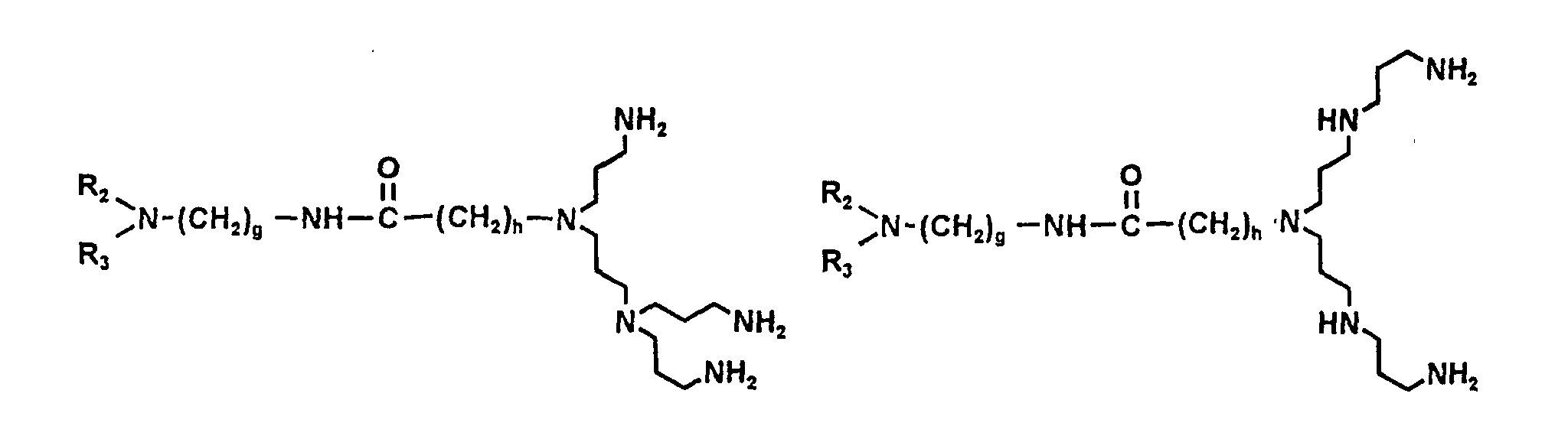 wobei h = 0,1,2,3,4,5 oder 6 und g = 1,2,3,4,5,6,7 oder 8 sein können und R2 und R3 unabhängig voneinander Dodecyl, Dodecenyl, Tetradecyl, Tetradecenyl, Hexadecyl, Hexadecenyl, Octadecyl oder Octadecenyl sein können.
- Verbindungen und ihre Salze entsprechend Anspruch 1 mit folgenden Strukturen:
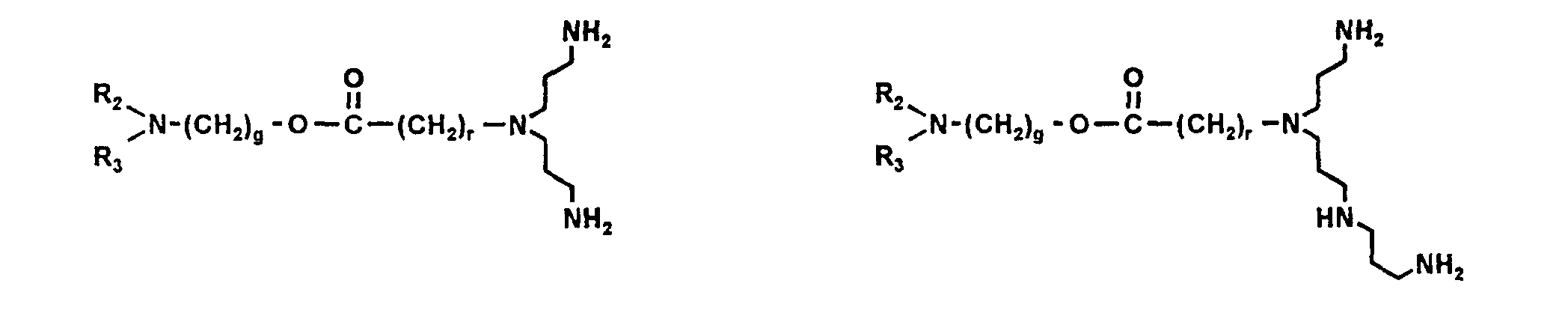
 wobei r = 0,1,2,3,4,5 oder 6 und g = 1,2,3,4,5,6,7 oder 8 sein können und R2 und R3 unabhängig voneinander Dodecyl, Dodecenyl, Tetradecyl, Tetradecenyl, Hexadecyl, Hexadecenyl, Octadecyl oder Octadecenyl sein können.
- Verbindungen und ihre Salze entsprechend Anspruch 1 mit folgenden Strukturen:

 wobei k = 1,2,3,4,5 oder 6 und g = 1,2,3,4,5,6,7 oder 8 sein können und R2 und R3 unabhängig voneinander Dodecyl, Dodecenyl, Tetradecyl, Tetradecenyl, Hexadecyl, Hexadecenyl, Octadecyl oder Octadecenyl sein können.
- Verbindungen und ihre Salze entsprechend Anspruch 1 mit folgenden Strukturen:
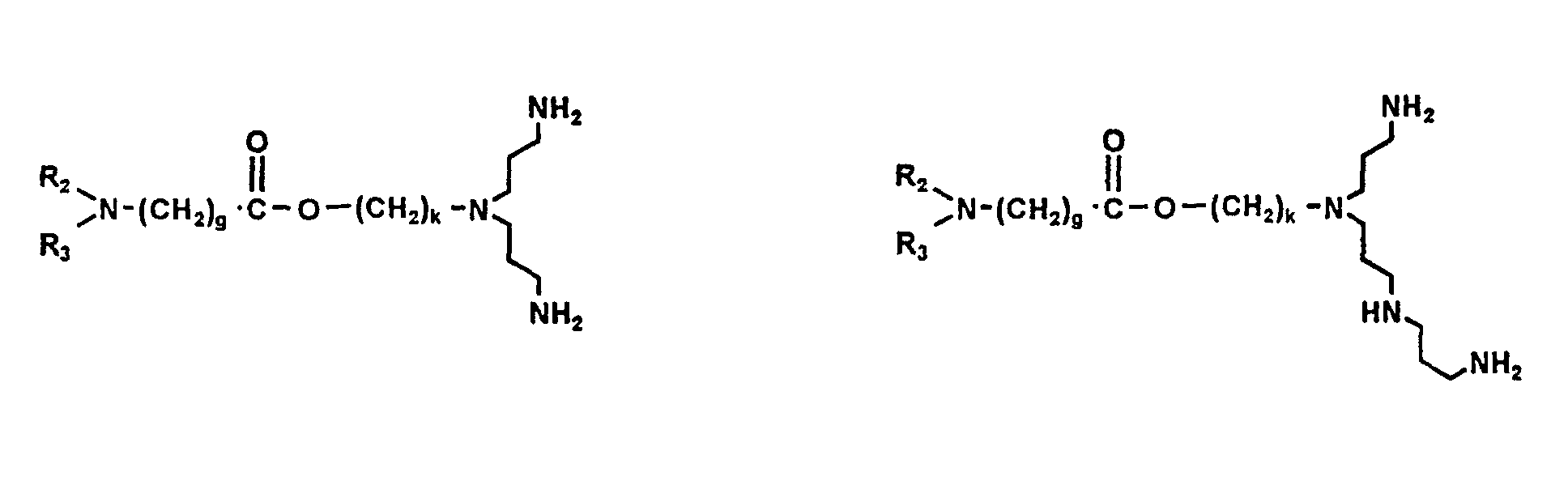
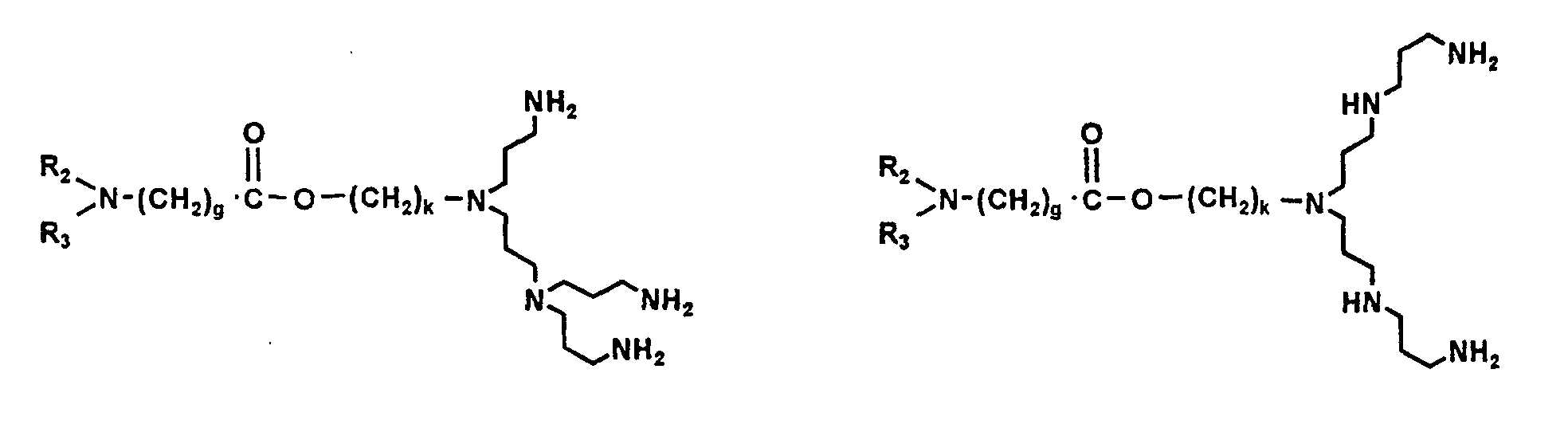 wobei k = 1,2,3,4,5 oder 6 und g = 1,2,3,4,5,6,7 oder 8 sein können und R2 und R3 unabhängig voneinander Dodecyl, Dodecenyl, Tetradecyl, Tetradecenyl, Hexadecyl, Hexadecenyl, Octadecyl oder Octadecenyl sein können.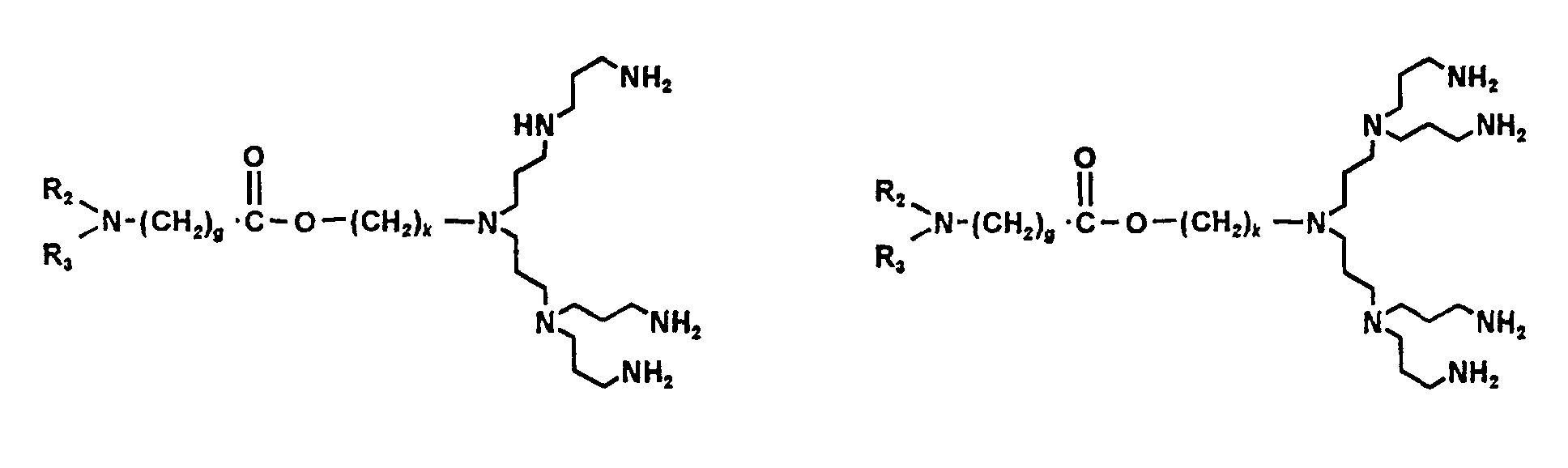
- Verbindungen und ihre Salze entsprechend Anspruch 1 mit folgenden Strukturen:
 wobei g = 1,2,3,4,5,6,7 oder 8 sein kann und R2 und R3 unabhängig voneinander Dodecyl, Dodecenyl, Tetradecyl, Tetradecenyl, Hexadecyl, Hexadecenyl, Octadecyl oder Octadecenyl sein können.
- Verbindungen und ihre Salze entsprechend Anspruch 1 mit folgenden Strukturen:
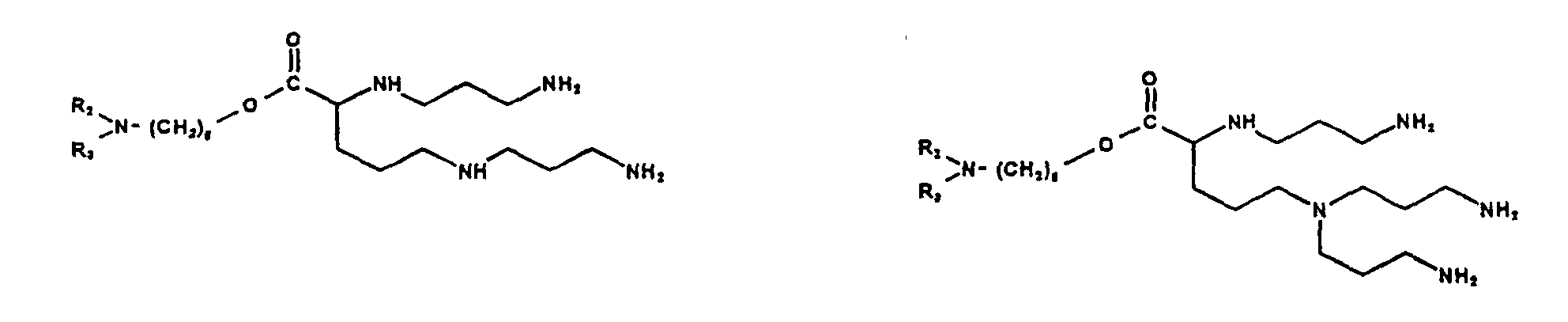 wobei g = 1,2,3,4,5,6,7 oder 8 sein kann und R2 und R3 unabhängig voneinander Dodecyl, Dodecenyl, Tetradecyl, Tetradecenyl, Hexadecyl, Hexadecenyl, Octadecyl oder Octadecenyl sein können.
- Verbindungen und ihre Salze entsprechend Anspruch 1 mit folgenden Strukturen:
 wobei 1 = 0,1,2,3,4,5 oder 6 und g 1,2,3,4,5,6,7 oder 8 sein können und R2 und R3 unabhängig voneinander Dodecyl, Dodecenyl, Tetradecyl, Tetradecenyl, Hexadecyl, Hexadecenyl, Octadecyl oder Octadecenyl sein können.
- Verbindungen und ihre Salze entsprechend Anspruch 1 mit folgenden Strukturen:
 wobei g = 1,2,3,4,5,6,7 oder 8 sein kann und R2 und R3 unabhängig voneinander Dodecyl, Dodecenyl, Tetradecyl, Tetradecenyl, Hexadecyl, Hexadecenyl, Octadecyl oder Octadecenyl sein können.
- Verbindungen und ihre Salze entsprechend Anspruch 1 mit folgenden Strukturen:
 wobei g = 1,2,3,4,5,6,7 oder 8 sein kann und R2 und R3 unabhängig voneinander Dodecyl, Dodecenyl, Tetradecyl, Tetradecenyl, Hexadecyl, Hexadecenyl, Octadecyl oder Octadecenyl sein können.
- Verbindungen und ihre Salze entsprechend Anspruch 1 mit folgenden Strukturen:


- Zusammensetzungen, die mindestens eine der Verbindungen der Ansprüche 1-12 mit oder ohne Colipide, wie z.B. Dioleoylphosphatidylethanolamin (DOPE), Dioleoylphosphatidylcholin, Cholesterol oder Cholesterylamin und gegebenenfalls übliche Zusatzstoffe, Träger oder Adjuvantien enthalten.
- Medizinische oder diagnostische Zusammensetzungen, die mindestens eine Verbindung nach einem der Ansprüche 1 bis 12 oder eine Zusammensetzung nach Anspruch 13 enhalten.
- Verfahren zum Einbringen von biologisch wirksamen Verbindungen, wie DNA, RNA, Ribozymen, Antisense-DNA, PNA,Peptiden, Peptoiden und Proteinen in eukariotische Zellen, wobei Verbindungen oder Zusammensetzungen nach einem der Ansprüche 1-14 mit den einzubringenden Verbindungen komplexiert und die entstandenen Komplexe mit eukariotischen Zellen in vitro in Kontakt gebracht werden.
- Verwendung der Verbindungen oder Zusammensetzungen nach einem der Ansprüche 1-14 zur Herstellung eines Medikaments oder eines Reagenzes zum Einbringen von biologisch wirksamen Verbindungen, wie DNA, RNA, Ribozymen, Antisense-DNA, PNA, Peptiden, Peptoiden und Proteinen in eukariotische Zellen in vivo oder in vitro.
- Verwendung nach Anspruch 16, wobei die Verbindungen in Kombination mit Enhancern verwendet werden.
Applications Claiming Priority (5)
| Application Number | Priority Date | Filing Date | Title |
|---|---|---|---|
| DE19735125 | 1997-08-13 | ||
| DE19735125 | 1997-08-13 | ||
| DE19834683A DE19834683A1 (de) | 1997-08-13 | 1998-07-31 | Neue Lipopolyamine, deren Darstellung und Anwendung |
| DE19834683 | 1998-07-31 | ||
| PCT/EP1998/005156 WO1999008997A1 (de) | 1997-08-13 | 1998-08-13 | Neue lipopolyamine, deren darstellung und anwendung |
Publications (2)
| Publication Number | Publication Date |
|---|---|
| EP1003711A1 EP1003711A1 (de) | 2000-05-31 |
| EP1003711B1 true EP1003711B1 (de) | 2001-11-07 |
Family
ID=26039111
Family Applications (1)
| Application Number | Title | Priority Date | Filing Date |
|---|---|---|---|
| EP98946333A Expired - Lifetime EP1003711B1 (de) | 1997-08-13 | 1998-08-13 | Neue lipopolyamine, deren darstellung und anwendung |
Country Status (8)
| Country | Link |
|---|---|
| US (1) | US6281371B1 (de) |
| EP (1) | EP1003711B1 (de) |
| JP (1) | JP4504559B2 (de) |
| AT (1) | ATE208369T1 (de) |
| AU (1) | AU745958B2 (de) |
| CA (1) | CA2299429C (de) |
| ES (1) | ES2167939T3 (de) |
| WO (1) | WO1999008997A1 (de) |
Families Citing this family (15)
| Publication number | Priority date | Publication date | Assignee | Title |
|---|---|---|---|---|
| AU768542C (en) | 1998-04-08 | 2004-06-17 | Celltech R & D Limited | Lipids |
| US6852334B1 (en) * | 1999-04-20 | 2005-02-08 | The University Of British Columbia | Cationic peg-lipids and methods of use |
| ATE368027T1 (de) * | 1999-04-26 | 2007-08-15 | Celltech R&D Ltd | Bipolare lipide und ihre verwendung zum transport bioaktiver substanzen |
| EP1237581A1 (de) * | 1999-12-17 | 2002-09-11 | Gene Therapy Systems, Inc. | Verwendung von kationischen lipiden zur intrazellulären protein-verabreichung |
| US7189705B2 (en) | 2000-04-20 | 2007-03-13 | The University Of British Columbia | Methods of enhancing SPLP-mediated transfection using endosomal membrane destabilizers |
| US7294511B2 (en) * | 2001-03-22 | 2007-11-13 | Chromos Molecular Systems, Inc. | Methods for delivering nucleic acid molecules into cells and assessment thereof |
| US7001925B1 (en) | 2002-09-27 | 2006-02-21 | University Of Central Florida Research Foundation, Inc. | Compounds and method for enhancing the efficacy of anti-cancer drugs |
| US7906122B2 (en) * | 2003-06-18 | 2011-03-15 | Yissum Research Development Company Of The Hebrew University Of Jersusalem | Sphingoid polyalkylamine conjugates for Hepatitis B virus vaccination |
| AU2004246904B2 (en) * | 2003-06-18 | 2010-02-04 | Biolab Ltd. | Sphingolipids polyalkylamine conjugates for use in transfection |
| US20110045001A1 (en) * | 2008-03-28 | 2011-02-24 | Biontex Laboratories Gmbh | Transfection results of non-viral gene delivery systems by influencing of the innate immune system |
| WO2013016058A1 (en) * | 2011-07-22 | 2013-01-31 | Merck Sharp & Dohme Corp. | Novel bis-nitrogen containing cationic lipids for oligonucleotide delivery |
| EP3542825A1 (de) | 2014-11-10 | 2019-09-25 | Ethris GmbH | Induktion von osteogenese durch bereitstellung von bmp-codierender rna |
| BR112021014528A2 (pt) | 2019-02-14 | 2021-10-13 | Ethris Gmbh | Composição farmacêutica, e, método para analisar o efeito de um polirribonucleotídeo na ciliogênese |
| WO2022096582A1 (en) | 2020-11-04 | 2022-05-12 | Ethris Gmbh | Use of ifn-lambda mrna for treating viral infections |
| WO2024121160A1 (en) | 2022-12-05 | 2024-06-13 | Ethris Gmbh | Regulator(s) of energy homeostasis-encoding rna molecule(s) with increased translation efficiency |
Family Cites Families (24)
| Publication number | Priority date | Publication date | Assignee | Title |
|---|---|---|---|---|
| DE1963189A1 (de) | 1969-12-17 | 1971-06-24 | Bayer Ag | Verfahren zur Herstellung von flammfesten,Urethangruppen aufweisenden Schaumstoffen |
| US4339767A (en) | 1980-05-05 | 1982-07-13 | International Business Machines Corporation | High performance PNP and NPN transistor structure |
| EP0737750B1 (de) | 1989-03-21 | 2003-05-14 | Vical, Inc. | Expression von exogenen Polynukleotidsequenzen in Wirbeltieren |
| FR2645866B1 (fr) * | 1989-04-17 | 1991-07-05 | Centre Nat Rech Scient | Nouvelles lipopolyamines, leur preparation et leur emploi |
| US5538722A (en) | 1989-06-13 | 1996-07-23 | Stanford University | Isolation, growth, differentiation and genetic engineering of human muscle cells |
| US5264618A (en) * | 1990-04-19 | 1993-11-23 | Vical, Inc. | Cationic lipids for intracellular delivery of biologically active molecules |
| IL103059A0 (en) | 1991-09-30 | 1993-02-21 | Boehringer Ingelheim Int | Conjugates for introducing nucleic acid into higher eucaryotic cells |
| DE4139001A1 (de) * | 1991-11-27 | 1993-06-03 | Boehringer Mannheim Gmbh | Verfahren zur einschleusung von nukleinsaeuren in zellen |
| US5972600A (en) | 1992-04-03 | 1999-10-26 | The Regents Of The University Of California | Separation of active complexes |
| US5334761A (en) * | 1992-08-28 | 1994-08-02 | Life Technologies, Inc. | Cationic lipids |
| GB9218762D0 (en) | 1992-09-04 | 1992-10-21 | Exxon Chemical Patents Inc | Esters |
| NZ263550A (en) | 1993-03-19 | 1996-12-20 | Boehringer Ingelheim Int | Preparing cancer vaccines containing autologous tumour cells characterised in that tumour cells or firbroblasts are cultivated and transfected ex vivo with a composition of dna and a dna binding molecule conjugate |
| US5777153A (en) | 1994-07-08 | 1998-07-07 | Gilead Sciences, Inc. | Cationic lipids |
| US5939401A (en) | 1994-12-09 | 1999-08-17 | Genzyme Corporation | Cationic amphiphile compositions for intracellular delivery of therapeutic molecules |
| US5650096A (en) * | 1994-12-09 | 1997-07-22 | Genzyme Corporation | Cationic amphiphiles for intracellular delivery of therapeutic molecules |
| US6071890A (en) | 1994-12-09 | 2000-06-06 | Genzyme Corporation | Organ-specific targeting of cationic amphiphile/DNA complexes for gene therapy |
| US5811406A (en) | 1995-06-07 | 1998-09-22 | Regents Of The University Of California | Dry powder formulations of polynucleotide complexes |
| JPH11507352A (ja) | 1995-06-07 | 1999-06-29 | ジンタ・インコーポレイテッド | 新規カルバメート基本カチオン性脂質 |
| JP2001516329A (ja) | 1995-06-07 | 2001-09-25 | ザ リージェンツ オブ ザ ユニバーシティ オブ カリフォルニア | ポリヌクレオチド複合体の安定化 |
| CA2223179A1 (en) | 1995-06-07 | 1996-12-19 | Bob Dale Brown | Phosphonic acid-based cationic lipids |
| DE19521412A1 (de) | 1995-06-14 | 1996-12-19 | Boehringer Mannheim Gmbh | Neue kationische und polykationische Amphiphile, diese enthaltende Reagenzien und deren Verwendung |
| CA2227373A1 (en) * | 1995-07-21 | 1997-02-06 | Promega Biosciences, Inc. | Novel amide-based cationic lipids |
| DE19607686A1 (de) | 1996-02-29 | 1997-09-04 | Chemicon Lab Gmbh | Neue metabolisierbare Lipopolyamine, deren Darstellung und Anwendung |
| US5747509A (en) | 1996-06-03 | 1998-05-05 | Schering Aktiengesellschaft | Method for lowering plasma levels of lipoprotein(a) |
-
1998
- 1998-08-13 CA CA2299429A patent/CA2299429C/en not_active Expired - Fee Related
- 1998-08-13 US US09/463,172 patent/US6281371B1/en not_active Expired - Lifetime
- 1998-08-13 AT AT98946333T patent/ATE208369T1/de not_active IP Right Cessation
- 1998-08-13 WO PCT/EP1998/005156 patent/WO1999008997A1/de not_active Ceased
- 1998-08-13 JP JP2000509683A patent/JP4504559B2/ja not_active Expired - Fee Related
- 1998-08-13 AU AU93421/98A patent/AU745958B2/en not_active Ceased
- 1998-08-13 EP EP98946333A patent/EP1003711B1/de not_active Expired - Lifetime
- 1998-08-13 ES ES98946333T patent/ES2167939T3/es not_active Expired - Lifetime
Also Published As
| Publication number | Publication date |
|---|---|
| US6281371B1 (en) | 2001-08-28 |
| ES2167939T3 (es) | 2002-05-16 |
| JP4504559B2 (ja) | 2010-07-14 |
| AU745958B2 (en) | 2002-04-11 |
| EP1003711A1 (de) | 2000-05-31 |
| WO1999008997A1 (de) | 1999-02-25 |
| ATE208369T1 (de) | 2001-11-15 |
| CA2299429C (en) | 2010-04-20 |
| CA2299429A1 (en) | 1999-02-25 |
| AU9342198A (en) | 1999-03-08 |
| JP2001515060A (ja) | 2001-09-18 |
Similar Documents
| Publication | Publication Date | Title |
|---|---|---|
| DE69815075T2 (de) | Dimere kationische lipide auf dicystinbasis | |
| EP0883602B1 (de) | Lipidverbindungen | |
| DE69800178T2 (de) | Glycerolipide verbindungen und ihre anwendung zum transport einer aktiven substanz in eine zielzelle | |
| JP4854853B2 (ja) | トランスフェクション薬剤 | |
| DE69832293T2 (de) | Zubereitungen zur abgabe von negativ geladenen molekülen | |
| DE69333434T2 (de) | Selbstorganisierendes system zur verabreichung von polynukleotiden enthaltend ein amphiphatisches peptid | |
| DE69707870T2 (de) | Quartäre cytofectine | |
| DE69732037T2 (de) | Cytofectine abgeleitet von piperazin | |
| DE69423915T2 (de) | Dichtgepackte polykationische ammonium, sulfonium und phosphonium lipide | |
| CA3186033A1 (en) | Methods for encapsulating polynucleotides into reduced sizes of lipid nanoparticles and novel formulation thereof | |
| DE60026164T2 (de) | Virale kernproteine-kationische lipid-nukleinsäure-verabreichungkomplexe | |
| DE19607686A1 (de) | Neue metabolisierbare Lipopolyamine, deren Darstellung und Anwendung | |
| DE69131347T2 (de) | Kationische lipide für die intrazelluläre abgabe von biologisch aktiven molekülen | |
| DE69828045T2 (de) | Verbindungen, ihre herstellung und ihre verwendung für den transfer von nucleinsäuren in zellen | |
| EP1003711A1 (de) | Neue lipopolyamine, deren darstellung und anwendung | |
| DE19605548A1 (de) | Zusammensetzung für die Transfektion höherer eukaryotischer Zellen | |
| DE69926615T2 (de) | Lipidabkömmlinge von pentaerythritol | |
| WO2023061460A1 (zh) | 含氮的阳离子脂质及其应用 | |
| CN120554239A (zh) | 一种碳核阳离子脂质 | |
| DE69531402T2 (de) | Kationische transport-reagenzien | |
| DE69928679T2 (de) | Kationische dendrimer-verbindungen und deren verwendung als oligonucleotid/polynucleotid-träger | |
| DE69708868T2 (de) | Neue kationische cholesterin derivate mit zyklischen polaren gruppen | |
| DE60032600T2 (de) | Spermin:peptidhaltige tenside | |
| DE19834683A1 (de) | Neue Lipopolyamine, deren Darstellung und Anwendung | |
| DE10064870B4 (de) | Schwefelhaltige Amphiphile für den Transfer von biologisch aktiven Molekülen in Zellen |
Legal Events
| Date | Code | Title | Description |
|---|---|---|---|
| PUAI | Public reference made under article 153(3) epc to a published international application that has entered the european phase |
Free format text: ORIGINAL CODE: 0009012 |
|
| 17P | Request for examination filed |
Effective date: 20000127 |
|
| AK | Designated contracting states |
Kind code of ref document: A1 Designated state(s): AT BE CH DE ES FR GB IT LI |
|
| GRAG | Despatch of communication of intention to grant |
Free format text: ORIGINAL CODE: EPIDOS AGRA |
|
| 17Q | First examination report despatched |
Effective date: 20001213 |
|
| GRAG | Despatch of communication of intention to grant |
Free format text: ORIGINAL CODE: EPIDOS AGRA |
|
| GRAH | Despatch of communication of intention to grant a patent |
Free format text: ORIGINAL CODE: EPIDOS IGRA |
|
| GRAH | Despatch of communication of intention to grant a patent |
Free format text: ORIGINAL CODE: EPIDOS IGRA |
|
| GRAA | (expected) grant |
Free format text: ORIGINAL CODE: 0009210 |
|
| AK | Designated contracting states |
Kind code of ref document: B1 Designated state(s): AT BE CH DE ES FR GB IT LI |
|
| REF | Corresponds to: |
Ref document number: 208369 Country of ref document: AT Date of ref document: 20011115 Kind code of ref document: T |
|
| REG | Reference to a national code |
Ref country code: CH Ref legal event code: EP |
|
| REF | Corresponds to: |
Ref document number: 59802084 Country of ref document: DE Date of ref document: 20011213 |
|
| REG | Reference to a national code |
Ref country code: GB Ref legal event code: IF02 |
|
| REG | Reference to a national code |
Ref country code: CH Ref legal event code: NV Representative=s name: E. BLUM & CO. PATENTANWAELTE |
|
| GBT | Gb: translation of ep patent filed (gb section 77(6)(a)/1977) |
Effective date: 20020305 |
|
| REG | Reference to a national code |
Ref country code: ES Ref legal event code: FG2A Ref document number: 2167939 Country of ref document: ES Kind code of ref document: T3 |
|
| PLBE | No opposition filed within time limit |
Free format text: ORIGINAL CODE: 0009261 |
|
| STAA | Information on the status of an ep patent application or granted ep patent |
Free format text: STATUS: NO OPPOSITION FILED WITHIN TIME LIMIT |
|
| 26N | No opposition filed | ||
| REG | Reference to a national code |
Ref country code: CH Ref legal event code: PFA Owner name: BIONTEX LABORATORIES GMBH Free format text: BIONTEX LABORATORIES GMBH#FRANKFURTER RING 193A#80807 MUENCHEN (DE) -TRANSFER TO- BIONTEX LABORATORIES GMBH#FRANKFURTER RING 193A#80807 MUENCHEN (DE) |
|
| PGFP | Annual fee paid to national office [announced via postgrant information from national office to epo] |
Ref country code: ES Payment date: 20090828 Year of fee payment: 12 |
|
| PGFP | Annual fee paid to national office [announced via postgrant information from national office to epo] |
Ref country code: CH Payment date: 20090828 Year of fee payment: 12 Ref country code: AT Payment date: 20090921 Year of fee payment: 12 |
|
| PGFP | Annual fee paid to national office [announced via postgrant information from national office to epo] |
Ref country code: BE Payment date: 20090828 Year of fee payment: 12 |
|
| PGFP | Annual fee paid to national office [announced via postgrant information from national office to epo] |
Ref country code: IT Payment date: 20090923 Year of fee payment: 12 |
|
| BERE | Be: lapsed |
Owner name: *BIONTEX LABORATORIES G.M.B.H. Effective date: 20100831 |
|
| REG | Reference to a national code |
Ref country code: CH Ref legal event code: PL |
|
| PG25 | Lapsed in a contracting state [announced via postgrant information from national office to epo] |
Ref country code: CH Free format text: LAPSE BECAUSE OF NON-PAYMENT OF DUE FEES Effective date: 20100831 Ref country code: LI Free format text: LAPSE BECAUSE OF NON-PAYMENT OF DUE FEES Effective date: 20100831 |
|
| PG25 | Lapsed in a contracting state [announced via postgrant information from national office to epo] |
Ref country code: AT Free format text: LAPSE BECAUSE OF NON-PAYMENT OF DUE FEES Effective date: 20100813 Ref country code: IT Free format text: LAPSE BECAUSE OF NON-PAYMENT OF DUE FEES Effective date: 20100813 |
|
| PG25 | Lapsed in a contracting state [announced via postgrant information from national office to epo] |
Ref country code: BE Free format text: LAPSE BECAUSE OF NON-PAYMENT OF DUE FEES Effective date: 20100831 |
|
| REG | Reference to a national code |
Ref country code: ES Ref legal event code: FD2A Effective date: 20111019 |
|
| PG25 | Lapsed in a contracting state [announced via postgrant information from national office to epo] |
Ref country code: ES Free format text: LAPSE BECAUSE OF NON-PAYMENT OF DUE FEES Effective date: 20100814 |
|
| REG | Reference to a national code |
Ref country code: FR Ref legal event code: PLFP Year of fee payment: 19 |
|
| REG | Reference to a national code |
Ref country code: FR Ref legal event code: PLFP Year of fee payment: 20 |
|
| PGFP | Annual fee paid to national office [announced via postgrant information from national office to epo] |
Ref country code: DE Payment date: 20170817 Year of fee payment: 20 Ref country code: FR Payment date: 20170823 Year of fee payment: 20 Ref country code: GB Payment date: 20170824 Year of fee payment: 20 |
|
| REG | Reference to a national code |
Ref country code: DE Ref legal event code: R071 Ref document number: 59802084 Country of ref document: DE |
|
| REG | Reference to a national code |
Ref country code: GB Ref legal event code: PE20 Expiry date: 20180812 |
|
| PG25 | Lapsed in a contracting state [announced via postgrant information from national office to epo] |
Ref country code: GB Free format text: LAPSE BECAUSE OF EXPIRATION OF PROTECTION Effective date: 20180812 |