EP1478652B1 - Komponenten fur die herstellung amphoterer liposomen - Google Patents
Komponenten fur die herstellung amphoterer liposomen Download PDFInfo
- Publication number
- EP1478652B1 EP1478652B1 EP03742541A EP03742541A EP1478652B1 EP 1478652 B1 EP1478652 B1 EP 1478652B1 EP 03742541 A EP03742541 A EP 03742541A EP 03742541 A EP03742541 A EP 03742541A EP 1478652 B1 EP1478652 B1 EP 1478652B1
- Authority
- EP
- European Patent Office
- Prior art keywords
- acid
- liposomes
- lipid
- amphoteric
- group
- Prior art date
- Legal status (The legal status is an assumption and is not a legal conclusion. Google has not performed a legal analysis and makes no representation as to the accuracy of the status listed.)
- Expired - Lifetime
Links
- 239000002502 liposome Substances 0.000 title claims abstract description 119
- 150000002632 lipids Chemical class 0.000 claims abstract description 59
- 239000000126 substance Substances 0.000 claims abstract description 31
- 108090000623 proteins and genes Proteins 0.000 claims description 21
- KRKNYBCHXYNGOX-UHFFFAOYSA-N citric acid Chemical compound OC(=O)CC(O)(C(O)=O)CC(O)=O KRKNYBCHXYNGOX-UHFFFAOYSA-N 0.000 claims description 20
- HNDVDQJCIGZPNO-UHFFFAOYSA-N histidine Natural products OC(=O)C(N)CC1=CN=CN1 HNDVDQJCIGZPNO-UHFFFAOYSA-N 0.000 claims description 19
- HNDVDQJCIGZPNO-YFKPBYRVSA-N L-histidine Chemical compound OC(=O)[C@@H](N)CC1=CN=CN1 HNDVDQJCIGZPNO-YFKPBYRVSA-N 0.000 claims description 18
- 102000004169 proteins and genes Human genes 0.000 claims description 18
- 125000000129 anionic group Chemical group 0.000 claims description 17
- 125000003178 carboxy group Chemical group [H]OC(*)=O 0.000 claims description 17
- OFOBLEOULBTSOW-UHFFFAOYSA-N Propanedioic acid Natural products OC(=O)CC(O)=O OFOBLEOULBTSOW-UHFFFAOYSA-N 0.000 claims description 16
- 125000002091 cationic group Chemical group 0.000 claims description 16
- RAXXELZNTBOGNW-UHFFFAOYSA-N imidazole Natural products C1=CNC=N1 RAXXELZNTBOGNW-UHFFFAOYSA-N 0.000 claims description 16
- 235000018102 proteins Nutrition 0.000 claims description 16
- 125000006850 spacer group Chemical group 0.000 claims description 15
- WHUUTDBJXJRKMK-UHFFFAOYSA-N Glutamic acid Natural products OC(=O)C(N)CCC(O)=O WHUUTDBJXJRKMK-UHFFFAOYSA-N 0.000 claims description 14
- WHUUTDBJXJRKMK-VKHMYHEASA-N L-glutamic acid Chemical compound OC(=O)[C@@H](N)CCC(O)=O WHUUTDBJXJRKMK-VKHMYHEASA-N 0.000 claims description 13
- KDXKERNSBIXSRK-YFKPBYRVSA-N L-lysine Chemical compound NCCCC[C@H](N)C(O)=O KDXKERNSBIXSRK-YFKPBYRVSA-N 0.000 claims description 13
- KDXKERNSBIXSRK-UHFFFAOYSA-N Lysine Natural products NCCCCC(N)C(O)=O KDXKERNSBIXSRK-UHFFFAOYSA-N 0.000 claims description 13
- GLUUGHFHXGJENI-UHFFFAOYSA-N Piperazine Chemical compound C1CNCCN1 GLUUGHFHXGJENI-UHFFFAOYSA-N 0.000 claims description 13
- 235000001014 amino acid Nutrition 0.000 claims description 13
- 150000001413 amino acids Chemical class 0.000 claims description 13
- 239000002253 acid Substances 0.000 claims description 12
- 239000013543 active substance Substances 0.000 claims description 12
- 125000000217 alkyl group Chemical group 0.000 claims description 12
- 239000000203 mixture Substances 0.000 claims description 12
- YNAVUWVOSKDBBP-UHFFFAOYSA-N Morpholine Chemical compound C1COCCN1 YNAVUWVOSKDBBP-UHFFFAOYSA-N 0.000 claims description 11
- 150000001982 diacylglycerols Chemical class 0.000 claims description 11
- 238000000034 method Methods 0.000 claims description 11
- QTBSBXVTEAMEQO-UHFFFAOYSA-N Acetic acid Chemical compound CC(O)=O QTBSBXVTEAMEQO-UHFFFAOYSA-N 0.000 claims description 10
- MUBZPKHOEPUJKR-UHFFFAOYSA-N Oxalic acid Chemical compound OC(=O)C(O)=O MUBZPKHOEPUJKR-UHFFFAOYSA-N 0.000 claims description 10
- 125000001931 aliphatic group Chemical group 0.000 claims description 10
- KDCGOANMDULRCW-UHFFFAOYSA-N 7H-purine Chemical compound N1=CNC2=NC=NC2=C1 KDCGOANMDULRCW-UHFFFAOYSA-N 0.000 claims description 9
- 125000002252 acyl group Chemical group 0.000 claims description 9
- 125000002887 hydroxy group Chemical group [H]O* 0.000 claims description 9
- 238000004519 manufacturing process Methods 0.000 claims description 9
- 108090000765 processed proteins & peptides Proteins 0.000 claims description 9
- 239000013598 vector Substances 0.000 claims description 9
- KQIGMPWTAHJUMN-UHFFFAOYSA-N 3-aminopropane-1,2-diol Chemical class NCC(O)CO KQIGMPWTAHJUMN-UHFFFAOYSA-N 0.000 claims description 8
- 235000003704 aspartic acid Nutrition 0.000 claims description 8
- OQFSQFPPLPISGP-UHFFFAOYSA-N beta-carboxyaspartic acid Natural products OC(=O)C(N)C(C(O)=O)C(O)=O OQFSQFPPLPISGP-UHFFFAOYSA-N 0.000 claims description 8
- 239000002800 charge carrier Substances 0.000 claims description 8
- FERIUCNNQQJTOY-UHFFFAOYSA-N Butyric acid Chemical compound CCCC(O)=O FERIUCNNQQJTOY-UHFFFAOYSA-N 0.000 claims description 7
- CKLJMWTZIZZHCS-REOHCLBHSA-N L-aspartic acid Chemical compound OC(=O)[C@@H](N)CC(O)=O CKLJMWTZIZZHCS-REOHCLBHSA-N 0.000 claims description 7
- JUJWROOIHBZHMG-UHFFFAOYSA-N Pyridine Chemical compound C1=CC=NC=C1 JUJWROOIHBZHMG-UHFFFAOYSA-N 0.000 claims description 7
- XBDQKXXYIPTUBI-UHFFFAOYSA-N dimethylselenoniopropionate Natural products CCC(O)=O XBDQKXXYIPTUBI-UHFFFAOYSA-N 0.000 claims description 7
- 235000013922 glutamic acid Nutrition 0.000 claims description 7
- 239000004220 glutamic acid Substances 0.000 claims description 7
- 238000001727 in vivo Methods 0.000 claims description 7
- 125000000400 lauroyl group Chemical group O=C([*])C([H])([H])C([H])([H])C([H])([H])C([H])([H])C([H])([H])C([H])([H])C([H])([H])C([H])([H])C([H])([H])C([H])([H])C([H])([H])[H] 0.000 claims description 7
- 125000001419 myristoyl group Chemical group O=C([*])C([H])([H])C([H])([H])C([H])([H])C([H])([H])C([H])([H])C([H])([H])C([H])([H])C([H])([H])C([H])([H])C([H])([H])C([H])([H])C([H])([H])C([H])([H])[H] 0.000 claims description 7
- 125000002811 oleoyl group Chemical group O=C([*])C([H])([H])C([H])([H])C([H])([H])C([H])([H])C([H])([H])C([H])([H])C([H])([H])/C([H])=C([H])\C([H])([H])C([H])([H])C([H])([H])C([H])([H])C([H])([H])C([H])([H])C([H])([H])C([H])([H])[H] 0.000 claims description 7
- 125000001312 palmitoyl group Chemical group O=C([*])C([H])([H])C([H])([H])C([H])([H])C([H])([H])C([H])([H])C([H])([H])C([H])([H])C([H])([H])C([H])([H])C([H])([H])C([H])([H])C([H])([H])C([H])([H])C([H])([H])C([H])([H])[H] 0.000 claims description 7
- 125000003696 stearoyl group Chemical group O=C([*])C([H])([H])C([H])([H])C([H])([H])C([H])([H])C([H])([H])C([H])([H])C([H])([H])C([H])([H])C([H])([H])C([H])([H])C([H])([H])C([H])([H])C([H])([H])C([H])([H])C([H])([H])C([H])([H])C([H])([H])[H] 0.000 claims description 7
- VZCYOOQTPOCHFL-UHFFFAOYSA-N trans-butenedioic acid Natural products OC(=O)C=CC(O)=O VZCYOOQTPOCHFL-UHFFFAOYSA-N 0.000 claims description 7
- 238000001890 transfection Methods 0.000 claims description 7
- BJEPYKJPYRNKOW-REOHCLBHSA-N (S)-malic acid Chemical compound OC(=O)[C@@H](O)CC(O)=O BJEPYKJPYRNKOW-REOHCLBHSA-N 0.000 claims description 6
- FEWJPZIEWOKRBE-JCYAYHJZSA-N Dextrotartaric acid Chemical compound OC(=O)[C@H](O)[C@@H](O)C(O)=O FEWJPZIEWOKRBE-JCYAYHJZSA-N 0.000 claims description 6
- JZNWSCPGTDBMEW-UHFFFAOYSA-N Glycerophosphorylethanolamin Natural products NCCOP(O)(=O)OCC(O)CO JZNWSCPGTDBMEW-UHFFFAOYSA-N 0.000 claims description 6
- 239000004472 Lysine Substances 0.000 claims description 6
- FEWJPZIEWOKRBE-UHFFFAOYSA-N Tartaric acid Natural products [H+].[H+].[O-]C(=O)C(O)C(O)C([O-])=O FEWJPZIEWOKRBE-UHFFFAOYSA-N 0.000 claims description 6
- BJEPYKJPYRNKOW-UHFFFAOYSA-N alpha-hydroxysuccinic acid Natural products OC(=O)C(O)CC(O)=O BJEPYKJPYRNKOW-UHFFFAOYSA-N 0.000 claims description 6
- 230000027455 binding Effects 0.000 claims description 6
- 125000004432 carbon atom Chemical group C* 0.000 claims description 6
- 235000015165 citric acid Nutrition 0.000 claims description 6
- 239000001630 malic acid Substances 0.000 claims description 6
- 235000011090 malic acid Nutrition 0.000 claims description 6
- WWZKQHOCKIZLMA-UHFFFAOYSA-N octanoic acid Chemical compound CCCCCCCC(O)=O WWZKQHOCKIZLMA-UHFFFAOYSA-N 0.000 claims description 6
- 150000008104 phosphatidylethanolamines Chemical class 0.000 claims description 6
- 239000011975 tartaric acid Substances 0.000 claims description 6
- 235000002906 tartaric acid Nutrition 0.000 claims description 6
- NIXOWILDQLNWCW-UHFFFAOYSA-N 2-Propenoic acid Natural products OC(=O)C=C NIXOWILDQLNWCW-UHFFFAOYSA-N 0.000 claims description 5
- PECYZEOJVXMISF-UHFFFAOYSA-N 3-aminoalanine Chemical compound [NH3+]CC(N)C([O-])=O PECYZEOJVXMISF-UHFFFAOYSA-N 0.000 claims description 5
- KCXVZYZYPLLWCC-UHFFFAOYSA-N EDTA Chemical compound OC(=O)CN(CC(O)=O)CCN(CC(O)=O)CC(O)=O KCXVZYZYPLLWCC-UHFFFAOYSA-N 0.000 claims description 5
- VZCYOOQTPOCHFL-OWOJBTEDSA-N Fumaric acid Chemical compound OC(=O)\C=C\C(O)=O VZCYOOQTPOCHFL-OWOJBTEDSA-N 0.000 claims description 5
- 125000000570 L-alpha-aspartyl group Chemical group [H]OC(=O)C([H])([H])[C@]([H])(N([H])[H])C(*)=O 0.000 claims description 5
- 125000002059 L-arginyl group Chemical group O=C([*])[C@](N([H])[H])([H])C([H])([H])C([H])([H])C([H])([H])N([H])C(=N[H])N([H])[H] 0.000 claims description 5
- CZPWVGJYEJSRLH-UHFFFAOYSA-N Pyrimidine Chemical compound C1=CN=CN=C1 CZPWVGJYEJSRLH-UHFFFAOYSA-N 0.000 claims description 5
- WNLRTRBMVRJNCN-UHFFFAOYSA-N adipic acid Chemical compound OC(=O)CCCCC(O)=O WNLRTRBMVRJNCN-UHFFFAOYSA-N 0.000 claims description 5
- 150000001735 carboxylic acids Chemical class 0.000 claims description 5
- 125000003438 dodecyl group Chemical group [H]C([H])([H])C([H])([H])C([H])([H])C([H])([H])C([H])([H])C([H])([H])C([H])([H])C([H])([H])C([H])([H])C([H])([H])C([H])([H])C([H])([H])* 0.000 claims description 5
- 238000000338 in vitro Methods 0.000 claims description 5
- 238000011068 loading method Methods 0.000 claims description 5
- VZCYOOQTPOCHFL-UPHRSURJSA-N maleic acid Chemical compound OC(=O)\C=C/C(O)=O VZCYOOQTPOCHFL-UPHRSURJSA-N 0.000 claims description 5
- 239000011976 maleic acid Substances 0.000 claims description 5
- 125000001421 myristyl group Chemical group [H]C([*])([H])C([H])([H])C([H])([H])C([H])([H])C([H])([H])C([H])([H])C([H])([H])C([H])([H])C([H])([H])C([H])([H])C([H])([H])C([H])([H])C([H])([H])C([H])([H])[H] 0.000 claims description 5
- 239000002088 nanocapsule Substances 0.000 claims description 5
- 125000001117 oleyl group Chemical group [H]C([*])([H])C([H])([H])C([H])([H])C([H])([H])C([H])([H])C([H])([H])C([H])([H])C([H])([H])/C([H])=C([H])\C([H])([H])C([H])([H])C([H])([H])C([H])([H])C([H])([H])C([H])([H])C([H])([H])C([H])([H])[H] 0.000 claims description 5
- 125000000913 palmityl group Chemical group [H]C([*])([H])C([H])([H])C([H])([H])C([H])([H])C([H])([H])C([H])([H])C([H])([H])C([H])([H])C([H])([H])C([H])([H])C([H])([H])C([H])([H])C([H])([H])C([H])([H])C([H])([H])C([H])([H])[H] 0.000 claims description 5
- 125000004079 stearyl group Chemical group [H]C([*])([H])C([H])([H])C([H])([H])C([H])([H])C([H])([H])C([H])([H])C([H])([H])C([H])([H])C([H])([H])C([H])([H])C([H])([H])C([H])([H])C([H])([H])C([H])([H])C([H])([H])C([H])([H])C([H])([H])C([H])([H])[H] 0.000 claims description 5
- BLCJBICVQSYOIF-UHFFFAOYSA-N 2,2-diaminobutanoic acid Chemical compound CCC(N)(N)C(O)=O BLCJBICVQSYOIF-UHFFFAOYSA-N 0.000 claims description 4
- SMZOUWXMTYCWNB-UHFFFAOYSA-N 2-(2-methoxy-5-methylphenyl)ethanamine Chemical compound COC1=CC=C(C)C=C1CCN SMZOUWXMTYCWNB-UHFFFAOYSA-N 0.000 claims description 4
- AHLPHDHHMVZTML-BYPYZUCNSA-N L-Ornithine Chemical compound NCCC[C@H](N)C(O)=O AHLPHDHHMVZTML-BYPYZUCNSA-N 0.000 claims description 4
- AHLPHDHHMVZTML-UHFFFAOYSA-N Orn-delta-NH2 Natural products NCCCC(N)C(O)=O AHLPHDHHMVZTML-UHFFFAOYSA-N 0.000 claims description 4
- UTJLXEIPEHZYQJ-UHFFFAOYSA-N Ornithine Natural products OC(=O)C(C)CCCN UTJLXEIPEHZYQJ-UHFFFAOYSA-N 0.000 claims description 4
- FOCAUTSVDIKZOP-UHFFFAOYSA-N chloroacetic acid Chemical compound OC(=O)CCl FOCAUTSVDIKZOP-UHFFFAOYSA-N 0.000 claims description 4
- 150000001991 dicarboxylic acids Chemical class 0.000 claims description 4
- 238000005538 encapsulation Methods 0.000 claims description 4
- 239000002773 nucleotide Substances 0.000 claims description 4
- 125000003729 nucleotide group Chemical group 0.000 claims description 4
- 229960003104 ornithine Drugs 0.000 claims description 4
- WLJVNTCWHIRURA-UHFFFAOYSA-N pimelic acid Chemical compound OC(=O)CCCCCC(O)=O WLJVNTCWHIRURA-UHFFFAOYSA-N 0.000 claims description 4
- TYFQFVWCELRYAO-UHFFFAOYSA-N suberic acid Chemical compound OC(=O)CCCCCCC(O)=O TYFQFVWCELRYAO-UHFFFAOYSA-N 0.000 claims description 4
- GTZCVFVGUGFEME-UHFFFAOYSA-N trans-aconitic acid Natural products OC(=O)CC(C(O)=O)=CC(O)=O GTZCVFVGUGFEME-UHFFFAOYSA-N 0.000 claims description 4
- 239000001124 (E)-prop-1-ene-1,2,3-tricarboxylic acid Substances 0.000 claims description 3
- WDJHALXBUFZDSR-UHFFFAOYSA-N Acetoacetic acid Natural products CC(=O)CC(O)=O WDJHALXBUFZDSR-UHFFFAOYSA-N 0.000 claims description 3
- ODBLHEXUDAPZAU-ZAFYKAAXSA-N D-threo-isocitric acid Chemical compound OC(=O)[C@H](O)[C@@H](C(O)=O)CC(O)=O ODBLHEXUDAPZAU-ZAFYKAAXSA-N 0.000 claims description 3
- ODBLHEXUDAPZAU-FONMRSAGSA-N Isocitric acid Natural products OC(=O)[C@@H](O)[C@H](C(O)=O)CC(O)=O ODBLHEXUDAPZAU-FONMRSAGSA-N 0.000 claims description 3
- KDYFGRWQOYBRFD-UHFFFAOYSA-N Succinic acid Natural products OC(=O)CCC(O)=O KDYFGRWQOYBRFD-UHFFFAOYSA-N 0.000 claims description 3
- 150000007513 acids Chemical class 0.000 claims description 3
- 229940091181 aconitic acid Drugs 0.000 claims description 3
- 229940106681 chloroacetic acid Drugs 0.000 claims description 3
- GTZCVFVGUGFEME-IWQZZHSRSA-N cis-aconitic acid Chemical compound OC(=O)C\C(C(O)=O)=C\C(O)=O GTZCVFVGUGFEME-IWQZZHSRSA-N 0.000 claims description 3
- HNEGQIOMVPPMNR-IHWYPQMZSA-N citraconic acid Chemical compound OC(=O)C(/C)=C\C(O)=O HNEGQIOMVPPMNR-IHWYPQMZSA-N 0.000 claims description 3
- 229940018557 citraconic acid Drugs 0.000 claims description 3
- LDHQCZJRKDOVOX-NSCUHMNNSA-N crotonic acid Chemical compound C\C=C\C(O)=O LDHQCZJRKDOVOX-NSCUHMNNSA-N 0.000 claims description 3
- 125000004122 cyclic group Chemical group 0.000 claims description 3
- QYQADNCHXSEGJT-UHFFFAOYSA-N cyclohexane-1,1-dicarboxylate;hydron Chemical compound OC(=O)C1(C(O)=O)CCCCC1 QYQADNCHXSEGJT-UHFFFAOYSA-N 0.000 claims description 3
- YZFOGXKZTWZVFN-UHFFFAOYSA-N cyclopentane-1,1-dicarboxylic acid Chemical compound OC(=O)C1(C(O)=O)CCCC1 YZFOGXKZTWZVFN-UHFFFAOYSA-N 0.000 claims description 3
- WOWBFOBYOAGEEA-UHFFFAOYSA-N diafenthiuron Chemical compound CC(C)C1=C(NC(=S)NC(C)(C)C)C(C(C)C)=CC(OC=2C=CC=CC=2)=C1 WOWBFOBYOAGEEA-UHFFFAOYSA-N 0.000 claims description 3
- WBJINCZRORDGAQ-UHFFFAOYSA-N ethyl formate Chemical compound CCOC=O WBJINCZRORDGAQ-UHFFFAOYSA-N 0.000 claims description 3
- AWUCVROLDVIAJX-UHFFFAOYSA-N glycerol 1-phosphate Chemical class OCC(O)COP(O)(O)=O AWUCVROLDVIAJX-UHFFFAOYSA-N 0.000 claims description 3
- 235000006408 oxalic acid Nutrition 0.000 claims description 3
- WTJKGGKOPKCXLL-RRHRGVEJSA-N phosphatidylcholine Chemical compound CCCCCCCCCCCCCCCC(=O)OC[C@H](COP([O-])(=O)OCC[N+](C)(C)C)OC(=O)CCCCCCCC=CCCCCCCCC WTJKGGKOPKCXLL-RRHRGVEJSA-N 0.000 claims description 3
- 229920001223 polyethylene glycol Polymers 0.000 claims description 3
- 235000019260 propionic acid Nutrition 0.000 claims description 3
- UMJSCPRVCHMLSP-UHFFFAOYSA-N pyridine Natural products COC1=CC=CN=C1 UMJSCPRVCHMLSP-UHFFFAOYSA-N 0.000 claims description 3
- IUVKMZGDUIUOCP-BTNSXGMBSA-N quinbolone Chemical compound O([C@H]1CC[C@H]2[C@H]3[C@@H]([C@]4(C=CC(=O)C=C4CC3)C)CC[C@@]21C)C1=CCCC1 IUVKMZGDUIUOCP-BTNSXGMBSA-N 0.000 claims description 3
- ODBLHEXUDAPZAU-UHFFFAOYSA-N threo-D-isocitric acid Natural products OC(=O)C(O)C(C(O)=O)CC(O)=O ODBLHEXUDAPZAU-UHFFFAOYSA-N 0.000 claims description 3
- LDHQCZJRKDOVOX-UHFFFAOYSA-N trans-crotonic acid Natural products CC=CC(O)=O LDHQCZJRKDOVOX-UHFFFAOYSA-N 0.000 claims description 3
- RTBFRGCFXZNCOE-UHFFFAOYSA-N 1-methylsulfonylpiperidin-4-one Chemical compound CS(=O)(=O)N1CCC(=O)CC1 RTBFRGCFXZNCOE-UHFFFAOYSA-N 0.000 claims description 2
- 239000004475 Arginine Substances 0.000 claims description 2
- 239000005635 Caprylic acid (CAS 124-07-2) Substances 0.000 claims description 2
- ODKSFYDXXFIFQN-BYPYZUCNSA-P L-argininium(2+) Chemical compound NC(=[NH2+])NCCC[C@H]([NH3+])C(O)=O ODKSFYDXXFIFQN-BYPYZUCNSA-P 0.000 claims description 2
- 239000002202 Polyethylene glycol Substances 0.000 claims description 2
- 239000001361 adipic acid Substances 0.000 claims description 2
- 235000011037 adipic acid Nutrition 0.000 claims description 2
- 150000001298 alcohols Chemical class 0.000 claims description 2
- JFCQEDHGNNZCLN-UHFFFAOYSA-N anhydrous glutaric acid Natural products OC(=O)CCCC(O)=O JFCQEDHGNNZCLN-UHFFFAOYSA-N 0.000 claims description 2
- 230000000692 anti-sense effect Effects 0.000 claims description 2
- ODKSFYDXXFIFQN-UHFFFAOYSA-N arginine Natural products OC(=O)C(N)CCCNC(N)=N ODKSFYDXXFIFQN-UHFFFAOYSA-N 0.000 claims description 2
- 150000001985 dialkylglycerols Chemical class 0.000 claims description 2
- 235000014113 dietary fatty acids Nutrition 0.000 claims description 2
- 229930195729 fatty acid Natural products 0.000 claims description 2
- 239000000194 fatty acid Substances 0.000 claims description 2
- 150000004665 fatty acids Chemical class 0.000 claims description 2
- 238000009472 formulation Methods 0.000 claims description 2
- 239000001530 fumaric acid Substances 0.000 claims description 2
- 235000011087 fumaric acid Nutrition 0.000 claims description 2
- 238000001990 intravenous administration Methods 0.000 claims description 2
- 239000000178 monomer Substances 0.000 claims description 2
- 229960002446 octanoic acid Drugs 0.000 claims description 2
- 235000000346 sugar Nutrition 0.000 claims description 2
- 125000002669 linoleoyl group Chemical group O=C([*])C([H])([H])C([H])([H])C([H])([H])C([H])([H])C([H])([H])C([H])([H])C([H])([H])/C([H])=C([H])\C([H])([H])/C([H])=C([H])\C([H])([H])C([H])([H])C([H])([H])C([H])([H])C([H])([H])[H] 0.000 claims 4
- 125000005645 linoleyl group Chemical group 0.000 claims 3
- 239000008194 pharmaceutical composition Substances 0.000 claims 3
- KDYFGRWQOYBRFD-NUQCWPJISA-N butanedioic acid Chemical compound O[14C](=O)CC[14C](O)=O KDYFGRWQOYBRFD-NUQCWPJISA-N 0.000 claims 1
- 150000001875 compounds Chemical class 0.000 abstract description 43
- 230000008878 coupling Effects 0.000 description 30
- 238000010168 coupling process Methods 0.000 description 30
- 238000005859 coupling reaction Methods 0.000 description 30
- -1 Bromessigsäure Chemical compound 0.000 description 26
- 239000012528 membrane Substances 0.000 description 25
- 210000004027 cell Anatomy 0.000 description 20
- 239000004480 active ingredient Substances 0.000 description 17
- 235000014304 histidine Nutrition 0.000 description 17
- 210000002966 serum Anatomy 0.000 description 16
- YMWUJEATGCHHMB-UHFFFAOYSA-N Dichloromethane Chemical compound ClCCl YMWUJEATGCHHMB-UHFFFAOYSA-N 0.000 description 15
- OGQYPPBGSLZBEG-UHFFFAOYSA-N dimethyl(dioctadecyl)azanium Chemical compound CCCCCCCCCCCCCCCCCC[N+](C)(C)CCCCCCCCCCCCCCCCCC OGQYPPBGSLZBEG-UHFFFAOYSA-N 0.000 description 15
- 125000003277 amino group Chemical group 0.000 description 13
- 230000015572 biosynthetic process Effects 0.000 description 13
- 229940079593 drug Drugs 0.000 description 13
- 239000003814 drug Substances 0.000 description 13
- OKKJLVBELUTLKV-UHFFFAOYSA-N Methanol Chemical compound OC OKKJLVBELUTLKV-UHFFFAOYSA-N 0.000 description 12
- 229940024606 amino acid Drugs 0.000 description 12
- IJGRMHOSHXDMSA-UHFFFAOYSA-N Atomic nitrogen Chemical compound N#N IJGRMHOSHXDMSA-UHFFFAOYSA-N 0.000 description 10
- HEDRZPFGACZZDS-UHFFFAOYSA-N Chloroform Chemical group ClC(Cl)Cl HEDRZPFGACZZDS-UHFFFAOYSA-N 0.000 description 10
- ZWZWYGMENQVNFU-UHFFFAOYSA-N Glycerophosphorylserin Natural products OC(=O)C(N)COP(O)(=O)OCC(O)CO ZWZWYGMENQVNFU-UHFFFAOYSA-N 0.000 description 10
- 210000004369 blood Anatomy 0.000 description 10
- 239000008280 blood Substances 0.000 description 10
- 230000006870 function Effects 0.000 description 9
- TZCPCKNHXULUIY-RGULYWFUSA-N 1,2-distearoyl-sn-glycero-3-phosphoserine Chemical compound CCCCCCCCCCCCCCCCCC(=O)OC[C@H](COP(O)(=O)OC[C@H](N)C(O)=O)OC(=O)CCCCCCCCCCCCCCCCC TZCPCKNHXULUIY-RGULYWFUSA-N 0.000 description 8
- FAPWRFPIFSIZLT-UHFFFAOYSA-M Sodium chloride Chemical compound [Na+].[Cl-] FAPWRFPIFSIZLT-UHFFFAOYSA-M 0.000 description 8
- 239000000872 buffer Substances 0.000 description 8
- 150000001768 cations Chemical class 0.000 description 8
- 229910052757 nitrogen Inorganic materials 0.000 description 8
- 0 CC1(*)CN(C*)CC(C*)CC1 Chemical compound CC1(*)CN(C*)CC(C*)CC1 0.000 description 7
- 230000008859 change Effects 0.000 description 7
- 238000006243 chemical reaction Methods 0.000 description 7
- WLNARFZDISHUGS-MIXBDBMTSA-N cholesteryl hemisuccinate Chemical compound C1C=C2C[C@@H](OC(=O)CCC(O)=O)CC[C@]2(C)[C@@H]2[C@@H]1[C@@H]1CC[C@H]([C@H](C)CCCC(C)C)[C@@]1(C)CC2 WLNARFZDISHUGS-MIXBDBMTSA-N 0.000 description 7
- 229910021645 metal ion Inorganic materials 0.000 description 7
- 230000035699 permeability Effects 0.000 description 7
- 238000003786 synthesis reaction Methods 0.000 description 7
- VHYFNPMBLIVWCW-UHFFFAOYSA-N 4-Dimethylaminopyridine Chemical compound CN(C)C1=CC=NC=C1 VHYFNPMBLIVWCW-UHFFFAOYSA-N 0.000 description 6
- CSCPPACGZOOCGX-UHFFFAOYSA-N Acetone Chemical compound CC(C)=O CSCPPACGZOOCGX-UHFFFAOYSA-N 0.000 description 6
- WVDDGKGOMKODPV-UHFFFAOYSA-N Benzyl alcohol Chemical compound OCC1=CC=CC=C1 WVDDGKGOMKODPV-UHFFFAOYSA-N 0.000 description 6
- XEKOWRVHYACXOJ-UHFFFAOYSA-N Ethyl acetate Chemical compound CCOC(C)=O XEKOWRVHYACXOJ-UHFFFAOYSA-N 0.000 description 6
- 150000001450 anions Chemical class 0.000 description 6
- HVYWMOMLDIMFJA-DPAQBDIFSA-N cholesterol Chemical compound C1C=C2C[C@@H](O)CC[C@]2(C)[C@@H]2[C@@H]1[C@@H]1CC[C@H]([C@H](C)CCCC(C)C)[C@@]1(C)CC2 HVYWMOMLDIMFJA-DPAQBDIFSA-N 0.000 description 6
- 230000032050 esterification Effects 0.000 description 6
- 238000005886 esterification reaction Methods 0.000 description 6
- 238000002360 preparation method Methods 0.000 description 6
- 239000000243 solution Substances 0.000 description 6
- 238000003756 stirring Methods 0.000 description 6
- FALRKNHUBBKYCC-UHFFFAOYSA-N 2-(chloromethyl)pyridine-3-carbonitrile Chemical compound ClCC1=NC=CC=C1C#N FALRKNHUBBKYCC-UHFFFAOYSA-N 0.000 description 5
- PVNIIMVLHYAWGP-UHFFFAOYSA-N Niacin Chemical compound OC(=O)C1=CC=CN=C1 PVNIIMVLHYAWGP-UHFFFAOYSA-N 0.000 description 5
- 230000009435 amidation Effects 0.000 description 5
- 238000007112 amidation reaction Methods 0.000 description 5
- 150000001412 amines Chemical class 0.000 description 5
- 230000008901 benefit Effects 0.000 description 5
- 210000000170 cell membrane Anatomy 0.000 description 5
- 229940014800 succinic anhydride Drugs 0.000 description 5
- QGZKDVFQNNGYKY-UHFFFAOYSA-N Ammonia Chemical compound N QGZKDVFQNNGYKY-UHFFFAOYSA-N 0.000 description 4
- DHMQDGOQFOQNFH-UHFFFAOYSA-N Glycine Chemical compound NCC(O)=O DHMQDGOQFOQNFH-UHFFFAOYSA-N 0.000 description 4
- 230000002776 aggregation Effects 0.000 description 4
- 238000004220 aggregation Methods 0.000 description 4
- 229940044199 carnosine Drugs 0.000 description 4
- 238000004440 column chromatography Methods 0.000 description 4
- 230000021615 conjugation Effects 0.000 description 4
- 231100000433 cytotoxic Toxicity 0.000 description 4
- 230000001472 cytotoxic effect Effects 0.000 description 4
- 150000002148 esters Chemical class 0.000 description 4
- 239000012634 fragment Substances 0.000 description 4
- 125000005842 heteroatom Chemical group 0.000 description 4
- 230000003993 interaction Effects 0.000 description 4
- 235000018977 lysine Nutrition 0.000 description 4
- 150000003904 phospholipids Chemical class 0.000 description 4
- 102000004196 processed proteins & peptides Human genes 0.000 description 4
- 239000011780 sodium chloride Substances 0.000 description 4
- 239000002904 solvent Substances 0.000 description 4
- 125000001424 substituent group Chemical group 0.000 description 4
- 239000000725 suspension Substances 0.000 description 4
- 238000012546 transfer Methods 0.000 description 4
- MTCFGRXMJLQNBG-REOHCLBHSA-N (2S)-2-Amino-3-hydroxypropansäure Chemical compound OC[C@H](N)C(O)=O MTCFGRXMJLQNBG-REOHCLBHSA-N 0.000 description 3
- BVKFQEAERCHBTG-UHFFFAOYSA-N 17,18,19-trihydroxypentatriacontane-16,20-dione Chemical compound CCCCCCCCCCCCCCCC(=O)C(O)C(O)C(O)C(=O)CCCCCCCCCCCCCCC BVKFQEAERCHBTG-UHFFFAOYSA-N 0.000 description 3
- 229960000549 4-dimethylaminophenol Drugs 0.000 description 3
- WEVYAHXRMPXWCK-UHFFFAOYSA-N Acetonitrile Chemical compound CC#N WEVYAHXRMPXWCK-UHFFFAOYSA-N 0.000 description 3
- QRYRORQUOLYVBU-VBKZILBWSA-N Carnosic acid Natural products CC([C@@H]1CC2)(C)CCC[C@]1(C(O)=O)C1=C2C=C(C(C)C)C(O)=C1O QRYRORQUOLYVBU-VBKZILBWSA-N 0.000 description 3
- 108010087806 Carnosine Proteins 0.000 description 3
- UFHFLCQGNIYNRP-UHFFFAOYSA-N Hydrogen Chemical compound [H][H] UFHFLCQGNIYNRP-UHFFFAOYSA-N 0.000 description 3
- CQOVPNPJLQNMDC-UHFFFAOYSA-N N-beta-alanyl-L-histidine Natural products NCCC(=O)NC(C(O)=O)CC1=CN=CN1 CQOVPNPJLQNMDC-UHFFFAOYSA-N 0.000 description 3
- KDLHZDBZIXYQEI-UHFFFAOYSA-N Palladium Chemical compound [Pd] KDLHZDBZIXYQEI-UHFFFAOYSA-N 0.000 description 3
- 239000004698 Polyethylene Substances 0.000 description 3
- MTCFGRXMJLQNBG-UHFFFAOYSA-N Serine Natural products OCC(N)C(O)=O MTCFGRXMJLQNBG-UHFFFAOYSA-N 0.000 description 3
- 229930006000 Sucrose Natural products 0.000 description 3
- CZMRCDWAGMRECN-UGDNZRGBSA-N Sucrose Chemical compound O[C@H]1[C@H](O)[C@@H](CO)O[C@@]1(CO)O[C@@H]1[C@H](O)[C@@H](O)[C@H](O)[C@@H](CO)O1 CZMRCDWAGMRECN-UGDNZRGBSA-N 0.000 description 3
- YXFVVABEGXRONW-UHFFFAOYSA-N Toluene Chemical compound CC1=CC=CC=C1 YXFVVABEGXRONW-UHFFFAOYSA-N 0.000 description 3
- 125000000218 acetic acid group Chemical group C(C)(=O)* 0.000 description 3
- 150000001408 amides Chemical class 0.000 description 3
- 239000012298 atmosphere Substances 0.000 description 3
- BVKZGUZCCUSVTD-UHFFFAOYSA-N carbonic acid Chemical compound OC(O)=O BVKZGUZCCUSVTD-UHFFFAOYSA-N 0.000 description 3
- CQOVPNPJLQNMDC-ZETCQYMHSA-N carnosine Chemical compound [NH3+]CCC(=O)N[C@H](C([O-])=O)CC1=CNC=N1 CQOVPNPJLQNMDC-ZETCQYMHSA-N 0.000 description 3
- 230000003197 catalytic effect Effects 0.000 description 3
- 235000012000 cholesterol Nutrition 0.000 description 3
- 238000010668 complexation reaction Methods 0.000 description 3
- 239000000470 constituent Substances 0.000 description 3
- 238000010276 construction Methods 0.000 description 3
- 238000001816 cooling Methods 0.000 description 3
- 238000010511 deprotection reaction Methods 0.000 description 3
- 230000000694 effects Effects 0.000 description 3
- 239000003480 eluent Substances 0.000 description 3
- 125000000524 functional group Chemical group 0.000 description 3
- 125000001183 hydrocarbyl group Chemical group 0.000 description 3
- 239000001257 hydrogen Substances 0.000 description 3
- 229910052739 hydrogen Inorganic materials 0.000 description 3
- 238000007327 hydrogenolysis reaction Methods 0.000 description 3
- 125000002883 imidazolyl group Chemical group 0.000 description 3
- 229920002521 macromolecule Polymers 0.000 description 3
- 150000002892 organic cations Chemical group 0.000 description 3
- 239000002245 particle Substances 0.000 description 3
- 230000008823 permeabilization Effects 0.000 description 3
- 239000012071 phase Substances 0.000 description 3
- 230000004962 physiological condition Effects 0.000 description 3
- SIOXPEMLGUPBBT-UHFFFAOYSA-N picolinic acid Chemical compound OC(=O)C1=CC=CC=N1 SIOXPEMLGUPBBT-UHFFFAOYSA-N 0.000 description 3
- 239000004417 polycarbonate Substances 0.000 description 3
- 229920000867 polyelectrolyte Polymers 0.000 description 3
- 150000003254 radicals Chemical class 0.000 description 3
- 239000011541 reaction mixture Substances 0.000 description 3
- 238000006268 reductive amination reaction Methods 0.000 description 3
- 230000002829 reductive effect Effects 0.000 description 3
- 125000006413 ring segment Chemical group 0.000 description 3
- 235000004400 serine Nutrition 0.000 description 3
- 239000005720 sucrose Substances 0.000 description 3
- 230000001225 therapeutic effect Effects 0.000 description 3
- LOIYMIARKYCTBW-OWOJBTEDSA-N trans-urocanic acid Chemical compound OC(=O)\C=C\C1=CNC=N1 LOIYMIARKYCTBW-OWOJBTEDSA-N 0.000 description 3
- LOIYMIARKYCTBW-UHFFFAOYSA-N trans-urocanic acid Natural products OC(=O)C=CC1=CNC=N1 LOIYMIARKYCTBW-UHFFFAOYSA-N 0.000 description 3
- WCOJOHPAKJFUDF-LBPRGKRZSA-N (2s)-3-(1h-imidazol-5-yl)-2-(phenylmethoxycarbonylamino)propanoic acid Chemical compound C([C@@H](C(=O)O)NC(=O)OCC=1C=CC=CC=1)C1=CN=CN1 WCOJOHPAKJFUDF-LBPRGKRZSA-N 0.000 description 2
- JKMHFZQWWAIEOD-UHFFFAOYSA-N 2-[4-(2-hydroxyethyl)piperazin-1-yl]ethanesulfonic acid Chemical compound OCC[NH+]1CCN(CCS([O-])(=O)=O)CC1 JKMHFZQWWAIEOD-UHFFFAOYSA-N 0.000 description 2
- WQTCTMDKQPZJES-UHFFFAOYSA-N 2-aminoethyl dihydrogen phosphate;nonane Chemical compound NCCOP(O)(O)=O.CCCCCCCCC.CCCCCCCCC WQTCTMDKQPZJES-UHFFFAOYSA-N 0.000 description 2
- HNXQXTQTPAJEJL-UHFFFAOYSA-N 2-aminopteridin-4-ol Chemical compound C1=CN=C2NC(N)=NC(=O)C2=N1 HNXQXTQTPAJEJL-UHFFFAOYSA-N 0.000 description 2
- GLJRUXJFSCIQFV-UHFFFAOYSA-N 3-iodopropane-1,2-diol Chemical class OCC(O)CI GLJRUXJFSCIQFV-UHFFFAOYSA-N 0.000 description 2
- FJKROLUGYXJWQN-UHFFFAOYSA-N 4-hydroxybenzoic acid Chemical compound OC(=O)C1=CC=C(O)C=C1 FJKROLUGYXJWQN-UHFFFAOYSA-N 0.000 description 2
- ZEYHEAKUIGZSGI-UHFFFAOYSA-N 4-methoxybenzoic acid Chemical compound COC1=CC=C(C(O)=O)C=C1 ZEYHEAKUIGZSGI-UHFFFAOYSA-N 0.000 description 2
- FTOAOBMCPZCFFF-UHFFFAOYSA-N 5,5-diethylbarbituric acid Chemical class CCC1(CC)C(=O)NC(=O)NC1=O FTOAOBMCPZCFFF-UHFFFAOYSA-N 0.000 description 2
- CIWBSHSKHKDKBQ-JLAZNSOCSA-N Ascorbic acid Chemical compound OC[C@H](O)[C@H]1OC(=O)C(O)=C1O CIWBSHSKHKDKBQ-JLAZNSOCSA-N 0.000 description 2
- DCXYFEDJOCDNAF-UHFFFAOYSA-N Asparagine Natural products OC(=O)C(N)CC(N)=O DCXYFEDJOCDNAF-UHFFFAOYSA-N 0.000 description 2
- BTBUEUYNUDRHOZ-UHFFFAOYSA-N Borate Chemical compound [O-]B([O-])[O-] BTBUEUYNUDRHOZ-UHFFFAOYSA-N 0.000 description 2
- QOSSAOTZNIDXMA-UHFFFAOYSA-N Dicylcohexylcarbodiimide Chemical compound C1CCCCC1N=C=NC1CCCCC1 QOSSAOTZNIDXMA-UHFFFAOYSA-N 0.000 description 2
- RTZKZFJDLAIYFH-UHFFFAOYSA-N Diethyl ether Chemical compound CCOCC RTZKZFJDLAIYFH-UHFFFAOYSA-N 0.000 description 2
- 239000004471 Glycine Substances 0.000 description 2
- AEMRFAOFKBGASW-UHFFFAOYSA-N Glycolic acid Chemical compound OCC(O)=O AEMRFAOFKBGASW-UHFFFAOYSA-N 0.000 description 2
- 239000007995 HEPES buffer Substances 0.000 description 2
- XUJNEKJLAYXESH-REOHCLBHSA-N L-Cysteine Chemical compound SC[C@H](N)C(O)=O XUJNEKJLAYXESH-REOHCLBHSA-N 0.000 description 2
- DCXYFEDJOCDNAF-REOHCLBHSA-N L-asparagine Chemical compound OC(=O)[C@@H](N)CC(N)=O DCXYFEDJOCDNAF-REOHCLBHSA-N 0.000 description 2
- ZDXPYRJPNDTMRX-VKHMYHEASA-N L-glutamine Chemical compound OC(=O)[C@@H](N)CCC(N)=O ZDXPYRJPNDTMRX-VKHMYHEASA-N 0.000 description 2
- AYFVYJQAPQTCCC-GBXIJSLDSA-N L-threonine Chemical compound C[C@@H](O)[C@H](N)C(O)=O AYFVYJQAPQTCCC-GBXIJSLDSA-N 0.000 description 2
- QIAFMBKCNZACKA-UHFFFAOYSA-N N-benzoylglycine Chemical compound OC(=O)CNC(=O)C1=CC=CC=C1 QIAFMBKCNZACKA-UHFFFAOYSA-N 0.000 description 2
- 108091034117 Oligonucleotide Proteins 0.000 description 2
- ISWSIDIOOBJBQZ-UHFFFAOYSA-N Phenol Chemical class OC1=CC=CC=C1 ISWSIDIOOBJBQZ-UHFFFAOYSA-N 0.000 description 2
- AJFWREUFUPEYII-UHFFFAOYSA-N Phosphatidylserin Natural products CCCCCCCCCCCCCCCCCC(=O)OCC(COP(O)(=O)OCC([NH3+])C([O-])=O)OC(=O)CCCCCCCC=CCCCCCCCC AJFWREUFUPEYII-UHFFFAOYSA-N 0.000 description 2
- NBIIXXVUZAFLBC-UHFFFAOYSA-N Phosphoric acid Chemical group OP(O)(O)=O NBIIXXVUZAFLBC-UHFFFAOYSA-N 0.000 description 2
- KYQCOXFCLRTKLS-UHFFFAOYSA-N Pyrazine Chemical compound C1=CN=CC=N1 KYQCOXFCLRTKLS-UHFFFAOYSA-N 0.000 description 2
- YGSDEFSMJLZEOE-UHFFFAOYSA-N Salicylic acid Natural products OC(=O)C1=CC=CC=C1O YGSDEFSMJLZEOE-UHFFFAOYSA-N 0.000 description 2
- 229920005654 Sephadex Polymers 0.000 description 2
- 239000012507 Sephadex™ Substances 0.000 description 2
- VYPSYNLAJGMNEJ-UHFFFAOYSA-N Silicium dioxide Chemical compound O=[Si]=O VYPSYNLAJGMNEJ-UHFFFAOYSA-N 0.000 description 2
- UIIMBOGNXHQVGW-UHFFFAOYSA-M Sodium bicarbonate Chemical compound [Na+].OC([O-])=O UIIMBOGNXHQVGW-UHFFFAOYSA-M 0.000 description 2
- KKEYFWRCBNTPAC-UHFFFAOYSA-N Terephthalic acid Chemical compound OC(=O)C1=CC=C(C(O)=O)C=C1 KKEYFWRCBNTPAC-UHFFFAOYSA-N 0.000 description 2
- AYFVYJQAPQTCCC-UHFFFAOYSA-N Threonine Natural products CC(O)C(N)C(O)=O AYFVYJQAPQTCCC-UHFFFAOYSA-N 0.000 description 2
- 239000004473 Threonine Substances 0.000 description 2
- DTQVDTLACAAQTR-UHFFFAOYSA-N Trifluoroacetic acid Chemical compound OC(=O)C(F)(F)F DTQVDTLACAAQTR-UHFFFAOYSA-N 0.000 description 2
- XSQUKJJJFZCRTK-UHFFFAOYSA-N Urea Chemical compound NC(N)=O XSQUKJJJFZCRTK-UHFFFAOYSA-N 0.000 description 2
- JLCPHMBAVCMARE-UHFFFAOYSA-N [3-[[3-[[3-[[3-[[3-[[3-[[3-[[3-[[3-[[3-[[3-[[5-(2-amino-6-oxo-1H-purin-9-yl)-3-[[3-[[3-[[3-[[3-[[3-[[5-(2-amino-6-oxo-1H-purin-9-yl)-3-[[5-(2-amino-6-oxo-1H-purin-9-yl)-3-hydroxyoxolan-2-yl]methoxy-hydroxyphosphoryl]oxyoxolan-2-yl]methoxy-hydroxyphosphoryl]oxy-5-(5-methyl-2,4-dioxopyrimidin-1-yl)oxolan-2-yl]methoxy-hydroxyphosphoryl]oxy-5-(6-aminopurin-9-yl)oxolan-2-yl]methoxy-hydroxyphosphoryl]oxy-5-(6-aminopurin-9-yl)oxolan-2-yl]methoxy-hydroxyphosphoryl]oxy-5-(6-aminopurin-9-yl)oxolan-2-yl]methoxy-hydroxyphosphoryl]oxy-5-(6-aminopurin-9-yl)oxolan-2-yl]methoxy-hydroxyphosphoryl]oxyoxolan-2-yl]methoxy-hydroxyphosphoryl]oxy-5-(5-methyl-2,4-dioxopyrimidin-1-yl)oxolan-2-yl]methoxy-hydroxyphosphoryl]oxy-5-(4-amino-2-oxopyrimidin-1-yl)oxolan-2-yl]methoxy-hydroxyphosphoryl]oxy-5-(5-methyl-2,4-dioxopyrimidin-1-yl)oxolan-2-yl]methoxy-hydroxyphosphoryl]oxy-5-(5-methyl-2,4-dioxopyrimidin-1-yl)oxolan-2-yl]methoxy-hydroxyphosphoryl]oxy-5-(6-aminopurin-9-yl)oxolan-2-yl]methoxy-hydroxyphosphoryl]oxy-5-(6-aminopurin-9-yl)oxolan-2-yl]methoxy-hydroxyphosphoryl]oxy-5-(4-amino-2-oxopyrimidin-1-yl)oxolan-2-yl]methoxy-hydroxyphosphoryl]oxy-5-(4-amino-2-oxopyrimidin-1-yl)oxolan-2-yl]methoxy-hydroxyphosphoryl]oxy-5-(4-amino-2-oxopyrimidin-1-yl)oxolan-2-yl]methoxy-hydroxyphosphoryl]oxy-5-(6-aminopurin-9-yl)oxolan-2-yl]methoxy-hydroxyphosphoryl]oxy-5-(4-amino-2-oxopyrimidin-1-yl)oxolan-2-yl]methyl [5-(6-aminopurin-9-yl)-2-(hydroxymethyl)oxolan-3-yl] hydrogen phosphate Polymers Cc1cn(C2CC(OP(O)(=O)OCC3OC(CC3OP(O)(=O)OCC3OC(CC3O)n3cnc4c3nc(N)[nH]c4=O)n3cnc4c3nc(N)[nH]c4=O)C(COP(O)(=O)OC3CC(OC3COP(O)(=O)OC3CC(OC3COP(O)(=O)OC3CC(OC3COP(O)(=O)OC3CC(OC3COP(O)(=O)OC3CC(OC3COP(O)(=O)OC3CC(OC3COP(O)(=O)OC3CC(OC3COP(O)(=O)OC3CC(OC3COP(O)(=O)OC3CC(OC3COP(O)(=O)OC3CC(OC3COP(O)(=O)OC3CC(OC3COP(O)(=O)OC3CC(OC3COP(O)(=O)OC3CC(OC3COP(O)(=O)OC3CC(OC3COP(O)(=O)OC3CC(OC3COP(O)(=O)OC3CC(OC3COP(O)(=O)OC3CC(OC3CO)n3cnc4c(N)ncnc34)n3ccc(N)nc3=O)n3cnc4c(N)ncnc34)n3ccc(N)nc3=O)n3ccc(N)nc3=O)n3ccc(N)nc3=O)n3cnc4c(N)ncnc34)n3cnc4c(N)ncnc34)n3cc(C)c(=O)[nH]c3=O)n3cc(C)c(=O)[nH]c3=O)n3ccc(N)nc3=O)n3cc(C)c(=O)[nH]c3=O)n3cnc4c3nc(N)[nH]c4=O)n3cnc4c(N)ncnc34)n3cnc4c(N)ncnc34)n3cnc4c(N)ncnc34)n3cnc4c(N)ncnc34)O2)c(=O)[nH]c1=O JLCPHMBAVCMARE-UHFFFAOYSA-N 0.000 description 2
- 230000010933 acylation Effects 0.000 description 2
- 238000005917 acylation reaction Methods 0.000 description 2
- HIMXGTXNXJYFGB-UHFFFAOYSA-N alloxan Chemical class O=C1NC(=O)C(=O)C(=O)N1 HIMXGTXNXJYFGB-UHFFFAOYSA-N 0.000 description 2
- 229910021529 ammonia Inorganic materials 0.000 description 2
- 235000009582 asparagine Nutrition 0.000 description 2
- 229960001230 asparagine Drugs 0.000 description 2
- WPYMKLBDIGXBTP-UHFFFAOYSA-N benzoic acid Chemical compound OC(=O)C1=CC=CC=C1 WPYMKLBDIGXBTP-UHFFFAOYSA-N 0.000 description 2
- 235000019445 benzyl alcohol Nutrition 0.000 description 2
- UCMIRNVEIXFBKS-UHFFFAOYSA-N beta-alanine Chemical compound NCCC(O)=O UCMIRNVEIXFBKS-UHFFFAOYSA-N 0.000 description 2
- 150000001732 carboxylic acid derivatives Chemical class 0.000 description 2
- 229940106189 ceramide Drugs 0.000 description 2
- 150000001783 ceramides Chemical class 0.000 description 2
- 239000003795 chemical substances by application Substances 0.000 description 2
- 238000003776 cleavage reaction Methods 0.000 description 2
- 230000000295 complement effect Effects 0.000 description 2
- 235000018417 cysteine Nutrition 0.000 description 2
- XUJNEKJLAYXESH-UHFFFAOYSA-N cysteine Natural products SCC(N)C(O)=O XUJNEKJLAYXESH-UHFFFAOYSA-N 0.000 description 2
- 230000008021 deposition Effects 0.000 description 2
- 150000004985 diamines Chemical class 0.000 description 2
- IJKVHSBPTUYDLN-UHFFFAOYSA-N dihydroxy(oxo)silane Chemical compound O[Si](O)=O IJKVHSBPTUYDLN-UHFFFAOYSA-N 0.000 description 2
- BIABMEZBCHDPBV-UHFFFAOYSA-N dipalmitoyl phosphatidylglycerol Chemical compound CCCCCCCCCCCCCCCC(=O)OCC(COP(O)(=O)OCC(O)CO)OC(=O)CCCCCCCCCCCCCCC BIABMEZBCHDPBV-UHFFFAOYSA-N 0.000 description 2
- 239000006185 dispersion Substances 0.000 description 2
- 150000002191 fatty alcohols Chemical class 0.000 description 2
- LNTHITQWFMADLM-UHFFFAOYSA-N gallic acid Chemical compound OC(=O)C1=CC(O)=C(O)C(O)=C1 LNTHITQWFMADLM-UHFFFAOYSA-N 0.000 description 2
- 238000001415 gene therapy Methods 0.000 description 2
- ZDXPYRJPNDTMRX-UHFFFAOYSA-N glutamine Natural products OC(=O)C(N)CCC(N)=O ZDXPYRJPNDTMRX-UHFFFAOYSA-N 0.000 description 2
- 235000004554 glutamine Nutrition 0.000 description 2
- 150000002337 glycosamines Chemical class 0.000 description 2
- 238000009830 intercalation Methods 0.000 description 2
- 230000002687 intercalation Effects 0.000 description 2
- AWJUIBRHMBBTKR-UHFFFAOYSA-N iso-quinoline Natural products C1=NC=CC2=CC=CC=C21 AWJUIBRHMBBTKR-UHFFFAOYSA-N 0.000 description 2
- JVTAAEKCZFNVCJ-UHFFFAOYSA-N lactic acid Chemical compound CC(O)C(O)=O JVTAAEKCZFNVCJ-UHFFFAOYSA-N 0.000 description 2
- 125000005647 linker group Chemical group 0.000 description 2
- 150000004668 long chain fatty acids Chemical class 0.000 description 2
- 230000007246 mechanism Effects 0.000 description 2
- 150000002780 morpholines Chemical class 0.000 description 2
- 230000007935 neutral effect Effects 0.000 description 2
- 235000001968 nicotinic acid Nutrition 0.000 description 2
- KJIFKLIQANRMOU-UHFFFAOYSA-N oxidanium;4-methylbenzenesulfonate Chemical compound O.CC1=CC=C(S(O)(=O)=O)C=C1 KJIFKLIQANRMOU-UHFFFAOYSA-N 0.000 description 2
- 230000003647 oxidation Effects 0.000 description 2
- 238000007254 oxidation reaction Methods 0.000 description 2
- 238000004806 packaging method and process Methods 0.000 description 2
- 125000002467 phosphate group Chemical group [H]OP(=O)(O[H])O[*] 0.000 description 2
- 150000004885 piperazines Chemical class 0.000 description 2
- 239000013612 plasmid Substances 0.000 description 2
- 229920000642 polymer Polymers 0.000 description 2
- 239000011148 porous material Substances 0.000 description 2
- 125000002924 primary amino group Chemical group [H]N([H])* 0.000 description 2
- 239000000047 product Substances 0.000 description 2
- XJMOSONTPMZWPB-UHFFFAOYSA-M propidium iodide Chemical compound [I-].[I-].C12=CC(N)=CC=C2C2=CC=C(N)C=C2[N+](CCC[N+](C)(CC)CC)=C1C1=CC=CC=C1 XJMOSONTPMZWPB-UHFFFAOYSA-M 0.000 description 2
- 238000010992 reflux Methods 0.000 description 2
- 230000007017 scission Effects 0.000 description 2
- 238000005204 segregation Methods 0.000 description 2
- 239000000741 silica gel Substances 0.000 description 2
- 229910002027 silica gel Inorganic materials 0.000 description 2
- 150000003408 sphingolipids Chemical class 0.000 description 2
- 239000007858 starting material Substances 0.000 description 2
- KDYFGRWQOYBRFD-UHFFFAOYSA-L succinate(2-) Chemical compound [O-]C(=O)CCC([O-])=O KDYFGRWQOYBRFD-UHFFFAOYSA-L 0.000 description 2
- 239000010414 supernatant solution Substances 0.000 description 2
- ISXSCDLOGDJUNJ-UHFFFAOYSA-N tert-butyl prop-2-enoate Chemical compound CC(C)(C)OC(=O)C=C ISXSCDLOGDJUNJ-UHFFFAOYSA-N 0.000 description 2
- 235000008521 threonine Nutrition 0.000 description 2
- 210000001519 tissue Anatomy 0.000 description 2
- 150000004992 toluidines Chemical class 0.000 description 2
- 230000007704 transition Effects 0.000 description 2
- 238000002604 ultrasonography Methods 0.000 description 2
- XLYOFNOQVPJJNP-UHFFFAOYSA-N water Substances O XLYOFNOQVPJJNP-UHFFFAOYSA-N 0.000 description 2
- YQYGGOPUTPQHAY-KIQLFZLRSA-N (4S)-4-[[(2S)-2-[[(2S)-2-[2-[6-[[(2S)-1-[[(2S)-1-[[(2S)-1-[[(2S,3S)-1-[[(2S)-5-amino-1-[[(4S,7R)-7-[[(2S)-1-[(2S)-6-amino-2-[[(2R)-2-[[(2S)-5-amino-2-[[(2S,3R)-2-[[(2S)-6-amino-2-[[(2S)-4-carboxy-2-hydrazinylbutanoyl]amino]hexanoyl]amino]-3-methylpentanoyl]amino]-5-oxopentanoyl]amino]propanoyl]amino]hexanoyl]pyrrolidine-2-carbonyl]amino]-2-methyl-5,6-dioxooctan-4-yl]amino]-1,5-dioxopentan-2-yl]amino]-3-hydroxy-1-oxobutan-2-yl]amino]-3-methyl-1-oxobutan-2-yl]amino]-5-carbamimidamido-1-oxopentan-2-yl]amino]-1-oxo-3-phenylpropan-2-yl]amino]-5-[[(2S)-2-[[(2S)-2-[[(2S)-2-[[(2S)-2-[[(2S,3S)-2-[[(2S)-4-amino-2-[[(2S)-2-amino-3-hydroxypropanoyl]amino]-4-oxobutanoyl]amino]-3-hydroxybutanoyl]amino]-3-hydroxypropanoyl]amino]-4-carboxybutanoyl]amino]-3-hydroxypropanoyl]amino]-3-phenylpropanoyl]amino]-6-oxohexyl]hydrazinyl]-3-phenylpropanoyl]amino]-3-hydroxypropanoyl]amino]-5-[[(2S)-1-[[(2S,3S)-1-[[(2S)-4-amino-1-[[(2S)-1-hydroxy-3-oxopropan-2-yl]amino]-1,4-dioxobutan-2-yl]amino]-3-hydroxy-1-oxobutan-2-yl]amino]-3-hydroxy-1-oxopropan-2-yl]amino]-5-oxopentanoic acid Chemical compound CC[C@@H](C)[C@H](NC(=O)[C@H](CCCCN)NC(=O)[C@H](CCC(O)=O)NN)C(=O)N[C@@H](CCC(N)=O)C(=O)N[C@H](C)C(=O)N[C@@H](CCCCN)C(=O)N1CCC[C@H]1C(=O)N[C@H](C)C(=O)C(=O)[C@H](CC(C)C)NC(=O)[C@H](CCC(N)=O)NC(=O)[C@@H](NC(=O)[C@@H](NC(=O)[C@H](CCCNC(N)=N)NC(=O)[C@H](Cc1ccccc1)NC(=O)C(CCCCNN[C@@H](Cc1ccccc1)C(=O)N[C@@H](CO)C(=O)N[C@@H](CCC(O)=O)C(=O)N[C@@H](CO)C(=O)N[C@@H]([C@H](C)O)C(=O)N[C@@H](CC(N)=O)C(=O)N[C@@H](CO)C=O)NC(=O)[C@H](Cc1ccccc1)NC(=O)[C@H](CO)NC(=O)[C@H](CCC(O)=O)NC(=O)[C@H](CO)NC(=O)[C@@H](NC(=O)[C@H](CC(N)=O)NC(=O)[C@@H](N)CO)[C@H](C)O)C(C)C)[C@H](C)O YQYGGOPUTPQHAY-KIQLFZLRSA-N 0.000 description 1
- WRIDQFICGBMAFQ-UHFFFAOYSA-N (E)-8-Octadecenoic acid Natural products CCCCCCCCCC=CCCCCCCC(O)=O WRIDQFICGBMAFQ-UHFFFAOYSA-N 0.000 description 1
- LMQSMXGZYBRDMQ-UTCJRWHESA-N (z)-2-[5-(2-hydroxyethyl)-1h-imidazol-2-yl]but-2-enedioic acid Chemical compound OCCC1=CN=C(C(=C\C(O)=O)\C(O)=O)N1 LMQSMXGZYBRDMQ-UTCJRWHESA-N 0.000 description 1
- WBYWAXJHAXSJNI-VOTSOKGWSA-M .beta-Phenylacrylic acid Natural products [O-]C(=O)\C=C\C1=CC=CC=C1 WBYWAXJHAXSJNI-VOTSOKGWSA-M 0.000 description 1
- JYEUMXHLPRZUAT-UHFFFAOYSA-N 1,2,3-triazine Chemical compound C1=CN=NN=C1 JYEUMXHLPRZUAT-UHFFFAOYSA-N 0.000 description 1
- KILNVBDSWZSGLL-KXQOOQHDSA-N 1,2-dihexadecanoyl-sn-glycero-3-phosphocholine Chemical compound CCCCCCCCCCCCCCCC(=O)OC[C@H](COP([O-])(=O)OCC[N+](C)(C)C)OC(=O)CCCCCCCCCCCCCCC KILNVBDSWZSGLL-KXQOOQHDSA-N 0.000 description 1
- ZGCHLAJIRWDGFE-UHFFFAOYSA-N 1-aminopropane-1,1-diol Chemical class CCC(N)(O)O ZGCHLAJIRWDGFE-UHFFFAOYSA-N 0.000 description 1
- HYZJCKYKOHLVJF-UHFFFAOYSA-N 1H-benzimidazole Chemical compound C1=CC=C2NC=NC2=C1 HYZJCKYKOHLVJF-UHFFFAOYSA-N 0.000 description 1
- KYWMCFOWDYFYLV-UHFFFAOYSA-N 1h-imidazole-2-carboxylic acid Chemical compound OC(=O)C1=NC=CN1 KYWMCFOWDYFYLV-UHFFFAOYSA-N 0.000 description 1
- ZEVWQFWTGHFIDH-UHFFFAOYSA-N 1h-imidazole-4,5-dicarboxylic acid Chemical compound OC(=O)C=1N=CNC=1C(O)=O ZEVWQFWTGHFIDH-UHFFFAOYSA-N 0.000 description 1
- KWVJHCQQUFDPLU-YEUCEMRASA-N 2,3-bis[[(z)-octadec-9-enoyl]oxy]propyl-trimethylazanium Chemical compound CCCCCCCC\C=C/CCCCCCCC(=O)OCC(C[N+](C)(C)C)OC(=O)CCCCCCC\C=C/CCCCCCCC KWVJHCQQUFDPLU-YEUCEMRASA-N 0.000 description 1
- KKTUQAYCCLMNOA-UHFFFAOYSA-N 2,3-diaminobenzoic acid Chemical class NC1=CC=CC(C(O)=O)=C1N KKTUQAYCCLMNOA-UHFFFAOYSA-N 0.000 description 1
- WXTMDXOMEHJXQO-UHFFFAOYSA-N 2,5-dihydroxybenzoic acid Chemical compound OC(=O)C1=CC(O)=CC=C1O WXTMDXOMEHJXQO-UHFFFAOYSA-N 0.000 description 1
- BZFGKBQHQJVAHS-UHFFFAOYSA-N 2-(trifluoromethyl)pyridine-4-carboxylic acid Chemical compound OC(=O)C1=CC=NC(C(F)(F)F)=C1 BZFGKBQHQJVAHS-UHFFFAOYSA-N 0.000 description 1
- YQPCHPBGAALCRT-UHFFFAOYSA-N 2-[1-(carboxymethyl)cyclohexyl]acetic acid Chemical compound OC(=O)CC1(CC(O)=O)CCCCC1 YQPCHPBGAALCRT-UHFFFAOYSA-N 0.000 description 1
- FWPVKDFOUXHOKQ-UHFFFAOYSA-N 2-[1-(carboxymethyl)cyclopentyl]acetic acid Chemical compound OC(=O)CC1(CC(O)=O)CCCC1 FWPVKDFOUXHOKQ-UHFFFAOYSA-N 0.000 description 1
- ROXHWHKBMVEZLO-UHFFFAOYSA-N 2-[2-(carboxymethyl)-1h-imidazol-5-yl]acetic acid Chemical compound OC(=O)CC1=CNC(CC(O)=O)=N1 ROXHWHKBMVEZLO-UHFFFAOYSA-N 0.000 description 1
- ZLZXCNDKYLPYTK-UHFFFAOYSA-N 2-[4-(carboxymethyl)-1h-imidazol-5-yl]acetic acid Chemical class OC(=O)CC=1N=CNC=1CC(O)=O ZLZXCNDKYLPYTK-UHFFFAOYSA-N 0.000 description 1
- DNUYOWCKBJFOGS-UHFFFAOYSA-N 2-[[10-(2,2-dicarboxyethyl)anthracen-9-yl]methyl]propanedioic acid Chemical compound C1=CC=C2C(CC(C(=O)O)C(O)=O)=C(C=CC=C3)C3=C(CC(C(O)=O)C(O)=O)C2=C1 DNUYOWCKBJFOGS-UHFFFAOYSA-N 0.000 description 1
- GTOFKXZQQDSVFH-UHFFFAOYSA-N 2-benzylsuccinic acid Chemical compound OC(=O)CC(C(O)=O)CC1=CC=CC=C1 GTOFKXZQQDSVFH-UHFFFAOYSA-N 0.000 description 1
- SMNDYUVBFMFKNZ-UHFFFAOYSA-N 2-furoic acid Chemical compound OC(=O)C1=CC=CO1 SMNDYUVBFMFKNZ-UHFFFAOYSA-N 0.000 description 1
- BSKHPKMHTQYZBB-UHFFFAOYSA-N 2-methylpyridine Chemical compound CC1=CC=CC=N1 BSKHPKMHTQYZBB-UHFFFAOYSA-N 0.000 description 1
- WLJVXDMOQOGPHL-PPJXEINESA-N 2-phenylacetic acid Chemical compound O[14C](=O)CC1=CC=CC=C1 WLJVXDMOQOGPHL-PPJXEINESA-N 0.000 description 1
- LQJBNNIYVWPHFW-UHFFFAOYSA-N 20:1omega9c fatty acid Natural products CCCCCCCCCCC=CCCCCCCCC(O)=O LQJBNNIYVWPHFW-UHFFFAOYSA-N 0.000 description 1
- SLRMQYXOBQWXCR-UHFFFAOYSA-N 2154-56-5 Chemical compound [CH2]C1=CC=CC=C1 SLRMQYXOBQWXCR-UHFFFAOYSA-N 0.000 description 1
- ALYNCZNDIQEVRV-UHFFFAOYSA-N 4-aminobenzoic acid Chemical class NC1=CC=C(C(O)=O)C=C1 ALYNCZNDIQEVRV-UHFFFAOYSA-N 0.000 description 1
- IMPPGHMHELILKG-UHFFFAOYSA-N 4-ethoxyaniline Chemical compound CCOC1=CC=C(N)C=C1 IMPPGHMHELILKG-UHFFFAOYSA-N 0.000 description 1
- 229940090248 4-hydroxybenzoic acid Drugs 0.000 description 1
- SJZRECIVHVDYJC-UHFFFAOYSA-N 4-hydroxybutyric acid Chemical compound OCCCC(O)=O SJZRECIVHVDYJC-UHFFFAOYSA-N 0.000 description 1
- QSBYPNXLFMSGKH-UHFFFAOYSA-N 9-Heptadecensaeure Natural products CCCCCCCC=CCCCCCCCC(O)=O QSBYPNXLFMSGKH-UHFFFAOYSA-N 0.000 description 1
- 239000005711 Benzoic acid Substances 0.000 description 1
- CUTLLJSSJRJSJP-JPXXJBEJSA-N C(CCC(=O)O)(=O)O.N[C@@H](CC1=CNC=N1)C(=O)C(O)(C(O)C(O)C(CCCCCCCCCCCCCCC)=O)C(CCCCCCCCCCCCCCC)=O Chemical compound C(CCC(=O)O)(=O)O.N[C@@H](CC1=CNC=N1)C(=O)C(O)(C(O)C(O)C(CCCCCCCCCCCCCCC)=O)C(CCCCCCCCCCCCCCC)=O CUTLLJSSJRJSJP-JPXXJBEJSA-N 0.000 description 1
- WBYWAXJHAXSJNI-SREVYHEPSA-N Cinnamic acid Chemical compound OC(=O)\C=C/C1=CC=CC=C1 WBYWAXJHAXSJNI-SREVYHEPSA-N 0.000 description 1
- 239000004971 Cross linker Substances 0.000 description 1
- MNQZXJOMYWMBOU-VKHMYHEASA-N D-glyceraldehyde Chemical compound OC[C@@H](O)C=O MNQZXJOMYWMBOU-VKHMYHEASA-N 0.000 description 1
- GZDFHIJNHHMENY-UHFFFAOYSA-N Dimethyl dicarbonate Chemical compound COC(=O)OC(=O)OC GZDFHIJNHHMENY-UHFFFAOYSA-N 0.000 description 1
- LFQSCWFLJHTTHZ-UHFFFAOYSA-N Ethanol Chemical compound CCO LFQSCWFLJHTTHZ-UHFFFAOYSA-N 0.000 description 1
- 229910052693 Europium Inorganic materials 0.000 description 1
- NYHBQMYGNKIUIF-UUOKFMHZSA-N Guanosine Chemical class C1=NC=2C(=O)NC(N)=NC=2N1[C@@H]1O[C@H](CO)[C@@H](O)[C@H]1O NYHBQMYGNKIUIF-UUOKFMHZSA-N 0.000 description 1
- NIKBMHGRNAPJFW-IUCAKERBSA-N His-Arg Chemical compound NC(N)=NCCC[C@@H](C(O)=O)NC(=O)[C@@H](N)CC1=CN=CN1 NIKBMHGRNAPJFW-IUCAKERBSA-N 0.000 description 1
- OAKJQQAXSVQMHS-UHFFFAOYSA-N Hydrazine Chemical compound NN OAKJQQAXSVQMHS-UHFFFAOYSA-N 0.000 description 1
- OYIFNHCXNCRBQI-BYPYZUCNSA-N L-2-aminoadipic acid Chemical compound OC(=O)[C@@H](N)CCCC(O)=O OYIFNHCXNCRBQI-BYPYZUCNSA-N 0.000 description 1
- ONIBWKKTOPOVIA-BYPYZUCNSA-N L-Proline Chemical compound OC(=O)[C@@H]1CCCN1 ONIBWKKTOPOVIA-BYPYZUCNSA-N 0.000 description 1
- QNAYBMKLOCPYGJ-REOHCLBHSA-N L-alanine Chemical compound C[C@H](N)C(O)=O QNAYBMKLOCPYGJ-REOHCLBHSA-N 0.000 description 1
- OUYCCCASQSFEME-QMMMGPOBSA-N L-tyrosine Chemical compound OC(=O)[C@@H](N)CC1=CC=C(O)C=C1 OUYCCCASQSFEME-QMMMGPOBSA-N 0.000 description 1
- 108090001090 Lectins Proteins 0.000 description 1
- 102000004856 Lectins Human genes 0.000 description 1
- NPBGTPKLVJEOBE-IUCAKERBSA-N Lys-Arg Chemical compound NCCCC[C@H](N)C(=O)N[C@H](C(O)=O)CCCNC(N)=N NPBGTPKLVJEOBE-IUCAKERBSA-N 0.000 description 1
- CIOWSLJGLSUOME-BQBZGAKWSA-N Lys-Asp Chemical compound NCCCC[C@H](N)C(=O)N[C@H](C(O)=O)CC(O)=O CIOWSLJGLSUOME-BQBZGAKWSA-N 0.000 description 1
- RKHLNPCQJDZDSD-UTCJRWHESA-N NCCC1=CNC(C(=C\C(N)=O)\C(O)=O)=N1 Chemical compound NCCC1=CNC(C(=C\C(N)=O)\C(O)=O)=N1 RKHLNPCQJDZDSD-UTCJRWHESA-N 0.000 description 1
- UFZXQFPRZJQBOW-VMPITWQZSA-N NCCC1N(CCOC1)/C(=C/C(=O)N)/C(=O)O Chemical compound NCCC1N(CCOC1)/C(=C/C(=O)N)/C(=O)O UFZXQFPRZJQBOW-VMPITWQZSA-N 0.000 description 1
- 239000005642 Oleic acid Substances 0.000 description 1
- ZQPPMHVWECSIRJ-UHFFFAOYSA-N Oleic acid Natural products CCCCCCCCC=CCCCCCCCC(O)=O ZQPPMHVWECSIRJ-UHFFFAOYSA-N 0.000 description 1
- 229910019142 PO4 Inorganic materials 0.000 description 1
- KHGNFPUMBJSZSM-UHFFFAOYSA-N Perforine Natural products COC1=C2CCC(O)C(CCC(C)(C)O)(OC)C2=NC2=C1C=CO2 KHGNFPUMBJSZSM-UHFFFAOYSA-N 0.000 description 1
- PCNDJXKNXGMECE-UHFFFAOYSA-N Phenazine Natural products C1=CC=CC2=NC3=CC=CC=C3N=C21 PCNDJXKNXGMECE-UHFFFAOYSA-N 0.000 description 1
- ONIBWKKTOPOVIA-UHFFFAOYSA-N Proline Natural products OC(=O)C1CCCN1 ONIBWKKTOPOVIA-UHFFFAOYSA-N 0.000 description 1
- SMWDFEZZVXVKRB-UHFFFAOYSA-N Quinoline Chemical compound N1=CC=CC2=CC=CC=C21 SMWDFEZZVXVKRB-UHFFFAOYSA-N 0.000 description 1
- 108091008103 RNA aptamers Proteins 0.000 description 1
- 102000003800 Selectins Human genes 0.000 description 1
- 108090000184 Selectins Proteins 0.000 description 1
- PMZURENOXWZQFD-UHFFFAOYSA-L Sodium Sulfate Chemical compound [Na+].[Na+].[O-]S([O-])(=O)=O PMZURENOXWZQFD-UHFFFAOYSA-L 0.000 description 1
- 229930182558 Sterol Natural products 0.000 description 1
- 229910052771 Terbium Inorganic materials 0.000 description 1
- FZWLAAWBMGSTSO-UHFFFAOYSA-N Thiazole Chemical compound C1=CSC=N1 FZWLAAWBMGSTSO-UHFFFAOYSA-N 0.000 description 1
- GSEJCLTVZPLZKY-UHFFFAOYSA-N Triethanolamine Chemical class OCCN(CCO)CCO GSEJCLTVZPLZKY-UHFFFAOYSA-N 0.000 description 1
- 229920004890 Triton X-100 Polymers 0.000 description 1
- 239000013504 Triton X-100 Substances 0.000 description 1
- QYKIQEUNHZKYBP-UHFFFAOYSA-N Vinyl ether Chemical class C=COC=C QYKIQEUNHZKYBP-UHFFFAOYSA-N 0.000 description 1
- ATBOMIWRCZXYSZ-XZBBILGWSA-N [1-[2,3-dihydroxypropoxy(hydroxy)phosphoryl]oxy-3-hexadecanoyloxypropan-2-yl] (9e,12e)-octadeca-9,12-dienoate Chemical compound CCCCCCCCCCCCCCCC(=O)OCC(COP(O)(=O)OCC(O)CO)OC(=O)CCCCCCC\C=C\C\C=C\CCCCC ATBOMIWRCZXYSZ-XZBBILGWSA-N 0.000 description 1
- JZSWZDBPGBBRNA-UHFFFAOYSA-N [hydroxymethyl(methyl)amino]methanol Chemical class OCN(C)CO JZSWZDBPGBBRNA-UHFFFAOYSA-N 0.000 description 1
- 230000002378 acidificating effect Effects 0.000 description 1
- 150000003838 adenosines Chemical class 0.000 description 1
- GFFGJBXGBJISGV-UHFFFAOYSA-N adenyl group Chemical group N1=CN=C2N=CNC2=C1N GFFGJBXGBJISGV-UHFFFAOYSA-N 0.000 description 1
- 230000001464 adherent effect Effects 0.000 description 1
- 230000004931 aggregating effect Effects 0.000 description 1
- 235000004279 alanine Nutrition 0.000 description 1
- 230000029936 alkylation Effects 0.000 description 1
- 238000005804 alkylation reaction Methods 0.000 description 1
- 125000000909 amidinium group Chemical group 0.000 description 1
- 235000009697 arginine Nutrition 0.000 description 1
- 125000003118 aryl group Chemical group 0.000 description 1
- 235000010323 ascorbic acid Nutrition 0.000 description 1
- 229960005070 ascorbic acid Drugs 0.000 description 1
- 239000011668 ascorbic acid Substances 0.000 description 1
- 229960002319 barbital Drugs 0.000 description 1
- 150000001556 benzimidazoles Chemical class 0.000 description 1
- 235000010233 benzoic acid Nutrition 0.000 description 1
- 229940000635 beta-alanine Drugs 0.000 description 1
- 229910021538 borax Inorganic materials 0.000 description 1
- 239000004202 carbamide Substances 0.000 description 1
- 150000001720 carbohydrates Chemical class 0.000 description 1
- 235000014633 carbohydrates Nutrition 0.000 description 1
- 125000002915 carbonyl group Chemical group [*:2]C([*:1])=O 0.000 description 1
- 239000000969 carrier Substances 0.000 description 1
- 230000001413 cellular effect Effects 0.000 description 1
- 238000005119 centrifugation Methods 0.000 description 1
- 230000009920 chelation Effects 0.000 description 1
- 238000012412 chemical coupling Methods 0.000 description 1
- 238000004587 chromatography analysis Methods 0.000 description 1
- 229930016911 cinnamic acid Natural products 0.000 description 1
- 235000013985 cinnamic acid Nutrition 0.000 description 1
- 238000000576 coating method Methods 0.000 description 1
- 230000004154 complement system Effects 0.000 description 1
- 239000007859 condensation product Substances 0.000 description 1
- 210000000172 cytosol Anatomy 0.000 description 1
- 230000003013 cytotoxicity Effects 0.000 description 1
- 231100000135 cytotoxicity Toxicity 0.000 description 1
- 238000012217 deletion Methods 0.000 description 1
- 230000037430 deletion Effects 0.000 description 1
- 230000001419 dependent effect Effects 0.000 description 1
- 238000001514 detection method Methods 0.000 description 1
- 125000004990 dihydroxyalkyl group Chemical group 0.000 description 1
- 230000009881 electrostatic interaction Effects 0.000 description 1
- 230000001159 endocytotic effect Effects 0.000 description 1
- 238000006266 etherification reaction Methods 0.000 description 1
- 125000001495 ethyl group Chemical group [H]C([H])([H])C([H])([H])* 0.000 description 1
- 150000003947 ethylamines Chemical class 0.000 description 1
- 238000005188 flotation Methods 0.000 description 1
- 230000004927 fusion Effects 0.000 description 1
- 229940074391 gallic acid Drugs 0.000 description 1
- 235000004515 gallic acid Nutrition 0.000 description 1
- 239000007789 gas Substances 0.000 description 1
- 210000001035 gastrointestinal tract Anatomy 0.000 description 1
- 239000000499 gel Substances 0.000 description 1
- MNQZXJOMYWMBOU-UHFFFAOYSA-N glyceraldehyde Chemical compound OCC(O)C=O MNQZXJOMYWMBOU-UHFFFAOYSA-N 0.000 description 1
- 125000002795 guanidino group Chemical group C(N)(=N)N* 0.000 description 1
- UYTPUPDQBNUYGX-UHFFFAOYSA-N guanine Chemical class O=C1NC(N)=NC2=C1N=CN2 UYTPUPDQBNUYGX-UHFFFAOYSA-N 0.000 description 1
- 150000002410 histidine derivatives Chemical class 0.000 description 1
- 239000005556 hormone Substances 0.000 description 1
- 229940088597 hormone Drugs 0.000 description 1
- 150000001261 hydroxy acids Chemical class 0.000 description 1
- 125000004029 hydroxymethyl group Chemical group [H]OC([H])([H])* 0.000 description 1
- 239000005457 ice water Substances 0.000 description 1
- 150000002460 imidazoles Chemical class 0.000 description 1
- 238000011065 in-situ storage Methods 0.000 description 1
- 230000002779 inactivation Effects 0.000 description 1
- 238000010348 incorporation Methods 0.000 description 1
- 239000011261 inert gas Substances 0.000 description 1
- 208000015181 infectious disease Diseases 0.000 description 1
- 238000009434 installation Methods 0.000 description 1
- 125000003010 ionic group Chemical group 0.000 description 1
- TWBYWOBDOCUKOW-UHFFFAOYSA-N isonicotinic acid Natural products OC(=O)C1=CC=NC=C1 TWBYWOBDOCUKOW-UHFFFAOYSA-N 0.000 description 1
- QXJSBBXBKPUZAA-UHFFFAOYSA-N isooleic acid Natural products CCCCCCCC=CCCCCCCCCC(O)=O QXJSBBXBKPUZAA-UHFFFAOYSA-N 0.000 description 1
- 125000000468 ketone group Chemical group 0.000 description 1
- 239000004310 lactic acid Substances 0.000 description 1
- 235000014655 lactic acid Nutrition 0.000 description 1
- 150000002605 large molecules Chemical class 0.000 description 1
- 239000002523 lectin Substances 0.000 description 1
- 239000003446 ligand Substances 0.000 description 1
- 125000003473 lipid group Chemical group 0.000 description 1
- 231100000053 low toxicity Toxicity 0.000 description 1
- 210000002751 lymph Anatomy 0.000 description 1
- 108010003700 lysyl aspartic acid Proteins 0.000 description 1
- 238000005259 measurement Methods 0.000 description 1
- IJFXRHURBJZNAO-UHFFFAOYSA-N meta--hydroxybenzoic acid Natural products OC(=O)C1=CC=CC(O)=C1 IJFXRHURBJZNAO-UHFFFAOYSA-N 0.000 description 1
- CRVGTESFCCXCTH-UHFFFAOYSA-N methyl diethanolamine Chemical class OCCN(C)CCO CRVGTESFCCXCTH-UHFFFAOYSA-N 0.000 description 1
- 125000002496 methyl group Chemical group [H]C([H])([H])* 0.000 description 1
- WBYWAXJHAXSJNI-UHFFFAOYSA-N methyl p-hydroxycinnamate Natural products OC(=O)C=CC1=CC=CC=C1 WBYWAXJHAXSJNI-UHFFFAOYSA-N 0.000 description 1
- 229930014626 natural product Natural products 0.000 description 1
- 229960003512 nicotinic acid Drugs 0.000 description 1
- 239000011664 nicotinic acid Substances 0.000 description 1
- 231100000065 noncytotoxic Toxicity 0.000 description 1
- 230000002020 noncytotoxic effect Effects 0.000 description 1
- 230000009871 nonspecific binding Effects 0.000 description 1
- ZQPPMHVWECSIRJ-KTKRTIGZSA-N oleic acid Chemical compound CCCCCCCC\C=C/CCCCCCCC(O)=O ZQPPMHVWECSIRJ-KTKRTIGZSA-N 0.000 description 1
- 238000011275 oncology therapy Methods 0.000 description 1
- 150000007530 organic bases Chemical class 0.000 description 1
- 239000012074 organic phase Substances 0.000 description 1
- BHAAPTBBJKJZER-UHFFFAOYSA-N p-anisidine Chemical compound COC1=CC=C(N)C=C1 BHAAPTBBJKJZER-UHFFFAOYSA-N 0.000 description 1
- 230000001575 pathological effect Effects 0.000 description 1
- 230000037368 penetrate the skin Effects 0.000 description 1
- 229930192851 perforin Natural products 0.000 description 1
- 239000003208 petroleum Substances 0.000 description 1
- 239000000825 pharmaceutical preparation Substances 0.000 description 1
- NBIIXXVUZAFLBC-UHFFFAOYSA-K phosphate Chemical compound [O-]P([O-])([O-])=O NBIIXXVUZAFLBC-UHFFFAOYSA-K 0.000 description 1
- 239000010452 phosphate Substances 0.000 description 1
- 229940081066 picolinic acid Drugs 0.000 description 1
- 150000003053 piperidines Chemical class 0.000 description 1
- 229920000447 polyanionic polymer Polymers 0.000 description 1
- 229920000515 polycarbonate Polymers 0.000 description 1
- 230000008569 process Effects 0.000 description 1
- 235000013930 proline Nutrition 0.000 description 1
- 125000001436 propyl group Chemical group [H]C([*])([H])C([H])([H])C([H])([H])[H] 0.000 description 1
- 125000006239 protecting group Chemical group 0.000 description 1
- 230000001681 protective effect Effects 0.000 description 1
- 150000003212 purines Chemical class 0.000 description 1
- PBMFSQRYOILNGV-UHFFFAOYSA-N pyridazine Chemical compound C1=CC=NN=C1 PBMFSQRYOILNGV-UHFFFAOYSA-N 0.000 description 1
- 150000003222 pyridines Chemical class 0.000 description 1
- 150000003230 pyrimidines Chemical class 0.000 description 1
- 125000001453 quaternary ammonium group Chemical group 0.000 description 1
- 108020003175 receptors Proteins 0.000 description 1
- 102000005962 receptors Human genes 0.000 description 1
- 238000011084 recovery Methods 0.000 description 1
- 230000004044 response Effects 0.000 description 1
- 125000000467 secondary amino group Chemical group [H]N([*:1])[*:2] 0.000 description 1
- 235000017557 sodium bicarbonate Nutrition 0.000 description 1
- 229910000030 sodium bicarbonate Inorganic materials 0.000 description 1
- 229910000033 sodium borohydride Inorganic materials 0.000 description 1
- 239000012279 sodium borohydride Substances 0.000 description 1
- 229910052938 sodium sulfate Inorganic materials 0.000 description 1
- 235000011152 sodium sulphate Nutrition 0.000 description 1
- 235000010339 sodium tetraborate Nutrition 0.000 description 1
- 238000000527 sonication Methods 0.000 description 1
- 230000009870 specific binding Effects 0.000 description 1
- 150000003410 sphingosines Chemical class 0.000 description 1
- 230000006641 stabilisation Effects 0.000 description 1
- 238000011105 stabilization Methods 0.000 description 1
- 150000003432 sterols Chemical class 0.000 description 1
- 235000003702 sterols Nutrition 0.000 description 1
- 238000003860 storage Methods 0.000 description 1
- 125000005480 straight-chain fatty acid group Chemical group 0.000 description 1
- 238000006467 substitution reaction Methods 0.000 description 1
- 239000001384 succinic acid Substances 0.000 description 1
- 125000000542 sulfonic acid group Chemical group 0.000 description 1
- 238000001308 synthesis method Methods 0.000 description 1
- 229940066771 systemic antihistamines piperazine derivative Drugs 0.000 description 1
- 230000008685 targeting Effects 0.000 description 1
- GZCRRIHWUXGPOV-UHFFFAOYSA-N terbium atom Chemical compound [Tb] GZCRRIHWUXGPOV-UHFFFAOYSA-N 0.000 description 1
- 150000003512 tertiary amines Chemical class 0.000 description 1
- 125000001302 tertiary amino group Chemical group 0.000 description 1
- VXKWYPOMXBVZSJ-UHFFFAOYSA-N tetramethyltin Chemical compound C[Sn](C)(C)C VXKWYPOMXBVZSJ-UHFFFAOYSA-N 0.000 description 1
- 238000010257 thawing Methods 0.000 description 1
- 238000002560 therapeutic procedure Methods 0.000 description 1
- 125000003396 thiol group Chemical group [H]S* 0.000 description 1
- 150000003573 thiols Chemical class 0.000 description 1
- RWQNBRDOKXIBIV-UHFFFAOYSA-N thymine Chemical class CC1=CNC(=O)NC1=O RWQNBRDOKXIBIV-UHFFFAOYSA-N 0.000 description 1
- 230000000699 topical effect Effects 0.000 description 1
- 231100000440 toxicity profile Toxicity 0.000 description 1
- LENZDBCJOHFCAS-UHFFFAOYSA-N tris Chemical class OCC(N)(CO)CO LENZDBCJOHFCAS-UHFFFAOYSA-N 0.000 description 1
- GKODZWOPPOTFGA-UHFFFAOYSA-N tris(hydroxyethyl)aminomethane Chemical class OCCC(N)(CCO)CCO GKODZWOPPOTFGA-UHFFFAOYSA-N 0.000 description 1
- BSVBQGMMJUBVOD-UHFFFAOYSA-N trisodium borate Chemical compound [Na+].[Na+].[Na+].[O-]B([O-])[O-] BSVBQGMMJUBVOD-UHFFFAOYSA-N 0.000 description 1
- OUYCCCASQSFEME-UHFFFAOYSA-N tyrosine Natural products OC(=O)C(N)CC1=CC=C(O)C=C1 OUYCCCASQSFEME-UHFFFAOYSA-N 0.000 description 1
- 235000002374 tyrosine Nutrition 0.000 description 1
- 150000003668 tyrosines Chemical class 0.000 description 1
- 239000003981 vehicle Substances 0.000 description 1
Images


Classifications
-
- A—HUMAN NECESSITIES
- A61—MEDICAL OR VETERINARY SCIENCE; HYGIENE
- A61K—PREPARATIONS FOR MEDICAL, DENTAL OR TOILETRY PURPOSES
- A61K9/00—Medicinal preparations characterised by special physical form
- A61K9/10—Dispersions; Emulsions
- A61K9/127—Synthetic bilayered vehicles, e.g. liposomes or liposomes with cholesterol as the only non-phosphatidyl surfactant
- A61K9/1271—Non-conventional liposomes, e.g. PEGylated liposomes or liposomes coated or grafted with polymers
-
- A—HUMAN NECESSITIES
- A61—MEDICAL OR VETERINARY SCIENCE; HYGIENE
- A61K—PREPARATIONS FOR MEDICAL, DENTAL OR TOILETRY PURPOSES
- A61K47/00—Medicinal preparations characterised by the non-active ingredients used, e.g. carriers or inert additives; Targeting or modifying agents chemically bound to the active ingredient
- A61K47/06—Organic compounds, e.g. natural or synthetic hydrocarbons, polyolefins, mineral oil, petrolatum or ozokerite
- A61K47/22—Heterocyclic compounds, e.g. ascorbic acid, tocopherol or pyrrolidones
-
- A—HUMAN NECESSITIES
- A61—MEDICAL OR VETERINARY SCIENCE; HYGIENE
- A61K—PREPARATIONS FOR MEDICAL, DENTAL OR TOILETRY PURPOSES
- A61K47/00—Medicinal preparations characterised by the non-active ingredients used, e.g. carriers or inert additives; Targeting or modifying agents chemically bound to the active ingredient
- A61K47/06—Organic compounds, e.g. natural or synthetic hydrocarbons, polyolefins, mineral oil, petrolatum or ozokerite
- A61K47/24—Organic compounds, e.g. natural or synthetic hydrocarbons, polyolefins, mineral oil, petrolatum or ozokerite containing atoms other than carbon, hydrogen, oxygen, halogen, nitrogen or sulfur, e.g. cyclomethicone or phospholipids
-
- A—HUMAN NECESSITIES
- A61—MEDICAL OR VETERINARY SCIENCE; HYGIENE
- A61K—PREPARATIONS FOR MEDICAL, DENTAL OR TOILETRY PURPOSES
- A61K9/00—Medicinal preparations characterised by special physical form
- A61K9/10—Dispersions; Emulsions
- A61K9/127—Synthetic bilayered vehicles, e.g. liposomes or liposomes with cholesterol as the only non-phosphatidyl surfactant
- A61K9/1271—Non-conventional liposomes, e.g. PEGylated liposomes or liposomes coated or grafted with polymers
- A61K9/1272—Non-conventional liposomes, e.g. PEGylated liposomes or liposomes coated or grafted with polymers comprising non-phosphatidyl surfactants as bilayer-forming substances, e.g. cationic lipids or non-phosphatidyl liposomes coated or grafted with polymers
-
- C—CHEMISTRY; METALLURGY
- C07—ORGANIC CHEMISTRY
- C07C—ACYCLIC OR CARBOCYCLIC COMPOUNDS
- C07C229/00—Compounds containing amino and carboxyl groups bound to the same carbon skeleton
- C07C229/02—Compounds containing amino and carboxyl groups bound to the same carbon skeleton having amino and carboxyl groups bound to acyclic carbon atoms of the same carbon skeleton
- C07C229/04—Compounds containing amino and carboxyl groups bound to the same carbon skeleton having amino and carboxyl groups bound to acyclic carbon atoms of the same carbon skeleton the carbon skeleton being acyclic and saturated
- C07C229/06—Compounds containing amino and carboxyl groups bound to the same carbon skeleton having amino and carboxyl groups bound to acyclic carbon atoms of the same carbon skeleton the carbon skeleton being acyclic and saturated having only one amino and one carboxyl group bound to the carbon skeleton
- C07C229/10—Compounds containing amino and carboxyl groups bound to the same carbon skeleton having amino and carboxyl groups bound to acyclic carbon atoms of the same carbon skeleton the carbon skeleton being acyclic and saturated having only one amino and one carboxyl group bound to the carbon skeleton the nitrogen atom of the amino group being further bound to acyclic carbon atoms or to carbon atoms of rings other than six-membered aromatic rings
- C07C229/16—Compounds containing amino and carboxyl groups bound to the same carbon skeleton having amino and carboxyl groups bound to acyclic carbon atoms of the same carbon skeleton the carbon skeleton being acyclic and saturated having only one amino and one carboxyl group bound to the carbon skeleton the nitrogen atom of the amino group being further bound to acyclic carbon atoms or to carbon atoms of rings other than six-membered aromatic rings to carbon atoms of hydrocarbon radicals substituted by amino or carboxyl groups, e.g. ethylenediamine-tetra-acetic acid, iminodiacetic acids
-
- C—CHEMISTRY; METALLURGY
- C07—ORGANIC CHEMISTRY
- C07C—ACYCLIC OR CARBOCYCLIC COMPOUNDS
- C07C229/00—Compounds containing amino and carboxyl groups bound to the same carbon skeleton
- C07C229/02—Compounds containing amino and carboxyl groups bound to the same carbon skeleton having amino and carboxyl groups bound to acyclic carbon atoms of the same carbon skeleton
- C07C229/04—Compounds containing amino and carboxyl groups bound to the same carbon skeleton having amino and carboxyl groups bound to acyclic carbon atoms of the same carbon skeleton the carbon skeleton being acyclic and saturated
- C07C229/24—Compounds containing amino and carboxyl groups bound to the same carbon skeleton having amino and carboxyl groups bound to acyclic carbon atoms of the same carbon skeleton the carbon skeleton being acyclic and saturated having more than one carboxyl group bound to the carbon skeleton, e.g. aspartic acid
-
- C—CHEMISTRY; METALLURGY
- C07—ORGANIC CHEMISTRY
- C07D—HETEROCYCLIC COMPOUNDS
- C07D233/00—Heterocyclic compounds containing 1,3-diazole or hydrogenated 1,3-diazole rings, not condensed with other rings
- C07D233/54—Heterocyclic compounds containing 1,3-diazole or hydrogenated 1,3-diazole rings, not condensed with other rings having two double bonds between ring members or between ring members and non-ring members
- C07D233/64—Heterocyclic compounds containing 1,3-diazole or hydrogenated 1,3-diazole rings, not condensed with other rings having two double bonds between ring members or between ring members and non-ring members with substituted hydrocarbon radicals attached to ring carbon atoms, e.g. histidine
-
- C—CHEMISTRY; METALLURGY
- C07—ORGANIC CHEMISTRY
- C07F—ACYCLIC, CARBOCYCLIC OR HETEROCYCLIC COMPOUNDS CONTAINING ELEMENTS OTHER THAN CARBON, HYDROGEN, HALOGEN, OXYGEN, NITROGEN, SULFUR, SELENIUM OR TELLURIUM
- C07F9/00—Compounds containing elements of Groups 5 or 15 of the Periodic Table
- C07F9/02—Phosphorus compounds
- C07F9/547—Heterocyclic compounds, e.g. containing phosphorus as a ring hetero atom
- C07F9/645—Heterocyclic compounds, e.g. containing phosphorus as a ring hetero atom having two nitrogen atoms as the only ring hetero atoms
- C07F9/6503—Five-membered rings
- C07F9/6506—Five-membered rings having the nitrogen atoms in positions 1 and 3
-
- C—CHEMISTRY; METALLURGY
- C07—ORGANIC CHEMISTRY
- C07K—PEPTIDES
- C07K5/00—Peptides containing up to four amino acids in a fully defined sequence; Derivatives thereof
- C07K5/04—Peptides containing up to four amino acids in a fully defined sequence; Derivatives thereof containing only normal peptide links
- C07K5/06—Dipeptides
- C07K5/06191—Dipeptides containing heteroatoms different from O, S, or N
-
- C—CHEMISTRY; METALLURGY
- C07—ORGANIC CHEMISTRY
- C07K—PEPTIDES
- C07K5/00—Peptides containing up to four amino acids in a fully defined sequence; Derivatives thereof
- C07K5/04—Peptides containing up to four amino acids in a fully defined sequence; Derivatives thereof containing only normal peptide links
- C07K5/08—Tripeptides
- C07K5/0827—Tripeptides containing heteroatoms different from O, S, or N
-
- C—CHEMISTRY; METALLURGY
- C12—BIOCHEMISTRY; BEER; SPIRITS; WINE; VINEGAR; MICROBIOLOGY; ENZYMOLOGY; MUTATION OR GENETIC ENGINEERING
- C12N—MICROORGANISMS OR ENZYMES; COMPOSITIONS THEREOF; PROPAGATING, PRESERVING, OR MAINTAINING MICROORGANISMS; MUTATION OR GENETIC ENGINEERING; CULTURE MEDIA
- C12N15/00—Mutation or genetic engineering; DNA or RNA concerning genetic engineering, vectors, e.g. plasmids, or their isolation, preparation or purification; Use of hosts therefor
- C12N15/09—Recombinant DNA-technology
- C12N15/87—Introduction of foreign genetic material using processes not otherwise provided for, e.g. co-transformation
- C12N15/88—Introduction of foreign genetic material using processes not otherwise provided for, e.g. co-transformation using microencapsulation, e.g. using amphiphile liposome vesicle
-
- A—HUMAN NECESSITIES
- A61—MEDICAL OR VETERINARY SCIENCE; HYGIENE
- A61K—PREPARATIONS FOR MEDICAL, DENTAL OR TOILETRY PURPOSES
- A61K31/00—Medicinal preparations containing organic active ingredients
- A61K31/33—Heterocyclic compounds
- A61K31/395—Heterocyclic compounds having nitrogen as a ring hetero atom, e.g. guanethidine or rifamycins
- A61K31/495—Heterocyclic compounds having nitrogen as a ring hetero atom, e.g. guanethidine or rifamycins having six-membered rings with two or more nitrogen atoms as the only ring heteroatoms, e.g. piperazine or tetrazines
-
- A—HUMAN NECESSITIES
- A61—MEDICAL OR VETERINARY SCIENCE; HYGIENE
- A61K—PREPARATIONS FOR MEDICAL, DENTAL OR TOILETRY PURPOSES
- A61K31/00—Medicinal preparations containing organic active ingredients
- A61K31/33—Heterocyclic compounds
- A61K31/395—Heterocyclic compounds having nitrogen as a ring hetero atom, e.g. guanethidine or rifamycins
- A61K31/535—Heterocyclic compounds having nitrogen as a ring hetero atom, e.g. guanethidine or rifamycins having six-membered rings with at least one nitrogen and one oxygen as the ring hetero atoms, e.g. 1,2-oxazines
- A61K31/5375—1,4-Oxazines, e.g. morpholine
-
- C—CHEMISTRY; METALLURGY
- C07—ORGANIC CHEMISTRY
- C07D—HETEROCYCLIC COMPOUNDS
- C07D295/00—Heterocyclic compounds containing polymethylene-imine rings with at least five ring members, 3-azabicyclo [3.2.2] nonane, piperazine, morpholine or thiomorpholine rings, having only hydrogen atoms directly attached to the ring carbon atoms
-
- Y—GENERAL TAGGING OF NEW TECHNOLOGICAL DEVELOPMENTS; GENERAL TAGGING OF CROSS-SECTIONAL TECHNOLOGIES SPANNING OVER SEVERAL SECTIONS OF THE IPC; TECHNICAL SUBJECTS COVERED BY FORMER USPC CROSS-REFERENCE ART COLLECTIONS [XRACs] AND DIGESTS
- Y10—TECHNICAL SUBJECTS COVERED BY FORMER USPC
- Y10T—TECHNICAL SUBJECTS COVERED BY FORMER US CLASSIFICATION
- Y10T428/00—Stock material or miscellaneous articles
- Y10T428/29—Coated or structually defined flake, particle, cell, strand, strand portion, rod, filament, macroscopic fiber or mass thereof
- Y10T428/2982—Particulate matter [e.g., sphere, flake, etc.]
- Y10T428/2991—Coated
Definitions
- the invention thus relates to the teaching that by conjugation of amphoteric groups via a spacer to an amphiphile which can be incorporated into liposomal membranes, structures can be provided which can be used in particular for the preparation of liposomes which are suitable for use in living organisms and can bind and / or transport high levels of proteins, peptides, carbohydrates, DNA and / or RNA.
- the novel compounds are useful for producing vesicles or liposomes which do not aggregate in the blood or serum, which are unaffected by complement components which are not cytotoxic and stable for several hours in the blood or serum, the permeability of the liposomes to pH Value and thus depends on the charge state of the connections. That the drug release of these non-aggregating, stable, non-cytotoxic liposomes occurs as a function of the pH of the medium.
- amphiphiles used with advantage as the starting material may be differently functionalized on their hydrophilic head group to expediently allow a stable, but also biodegradable coupling or optionally to fulfill the function of a spatial spacer.
- Particularly suitable for a direct coupling are the hydroxyl group present or an amino group. Also suitable are carboxyl groups.
- Amphoteric The whole molecule receives its pH-dependent charge characteristics through the simultaneous presence of cationic and anionic groups in the moiety "amphoteric".
- An amphoteric is characterized in particular in that at a certain pH the sum of its charge components is just zero. This point is called the isoelectric point (iP). Above the iP, the connection is negatively charged, below the iP is to be regarded as a positive cation; wherein the iP of the compounds of the invention is between 4.5 and 8.5.
- Amphoterics may more preferably be present as complete structural units. This is preferably the case for o-, m- or p-aminobenzoic acids, imidazolecarboxylic acid, imidazolediacetic acid or else nicotinic acid or picolinic acid.
- Exemplary coupling members are the carboxyl group itself, the acetic acid bonded in the aliphatic chain, bromoacetic acid, chloroacetic acid, acetoacetic acid, propionic acid, acrylic acid, butyric acid, crotonic acid or higher carboxylic acid, the dicarboxylic acid such as oxalic acid, malonic acid, succinic acid easily esterified or amidated or in the aliphatic chain Maleic acid, fumaric acid, malic acid, tartaric acid, glutaric acid, adipic acid, caprylic acid, pimelic acid, suberic acid, cyclohexanedicarboxylic acid or else cyclopentanedicarboxylic acid; the monoesterified or amidated or in the aliphatic part bound oligocarboxylic acid such as citric acid, isocitric acid or ethylenediaminetetraacetic acid.
- the dicarboxylic acid such as oxalic acid, malonic acid
- the amphoteric peptides comprise from 2 to 6 amino acids.
- particular preference is given in particular to the amino acids histidine, arginine, lysine, glutamic acid or aspartic acid for forming the amphoteric and for determining its charge characteristics.
- Other preferred amino acids are glycine, serine, threonine, glutamine, asparagine, as well as cysteine, which contribute to increasing the polarity and thus improving the solubility of the amphoteric.
- Particularly preferred compounds include the following embodiments (the long chain hydrocarbon chains of the amphiphiles are given in abbreviated notation and correspond to lauroyl, myristoyl, palmitoyl, stearoyl, oleoyl and linoyl radicals):
- the particularly preferred amphoteric components include, for example, the following compounds, wherein R 1 or R 2 represent the amphiphile and (n represent further parts of the molecule in the sense of the spacer defined above. Histidine derivatives.
- the coupling of the amphiphile via the amino group is preferably carried out as R2.
- R1 in this case forms an anion and may be, for example, H or a hydroxycarboxylic acid or one or more amino acids. If the coupling via R1, then R2 is an anionic radical, such as a carboxylic acid or dicarboxylic acid. Piperazine derivatives.
- the coupling of the amphiphile can take place via one of the ring atoms.
- the coupling can advantageously take place via these heteroatoms.
- the preferred adjacent derivative shows the coupling of piperazine to the N ⁇ of phosphatidylserine.
- Morpholine derivatives The coupling of the amphiphile can take place via one of the ring atoms. If the side chains are in the form of hydroxycarboxylic acids or amino acids, the coupling can advantageously take place via these heteroatoms. Derivatives of imidazole-4,5-diacetic acid.
- the attachment of the amphiphile is preferably carried out as an ester of one of the two acetic acid functions.
- the amphiphile can also be attached to the 3-amino function.
- the coupling of the amphiphile can take place via one of the ring atoms. If the side chains are in the form of hydroxy or amino acids, the coupling can take place in a concentrated manner via their heteroatoms.
- Diaminobenzoic acid derivatives the coupling of the amphiphile preferably via one of the two amino groups.
- the second amino group may be alkylated to obtain a higher pKa.
- Coupling as the amide of phosphatidylserine is another preferred embodiment of the invention.
- Trinitriloessigklaklad derivatives. Amphoteric groups are also formed by esterification of trinitriloacetic acid.
- the charge behavior of these compounds can additionally be modified by the complexation of metal ions.
- Na-alkylcarboxy-amino acid derivatives Amphoteric compounds also arise here by coupling of sterols to the terminal groups of N-acylamino acids.
- the structure can advantageously be derived from serine, aspartic acid or glutamic acid or from lysine or ornithine.
- the aminodicarboxylic acids can not only be terminal, but also coupled to the other acid groups.
- the charge behavior of these compounds can additionally be modified by the complexation of metal ions.
- EDTA derivatives Amphoteric groups are also formed by esterification of trinitriloacetic acid.
- the charge behavior of these compounds can additionally be modified by the complexation of metal ions.
- the invention also relates to liposomes comprising the compounds of the invention.
- the compounds of the invention can be incorporated in a high proportion in liposomal membranes and form amphoteric liposomes, which are characterized in that their charge state changes reversibly by pH change of the surrounding medium. Below their isoelectric point, the liposomes are cationic, above anionic.
- Liposomes comprising the compounds of the invention may be coated with polymers under suitable conditions. In this case, a simple or multiple deposition of such substances on the surface can take place. In a multiple deposition, which is optionally carried out in the presence of crosslinker, arise liposomal nanocapsules. Methods of preparing the liposomes are known to those skilled in the art, e.g. from WO 00/28972 or WO 01/64330, which are included in the disclosure of the invention. Particularly advantageous in the use of the substances according to the invention is the fact that an electrostatic interaction with the polymer can be interrupted if this is a polyelectrolyte.
- Liposomes produced using the substances according to the invention advantageously also fuse effectively in the absence of helper lipids.
- the substances according to the invention it is possible to produce liposomes which can stably encapsulate an active ingredient but, under the conditions of a low pH, fuse with cell membranes and release the active ingredient there.
- the liposomes comprise phosphatidylcholine, phosphatidylethanolamine, diacylglycerols, ceramides, sphingolipids, tetraetherlipids and / or PEG-lipids. Since the compounds according to the invention do not always themselves form liposomes, it may be advantageous to add the stated lipids.
- the liposomes have an average size between 50 and 1000 nm, preferably between 50 and 500 nm, particularly preferably between 50 and 300 nm and very particularly preferably between 60 and 130 nm.
- At least 50 ⁇ g, more preferably 100 ⁇ g, preferably 150 ⁇ g of the active ingredient per mg of lipid are enclosed in the liposomes.
- Unincorporated, externally adherent Cargomoleküle can if necessary to be removed by simply increasing the pH. This step is necessary whenever unincorporated cargo molecules lead to aggregation of the liposomes.
- the advantage of using the components according to the invention is the fact that the entrapped active ingredients only have to be brought into conditions for the period of the actual inclusion, which permit interaction with the lipid layer. Once the lipid layer remains self-contained, it can be changed to other conditions. A conceivable inactivation of active substances, in particular of proteins, can thereby be minimized.
- the invention also relates to the use of the liposomes in diagnostics and in delivery systems.
- the liposomes can also be used in a detection system.
- the liposomes can with Metal ions are charged whose fluorescence is enhanced by the chelation, so for example terbium or europium ions.
- liposomes for this application may contain specificity determining components, eg antibodies, lectins, selectins, receptors or hormones or RNA aptamers.
- the presence of these metal ions is limited to the lumen of the liposomes in order to avoid nonspecific signals from externally attached and slowly released metal ions.
- the liposomes can be used for the preparation of release systems in diagnostics.
- succinic anhydride is opened with benzyl alcohol to the benzylsuccinate.
- 10 mmol (1 g) of succinic anhydride are dissolved in 50 ml of toluene with 9.5 mmol (1 g) of benzyl alcohol.
- 1 mmol (190 mg) of p-toluenesulfonic acid monohydrate is heated under reflux for two hours.
- 2 mmol (0.42 g) of benzyl-protected succinate are coupled to 1.6 mmol (1.13 g) of DG-Hist via an amide bond.
- the synthesis of the desired compound proceeds through three stages.
- the amino group of 3-amino-1,2-propanediol is protected with tert-butyl acrylate.
- 111 mmol (10 g) of 3-amino-1,2-propanediol are initially charged in 100 ml of acetonitrile.
- Under inert gas 222 mmol (28.5 g) of tert-butyl acrylate are added and the mixture is heated under reflux for two days.
- the reaction mixture is concentrated on a rotary evaporator and purified by column chromatography on silica gel.
- the eluent used was ethyl acetate / methanol 9: 1.
Landscapes
- Chemical & Material Sciences (AREA)
- Health & Medical Sciences (AREA)
- Organic Chemistry (AREA)
- Life Sciences & Earth Sciences (AREA)
- General Health & Medical Sciences (AREA)
- Genetics & Genomics (AREA)
- Medicinal Chemistry (AREA)
- Molecular Biology (AREA)
- Biophysics (AREA)
- Engineering & Computer Science (AREA)
- Biochemistry (AREA)
- Animal Behavior & Ethology (AREA)
- Public Health (AREA)
- Veterinary Medicine (AREA)
- Pharmacology & Pharmacy (AREA)
- Epidemiology (AREA)
- Dispersion Chemistry (AREA)
- Proteomics, Peptides & Aminoacids (AREA)
- Bioinformatics & Cheminformatics (AREA)
- Zoology (AREA)
- Biomedical Technology (AREA)
- Biotechnology (AREA)
- General Engineering & Computer Science (AREA)
- Wood Science & Technology (AREA)
- General Chemical & Material Sciences (AREA)
- Oil, Petroleum & Natural Gas (AREA)
- Chemical Kinetics & Catalysis (AREA)
- Microbiology (AREA)
- Plant Pathology (AREA)
- Physics & Mathematics (AREA)
- Medicinal Preparation (AREA)
- Cosmetics (AREA)
- Manufacturing Of Micro-Capsules (AREA)
- Organic Low-Molecular-Weight Compounds And Preparation Thereof (AREA)
- Emulsifying, Dispersing, Foam-Producing Or Wetting Agents (AREA)
Description
- Die Erfindung betrifft amphotere Verbindungen, auf Basis amphiphiler Moleküle, wobei an deren Kopfgruppen eine oder mehrere amphotere Gruppen mit einem isoelektrischen Punkt zwischen 4 und 9 substituiert sind, Liposomen, die diese Verbindungen enthalten sowie ihre Verwendung.
- Unter dem Begriff der Lipide werden drei Klassen von Naturstoffen zusammengefasst, die sich aus biologischen Membranen isolieren lassen: Phospholipide, Sphingolipide und Cholesterol mit seinen Derivaten. Technisch hergestellte Verbindungen mit ähnlichen Eigenschaften sind die Diacylglycerole oder N, N-Dialkylamine.
- Von technischem Interesse sind diese Substanzen bei der Herstellung von Liposomen. Diese Liposomen lassen sich unter anderem als Container für Wirkstoffe bei pharmazeutischen Zubereitungen einsetzen. Wünschenswert ist dabei eine effiziente und stabile Verpackung des Cargos und eine kontrollierbare Freisetzung des Inhalts. Beide Ansprüche sind nicht ohne weiteres zu vereinen: Je stabiler und dichter die Verpackung ist, desto schwerer gibt sie den eingeschlossenen Wirkstoff wieder frei. Aus diesem Grund wurden Liposomen entwickelt, die ihre Eigenschaften als Reaktion auf einen äußeren Reiz verändern. Bekannt sind thermosensible und pH-sensitive Liposomen. Die pH-sensitiven Liposomen sind von besonderem Interesse, da dieser Parameter sich auch unter physiologischen Umständen, etwa bei der endozytotischen Aufnahme eines Liposoms in Zellen oder bei der Passage des Magen-Darm-Trakts, ändern kann.
- Nach dem Stand der Technik umfassen pH-sensitive Liposomen insbesondere Cholesterolhemisuccinat (CHEMS). Cholesterolhemisuccinat wird in Mischung mit Phosphatidylethanolamin zur Herstellung pH-sensitiver Liposomen verwendet (Tachibana et al.(1998); BBRC 251: 538-544, US4891208). Solche Liposomen können von Zellen endozytiert werden und vermögen auf diesem Weg Cargomoleküle in das Innere von Zellen zu transportieren, ohne die Integrität der zellulären Membran zu verletzen.
- Ein wesentlicher Nachteil des CHEMS ist dessen anionischer Charakter. Die damit hergestellten Liposomen besitzen eine negative Gesamtladung und werden nur mit geringer Effizienz von Zellen aufgenommen. Trotz des oben beschriebenen Transfermechanismus eignen sie sich daher kaum für den Eintransport von Makromolekülen in Zellen. Außerdem ist es nicht möglich makromolekulare Wirkstoffe wie DNA in diesen Liposomen zu verpacken.
- Für den Eintransport von Wirkstoffen in Zellen (Transfektion) werden fachgemäß kationische Liposomen verwendet, die über eine möglichst hohe und konstante Oberflächenladung verfügen. Die positive Gesamtladung solcher Partikel führt zu einer elektrostatischen Anheftung an Zellen und in der Folge zu einem effizienten Eintransport. Der Einsatz dieser Verbindungen und der damit hergestellten Liposomen bleibt aber auf Anwendungen in vitro oder ex vivo beschränkt, da solche positiv geladenen Liposomen mit Serumbestandteilen unkontrollierte Aggregate bilden.
- Der Stand der Technik beschreibt in der WO 00/59474 Verbindungen mit einem Membrananker und einer kationischen und anionischen Kopfgruppe auf demselben Molekül, wobei die anionische Gruppe über eine Disulfidbrücke mit der Grundstruktur verbunden ist. Diese Disulfidbrücke kann unter physiologischen Bedingungen, etwa bei Kontakt mit dem Cytosol, reduziert werden, die anionische Kopfgruppe wird dann freigesetzt und das Gesamtmolekül erhält eine positive Ladung und ermöglicht die Fusion mit der Zellmembran. Nachteilhaft ist das Toxizitätsprofil und die Lagerstabilität der in WO 00/59474 offenbarten Verbindungen, da durch die Abspaltung der Disulfidbrücken freie kationische Lipide entstehen. Für diese Verbindungen ist es bekannt, dass sie nachteilhafterweise eine zytotoxische Wirkung besitzen.
- Weiterhin ist es bei den bekannten Lipiden und den sie umfassenden Liposomen nachteilig, dass diese nur unterdurchschnittliche Mengen an Proteinen, DNA und / oder RNA binden bzw. einschließen können. Sofern Veränderungen der Liposomen dahingehend vorgenommen werden, dass diese mehr Mengen an Carbo binden bzw. einschließen können, werden diese zytotoxisch oder weisen eine geringe Kompatibilität mit Serum oder Blut auf bzw. sind innerhalb des Blutes oder des Serums nicht stabil, da sie von einzelnen Bestandteilen des Blutes oder des Serums, wie beispielsweise Komplement oder Perforin, angegriffen werden. Die bekannten Liposomen und Lipide eignen sich daher nur bedingt für den Einsatz im lebenden Organismus und weisen weiterhin nur eine geringe Effizienz bei dem Transport von Inhalts- und / oder Bindungsstoffen auf. Einzelne, bekannte Verbindungen, die zumindest einen Teil der genannten Nachteile nicht aufweisen, sind nur sehr kompliziert herstellbar, wobei einzelne Komponenten so teuer sind, dass eine Verwertung im klinischen Maßstab bzw. bei der Verwendung in Laborroutinen nicht möglich ist.
- Es bestand daher die Aufgabe, neue Verbindungen herzustellen, die die genannten Nachteile nicht aufweisen und
- i) die es insbesondere ermöglichen, Wirkstoffe, insbesondere Plasmide in Liposomen einzuschließen,
- ii) aus denen Liposomen hergestellt werden können, die einen eingeschlossenen Wirkstoff in das Innere von Zellen transportieren können,
- iii) durch deren Anwesenheit die Herstellung von Liposomen möglich ist, die unter physiologischen Bedingungen mit Serum gemischt werden können, ohne dass es zur Aggregation kommt,
- iv) die in hohem Anteil in liposomale Membranen eingebaut werden können und
- v) die sich einfach und preiswert herstellen lassen.
- Die Erfindung löst diese technische Aufgabe durch Liposomen, umfassend amphiphile Verbindungen mit einem isoelektrischen Punkt zwischen 4,5 und 8,5, die ihren Ladungszustand reversibel von kationisch nach anionisch in einem pH-Bereich von 1-2 Einheiten ändern können, nach der allgemeinen Formel (I) :
(I) Amphoter - Y - Spacer - Amphiphil
wobei - (a) der Amphoter mindestens einen kationischen Ladungsteil mit einem pKa-Wert zwischen 4 bis 8 und/oder mindestens einen anionischen Ladungsteil mit einem pKa-Wert zwischen 3 bis 7 und gegebenenfalls weitere Ladungsträger umfasst, wobei
- aa) der kationische Ladungsteil ausgewählt ist aus der Gruppe umfassend Imidazol, Morpholin, Piperazin, Purin, Pyridin und/oder Pyrimidin oder ein Derivat hiervon,
- bb) der anionische Ladungsteil eine Carboxylgruppe ist, die in der aliphatischen Kette gebundene Essigsäure, Bromessigsäure, Chloressigsäure, Acetoessigsäure, Propionsäure, Acrylsäure, Buttersäure, Crotonsäure oder Carbonsäuren umfasst, die einfach veresterte oder amidierte oder in der aliphatischen Kette gebundene Dicarbonsäure wie Oxalsäure, Malonsäure, Bernsteinsäure, Maleinsäure, Fumarsäure, Äpfelsäure, Weinsäure, Glutarsäure, Adipinsäure, Caprylsäure, Pimelinsäure, Suberinsäure, Cyclohexandicarbonsäure oder auch Cyclopentandicarbonsäure umfasst; die einfach veresterte oder amidierte oder im aliphatischen Teil gebundene Oligocarbonsäure wie Citronensäure, Isocitronensäure oder Ethylendiamintetraessigsäure umfasst,
- (b) der Spacer ein Niederalkylrest mit bis zu 8 C-Atomen mit linearer, verzweigter oder ringförmiger Struktur mit 0, 1 oder 2 ethylenisch ungesättigten Bindungen und 0-4 Hydroxylgruppen ist,
- (c) Y -(C=O)-O-; -(C=O)-NH-; -NH-(C=O)-O-; -O-; -NH-; -CH=N-; -O-(O=C)-; -S-; (O=C)-; -NH-(O=C)-; -O-(O=C)-NH-, -N=CH- und/oder -S-S- umfasst.
- (d) das Amphiphil eine Struktur nach der allgemeinen Formel (II) oder (III) oder (IV) ist:

R1 und R2 unabhängig voneinander C8 bis C30 Alkyl oder Acylketten mit 0, 1 oder 2 ethylenisch ungesättigten Bindungen sind und
X ausgewählt ist aus der Gruppe umfassend -O-(C=O); -NH-(C=O)-; -S-(C=O)-; -O-; -NH-; -S-; -N=CH-; -(O=C)-O-; -S-(O=C)-; -NH-(O=C)-; -N=CH- und/oder -S-S-;
oder
R1 und R2 unabhängig voneinander C8 bis C30 Acylketten mit 0, 1 oder 2 ethylenisch ungesättigten Bindungen sind und
X -O- ist.
oder
R1 und R2 unabhängig voneinander C8 bis C30 Alkylketten mit 0, 1 oder 2 ethylenisch ungesättigten Bindungen sind und
X abwesend oder ausgewählt ist aus der Gruppe bestehend aus -(C=O)-O-; -(C=O)-NH-; -(C=O)-S-; -NH-; -CH=N-; und/oder -S-(O=C)-; - (e) das Amphiphil eine mit linearen C8 bis C30-Alkoholen-veresterten 1,4- oder 1,5- Dicarbonsäuren wie. Asparaginsäure, Glutaminsäure, Äpfelsäure, Weinsäure, Citronensäure, Aconitsäure, Citraconsäure und/oder Maleinsäure ist und/oder
- (f) das Amphiphil eine mit linearen C8 bis C30-Fettsäuren amidierten 1,4- oder 1,5- Diaminen des 3-Aminoalanins, Diaminobuttersäure, Ornithins oder Lysin ist.
- Die Erfindung betrifft also die Lehre, dass durch Konjugation von amphoteren Gruppen über einen Spacer an ein Amphiphil, das sich in liposomale Membranen einbauen läßt, Strukturen bereitstellen lassen, die insbesondere zur Herstellung von Liposomen verwendet werden können, die geeignet sind, im lebenden Organismus eingesetzt zu werden und hohe Mengen an Proteinen, Peptiden, Kohlenhydrate, DNA und / oder RNA binden und / oder transportieren können. Überraschenderweise sind die neuen Verbindungen geeignet zur Herstellung von Vesikeln oder Liposomen, die im Blut oder Serum nicht aggregieren, die durch Complementkomponenten nicht angegriffen werden, die nicht zytotoxisch sind und über mehrere Stunden im Blut oder Serum stabil sind, wobei die Permeabilität der Liposomen vom pH-Wert und damit vom Ladungszustand der Verbindungen abhängig ist. D.h. die Wirkstofffreigabe dieser nicht-aggregierenden, stabilen, nicht-zytotoxischen Liposomen erfolgt in Abhängigkeit vom pH-Wert des Mediums.
- Je nach verwendetem Amphoter und Amphiphil werden Verbindungen erhalten, die bei einem pH-Wert zwischen 4 und 9 ihre Ladung ändern und sich überraschenderweise zu einem hohen Anteil in liposomale Membranen einbauen lassen.
- Im Zusammenhang mit der Erfindung sollen folgende Abkürzungen verwendet werden:
- CHEMS
- Cholesterolhemisuccinat
- PC
- Phospatidylcholin
- PE
- Phosphatidylethanolamin
- PS
- Phosphatidylserin
- Die in diesem Molekülbaustein vorhandenen ein oder zwei langkettigen Alkyle oder Acyle umfassen zwischen 8 und 30 C-Atome. Sie sind vorzugsweise geradkettig oder wenig verzweigt und können 0,1, oder 2 ethylenisch ungesättigte Bindungen aufweisen. Besonders bevorzugt sind solche Substituenten, die man in natürlichen Lipiden findet, also geradkettige Fettsäuren oder Alkohole mit 12 bis 20 C-Atomen und keiner, einer oder zwei ungesättigten Bindungen. Ganz besonders bevorzugt sind Lauroyl-, Myristoyl-, Palmitoyl-, Stearoyl-, Oleoyl- und Linoyl-Reste, beziehungsweise deren entsprechende Fettalkohole.
- Bevorzugt werden als Amphiphile Diacylglycerole, Dialkylglycerole, Phosphoglycerole, acylierte oder alkylierte 3-Amino-1,2-Propandiole oder auch die N,N-Dialkylamine eingesetzt, da diese Verbindungen insbesondere billig verfügbar sind, eine einfache Chemie aufweisen und in einem hohen Anteil in Membranen eingebaut werden können, ohne deren Permeabilität zu erhöhen oder gar den Membrancharakter völlig zu zerstören.
- In einer vorteilhaften Ausführung der Erfindung werden Dicarbonsäuren als polare Kopfgruppe des Amphiphils eingesetzt, die zweckmässigerweise eine Ankopplung der letztlich ladungstragenden Substituenten über weitere funktionelle Gruppen erlauben. Bevorzugt für die daraus abgeleiteten Amphiphile stehen: langkettige Ester von 1,4- oder 1,5- Dicarbonsäuren, wie etwa Asparaginsäure, Glutaminsäure, Äpfelsäure, Weinsäure, Citronensäure, Aconitsäure, Citraconsäure, Maleinsäure oder ähnliche solcher Verbindungen mit Fettalkoholen. Besonders bevorzugt sind die Lauryl-, Myristyl-, Palmityl-, Stearyl-, Oleyl- und Linol-Ester der genannten Dicarbonsäuren. Weitere Molekülbausteine (Spacer, Amphoter) werden über die verbleibende Aminogruppe, Hydroxylgruppe, Carboxylgruppe oder über die Doppelbindung gekoppelt.
- Andere vorteilhafte Amphiphile erhält man aus Diaminen mit einer weiteren funktionellen Gruppe etwa als Diamid des 3-Aminoalanins, der Diaminobuttersäure, des Ornithins oder Lysins mit langkettigen Fettsäuren. Darunter sind die Lauroyl-, Myristoyl-, Palmitoyl-, Stearoyl-, Oleoyl- und Linoyl-Reste besonders bevorzugt.
- Letztlich lassen sich die erfindungsgemässen Verbindungen auch als Derivate des Sphingosins oder der Ceramide herstellen. Sie sind auch als Derivate langkettiger Vinylether oder Plasmalogene darstellbar.
- Die mit Vorteil als Ausgangsstoff verwendeten Amphiphile können an ihrer hydrophilen Kopfgruppe verschieden funktionalisiert sein um zweckmäßigerweise eine beständige, aber auch biologisch abbaubare Ankopplung erlauben oder optional die Funktion eines räumlichen Spacers zu erfüllen. Besonders geeignet für eine direkte Kopplung sind die vorhandene Hydroxylgruppe oder eine Aminogruppe. Weiterhin geeignet sind auch Carboxylgruppen.
- Amphoter: Das Gesamtmolekül erhält seine pH-abhängige Ladungscharakteristik durch die gleichzeitige Anwesenheit von kationischen und anionischen Gruppen im Molekülteil "Amphoter". Ein Amphoter ist insbesondere dadurch gekennzeichnet, dass bei einem bestimmten pH-Wert die Summe seiner Ladungsbestandteile gerade Null ist. Dieser Punkt wird als isoelektrischer Punkt (iP) bezeichnet. Oberhalb des iP ist die Verbindung negativ geladen, unterhalb des iP ist sie als positives Kation aufzufassen; wobei der iP der erfindungsgemäßen Verbindungen zwischen 4,5 und 8,5 liegt.
- Die Gesamtladung des Moleküls bei einem bestimmten pH-Wert des Mediums kann wie folgt berechnet werden:

- qi
- absolute Ladung der ionischen Gruppe unterhalb ihres pK (Beispiel: Carboxyl = 0, einfache Stickstoffbase = 1, zweifach veresterte Phosphatgruppe = -1)
- ni
- Anzahl dieser Gruppen im Molekül
- Eine erfindungsgemäße Verbindung entsteht beispielsweise durch Kopplung der Aminogruppe des Histidins an Dipalmitoylglycerolhemisuccinat. Das Produkt ist bei einem neutralem pH-Wert von 7 negativ geladen, da die vorhandene Carboxylfunktion im Wesentlichen vollständig dissoziiert vorliegt und die Imidazolfunktion nur gering aufgeladen ist. Bei einem sauren pH-Wert von etwa 4 sind die Verhältnisse umgekehrt: die Carboxylfunktion ist nun weitgehend entladen, die Imidazolgruppe jedoch im Wesentlichen vollständig protoniert, die Gesamtladung des Moleküls ist daher positiv.
- Werden Phospholipide als Amphiphile verwendet, so muß die dort vorhandene konstante negative Ladung des Phosphats durch eine zusätzliche positive Ladung kompensiert werden, damit eine erfindungsgemäße Verbindung entsteht. Eine Verbindung, die die erfinderische Lehre verdeutlichen soll, entsteht durch Kopplung von Histidin an Phosphatidylserin. Dabei ist es unerheblich, ob die Kopplung zwischen der Carboxygruppe des Histidins und der Aminogruppe des PS erfolgt oder ob die Aminogruppe des Histidins an die Carboxylfunktion des PS gekoppelt wird. In beiden Fällen entstehen Moleküle, in denen eine freie Aminogruppe die konstant negative Ladung der Phosphatgruppe neutralisiert. Die verbleibende Carboxylgruppe und die Imidazolfunktion reagieren wie oben, so dass es zur beabsichtigten Charakteristik vor erfindungsgemäßen Strukturen kommt.
- In einer bevorzugten Ausführungsvariante der Erfindung weist das Molekül einen isoelektrischen Punkt zwischen 4 und 8, bevorzugt zwischen 5 und 7 auf.
- In einer weiteren bevorzugten Ausführungsvariante der Erfindung umfasst das Amphoter ein oder mehrere Kationen mit einem pKa-Wert zwischen 4 und 8 und gleichzeitig ein oder mehrere Anionen mit einem pKa-Wert zwischen 3 und 7. Amphotere können insbesondere aus zwei Ladungsträgern zusammengesetzt sein, die beide im benannten pH-Bereich zwischen 4 und 9 ihre Ladung wechseln. Der gleichzeitig stattfindende Verlust an anionische Ladung und Gewinn an kationische Ladung führt zu einem Ladungswechsel des Gesamtmoleküls.
- Dabei umfasst eine besonders bevorzugte Ausführungsvariante Amphotere, bei denen die pKa-Werte von Kation und Anion höchstens 2 pH-Einheiten auseinahderliegen. Besonders vorteilhaft wirkt sich das auf die Schärfe des iP aus. Je enger die beiden pKa-Werte beieinander liegen, desto enger ist der pH-Bereich, in dem die Molekülladung von kationisch zu anionisch wechselt. Eine vorteilhafte Auswahl von Art und Anzahl der Kationen und Anionen kann der Fachmann anhand der oben genannten Formel vornehmen.
- Es kann zweckmäßig sein, funktionelle Gruppen oder Molekülfragmente als Ladungsträger zu verwenden, die im pH-Bereich zwischen 4 und 9 voll dissoziiert vorliegen. Dazu gehören insbesondere Phosphorsäuregruppen, Sulfonsäuregruppen oder andere starke Anionen. Bevorzugt sind weiterhin die meisten primären, sekundären oder tertiären Aminogruppen. Dazu gehören die quartären Ammonium-, Amidinium-, Pyridimnium- und die Guanidinogruppen. Die Phosphorsäuregruppe der Phospholipide ist ein besonders vorteilhaftes Beispiel für diesen Molekülbestandteil.
- Diese, feststehenden Ladungen des Amphoters müssen erfindungsgemäß durch die beschriebenen veränderlichen Ladungen überkompensiert werden. Dies ist nur möglich, wenn die veränderlichen Ladungsträger in einem Überschuss eingesetzt werden. Wird beispielsweise eine tertiäres Amin als Kation verwendet, so werden mindestens 2 Carboxygruppen benötigt, um ein Amphoter im Sinne der Erfindung zu erhalten. Bei nur einer Carboxylgruppe kann nur die positive Ladung des Amins kompensiert werden, das Molekül niemals vollständig umladen. Vorteilhaft bei der Verwendung voll dissoziierter Gruppen ist deren starke Polarität.
- Amphotere können besonders bevorzugt als komplette Struktureinheiten vorliegen. Das ist vorzugweise der Fall bei den o-, m- oder p-Aminobenzoesäuren, der Imidazolcarbonsäure, der Imidazoldiessigsäure oder auch der Nicotinsäure oder Picolinsäure.
- Weitere vorteilhafte Verbindungen sind beispielsweise w-(1-Piperazino)alkylcarbonsäuren, Urocansäure, 4-(2-Aminoethyl)-imidazol-maleinsäuremonoamid, 4-(2-Hydroxyethyl)imidazolmaleinsäuremonoester, (2-Aminoethyl)morpholin-maleinsäuremonoamid oder analoge Verbindungen.
- pH-sensitive Kationen mit einem pKa zwischen 4 und 8: Bevorzugt ist das Kation ein Imidazol, Piperazin, Morpholin, Purin oder Pyrimidin. Weitere vorteilhafte Kationen mit dieser Eigenschaft sind im wesentlichen Stickstoffbasen. Insbesondere wenn die Stickstoffbasen als Ringsysteme vorliegen, existieren vorteilhafterweise Stellungsisomere, bei denen der verbindende Spacer an verschiedenen Positionen des organischen Kations substituiert ist. Durch die Stellungsisomerie lassen sich zweckmäßigerweise die pKa-Werte der organischen Kationen beeinflussen. Die dem zugrunde liegenden Regeln sind dem Fachmann bekannt. Alternativ können diese Einflüsse aus Tabellenwerken abgeschätzt werden (Handbook of Chemistry and Physics, 73. Band, S. 8 - 37 ff.).
- Vorteilhafte organische Kationen sind die insbesondere folgenden Stoffklassen:
- o-, m-, p-Aniline; 2-,3- oder 4-substituierte Anisidine, Toluidine oder Phenetidine; 2-, 3-, 5-,6-, 7-oder 8-substituierte Benzimidazole, 2-, 3, 4- oder 5-substituierte Imidazole, 1-, oder 5-substituierte Isochinoline, 2-,3- oder 4- substituierte Morpholine, 2-,3- oder 4- substituierte Picoline, 1-, 2-,oder 3- substitutierte Piperazine, 2-, 5- oder 6-modifizierte Pterine, 3-,4-, 5-, 6- oder 9-substituierte Purine, 2- oder 3- substituierte Pyrazine, 3- oder 4- substituierte Pyridazine, 2-, 3- oder 4- modifizierte Pyridine, 2- , 4-, 5- oder 6-subsituierte Pyrimidine, 1-,2-,3-, 4-,5-, 6- oder 8- substituierte Chinoline, 2-, 4- oder 5-substituierte Thiazole, 2-, 4- oder 6- substituierte Triazine, oder auch Abkömmlinge des Tyrosins.
- Besonders bevorzugt sind die genannten Piperazine, Imidazole und Morpholine, Purine oder Pyrimidine. Ganz besonders bevorzugt sind solche Molekülfragmente, wie sie in biologischen Systemen vorkommen, also beispielsweise 4-Imidazole (Histamine, Histidin selbst), 2-,6- oder 9- Purine (Adenine, Guanine, Adenosine oder Guanosine), 1-, 2- oder 4-Pyrimidine (Uracile, Thymine, Cytosine, Uridine, Thymidine, Cytidine) oder auch Pyridin-3-carbonsäuren. Die hier genannten Strukturfragmente können weitere Substituenten aufweisen. Das können beispielsweise Methyl-, Ethyl-, Propyl- oder Isopropylreste sein, besonders bevorzugt in hydroxylierte Form mit einer oder zwei Hydroxylgruppen. Das können aber auch Hydroxyl- oder Ketofunktionen des Ringsystems sein.
- Stickstoffbasen mit bevorzugten pKa-Werten entstehen beispielsweise auch durch einfache oder mehrfache Substitution eines Amins mit Niederalkanhydroxylen, etwa Hydroxymethyl- oder Hydroxyethylgruppen. Geeignete organische Basen aus dieser Gruppe sind beispielsweise Aminopropandiole, Triethanolamine, Tris-(hydroxymethyl)methylamine, Bis-(hydroxymethyl)methylamine, Tris-(hydroxyethyl)methylamine, Bis-(hydroxyethyl)methylamine oder die entsprechend substituierten Ethylamine.
- Stickstoffbasen mit bevorzugten pKa-Werten sind auch unter den Aminozuckern oder Aminozuckeralkoholen zu finden.
- pH-sensitive Anionen des Amphoters mit einem pKa zwischen 3 und 7: Bevorzugt sind die anionischen Ladungsträger Carboxylgruppen. Selbstverständlich können alle Carbonsäuren als Ladungsträger eingesetzt werden. Dazu gehören insbesondere aliphatische, geradkettige oder verzweigte Carbonsäuren mit bis zu 8 C-Atomen und 0, 1 oder 2 ethylenisch ungesättigten Bindungen. Beispielhafte Verbindungsteile sind die Carboxylgruppe selbst, die in der aliphatischen Kette gebundene Essigsäure, Bromessigsäure, Chloressigsäure, Acetoessigsäure, Propionsäure, Acrylsäure, Buttersäure, Crotonsäure oder höhere Carbonsäure, die einfach veresterte oder amidierte oder in der aliphatischen Kette gebundene Dicarbonsäure wie Oxalsäure, Malonsäure, Bernsteinsäure, Maleinsäure, Fumarsäure, Äpfelsäure, Weinsäure, Glutarsäure, Adipinsäure, Caprylsäure, Pimelinsäure, Suberinsäure, Cyclohexandicarbonsäure oder auch Cyclopentandicarbonsäure; die einfach veresterte oder amidierte oder im aliphatischen Teil gebundene Oligocarbonsäure wie Citronensäure, Isocitronensäure oder Ethylendiamintetraessigsäure.
- Weitere vorteilhafte Verbindungsteile sind die in der Seitenkette über ein Heteroatom gebundene Glykolsäure, Milchsäure, Hydroxybuttersäure, Äpfelsäure, Weinsäure, Asparaginsäure oder Glutaminsäure, Alanin, Glycin, Serin, Threonin, Asparagin, Glutamin, Prolin, Tyrosin oder Cystein oder andere Aminosäuren oder Hydroxysäuren.
- Carbonsäuren mit einem geeigneten Verhalten findet man auch als Substituenten aromatischen Systeme, etwa als Benzoesäure, Anissäure, o-, m- oder p-Hydroxybenzoesäure, als Dihydroxybenzoesäure, Gallussäure, Zimtsäure, Phenylessigsäure, Hippursäure, Pthalsäure, Terephtalsäure, 2,3 oder 4-Pyridincarbonsäure, Furancarboxylsäure. Andere anionische Gruppen sind dissoziierbare Hydroxyle oder Thiole, wie sie in der Ascorbinsäure, dem N-substituierten Alloxan, der N-substituierten Barbitursäure, im Veronal, dem Phenol oder als Thiolgruppe vorkommen.
- Peptide als Amphotere: In einer bevorzugten Ausführungsform der Erfindung sind die Amphotere Peptide und umfassen 2 bis 6 Aminosäuren. Besonders bevorzugt sind in einer weiteren Ausführungsform insbesondere die Aminosäuren Histidin, Arginin, Lysin, Glutaminsäure oder Asparaginsäure zur Bildung des Amphoters und zur Bestimmung seiner Ladungscharakteristik. Weitere bevorzugte Aminosäuren sind Glycin, Serin, Threonin, Glutamin, Asparagin, aber auch Cystein, die zur Erhöhung der Polarität und damit zur Verbesserung der Löslichkeit des Amphoters beitragen. Besonders bevorzugte Zusammensetzungen der Peptide zeigt die folgende Tabelle 1 in prozentualem Anteil an Gesamtaminosäure:
Tab.1 Aminosäure His Arg/Lys Asp/Glu Bedingungen i Bis 66% --- Bis 66% His, Asp/Glu ≠ 0 ii --- < 50% > Arg/Lys Arg/Lys, Asp/Glu ≠ 0 iii ≤ 33% ≤ 33% > Arg/Lys alle ≠ 0 - Wobei i) den Fall zweier pH-sensitiver Komponenten, ii) den Fall einer feststehenden und einer pH-sensitiven Komponente und iii) den Fall einer Mischung von i) und ii) behandeln. Die Sequenz der einzelnen Aminosäuren ist beliebig, es kommt für die Ladungscharakteristik hauptsächlich auf die globale Zusammensetzung an. Terminale Gruppe des Peptids werden geblockt, im Falle des C-Terminus als Amid, im Fall des N-Terminus mit Acetyl.
- Spacer: Zwischen dem Amphoter und dem Amphiphil liegen die Molekülfragmente: - Y - Spacer - X. Der Spacer ist ein Niederalkylrest mit linearer, verzweigter oder ringförmiger Struktur, der 0 bis 8 C-Atome besitzt und 0, 1 oder 2 ethylenische ungesättigte Bindungen enthält. Der Spacer kann zur Erhöhung der Polarität des Moleküls Hydroxylgruppen besitzen. Der Spacer kann insbesondere ein Zucker sein. Spacer kann vorteilhafterweise auch ein Polyethylenglykol sein, wobei dieser bis zu 20 Monomereinheiten umfassen kann.
- X und Y: Bevorzugt umfasst die verbindende Gruppe X die Struktur -(C=O)-O-; -(C=O)-NH-; -NH-(C=O)-O-; -O-; -NH-; -CH=N- oder -S-S-. Vorteilhafterweise entspricht die verbindende Gruppe Y in ihrer Struktur der Gruppe X, zusätzlich kann sie die Struktur -O-(O=C)-; -S-; (O=C)-; -NH-(O=C)-; -O-(O=C)-NH- oder -N=CH- umfassen. X und / oder Y können auch Deletionen sein, d.h. ihre Anwesenheit ist nicht zwingend. Die Gruppe Y kann beispielsweise entfallen, wenn sich das Amphoter direkt an das Amphiphil koppeln lässt, beispielsweise bei der Veresterung von Imidazol-4,5-dicarbonsäure mit Dipalmitoylglycerol.
- Synthesemethoden: Methoden zur Ausführung der chemischen Kopplung der einzelnen Molekülbausteine sind dem Fachmann bekannt und können je nach verwendetem Ausgangsstoff und Kopplungskomponente variieren. Typische Reaktionen sind die Veresterung, die Amidierung, die Addition von Aminen an Doppelbindungen, die Veretherung oder auch die reduktive Aminierung.
- Besonders bevorzugte Moleküle lassen sich herstellen durch
- i) Veresterung von Diacylglycerolen,
- ii) Veresterung oder Amidierung von Diacylglycerolhemisuccinat,
- iii) Addition von Aminen an die Doppelbindung eines Diacylglycerolhemimaleats,
- iv) Amidierung von Phosphatidylethanolamin oder Phosphatidylserin,
- v) Amidierung oder Alkylierung von 3-Amino-1,2-propandioldiestern,
- vi) Oxidation von Phosphatidylglycerolen und anschliessende reduktive Aminierung und
- vii) reduktive Aminierung von Glyceraldehyd und anschliessende Acylierung.
- Zu den besonders bevorzugten Verbindungen gehören die folgenden Ausführungsformen (die langkettigen Kohlenwasserstoffketten der Amphiphile sind nur in verkürzter Schreibweise wiedergegeben und entsprechen Lauroyl-, Myristoyl-, Palmitoyl-, Stearoyl-, Oleoyl- und Linoyl-Resten):
-

#7 Histidinyl-Phosphatidylserin durch Kopplung von Histidin an die Aminogruppe des Phosphatidylserin 
#26 Phosphatidylseryl-Histidin durch Kopplung von Histidin an die Carboxygruppe des Phosphatidylserin 
#25 Derivat des Phosphatidylglcerols. Die Ankopplung von Carnosin erfolgt nach Reaktion vi) 
#29 Derivat des Phosphatidylglcerols . Die Ankopplung erfolgt nach Reaktion vi) mit Histidin 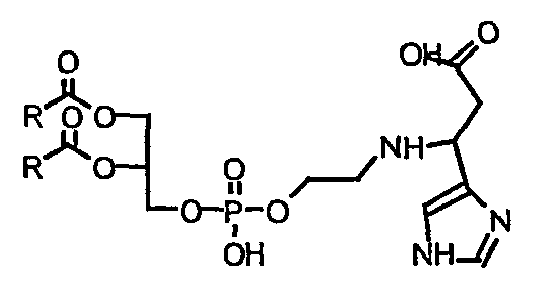
#28 N-Phosphatidylethyl-3-amino-5-imidazoylcarbonsäure: a)Addition des Phosphatidylethnanolamins an Urocansäure nach iii) oder b) nach vi) mit β-Histidin und Phosphatidylglycerol 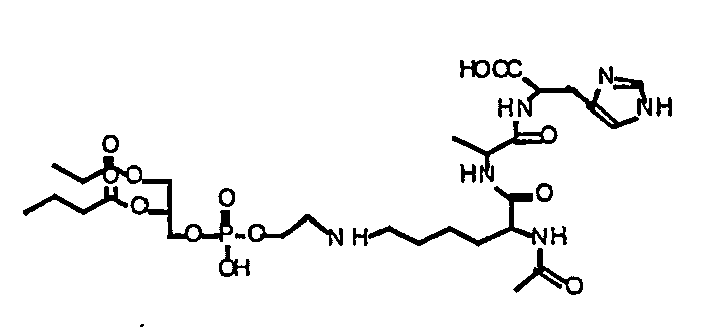
#31 Acetyl-Lys-Ala-His gekoppelt über die Seitenketten Aminogruppe des Lys an DPPG nach vi) -
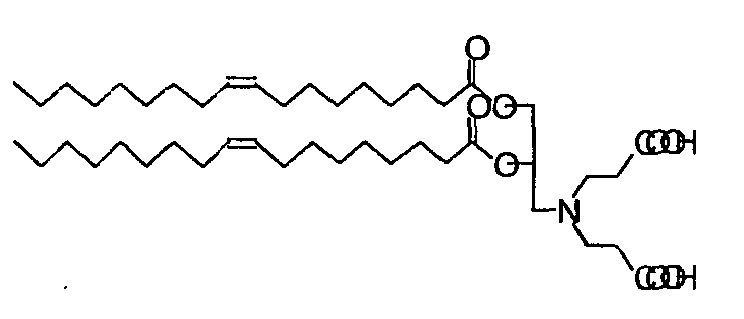
#8 Addition von Acrylsäure an 1-Amino-2,3-Propandiol und anschließende Acylierung 
#32 Kondensationsprodukt aus Homoglutaminsäure und doppelt acyliertem 1-Iod-2,3-Propandiol 
#36 Kopplung von CBZ-Histidin an doppelt acyliertes 1-Amino-2,3-Propandiol; Entschützen; Kopplung mit Succinanhydrid; 
#37 Kopplung von Succinanhydrid andoppelt acyliertes 1-Amino-2,3-Propandiol; Kopplung von Benzyl-geschütztem Histidin; Entschützen 
#38 Konjugation von β-Histidin an ein doppelt acyliertes 1-Jod-2,3-Propandiol -

#34 Konjugation von Histidin an ein Diacylglycerolhemisuccinat 
#35 Konjugation von Histidin an ein Diacylglycerol und anschließende Kopplung mit Succinanhydrid - Die langkettigen Amphiphile sind nur in verkürzter Schreibweise wiedergegeben und entsprechen Lauryl-, Myristyl-, Palmityl-, Stearyl-, Oleyl- und Linyl-Resten.

#50 N-(Asparaginsäuredihydroxyalkyl)-3-amino-5-imidazolcarbonsäure, kann durch Addition von Asparaginsäurediester an Urocansäure dargestellt werden. 
#51 N-(Aspartyldihydroxyalkyl)-N'-histidinyl-harnstoff. 
#52 doppelt acyliertes Tripeptid aus 2,3-Diaminopropionsäure, β-Alanin und Histidin. - Zu den besonders bevorzugten amphoteren Komponenten gehören beispielsweise die folgenden Verbindungen, wobei R1 oder R2 das Amphiphil bedeuten und ( )n weitere Molekülteile im Sinne des oben definierten Spacers darstellen.

Histidin-Derivate.
Bevorzugt erfolgt die Ankopplung des Amphiphils über die Aminogruppe als R2. R1 bildet in diesem Fall ein Anion und kann beispielsweise H oder eine Hydroxycarbonsäure oder eine oder mehrere Aminosäuren sein. Erfolgt die Ankopplung über R1, dann ist R2 ein anionischer Rest, etwa eine Carbonsäure oder Dicarbonsäure.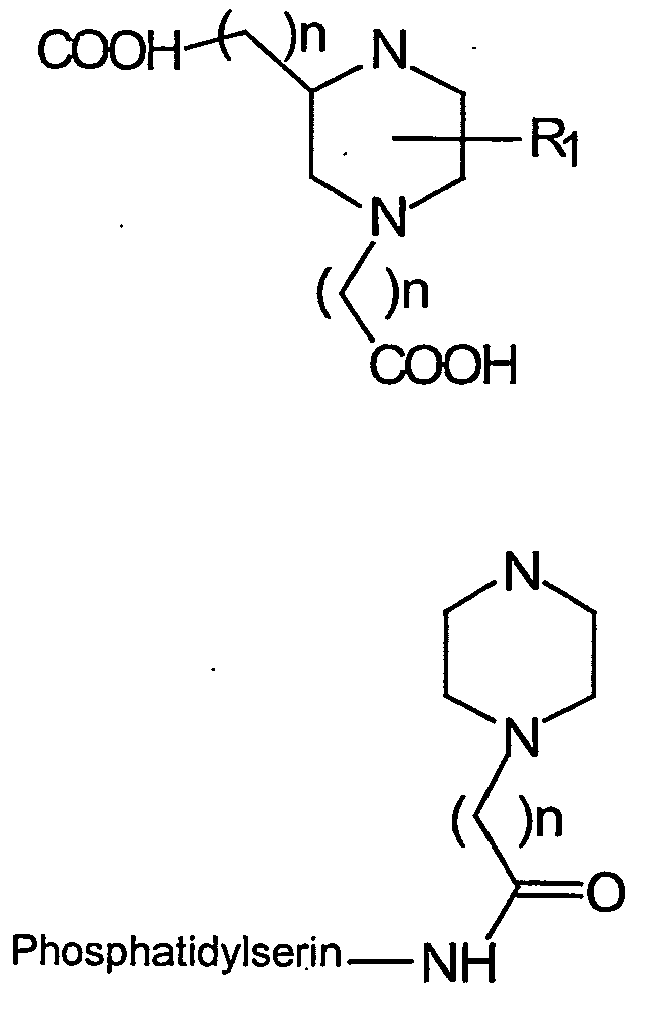
Piperazin-Derivate.
Die Ankopplung des Amphiphils kann über eines der Ringatome erfolgen. Sind die Seitenketten als Hydroxycarbonsäuren oder Aminosäuren ausgeführt, so kann die Ankopplung vorteilhafterweise über diese Heteroatome erfolgen.
Das bevorzugte nebenstehende Derivat zeigt die Ankopplung von Piperazin an das Nα des Phosphatidylserin.
Morpholin-Derivate
Die Ankopplung des Amphiphils kann über eines der Ringatome erfolgen. Sind die Seitenketten als Hydroxycarbonsäuren oder Aminosäuren ausgeführt, so kann die Ankopplung vorteilhafterweise über diese Heteroatome erfolgen.
Derivate der Imidazol-4,5-diessigsäure.
Die Anbindung des Amphiphils erfolgt bevorzugt als Ester einer der beiden Essigsäurefunktionen. Das Amphiphil kann aber auch an die 3-Aminofunktion angebunden sein.
Derivate des Piperidins.
Die Ankopplung des Amphiphils kann über eins der Ringatome erfolgen. Sind die Seitenketten als Hydroxy- oder Aminosäuren ausgeführt, dann kann die Ankopplung vertielhaft über deren Heteroatome erfolgen.
Diaminobenzoesäure-Derivate.
Hier erfolgt die Ankopplung des Amphiphils bevorzugt über eine der beiden Aminogruppen. Die zweite Aminogruppe kann beispielsweise alkyliert sein, um einen höheren pKa-Wert zu erhalten.
Eine Ankopplung als Amid des Phosphatidylserins ist eine andere bevorzugte Ausführung der Erfindung.

Trinitriloessigsäure-Derivate.
Amphotere Grupen entstehen auch durch Veresterung von Trinitriloessigsäure. Das Ladungsverhalten dieser Verbindungen kann zusätzlich durch die Komplexierung von Metallionen verändert werden.
Na-Alkylcarboxy-Aminosäure-Derivate
Amphotere Verbindungen entstehen auch hier durch Kopplung von Sterolen an die endständigen Gruppen von N-Acylaminosäuren. Die Struktur kann vorteilhaft vom Serin, der Asparaginsäure oder Glutaminsäure oder vom Lysin oder Ornithin abgeleitet werden. Die Aminodicarbonsäuren können nicht nur endständig, sondern auch an den anderen Säuregruppen gekoppelt sein. Das Ladungsverhalten dieser Verbindungen kann zusätzlich durch die Komplexierung von Metallionen verändert werden.


EDTA-Derivate
Amphotere Grupen entstehen auch durch Veresterung von Trinitriloessigsäure. Das Ladungsverhalten dieser Verbindungen kann zusätzlich durch die Komplexierung von Metallionen verändert werden. - Liposomen, umfassend die erfindungsgemäßen Verbindungen können unter geeigneten Bedingungen mit Polymeren beschichtet werden. Dabei kann eine einfache oder mehrfache Abscheidung solcher Substanzen auf der Oberfläche erfolgen. Bei einer mehrfachen Abscheidung, die gegebenenfalls unter Anwesenheit von Vernetzer durchgeführt wird, entstehen liposomale Nanokapseln. Verfahren zur Herstellung der Liposomen sind dem Fachmann z.B. aus der WO 00/28972 oder der WO 01/64330 bekann, die in dem Offenbarungsgehalt der Erfindung mit aufgenommen sind. Besonders vorteilhaft bei der Verwendung der erfindungsgemäßen Substanzen ist die Tatsache, dass eine elektrostatische Interaktion mit dem Polymer unterbrochen werden kann, wenn dieses ein Polyelektrolyt ist. Es ist bekannt, dass die Wechselwirkung eines Polyelektrolyten mit Ladungsträgern der liposomalen Membran zur Entmischung von Membranbestandteilen und zur Bildung von Lipidclustern führen kann. In vielen Fällen geht diese Entmischung mit einer Permeabilisierung des Liposoms einher. Die erfindungsgemäßen Substanzen ermöglichen eine Abschaltung dieser Wechselwirkung nach dem Beschichtungsprozess. Wird der pH-Wert zu diesem Zeitpunkt auf oder über den iP erhöht, so sind die Liposomen nur noch sterisch in der Nanokapseln eingeschlossen, eine Wechselwirkung der Membran mit den Polyelektrolyten besteht dann nicht mehr. Clusterbildung der Lipide und damit verbundene Permeabilisierung der Membran können so vorteilhafterweise umgangen werden.
- Es wurde überraschend gefunden, dass Liposomen, deren Membran die erfindungsgemäßen Substanzen enthalten, unterhalb des isoelektrischen Punktes der Substanz leicht mit anderen Membranen, insbesondere Zellmembranen fusionieren. Für gewöhnlich erfordert dieser Schritt die Anwesenheit eines größeren Anteils von PE in der Membran. Dieses hat durch seine Neigung zur Bildung von hexagonalen Phasen die Funktion eines Helferlipids. Nachteilig ist aber die geringere Stabilität solcher Membranen, hier wird oft eine schleichende Freisetzung von eingeschlossenen Wirkstoffen beobachtet.
- Liposomen, die unter Verwendung der erfindungsgemäßen Substanzen hergestellt werden, fusionieren vorteilhafterweise effektiv auch in Abwesenheit von Helferlipiden. Es sind also unter Verwendung der erfindungsgemäßen Substanzen Liposomen herstellbar, die einen Wirkstoff stabil verkapseln können, aber unter den Bedingungen eines niedrigen pH-Werts mit Zellmembranen fusionieren und dort den Wirkstoff freisetzen.
- In einer bevorzugten Ausführungsform der Erfindung umfasst der Anteil der amphoteren Lipide maximal 30 mol%, 40 mol% oder 50 mol% des Gesamtlipids. Besonders vorteilhaft sind Zusammensetzungen, die mindestens 2 mol%, höchstens aber 50 mol% der amphoteren Lipide umfassen. Besonders bevorzugt sind Zusammensetzungen, die mindestens 5 mol%, bevorzugt 10 mol% und höchstens 50 mol%, bevorzugt 40 mol% des amphoteren Lipids umfassen. Die Herstellung von Liposomen umfassend die erfinderischen Substanzen erfolgt nach den dem Fachmann bekannten Techniken.
- In einer weiteren bevorzugten Ausführungsvariante der Erfindung umfassen die Liposomen Phosphatidylcholin, Phosphatidylethanolamin, Diacylglycerole, Ceramide, Sphingolipide, Tetraetherlipide und/oder PEG-Lipide. Da die erfindungsgemäßen Verbindungen nicht immer selbst Liposomen bilden, kann es vorteilhaft sein, die genannten Lipide zuzusetzen.
- In einer weiteren bevorzugten Ausführungsvariante der Erfindung weisen die Liposomen eine mittlere Größe zwischen 50 und 1000 nm, bevorzugt zwischen 50 und 500 nm, besonders bevorzugt zwischen 50 und 300 nm und ganz besonders bevorzugt zwischen 60 und 130 nm auf.
- Zweckmäßig ist es, in die Liposomen insbesondere wasserlösliche Wirkstoffe einzuschließen. Sie können z.B. in der Krebstherapie und zur Therapie schwerer Infektionen verwendet werden. Liposomendispersionen können dazu injiziert, infundiert oder implantiert werden. Sie verteilen sich danach im Blut oder in der Lymphe oder geben als Depot ihren Wirkstoff kontrolliert ab. Letzteres kann durch hochkonzentrierte Dispersionen erreicht werden, die als Gele vorliegen. Die Liposomen können auch für topische Anwendung auf der Haut eingesetzt werden. Sie können insbesondere dazu beitragen, dass verschiedene Wirkstoffe besser in die Haut eindringen können oder sogar durch die Haut in den Körper gelangen können. Weiterhin ist es möglich die Liposomen für den Gentransfer einzusetzen. Genetisches Material kann wegen seiner Größe und Ladung meist nicht ohne Hilfsmittel in Zellen gelangen. Dazu bedarf es geeigneter Träger wie z.B. Liposomen oder Lipid-Komplexe. Diese sollen zusammen mit der DNA effizient und möglichst gezielt in die betroffenen Zellen aufgenommen werden. Besonders vorteilhaft ist es, wenn der Wirkstoff ein Protein, ein Peptid, eine DNA, eine RNA, ein antisense-Nukleotid und/oder ein Decoy-Nukleotid ist. Liposomen sind in ihrer prinzipiellen Struktur den Zellmembranen sehr ähnlich. Sie können daher als Membranmodelle eingesetzt werden, um die Permeationsgeschwindigkeit von Wirkstoffen durch Membranen oder die Membranbindung von Wirkstoffen zu quantifizieren.
- In einer weiteren Ausführungsvariante der Erfindung sind mindestens 50µg, vorteilhafter 100µg, bevorzugt 150µg des Wirkstoffes pro mg Lipid in den Liposomen eingeschlossen. Nicht eingebaute, außen anhaftende Cargomoleküle können wenn nötig durch einen einfache Erhöhung des pH-Wertes entfernt werden. Dieser Schritt ist immer dann notwendig, wenn nicht eingebaute Cargomoleküle zu einer Aggregation der Liposomen führen. Vorteilhaft bei der Verwendung der erfindungsgemäßen Komponenten ist die Tatsache, dass die eingeschlossenen Wirkstoffe nur für den Zeitraum des eigentlichen Einschlusses unter Bedingungen gebracht werden müssen, die eine Interaktion mit der Lipidschicht erlauben. Sobald die Lipidschicht in sich geschlossen bleibt, kann zu anderen Bedingungen gewechselt werden. Eine denkbare Inaktivierung von Wirkstoffen, insbesondere von Proteinen kann dadurch minimiert werden.
- Die Erfindung betrifft auch Verfahren zur Wirkstoffbeladung von Liposomen, wobei ein Bindungs-pH-Wert zur Verkapselung benutzt wird und ein zweiter pH-Wert zur Abtrennung der nicht gebundenen Wirkstoffe verwendet wird.
- Die Erfindung betrifft weiterhin ein Verfahren zur Wirkstoffbeladung von Liposomen, wobei die Liposomen bei einem bestimmten pH-Wert permeabilisiert und folgend verschlossen werden. Bevorzugt können insbesondere Permeabilitätsänderungen gezielt zur Beladung von Liposomen genutzt werden. Ein einzuschließender Wirkstoff kann dabei unter Bedingungen hoher Permeabilität ins Medium zugegeben werden. Anschließend werden Bedingungen geringer Permeabilität eingestellt. Damit verbleibt der Wirkstoff im Innern der Liposomen. Nicht eingeschlossener Wirkstoff kann dann gegebenenfalls abgetrennt werden. Eine solche Permeabilitätsänderung kann an Liposomen oder an liposomalen Nanokapseln herbeigeführt werden.
- Die Erfindung betrifft auch die Verwendung der Liposomen in der Diagnostik und in Freisetzungssystemen. Die Liposomen können selbstverständlich auch in einem Detektionssystem verwendet werden. Insbesondere können die Liposomen mit Metallionen beladen werden, deren Fluoreszens durch die Chelatisierung verstärkt wird, also beispielsweise Terbium- oder Europiumionen. Liposomen für diese Anwendung können selbstverständlich spezifitätsbestimmende Komponenten enthalten, also z.B. Antikörper, Lektine, Selektine, Rezeptoren oder Hormone oder RNA-Aptamere. In einer besonders bevorzugten Ausführungsform der erfindungsgemäßen Verwendung ist die Anwesenheit dieser Metallionen auf das Lumen der Liposomen beschränkt, um unspezifische Signale von außen anhaftendem und langsam freigesetztem Metallionen zu vermeiden. Zweckmäßig ist es auch, die Liposomen zur Herstellung von Nanokapseln zu verwenden. Mit Vorteil können die Liposomen zur Herstellung von Freisetzungssystemen in der Diagnostik verwendet werden.
- Zweckmäßig ist auch die Verwendung zum Transport und/oder zur Freisetzung von Wirkstoffen. Vorteilhafterweise können die Liposomen als Depotformulierung und/oder als zirkulierbares Depot verwendet werden. Vorteilhaft ist weiterhin die Verwendung der Liposomen als Vektor zur Transfektion von Zellen in vivo, in vitro und/oder ex vivo. Die Liposomen sind beispielsweise bei intravenöser und/oder peritonealer Applikation verwendbar.
- Die erfindungsgemäßen Verbindungen und Liposomen weisen mehrere Vorteile auf. Überraschenderweise konnte festgestellt werden, dass die Permeabilität der erfindungsgemäßen Liposomen vom pH-Wert und damit vom Ladungszustand der Verbindungen abhängig ist.
- Liposomen, die unter Verwendung der erfindungsgemäßen Strukturen hergestellt werden, sind daher insbesondere geeignet zur Konstruktion von Freisetzungssystemen, bei denen eine Abgabe von Wirkstoffen in Abhängigkeit vom pH-Wert des Mediums erfolgen soll.
- Es wurde darüber hinaus überraschenderweise gefunden, dass in Liposomen, deren Membran die erfindungsgemäßen Verbindungen umfasst, überdurchschnittlich hohe Mengen, mindestens 50µg, bevorzugt 100µg, besonders bevorzugt 150µg an Proteinen oder DNA pro mg Lipid eingeschlossen werden können. Die Effizienz dieses Einbaus ist dabei abhängig vom pH-Wert der verwendeten Lösung. Ein Prozess für die effiziente Verkapselung von Proteinen oder DNA in die Liposomen kann daher so geführt werden, dass zunächst ein pH-Wert eingestellt wird, der zu einer guten Bindung der Cargomoleküle an die Lipidschicht führt. Für DNA als Polyanion werden hier niedrige pH-Werte von etwa 4 bis 5 verwendet. Bei Proteinen richtet sich der nutzbare pH-Wert nach dem isoelektrischen Punkt des Proteins. Dieser sollte unterhalb des isoelektrischen Punktes der erfindungsgemäßen Substanz liegen. Eine Verkapselung ist dann besonders effektiv, wenn der pH-Wert des Mediums so gewählt wird, dass er zwischen dem isoelektrischen Punkt des Proteins und dem isoelektrischen Punkt der erfindungsgemäßen Verbindung liegt. Das Protein ist dann negativ und die Lipidschicht ist positiv geladen.
- Weiterhin wurde überraschend gefunden, dass Liposomen, deren Membran beispielsweise Histidinyl-PS oder Histidinyl-Diacylglycerolhemisuccinat umfasst, zur Chelatisierung von Metallionen befähigt sind. Diese Eigenschaft führt zu einer Verstärkung der positiven Ladung des Liposoms. Dieser Effekt ist besonders stark bei neutralen pH-Werten zu beobachten, da dann die Eigenladung der Verbindung gering ist. Aufgrund ihrer chelatisierenden Eigenschaften lassen sich solche Liposomen in der biochemischen Diagnostik und zur pharmazeutischen Therapie verwenden.
- Eine wesentliche Voraussetzung für die Verwendung von Liposomen für experimentelle oder therapeutische Zwecke ist deren Verträglichkeit mit Zellen und Geweben. Eine Reihe bekannter Verbindungen, die für das Einbringen von DNA oder Proteinen in Zellen genutzt werden (beispielsweise das kationische Lipid DOTAP) sind zytotoxisch. Es wurde überraschenderweise gefunden, dass einige der erfindungsgemäßen Verbindungen eine verringerte Zytotoxizität zeigen. Das betrifft insbesondere die Gruppe von Verbindungen, bei denen das Amphoter eine Aminosäure oder ein Peptid ist. Diese erfüllen daher wesentliche Voraussetzungen eines Transfektionssystems.
- Eine weitere Voraussetzung für die Konstruktion von Vektoren zum Gen- oder Proteintransport in Zellen ist deren Kompatibilität mit Serum oder Blut. Wegen ihrer starken kationischen Ladung bilden die derzeit bekannten Vektoren mit Serum unkontrollierte große Aggregate, die im Organismus zur Bildung von Thromben führen. Ihre Verwendung ist damit in vivo praktisch ausgeschlossen und auf in vitro oder ex vivo Anwendungen beschränkt. Es wurde überraschenderweise gefunden, dass Liposomen, die unter Verwendung der erfindungsgemäßen Komponenten aufgebaut wurden, in Serum oder Blut keine Aggregate bilden. Das sind insbesondere solche Liposomen, deren isoelektrischen Punkt kleiner als 7,5 ist.
- Eine weitere Voraussetzung für die Konstruktion von Vektoren zum Protein- oder Gentransfer ist deren Stabilität unter physiologischen Bedingungen. Liposomen werden bei einer Applikation in den Blutkreislauf vom Bestandteilen des Complementsystems angegriffen und schnell lysiert. Diese Reaktion erfolgt binnen Minuten. Es kommt zur Porenbildung in der Membran, durch die selbst grosse Moleküle wie Proteine ausdiffundieren können. Eine Stabilisierung von Liposomen gegenüber diesen Mechanismen ist bisher nur durch Einbau von Cholesteröl in die Lipidschicht möglich. Solche Liposomen sind dann sehr stabil, können aber nicht mehr mit Zellen wechselwirken oder ihren Wirkstoff leicht abgeben. Es wurde überraschenderweise gefunden, dass Liposomen, die unter Verwendung der erfindungsgemäßen Komponenten aufgebaut werden, in Serum oder Blut über mehrere Stunden stabil sein können. Die Wirkstofffreisetzung ist auch unter diesen Bedingungen gering. Eine liposomaler Vektor für den Transport von Wirkstoffen muss mindestens drei Voraussetzungen erfüllen: er muss eine geringe Toxizität besitzen, den Wirkstoff sicher und stabil einschließen und kompatibel mit Serum oder Blut sein.
- Alle drei dieser Voraussetzungen werden von Liposomen, die unter Verwendung ausgewählter erfindungsgemäßer Substanzen hergestellt sind, mit Vorteil erfüllt. Die Liposomen sind daher für eine Verwendung bei therapeutischen Zwecken gut geeignet. Weitere Eigenschaften, die diese Verwendung unterstützen, sind die gute Beladbarkeit mit Wirkstoffen und die gezielte Ablösung dieser Stoffe durch Veränderungen des pH-Werts oder durch Permeabilisierung der Membran. Liposomen, die unter Verwendung der erfindungsgemäßen Substanzen hergestellt werden, zeigen nur eine geringe unspezifische Bindung an Zelloberflächen. Diese geringe unspezifische Bindung ist eine wesentliche Voraussetzung für das Zustandekommen einer spezifischen Bindung an Zielzellen. Werden die beschriebenen Liposomen mit weiteren Liganden versehen, so ist eine Zielsteuerung der Vehikel gegeben. Der Wirkstoff kann dann spezifisch an solchen Zellen oder Geweben angereichert werden, die pathologische Zustände aufweisen.
- Eine wesentliche Verwendung der erfindungsgemäßen Substanzen liegt daher bei der Konstruktion von Vektoren für den Wirkstofftransfer in lebenden Organismen. Die Vektoren sind besonders geeignet für den Transport von therapeutischen Makromolekülen wie etwa Proteinen oder DNA, die von sich aus nicht die Zellmembran überwinden können oder im Blutstrom schnell abgebaut werden.
- Überraschenderweise wurde gefunden, dass auch amphotere Amphiphile mit nur einer Kohlewasserstoffkette, wie sie in der US 6,255,344 offenbart sind, sich zur Herstellung von erfindungsgemäßen amphoteren Liposomen eignen, wenn die Kohlenwasserstoffkette mehr als 12 CH2-Gruppen umfasst. Diese Liposomen lassen sich mit Vorteil nach dem oben genannten Verfahren mit Wirkstoff, insbesondere DNA oder Oligonucleotiden beladen und ihre Verwendung zur Transfektion von Zellen sowie zur Gentherapie wird in den Offenbahrungsgehalt der vorliegenden Erfindung mit aufgenommen.
- Ebenso wurde überraschenderweise gefunden, dass sich zweikettige Amphiphile, die durch Amidierung von langkettigen Fettsäuren mit langkettigen α-amino-Carbonsäuren gebildet werden und mit einer amphoteren Gruppe, wie zum Beispiel Histidin versehen werden, sich ebenfalls zur Herstellung von amphoteren Liposomen eignen. Diese Liposomen lassen sich mit Vorteil nach dem oben genannten Verfahren mit Wirkstoff, insbesondere DNA oder oligonucleotiden beladen und ihre Verwendung zur Transfektion von Zellen sowie zur Gentherapie wird in den Offenbahrungsgehalt der vorliegenden Erfindung mit aufgenommen.
- Die erfindungsgemäße Lehre soll an den folgenden Beispielen näher erläutert werden, ohne sich auf diese zu beschränken.
- Zur Synthese des DG-Succ-Hist werden 3 mmol (2 g) Diacylglycerol-Succinat (Avanti) mit 3,3 mmol (0,81 g) Benzyl-geschütztem Histidin, 3,45 mmol (0,71 g) DCC und 3,45 mmol (0,42 g) DMAP in 50 ml Dichlormethan als Lösungsmittel umgesetzt. Der Reaktionsansatz wird über Nacht bei Raumtemperatur Rühren gelassen. Nach erfolgter Amid-Kopplung wird die Carbonylgruppe des Histidins mittels katalytischer Hydrogenolyse an 10% Palladium/Kohlenstoff und Rühren über Nacht unter Wasserstoffatmosphäre entschützt. Nach Einengen des Reaktionsansatzes im Vakuum erfolgt die säulenchromatographische Reinigung an Kieselgel 60. Als Laufmittel wird Chloroform / Methanol / Ammoniak (25%ige Lösung) 60:40:2 verwandt.
- Die Synthese des DG-Hist-Succ erfolgt in drei Stufen. Zunächst werden 3,7 mmol (2g) Dipalmitoylglycerol mit 4,1 mmol Aminogeschütztem CBZ-Histidin verestert. Die Esterbildung erfolgt unter Zugabe von 4,3 mmol (0,67 g) EDC und 4,3 mmol (0,53 g) DMAP in 60 ml Dichlormethan. Der Ansatz wird für 4 h gerührt. Durch Entschützung der Aminofunktion des Histidins entsteht das Zwischenprodukt DG-Hist. Die Aminogruppe wird mittels katalytischer Hydrogenolyse an 10 % Palladium/Kohlenstoff durch Rühren über Nacht unter Wasserstoffatmosphäre entschützt. In einer zweiten Stufe wird Bernsteinsäureanhydrid mit Benzylalkohol zum Benzylsuccinat geöffnet. 10 mmol (1 g) Bernsteinsäureanhydrid werden mit 9,5 mmol (1 g) Benzylalkohol werden in 50 ml Toluol gelöst. Nach Zugabe von 1 mmol (190 mg) p-Toluolsulfonsäure-Monohydrat wird für zwei Stunden unter Rückfluß erhitzt. Im letzten Schritt werden 2 mmol (0,42 g) Benzyl-geschützte Succinat an 1,6 mmol (1,13g) DG-Hist über eine Amidbindung gekoppelt. Die Reaktion erfolgt unter Zugabe von 2,5 mmol (0,39 g) EDC und 2,5 mmol (0,3 g) DMAP in 50 ml Dichlormethan durch vierstündiges Rühren bei Raumtemperatur. Abschließend erfolgt die Entschützung des Succinats durch Abspaltung des Benzylrestes durch katalytische Hydrogenolyse an 10 % Palladium/Kohlenstoff durch Rühren über Nacht unter Wasserstoffatmosphäre. Nach Einengen des Reaktionsansatzes im Vakuum erfolgt die säulenchromatographische Reinigung an Kieselgel 60. Als Laufmittel wird Chloroform / Methanol /Ammoniak (25%ige Lösung) 60:40:2 verwandt.
- Die Synthese der gewünschten Verbindung verläuft über drei Stufen.
In der 1. Stufe wird die Aminogruppe des 3-Amino-1,2-propandiols mit tert-Butylacrylat geschützt. 111 mmol (10 g) 3-Amino-1,2-propandiol werden in 100 ml Acetonitril vorgelegt. Unter Schutzgas werden 222 mmol (28,5 g) tert.-Butylacrylat zugegeben und der Ansatz für zwei Tage unter Rückfluß erhitzt. Die Reaktionsmischung wird am Rotationsverdampfer eingeengt und an Kieselgel säulenchromatographisch gereinigt. Als Laufmittel wurde Essigester / Methanol 9:1 verwandt.
Im nächsten Schritt werden 17,7 mmol (6,15 g) Zwischenprodukt Stufe 1 mit 35,4 mmol (10 g) Ölsäure in 100 ml Dichlormethan vorgelegt. Die Reaktion wird unter Schutzgas und Eisbad-Kühlung durchgeführt. Nach Zugabe von 35,4 mmol (7,3 g) Dicyclohexylcarbodiimid wird die Eiskühlung entfernt und der Ansatz einen Tag bei Raumtemperatur gerührt. Der ausgefallene Harnstoff wird abfiltriert und die Lösung am Rotationsverdampfer eingeengt. Das Produkt wird roh weiterverwandt. Abschließend wird die Schutzgruppe abgespalten. Dazu werden 11,5 mmol Zwischenprodukt Stufe 2 in 25 ml Dichlormethan vorgelegt. Unter Eiswasserkühlung werden langsam 25 ml Trifluoressigsäure zugegeben. Es wird für einen Tag bei 40 °C gerührt. Nach Abziehen des Lösungsmittels wird der Rückstand säulenchromatographisch an Kieselgel gereinigt.
Als Lösungsmittel wird Essigester / Petrolether 1:1 verwandt. Das gewonnene Öl wird in circa 50 ml Aceton aufgenommen und mit 1 N Natriumhydrogencarbonatlösung leicht basisch eingestellt. Nach Zentrifugation wird die überstehende Lösung verworfen. Der Rückstand wird mit wenig Aceton im Utraschallbad behandelt, zentrifugiert und die überstehende Lösung wird verworfen. Der Rückstand wird in 30 ml Chloroform aufgenommen und mit 30 ml Wasser überschichtet. Unter kräftigem Rühren wird mit 1 N HCl auf pH 5 eingestellt. Die organische Phase wird abgetrennt, über Natriumsulfat getrocknet und am Rotationsverdampfer eingeengt. - 2 mg des entsprechenden Lipids und 10 mg DMPC werden in 4 mL Chloroform/ Methanol (1:1, v/v) gelöst und im Rotationsverdampfer vollständig getrocknet. Der Lipidfilm wird mit 4.3 mL eines Puffers (10 mM Kac, 10 mM HEPES, 150 mM NaCl, pH 7,5) in einer Lipidkonzentration von 5 mM durch 5 min Ultraschallbehandlung hydratisiert. Abschließend wird die Suspension eingefroren und nach dem Auftauen mehrfach extrudiert (Avestin LiposoFast, Polycarbonatfilter 200nm Porenweite). Der Verlauf des Zetapotentials in mV bei verschiedenen pH-Werten ist in Abbildung 1 dargestellt. Der Nulldurchgang zeigt den pH-wert, bei dem das Liposom entladen ist. Dieser pH entspricht dem isoelektrischen Punkt des Lipids und ist für #8 4,5; #34 5,2; #25 5,7;

- Unilamellare Liposomen (DPPC / DPPG / Cholesterol 40:20:40 Mol%) werden in einer Konzentration von 20mM Lipid in einem Borat-Puffern (20mM Natriumborat, 120 mM Natriumchlorid pH8,4) suspendiert. Zu 2ml dieser Lösung werden 400µl einer 0,6M Natriumperiodatlösung zugegeben, die Mischung wird für 30min im Dunkeln inkubiert. 1ml einer solchen Suspension wird an Sephadex G25 im oben verwendeten Boratpuffer chromatografiert. Das Eluat der Liposomensuspension wird auf 4ml aufgefüllt.
Zu den so oxidierten Liposomen wird Carnosin in einer Endkonzentration von 20mM zugegeben und 2 Stunden inkubiert. Abschliessend wurde mit 20mM Natriumborhydrid über Nacht bei 4°C reduziert. überschüssiges Carnosin kann durch Chromatografie an Sephadex G25 wie oben abgetrennt werden. - Zu 140µL Humanserum werden 10µl einer 25mM Liposomensuspension pipettiert und gut gemischt. Davon werden 65 µL abgenommen und mit 1,5 ml Puffer (HEPES 10mM, NaCl 150mM pH 7,5) verdünnt. Der Rest wird für 2 h bei 37°C inkubiert und wieder werden 65 µL abgenommen und mit 1,5 mL Puffer verdünnt. Von beiden Proben werden die Partikelgrößen mit einem Malvern Zetasizer 3000 bestimmt. Parallel dazu werden Kontrollproben nur in Puffer aufgenommen, die ebenfalls 2 h bei 37°C inkubiert wurden. Eine unveränderte Partikelgröße zeigt eine eine gute Serumverträglichkeit an.
- 1,43 mM des amphoteren Lipids werden je nach Lipidzusammensetzung des Lipidfilmes mit den anderen Lipiden in Chloroform gelöst. Nach Abziehen des Lösungsmittels wird der Lipidfilm über Nacht im Vakuum getrocknet.
Der Lipidfilm wird direkt mit 1 ml DNA-haltigen (100 µg DNA /ml) NaAc-Puffer (10 mM NaAc, 150 mM NaCl, pH 4) hydratisiert (leichter Ultraschall, anschließend für 30 min oberhalb der Phasenumwandlungstemperatur rotiert). Anschließend erfolgt ein freeze/thaw-Schritt.
Die Mischung wird 10 °C oberhalb der Phasenumwandlungstemperatur 15fach durch 400 nm-Membranen extrudiert.
Nicht eingeschlossenen DNA kann durch Flotation im Sucrose-Gradienten (bei pH 7.5) abgetrennt werden (0,8 M Sucrose, 0,5 M Sucrose, Puffer).
Der Gehalt an DNA wird mit Hilfe des Interkalationsfarbstoffes Propidiumiodid durch die Zunahme der Fluoreszenzintensität bei Interkalation in die DNA bestimmt. Dazu werden 20 µl Propidiumiodid, 6 µl Triton X-100 (10 % in Wasser) mit Probe auf 300µl aufgefüllt und mit einem Fluoreszenzplattenreader vermessen.
Claims (31)
- Amphoteres Lipid mit einem isoelektrischen Punkt zwischen 4,5 und 8,5 nach der allgemeinen Formel (I):
(I) Amphoter - Y - Spacer - Amphiphil
dadurch gekennzeichnet, dass(a) der Amphoter mindestens einen kationischen Ladungsteil mit einem pKa-Wert zwischen 4 bis 8 und/oder mindestens einen anionischen Ladungsteil mit einem pKa-Wert zwischen 3 bis 7 und gegebenenfalls weitere Ladungsträger umfasst, wobeiaa) der kationische Ladungsteil ausgewählt ist aus der Gruppe umfassend Imidazol, Morpholin, Piperazin, Purin, Pyridin und/oder Pyrimidin oder ein Derivat hiervon,bb) der anionische Ladungsteil eine Carboxylgruppe ist, die in der aliphatischen Kette gebundene Essigsäure, Bromessigsäure, Chloressigsäure, Acetoessigsäure, Propionsäure, Acrylsäure, Buttersäure, Crotonsäure oder Carbonsäuren umfasst, die einfach veresterte oder amidierte oder in der aliphatischen Kette gebundene Dicarbonsäure umfasst; die einfach veresterte oder amidierte oder im aliphatischen Teil gebundene Oligocarbonsäure umfasst,(b) der Spacer ein Niederalkylrest mit 0 bis 8 C-Atomen mit linearer, verzweigter oder ringförmiger Struktur mit 0, 1 oder 2 ethylenisch ungesättigten Bindungen und 0-4 Hydroxylgruppen ist,(c) Y abwesend ist oder -(C=O)-O-; -(C=O)-NH-; -NH-(C=O)-O-; -O-; -NH-; -CH=N-; -O-(O=C)-; -S-;. (O=C)-; -NH-(O=C)-; -O-(O=C)-NH-, -N=CH- und/oder -S-S- umfasst(d) das Amphiphil eine Struktur nach der allgemeinen Formel (II) oder (IV) ist:
R1 und R2 unabhängig voneinander C8 bis C30 Alkyl oder Acylketten mit 0, 1 oder 2 ethylenisch ungesättigten Bindungen sind und
X abwesend oder ausgewählt ist aus der Gruppe umfassend -O-(C=O); -NH-(C=O)-; -S-(C=O)-; -O-; -NH-; -S-; -N=CH-; -(O=C)-O-; -S-(O=C)-; -NH-(O=C)-; -N=CH- und/oder -S-S-;
oder
R1 und R2 unabhängig voneinander C8 bis C30 Alkylketten mit 0, 1 oder 2 ethylenisch ungesättigten Bindungen sind und
X abwesend oder ausgewählt ist aus der Gruppe bestehend aus -(C=O)-O-; -(C=O)-NH-; -(C=O)-S-; -NH-; -CH=N-; und/oder -S-(O=C)-;(e) das Amphiphil eine mit linearen C8 bis C30-Alkoholen-veresterten 1,4- oder 1,5-Dicarbonsäuren wie Asparaginsäure, Glutaminsäure, Äpfelsäure, Weinsäure, Citronensäure, Aconitsäure, Citraconsäure und/oder Maleinsäure ist und/oder(f) das Amphiphil eine mit linearen C8 bis C30-Fettsäuren amidierten 1,4- oder 1,5- Diaminen des 3-Aminoalanins, Diaminobuttersäure, Ornithins oder Lysin ist. - Lipid nach Anspruch 1, dadurch gekennzeichnet,
dass die Dicarbonsäure ausgewählt ist aus der Gruppe umfassend Oxalsäure, Malonsäure, Bernseinsäure, Maleinsäure, Fumarsäure, Äpfelsäure, Weinsäure, Glutarsäure, Adipinsäure, Caprylsäure, Pimelinsäure, Suberinsäure, Cyclohexandicarbonsäure und / oder Cyclopentandicarbonsäure und / oder die Oligocarbonsäure ausgewählt ist aus der Gruppe umfassend Citronensäure, Isocitronensäure und / oder Ethylendiamintetraessigsäure. - Lipid nach Anspruch 1 oder 2,
dadurch gekennzeichnet, dass
das amphotere Lipid einen isoelektrischen Punkt zwischen 5 und 7 aufweist. - Lipid nach einem der Ansprüche 1 bis 3,
dadurch gekennzeichnet, dass
sich die pKa-Werte des kationischen und anionischen Ladungsteils des Amphoters sich höchstens um 2 pH-Einheiten unterscheiden. - Lipid nach einem der Ansprüche 1 bis 4,
dadurch gekennzeichnet, dass
das kationische Ladungsteil des Amphoters Imidazol, Piperazin, Morpholin, der anionische Ladungsteil die Carboxylgruppe umfasst. - Lipid nach einem der vorhergehenden Ansprüche 1 bis 5,
dadurch gekennzeichnet, dass
das Amphoter ein Peptid mit 2-6 Aminosäuren ist, die ausgewählt sind aus der Gruppe bestehend aus Histidin, Arginin, Lysin, Glutaminsäure und/oder Asparaginsäure,
wobeii) der prozentuale Anteil von His und Asp/Glu 66% nicht überschreitet oderii) der prozentuale Anteil von Arg/Lys kleiner 50%, der von Asp/Glu größer als 50% ist, oderiii) der prozentuale Anteil von His und Arg/Lys kleiner/gleich 33%, der von der von Asp/Glu größer als Arg/Lys ist. - Lipid nach einem der vorhergehenden Ansprüche 1 bis 6,
dadurch gekennzeichnet, dass
das Amphiphil ausgewählt ist aus der Gruppe bestehend aus Diacylglycerolen, Dialkylglycerolen, Phosphoglycerolen, acylierte oder alkylierte 3-Amino-1,2-Propandiolen und/oder N,N-Dialkylaminen. - Lipid nach einem der vorhergehenden Ansprüche 1 bis 7,
dadurch gekennzeichnet, dass
der Spacer Zucker oder ein Polyethylenglykol mit bis zu 20 Monomereinheiten umfasst. - Amphoteres Lipid nach einem der vorhergehenden Ansprüche mit der Struktur

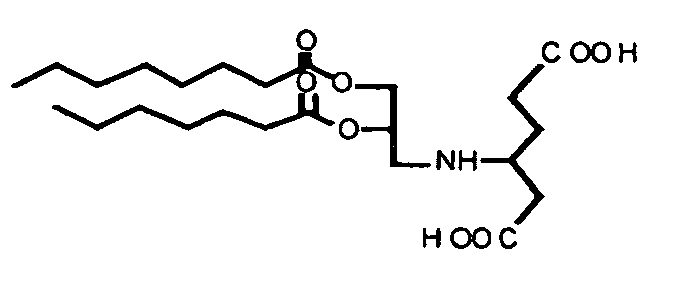


 a) Lauroyl-, Myristoyl-, Palmitoyl-, Stearoyl-, Oleoyl- oder Linoyl-Reste oderb) Lauryl-, Myristyl-, Palmityl-, Stearyl-, Oleyl- oder Linyl-Reste umfassen.
- Amphoteres Lipid nach einem der vorhergehenden Ansprüche mit der Struktur

 a) Lauroyl-, Myristoyl-, Palmitoyl-, Stearoyl-, Oleoyl- oder Linoyl-Reste oderb) Lauryl-, Myristyl-, Palmityl-, Stearyl-, Oleyl- oder Linyl-Reste umfassen.
- Amphoteres Lipid nach einem der vorhergehenden Ansprüche mit der Struktur
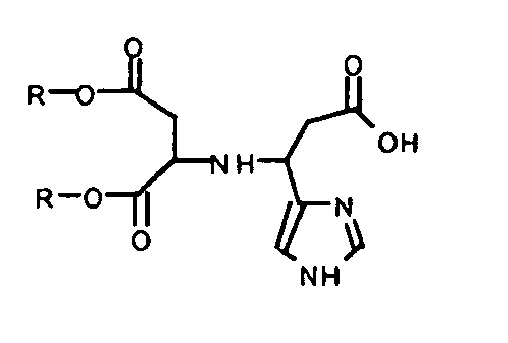

- Amphoteres Lipid nach einem der vorhergehenden Ansprüche mit der Struktur

- Liposomen umfassend amphotere Lipide nach einem der Ansprüche 1 bis 12, wobei die amphoteren Lipide alternativ zu den Amphiphilen nach Anspruch 1
ein Amphiphil nach der allgemeinen Formel (III) aufweisen können,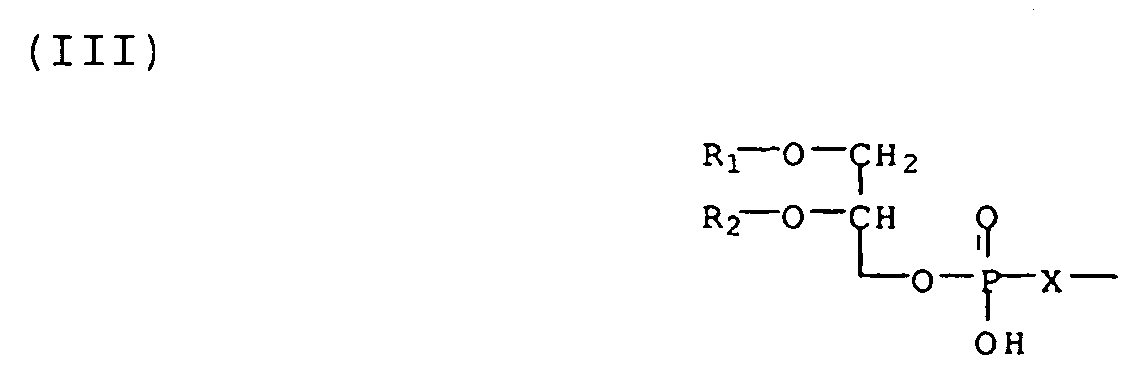
R1 und R2 unabhängig voneinander C8 bis C30 Acylketten mit 0, 1 oder 2 ethylenisch ungesättigten Bindungen sind und X -O- ist. - Liposomen nach Anspruch 13 ein amphoteres Lipid mit der nachfolgender Struktur umfassend
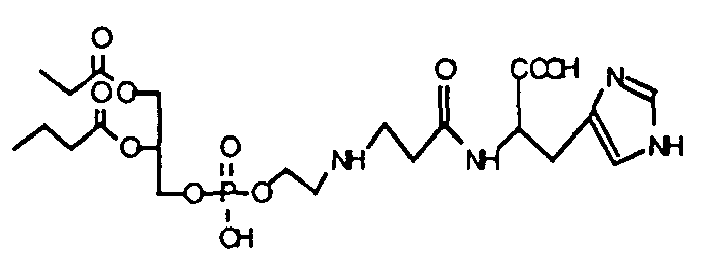


- Liposomen nach Anspruch 13 oder 14,
dadurch gekennzeichnet, dass
die Liposomen maximal 50 mol% des amphoteren Lipids umfassen, bevorzugt 2 bis 50 mol%, besonders bevorzugt 10 bis 40 mol%. - Liposomen nach einem der Ansprüche 13 bis 15,
dadurch gekennzeichnet, dass
die Liposomen Phosphatidylcholin, Phosphatidylethanolamin, Diacylglycerol, Tetraetherlipid und/oder PEG-Lipid umfassen. - Liposomen nach einem der Ansprüche 13 bis 16,
dadurch gekennzeichnet, das
die Liposomen eine mittlere Größe zwischen 50 und 1000 nm, bevorzugt zwischen 50 und 300 nm, besonders bevorzugt zwischen 60 und 130 nm aufweisen. - Liposomen nach einem der Ansprüche 13 bis 17,
dadurch gekennzeichnet, dass
die Liposomen einen Wirkstoff umfassen. - Liposomen nach einem der Ansprüche 13 bis 18,
dadurch gekennzeichnet, dass
der Wirkstoff ein Protein, ein Peptid, eine DNA, eine RNA, ein antisense-Nukleotid und/oder ein Decoy-Nukleotid ist. - Liposomen nach dem Anspruch 18 oder 19,
dadurch gekennzeichnet, dass
mindestens 50 µg, bevorzugt mehr als 90µg, besonders bevorzugt mehr als 150µg des Wirkstoffes pro mg Lipid im Innern des Liposoms eingeschlossen sind. - Verfahren zur Wirkstoffbeladung von Liposomen nach einem der Ansprüche 13 bis 20,
dadurch gekennzeichnet, dass
ein Bindungs-pH-Wert zur Verkapselung eines Wirkstoffs eingesetzt wird und ein zweiter pH-Wert zur Abtrennung der nicht gebundenen Wirkstoffe verwendet wird. - Liposomen, hergestellt nach dem Verfahren von Anspruch 21.
- Verfahren zur Wirkstoffbeladung von Liposomen nach einem der Ansprüche 13 bis 20,
dadurch gekennzeichnet, dass
die Liposomen bei einem bestimmten pH-Wert permeabilisiert und folgend verschlossen werden. - Verwendung der Liposomen nach einem der Ansprüche 13 bis 20 zur Herstellung von Nanokapseln.
- Verwendung der Liposomen nach einem der Ansprüche 13 bis 20 zur Herstellung von Freisetzungssystemen in der Diagnostik.
- Verwendung der Liposomen nach einem der Ansprüche 13 bis 20 zur Herstellung eines Arzneimittels als Depotformulierung und/oder als zirkulierbares Depot.
- Verwendung der Liposomen nach einem der Ansprüche 13 bis 20 zur Herstellung eines Arzneimittels als Vektor zur Transfektion von Zellen in vivo, in vitro und/oder ex vivo.
- In-vivo-Transfektionssystem,
dadurch gekennzeichnet, dass
es mit genetischem Material beladene Liposomen nach Anspruch 13 bis 20 enthält. - In-vivo-Transfektionssystem nach Anspruch 28,
dadurch gekennzeichnet, dass
das Amphiphil eine Struktur nach der Formel (V)
R1 und R2 unabhängig voneinander C8 bis C30 Alkyl mit 0, 1 oder 2 ethylenisch ungesättigten Bindungen sind und
X ausgewählt ist aus der Gruppe -O-; -NH-; -S-
oder
nach der der Formel (VI):
R C8 bis C30 Alkyl mit 0, 1 oder 2 ethylenisch ungesättigten Bindungen ist und
X ausgewählt ist aus der Gruppe -O-; -NH-; -S-
aufweisen kann. - Verwendung des In-vivo-Transfektionssystems nach Anspruch 28 oder 29 zur Herstellung eines Arzneimittels als Vektor zur Transfektion von Zellen in vivo, in vitro und/oder ex vivo.
- Verwendung der Liposomen nach einem der Ansprüche 13 bis 20 zur Herstellung eines Arzneimittels bei intravenöser und/oder peritonealer Applikation.
Applications Claiming Priority (3)
| Application Number | Priority Date | Filing Date | Title |
|---|---|---|---|
| DE10207178 | 2002-02-19 | ||
| DE10207178A DE10207178A1 (de) | 2002-02-19 | 2002-02-19 | Komponenten für die Herstellung amphoterer Liposomen |
| PCT/EP2003/001662 WO2003070735A2 (de) | 2002-02-19 | 2003-02-19 | Komponenten für die herstellung amphoterer liposomen |
Publications (2)
| Publication Number | Publication Date |
|---|---|
| EP1478652A2 EP1478652A2 (de) | 2004-11-24 |
| EP1478652B1 true EP1478652B1 (de) | 2007-04-25 |
Family
ID=27674785
Family Applications (1)
| Application Number | Title | Priority Date | Filing Date |
|---|---|---|---|
| EP03742541A Expired - Lifetime EP1478652B1 (de) | 2002-02-19 | 2003-02-19 | Komponenten fur die herstellung amphoterer liposomen |
Country Status (7)
| Country | Link |
|---|---|
| US (3) | US20050164963A1 (de) |
| EP (1) | EP1478652B1 (de) |
| JP (1) | JP2005517739A (de) |
| AT (1) | ATE360635T1 (de) |
| AU (1) | AU2003215567A1 (de) |
| DE (2) | DE10207178A1 (de) |
| WO (1) | WO2003070735A2 (de) |
Families Citing this family (106)
| Publication number | Priority date | Publication date | Assignee | Title |
|---|---|---|---|---|
| DE10207178A1 (de) * | 2002-02-19 | 2003-09-04 | Novosom Ag | Komponenten für die Herstellung amphoterer Liposomen |
| CA2487274A1 (en) * | 2002-05-06 | 2003-11-13 | Nucleonics Inc. | Spermine chemically linked to lipids and cell-specific targeting molecules as a transfection agent |
| DE102004054730A1 (de) * | 2004-03-28 | 2006-05-11 | Novosom Ag | Serumstabile amphotere Liposomen |
| DE102004056659A1 (de) * | 2004-11-19 | 2006-06-01 | Novosom Ag | Abgabe von Oligonucleotiden an entzündete Schleimhaut |
| EP1764090A1 (de) * | 2005-09-15 | 2007-03-21 | Novosom AG | Amphotere Liposomen zur lokalen Verabreichung von Arzneistoffen |
| WO2006138380A2 (en) | 2005-06-15 | 2006-12-28 | Massachusetts Institute Of Technology | Amine-containing lipids and uses thereof |
| EP1764091B1 (de) | 2005-09-15 | 2017-08-30 | Marina Biotech, Inc. | Verbesserungen für, oder in Bezug auf amphotere Liposomen |
| US20090324587A1 (en) | 2005-12-01 | 2009-12-31 | Neal Clifford Goodwin | Cancer Therapies and Pharmaceutical Compositions Used Therein |
| US20080138393A1 (en) * | 2006-12-11 | 2008-06-12 | Access To Business Group International Llc | Water soluble extract of spinach for prevention and repair of DNA damage |
| EP1935434A1 (de) * | 2006-12-19 | 2008-06-25 | Novosom AG | Konstruktion und Verwendung von transfektionsverstärkenden Elementen |
| JP2010513354A (ja) * | 2006-12-19 | 2010-04-30 | ノヴォソム アクチェンゲゼルシャフト | トランスフェクションエンハンサー要素を含む脂質および脂質集合体 |
| US8309760B2 (en) | 2007-05-31 | 2012-11-13 | University Of Alabama | Process for purification of aryl carboxylic acids |
| WO2008154700A1 (en) | 2007-06-20 | 2008-12-24 | Phylogica Limited | Compositions and uses thereof for the treatment of acute respiratory distress syndrome (ards) and clinical disorders associated with therewith |
| GB0720486D0 (en) * | 2007-10-19 | 2007-11-28 | Univ Edinburgh | Cationic lipids |
| WO2010053572A2 (en) | 2008-11-07 | 2010-05-14 | Massachusetts Institute Of Technology | Aminoalcohol lipidoids and uses thereof |
| EP3699172A3 (de) | 2008-11-10 | 2020-11-18 | Arbutus Biopharma Corporation | Neuartige lipide und zusammensetzungen zur verabreichung von therapeutika |
| SI2506857T1 (en) | 2009-12-01 | 2018-08-31 | Translate Bio, Inc. | Delivery of mRNA for the enrichment of proteins and enzymes in human genetic diseases |
| KR101831685B1 (ko) * | 2010-01-25 | 2018-02-23 | 롬 앤드 하스 일렉트로닉 머트어리얼즈 엘엘씨 | 질소-함유 화합물을 포함하는 포토레지스트 |
| CA2807552A1 (en) | 2010-08-06 | 2012-02-09 | Moderna Therapeutics, Inc. | Engineered nucleic acids and methods of use thereof |
| US9193827B2 (en) | 2010-08-26 | 2015-11-24 | Massachusetts Institute Of Technology | Poly(beta-amino alcohols), their preparation, and uses thereof |
| EP2857499A1 (de) | 2010-10-01 | 2015-04-08 | Moderna Therapeutics, Inc. | Manipulierte Nukleinsäuren und Verfahren zur Verwendung davon |
| WO2012109495A1 (en) | 2011-02-09 | 2012-08-16 | Metabolic Solutions Development Company, Llc | Cellular targets of thiazolidinediones |
| CA2831392C (en) | 2011-03-28 | 2020-04-28 | Massachusetts Institute Of Technology | Conjugated lipomers and uses thereof |
| CA2831613A1 (en) | 2011-03-31 | 2012-10-04 | Moderna Therapeutics, Inc. | Delivery and formulation of engineered nucleic acids |
| WO2012159164A1 (en) | 2011-05-23 | 2012-11-29 | Phylogica Limited | Method of determining, identifying or isolating cell-penetrating peptides |
| EP2532649B1 (de) * | 2011-06-07 | 2015-04-08 | Incella GmbH | Aminolipide, deren Synthese und Verwendungen davon |
| KR20220025112A (ko) | 2011-06-08 | 2022-03-03 | 샤이어 휴먼 지네틱 테라피즈 인크. | Mrna 전달을 위한 지질 나노입자 조성물 및 방법 |
| JP2013043885A (ja) * | 2011-08-26 | 2013-03-04 | Kansai Bunri Sogo Gakuen | デヒドロアミノ酸含有グリセロール誘導体 |
| US9464124B2 (en) | 2011-09-12 | 2016-10-11 | Moderna Therapeutics, Inc. | Engineered nucleic acids and methods of use thereof |
| CN107287660A (zh) * | 2011-09-30 | 2017-10-24 | 中外制药株式会社 | 离子浓度依赖性结合分子文库 |
| PT3682905T (pt) | 2011-10-03 | 2022-04-07 | Modernatx Inc | Nucleósidos, nucleótidos e ácidos nucleicos modificados e respetivas utilizações |
| ES2698075T3 (es) * | 2011-10-05 | 2019-01-30 | Arkema France | Compuestos amino sustituidos con polihidroxilos, polímeros que los contienen, y su uso |
| US9512073B2 (en) | 2011-10-27 | 2016-12-06 | Massachusetts Institute Of Technology | Amino acid-, peptide-and polypeptide-lipids, isomers, compositions, and uses thereof |
| ES2923757T3 (es) | 2011-12-16 | 2022-09-30 | Modernatx Inc | Composiciones de ARNm modificado |
| WO2013151664A1 (en) | 2012-04-02 | 2013-10-10 | modeRNA Therapeutics | Modified polynucleotides for the production of proteins |
| US10501512B2 (en) | 2012-04-02 | 2019-12-10 | Modernatx, Inc. | Modified polynucleotides |
| US9283287B2 (en) | 2012-04-02 | 2016-03-15 | Moderna Therapeutics, Inc. | Modified polynucleotides for the production of nuclear proteins |
| US9572897B2 (en) | 2012-04-02 | 2017-02-21 | Modernatx, Inc. | Modified polynucleotides for the production of cytoplasmic and cytoskeletal proteins |
| EP3536787A1 (de) | 2012-06-08 | 2019-09-11 | Translate Bio, Inc. | Nukleaseresistente polynukleotide und verwendungen davon |
| WO2014028487A1 (en) | 2012-08-13 | 2014-02-20 | Massachusetts Institute Of Technology | Amine-containing lipidoids and uses thereof |
| CN104884637A (zh) | 2012-11-05 | 2015-09-02 | 普隆奈治疗公司 | 利用生物标志物通过bcl2表达的调节治疗癌症的方法 |
| PT2922554T (pt) | 2012-11-26 | 2022-06-28 | Modernatx Inc | Arn modificado nas porções terminais |
| US20150315154A1 (en) * | 2012-12-07 | 2015-11-05 | Council Of Scientific & Industrial Research | Histidinylated cationic amphiphiles, process for preparation therof and their liposomal formulation |
| UA117466C2 (uk) | 2012-12-13 | 2018-08-10 | Мерк Шарп Енд Доме Корп. | СТАБІЛЬНИЙ СКЛАД У ВИГЛЯДІ РОЗЧИНУ АНТИТІЛА ДО IL-23p19 |
| KR102311614B1 (ko) | 2013-03-14 | 2021-10-08 | 샤이어 휴먼 지네틱 테라피즈 인크. | Cftr mrna 조성물 및 관련 방법 및 사용 |
| US10258698B2 (en) | 2013-03-14 | 2019-04-16 | Modernatx, Inc. | Formulation and delivery of modified nucleoside, nucleotide, and nucleic acid compositions |
| EA201591229A1 (ru) | 2013-03-14 | 2016-01-29 | Шир Хьюман Дженетик Терапис, Инк. | Способы очистки матричной рнк |
| US8980864B2 (en) | 2013-03-15 | 2015-03-17 | Moderna Therapeutics, Inc. | Compositions and methods of altering cholesterol levels |
| US9315472B2 (en) | 2013-05-01 | 2016-04-19 | Massachusetts Institute Of Technology | 1,3,5-triazinane-2,4,6-trione derivatives and uses thereof |
| JP5914418B2 (ja) | 2013-06-26 | 2016-05-11 | 富士フイルム株式会社 | 脂質粒子、核酸送達キャリア、核酸送達キャリア製造用組成物、脂質粒子の製造方法及び遺伝子導入方法 |
| US10023626B2 (en) | 2013-09-30 | 2018-07-17 | Modernatx, Inc. | Polynucleotides encoding immune modulating polypeptides |
| KR20160067219A (ko) | 2013-10-03 | 2016-06-13 | 모더나 세라퓨틱스, 인코포레이티드 | 저밀도 지단백질 수용체를 암호화하는 폴리뉴클레오타이드 |
| EP3574923A1 (de) | 2013-10-22 | 2019-12-04 | Translate Bio, Inc. | Mrna-therapie für phenylketonurie |
| ES2707966T3 (es) | 2013-10-22 | 2019-04-08 | Translate Bio Inc | Terapia de ARNm para la deficiencia en síntesis de argininosuccinato |
| ES3032935T3 (en) | 2013-10-22 | 2025-07-29 | Translate Bio Inc | Lipid formulations for delivery of messenger rna |
| SI3071696T1 (sl) | 2013-11-22 | 2019-11-29 | Mina Therapeutics Ltd | C/EBP alfa kratko delujoči RNA sestavki in postopki uporabe |
| EP4729528A3 (de) | 2014-04-25 | 2026-06-24 | Translate Bio, Inc. | Verfahren zur reinigung von messenger-rna |
| WO2015184256A2 (en) | 2014-05-30 | 2015-12-03 | Shire Human Genetic Therapies, Inc. | Biodegradable lipids for delivery of nucleic acids |
| KR102559979B1 (ko) | 2014-06-24 | 2023-07-25 | 샤이어 휴먼 지네틱 테라피즈 인크. | 핵산의 전달용 입체화학적으로 풍부한 조성물 |
| WO2016004202A1 (en) | 2014-07-02 | 2016-01-07 | Massachusetts Institute Of Technology | Polyamine-fatty acid derived lipidoids and uses thereof |
| JP6240570B2 (ja) | 2014-07-17 | 2017-11-29 | 富士フイルム株式会社 | 脂質粒子および核酸送達キャリア |
| JP6339884B2 (ja) * | 2014-07-17 | 2018-06-06 | 富士フイルム株式会社 | イミダゾール化合物およびそれを含有するリポソーム |
| US10722599B2 (en) * | 2015-02-04 | 2020-07-28 | Yissum Research Development Company Of The Hebrew University Of Jerusalem Ltd. | Lipid assemblies and uses thereof and some pH and electrostatic modulating lipids to be used in said assemblies |
| RS64331B1 (sr) | 2015-06-19 | 2023-08-31 | Massachusetts Inst Technology | Alkenil supstituisani 2,5-piperazindioni i njihova primena u sastavima za isporuku agensa u organizam ili ćeliju subjekta |
| WO2017031232A1 (en) | 2015-08-17 | 2017-02-23 | Modernatx, Inc. | Methods for preparing particles and related compositions |
| HRP20220156T1 (hr) | 2015-09-17 | 2022-04-15 | Modernatx, Inc. | Spojevi i pripravci za unutarstaničnu isporuku terapeutskih sredstava |
| DK3386484T3 (da) | 2015-12-10 | 2022-07-04 | Modernatx Inc | Sammensætninger og fremgangsmåder til afgivelse af terapeutiske midler |
| RS63051B1 (sr) | 2015-12-22 | 2022-04-29 | Modernatx Inc | Jedinjenja i kompozicije za intracelularnu isporuku agenasa |
| EP3538067A1 (de) | 2016-11-08 | 2019-09-18 | Modernatx, Inc. | Stabilisierte formulierungen von lipidnanopartikeln |
| MX2019010155A (es) | 2017-02-27 | 2020-12-10 | Translate Bio Inc | Arnm de cftr optimizado por codón novedoso. |
| RS63953B1 (sr) | 2017-03-15 | 2023-02-28 | Modernatx Inc | Jedinjenje i kompozicije za intracelularnu isporuku terapeutskih sredstava |
| JP7332478B2 (ja) | 2017-03-15 | 2023-08-23 | モデルナティエックス インコーポレイテッド | 脂質ナノ粒子製剤 |
| WO2018170322A1 (en) | 2017-03-15 | 2018-09-20 | Modernatx, Inc. | Crystal forms of amino lipids |
| CN110913906A (zh) | 2017-05-02 | 2020-03-24 | 默沙东公司 | 抗lag3抗体的制剂和抗lag3抗体与抗pd-1抗体的共制剂 |
| JOP20190260A1 (ar) | 2017-05-02 | 2019-10-31 | Merck Sharp & Dohme | صيغ ثابتة لأجسام مضادة لمستقبل الموت المبرمج 1 (pd-1) وطرق استخدامها |
| IL270631B2 (en) | 2017-05-16 | 2024-03-01 | Translate Bio Inc | Treatment of cystic fibrosis by delivery of codon-optimized mrna encoding cftr |
| EP3638678B1 (de) | 2017-06-14 | 2025-12-03 | ModernaTX, Inc. | Verbindungen und zusammensetzungen zur intrazellulären verabreichung von wirkstoffen |
| WO2019048632A1 (en) | 2017-09-08 | 2019-03-14 | Mina Therapeutics Limited | STABILIZED COMPOSITIONS OF SMALL ACTIVATORY RNA (PARNA) OF HNF4A AND METHODS OF USE |
| WO2019048645A1 (en) | 2017-09-08 | 2019-03-14 | Mina Therapeutics Limited | STABILIZED COMPOSITIONS OF SMALL ACTIVATOR RNA (PARNA) FROM CEBPA AND METHODS OF USE |
| US11566246B2 (en) | 2018-04-12 | 2023-01-31 | Mina Therapeutics Limited | SIRT1-saRNA compositions and methods of use |
| US11174500B2 (en) | 2018-08-24 | 2021-11-16 | Translate Bio, Inc. | Methods for purification of messenger RNA |
| US12151029B2 (en) | 2018-09-19 | 2024-11-26 | Modernatx, Inc. | PEG lipids and uses thereof |
| CN112996854B (zh) | 2018-09-19 | 2024-08-30 | 摩登纳特斯有限公司 | 高纯度peg脂质和其用途 |
| EP3853202A1 (de) | 2018-09-19 | 2021-07-28 | ModernaTX, Inc. | Verbindungen und zusammensetzungen zur intrazellulären verabreichung von therapeutischen wirkstoffen |
| MX2021004356A (es) | 2018-10-18 | 2021-05-31 | Merck Sharp & Dohme Llc | Formulaciones de anticuerpos anti-rsv y metodos de uso de las mismas. |
| MA54089A (fr) | 2018-10-31 | 2022-02-09 | Merck Sharp & Dohme | Anticorps anti-pd-1 humain et procédés d'utilisation associés |
| JP7503056B6 (ja) | 2018-11-07 | 2024-07-16 | メルク・シャープ・アンド・ドーム・エルエルシー | 抗lag3抗体および抗pd-1抗体の共-製剤 |
| AU2019384557B2 (en) | 2018-11-21 | 2025-07-17 | Translate Bio, Inc. | Treatment of cystic fibrosis by delivery of nebulized mRNA encoding CFTR |
| EP3953473A1 (de) | 2019-04-12 | 2022-02-16 | MiNA Therapeutics Limited | Sirt1-sarna-zusammensetzungen und verfahren zur verwendung |
| EP4031524A1 (de) | 2019-09-19 | 2022-07-27 | ModernaTX, Inc. | Lipidverbindungen mit verzweigtem ende und zusammensetzungen zur intrazellulären abgabe therapeutischer mittel |
| AU2020351220A1 (en) | 2019-09-19 | 2022-04-07 | Modernatx, Inc. | Carbonate containing lipid compounds and compositions for intracellular delivery of therapeutic agents |
| CA3155003A1 (en) | 2019-09-20 | 2021-03-25 | Translate Bio, Inc. | Mrna encoding engineered cftr |
| US20230320994A1 (en) * | 2020-08-21 | 2023-10-12 | The Board Of Regents Of The University Of Texas System | Functional ionizable phospholipids |
| GB2603454A (en) | 2020-12-09 | 2022-08-10 | Ucl Business Ltd | Novel therapeutics for the treatment of neurodegenerative disorders |
| CN114685778B (zh) * | 2020-12-30 | 2023-10-17 | 苏州艾博生物科技有限公司 | 长循环阳离子脂质体的合成方法 |
| US11524023B2 (en) | 2021-02-19 | 2022-12-13 | Modernatx, Inc. | Lipid nanoparticle compositions and methods of formulating the same |
| US20240175033A1 (en) | 2021-03-26 | 2024-05-30 | Mina Therapeutics Limited | TMEM173 saRNA Compositions and Methods of Use |
| WO2023023410A2 (en) * | 2021-07-12 | 2023-02-23 | University Of Cincinnati | Ionizable lipids, lipid nanoparticles for mrna delivery and methods of making the same |
| CN115894281B (zh) * | 2021-09-22 | 2025-07-01 | 广州谷森制药有限公司 | 阳离子脂质化合物、其制备方法、组合物及应用 |
| WO2023099884A1 (en) | 2021-12-01 | 2023-06-08 | Mina Therapeutics Limited | Pax6 sarna compositions and methods of use |
| GB202117758D0 (en) | 2021-12-09 | 2022-01-26 | Ucl Business Ltd | Therapeutics for the treatment of neurodegenerative disorders |
| WO2023170435A1 (en) | 2022-03-07 | 2023-09-14 | Mina Therapeutics Limited | Il10 sarna compositions and methods of use |
| CN115463093B (zh) * | 2022-09-28 | 2024-03-19 | 天津市人民医院 | 一种奥沙利铂制剂及其制备方法 |
| TW202440929A (zh) | 2022-12-14 | 2024-10-16 | 加拿大商普羅維登斯治療控股公司 | 用於感染性疾病的組合物和方法 |
| US20260218178A1 (en) | 2022-12-22 | 2026-07-30 | Mina Therapeutics Limited | Chemically Modified saRNA Compositions and Methods of Use |
| WO2026027887A2 (en) | 2024-08-02 | 2026-02-05 | Mina Therapeutics Limited | Hbg1/2-sarna compositions and methods of use |
Family Cites Families (18)
| Publication number | Priority date | Publication date | Assignee | Title |
|---|---|---|---|---|
| ATE45744T1 (de) * | 1984-07-25 | 1989-09-15 | Ciba Geigy Ag | Phosphatidylverbindungen, verfahren zu ihrer herstellung und ihre verwendung. |
| US6599887B2 (en) * | 1988-07-07 | 2003-07-29 | Chimerix, Inc. | Methods of treating viral infections using antiviral liponucleotides |
| CA2032259A1 (en) * | 1989-12-18 | 1991-06-19 | Wayne J. Thompson | Hiv protease inhibitors useful for the treatment of aids |
| JP2604268B2 (ja) * | 1990-04-09 | 1997-04-30 | 富士写真フイルム株式会社 | ペプチド誘導体両親媒性化合物、その中間体、ペプチド誘導体両親媒性化合物を用いたリポソームおよび薄膜 |
| US5206027A (en) * | 1990-09-13 | 1993-04-27 | Fuji Photo Film Co., Ltd. | Amphipathic compound and liposome comprising the same |
| JP2597927B2 (ja) * | 1990-11-29 | 1997-04-09 | 富士写真フイルム株式会社 | リン脂質誘導体およびそれを用いたリポソーム |
| US5334761A (en) * | 1992-08-28 | 1994-08-02 | Life Technologies, Inc. | Cationic lipids |
| JP2886748B2 (ja) | 1992-09-17 | 1999-04-26 | 富士写真フイルム株式会社 | 写真用処理組成物及び処理方法 |
| US6180134B1 (en) * | 1993-03-23 | 2001-01-30 | Sequus Pharmaceuticals, Inc. | Enhanced ciruclation effector composition and method |
| CA2194221C (en) * | 1994-06-22 | 2001-01-02 | Megabios Corporation | Cationic amphiphiles |
| WO1998016201A1 (en) * | 1996-10-11 | 1998-04-23 | Sequus Pharmaceuticals, Inc. | Therapeutic liposome composition and method |
| US6090800A (en) * | 1997-05-06 | 2000-07-18 | Imarx Pharmaceutical Corp. | Lipid soluble steroid prodrugs |
| US6022720A (en) * | 1997-07-17 | 2000-02-08 | Glaxo Wellcome Inc. | Bax protein channel formation |
| US6379698B1 (en) * | 1999-04-06 | 2002-04-30 | Isis Pharmaceuticals, Inc. | Fusogenic lipids and vesicles |
| ES1045340Y (es) * | 2000-02-11 | 2001-02-16 | Luque Fernandez Antonio De | Cuña elevadora para camas de accionamiento neumatico. |
| DE10109898A1 (de) * | 2001-02-21 | 2002-09-05 | Novosom Gmbh | Lipide mit veränderlicher Ladung |
| GB0106041D0 (en) * | 2001-03-12 | 2001-05-02 | Cancer Res Ventures Ltd | Lipids and liposomes |
| DE10207178A1 (de) * | 2002-02-19 | 2003-09-04 | Novosom Ag | Komponenten für die Herstellung amphoterer Liposomen |
-
2002
- 2002-02-19 DE DE10207178A patent/DE10207178A1/de not_active Withdrawn
-
2003
- 2003-02-19 JP JP2003569642A patent/JP2005517739A/ja not_active Abandoned
- 2003-02-19 AU AU2003215567A patent/AU2003215567A1/en not_active Abandoned
- 2003-02-19 DE DE50307127T patent/DE50307127D1/de not_active Expired - Lifetime
- 2003-02-19 US US10/505,093 patent/US20050164963A1/en not_active Abandoned
- 2003-02-19 AT AT03742541T patent/ATE360635T1/de active
- 2003-02-19 WO PCT/EP2003/001662 patent/WO2003070735A2/de not_active Ceased
- 2003-02-19 EP EP03742541A patent/EP1478652B1/de not_active Expired - Lifetime
-
2011
- 2011-11-08 US US13/291,650 patent/US8580297B2/en not_active Expired - Fee Related
-
2013
- 2013-10-11 US US14/052,215 patent/US9668973B2/en not_active Expired - Fee Related
Also Published As
| Publication number | Publication date |
|---|---|
| US8580297B2 (en) | 2013-11-12 |
| DE50307127D1 (de) | 2007-06-06 |
| US20140227345A1 (en) | 2014-08-14 |
| WO2003070735A3 (de) | 2004-03-25 |
| EP1478652A2 (de) | 2004-11-24 |
| US9668973B2 (en) | 2017-06-06 |
| WO2003070735A2 (de) | 2003-08-28 |
| US20120100205A1 (en) | 2012-04-26 |
| JP2005517739A (ja) | 2005-06-16 |
| US20050164963A1 (en) | 2005-07-28 |
| ATE360635T1 (de) | 2007-05-15 |
| AU2003215567A1 (en) | 2003-09-09 |
| DE10207178A1 (de) | 2003-09-04 |
Similar Documents
| Publication | Publication Date | Title |
|---|---|---|
| EP1478652A2 (de) | Komponenten fur die herstellung amphoterer liposomen | |
| EP1363932B1 (de) | Amphotere sterole und deren verwendung | |
| EP1363601B1 (de) | Amphotere liposomen und verwendung dieser | |
| EP1480621A1 (de) | Ph sensitiv kationische lipide, lipsomen und nanokapseln, die diese umfassen | |
| DE69333434T2 (de) | Selbstorganisierendes system zur verabreichung von polynukleotiden enthaltend ein amphiphatisches peptid | |
| US5948767A (en) | Cationic amphiphile/DNA complexes | |
| DE69324367T2 (de) | Kationische lipide | |
| DE69815075T2 (de) | Dimere kationische lipide auf dicystinbasis | |
| US5958901A (en) | Phosphonic acid-based cationic lipids | |
| DE69527650T2 (de) | Katonische amphiphile und plasmide für die intrazelluläre abgabe von therapeutischen mitteln | |
| US5840710A (en) | Cationic amphiphiles containing ester or ether-linked lipophilic groups for intracellular delivery of therapeutic molecules | |
| DE69707870T2 (de) | Quartäre cytofectine | |
| DE69725877T2 (de) | Kationische lipid-nukleinsäure komplexe | |
| US5719131A (en) | Cationic amphiphiles containing dialkylamine lipophilic groups for intracellular delivery of therapeutic molecules | |
| WO2008155141A2 (en) | Novel facultative catonic sterols | |
| EP2157096B1 (de) | Amphipathisches molekül, molekulares aggregat mit dem amphipathisches molekül und verwendung des molekularen aggregats | |
| DE19607686A1 (de) | Neue metabolisierbare Lipopolyamine, deren Darstellung und Anwendung | |
| EP1003711B1 (de) | Neue lipopolyamine, deren darstellung und anwendung | |
| DE69708868T2 (de) | Neue kationische cholesterin derivate mit zyklischen polaren gruppen | |
| DE60223950T2 (de) | Katonische amphiphile zur intrazellulären verabreichung therapeutischer moleküle, zusammensetzung, verfahren sowie deren verwendung | |
| CN121045013A (zh) | 一种可电离阳离子脂质化合物及其制备方法和应用 |
Legal Events
| Date | Code | Title | Description |
|---|---|---|---|
| PUAI | Public reference made under article 153(3) epc to a published international application that has entered the european phase |
Free format text: ORIGINAL CODE: 0009012 |
|
| 17P | Request for examination filed |
Effective date: 20040917 |
|
| AK | Designated contracting states |
Kind code of ref document: A2 Designated state(s): AT BE BG CH CY CZ DE DK EE ES FI FR GB GR HU IE IT LI LU MC NL PT SE SI SK TR |
|
| AX | Request for extension of the european patent |
Extension state: AL LT LV MK RO |
|
| 17Q | First examination report despatched |
Effective date: 20041028 |
|
| GRAP | Despatch of communication of intention to grant a patent |
Free format text: ORIGINAL CODE: EPIDOSNIGR1 |
|
| GRAS | Grant fee paid |
Free format text: ORIGINAL CODE: EPIDOSNIGR3 |
|
| GRAA | (expected) grant |
Free format text: ORIGINAL CODE: 0009210 |
|
| RIN1 | Information on inventor provided before grant (corrected) |
Inventor name: ENDERT, GEROLD Inventor name: DR. ESSLER, FRANK Inventor name: DR. PANZNER, STEFFEN |
|
| AK | Designated contracting states |
Kind code of ref document: B1 Designated state(s): AT BE BG CH CY CZ DE DK EE ES FI FR GB GR HU IE IT LI LU MC NL PT SE SI SK TR |
|
| PG25 | Lapsed in a contracting state [announced via postgrant information from national office to epo] |
Ref country code: FI Free format text: LAPSE BECAUSE OF FAILURE TO SUBMIT A TRANSLATION OF THE DESCRIPTION OR TO PAY THE FEE WITHIN THE PRESCRIBED TIME-LIMIT Effective date: 20070425 |
|
| REG | Reference to a national code |
Ref country code: GB Ref legal event code: FG4D Free format text: NOT ENGLISH |
|
| REG | Reference to a national code |
Ref country code: IE Ref legal event code: FG4D Free format text: LANGUAGE OF EP DOCUMENT: GERMAN |
|
| REG | Reference to a national code |
Ref country code: CH Ref legal event code: EP |
|
| REF | Corresponds to: |
Ref document number: 50307127 Country of ref document: DE Date of ref document: 20070606 Kind code of ref document: P |
|
| PG25 | Lapsed in a contracting state [announced via postgrant information from national office to epo] |
Ref country code: SE Free format text: LAPSE BECAUSE OF FAILURE TO SUBMIT A TRANSLATION OF THE DESCRIPTION OR TO PAY THE FEE WITHIN THE PRESCRIBED TIME-LIMIT Effective date: 20070725 |
|
| PG25 | Lapsed in a contracting state [announced via postgrant information from national office to epo] |
Ref country code: ES Free format text: LAPSE BECAUSE OF FAILURE TO SUBMIT A TRANSLATION OF THE DESCRIPTION OR TO PAY THE FEE WITHIN THE PRESCRIBED TIME-LIMIT Effective date: 20070805 |
|
| GBT | Gb: translation of ep patent filed (gb section 77(6)(a)/1977) |
Effective date: 20070724 |
|
| PG25 | Lapsed in a contracting state [announced via postgrant information from national office to epo] |
Ref country code: PT Free format text: LAPSE BECAUSE OF FAILURE TO SUBMIT A TRANSLATION OF THE DESCRIPTION OR TO PAY THE FEE WITHIN THE PRESCRIBED TIME-LIMIT Effective date: 20070925 |
|
| ET | Fr: translation filed | ||
| REG | Reference to a national code |
Ref country code: IE Ref legal event code: FD4D |
|
| PG25 | Lapsed in a contracting state [announced via postgrant information from national office to epo] |
Ref country code: CZ Free format text: LAPSE BECAUSE OF FAILURE TO SUBMIT A TRANSLATION OF THE DESCRIPTION OR TO PAY THE FEE WITHIN THE PRESCRIBED TIME-LIMIT Effective date: 20070425 Ref country code: DK Free format text: LAPSE BECAUSE OF FAILURE TO SUBMIT A TRANSLATION OF THE DESCRIPTION OR TO PAY THE FEE WITHIN THE PRESCRIBED TIME-LIMIT Effective date: 20070425 Ref country code: BG Free format text: LAPSE BECAUSE OF FAILURE TO SUBMIT A TRANSLATION OF THE DESCRIPTION OR TO PAY THE FEE WITHIN THE PRESCRIBED TIME-LIMIT Effective date: 20070725 Ref country code: SI Free format text: LAPSE BECAUSE OF FAILURE TO SUBMIT A TRANSLATION OF THE DESCRIPTION OR TO PAY THE FEE WITHIN THE PRESCRIBED TIME-LIMIT Effective date: 20070425 Ref country code: IE Free format text: LAPSE BECAUSE OF FAILURE TO SUBMIT A TRANSLATION OF THE DESCRIPTION OR TO PAY THE FEE WITHIN THE PRESCRIBED TIME-LIMIT Effective date: 20070425 |
|
| PG25 | Lapsed in a contracting state [announced via postgrant information from national office to epo] |
Ref country code: SK Free format text: LAPSE BECAUSE OF FAILURE TO SUBMIT A TRANSLATION OF THE DESCRIPTION OR TO PAY THE FEE WITHIN THE PRESCRIBED TIME-LIMIT Effective date: 20070425 |
|
| PLBE | No opposition filed within time limit |
Free format text: ORIGINAL CODE: 0009261 |
|
| STAA | Information on the status of an ep patent application or granted ep patent |
Free format text: STATUS: NO OPPOSITION FILED WITHIN TIME LIMIT |
|
| 26N | No opposition filed |
Effective date: 20080128 |
|
| PG25 | Lapsed in a contracting state [announced via postgrant information from national office to epo] |
Ref country code: IT Free format text: LAPSE BECAUSE OF FAILURE TO SUBMIT A TRANSLATION OF THE DESCRIPTION OR TO PAY THE FEE WITHIN THE PRESCRIBED TIME-LIMIT Effective date: 20070425 Ref country code: GR Free format text: LAPSE BECAUSE OF FAILURE TO SUBMIT A TRANSLATION OF THE DESCRIPTION OR TO PAY THE FEE WITHIN THE PRESCRIBED TIME-LIMIT Effective date: 20070726 |
|
| BERE | Be: lapsed |
Owner name: OVOSOM A.G. Effective date: 20080228 |
|
| PG25 | Lapsed in a contracting state [announced via postgrant information from national office to epo] |
Ref country code: MC Free format text: LAPSE BECAUSE OF NON-PAYMENT OF DUE FEES Effective date: 20080228 |
|
| PG25 | Lapsed in a contracting state [announced via postgrant information from national office to epo] |
Ref country code: EE Free format text: LAPSE BECAUSE OF FAILURE TO SUBMIT A TRANSLATION OF THE DESCRIPTION OR TO PAY THE FEE WITHIN THE PRESCRIBED TIME-LIMIT Effective date: 20070425 |
|
| PG25 | Lapsed in a contracting state [announced via postgrant information from national office to epo] |
Ref country code: BE Free format text: LAPSE BECAUSE OF NON-PAYMENT OF DUE FEES Effective date: 20080228 |
|
| PG25 | Lapsed in a contracting state [announced via postgrant information from national office to epo] |
Ref country code: CY Free format text: LAPSE BECAUSE OF FAILURE TO SUBMIT A TRANSLATION OF THE DESCRIPTION OR TO PAY THE FEE WITHIN THE PRESCRIBED TIME-LIMIT Effective date: 20070425 |
|
| PG25 | Lapsed in a contracting state [announced via postgrant information from national office to epo] |
Ref country code: LU Free format text: LAPSE BECAUSE OF NON-PAYMENT OF DUE FEES Effective date: 20080219 Ref country code: HU Free format text: LAPSE BECAUSE OF FAILURE TO SUBMIT A TRANSLATION OF THE DESCRIPTION OR TO PAY THE FEE WITHIN THE PRESCRIBED TIME-LIMIT Effective date: 20071026 |
|
| PG25 | Lapsed in a contracting state [announced via postgrant information from national office to epo] |
Ref country code: TR Free format text: LAPSE BECAUSE OF FAILURE TO SUBMIT A TRANSLATION OF THE DESCRIPTION OR TO PAY THE FEE WITHIN THE PRESCRIBED TIME-LIMIT Effective date: 20070425 |
|
| REG | Reference to a national code |
Ref country code: GB Ref legal event code: 732E Free format text: REGISTERED BETWEEN 20101209 AND 20101215 |
|
| REG | Reference to a national code |
Ref country code: FR Ref legal event code: TP |
|
| REG | Reference to a national code |
Ref country code: CH Ref legal event code: PUE Owner name: MARINA BIOTECH, INC. Free format text: NOVOSOM AG#WEINBERGWEG 22#06120 HALLE (DE) -TRANSFER TO- MARINA BIOTECH, INC.#3830 MONTE VILLA PARKWAY#BOTHELL WA 98021-7266 (US) Ref country code: CH Ref legal event code: NV Representative=s name: ISLER & PEDRAZZINI AG |
|
| REG | Reference to a national code |
Ref country code: NL Ref legal event code: SD Effective date: 20110408 |
|
| REG | Reference to a national code |
Ref country code: DE Ref legal event code: R081 Ref document number: 50307127 Country of ref document: DE Owner name: MARINA BIOTECH, INC., BOTHELL, US Free format text: FORMER OWNER: NOVOSOM AG, 06120 HALLE, DE Effective date: 20110330 |
|
| REG | Reference to a national code |
Ref country code: FR Ref legal event code: PLFP Year of fee payment: 14 |
|
| PGFP | Annual fee paid to national office [announced via postgrant information from national office to epo] |
Ref country code: NL Payment date: 20160226 Year of fee payment: 14 Ref country code: DE Payment date: 20160216 Year of fee payment: 14 |
|
| PGFP | Annual fee paid to national office [announced via postgrant information from national office to epo] |
Ref country code: FR Payment date: 20160223 Year of fee payment: 14 Ref country code: GB Payment date: 20160217 Year of fee payment: 14 Ref country code: AT Payment date: 20160225 Year of fee payment: 14 |
|
| PGFP | Annual fee paid to national office [announced via postgrant information from national office to epo] |
Ref country code: CH Payment date: 20170524 Year of fee payment: 15 |
|
| REG | Reference to a national code |
Ref country code: DE Ref legal event code: R119 Ref document number: 50307127 Country of ref document: DE |
|
| REG | Reference to a national code |
Ref country code: NL Ref legal event code: MM Effective date: 20170301 |
|
| REG | Reference to a national code |
Ref country code: AT Ref legal event code: MM01 Ref document number: 360635 Country of ref document: AT Kind code of ref document: T Effective date: 20170219 |
|
| GBPC | Gb: european patent ceased through non-payment of renewal fee |
Effective date: 20170219 |
|
| PG25 | Lapsed in a contracting state [announced via postgrant information from national office to epo] |
Ref country code: AT Free format text: LAPSE BECAUSE OF NON-PAYMENT OF DUE FEES Effective date: 20170219 |
|
| PG25 | Lapsed in a contracting state [announced via postgrant information from national office to epo] |
Ref country code: NL Free format text: LAPSE BECAUSE OF NON-PAYMENT OF DUE FEES Effective date: 20170301 |
|
| REG | Reference to a national code |
Ref country code: FR Ref legal event code: ST Effective date: 20171031 |
|
| PG25 | Lapsed in a contracting state [announced via postgrant information from national office to epo] |
Ref country code: DE Free format text: LAPSE BECAUSE OF NON-PAYMENT OF DUE FEES Effective date: 20170901 Ref country code: FR Free format text: LAPSE BECAUSE OF NON-PAYMENT OF DUE FEES Effective date: 20170228 |
|
| PG25 | Lapsed in a contracting state [announced via postgrant information from national office to epo] |
Ref country code: GB Free format text: LAPSE BECAUSE OF NON-PAYMENT OF DUE FEES Effective date: 20170219 |
|
| REG | Reference to a national code |
Ref country code: CH Ref legal event code: PL |
|
| PG25 | Lapsed in a contracting state [announced via postgrant information from national office to epo] |
Ref country code: CH Free format text: LAPSE BECAUSE OF NON-PAYMENT OF DUE FEES Effective date: 20180228 Ref country code: LI Free format text: LAPSE BECAUSE OF NON-PAYMENT OF DUE FEES Effective date: 20180228 |