EP1003724B1 - Derives de quinoleine substituee a effet antiviral - Google Patents
Derives de quinoleine substituee a effet antiviral Download PDFInfo
- Publication number
- EP1003724B1 EP1003724B1 EP97915425A EP97915425A EP1003724B1 EP 1003724 B1 EP1003724 B1 EP 1003724B1 EP 97915425 A EP97915425 A EP 97915425A EP 97915425 A EP97915425 A EP 97915425A EP 1003724 B1 EP1003724 B1 EP 1003724B1
- Authority
- EP
- European Patent Office
- Prior art keywords
- chlorine
- alkoxy
- fluorine
- formula
- phenoxy
- Prior art date
- Legal status (The legal status is an assumption and is not a legal conclusion. Google has not performed a legal analysis and makes no representation as to the accuracy of the status listed.)
- Expired - Lifetime
Links
- 229940027991 antiseptic and disinfectant quinoline derivative Drugs 0.000 title abstract description 3
- 125000002943 quinolinyl group Chemical class N1=C(C=CC2=CC=CC=C12)* 0.000 title abstract 2
- 230000000840 anti-viral effect Effects 0.000 title description 5
- 150000001875 compounds Chemical class 0.000 claims abstract description 67
- 238000000034 method Methods 0.000 claims abstract description 28
- 125000001424 substituent group Chemical group 0.000 claims abstract description 13
- -1 (C1-C6)-acyloxy Chemical group 0.000 claims description 100
- ZAMOUSCENKQFHK-UHFFFAOYSA-N Chlorine atom Chemical compound [Cl] ZAMOUSCENKQFHK-UHFFFAOYSA-N 0.000 claims description 44
- 239000000460 chlorine Substances 0.000 claims description 43
- 229910052801 chlorine Inorganic materials 0.000 claims description 43
- 239000011737 fluorine Substances 0.000 claims description 40
- 229910052731 fluorine Inorganic materials 0.000 claims description 40
- 125000001997 phenyl group Chemical group [H]C1=C([H])C([H])=C(*)C([H])=C1[H] 0.000 claims description 37
- WKBOTKDWSSQWDR-UHFFFAOYSA-N Bromine atom Chemical compound [Br] WKBOTKDWSSQWDR-UHFFFAOYSA-N 0.000 claims description 33
- GDTBXPJZTBHREO-UHFFFAOYSA-N bromine Substances BrBr GDTBXPJZTBHREO-UHFFFAOYSA-N 0.000 claims description 33
- 229910052794 bromium Inorganic materials 0.000 claims description 33
- 229910052760 oxygen Inorganic materials 0.000 claims description 32
- 239000001301 oxygen Substances 0.000 claims description 31
- 125000000229 (C1-C4)alkoxy group Chemical group 0.000 claims description 30
- 125000001153 fluoro group Chemical group F* 0.000 claims description 29
- QVGXLLKOCUKJST-UHFFFAOYSA-N atomic oxygen Chemical group [O] QVGXLLKOCUKJST-UHFFFAOYSA-N 0.000 claims description 22
- 125000003178 carboxy group Chemical group [H]OC(*)=O 0.000 claims description 21
- 229910052739 hydrogen Inorganic materials 0.000 claims description 19
- 239000001257 hydrogen Substances 0.000 claims description 19
- 125000004432 carbon atom Chemical group C* 0.000 claims description 14
- PXGOKWXKJXAPGV-UHFFFAOYSA-N Fluorine Chemical compound FF PXGOKWXKJXAPGV-UHFFFAOYSA-N 0.000 claims description 13
- UFHFLCQGNIYNRP-UHFFFAOYSA-N Hydrogen Chemical compound [H][H] UFHFLCQGNIYNRP-UHFFFAOYSA-N 0.000 claims description 13
- 239000000203 mixture Substances 0.000 claims description 13
- 125000004178 (C1-C4) alkyl group Chemical group 0.000 claims description 12
- 125000004043 oxo group Chemical group O=* 0.000 claims description 12
- NINIDFKCEFEMDL-UHFFFAOYSA-N Sulfur Chemical group [S] NINIDFKCEFEMDL-UHFFFAOYSA-N 0.000 claims description 11
- 229910052740 iodine Inorganic materials 0.000 claims description 11
- 229910052717 sulfur Inorganic materials 0.000 claims description 11
- 125000005913 (C3-C6) cycloalkyl group Chemical group 0.000 claims description 10
- 125000003118 aryl group Chemical group 0.000 claims description 10
- 125000002023 trifluoromethyl group Chemical group FC(F)(F)* 0.000 claims description 10
- 125000001797 benzyl group Chemical group [H]C1=C([H])C([H])=C(C([H])=C1[H])C([H])([H])* 0.000 claims description 9
- 150000002431 hydrogen Chemical group 0.000 claims description 9
- 125000000876 trifluoromethoxy group Chemical group FC(F)(F)O* 0.000 claims description 9
- 125000004169 (C1-C6) alkyl group Chemical group 0.000 claims description 8
- 125000000882 C2-C6 alkenyl group Chemical group 0.000 claims description 8
- 238000004519 manufacturing process Methods 0.000 claims description 8
- 239000011593 sulfur Chemical group 0.000 claims description 8
- 229910052784 alkaline earth metal Inorganic materials 0.000 claims description 7
- 125000004191 (C1-C6) alkoxy group Chemical group 0.000 claims description 6
- 125000000951 phenoxy group Chemical group [H]C1=C([H])C([H])=C(O*)C([H])=C1[H] 0.000 claims description 6
- 150000003839 salts Chemical class 0.000 claims description 6
- 239000000126 substance Substances 0.000 claims description 6
- 239000003638 chemical reducing agent Substances 0.000 claims description 5
- 201000010099 disease Diseases 0.000 claims description 5
- 208000037265 diseases, disorders, signs and symptoms Diseases 0.000 claims description 5
- 125000001072 heteroaryl group Chemical group 0.000 claims description 5
- 125000006274 (C1-C3)alkoxy group Chemical group 0.000 claims description 4
- 125000004209 (C1-C8) alkyl group Chemical group 0.000 claims description 4
- 150000001342 alkaline earth metals Chemical class 0.000 claims description 4
- 125000004429 atom Chemical group 0.000 claims description 4
- 239000003153 chemical reaction reagent Substances 0.000 claims description 4
- 239000003814 drug Substances 0.000 claims description 4
- 229910052751 metal Inorganic materials 0.000 claims description 4
- 239000002184 metal Substances 0.000 claims description 4
- 229910052757 nitrogen Inorganic materials 0.000 claims description 4
- IJGRMHOSHXDMSA-UHFFFAOYSA-N nitrogen Substances N#N IJGRMHOSHXDMSA-UHFFFAOYSA-N 0.000 claims description 4
- LEVJVKGPFAQPOI-UHFFFAOYSA-N phenylmethanone Chemical compound O=[C]C1=CC=CC=C1 LEVJVKGPFAQPOI-UHFFFAOYSA-N 0.000 claims description 4
- 125000003170 phenylsulfonyl group Chemical group C1(=CC=CC=C1)S(=O)(=O)* 0.000 claims description 4
- 125000005843 halogen group Chemical group 0.000 claims description 3
- 230000003287 optical effect Effects 0.000 claims description 3
- 229940002612 prodrug Drugs 0.000 claims description 3
- 239000000651 prodrug Substances 0.000 claims description 3
- 125000004738 (C1-C6) alkyl sulfinyl group Chemical group 0.000 claims description 2
- 125000006700 (C1-C6) alkylthio group Chemical group 0.000 claims description 2
- 125000006704 (C5-C6) cycloalkyl group Chemical group 0.000 claims description 2
- 125000003601 C2-C6 alkynyl group Chemical group 0.000 claims description 2
- 125000004648 C2-C8 alkenyl group Chemical group 0.000 claims description 2
- 125000000852 azido group Chemical group *N=[N+]=[N-] 0.000 claims description 2
- 150000002829 nitrogen Chemical class 0.000 claims description 2
- 125000004430 oxygen atom Chemical group O* 0.000 claims description 2
- 125000004434 sulfur atom Chemical group 0.000 claims description 2
- 125000003917 carbamoyl group Chemical group [H]N([H])C(*)=O 0.000 claims 6
- 125000002887 hydroxy group Chemical group [H]O* 0.000 claims 6
- 125000002924 primary amino group Chemical group [H]N([H])* 0.000 claims 5
- 125000004435 hydrogen atom Chemical group [H]* 0.000 claims 2
- 125000002861 (C1-C4) alkanoyl group Chemical group 0.000 claims 1
- 125000006823 (C1-C6) acyl group Chemical group 0.000 claims 1
- 208000005074 Retroviridae Infections Diseases 0.000 claims 1
- 229910052783 alkali metal Inorganic materials 0.000 claims 1
- 150000001340 alkali metals Chemical class 0.000 claims 1
- 238000002360 preparation method Methods 0.000 abstract description 25
- 241000700605 Viruses Species 0.000 abstract description 5
- 125000001449 isopropyl group Chemical group [H]C([H])([H])C([H])(*)C([H])([H])[H] 0.000 description 64
- XEKOWRVHYACXOJ-UHFFFAOYSA-N Ethyl acetate Chemical compound CCOC(C)=O XEKOWRVHYACXOJ-UHFFFAOYSA-N 0.000 description 48
- IMNFDUFMRHMDMM-UHFFFAOYSA-N N-Heptane Chemical compound CCCCCCC IMNFDUFMRHMDMM-UHFFFAOYSA-N 0.000 description 37
- IAZDPXIOMUYVGZ-UHFFFAOYSA-N Dimethylsulphoxide Chemical compound CS(C)=O IAZDPXIOMUYVGZ-UHFFFAOYSA-N 0.000 description 35
- 125000002496 methyl group Chemical group [H]C([H])([H])* 0.000 description 30
- 238000006243 chemical reaction Methods 0.000 description 28
- 125000001495 ethyl group Chemical group [H]C([H])([H])C([H])([H])* 0.000 description 27
- LFQSCWFLJHTTHZ-UHFFFAOYSA-N Ethanol Chemical compound CCO LFQSCWFLJHTTHZ-UHFFFAOYSA-N 0.000 description 26
- 125000000956 methoxy group Chemical group [H]C([H])([H])O* 0.000 description 26
- YXFVVABEGXRONW-UHFFFAOYSA-N Toluene Chemical compound CC1=CC=CC=C1 YXFVVABEGXRONW-UHFFFAOYSA-N 0.000 description 21
- 238000002844 melting Methods 0.000 description 21
- 230000008018 melting Effects 0.000 description 21
- 125000001436 propyl group Chemical group [H]C([*])([H])C([H])([H])C([H])([H])[H] 0.000 description 21
- 239000013078 crystal Substances 0.000 description 20
- 125000004423 acyloxy group Chemical group 0.000 description 17
- 239000002904 solvent Substances 0.000 description 17
- 238000005160 1H NMR spectroscopy Methods 0.000 description 16
- WYURNTSHIVDZCO-UHFFFAOYSA-N Tetrahydrofuran Chemical compound C1CCOC1 WYURNTSHIVDZCO-UHFFFAOYSA-N 0.000 description 16
- 239000011541 reaction mixture Substances 0.000 description 16
- 239000000243 solution Substances 0.000 description 16
- OKKJLVBELUTLKV-UHFFFAOYSA-N Methanol Chemical compound OC OKKJLVBELUTLKV-UHFFFAOYSA-N 0.000 description 15
- 239000007795 chemical reaction product Substances 0.000 description 15
- 230000002829 reductive effect Effects 0.000 description 14
- XLYOFNOQVPJJNP-UHFFFAOYSA-N water Substances O XLYOFNOQVPJJNP-UHFFFAOYSA-N 0.000 description 14
- 125000004108 n-butyl group Chemical group [H]C([H])([H])C([H])([H])C([H])([H])C([H])([H])* 0.000 description 12
- 241000725303 Human immunodeficiency virus Species 0.000 description 11
- 238000012360 testing method Methods 0.000 description 11
- YLQBMQCUIZJEEH-UHFFFAOYSA-N Furan Chemical compound C=1C=COC=1 YLQBMQCUIZJEEH-UHFFFAOYSA-N 0.000 description 10
- JYGFTBXVXVMTGB-UHFFFAOYSA-N indolin-2-one Chemical compound C1=CC=C2NC(=O)CC2=C1 JYGFTBXVXVMTGB-UHFFFAOYSA-N 0.000 description 10
- 239000012071 phase Substances 0.000 description 10
- 238000010992 reflux Methods 0.000 description 10
- RTZKZFJDLAIYFH-UHFFFAOYSA-N Diethyl ether Chemical compound CCOCC RTZKZFJDLAIYFH-UHFFFAOYSA-N 0.000 description 9
- VEXZGXHMUGYJMC-UHFFFAOYSA-N Hydrochloric acid Chemical compound Cl VEXZGXHMUGYJMC-UHFFFAOYSA-N 0.000 description 9
- LRHPLDYGYMQRHN-UHFFFAOYSA-N N-Butanol Chemical compound CCCCO LRHPLDYGYMQRHN-UHFFFAOYSA-N 0.000 description 9
- VYPSYNLAJGMNEJ-UHFFFAOYSA-N Silicium dioxide Chemical compound O=[Si]=O VYPSYNLAJGMNEJ-UHFFFAOYSA-N 0.000 description 9
- 238000004587 chromatography analysis Methods 0.000 description 9
- KRKNYBCHXYNGOX-UHFFFAOYSA-N citric acid Chemical compound OC(=O)CC(O)(C(O)=O)CC(O)=O KRKNYBCHXYNGOX-UHFFFAOYSA-N 0.000 description 9
- OKTJSMMVPCPJKN-UHFFFAOYSA-N Carbon Chemical compound [C] OKTJSMMVPCPJKN-UHFFFAOYSA-N 0.000 description 8
- MYMOFIZGZYHOMD-UHFFFAOYSA-N Dioxygen Chemical compound O=O MYMOFIZGZYHOMD-UHFFFAOYSA-N 0.000 description 8
- KFZMGEQAYNKOFK-UHFFFAOYSA-N Isopropanol Chemical compound CC(C)O KFZMGEQAYNKOFK-UHFFFAOYSA-N 0.000 description 8
- JUJWROOIHBZHMG-UHFFFAOYSA-N Pyridine Chemical compound C1=CC=NC=C1 JUJWROOIHBZHMG-UHFFFAOYSA-N 0.000 description 8
- 210000004027 cell Anatomy 0.000 description 8
- 239000002609 medium Substances 0.000 description 8
- 239000000741 silica gel Substances 0.000 description 8
- 229910002027 silica gel Inorganic materials 0.000 description 8
- 125000000623 heterocyclic group Chemical group 0.000 description 7
- CFHGBZLNZZVTAY-UHFFFAOYSA-N lawesson's reagent Chemical compound C1=CC(OC)=CC=C1P1(=S)SP(=S)(C=2C=CC(OC)=CC=2)S1 CFHGBZLNZZVTAY-UHFFFAOYSA-N 0.000 description 7
- 238000003756 stirring Methods 0.000 description 7
- 238000003786 synthesis reaction Methods 0.000 description 7
- 241000282414 Homo sapiens Species 0.000 description 6
- 102100034343 Integrase Human genes 0.000 description 6
- CTQNGGLPUBDAKN-UHFFFAOYSA-N O-Xylene Chemical compound CC1=CC=CC=C1C CTQNGGLPUBDAKN-UHFFFAOYSA-N 0.000 description 6
- 108010092799 RNA-directed DNA polymerase Proteins 0.000 description 6
- HEMHJVSKTPXQMS-UHFFFAOYSA-M Sodium hydroxide Chemical compound [OH-].[Na+] HEMHJVSKTPXQMS-UHFFFAOYSA-M 0.000 description 6
- 230000015572 biosynthetic process Effects 0.000 description 6
- 238000009835 boiling Methods 0.000 description 6
- 239000000872 buffer Substances 0.000 description 6
- JXDYKVIHCLTXOP-UHFFFAOYSA-N isatin Chemical compound C1=CC=C2C(=O)C(=O)NC2=C1 JXDYKVIHCLTXOP-UHFFFAOYSA-N 0.000 description 6
- WLJVXDMOQOGPHL-UHFFFAOYSA-N phenylacetic acid Chemical compound OC(=O)CC1=CC=CC=C1 WLJVXDMOQOGPHL-UHFFFAOYSA-N 0.000 description 6
- 239000008096 xylene Substances 0.000 description 6
- 208000030507 AIDS Diseases 0.000 description 5
- XTHFKEDIFFGKHM-UHFFFAOYSA-N Dimethoxyethane Chemical compound COCCOC XTHFKEDIFFGKHM-UHFFFAOYSA-N 0.000 description 5
- PEDCQBHIVMGVHV-UHFFFAOYSA-N Glycerine Chemical compound OCC(O)CO PEDCQBHIVMGVHV-UHFFFAOYSA-N 0.000 description 5
- 150000001298 alcohols Chemical class 0.000 description 5
- 150000004945 aromatic hydrocarbons Chemical class 0.000 description 5
- 239000002585 base Substances 0.000 description 5
- 125000000484 butyl group Chemical group [H]C([*])([H])C([H])([H])C([H])([H])C([H])([H])[H] 0.000 description 5
- 125000000392 cycloalkenyl group Chemical group 0.000 description 5
- 125000001995 cyclobutyl group Chemical group [H]C1([H])C([H])([H])C([H])(*)C1([H])[H] 0.000 description 5
- 125000000113 cyclohexyl group Chemical group [H]C1([H])C([H])([H])C([H])([H])C([H])(*)C([H])([H])C1([H])[H] 0.000 description 5
- 125000001511 cyclopentyl group Chemical group [H]C1([H])C([H])([H])C([H])([H])C([H])(*)C1([H])[H] 0.000 description 5
- 125000001559 cyclopropyl group Chemical group [H]C1([H])C([H])([H])C1([H])* 0.000 description 5
- 230000000694 effects Effects 0.000 description 5
- 150000002170 ethers Chemical class 0.000 description 5
- VNWKTOKETHGBQD-UHFFFAOYSA-N methane Natural products C VNWKTOKETHGBQD-UHFFFAOYSA-N 0.000 description 5
- 239000012074 organic phase Substances 0.000 description 5
- 239000003960 organic solvent Substances 0.000 description 5
- 239000000047 product Substances 0.000 description 5
- OEZBAEMTDIRFSD-UHFFFAOYSA-N propan-2-yl 6-methoxy-2-oxo-3-phenyl-1h-quinoline-4-carboxylate Chemical compound CC(C)OC(=O)C=1C2=CC(OC)=CC=C2NC(=O)C=1C1=CC=CC=C1 OEZBAEMTDIRFSD-UHFFFAOYSA-N 0.000 description 5
- 239000007787 solid Substances 0.000 description 5
- 125000000391 vinyl group Chemical group [H]C([*])=C([H])[H] 0.000 description 5
- XAHCWHCMRDQINB-UHFFFAOYSA-N (6-chloro-3-methyl-2-oxo-1h-quinolin-4-yl)methyl acetate Chemical compound C1=C(Cl)C=C2C(COC(=O)C)=C(C)C(=O)NC2=C1 XAHCWHCMRDQINB-UHFFFAOYSA-N 0.000 description 4
- NGNBDVOYPDDBFK-UHFFFAOYSA-N 2-[2,4-di(pentan-2-yl)phenoxy]acetyl chloride Chemical compound CCCC(C)C1=CC=C(OCC(Cl)=O)C(C(C)CCC)=C1 NGNBDVOYPDDBFK-UHFFFAOYSA-N 0.000 description 4
- QTBSBXVTEAMEQO-UHFFFAOYSA-N Acetic acid Chemical compound CC(O)=O QTBSBXVTEAMEQO-UHFFFAOYSA-N 0.000 description 4
- KEAYESYHFKHZAL-UHFFFAOYSA-N Sodium Chemical compound [Na] KEAYESYHFKHZAL-UHFFFAOYSA-N 0.000 description 4
- FAPWRFPIFSIZLT-UHFFFAOYSA-M Sodium chloride Chemical compound [Na+].[Cl-] FAPWRFPIFSIZLT-UHFFFAOYSA-M 0.000 description 4
- 239000002253 acid Substances 0.000 description 4
- 125000002252 acyl group Chemical group 0.000 description 4
- 239000003513 alkali Substances 0.000 description 4
- 125000000217 alkyl group Chemical group 0.000 description 4
- 125000004369 butenyl group Chemical group C(=CCC)* 0.000 description 4
- 239000012043 crude product Substances 0.000 description 4
- 125000000753 cycloalkyl group Chemical group 0.000 description 4
- 125000006038 hexenyl group Chemical group 0.000 description 4
- 125000004051 hexyl group Chemical group [H]C([H])([H])C([H])([H])C([H])([H])C([H])([H])C([H])([H])C([H])([H])* 0.000 description 4
- 239000003112 inhibitor Substances 0.000 description 4
- 210000004698 lymphocyte Anatomy 0.000 description 4
- 125000002255 pentenyl group Chemical group C(=CCCC)* 0.000 description 4
- 125000001147 pentyl group Chemical group C(CCCC)* 0.000 description 4
- ZUAJKMVKKGNGJL-UHFFFAOYSA-N propan-2-yl 6-chloro-3-ethyl-2-oxo-1h-quinoline-4-carboxylate Chemical compound ClC1=CC=C2NC(=O)C(CC)=C(C(=O)OC(C)C)C2=C1 ZUAJKMVKKGNGJL-UHFFFAOYSA-N 0.000 description 4
- 125000004368 propenyl group Chemical group C(=CC)* 0.000 description 4
- UMJSCPRVCHMLSP-UHFFFAOYSA-N pyridine Natural products COC1=CC=CN=C1 UMJSCPRVCHMLSP-UHFFFAOYSA-N 0.000 description 4
- 230000001177 retroviral effect Effects 0.000 description 4
- 239000000725 suspension Substances 0.000 description 4
- BEQWLLDYXADYTR-UHFFFAOYSA-N (1-acetyl-6-chloro-3-methyl-2-oxoquinolin-4-yl)methyl acetate Chemical compound C1=C(Cl)C=C2C(COC(=O)C)=C(C)C(=O)N(C(C)=O)C2=C1 BEQWLLDYXADYTR-UHFFFAOYSA-N 0.000 description 3
- 125000006526 (C1-C2) alkyl group Chemical group 0.000 description 3
- XNWFRZJHXBZDAG-UHFFFAOYSA-N 2-METHOXYETHANOL Chemical compound COCCO XNWFRZJHXBZDAG-UHFFFAOYSA-N 0.000 description 3
- QKNYBSVHEMOAJP-UHFFFAOYSA-N 2-amino-2-(hydroxymethyl)propane-1,3-diol;hydron;chloride Chemical compound Cl.OCC(N)(CO)CO QKNYBSVHEMOAJP-UHFFFAOYSA-N 0.000 description 3
- XHDJYQWGFIBCEP-UHFFFAOYSA-N 5-Chloro-1H-indole-2,3-dione Chemical compound ClC1=CC=C2NC(=O)C(=O)C2=C1 XHDJYQWGFIBCEP-UHFFFAOYSA-N 0.000 description 3
- WFDIJRYMOXRFFG-UHFFFAOYSA-N Acetic anhydride Chemical compound CC(=O)OC(C)=O WFDIJRYMOXRFFG-UHFFFAOYSA-N 0.000 description 3
- WEVYAHXRMPXWCK-UHFFFAOYSA-N Acetonitrile Chemical compound CC#N WEVYAHXRMPXWCK-UHFFFAOYSA-N 0.000 description 3
- YMWUJEATGCHHMB-UHFFFAOYSA-N Dichloromethane Chemical compound ClCCl YMWUJEATGCHHMB-UHFFFAOYSA-N 0.000 description 3
- KWYUFKZDYYNOTN-UHFFFAOYSA-M Potassium hydroxide Chemical compound [OH-].[K+] KWYUFKZDYYNOTN-UHFFFAOYSA-M 0.000 description 3
- PMZURENOXWZQFD-UHFFFAOYSA-L Sodium Sulfate Chemical compound [Na+].[Na+].[O-]S([O-])(=O)=O PMZURENOXWZQFD-UHFFFAOYSA-L 0.000 description 3
- ZMANZCXQSJIPKH-UHFFFAOYSA-N Triethylamine Chemical compound CCN(CC)CC ZMANZCXQSJIPKH-UHFFFAOYSA-N 0.000 description 3
- 244000309464 bull Species 0.000 description 3
- 229940044683 chemotherapy drug Drugs 0.000 description 3
- 238000004140 cleaning Methods 0.000 description 3
- 238000010790 dilution Methods 0.000 description 3
- 239000012895 dilution Substances 0.000 description 3
- 150000002148 esters Chemical class 0.000 description 3
- 125000005842 heteroatom Chemical group 0.000 description 3
- 239000005457 ice water Substances 0.000 description 3
- 229960003424 phenylacetic acid Drugs 0.000 description 3
- 239000003279 phenylacetic acid Substances 0.000 description 3
- 125000000286 phenylethyl group Chemical group [H]C1=C([H])C([H])=C(C([H])=C1[H])C([H])([H])C([H])([H])* 0.000 description 3
- 125000001501 propionyl group Chemical group O=C([*])C([H])([H])C([H])([H])[H] 0.000 description 3
- 238000002821 scintillation proximity assay Methods 0.000 description 3
- 229910052938 sodium sulfate Inorganic materials 0.000 description 3
- 235000011152 sodium sulphate Nutrition 0.000 description 3
- 239000011877 solvent mixture Substances 0.000 description 3
- 239000007858 starting material Substances 0.000 description 3
- QAOWNCQODCNURD-UHFFFAOYSA-N sulfuric acid Substances OS(O)(=O)=O QAOWNCQODCNURD-UHFFFAOYSA-N 0.000 description 3
- 238000005987 sulfurization reaction Methods 0.000 description 3
- 238000011282 treatment Methods 0.000 description 3
- BRMBNLSSFPEYML-UHFFFAOYSA-N 2-oxo-3-phenyl-1h-quinoline-4-carboxylic acid Chemical compound O=C1NC2=CC=CC=C2C(C(=O)O)=C1C1=CC=CC=C1 BRMBNLSSFPEYML-UHFFFAOYSA-N 0.000 description 2
- TYEYBOSBBBHJIV-UHFFFAOYSA-N 2-oxobutanoic acid Chemical compound CCC(=O)C(O)=O TYEYBOSBBBHJIV-UHFFFAOYSA-N 0.000 description 2
- DMHGXMPXHPOXBF-UHFFFAOYSA-N 5-Methoxyisatin Chemical compound COC1=CC=C2NC(=O)C(=O)C2=C1 DMHGXMPXHPOXBF-UHFFFAOYSA-N 0.000 description 2
- LXMZVPXGKVAKEF-UHFFFAOYSA-N 5-chloro-1-propanoylindole-2,3-dione Chemical compound ClC1=CC=C2N(C(=O)CC)C(=O)C(=O)C2=C1 LXMZVPXGKVAKEF-UHFFFAOYSA-N 0.000 description 2
- OYJCWCCFIVYOQQ-UHFFFAOYSA-N 6-chloro-3-methyl-2-oxo-1h-quinoline-4-carboxylic acid Chemical compound C1=CC(Cl)=CC2=C(C(O)=O)C(C)=C(O)N=C21 OYJCWCCFIVYOQQ-UHFFFAOYSA-N 0.000 description 2
- 108091003079 Bovine Serum Albumin Proteins 0.000 description 2
- VTYYLEPIZMXCLO-UHFFFAOYSA-L Calcium carbonate Chemical compound [Ca+2].[O-]C([O-])=O VTYYLEPIZMXCLO-UHFFFAOYSA-L 0.000 description 2
- 241000282412 Homo Species 0.000 description 2
- SIKJAQJRHWYJAI-UHFFFAOYSA-N Indole Chemical compound C1=CC=C2NC=CC2=C1 SIKJAQJRHWYJAI-UHFFFAOYSA-N 0.000 description 2
- OFOBLEOULBTSOW-UHFFFAOYSA-N Malonic acid Chemical compound OC(=O)CC(O)=O OFOBLEOULBTSOW-UHFFFAOYSA-N 0.000 description 2
- MZRVEZGGRBJDDB-UHFFFAOYSA-N N-Butyllithium Chemical compound [Li]CCCC MZRVEZGGRBJDDB-UHFFFAOYSA-N 0.000 description 2
- FZERHIULMFGESH-UHFFFAOYSA-N N-phenylacetamide Chemical compound CC(=O)NC1=CC=CC=C1 FZERHIULMFGESH-UHFFFAOYSA-N 0.000 description 2
- 238000005481 NMR spectroscopy Methods 0.000 description 2
- OFBQJSOFQDEBGM-UHFFFAOYSA-N Pentane Chemical compound CCCCC OFBQJSOFQDEBGM-UHFFFAOYSA-N 0.000 description 2
- SMWDFEZZVXVKRB-UHFFFAOYSA-N Quinoline Chemical compound N1=CC=CC2=CC=CC=C21 SMWDFEZZVXVKRB-UHFFFAOYSA-N 0.000 description 2
- CDBYLPFSWZWCQE-UHFFFAOYSA-L Sodium Carbonate Chemical compound [Na+].[Na+].[O-]C([O-])=O CDBYLPFSWZWCQE-UHFFFAOYSA-L 0.000 description 2
- VMHLLURERBWHNL-UHFFFAOYSA-M Sodium acetate Chemical compound [Na+].CC([O-])=O VMHLLURERBWHNL-UHFFFAOYSA-M 0.000 description 2
- YTPLMLYBLZKORZ-UHFFFAOYSA-N Thiophene Chemical compound C=1C=CSC=1 YTPLMLYBLZKORZ-UHFFFAOYSA-N 0.000 description 2
- 229960000583 acetic acid Drugs 0.000 description 2
- 125000004414 alkyl thio group Chemical group 0.000 description 2
- 239000000427 antigen Substances 0.000 description 2
- 102000036639 antigens Human genes 0.000 description 2
- 108091007433 antigens Proteins 0.000 description 2
- 238000013459 approach Methods 0.000 description 2
- 238000003556 assay Methods 0.000 description 2
- HTZCNXWZYVXIMZ-UHFFFAOYSA-M benzyl(triethyl)azanium;chloride Chemical compound [Cl-].CC[N+](CC)(CC)CC1=CC=CC=C1 HTZCNXWZYVXIMZ-UHFFFAOYSA-M 0.000 description 2
- 150000001732 carboxylic acid derivatives Chemical class 0.000 description 2
- 238000004113 cell culture Methods 0.000 description 2
- NEHMKBQYUWJMIP-UHFFFAOYSA-N chloromethane Chemical compound ClC NEHMKBQYUWJMIP-UHFFFAOYSA-N 0.000 description 2
- 238000001816 cooling Methods 0.000 description 2
- 125000004850 cyclobutylmethyl group Chemical group C1(CCC1)C* 0.000 description 2
- 125000004210 cyclohexylmethyl group Chemical group [H]C([H])(*)C1([H])C([H])([H])C([H])([H])C([H])([H])C([H])([H])C1([H])[H] 0.000 description 2
- 125000004851 cyclopentylmethyl group Chemical group C1(CCCC1)C* 0.000 description 2
- 125000004186 cyclopropylmethyl group Chemical group [H]C([H])(*)C1([H])C([H])([H])C1([H])[H] 0.000 description 2
- 230000006378 damage Effects 0.000 description 2
- 238000000354 decomposition reaction Methods 0.000 description 2
- 239000003480 eluent Substances 0.000 description 2
- 125000004705 ethylthio group Chemical group C(C)S* 0.000 description 2
- 239000012362 glacial acetic acid Substances 0.000 description 2
- 235000011187 glycerol Nutrition 0.000 description 2
- 150000002391 heterocyclic compounds Chemical class 0.000 description 2
- 125000004356 hydroxy functional group Chemical group O* 0.000 description 2
- 238000011534 incubation Methods 0.000 description 2
- 230000005764 inhibitory process Effects 0.000 description 2
- 238000011835 investigation Methods 0.000 description 2
- 125000000959 isobutyl group Chemical group [H]C([H])([H])C([H])(C([H])([H])[H])C([H])([H])* 0.000 description 2
- AWJUIBRHMBBTKR-UHFFFAOYSA-N isoquinoline Chemical compound C1=NC=CC2=CC=CC=C21 AWJUIBRHMBBTKR-UHFFFAOYSA-N 0.000 description 2
- 239000007788 liquid Substances 0.000 description 2
- ZCSHNCUQKCANBX-UHFFFAOYSA-N lithium diisopropylamide Chemical compound [Li+].CC(C)[N-]C(C)C ZCSHNCUQKCANBX-UHFFFAOYSA-N 0.000 description 2
- HSZCZNFXUDYRKD-UHFFFAOYSA-M lithium iodide Chemical compound [Li+].[I-] HSZCZNFXUDYRKD-UHFFFAOYSA-M 0.000 description 2
- LQNUZADURLCDLV-UHFFFAOYSA-N nitrobenzene Chemical compound [O-][N+](=O)C1=CC=CC=C1 LQNUZADURLCDLV-UHFFFAOYSA-N 0.000 description 2
- 239000002777 nucleoside Substances 0.000 description 2
- 150000003833 nucleoside derivatives Chemical class 0.000 description 2
- NROKBHXJSPEDAR-UHFFFAOYSA-M potassium fluoride Chemical compound [F-].[K+] NROKBHXJSPEDAR-UHFFFAOYSA-M 0.000 description 2
- WYVAMUWZEOHJOQ-UHFFFAOYSA-N propionic anhydride Chemical compound CCC(=O)OC(=O)CC WYVAMUWZEOHJOQ-UHFFFAOYSA-N 0.000 description 2
- 238000000746 purification Methods 0.000 description 2
- VQMSRUREDGBWKT-UHFFFAOYSA-N quinoline-4-carboxylic acid Chemical class C1=CC=C2C(C(=O)O)=CC=NC2=C1 VQMSRUREDGBWKT-UHFFFAOYSA-N 0.000 description 2
- 230000035484 reaction time Effects 0.000 description 2
- 239000011734 sodium Substances 0.000 description 2
- 239000011780 sodium chloride Substances 0.000 description 2
- 239000011550 stock solution Substances 0.000 description 2
- 239000006228 supernatant Substances 0.000 description 2
- 230000001225 therapeutic effect Effects 0.000 description 2
- FYSNRJHAOHDILO-UHFFFAOYSA-N thionyl chloride Chemical compound ClS(Cl)=O FYSNRJHAOHDILO-UHFFFAOYSA-N 0.000 description 2
- 241001430294 unidentified retrovirus Species 0.000 description 2
- 230000009385 viral infection Effects 0.000 description 2
- 230000003612 virological effect Effects 0.000 description 2
- HBOMLICNUCNMMY-XLPZGREQSA-N zidovudine Chemical compound O=C1NC(=O)C(C)=CN1[C@@H]1O[C@H](CO)[C@@H](N=[N+]=[N-])C1 HBOMLICNUCNMMY-XLPZGREQSA-N 0.000 description 2
- MDEHFNBKDPLEEJ-UXBLZVDNSA-N (2e)-2-hydroxyimino-n-(4-methoxyphenyl)acetamide Chemical compound COC1=CC=C(NC(=O)\C=N\O)C=C1 MDEHFNBKDPLEEJ-UXBLZVDNSA-N 0.000 description 1
- NMRPBPVERJPACX-UHFFFAOYSA-N (3S)-octan-3-ol Natural products CCCCCC(O)CC NMRPBPVERJPACX-UHFFFAOYSA-N 0.000 description 1
- SSBOUEPMQLJJCR-UHFFFAOYSA-N (6-chloro-3-methyl-2-sulfanylidene-1h-quinolin-4-yl)methyl acetate Chemical compound C1=C(Cl)C=C2C(COC(=O)C)=C(C)C(=S)NC2=C1 SSBOUEPMQLJJCR-UHFFFAOYSA-N 0.000 description 1
- 108091032973 (ribonucleotides)n+m Proteins 0.000 description 1
- 102000040650 (ribonucleotides)n+m Human genes 0.000 description 1
- WSLDOOZREJYCGB-UHFFFAOYSA-N 1,2-Dichloroethane Chemical compound ClCCCl WSLDOOZREJYCGB-UHFFFAOYSA-N 0.000 description 1
- GCMNJUJAKQGROZ-UHFFFAOYSA-N 1,2-Dihydroquinolin-2-imine Chemical class C1=CC=CC2=NC(N)=CC=C21 GCMNJUJAKQGROZ-UHFFFAOYSA-N 0.000 description 1
- MCTWTZJPVLRJOU-UHFFFAOYSA-N 1-methyl-1H-imidazole Chemical compound CN1C=CN=C1 MCTWTZJPVLRJOU-UHFFFAOYSA-N 0.000 description 1
- 125000006018 1-methyl-ethenyl group Chemical group 0.000 description 1
- YQTCQNIPQMJNTI-UHFFFAOYSA-N 2,2-dimethylpropan-1-one Chemical group CC(C)(C)[C]=O YQTCQNIPQMJNTI-UHFFFAOYSA-N 0.000 description 1
- 125000006069 2,3-dimethyl-2-butenyl group Chemical group 0.000 description 1
- 125000004974 2-butenyl group Chemical group C(C=CC)* 0.000 description 1
- 125000004182 2-chlorophenyl group Chemical group [H]C1=C([H])C(Cl)=C(*)C([H])=C1[H] 0.000 description 1
- 125000006022 2-methyl-2-propenyl group Chemical group 0.000 description 1
- CEZBBZFHEDWAKV-UHFFFAOYSA-N 2-oxo-1-phenylquinoline-4-carboxylic acid Chemical compound C12=CC=CC=C2C(C(=O)O)=CC(=O)N1C1=CC=CC=C1 CEZBBZFHEDWAKV-UHFFFAOYSA-N 0.000 description 1
- 125000003903 2-propenyl group Chemical group [H]C([*])([H])C([H])=C([H])[H] 0.000 description 1
- 125000001494 2-propynyl group Chemical group [H]C#CC([H])([H])* 0.000 description 1
- 125000004975 3-butenyl group Chemical group C(CC=C)* 0.000 description 1
- 125000000474 3-butynyl group Chemical group [H]C#CC([H])([H])C([H])([H])* 0.000 description 1
- CSDQQAQKBAQLLE-UHFFFAOYSA-N 4-(4-chlorophenyl)-4,5,6,7-tetrahydrothieno[3,2-c]pyridine Chemical compound C1=CC(Cl)=CC=C1C1C(C=CS2)=C2CCN1 CSDQQAQKBAQLLE-UHFFFAOYSA-N 0.000 description 1
- RXLJNAKOUOFKOO-UHFFFAOYSA-N 4-benzoyl-6-chloro-3-phenyl-1h-quinolin-2-one Chemical compound C=1C=CC=CC=1C(=O)C=1C2=CC(Cl)=CC=C2NC(=O)C=1C1=CC=CC=C1 RXLJNAKOUOFKOO-UHFFFAOYSA-N 0.000 description 1
- CDPKJZJVTHSESZ-UHFFFAOYSA-N 4-chlorophenylacetic acid Chemical compound OC(=O)CC1=CC=C(Cl)C=C1 CDPKJZJVTHSESZ-UHFFFAOYSA-N 0.000 description 1
- WWJLCYHYLZZXBE-UHFFFAOYSA-N 5-chloro-1,3-dihydroindol-2-one Chemical compound ClC1=CC=C2NC(=O)CC2=C1 WWJLCYHYLZZXBE-UHFFFAOYSA-N 0.000 description 1
- XDNSUNTVYHKGJJ-UHFFFAOYSA-N 6-chloro-2-oxo-3-phenyl-1h-quinoline-4-carbonyl chloride Chemical compound O=C1NC2=CC=C(Cl)C=C2C(C(=O)Cl)=C1C1=CC=CC=C1 XDNSUNTVYHKGJJ-UHFFFAOYSA-N 0.000 description 1
- BOSHXZYZARYMTN-UHFFFAOYSA-N 6-chloro-3-ethyl-2-oxo-1h-quinoline-4-carboxylic acid Chemical compound ClC1=CC=C2NC(=O)C(CC)=C(C(O)=O)C2=C1 BOSHXZYZARYMTN-UHFFFAOYSA-N 0.000 description 1
- SQDZSHXPANXDAU-UHFFFAOYSA-N 6-chloro-3-methyl-2-oxo-1h-quinoline-4-carbonyl chloride Chemical compound ClC1=CC=C2NC(=O)C(C)=C(C(Cl)=O)C2=C1 SQDZSHXPANXDAU-UHFFFAOYSA-N 0.000 description 1
- JENUZCNTAUKODY-UHFFFAOYSA-N 6-chloro-4-(hydroxymethyl)-3-methyl-1h-quinolin-2-one Chemical compound ClC1=CC=C2NC(=O)C(C)=C(CO)C2=C1 JENUZCNTAUKODY-UHFFFAOYSA-N 0.000 description 1
- CLOSNZZZEVYWNM-UHFFFAOYSA-N 6-methoxy-2-oxo-3-phenyl-1h-quinoline-4-carboxylic acid Chemical compound OC(=O)C=1C2=CC(OC)=CC=C2NC(=O)C=1C1=CC=CC=C1 CLOSNZZZEVYWNM-UHFFFAOYSA-N 0.000 description 1
- CYHOMWAPJJPNMW-UHFFFAOYSA-N 8-methyl-8-azabicyclo[3.2.1]octan-3-ol Chemical compound C1C(O)CC2CCC1N2C CYHOMWAPJJPNMW-UHFFFAOYSA-N 0.000 description 1
- 229940098747 AMPA receptor antagonist Drugs 0.000 description 1
- 239000000775 AMPA receptor antagonist Substances 0.000 description 1
- 0 CC(*)(C=C1)C=CC(N2*)=C1C(C(O)=O)=C(*)C2=* Chemical compound CC(*)(C=C1)C=CC(N2*)=C1C(C(O)=O)=C(*)C2=* 0.000 description 1
- NJTSQTUMXVOYHQ-UHFFFAOYSA-N CN(C)CCS=C Chemical compound CN(C)CCS=C NJTSQTUMXVOYHQ-UHFFFAOYSA-N 0.000 description 1
- 102000007644 Colony-Stimulating Factors Human genes 0.000 description 1
- 108010071942 Colony-Stimulating Factors Proteins 0.000 description 1
- 102000004163 DNA-directed RNA polymerases Human genes 0.000 description 1
- 108090000626 DNA-directed RNA polymerases Proteins 0.000 description 1
- 102000004190 Enzymes Human genes 0.000 description 1
- 108090000790 Enzymes Proteins 0.000 description 1
- 241000588724 Escherichia coli Species 0.000 description 1
- 239000004606 Fillers/Extenders Substances 0.000 description 1
- 108010017080 Granulocyte Colony-Stimulating Factor Proteins 0.000 description 1
- 102000004269 Granulocyte Colony-Stimulating Factor Human genes 0.000 description 1
- 102000004457 Granulocyte-Macrophage Colony-Stimulating Factor Human genes 0.000 description 1
- 108010017213 Granulocyte-Macrophage Colony-Stimulating Factor Proteins 0.000 description 1
- AVXURJPOCDRRFD-UHFFFAOYSA-N Hydroxylamine Chemical compound ON AVXURJPOCDRRFD-UHFFFAOYSA-N 0.000 description 1
- WTDHULULXKLSOZ-UHFFFAOYSA-N Hydroxylamine hydrochloride Chemical compound Cl.ON WTDHULULXKLSOZ-UHFFFAOYSA-N 0.000 description 1
- DGAQECJNVWCQMB-PUAWFVPOSA-M Ilexoside XXIX Chemical compound C[C@@H]1CC[C@@]2(CC[C@@]3(C(=CC[C@H]4[C@]3(CC[C@@H]5[C@@]4(CC[C@@H](C5(C)C)OS(=O)(=O)[O-])C)C)[C@@H]2[C@]1(C)O)C)C(=O)O[C@H]6[C@@H]([C@H]([C@@H]([C@H](O6)CO)O)O)O.[Na+] DGAQECJNVWCQMB-PUAWFVPOSA-M 0.000 description 1
- 206010061598 Immunodeficiency Diseases 0.000 description 1
- 208000029462 Immunodeficiency disease Diseases 0.000 description 1
- 102000014150 Interferons Human genes 0.000 description 1
- 108010050904 Interferons Proteins 0.000 description 1
- 102000000588 Interleukin-2 Human genes 0.000 description 1
- 108010002350 Interleukin-2 Proteins 0.000 description 1
- 102000015696 Interleukins Human genes 0.000 description 1
- 108010063738 Interleukins Proteins 0.000 description 1
- 239000002841 Lewis acid Substances 0.000 description 1
- 229910010082 LiAlH Inorganic materials 0.000 description 1
- 108010046938 Macrophage Colony-Stimulating Factor Proteins 0.000 description 1
- 102000007651 Macrophage Colony-Stimulating Factor Human genes 0.000 description 1
- 241001465754 Metazoa Species 0.000 description 1
- ZMXDDKWLCZADIW-UHFFFAOYSA-N N,N-Dimethylformamide Chemical compound CN(C)C=O ZMXDDKWLCZADIW-UHFFFAOYSA-N 0.000 description 1
- SECXISVLQFMRJM-UHFFFAOYSA-N N-Methylpyrrolidone Chemical compound CN1CCCC1=O SECXISVLQFMRJM-UHFFFAOYSA-N 0.000 description 1
- 229940127307 Noncompetitive NMDA Receptor Antagonists Drugs 0.000 description 1
- ZCQWOFVYLHDMMC-UHFFFAOYSA-N Oxazole Chemical compound C1=COC=N1 ZCQWOFVYLHDMMC-UHFFFAOYSA-N 0.000 description 1
- 108010047620 Phytohemagglutinins Proteins 0.000 description 1
- CZPWVGJYEJSRLH-UHFFFAOYSA-N Pyrimidine Chemical compound C1=CN=CN=C1 CZPWVGJYEJSRLH-UHFFFAOYSA-N 0.000 description 1
- 239000012979 RPMI medium Substances 0.000 description 1
- 239000006146 Roswell Park Memorial Institute medium Substances 0.000 description 1
- 229920005654 Sephadex Polymers 0.000 description 1
- 239000012507 Sephadex™ Substances 0.000 description 1
- UIIMBOGNXHQVGW-DEQYMQKBSA-M Sodium bicarbonate-14C Chemical compound [Na+].O[14C]([O-])=O UIIMBOGNXHQVGW-DEQYMQKBSA-M 0.000 description 1
- FZWLAAWBMGSTSO-UHFFFAOYSA-N Thiazole Chemical compound C1=CSC=N1 FZWLAAWBMGSTSO-UHFFFAOYSA-N 0.000 description 1
- ATJFFYVFTNAWJD-UHFFFAOYSA-N Tin Chemical compound [Sn] ATJFFYVFTNAWJD-UHFFFAOYSA-N 0.000 description 1
- YZCKVEUIGOORGS-NJFSPNSNSA-N Tritium Chemical compound [3H] YZCKVEUIGOORGS-NJFSPNSNSA-N 0.000 description 1
- 208000036142 Viral infection Diseases 0.000 description 1
- 238000006359 acetalization reaction Methods 0.000 description 1
- 229960001413 acetanilide Drugs 0.000 description 1
- 125000002777 acetyl group Chemical group [H]C([H])([H])C(*)=O 0.000 description 1
- 150000007513 acids Chemical class 0.000 description 1
- 125000001931 aliphatic group Chemical group 0.000 description 1
- 229910001854 alkali hydroxide Inorganic materials 0.000 description 1
- 229910001515 alkali metal fluoride Inorganic materials 0.000 description 1
- 229910001860 alkaline earth metal hydroxide Inorganic materials 0.000 description 1
- 125000003342 alkenyl group Chemical group 0.000 description 1
- 125000004453 alkoxycarbonyl group Chemical group 0.000 description 1
- 125000000304 alkynyl group Chemical group 0.000 description 1
- 150000001412 amines Chemical class 0.000 description 1
- 229940040526 anhydrous sodium acetate Drugs 0.000 description 1
- 230000036436 anti-hiv Effects 0.000 description 1
- 229940054051 antipsychotic indole derivative Drugs 0.000 description 1
- 239000003443 antiviral agent Substances 0.000 description 1
- 239000000010 aprotic solvent Substances 0.000 description 1
- 239000008346 aqueous phase Substances 0.000 description 1
- 239000007864 aqueous solution Substances 0.000 description 1
- 125000005098 aryl alkoxy carbonyl group Chemical group 0.000 description 1
- 125000003710 aryl alkyl group Chemical group 0.000 description 1
- RQPZNWPYLFFXCP-UHFFFAOYSA-L barium dihydroxide Chemical compound [OH-].[OH-].[Ba+2] RQPZNWPYLFFXCP-UHFFFAOYSA-L 0.000 description 1
- 229910001863 barium hydroxide Inorganic materials 0.000 description 1
- 125000003236 benzoyl group Chemical group [H]C1=C([H])C([H])=C(C([H])=C1[H])C(*)=O 0.000 description 1
- RLECCBFNWDXKPK-UHFFFAOYSA-N bis(trimethylsilyl)sulfide Chemical compound C[Si](C)(C)S[Si](C)(C)C RLECCBFNWDXKPK-UHFFFAOYSA-N 0.000 description 1
- 210000004369 blood Anatomy 0.000 description 1
- 239000008280 blood Substances 0.000 description 1
- 230000037396 body weight Effects 0.000 description 1
- 229940098773 bovine serum albumin Drugs 0.000 description 1
- CODNYICXDISAEA-UHFFFAOYSA-N bromine monochloride Chemical compound BrCl CODNYICXDISAEA-UHFFFAOYSA-N 0.000 description 1
- 125000004063 butyryl group Chemical group O=C([*])C([H])([H])C([H])([H])C([H])([H])[H] 0.000 description 1
- 229910000019 calcium carbonate Inorganic materials 0.000 description 1
- 239000002775 capsule Substances 0.000 description 1
- 229910052799 carbon Inorganic materials 0.000 description 1
- QGJOPFRUJISHPQ-NJFSPNSNSA-N carbon disulfide-14c Chemical compound S=[14C]=S QGJOPFRUJISHPQ-NJFSPNSNSA-N 0.000 description 1
- 125000002915 carbonyl group Chemical group [*:2]C([*:1])=O 0.000 description 1
- 150000001735 carboxylic acids Chemical class 0.000 description 1
- 239000006285 cell suspension Substances 0.000 description 1
- 210000003169 central nervous system Anatomy 0.000 description 1
- 238000005119 centrifugation Methods 0.000 description 1
- RNFNDJAIBTYOQL-UHFFFAOYSA-N chloral hydrate Chemical compound OC(O)C(Cl)(Cl)Cl RNFNDJAIBTYOQL-UHFFFAOYSA-N 0.000 description 1
- 229960002327 chloral hydrate Drugs 0.000 description 1
- 125000002668 chloroacetyl group Chemical group ClCC(=O)* 0.000 description 1
- 229940047120 colony stimulating factors Drugs 0.000 description 1
- 239000003086 colorant Substances 0.000 description 1
- 239000002131 composite material Substances 0.000 description 1
- 239000012141 concentrate Substances 0.000 description 1
- 239000006071 cream Substances 0.000 description 1
- 239000012228 culture supernatant Substances 0.000 description 1
- 125000000596 cyclohexenyl group Chemical group C1(=CCCCC1)* 0.000 description 1
- 125000002433 cyclopentenyl group Chemical group C1(=CCCC1)* 0.000 description 1
- 238000011161 development Methods 0.000 description 1
- 125000004663 dialkyl amino group Chemical group 0.000 description 1
- 229940042399 direct acting antivirals protease inhibitors Drugs 0.000 description 1
- 238000001035 drying Methods 0.000 description 1
- 239000003995 emulsifying agent Substances 0.000 description 1
- 238000011156 evaluation Methods 0.000 description 1
- 238000002474 experimental method Methods 0.000 description 1
- 239000012894 fetal calf serum Substances 0.000 description 1
- 239000000945 filler Substances 0.000 description 1
- 239000000706 filtrate Substances 0.000 description 1
- 239000012467 final product Substances 0.000 description 1
- 238000009472 formulation Methods 0.000 description 1
- 125000002485 formyl group Chemical group [H]C(*)=O 0.000 description 1
- 125000000524 functional group Chemical group 0.000 description 1
- 239000000499 gel Substances 0.000 description 1
- 125000000350 glycoloyl group Chemical group O=C([*])C([H])([H])O[H] 0.000 description 1
- 125000003630 glycyl group Chemical group [H]N([H])C([H])([H])C(*)=O 0.000 description 1
- XNXVOSBNFZWHBV-UHFFFAOYSA-N hydron;o-methylhydroxylamine;chloride Chemical compound Cl.CON XNXVOSBNFZWHBV-UHFFFAOYSA-N 0.000 description 1
- 210000000987 immune system Anatomy 0.000 description 1
- 230000007813 immunodeficiency Effects 0.000 description 1
- 229960001438 immunostimulant agent Drugs 0.000 description 1
- 239000003022 immunostimulating agent Substances 0.000 description 1
- 230000003308 immunostimulating effect Effects 0.000 description 1
- PZOUSPYUWWUPPK-UHFFFAOYSA-N indole Natural products CC1=CC=CC2=C1C=CN2 PZOUSPYUWWUPPK-UHFFFAOYSA-N 0.000 description 1
- RKJUIXBNRJVNHR-UHFFFAOYSA-N indolenine Natural products C1=CC=C2CC=NC2=C1 RKJUIXBNRJVNHR-UHFFFAOYSA-N 0.000 description 1
- 208000015181 infectious disease Diseases 0.000 description 1
- 230000002458 infectious effect Effects 0.000 description 1
- 230000002401 inhibitory effect Effects 0.000 description 1
- 230000002452 interceptive effect Effects 0.000 description 1
- 229940047124 interferons Drugs 0.000 description 1
- 229940047122 interleukins Drugs 0.000 description 1
- PNDPGZBMCMUPRI-UHFFFAOYSA-N iodine Chemical compound II PNDPGZBMCMUPRI-UHFFFAOYSA-N 0.000 description 1
- 150000002496 iodine Chemical class 0.000 description 1
- ZLTPDFXIESTBQG-UHFFFAOYSA-N isothiazole Chemical compound C=1C=NSC=1 ZLTPDFXIESTBQG-UHFFFAOYSA-N 0.000 description 1
- CTAPFRYPJLPFDF-UHFFFAOYSA-N isoxazole Chemical compound C=1C=NOC=1 CTAPFRYPJLPFDF-UHFFFAOYSA-N 0.000 description 1
- 150000007517 lewis acids Chemical class 0.000 description 1
- 239000000314 lubricant Substances 0.000 description 1
- 238000001819 mass spectrum Methods 0.000 description 1
- 239000000155 melt Substances 0.000 description 1
- 229910052987 metal hydride Inorganic materials 0.000 description 1
- 150000004681 metal hydrides Chemical class 0.000 description 1
- 229940050176 methyl chloride Drugs 0.000 description 1
- 239000003094 microcapsule Substances 0.000 description 1
- 238000012986 modification Methods 0.000 description 1
- 230000004048 modification Effects 0.000 description 1
- 125000001624 naphthyl group Chemical group 0.000 description 1
- 125000004923 naphthylmethyl group Chemical group C1(=CC=CC2=CC=CC=C12)C* 0.000 description 1
- 230000004770 neurodegeneration Effects 0.000 description 1
- 208000015122 neurodegenerative disease Diseases 0.000 description 1
- 239000002674 ointment Substances 0.000 description 1
- 150000007530 organic bases Chemical class 0.000 description 1
- 150000002900 organolithium compounds Chemical class 0.000 description 1
- BHAAPTBBJKJZER-UHFFFAOYSA-N p-anisidine Chemical compound COC1=CC=C(N)C=C1 BHAAPTBBJKJZER-UHFFFAOYSA-N 0.000 description 1
- 125000003854 p-chlorophenyl group Chemical group [H]C1=C([H])C(*)=C([H])C([H])=C1Cl 0.000 description 1
- 239000000137 peptide hydrolase inhibitor Substances 0.000 description 1
- 230000002093 peripheral effect Effects 0.000 description 1
- 210000001428 peripheral nervous system Anatomy 0.000 description 1
- 239000003444 phase transfer catalyst Substances 0.000 description 1
- CYQAYERJWZKYML-UHFFFAOYSA-N phosphorus pentasulfide Chemical compound S1P(S2)(=S)SP3(=S)SP1(=S)SP2(=S)S3 CYQAYERJWZKYML-UHFFFAOYSA-N 0.000 description 1
- 230000001885 phytohemagglutinin Effects 0.000 description 1
- 239000011698 potassium fluoride Substances 0.000 description 1
- 235000003270 potassium fluoride Nutrition 0.000 description 1
- LPNYRYFBWFDTMA-UHFFFAOYSA-N potassium tert-butoxide Chemical compound [K+].CC(C)(C)[O-] LPNYRYFBWFDTMA-UHFFFAOYSA-N 0.000 description 1
- 239000000843 powder Substances 0.000 description 1
- 125000001844 prenyl group Chemical group [H]C([*])([H])C([H])=C(C([H])([H])[H])C([H])([H])[H] 0.000 description 1
- 230000000750 progressive effect Effects 0.000 description 1
- RSVAZJDKMOBPAF-UHFFFAOYSA-N propan-2-yl 2-oxo-3-phenyl-1h-quinoline-4-carboxylate Chemical compound O=C1NC2=CC=CC=C2C(C(=O)OC(C)C)=C1C1=CC=CC=C1 RSVAZJDKMOBPAF-UHFFFAOYSA-N 0.000 description 1
- XJPHJLBFRAWZLJ-UHFFFAOYSA-N propan-2-yl 3-phenyl-2-sulfanylidene-1h-quinoline-4-carboxylate Chemical compound S=C1NC2=CC=CC=C2C(C(=O)OC(C)C)=C1C1=CC=CC=C1 XJPHJLBFRAWZLJ-UHFFFAOYSA-N 0.000 description 1
- JRGRYZYMYHDTFL-UHFFFAOYSA-N propan-2-yl 6-chloro-3-(4-chlorophenyl)-2-(methoxyamino)quinoline-4-carboxylate Chemical compound CONC1=NC2=CC=C(Cl)C=C2C(C(=O)OC(C)C)=C1C1=CC=C(Cl)C=C1 JRGRYZYMYHDTFL-UHFFFAOYSA-N 0.000 description 1
- HZZJAGOELKJSRR-UHFFFAOYSA-N propan-2-yl 6-chloro-3-(4-chlorophenyl)-2-sulfanylidene-1h-quinoline-4-carboxylate Chemical compound S=C1NC2=CC=C(Cl)C=C2C(C(=O)OC(C)C)=C1C1=CC=C(Cl)C=C1 HZZJAGOELKJSRR-UHFFFAOYSA-N 0.000 description 1
- SIWXXPTYHFIWOJ-UHFFFAOYSA-N propan-2-yl 6-chloro-3-ethyl-2-sulfanylidene-1h-quinoline-4-carboxylate Chemical compound ClC1=CC=C2NC(=S)C(CC)=C(C(=O)OC(C)C)C2=C1 SIWXXPTYHFIWOJ-UHFFFAOYSA-N 0.000 description 1
- JYIYDMMMMCIAKE-UHFFFAOYSA-N propan-2-yl 6-methoxy-3-phenyl-2-sulfanylidene-1h-quinoline-4-carboxylate Chemical compound CC(C)OC(=O)C=1C2=CC(OC)=CC=C2NC(=S)C=1C1=CC=CC=C1 JYIYDMMMMCIAKE-UHFFFAOYSA-N 0.000 description 1
- 238000011321 prophylaxis Methods 0.000 description 1
- 125000006239 protecting group Chemical group 0.000 description 1
- 238000000425 proton nuclear magnetic resonance spectrum Methods 0.000 description 1
- LISFMEBWQUVKPJ-UHFFFAOYSA-N quinolin-2-ol Chemical class C1=CC=C2NC(=O)C=CC2=C1 LISFMEBWQUVKPJ-UHFFFAOYSA-N 0.000 description 1
- 150000003248 quinolines Chemical class 0.000 description 1
- FFRYUAVNPBUEIC-UHFFFAOYSA-N quinoxalin-2-ol Chemical class C1=CC=CC2=NC(O)=CN=C21 FFRYUAVNPBUEIC-UHFFFAOYSA-N 0.000 description 1
- 239000002994 raw material Substances 0.000 description 1
- 229940044551 receptor antagonist Drugs 0.000 description 1
- 239000002464 receptor antagonist Substances 0.000 description 1
- 230000010076 replication Effects 0.000 description 1
- 238000002976 reverse transcriptase assay Methods 0.000 description 1
- 238000010839 reverse transcription Methods 0.000 description 1
- 230000002441 reversible effect Effects 0.000 description 1
- 229920006395 saturated elastomer Polymers 0.000 description 1
- 201000000980 schizophrenia Diseases 0.000 description 1
- 125000002914 sec-butyl group Chemical group [H]C([H])([H])C([H])([H])C([H])(*)C([H])([H])[H] 0.000 description 1
- 231100000004 severe toxicity Toxicity 0.000 description 1
- FGEJJBGRIFKJTB-UHFFFAOYSA-N silylsulfanylsilane Chemical class [SiH3]S[SiH3] FGEJJBGRIFKJTB-UHFFFAOYSA-N 0.000 description 1
- 229910052708 sodium Inorganic materials 0.000 description 1
- 239000001632 sodium acetate Substances 0.000 description 1
- 235000017281 sodium acetate Nutrition 0.000 description 1
- 239000012279 sodium borohydride Substances 0.000 description 1
- 229910000033 sodium borohydride Inorganic materials 0.000 description 1
- 229910000029 sodium carbonate Inorganic materials 0.000 description 1
- QDRKDTQENPPHOJ-UHFFFAOYSA-N sodium ethoxide Chemical compound [Na+].CC[O-] QDRKDTQENPPHOJ-UHFFFAOYSA-N 0.000 description 1
- 239000012312 sodium hydride Substances 0.000 description 1
- 229910000104 sodium hydride Inorganic materials 0.000 description 1
- RSIJVJUOQBWMIM-UHFFFAOYSA-L sodium sulfate decahydrate Chemical compound O.O.O.O.O.O.O.O.O.O.[Na+].[Na+].[O-]S([O-])(=O)=O RSIJVJUOQBWMIM-UHFFFAOYSA-L 0.000 description 1
- 238000001179 sorption measurement Methods 0.000 description 1
- 125000005504 styryl group Chemical group 0.000 description 1
- 239000000829 suppository Substances 0.000 description 1
- 208000011580 syndromic disease Diseases 0.000 description 1
- 125000000999 tert-butyl group Chemical group [H]C([H])([H])C(*)(C([H])([H])[H])C([H])([H])[H] 0.000 description 1
- 229930192474 thiophene Natural products 0.000 description 1
- 238000012546 transfer Methods 0.000 description 1
- BDIWFCKBPZPBQT-UHFFFAOYSA-N tributyl(tributylstannylsulfanyl)stannane Chemical compound CCCC[Sn](CCCC)(CCCC)S[Sn](CCCC)(CCCC)CCCC BDIWFCKBPZPBQT-UHFFFAOYSA-N 0.000 description 1
- FAQYAMRNWDIXMY-UHFFFAOYSA-N trichloroborane Chemical compound ClB(Cl)Cl FAQYAMRNWDIXMY-UHFFFAOYSA-N 0.000 description 1
- NBTHYJWPOYZDHL-UHFFFAOYSA-N tricyclohexyl(tricyclohexylstannylsulfanyl)stannane Chemical compound C1CCCCC1[Sn](C1CCCCC1)(C1CCCCC1)S[Sn](C1CCCCC1)(C1CCCCC1)C1CCCCC1 NBTHYJWPOYZDHL-UHFFFAOYSA-N 0.000 description 1
- 125000004044 trifluoroacetyl group Chemical group FC(C(=O)*)(F)F 0.000 description 1
- NTCQOKPUDSWFJF-UHFFFAOYSA-N triphenyl(triphenylstannylsulfanyl)stannane Chemical compound C=1C=CC=CC=1[Sn](C=1C=CC=CC=1)(C=1C=CC=CC=1)S[Sn](C=1C=CC=CC=1)(C=1C=CC=CC=1)C1=CC=CC=C1 NTCQOKPUDSWFJF-UHFFFAOYSA-N 0.000 description 1
- 229910052722 tritium Inorganic materials 0.000 description 1
- 229960002555 zidovudine Drugs 0.000 description 1
Classifications
-
- C—CHEMISTRY; METALLURGY
- C07—ORGANIC CHEMISTRY
- C07D—HETEROCYCLIC COMPOUNDS
- C07D215/00—Heterocyclic compounds containing quinoline or hydrogenated quinoline ring systems
- C07D215/02—Heterocyclic compounds containing quinoline or hydrogenated quinoline ring systems having no bond between the ring nitrogen atom and a non-ring member or having only hydrogen atoms or carbon atoms directly attached to the ring nitrogen atom
- C07D215/16—Heterocyclic compounds containing quinoline or hydrogenated quinoline ring systems having no bond between the ring nitrogen atom and a non-ring member or having only hydrogen atoms or carbon atoms directly attached to the ring nitrogen atom with hetero atoms or with carbon atoms having three bonds to hetero atoms with at the most one bond to halogen, e.g. ester or nitrile radicals, directly attached to ring carbon atoms
- C07D215/20—Oxygen atoms
- C07D215/22—Oxygen atoms attached in position 2 or 4
- C07D215/227—Oxygen atoms attached in position 2 or 4 only one oxygen atom which is attached in position 2
-
- A—HUMAN NECESSITIES
- A61—MEDICAL OR VETERINARY SCIENCE; HYGIENE
- A61K—PREPARATIONS FOR MEDICAL, DENTAL OR TOILETRY PURPOSES
- A61K31/00—Medicinal preparations containing organic active ingredients
- A61K31/33—Heterocyclic compounds
- A61K31/395—Heterocyclic compounds having nitrogen as a ring hetero atom, e.g. guanethidine or rifamycins
- A61K31/435—Heterocyclic compounds having nitrogen as a ring hetero atom, e.g. guanethidine or rifamycins having six-membered rings with one nitrogen as the only ring hetero atom
- A61K31/47—Quinolines; Isoquinolines
- A61K31/4704—2-Quinolinones, e.g. carbostyril
-
- A—HUMAN NECESSITIES
- A61—MEDICAL OR VETERINARY SCIENCE; HYGIENE
- A61K—PREPARATIONS FOR MEDICAL, DENTAL OR TOILETRY PURPOSES
- A61K31/00—Medicinal preparations containing organic active ingredients
- A61K31/33—Heterocyclic compounds
- A61K31/395—Heterocyclic compounds having nitrogen as a ring hetero atom, e.g. guanethidine or rifamycins
- A61K31/435—Heterocyclic compounds having nitrogen as a ring hetero atom, e.g. guanethidine or rifamycins having six-membered rings with one nitrogen as the only ring hetero atom
- A61K31/47—Quinolines; Isoquinolines
- A61K31/4709—Non-condensed quinolines and containing further heterocyclic rings
-
- A—HUMAN NECESSITIES
- A61—MEDICAL OR VETERINARY SCIENCE; HYGIENE
- A61P—SPECIFIC THERAPEUTIC ACTIVITY OF CHEMICAL COMPOUNDS OR MEDICINAL PREPARATIONS
- A61P31/00—Antiinfectives, i.e. antibiotics, antiseptics, chemotherapeutics
-
- A—HUMAN NECESSITIES
- A61—MEDICAL OR VETERINARY SCIENCE; HYGIENE
- A61P—SPECIFIC THERAPEUTIC ACTIVITY OF CHEMICAL COMPOUNDS OR MEDICINAL PREPARATIONS
- A61P31/00—Antiinfectives, i.e. antibiotics, antiseptics, chemotherapeutics
- A61P31/12—Antivirals
-
- A—HUMAN NECESSITIES
- A61—MEDICAL OR VETERINARY SCIENCE; HYGIENE
- A61P—SPECIFIC THERAPEUTIC ACTIVITY OF CHEMICAL COMPOUNDS OR MEDICINAL PREPARATIONS
- A61P31/00—Antiinfectives, i.e. antibiotics, antiseptics, chemotherapeutics
- A61P31/12—Antivirals
- A61P31/14—Antivirals for RNA viruses
-
- C—CHEMISTRY; METALLURGY
- C07—ORGANIC CHEMISTRY
- C07D—HETEROCYCLIC COMPOUNDS
- C07D215/00—Heterocyclic compounds containing quinoline or hydrogenated quinoline ring systems
- C07D215/02—Heterocyclic compounds containing quinoline or hydrogenated quinoline ring systems having no bond between the ring nitrogen atom and a non-ring member or having only hydrogen atoms or carbon atoms directly attached to the ring nitrogen atom
- C07D215/16—Heterocyclic compounds containing quinoline or hydrogenated quinoline ring systems having no bond between the ring nitrogen atom and a non-ring member or having only hydrogen atoms or carbon atoms directly attached to the ring nitrogen atom with hetero atoms or with carbon atoms having three bonds to hetero atoms with at the most one bond to halogen, e.g. ester or nitrile radicals, directly attached to ring carbon atoms
- C07D215/48—Carbon atoms having three bonds to hetero atoms with at the most one bond to halogen
- C07D215/50—Carbon atoms having three bonds to hetero atoms with at the most one bond to halogen attached in position 4
-
- C—CHEMISTRY; METALLURGY
- C07—ORGANIC CHEMISTRY
- C07D—HETEROCYCLIC COMPOUNDS
- C07D401/00—Heterocyclic compounds containing two or more hetero rings, having nitrogen atoms as the only ring hetero atoms, at least one ring being a six-membered ring with only one nitrogen atom
- C07D401/02—Heterocyclic compounds containing two or more hetero rings, having nitrogen atoms as the only ring hetero atoms, at least one ring being a six-membered ring with only one nitrogen atom containing two hetero rings
- C07D401/12—Heterocyclic compounds containing two or more hetero rings, having nitrogen atoms as the only ring hetero atoms, at least one ring being a six-membered ring with only one nitrogen atom containing two hetero rings linked by a chain containing hetero atoms as chain links
-
- C—CHEMISTRY; METALLURGY
- C07—ORGANIC CHEMISTRY
- C07D—HETEROCYCLIC COMPOUNDS
- C07D491/00—Heterocyclic compounds containing in the condensed ring system both one or more rings having oxygen atoms as the only ring hetero atoms and one or more rings having nitrogen atoms as the only ring hetero atoms, not provided for by groups C07D451/00 - C07D459/00, C07D463/00, C07D477/00 or C07D489/00
- C07D491/02—Heterocyclic compounds containing in the condensed ring system both one or more rings having oxygen atoms as the only ring hetero atoms and one or more rings having nitrogen atoms as the only ring hetero atoms, not provided for by groups C07D451/00 - C07D459/00, C07D463/00, C07D477/00 or C07D489/00 in which the condensed system contains two hetero rings
- C07D491/04—Ortho-condensed systems
-
- C—CHEMISTRY; METALLURGY
- C07—ORGANIC CHEMISTRY
- C07D—HETEROCYCLIC COMPOUNDS
- C07D491/00—Heterocyclic compounds containing in the condensed ring system both one or more rings having oxygen atoms as the only ring hetero atoms and one or more rings having nitrogen atoms as the only ring hetero atoms, not provided for by groups C07D451/00 - C07D459/00, C07D463/00, C07D477/00 or C07D489/00
- C07D491/02—Heterocyclic compounds containing in the condensed ring system both one or more rings having oxygen atoms as the only ring hetero atoms and one or more rings having nitrogen atoms as the only ring hetero atoms, not provided for by groups C07D451/00 - C07D459/00, C07D463/00, C07D477/00 or C07D489/00 in which the condensed system contains two hetero rings
- C07D491/06—Peri-condensed systems
Definitions
- the present invention relates to quinoline-4-carboxylic acid derivatives and related compounds, processes for their preparation and their use.
- HIV human immunodeficiency virus
- AIDS causes one progressive destruction of the patient's immune system, associated with a Destruction of the peripheral and central nervous system.
- An important The step in the replication cycle of retroviruses is the reverse transcription of the RNA genome of the virus through the virus' own enzyme reverse transcriptase, which provides DNA copies of the HIV sequence. It is known that some Connections such as Azidothymidine (AZT), as a reverse inhibitor Transcriptase can act. They are therefore used to treat AIDS applied.
- Azidothymidine Azidothymidine (AZT)
- AZT and similar nucleoside type compounds such as DDC or DDI are, however, due to a very narrow therapeutic range or already very severe toxicities occurring in the therapeutic area characterized (see e.g. Hirsch, M.S. J. Infect. Dis. 157 (1988), 427-431). Of Another problem is the development of resistance to chemotherapy drugs largely unsolved.
- Iminoquinoline derivatives with antiviral activity against the HIV virus are in patent application EP 93109965.9.
- Quinoxalinone derivatives with related structures with antiviral activity are in the patent application EP 509.398.
- R 1 Fluorine, chlorine, bromine, trifluoromethyl, trifluoromethoxy, (C 5 -C 6 ) cycloalkyl, (C 1 -C 4 ) alkoxy, (C 1 -C 4 ) alkoxy ((C 1 -C 4 ) alkoxy) , (C 1 -C 4 ) alkylthio, (C 1 -C 4 ) acyl, or a phenyl, phenoxy or benzoyl radical which is optionally substituted by a radical R 6 , where R 6 Fluorine, chlorine, bromine, trifluoromethyl, trifluoromethoxy, (C 1 -C 4 ) alkyl, (C 1 -C 4 ) alkoxy, (C 1 -C 4 ) alkylthio, X oxygen or sulfur, and R 2 is hydrogen, and R 3 (C 1 -C 1 -C
- the subject of the invention is also the use of compounds of the formulas I and I a for the production of medicaments for the treatment or prophylaxis of retroviral diseases such as AIDS.
- alkyl groups mentioned in the preceding definitions can straight chain or branched. Unless otherwise defined, they contain preferably 1-8, particularly preferably 1-6, in particular 1-4 C atoms. Examples are the methyl, ethyl, propyl, 1-methylethyl, butyl, 1-methylpropyl, 2-methylpropyl, 1,1-dimethylethyl group and the like.
- the alkyl radicals of dialkylamino groups can be the same or different and are particularly defined as indicated above.
- the number The carbon atoms in the dialkyl compounds always only refer to one of the alkyl residues.
- alkenyl groups mentioned in the preceding definitions can straight-chain or branched and contain 1 to 3 double bonds. Provided not otherwise defined, these groups preferably contain 2-8, in particular 2-6 carbon atoms. Examples are the 2-propenyl, 1-methylethenyl, 2-butenyl, 3-butenyl, 2-methyl-2-propenyl, 3-methyl-2-butenyl, 2,3-dimethyl-2-butenyl, 3,3-dichloro-2-propenyl and pentadienyl groups and the like.
- alkynyl groups mentioned in the previous definitions can straight or branched and contain 1 to 3 triple bonds. Unless otherwise defined, they preferably contain 2-8, especially preferably 3-6 carbon atoms. Examples are the 2-propynyl and 3-butynyl groups and similar.
- cycloalkenyl groups preferably contain 3-8, particularly preferably 4-6 carbon atoms. Examples are the cyclopropyl, cyclobutyl, Cyclopentyl, cyclopentenyl, cyclohexyl or cyclohexenyl group.
- acyl groups mentioned in the previous definitions can be aliphatic, cycloaliphatic or aromatic. Unless otherwise defined, they preferably contain 1-8, particularly preferably 2-7, carbon atoms.
- exemplary acyl groups are the formyl, acetyl, chloroacetyl, Trifluoroacetyl, hydroxyacetyl, glycyl, propionyl, butyryl, isobutyryl, Pivaloyl, cyclohexanoyl or benzoyl group.
- aryl groups mentioned in the previous definitions are preferably aromatic groups with 6-14 carbon atoms are suitable, in particular with 6-10 carbon atoms such as phenyl and naphthyl.
- heteroatoms are in particular, for example, O, S, N, where in the case of an N-containing ring which is saturated at this point, NZ is present, in which Z, H or R 2 have the respective definitions described above means.
- the heterocyclic rings preferably have 1-15 C atoms and 1-6 heteroatoms, in particular 3-11 C atoms and 1-4 heteroatoms.
- heterocyclic rings mentioned in the previous definitions or heteroaryl groups for example thiophene, furan, pyridine, Pyrimidine, indole, quinoline, isoquinoline, oxazole, isoxazole, thiazole or isothiazole in question.
- Aralkyl groups are, for example, benzyl, phenylethyl, naphthylmethyl or Styryl.
- substituents R1 to R6 are preferably 3 times, particularly preferably 2-fold, in particular simply with the specified Substitutes substituted.
- compounds can of the formulas I and la have several asymmetric carbon atoms.
- the invention therefore relates both to the pure stereoisomers also mixtures of the same, such as. B. the associated racemate.
- the pure stereoisomers of the compounds of the formulas I and la can be by known methods or in analogy to known methods manufacture or separate subsequently.
- the above method A preferably proceeds among the following Conditions from:
- the reaction preferably proceeds with a 0.2 to 10-fold excess of Reaction component III.
- the reaction is conveniently carried out in one organic solvent or a solvent mixture, at -78 ° C to 150 ° C, preferably at the boiling point of the reaction mixture and if possible carried out under anhydrous conditions.
- reaction as described above under B) is preferably used as a sulfurization reagent 2,4-bis (4-methoxyphenyl) -1,3-dithia-2,4-diphosphetane-2,4-disulfide (Lawesson's reagent), bis (tricyclohexyltin) sulfide,
- the reaction is conveniently carried out in an organic solvent or a mixture of solvents Room temperature or higher, preferably at the boiling point of the Reaction mixture and if possible under anhydrous conditions carried out.
- tin or silyl sulfides mentioned it is appropriate to like the sulfurization reaction in the presence of a Lewis acid Perform boron trichloride.
- reaction is carried out by reacting a compound of the formula I, where I as defined under C), with one or more molar equivalents one Compound of formula IV, preferably 1.5 to 4 molar equivalents.
- salts of the compounds of the formula IV preferably salts of hydrohalic acids, especially hydrochloric acid be used.
- reaction can be carried out without additional components or under acid or Base addition can be carried out.
- a salt a compound of formula IV an equivalent of a base to release the free amine or hydroxylamine can be used.
- the reaction is advantageously carried out in an organic solvent carried out.
- organic solvent carried out.
- aromatic hydrocarbons such as toluene or xylene
- lower alcohols such as methanol, ethanol, methyl glycol or 1-butanol
- ethers such as tetrahydrofuran or glycol dimethyl ether
- basic Solvents such as pyridine or N-methylimidazole or mixtures thereof Solvent.
- the reaction temperature can be between 0 and 200 ° C, preferably between 20 ° C and the boiling point of the solvent used or Solvent mixture
- the above-mentioned method D preferably runs under the following conditions from.
- the reaction is carried out by reacting a compound of formula 11 with a stoichiometric amount or an excess of a reducing agent.
- Complex metal hydrides such as NaBH 4 , LiBH 4 or LiAlH 4 can be used in particular as reducing agents.
- the reaction is conveniently carried out in an inert organic Solvent.
- organic Solvent Suitable are e.g. depending on the reducing agents used aromatic hydrocarbons such as toluene or xylene, lower alcohols such as Methanol or ethanol, ethers such as tetrahydrofuran or glycol dimethyl ether, or mixtures of these solvents.
- the reaction temperature can be between 0 ° C and 200 ° C, preferably between 0 ° C and the boiling point of the solvent used.
- reaction is advantageously carried out in a solvent.
- aromatic hydrocarbons such as toluene or xylene, Water, lower alcohols such as methanol, ethanol, methylglycol or 1-butanol, Ethers such as tetrahydrofuran or glycol dimethyl ether.
- the reaction temperature can be between 0 and 200 ° C, preferably between 20 ° C and the boiling point of the solvent used or Solvent mixture.
- the substituent B in formula V is a suitable leaving group, such as. B. Chlorine, bromine or iodine, a suitable radical of sulfuric acid aliphatic or aromatic sulfonic acid ester or optionally halogenated Acyloxy.
- the reaction is conveniently carried out in a solvent in the presence a suitable base to collect the acid released during the reaction carried out.
- Aromatic hydrocarbons can be used as solvents such as toluene or xylene, lower alcohols such as methanol, ethanol, methyl glycol or 1-butanol, ethers such as tetrahydrofuran or glycol dimethyl ether, dipolar aprotic solvents such as N, N-dimethyformamide, N-methylpyrrolidone, Acetonitrile, nitrobenzene, dimethyl sulfoxide or mixtures of these solvents.
- solvents such as toluene or xylene
- lower alcohols such as methanol, ethanol, methyl glycol or 1-butanol
- ethers such as tetrahydrofuran or glycol dimethyl ether
- dipolar aprotic solvents such as N, N-dimethyformamide, N-methylpyrrolidone, Acetonitrile, nitrobenzene, dimethyl sulfoxide or mixtures of these solvents.
- Suitable bases are e.g. B. alkali or alkaline earth metal carbonates or -hydrogen carbonates such as sodium bicarbonate, sodium carbonate or Calcium carbonate, alkali or alkaline earth metal hydroxides such as potassium hydroxide or
- organolithium compounds such as butyllithium or lithium diisopropylamide
- Alkali or alkaline earth metal hydrides such as sodium hydride or calcium hydride
- Alkali metal fluorides such as potassium fluoride or an organic base such as Triethylamine or pyridine.
- an iodine salt e.g. B. lithium iodide, appropriate.
- the reaction is usually carried out at temperatures between - 10 and 160 ° C carried out, preferably at room temperature or the boiling point of Solvent.
- the medicaments according to the invention can be administered enterally (orally), parenterally (intravenously), rectally, subcutaneously, intramuscularly or locally (topically) become.
- the appropriate dosage is 0.1-10, preferably 0.2-8 mg / kg Body weight administered one or more times a day.
- Dosage units suitably depend on the respective Pharmacokinetics of the substance or the galenic used Preparation.
- the dosage unit used for the compounds according to the invention is z. B. 1 - 1500 mg, preferably 50 - 500 mg.
- the compounds according to the invention can also be used in combination with other antiviral agents such as e.g. B. nucleoside analogs, protease inhibitors or adsorption inhibitors and immunostimulants, interferons, interleukins and colony stimulating factors (e.g. GM-CSF, G-CSF, M-CSF) become.
- antiviral agents e.g. B. nucleoside analogs, protease inhibitors or adsorption inhibitors and immunostimulants, interferons, interleukins and colony stimulating factors (e.g. GM-CSF, G-CSF, M-CSF) become.
- the reagent kit for the RT-SPA was developed by Amersham / Buchler (Braunschweig) based.
- the enzyme RT (cloned from HIV into E. coli) was from the company HT-Biotechnology LTD, Cambridge, UK.
- the inhibitor stock solutions were further diluted in Tris-HCl buffer, 50 mM, pH 8 and tested in suitable concentrations.
- Step 1 Synthesis of p-methoxy-isonitrosoacetanilide
- 69 g of the compound prepared in stage 1 are 90% more aqueous in 550 ml Dissolved sulfuric acid, the temperature of the solution from room temperature to 55 ° C. It is then 30 minutes at this temperature stirred and the solution was then poured onto 5 l of ice water. The fancy The reaction product is filtered off, washed and in an oil pump vacuum dried.
- reaction product obtained in this way is without further purification used for further reactions (see example 3).
- reaction solution is placed on a rotary evaporator reduced pressure, the residue taken up in 100 ml of water and acidified with 20% aqueous citric acid solution.
- the fancy Solid is filtered off and dried in vacuo.
- Both reaction products are obtained on the rotary evaporator as eluent after stirring the respective fractions with diethyl ether in crystalline form.
- the two compounds are 4-acetoxymethyl-6-chloro-3-methyl-quinolin-2 (1H) -one and 4-acetoxymethyl-1-acetyl-6-chloro-3-methylquinolin-2 (1H) -one is.
- the mixture is then concentrated on a rotary evaporator under reduced pressure, the residue taken up in ethyl acetate, the organic phase twice with Washed water and after drying the organic phase Sodium sulfate concentrated on a rotary evaporator under reduced pressure.
- reaction mixture is poured onto 20% aqueous citric acid solution and this solution is extracted twice with 150 ml of ethyl acetate.
- the combined organic phases are dried over Na 2 SO - 4 and concentrated on a rotary evaporator under reduced pressure.
- the derivatives of the formulas I and Ia listed in Table 3 are generally prepared from the relevant carboxylic acids of the formulas VI or VIa, which can be synthesized by the methods described in Examples 1, 6, 9 and 12.
- the compounds of the formulas VI and Vla are either known from the literature or can be prepared analogously to processes known from the literature (see, for example: J. Am. Chem. Soc. 1953, 75, 5305; Ind. J. Chem. 1987, 26B , 910; Synthesis 1985, 541; J. Heterocyclic Chem. 1979, 16, 487; J. Heterocyclic Chem. 1989, 26, 281; Ber. 1894, 26, 2484; Bull. Chem. Soc. Japan 1977, 50 (8 ), 1959; J. Org. Chem.
- Table 4 gives an overview of all quinoline-4-carboxylic acids synthesized to date. description R (1) R (2) R (3) X Production method yield VI.1 H H phenyl O see example 6; 74% VI.2 6-Cl H phenyl O analogous to example 6, 43% VI.3 H H ethyl O analogous to example 9, 36% VI.4 H H isobutyl O analogous to example 9, 48% VI.5 6-F H phenyl O analogous to example 6, 91% VI.6 H H ethenyl O analogous to example 1, 16% VI.7 6-F H 2,6-F 2 phenyl O analogous example 6, 85% VI.8 6-Cl H benzyl O analogous to example 1, 13% VI.9 6-CF 3 O H phenyl O analogous to example 6, 99% VI.10 H H methyl O analogous to example 1, 17% VI.11 H H isopropyl O analogous to example 1, 26% VI.12 H H 2-Cl-phenyl O analogous to example
- Indole derivatives can be prepared by the methods of Examples I - III.
Landscapes
- Chemical & Material Sciences (AREA)
- Organic Chemistry (AREA)
- Health & Medical Sciences (AREA)
- Life Sciences & Earth Sciences (AREA)
- Veterinary Medicine (AREA)
- Public Health (AREA)
- General Health & Medical Sciences (AREA)
- Animal Behavior & Ethology (AREA)
- Medicinal Chemistry (AREA)
- Pharmacology & Pharmacy (AREA)
- Epidemiology (AREA)
- Oncology (AREA)
- Nuclear Medicine, Radiotherapy & Molecular Imaging (AREA)
- General Chemical & Material Sciences (AREA)
- Chemical Kinetics & Catalysis (AREA)
- Communicable Diseases (AREA)
- Virology (AREA)
- Molecular Biology (AREA)
- Pharmaceuticals Containing Other Organic And Inorganic Compounds (AREA)
- Plural Heterocyclic Compounds (AREA)
- Acyclic And Carbocyclic Compounds In Medicinal Compositions (AREA)
Claims (7)
- Composés de formule Iainsi leurs formes tautomères de formule générale Ia
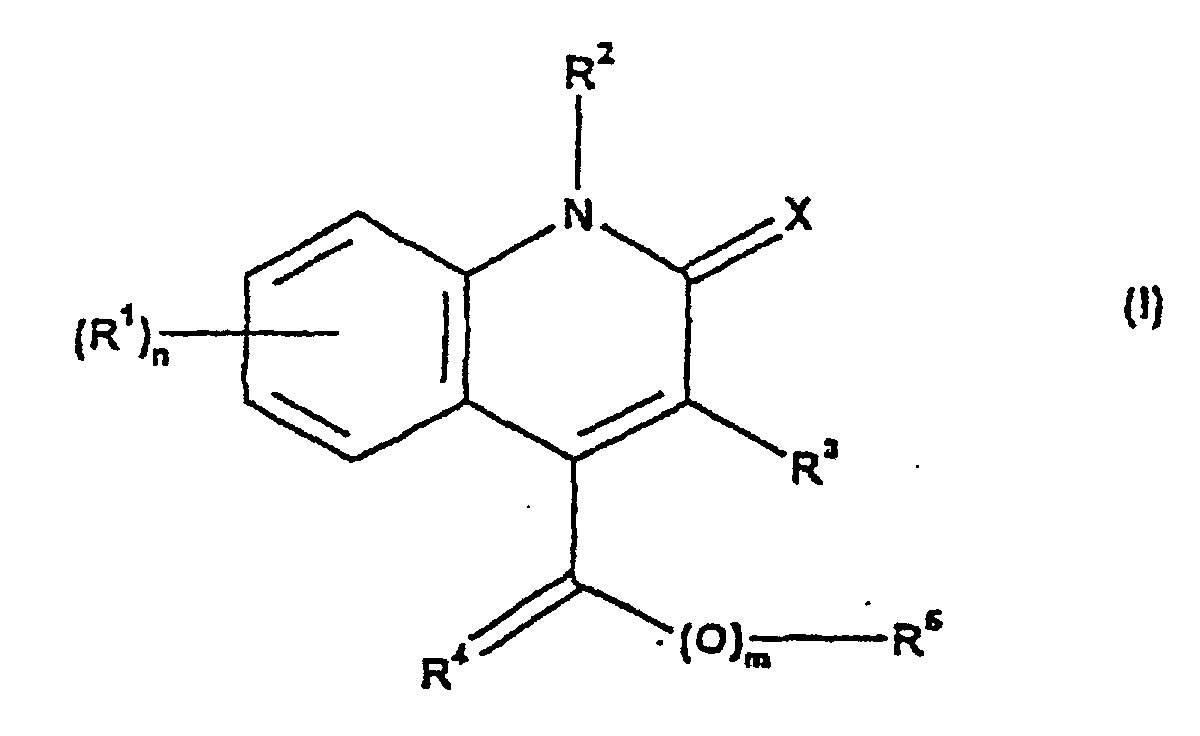 où
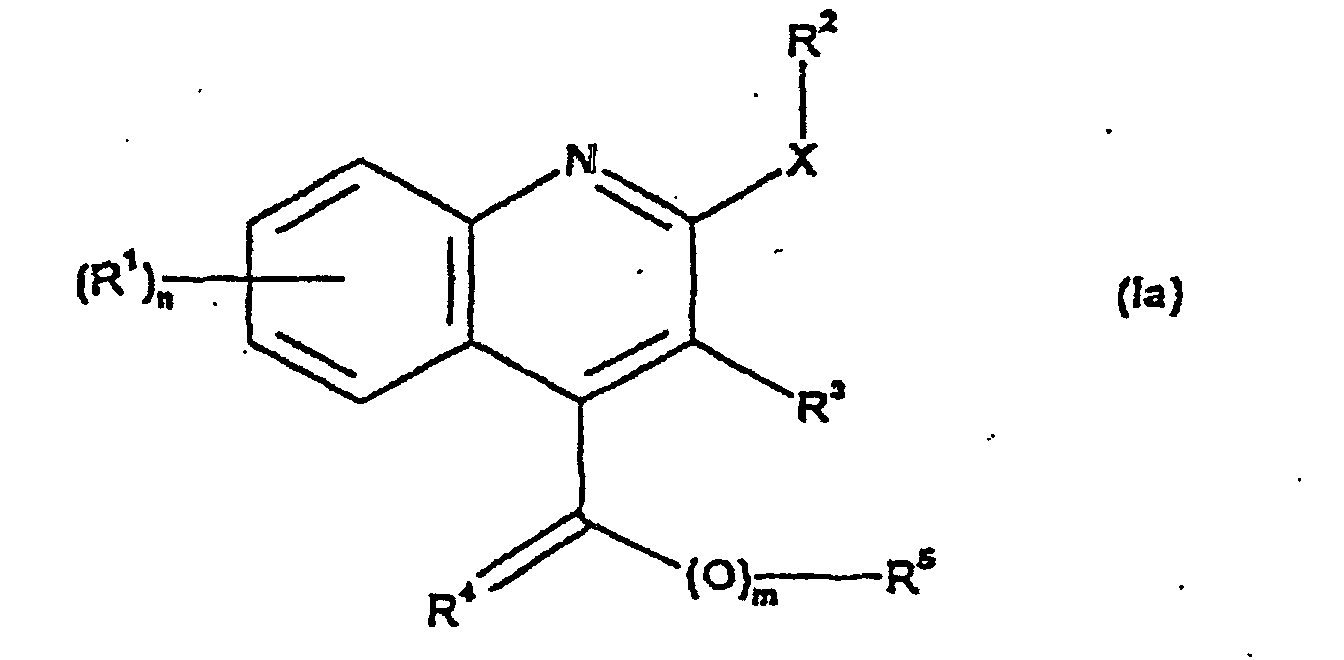
- n
- vaut zéro, un, deux,
les différents substituants - R1
- représentent,
indépendamment les uns des autres, des atomes de
fluor, de chlore, de brome, des groupes
trifluorométhyle, trifluorométhoxy, alkyle en C1-C6,
cycloalkyle en C3-C6, alkoxy en C1-C6, (alkoxy en C1-C6)-
(alkoxy en C1-C6), (alkyl en C1-C6)thio, (alkyl en C1-
C6)sulfinyle, acyle en C1-C6, acyloxy en C1-C6, carboxy,
(alkyloxy en C1-C6)carbonyle,
ou
un reste phényle, phénoxy, phénoxycarbonyle, phénylthio, phénylsulfonyle, phénoxysulfonyle, phénylsulfonyloxy, phénylsulfonylamino, benzoyle, éventuellement substitué par jusqu'à deux restes R6 indépendants l'un de l'autre, - R6
- pouvant représenter
des atomes de fluor, de chlore, de brome, des groupes trifluorométhyle, trifluorométhoxy, azido, alkyle en C1-C4, cycloalkyle en C4-C6, alkoxy en C1-C4, (alkyl en C1-C4)thio, - X
- représente
un atome d'oxygène, un atome de soufre ou un atome d'azote substitué N-R2, N-O-R2, où R2 peut posséder les significations données ci-dessous, et - R2
- représente un atome d'hydrogène,
un groupe alkyle en C1-C4, éventuellement substitué par des substituants fluor, chlore, brome, acyloxy en C1-C3, benzoyloxy, benzyloxy, phénoxy, alkoxy en C1-C3, phénylsulfonyle, oxo, carboxy, carbamoyle ;
un groupe alcényle en C2-C6, éventuellement substitué par des substituants fluor, chlore, brome, acyloxy en C1-C3, benzoyloxy, benzyloxy, phénoxy, alkoxy en C1-C3, phénylsulfonyle, oxo, carboxy, carbamoyle ; et - R3
- représente
un groupe alkyle en C1-C8, éventuellement substitué par des substituants fluor, chlore, hydroxy, amino, acyloxy en C1-C4, benzoyloxy, benzyloxy, phénoxy, alkoxy en C1-C4, carboxy ;
un groupe alcényle en C2-C6, éventuellement substitué par des substituants fluor, chlore, hydroxy, amino, acyloxy en C1-C4, benzoyloxy, benzyloxy, phénoxy, alkoxy en C1-C4, carboxy ;
un groupe cycloalkyle en C3-C6, éventuellement substitué par des substituants fluor, chlore, hydroxy, amino, acyloxy en C1-C4, benzoyloxy, benzyloxy, phénoxy, alkoxy en C1-C4, carboxy ;
un groupe cycloalcényle en C3-C6, éventuellement substitué par des substituants fluor, chlore, hydroxy, amino, acyloxy en C1-C4, benzoyloxy, benzyloxy, phénoxy, alkoxy en C1-C4, carboxy ; ou
un groupe aryle non substitué ou substitué par jusqu'à deux restes R6 indépendants, un groupe aryl- alkyle en C1-C2, R6 étant défini ci-dessus, et
- R4
- représente un atome d'oxygène, et
- m
- vaut 0 ou 1, et
- R5
- représente
un groupe alcényle en C2-C8, éventuellement substitué par des substituants fluor, chlore, brome, iode, cyano, amino, hydroxy, acyloxy en C1-C4, benzoyloxy, benzyloxy, phénoxy, alkoxy en C1-C4, oxo, carboxy, carbamoyle ;
un groupe alcynyle en C2-C6, éventuellement substitué par des substituants fluor, chlore, brome, cyano, amino, hydroxy, acyloxy en C1-C4, benzoyloxy, benzyloxy, phénoxy, alkoxy en C1-C4, oxo, carboxy, carbamoyle ;
un groupe cycloalkyle en C3-C6, éventuellement substitué par des substituants fluor, chlore, brome, cyano, amino, hydroxy, acyloxy en C1-C4, benzoyloxy, benzyloxy, phénoxy, alkoxy en C1-C4, oxo, carboxy, carbamoyle ;
un groupe cycloalcényle en C3-C6, éventuellement substitué par des substituants fluor, chlore, brome, amino, hydroxy, acyloxy en C1-C4, benzoyloxy, benzyloxy, phénoxy, alkoxy en C1-C4 ;
un groupe (cycloalkyl en C3-C6) - (alkyle en C1-C2) éventuellement substitué par des substituants fluor, chlore, brome, amino, hydroxy, acyloxy en C1-C4, benzoyloxy, benzyloxy, phénoxy ;
un groupe (cycloalcényl en C3-C6) - (alkyle en C1 - C2) éventuellement substitué par des substituants fluor, chlore, brome, amino, hydroxy, acyloxy en C1-C4, benzoyloxy, benzyloxy, phénoxy ;
ou un groupe aryle non substitué ou substitué par jusqu'à deux restes R6 indépendants, des groupes arylalkyle en C1-C4, arylalcényle en C1-C4, R6 étant défini comme ci-dessus ;
ou un groupe hétéroaryle non substitué ou substitué par jusqu'à trois restes R6 indépendants, un groupe hétéroarylalkyle en C1-C4 ;
leurs isomères optiques, diastéréomères sous forme pure ou sous forme de leurs mélanges et leurs sels d'addition et des précurseurs de médicaments,
à l'exception des composés de formule I, dans lesquels les restes R1, R2, R3, R4, R5, X et m présentent en même temps les significations suivantes :- R2
- représente un atome d'hydrogène,
- R3
- représente
un groupe phényle non substitué ou substitué
- X
- représente un atome d'oxygène,
- R4
- représente un atome d'oxygène,
- m
- vaut 1 et
- R5
- représente
un groupe alkyle en C1-C6,
- R2
- représente un atome d'hydrogène,
- R3
- représente
- X
- représente un atome d'oxygène,
- R4
- représente un atome d'oxygène,
- m
- vaut 0 et
- R5
- est défini comme ci-dessus.
- Composés de formules I ou Ia selon revendication 1, où représentent
- n
- vaut zéro, un,
les substituants - R1
- représentent
des atomes de fluor, de chlore, de brome, des groupes trifluorométhyle, trifluorométhoxy, cyclo- alkyle en C5-C6, alkoxy en C1-C4, (alkoxy en C1-C4)- (alkoxy en C1-C4), (alkyl en C1-C4)thio, acyle en C1-C4, ou
un reste phényle, phénoxy, benzoyle, éventuellement substitué par un reste R6, - R6
- pouvant représenter
des atomes de fluor, de chlore, de brome, des groupes trifluorométhyle, trifluorométhoxy, alkyle en - C1-C4,
- alkoxy en C1-C4, (alkyl en C1-C4)thio,
- X
- représente
un atome d'oxygène ou un atome de soufre, et - R2
- représente un atome d'hydrogène, et
- R3
- représente
un groupe alkyle en C1-C6, un groupe alcényle en - C2-C6,
- un groupe cycloalkyle en C3-C6,
ou
un groupe phényle, un groupe benzyle non substitué ou substitué par jusqu'à deux restes R6 indépendants, R6 étant défini ci-dessus, et - R4
- représente un atome d'oxygène, et
- m
- vaut 1, et
- R5
- représente
un groupe alkyle en C1-C6, éventuellement substitué par des substituants fluor, chlore, brome, cyano, amino, hydroxy, acyloxy en C1-C4, benzoyloxy, benzyloxy, phénoxy, en C1-C4 ;
un groupe alcényle en C2-C6, éventuellement substitué par des substituants fluor, chlore, brome, amino, hydroxy, acyloxy en C1-C4, carboxy ;
un groupe cycloalkyle en C3-C6 ;
un groupe cycloalcényle en C3-C6 ;
un groupe (cycloalkyl en C3-C6) - (alkyle en C1-C2) ;
jusqu'à deux restes R6 indépendants, un groupe arylalkyle en C1-C4, R6 étant défini comme ci- dessus. - Procédé pour la préparation de composés selon une ou plusieurs des revendications 1-2, caractérisé en ce queA) pour la préparation de composés de formule I ou Ia, où X et R4 représentent un atome d'oxygène, m vaut 0 ou 1, avec les autres restes définis comme dans les revendications 1-2, on fait réagir un composé de formule II, où A représente un groupe partant, de préférence un atome d'halogène, sur un composé de formule III, où M représente un atome d'hydrogène, un atome métallique ou un équivalent d'atome métallique, de préférence un métal alcalin ou alcalinoterreux,ou en ce qu'on fait réagir
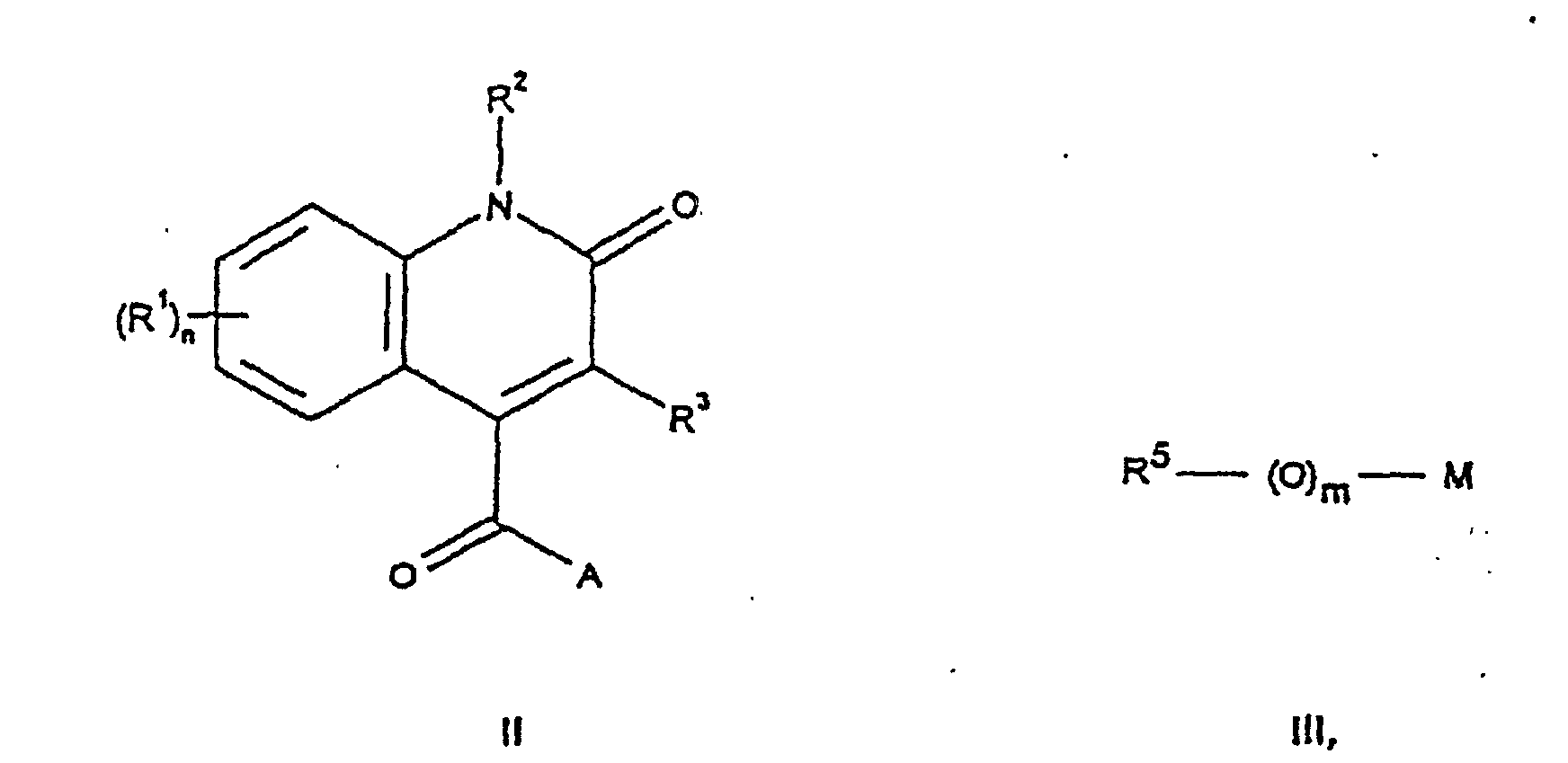 B) des composés de formule I avec X représentant un atome d'oxygène, et R1 à R5 sont définis comme ci-dessus, sur un réactif de sulfuration pour obtenir des composés de formule I avec X représentant un atome de soufre et R1 à R5 étant définis dans les revendications 1-2,
ou en ce qu'on fait réagirC) un composé de formule I, avec R1 à R5 définis comme dans les revendications 1-2 et X représentant un atome d'oxygène ou un atome de soufre, sur un composé de formule IV ou IVaou pour obtenir des dérivés de formule I avec R1 à R5 définis comme dans les revendications 1-2 et X représentant des groupes N-R2 ou N-O-R2,
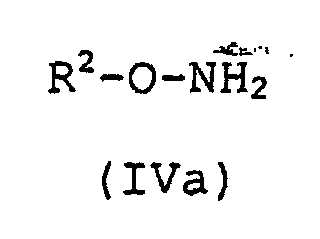
ou en ce qu'on fait réagirD) un composé de formule II avec A représentant un atome de chlore et R1 à R5 étant définis comme dans les revendications 1-2, sur un agent réducteur pour obtenir des composés de formule I avec R1 à R3 définis comme ci-dessus, R4 formant, conjointement avec l'atome de carbone qui le relie, un groupe CH2 et (O)m-R représente un groupe hydroxy,ou en ce qu'on fait réagir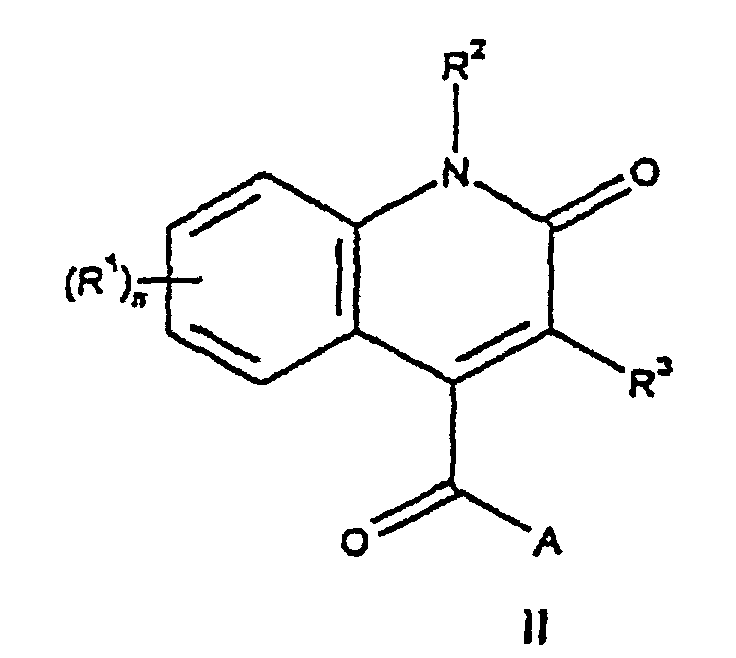 E) un composé de formule I ou Ia avec R2 représentant un atome d'hydrogène et R1, R3, R4 et R5 étant définis comme dans les revendications 1-2, sur un composé de formule V
- Utilisation de composés de formules I ou Ia selon une ou plusieurs des revendications 1-2 pour l'application comme médicament.
- Médicament contenant une quantité efficace d'au moins un composé de formules I ou Ia selon une ou plusieurs des revendications 1-2.
- Procédé pour la préparation d'un médicament selon la revendication 5, caractérisé en ce qu'on met en forme d'administration appropriée une quantité efficace d'un composé de formules I ou Ia avec des adjuvants pharmaceutiques usuels.
- Utilisation de composés selon l'une des revendications 1 ou 2 pour la préparation de médicaments pour le traitement de maladies provoquées par des infections rétrovirales.
Applications Claiming Priority (3)
| Application Number | Priority Date | Filing Date | Title |
|---|---|---|---|
| DE19613591A DE19613591A1 (de) | 1996-04-04 | 1996-04-04 | Substituierte-Chinolin-Derivate, Verfahren zu ihrer Herstellung und ihre Verwendung |
| DE19613591 | 1996-04-04 | ||
| PCT/EP1997/001496 WO1997037977A1 (fr) | 1996-04-04 | 1997-03-25 | Derives de quinoleine substituee a effet antiviral |
Publications (2)
| Publication Number | Publication Date |
|---|---|
| EP1003724A1 EP1003724A1 (fr) | 2000-05-31 |
| EP1003724B1 true EP1003724B1 (fr) | 2003-02-12 |
Family
ID=7790532
Family Applications (1)
| Application Number | Title | Priority Date | Filing Date |
|---|---|---|---|
| EP97915425A Expired - Lifetime EP1003724B1 (fr) | 1996-04-04 | 1997-03-25 | Derives de quinoleine substituee a effet antiviral |
Country Status (10)
| Country | Link |
|---|---|
| US (1) | US6114349A (fr) |
| EP (1) | EP1003724B1 (fr) |
| JP (1) | JP4231107B2 (fr) |
| AT (1) | ATE232519T1 (fr) |
| AU (1) | AU2291297A (fr) |
| DE (2) | DE19613591A1 (fr) |
| DK (1) | DK1003724T3 (fr) |
| ES (1) | ES2192675T3 (fr) |
| PT (1) | PT1003724E (fr) |
| WO (1) | WO1997037977A1 (fr) |
Families Citing this family (12)
| Publication number | Priority date | Publication date | Assignee | Title |
|---|---|---|---|---|
| US6077850A (en) * | 1997-04-21 | 2000-06-20 | G.D. Searle & Co. | Substituted benzopyran analogs for the treatment of inflammation |
| GB9930061D0 (en) * | 1999-12-20 | 2000-02-09 | Glaxo Group Ltd | Quinolone compounds for use in treating viral infections |
| ATE319706T1 (de) * | 2000-09-19 | 2006-03-15 | Centre Nat Rech Scient | Pyridinon und pyridinethion-derivate mit hiv- hemmenden eigenschaften |
| CA2469048A1 (fr) * | 2001-12-14 | 2003-06-26 | Daniel Dube | Quinolinones comme ligands du recepteur de la prostaglandine |
| RU2260002C2 (ru) * | 2003-08-08 | 2005-09-10 | ООО "Исследовательский институт химического разнообразия" | Замещенные 6-сульфо-2-оксо-1,2-дигидрохинолин 4-карбоновые кислоты и их производные (варианты) и фокусированная библиотека |
| ATE433974T1 (de) * | 2003-09-19 | 2009-07-15 | Gilead Sciences Inc | Azachinolinolphosphonatverbindungen als integraseinhibitoren |
| SI1742642T1 (sl) * | 2004-04-14 | 2009-04-30 | Gilead Sciences Inc | Fosfonatni analogi inhibitorskih spojin HIV integraze |
| EP1917245A1 (fr) | 2005-08-21 | 2008-05-07 | Abbott GmbH & Co. KG | Composes heterocycliques et leur utilisation en tant que partenaires de liaison des recepteurs 5-ht5 |
| TW200829554A (en) * | 2006-09-29 | 2008-07-16 | Tibotec Pharm Ltd | Quinolinone derivatives |
| CN113087664B (zh) * | 2021-03-22 | 2022-03-11 | 云南中烟工业有限责任公司 | 一种喹啉生物碱类化合物及其制备方法与应用 |
| WO2023004188A2 (fr) * | 2021-07-23 | 2023-01-26 | The Research Institute At Nationwide Children's Hospital | Inhibition d'agents pathogènes intracellulaires |
| CN118994003B (zh) * | 2024-08-07 | 2026-07-24 | 中国药科大学 | 2-氧亚基-1h-喹啉-4-甲酸类衍生物及其制法和应用 |
Family Cites Families (4)
| Publication number | Priority date | Publication date | Assignee | Title |
|---|---|---|---|---|
| ES2164639T3 (es) * | 1991-04-15 | 2002-03-01 | Aventis Pharma Gmbh | Quinoxalinas, procedimiento para su preparacion y su empleo. |
| GB9125515D0 (en) * | 1991-11-29 | 1992-01-29 | Merck Sharp & Dohme | Therapeutic agents |
| TW304945B (fr) * | 1992-06-27 | 1997-05-11 | Hoechst Ag | |
| JPH0692939A (ja) * | 1992-09-16 | 1994-04-05 | Kyowa Hakko Kogyo Co Ltd | イミダゾール誘導体 |
-
1996
- 1996-04-04 DE DE19613591A patent/DE19613591A1/de not_active Withdrawn
-
1997
- 1997-03-25 DK DK97915425T patent/DK1003724T3/da active
- 1997-03-25 DE DE59709321T patent/DE59709321D1/de not_active Expired - Lifetime
- 1997-03-25 PT PT97915425T patent/PT1003724E/pt unknown
- 1997-03-25 AU AU22912/97A patent/AU2291297A/en not_active Abandoned
- 1997-03-25 ES ES97915425T patent/ES2192675T3/es not_active Expired - Lifetime
- 1997-03-25 WO PCT/EP1997/001496 patent/WO1997037977A1/fr not_active Ceased
- 1997-03-25 JP JP53578997A patent/JP4231107B2/ja not_active Expired - Fee Related
- 1997-03-25 EP EP97915425A patent/EP1003724B1/fr not_active Expired - Lifetime
- 1997-03-25 US US09/155,647 patent/US6114349A/en not_active Expired - Lifetime
- 1997-03-25 AT AT97915425T patent/ATE232519T1/de not_active IP Right Cessation
Also Published As
| Publication number | Publication date |
|---|---|
| WO1997037977A1 (fr) | 1997-10-16 |
| EP1003724A1 (fr) | 2000-05-31 |
| ES2192675T3 (es) | 2003-10-16 |
| US6114349A (en) | 2000-09-05 |
| JP2000508299A (ja) | 2000-07-04 |
| DK1003724T3 (da) | 2003-05-05 |
| DE59709321D1 (de) | 2003-03-20 |
| JP4231107B2 (ja) | 2009-02-25 |
| DE19613591A1 (de) | 1997-10-09 |
| ATE232519T1 (de) | 2003-02-15 |
| AU2291297A (en) | 1997-10-29 |
| PT1003724E (pt) | 2003-06-30 |
Similar Documents
| Publication | Publication Date | Title |
|---|---|---|
| DE69818831T2 (de) | Indolderivate als mcp-1 rezeptor antagonisten | |
| DE69118388T2 (de) | Substituierte bizyklische arylderivate mit selektiver leukotrien b4 antagonistischer wirkung | |
| DE69110254T2 (de) | Hydroxychinolonderivate. | |
| DE60013859T2 (de) | Indolderivate und deren verwendung zur behandlung von u.a. osteoporosis | |
| DE4344452A1 (de) | Aza-4-iminochinoline, Verfahren zu ihrer Herstellung und ihre Verwendung | |
| EP0509398B1 (fr) | Quinoxalines, procédé pour leur préparation et leur utilisation | |
| EP0590428A1 (fr) | Azaquinoxalines, procédé pour leur préparation et leur utilisation | |
| DE69200394T2 (de) | 3-Sulfonylamino-2-(1H)-Chinolinone und deren 7-Azaderivate als anregende Aminosäuren Antagonisten. | |
| EP1003724A1 (fr) | Derives de quinoleine substituee a effet antiviral | |
| DD209624A5 (de) | Verfahren zur herstellung von benzimidazolverbindungen | |
| EP0657166B1 (fr) | Composition contenant un quinoxaline et un nucléosid | |
| DE3622036A1 (de) | Benzimidazolderivate | |
| DE2537070C2 (fr) | ||
| EP0708093B1 (fr) | Quinoxalines, procédé pour leur préparation et leur application | |
| DE69629341T2 (de) | Pyrrolocarbazolderivate | |
| EP0697405B1 (fr) | Dérivés de quinoléines substituées, procédé pour leur préparation et leur utilisation | |
| EP0290915A2 (fr) | Dérivés d'acides flavonyl-3-carboxyliques et procédé, intermédiaires pour leur préparation et médicament contenant ces composés | |
| EP0579968B1 (fr) | Dérivés de 4-Iminoquinoléine, procédé pour leur préparation et leur utilisation | |
| WO2001070687A1 (fr) | Indoles pour le traitement de maladies pouvant etre traitees a l'aide d'hormones thyroidiennes | |
| DE69734594T2 (de) | Nmda (n-methyl-d-aspartate) antagonists | |
| EP1833830B1 (fr) | Derive de quinoleine, son utilisation, sa fabrication et medicament le contenant | |
| DE3320102C2 (fr) | ||
| DE3532279A1 (de) | 1,4-benzoxathiin-derivate | |
| DE4301900A1 (de) | 2-Oxochinolin-1-yl-methylphenylessigsäurederivate | |
| DE19818964A1 (de) | Neue Hydroxyindole, deren Verwendung als Inhibitoren der Phospodiesterase 4 und Verfahren zu deren Herstellung |
Legal Events
| Date | Code | Title | Description |
|---|---|---|---|
| PUAI | Public reference made under article 153(3) epc to a published international application that has entered the european phase |
Free format text: ORIGINAL CODE: 0009012 |
|
| 17P | Request for examination filed |
Effective date: 19981104 |
|
| AK | Designated contracting states |
Kind code of ref document: A1 Designated state(s): AT BE CH DE DK ES FI FR GB GR IE IT LI LU NL PT SE |
|
| 17Q | First examination report despatched |
Effective date: 20000920 |
|
| GRAH | Despatch of communication of intention to grant a patent |
Free format text: ORIGINAL CODE: EPIDOS IGRA |
|
| GRAH | Despatch of communication of intention to grant a patent |
Free format text: ORIGINAL CODE: EPIDOS IGRA |
|
| GRAA | (expected) grant |
Free format text: ORIGINAL CODE: 0009210 |
|
| AK | Designated contracting states |
Designated state(s): AT BE CH DE DK ES FI FR GB GR IE IT LI LU NL PT SE |
|
| REG | Reference to a national code |
Ref country code: GB Ref legal event code: FG4D Free format text: NOT ENGLISH |
|
| REG | Reference to a national code |
Ref country code: CH Ref legal event code: EP |
|
| PGFP | Annual fee paid to national office [announced via postgrant information from national office to epo] |
Ref country code: AT Payment date: 20030219 Year of fee payment: 7 |
|
| PGFP | Annual fee paid to national office [announced via postgrant information from national office to epo] |
Ref country code: SE Payment date: 20030220 Year of fee payment: 7 Ref country code: NL Payment date: 20030220 Year of fee payment: 7 |
|
| PGFP | Annual fee paid to national office [announced via postgrant information from national office to epo] |
Ref country code: CH Payment date: 20030221 Year of fee payment: 7 |
|
| PGFP | Annual fee paid to national office [announced via postgrant information from national office to epo] |
Ref country code: DK Payment date: 20030224 Year of fee payment: 7 |
|
| PGFP | Annual fee paid to national office [announced via postgrant information from national office to epo] |
Ref country code: IE Payment date: 20030305 Year of fee payment: 7 |
|
| PGFP | Annual fee paid to national office [announced via postgrant information from national office to epo] |
Ref country code: GR Payment date: 20030306 Year of fee payment: 7 Ref country code: FI Payment date: 20030306 Year of fee payment: 7 |
|
| PGFP | Annual fee paid to national office [announced via postgrant information from national office to epo] |
Ref country code: BE Payment date: 20030311 Year of fee payment: 7 |
|
| PGFP | Annual fee paid to national office [announced via postgrant information from national office to epo] |
Ref country code: LU Payment date: 20030312 Year of fee payment: 7 |
|
| REF | Corresponds to: |
Ref document number: 59709321 Country of ref document: DE Date of ref document: 20030320 Kind code of ref document: P |
|
| REG | Reference to a national code |
Ref country code: DK Ref legal event code: T3 |
|
| PGFP | Annual fee paid to national office [announced via postgrant information from national office to epo] |
Ref country code: PT Payment date: 20030507 Year of fee payment: 7 |
|
| REG | Reference to a national code |
Ref country code: GR Ref legal event code: EP Ref document number: 20030401329 Country of ref document: GR |
|
| REG | Reference to a national code |
Ref country code: SE Ref legal event code: TRGR |
|
| GBT | Gb: translation of ep patent filed (gb section 77(6)(a)/1977) |
Effective date: 20030514 |
|
| REG | Reference to a national code |
Ref country code: PT Ref legal event code: SC4A Free format text: AVAILABILITY OF NATIONAL TRANSLATION Effective date: 20030506 |
|
| REG | Reference to a national code |
Ref country code: IE Ref legal event code: FG4D Free format text: GERMAN |
|
| REG | Reference to a national code |
Ref country code: ES Ref legal event code: FG2A Ref document number: 2192675 Country of ref document: ES Kind code of ref document: T3 |
|
| ET | Fr: translation filed | ||
| PLBE | No opposition filed within time limit |
Free format text: ORIGINAL CODE: 0009261 |
|
| STAA | Information on the status of an ep patent application or granted ep patent |
Free format text: STATUS: NO OPPOSITION FILED WITHIN TIME LIMIT |
|
| 26N | No opposition filed |
Effective date: 20031113 |
|
| PG25 | Lapsed in a contracting state [announced via postgrant information from national office to epo] |
Ref country code: LU Free format text: LAPSE BECAUSE OF NON-PAYMENT OF DUE FEES Effective date: 20040325 Ref country code: IE Free format text: LAPSE BECAUSE OF NON-PAYMENT OF DUE FEES Effective date: 20040325 Ref country code: FI Free format text: LAPSE BECAUSE OF NON-PAYMENT OF DUE FEES Effective date: 20040325 Ref country code: AT Free format text: LAPSE BECAUSE OF NON-PAYMENT OF DUE FEES Effective date: 20040325 |
|
| PG25 | Lapsed in a contracting state [announced via postgrant information from national office to epo] |
Ref country code: SE Free format text: LAPSE BECAUSE OF NON-PAYMENT OF DUE FEES Effective date: 20040326 |
|
| PG25 | Lapsed in a contracting state [announced via postgrant information from national office to epo] |
Ref country code: LI Free format text: LAPSE BECAUSE OF NON-PAYMENT OF DUE FEES Effective date: 20040331 Ref country code: DK Free format text: LAPSE BECAUSE OF NON-PAYMENT OF DUE FEES Effective date: 20040331 Ref country code: CH Free format text: LAPSE BECAUSE OF NON-PAYMENT OF DUE FEES Effective date: 20040331 Ref country code: BE Free format text: LAPSE BECAUSE OF NON-PAYMENT OF DUE FEES Effective date: 20040331 |
|
| BERE | Be: lapsed |
Owner name: *AVENTIS PHARMA DEUTSCHLAND G.M.B.H. Effective date: 20040331 |
|
| PG25 | Lapsed in a contracting state [announced via postgrant information from national office to epo] |
Ref country code: NL Free format text: LAPSE BECAUSE OF NON-PAYMENT OF DUE FEES Effective date: 20041001 |
|
| PG25 | Lapsed in a contracting state [announced via postgrant information from national office to epo] |
Ref country code: GR Free format text: LAPSE BECAUSE OF NON-PAYMENT OF DUE FEES Effective date: 20041006 |
|
| PG25 | Lapsed in a contracting state [announced via postgrant information from national office to epo] |
Ref country code: PT Free format text: LAPSE BECAUSE OF NON-PAYMENT OF DUE FEES Effective date: 20041015 |
|
| EUG | Se: european patent has lapsed | ||
| REG | Reference to a national code |
Ref country code: CH Ref legal event code: PL |
|
| REG | Reference to a national code |
Ref country code: PT Ref legal event code: MM4A Free format text: LAPSE DUE TO NON-PAYMENT OF FEES Effective date: 20040930 |
|
| NLV4 | Nl: lapsed or anulled due to non-payment of the annual fee |
Effective date: 20041001 |
|
| REG | Reference to a national code |
Ref country code: IE Ref legal event code: MM4A |
|
| REG | Reference to a national code |
Ref country code: FR Ref legal event code: CD |
|
| PGFP | Annual fee paid to national office [announced via postgrant information from national office to epo] |
Ref country code: FR Payment date: 20110317 Year of fee payment: 15 |
|
| PGFP | Annual fee paid to national office [announced via postgrant information from national office to epo] |
Ref country code: GB Payment date: 20110323 Year of fee payment: 15 Ref country code: ES Payment date: 20110414 Year of fee payment: 15 |
|
| PGFP | Annual fee paid to national office [announced via postgrant information from national office to epo] |
Ref country code: IT Payment date: 20110323 Year of fee payment: 15 |
|
| PGFP | Annual fee paid to national office [announced via postgrant information from national office to epo] |
Ref country code: DE Payment date: 20120331 Year of fee payment: 16 |
|
| GBPC | Gb: european patent ceased through non-payment of renewal fee |
Effective date: 20120325 |
|
| REG | Reference to a national code |
Ref country code: FR Ref legal event code: ST Effective date: 20121130 |
|
| PG25 | Lapsed in a contracting state [announced via postgrant information from national office to epo] |
Ref country code: FR Free format text: LAPSE BECAUSE OF NON-PAYMENT OF DUE FEES Effective date: 20120402 Ref country code: GB Free format text: LAPSE BECAUSE OF NON-PAYMENT OF DUE FEES Effective date: 20120325 |
|
| PG25 | Lapsed in a contracting state [announced via postgrant information from national office to epo] |
Ref country code: IT Free format text: LAPSE BECAUSE OF NON-PAYMENT OF DUE FEES Effective date: 20120325 |
|
| REG | Reference to a national code |
Ref country code: ES Ref legal event code: FD2A Effective date: 20130710 |
|
| PG25 | Lapsed in a contracting state [announced via postgrant information from national office to epo] |
Ref country code: ES Free format text: LAPSE BECAUSE OF NON-PAYMENT OF DUE FEES Effective date: 20120326 |
|
| REG | Reference to a national code |
Ref country code: DE Ref legal event code: R119 Ref document number: 59709321 Country of ref document: DE Effective date: 20131001 |
|
| PG25 | Lapsed in a contracting state [announced via postgrant information from national office to epo] |
Ref country code: DE Free format text: LAPSE BECAUSE OF NON-PAYMENT OF DUE FEES Effective date: 20131001 |