EP1003749B1 - 8-substituierte-9h-1,3-dioxolo/4,5-h//2,3/benzodiazepin derivate als ampa/kainate-rezeptor-hemmer - Google Patents
8-substituierte-9h-1,3-dioxolo/4,5-h//2,3/benzodiazepin derivate als ampa/kainate-rezeptor-hemmer Download PDFInfo
- Publication number
- EP1003749B1 EP1003749B1 EP98939781A EP98939781A EP1003749B1 EP 1003749 B1 EP1003749 B1 EP 1003749B1 EP 98939781 A EP98939781 A EP 98939781A EP 98939781 A EP98939781 A EP 98939781A EP 1003749 B1 EP1003749 B1 EP 1003749B1
- Authority
- EP
- European Patent Office
- Prior art keywords
- group
- formula
- dioxolo
- benzodiazepine
- atom
- Prior art date
- Legal status (The legal status is an assumption and is not a legal conclusion. Google has not performed a legal analysis and makes no representation as to the accuracy of the status listed.)
- Expired - Lifetime
Links
- 0 CC(**)(C1)N(C(**)=O)N=C(c2ccc(*)cc2)c2c1cc1OCOc1c2 Chemical compound CC(**)(C1)N(C(**)=O)N=C(c2ccc(*)cc2)c2c1cc1OCOc1c2 0.000 description 2
- LCBZYTMMONJJNI-UHFFFAOYSA-N CC(C1)(C#N)NN=C(c(cc2)ccc2[N+]([O-])=O)c2c1cc1OCOc1c2 Chemical compound CC(C1)(C#N)NN=C(c(cc2)ccc2[N+]([O-])=O)c2c1cc1OCOc1c2 LCBZYTMMONJJNI-UHFFFAOYSA-N 0.000 description 1
- RKVGYXWLXUQPTD-UHFFFAOYSA-N O=CC(C1)=NN=C(c(cc2)ccc2N=O)c2c1cc1OCOc1c2 Chemical compound O=CC(C1)=NN=C(c(cc2)ccc2N=O)c2c1cc1OCOc1c2 RKVGYXWLXUQPTD-UHFFFAOYSA-N 0.000 description 1
Classifications
-
- C—CHEMISTRY; METALLURGY
- C07—ORGANIC CHEMISTRY
- C07D—HETEROCYCLIC COMPOUNDS
- C07D491/00—Heterocyclic compounds containing in the condensed ring system both one or more rings having oxygen atoms as the only ring hetero atoms and one or more rings having nitrogen atoms as the only ring hetero atoms, not provided for by groups C07D451/00 - C07D459/00, C07D463/00, C07D477/00 or C07D489/00
- C07D491/02—Heterocyclic compounds containing in the condensed ring system both one or more rings having oxygen atoms as the only ring hetero atoms and one or more rings having nitrogen atoms as the only ring hetero atoms, not provided for by groups C07D451/00 - C07D459/00, C07D463/00, C07D477/00 or C07D489/00 in which the condensed system contains two hetero rings
- C07D491/04—Ortho-condensed systems
- C07D491/056—Ortho-condensed systems with two or more oxygen atoms as ring hetero atoms in the oxygen-containing ring
-
- C—CHEMISTRY; METALLURGY
- C07—ORGANIC CHEMISTRY
- C07D—HETEROCYCLIC COMPOUNDS
- C07D491/00—Heterocyclic compounds containing in the condensed ring system both one or more rings having oxygen atoms as the only ring hetero atoms and one or more rings having nitrogen atoms as the only ring hetero atoms, not provided for by groups C07D451/00 - C07D459/00, C07D463/00, C07D477/00 or C07D489/00
- C07D491/02—Heterocyclic compounds containing in the condensed ring system both one or more rings having oxygen atoms as the only ring hetero atoms and one or more rings having nitrogen atoms as the only ring hetero atoms, not provided for by groups C07D451/00 - C07D459/00, C07D463/00, C07D477/00 or C07D489/00 in which the condensed system contains two hetero rings
- C07D491/04—Ortho-condensed systems
-
- A—HUMAN NECESSITIES
- A61—MEDICAL OR VETERINARY SCIENCE; HYGIENE
- A61P—SPECIFIC THERAPEUTIC ACTIVITY OF CHEMICAL COMPOUNDS OR MEDICINAL PREPARATIONS
- A61P1/00—Drugs for disorders of the alimentary tract or the digestive system
- A61P1/08—Drugs for disorders of the alimentary tract or the digestive system for nausea, cinetosis or vertigo; Antiemetics
-
- A—HUMAN NECESSITIES
- A61—MEDICAL OR VETERINARY SCIENCE; HYGIENE
- A61P—SPECIFIC THERAPEUTIC ACTIVITY OF CHEMICAL COMPOUNDS OR MEDICINAL PREPARATIONS
- A61P21/00—Drugs for disorders of the muscular or neuromuscular system
- A61P21/02—Muscle relaxants, e.g. for tetanus or cramps
-
- A—HUMAN NECESSITIES
- A61—MEDICAL OR VETERINARY SCIENCE; HYGIENE
- A61P—SPECIFIC THERAPEUTIC ACTIVITY OF CHEMICAL COMPOUNDS OR MEDICINAL PREPARATIONS
- A61P25/00—Drugs for disorders of the nervous system
-
- A—HUMAN NECESSITIES
- A61—MEDICAL OR VETERINARY SCIENCE; HYGIENE
- A61P—SPECIFIC THERAPEUTIC ACTIVITY OF CHEMICAL COMPOUNDS OR MEDICINAL PREPARATIONS
- A61P25/00—Drugs for disorders of the nervous system
- A61P25/06—Antimigraine agents
-
- A—HUMAN NECESSITIES
- A61—MEDICAL OR VETERINARY SCIENCE; HYGIENE
- A61P—SPECIFIC THERAPEUTIC ACTIVITY OF CHEMICAL COMPOUNDS OR MEDICINAL PREPARATIONS
- A61P25/00—Drugs for disorders of the nervous system
- A61P25/08—Antiepileptics; Anticonvulsants
-
- A—HUMAN NECESSITIES
- A61—MEDICAL OR VETERINARY SCIENCE; HYGIENE
- A61P—SPECIFIC THERAPEUTIC ACTIVITY OF CHEMICAL COMPOUNDS OR MEDICINAL PREPARATIONS
- A61P25/00—Drugs for disorders of the nervous system
- A61P25/28—Drugs for disorders of the nervous system for treating neurodegenerative disorders of the central nervous system, e.g. nootropic agents, cognition enhancers, drugs for treating Alzheimer's disease or other forms of dementia
Definitions
- the invention refers to novel 8-substituted-9H-1,3-dioxolo/4,5-h//2,3/benzodiazepine derivatives, a pharmaceutical composition containing the same, and a process for the preparation of the active ingredient.
- the invention refers to novel 8-substituted-9H-1,3-dioxolo/4,5-h//2,3/benzodiazepine derivatives of the formula I wherein
- Tofisopam i.e. 1-(3,4-dimethoxyphenyl)-5-ethyl-7,8-dimethoxy-4-methyl-5H-2,3-benzodiazepine having anxiolytic effect is known from EU-P No. 155 572 and GB-P No. 1 202 579, respectively.
- the known compound does not comprise the ring system 1,3-dioxolo/4,5-h//2,3/benzodiazepine.
- a novel process for the preparation of partly new 8-methyl-9H-1,3-dioxolo/4,5-h//2,3/benzodiazepine derivatives having antiaggressive activity is known from HU-P No. 191 702. According to the novel process, the suitably substituted 2-acetonyl-4,5-methylenedioxybenzophenone is reacted with an excess of hydrazine hydrate.
- Enantiomers of 7,8-dihydro-8-methyl-5-(4-nitrophenyl)-9H-1,3-dioxolo/4,5-h//2,3/benzodiazepine are described in WO 95/01357.
- the known enantiomers are useful as intermediates in the synthesis of therapeutically active compounds.
- AMPA/kainate receptors play an important role in the acute and chronic diseases of the central nervous system. Through the inhibition of these receptors, muscle relaxant, neuroprotective and spasm inhibiting effects can be achieved /Vizi, E.S. et al., CNS Drug Reviews, 2 , 91-126 (1996); Lees, G.L., CNS Drugs, 5 , 51-74 (1996)/.
- the aim of the invention is to prepare novel 2,3-benzodiazepine derivatives that are more effective than the known 2,3-benzodiazepine derivatives.
- novel compounds can be employed for the treatment of any diseases (such as epilepsy, diseases resulting in muscle spasm, various neurodegenerative diseases, stroke) in which the inhibition of the AMPA/kainate receptors is favourable.
- a C 1-4 alkyl group is a methyl, ethyl, n-propyl, isopropyl, n-butyl, sec.-butyl, tert.-butyl or isobutyl group.
- a C 1-4 alkyl group is a methyl or an ethyl group.
- a C 1-6 alkyl group can be, in addition to alkyl groups listed above, for example a n-pentyl, 2-methylbutyl, n-hexyl, 2,2-dimethylbutyl or 2,3-dimethylbutyl group etc.
- a C 1-4 alkanoyl group is, primarily, a formyl, acetyl or n-propionyl group.
- a C 1-4 alkanoyl group is an acetyl group.
- a C 1-4 alkanoyloxy group is, primarily, a formyloxy, acetyloxy or n-propionyloxy group.
- a saturated or unsaturated heterocyclic group having 5 or 6 members and comprising one or two nitrogen atom(s) or a nitrogen atom and an oxygen atom as the heteroatom for example a pyrrolidinyl, piperidinyl, piperazinyl, imidazolyl or morpholino group is meant.
- the other nitrogen atom of the piperazinyl group is substituted.
- heterocyclic group contains one or two nitrogen atom(s) or a nitrogen atom and an oxygen atom as the heteroatom, and it consists of one ring or two condensed rings.
- the heterocyclic ring(s) contain(s) no double bond or one or more double bond(s).
- the above heterocyclic group is for example a pyrrolidinyl, imidazolyl, piperidinyl, pyridyl, morpholino, piperazinyl or 1,5-diazabicyclo/4.3.0/non-5-enyl group.
- one of the nitrogen atoms of the piperazinyl group is substituted.
- an acid addition salt formed with a pharmaceutically suitable inorganic acid such as hydrochloric acid, hydrobromic acid, sulfuric acid, phosphoric acid etc. or with a pharmaceutically suitable organic acid such as formic acid, acetic acid, fumaric acid, maleic acid, lactic acid, malic acid, tartaric acid, succinic acid, citric acid, methanesulfonic acid etc. is meant.
- a pharmaceutically suitable inorganic acid such as hydrochloric acid, hydrobromic acid, sulfuric acid, phosphoric acid etc.
- a pharmaceutically suitable organic acid such as formic acid, acetic acid, fumaric acid, maleic acid, lactic acid, malic acid, tartaric acid, succinic acid, citric acid, methanesulfonic acid etc.
- a quaternary ammonium derivative is a derivative wherein one of the nitrogen atoms of a compound of the formula I is present in a quaternerized form.
- the invention includes any isomers of the compounds of the formula I and the mixtures thereof.
- a preferred subgroup of the compounds of the formula I consists of the 8-substituted-9H-1,3-dioxolo/4,5-h//2,3/benzodiazepine derivatives and pharmaceutically suitable . acid addition salts and quaternary ammonium derivatives thereof, wherein in the formula I
- especially preferred compounds of the invention consist of the following 8-substituted-9H-1,3-dioxolo/4,5-h//2,3/benzodiazepine derivatives and pharmaceutically suitable acid addition salts and quaternary ammonium derivatives thereof:
- a further preferred subgroup of the compounds of the invention consists of the 8-substituted-9H-1,3-dioxolo/4,5-h//2,3/benzodiazepine derivatives of the formula I, wherein
- suitable compounds of the invention consist of the 8-substituted-9H-1,3-dioxolo/4,5-h//2,3/benzodiazepine derivatives of the formula I, wherein
- Especielly preferred compounds of the invention consist of the 8-substituted-9H-1,3-dioxolo/4,5-h//2,3/benzodiazepine derivatives of the formula I, wherein R 2 represents an acetylamino or a propionylamino group, R 1 , R 3 , X and Y are as defined in Claim 5, and pharmaceutically suitable acid addition salts thereof.
- the 8-substituted-9H-1,3-dioxolo/4,5-h//2,3/benzodiazepine derivatives of the invention are prepared by the following methods:
- reaction a) of the invention the reaction is performed in a manner known in itself in the preparation of aldehydes /Houben-Weyl: Methoden der Organischen Chemie, Aldehyde, Band E3, Georg Thieme Verlag, Stuttgart, 1983/.
- a preferred oxidizing agent is selenium(IV) oxide.
- reaction b) of the invention the reaction is conducted in a manner known in itself in the preparation from carboxylic acids from aldehydes /Houben-Weyl: Methoden der Organischen Chemie, Carbonsaure-Derivate, Band E5, Georg Thieme Verlag, Stuttgart, 1985; Saul Patai: The chemistry of acid derivatives, John Wiley and Sons, New York/.
- the reactions are performed in a manner known in itself in the transformation of oxo compounds to alcohols /Houben-Weyl: Methoden der Organischen Chemie, mecanice, Band VI, Georg Thieme Verlag, Stuttgart, 1979/.
- the hydroxy compound formed is reacted also in a manner known in itself with an alkylsulfonyl halide, preferably methylsulfonyl chloride in case of process f); in case of process g), the alkylsulfonyl ester of the hydroxy compound is reacted with an amine or the hydroxy compound is acylated for example with the corresponding alkanecarboxylic anhydride.
- process k) of the invention the reduction is performed in a manner known in itself /Houben-Weyl: Methoden der Organischen Chemie, Band IV, Reduction, Georg Thieme Verlag, Stuttgart, 1989/.
- the reducing agent is preferably sodium tetrahydroborate.
- the acylation reactions are carried out, in general, using a reactive acylating derivative of the C 1-4 alkanecarboxylic acid such as acid halide, acid anhydride or an active ester, at a temperature from -20 to +150 °C preferably in the presence of an acid binding agent and/or pyridine, in the presence or absance of an organic solvent /Houben-Weyl: Methoden der Organischen Chemie, Carbonsaure und Carbonsaure-Derivate, Band E5, Georg Thieme Verlag, Stuttgart, 1985; S. Patai: The chemistry of amides, Interscience Publishers, 1970/.
- a reactive acylating derivative of the C 1-4 alkanecarboxylic acid such as acid halide, acid anhydride or an active ester
- the 8-methyl-9H-1,3-dioxolo/4,5-h//2,3/benzodiazepine derivative of the formula IX can be prepared by a method that is analogous with the process described in HU-P No. 191 702.
- the cyano group of the compound of the formula X can be hydrolized in a manner known in itself, preferably in the presence of a mineral acid /S. Patai: The chemistry of the cyano group/.
- the nitrogen atom in position 8 of the compound of the formula I can be acylated in a manner known in itself, in general, with an acid chloride, an acid anhydride or a chlorocarbonate ester, optionally in the presence of an acid binding agent, in the presence or absence of a solvent, at a temperature from -20 to +150 °C.
- the acylated derivative obtained by using an active chlorocarbonate ester is reacted with an amino compound, or a compound of the formula I, wherein R represents a hydrogen atom, is reacted directly with the corresponding isocyanate.
- compounds of the formula I wherein the carbon atom in position 8 is substituted by a group of the formula -CO-(CH 2 ) n -NR 4 R 5 , can be suitably prepared by reacting the corresponding compound of the formula XI, wherein R 1 , R 2 and n are as stated in connection with formula I, X stands for a leaving group, preferably a chloro atom, with an amine of the formula HNR 4 R 5 , wherein R 4 and R 5 are as defined in connection with formula I.
- the compound of the formula XI can be prepared by acylating a compound of the formula I, wherein R means a hydrogen atom.
- the nitro group of the compounds of the formula I can be converted to an amino group by reduction in a manner known in itself.
- the reduction can be performed for example with tin(II) chloride or in the presence of a catalyst using a hydrogen source.
- the catalyst is Raney nickel, palladium or platinum oxide
- the hydrogen source consists of, for example, gaseous hydrogen, hydrazine, hydrazine hydrate, formic acid, trialkylammonium formate or an alkali metal formate.
- the latter group can be acylated with a C 1-4 alkanecarboxylic acid in a manner known in itself.
- the acylation reaction can be performed by the method described in connection with processes l) and m).
- a base of the formula I is reacted with an inorganic or organic acid to transform it into a pharmaceutically suitable acid addition salt, or the base of the formula I is liberated from the acid addition salt using a stronger base.
- the method is based on the phenomenon that the neurotoxic effect of quisqualate /i.e. (S)-alpha-amino-3,5-dioxo-1,2,4-oxadiazolidine-2-propanoic acid, an AMPA/kainate agonist/ on the primer telencephalic cell culture of the rat could be inhibited by AMPA/kainate antagonists.
- the test was performed as described in the literature /Kovács, A.D., Egyed, A.: Protection against non-NMDA receptor-mediated excitotoxicity by GYKI 52466 in mature telencephalic cultures of the rat, Neurobiology, 4 , 59-72 (1996)/.
- the IC 50 values obtained are shown in Table I.
- the field potentials (population spike) evoked by electric stimulation of the Shaffer collateral comissural pathway were measured in the CAl neurones of rat hippocampus.
- the population spike can be inhibited by AMPA/kainate antagonists.
- the non-cumulative IC 50 values are shown in Table I. /Tarnawa, I., Molnár, P., Gaál, L., Andrási, F.: Inhibition of hippocampal field potentials by GYKI 52466 in vitro and in vivo, Acta Physiol. Hung., 79 (2), 163-9 (1992)/.
- the method is based on the phenomenon of spreading depression evoked by kainate in isolated retinal preparation of the chicken.
- the formation of spreading depression is inhibited (delayed) by AMPA/kainate antagonists.
- the obtained IC 50 values are shown in Table I.
- IC 50 values of the compounds examined in various in vitro AMPA antagonist tests Compound QNTI PSI SD (No.
- Example IC 50 in micromole 48 no data 6.1 73 7.4 6.3 6.7 89 5.4 3.0 3.7 "A” 12.0 9.1 9.5
- the inhibitory effects of the novel compounds are significantly higher than that of reference compound "A”.
- the assay was done according to Hoppe in male NMRI mice weighing 20 to 25 g, with 10 animals in each group /Hoppe, J.O., J. Pharmacol. Exp. Ther., 100, 333 (1950)/. Following the ip. treatment of animals, the number of mice showing muscle weakness were recorded at every 10 minutes in the first hour and at half hour intervals afterwards. The animals falling off the 60° inclined screen within 30 seconds were considered positive.
- ED 50 values of the given compounds were determined at each time. The duration of effect was defined as the time of last reading when the effect was at least 30 %. The results obtained are summarized in Table III. Muscle relaxant effect Compound Muscle relaxant effect (No. of Example) ED 50 ip.
- mice weighing 20 to 30 g were used for the method of Swinyard et al. /Swinyard, E.A., Brown, W.C. and Goodman, L.S.: Comparative assays of antiepileptic drugs in mice and rats, J. Pharmacol., 106 , 319 (1952)/.
- the animals - 10 in each group - were treated ip. either with various doses of the test substance or with vehicle. After 30 minutes, a 50 Hz, 40 mA electroshock was applied for 0.4 s through corneal electrodes.
- the maximum response during the 60 s exposure was recorded for each animal. Lethality was also noted.
- the ED 50 values were determined by the method of Litchfield and Wilcoxon concerning the inhibition of clonic seizures and tonic extensor convulsions. The results are summarized in Table IV. Anticonvulsant effect following ip. treatment Compound MES AS (No.
- Example ED 50 in mg/kg tonic clonic convulsion 32 2.5 no data 73 (HCl) ⁇ 8.0 3.7 4.6 89 2.3 1.2 5.4 "A” 6.9 3.6 4.3
- the compound according to Example 89 was significantly more effective at the inhibition of maximal electroshock and sound induced tonic convulsions than the reference compound "A" as shown in Table IV.
- novel 8-substituted-9H-1,3-dioxolo/4,5-h//2,3/benzodiazepine derivatives of the formula I can be used as active ingredients of pharmaceutical compositions.
- the novel compounds of the invention due to their competitive AMPA/kainate antagonist property - have considerable muscle relaxant, neuroprotective and anticonvulsive effects. Consequently, the novel compounds can be used for the treatment of any disease such as epilepsy, diseases resulting in muscle spasm, neurodegenerative diseases, states after stroke, migraine and vomiting, wherein the inhibition of the AMPA/kainate receptors may have a favourable effect.
- the acute toxicity of the compounds of the formula I is essentially lower than that of the most efficient known AMPA/kainate antagonist 2,3-benzodiazepines. This property renders a significant therapeutical advantage, in contrast to the known compounds, in the treatment of clinical pictures listed above.
- compositions of the invention contain a therapeutically active amount of the compound of the formula I or a pharmaceutically suitable acid addition salt or quaternary ammonium derivative thereof and one or more conventional carrier(s).
- compositions of the invention are suitable for peroral, parenteral or rectal administration or for local treatment, and can be solid or liquid.
- the solid pharmaceutical compositions suitable for peroral administration may be powders, capsules, tablets, film-coated tablets, microcapsules etc., and can comprise binding agents such as gelatine, sorbitol, poly(vinylpyrrolidone) etc.; filling agents such as lactose, glucose, starch, calcium phosphate etc.; auxiliary substances for tabletting such as magnesium stearate, talc, poly(ethyleneglycol), silica etc.; wetting agents such as sodium laurylsulfate etc. as the carrier.
- binding agents such as gelatine, sorbitol, poly(vinylpyrrolidone) etc.
- filling agents such as lactose, glucose, starch, calcium phosphate etc.
- auxiliary substances for tabletting such as magnesium stearate, talc, poly(ethyleneglycol), silica etc.
- wetting agents such as sodium laurylsulfate etc. as the carrier.
- the liquid pharmaceutical compositions suitable for peroral administration may be solutions, suspensions or emulsions and can comprise e.g. suspending agents such as gelatine, carboxymethylcellulose etc.; emulsifiers such as sorbitane monooleate etc.; solvents such as water, oils, glycerol, propyleneglycol, ethanol etc.; preservatives such as methyl p-hydroxybenzoate etc. as the carrier.
- suspending agents such as gelatine, carboxymethylcellulose etc.
- emulsifiers such as sorbitane monooleate etc.
- solvents such as water, oils, glycerol, propyleneglycol, ethanol etc.
- preservatives such as methyl p-hydroxybenzoate etc. as the carrier.
- compositions suitable for parenteral administration consist of sterile solutions of the active ingredient, in general.
- Dosage forms listed above as well as other dosage forms are known per se, see e.g. Remington's Pharmaceutical Sciences, 18th Edition, Mack Publishing Co., Easton, USA (1990).
- compositions of the invention contain, in general, 0.1 to 95.0 per cent by mass of a compound of the formula I or a pharmaceutically suitable acid addition salt or quaternary ammonium derivative thereof.
- a typical dose for adult patients amounts to 0.1 to 20 mg of the compound of the formula I or a pharmaceutically acceptable acid addition salt or quaternary ammonium derivative thereof, daily.
- the above dose can be administered in one or more portions. The actual dosage depends on many factors and is determined by the doctor.
- compositions of the invention are prepared by admixing a compound of the formula I or a pharmaceutically acceptable acid addition salt or quaternary ammonium derivative thereof to one or more carrier(s), and converting the mixture obtained to a pharmaceutical composition in a manner known per se.
- Useful methods are known from the literature, e.g. Remington's Pharmaceutical Sciences.
- a preferred subgroup of the pharmaceutical compositions of the invention contains a 8-substituted-9H-1,3-dioxolo/4,5-h//2,3/benzodiazepine derivative or a pharmaceutically suitable acid addition salt or quaternary ammonium derivative thereof, wherein
- the suitable pharmaceutical compositions contain one of the following compounds:
- a further preferred subgroup of the pharmaceutical compositions of the invention contains a compound of the formula I, wherein
- compositions of the invention contain a compound of the formula I, wherein
- the invention refers to a method for preparing a medicament for the treatment of a patient suffering from especially epilepsy or a neurodegenerative disease or being in a state after stroke which contains a therapeutically effective non-toxic amount of a 8-substituted-9H-1,3-dioxolo/4,5-h//2,3/benzodiazepine derivative of the formula I, as above defined, or a pharmaceutically suitable acid addition salt or quaternary ammonium derivative thereof.
- the invention includes also a process for the preparation of a pharmaceutical composition suitable for the treatment of especially epilepsy or a neurodegenerative disease or a state after stroke in which a 8-substituted-9H-1,3-dioxolo/4,5-h//2,3/benzodiazepine derivative of the formula I or a pharmaceutically suitable acid addition salt or a quaternary ammonium derivative thereof is converted to a pharmaceutical composition using one or more carrier(s) commonly employed in the manufacture of drugs.
- a solution of 1.60 g (40.0 mmoles) of sodium hydroxide in 25 cm 3 of water is added to a stirred solution of 3.40 g (20.0 mmoles) of silver(I) nitrate in 25 cm 3 of water.
- the reaction mixture is stirred for further 10 minutes, then diluted with 50 cm 3 of tetrahydrofuran.
- 3.37 g (10.0 mmoles) of the aldehyde obtained in Example 1 are added under ice-water cooling.
- the reaction mixture is stirred at room temperature for 5 hours, then filtered through a coal bed that is washed with cold water.
- the pH of the solution obtained is adjusted to a value of 2 with 6 n hydrochloric acid solution. After cooling, the precipitate is filtered and washed with 10 cm 3 of cold water.
- the crude product obtained is recrystallized from 30 cm 3 of dimethyl formamide.
- the layers are separated, the aqueous phase is extracted twice using 50 cm 3 of dichloromethane each time, the combined organic phases are washed with 30 cm 3 of saturated brine, dried over anhydrous magnesium sulfate, and evaporated.
- the residue obtained is stirred in 15 cm 3 of acetic anhydride for 10 hours, then diluted with a mixture of 100 cm 3 of water and 100 cm 3 of dichloromethane. The mixture is stirred for an hour, and the pH of the aqueous phase is adjusted to a value of 8 by adding sodium carbonate.
- the phases are separated, the aqueous phase is extracted twice using 50 cm 3 of dichloromethane each time, the combined organic phases are washed with 30 cm 3 of saturated brine, dried over anhydrous magnesium sulfate, and evaporated under reduced pressure.
- the crude product obtained is recrystallized from 50 cm 3 of diethyl ether.
- the residue is stirred in 25 cm 3 of acetic anhydride for 10 hours, then diluted with a mixture of 100 cm 3 of water and 100 cm 3 of dichloromethane, the mixture obtained is stirred for an hour, and the pH of the aqueous phase is adjusted to a value of 8 by adding sodium carbonate.
- the phases are separated, the aqueous phase is extracted twice using 50 cm 3 of dichloromethane each time, the combined organic phases are washed with 30 cm 3 of saturated brine, dried over anhydrous magnesium sulfate, and evaporated under reduced pressure.
- the crude product obtained is recrystallized from 50 cm 3 of acetonitrile.
- the mixture obtained is stirred for an hour, then the pH of the aqueous phase is adjusted to a value of 8 by adding sodium carbonate.
- the phases are separated, the aqueous phase is extracted twice using 50 cm 3 of dichloromethane each time, the combined organic phases are washed with 30 cm 3 of saturated brine, dried over anhydrous magnesium sulfate, and evaporated under reduced pressure.
- the crude product obtained is boiled in 50 cm 3 of diethyl ether for an hour, then cooled with ice-water, and filtered.
- 5.0 mmoles of nitro compound are dissolved in a mixture of 100 cm 3 of dichloromethane and 100 cm 3 of methanol, and the solution is hydrogenized in the presence of 0.10 g of 10 % palladium/carbon catalyst at room temperature and 5.065x10 5 Pa pressure. After the hydrogenization, the catalyst is filtered, the solvent is evaporated under reduced pressure, and the crude product is recrystallized.
- reaction mixture is stirred with 600 cm 3 of dichloromethane and 600 cm 3 of water, the phases are separated, the aqueous layer is further extracted twice using 300 cm 3 of dichloromethane each time, the combined organic phases are washed three times with 300 cm 3 of water each time, dried over anhydrous magnesium sulfate, and evaporated.
- the residue is crystallized from 250 cm 3 of ether, the crystals are filtered, and washed three times using 60 cm 3 of ether each time.
- the hydrochloride is suspended in 80 cm 3 of water, and the pH is adjusted with 10 % sodium hydroxide to a value of 10 at 5 to 10 °C. After 10 minutes's stirring, the crystals are filtered, washed with ether and dried.
- the evaporation residue obtained as described above is dissolved in 100 cm 3 of ethanol, and 7.2 cm 3 (83 mmoles) of morpholine are added to the solution.
- the mixture is boiled for 23 hours, then cooled with ice-water, and stirred at 5 to 10 °C for half an hour.
- the crystals obtained are filtered, and washed three times using 40 cm 3 of ether each time.
- the crude product is transferred to a silica gel column that is eluted with a mixture of hexane, acetone and methanol in a ratio of 1:3:0.1.
- the adequate fraction is evaporated, the residue is suspended in water, and filtered.
- the filtrate is under reduced pressure, and 300 cm 3 of water are added to the crystalline residue. After 1 hour's stirring, the crystals are filtered, washed three times using 70 cm 3 of water each time, and twice using 50 cm 3 of ether each time. The 14.0 g (82.8 %) of the crude product are recrystallized from 420 cm 3 of ethyl acetate, the crystals are filtered, washed three times with 30 cm 3 of ether each time, and dried under a lamp emitting infra red radiation.
- the 1.1 g (47.0 %) of crude product obtained are transferred to a silica gel column that is eluted with a mixture of chloroform and methanol in a ratio of 9 to 1.
- the adequate fraction is evaporated under reduced pressure, the is stirred in 20 cm 3 of diisopropyl ether, the crystals obtained are filtered, washed three times using 10 cm 3 of diisopropyl ether each time, and dried under a lamp emitting infra red radiation.
- Example 69 7.5 g (16.46 mmoles) of the compound prepared according to Example 69 are reduced using the method of Example 84. 2.0 g (26.3 %) of the title compound are obtained. M.p.: 244-245 °C. Analysis: for C 24 H 19 N 5 O 3 (461.46) calculated C 62.47 %, H 5.02 %, N 15.18 %; found C 63.36 %, H 4.73 %, N 14.80 %.
- the crude product is transferred to a silica gel column that is eluted with a mixture of chloroform and methanol in a ratio of 4:1.
- the adequate fraction is evaporated, and the residue is stirred in 30 cm 3 of ether for half an hour.
- the crystals obtained are filtered, and washed with ether.
- the 1.6 g (68.9 %) of the crude product are transferred to a silica gel column that is eluted with a mixture of chloroform and methanol in a ratio of 9:1.
- the adequate fraction is evaporated under reduced pressure, the residue is crystallized from 20 cm 3 of ether, the crystals are filtered, washed with ether, and dried in a drying pistol at 120 °C.
- the dichloromethane phase is dried, and evaporated under reduced pressure.
- 40 cm 3 of diisopropyl ether are added, the mixture is stirred for 30 minutes, the crystals are filtered, and washed three times with 10 cm 3 of diisopropyl ether each time.
- the 1.1 g (37.4 %) of crude product obtained are boiled in 25 cm 3 of ethanol, cooled, filtered, and washed with a large quantity of ether.
- the pH of the aqueous phase is adjusted with 10 % aqueous sodium hydroxide solution to a value of 10, and it is extracted three times using 70 cm 3 of dichloromethane each time.
- the dichloromethane layers obtained before and after the alkalization are combined, dried, and evaporated under reduced pressure.
- 50 cm 3 of diisopropyl ether are added, after 60 minutes' stirring, the crystals are filtered, and washed three times using 10 cm 3 of diisopropyl ether each time.
- the 1.7 g (45.6 %) of crude product obtained are transferred to a silica gel column that is eluted with pure chloroform.
- the R f value of the product amounts to 0.53 in a mixture of toluene and methanol in a ratio of 7:3.
- the fraction containing the product is evaporated under reduced pressure, the residue is crystallized from 10 cm 3 of n-hexane.
- the crystals are filtered, and washed with 10 cm 3 of n-hexane.
- 0.7 g (18.7 %) of the title compound are obtained.
- the aqueous phase is saturated with sodium chloride, and extracted again three times using 70 cm 3 of dichloromethane each time.
- the dichloromethane phases are combined, dried, and evaporated under reduced pressure.
- the 1.25 g of evaporation residue are transferred to a silica gel column that is eluted with a mixture of chloroform and methanol in a ratio of 9:1.
- the fraction containing the product is evaporated under reduced pressure, and the residue is crystallized from 10 cm 3 of ether.
- the crystals are filtered, and washed three times using 10 cm 3 of ether each time.
- the 0.6 g (43.1 %) of crude product obtained are boiled in 4 cm 3 of isopropanol for 5 minutes, then cooled, filtered, and washed three times with 3 cm 3 of ether each time.
- the crude product is transferred to a silica gel column that is eluted with a mixture of chloroform and methanol in a ratio of 9:1.
- the adequate fraction is evaporated under reduced pressure, the residue is crystallized from 20 cm 3 of diisopropyl ether, filtered, and washed with diisopropyl ether.
Landscapes
- Health & Medical Sciences (AREA)
- Chemical & Material Sciences (AREA)
- Organic Chemistry (AREA)
- Engineering & Computer Science (AREA)
- Bioinformatics & Cheminformatics (AREA)
- Animal Behavior & Ethology (AREA)
- Chemical Kinetics & Catalysis (AREA)
- General Chemical & Material Sciences (AREA)
- Medicinal Chemistry (AREA)
- Nuclear Medicine, Radiotherapy & Molecular Imaging (AREA)
- Neurology (AREA)
- Pharmacology & Pharmacy (AREA)
- Life Sciences & Earth Sciences (AREA)
- General Health & Medical Sciences (AREA)
- Public Health (AREA)
- Veterinary Medicine (AREA)
- Neurosurgery (AREA)
- Biomedical Technology (AREA)
- Pain & Pain Management (AREA)
- Hospice & Palliative Care (AREA)
- Psychiatry (AREA)
- Otolaryngology (AREA)
- Orthopedic Medicine & Surgery (AREA)
- Physical Education & Sports Medicine (AREA)
- Pharmaceuticals Containing Other Organic And Inorganic Compounds (AREA)
- Plural Heterocyclic Compounds (AREA)
- Heterocyclic Carbon Compounds Containing A Hetero Ring Having Oxygen Or Sulfur (AREA)
- Nitrogen Condensed Heterocyclic Rings (AREA)
- Acyclic And Carbocyclic Compounds In Medicinal Compositions (AREA)
- Organic Low-Molecular-Weight Compounds And Preparation Thereof (AREA)
Claims (14)
- 8-substituiertes 9H-1,3-Dioxolo/4,5-h//2,3/benzodiazepin-Derivat der Formel Iworin
 mit der Maßgabe, dassX für eine Carbonylgruppe steht,
undR1 für ein Wasserstoffatom, eine Hydroxygruppe, eine C1-4-Alkoxygruppe, eine C1-4-Alkanoyloxygruppe, eine (C1-4-Alkyl)sulfonyloxygruppe oder eine Gruppe der Formel -NR4R5 steht, worinR4 und R5 unabhängig für ein Wasserstoffatom, eine C1-4-Alkoxygruppe, eine C1-4-Alkanoylgruppe oder eine C1-6-Alkylgruppe stehen, wobei letztere wahlweise durch eine gesättigte oder ungesättigte heterocyclische Gruppe mit 5 oder 6 Bauteilen substituiert ist und ein oder zwei Stickstoffatom(e) oder ein Stickstoffatom und ein Sauerstoffatom als Heteroatom umfasst, oder durch eine N-/Phenyl-(C1-4-alkyl)/-N-( C1-4-alkyl)aminogruppe, worin die Phenylgruppe wahlweise durch 1 bis 3 Substituent(en) substituiert ist, wobei der Substituent aus einer C1-4-Alkoxygruppe besteht, oderR4 und R5 mit dem benachbarten Stickstoffatom und wahlweise mit einem weiteren Stickstoffatom oder einem Sauerstoffatom eine gesättigte oder ungesättigte heterocyclische Gruppe mit 5 bis 10 Bauteilen bilden, oder einen 1,5-Diazabicyclo[4.3.0]non-5-enyl-Ring, oderX zusammen mit R1 eine Cyanogruppe, eine Tetrazolylgruppe, eine Gruppe der Formel -CHNOH oder eine Gruppe der Formel -COR6 bildet, worinR6 für eine Hydroxygruppe, eine C1-4-Alkoxygruppe, eine Phenoxygruppe, eine Naphthyloxygruppe oder eine Aminogruppe steht, wobei letztere wahlweise durch eine C1-4-Alkylgruppe substituiert ist,R2 für eine Nitrogruppe, eine Aminogruppe oder eine (C1-4-Alkanoyl)aminogruppe steht,R3 für ein Wasserstoffatom, eine C1-4-Alkylgruppe oder eine Gruppe der Formel -COR7 steht, worinR7 ein Wasserstoffatom, eine C1-6-Alkylgruppe, eine C1-6-Alkylgruppe, substituiert durch 1 bis 3 Halogenatome, eine C1-4-Alkoxygruppe, eine Phenoxygruppe, eine Pyridylgruppe, eine Phenylgruppe oder eine Naphthylgruppe bedeutet, wobei die zwei letzten Gruppen wahlweise durch 1 bis 3 Substituenten substituiert ist, oder eine Gruppe der Formel -(CH2)n-NR8R9, worinR8 und R9 unabhängig für ein Wasserstoffatom, eine C1-4-Alkylgruppe, wahlweise substituiert durch eine Phenylgruppe oder eine gesättigte heterocyclische Gruppe mit 5 oder 6 Bauteilen und eine Stickstoffgruppe und eine Stickstoff- und eine Sauerstoffgruppe enthaltend, stehen, und wobei die Phenylgruppe wahlweise durch 1 bis 3 Substituenten substituiert sind, wobei der Substituent aus einer C1-4-Alkoxygruppe besteht,R8 und R9 zusammen mit dem benachbarten Stickstoffatom und wahlweise einem weiteren Stickstoff- oder Sauerstoffatom eine gesättigte oder ungesättigte heterocyclische Gruppe mit 5 oder 6 Bauteilen bilden, und welche wahlweise durch eine Phenylgruppe substituiert ist, welche wahlweise durch 1 bis 3 Substituenten substituiert ist, wobei der Substituent aus einem Halogenatom oder einer C1-4-Alkoxygruppe besteht,n einen Wert von 0, 1 oder 2 besitzt,Y ein Wasserstoffatom oder eine Methylgruppe ist, oderY zusammen mit R3 eine Valenzbindung zwischen dem Kohlenstoffatom in Position 8 und dem Stickstoffatom in Position 7 bildet, oderX für eine Methylengruppe steht,R1, R2 und R3 wie oben definiert sind, undY eine Methylgruppe ist,
oderY zusammen mit R3 eine Valenzbindung zwischen dem Kohlenstoffatom in Position 8 und dem Stickstoffatom in Position 7 bildet, oderX für eine Methylengruppe steht,R1 für eine Hydroxygruppe, eine C1-4-Alkoxygruppe, eine C1-4-Alkanoyloxygruppe, eine (C1-4-Alkyl)sulfonyloxygruppe oder eine Gruppe der Formel -NR4R5 steht, wobeiR4 und R5 unabhängig ein Wasserstoffatom, eine C1-4-Alkoxygruppe, eine C1-4-Alkanoylgruppe oder eine C1-6-Alkylgruppe bedeuten, wobei letztere wahlweise durch eine gesättigte oder ungesättigte heterocyclische Gruppe mit 5 oder 6 Bauteilen substituiert ist und 1 oder 2 Stickstoffatom(e) oder ein Stickstoffatom und ein Sauerstoffatom als Heteroatom umfasst, oder durch eine N-/Phenyl-(C1-4-alkyl)/-N-(C1-4-alkyl)aminogruppe, wobei die Phenylgruppe wahlweise durch 1 bis 3 Substituenten substituiert ist, wobei der Substituent aus einer C1-4-Alkoxygruppe besteht, oderR4 und R5 zusammen mit dem benachbarten Stickstoffatom und wahlweise mit einem weiteren Stickstoffatom und einem Sauerstoffatom eine gesättigte oder ungesättigte heterocyclische Gruppe mit 5 bis 10 Bauteilen oder einen 1,5-Diazabicyclo[4.3.0]non-5-enyl-Ring bilden,R2 und R3 wie oben definiert sind undY ein Wasserstoffatom oder eine Methylgruppe ist,
oderY bildet zusammen mit R3 eine Valenzbindung zwischen dem Kohlenstoffatom in Position 8 und dem Stickstoffatom in Position 7,und pharmazeutisch geeignete Säure-Additionssalze und quaternäre Ammonium-Derivate davon.1) wenn Y zusammen R3 eine Valenzbindung bildet, und X für eine Methylengruppe steht, dann R1 etwas anderes als ein Wasserstoffatom ist, und2) wenn Y für eine Methylgruppe steht und R3 für eine C1-4-Alkylgruppe oder eine Gruppe der Formel -COR7 steht, dann X etwas anderes als eine Methylengruppe ist, - 8-substituiertes 9H-1,3-Dioxolo/4,5-h//2,3/benzodiazepin-Derivat, wie in Anspruch 1 beansprucht, worinmit der Maßgabe, dassX für eine Carbonylgruppe steht,
undR1 für ein Wasserstoffatom, eine Hydroxygruppe, eine Methoxygruppe, eine Acetoxygruppe, eine Methylsulfonyloxygruppe ode eine Gruppe der Formel -NR4R5 steht, worinR4 und R5 unabhängig für ein Wasserstoffatom, eine Methoxygruppe, eine Acetylgruppe oder eine C1-4-Alkylgruppe stehen, wobei letztere wahlweise durch eine Morpholino- oder eine N-(Dimethoxyphenylethyl)-N-(methyl)aminogruppe substituiert ist, oderR4 und R5 zusammen mit dem benachbarten Stickstoffatom und wahlweise mit einem weiteren Stickstoffatom oder einem Sauerstoffatom eine gesättigte oder ungesättigte heterocyclische Gruppe mit 5 bis 9 Bauteilen bilden, oderX zusammen mit R1 eine Cyanogruppe, eine Tetrazolylgruppe, eine Gruppe der Formel -CHNOH bildet,R2 für eine Nitrogruppe oder eine Aminogruppe steht,R3 für ein Wasserstoffatom oder eine Acylgruppe steht,Y für ein Wasserstoffatom steht oderY zusammen mit R3 eine Valenzbindung zwischen dem Kohlenstoffatom in Position 8 und dem Stickstoffatom in Position 7 bildet, oderX für eine Methylengruppe steht,R1, R2 und R3 wie oben definiert sind, undY zusammen mit R3 eine Valenzbindung zwischen dem Kohlenstoffatom in Position 8 und dem Stickstoffatom in Position 7 bildet, oderX für eine Methylengruppe steht,R1 für eine Hydroxygruppe, eine Methoxygruppe, eine Acetoxygruppe, eine Methylsulfonyl- o-xygruppe oder eine Gruppe der Formel -NR4R5 steht, worinR4 und R5 unabhängig für ein Wasserstoffatom, eine Methoxygruppe, eine Acetylgruppe oder eine C1-4-Alkylgruppe stehen, wobei letztere wahlweise durch eine Morpholino- oder eine N-(Dimethoxyphenylethyl)-N-(methyl)aminogruppe steht, oderR4 und R5 zusammen mit dem benachbarten Stickstoffatom und wahlweise mit einem weiteren Stickstoffatom oder einem Sauerstoffatom eine gesättigte oder ungesättigte heterocyclische Gruppe mit 5 bis 9 Bauteilen bilden,R2 und R3 wie oben definiert sind undY ein Wasserstoffatom ist,
oderY zusammen mit R3 eine Valenzbindung zwischen dem Kohlenstoffatom in Position 8 und dem Stickstoffatom in Position 7 bildet,
wenn Y zusammen R3 eine Valenzbindung bildet, und X für eine Methylengruppe steht, dann R1 etwas anderes als ein Wasserstoffatom ist,
und pharmazeutisch geeignete Säure-Additionssalze und quaternäre Ammonium-Derivate davon. - 5-(4-Aminophenyl)-9H-1,3-dioxolo/4,5-h//2,3/benzodiazepin-8-carbonsäureamid,
5-(4-Aminophenyl)-8-cyano-9H-1,3-dioxolo/4,5-h//2,3/benzodiazepin,
5-(4-Aminophenyl)-8-(5-tetrazolyl)-9H-1,3-dioxolo/4,5-h//2,3/benzodiazepin und
pharmazeutisch geeignete Säure-Additionssalze und quaternäre Ammonium-Derivate davon. - 8-substituiertes 9H-1,3-Dioxolo/4,5-h//2,3/benzodiazepin-Derivat gemäß Anspruch 1, worinund pharmazeutisch geeignete Säure-Additionssalze davon.R3 für ein Wasserstoffatom oder eine Gruppe der Formel -COR7 steht, worinR7 für ein Wasserstoffatom, eine C1-4-Alkylgruppe, eine C1-4-Alkylgruppe, substituiert mit 1 bis 3 Halogenatomen, oder eine Gruppe der Formel -(CH2)n-NR8R9 steht, worinR8 und R9 unabhängig für ein Wasserstoffatom, eine C1-4-Alkylgruppe, wahlweise substituiert durch eine Phenylgruppe oder eine Morpholinogruppe, stehen, und die Phenylgruppe ist wahlweise durch ein oder zwei Methoxygruppe(n) substituiert, oderR8 und R9 bilden zusammen mit dem benachbarten Stickstoffatom und wahlweise einem weiteren Stickstoff- oder Sauerstoffatom eine gesättigte oder ungesättigte heterocyclische Gruppe mit 5 oder 6 Bauteilen, und welche wahlweise durch eine Phenylgruppe substituiert ist, welche wahlweise durch ein Halogenatom oder eine Methoxygruppe substituiert ist,n einen Wert von 0, 1 oder 2 besitzt,X zusammen mit R1 eine Cyanogruppe oder eine Gruppe der Formel -COR6 bildet, worinR6 für eine Hydroxygruppe oder eine Aminogruppe steht,Y für eine Methylgruppe steht,R2 eine Nitrogruppe, eine Aminogruppe oder eine (C1-4-Alkanoyl)aminogruppe ist,
- 8-substituiertes 9H-1,3-Dioxolo-/4,5-h//2,3/benzodiazepin-Derivat gemäß Anspruch 4, worinund pharmazeutisch geeignete Säure-Additionssalze davon.R3 für ein Wasserstoffatom oder eine Gruppe der Formel -COR7 steht, worinR7 für ein Wasserstoffatom, eine C1-4-Alkylgruppe, eine C1-2-Alkylgruppe, substituiert durch ein Chloratom, eine Trifluormethylgruppe, eine Trichlormethylgruppe oder eine Gruppe der Formel -(CH2)n-NR8R9 steht, worinR8 und R9 unabhängig für ein Wasserstoffatom, eine C1-2-Alkylgruppe, wahlweise substituiert durch eine Phenylgruppe oder eine Morpholinogruppe, stehen, und die Phenylgruppe ist wahlweise durch zwei Methoxygruppen substituiert, oderR8 und R9 bilden zusammen mit dem benachbarten Stickstoffatom und wahlweise einem weiteren Stickstoff- oder Sauerstoffatom eine Pyridinyl-, Pyrrolidinyl-, Morpholino- oder Piperazinylgruppe, wobei die Piperazinylgruppe durch eine Fluorphenyl- oder eine Methoxyphenylgruppe substituiert ist,n einen Wert von 0, 1 oder 2 besitzt,X zusammen mit R1 eine Cyanogruppe bildet,R2 eine Aminogruppe oder eine (C1-4-Alkanoyl)aminogruppe bedeutet,Y für eine Methylgruppe steht,
- 8-substituiertes 9H-1,3-Dioxolo-/4,5-h//2,3/benzodiazepin-Derivat gemäß Anspruch 5, worinund pharmazeutisch geeignete Säure-Additionssalze davon.R2 für eine Acetylamino- oder eine Propionylaminogruppe steht,R1, R3, X und Y wie in Anspruch 5 definiert sind,
- Verfahren zur Herstellung von 8-substituiertes 9H-1,3-Dioxolo-/4,5-h//2,3/benzodiazepin-Derivaten der Formel I, wie in Anspruch 1 definiert, und pharmazeutisch geeignete Säure-Additionssalze und quaternäre Ammonium-Derivate davon, dadurch gekennzeichnet, dassworin -X-R1, R2 und n wie oben angegeben sind, X1 eine Abgangsgruppe ist, vorzugsweise ein Chloratom, mit einem Amin der Formel HNR8R9 umgesetzt wird;a) zur Herstellung vom 8-Formyl-5-(4-nitrophenyl)-9H-1,3-dioxolo/4,5-h//2,3/benzodiazepin der Formel IIdie innerhalb des Umfangs der Verbindungen der Formel I liegt, 8-Methyl-5-(4-nitrophenyl)-9H-1,3-dioxolo/4,5-h//2,3/benzodiazepin mit einem Oxidationsmittel umgesetzt wird; oder
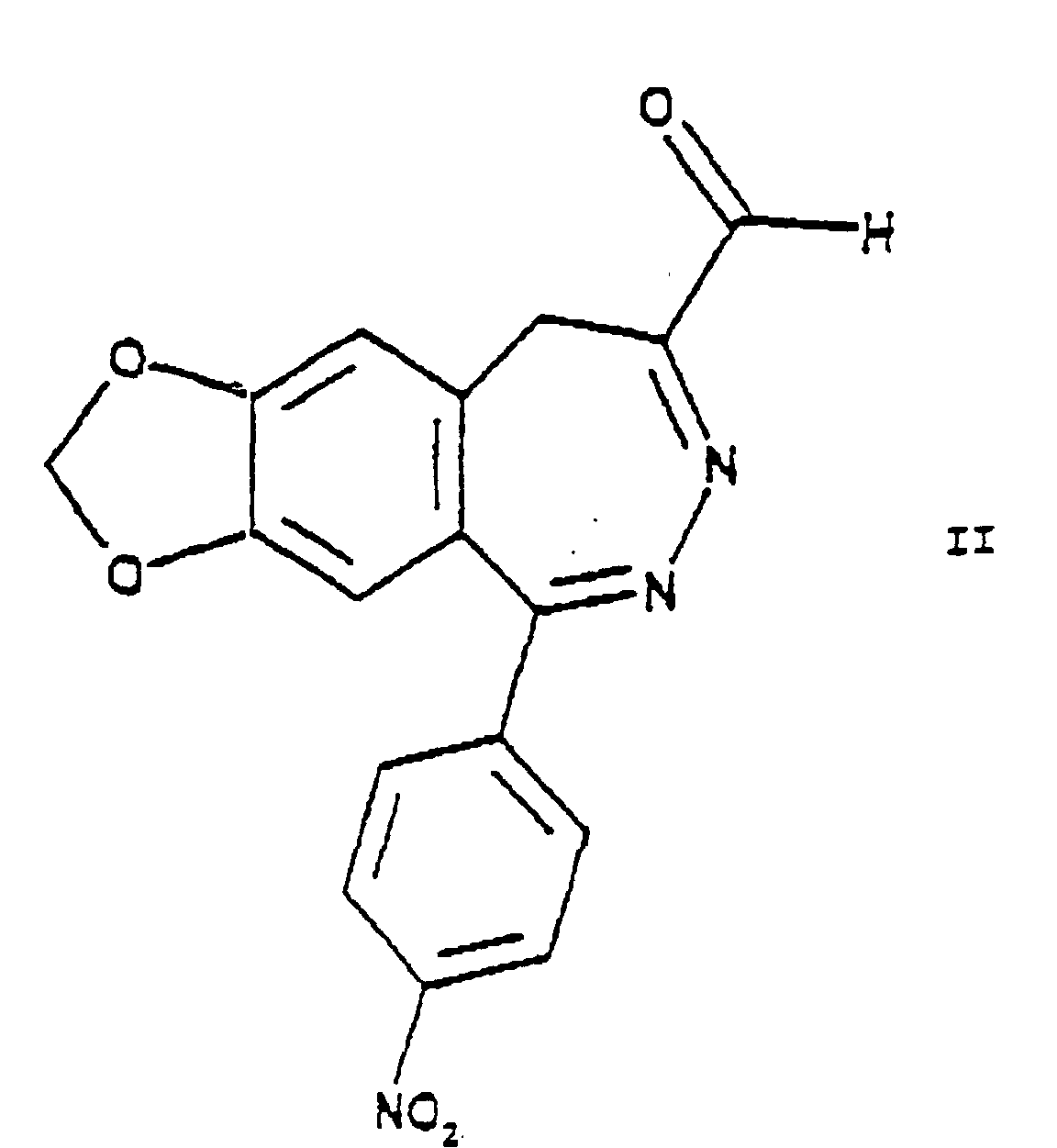 b) zur Herstellung von 5-(4-Nitrophenyl)-9H-1,3-dioxolo/4,5-h//2,3/benzodiazepin-8-carbonsäure der Formel IIIwelche innerhalb des Umfangs der Verbindungen der Formel I liegt, 8-Formyl-5-(4-nitrophenyl)-9H-1,3-dioxolo/4,5-h//2,3/benzodiazepin der Formel II mit einem Oxidationsmittel umgesetzt wird; oder
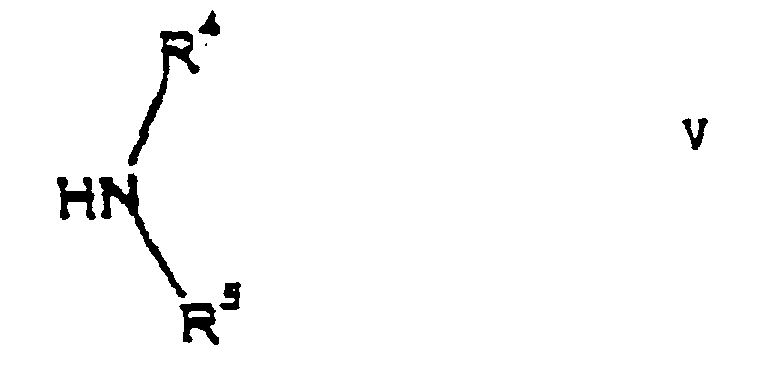
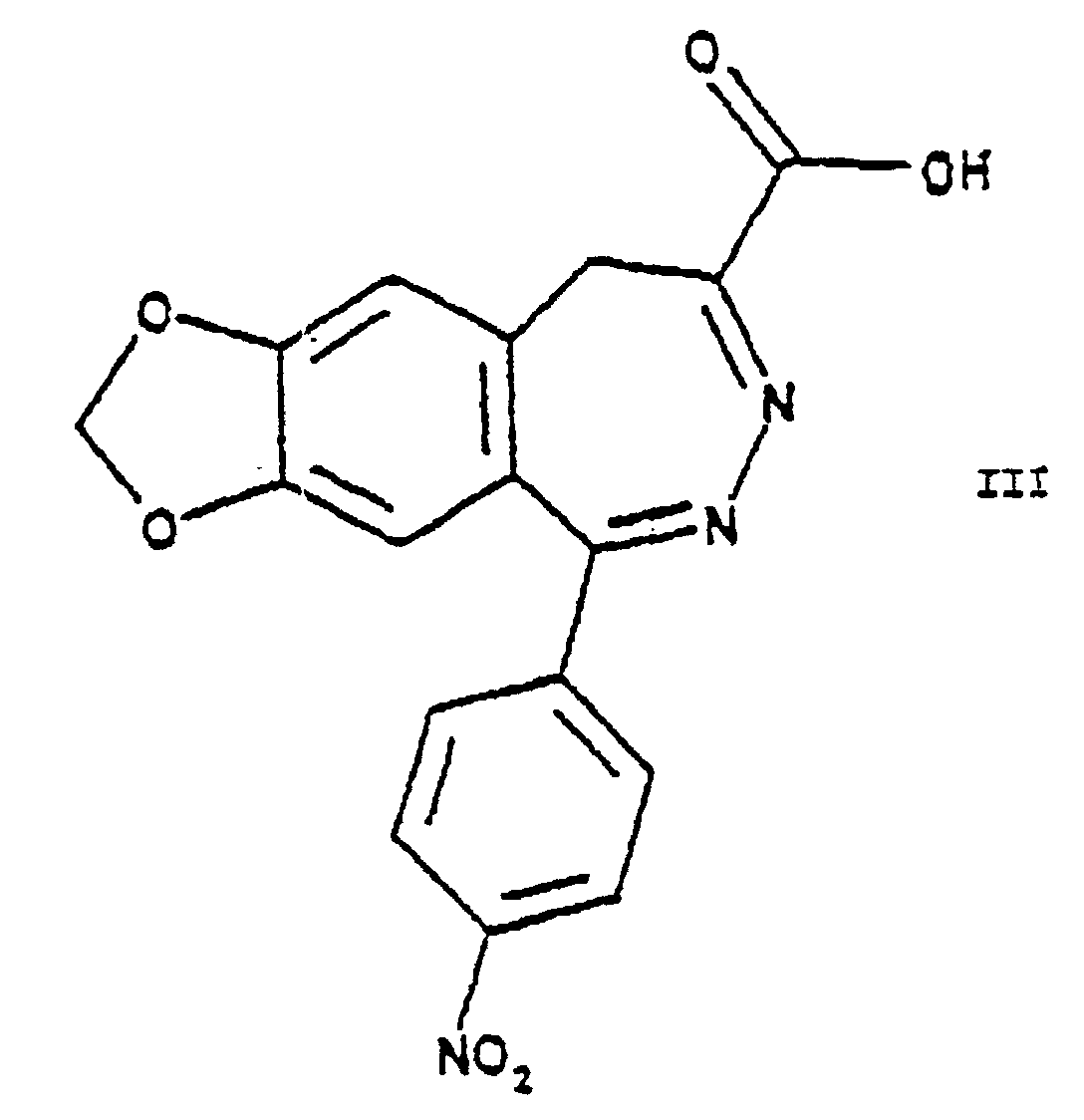 c) zur Herstellung von Verbindungen der Formel 1, worin R1 eine Imidazolylgruppe ist, R2 für eine Nitrogruppe steht, X für eine Carbonylgruppe steht und Y zusammen mit R3 eine Valenzbindung bildet, 5-(4-Nitrophenyl)-9H-1,3-dioxolo/4,5-h//2,3/benzodiazepin-8-carbonsäure der Formel III mit 1,1'-Carbonyldiimidazol umgesetzt wird; oderd) zur Herstellung der Verbindungen der Formel 1, in denen R1 eine Gruppe der Formel -NR4R5 ist, R2 eine Nitrogruppe bedeutet, X für eine Carbonylgruppe steht, Y zusammen mit R3 eine Valenzbindung bildet, R4 und R5 wie in Verbindung mit der Formel I definiert sind, 5-(4-Nitrophenyl)-9H-1,3-dioxolo/4,5-h//2,3/benzodiazepin-8-carbonsäure der Formel III oder ein reaktives Derivat davon der Formel IVworin Y1 eine Abgangsgruppe ist, mit einem Amin der Formel V
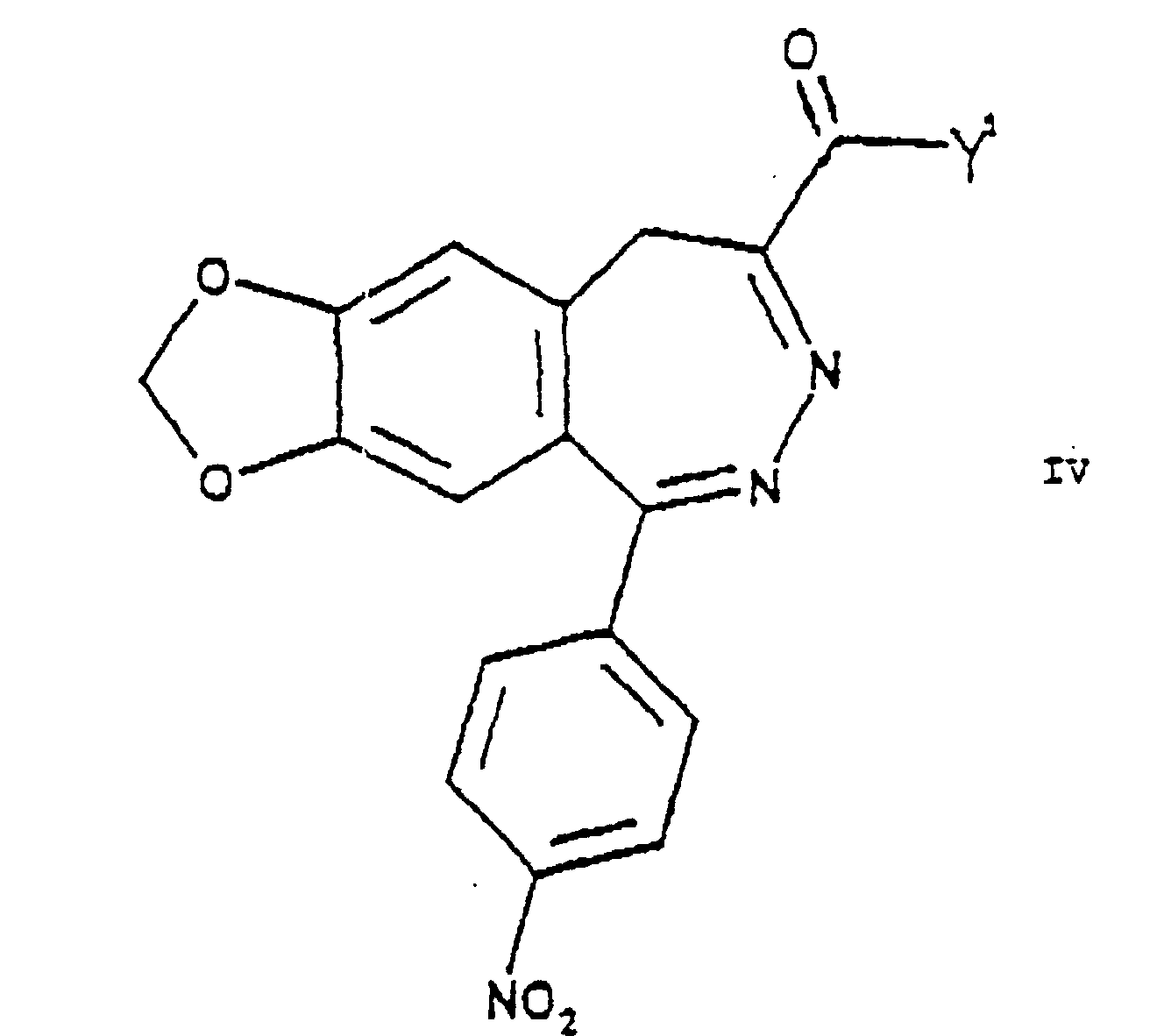 umgesetzt wird, wobei R4 und R5 wie oben angegeben sind; oder
 e) zur Herstellung der Verbindungen der Formel I, in denen R1 eine C1-4-Alkoxygruppe ist, R2 für eine Nitrogruppe steht, X für eine Carbonylgruppe steht, Y zusammen mit R3 eine Valenzbindung bildet, 5-(4-Nitrophenyl)-9H-1,3-dioxolo/4,5-h//2,3/benzodiazepin-8-carbonsäure der Formel III mit einem C1-4-Alkanol verestert wird; oderf) für die Herstellung von Verbindungen der Formel I, worin R1 eine (C1-4-Alkyl)sulfonyloxygruppe ist, R2 eine Nitrogruppe bedeutet, X für eine Methylengruppe steht, Y zusammen mit R3 eine Valenzbindung bildet, 8-Formyl-5-(4-nitrophenyl)-9H-1,3-dioxolo/4,5-h//2,3/benzodiazepin der Formel II mit einem Reduktionsmittel umgesetzt wird, und das erhaltene 8-(Hydroxymethyl)-5-(4-nitrophenyl)-9H-1,3-dioxolo/4,5-h//2,3/benzodiazepin mit einem (C1-4-Alkyl)sulfonylhalogenid umgesetzt wird; oderg) zur Herstellung von Verbindungen der Formel I, worin R1 eine C1-4-Alkoxygruppe, eine C1-4-Alkanoyloxygruppe oder eine Gruppe der Formel -NR4R5 bedeutet, R2 für eine Nitrogruppe steht, Y zusammen mit R3 eine Valenzbindung bildet, R4 und R5 wie in Verbindung mit der Formel I angegeben sind, 8-Formyl-5-(4-nitrophenyl)-9H-1,3-dioxolo/4,5-h//2,3/benzodiazepin der Formel II mit einem Reduktionsmittel umgesetzt wird, und das erhaltene 8-(Hydroxymethyl)-5-(4-nitrophenyl)-9H-1,3-dioxolo/4,5-h//2,3/benzodiazepin oder ein reaktives Alkylierungs-Derivat davon der Formel VIworin Q für eine Abgangsgruppe steht, mit einem C1-4-Alkanol, einer C1-4-Alkancarbonsäure oder einem reaktiven Acylierungs-Derivat davon oder einem Amin der Formel V umgesetzt wird, wobei R4 und R5 wie oben angegeben sind;

oderh) zur Herstellung einer Verbindung der Formel I, worin X zusammen mit R1 eine Gruppe der Formel -CHNOH bildet, R2 für eine Nitrogruppe steht, Y zusammen mit R3 eine Valenzbindung bildet, 8-Formyl-5-(4-nitrophenyl)-9H-1,3-dioxolo/4,5-h//2,3/benzodiazepin der Formel II mit Hydroxylamin umgesetzt wird; oderi) zur Herstellung einer Verbindung der Formel I, worin X zusammen mit R1 eine Cyanogruppe bildet, R2 eine Nitrogruppe bedeutet, Y zusammen mit R3 eine Valenzbindung bildet, 8-(Hydroxyiminomethyl)-5-(4-nitrophenyl)-9H-1,3-dioxolo/4,5-h//2,3/benzodiazepin mit einem Dehydratisierungsmittel umgesetzt wird;
oderj) zur Herstellung einer Verbindung der Formel I, in der X zusammen mit R1 eine Tetrazolylgruppe bildet, R2 für eine Nitrogruppe steht, Y zusammen mit R3eine Valenzbindung bildet, 8-Cyano-5-(4-nitrophenyl)-9H-1,3-dioxolo/4,5-h//2,3/benzodiazepin mit einem Alkalimetallazid umgesetzt wird; oderk) zur Herstellung von 7,8-Dihydroverbindungen der Formel VI, welche eine engere Gruppe der Verbindungen der Formel I ist, worin X für eine Carbonylgruppe oder eine Methylengruppe steht, und R1 wie in Verbindung mit Formel I definiert ist, eine Verbindung der Formel VIIworin X und R wie oben angegeben sind, mit einem Reduktionsmittel umgesetzt wird; oder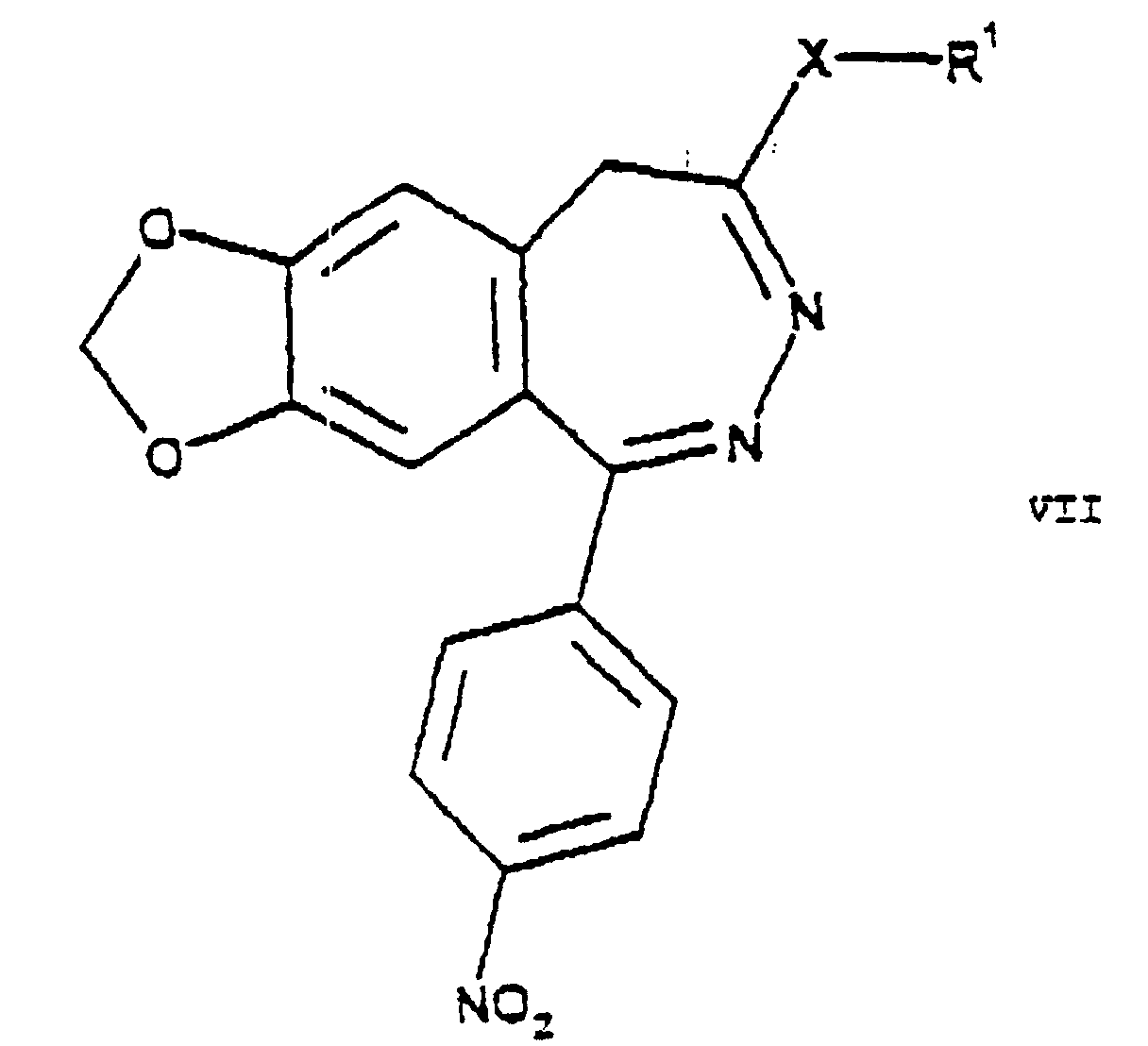 l) zur Herstellung von 7,8-Dihydro-7-acyl-Derivaten der Formel VIIIwelche eine engere Gruppe der Verbindungen der Formel I ist, worin X für eine Carbonylgruppe oder eine Methylengruppe steht, R1 wie in Verbindung mit der Formel I angegeben ist, R3 für eine C1-4Alkanoylgruppe steht, ein 7,8-Dihydro-Derivat der Formel VI, worin X und R1 wie oben definiert sind, mit einer C1-4-Alkancarbonsäure oder einem reaktiven Acylierungs-Derivat davon umgesetzt wird; oder
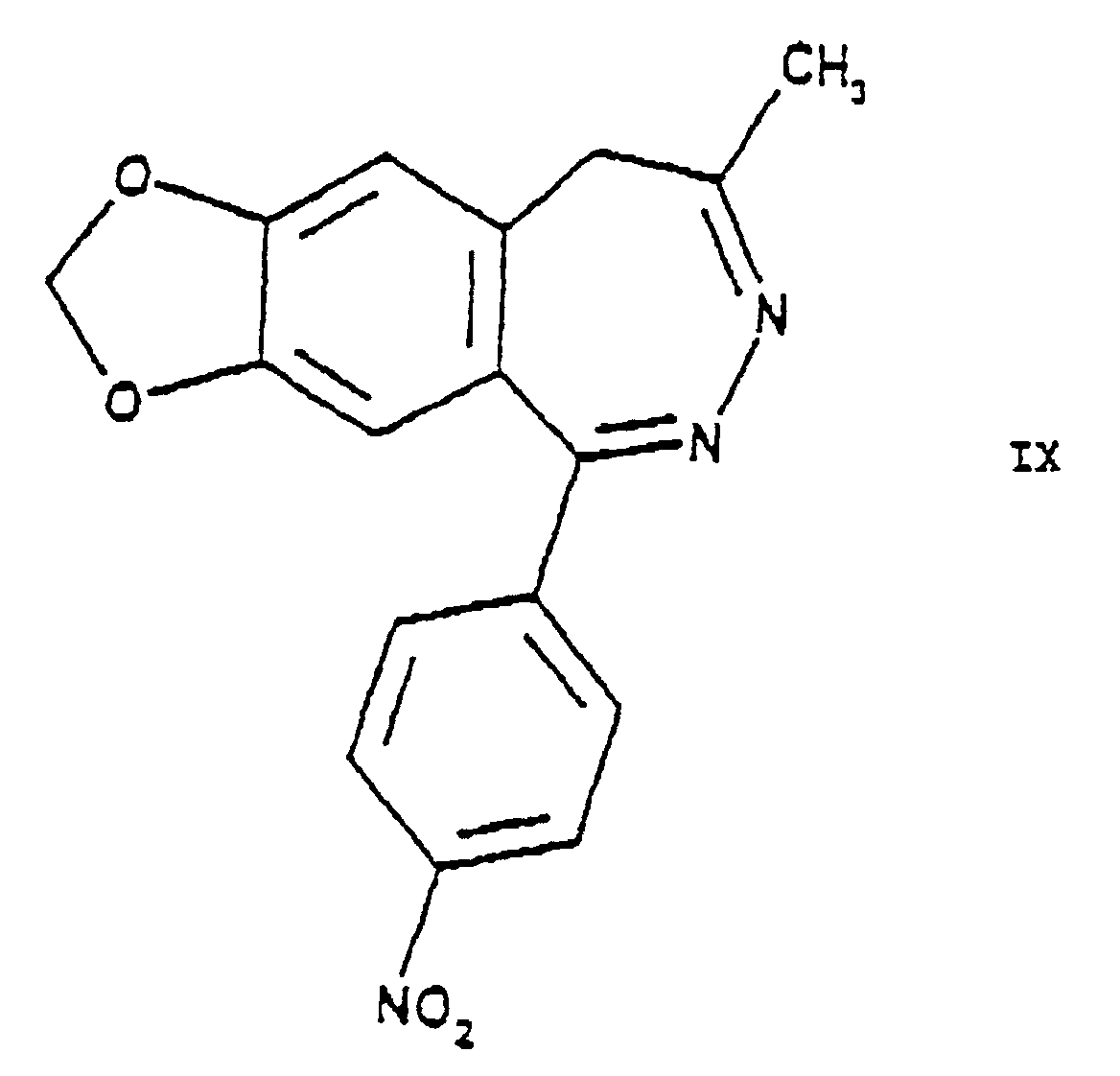
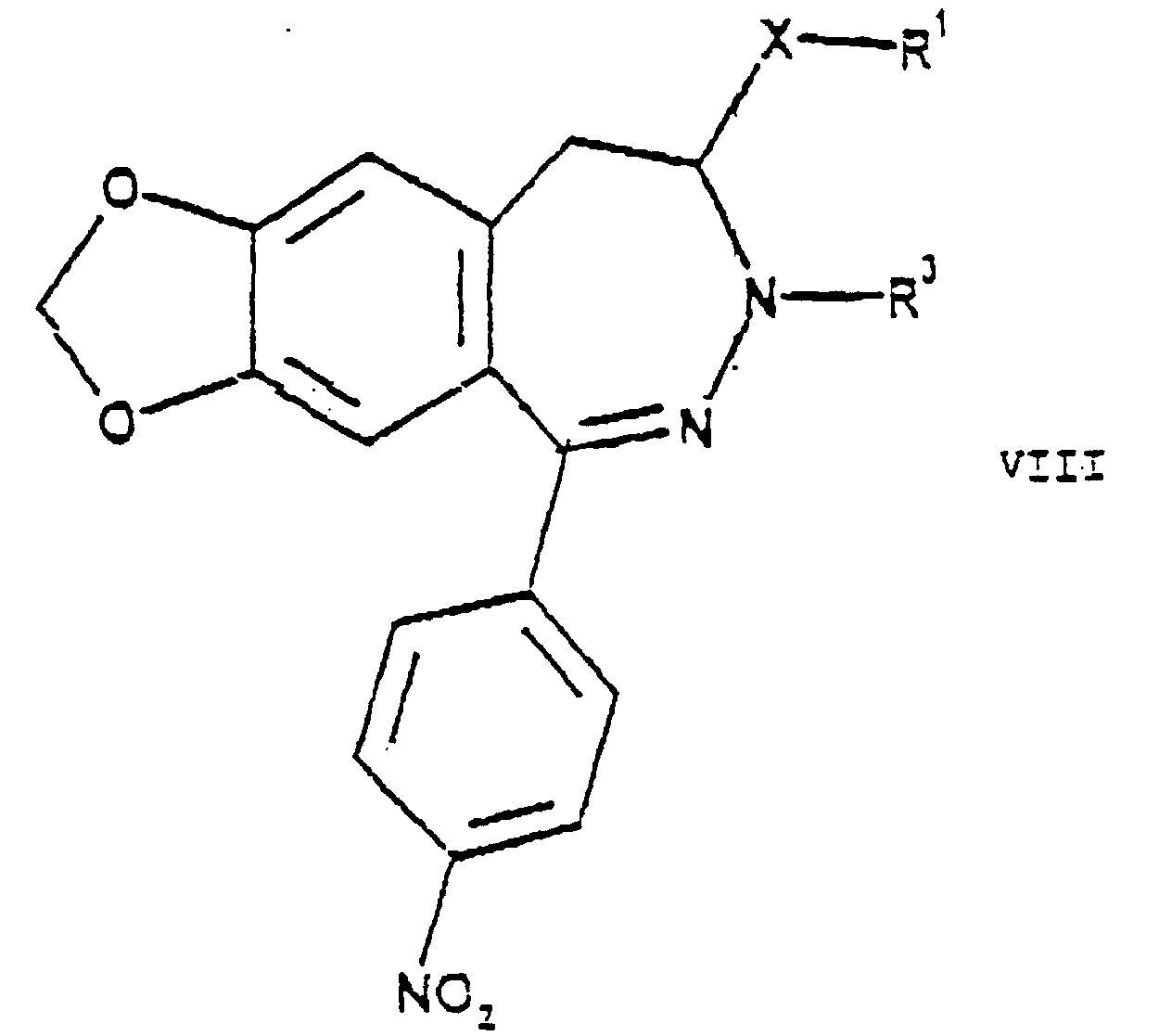 m) zur Herstellung von Verbindungen der Formel I, in denen R1 eine Gruppe der Formel -NR4R5 ist, R2 für eine Nitrogruppe steht, X für eine Carbonylgruppe oder eine Methylengruppe steht, eines von R4 und R5 eine C1-4-Alkanoylgruppe bedeutet, wobei die andere wie in Verbindung mit der Formel I definiert ist, Y für ein Wasserstoffatom steht und in diesem Fall R3 für eine C1-4-Alkanoylgruppe steht, oder Y zusammen mit R3 eine Valenzbindung bildet, eine Verbindung der Formel I, worin R1 eine Gruppe der Formel -NR4R5 ist, worin eines von R4 und R5 ein Wasserstoffatom bedeutet, während das andere wie oben definiert ist, X, R2, Y und R3 wie oben angegeben sind, mit einer C1-4-Alkancarbonsäure oder einem reaktiven Acylierungs-Derivat davon umgesetzt wird;n) zur Herstellung der Verbindungen der Formel I, in denen Y für eine Methylgruppe steht, -X-R1 für eine Cyanogruppe steht, R3 ein Wasserstoffatom ist und R2 eine Nitrogruppe bedeutet, die Verbindung der Formel IXmit Wasserstoffcyanid umgesetzt wird; oder
 o) zur Herstellung der Verbindungen der Formel I, worin Y für eine Methylgruppe steht, R3 für ein Wasserstoffatom steht, R2 für eine Nitrogruppe steht und -X-R1 eine Gruppe der Formel -COR6 bedeutet, worin R6 wie in Verbindung mit der Formel I definiert ist, die Verbindung der Formel Xmit einer Mineralsäure hydrolysiert und die erhaltene Carbonsäure wahlweise zu einem Ester oder einem Carbonsäureamid umgewandelt wird; oder
 p) zur Herstellung von Verbindungen der Formel 1, in denen Y eine Methylgruppe bedeutet, -X-R1 für eine Cyanogruppe oder eine Gruppe der Formel -COR6 steht, R2 eine Nitrogruppe bedeutet, R3 eine C1-4-Alkylgruppe bedeutet, und R6 wie in Verbindung mit der Formel I definiert ist, eine Verbindung der Formel I, in der Y, -X-R1 und R2 wie oben angegeben sind, R3 für ein Wasserstoffatom steht, mit einem (C1-4-Alkyl)halogenid umgesetzt wird; oderr) zur Herstellung von Verbindungen der Formel I, in denen Y für eine Methylgruppe steht, -X-R1 für eine Cyanogruppe oder eine Gruppe der Formel -COR6 steht, R2 eine Nitrogruppe bedeutet, R3 eine Gruppe der Formel -COR7 bedeutet, R7 für eine Gruppe der Formel -(CH2)n-NR8R9 steht, R6, R8, R9 und n wie in Verbindung mit der Formel I definiert sind, eine Verbindung der Formel XI

und, sofern erwünscht, wird eine erhaltene Verbindung der Formel I, worin R2 eine Nitrogruppe bedeutet, R1, R3, X und Y wie in Verbindung mit der Formel I definiert sind, zu einer Verbindung der Formel I durch Reduktion umgewandelt wird, worin R2 für eine Aminogruppe steht;
und, sofern erwünscht, eine erhaltene Verbindung der Formel I, worin R2 für eine Aminogruppe steht, R1, R3, X und Y wie in Verbindung mit der Formel I angegeben sind, mit einer C1-4-Alkancarbonsäure oder einem reaktiven Acylierungs-Derivat davon umgesetzt wird;
und, sofern erwünscht, eine erhaltene Base der Formel I zu einem pharmazeutisch geeigneten Säure-Additionssalz umgewandelt und aus dem Säure-Additionssalz freigesetzt wird;
und, sofern erwünscht, eine erhaltene Verbindung der Formel I oder ein pharmazeutisch geeignetes Säure-Additionssalz davon zu einem quaternären Ammonium-Derivat umgewandelt wird. - Pharmazeutische Zusammensetzung, umfassend 8-substituiertes 9H-1,3-Dioxolo/4,5-h//2,3/benzodiazepin-Derivat der Formel Iworin
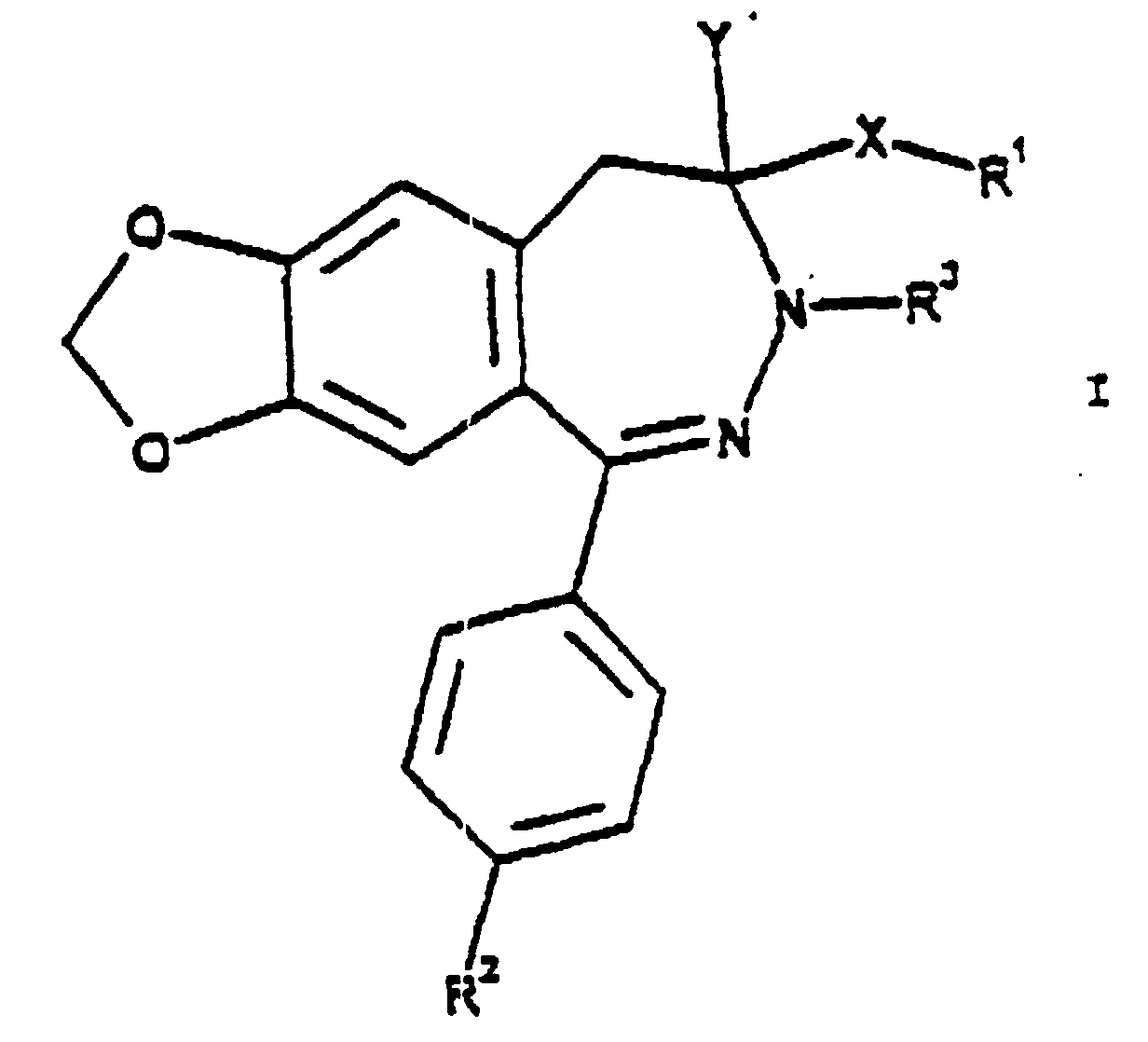
X, Y, R1, R2 und R3 wie in Anspruch 1 definiert sind,
oder ein pharmazeutisch geeignetes Säure-Additionssalz oder ein quaternäres Ammonium-Derivat davon als Wirkbestandteil und einen oder mehrere herkömmliche Träger. - Pharmazeutische Zusammensetzung gemäß Anspruch 8, umfassend 8-substituiertes 9H-1,3-Dioxolo/4,5-h//2,3/benzodiazepin-Derivat der Formel I, worin X, R1, R2, R3 und Y wie in Anspruch 2 definiert sind,
oder ein pharmazeutisch geeignetes Säure-Additionssalz oder ein quaternäres Ammonium-Derivat davon als Wirkbestandteil. - Pharmazeutische Zusammensetzung gemäß Anspruch 8 oder 9, umfassend eine der folgenden Verbindungen:oder ein pharmazeutisch geeignetes Säure-Additionssalz oder ein quaternäres Ammonium-Derivat davon als Wirkbestandteil.5-(4-Aminophenyl)-9H-1,3-dioxolo/4,5-h//2,3/benzodiazepin-8-carbonsäureamid;5-(4-Aminophenyl)-8-cyano-9H-1,3-dioxolo/4,5-h//2,3/benzodiazepin;5-(4-Aminophenyl)-8-(5-tetrazolyl)-9H-1,3-dioxolo/4,5-h//2,3/benzodiazepin;
- Pharmazeutische Zusammensetzung gemäß Anspruch 8, umfassend ein 8-substituiertes 9H-1,3-Dioxolo/4,5-h//2,3/benzodiazepin-Derivat der Formel I, worin X, Y, R1, R2 und R3 in Anspruch 4 definiert sind,
oder ein pharmazeutisch geeignetes Säure-Additionssalz davon als Wirkbestandteil. - Pharmazeutische Zusammensetzung gemäß Anspruch 11, umfassend ein 8-substituiertes 9H-1,3-Dioxolo/4,5-h//2,3/benzodiazepin-Derivat der Formel I, worin X, Y, R1, R2 und R3 in Anspruch 5 definiert sind,
oder ein pharmazeutisch geeignetes Säure-Additionssalz davon als Wirkbestandteil. - Verfahren zur Herstellung von Medikamenten speziell zur Behandlung der Epilepsie oder einer neurodegenerativen Erkrankung oder Zuständen nach einem Schlaganfall, enthaltend eine nichttoxische Dosis eines 8-substituierten 9H-1,3-Dioxolo/4,5-h//2,3/benzodiazepin-Derivats der Formel I, wie in Anspruch 1 definiert,
oder ein pharmazeutisch geeignetes Säure-Additionssalz oder ein quaternäres Ammonium-Derivat davon. - Verfahren zur Herstellung einer pharmazeutischen Zusammensetzung, welche zur Behandlung insbesondere von Epilepsie oder einer neurodegenerativen Erkrankung oder einem Zustand nach einem Schlaganfall geeignet ist, dadurch gekennzeichnet, dass ein 8-substituiertes 9H-1,3-Dioxolo/4,5-h//2,3/benzodiazepin-Derivat der Formel I, wie es in Anspruch 1 definiert ist,
oder ein pharmazeutisch geeignetes Säure-Additionssalz oder ein quatemäres Ammonium-Derivat davon, zu einer pharmazeutischen Zusammensetzung unter Verwendung von einem oder mehreren bei der Herstellung von Arzneimitteln gängigerweise angewendeten Trägern umgewandelt wird.
Applications Claiming Priority (5)
| Application Number | Priority Date | Filing Date | Title |
|---|---|---|---|
| HU9701380 | 1997-08-12 | ||
| HU9701380A HUP9701380A3 (en) | 1997-08-12 | 1997-08-12 | New 8-substituted-9h-1,3-dioxolo-[4,5-h][2,3]-benzodiazepine derivatives, pharmaceutical compositions containing them as active component, and process for producing them |
| HU9701381 | 1997-08-12 | ||
| HU9701381A HUP9701381A3 (en) | 1997-08-12 | 1997-08-12 | New 7,8-dihydro-8,8-disubstituted-9h-1,3-dioxolo-[4,5-h][2,3]-benzodiazepine derivatives, pharmaceutical compositions containing them as active component, and process for producing them |
| PCT/HU1998/000075 WO1999007707A1 (en) | 1997-08-12 | 1998-08-07 | 8-SUBSTITUTED-9H-1,3-DIOXOLO/4,5-h//2,3/BENZODIAZEPINE DERIVATIVES, AS AMPA/KAINATE RECEPTOR INHIBITORS |
Publications (2)
| Publication Number | Publication Date |
|---|---|
| EP1003749A1 EP1003749A1 (de) | 2000-05-31 |
| EP1003749B1 true EP1003749B1 (de) | 2003-10-22 |
Family
ID=89995497
Family Applications (1)
| Application Number | Title | Priority Date | Filing Date |
|---|---|---|---|
| EP98939781A Expired - Lifetime EP1003749B1 (de) | 1997-08-12 | 1998-08-07 | 8-substituierte-9h-1,3-dioxolo/4,5-h//2,3/benzodiazepin derivate als ampa/kainate-rezeptor-hemmer |
Country Status (18)
| Country | Link |
|---|---|
| US (1) | US6562810B1 (de) |
| EP (1) | EP1003749B1 (de) |
| JP (1) | JP2001512730A (de) |
| KR (1) | KR20010022862A (de) |
| CN (1) | CN1109033C (de) |
| AT (1) | ATE252586T1 (de) |
| AU (1) | AU735490B2 (de) |
| BR (1) | BR9812120A (de) |
| CA (1) | CA2300302A1 (de) |
| DE (1) | DE69819166T2 (de) |
| DK (1) | DK1003749T3 (de) |
| NO (1) | NO20000655L (de) |
| NZ (1) | NZ503300A (de) |
| PL (1) | PL338680A1 (de) |
| RU (1) | RU2208013C2 (de) |
| SK (1) | SK1772000A3 (de) |
| UA (1) | UA67749C2 (de) |
| WO (1) | WO1999007707A1 (de) |
Families Citing this family (11)
| Publication number | Priority date | Publication date | Assignee | Title |
|---|---|---|---|---|
| HUP9900354A3 (en) * | 1999-02-15 | 2001-02-28 | Egyt Gyogyszervegyeszeti Gyar | Use of condensed 2,3-benzodiazepine derivatives for the preparation of pharmaceutical compositions treating and preventing diseases related with the inhibition of lipide peroxidation |
| HU227128B1 (en) * | 1999-07-07 | 2010-07-28 | Egyt Gyogyszervegyeszeti Gyar | New 2,3-benzodiazepine derivatives |
| US6858605B2 (en) | 2003-02-04 | 2005-02-22 | Ivax Drug Research Institute, Ltd. | Substituted 2,3-benzodiazepine derivatives |
| CN100558834C (zh) * | 2006-07-21 | 2009-11-11 | 华南理工大学 | 一种环保型干粉涂料及其制备方法 |
| FR2972454B1 (fr) * | 2011-03-08 | 2013-03-01 | Servier Lab | Nouveaux derives dihydro-oxazolobenzodiazepinones, leur procede de preparation et les compositions pharmaceutiques qui les contiennent |
| HU230684B1 (hu) * | 2014-01-21 | 2017-08-28 | Egis Gyogyszergyar Nyilvanosan Muekoedoe Reszvenytarsasag | Új dihidro-oxazino-benzodiazepin vegyületek és eljárás ezek elõállítására, illetve az ezeket tartalmazó gyógyászati készítmények |
| CN104391999B (zh) * | 2014-12-15 | 2018-02-02 | 北京国双科技有限公司 | 信息推荐方法和装置 |
| PL3321252T3 (pl) * | 2015-07-06 | 2021-04-06 | Public University Corporation Yokohama City University | Nowy związek, który specyficznie wiąże się z receptorem AMPA |
| RU2634594C1 (ru) * | 2016-11-30 | 2017-11-01 | федеральное государственное автономное образовательное учреждение высшего образования "Казанский (Приволжский) федеральный университет" (ФГАОУ ВО КФУ) | Ингибиторы образования конечных продуктов гликирования на основе азопроизводных фенилсульфокислот |
| JPWO2023042888A1 (de) | 2021-09-15 | 2023-03-23 | ||
| JPWO2023042887A1 (de) | 2021-09-15 | 2023-03-23 |
Family Cites Families (10)
| Publication number | Priority date | Publication date | Assignee | Title |
|---|---|---|---|---|
| HU191702B (en) | 1984-06-27 | 1987-03-30 | Gyogyszerkutato Intezet | New process for preparing 1-aryl-5 h-2,3-benzodiazepines |
| HU191698B (en) | 1984-07-27 | 1987-03-30 | Gyogyszerkutato Intezet | Process for producing new 1-aryl-5h-2beta-benzodiazepines |
| HU198494B (en) | 1986-08-15 | 1989-10-30 | Gyogyszerkutato Intezet | Process for producing new 3,4-dihydro-5h-2,3-benzodiazepine derivative and acid addition salts thereof, as well as pharmaceutical compositions comprising same |
| HU219778B (hu) * | 1990-12-21 | 2001-07-30 | Gyógyszerkutató Intézet Közös Vállalat | Eljárás N-acil-2,3-benzodiazepin-származékok, savaddíciós sóik és az ezeket tartalmazó gyógyászati készítmények előállítására, valamint a vegyületek egy csoportja, és az ezeket tartalmazó gyógyászati készítmények |
| HU206719B (en) | 1990-12-21 | 1992-12-28 | Gyogyszerkutato Intezet | Process for producing 1-/4-acylamino-phenyl/-7,8-methylenedioxy-5h-2,3-benzodiazepine derivatives, acid addicional salts and pharmaceutical compositions containing them |
| HU219777B (hu) | 1993-07-02 | 2001-07-30 | Gyógyszerkutató Intézet Kft. | Optikailag aktív 1-(4-nitro-fenil)-4-metil-7,8-metiléndioxi-3,4-dihidro-5H-2,3-benzodiazepin és eljárás előállítására |
| DE4428835A1 (de) | 1994-08-01 | 1996-02-08 | Schering Ag | Neue 3-substituierte 3H-2,3-Benzodiazepinderivate, deren Herstellung und Verwendung als Arzneimittel |
| TR199501071A2 (tr) | 1994-08-31 | 1996-06-21 | Lilly Co Eli | Dihidro-2,3-benzodiazepin türevlerinin üretilmesi icin stereoselektif islem. |
| TR199501070A2 (tr) | 1994-08-31 | 1996-06-21 | Lilly Co Eli | Dihidro-2,3-benzodiazepin türevinin kristalli bicimi. |
| DE19604919A1 (de) * | 1996-02-01 | 1997-08-07 | Schering Ag | Neue 2,3-Benzodiazepinderivate, deren Herstellung und Verwendung als Arzneimittel |
-
1998
- 1998-07-08 UA UA2000031380A patent/UA67749C2/uk unknown
- 1998-08-07 RU RU2000106060/04A patent/RU2208013C2/ru not_active IP Right Cessation
- 1998-08-07 DE DE69819166T patent/DE69819166T2/de not_active Expired - Fee Related
- 1998-08-07 EP EP98939781A patent/EP1003749B1/de not_active Expired - Lifetime
- 1998-08-07 CN CN98809765A patent/CN1109033C/zh not_active Expired - Fee Related
- 1998-08-07 NZ NZ503300A patent/NZ503300A/en unknown
- 1998-08-07 AT AT98939781T patent/ATE252586T1/de not_active IP Right Cessation
- 1998-08-07 US US09/485,391 patent/US6562810B1/en not_active Expired - Fee Related
- 1998-08-07 AU AU88181/98A patent/AU735490B2/en not_active Ceased
- 1998-08-07 DK DK98939781T patent/DK1003749T3/da active
- 1998-08-07 JP JP2000506210A patent/JP2001512730A/ja active Pending
- 1998-08-07 KR KR1020007001464A patent/KR20010022862A/ko not_active Ceased
- 1998-08-07 SK SK177-2000A patent/SK1772000A3/sk unknown
- 1998-08-07 PL PL98338680A patent/PL338680A1/xx unknown
- 1998-08-07 BR BR9812120-0A patent/BR9812120A/pt not_active IP Right Cessation
- 1998-08-07 CA CA002300302A patent/CA2300302A1/en not_active Abandoned
- 1998-08-07 WO PCT/HU1998/000075 patent/WO1999007707A1/en not_active Ceased
-
2000
- 2000-02-09 NO NO20000655A patent/NO20000655L/no not_active Application Discontinuation
Also Published As
| Publication number | Publication date |
|---|---|
| KR20010022862A (ko) | 2001-03-26 |
| DK1003749T3 (da) | 2004-03-08 |
| NO20000655D0 (no) | 2000-02-09 |
| DE69819166T2 (de) | 2004-07-22 |
| DE69819166D1 (de) | 2003-11-27 |
| CN1109033C (zh) | 2003-05-21 |
| PL338680A1 (en) | 2000-11-20 |
| ATE252586T1 (de) | 2003-11-15 |
| NZ503300A (en) | 2001-06-29 |
| BR9812120A (pt) | 2001-11-20 |
| CN1272846A (zh) | 2000-11-08 |
| WO1999007707A1 (en) | 1999-02-18 |
| JP2001512730A (ja) | 2001-08-28 |
| CA2300302A1 (en) | 1999-02-18 |
| UA67749C2 (uk) | 2004-07-15 |
| US6562810B1 (en) | 2003-05-13 |
| AU735490B2 (en) | 2001-07-12 |
| SK1772000A3 (en) | 2000-10-09 |
| EP1003749A1 (de) | 2000-05-31 |
| NO20000655L (no) | 2000-04-10 |
| RU2208013C2 (ru) | 2003-07-10 |
| AU8818198A (en) | 1999-03-01 |
Similar Documents
| Publication | Publication Date | Title |
|---|---|---|
| EP0492485B1 (de) | N-Acyl-2,3-benzodiazepin-Derivate, diese enthaltende pharmazeutische Zusammensetzungen und Verfahren zu ihrer Herstellung | |
| US5519019A (en) | N-acyl-2,3-benzoidazepine derivatives, pharmaceutical compositions containing them and process for preparing same | |
| NO310512B1 (no) | 5H-Tiazolo [3,2-a] pyrimidinderivater | |
| US6562810B1 (en) | 8-substituted-9H-1,3-dioxolo/4,5-h//2,3/benzodiazepine derivatives, as AMPA/kainate receptor inhibitors | |
| US20040157857A1 (en) | Substituted chroman derivatives | |
| US5639751A (en) | N-acyl-2,3-benzodiazepine derivatives for treating acute and chronic neurodegenerative disorders | |
| US5521174A (en) | N-acyl-2,3-benzodiazepine derivatives and a method of treating spasms of the skeletal musculature therewith | |
| EP1015457B1 (de) | 1-3 dioxolo/4.5-h//2,3-benzodiazepin derivate als ampa/kainate-rezeptor-hemmer | |
| RU2243228C2 (ru) | Новые производные 2,3-бензодиазепина, способы их получения, фармацевтическая композиция на их основе и способ лечения | |
| US5157038A (en) | 2-oxo-1-oxa-8 azaspiro[4,5]decane derivatives, pharmaceutical compositions containing them and process for preparing same | |
| MXPA00001486A (en) | 8-SUBSTITUTED-9H-1,3-DIOXOLO/4,5-h//2,3/BENZODIAZEPINE DERIVATIVES, AS AMPA/KAINATE RECEPTOR INHIBITORS | |
| CZ2000434A3 (cs) | Deriváty 8-substituovaného-9H-l,3-dioxoIo-(4,5- h)(2,3)benzodiazepinu jako inhibitory receptorů AMPA/kainatu | |
| MXPA00001487A (en) | 1,3-dioxolo/4,5-h//2,3/benzodiazepine derivatives as ampa/kainate receptor inhibitors | |
| CZ2000433A3 (cs) | Deriváty 1,3-dioxolo(4,5-H)(2,3)benzodiazepinu, farmaceutické kompozice je obsahující a způsob přípravy účinné složky | |
| AU2004261491B2 (en) | 8-chloro-2,3-benzodiazepine derivatives | |
| CN101153043B (zh) | 四环化合物、其制备方法以及其药物组合物 |
Legal Events
| Date | Code | Title | Description |
|---|---|---|---|
| PUAI | Public reference made under article 153(3) epc to a published international application that has entered the european phase |
Free format text: ORIGINAL CODE: 0009012 |
|
| 17P | Request for examination filed |
Effective date: 20000306 |
|
| AK | Designated contracting states |
Kind code of ref document: A1 Designated state(s): AT BE CH DE DK ES FR GB GR LI NL PT SE |
|
| AX | Request for extension of the european patent |
Free format text: LT PAYMENT 20000306;LV PAYMENT 20000306;RO PAYMENT 20000306;SI PAYMENT 20000306 |
|
| RBV | Designated contracting states (corrected) |
Designated state(s): AT BE CH DE DK ES FR GB GR LI NL PT SE |
|
| 17Q | First examination report despatched |
Effective date: 20020314 |
|
| GRAH | Despatch of communication of intention to grant a patent |
Free format text: ORIGINAL CODE: EPIDOS IGRA |
|
| GRAS | Grant fee paid |
Free format text: ORIGINAL CODE: EPIDOSNIGR3 |
|
| GRAA | (expected) grant |
Free format text: ORIGINAL CODE: 0009210 |
|
| AK | Designated contracting states |
Kind code of ref document: B1 Designated state(s): AT BE CH DE DK ES FR GB GR LI NL PT SE |
|
| AX | Request for extension of the european patent |
Extension state: LT LV RO SI |
|
| PG25 | Lapsed in a contracting state [announced via postgrant information from national office to epo] |
Ref country code: LI Free format text: LAPSE BECAUSE OF FAILURE TO SUBMIT A TRANSLATION OF THE DESCRIPTION OR TO PAY THE FEE WITHIN THE PRESCRIBED TIME-LIMIT Effective date: 20031022 Ref country code: CH Free format text: LAPSE BECAUSE OF FAILURE TO SUBMIT A TRANSLATION OF THE DESCRIPTION OR TO PAY THE FEE WITHIN THE PRESCRIBED TIME-LIMIT Effective date: 20031022 |
|
| REG | Reference to a national code |
Ref country code: GB Ref legal event code: FG4D |
|
| REG | Reference to a national code |
Ref country code: CH Ref legal event code: EP |
|
| REF | Corresponds to: |
Ref document number: 69819166 Country of ref document: DE Date of ref document: 20031127 Kind code of ref document: P |
|
| PG25 | Lapsed in a contracting state [announced via postgrant information from national office to epo] |
Ref country code: GR Free format text: LAPSE BECAUSE OF FAILURE TO SUBMIT A TRANSLATION OF THE DESCRIPTION OR TO PAY THE FEE WITHIN THE PRESCRIBED TIME-LIMIT Effective date: 20040122 |
|
| PG25 | Lapsed in a contracting state [announced via postgrant information from national office to epo] |
Ref country code: ES Free format text: LAPSE BECAUSE OF FAILURE TO SUBMIT A TRANSLATION OF THE DESCRIPTION OR TO PAY THE FEE WITHIN THE PRESCRIBED TIME-LIMIT Effective date: 20040202 |
|
| REG | Reference to a national code |
Ref country code: SE Ref legal event code: TRGR |
|
| PGFP | Annual fee paid to national office [announced via postgrant information from national office to epo] |
Ref country code: SE Payment date: 20040216 Year of fee payment: 7 |
|
| REG | Reference to a national code |
Ref country code: DK Ref legal event code: T3 |
|
| LTIE | Lt: invalidation of european patent or patent extension |
Effective date: 20031022 |
|
| REG | Reference to a national code |
Ref country code: CH Ref legal event code: PL |
|
| ET | Fr: translation filed | ||
| PGFP | Annual fee paid to national office [announced via postgrant information from national office to epo] |
Ref country code: GB Payment date: 20040723 Year of fee payment: 7 |
|
| PG25 | Lapsed in a contracting state [announced via postgrant information from national office to epo] |
Ref country code: AT Free format text: LAPSE BECAUSE OF NON-PAYMENT OF DUE FEES Effective date: 20040807 |
|
| PLBE | No opposition filed within time limit |
Free format text: ORIGINAL CODE: 0009261 |
|
| STAA | Information on the status of an ep patent application or granted ep patent |
Free format text: STATUS: NO OPPOSITION FILED WITHIN TIME LIMIT |
|
| PG25 | Lapsed in a contracting state [announced via postgrant information from national office to epo] |
Ref country code: DK Free format text: LAPSE BECAUSE OF NON-PAYMENT OF DUE FEES Effective date: 20040831 Ref country code: BE Free format text: LAPSE BECAUSE OF NON-PAYMENT OF DUE FEES Effective date: 20040831 |
|
| 26N | No opposition filed |
Effective date: 20040723 |
|
| BERE | Be: lapsed |
Owner name: *EGIS GYOGYSZERGYAR RT. Effective date: 20040831 |
|
| PG25 | Lapsed in a contracting state [announced via postgrant information from national office to epo] |
Ref country code: NL Free format text: LAPSE BECAUSE OF NON-PAYMENT OF DUE FEES Effective date: 20050301 Ref country code: DE Free format text: LAPSE BECAUSE OF NON-PAYMENT OF DUE FEES Effective date: 20050301 |
|
| PG25 | Lapsed in a contracting state [announced via postgrant information from national office to epo] |
Ref country code: FR Free format text: LAPSE BECAUSE OF NON-PAYMENT OF DUE FEES Effective date: 20050429 |
|
| NLV4 | Nl: lapsed or anulled due to non-payment of the annual fee |
Effective date: 20050301 |
|
| REG | Reference to a national code |
Ref country code: FR Ref legal event code: ST |
|
| REG | Reference to a national code |
Ref country code: DK Ref legal event code: EBP |
|
| PG25 | Lapsed in a contracting state [announced via postgrant information from national office to epo] |
Ref country code: GB Free format text: LAPSE BECAUSE OF NON-PAYMENT OF DUE FEES Effective date: 20050807 |
|
| PG25 | Lapsed in a contracting state [announced via postgrant information from national office to epo] |
Ref country code: SE Free format text: LAPSE BECAUSE OF NON-PAYMENT OF DUE FEES Effective date: 20050808 |
|
| EUG | Se: european patent has lapsed | ||
| GBPC | Gb: european patent ceased through non-payment of renewal fee |
Effective date: 20050807 |
|
| BERE | Be: lapsed |
Owner name: *EGIS GYOGYSZERGYAR RT. Effective date: 20040831 |
|
| PG25 | Lapsed in a contracting state [announced via postgrant information from national office to epo] |
Ref country code: PT Free format text: LAPSE BECAUSE OF NON-PAYMENT OF DUE FEES Effective date: 20040322 |