EP1003837B1 - Composition pour la conservation de quantites determinees et reproductibles de micro-organismes, et procede d'obtention - Google Patents
Composition pour la conservation de quantites determinees et reproductibles de micro-organismes, et procede d'obtention Download PDFInfo
- Publication number
- EP1003837B1 EP1003837B1 EP98933707A EP98933707A EP1003837B1 EP 1003837 B1 EP1003837 B1 EP 1003837B1 EP 98933707 A EP98933707 A EP 98933707A EP 98933707 A EP98933707 A EP 98933707A EP 1003837 B1 EP1003837 B1 EP 1003837B1
- Authority
- EP
- European Patent Office
- Prior art keywords
- pellets
- microorganisms
- composition
- albumin
- drying
- Prior art date
- Legal status (The legal status is an assumption and is not a legal conclusion. Google has not performed a legal analysis and makes no representation as to the accuracy of the status listed.)
- Expired - Lifetime
Links
Images





Classifications
-
- C—CHEMISTRY; METALLURGY
- C12—BIOCHEMISTRY; BEER; SPIRITS; WINE; VINEGAR; MICROBIOLOGY; ENZYMOLOGY; MUTATION OR GENETIC ENGINEERING
- C12N—MICROORGANISMS OR ENZYMES; COMPOSITIONS THEREOF; PROPAGATING, PRESERVING, OR MAINTAINING MICROORGANISMS; MUTATION OR GENETIC ENGINEERING; CULTURE MEDIA
- C12N1/00—Microorganisms; Compositions thereof; Processes of propagating, maintaining or preserving microorganisms or compositions thereof; Processes of preparing or isolating a composition containing a microorganism; Culture media therefor
- C12N1/04—Preserving or maintaining viable microorganisms
-
- Y—GENERAL TAGGING OF NEW TECHNOLOGICAL DEVELOPMENTS; GENERAL TAGGING OF CROSS-SECTIONAL TECHNOLOGIES SPANNING OVER SEVERAL SECTIONS OF THE IPC; TECHNICAL SUBJECTS COVERED BY FORMER USPC CROSS-REFERENCE ART COLLECTIONS [XRACs] AND DIGESTS
- Y10—TECHNICAL SUBJECTS COVERED BY FORMER USPC
- Y10S—TECHNICAL SUBJECTS COVERED BY FORMER USPC CROSS-REFERENCE ART COLLECTIONS [XRACs] AND DIGESTS
- Y10S435/00—Chemistry: molecular biology and microbiology
- Y10S435/8215—Microorganisms
- Y10S435/822—Microorganisms using bacteria or actinomycetales
Definitions
- the present request relates to a composition for the conservation of specific and reproducible quantities of microorganisms.
- control laboratories In order to guarantee the reliability of the measurements, the following questions were asked: control laboratories to be accredited. Initially, this accreditation only defined obligations of means (qualified personnel, suitable premises, maintenance of measurement, control of raw materials and writing of procedures Analytical). Currently, it requires in addition to obligations of results. This new requirement imposes the establishment of a system quality including internal controls and participation in inter-laboratory tests.
- reference materials For the internal control of analytical chains and the organization of inter-laboratory tests, it is imperative to have reference materials. These reference materials must be stable over time and must allow easy reconstitution of homogeneous control samples containing a precise quantity of the product to be dosed.
- microorganisms In chemistry, these reference materials have existed for many years. However, in the field of microbiology, it is particularly difficult to keep precise amounts of microorganisms. Indeed, the number of microorganisms can increase, if the conservation medium allows their multiplication at during manufacture, transport or storage, or decrease, if die during manufacture, transport, storage or at the time of reconstitution of the control sample before use.
- US Patent 5,364,756 describes a method of cryopreservation eukaryotic cells. A suspension of these cells is prepared in a buffer comprising cryoprotective agents, then the solution is nebulized by ultrasound to form microdroplets which are quickly cooled and dried.
- US Patent 5,405,616 relates to the conservation of molecules pharmacologically active.
- the particles comprising these molecules consist mainly of a soluble hydrophilic macromolecule in the water forming a skeleton.
- Various proteins are mentioned, mainly proteins of vegetable origin.
- Applicant solved this problem by finding a composition particular to maintain the viability of microorganisms.
- the present invention therefore relates to a composition for the conservation in specified and reproducible quantities of microorganisms comprising in combination effective amounts of at least minus a substance capable of forming the skeleton of lozenges lenticulates and at least one saturating substance as well as microorganisms.
- reproducible quantities are understood to mean of microorganisms variations in the ratio between two measurements in 95% of cases, between 0.25 and 4 and even more preferably between 0.5 and 2.
- Said composition comprises between approximately 10 and 60%, of substances capable of forming the skeleton of lenticular pellets.
- a mixture of albumin and starch is used, containing between about 20 and 40% albumin and between about 2 and 5% starch (by total weight of the composition). After freezing and drying these molecules form a highly porous skeleton and in same time mechanically stable, which dissolves quickly in the water.
- the albumin falling into this composition is ovalbumin.
- ovalbumin can be in the form of an egg white preparation.
- Egg white constitutes a sterile environment rich in protective proteins within from which it is possible to homogeneously disperse microorganisms. It can nevertheless be any other albumin (serum bovine albumin), or any protein, having the same function.
- the starch can be any type of starch, and in particular natural as well as modified starches, dextrans, dextrins and maltodextrin. It can be substituted by any other macromolecule hydrophilic, in particular vegetable proteins, or their hydrolysates, collagens, gelatins, elastin hydrolyzate or mixtures of the aforementioned substances.
- Said composition also comprises between approximately 40 and 90% of saturating substance.
- the saturating material can consist of a or more salts or sugars mixed. These salts or sugars can be added as a powder, brine or syrup. Using sucrose, preferably between about 60 and 80%, the composition has a water activity of less than 0.9. As a result, the damage freezing and drying are limited, and the development of microorganisms is prevented in particular when possible transport at room temperature.
- the composition contains one or more types of microorganisms. They can be strict anaerobic, aero-anaerobic or aerobic bacteria, psychrophilic, mesophilic or thermophilic bacteria, halophilic bacteria, enterobacteria, streptococci, staphylococci, pathogenic bacteria ( Salmonella, Campylobacter, Yersinia, Listeria, Pseudomonon aerosol , Aeromonas, Vibrio, etc.), yeasts or molds or fungi, bacteriophages or viruses, or protozoan cysts.
- microorganisms can be strict anaerobic, aero-anaerobic or aerobic bacteria, psychrophilic, mesophilic or thermophilic bacteria, halophilic bacteria, enterobacteria, streptococci, staphylococci, pathogenic bacteria ( Salmonella, Campylobacter, Yersinia, Listeria, Pseudomonon aerosol , Aeromonas, Vi
- the present composition contains between 10 2 and 10 11 , and preferably between 10 2 and 10 9 microorganisms per gram.
- Such a composition can advantageously be in the form of pellets, and in particular of lenticular shaped pellets, having a diameter of between 1 and 10 mm.
- such pellets have a mass between approximately 1 and 250 mg, preferably between approximately 2 and 100 mg and even more preferably between 10 and 25 mg.
- drying of the pellets is carried out in a desiccator lasting between approximately 12 hours and 10 days.
- the tablets can be stored at -70 ° C in the presence of a desiccant sachet. They can nevertheless be kept for 3 months at -20 ° C and 4 days at room temperature, which in particular facilitates their transport since no particular and complicated condition of transport is not required.
- An appropriate reconstruction medium for the implementation of the invention must minimize the osmotic shock at the time of dissolution of the pellets.
- 23 g / l synthetic sea salt solution is recommended as a restorative because it has a level of higher microorganism recovery than diluents usually used in microbiology such as Ringer, peptone saline or distilled water.
- diluents usually used in microbiology such as Ringer, peptone saline or distilled water.
- Such a solution can be the one sold by the Aquarium Systems Company (MENTOR, OHIO, USA) under the name Instant Ocean, or the DSM environment marketed by the SANOFI PASTEUR company (Marnes la Coquette, FRANCE).
- the dissolution of the pellets must be carried out at temperature room. If the sample is not analyzed within half an hour reconstitution, it is recommended to keep it in ice melting, in order to guarantee good stability.
- pellets containing stable microorganisms in the homogeneous and likely to be reconstituted in the form of suspension reproducibly, i.e. with quantities varying slightly from one test to another constitute real materials of reference particularly suitable for checking the reliability of measures (internal and external quality control) in the field of bacteriology of water, beverages and food products general of pharmacy, cosmetics, and the environment.
- the tablets contain one or more microorganisms.
- the lozenges can be directly introduced into the product to be tested (tray, sachet of salad, cooked dish, etc.).
- the products are then placed in the actual storage conditions and evolution of contamination introduced in a quantified manner in the products is monitored according to the usual counting methods.
- the pellets comprising at at least one type of microorganism can advantageously be used in some products as starting agents for the seeding of strains in order to control a parameter crucial microbiological involved in a biotechnological process, and in particular fermentation.
- lozenges containing certain yeasts such as for example S. cerevisae, S. calbergensis, S. ellipsoidus , can be used for the production of bread, high and low pressure beer, wine and other alcohols.
- Pastilles containing lactic acid bacteria can advantageously be used for the manufacture of fermented milks and yoghurt, as well as in the pharmaceutical industry for manufacturing of products intended for reseeding the intestinal flora.
- Tablets containing activated fungal spores can be used directly or after dilution to a desired content of microorganisms, in the food industry, in particular cheese or salting.
- Said compositions can for example be widespread or incorporated into products to be processed such as cheeses or salting products.
- lozenges containing certain bacterial genera such as for example Rhizobium, Pseudomonas, Bacillus, Arthrobacter, Serratia and Azospirillum, can be used in agriculture and in the environment industry.
- FIGS. 1 and 2 illustrate the reconstruction of lenticular pellets containing respectively Escherichia coli and Enterococcus faecalis bacteria , in distilled water, RINGER medium and DSM medium.
- Figure 3 is a statistical analysis of the reconstitution results obtained with Escherichia coli for each of the three reconstitution media. This figure illustrates the effect of the reconstruction medium with study of the yield.
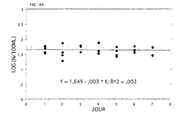
- FIGS. 4A to 4C illustrate the stability of lenticular pellets containing Escherichia coli and stored at + 4 ° C, at -20 ° C and at -70 ° C.
- FIGS. 4A and 4C illustrate the effect of the storage temperature with study of the stability of the reference materials, with for FIG. 4A E. coli preserved at + 4 ° C., for FIG. 4B E. coli preserved at -20 ° C and for Figure 4C E.coli stored at -7O ° C.
- FIGS. 5A and 5B illustrate the stability of lenticular pellets containing Klebsiella planticola and stored at + 4 ° C and - 20 ° C respectively.
- FIGS. 5A and 5B illustrate the effect of the storage temperature with study of the stability of the reference materials with, for FIG. 5A, Klebsiella planticola preserved at + 4 ° C. and for FIG. 5B, Klebseilla planticola preserved at -20 °. vs.
- Figures 6A to 6C illustrate the stability of lenticular pellets containing Staphylococcus aureus stored respectively at + 4 ° C, -20 ° C and -70 ° C.
- Figures 6A to 6C illustrate the effect of the storage temperature with study the stability of the reference materials, this figure corresponding to Staphylococcus aureus stored at + 4 ° C, -20 ° C and -70 ° C.
- FIGS. 7A to 7C illustrate the stability of lenticular pellets containing Enterococcus faecalis stored respectively at + 4 ° C, -20 ° C and - 70 ° C.
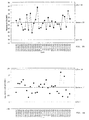
- FIGS. 8A and 8B represent the control charts of the mean and the standard deviation respectively obtained for the enumeration of Escherichia coli over a period of more than 30 days.
- Figures 9A and 9B show the mean and standard deviation control maps obtained respectively for the enumeration of Enterococcus faecalis over a period of more than 30 days.
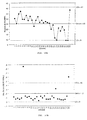
- Figures 10A and 10B show the mean and standard deviation control charts obtained for S. aureus over a period of 30 weeks, respectively.
- Figures 11A and 11B show the mean and standard deviation control charts respectively obtained for Clostridium sporogenes over a period of 30 weeks.
- Bacteria in the form of culture broths, or colonies resuspended in 0.25 ml DSM medium are mixed for 3 min. in 10 ml of egg white (about 15g).
- Brewing is carried out for these different stages in a mixer set at 700 rpm.
- composition thus obtained is then distributed in drops over a plastic plate, using a 10 ml syringe fitted with a needle 1.2 x 40mm.
- the plate is placed in a desiccator, then the assembly is put under vacuum and placed at -20 ° C for 4 days.
- the lenticular pellets, or lenticles, thus obtained are collected and then stored at + 4 ° C or -20 ° C in a bottle fitted with a desiccant bag.
- the broth sample is used when mortality after drying was considered important during a first attempt at packaging in the form of lenticles. Indeed the broth allows after centrifugation a large concentration of bacteria difficult to achieve with colonies.
- the colony sample has the advantage of being very easily quantifiable. It is used when the survival rate after drying is considered correct. Its use involves the addition of 0.25 ml of DSM, which avoids the modification of the quantities with respect to the mixture using the broth.
- the lenticles are reconstituted in a 9 ml tube of RINGER medium.
- E.coli strain WR 1 available from the RIVM Dutch Collection.
- Validation is carried out by counting 30 lenticles after drying.
- Each of the lenticles is placed in a tube containing 9 ml from DSM.
- the tubes previously at room temperature are placed at + 4 ° C (Water bath + Ice Pack®) as soon as the lenticle has dissolved in DSM (dissolution with Vortex®).
- a dissolution is carried out when the concentration of the lens is too large.
- Lenticles are stored at + 4 ° C, -20 ° C or -70 ° C in bottles with a desiccant bag (the same batch is split in two identical quantities, stored at two different temperatures).
- Each lenticle is placed in a tube containing 10 ml of DSM, this is dissolved in Vortex® at room temperature.
- the samples thus reconstituted are placed at + 4 ° C before filtration.
- Filtration is carried out in two 5 ml replicates for each duckweed.
- Reference materials can be used for testing of fertility of the culture media, the statistical control of the processes and aptitude tests by comparison between laboratories.
- AFNOR T90-432 and T90-433 standards impose criteria for quality for the production of microplate culture medium.
- microplates to be tested Quality control must relate to each batch of microplates manufactured.
- the microplates to be tested are removed so random or systematic in order to constitute a sample according to the AFNOR NFX 06-023 standard, respecting the normal level of sampling (9 microplates checked for a batch size of 1000 microplates produced).
- the fertility of the culture medium is measured by the ratio between the number of microorganisms observed with the batch of microplates tested and the number of microorganisms expected with a material of stable reference (target value).
- the level of concentration to be implemented work after reconstitution of the reference material must be located around the maximum precision of the method, about 500 sprouts / 100 ml.
- Acceptance thresholds for the batch of microplates under test are: 0.66 to 1.50 times the target value (66% ⁇ yield (%) ⁇ 150%).
- the strain to be tested for standard T90-433 is E. coli WR1.
- strains to be tested for standard T90-432 are E. faecium WR63, E. faecalis CCM 2541 and E. hirae CCM 2423
- Tables 3 to 6 report for each of the strains the fertility results obtained on the production of microplates in 1997. They show perfect mastery of manufacturing by the producer. In 90% of the batches produced meet the fertility criteria set out in the standards.
- a proficiency test involves using intercomparisons to determine the performance of a laboratory in terms of testing or measurements. Participation in proficiency testing systems gives to laboratories an objective means of assessing and demonstrating reliability of the data they produce. The laboratories thus complete the internal quality control procedures by providing a measure additional external testing skills.
- S u measures the variability of the results obtained when the measurements are carried out on the same pellet in the same laboratory.
- r corresponds to the variability of the results obtained when the measurements are made on different pads within the same laboratory.
- R measures the variability of the results obtained when the measurements are performed on different pellets and by different laboratories.
- the value of 0.3 obtained for R is a value comparable to results usually obtained in this type of inter-laboratory test, and therefore validates this technique (stability of the pellets during transfer and easy implementation in laboratories).
Landscapes
- Life Sciences & Earth Sciences (AREA)
- Chemical & Material Sciences (AREA)
- Engineering & Computer Science (AREA)
- Health & Medical Sciences (AREA)
- Genetics & Genomics (AREA)
- Biotechnology (AREA)
- Organic Chemistry (AREA)
- Zoology (AREA)
- Bioinformatics & Cheminformatics (AREA)
- Wood Science & Technology (AREA)
- Tropical Medicine & Parasitology (AREA)
- Medicinal Chemistry (AREA)
- Biomedical Technology (AREA)
- Virology (AREA)
- Biochemistry (AREA)
- General Engineering & Computer Science (AREA)
- General Health & Medical Sciences (AREA)
- Microbiology (AREA)
- Micro-Organisms Or Cultivation Processes Thereof (AREA)
- Measuring Or Testing Involving Enzymes Or Micro-Organisms (AREA)
- Agricultural Chemicals And Associated Chemicals (AREA)
- Food Preservation Except Freezing, Refrigeration, And Drying (AREA)
- Apparatus Associated With Microorganisms And Enzymes (AREA)
- Immobilizing And Processing Of Enzymes And Microorganisms (AREA)
- Peptides Or Proteins (AREA)
- Enzymes And Modification Thereof (AREA)
Applications Claiming Priority (3)
| Application Number | Priority Date | Filing Date | Title |
|---|---|---|---|
| FR9707954A FR2765239B1 (fr) | 1997-06-25 | 1997-06-25 | Composition pour la conservation de quantites determinees et reproductibles de micro-organismes, et procede d'obtention |
| FR9707954 | 1997-06-25 | ||
| PCT/FR1998/001335 WO1999000485A1 (fr) | 1997-06-25 | 1998-06-24 | Composition pour la conservation de quantites determinees et reproductibles de micro-organismes, et procede d'obtention |
Publications (2)
| Publication Number | Publication Date |
|---|---|
| EP1003837A1 EP1003837A1 (fr) | 2000-05-31 |
| EP1003837B1 true EP1003837B1 (fr) | 2003-06-11 |
Family
ID=9508429
Family Applications (1)
| Application Number | Title | Priority Date | Filing Date |
|---|---|---|---|
| EP98933707A Expired - Lifetime EP1003837B1 (fr) | 1997-06-25 | 1998-06-24 | Composition pour la conservation de quantites determinees et reproductibles de micro-organismes, et procede d'obtention |
Country Status (10)
| Country | Link |
|---|---|
| US (1) | US6723526B1 (da) |
| EP (1) | EP1003837B1 (da) |
| JP (1) | JP2002507122A (da) |
| AT (1) | ATE242801T1 (da) |
| AU (1) | AU8343598A (da) |
| CA (1) | CA2295927A1 (da) |
| DE (1) | DE69815531T2 (da) |
| DK (1) | DK1003837T3 (da) |
| FR (1) | FR2765239B1 (da) |
| WO (1) | WO1999000485A1 (da) |
Families Citing this family (6)
| Publication number | Priority date | Publication date | Assignee | Title |
|---|---|---|---|---|
| EP1213347A1 (en) * | 2000-11-24 | 2002-06-12 | TDI Tournois Dynamic Innovations B.V. | A method for preserving cells by processing the same into dry products |
| JP2006333718A (ja) * | 2005-05-31 | 2006-12-14 | Food & Drug Safety Center | 一般細菌数測定検査用標準試料及びその製造方法 |
| US20070251352A1 (en) * | 2006-05-01 | 2007-11-01 | Pruitt Judith G | Pelletized Feed Material for Biomass Generator |
| US8551762B2 (en) | 2009-07-07 | 2013-10-08 | Nch Corporation | System and apparatus for feeding, solubilizing, growing and discharging a biological material |
| US8961893B2 (en) * | 2009-07-07 | 2015-02-24 | Nch Corporation | Automated chemical diluter system having disposable components |
| US10323226B2 (en) | 2017-03-30 | 2019-06-18 | Nch Corporation | Feed material for biomass generator |
Family Cites Families (7)
| Publication number | Priority date | Publication date | Assignee | Title |
|---|---|---|---|---|
| US3567585A (en) * | 1963-07-12 | 1971-03-02 | Ciba Geigy Corp | Process for obtaining bcg-cultures |
| US3942969A (en) * | 1974-05-21 | 1976-03-09 | Carroll Jr Alban David | Delayed release nutrients for mushroom culture |
| DE3854472T2 (de) * | 1988-06-17 | 1996-02-29 | Cominco Fertilizers Ltd | Erhaltung der Viabilität von Mikroorganismen zur Anwendung in mikrobiellen Inokulantien. |
| DE4109036C1 (da) * | 1991-03-15 | 1992-08-13 | Eckhard Dr. 1000 Berlin De Lauer | |
| FR2676751B1 (fr) * | 1991-05-24 | 1993-09-17 | Lacto Labo Sa | Composition appropriee a la conservation de spores fongiques activees. |
| US5545555A (en) * | 1994-07-25 | 1996-08-13 | Microtest, Inc. | Microbial transport media |
| CA2269806C (en) * | 1996-10-28 | 2006-01-24 | Bernhard H. Van Lengerich | Embedding and encapsulation of controlled release particles |
-
1997
- 1997-06-25 FR FR9707954A patent/FR2765239B1/fr not_active Expired - Fee Related
-
1998
- 1998-06-24 AU AU83435/98A patent/AU8343598A/en not_active Abandoned
- 1998-06-24 WO PCT/FR1998/001335 patent/WO1999000485A1/fr not_active Ceased
- 1998-06-24 DE DE69815531T patent/DE69815531T2/de not_active Expired - Lifetime
- 1998-06-24 US US09/446,457 patent/US6723526B1/en not_active Expired - Fee Related
- 1998-06-24 JP JP50532399A patent/JP2002507122A/ja active Pending
- 1998-06-24 CA CA002295927A patent/CA2295927A1/fr not_active Abandoned
- 1998-06-24 AT AT98933707T patent/ATE242801T1/de not_active IP Right Cessation
- 1998-06-24 DK DK98933707T patent/DK1003837T3/da active
- 1998-06-24 EP EP98933707A patent/EP1003837B1/fr not_active Expired - Lifetime
Also Published As
| Publication number | Publication date |
|---|---|
| CA2295927A1 (fr) | 1999-01-07 |
| FR2765239A1 (fr) | 1998-12-31 |
| DK1003837T3 (da) | 2003-10-06 |
| WO1999000485A1 (fr) | 1999-01-07 |
| AU8343598A (en) | 1999-01-19 |
| DE69815531T2 (de) | 2004-04-29 |
| EP1003837A1 (fr) | 2000-05-31 |
| JP2002507122A (ja) | 2002-03-05 |
| FR2765239B1 (fr) | 1999-09-10 |
| DE69815531D1 (de) | 2003-07-17 |
| US6723526B1 (en) | 2004-04-20 |
| ATE242801T1 (de) | 2003-06-15 |
Similar Documents
| Publication | Publication Date | Title |
|---|---|---|
| EP1664334B1 (fr) | Procede et dispositif pour determiner si un produit est en etat d'etre utilise ou consomme | |
| US10378041B2 (en) | Effervescent compositions and uses thereof | |
| EP1003837B1 (fr) | Composition pour la conservation de quantites determinees et reproductibles de micro-organismes, et procede d'obtention | |
| FR2732037A1 (fr) | Procede de detection de microorganismes par separation et culture sur un systeme gelifie, systeme gelifie et necessaire de dosage pour mettre en oeuvre ce procede, utilisation en microbiologie | |
| EP2408909B1 (en) | Improved blends containing proteases | |
| Tarifa et al. | Disinfection efficacy over yeast biofilms of juice processing industries | |
| US20140017767A1 (en) | Inoculum and method of preparation | |
| Ogodo et al. | Principles of applied microbiology and biotechnology: Technique for the screening of antimicrobial herbs | |
| CN107019138A (zh) | 一种丁香酚组合液及制备方法和应用 | |
| US20220081701A1 (en) | Dehydrated biofilm assemblies and methods for manufacturing dehydrated biofilm assemblies | |
| BE1030650B1 (fr) | Composition de decrochage et de prelevement de microorganismes | |
| BE1030646B1 (fr) | Kit de prélèvement comprenant une solution de conservation pour la collecte de microorganismes | |
| CA3134894A1 (fr) | Billes de verre fonctionnalisees, leur utilisation pour capter des micro-organismes et les dispositifs correspondants | |
| US12618095B2 (en) | Medium for Bacillus cereus group detection | |
| WO2011001402A2 (fr) | Procede d'inactivation d'au moins un agent pathogene dans un echantillon de plasma sanguin humain | |
| Popoola et al. | Multidrug-resistant microorganisms associated with slightly spoilt oranges | |
| WO2021234102A1 (fr) | Procédé de décontamination | |
| US20230143236A1 (en) | Medium for bacillus cereus group detection | |
| WO1992014998A1 (fr) | Dispositif biologique de controle de la conservation a temperature positive de substances perissables et son procede de fabrication | |
| Pudale et al. | Microbial Analysis of Buffalo Milk at Various Stages of Supply Chain in and around Parbhani City, India | |
| Saksangawong et al. | Development and evaluation of a screening test kit for detection of tetracycline group residues in honey | |
| BE512562A (da) | ||
| Choi et al. | Shelf-life assessment of agar plates vacuum-sealed in nylon/polyethylene packaging flushed with nitrogen | |
| FR2921669A1 (fr) | Milieu de culture de microorganismes comprenant un inhibiteur de bacteriocines. | |
| BE1030647A1 (fr) | Procede d'echantillonnage de microorganismes sur des surfaces industrielles agro-alimentaires |
Legal Events
| Date | Code | Title | Description |
|---|---|---|---|
| PUAI | Public reference made under article 153(3) epc to a published international application that has entered the european phase |
Free format text: ORIGINAL CODE: 0009012 |
|
| 17P | Request for examination filed |
Effective date: 20000125 |
|
| AK | Designated contracting states |
Kind code of ref document: A1 Designated state(s): AT BE CH CY DE DK ES FI FR GB GR IE IT LI LU MC NL PT SE |
|
| 17Q | First examination report despatched |
Effective date: 20010430 |
|
| GRAH | Despatch of communication of intention to grant a patent |
Free format text: ORIGINAL CODE: EPIDOS IGRA |
|
| GRAA | (expected) grant |
Free format text: ORIGINAL CODE: 0009210 |
|
| GRAH | Despatch of communication of intention to grant a patent |
Free format text: ORIGINAL CODE: EPIDOS IGRA |
|
| AK | Designated contracting states |
Designated state(s): AT BE CH CY DE DK ES FI FR GB GR IE IT LI LU MC NL PT SE |
|
| PG25 | Lapsed in a contracting state [announced via postgrant information from national office to epo] |
Ref country code: NL Free format text: LAPSE BECAUSE OF FAILURE TO SUBMIT A TRANSLATION OF THE DESCRIPTION OR TO PAY THE FEE WITHIN THE PRESCRIBED TIME-LIMIT Effective date: 20030611 Ref country code: IT Free format text: LAPSE BECAUSE OF FAILURE TO SUBMIT A TRANSLATION OF THE DESCRIPTION OR TO PAY THE FEE WITHIN THE PRESCRIBED TIME-LIMIT;WARNING: LAPSES OF ITALIAN PATENTS WITH EFFECTIVE DATE BEFORE 2007 MAY HAVE OCCURRED AT ANY TIME BEFORE 2007. THE CORRECT EFFECTIVE DATE MAY BE DIFFERENT FROM THE ONE RECORDED. Effective date: 20030611 Ref country code: IE Free format text: LAPSE BECAUSE OF FAILURE TO SUBMIT A TRANSLATION OF THE DESCRIPTION OR TO PAY THE FEE WITHIN THE PRESCRIBED TIME-LIMIT Effective date: 20030611 Ref country code: FI Free format text: LAPSE BECAUSE OF FAILURE TO SUBMIT A TRANSLATION OF THE DESCRIPTION OR TO PAY THE FEE WITHIN THE PRESCRIBED TIME-LIMIT Effective date: 20030611 Ref country code: AT Free format text: LAPSE BECAUSE OF FAILURE TO SUBMIT A TRANSLATION OF THE DESCRIPTION OR TO PAY THE FEE WITHIN THE PRESCRIBED TIME-LIMIT Effective date: 20030611 |
|
| REG | Reference to a national code |
Ref country code: GB Ref legal event code: FG4D Free format text: NOT ENGLISH |
|
| REG | Reference to a national code |
Ref country code: CH Ref legal event code: EP |
|
| PG25 | Lapsed in a contracting state [announced via postgrant information from national office to epo] |
Ref country code: LU Free format text: LAPSE BECAUSE OF NON-PAYMENT OF DUE FEES Effective date: 20030624 Ref country code: CY Free format text: LAPSE BECAUSE OF FAILURE TO SUBMIT A TRANSLATION OF THE DESCRIPTION OR TO PAY THE FEE WITHIN THE PRESCRIBED TIME-LIMIT Effective date: 20030624 |
|
| PG25 | Lapsed in a contracting state [announced via postgrant information from national office to epo] |
Ref country code: MC Free format text: LAPSE BECAUSE OF NON-PAYMENT OF DUE FEES Effective date: 20030630 Ref country code: LI Free format text: LAPSE BECAUSE OF NON-PAYMENT OF DUE FEES Effective date: 20030630 Ref country code: CH Free format text: LAPSE BECAUSE OF NON-PAYMENT OF DUE FEES Effective date: 20030630 |
|
| REG | Reference to a national code |
Ref country code: IE Ref legal event code: FG4D Free format text: FRENCH |
|
| REF | Corresponds to: |
Ref document number: 69815531 Country of ref document: DE Date of ref document: 20030717 Kind code of ref document: P |
|
| PG25 | Lapsed in a contracting state [announced via postgrant information from national office to epo] |
Ref country code: SE Free format text: LAPSE BECAUSE OF FAILURE TO SUBMIT A TRANSLATION OF THE DESCRIPTION OR TO PAY THE FEE WITHIN THE PRESCRIBED TIME-LIMIT Effective date: 20030911 Ref country code: PT Free format text: LAPSE BECAUSE OF FAILURE TO SUBMIT A TRANSLATION OF THE DESCRIPTION OR TO PAY THE FEE WITHIN THE PRESCRIBED TIME-LIMIT Effective date: 20030911 Ref country code: GR Free format text: LAPSE BECAUSE OF FAILURE TO SUBMIT A TRANSLATION OF THE DESCRIPTION OR TO PAY THE FEE WITHIN THE PRESCRIBED TIME-LIMIT Effective date: 20030911 |
|
| PG25 | Lapsed in a contracting state [announced via postgrant information from national office to epo] |
Ref country code: ES Free format text: LAPSE BECAUSE OF FAILURE TO SUBMIT A TRANSLATION OF THE DESCRIPTION OR TO PAY THE FEE WITHIN THE PRESCRIBED TIME-LIMIT Effective date: 20030922 |
|
| REG | Reference to a national code |
Ref country code: DK Ref legal event code: T3 |
|
| GBT | Gb: translation of ep patent filed (gb section 77(6)(a)/1977) | ||
| NLV1 | Nl: lapsed or annulled due to failure to fulfill the requirements of art. 29p and 29m of the patents act | ||
| REG | Reference to a national code |
Ref country code: IE Ref legal event code: FD4D |
|
| REG | Reference to a national code |
Ref country code: CH Ref legal event code: PL |
|
| PLBE | No opposition filed within time limit |
Free format text: ORIGINAL CODE: 0009261 |
|
| STAA | Information on the status of an ep patent application or granted ep patent |
Free format text: STATUS: NO OPPOSITION FILED WITHIN TIME LIMIT |
|
| 26N | No opposition filed |
Effective date: 20040312 |
|
| PGFP | Annual fee paid to national office [announced via postgrant information from national office to epo] |
Ref country code: FR Payment date: 20110621 Year of fee payment: 14 |
|
| PGFP | Annual fee paid to national office [announced via postgrant information from national office to epo] |
Ref country code: GB Payment date: 20110627 Year of fee payment: 14 Ref country code: DK Payment date: 20110621 Year of fee payment: 14 |
|
| PGFP | Annual fee paid to national office [announced via postgrant information from national office to epo] |
Ref country code: DE Payment date: 20110713 Year of fee payment: 14 |
|
| PGFP | Annual fee paid to national office [announced via postgrant information from national office to epo] |
Ref country code: BE Payment date: 20110727 Year of fee payment: 14 |
|
| BERE | Be: lapsed |
Owner name: *INSTITUT PASTEUR DE LILLE Effective date: 20120630 |
|
| REG | Reference to a national code |
Ref country code: DK Ref legal event code: EBP |
|
| GBPC | Gb: european patent ceased through non-payment of renewal fee |
Effective date: 20120624 |
|
| REG | Reference to a national code |
Ref country code: FR Ref legal event code: ST Effective date: 20130228 |
|
| REG | Reference to a national code |
Ref country code: DE Ref legal event code: R119 Ref document number: 69815531 Country of ref document: DE Effective date: 20130101 |
|
| PG25 | Lapsed in a contracting state [announced via postgrant information from national office to epo] |
Ref country code: DE Free format text: LAPSE BECAUSE OF NON-PAYMENT OF DUE FEES Effective date: 20130101 Ref country code: GB Free format text: LAPSE BECAUSE OF NON-PAYMENT OF DUE FEES Effective date: 20120624 Ref country code: BE Free format text: LAPSE BECAUSE OF NON-PAYMENT OF DUE FEES Effective date: 20120630 Ref country code: FR Free format text: LAPSE BECAUSE OF NON-PAYMENT OF DUE FEES Effective date: 20120702 |
|
| PG25 | Lapsed in a contracting state [announced via postgrant information from national office to epo] |
Ref country code: DK Free format text: LAPSE BECAUSE OF NON-PAYMENT OF DUE FEES Effective date: 20120702 |