EP1003915B1 - Amplification d'acides nucleiques - Google Patents
Amplification d'acides nucleiques Download PDFInfo
- Publication number
- EP1003915B1 EP1003915B1 EP98938802A EP98938802A EP1003915B1 EP 1003915 B1 EP1003915 B1 EP 1003915B1 EP 98938802 A EP98938802 A EP 98938802A EP 98938802 A EP98938802 A EP 98938802A EP 1003915 B1 EP1003915 B1 EP 1003915B1
- Authority
- EP
- European Patent Office
- Prior art keywords
- sequence
- strand
- restriction
- nucleic acid
- molecule
- Prior art date
- Legal status (The legal status is an assumption and is not a legal conclusion. Google has not performed a legal analysis and makes no representation as to the accuracy of the status listed.)
- Expired - Lifetime
Links
- 150000007523 nucleic acids Chemical class 0.000 title claims abstract description 39
- 108020004707 nucleic acids Proteins 0.000 title claims abstract description 34
- 102000039446 nucleic acids Human genes 0.000 title claims abstract description 34
- 230000003321 amplification Effects 0.000 title description 45
- 238000003199 nucleic acid amplification method Methods 0.000 title description 45
- 238000000034 method Methods 0.000 claims abstract description 48
- 108091008146 restriction endonucleases Proteins 0.000 claims abstract description 25
- 102000004190 Enzymes Human genes 0.000 claims abstract description 12
- 108090000790 Enzymes Proteins 0.000 claims abstract description 12
- 230000000295 complement effect Effects 0.000 claims abstract description 11
- 125000003729 nucleotide group Chemical group 0.000 claims abstract description 7
- 238000010348 incorporation Methods 0.000 claims abstract description 4
- 108091028043 Nucleic acid sequence Proteins 0.000 claims abstract description 3
- 238000006243 chemical reaction Methods 0.000 claims description 44
- 108020004414 DNA Proteins 0.000 claims description 20
- 238000006073 displacement reaction Methods 0.000 claims description 6
- 239000011541 reaction mixture Substances 0.000 claims description 6
- 102000053602 DNA Human genes 0.000 claims description 4
- 239000013615 primer Substances 0.000 claims 3
- 239000003155 DNA primer Substances 0.000 claims 2
- 238000011065 in-situ storage Methods 0.000 claims 1
- 239000002243 precursor Substances 0.000 claims 1
- 239000012634 fragment Substances 0.000 description 17
- 239000000499 gel Substances 0.000 description 13
- 239000000203 mixture Substances 0.000 description 11
- 238000003752 polymerase chain reaction Methods 0.000 description 11
- 238000009396 hybridization Methods 0.000 description 10
- XLYOFNOQVPJJNP-UHFFFAOYSA-N water Substances O XLYOFNOQVPJJNP-UHFFFAOYSA-N 0.000 description 10
- 239000000872 buffer Substances 0.000 description 8
- 238000003776 cleavage reaction Methods 0.000 description 8
- 238000011534 incubation Methods 0.000 description 8
- 230000007017 scission Effects 0.000 description 8
- 238000011068 loading method Methods 0.000 description 6
- KZMAWJRXKGLWGS-UHFFFAOYSA-N 2-chloro-n-[4-(4-methoxyphenyl)-1,3-thiazol-2-yl]-n-(3-methoxypropyl)acetamide Chemical compound S1C(N(C(=O)CCl)CCCOC)=NC(C=2C=CC(OC)=CC=2)=C1 KZMAWJRXKGLWGS-UHFFFAOYSA-N 0.000 description 5
- 101001042415 Cratylia mollis Mannose/glucose-specific lectin Cramoll Proteins 0.000 description 5
- 101001012787 Homo sapiens Eukaryotic translation initiation factor 1 Proteins 0.000 description 5
- 101000643378 Homo sapiens Serine racemase Proteins 0.000 description 5
- 102100035717 Serine racemase Human genes 0.000 description 5
- 239000011543 agarose gel Substances 0.000 description 5
- AIXMJTYHQHQJLU-UHFFFAOYSA-N chembl210858 Chemical compound O1C(CC(=O)OC)CC(C=2C=CC(O)=CC=2)=N1 AIXMJTYHQHQJLU-UHFFFAOYSA-N 0.000 description 5
- 230000000694 effects Effects 0.000 description 5
- 108091034117 Oligonucleotide Proteins 0.000 description 4
- 230000029087 digestion Effects 0.000 description 4
- ZMMJGEGLRURXTF-UHFFFAOYSA-N ethidium bromide Chemical compound [Br-].C12=CC(N)=CC=C2C2=CC=C(N)C=C2[N+](CC)=C1C1=CC=CC=C1 ZMMJGEGLRURXTF-UHFFFAOYSA-N 0.000 description 4
- 229960005542 ethidium bromide Drugs 0.000 description 4
- 238000004519 manufacturing process Methods 0.000 description 4
- 239000002773 nucleotide Substances 0.000 description 4
- 239000000243 solution Substances 0.000 description 4
- 102000016928 DNA-directed DNA polymerase Human genes 0.000 description 3
- 108010014303 DNA-directed DNA polymerase Proteins 0.000 description 3
- 238000004458 analytical method Methods 0.000 description 3
- 238000004925 denaturation Methods 0.000 description 3
- 230000036425 denaturation Effects 0.000 description 3
- 238000000926 separation method Methods 0.000 description 3
- OSBLTNPMIGYQGY-UHFFFAOYSA-N 2-amino-2-(hydroxymethyl)propane-1,3-diol;2-[2-[bis(carboxymethyl)amino]ethyl-(carboxymethyl)amino]acetic acid;boric acid Chemical compound OB(O)O.OCC(N)(CO)CO.OC(=O)CN(CC(O)=O)CCN(CC(O)=O)CC(O)=O OSBLTNPMIGYQGY-UHFFFAOYSA-N 0.000 description 2
- FWMNVWWHGCHHJJ-SKKKGAJSSA-N 4-amino-1-[(2r)-6-amino-2-[[(2r)-2-[[(2r)-2-[[(2r)-2-amino-3-phenylpropanoyl]amino]-3-phenylpropanoyl]amino]-4-methylpentanoyl]amino]hexanoyl]piperidine-4-carboxylic acid Chemical compound C([C@H](C(=O)N[C@H](CC(C)C)C(=O)N[C@H](CCCCN)C(=O)N1CCC(N)(CC1)C(O)=O)NC(=O)[C@H](N)CC=1C=CC=CC=1)C1=CC=CC=C1 FWMNVWWHGCHHJJ-SKKKGAJSSA-N 0.000 description 2
- TWRXJAOTZQYOKJ-UHFFFAOYSA-L Magnesium chloride Chemical compound [Mg+2].[Cl-].[Cl-] TWRXJAOTZQYOKJ-UHFFFAOYSA-L 0.000 description 2
- 239000008051 TBE buffer Substances 0.000 description 2
- 238000009825 accumulation Methods 0.000 description 2
- 238000000246 agarose gel electrophoresis Methods 0.000 description 2
- 239000012888 bovine serum Substances 0.000 description 2
- 230000001351 cycling effect Effects 0.000 description 2
- 239000012895 dilution Substances 0.000 description 2
- 238000010790 dilution Methods 0.000 description 2
- 238000001976 enzyme digestion Methods 0.000 description 2
- 238000011067 equilibration Methods 0.000 description 2
- 238000010438 heat treatment Methods 0.000 description 2
- 239000000543 intermediate Substances 0.000 description 2
- 238000012986 modification Methods 0.000 description 2
- 230000004048 modification Effects 0.000 description 2
- 229920002401 polyacrylamide Polymers 0.000 description 2
- 239000000376 reactant Substances 0.000 description 2
- 230000001172 regenerating effect Effects 0.000 description 2
- 230000008929 regeneration Effects 0.000 description 2
- 238000011069 regeneration method Methods 0.000 description 2
- 238000010839 reverse transcription Methods 0.000 description 2
- 238000005382 thermal cycling Methods 0.000 description 2
- GFFGJBXGBJISGV-UHFFFAOYSA-N Adenine Chemical compound NC1=NC=NC2=C1N=CN2 GFFGJBXGBJISGV-UHFFFAOYSA-N 0.000 description 1
- 229930024421 Adenine Natural products 0.000 description 1
- 229920000936 Agarose Polymers 0.000 description 1
- 108091003079 Bovine Serum Albumin Proteins 0.000 description 1
- FGUUSXIOTUKUDN-IBGZPJMESA-N C1(=CC=CC=C1)N1C2=C(NC([C@H](C1)NC=1OC(=NN=1)C1=CC=CC=C1)=O)C=CC=C2 Chemical compound C1(=CC=CC=C1)N1C2=C(NC([C@H](C1)NC=1OC(=NN=1)C1=CC=CC=C1)=O)C=CC=C2 FGUUSXIOTUKUDN-IBGZPJMESA-N 0.000 description 1
- 241000701022 Cytomegalovirus Species 0.000 description 1
- 241000463291 Elga Species 0.000 description 1
- 241000701024 Human betaherpesvirus 5 Species 0.000 description 1
- JLVVSXFLKOJNIY-UHFFFAOYSA-N Magnesium ion Chemical compound [Mg+2] JLVVSXFLKOJNIY-UHFFFAOYSA-N 0.000 description 1
- JLCPHMBAVCMARE-UHFFFAOYSA-N [3-[[3-[[3-[[3-[[3-[[3-[[3-[[3-[[3-[[3-[[3-[[5-(2-amino-6-oxo-1H-purin-9-yl)-3-[[3-[[3-[[3-[[3-[[3-[[5-(2-amino-6-oxo-1H-purin-9-yl)-3-[[5-(2-amino-6-oxo-1H-purin-9-yl)-3-hydroxyoxolan-2-yl]methoxy-hydroxyphosphoryl]oxyoxolan-2-yl]methoxy-hydroxyphosphoryl]oxy-5-(5-methyl-2,4-dioxopyrimidin-1-yl)oxolan-2-yl]methoxy-hydroxyphosphoryl]oxy-5-(6-aminopurin-9-yl)oxolan-2-yl]methoxy-hydroxyphosphoryl]oxy-5-(6-aminopurin-9-yl)oxolan-2-yl]methoxy-hydroxyphosphoryl]oxy-5-(6-aminopurin-9-yl)oxolan-2-yl]methoxy-hydroxyphosphoryl]oxy-5-(6-aminopurin-9-yl)oxolan-2-yl]methoxy-hydroxyphosphoryl]oxyoxolan-2-yl]methoxy-hydroxyphosphoryl]oxy-5-(5-methyl-2,4-dioxopyrimidin-1-yl)oxolan-2-yl]methoxy-hydroxyphosphoryl]oxy-5-(4-amino-2-oxopyrimidin-1-yl)oxolan-2-yl]methoxy-hydroxyphosphoryl]oxy-5-(5-methyl-2,4-dioxopyrimidin-1-yl)oxolan-2-yl]methoxy-hydroxyphosphoryl]oxy-5-(5-methyl-2,4-dioxopyrimidin-1-yl)oxolan-2-yl]methoxy-hydroxyphosphoryl]oxy-5-(6-aminopurin-9-yl)oxolan-2-yl]methoxy-hydroxyphosphoryl]oxy-5-(6-aminopurin-9-yl)oxolan-2-yl]methoxy-hydroxyphosphoryl]oxy-5-(4-amino-2-oxopyrimidin-1-yl)oxolan-2-yl]methoxy-hydroxyphosphoryl]oxy-5-(4-amino-2-oxopyrimidin-1-yl)oxolan-2-yl]methoxy-hydroxyphosphoryl]oxy-5-(4-amino-2-oxopyrimidin-1-yl)oxolan-2-yl]methoxy-hydroxyphosphoryl]oxy-5-(6-aminopurin-9-yl)oxolan-2-yl]methoxy-hydroxyphosphoryl]oxy-5-(4-amino-2-oxopyrimidin-1-yl)oxolan-2-yl]methyl [5-(6-aminopurin-9-yl)-2-(hydroxymethyl)oxolan-3-yl] hydrogen phosphate Polymers Cc1cn(C2CC(OP(O)(=O)OCC3OC(CC3OP(O)(=O)OCC3OC(CC3O)n3cnc4c3nc(N)[nH]c4=O)n3cnc4c3nc(N)[nH]c4=O)C(COP(O)(=O)OC3CC(OC3COP(O)(=O)OC3CC(OC3COP(O)(=O)OC3CC(OC3COP(O)(=O)OC3CC(OC3COP(O)(=O)OC3CC(OC3COP(O)(=O)OC3CC(OC3COP(O)(=O)OC3CC(OC3COP(O)(=O)OC3CC(OC3COP(O)(=O)OC3CC(OC3COP(O)(=O)OC3CC(OC3COP(O)(=O)OC3CC(OC3COP(O)(=O)OC3CC(OC3COP(O)(=O)OC3CC(OC3COP(O)(=O)OC3CC(OC3COP(O)(=O)OC3CC(OC3COP(O)(=O)OC3CC(OC3COP(O)(=O)OC3CC(OC3CO)n3cnc4c(N)ncnc34)n3ccc(N)nc3=O)n3cnc4c(N)ncnc34)n3ccc(N)nc3=O)n3ccc(N)nc3=O)n3ccc(N)nc3=O)n3cnc4c(N)ncnc34)n3cnc4c(N)ncnc34)n3cc(C)c(=O)[nH]c3=O)n3cc(C)c(=O)[nH]c3=O)n3ccc(N)nc3=O)n3cc(C)c(=O)[nH]c3=O)n3cnc4c3nc(N)[nH]c4=O)n3cnc4c(N)ncnc34)n3cnc4c(N)ncnc34)n3cnc4c(N)ncnc34)n3cnc4c(N)ncnc34)O2)c(=O)[nH]c1=O JLCPHMBAVCMARE-UHFFFAOYSA-N 0.000 description 1
- 229960000643 adenine Drugs 0.000 description 1
- 238000000137 annealing Methods 0.000 description 1
- 238000003556 assay Methods 0.000 description 1
- 229940098773 bovine serum albumin Drugs 0.000 description 1
- 239000003153 chemical reaction reagent Substances 0.000 description 1
- 238000010276 construction Methods 0.000 description 1
- 238000001816 cooling Methods 0.000 description 1
- 125000004122 cyclic group Chemical group 0.000 description 1
- 239000005547 deoxyribonucleotide Substances 0.000 description 1
- 125000002637 deoxyribonucleotide group Chemical group 0.000 description 1
- 230000001419 dependent effect Effects 0.000 description 1
- 238000011161 development Methods 0.000 description 1
- 230000018109 developmental process Effects 0.000 description 1
- UEGPKNKPLBYCNK-UHFFFAOYSA-L magnesium acetate Chemical compound [Mg+2].CC([O-])=O.CC([O-])=O UEGPKNKPLBYCNK-UHFFFAOYSA-L 0.000 description 1
- 239000011654 magnesium acetate Substances 0.000 description 1
- 229940069446 magnesium acetate Drugs 0.000 description 1
- 235000011285 magnesium acetate Nutrition 0.000 description 1
- 229910001629 magnesium chloride Inorganic materials 0.000 description 1
- 229910001425 magnesium ion Inorganic materials 0.000 description 1
- 125000002467 phosphate group Chemical group [H]OP(=O)(O[H])O[*] 0.000 description 1
- 229920001184 polypeptide Polymers 0.000 description 1
- 230000037452 priming Effects 0.000 description 1
- 102000004196 processed proteins & peptides Human genes 0.000 description 1
- 108090000765 processed proteins & peptides Proteins 0.000 description 1
- 238000012545 processing Methods 0.000 description 1
- 230000002035 prolonged effect Effects 0.000 description 1
- 102000004169 proteins and genes Human genes 0.000 description 1
- 108090000623 proteins and genes Proteins 0.000 description 1
- 150000003839 salts Chemical class 0.000 description 1
- 238000010530 solution phase reaction Methods 0.000 description 1
- 125000006850 spacer group Chemical class 0.000 description 1
- 238000011144 upstream manufacturing Methods 0.000 description 1
Images







Classifications
-
- C—CHEMISTRY; METALLURGY
- C12—BIOCHEMISTRY; BEER; SPIRITS; WINE; VINEGAR; MICROBIOLOGY; ENZYMOLOGY; MUTATION OR GENETIC ENGINEERING
- C12Q—MEASURING OR TESTING PROCESSES INVOLVING ENZYMES, NUCLEIC ACIDS OR MICROORGANISMS; COMPOSITIONS OR TEST PAPERS THEREFOR; PROCESSES OF PREPARING SUCH COMPOSITIONS; CONDITION-RESPONSIVE CONTROL IN MICROBIOLOGICAL OR ENZYMOLOGICAL PROCESSES
- C12Q1/00—Measuring or testing processes involving enzymes, nucleic acids or microorganisms; Compositions therefor; Processes of preparing such compositions
- C12Q1/68—Measuring or testing processes involving enzymes, nucleic acids or microorganisms; Compositions therefor; Processes of preparing such compositions involving nucleic acids
- C12Q1/6844—Nucleic acid amplification reactions
- C12Q1/6853—Nucleic acid amplification reactions using modified primers or templates
Definitions
- the present invention relates to the amplification of nucleic acids, i.e. procedures for producing copies of nucleic acid sequences.
- nucleic acid includes protein nucleic acid (PNA) (i.e. nucleic acids in which the bases are linked by a polypeptide backbone) as well as nucleic acids (e.g. DNA and RNA) having a sugar phosphate backbone.
- PNA protein nucleic acid
- nucleic acids e.g. DNA and RNA
- RNA amplification techniques are already known, e.g. the Polymerase Chain Reaction (PCR).
- PCR Polymerase Chain Reaction
- many of these techniques suffer from the disadvantage that various cycles of heating and cooling are required for each amplification reaction.
- the sequence (in single stranded form) to be amplified is treated with an oligonucleotide capable of hybridising to the sequence at a particular location thereof, the treatment being effected at a temperature (and under other conditions, e.g. buffers etc.) at which the hybridisation will occur.
- a polymerase enzyme is used to extend the oligonucleotide primer (using the original sequence as a template) to produce a strand which is complementary to the original strand and which is hybridised thereto.
- the reaction mixture must be heated to denature the complementary strands and then cooled so that the above described procedure (i.e. primer hybridisation, extension, denaturing) may be repeated.
- Strand Displacement Amplification An alternative amplification procedure known as Strand Displacement Amplification has previously been proposed in EP-A-497272.
- This procedure may be effected isothermally but does require the construction of a double stranded nucleic acid molecule incorporating hemi-modified restriction site, more particularly a site modified (in one strand) by the incorporation of a thiolyated adenine.
- the SDA reaction must be conducted in the presence of a chemically modified base to ensure regeneration of the hemi-modified restriction site. This modified base does however become incorporated in the copy strands produced in the reaction and this is a restriction imposed on the procedure.
- unmodified recognition site we mean that the site consists of unmodified A, G, T and/or C bases.
- restriction enzyme is capable of providing a 3'-end region of the second strand which projects beyond the cut site in the first strand.
- the nucleic acid molecule and/or the nature of the restriction enzyme may be such that only the first strand is cut (i.e. nicked). Alternatively both strands may be cut. In either case, the cut in the first strand generates a fragment (a 3'-upstream fragment) on the 3' side of the cut in that strand.
- This fragment may, in certain cases, act as said primer sequence (provided that it remains hybridised to the 3'-end region of the second strand) Alternatively, depending on the length of the fragment and/or the reaction conditions, the fragment may be cleaved from the end region of the second strand to generate a 3'-overhang. It is therefore usually preferred that an oligonucleotide primer (also referred to herein as the FP primer) capable of hybridising to the 3'-end region is additionally incorporated in the reaction to improve the probability of there being a primer sequence hybridised to the 3'-end region of the second strand for effecting the extension/displacement reaction. It will be appreciated that the FP primer incorporates all or part of the overhanging sequence produced by the enzyme digestion outlined above.
- the primer sequence is extended in the 5' to 3' direction to displace the sequence to be amplified whilst creating a further copy of that sequence (hybridised to the template strand) and regenerating the restriction site.
- the processes of cutting the double stranded molecule and extension/displacement are repeated to provide for increasing quantities (i.e. amplification) of the sequence to be amplified.
- the nucleic acid molecule incorporates two restriction sites of the type described, one each side of the sequence to be amplified. These restriction sites are ideally the same as each other (so that only one restriction enzyme is required) but may be different.
- the provision of two restriction sites as described allows for extension/displacement reactions to proceed in opposite directions from either end of the molecule. By providing an excess of FP primers in the reactant mix, these primers may hybridise to the 3'-overhangs, produced by the digestion with the restriction enzyme, allowing production of double stranded molecules incorporating a single restriction site. These double stranded molecules participate in further amplification reactions as described more fully below.
- the reactant mix includes at least one further type of primer (referred to herein as ISOS primers) incorporating the FP sequence and being capable of hybridising to the nucleic acid strands which are themselves not able to bind to the FP primers per se .
- ISOS primers result in generation of further double stranded molecules incorporating a restriction site, such molecules being able to participate in amplification reactions. This channelling of otherwise non-hybridisable single strands back into the amplification process leads to an exponential accumulation of product.
- the former will generally be employed at a much lower concentration than the latter, generally at least 10 fold less ISO-S primer than FP primer.
- the ISO-S primers generally are used at a concentration of between 1 fmol/ ⁇ l to 50 pmol/ ⁇ l and the FP primers are generally used at a concentration of between 10 fmol/ ⁇ l to 500 pmol/ ⁇ l. It should be noted that, under conditions in which the cleavage products of restriction enzyme digestion do not become separated prior to the action of the DNA polymerase, the exponential amplification reaction may be performed by the ISOS primers in the absence of FP primers.
- the method of the invention may be a solution phase reaction, and must occur under such conditions (of salt concentration, pH, nucleotide concentration etc.) that both the restriction digestion and polymerase extension reactions can occur, though not necessarily simultaneously.
- Preferred conditions for the method of the invention to be carried out are in a New England Thermopolymerase buffer at pH 8.8, in the presence of 10-20 mM magnesium ions, and a nucleotide final concentation of 0.1 - 1.0 mM.
- the target nucleic acid for the amplification may be present in very small amounts, and hence the amplification will find utility in such areas as clinical diagnostics, to detect either the presence or absence of a sequence or, at a more discriminatory level the occurrence of variations of an underlying sequence.
- Both DNA and RNA might be used as the target for amplification, the later requiring initial reverse transcription to a DNA intermediate.
- the restriction enzyme may for example be Tsp RI but any other enzyme producing the required 3'-end region in the second strand may be used.
- the strand displacing polymerase may for example be 9°N polymerase (ex-New England Biolabs), Klenow (exo-) polymerase, Bst polymerase, Vent (exo-) polymerase, or Deep Vent (exo-) polymerase.
- the temperature(s) at which the reaction is effected is/are dependent upon the combination of restriction endonuclease and displacing polymerase used in the reaction.
- the restriction endonuclease will effect cutting at the temperature at which the displacing polymerase will effect a copying reaction.
- the reaction of the invention may be effected isothermally. It is however also within the scope of the invention that different temperatures are required for cutting and copying so that a two-step thermal cycling reaction may be envisaged.
- Thermal cycling in this case is not that cycling which is required to perform PCR.
- a strand separation step is an absolute requirement of each cycle of the technique and is usually performed by heating the sample to 95-98°C. No such cyclic strand separation is required in the method of the invention where cycling is used to allow primer annealing or to move between the temperature optima of the enzymes used.
- Fig. 1 illustrates the restriction site of the enzyme Tsp RI.
- This recognition sequence comprises five base pairs as shown and the enzyme cuts two bases either side of the recognition sequence to produce a 9-base 3' overhang.
- Fig. 2 illustrates a double stranded target DNA molecule 1 containing an internal sequence X (flanked by sequences Y and Y') to be amplified by the procedure described more fully below with reference to Fig. 3.
- sequences Y and Y' are denoted by the same letters (or sequence of letters) but with one of the two complementary sequences additionally being denoted by the "prime" suffix (').
- X' is the complementary sequence to X.
- a molecule When a molecule is composed of more than one segment it will be annotated from the 5' end of the molecule (thus the notation YXY' would be used to denote the upper strand of the molecule in Fig. 2).
- YXY' When a double stranded molecule is referred to the upper and lower sequences are separated by a slash (/) with both annotated from their 5' ends.
- YXY'/YX'Y' the entire molecule shown in Fig. 2 can be denoted YXY'/YX'Y'.
- the molecule shown in Fig. 2 has a Tsp RI restriction site towards each end thereof flanking the sequence X/X' with each site being spaced from its respective end of the molecule by a short (8 bp) sequence to distance the restriction site away from the 5' end of the molecule.
- 8 bp sequences which are identical at each end of the molecule, have been included because certain restriction enzymes are unable to cleave near the ends of DNA. It has not been reported whether Tsp RI behaves in this fashion so that this sequence may or may not be necessary. Likewise, the optimum length of this sequence has not been reported and so this spacer may contain more or less than 8 bases.
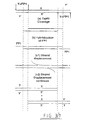
- the molecule 1 is treated with the enzyme Tsp RI in the presence of a strand displacing polymerase, a primer FP1 having the aforementioned sequence Y, and the four nucleotides in a buffer such as conventionally used in amplification reactions.
- the molecule 1 is cleaved at both ends by Tsp RI so as to produce a "cleaved" molecule having 3' overhangs (each 9 bases) as illustrated as the result of step (a) in Fig. 3.
- the primer FP1 (shown in bold for the purposes of clarity) hybridises to the "cleaved" molecule to produce the construct illustrated as the product of step (b) of Fig. 3. It should at this point be appreciated that exactly the same construct would be obtained if the short cleavage fragments of sequence Y nicked by the Tsp RI did not become denatured or if such denaturation did occur they became rehybridised.
- the strand displacing polymerase begins to extend each primer FP1 so that (with reference to the primer FP1 shown at the left hand end of Fig. 3) the primer FP1 is extended by copying strand X' as a template and simultaneously displaces the remainder of strand X. Similarly the other FP1 primer is extended by copying of strand X and displaces the remainder of strand X'. Simultaneously with extension of primers FP1, the 3' ends of the cleaved target molecule are extended using the FP1 primers as a template regenerating the restriction endonuclease sites. All of these copying reactions are schematically illustrated between steps (c1) and (c2) of Fig. 3.
- Fig. 3 shows the product of the strand displacement polymerisation (i.e. the product of step (c2)) to be two, foreshortened, double stranded copies of the original molecule (YX/X'Y' and XY'/YX'). It can be seen that each of these copies lacks one terminus of the original including the TspRI site at the end of the molecule.
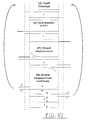
- next steps involve cleavage of the molecules with Tsp RI and hybridisation of primers FP1 to the 3' overhangs produced.
- primers FP1 Once these primers are hybridised to the respective strands, strand displacing primer extension can occur as shown (steps (f1) and (f2)).
- the products of this extension include two foreshortened double stranded molecules (YX/X'Y' and XY'/YX') essentially identical to the products of steps (c1) and (c2). These molecules are, therefore, available for further cycles of TspRI cleavage/hybridisation/extension (steps (d), (e) and (f1/f2)).
- step f ((f1) and (f2)) are two, further shortened, single strand sequences (X and X') which contain neither TspRI restriction site. These sequences are complementary, being copies of each strand of the central region of the original molecule.
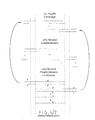
- YX/X'Y' and XY'/YX' are identical, in sequence terms, to the double stranded products of steps (c1/c2) and (f1/f2) described earlier, and so, are also able to re-enter further cycles of TspRI cleavage/hybridisation/extension (steps (d), (e) and (f1/f2)) described earlier.
- each original molecule 1 undergoes a reaction resulting in the production of two shortened products lacking one or other terminal restriction site. Further processing of these molecules leads to their cyclical regeneration with the additional production of single stranded copies of each strand of the region between the Tsp RI sites in the original molecule.
- target sequence specific ISO-primers ISO1 and ISO2
- these single strands are processed to generate further molecules identical to the earlier shortened double strands.
- the overall process is depicted in Fig. 3. The reaction thus cycles from (d) to (h) in a geometric manner.
- primers ISO1 and ISO2 should be at much lower concentration than primer FP1 so that in step (b) of Fig. 3 there is a much higher probability of primer FP1 hybridising to the 3'-overhang than either of ISO1 or ISO2 which could not then be extended to re-generate the restriction site.
- the process may be performed using two different sequences FP1 and FP2 instead of the single sequence FP1 as described.
- the cleavage site (generated by Tsp RI) may not dissociate prior to extension by nucleotide polymerase so that, under such conditions, the amplification reaction will proceed without the need to use primer FP1.
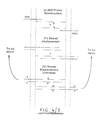
- Fig. 4 which, in many respects, is analogous to the procedure shown in Fig. 3, save that:
- restriction site may be that of a restriction enzyme other than Tsp RI.
- An amplification reaction was effected using the following templates, primers and reaction conditions.
- a mix containing the three primers (ISOS1 and ISOS2 at approx. 20 fmol ⁇ L -1 , and ISOFP1 at approx. 200 fmol ⁇ L -1 ), deoxyribonucleotides (250 ⁇ molL -1 each), and template (Isofragment 2 at 2.5 fmol ⁇ L -1 ) was equilibrated (in a water bath) to 65°C when 25 U Tsp RI restriction enzyme was added.
- the optimum temperature for cleavage of Isofragment 2 by Tsp RI is 65°C and incubation was continued for 20 minutes to allow restriction to occur (Fig. 3(a)).
- the mix was transferred to a second water bath at 37°C.
- Tsp RI can survive incubation at lower temperatures (e.g. 37°C) the initial amount input was sufficient for the entire reaction.
- Klenow (exo-) is destroyed by prolonged incubation at 65°C and so additional enzyme was added to the mix following each incubation at the higher temperature.
- the cycle of incubation at 65°C, hybridisation, Klenow addition and extension at 37°C constitute the "cycles" of amplification.
- Samples (20 ⁇ L) were removed at the end of the cycle as necessary.
- the reaction in the samples taken was terminated immediately by the addition of 4 ⁇ L of agarose gel loading dye and samples were held at 4°C until all samples were collected.
- the samples were then analysed by agarose gel electrophoresis in 1% (w/v) agarose gel, containing 0.5 ⁇ g mL -1 ethidium bromide, in 1 x TBE buffer.
- the effect of ISOFP1 on amplification can be quantified, to an extent, by using the gel scanning software (GELSCAN-UVP Ltd). To estimate peak heights or peak areas for the specific band being amplified (ca. 400 pairs). The results of peak area analysis for the gel photograph of Fig. 6 are illustrated in Fig. 7. These results show that there is considerable amplification of the fragment in the presence of ISOFP1. There is also a small, but significant, amplification in the absence of ISOFPI.
- An amplification reaction was effected using the following template, primers and reaction conditions.
- FP primers were used at a concentration of 50pmol/ ⁇ l while the longer ISO primers were used at a concentration of 5pmol/ ⁇ l.
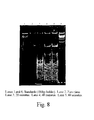
- the gel was visualised using a UV transilluminator and photographic system (MWG Biotech). An image of the gel is show in Fig. 8 and demonstrates considerable amplification under the conditions used.
- a mix containing the three primers (ISOS1 and ISOS2 at approx. 20fmol ⁇ L -1 , and ISOFP1 at approx. 200 fmol ⁇ L -1 ), deoxynucleotides (250 ⁇ mol ⁇ L -1 each), and template (Isofragment 2 at 2.5 fmol ⁇ L -1 ) was equilibrated (in a water bath) to 65°C, when 25 U of Tsp RI restriction enzyme was added. Incubation was continued for 20 minutes when the mix was transferred to a second water bath at 34°C.
- Fig. 10 is a plot showing the accumulation of product (400bp band) based on peak area analysis of the GelBase/GelBlot analysis package (Ultra Violet Products Limited, Cambridge, UK). The 10 cycle value is not shown.
- CMV144 purified 144bp PCR fragment (CMV144) generated from human cytomegalovirus DNA using ISOCMV001 and ISOCMV002-AT primers below (used at a final concentration of 760 fmol/ ⁇ l).
- Template (CMV 144) was diluted from the 760 fmol/ ⁇ l stock using serial tenfold dilutions. Concentrations of template used in the assay were 760 zmol/ ⁇ l (456000 molecules/ ⁇ l), 76 zmol/ ⁇ l (45600 molecules/ ⁇ l), 7.6 zmol/ ⁇ l (4560 molecules/ ⁇ l), 0.76 zmol/ ⁇ l (456 molecules/ ⁇ l), and 0.076 zmol/ ⁇ l (456 molecules/ ⁇ l).
- the gel was visualised using a UV transiluminator and photographic system (MWG Biotech). The results of this amplification procedure are shown in the gel photograph of Figure 11 from which amplification is clearly demonstrated.
- targets used contained sites for the restriction enzyme, Tsp RI. which were introduced during their production. It will however be appreciated that suitable targets may be generated in a number of ways. Such methods might include, but are not limited to:
Landscapes
- Chemical & Material Sciences (AREA)
- Life Sciences & Earth Sciences (AREA)
- Organic Chemistry (AREA)
- Engineering & Computer Science (AREA)
- Zoology (AREA)
- Wood Science & Technology (AREA)
- Proteomics, Peptides & Aminoacids (AREA)
- Health & Medical Sciences (AREA)
- Biophysics (AREA)
- Chemical Kinetics & Catalysis (AREA)
- Immunology (AREA)
- Microbiology (AREA)
- Molecular Biology (AREA)
- Analytical Chemistry (AREA)
- Physics & Mathematics (AREA)
- Biotechnology (AREA)
- Biochemistry (AREA)
- Bioinformatics & Cheminformatics (AREA)
- General Engineering & Computer Science (AREA)
- General Health & Medical Sciences (AREA)
- Genetics & Genomics (AREA)
- Measuring Or Testing Involving Enzymes Or Micro-Organisms (AREA)
Abstract
Claims (9)
- Procédé d'amplification d'une séquence d'acide nucléique présente dans un premier brin d'une molécule d'acide nucléique double brin constituée d'un premier et d'un deuxième brins complémentaires, dans lequel
ladite molécule incorpore un site de reconnaissance non modifié pour une enzyme de restriction capable de couper le premier brin à l'extrémité 5' de la séquence de celui-ci à amplifier et laissant la région d'extrémité 3' du deuxième brin faire saillie au-delà du site de coupure dans le premier brin, et ledit procédé comprend
traiter ladite molécule d'acide nucléique avec ladite enzyme en présence d'une polymérase de déplacement de brin et de nucléotides non modifiés pour incorporation dans un brin d'acide nucléique de prolongation dans des conditions telles qu'il y a une séquence d'amorce ou que celle-ci devient hybridée à ladite région d'extrémité 3' du deuxième brin, laquelle est complémentaire à celui-ci, en vertu de quoi ladite séquence d'amorce est prolongée dans la direction 5' à 3' en utilisant le deuxième brin comme matrice afin de régénérer le site de coupure par endonucléase de restriction et de déplacer la séquence à amplifier. - Procédé tel que revendiqué dans la revendication 1, dans lequel la molécule d'acide nucléique incorpore deux desdits sites de restriction, un de chaque côté de la séquence à amplifier.
- Procédé tel que revendiqué dans la revendication 1 ou 2, dans lequel chaque site de restriction est un site TspRI.
- Procédé tel que revendiqué dans l'une quelconque des revendications 1 à 3, dans lequel je mélange de réaction incorpore en plus un excédent d'amorces oligonucléotidiques incorporant la séquence de restriction et capables de s'hybrider à l'extrémité 3' de la séquence déplacée, en vertu de quoi une molécule double brin incorporant le site de restriction est générée, et cette dernière molécule double brin est capable de réactions de coupure et de prolongation/déplacement supplémentaires pour générer des brins qui n'incorporcnt pas la séquence de restriction.
- Procédé tel que revendiqué dans l'une quelconque des revendications 1 à 4, dans lequel le mélange de réaction incorpore en plus des amorces oligonucléotidiques incorporant la séquence de restriction et étant capables de s'hybrider auxdits brins qui n'incorporent pas la séquence de restriction.
- Procédé tel que revendiqué dans l'une quelconque des revendications 1 à 5, dans lequel l'acide nucléique est de l'ADN.
- Procédé tel que revendiqué dans l'une quelconques de revendications 1 à 6, dans lequel la polymérase de déplacement de brin est de la 9°N polymérase, de la Klenow (exo-) polymérase, de la Bst polymérase, de la Vent (exo-) polymérase ou de la Deep Vent (exo-) polymérase.
- Procédé tel que revendiqué dans l'une quelconque des revendications 1 à 7 effectué isothermiquement.
- Procédé tel que revendiqué dans l'une quelconque des revendications 1 à 8, dans lequel la molécule d'ADN est générée in situ par la réaction d'une molécule d'acide nucléique précurseur contenant la séquence à amplifier avec au moins une amorce capable de générer le site de restriction.
Applications Claiming Priority (3)
| Application Number | Priority Date | Filing Date | Title |
|---|---|---|---|
| GBGB9717061.7A GB9717061D0 (en) | 1997-08-13 | 1997-08-13 | Amplification of nucleic acids |
| GB9717061 | 1997-08-13 | ||
| PCT/GB1998/002427 WO1999009211A1 (fr) | 1997-08-13 | 1998-08-12 | Amplification d'acides nucleiques |
Publications (3)
| Publication Number | Publication Date |
|---|---|
| EP1003915A1 EP1003915A1 (fr) | 2000-05-31 |
| EP1003915B1 true EP1003915B1 (fr) | 2005-11-23 |
| EP1003915B8 EP1003915B8 (fr) | 2006-02-01 |
Family
ID=10817375
Family Applications (1)
| Application Number | Title | Priority Date | Filing Date |
|---|---|---|---|
| EP98938802A Expired - Lifetime EP1003915B8 (fr) | 1997-08-13 | 1998-08-12 | Amplification d'acides nucleiques |
Country Status (8)
| Country | Link |
|---|---|
| US (1) | US6423495B1 (fr) |
| EP (1) | EP1003915B8 (fr) |
| AU (1) | AU8740398A (fr) |
| CA (1) | CA2300477A1 (fr) |
| DE (1) | DE69832490D1 (fr) |
| GB (1) | GB9717061D0 (fr) |
| WO (1) | WO1999009211A1 (fr) |
| ZA (1) | ZA987257B (fr) |
Families Citing this family (33)
| Publication number | Priority date | Publication date | Assignee | Title |
|---|---|---|---|---|
| US8445664B2 (en) | 1998-06-24 | 2013-05-21 | Enzo Diagnostics, Inc. | Kits for amplifying and detecting nucleic acid sequences |
| US6743605B1 (en) | 1998-06-24 | 2004-06-01 | Enzo Life Sciences, Inc. | Linear amplification of specific nucleic acid sequences |
| US6951722B2 (en) | 1999-03-19 | 2005-10-04 | Takara Bio Inc. | Method for amplifying nucleic acid sequence |
| CA2365135C (fr) * | 1999-03-19 | 2009-08-18 | Takara Shuzo Co., Ltd. | Procede d'amplification d'une sequence d'acide nucleique |
| US6893819B1 (en) * | 2000-11-21 | 2005-05-17 | Stratagene California | Methods for detection of a nucleic acid by sequential amplification |
| US7435541B2 (en) * | 2000-05-23 | 2008-10-14 | Sequenom, Inc. | Restriction enzyme genotyping |
| WO2002034907A1 (fr) * | 2000-10-27 | 2002-05-02 | Eiken Kagaku Kabushiki Kaisha | Methode de synthese d'acide nucleique simple brin |
| TWI316964B (fr) * | 2000-10-30 | 2009-11-11 | Takara Bio Inc | |
| US7309573B2 (en) * | 2000-11-21 | 2007-12-18 | Stratagene California | Methods for detection of a nucleic acid by sequential amplification |
| EP1347060A4 (fr) * | 2000-12-26 | 2004-08-18 | Takara Bio Inc | Procede de detection d'un micro-organisme pathogene |
| JPWO2002062993A1 (ja) * | 2001-02-06 | 2004-06-10 | タカラバイオ株式会社 | 増幅核酸及びその固定化物 |
| EA006679B1 (ru) * | 2001-06-12 | 2006-02-24 | Такара Био Инк. | Способ стабилизации реагента для амплификации или детекции нуклеиновой кислоты и способ хранения |
| JPWO2003016569A1 (ja) | 2001-08-20 | 2004-12-02 | タカラバイオ株式会社 | 核酸の増幅方法 |
| CA2749227A1 (fr) * | 2002-10-16 | 2005-01-13 | Board Of Regents Of The University Of Texas System | Banques combinatoires d'aptameres a groupes phosphorothioate et phosphorodithioate oligonucleotidiques lies a des billes |
| EP1668148B1 (fr) | 2003-09-04 | 2008-12-31 | Human Genetic Signatures PTY Ltd. | Dosage de detection d'acide nucleique |
| CN1890368A (zh) | 2003-12-10 | 2007-01-03 | 宝生物工程株式会社 | 扩增核酸的方法 |
| TW200525026A (en) | 2003-12-25 | 2005-08-01 | Riken | Method of amplifying nucleic acid and method of detecting mutated nucleic acid using the same |
| US8168777B2 (en) | 2004-04-29 | 2012-05-01 | Human Genetic Signatures Pty. Ltd. | Bisulphite reagent treatment of nucleic acid |
| NZ555620A (en) | 2004-12-03 | 2008-08-29 | Human Genetic Signatures Pty | Methods for simplifying microbial nucleic acids by chemical modification of cytosines |
| EP1883707B1 (fr) * | 2005-05-26 | 2014-04-09 | Human Genetic Signatures PTY Ltd | Amplification par deplacement de brin isotherme utilisant des amorces contenant une base non reguliere |
| CN101292046B (zh) | 2005-09-14 | 2013-03-13 | 人类遗传标记控股有限公司 | 健康状态的测定法 |
| JP4918409B2 (ja) | 2006-07-26 | 2012-04-18 | 西川ゴム工業株式会社 | 核酸配列の増幅方法 |
| CA2622649C (fr) | 2007-03-09 | 2018-04-24 | Riken | Methode d'amplification d'acide nucleique au moyen d'un amorceur presentant un effet d'exciton |
| US8153064B2 (en) | 2007-03-22 | 2012-04-10 | Doebler Ii Robert W | Systems and devices for isothermal biochemical reactions and/or analysis |
| EP2171097A2 (fr) * | 2007-06-29 | 2010-04-07 | Population Genetics Technologies LTD. | Procédés et compositions pour isoler des variantes de séquences d'acides nucléiques |
| US9689031B2 (en) | 2007-07-14 | 2017-06-27 | Ionian Technologies, Inc. | Nicking and extension amplification reaction for the exponential amplification of nucleic acids |
| US8143006B2 (en) | 2007-08-03 | 2012-03-27 | Igor Kutyavin | Accelerated cascade amplification (ACA) of nucleic acids comprising strand and sequence specific DNA nicking |
| AU2008329549B2 (en) | 2007-11-27 | 2013-08-22 | Human Genetic Signatures Pty Ltd | Enzymes for amplification and copying bisulphite modified nucleic acids |
| EP2232259B1 (fr) | 2008-01-09 | 2016-10-12 | Keck Graduate Institute | Système, appareil et procédé pour la préparation et/ou la manipulation de matériau |
| JP5711227B2 (ja) | 2009-06-26 | 2015-04-30 | クレアモント バイオソリューソンズ エルエルシー | 試料破壊用ビーズを利用した生物検体の捕捉および溶出 |
| KR101912488B1 (ko) | 2011-09-07 | 2018-10-26 | 휴먼 제네틱 시그너처스 피티와이 엘티디 | 분자 검출 분석법 |
| EP2746395B1 (fr) | 2011-09-08 | 2017-11-29 | Kabushiki Kaisha DNAFORM | Ensemble d'amorces, procédé d'amplification d'une séquence d'acide nucléique cible à l'aide de celui-ci, et procédé de détection d'un acide nucléique muté à l'aide de celui-ci |
| AU2015239394B2 (en) | 2014-03-31 | 2017-11-02 | Kabushiki Kaisha Dnaform | Fluorescent labeled single-stranded nucleic acid and use thereof |
Family Cites Families (3)
| Publication number | Priority date | Publication date | Assignee | Title |
|---|---|---|---|---|
| US5849479A (en) * | 1990-06-11 | 1998-12-15 | Nexstar Pharmaceuticals, Inc. | High-affinity oligonucleotide ligands to vascular endothelial growth factor (VEGF) |
| US5723289A (en) * | 1990-06-11 | 1998-03-03 | Nexstar Pharmaceuticals, Inc. | Parallel selex |
| JPH09510351A (ja) * | 1994-03-16 | 1997-10-21 | ジェン−プローブ・インコーポレイテッド | 等温鎖置換核酸増幅法 |
-
1997
- 1997-08-13 GB GBGB9717061.7A patent/GB9717061D0/en active Pending
-
1998
- 1998-08-12 EP EP98938802A patent/EP1003915B8/fr not_active Expired - Lifetime
- 1998-08-12 US US09/485,506 patent/US6423495B1/en not_active Expired - Lifetime
- 1998-08-12 CA CA002300477A patent/CA2300477A1/fr not_active Abandoned
- 1998-08-12 AU AU87403/98A patent/AU8740398A/en not_active Abandoned
- 1998-08-12 DE DE69832490T patent/DE69832490D1/de not_active Expired - Lifetime
- 1998-08-12 WO PCT/GB1998/002427 patent/WO1999009211A1/fr not_active Ceased
- 1998-08-13 ZA ZA987257A patent/ZA987257B/xx unknown
Also Published As
| Publication number | Publication date |
|---|---|
| US6423495B1 (en) | 2002-07-23 |
| EP1003915A1 (fr) | 2000-05-31 |
| CA2300477A1 (fr) | 1999-02-25 |
| DE69832490D1 (de) | 2005-12-29 |
| ZA987257B (en) | 1999-02-15 |
| AU8740398A (en) | 1999-03-08 |
| WO1999009211A1 (fr) | 1999-02-25 |
| GB9717061D0 (en) | 1997-10-15 |
| EP1003915B8 (fr) | 2006-02-01 |
Similar Documents
| Publication | Publication Date | Title |
|---|---|---|
| EP1003915B8 (fr) | Amplification d'acides nucleiques | |
| EP0669401B1 (fr) | Amplification de séquences d'acides nucléiques longues avec PCR | |
| US11834655B2 (en) | Molecular barcoding | |
| US6027923A (en) | Linked linear amplification of nucleic acids | |
| US20070059700A1 (en) | Methods and compositions for optimizing multiplex pcr primers | |
| EP2253717B1 (fr) | Méthode d'amplification d'acides nucléiques en utilisant comme matrice des acides nucléiques double-brin | |
| EP0519338A1 (fr) | Méthodes améliorées d'amplification d'acides nucléiques | |
| EP3332024A1 (fr) | Enrichissement d'une cible par extension d'une unique amorce de sonde | |
| AU2329497A (en) | Target nucleic acid sequence amplification | |
| DE69328524T2 (de) | Exonuklease-Dekontaminierungsverfahren | |
| WO2018175399A1 (fr) | Amorces universelles en épingle à cheveux | |
| EP1019540A1 (fr) | Liaison efficace de segments d'acide nucleique | |
| US20220380823A1 (en) | System and method for nucleic acid library preparation via template switching mechanism | |
| KR20030045124A (ko) | 핵산 염기서열의 결정방법 | |
| US20070122827A1 (en) | Target nucleic acid signal detection | |
| JP2001136965A (ja) | 核酸配列の増幅方法 | |
| CA3084183C (fr) | Systeme et procede de preparation de bibliotheque d'acides nucleiques par l'intermediaire d'un mecanisme de commutation de matrice | |
| CN111133135A (zh) | 用于高通量测序的快速文库构建 | |
| EP2208797A2 (fr) | Techniques, compositions et kits d'amplification de polynucleotide | |
| JP2005052002A (ja) | 非環状核酸断片の増幅方法 | |
| JP2005218301A (ja) | 核酸の塩基配列決定方法 |
Legal Events
| Date | Code | Title | Description |
|---|---|---|---|
| PUAI | Public reference made under article 153(3) epc to a published international application that has entered the european phase |
Free format text: ORIGINAL CODE: 0009012 |
|
| 17P | Request for examination filed |
Effective date: 20000301 |
|
| AK | Designated contracting states |
Kind code of ref document: A1 Designated state(s): BE CH DE FR GB IE IT LI NL SE |
|
| GRAP | Despatch of communication of intention to grant a patent |
Free format text: ORIGINAL CODE: EPIDOSNIGR1 |
|
| GRAS | Grant fee paid |
Free format text: ORIGINAL CODE: EPIDOSNIGR3 |
|
| GRAA | (expected) grant |
Free format text: ORIGINAL CODE: 0009210 |
|
| AK | Designated contracting states |
Kind code of ref document: B1 Designated state(s): BE CH DE FR GB IE IT LI NL SE |
|
| PG25 | Lapsed in a contracting state [announced via postgrant information from national office to epo] |
Ref country code: NL Free format text: LAPSE BECAUSE OF FAILURE TO SUBMIT A TRANSLATION OF THE DESCRIPTION OR TO PAY THE FEE WITHIN THE PRESCRIBED TIME-LIMIT Effective date: 20051123 Ref country code: LI Free format text: LAPSE BECAUSE OF FAILURE TO SUBMIT A TRANSLATION OF THE DESCRIPTION OR TO PAY THE FEE WITHIN THE PRESCRIBED TIME-LIMIT Effective date: 20051123 Ref country code: IT Free format text: LAPSE BECAUSE OF FAILURE TO SUBMIT A TRANSLATION OF THE DESCRIPTION OR TO PAY THE FEE WITHIN THE PRESCRIBED TIME-LIMIT;WARNING: LAPSES OF ITALIAN PATENTS WITH EFFECTIVE DATE BEFORE 2007 MAY HAVE OCCURRED AT ANY TIME BEFORE 2007. THE CORRECT EFFECTIVE DATE MAY BE DIFFERENT FROM THE ONE RECORDED. Effective date: 20051123 Ref country code: CH Free format text: LAPSE BECAUSE OF FAILURE TO SUBMIT A TRANSLATION OF THE DESCRIPTION OR TO PAY THE FEE WITHIN THE PRESCRIBED TIME-LIMIT Effective date: 20051123 Ref country code: BE Free format text: LAPSE BECAUSE OF FAILURE TO SUBMIT A TRANSLATION OF THE DESCRIPTION OR TO PAY THE FEE WITHIN THE PRESCRIBED TIME-LIMIT Effective date: 20051123 |
|
| REG | Reference to a national code |
Ref country code: GB Ref legal event code: FG4D |
|
| REG | Reference to a national code |
Ref country code: CH Ref legal event code: EP |
|
| RAP2 | Party data changed (patent owner data changed or rights of a patent transferred) |
Owner name: TEPNEL MEDICAL LIMITED |
|
| REF | Corresponds to: |
Ref document number: 69832490 Country of ref document: DE Date of ref document: 20051229 Kind code of ref document: P |
|
| REG | Reference to a national code |
Ref country code: IE Ref legal event code: FG4D |
|
| NLT2 | Nl: modifications (of names), taken from the european patent patent bulletin |
Owner name: TEPNEL MEDICAL LIMITED Effective date: 20051207 |
|
| PG25 | Lapsed in a contracting state [announced via postgrant information from national office to epo] |
Ref country code: SE Free format text: LAPSE BECAUSE OF FAILURE TO SUBMIT A TRANSLATION OF THE DESCRIPTION OR TO PAY THE FEE WITHIN THE PRESCRIBED TIME-LIMIT Effective date: 20060223 |
|
| PG25 | Lapsed in a contracting state [announced via postgrant information from national office to epo] |
Ref country code: DE Free format text: LAPSE BECAUSE OF FAILURE TO SUBMIT A TRANSLATION OF THE DESCRIPTION OR TO PAY THE FEE WITHIN THE PRESCRIBED TIME-LIMIT Effective date: 20060224 |
|
| NLV1 | Nl: lapsed or annulled due to failure to fulfill the requirements of art. 29p and 29m of the patents act | ||
| REG | Reference to a national code |
Ref country code: CH Ref legal event code: PL |
|
| PGFP | Annual fee paid to national office [announced via postgrant information from national office to epo] |
Ref country code: FR Payment date: 20060710 Year of fee payment: 9 |
|
| PLBE | No opposition filed within time limit |
Free format text: ORIGINAL CODE: 0009261 |
|
| STAA | Information on the status of an ep patent application or granted ep patent |
Free format text: STATUS: NO OPPOSITION FILED WITHIN TIME LIMIT |
|
| PG25 | Lapsed in a contracting state [announced via postgrant information from national office to epo] |
Ref country code: FR Free format text: LAPSE BECAUSE OF FAILURE TO SUBMIT A TRANSLATION OF THE DESCRIPTION OR TO PAY THE FEE WITHIN THE PRESCRIBED TIME-LIMIT Effective date: 20061020 |
|
| 26N | No opposition filed |
Effective date: 20060824 |
|
| EN | Fr: translation not filed | ||
| PGFP | Annual fee paid to national office [announced via postgrant information from national office to epo] |
Ref country code: GB Payment date: 20120821 Year of fee payment: 15 Ref country code: IE Payment date: 20120821 Year of fee payment: 15 |
|
| GBPC | Gb: european patent ceased through non-payment of renewal fee |
Effective date: 20130812 |
|
| REG | Reference to a national code |
Ref country code: IE Ref legal event code: MM4A |
|
| PG25 | Lapsed in a contracting state [announced via postgrant information from national office to epo] |
Ref country code: GB Free format text: LAPSE BECAUSE OF NON-PAYMENT OF DUE FEES Effective date: 20130812 Ref country code: IE Free format text: LAPSE BECAUSE OF NON-PAYMENT OF DUE FEES Effective date: 20130812 |