EP1004861A1 - Procédé et dispositif pour déterminer la répartition de concentration et de température d'un milieu quelconque, de préférence gazeux - Google Patents
Procédé et dispositif pour déterminer la répartition de concentration et de température d'un milieu quelconque, de préférence gazeux Download PDFInfo
- Publication number
- EP1004861A1 EP1004861A1 EP99122300A EP99122300A EP1004861A1 EP 1004861 A1 EP1004861 A1 EP 1004861A1 EP 99122300 A EP99122300 A EP 99122300A EP 99122300 A EP99122300 A EP 99122300A EP 1004861 A1 EP1004861 A1 EP 1004861A1
- Authority
- EP
- European Patent Office
- Prior art keywords
- spectrometer
- image sensor
- medium
- spectral
- view
- Prior art date
- Legal status (The legal status is an assumption and is not a legal conclusion. Google has not performed a legal analysis and makes no representation as to the accuracy of the status listed.)
- Granted
Links
- 0 **1CCCC1 Chemical compound **1CCCC1 0.000 description 1
Images


Classifications
-
- G—PHYSICS
- G01—MEASURING; TESTING
- G01J—MEASUREMENT OF INTENSITY, VELOCITY, SPECTRAL CONTENT, POLARISATION, PHASE OR PULSE CHARACTERISTICS OF INFRARED, VISIBLE OR ULTRAVIOLET LIGHT; COLORIMETRY; RADIATION PYROMETRY
- G01J5/00—Radiation pyrometry, e.g. infrared or optical thermometry
- G01J5/0014—Radiation pyrometry, e.g. infrared or optical thermometry for sensing the radiation from gases, flames
-
- G—PHYSICS
- G01—MEASURING; TESTING
- G01J—MEASUREMENT OF INTENSITY, VELOCITY, SPECTRAL CONTENT, POLARISATION, PHASE OR PULSE CHARACTERISTICS OF INFRARED, VISIBLE OR ULTRAVIOLET LIGHT; COLORIMETRY; RADIATION PYROMETRY
- G01J3/00—Spectrometry; Spectrophotometry; Monochromators; Measuring colours
- G01J3/28—Investigating the spectrum
- G01J3/2823—Imaging spectrometer
-
- G—PHYSICS
- G01—MEASURING; TESTING
- G01J—MEASUREMENT OF INTENSITY, VELOCITY, SPECTRAL CONTENT, POLARISATION, PHASE OR PULSE CHARACTERISTICS OF INFRARED, VISIBLE OR ULTRAVIOLET LIGHT; COLORIMETRY; RADIATION PYROMETRY
- G01J3/00—Spectrometry; Spectrophotometry; Monochromators; Measuring colours
- G01J3/28—Investigating the spectrum
- G01J3/30—Measuring the intensity of spectral lines directly on the spectrum itself
- G01J3/36—Investigating two or more bands of a spectrum by separate detectors
-
- G—PHYSICS
- G01—MEASURING; TESTING
- G01J—MEASUREMENT OF INTENSITY, VELOCITY, SPECTRAL CONTENT, POLARISATION, PHASE OR PULSE CHARACTERISTICS OF INFRARED, VISIBLE OR ULTRAVIOLET LIGHT; COLORIMETRY; RADIATION PYROMETRY
- G01J5/00—Radiation pyrometry, e.g. infrared or optical thermometry
- G01J5/02—Constructional details
- G01J5/07—Arrangements for adjusting the solid angle of collected radiation, e.g. adjusting or orienting field of view, tracking position or encoding angular position
-
- G—PHYSICS
- G01—MEASURING; TESTING
- G01J—MEASUREMENT OF INTENSITY, VELOCITY, SPECTRAL CONTENT, POLARISATION, PHASE OR PULSE CHARACTERISTICS OF INFRARED, VISIBLE OR ULTRAVIOLET LIGHT; COLORIMETRY; RADIATION PYROMETRY
- G01J5/00—Radiation pyrometry, e.g. infrared or optical thermometry
- G01J5/02—Constructional details
- G01J5/08—Optical arrangements
-
- G—PHYSICS
- G01—MEASURING; TESTING
- G01J—MEASUREMENT OF INTENSITY, VELOCITY, SPECTRAL CONTENT, POLARISATION, PHASE OR PULSE CHARACTERISTICS OF INFRARED, VISIBLE OR ULTRAVIOLET LIGHT; COLORIMETRY; RADIATION PYROMETRY
- G01J5/00—Radiation pyrometry, e.g. infrared or optical thermometry
- G01J5/02—Constructional details
- G01J5/08—Optical arrangements
- G01J5/0846—Optical arrangements having multiple detectors for performing different types of detection, e.g. using radiometry and reflectometry channels
-
- G—PHYSICS
- G01—MEASURING; TESTING
- G01J—MEASUREMENT OF INTENSITY, VELOCITY, SPECTRAL CONTENT, POLARISATION, PHASE OR PULSE CHARACTERISTICS OF INFRARED, VISIBLE OR ULTRAVIOLET LIGHT; COLORIMETRY; RADIATION PYROMETRY
- G01J5/00—Radiation pyrometry, e.g. infrared or optical thermometry
- G01J5/60—Radiation pyrometry, e.g. infrared or optical thermometry using determination of colour temperature
- G01J5/601—Radiation pyrometry, e.g. infrared or optical thermometry using determination of colour temperature using spectral scanning
-
- G—PHYSICS
- G01—MEASURING; TESTING
- G01K—MEASURING TEMPERATURE; MEASURING QUANTITY OF HEAT; THERMALLY-SENSITIVE ELEMENTS NOT OTHERWISE PROVIDED FOR
- G01K3/00—Thermometers giving results other than momentary value of temperature
- G01K3/08—Thermometers giving results other than momentary value of temperature giving differences of values; giving differentiated values
- G01K3/14—Thermometers giving results other than momentary value of temperature giving differences of values; giving differentiated values in respect of space
-
- G—PHYSICS
- G01—MEASURING; TESTING
- G01N—INVESTIGATING OR ANALYSING MATERIALS BY DETERMINING THEIR CHEMICAL OR PHYSICAL PROPERTIES
- G01N21/00—Investigating or analysing materials by the use of optical means, i.e. using sub-millimetre waves, infrared, visible or ultraviolet light
- G01N21/17—Systems in which incident light is modified in accordance with the properties of the material investigated
- G01N21/25—Colour; Spectral properties, i.e. comparison of effect of material on the light at two or more different wavelengths or wavelength bands
- G01N21/31—Investigating relative effect of material at wavelengths characteristic of specific elements or molecules, e.g. atomic absorption spectrometry
- G01N21/35—Investigating relative effect of material at wavelengths characteristic of specific elements or molecules, e.g. atomic absorption spectrometry using infrared light
- G01N21/3504—Investigating relative effect of material at wavelengths characteristic of specific elements or molecules, e.g. atomic absorption spectrometry using infrared light for analysing gases, e.g. multi-gas analysis
-
- G—PHYSICS
- G01—MEASURING; TESTING
- G01J—MEASUREMENT OF INTENSITY, VELOCITY, SPECTRAL CONTENT, POLARISATION, PHASE OR PULSE CHARACTERISTICS OF INFRARED, VISIBLE OR ULTRAVIOLET LIGHT; COLORIMETRY; RADIATION PYROMETRY
- G01J5/00—Radiation pyrometry, e.g. infrared or optical thermometry
- G01J2005/0077—Imaging
-
- G—PHYSICS
- G01—MEASURING; TESTING
- G01N—INVESTIGATING OR ANALYSING MATERIALS BY DETERMINING THEIR CHEMICAL OR PHYSICAL PROPERTIES
- G01N21/00—Investigating or analysing materials by the use of optical means, i.e. using sub-millimetre waves, infrared, visible or ultraviolet light
- G01N21/17—Systems in which incident light is modified in accordance with the properties of the material investigated
- G01N21/25—Colour; Spectral properties, i.e. comparison of effect of material on the light at two or more different wavelengths or wavelength bands
- G01N21/31—Investigating relative effect of material at wavelengths characteristic of specific elements or molecules, e.g. atomic absorption spectrometry
- G01N21/314—Investigating relative effect of material at wavelengths characteristic of specific elements or molecules, e.g. atomic absorption spectrometry with comparison of measurements at specific and non-specific wavelengths
- G01N2021/3155—Measuring in two spectral ranges, e.g. UV and visible
Definitions
- the invention relates to a method and an apparatus for determining concentration and temperature distributions of any, preferably gaseous media.
- Non-contact measuring sensors can essentially be divided into two categories, namely in imaging sensors or image sensors and in Spectrometer.
- imaging sensors or image sensors When an image sensor is inserted, it turns off defined solid angles received electromagnetic radiation mapped on detectors to which pixels are assigned are.
- a detector provides a low-resolution spectrum with a few spectral channels. The entirety of all Pixels of a spectral channel provide an image. So it is possible to observe several spectral ranges at the same time.
- emissive or reflective Material From the characteristics of the spectrum of a pixel can for example the type of emissive or reflective Material to be closed. This is a classification of the observed scene. Also a rough differentiation is partial between foreground and background possible. For example, in the infrared in some spectral ranges looking through clouds of smoke and with it be identified what is in the background of the cloud of smoke located.
- spectrometers such as Michelson interferometers
- concentrations and temperatures along the line of sight the spectrometer from the high-resolution spectral signatures receive.
- this information is about the visual field of the spectrometer averaged.
- spatially resolving spectrometers can be used; However, this has the following disadvantages: Spatially resolving spectrometers are technically very complex. In extreme cases, a separate spectrometer must be provided behind each pixel in order to be able to measure as simultaneously as possible. Otherwise, if a few spectrometers are used, the pixels must be measured one after the other, which in turn causes problems due to the time offset. Furthermore, spatially resolving spectrometers are very expensive in comparison to purely imaging sensors or spectrometers. New devices would therefore have to be developed for current applications.
- the object of the invention is to make contactless concentration and temperature distributions of any, preferably gaseous To determine media. According to the invention, this is Object by a method with the features of claim 1 and also in an advantageous application of the features of the evaluation method specified in claim 5 and with a device for performing the method with the Features of claim 10 solved.
- Such parameters can include the composition of the medium, i.e. Concentration profiles of the ingredients of the Medium depending on the room coordinates or temperature distributions his.
- the background radiation can, for example parameterized by the background temperature distribution his.
- optimal for an application Information refers to the fact that in the Usually poorly conditioned when determining parameters Systems of equations occur by application-related Supplementary conditions are added to provide a clear solution achieve.
- the spectral ranges of image sensor and spectrometer should overlap and the set of parameters that come from the high-resolution Spectrum is determinable, partially affects the Spectral ranges of the image sensor. This ensures that information about the area distribution of the searched Parameters available in the spectra of the pixels of the image sensor are.
- the method according to the invention is based on emission and absorption measurements as well as applicable to combinations of these. In general, both emission plays a role in the measurement absorption as well as usually a mixture is observed.
- the main field of application of the invention is the investigation of are called gas volumes with regard to composition and temperature distribution, such as the aircraft or satellite-based Observation of high temperature events the earth's surface.
- gas volumes with regard to composition and temperature distribution, such as the aircraft or satellite-based Observation of high temperature events the earth's surface.
- Another application of the method and the device for carrying it out is the examination the composition and temperature distribution of engine exhaust gases.
- the special advantage over sampling The method is non-contact measurement, because it does not Effects on the combustion chamber of the engine arise which is especially important in the development and maintenance of Engines in the test bench and their investigation is in flight. Also when inspecting and inspecting industrial plants as well as from landfills is the method according to the invention applicable.
- the method according to the invention can generally be applied to any type of Medium are applied and is from the spectral ranges independently, that is, it can be adapted appropriately Devices can also be applied to other spectral ranges.
- Spectrometer is preferably a Michelson interferometer used. However, there are also other spectrometers, such as grating spectrometers or prism spectrometer, etc., can be used. The type of spectrometer used is the one to be observed Spectral range, the required spectral resolution and the signal / noise ratio.
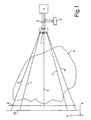
- FIG. 1 lies, for example, in the yz plane. Emitted radiation from a medium 9 to be examined and the transmitted radiation from the background 10 are distributed by a common entrance optics 1 via a beam splitter 2 to the spectrometer 4 and the image sensor 3. In this arrangement, image sensor 3 and spectrometer 4 therefore “see” through the same entrance optics 1, the optical axis 5 of which is selected in the direction of the z-axis.
- Preferred application of the arrangement described above is the observation of high temperature events, like fires or volcanic eruptions on the earth’s surface can be observed from satellites or aircraft.
- a another application is the observation of hot engine exhaust gases, which are measured on the test bench or in flight.
- the invention The procedure is generally for any media applicable.
- Typical values can be given for the size of the visual fields.
- a satellite-based, nadir-looking spectrometer has a field of view on the ground of approximately 100 km 2 (dimensions approx. 10 km x 10 km ) when observed from a height of approximately 700 km and the field of view of a pixel of the imaging sensor corresponds to approximately 0.1 km 2 ( Dimensions approx. 0.3 km x 0.3 km). This results in approx. 1000 pixels that overlap with the spectrometer field of view. If the image sensor has 1024 detector elements per line, the dimension of the field of view on the ground transverse to the flight direction of the satellite is approximately 300 km.
- Carbon monoxide can be in the range of 4.55 to 4.88 ⁇ m
- carbon dioxide and the gas temperature can be in the range of the absorption band edges at 13.0 to 15.4 ⁇ m and 4.13 to 4.26 ⁇ m and water vapor in the range of 4.88 observe up to 5.13 ⁇ m
- Smoke particles emit weak wavelengths over the entire spectral range between 15 ⁇ m and 0.6 ⁇ m.
- Sulfur dioxide emits at 8.55 ⁇ m to 8.70 ⁇ m, 7.30 ⁇ m to 7.41 ⁇ m and 3.97 ⁇ m to 4.00 ⁇ m, methane at 7.41 ⁇ m to 8.33 ⁇ m and 3.44 ⁇ m to 3.70 ⁇ m and nitrogen oxides (NO, NO 2 ) at 6.10 to 6.29 ⁇ m, 5.34 to 5.29 ⁇ m and 3.41 to 3.44 ⁇ m.
- the properties of the background radiation from the floor can be determined in the atmospheric window areas.
- the image sensor 3 operates approximately in the known atmospheric window regions in t hermischen I nfra r ot (TIR) from 8 to 12 microns, in m ittleren I nfra r ot (MIR) of 3 to 5 .mu.m and n Ahen I nfra r ot (NIR) from 0.8 to 0.9 ⁇ m.
- TIR t hermischen I nfra r ot
- MIR m ittleren I nfra r ot
- NIR n Ahen I nfra r ot
- the evaluation method according to the invention becomes a regulation to evaluate the combination of image and spectral data specified.
- 2 is a perpendicular to the z-axis running section 8 shown in Figure 1 in the xy plane.
- the field of view 6 of the image sensor 3 is rectangular here and the field of view 7 of the spectrometer 4 as circular accepted.
- the visual fields can also be any have other shapes.
- the field of view of the image sensor 3 is in rectangular areas divided that mapped onto the pixels of the sensor become. With real image sensors 3 it must be taken into account that the pixels through diffraction effects and crosstalk mutually influence of detector elements.
- the quantities ⁇ i are known from the geometry of the measuring arrangement.
- the radiation is transported from the area i along the line of sight to the entrance optics 1 through the medium to be examined to the image sensor 3 and to the spectrometer 4.
- This radiation transport depends on a set of parameters ⁇ i that describe the properties of the medium and a set of parameters b i that describe the properties of the background radiation.
- the parameters ⁇ i and b i represent the sizes searched.
- the parameter vectors correspond ⁇ i and b i a discretized approximation of functions ⁇ (x, y, z) and b (x, y), which depend continuously on the spatial coordinates.
- ⁇ (x, y, z) a discretized approximation of functions ⁇ (x, y, z) and b (x, y), which depend continuously on the spatial coordinates.
- a specific discretization rule for ⁇ (x, y, z) along the z axis will be given later.
- the radiation transport can be modeled in a known manner.
- the total area with the elements i -1, i , i + 1 is designated by the reference number 11, which is described in more detail with reference to FIG.
- the spectrometer 4 has only one field of view; in general however, all of the following considerations can be simple can be extended to several fields of view of spectrometer 4, adding formalism to every field of view of the spectrometer is applied individually.
- Each area i in FIG. 2 has a low-resolution spectrum I l / i ( v, b i ⁇ i ) of the image sensor 3.
- v denotes the wave number in cm -1 .
- Such classifications can be carried out in a known manner. The summary is achieved by summing up the spectra. As a result, the computing time is significantly reduced later in the evaluation, since not every radiation transport along each individual line of sight has to be calculated.
- the contribution of the area k to the spectrally high-resolution overall spectrum of the spectrometer is through given.
- the high-resolution total spectrum of the spectrometer is a superposition of the individual contributions I h / k (v, b k , ⁇ k )
- a discretization rule for the parameter vectors sought is also created ⁇ k specified.
- ⁇ k a property of the medium depending on the spatial coordinates, for example a concentration profile.
- Points 13 are the discretization points of vectors ⁇ i -1 , ⁇ i and ⁇ i + 1 along the respective line of sight. They are the components of a vector ⁇ i Values of the profile along the z axis of the coordinate system. All components of the vectors with the number j belong to the same z coordinate. The values between adjacent discretization points can be determined, for example, by linear interpolation.
- the starting point for the search for the unknown set of parameters is that the measured spectra of the image sensor 3 and the spectrum of the spectrometer 4 are given at discrete spectral support points.
- the vector notation for the measured spectra is therefore introduced, the component of a vector corresponding to the value of the spectrum at a specific frequency.
- I. h is the measured spectrum of the spectrometer 4 I. l / k ( b k , ⁇ k ) the theoretical fit model for the spectra of the image sensor 3 and I. h ( b 1 , ..., b k , ⁇ 1 , ..., ⁇ K ) the corresponding fit model for the spectrum of the spectrometer 4.
- Both models are generally non-linear functions with respect to the parameter vectors.
- the Fit models can also be used be put together.
- the minimization problem (3) can also be used as can be written, where W -1 is a matrix indicating the weighting between measurements.
- the matrix W -1 is generally proportional to the inverse of the variance-covariance matrix of the measurement vectors, and has a block diagonal shape.
- the minimization problem (8) can be done in a known manner by a nonlinear minimization method if that Problem is well posed. Usually, however, the minimization problem (8) not clearly solvable, or badly posed his. Solvability can be increased by introducing additional physically meaningful, application-related constraints, such as positivity, smoothness or monotony the solution. Monotony and positivity are in a known manner by linear constraints introduce. The smoothing is in a known manner by introduction quadratic constraints achievable.
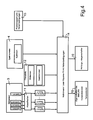
- the sequence of an evaluation is shown schematically in FIG. First, the overlapping area of image sensor 3 and spectrometer 4 is numbered as described in FIG. 2. Then the n measured spectra of the pixels of the image sensor 3 are first classified according to their spectral characteristics in a known manner in a classification device 11 and the weights ß k are formed over the area portions of the pixels of a class according to Eq. (1). The classification thus delivers a set of k low-resolution spectra of the combined image areas by summing up the low-resolution spectra of the image points of a class. This enables a considerable reduction in the computing times in the evaluation, since the radiation transport does not have to be carried out for every pixel, but only for each class.
- Each class is characterized by its background temperature, gas concentration and temperature profiles described; assuming this parameter set is used for each class in a fit modeling facility 12 on the one hand a low resolution Image spectrum and on the other hand a high-resolution spectrum modeled, the linear combination of these high-resolution Spectra according to Eq. (2) the modeled high-resolution Spectrum of the spectrometer 4 provides.
- the nonlinear optimization problem is known in a device 14 for processing the non-linear Least-square fits with constraints iteratively through variation the class parameters solved until the modeled and observed spectra (taking into account the noise) To match.
- the result is the distribution at output 15 the concentrations and temperatures in the medium under investigation and at output 16 the properties of the background.
Landscapes
- Physics & Mathematics (AREA)
- Spectroscopy & Molecular Physics (AREA)
- General Physics & Mathematics (AREA)
- Health & Medical Sciences (AREA)
- Life Sciences & Earth Sciences (AREA)
- Chemical & Material Sciences (AREA)
- Analytical Chemistry (AREA)
- Biochemistry (AREA)
- General Health & Medical Sciences (AREA)
- Immunology (AREA)
- Pathology (AREA)
- Investigating Or Analysing Materials By Optical Means (AREA)
Applications Claiming Priority (4)
| Application Number | Priority Date | Filing Date | Title |
|---|---|---|---|
| DE19854679 | 1998-11-26 | ||
| DE19854679 | 1998-11-26 | ||
| DE19915493A DE19915493C2 (de) | 1998-11-26 | 1999-04-07 | Verfahren und Vorrichtung zum Bestimmen von Konzentrations- und Temperaturverteilungen von beliebigen, vorzugsweise gasförmigen Medien |
| DE19915493 | 1999-04-07 |
Publications (2)
| Publication Number | Publication Date |
|---|---|
| EP1004861A1 true EP1004861A1 (fr) | 2000-05-31 |
| EP1004861B1 EP1004861B1 (fr) | 2002-10-09 |
Family
ID=26050410
Family Applications (1)
| Application Number | Title | Priority Date | Filing Date |
|---|---|---|---|
| EP99122300A Expired - Lifetime EP1004861B1 (fr) | 1998-11-26 | 1999-11-09 | Procédé et dispositif pour déterminer la répartition de concentration et de température d'un milieu quelconque, de préférence gazeux |
Country Status (2)
| Country | Link |
|---|---|
| EP (1) | EP1004861B1 (fr) |
| ES (1) | ES2181357T3 (fr) |
Cited By (1)
| Publication number | Priority date | Publication date | Assignee | Title |
|---|---|---|---|---|
| CN107462528A (zh) * | 2017-08-02 | 2017-12-12 | 塔里木大学 | 一种多通道光谱检测红枣品质的方法 |
Families Citing this family (1)
| Publication number | Priority date | Publication date | Assignee | Title |
|---|---|---|---|---|
| DE102004001748B4 (de) * | 2004-01-12 | 2006-04-20 | Deutsches Zentrum für Luft- und Raumfahrt e.V. | Verfahren zum Analysieren von beliebigen, vorzugsweise gasförmigen Medien |
-
1999
- 1999-11-09 ES ES99122300T patent/ES2181357T3/es not_active Expired - Lifetime
- 1999-11-09 EP EP99122300A patent/EP1004861B1/fr not_active Expired - Lifetime
Non-Patent Citations (5)
| Title |
|---|
| ALTHOUSE M L G: "CHEMICAL VAPOR DETECTION WITH A MULTISPECTRAL THERMAL IMAGER", OPTICAL ENGINEERING,US,SOC. OF PHOTO-OPTICAL INSTRUMENTATION ENGINEERS. BELLINGHAM, vol. 30, no. 11, 1 November 1991 (1991-11-01), pages 1725 - 1732, XP000234518, ISSN: 0091-3286 * |
| BETREMIEUX Y ET AL: "SPINR: TWO-DIMENSIONAL SPECTRAL IMAGING THROUGH TOMOGRAPHIC RECONSTRUCTION", OPTICAL ENGINEERING,US,SOC. OF PHOTO-OPTICAL INSTRUMENTATION ENGINEERS. BELLINGHAM, vol. 32, no. 12, 1 December 1993 (1993-12-01), pages 3133 - 3138, XP000415650, ISSN: 0091-3286 * |
| D.Q. WARK E.A.: "NIMBUS SATELLITE INFRARED SPECTROMETER EXPERIMENT", IEEE TRANSACTIONS ON GEOSCIENCE ELECTRONICS., vol. 8, no. 4, October 1970 (1970-10-01), IEEE INC. NEW YORK., US, pages 264 - 270, XP002130600 * |
| DUNLOP J D: "COMBINING SPECTRAL AND SPATIAL MODE IMAGERY FROM AN IMAGING SPECTROMETER", PROCEEDINGS OF THE INTERNATIONAL GEOSCIENCE AND REMOTE SENSING SYMPOSIUM. (IGARSS),US,NEW YORK, IEEE, vol. SYMP. 12, 1989, pages 2077 - 2080, XP000139355 * |
| MOIRA HILTON ET AL: "QUANTITATIVE ANALYSIS OF REMOTE GAS TEMPERATURES AND CONCENTRATIONSFROM THEIR INFRARED EMISSION SPECTRA", MEASUREMENT SCIENCE AND TECHNOLOGY,GB,IOP PUBLISHING, BRISTOL, vol. 6, no. 9, 1 September 1995 (1995-09-01), pages 1236 - 1241, XP000528779, ISSN: 0957-0233 * |
Cited By (1)
| Publication number | Priority date | Publication date | Assignee | Title |
|---|---|---|---|---|
| CN107462528A (zh) * | 2017-08-02 | 2017-12-12 | 塔里木大学 | 一种多通道光谱检测红枣品质的方法 |
Also Published As
| Publication number | Publication date |
|---|---|
| ES2181357T3 (es) | 2003-02-16 |
| EP1004861B1 (fr) | 2002-10-09 |
Similar Documents
| Publication | Publication Date | Title |
|---|---|---|
| EP0959341B1 (fr) | Méthode d'analyse quantitative de volume de gaz, notamment d'un dispositif de combustion, et dispositif pour sa mise en oeuvre | |
| Hyyppä et al. | Accuracy comparison of various remote sensing data sources in the retrieval of forest stand attributes | |
| DE69218536T2 (de) | Verfahren und Gerät zur Spektrenvergleichung | |
| DE102018114860A1 (de) | Vorrichtung und Verfahren zur optischen Vermessung eines Messobjekts | |
| DE2935812A1 (de) | Verfahren zur werkstoffpruefung | |
| DE69919853T2 (de) | Vorrichtung und verfahren zur unmittelbaren messung des heizwertes eines brennbaren gases | |
| DE19548378A1 (de) | Verfahren und Gerätekombination zur Herstellung der Vergleichbarkeit von Spektrometermessungen | |
| DE2130331A1 (de) | Verfahren und Vorrichtung zur Konzentrationsbestimmung von Gasen durch optische Extinktionsmessung | |
| EP0952441B1 (fr) | Procédé pour déterminer la fluorescence induite par le soleil | |
| DE102008050046B3 (de) | Verfahren zum Bestimmen von Konzentrations-, Druck- und Temperaturprofilen in beliebigen, vorzugsweise gasförmigen Medien | |
| EP1004861B1 (fr) | Procédé et dispositif pour déterminer la répartition de concentration et de température d'un milieu quelconque, de préférence gazeux | |
| DE4324154A1 (de) | Vorrichtung und Verfahren zur räumlich hochauflösenden Analyse mindestens einer Gaskomponente in einem Gasgemisch | |
| DE4324118C2 (de) | Verfahren und Vorrichtung zur Bestimmung der Emissionsrate mindestens einer Gaskomponente eines Gasgemischs | |
| DE69514379T2 (de) | Verfahren zum bewerten von nichteuclidischen effekten in einem mit einem luft-radar erzeugtem bild, und sattelit zu dessen durchführung | |
| DE19915493C2 (de) | Verfahren und Vorrichtung zum Bestimmen von Konzentrations- und Temperaturverteilungen von beliebigen, vorzugsweise gasförmigen Medien | |
| EP0843812A1 (fr) | Procede de mesure a distance de polluants atmospheriques | |
| DE102005060245B3 (de) | Verfahren zur Bestimmung von Konzentrations-, Druck- und Temperaturprofilen von Gasen in Verbrennungsprozessen und deren Abgasströmen und -wolken | |
| DE10196598B4 (de) | Passive Entfernungsmessung zu einem Sonneneinstrahlung reflektierenden Ziel | |
| WO2004106853A1 (fr) | Dispositif et procede pour reconnaitre des couches qui sont appliquees a la surface de pieces, et determination de leurs proprietes | |
| DE10140945B4 (de) | Verfahren zur Konzentrationsmessung mehrerer Gaskomponenten in einer Gasprobe | |
| EP4176237B1 (fr) | Procédé d'estimation de l'influence de granularités sur une qualité d'un étalonnage radiométrique d'un spectromètre d'imagerie | |
| DE3801187C1 (en) | Method for gas analysis and gas analyser | |
| DE19719211B4 (de) | Verfahren zur Kalibrierung von Spektralradiometern | |
| DE3843302A1 (de) | Passive Entfernungsmeßeinrichtung | |
| DE102019101650A1 (de) | Verfahren zur ellipsometrischen Bestimmung von Eigenschaften einer Probe |
Legal Events
| Date | Code | Title | Description |
|---|---|---|---|
| PUAI | Public reference made under article 153(3) epc to a published international application that has entered the european phase |
Free format text: ORIGINAL CODE: 0009012 |
|
| AK | Designated contracting states |
Kind code of ref document: A1 Designated state(s): DE ES IT |
|
| AX | Request for extension of the european patent |
Free format text: AL;LT;LV;MK;RO;SI |
|
| 17P | Request for examination filed |
Effective date: 20001125 |
|
| AKX | Designation fees paid |
Free format text: DE ES IT |
|
| 17Q | First examination report despatched |
Effective date: 20011023 |
|
| GRAG | Despatch of communication of intention to grant |
Free format text: ORIGINAL CODE: EPIDOS AGRA |
|
| GRAG | Despatch of communication of intention to grant |
Free format text: ORIGINAL CODE: EPIDOS AGRA |
|
| GRAH | Despatch of communication of intention to grant a patent |
Free format text: ORIGINAL CODE: EPIDOS IGRA |
|
| GRAH | Despatch of communication of intention to grant a patent |
Free format text: ORIGINAL CODE: EPIDOS IGRA |
|
| GRAA | (expected) grant |
Free format text: ORIGINAL CODE: 0009210 |
|
| AK | Designated contracting states |
Kind code of ref document: B1 Designated state(s): DE ES IT |
|
| REF | Corresponds to: |
Ref document number: 59903012 Country of ref document: DE Date of ref document: 20021114 |
|
| REG | Reference to a national code |
Ref country code: ES Ref legal event code: FG2A Ref document number: 2181357 Country of ref document: ES Kind code of ref document: T3 |
|
| PLBE | No opposition filed within time limit |
Free format text: ORIGINAL CODE: 0009261 |
|
| STAA | Information on the status of an ep patent application or granted ep patent |
Free format text: STATUS: NO OPPOSITION FILED WITHIN TIME LIMIT |
|
| 26N | No opposition filed |
Effective date: 20030710 |
|
| PGFP | Annual fee paid to national office [announced via postgrant information from national office to epo] |
Ref country code: ES Payment date: 20071127 Year of fee payment: 9 Ref country code: DE Payment date: 20071101 Year of fee payment: 9 |
|
| PGFP | Annual fee paid to national office [announced via postgrant information from national office to epo] |
Ref country code: IT Payment date: 20071127 Year of fee payment: 9 |
|
| PG25 | Lapsed in a contracting state [announced via postgrant information from national office to epo] |
Ref country code: IT Free format text: LAPSE BECAUSE OF NON-PAYMENT OF DUE FEES Effective date: 20081109 |
|
| PG25 | Lapsed in a contracting state [announced via postgrant information from national office to epo] |
Ref country code: DE Free format text: LAPSE BECAUSE OF NON-PAYMENT OF DUE FEES Effective date: 20090603 |
|
| REG | Reference to a national code |
Ref country code: ES Ref legal event code: FD2A Effective date: 20081110 |
|
| PG25 | Lapsed in a contracting state [announced via postgrant information from national office to epo] |
Ref country code: ES Free format text: LAPSE BECAUSE OF NON-PAYMENT OF DUE FEES Effective date: 20081110 |