EP1005178B1 - Recherche de cellule dans un système à large bande et de communications à acces multiple par difference de code - Google Patents
Recherche de cellule dans un système à large bande et de communications à acces multiple par difference de code Download PDFInfo
- Publication number
- EP1005178B1 EP1005178B1 EP19990308412 EP99308412A EP1005178B1 EP 1005178 B1 EP1005178 B1 EP 1005178B1 EP 19990308412 EP19990308412 EP 19990308412 EP 99308412 A EP99308412 A EP 99308412A EP 1005178 B1 EP1005178 B1 EP 1005178B1
- Authority
- EP
- European Patent Office
- Prior art keywords
- code
- frame
- long code
- slot
- long
- Prior art date
- Legal status (The legal status is an assumption and is not a legal conclusion. Google has not performed a legal analysis and makes no representation as to the accuracy of the status listed.)
- Expired - Lifetime
Links
Images





Classifications
-
- H—ELECTRICITY
- H04—ELECTRIC COMMUNICATION TECHNIQUE
- H04B—TRANSMISSION
- H04B1/00—Details of transmission systems, not covered by a single one of groups H04B3/00 - H04B13/00; Details of transmission systems not characterised by the medium used for transmission
- H04B1/69—Spread spectrum techniques
- H04B1/707—Spread spectrum techniques using direct sequence modulation
- H04B1/7073—Synchronisation aspects
- H04B1/7083—Cell search, e.g. using a three-step approach
Definitions
- the present invention relates to a cell searching method in an asynchronous wideband code division multiple access system.
- IS-95 CDMA In an interim standard (IS)-95 CDMA system, all base stations operate by using a frame synchronization between base stations based on an external time such as a global positioning system (GPS) receiver.
- GPS global positioning system
- a wideband CDMA system which has been proposed in Europe or Japan as an international mobile telecommunication system-2000 wireless transmission technique, all the mobile stations can operate without a frame synchronization between base stations differently from that of the IS-95 CDMA system.
- synchronous IS-95 CDMA system a mobile station discriminates each base station based on a phase difference with respect to an absolute time of one code sequence.
- the mobile station discriminates each base station based on different code sequences.
- a cell searching time of a mobile station is lengthened at an initial calling set or a hand off.
- it uses two synchronization channels in a forward link.
- U.S. Patent No. 5,765,111 discloses a method and apparatus for selectively calling a mobile station by generating a ring signal at only a selected mobile station among a plurality of mobile stations registered to a private base station.
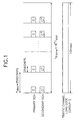
- FIG. 1 shows a synchronization channel structure of a forward link which is used for a conventionally asynchronous wideband CDMA system.
- the synchronization channel(SCH) of a forward link includes a primary SCH(C) and a secondary SCH C i 1 ⁇ C i 2 ... C i 15 ⁇ C i 16 .
- the primary SCH(C) is composed of a binary code having 256 chips which are not modulated. Each code of the primary SCH(C) is transmitted every slot at a slot boundary.
- the slot has a length of 0.625 msec.
- One frame of the primary SCH(C) has a time interval of 10 msec.
- each code of the primary SCH(C) is transmitted every slot, that is, sixteen codes of the primary SCH(C) are repeatedly transmitted in every frame.
- all base stations use an identical code as the primary SCH(C).
- the primary SCH(C) is used for searching a starting location of 16 slots per one frame.
- the secondary SCH C i 1 ⁇ C i 2 ... C i 15 ⁇ C i 16 is composed of sixteen code sequences of an orthogonally binary gold code which have not been modulated. Each of the sixteen code sequences corresponds to each of the primary SCH(C). Each element of the secondary SCH C i 1 ⁇ C i 2 ... C i 15 ⁇ C i 16 is selected from an orthogonally binary code group (C 1 , C 2 , ..., C 16 , C 17 ) each having seventeen elements. That is, C i t ⁇ C 1 ⁇ C 2 ... C 16 ⁇ C 17 .
- the secondary SCH C i 1 ⁇ C i 2 ... C i 15 ⁇ C i 16 indicates a code group (group i) to which a long code belongs.
- a current base station uses the long code.
- 512 different long codes are used in the system and divided into 32 long code groups.
- Each of the 32 long code groups is discriminated based on the secondary SCH C i 1 ⁇ C i 2 ... C i 15 ⁇ C i 16 . That is, 32 different secondary SCHs are present at the system.
- the secondary SCH uses a hopping code such as a Reed-Solomon code.
- An alphabet size and a length of the secondary SCH are 17 and 16, respectively.
- 32 possible sequences of the secondary SCH C i 1 ⁇ C i 2 ... C i 15 ⁇ C i 16 are unique with respect to a cyclic shift.
- an optionally cyclic shift, a code sequence length of which is smaller than 16 and is not zero, is always different from a cyclic shift except the optional cyclic shift, a code sequence length of which is smaller than 16.
- Such a feature of the secondary SCH is used for uniquely determining a long code group and a starting point of 10 msec frame by means of a mobile station.
- FIG. 2 illustrates an initial synchronization obtaining method by a mobile station.
- a mobile station(not shown) searches a predetermined starting point of a slot with respect to a base station(not shown) having a minimal channel loss by using a primary SCH(C), as shown in FIG. 1 , by means of a matched filter(not shown).
- step S202 the mobile station obtains long code group information and frame sync information of 10 msec.
- the long code group information and frame sync information of 10 msec are obtained by correlating 17 possible secondary SCH C i 1 ⁇ C i 2 ... C i 15 ⁇ C i 16 with respect to a mobile station receiving signal at a slot location.
- the step S202 will be described in detail below.
- the mobile station calculates decision variables with respect to 512 sequences which includes 32 possible sequences and 16 cyclic shifts each that the 32 possible sequences may have.
- the decision variables are obtained by non-coherently adding 17 correlator outputs with respect to a sequence corresponding to a corresponding decision variable at each of 16 secondary synchronization channel locations.
- the mobile station obtains the long code group information and frame sync information by selecting a maximum value among 512 decision variables.
- step S203 the mobile station judges what kind of code is the long code based on the long code group information and frame sync information, that is, a frame location information(frame boundary) obtained in step S202. That is, correlating operations with respect to 16 long codes included in the long code group obtained in step S202 are performed to obtain correlating results.
- a maximum value of the correlating results is larger than a set threshold value, the mobile station judges that the long code having the maximum value is a code for a band spreading of a forward link which a current base station uses.
- the conventional cell searching method is satisfied with orthogonal feature between a forward synchronization channel and a traffic channel.
- An interference between a synchronization channel and a traffic channel with respect to a signal received through an identical path of an identical cell occurs.
- the interference causes reduction in a capacity of a forward link and increases a searching time of a mobile station.
- the conventional cell searching method needs two sync channels and a mobile station needs 17 parallel correlators so that it has a complex configuration. Since the 17 parallel correlators should be used to continue searching a neighboring cell for a handoff after a call set, power consumption is increased.
- EP 0,825,737 discloses a method of code synchronizing where a control channel information signal and traffic channel information signals are each spread by different first spreading codes which are fed from a first spreading code generator, and which have a period equal to the period of an information signal.
- each cell uses a unique downlink scrambling code of length 10 msec.
- the set of scrambling codes is divided into groups with a limited number of codes in each group.
- a cell searching method in an asynchronous wideband code division multiple access system comprising the steps of:
- FIG. 3 is a view for showing a sync channel structure of a forward link which is used for an asynchronous wideband code division multiple access system according to a first embodiment of the present invention.
- a sync channel code 302 is composed of a binary code having N(where, N is a positive integer) chips which are not modulated. Each code of the sync channel codes is transmitted every slot at a slot boundary.
- T frame represents a frame length.
- One frame is divided into L(where, L is a positive integer) slots.
- the slot is divided into a plurality of mini slots.
- a length of the mini slot is ⁇ T c , where ⁇ is a positive integer and T c represents a chip width which is used for the system.
- a sync channel code location of each slot has a value which coincides with each code element of a time hopping code corresponding to a long code group to which a current base station belongs.
- a length of a time hopping code used for the present invention is identical with the number L of slots per frame.
- An alphabet size M of each time hopping code has a value which is equal to or fewer than the number of slots.
- the number of time hopping codes which is used for the present invention is identical with the number of long code groups and is represented as N GROUP .
- Time hopping code sequences according to the present invention should be uniquely designed with respect to a cyclic shift of a code. That is, an optional code sequence which has performed one cyclic shift or cyclic shifts except L cyclic shifts is different from another code sequence which has performed cyclic shifts smaller than the L cyclic shifts. This feature causes the mobile station to uniquely determine long code group information and frame sync information while searching a cell.
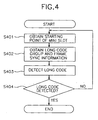
- FIG. 4 is a flow chart for illustrating a fast cell searching method in an asynchronous wideband code division multiple access system according to a first embodiment of the present invention.
- a mobile station(not shown) obtains a predetermined starting point of a mini slot among a plurality of sync channel code locations in a frame with respect to a base station(not shown) having a minimal channel loss.
- step S402 the mobile station obtains long code group information and starting point information of 10 msec frame, that is, frame sync information by using outputs of a matched filter(not shown) every mini slot clock location, that is, in every ⁇ chips for one frame after a starting point of a current mini slot.
- the step S402 will be described in detail below.
- the mobile station has all possible cyclic shift information of a time hopping code sequence, that is, shift information of N GROUP ⁇ L.
- the mobile station obtains the long code group and frame sync information by using shift information of N GROUP ⁇ L and outputs of a matched filter every mini slot clock location. That is, the mobile station calculates decision variables for one frame corresponding to each of N GROUP ⁇ L sequences.
- Each decision variable is obtained by non-coherently adding outputs of the matched filter in relative locations which correspond to each element of a corresponding code sequence.
- the relative location is determined by a first element value of each time hopping code sequence. That is, each decision variable is a sum of 16 outputs of the matched filter which is selected every slot.
- the mobile station obtains the long code group and frame sync information by selecting a maximum value among N GROUP ⁇ L (512) decision variables.
- FIG. 5 is a view for illustrating the step S402 shown in FIG. 4 .
- the number of long code groups is two.
- T frame represents a frame length.
- One frame is divided into four slots.
- the slot is divided into five mini slots.
- the number of mini slots per slot is 5 and an alphabet size of a time hopping code is identical with the number of mini slots per slot.
- a time hopping code of a first group is (1 3 3 4)and a time hopping code of a second group is (4 0 2 1).
- FIG. 6 shows one example of a time hopping code which may be used for the fast cell searching method illustrated in FIG. 4 .
- the time hopping code is a subset of Reed-Solomon codewords whose alphabet size is 17 and the length is 16. All 16 cyclic shifts of each code word are unique, and the minimum Hamming distance between code words is 14.
- the time hopping code can be used to encode 32 long code groups, and to provide complete frame timing information.
- the maximum number of hitting between any two sequences for any mini slot wise(128 chips) time shift is 4, even though the number of mini slots per slot(0.625 msec) is 20 (because the alphabet size of hopping code is 17, the last 13 mini slots are not used).
- step S403 the mobile station detects a long code by using the long code group and frame sync information obtained in step S402.
- a correlating operation with respect to long codes corresponding to a long code group obtained in step S402 is performed from a starting point of a frame obtained in step S402 to obtain the correlating results.
- the mobile station judges that the long code having the maximum value is a code which is used for band-spreading of a forward link by a current base station.
- step S404 the mobile station judges whether the long code is detected. As a result of the judgement in step S404, when the long code is not detected, the routine returns to step S401. On the contrary, when it is judged in step S404 that the long code is detected, a total operation finishes.
- a sync channel code is inserted at a sync channel code location with respect to a long code.
- the long code is used for a direct sequence band spreading of a traffic channel.
- a detecting probability of a sync channel code matched filter is increased to reduce an initial sync obtaining time of a mobile station.
- one of two sync channel codes is inserted into a long code and the other sync channel code remains so that it does not satisfy orothogonal feature.
- a capacity of a traffic channel can be reduced when a slot starting point is in accord with a neighboring base station.
- a binary hopping code having a good correlating and self-relating feature is used for modulating a location of a sync channel code, it can solve the disadvantages of the conventional method.
- FIG. 7 is a flow chart for illustrating a fast cell searching method in an asynchronous wideband code division multiple access system according to a second embodiment of the present invention.
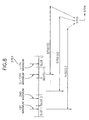
- FIG. 8 is a view for illustrating a principle of a fast cell searching method illustrated in FIG. 7 .
- a receiver(not shown) according to the present invention selects one maximum value among 2560 sampling values every one slot at L pieces of slots, that is, L pieces of maximum values per frame, that is, L maximum values per frame.
- the L is 16.
- step S702 the receiver selects S(where, 2 ⁇ S ⁇ L) pieces of maximum values among the L pieces of maximum values per frame from the greatest value in order and calculates (N GROUP ⁇ L ⁇ S) decision variables corresponding to each of a plurality of pseudo time hopping code sequences with respect to each location which corresponds to the S pieces of selected maximum values.
- the N GROUP represents the number of long code groups which are used in the system.
- the N GROUP is 32.
- Each of the decision variables is obtained by non-coherently adding outputs of the matched filter at a relative location which corresponds to each element of a corresponding code sequence. The relative location is determined by a first element of each of the time hopping code sequences. That is, each decision variable is a sum of 16 outputs of the matched filter in which one variable is selected every slot.
- a mobile station(not shown) obtains long code group and frame sync information by selecting a maximum value among the (N GROUP ⁇ L ⁇ S) decision variables calculated in step S702.
- the frame sync information represents information with respect to a starting point of a frame.
- step S704 the mobile station detects a long code that is used for band spreading of a forward link by a current base station by using the long code group and frame sync information detected in step S703.
- a correlating operation with respect to long codes corresponding to a long code group obtained in step S703 is performed from a starting point of a frame obtained in step S703 to obtain the correlating results.
- the mobile station judges that the long code having the maximum value is a code which is used for band-spreading of a forward link by a current base station.
- FIG. 9 is a flow chart for illustrating a fast cell searching method in an asynchronous wideband code division multiple access system according to a third embodiment of the present invention.
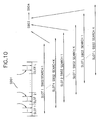
- FIG. 10 is a view for illustrating a principle of a fast cell searching method illustrated in FIG. 9 .
- a receiver(not shown) selects K(where, K is an integer greater than 1) maximum values per frame among 2560 sampling values every one slot at L pieces of slots, that is, (LxK) values per frame.
- K is an integer greater than 1
- the L is 16.
- step S902 the receiver calculates (N NEIGHBORD ⁇ L ⁇ K ⁇ L) decision variables corresponding to each of a plurality of pseudo time hopping code sequences with respect to each location which corresponds to the (K ⁇ L) selected maximum values.
- the N NEIGHBORD represents the number of groups of a neighboring cell that a mobile station should search in a mobile station idle or active state.
- 1 ⁇ N NEIGHBORD ⁇ N GROUP .
- Each of the decision variables is obtained by non-coherently adding outputs of the matched filter at a relative location which corresponds to each element of a corresponding code sequence. The relative location is determined by a first element of each of the time hopping code sequences.
- a mobile station(not shown) obtains long code group and frame sync information by selecting a maximum value among the (N NEIGHBOR ⁇ L ⁇ K ⁇ L) decision variables calculated in step S902.
- step S904 the mobile station detects a long code that is used for band spreading of a forward link by a current base station by using the long code group and frame sync information detected in step S903.
- a correlating operation with respect to long codes corresponding to a long code group obtained in step S903 is performed from a starting point of a frame obtained in step S903 to obtain the correlating results.
- the mobile station judges that the long code having the maximum value is a code which is used for band-spreading of a forward link by a current base station.
- a cell searching operation can be performed by one sync channel and a parallel correlator for obtaining long code group information and frame sync information of 10 msec is not necessary. Orthogonal feature between a sync channel and a traffic channel of a forward link can be maintained. Accordingly, the present invention reduces an initial sync obtaining time compared with the conventional cell searching method. No reduction of a capacity of a forward channel occurs and a complex of a mobile station can be reduced. Since an error which can be generated while obtaining long code group and frame sync information is reduced, a cell searching time is reduced so cell searching performance is increased.
- the present invention in a second step uses outputs of a matched filter which are obtained in a first step so that additional hardware is not needed and a little calculation can improve a cell searching performance.
Landscapes
- Engineering & Computer Science (AREA)
- Computer Networks & Wireless Communication (AREA)
- Signal Processing (AREA)
- Mobile Radio Communication Systems (AREA)
Claims (3)
- Procédé de recherche de cellule dans un système à accès multiple par répartition en code à large bande asynchrone, ledit procédé comprenant les étapes consistant à :obtenir un point de départ prédéterminé (S401) parmi une pluralité d'emplacements de codes de canal de synchronisation dans une trame relativement à une station de base ayant un affaiblissement de canal minimal ;obtenir des informations de groupe de codes longs et de synchronisation de trame (S402) au niveau de la station mobile sur la base de sorties d'un filtre adapté à chaque emplacement d'horloge de mini-tranche pour une durée de trame après un point de départ d'une mini-tranche actuelle, l'étape consistant à obtenir des informations de groupe de codes longs et de synchronisation de trame comprenant en outre :le procédé de recherche de cellule comprenant en outre la détection d'un code long (S403) sur la base des informations de groupe de codes longs et de synchronisation de trame obtenues, dans lequel le code long est utilisé pour l'étalement de bande d'une liaison aller par une station de base actuelle.le calcul d'une pluralité de variables de décision correspondant à chacune d'une pluralité de séquences de codes de sauts temporels sur la base des sorties d'un filtre adapté ;la sélection d'une séquence de codes de sauts temporels correspondant à une variable de décision ayant une valeur maximum parmi la pluralité de variables de décision ; etl'obtention des informations de groupe de codes longs et de synchronisation de trame sur la base de la séquence de codes de sauts temporels sélectionnée ;
- Procédé selon la revendication 1, dans lequel chacun des codes de canal de synchronisation est composé d'un code binaire ayant 156 éléments qui ne sont pas modulés, chacun des codes de canal de synchronisation est transmis à chaque tranche au niveau d'une limite de tranche, une trame est divisée en 16 tranches, et la tranche est divisée en une pluralité de mini-tranches.
- Procédé selon la revendication 1, dans lequel une opération de corrélation relativement aux codes longs correspondant à un groupe de codes longs obtenu est effectuée depuis un point de départ de la trame pour obtenir les résultats de corrélation, et la station mobile juge que le code long ayant la valeur maximum est un code qui est utilisé pour l'étalement de bande d'une liaison aller par une station de base actuelle lorsqu'une valeur maximum parmi les résultats de corrélation est supérieure à une valeur de seuil établie.
Applications Claiming Priority (4)
| Application Number | Priority Date | Filing Date | Title |
|---|---|---|---|
| KR4562598 | 1998-10-26 | ||
| KR19980045625 | 1998-10-26 | ||
| KR1019990039503A KR100340932B1 (ko) | 1998-10-26 | 1999-09-15 | 비동기식 광대역 부호 분할 다중 접속 시스템에서의 셀 탐색 방법 |
| KR3950399 | 1999-09-15 |
Publications (3)
| Publication Number | Publication Date |
|---|---|
| EP1005178A2 EP1005178A2 (fr) | 2000-05-31 |
| EP1005178A3 EP1005178A3 (fr) | 2003-07-23 |
| EP1005178B1 true EP1005178B1 (fr) | 2008-05-07 |
Family
ID=26634265
Family Applications (1)
| Application Number | Title | Priority Date | Filing Date |
|---|---|---|---|
| EP19990308412 Expired - Lifetime EP1005178B1 (fr) | 1998-10-26 | 1999-10-25 | Recherche de cellule dans un système à large bande et de communications à acces multiple par difference de code |
Country Status (7)
| Country | Link |
|---|---|
| US (1) | US6571099B1 (fr) |
| EP (1) | EP1005178B1 (fr) |
| JP (1) | JP3357017B2 (fr) |
| KR (1) | KR100340932B1 (fr) |
| CN (3) | CN100341377C (fr) |
| CA (1) | CA2287810C (fr) |
| DE (1) | DE69938644D1 (fr) |
Families Citing this family (30)
| Publication number | Priority date | Publication date | Assignee | Title |
|---|---|---|---|---|
| JP3411836B2 (ja) | 1998-10-30 | 2003-06-03 | 松下電器産業株式会社 | 同期捕捉装置及び同期捕捉方法 |
| KR100398784B1 (ko) * | 1999-06-15 | 2003-09-19 | 가부시키가이샤 엔.티.티.도코모 | 이동 통신 시스템에서의 셀 탐색을 위한 정보 관리 방법,이동국의 셀 탐색 방법, 이동 통신 시스템, 이동국,기지국 및 제어국 |
| JP2000357980A (ja) * | 1999-06-16 | 2000-12-26 | Matsushita Electric Ind Co Ltd | 受信装置 |
| JP2001086035A (ja) * | 1999-09-14 | 2001-03-30 | Nec Corp | Cdmaにおけるセルサーチ方法 |
| US6704581B1 (en) * | 1999-11-13 | 2004-03-09 | Hyundai Electronics Industry Co. | Mobile telecommunication system and method for performing handoff between asynchronous base station and synchronous base station |
| JP3884896B2 (ja) * | 2000-04-06 | 2007-02-21 | 株式会社エヌ・ティ・ティ・ドコモ | 通信品質取得装置および通信品質取得方法 |
| US6671310B1 (en) * | 2000-06-12 | 2003-12-30 | Time Domain Corporation | Method and apparatus for positioning pulses over time by applying time-hopping codes having pre-defined characteristics |
| KR100627188B1 (ko) * | 2000-07-04 | 2006-09-22 | 에스케이 텔레콤주식회사 | 무선통신 역방향 동기 방식에서의 코드 할당 방법 |
| KR100406520B1 (ko) * | 2000-12-20 | 2003-11-21 | 주식회사 팬택앤큐리텔 | 광대역-코드분할다중접속 시스템에서의 스크램블링 코드 탐색방법 |
| KR100525543B1 (ko) * | 2000-12-29 | 2005-10-31 | 엘지전자 주식회사 | 트랙킹 기능을 가진 프레임 동기화 및 코드 그룹 검출기 |
| JP4145032B2 (ja) * | 2001-08-07 | 2008-09-03 | 富士通株式会社 | 無線lanシステム |
| KR100871219B1 (ko) * | 2002-04-24 | 2008-12-01 | 삼성전자주식회사 | 이동 통신 시스템에서 멀티 탐색을 제공하는 셀 탐색 장치및 방법 |
| KR100474683B1 (ko) * | 2002-08-23 | 2005-03-10 | 삼성전자주식회사 | 이동 통신 시스템의 동기 획득 장치 및 방법 |
| US7194011B1 (en) * | 2002-08-31 | 2007-03-20 | National Semiconductor Corporation | 3GPP WCDMA receiver using pipelined apparatus and method for performing cell searches |
| US7061966B2 (en) * | 2003-02-27 | 2006-06-13 | Motorola, Inc. | Frame synchronization and scrambling code indentification in wireless communications systems and methods therefor |
| US7269206B2 (en) * | 2003-05-13 | 2007-09-11 | Benq Corporation | Flexible correlation for cell searching in a CDMA system |
| SE0402210D0 (sv) * | 2004-09-13 | 2004-09-13 | Ericsson Telefon Ab L M | a telecommunication system |
| KR100622149B1 (ko) * | 2004-11-25 | 2006-09-19 | 주식회사 팬택 | 비동기 방식 광대역 부호분할다중접속 시스템에서의코드그룹 획득 장치 및 방법 |
| US7539214B2 (en) * | 2004-12-08 | 2009-05-26 | Motorola, Inc. | Variable reliability wireless communication transmission method and apparatus |
| KR100614745B1 (ko) * | 2004-12-29 | 2006-08-21 | 에스케이텔레콤 주식회사 | 수신 다이버시티를 이용한 비동기 방식 광역 부호분할다중접속 시스템에서의 코드 그룹 획득 방법 및 장치 |
| JP4602886B2 (ja) * | 2005-09-29 | 2010-12-22 | 株式会社日立製作所 | 符号系列の生成方法、無線通信装置及び無線通信システム |
| CN101390356B (zh) * | 2006-02-24 | 2013-07-10 | 华为技术有限公司 | 无线资源分配方法和装置 |
| US8005175B2 (en) * | 2006-03-17 | 2011-08-23 | Futurewei Technologies, Inc. | Method and apparatus for interference mitigation in an OFDMA-based communication system |
| US20070218915A1 (en) * | 2006-03-20 | 2007-09-20 | Futurewei Technologies, Inc. | Wireless communication resource allocation and related signaling |
| US7957345B2 (en) * | 2006-03-20 | 2011-06-07 | Futurewei Technologies, Inc. | Adaptive HARQ in an OFDMA based communication system |
| US7760751B2 (en) | 2006-05-19 | 2010-07-20 | Futurewei Technologies, Inc. | System for supporting consecutive and distributed subcarrier channels in OFDMA networks |
| WO2008037114A1 (fr) * | 2006-09-25 | 2008-04-03 | Huawei Technologies Co., Ltd. | Code de synchronisation portant des informations et procédé de synchronisation des trames |
| KR101302462B1 (ko) * | 2006-11-03 | 2013-09-03 | 삼성전자주식회사 | 이동 통신 시스템에서 셀 아이디 검출 장치 및 방법 |
| US12425371B2 (en) * | 2022-09-16 | 2025-09-23 | Cisco Technology, Inc. | System and method for providing SCHC-based edge firewalling |
| CN115499036B (zh) * | 2022-11-14 | 2023-02-24 | 北京航空航天大学合肥创新研究院(北京航空航天大学合肥研究生院) | 宽带扩频信号并行捕获方法及存储介质 |
Family Cites Families (5)
| Publication number | Priority date | Publication date | Assignee | Title |
|---|---|---|---|---|
| KR0162828B1 (ko) | 1995-07-06 | 1998-12-01 | 김광호 | 디지탈 무선전화기에서 선택적 이동국 호출방법 및 그 장치 |
| US6205132B1 (en) * | 1996-02-22 | 2001-03-20 | Korea Mobile Telecommunications Corp. | Method for accessing a cell using two pilot channels in a CDMA communication system of an asynchronous or quasi-synchronous mode |
| EP0825737B1 (fr) * | 1996-03-05 | 2007-05-02 | NTT DoCoMo, Inc. | Procede de transmission de signaux, emetteur et recepteur pour un systeme de communication mobile |
| US5930366A (en) * | 1997-08-29 | 1999-07-27 | Telefonaktiebolaget L M Ericsson | Synchronization to a base station and code acquisition within a spread spectrum communication system |
| US6185244B1 (en) * | 1997-08-29 | 2001-02-06 | Telefonaktiebolaget Lm Ericsson | Cell searching in a CDMA communications system |
-
1999
- 1999-09-15 KR KR1019990039503A patent/KR100340932B1/ko not_active Expired - Fee Related
- 1999-10-25 CN CNB2003101223808A patent/CN100341377C/zh not_active Expired - Fee Related
- 1999-10-25 DE DE69938644T patent/DE69938644D1/de not_active Expired - Lifetime
- 1999-10-25 JP JP30312899A patent/JP3357017B2/ja not_active Expired - Fee Related
- 1999-10-25 EP EP19990308412 patent/EP1005178B1/fr not_active Expired - Lifetime
- 1999-10-25 CN CNB991231635A patent/CN1159946C/zh not_active Expired - Fee Related
- 1999-10-25 CN CNB2003101223795A patent/CN100353800C/zh not_active Expired - Fee Related
- 1999-10-25 CA CA 2287810 patent/CA2287810C/fr not_active Expired - Fee Related
- 1999-10-26 US US09/426,852 patent/US6571099B1/en not_active Expired - Lifetime
Also Published As
| Publication number | Publication date |
|---|---|
| CN1252681A (zh) | 2000-05-10 |
| JP2000152316A (ja) | 2000-05-30 |
| CA2287810A1 (fr) | 2000-04-26 |
| EP1005178A3 (fr) | 2003-07-23 |
| CN1551666A (zh) | 2004-12-01 |
| DE69938644D1 (de) | 2008-06-19 |
| CN1159946C (zh) | 2004-07-28 |
| KR20000028679A (ko) | 2000-05-25 |
| CN1551667A (zh) | 2004-12-01 |
| KR100340932B1 (ko) | 2002-06-20 |
| CN100341377C (zh) | 2007-10-03 |
| JP3357017B2 (ja) | 2002-12-16 |
| CN100353800C (zh) | 2007-12-05 |
| EP1005178A2 (fr) | 2000-05-31 |
| CA2287810C (fr) | 2009-12-22 |
| US6571099B1 (en) | 2003-05-27 |
Similar Documents
| Publication | Publication Date | Title |
|---|---|---|
| US6571099B1 (en) | Cell searching method in asynchronous wideband code division multiple access system | |
| US6078607A (en) | Synchronization codes for use in communication | |
| US6724739B1 (en) | Method for handoff between an asynchronous CDMA base station and a synchronous CDMA base station | |
| US6504830B1 (en) | Method, apparatus, and system for fast base synchronization and sector identification | |
| CN100531016C (zh) | Cdma蜂窝通信系统中移动站对基站发送的识别码解码的方法 | |
| ES2291218T3 (es) | Procedimiento y aparato para la adquisicion wcdma rapida. | |
| KR100532328B1 (ko) | 부호분할다중접속통신시스템의피.엔시퀀스식별장치 | |
| US6731673B1 (en) | Synchronization channel with cyclic hierarchical sequences and method for cell site search with low detector complexity | |
| US6377615B1 (en) | Apparatus and methods for receiving information using variable length accumulation searchers | |
| KR20010031050A (ko) | 다중 사용자 통신 시스템의 다층 pn 코드 확산 | |
| PL193025B1 (pl) | Sposób synchronizacji czasu stacji bazowej podległej ze stacją bazową odniesienia w systemie komunikacyjnym | |
| JP2005522908A (ja) | 改良されたセル検出方法及び装置 | |
| EP1032959B1 (fr) | Dispositif et procede permettant d'effectuer une synchronisation de trame a l'aide d'un canal de synchronisation dans un systeme de communications mobile | |
| US20040161020A1 (en) | Method and apparatus for code identification in wireless applications | |
| EP0977378B1 (fr) | Système de communication à étalement de spectre et procédé de transfert de communication dans celui-ci | |
| US6421371B1 (en) | Modulation sequence synchronization methods and apparatus employing partial sequence correlation | |
| EP1804392B1 (fr) | Système de communication mobile avec accès multiple à division de code | |
| US20030236098A1 (en) | Method of optimizing the search for cells in a mobile telecommunication network | |
| KR100260457B1 (ko) | 엠진 도약 코드를 이용하는 기지국 비동기 방법 및 초기 동기획득 방법 | |
| KR100311523B1 (ko) | 프레임 동기 획득 방법 | |
| KR20020022409A (ko) | 이동국의 이웃 기지국 탐색장치 및 방법 | |
| KR20030045927A (ko) | 코드 블록 내 코드 위치 변조를 이용한 고속 셀 탐색 방법 |
Legal Events
| Date | Code | Title | Description |
|---|---|---|---|
| PUAI | Public reference made under article 153(3) epc to a published international application that has entered the european phase |
Free format text: ORIGINAL CODE: 0009012 |
|
| AK | Designated contracting states |
Kind code of ref document: A2 Designated state(s): AT BE CH CY DE DK ES FI FR GB GR IE IT LI LU MC NL PT SE |
|
| AX | Request for extension of the european patent |
Free format text: AL;LT;LV;MK;RO;SI |
|
| PUAL | Search report despatched |
Free format text: ORIGINAL CODE: 0009013 |
|
| AK | Designated contracting states |
Designated state(s): AT BE CH CY DE DK ES FI FR GB GR IE IT LI LU MC NL PT SE |
|
| AX | Request for extension of the european patent |
Extension state: AL LT LV MK RO SI |
|
| RIC1 | Information provided on ipc code assigned before grant |
Ipc: 7H 04B 1/707 B Ipc: 7H 04B 7/26 A |
|
| RAP1 | Party data changed (applicant data changed or rights of an application transferred) |
Owner name: SK TELEKOM CO., LTD. |
|
| 17P | Request for examination filed |
Effective date: 20040116 |
|
| AKX | Designation fees paid |
Designated state(s): DE FI FR SE |
|
| 17Q | First examination report despatched |
Effective date: 20050215 |
|
| GRAP | Despatch of communication of intention to grant a patent |
Free format text: ORIGINAL CODE: EPIDOSNIGR1 |
|
| GRAS | Grant fee paid |
Free format text: ORIGINAL CODE: EPIDOSNIGR3 |
|
| GRAA | (expected) grant |
Free format text: ORIGINAL CODE: 0009210 |
|
| AK | Designated contracting states |
Kind code of ref document: B1 Designated state(s): DE FI FR SE |
|
| REF | Corresponds to: |
Ref document number: 69938644 Country of ref document: DE Date of ref document: 20080619 Kind code of ref document: P |
|
| REG | Reference to a national code |
Ref country code: SE Ref legal event code: TRGR |
|
| PLBE | No opposition filed within time limit |
Free format text: ORIGINAL CODE: 0009261 |
|
| 26N | No opposition filed |
Effective date: 20090210 |
|
| REG | Reference to a national code |
Ref country code: FR Ref legal event code: PLFP Year of fee payment: 17 |
|
| PGFP | Annual fee paid to national office [announced via postgrant information from national office to epo] |
Ref country code: FR Payment date: 20150908 Year of fee payment: 17 |
|
| PGFP | Annual fee paid to national office [announced via postgrant information from national office to epo] |
Ref country code: DE Payment date: 20151020 Year of fee payment: 17 Ref country code: FI Payment date: 20151012 Year of fee payment: 17 |
|
| PGFP | Annual fee paid to national office [announced via postgrant information from national office to epo] |
Ref country code: SE Payment date: 20151013 Year of fee payment: 17 |
|
| REG | Reference to a national code |
Ref country code: DE Ref legal event code: R119 Ref document number: 69938644 Country of ref document: DE |
|
| REG | Reference to a national code |
Ref country code: FR Ref legal event code: ST Effective date: 20170630 |
|
| PG25 | Lapsed in a contracting state [announced via postgrant information from national office to epo] |
Ref country code: DE Free format text: LAPSE BECAUSE OF NON-PAYMENT OF DUE FEES Effective date: 20170503 Ref country code: FI Free format text: LAPSE BECAUSE OF NON-PAYMENT OF DUE FEES Effective date: 20161025 Ref country code: FR Free format text: LAPSE BECAUSE OF NON-PAYMENT OF DUE FEES Effective date: 20161102 |
|
| PG25 | Lapsed in a contracting state [announced via postgrant information from national office to epo] |
Ref country code: SE Free format text: LAPSE BECAUSE OF NON-PAYMENT OF DUE FEES Effective date: 20161026 |