EP1005210A2 - Méthode et système de transmission de messages pour abonnés durant l'établissement des appels téléphoniques incidents - Google Patents
Méthode et système de transmission de messages pour abonnés durant l'établissement des appels téléphoniques incidents Download PDFInfo
- Publication number
- EP1005210A2 EP1005210A2 EP99402754A EP99402754A EP1005210A2 EP 1005210 A2 EP1005210 A2 EP 1005210A2 EP 99402754 A EP99402754 A EP 99402754A EP 99402754 A EP99402754 A EP 99402754A EP 1005210 A2 EP1005210 A2 EP 1005210A2
- Authority
- EP
- European Patent Office
- Prior art keywords
- message
- telephone terminal
- local switching
- switching exchange
- telephone
- Prior art date
- Legal status (The legal status is an assumption and is not a legal conclusion. Google has not performed a legal analysis and makes no representation as to the accuracy of the status listed.)
- Withdrawn
Links
- 238000000034 method Methods 0.000 title claims abstract description 28
- 230000010076 replication Effects 0.000 claims abstract description 12
- 230000011664 signaling Effects 0.000 claims description 22
- 230000005540 biological transmission Effects 0.000 claims description 21
- 238000001514 detection method Methods 0.000 claims description 10
- 230000003362 replicative effect Effects 0.000 claims description 8
- 230000007274 generation of a signal involved in cell-cell signaling Effects 0.000 claims description 4
- 230000003213 activating effect Effects 0.000 claims 2
- 238000004088 simulation Methods 0.000 claims 2
- 238000010586 diagram Methods 0.000 description 4
- 230000001934 delay Effects 0.000 description 3
- 230000000694 effects Effects 0.000 description 1
- 239000000835 fiber Substances 0.000 description 1
- 230000006870 function Effects 0.000 description 1
- 230000000977 initiatory effect Effects 0.000 description 1
Images


Classifications
-
- H—ELECTRICITY
- H04—ELECTRIC COMMUNICATION TECHNIQUE
- H04Q—SELECTING
- H04Q3/00—Selecting arrangements
- H04Q3/72—Finding out and indicating number of calling subscriber
-
- H—ELECTRICITY
- H04—ELECTRIC COMMUNICATION TECHNIQUE
- H04M—TELEPHONIC COMMUNICATION
- H04M1/00—Substation equipment, e.g. for use by subscribers
- H04M1/57—Arrangements for indicating or recording the number of the calling subscriber at the called subscriber's set
-
- H—ELECTRICITY
- H04—ELECTRIC COMMUNICATION TECHNIQUE
- H04Q—SELECTING
- H04Q2213/00—Indexing scheme relating to selecting arrangements in general and for multiplex systems
- H04Q2213/1307—Call setup
-
- H—ELECTRICITY
- H04—ELECTRIC COMMUNICATION TECHNIQUE
- H04Q—SELECTING
- H04Q2213/00—Indexing scheme relating to selecting arrangements in general and for multiplex systems
- H04Q2213/1309—Apparatus individually associated with a subscriber line, line circuits
-
- H—ELECTRICITY
- H04—ELECTRIC COMMUNICATION TECHNIQUE
- H04Q—SELECTING
- H04Q2213/00—Indexing scheme relating to selecting arrangements in general and for multiplex systems
- H04Q2213/13091—CLI, identification of calling line
-
- H—ELECTRICITY
- H04—ELECTRIC COMMUNICATION TECHNIQUE
- H04Q—SELECTING
- H04Q2213/00—Indexing scheme relating to selecting arrangements in general and for multiplex systems
- H04Q2213/13096—Digital apparatus individually associated with a subscriber line, digital line circuits
-
- H—ELECTRICITY
- H04—ELECTRIC COMMUNICATION TECHNIQUE
- H04Q—SELECTING
- H04Q2213/00—Indexing scheme relating to selecting arrangements in general and for multiplex systems
- H04Q2213/13176—Common channel signaling, CCS7
-
- H—ELECTRICITY
- H04—ELECTRIC COMMUNICATION TECHNIQUE
- H04Q—SELECTING
- H04Q2213/00—Indexing scheme relating to selecting arrangements in general and for multiplex systems
- H04Q2213/13199—Modem, modulation
-
- H—ELECTRICITY
- H04—ELECTRIC COMMUNICATION TECHNIQUE
- H04Q—SELECTING
- H04Q2213/00—Indexing scheme relating to selecting arrangements in general and for multiplex systems
- H04Q2213/13206—User-to-user signaling, UUS
-
- H—ELECTRICITY
- H04—ELECTRIC COMMUNICATION TECHNIQUE
- H04Q—SELECTING
- H04Q2213/00—Indexing scheme relating to selecting arrangements in general and for multiplex systems
- H04Q2213/1333—Random systems
-
- H—ELECTRICITY
- H04—ELECTRIC COMMUNICATION TECHNIQUE
- H04Q—SELECTING
- H04Q2213/00—Indexing scheme relating to selecting arrangements in general and for multiplex systems
- H04Q2213/13336—Store & forward, messaging systems
Definitions
- the present invention relates to a method and a system for transmitting messages to subscribers during the set-up stage of incoming calls and, particularly, to subscribers to an access system connected to a local switching exchange by means of two-wire telephone interfaces.
- Said procedure defines several stages, starting with the sending from the local exchange of a warning indication to the telephone terminal, followed by the transmission of the message to be sent, previously modulated into the audio band, and followed finally by the ringing tone which causes the telephone terminal ringer to start ringing.
- the stages mentioned above have a predetermined duration, and the interval of time that elapses between each of the stages is also specified.
- the switching exchange employs a procedure in which one stage of the procedure is not initiated before acknowledgement has been received from the access system with respect to the preceding stage.
- An access system typically consists of a central access node, which makes the connection with the local switching exchange, and a set of network terminations, to which the telephone terminals of the end user are connected.
- the central access node serves to allocate the access system resources (traffic channels) which are shared among all system users. Said allocation of resources is achieved by means of signalling messages generated as a result of detecting incoming calls (to system subscribers) or outgoing calls (from system subscribers). A dialogue is therefore set up between the access system elements (central access node and network terminations) in which agreement is reached on the resources which are to be employed from among those presently available to all the subscribers connected to the access system (shared resources) and which will serve as support for the call being set up.
- the central access node is formed by a set of units with the following associated functionalities:
- the network terminations serve to handle the calls from or to the telephone terminals that are connected to them, replicating the operation of the local switching exchange. For this reason, the network terminations are formed by a set of units with the following functionalities:
- the telephone terminal connected to the access system network termination has to permit the displaying of said messages sent during the call announcement stage.
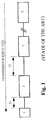
- the alert signal (1) is first transmitted by the local switching exchange for the purpose of notify the telephone terminal of the imminent transmission of a modulated message (2).
- Said alert signal (1) causes the telephone terminal to connect the circuits required for extracting the information sent by the local switching exchange.
- T1 guard time between the end of the alert signal and the start of the modulated message (2).
- T1 guard time between the end of the alert signal and the start of the modulated message (2).
- the switching exchange includes a guard time between the alert signal (1) and the modulated message (2), it also has a guard time (T2) between the end of the modulated message (2) and the first pulse of ringing tone (3) in order for the telephone terminal to detect the end of the message and proceed to disconnect the modulated message detection circuitry.
- T2 guard time
- the ringing tone pulses due to the characteristics of the ringing tone pulses, and particularly their relatively high voltage, it is necessary to ensure that the demodulator is disconnected when the first ringing tone arrives, otherwise said circuit could suffer damage. From the first ringing tone pulse, successive ringing tone pulses (3') are applied until the destination user off-hooks his handset.
- guard times and events sequence may be systematically altered either through delays in setting up traffic channels for transporting the modulated message, with the possibility of truncating or even impeding message transmission over the access system, or through lack of synchronisation between the local switching exchange events and events replicated into the telephone terminal, leading to harm of guard times and consequently endangering the telephone terminal circuitry.
- the present invention describes in particular the method and system to be employed in an access system with shared resources in order to provision the on-hook data transmission service when the connection with the switching exchange is established through said access system via a two-wire telephone line.
- an access system situated between a local exchange and at least one telephone terminal simulates, on one side, the operation of a telephone terminal towards the local switching exchange such that it receives and stores at least a first message sent from said local switching exchange; and, on the other side, it simulates the operation of a local switching exchange towards the telephone terminal such that it generates and transmits to said telephone terminal a second message which is a replication of said first message.
- the first message sent from the local exchange is modulated, being demodulated in order to be stored in the access system for its later replication.
- the access system as proposed in the present invention comprises means for receiving and storing at least one first message proceeding from a local switching exchange and means for generating a second message which is a replication of said first message and forward it to a destination telephone terminal.
- the access system of the invention preferentially comprises means for demodulating said first modulated message in order to be stored in the access system for its later replication.
- Figure 1 shows a sequence of events for on-hook data transmission according to the procedure defined in the ETSI standard ETS 300 659-1 that belongs to the state of the art.
- Figure 2 shows a two-wire access system architecture.
- Figure 3 shows a block diagram of a central access node according to one embodiment of the invention.
- Figure 4 shows a block diagram of a network termination to be used with the central access node of figure 3.
- Figure 5 shows a block diagram of a central access node according to an alternative embodiment of the invention.
- Figure 6 shows a block diagram of a network termination to be used with the central access node of figure 5.
- Figure 7 is a flow chart of the message replicating process in the central access node.
- Figure 8 is a partial illustration of an alternative form of implementing the message replicating process of figure 7.
- a central access system architecture (4) mainly comprises a central access node (5) which is connected to a set of network terminations (6) by whatever appropriate transmission means (7) like, for example, radio, optic fibre, cable or similar media.
- the access node (5) is connected by a two-wire telephone line (8) to the local switching exchange (9); and each network termination (6) is connected by a two-wire telephone line (8) to one or more telephone terminal(s) (10).
- the central access node (5) is able of receiving the modulated messages transmitted by the local switching exchange (9) as well as the signalling sent by it, for replicating them towards the telephone terminal once the resources have been allocated.
- the central access node (5) basically comprises:
- the network termination (6) basically comprises:
- the access node (5) in step (107), from the message received from the local switching exchange (9) and demodulated in the demodulator (52) and stored in its memory (54), produces the same message but modulated in the audio frequency band by the modulator (55), transmitting it over a channel allocated in the transmission means (7) to the network termination (6), the latter permitting the modulated message to pass transparently to the telephone terminal (10).
- the central access node (5) basically comprises:
- the network termination (6) basically comprises:
- the central access node (5) sends to the network termination (6) a message, which has been demodulated in its demodulator (52) through the own signalling of the access system (4), containing the message to be replicated towards the telephone terminal (10), as can be seen in step (107').
- the network termination (6) contains the necessary circuitry, i.e. the modulator (64), for generating the message modulated in the audio frequency band from the message received from the central access node (5).
Landscapes
- Engineering & Computer Science (AREA)
- Computer Networks & Wireless Communication (AREA)
- Signal Processing (AREA)
- Telephonic Communication Services (AREA)
- Monitoring And Testing Of Exchanges (AREA)
Applications Claiming Priority (2)
| Application Number | Priority Date | Filing Date | Title |
|---|---|---|---|
| ES9802486 | 1998-11-26 | ||
| ES9802486 | 1998-11-26 |
Publications (2)
| Publication Number | Publication Date |
|---|---|
| EP1005210A2 true EP1005210A2 (fr) | 2000-05-31 |
| EP1005210A3 EP1005210A3 (fr) | 2003-10-01 |
Family
ID=8305927
Family Applications (1)
| Application Number | Title | Priority Date | Filing Date |
|---|---|---|---|
| EP99402754A Withdrawn EP1005210A3 (fr) | 1998-11-26 | 1999-11-05 | Méthode et système de transmission de messages pour abonnés durant l'établissement des appels téléphoniques incidents |
Country Status (3)
| Country | Link |
|---|---|
| US (1) | US6697482B1 (fr) |
| EP (1) | EP1005210A3 (fr) |
| JP (1) | JP2000216890A (fr) |
Families Citing this family (1)
| Publication number | Priority date | Publication date | Assignee | Title |
|---|---|---|---|---|
| DE10240810B3 (de) * | 2002-08-30 | 2004-04-08 | Infineon Technologies Ag | Verfahren und Schaltungsanordnung zum Steuern einer Teilnehmerleitungs-Schnittstellenschaltung |
Family Cites Families (16)
| Publication number | Priority date | Publication date | Assignee | Title |
|---|---|---|---|---|
| US4551581B1 (en) * | 1983-07-12 | 1995-06-20 | Bell Telephone Labor Inc | Method and apparatus for sending a data message to a selected station during a silent interval between ringing |
| US5263081A (en) * | 1989-11-01 | 1993-11-16 | Hubbell Incorporated | Method and apparatus for providing on-hook transmission for digital loop carrier channel units |
| US5222130A (en) * | 1990-11-19 | 1993-06-22 | Ag Communication Systems Corporation | Message arrangement and method for implementing a digital telephone system |
| US5479493A (en) * | 1992-05-21 | 1995-12-26 | At&T Corp. | Calling line identification adjunct for use with a communication system |
| US5559860A (en) * | 1992-06-11 | 1996-09-24 | Sony Corporation | User selectable response to an incoming call at a mobile station |
| US5396548A (en) * | 1993-03-08 | 1995-03-07 | At&T Corp. | Communication system utilizing information received during a silent interval between ringing signals |
| US5581599A (en) * | 1993-12-30 | 1996-12-03 | Northern Telecom Limited | Cordless telephone terminal |
| US5467385A (en) * | 1994-01-27 | 1995-11-14 | Reuben; Douglas S. | Calling number display and recording system |
| US5566239A (en) * | 1994-06-07 | 1996-10-15 | Teltrend, Inc. | Floating digital loop carrier telephone interface |
| US5737400A (en) * | 1996-02-27 | 1998-04-07 | U-Tel Incorporated | Telecommunications system for accessing subscriber premises equipment using ring suppression |
| US6141330A (en) * | 1996-09-20 | 2000-10-31 | Godigital Networks Corporation | Multiple ISDN and pots carrier system |
| US6208670B1 (en) * | 1997-03-10 | 2001-03-27 | Conklin Corporation | Digital carrier system for rural telephone and data applications |
| US6219409B1 (en) * | 1998-02-27 | 2001-04-17 | Sharegate, Inc. | Premises gateway and premises network interfaces for accessing subscriber premises equipment and communication networks using ring suppression |
| US6289097B1 (en) * | 1998-05-29 | 2001-09-11 | 3Com Corporation | Method and system for a redirect repeater providing network access |
| US6442264B1 (en) * | 1998-07-30 | 2002-08-27 | Phillip R. Sutter | Telephone call router for transferring data to and from data collection apparatus |
| US6442256B1 (en) * | 1999-02-02 | 2002-08-27 | Lucent Technologies Inc. | System and method for establishing a call path through a private network |
-
1999
- 1999-11-05 EP EP99402754A patent/EP1005210A3/fr not_active Withdrawn
- 1999-11-19 US US09/443,466 patent/US6697482B1/en not_active Expired - Lifetime
- 1999-11-22 JP JP11330912A patent/JP2000216890A/ja active Pending
Also Published As
| Publication number | Publication date |
|---|---|
| EP1005210A3 (fr) | 2003-10-01 |
| JP2000216890A (ja) | 2000-08-04 |
| US6697482B1 (en) | 2004-02-24 |
Similar Documents
| Publication | Publication Date | Title |
|---|---|---|
| CA2117451C (fr) | Methode d'emission et de reception de signaux video | |
| US5263084A (en) | Spontaneous caller identification with call-waiting | |
| US5764746A (en) | Holding party call back subscriber feature | |
| JPH07203023A (ja) | 狭帯域通信網用直接信号システム | |
| US5448286A (en) | Process and terminal for video telephony permitting acceptance, and possibly calling, by a telephone set | |
| FI98182C (fi) | Menetelmä lähtevän ja päättyvän puhelun yhteentörmäyksen käsittelemiseksi, tilaajalaite ja tilaajaverkkoelementti | |
| US6697482B1 (en) | Method and system for transmitting messages to subscribers during the set-up stage of incoming telephone calls | |
| KR19990086215A (ko) | 전전자 교환기에 있어서 다중 호출음 서비스방법 | |
| KR100274092B1 (ko) | 발신가입자 정보전송 기능을 갖는 전전자식 자동교환기 및발신가입자 정보전송 방법 | |
| KR100218882B1 (ko) | 전자 교환기의 발신자 전화번호 통보방법 | |
| KR100208179B1 (ko) | 국선 교환기의 통화중 메시지 전달방법 | |
| JP3196365B2 (ja) | ディジタル通信方式とその端末 | |
| JPH09307647A (ja) | 発呼者情報通知システム | |
| KR100532323B1 (ko) | 종합정보통신망을 통한 문자정보 서비스방법 | |
| JP2864198B2 (ja) | 局間共通線接続方式 | |
| JP3234698B2 (ja) | Isdn交換機および端末 | |
| RU2185038C2 (ru) | Способ установления связи по коммутируемой сети для абонентских приборов одного абонентского номера с избираемым прибором другого абонентского номера и устройство для его осуществления | |
| JPH04314248A (ja) | 自動アナウンス装置 | |
| KR100727757B1 (ko) | 전전자교환기의 가입자제어랙에 실장되는 주파수편이회로팩 | |
| JPS61140265A (ja) | 交換装置 | |
| JPH0654081A (ja) | 総合サービスディジタル網通信装置 | |
| JPS6328389B2 (fr) | ||
| GB2365670A (en) | Information display provided to calling party | |
| KR960009550A (ko) | 발신번호 자동송출 무선호출시스템 및 무선호출 발신번호 자동송출방법 | |
| JPH03175869A (ja) | 通話路設定方式 |
Legal Events
| Date | Code | Title | Description |
|---|---|---|---|
| PUAI | Public reference made under article 153(3) epc to a published international application that has entered the european phase |
Free format text: ORIGINAL CODE: 0009012 |
|
| AK | Designated contracting states |
Kind code of ref document: A2 Designated state(s): AT BE CH CY DE DK ES FI FR GB GR IE IT LI LU MC NL PT SE |
|
| AX | Request for extension of the european patent |
Free format text: AL;LT;LV;MK;RO;SI |
|
| PUAL | Search report despatched |
Free format text: ORIGINAL CODE: 0009013 |
|
| AK | Designated contracting states |
Kind code of ref document: A3 Designated state(s): AT BE CH CY DE DK ES FI FR GB GR IE IT LI LU MC NL PT SE |
|
| AX | Request for extension of the european patent |
Extension state: AL LT LV MK RO SI |
|
| 17P | Request for examination filed |
Effective date: 20040401 |
|
| AKX | Designation fees paid |
Designated state(s): AT BE CH CY DE DK ES FI FR GB GR IE IT LI LU MC NL PT SE |
|
| 17Q | First examination report despatched |
Effective date: 20040514 |
|
| 17Q | First examination report despatched |
Effective date: 20040514 |
|
| RAP1 | Party data changed (applicant data changed or rights of an application transferred) |
Owner name: ALCATEL LUCENT |
|
| STAA | Information on the status of an ep patent application or granted ep patent |
Free format text: STATUS: THE APPLICATION IS DEEMED TO BE WITHDRAWN |
|
| 18D | Application deemed to be withdrawn |
Effective date: 20070116 |