EP1005215B1 - Procédé et système pour l'édition des données de configuration pour systèmes de télécommunication - Google Patents
Procédé et système pour l'édition des données de configuration pour systèmes de télécommunication Download PDFInfo
- Publication number
- EP1005215B1 EP1005215B1 EP99440317A EP99440317A EP1005215B1 EP 1005215 B1 EP1005215 B1 EP 1005215B1 EP 99440317 A EP99440317 A EP 99440317A EP 99440317 A EP99440317 A EP 99440317A EP 1005215 B1 EP1005215 B1 EP 1005215B1
- Authority
- EP
- European Patent Office
- Prior art keywords
- editor
- configuration data
- editing
- rule set
- rules
- Prior art date
- Legal status (The legal status is an assumption and is not a legal conclusion. Google has not performed a legal analysis and makes no representation as to the accuracy of the status listed.)
- Expired - Lifetime
Links
Images


Classifications
-
- H—ELECTRICITY
- H04—ELECTRIC COMMUNICATION TECHNIQUE
- H04L—TRANSMISSION OF DIGITAL INFORMATION, e.g. TELEGRAPHIC COMMUNICATION
- H04L41/00—Arrangements for maintenance, administration or management of data switching networks, e.g. of packet switching networks
- H04L41/08—Configuration management of networks or network elements
- H04L41/0866—Checking the configuration
- H04L41/0869—Validating the configuration within one network element
-
- G—PHYSICS
- G06—COMPUTING OR CALCULATING; COUNTING
- G06Q—INFORMATION AND COMMUNICATION TECHNOLOGY [ICT] SPECIALLY ADAPTED FOR ADMINISTRATIVE, COMMERCIAL, FINANCIAL, MANAGERIAL OR SUPERVISORY PURPOSES; SYSTEMS OR METHODS SPECIALLY ADAPTED FOR ADMINISTRATIVE, COMMERCIAL, FINANCIAL, MANAGERIAL OR SUPERVISORY PURPOSES, NOT OTHERWISE PROVIDED FOR
- G06Q10/00—Administration; Management
- G06Q10/10—Office automation; Time management
-
- H—ELECTRICITY
- H04—ELECTRIC COMMUNICATION TECHNIQUE
- H04L—TRANSMISSION OF DIGITAL INFORMATION, e.g. TELEGRAPHIC COMMUNICATION
- H04L41/00—Arrangements for maintenance, administration or management of data switching networks, e.g. of packet switching networks
- H04L41/08—Configuration management of networks or network elements
- H04L41/0803—Configuration setting
-
- H—ELECTRICITY
- H04—ELECTRIC COMMUNICATION TECHNIQUE
- H04Q—SELECTING
- H04Q3/00—Selecting arrangements
- H04Q3/0016—Arrangements providing connection between exchanges
- H04Q3/0062—Provisions for network management
-
- H—ELECTRICITY
- H04—ELECTRIC COMMUNICATION TECHNIQUE
- H04M—TELEPHONIC COMMUNICATION
- H04M3/00—Automatic or semi-automatic exchanges
- H04M3/22—Arrangements for supervision, monitoring or testing
-
- H—ELECTRICITY
- H04—ELECTRIC COMMUNICATION TECHNIQUE
- H04Q—SELECTING
- H04Q2213/00—Indexing scheme relating to selecting arrangements in general and for multiplex systems
- H04Q2213/13093—Personal computer, PC
-
- H—ELECTRICITY
- H04—ELECTRIC COMMUNICATION TECHNIQUE
- H04Q—SELECTING
- H04Q2213/00—Indexing scheme relating to selecting arrangements in general and for multiplex systems
- H04Q2213/13103—Memory
-
- H—ELECTRICITY
- H04—ELECTRIC COMMUNICATION TECHNIQUE
- H04Q—SELECTING
- H04Q2213/00—Indexing scheme relating to selecting arrangements in general and for multiplex systems
- H04Q2213/13106—Microprocessor, CPU
-
- H—ELECTRICITY
- H04—ELECTRIC COMMUNICATION TECHNIQUE
- H04Q—SELECTING
- H04Q2213/00—Indexing scheme relating to selecting arrangements in general and for multiplex systems
- H04Q2213/13109—Initializing, personal profile
-
- H—ELECTRICITY
- H04—ELECTRIC COMMUNICATION TECHNIQUE
- H04Q—SELECTING
- H04Q2213/00—Indexing scheme relating to selecting arrangements in general and for multiplex systems
- H04Q2213/13349—Network management
Definitions
- the present invention relates to a method for editing configuration data for telecommunication systems and for determining editing rules, as well as an editor therefor, a computer therefor, a system and a storage means therefor.
- Telecommunication systems such as exchanges, access systems, cross-connects, network management systems, computer networks, etc.
- configuration data can be selected within certain limits to specific requirements, which are determined by the respective field of use.
- a control software contained in a telecommunication system can control the telecommunication system as intended in the respective field of application.
- a modem digital exchange for example, must be specified by appropriate configuration data, among other things, which subscriber lines the exchange has to serve, which Numbers are assigned to each of these and which telecommunication services are made available to the respective subscriber lines.
- the configuration data of such a local loop must comply with predetermined rules.
- a telephone number of a subscriber line may contain only numerals and no letters and must consist of a predetermined number of digits.
- an ISDN-capable subscriber line for an ISDN telecommunications network (Integrated Services Digital Network) defined services.
- an operating system such as Microsoft Windows or X-Windows.
- Such an editor clearly and comfortably displays already created configuration data, most of which are in the form of numerous, inter-related tables.
- the editor also allows input to the configuration data, both new inputs and additions or changes to existing inputs.
- the editor checks the inputs. If, for example, a data field is provided for a telephone number, the editor only permits an entry in the data field if this input contains only numerals.
- the design of the display of configuration data is usually hard-coded in such an editor.
- the editor is usually part of a configuration system.
- Such a configuration system contains, in addition to the editor, among other things, a so-called validation program module with which the configuration data are checked for their validity and consistency after editing.
- WO-A-9716929 discloses a system in which three so-called "software toolsets" operating at different architectural levels are used to create services.
- structuring is carried out on the different architectural levels by different editors, with structuring carried out on a lower architectural level representing boundary conditions for structuring to be carried out at a higher architectural level. From a system of this kind, the invention proceeds.
- EP-A-0793171 discloses that a process for software configuration is divided into sub-processes, wherein in one of these sub-processes the determination of the configuration is made and in another the updating of the configuration is performed, the software configuration has to follow certain rules, and that certain data, the determination and editing the software configuration are entered via a graphical interface by the user.
- WO-A-9805152 discloses a system in which a variety of different telecommunications equipment is managed and controlled by means of an installation and management system. To accomplish this purpose, it is described that the source code of this installation and management system includes a program for displaying generic or specific surfaces for data entry. It also uses a standardized user interface to enter and change information.
- a typical example of a configuration system is in European Patent Application EP 0 678 817 A1 shown.
- configuration data are acquired by a computer with the aid of a graphical user interface and, after the input with the aid of a program module, subjected to a check of its consistency, that is to say a validation. Only then is the configuration data written to a database and subsequently processed into a state in which it can be loaded into a telecommunications system called a "target system".
- Both the graphical user interface and the program module for editing the configuration data and the validation rules contained in the validation program module are provided and programmed as usual for the configuration data to be acquired, in the present example in the "Omnis 7" programming language.
- Such a "hard” programmed editor as well as a likewise “permanently" programmed associated validation program modules are each only suitable for the creation of configuration data for a particular destination telecommunication system, so that for each destination telecommunication system or each type of such a system must be created for the respective target telecommunication system suitable configuration system.
- the object of the invention is to edit configuration data for a telecommunication system in an efficient manner in accordance with suitable editing rules for the respective telecommunications system to be configured with the configuration data and to determine said editing rules.
- the invention is based on the idea of designing an editor, a program module that can be executed on a computer, in such a way that the editor has editing rules that are stored in different editing rule sets and are each required for editing configuration data of a telecommunication system before the actual editing of the Configuration data determined.
- the editor then reads out an editing rule set determined in this way from a memory and edits the configuration data according to the editing rules contained in the editing rule set.
- the editing rules are therefore not contained in the actual editor, but rather are read in again, depending on the configuration data to be checked, and evaluated by the editor.
- the editing rules include, for example, rules for displaying the configuration data, so-called formatting rules, rules that define relationships between components of the configuration data, and rules for checking operator input.
- the editor determines rules for checking operator inputs from a validation rule set, which specifies rules for the validation of the configuration data for a validation module.
- the editor rule set to be used by each editor can be defined in control data which the editor reads in and evaluates.
- the editing rule set to be used in each case can also be determined by the editor on the basis of an identifier which is contained in the configuration data to be edited.
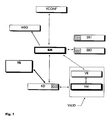
- FIG. 1 shows a very schematic example of an arrangement for carrying out the method according to the invention.
- an inventive editor EM is shown, which is executable as a program module on a computer and can edit configuration data universally for various telecommunications systems.
- Such configuration data are shown schematically in FIG. 1 as configuration data KD.
- a computer eg a personal computer or a workstation, for executing the editor EM is shown in some essential components in FIG. 3 as computer SER.
- the computer SER contains a control means CPU, eg a processor, for the execution of machine-readable instructions, eg for the execution of the editor EM.
- the computer SER has a memory MEM in which the editor EM can be stored.
- the computer SER as an input means via a keypad KEY and a so-called mouse MOUS to enter data eg in the editor EM.
- the computer SER can display on a display device DIS, such as a screen, data, eg be generated by the editor EM.
- FIG. 1 is again considered, reference being also made to components of the computer SER shown in FIG.
- the editor EM can edit the configuration data KD according to one or more editing rules contained in an editing rule set. Examples of such editing rule sets are shown in the form of an editing rule set ER1 and an editing rule set ER2 in FIG.
- the editing rule sets ER1 and ER2 are examples of further, not shown in Figure 1 editing rule sets and are stored in the memory MEM.
- the configuration data KD are suitable for the configuration of the target system TS known from FIG. 1, which may be, for example, an exchange or a network management system.
- the configuration data KD contain, for example, data about connections that can be switched by the destination system TS or data that defines subscriber lines operated by the destination system TS.
- the target system TS can also be, for example, a telecontrol substation.
- the configuration data KD then contains, for example, data about measured values and commands which the remote control substation is to acquire or output.
- the configuration data KD can be recreated using the editor EM as well as modified. Default values, so-called default values, for a first generation of the configuration data KD, the editor EM one of the edit rule sets ER1 or ER2 remove. If the configuration data KD should only be modified by the editor EM, the editor EM can be given an instruction, for example via the keypad KEY, to load such already defined configuration data KD from the memory MEM or also to receive it from the target system TS.
- the target system TS sends the configuration data KD to the editor EM, for example via a connection line and via the interface device IF of the computer SER.
- the process of outputting the configuration data KD by the editor EM as well as the loading of already defined configuration data KD in the editor EM is indicated by a bidirectional arrow.
- control data VCONF which specifies in which editing rule set the required editing rules are contained.
- the control data VCONF can, for example, be provided to the editor EM as a so-called call parameter when it is started or stored in the memory MEM in the form of a control table in which an assignment of configuration data to an editing rule set is defined. For example, it may be specified that one particular type of target system requires configuration data to be edited using the edit rule set ER1, while another type of target system requires configuration data that needs to be edited after the edit rule set ER2.
- the editor EM determines, without the aid of the control data VCONF, which of the editing rule sets ER1 or ER2 is to be used.
- the editor EM reads the Edit rule set ER2 from the memory MEM and edited the configuration data KD according to the specifications of the editing rule set ER2.
- the editor EM outputs the configuration data KD again, in particular if changes have been made during the editing, for example by the editor EM storing the configuration data KD in the memory MEM or sending it via the interface device IF to the target system TS. If no changes have been made to the configuration data KD, the step of issuing changed configuration data KD can also be dispensed with in individual cases.
- the process of editing data on a computer is known per se.
- the editing essentially involves the display as well as the acquisition of data. These functions as well as further functions, which will be explained in detail later, are performed by the editor EM in the example shown in FIG. 1 according to editing rules of the editing rule set ER2.
- the editor EM can control a display form of the configuration data KD suitable for the configuration data KD on the display device DIS.
- the editing rule set ER2 it can be defined with the editing rule set ER2 that the configuration data KD are to be displayed in tabular form.
- the design of individual tables for example, how many lines and columns a table contains and what information should appear in the row and column headers of the table are defined by the editing rule set ER2.
- it can be specified in the editing rule set ER2 in so-called formatting rules how the individual cells of a table are to be formatted, for example whether their content is left-justified or centered, in boldface or italics.
- the editor EM can also display the configuration data KD in partial views, e.g. in the form of different tables.
- the respectively optimal partial view of the configuration data KD can be determined by the editor EM on the basis of editing rules specified in the editing rule set ER2. If e.g. For example, if an entry in the configuration data KD has already been or has to be made in one field in two tables, the editor EM displays both tables next to one another when an operator selects one of the fields. select MOUS with the mouse, or switch between partial views with each of the tables when the operator gives an instruction, e.g. by so-called "double click" with the mouse MOUS on one of the fields.
- the editor EM also checks operator inputs in the configuration data KD.
- the editing rule set ER2 contains instructions for this, which specify which operator inputs are permitted and which are to be rejected by the editor EM. If a field of a table is intended for the entry of a telephone number, for example, and if such a telephone number should each have six digits, the editor rejects any entry that does not fulfill these conditions. If the operator provides the editor EM with an input that does not fulfill the intended conditions, the editor EM reports this with a message MSG, for example in the form of an output on the display device DIS. With the aid of the message MSG, the editor EM can display the error that has occurred in detail and also output a help text to the operator in which the requirements for a correct input are described.
- the editor EM can display to the operator a list of possible and allowed input values for an input field, e.g. in the form of so-called selection fields, engl. "Pick Lists".
- the default values for such lists as well as the nature and design of their display can be determined by the editor EM from editing rules of the editing rule set ER2.
- the requirements which the configuration data KD have to fulfill for the correct operation of the target system TS have changed, it is sufficient to merely exchange the editing rule set ER2 or modify it so that the editing rules contained in the new or modified editing rule set ER2 meet the new requirements allow the target system TS adapted editing.
- the editor EM itself does not have to be changed. In this way, it is also easily possible to insert further editing rules in an editing rule set or remove editing rules no longer needed from an editing rule set. If the editor EM is to edit configuration data that is editable neither with the editing rule set ER1 nor with the editing rule set ER2, a new editing rule set can also be added to the editing rule sets ER1 and ER2 at any time, with which the new configuration data can be edited.
- the configuration data already contain editing rules at least to a certain extent, eg formatting rules.
- these editing rules must be removed awkwardly from the configuration data, since the control software of the target system, although the Configuration data can evaluate itself, but not the editing rules.
- Another problem arises in such an approach when previously exempt from editing rules configuration data for re-loading from the target system are loaded into an editor. This is very often the case in practice. Then, before loading the configuration data into the editor, editing rules must be added to the configuration data again.
- the editor EM can check operator input using the edit rule set ER2. However, it is also possible for the editor EM to determine the rules for checking operator inputs from a rule set which actually serves to validate the configuration data KD.
- a rule set is shown in the form of a validation rule set VR in FIG.
- the validation rule set VR stands by way of example for further validation rule sets not shown in FIG. 1 and is determined and read in each case by a validation module VM, a program module likewise executable on the computer SER, for validation.
- the validation module VM then evaluates the validation rules contained therein as part of a validation of the configuration data KD.
- the assignment of the validation rule set VR to the validation module VM is indicated by an arrow.
- the validation module VM and the validation rule set VR together form a validation system VALID that has configuration data acquired by both the editor EM and another data acquisition system, not shown in FIG. 1 can check. If the configuration data checked by the validation module VM, ie the configuration data KD, have withstood the check in FIG. 1, are therefore consistent, the configuration data KD can be loaded into the target system TS and adopted by it as an operating parameter.
- the editor EM can determine, for example with the aid of the control data VCONF, by means of a corresponding reference in the editing rule set ER2 or also with reference to the structure and design of the configuration data KD, that he must consult the validation rule set VR for editing the configuration data KD.
- the editor EM then reads the validation rule set VR and at least partially evaluates the validation rules contained therein.
- the editor EM will not evaluate all the validation rules contained in such a validation rule set, since a validation rule set is generally intended for a comprehensive validation of configuration data taking into account numerous inter-relationships between data fields.
- validation rules For a validation of individual data fields defined validation rules, so-called “A-rules” as well as conditions between data fields defining so-called “B-rules” but are particularly suitable for evaluation by the editor EM.
- the editor can check EM operator input and only allow operator input corresponding to those validation rules.
- the editor EM also performs more detailed and advanced checks of operator input based on appropriate validation rules of the validation rule set VR.
- so-called “C-rules” are evaluated, which define conditions between data fields of different data records of a table, as well as “D-rules", which also Set relationships between data fields of different tables.
- the validation rules can be contained in a further variant of the invention instead of the separate validation rule set VR in the editing rule set ER2 - completely or even partially - so that the editor EM already has all the necessary validation rules available through the editing rule set ER2.
- validation rules which are defined for validation of the configuration data KD by the validation module VM
- the validation rules which the configuration data KD have to fulfill need only once and in one for the editor EM as well as for the validation module VM can be generated evaluable language and not each separately for the editor EM and the validation module VM.
- this saves work and, on the other hand, avoids a mistake-prone double definition of validation rules as well as these editing rules, which in their function correspond to each other, each fulfilling a similar task.
- the editor EM can check whether the new inputs can withstand later validation by the validation module VM.
- default information eg text elements
- the editor EM can use this default information to design the message MSG.
- the editor EM can use this default information to design the message MSG.
- the editing rule sets ER1 or ER2 for each of the editing rules contained therein for checking operator inputs it is possible to determine which error message is to be displayed by the editor EM when, during a check an error occurs according to the specifications of the respective editing rule.
- the default information for the notification message MSG is not part of the editor EM, but each is read from an editing rule set, this preference information as well as the editing rules can be easily exchanged or modified to meet current requirements. In this way, for example, a reason for an error can be made more precise by a text newly inserted into an editing rule set for an error message.
- the editing rules contained in the edit rule sets ER1 and ER2 must correspond to given syntactic and semantic rules by the design of the editor EM, and must therefore be written in a fixed language. Such a language can be specifically defined for the editor EM.
- An instruction to display a data field of the configuration data KD, to a so-called formatting of the data field may be e.g. are: "Field: Left aligned". An entry in this data field is then left justified by the editor EM.
- Further editing rules for formatting the configuration data KD can also be easily defined in this way, e.g. Size of the display of a data field, number of data fields in a row of a table etc.
- interpreter language whose statements the editor EM can "interpret” and translate into machine-readable commands. These commands may then execute the control means CPU in a manner similar to the command sequences of the editor EM.
- an interpreter language can Function blocks with extensive command sequences, so-called "macros", are defined in the editing rule sets ER1 and ER2, whose instructions the editor EM can use to execute the control means CPU when editing the configuration data KD. If an entry in the configuration data KD occurs identically at different points, for example in different tables, this entry may not only be changed at one of these points during a modification, but must be modified identically at all points.
- the editor EM can either provide all positions with an identical entry itself or commission a macro provided for this purpose in the editing rules of the editing rule set ER2.
- a universally suitable interpreter language is used for the editing rules.
- An example of a universal interpreter language is the language of PERL (P ractical E Xtraction and R eport L anguage) which is commonly associated with the UNIX operating system.
- PERL Physical E Xtraction and R eport L anguage
- the editor EM does not necessarily have to interpret the editing rules itself, but may instruct a program module called "PERL interpreter" to interpret the editing rules.
- a PERL interpreter is usually included in the scope of delivery of a UNIX operating system.
- the machine-readable instructions generated by the PERL interpreter from the editing rules are incorporated by the editor EM into its own instruction sequences, eg in the form of program branches.
- This process of incorporating editing rules in the editor EM is particularly simple when both the editor EM and the editing rules to be included are written in the same interpreter language are. Then, in the editor EM, a general call may be included that refers to an editing rule that carries a name specified in the call. However, depending on which of the edit rule sets ER1 or ER2 must be used for the validation, the call refers either to an edit rule in the edit rule set ER1 or to an edit rule in the edit rule set ER2. Although both editing rules have the same name, they can contain different test specifications. In this case, the interpreter program module ensures a correct branching of the command sequences of the editor EM into the command sequences generated by interpreting the editing rules.
- the editing rules can also already be contained in the editing rule sets ER1 and ER2 in a form executable by a processor, referred to as so-called functions, also called library functions.
- the editor EM can integrate the command sequences of such functions directly into its own command sequences without prior interpretation. Such a process is also called "dynamic linking" of functions.
- functions can also be generated only at runtime of the editor EM, by having the editor EM first translate an edit rule set to be used for editing the configuration data KD into command sequences executable by a processor or have it translated by a translator program module and the thus creating edit rule command sequences into its own command sequences.
- the remarks in the above sections on the editing rules apply analogously to the validation rules of the Validation rule set VR.
- the validation rule set VR for example, can also be written in an interpreter language, contain function blocks, both in the form of macros and in the form of executable program functions.
- the editor EM determines, based on the configuration data KD, which of the editing rule sets ER1 or ER2 is needed for checking the configuration data KD. For this purpose, the editor EM searches in the configuration data KD for a feature or an identifier that uniquely identifies the configuration data KD. Such an identifier is included in the configuration data KD in the form of an identifier ID2.
- the identifier ID2 may for example identify the configuration data KD as belonging to a specific target system and be a text element with the content: "Exchange A with control software Version 1.3".
- the editor EM can determine which editing rule set is to be used for editing the configuration data KD. It is also possible for the editor EM to determine the editing rule set ER1 or ER2 required for editing the configuration data KD on the basis of an identifier which must be the same as that contained in the configuration data KD.
- the identifier ID2 of the configuration data KD is also indicated in the editing rule set ER2 in the example of FIG. 1; the editing rule set ER1, on the other hand, has an identifier ID1.
- the editor EM can also determine from the structure and the type of the configuration data KD which editing rule set must be used for the check. If, in a very simple example, the configuration data KD contains only data records which each begin with a number string, the editor EM can e.g. derived from the fact that the configuration data KD are to be edited after the editing rule set ER1. However, if the configuration data KD contains only records each beginning with a letter string, the editor EM can recognize that the configuration data KD is to be edited after the editing rule set ER2.
- FIG. 2 shows the editor EM in essential functional steps.
- the editor EM is, as already mentioned, stored in a memory and by a control means, such as a processor, readable and directly executable or indirectly evaluable using an interpreter program module command sequences.
- the editor EM can be written eg in the programming language "JAVA", which was originally developed for Internet applications and for the interpretation of which nearly every operating system now has a suitable interpreter program module.
- FIG. 2 shows the editor EM in essential functional steps.
- the editor EM is, as already mentioned, stored in a memory and by a control means, such as a processor, readable and directly executable or indirectly evaluable using an interpreter program module command sequences.
- the editor EM can be written eg in the programming language "JAVA", which was originally developed for Internet applications and for the interpretation of which nearly every operating system now has a suitable interpreter program module.
- FIG. 2 shows the editor EM in essential functional steps.
- the editor EM is, as already mentioned, stored
- step START the editor EM determines in a step ST1, for example based on the control data VCONF known from FIG. 1, according to which editing rule set it should edit configuration data.
- the instructions of step ST1, for example, the reading of the control data VCONF and their evaluation are combined in a determination function unit, for example in a subroutine.
- step ST2 the editor EM reads the determined editing rule set and then evaluates first editing rules contained therein in a step ST3 and uses these editing rules, for example, to design a display on the display device DIS.
- step ST4 the editor EM acquires configuration data which are entered, for example, as operator inputs on the keypad KEY.
- step ST4 the editor EM reads in step ST4 first to be modified configuration data that are already used by a telecommunications system.
- the editor EM displays this configuration data in a step ST5 according to the specifications of the editing rules.
- the editor EM can also check an operator input to the configuration data after an editing rule read in step ST2.
- a step ST6 it is checked whether the editor EM should output the configuration data or fulfill further operator inputs after the execution of step ST5. If further operator inputs are to be made, the editor EM returns to step ST4.
- the editor EM outputs configuration data in a step ST7, that is, stores it in the memory MEM, for example, or sends the configuration data via the Interface device IF to be configured with the configuration data telecommunication system, if an instruction is given to it. Subsequently, the editor EM ends in a step END.
Landscapes
- Engineering & Computer Science (AREA)
- Business, Economics & Management (AREA)
- Computer Networks & Wireless Communication (AREA)
- Signal Processing (AREA)
- Entrepreneurship & Innovation (AREA)
- Human Resources & Organizations (AREA)
- Strategic Management (AREA)
- General Business, Economics & Management (AREA)
- Data Mining & Analysis (AREA)
- Quality & Reliability (AREA)
- Tourism & Hospitality (AREA)
- Physics & Mathematics (AREA)
- Marketing (AREA)
- General Physics & Mathematics (AREA)
- Theoretical Computer Science (AREA)
- Economics (AREA)
- Operations Research (AREA)
- Stored Programmes (AREA)
- Exchange Systems With Centralized Control (AREA)
- Management Or Editing Of Information On Record Carriers (AREA)
- Telephone Function (AREA)
- Telephonic Communication Services (AREA)
- Computer And Data Communications (AREA)
- Maintenance And Management Of Digital Transmission (AREA)
Claims (8)
- Procédé permettant l'édition de données de configuration (KD) en tant que paramètres d'exploitation de systèmes de télécommunication au moyen de règles d'édition par l'intermédiaire d'un éditeur (EM) et permettant la détermination d'un ensemble de règles d'édition (FR7) comportant au moins une règle d'édition selon laquelle les données de configuration (KD) doivent être éditées par l'intermédiaire de l'éditeur (EM), caractérisé en ce que avec le procédé les étapes suivantes sont exécutées :- détermination de l'ensemble de règles d'édition susmentionnées (ER2) au moyen de certaines données de commande (VCONF) ou des données de configuration (KD) pour l'éditeur (EM),- lecture de l'ensemble de règles d'édition,- évaluation de l'ensemble de règles d'édition,- lecture des valeurs déjà définies pour les données de configuration,- édition des données de configuration conformément aux prescriptions de l'ensemble de règles d'édition et- sortie des données de configuration.
- Procédé selon la revendication 1, caractérisé en ce que l'éditeur (EM) détermine un ensemble de règles de validation qui contient au moins une règle de validation et avec lequel les données de configuration (KD) peuvent être validées, l'éditeur évalue l'ensemble de règles de validation, et édite les données de configuration conformément aux prescriptions de l'ensemble de règles de validation.
- Procédé selon la revendication 1, caractérisé en ce que, lors de l'évaluation de l'ensemble de règles d'édition (ER2), des blocs de fonction, avec lesquels les données de configuration (KD) peuvent être éditées conformément aux règles d'édition contenues dans l'ensemble de règles d'édition, sont déterminés et lus, et les blocs de fonction sont utilisés pour l'édition des données de configuration.
- Procédé selon la revendication 1, caractérisé en ce que l'ensemble de règles d'édition (ER) est déterminé à l'aide d'un identificateur (ID1) contenu dans les données de configuration (KD).
- Editeur (EM) permettant l'édition de données de configuration (KD) en tant que paramètres d'exploitation de systèmes de télécommunication au moyen de règles d'édition et la détermination d'un ensemble de règles d'édition (ER2) comportant au moins une règle d'édition, selon laquelle les données de configuration (KD) doivent être éditées par l'intermédiaire de l'éditeur (EM), caractérisé en ce que l'éditeur présente un ensemble fonctionnel de détermination qui est configuré, de sorte que l'éditeur puisse déterminer ledit ensemble de règles d'édition (ER2) au moyen de certaines données de commande (VCONF) ou des données de configuration (KD) pour l'éditeur (EM), l'éditeur présente un ensemble fonctionnel de lecture qui est configuré, de sorte que l'éditeur puisse lire l'ensemble de règles d'édition, l'éditeur présente un ensemble fonctionnel d'évaluation, qui est configuré, de sorte que l'éditeur puisse évaluer l'ensemble de règles d'édition, l'éditeur présente un ensemble fonctionnel de lecture qui est configuré, de sorte que l'éditeur puisse lire les valeurs déjà définies pour les données de configuration, l'éditeur présente un ensemble fonctionnel d'édition qui est configuré, de sorte que l'éditeur puisse éditer les données de configuration conformément aux prescriptions de l'ensemble de règles d'édition, l'éditeur présente un ensemble fonctionnel de sortie qui est configuré, de sorte que l'éditeur puisse sortir les données de configuration.
- Ordinateur (SER) permettant l'édition de données de configuration (KD) en tant que paramètres d'exploitation de systèmes de télécommunication au moyen de règles d'édition et la détermination d'un ensemble de règles d'édition (ER2) comportant au moins une règle d'édition, selon laquelle les données de configuration (KD) doivent être éditées par l'intermédiaire de l'éditeur (EM), caractérisé en ce que l'ordinateur présente des moyens de détermination qui sont configurés, de sorte que l'ordinateur puisse déterminer ledit ensemble de règles d'édition (ER2) au moyen de certaines données de commande (VCONF) ou des données de configuration (KD) pour l'éditeur (EM), l'ordinateur présente des moyens de lecture qui sont configurés, de sorte que l'ordinateur puisse lire l'ensemble de règles d'édition, l'ordinateur présente des moyens d'évaluation qui sont configurés, de sorte que l'ordinateur puisse évaluer l'ensemble de règles d'édition, l'ordinateur présente des moyens de lecture qui sont configurés, de sorte que l'ordinateur puisse lire les valeurs déjà définies pour les données de configuration, l'ordinateur présente des moyens d'édition (DIS, KEY) qui sont configurés de sorte que l'ordinateur puisse éditer les données de configuration conformément aux prescriptions de l'ensemble de règles d'édition, l'ordinateur présente des moyens de sortie (IF) qui sont configurés, de sorte que l'ordinateur puisse sortir les données de configuration.
- Système permettant l'édition de données de configuration, caractérisé en ce qu'il présente des moyens permettant l'exécution du procédé selon la revendication 1.
- Moyen de mémorisation, caractérisé en ce qu'un éditeur (EM) est mis en mémoire dans celui-ci selon la revendication 5.
Applications Claiming Priority (2)
| Application Number | Priority Date | Filing Date | Title |
|---|---|---|---|
| DE19854754A DE19854754A1 (de) | 1998-11-27 | 1998-11-27 | Verfahren, Editor, Rechner, Steuermodul und Speichermittel zum Editieren von Konfigurationsdaten für Telekommunikationssysteme |
| DE19854754 | 1998-11-27 |
Publications (3)
| Publication Number | Publication Date |
|---|---|
| EP1005215A2 EP1005215A2 (fr) | 2000-05-31 |
| EP1005215A3 EP1005215A3 (fr) | 2003-02-05 |
| EP1005215B1 true EP1005215B1 (fr) | 2008-01-16 |
Family
ID=7889213
Family Applications (1)
| Application Number | Title | Priority Date | Filing Date |
|---|---|---|---|
| EP99440317A Expired - Lifetime EP1005215B1 (fr) | 1998-11-27 | 1999-11-16 | Procédé et système pour l'édition des données de configuration pour systèmes de télécommunication |
Country Status (6)
| Country | Link |
|---|---|
| US (1) | US6597666B1 (fr) |
| EP (1) | EP1005215B1 (fr) |
| JP (1) | JP2000216855A (fr) |
| AT (1) | ATE384396T1 (fr) |
| AU (1) | AU5959999A (fr) |
| DE (2) | DE19854754A1 (fr) |
Families Citing this family (13)
| Publication number | Priority date | Publication date | Assignee | Title |
|---|---|---|---|---|
| DE19954694A1 (de) * | 1999-11-13 | 2001-05-23 | Alcatel Sa | Verfahren, Konfigurationsserver, Signalisierungsserver, Computerprogramm und Speichermedium zur Erzeugung von Dienstfunktionsmodulen |
| EP1356392A2 (fr) * | 2000-11-01 | 2003-10-29 | Intellocity USA, Inc. | Systeme et methodes pour amelioration de media a partir de regles |
| JP4786050B2 (ja) * | 2001-03-28 | 2011-10-05 | 株式会社東芝 | 電子機器のサービス提供方法及びカスタマセンタ並びにユーザシステム |
| US7093010B2 (en) * | 2002-05-20 | 2006-08-15 | Telefonaktiebolaget Lm Ericsson (Publ) | Operator-defined consistency checking in a network management system |
| US8190723B2 (en) * | 2003-12-14 | 2012-05-29 | Cisco Technology, Inc. | Method and system for automatically determining commands for a network element |
| US8010952B2 (en) * | 2004-06-08 | 2011-08-30 | Cisco Technology, Inc. | Method and apparatus for configuration syntax and semantic validation |
| US7735140B2 (en) * | 2004-06-08 | 2010-06-08 | Cisco Technology, Inc. | Method and apparatus providing unified compliant network audit |
| US20060015591A1 (en) * | 2004-06-08 | 2006-01-19 | Datla Krishnam R | Apparatus and method for intelligent configuration editor |
| US7721304B2 (en) * | 2004-06-08 | 2010-05-18 | Cisco Technology, Inc. | Method and apparatus providing programmable network intelligence |
| DE102005005279A1 (de) * | 2005-02-04 | 2006-08-10 | Siemens Ag | Steuerinstanz für ein mehrere Netzelemente aufweisendes Kommunikationsnetz |
| US9378099B2 (en) | 2005-06-24 | 2016-06-28 | Catalogic Software, Inc. | Instant data center recovery |
| US11824958B2 (en) * | 2020-10-23 | 2023-11-21 | Rohde & Schwarz Gmbh & Co. Kg | Verification module and verification method for 5G new radio applications |
| WO2023157204A1 (fr) * | 2022-02-17 | 2023-08-24 | 日本電信電話株式会社 | Dispositif d'entrée de configuration, procédé d'entrée de configuration et programme d'entrée de configuration |
Family Cites Families (16)
| Publication number | Priority date | Publication date | Assignee | Title |
|---|---|---|---|---|
| US5214692A (en) * | 1989-11-13 | 1993-05-25 | Aspect Telecommunications Corporation | Bypass for telephone switching system |
| DE69228819T2 (de) * | 1992-12-17 | 1999-10-07 | International Business Machines Corp., Armonk | Konfigurations- und Betriebsverfahren eines Telekommunikationsgeräts |
| US5515524A (en) * | 1993-03-29 | 1996-05-07 | Trilogy Development Group | Method and apparatus for configuring systems |
| US5381403A (en) * | 1993-04-02 | 1995-01-10 | Motorola, Inc. | Method for establishing and maintaining system configuration information |
| EP0678817A1 (fr) | 1994-04-21 | 1995-10-25 | BRITISH TELECOMMUNICATIONS public limited company | Saisie de données dans un système de configuration de réseau de communication |
| CN1214840A (zh) * | 1995-11-02 | 1999-04-21 | 英国电讯有限公司 | 用于通信网络的服务生成设备 |
| US5713075A (en) * | 1995-11-30 | 1998-01-27 | Amsc Subsidiary Corporation | Network engineering/systems engineering system for mobile satellite communication system |
| FR2745649B1 (fr) * | 1996-03-01 | 1998-04-30 | Bull Sa | Systeme de configuration de logiciels preconfigures sur des systemes ouverts en reseau dans un environnement distribue et procede mis en oeuvre par un tel systeme |
| US6307925B1 (en) * | 1996-04-10 | 2001-10-23 | Harris Corporation | Use of wizards/experts in a PBX environment |
| US5875242A (en) * | 1996-07-26 | 1999-02-23 | Glaser; Lawrence F. | Telecommunications installation and management system and method |
| US5892950A (en) * | 1996-08-09 | 1999-04-06 | Sun Microsystems, Inc. | Interface for telecommunications network management |
| US6122362A (en) * | 1996-12-24 | 2000-09-19 | Evolving Systems, Inc. | Systems and method for providing network element management functionality for managing and provisioning network elements associated with number portability |
| US5991534A (en) * | 1997-06-03 | 1999-11-23 | Sun Microsystems, Inc. | Method and apparatus for editing a software component |
| JP3196827B2 (ja) * | 1997-12-04 | 2001-08-06 | 日本電気株式会社 | ネットワーク通信システム |
| US5966123A (en) * | 1998-09-30 | 1999-10-12 | Harris Corporation | Meta model editor controlling topic display application |
| US6434514B1 (en) * | 2000-10-13 | 2002-08-13 | Sbc Technology Resources, Inc. | Rule based capacity management system for an inter office facility |
-
1998
- 1998-11-27 DE DE19854754A patent/DE19854754A1/de not_active Withdrawn
-
1999
- 1999-11-16 DE DE59914608T patent/DE59914608D1/de not_active Expired - Lifetime
- 1999-11-16 AT AT99440317T patent/ATE384396T1/de not_active IP Right Cessation
- 1999-11-16 EP EP99440317A patent/EP1005215B1/fr not_active Expired - Lifetime
- 1999-11-22 AU AU59599/99A patent/AU5959999A/en not_active Abandoned
- 1999-11-23 US US09/447,299 patent/US6597666B1/en not_active Expired - Lifetime
- 1999-11-25 JP JP11333692A patent/JP2000216855A/ja active Pending
Also Published As
| Publication number | Publication date |
|---|---|
| AU5959999A (en) | 2000-06-01 |
| DE19854754A1 (de) | 2000-06-08 |
| EP1005215A3 (fr) | 2003-02-05 |
| EP1005215A2 (fr) | 2000-05-31 |
| DE59914608D1 (de) | 2008-03-06 |
| JP2000216855A (ja) | 2000-08-04 |
| ATE384396T1 (de) | 2008-02-15 |
| US6597666B1 (en) | 2003-07-22 |
Similar Documents
| Publication | Publication Date | Title |
|---|---|---|
| DE69232255T2 (de) | Verfahren und System zum Steuern des Ablaufs eines Anwenderprogramms | |
| EP1330685B1 (fr) | Procede et dispositif de controle destines a la mise en service de systemes commandes au moyen d'une logique de programme | |
| EP1430369B1 (fr) | Acces dynamique a des ressources d'automatisation | |
| DE69119930T2 (de) | Vorrichtung zur Programmierung einer speicherprogrammierbaren Steuerung und Verfahren zum Gebrauch der Ablaufplantechnik | |
| EP2439691A1 (fr) | Dispositif et procédé d'établissement mécanique d'un schéma de processus | |
| EP1005215A2 (fr) | Procédé et système pour l'édition des données de configuration pour systèmes de télécommunication | |
| EP1035707A2 (fr) | Procédé, module de génération, serveur, module de commande, et support de stockage pour la création de règles de vérification | |
| EP1036352B1 (fr) | Procede de definition et de parametrage d'interfaces assiste par ecran | |
| EP1005216B1 (fr) | Procédé et système pour validation des données de configuration pour systèmes de télécommunication | |
| EP0977416B1 (fr) | Méthode, terminal, noeud, module programme et interface d'exploitation pour déterminer des caractéristiques requises pour une application de communication | |
| DE10041072A1 (de) | Verfahren zur automatischen Erzeugung von Programmcode | |
| EP0838054B1 (fr) | Procede et dispositif de commande pour une commande graphique d'operations dans un systeme de gestion d'un reseau | |
| EP3441919A1 (fr) | Procédé d'échange de données entre les outils d'ingénierie d'un système d'ingénierie ainsi que ??système d'ingénierie permettant la mise en uvre du procédé | |
| DE4310615C2 (de) | Entwurf elektrischer Vorrichtungen mit mehreren Entwurfswerkzeugen, die zumindest teilweise untereinander inkompatibel sind | |
| EP1183577B1 (fr) | Procede de production d'un bloc de controle, et bloc de controle y relatif | |
| EP1387260A1 (fr) | Procédé et dispositif pour la génération des logiciels | |
| DE102006033863A1 (de) | Verschaltungsschnittstelle für flexibles Online/Offline-Deployment einer n-schichtigen Softwareapplikation | |
| WO2021245247A1 (fr) | Procédé de création et d'exécution d'un programme de commande pour commander un système d'automatisation, et système d'automatisation | |
| DE102004023634B4 (de) | Verfahren zur Vollständigkeits- und Konsistenzprüfung einer Informationsbibliothek | |
| DE10065323C2 (de) | Verfahren zur Steuerung der Anordnung von graphischen Elementen | |
| EP0740257B1 (fr) | Procédé pour convertir des informations industrielles dans un dispositif programmable de communication | |
| WO2004042479A2 (fr) | Procédé pour paramétrer des appareils assistés par ordinateur | |
| WO2025061858A1 (fr) | Procédé de génération d'un programme de commande pour un système d'automatisation, et environnement de développement | |
| EP1593036A2 (fr) | Procede et dispositif pour modifier des messages modulaires | |
| DE10105729C1 (de) | Verfahren und System zur funktionsmäßigen Erweiterung einer Telekommunikationsanlage |
Legal Events
| Date | Code | Title | Description |
|---|---|---|---|
| PUAI | Public reference made under article 153(3) epc to a published international application that has entered the european phase |
Free format text: ORIGINAL CODE: 0009012 |
|
| AK | Designated contracting states |
Kind code of ref document: A2 Designated state(s): AT BE CH CY DE DK ES FI FR GB GR IE IT LI LU MC NL PT SE |
|
| AX | Request for extension of the european patent |
Free format text: AL;LT;LV;MK;RO;SI |
|
| PUAL | Search report despatched |
Free format text: ORIGINAL CODE: 0009013 |
|
| AK | Designated contracting states |
Designated state(s): AT BE CH CY DE DK ES FI FR GB GR IE IT LI LU MC NL PT SE |
|
| AX | Request for extension of the european patent |
Extension state: AL LT LV MK RO SI |
|
| RIC1 | Information provided on ipc code assigned before grant |
Ipc: 7H 04M 3/22 B Ipc: 7H 04Q 3/00 B Ipc: 7H 04M 3/42 A |
|
| 17P | Request for examination filed |
Effective date: 20030114 |
|
| AKX | Designation fees paid |
Designated state(s): AT BE CH CY DE DK ES FI FR GB GR IE IT LI LU MC NL PT SE |
|
| 17Q | First examination report despatched |
Effective date: 20050324 |
|
| RAP1 | Party data changed (applicant data changed or rights of an application transferred) |
Owner name: ALCATEL LUCENT |
|
| GRAP | Despatch of communication of intention to grant a patent |
Free format text: ORIGINAL CODE: EPIDOSNIGR1 |
|
| GRAS | Grant fee paid |
Free format text: ORIGINAL CODE: EPIDOSNIGR3 |
|
| GRAA | (expected) grant |
Free format text: ORIGINAL CODE: 0009210 |
|
| AK | Designated contracting states |
Kind code of ref document: B1 Designated state(s): AT BE CH CY DE DK ES FI FR GB GR IE IT LI LU MC NL PT SE |
|
| REG | Reference to a national code |
Ref country code: GB Ref legal event code: FG4D Free format text: NOT ENGLISH |
|
| REG | Reference to a national code |
Ref country code: CH Ref legal event code: EP |
|
| REG | Reference to a national code |
Ref country code: IE Ref legal event code: FG4D Free format text: LANGUAGE OF EP DOCUMENT: GERMAN |
|
| REF | Corresponds to: |
Ref document number: 59914608 Country of ref document: DE Date of ref document: 20080306 Kind code of ref document: P |
|
| GBT | Gb: translation of ep patent filed (gb section 77(6)(a)/1977) |
Effective date: 20080319 |
|
| PG25 | Lapsed in a contracting state [announced via postgrant information from national office to epo] |
Ref country code: NL Free format text: LAPSE BECAUSE OF FAILURE TO SUBMIT A TRANSLATION OF THE DESCRIPTION OR TO PAY THE FEE WITHIN THE PRESCRIBED TIME-LIMIT Effective date: 20080116 |
|
| NLV1 | Nl: lapsed or annulled due to failure to fulfill the requirements of art. 29p and 29m of the patents act | ||
| PG25 | Lapsed in a contracting state [announced via postgrant information from national office to epo] |
Ref country code: FI Free format text: LAPSE BECAUSE OF FAILURE TO SUBMIT A TRANSLATION OF THE DESCRIPTION OR TO PAY THE FEE WITHIN THE PRESCRIBED TIME-LIMIT Effective date: 20080116 Ref country code: ES Free format text: LAPSE BECAUSE OF FAILURE TO SUBMIT A TRANSLATION OF THE DESCRIPTION OR TO PAY THE FEE WITHIN THE PRESCRIBED TIME-LIMIT Effective date: 20080427 |
|
| ET | Fr: translation filed | ||
| PG25 | Lapsed in a contracting state [announced via postgrant information from national office to epo] |
Ref country code: PT Free format text: LAPSE BECAUSE OF FAILURE TO SUBMIT A TRANSLATION OF THE DESCRIPTION OR TO PAY THE FEE WITHIN THE PRESCRIBED TIME-LIMIT Effective date: 20080616 |
|
| REG | Reference to a national code |
Ref country code: IE Ref legal event code: FD4D |
|
| PG25 | Lapsed in a contracting state [announced via postgrant information from national office to epo] |
Ref country code: SE Free format text: LAPSE BECAUSE OF FAILURE TO SUBMIT A TRANSLATION OF THE DESCRIPTION OR TO PAY THE FEE WITHIN THE PRESCRIBED TIME-LIMIT Effective date: 20080416 Ref country code: IE Free format text: LAPSE BECAUSE OF FAILURE TO SUBMIT A TRANSLATION OF THE DESCRIPTION OR TO PAY THE FEE WITHIN THE PRESCRIBED TIME-LIMIT Effective date: 20080116 Ref country code: DK Free format text: LAPSE BECAUSE OF FAILURE TO SUBMIT A TRANSLATION OF THE DESCRIPTION OR TO PAY THE FEE WITHIN THE PRESCRIBED TIME-LIMIT Effective date: 20080116 |
|
| PLBE | No opposition filed within time limit |
Free format text: ORIGINAL CODE: 0009261 |
|
| STAA | Information on the status of an ep patent application or granted ep patent |
Free format text: STATUS: NO OPPOSITION FILED WITHIN TIME LIMIT |
|
| 26N | No opposition filed |
Effective date: 20081017 |
|
| BERE | Be: lapsed |
Owner name: ALCATEL LUCENT Effective date: 20081130 |
|
| PG25 | Lapsed in a contracting state [announced via postgrant information from national office to epo] |
Ref country code: MC Free format text: LAPSE BECAUSE OF NON-PAYMENT OF DUE FEES Effective date: 20081130 |
|
| REG | Reference to a national code |
Ref country code: CH Ref legal event code: PL |
|
| PG25 | Lapsed in a contracting state [announced via postgrant information from national office to epo] |
Ref country code: CY Free format text: LAPSE BECAUSE OF FAILURE TO SUBMIT A TRANSLATION OF THE DESCRIPTION OR TO PAY THE FEE WITHIN THE PRESCRIBED TIME-LIMIT Effective date: 20080116 |
|
| PG25 | Lapsed in a contracting state [announced via postgrant information from national office to epo] |
Ref country code: IT Free format text: LAPSE BECAUSE OF FAILURE TO SUBMIT A TRANSLATION OF THE DESCRIPTION OR TO PAY THE FEE WITHIN THE PRESCRIBED TIME-LIMIT Effective date: 20080116 |
|
| PG25 | Lapsed in a contracting state [announced via postgrant information from national office to epo] |
Ref country code: BE Free format text: LAPSE BECAUSE OF NON-PAYMENT OF DUE FEES Effective date: 20081130 |
|
| PG25 | Lapsed in a contracting state [announced via postgrant information from national office to epo] |
Ref country code: LI Free format text: LAPSE BECAUSE OF NON-PAYMENT OF DUE FEES Effective date: 20081130 Ref country code: CH Free format text: LAPSE BECAUSE OF NON-PAYMENT OF DUE FEES Effective date: 20081130 |
|
| PG25 | Lapsed in a contracting state [announced via postgrant information from national office to epo] |
Ref country code: AT Free format text: LAPSE BECAUSE OF NON-PAYMENT OF DUE FEES Effective date: 20081116 |
|
| PG25 | Lapsed in a contracting state [announced via postgrant information from national office to epo] |
Ref country code: LU Free format text: LAPSE BECAUSE OF NON-PAYMENT OF DUE FEES Effective date: 20081116 |
|
| PG25 | Lapsed in a contracting state [announced via postgrant information from national office to epo] |
Ref country code: GR Free format text: LAPSE BECAUSE OF FAILURE TO SUBMIT A TRANSLATION OF THE DESCRIPTION OR TO PAY THE FEE WITHIN THE PRESCRIBED TIME-LIMIT Effective date: 20080417 |
|
| REG | Reference to a national code |
Ref country code: GB Ref legal event code: 732E Free format text: REGISTERED BETWEEN 20130926 AND 20131002 |
|
| REG | Reference to a national code |
Ref country code: FR Ref legal event code: GC Effective date: 20131018 |
|
| REG | Reference to a national code |
Ref country code: FR Ref legal event code: RG Effective date: 20141016 |
|
| REG | Reference to a national code |
Ref country code: FR Ref legal event code: CA Effective date: 20150521 |
|
| REG | Reference to a national code |
Ref country code: FR Ref legal event code: CA Effective date: 20150521 |
|
| REG | Reference to a national code |
Ref country code: FR Ref legal event code: PLFP Year of fee payment: 17 |
|
| PGFP | Annual fee paid to national office [announced via postgrant information from national office to epo] |
Ref country code: DE Payment date: 20151119 Year of fee payment: 17 Ref country code: GB Payment date: 20151118 Year of fee payment: 17 |
|
| PGFP | Annual fee paid to national office [announced via postgrant information from national office to epo] |
Ref country code: FR Payment date: 20151119 Year of fee payment: 17 |
|
| REG | Reference to a national code |
Ref country code: DE Ref legal event code: R119 Ref document number: 59914608 Country of ref document: DE |
|
| GBPC | Gb: european patent ceased through non-payment of renewal fee |
Effective date: 20161116 |
|
| REG | Reference to a national code |
Ref country code: FR Ref legal event code: ST Effective date: 20170731 |
|
| PG25 | Lapsed in a contracting state [announced via postgrant information from national office to epo] |
Ref country code: FR Free format text: LAPSE BECAUSE OF NON-PAYMENT OF DUE FEES Effective date: 20161130 |
|
| PG25 | Lapsed in a contracting state [announced via postgrant information from national office to epo] |
Ref country code: DE Free format text: LAPSE BECAUSE OF NON-PAYMENT OF DUE FEES Effective date: 20170601 Ref country code: GB Free format text: LAPSE BECAUSE OF NON-PAYMENT OF DUE FEES Effective date: 20161116 |