EP1005216B1 - Procédé et système pour validation des données de configuration pour systèmes de télécommunication - Google Patents
Procédé et système pour validation des données de configuration pour systèmes de télécommunication Download PDFInfo
- Publication number
- EP1005216B1 EP1005216B1 EP99440323A EP99440323A EP1005216B1 EP 1005216 B1 EP1005216 B1 EP 1005216B1 EP 99440323 A EP99440323 A EP 99440323A EP 99440323 A EP99440323 A EP 99440323A EP 1005216 B1 EP1005216 B1 EP 1005216B1
- Authority
- EP
- European Patent Office
- Prior art keywords
- validation
- rule set
- configuration data
- module
- validation rule
- Prior art date
- Legal status (The legal status is an assumption and is not a legal conclusion. Google has not performed a legal analysis and makes no representation as to the accuracy of the status listed.)
- Expired - Lifetime
Links
Images


Classifications
-
- H—ELECTRICITY
- H04—ELECTRIC COMMUNICATION TECHNIQUE
- H04L—TRANSMISSION OF DIGITAL INFORMATION, e.g. TELEGRAPHIC COMMUNICATION
- H04L41/00—Arrangements for maintenance, administration or management of data switching networks, e.g. of packet switching networks
- H04L41/08—Configuration management of networks or network elements
- H04L41/0866—Checking the configuration
- H04L41/0869—Validating the configuration within one network element
-
- H—ELECTRICITY
- H04—ELECTRIC COMMUNICATION TECHNIQUE
- H04Q—SELECTING
- H04Q3/00—Selecting arrangements
- H04Q3/42—Circuit arrangements for indirect selecting controlled by common circuits, e.g. register controller, marker
- H04Q3/54—Circuit arrangements for indirect selecting controlled by common circuits, e.g. register controller, marker in which the logic circuitry controlling the exchange is centralised
- H04Q3/545—Circuit arrangements for indirect selecting controlled by common circuits, e.g. register controller, marker in which the logic circuitry controlling the exchange is centralised using a stored program
- H04Q3/54508—Configuration, initialisation
- H04Q3/54533—Configuration data, translation, passwords, databases
-
- H—ELECTRICITY
- H04—ELECTRIC COMMUNICATION TECHNIQUE
- H04Q—SELECTING
- H04Q2213/00—Indexing scheme relating to selecting arrangements in general and for multiplex systems
- H04Q2213/13103—Memory
-
- H—ELECTRICITY
- H04—ELECTRIC COMMUNICATION TECHNIQUE
- H04Q—SELECTING
- H04Q2213/00—Indexing scheme relating to selecting arrangements in general and for multiplex systems
- H04Q2213/13106—Microprocessor, CPU
-
- H—ELECTRICITY
- H04—ELECTRIC COMMUNICATION TECHNIQUE
- H04Q—SELECTING
- H04Q2213/00—Indexing scheme relating to selecting arrangements in general and for multiplex systems
- H04Q2213/13109—Initializing, personal profile
-
- H—ELECTRICITY
- H04—ELECTRIC COMMUNICATION TECHNIQUE
- H04Q—SELECTING
- H04Q2213/00—Indexing scheme relating to selecting arrangements in general and for multiplex systems
- H04Q2213/1334—Configuration within the switch
Definitions
- the present invention relates to a method for validating configuration data as operating parameters of telecommunication systems, as well as a validation module according to the preamble of claim 7 therefor, a server according to the preamble of claim 8 therefor, a control module and a storage means therefor.
- Telecommunication systems such as exchanges, access systems, cross-connects, network management systems, computer networks, etc.
- configuration data can be selected within certain limits to specific requirements, which are determined by the respective field of use.
- a control software contained in a telecommunication system can control the telecommunication system as intended in the respective field of application.
- a modern digital exchange for example, must be specified by appropriate configuration data, among other things, which subscriber lines the exchange has to use, which numbers to each of these are assigned and which telecommunication services are made available to the respective subscriber lines.
- the configuration data of such a local loop must comply with predetermined rules.
- a telephone number of a subscriber line may contain only numerals and no letters and must consist of a predetermined number of digits.
- ISDN telecommunications network Integrated Services Digital Network
- configuration data could be checked by the telecommunication system itself to be configured.
- configuration data for a telecommunication system is usually very large and complicated Conditions must then be sufficient in the telecommunications system, a comprehensive "testing software" required, which would need in the telecommunication system for other purposes urgent used resources, eg storage space. Therefore, such configuration data is created by means of a configuration system suitable for configuration data of a telecommunication system or a type of such a telecommunication system, respectively.
- a typical example of such a configuration system is in the European patent application EP 0 678 817 A1 shown.
- configuration data are acquired by a computer with the aid of a graphical user interface and, after the input with the aid of a program module, subjected to a check of its consistency, that is to say a validation. Only then is the configuration data written to a database and subsequently processed into a state in which it can be loaded into a telecommunications system called a "target system".
- target system a telecommunications system
- Such a "hard” programmed graphical user interface as well as a likewise “hard” programmed associated validation program modules are only optimized and appropriate for the generation of configuration data for a particular destination telecommunication system, so that for each destination telecommunication system or type of such system in each case a specially designed for the respective target telecommunications system configuration system must be created and used.
- the configuration data must meet, eg because a new control software of a telecommunications system Requires configuration data in another form or to a different extent or because in configuration data additionally new data types for configuring new features are included, also for the new configuration data suitable new validation program module must be created or an existing validation program module at least partially reprogrammed and then compiled.
- a new validation program module is time-consuming and only possible with the help of programming tools.
- such reprogramming easily makes errors that must be determined by extensive testing of the new or modified validation program module and then corrected.
- the object of the invention is to validate configuration data of a telecommunication system in an efficient manner according to the validation rules required for the telecommunication system operating in each case with the configuration data.
- the invention is based on the idea of designing a validation module, a program module that can be executed on a computer, in such a way that the validation module has validation rules which are respectively required for the validation of configuration data of a telecommunication system and a validation rule set are determined before the actual validation of the configuration data.
- a validation rule set determined in this way is then read out of a memory by the validation module and checks the configuration data according to the validation rules contained in the validation rule set.
- the validation rules are therefore not contained in the actual validation module, but instead are read in again, depending on the configuration data to be tested, and evaluated by the validation module.
- the validation module reads in control data in which the validation rule set belonging to the configuration data is defined. In a further embodiment of the invention, the validation module determines, based on an identifier which is contained in the configuration data to be checked, which validation rule set is to be used for checking the configuration data. In a variant of the invention, the validation rules of a validation rule set are written in a so-called interpreter language and are interpreted by the validation module when checking the configuration data. However, it is also possible that the validation rules are already written in a language that can be executed by a processor and are incorporated directly into the checking process as so-called functions by the validation module.
- FIG. 1 shows a very schematic example of an arrangement for carrying out the method according to the invention.
- a validation module VM according to the invention is shown, which can be executed as a program module on a computer, eg a personal computer or a workstation, and can validate configuration data, exemplified by configuration data KD, universally for various telecommunication systems.
- An example of a telecommunication system is in the form of a target system TS in FIG. 1 shown.
- the target system TS can be configured with configuration data KD.
- the destination system TS can be, for example, an exchange or a network management system.
- the configuration data KD contain, for example, data about connections that can be switched by the destination system TS or data that defines subscriber lines operated by the destination system TS.
- the target system TS can also be, for example, a telecontrol substation.
- the configuration data KD then contains, for example, data about measured values and commands which the remote control substation is to acquire or output.
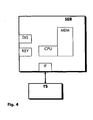
- a computer for executing the validation module VM is in some essential components is in FIG. 4 represented as server SER.
- the server SER contains a control means CPU, for example a processor, for executing machine-readable instructions, eg for executing the validation module VM.
- the server SER has a memory MEM in which the validation module VM can be stored.
- the server SER has as input and output means a keypad KEY and a display device DIS, eg to output data generated by the validation module VM or to send data to the validation module VM.
- the server SER has an interface device IF, via which it outputs data with the FIG. 1 known target system TS can exchange.
- the components of the server SER are defined by in FIG. 4 not shown interconnected connections.
- An operating system such as UNIX or DOS (D isc O perating S ystem), manages the resources of the server SER and controls, among other things, the execution of the validation module VM.
- DOS isc O perating S ystem
- the validation module VM can validate the configuration data KD according to one or more validation rules contained in a validation rule set. Examples of such validation rule sets are in the form of a validation rule set VR1 and a validation rule set VR2 in FIG. 1 shown. The validation rule sets VR1 and VR2 are examples of further, in FIG. 1 not shown validation rule sets and are stored in the memory MEM.
- the configuration data KD are sent from the target system TS to the validation module VM or from an in FIG. 1 not shown program module detected, for example, read by an editor or a graphical user interface or via the interface device IF.
- the configuration data KD are transmitted to the validation module VM, for example in the form of a file which is stored in the memory MEM, or by means of messages which are sent to the validation module VM.
- the process of submitting is in FIG. 1 indicated by an arrow.
- the validation module VM determines according to which validation rules the configuration data KD are to be checked. For this purpose, the validation module VM uses control data VCONF, which specifies in which validation rule set the required validation rules are contained.
- the control data can be stored, for example, in the form of a control table, in each of which an assignment of configuration data to a validation rule set is defined. For example, it may be specified that one particular type of target system requires configuration data to be validated against the validation rule set VR1, while another type of target system requires configuration data that must withstand the validation rule set VR2. In the example off FIG. 1 is defined in the control data VCONF that the configuration data KD are to be checked according to the specifications of the validation rule set VR2.
- the validation module VM reads the validation rule set VR2 from the memory MEM and checks the configuration data KD in accordance with the specifications of the validation rule set VR2.
- the result of the check is reported by the validation module VM with a notification message MSG, for example in the form of an output on the display device DIS or on a printer. With the help of the message MSG, errors that occurred during the check can also be displayed in detail. If the configuration data KD checked by the validation module VM have withstood the check, ie are consistent, the configuration data KD can be loaded, for example, via the interface device IF into the target system TS and adopted by it as an operating parameter.
- the requirements which the configuration data KD have to fulfill for the correct operation of the target system TS have changed, it is sufficient merely to exchange the validation rule set VR2 or to modify it so that the data in the new or the second modified validation rule set VR2 ensure a complete, adapted to the new requirements of the target system TS validation validation.
- the validation module VM itself does not have to be changed. In this way, it is also easily possible to insert further validation rules into a validation rule set or to remove validation rules no longer needed from a validation rule set.
- a new validation rule set can also be added to the validation rule sets VR1 and VR2 at any time, with which the new configuration data can be validated.
- the validation module VM can use this default information to design the notification message MSG.
- default information e.g. Text elements containing content of the notification message MSG
- the validation module VM can use this default information to design the notification message MSG.
- the validation rule sets VR1 or VR2 for each of the validation rules contained therein, which error message is to be displayed by the validation module VM if an error occurs in a check according to the specifications of the respective validation rule.
- this specification information as well as the validation rules can be easily exchanged or modified to meet current requirements.
- a new text added to a validation rule set for an error message will further specify a cause for an error.
- the validation module VM can also determine before the reading of the configuration data KD with which the validation rule sets VR1 or VR2, the configuration data KD are to be checked, for example, if the control data VCONF are given as so-called call parameters the validation module VM already at its start.
- the validation module VM determines on the basis of the configuration data KD which of the validation rule sets VR1 or VR2 is needed for checking the configuration data KD. For this purpose, the validation module VM searches in the configuration data KD for a feature or an identifier that uniquely identifies the configuration data KD. Such an identifier is included in the configuration data KD in the form of an identifier ID2.
- the identifier ID2 can, for example, enter the configuration data KD as a specific target system, in FIG. 1 the target system TS, identify and be a text element with the content: "exchange A with control software version 1.3".
- the validation module VM can then determine which validation rule set is to be used for checking the configuration data KD. It is also possible for the validation module VM to determine the validation rule set VR1 or VR2 required for the validation of the configuration data KD on the basis of an identifier which must be the same as that contained in the configuration data KD.
- the identifier ID2 of the configuration data KD is in the example FIG. 1 also specified in the validation rule set VR2; the validation rule set VR1, on the other hand, has an identifier ID1.
- the validation module VM can also use the structure and the type of the configuration data KD to determine which validation rule set must be used for the check. If, in a very simple example, the configuration data KD contains only data sets which each begin with a number string, the validation module VM can e.g. deduce that the configuration data KD after the validation rule set VR1 are to be checked. However, if the configuration data KD contains only records each beginning with a letter string, the validation module VM can recognize that the configuration data KD is to be checked after the validation rule set VR2.
- the validation rules contained in the validation rule sets VR1 and VR2 must correspond to predetermined semantic and syntactic rules through the design of the validation module VM.
- the validation rules can be written in a so-called interpreter language, whose instructions "interpret" the validation module VM, ie evaluate it and convert it into machine-readable instructions. These commands may then execute the control means CPU in a similar manner as the instruction sequences of the validation module VM.
- An interpreter language for validation rules can be specifically defined for the validation module VM. However, it is also possible to use a universally suitable interpreter language for various purposes.
- PERL Physical E Xtraction and R eport L anguage
- PERL Physical E Xtraction and R eport L anguage
- the validation module VM does not necessarily have to interpret the validation rules itself, but instead can instruct a program module called "PERL interpreter" to interpret the validation rules.
- a PERL interpreter usually comes with a UNIX operating system.
- the machine-readable instructions generated by the PERL interpreter from the validation rules are incorporated by the validation module VM in its own command sequences, eg in the form of program branches.
- the validation engine VM may contain a generic call that references a validation rule that carries a name specified in the call.
- the call refers either to a validation rule in the validation rule set VR1 or to a validation rule in the validation rule set VR2.
- both validation rules bear the same name, they can contain different test specifications.
- the interpreter program module ensures a correct branching of the command sequences of the validation module VM into the command sequences generated by interpreting the validation rules.
- the validation rules can also already be contained in the validation rule sets VR1 and VR2 in a form executable by a processor, referred to as so-called functions, also called library functions.
- the validation module VM can directly integrate the instruction sequences of such functions into its own instruction sequences without prior interpretation. Such a process is also called "dynamic linking" of functions.
- functions can also be generated only at run time of the validation module VM, by the validation module VM for validating the configuration data KD
- the validation ruleset is first translated into translator-executable command sequences or translated by a translator program module, and the resulting validation rule command sequences are included in its own command sequences.
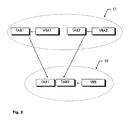
- FIG. 2 are the ones out FIG. 1 known, to be validated configuration data KD divided into two subsets TAB1 and TAB2, eg in two data tables, which also in FIG. 2 through that FIG. 1 known validation module VM are validated.
- the validation module VM initially determines, in the manner described above, which validation rule sets VR1 and VR2 must be used to validate the configuration data KD. Then the validation module VM performs the actual validation on the basis of the validation rules contained in the determined validation rule set.
- FIG. 2 These validation rules are shown in the form of validation rules VRA1, VRA2 and VRB, which follow the example FIG. 1 following in the validation rule set VR2.
- the validation module VM checks the configuration data KD in accordance with the validation rules VRA1, VRA2 and VRB in a partial examination S1 and a partial examination S2, which in FIG. 2 each indicated by dashed lines.
- the sub-sets TAB1 and TAB2 are individually checked by the validation module VM, namely the subset TAB1 on the basis of the validation rule VRA1 and the subset TAB2 on the basis of the validation rule VRA2. It can be checked, for example, whether the subset TAB1 only records each with a six-digit number and a first identifier and the subset TAB2 only records that each consist of a phone number and a second identifier.
- the validation module VM checks in the partial check 52 whether the subsets TAB1 and TAB2 are mutually consistent. For this purpose, the validation module VM applies the validation rule VRB. In this example, it is specified that each phone number from the subset TAB1 must also be contained in at least one record of the subset TAB2. The results of the partial tests S1 and S2 are reported by the validation module VM as in FIG. 1 with the help of a message MSG.
- the validation engine VM can sequentially and completely apply all the validation rules contained in a validation rule set to the configuration data KD.
- the validation module VM is predefined by means of control data to perform only a partial validation of the configuration data KD, that is, to use only a part of the validation rules of a validation rule set.
- the validation module VM can e.g. instructed to carry out only the partial test S1 on the basis of the validation rules VRA1 and VR2.
- the validation module VM can work very efficiently in this way since it only needs to read in and evaluate the validation rules actually required for validation.
- the validation rules VRA1 and VRA2 are contained in a first validation rule set, eg the validation rule set VR1, and the validation rule VRB in a second validation rule set, eg the validation rule set VR2.
- the validation module VM determines that only the validation rule set VR1 is involved is required, then reads only the validation rule set VR1 and checks for its validation rules. Only if both partial checks S1 and S2 are required does the validation module VM use both the validation rule set VR1 and the validation rule set VR2 for the desired validation of the configuration data KD.
- the validation module VM is shown in its essential functional steps.
- the validation module VM is, as already mentioned, stored in a memory and by a control means, such as a processor, readable and directly executable or indirectly evaluable using an interpreter program module command sequences.
- the validation module is VM in FIG. 3 represented in the form of a flowchart, in the course of which individual steps are executed.
- the individual steps each represent a single command or a sequence of commands, each of which forms a functional unit, a so-called function.
- the number of steps in FIG. 3 and their sequence is to be regarded as exemplary for a practical solution.
- the validation module VM detects in a step ST1 configuration data which are sent, for example via the interface device IF or the keypad KEY to the validation module VM.
- the instructions of step ST1 are combined in a receiving functional unit, for example in a subroutine.
- the validation module VM determines which validation rule set is required for the validation of the acquired configuration data KD.
- the validation module VM reads the determined validation rule set and then evaluates the first validation rule contained therein in a step ST4.
- the validation module VM checks the configuration data according to the rules of the validation rule evaluated in step ST4.
- a step ST6 it is checked whether the Validation module VM after fulfillment of step ST5 should evaluate further validation rules. If this is the case, the validation module VM branches back to the step ST4. Otherwise, the validation module VM ends in a step END.
Landscapes
- Engineering & Computer Science (AREA)
- Computer Networks & Wireless Communication (AREA)
- Signal Processing (AREA)
- Databases & Information Systems (AREA)
- Exchange Systems With Centralized Control (AREA)
- Maintenance And Management Of Digital Transmission (AREA)
- Computer And Data Communications (AREA)
- Communication Control (AREA)
- Radar Systems Or Details Thereof (AREA)
- Inspection Of Paper Currency And Valuable Securities (AREA)
- Mobile Radio Communication Systems (AREA)
- Telephonic Communication Services (AREA)
- Monitoring And Testing Of Exchanges (AREA)
Claims (10)
- Procédé destiné à la validation de données de configuration (KD) en tant que paramètres de fonctionnement de systèmes de télécommunication au moyen de règles de validation par l'intermédiaire d'un module de validation (VM), ledit procédé comportant les étapes suivantes :- détection des données de configuration,- détermination d'un ensemble de règles de validation (VR2) comportant au moins une règle de validation destinée à la validation des données de configuration,- évaluation de l'ensemble de règles de validation,- contrôle des données de configuration conformément aux spécifications de l'ensemble de règles de validation et- émission d'un message de signalisation (MSG) comportant une information relative au succès du contrôle,caractérisé en ce que la détermination d'un ensemble de règles de validation comprend le choix d'un ensemble de règles de validation parmi une pluralité d'au moins deux ensembles de règles de validation (VR1, VR2), l'ensemble de règles de validation déterminé et choisi est lu, et l'association de données de configuration à un ensemble de règles de validation a lieu par l'utilisation de données de commande (VCONF).
- Procédé selon la revendication 1, caractérisé en ce que le module de validation (VM) détermine l'ensemble de règles de validation (VR2) à partir des données de commande (VCONF) déterminées pour le module de validation (VM).
- Procédé selon la revendication 1, caractérisé en ce que l'ensemble de règles de validation (RV) est déterminé à l'aide d'un identificateur (ID1) contenu dans les données de configuration (KD).
- Procédé selon la revendication 1, caractérisé en ce que, lors de l'évaluation de l'ensemble de règles de validation (VR2), des blocs fonctionnels, avec lesquels les données de configuration (KD) peuvent être contrôlées conformément aux règles de validation contenues dans l'ensemble de règles de validation, sont déterminés et lus, et les blocs fonctionnels sont utilisés pour le contrôle des données de configuration.
- Procédé selon la revendication 1, caractérisé en ce que, lors de l'évaluation de l'ensemble de règles de validation (VR2) à partir des règles de validation contenues dans l'ensemble de règles de validation, des blocs fonctionnels, avec lesquels les données de configuration (KD) peuvent être contrôlées conformément aux règles de validation contenues dans l'ensemble de règles de validation, sont produits, et les blocs fonctionnels sont utilisés pour le contrôle des données de configuration.
- Procédé selon la revendication 1, caractérisé en ce que, lors de l'émission du message de signalisation (MSG) comportant une information relative au succès du contrôle, des informations prédéterminées qui sont contenues dans l'ensemble de règles de validation sont utilisées.
- Module de validation (VM) destiné à la validation de données de configuration (KD) en tant que paramètres de fonctionnement de systèmes de télécommunication au moyen de règles de validation, le module de validation présentant une unité fonctionnelle de réception qui est formée de sorte que le module de validation puisse détecter les données de configuration, le module de validation présentant une unité fonctionnelle d'évaluation qui est formée de sorte que le module de validation puisse évaluer l'ensemble de règles de validation, le module de validation présentant une unité fonctionnelle de contrôle qui est formée de sorte que le module de validation puisse contrôler les données de configuration conformément aux spécifications de l'ensemble de règles de validation, et le module de validation présentant une unité fonctionnelle d'émission qui est formée de sorte que le module de validation puisse émettre un message de signalisation comportant une information relative au succès du contrôle, caractérisé en ce que le module de validation présente une unité fonctionnelle d'émission qui est formée de sorte que le module de validation puisse déterminer un ensemble de règles de validation comportant au moins une règle de validation destinée à la validation des données de configuration, la détermination d'un ensemble de règles de validation comprenant le choix d'un ensemble de règles de validation parmi une pluralité d'au moins deux ensembles de règles de validation (VR1, VR2) et l'association de données de configuration à un ensemble de règles de validation ayant lieu par l'utilisation de données de commande (VCONF), et le module de validation présentant une unité fonctionnelle de lecture qui est formée de sorte que le module de validation puisse lire l'ensemble de règles de validation.
- Serveur (SER) destiné à la validation de données de configuration (KD) en tant que paramètres de fonctionnement de systèmes de télécommunication au moyen de règles de validation, le serveur présentant des moyens de réception (IF, KEY) qui sont formés de sorte que le serveur puisse détecter les données de configuration, le serveur présentant des moyens d'évaluation qui sont formés de sorte que le serveur puisse évaluer l'ensemble de règles de validation, le serveur présentant des moyens de contrôle qui sont formés de sorte que le serveur puisse contrôler les données de configuration conformément aux spécifications de l'ensemble de règles de validation, et le serveur présentant des moyens d'émission (DIS) qui sont formés de sorte que le serveur puisse émettre un message de signalisation comportant une information relative au succès du contrôle, caractérisé en ce que le serveur présente des moyens de détermination qui sont formés de sorte que le serveur puisse déterminer un ensemble de règles de validation comportant au moins une règle de validation concernant la validation de données de configuration, la détermination d'un ensemble de règles de validation comprenant le choix d'un ensemble de règles de validation parmi une pluralité d'au moins deux ensemble de règles de validation (VR1, VR2) et l'association de données de configuration à un ensemble de règles de validation ayant lieu par l'utilisation de données de commande (VCONF), et le serveur présentant des moyens de lecture qui sont formés de sorte que le serveur puisse lire l'ensemble de règles de validation.
- Module de commande, sur lequel est stocké un module de validation et qui est prévu pour exécuter, en relation avec un processeur, le procédé selon la revendication 1.
- Moyen de mémorisation, caractérisé en ce que sur celui-ci est stocké un module de validation (VM) selon la revendication 7.
Applications Claiming Priority (2)
| Application Number | Priority Date | Filing Date | Title |
|---|---|---|---|
| DE19854753 | 1998-11-27 | ||
| DE19854753 | 1998-11-27 |
Publications (3)
| Publication Number | Publication Date |
|---|---|
| EP1005216A2 EP1005216A2 (fr) | 2000-05-31 |
| EP1005216A3 EP1005216A3 (fr) | 2003-01-29 |
| EP1005216B1 true EP1005216B1 (fr) | 2008-11-19 |
Family
ID=7889212
Family Applications (1)
| Application Number | Title | Priority Date | Filing Date |
|---|---|---|---|
| EP99440323A Expired - Lifetime EP1005216B1 (fr) | 1998-11-27 | 1999-11-19 | Procédé et système pour validation des données de configuration pour systèmes de télécommunication |
Country Status (5)
| Country | Link |
|---|---|
| EP (1) | EP1005216B1 (fr) |
| JP (1) | JP4394225B2 (fr) |
| AT (1) | ATE415044T1 (fr) |
| AU (1) | AU6174699A (fr) |
| DE (1) | DE59914907D1 (fr) |
Families Citing this family (12)
| Publication number | Priority date | Publication date | Assignee | Title |
|---|---|---|---|---|
| ITTO20010180A1 (it) * | 2001-03-01 | 2002-09-01 | Cselt Centro Studi Lab Telecom | Procedimento e sistema per il controllo della configurazione dei nodidi una rete per telecomunicazione. |
| US7418484B2 (en) * | 2001-11-30 | 2008-08-26 | Oracle International Corporation | System and method for actively managing an enterprise of configurable components |
| ITTO20020742A1 (it) * | 2002-08-23 | 2004-02-24 | Telecom Italia Lab Spa | Procedimento e sistema per il controllo della |
| DE10336793B4 (de) * | 2003-08-08 | 2005-06-23 | Db Telematik Gmbh | Verfahren zur Einrichtung und Konfiguration von Telekommunikationsdiensten eines Mobilfunknetzes |
| US20060126530A1 (en) * | 2004-12-14 | 2006-06-15 | Nokia Corporation | Indicating a configuring status |
| US8615578B2 (en) | 2005-10-07 | 2013-12-24 | Oracle International Corporation | Using a standby data storage system to detect the health of a cluster of data storage servers |
| EP1841131A1 (fr) * | 2006-03-28 | 2007-10-03 | Nokia Siemens Networks Gmbh & Co. Kg | Gestion de la configuration avec opérations supplémentaires |
| WO2009083683A1 (fr) * | 2007-12-20 | 2009-07-09 | France Telecom | Procede de configuration d'un equipement reseau |
| JP4937968B2 (ja) * | 2008-06-19 | 2012-05-23 | 富士通テレコムネットワークス株式会社 | 通信制御装置およびメッセージ生成方法 |
| CN110188038B (zh) * | 2019-05-13 | 2023-07-21 | 青岛海尔科技有限公司 | 一种参数校验方法及装置、校验架构 |
| CN111047295B (zh) * | 2019-12-13 | 2023-04-07 | 红云红河烟草(集团)有限责任公司 | 一种卷烟制丝加工过程的数据采集方法 |
| CN115277392A (zh) * | 2022-07-08 | 2022-11-01 | 南瑞集团有限公司 | 电力调度数据网设备配置合规性核查系统及方法 |
Family Cites Families (3)
| Publication number | Priority date | Publication date | Assignee | Title |
|---|---|---|---|---|
| EP0667722A1 (fr) * | 1994-02-09 | 1995-08-16 | Koninklijke KPN N.V. | Procédé de détection des interactions de service dans réseaux intelligents |
| US5713075A (en) * | 1995-11-30 | 1998-01-27 | Amsc Subsidiary Corporation | Network engineering/systems engineering system for mobile satellite communication system |
| US5912960A (en) * | 1996-05-17 | 1999-06-15 | Alcatel Usa Sourcing, L.P. | Method and apparatus for remotely activating services in a telecommunications network |
-
1999
- 1999-11-19 DE DE59914907T patent/DE59914907D1/de not_active Expired - Lifetime
- 1999-11-19 EP EP99440323A patent/EP1005216B1/fr not_active Expired - Lifetime
- 1999-11-19 AT AT99440323T patent/ATE415044T1/de not_active IP Right Cessation
- 1999-11-22 JP JP33089799A patent/JP4394225B2/ja not_active Expired - Fee Related
- 1999-11-26 AU AU61746/99A patent/AU6174699A/en not_active Abandoned
Also Published As
| Publication number | Publication date |
|---|---|
| JP2000216854A (ja) | 2000-08-04 |
| AU6174699A (en) | 2000-06-01 |
| JP4394225B2 (ja) | 2010-01-06 |
| DE59914907D1 (de) | 2009-01-02 |
| EP1005216A2 (fr) | 2000-05-31 |
| EP1005216A3 (fr) | 2003-01-29 |
| ATE415044T1 (de) | 2008-12-15 |
Similar Documents
| Publication | Publication Date | Title |
|---|---|---|
| DE69900810T2 (de) | Verfahren und Vorrichtung zum Testen von ereignisgesteuerten Programmen | |
| DE19837871C2 (de) | Verfahren zum automatischen Erzeugen eines Programms | |
| DE69529846T2 (de) | Verfahren zum vergleich von attributwerten von steuerbaren objektausdrücken in einem netzwerkelement | |
| DE69327777T2 (de) | Informationsbearbeitungseinrichtung, die die Führung von Betriebsmitteln durch ein Verwaltungssystem erlaubt | |
| DE69228819T2 (de) | Konfigurations- und Betriebsverfahren eines Telekommunikationsgeräts | |
| EP1430369B1 (fr) | Acces dynamique a des ressources d'automatisation | |
| EP0525432A2 (fr) | Méthode de changement des données de configuration de système dans un système de commutation de télécommunications | |
| DE69511080T2 (de) | Schnittstellenanordnung und verfahren | |
| DE3503119A1 (de) | Verfahren zum automatischen erzeugen eines quellenprogramms | |
| DE4125389C1 (fr) | ||
| EP1005216B1 (fr) | Procédé et système pour validation des données de configuration pour systèmes de télécommunication | |
| EP1035707A2 (fr) | Procédé, module de génération, serveur, module de commande, et support de stockage pour la création de règles de vérification | |
| DE19822553A1 (de) | Netzelement mit einer Steuerungseinrichtung und Steuerungsverfahren | |
| EP1005215B1 (fr) | Procédé et système pour l'édition des données de configuration pour systèmes de télécommunication | |
| EP0977416B1 (fr) | Méthode, terminal, noeud, module programme et interface d'exploitation pour déterminer des caractéristiques requises pour une application de communication | |
| EP0303869B1 (fr) | Système de communication numérique à structure modulaire comprenant des moyens de communication d'opération technique | |
| DE3727942A1 (de) | Modular strukturiertes digitales kommunikationssystem mit betriebstechnischen und sicherheitstechnischen komponenten | |
| DE69828804T2 (de) | Einführung von dienst unabhängigen baublöcken | |
| EP0358597A2 (fr) | Central téléphonique | |
| DE102009019442A1 (de) | Testdatengenerator | |
| DE69333420T2 (de) | Verfahren und anordnung zum testen von diensten in einem telekommunikationssystem | |
| DE3016510A1 (de) | Hilfsgeraet zur steuerprogrammentwicklung fuer komplexe anlagen, insbesondere fuer ein fernsprech-vermittlungssystem | |
| EP0821533B1 (fr) | Procédé pour charger une séquence d'instructions dans un central de télécommunications | |
| EP1157566A1 (fr) | Procede et element de reseau pour exploiter un reseau de telecommunication | |
| DE3319211A1 (de) | Online-dokumentationsverfahren und -einrichtung |
Legal Events
| Date | Code | Title | Description |
|---|---|---|---|
| PUAI | Public reference made under article 153(3) epc to a published international application that has entered the european phase |
Free format text: ORIGINAL CODE: 0009012 |
|
| AK | Designated contracting states |
Kind code of ref document: A2 Designated state(s): AT BE CH CY DE DK ES FI FR GB GR IE IT LI LU MC NL PT SE |
|
| AX | Request for extension of the european patent |
Free format text: AL;LT;LV;MK;RO;SI |
|
| PUAL | Search report despatched |
Free format text: ORIGINAL CODE: 0009013 |
|
| AK | Designated contracting states |
Designated state(s): AT BE CH CY DE DK ES FI FR GB GR IE IT LI LU MC NL PT SE |
|
| AX | Request for extension of the european patent |
Extension state: AL LT LV MK RO SI |
|
| RIC1 | Information provided on ipc code assigned before grant |
Ipc: 7H 04M 3/42 B Ipc: 7H 04Q 3/00 B Ipc: 7H 04M 3/22 A |
|
| 17P | Request for examination filed |
Effective date: 20030218 |
|
| AKX | Designation fees paid |
Designated state(s): AT BE CH CY DE DK ES FI FR GB GR IE IT LI LU MC NL PT SE |
|
| 17Q | First examination report despatched |
Effective date: 20050324 |
|
| RAP1 | Party data changed (applicant data changed or rights of an application transferred) |
Owner name: ALCATEL LUCENT |
|
| GRAP | Despatch of communication of intention to grant a patent |
Free format text: ORIGINAL CODE: EPIDOSNIGR1 |
|
| GRAS | Grant fee paid |
Free format text: ORIGINAL CODE: EPIDOSNIGR3 |
|
| GRAA | (expected) grant |
Free format text: ORIGINAL CODE: 0009210 |
|
| AK | Designated contracting states |
Kind code of ref document: B1 Designated state(s): AT BE CH CY DE DK ES FI FR GB GR IE IT LI LU MC NL PT SE |
|
| REG | Reference to a national code |
Ref country code: GB Ref legal event code: FG4D Free format text: NOT ENGLISH |
|
| REG | Reference to a national code |
Ref country code: CH Ref legal event code: EP |
|
| REG | Reference to a national code |
Ref country code: IE Ref legal event code: FG4D Free format text: LANGUAGE OF EP DOCUMENT: GERMAN |
|
| REF | Corresponds to: |
Ref document number: 59914907 Country of ref document: DE Date of ref document: 20090102 Kind code of ref document: P |
|
| PG25 | Lapsed in a contracting state [announced via postgrant information from national office to epo] |
Ref country code: ES Free format text: LAPSE BECAUSE OF FAILURE TO SUBMIT A TRANSLATION OF THE DESCRIPTION OR TO PAY THE FEE WITHIN THE PRESCRIBED TIME-LIMIT Effective date: 20090301 |
|
| NLV1 | Nl: lapsed or annulled due to failure to fulfill the requirements of art. 29p and 29m of the patents act | ||
| PG25 | Lapsed in a contracting state [announced via postgrant information from national office to epo] |
Ref country code: NL Free format text: LAPSE BECAUSE OF FAILURE TO SUBMIT A TRANSLATION OF THE DESCRIPTION OR TO PAY THE FEE WITHIN THE PRESCRIBED TIME-LIMIT Effective date: 20081119 Ref country code: FI Free format text: LAPSE BECAUSE OF FAILURE TO SUBMIT A TRANSLATION OF THE DESCRIPTION OR TO PAY THE FEE WITHIN THE PRESCRIBED TIME-LIMIT Effective date: 20081119 |
|
| BERE | Be: lapsed |
Owner name: ALCATEL LUCENT Effective date: 20081130 |
|
| PG25 | Lapsed in a contracting state [announced via postgrant information from national office to epo] |
Ref country code: MC Free format text: LAPSE BECAUSE OF NON-PAYMENT OF DUE FEES Effective date: 20081130 |
|
| REG | Reference to a national code |
Ref country code: CH Ref legal event code: PL |
|
| REG | Reference to a national code |
Ref country code: IE Ref legal event code: FD4D |
|
| PG25 | Lapsed in a contracting state [announced via postgrant information from national office to epo] |
Ref country code: IE Free format text: LAPSE BECAUSE OF FAILURE TO SUBMIT A TRANSLATION OF THE DESCRIPTION OR TO PAY THE FEE WITHIN THE PRESCRIBED TIME-LIMIT Effective date: 20081119 Ref country code: DK Free format text: LAPSE BECAUSE OF FAILURE TO SUBMIT A TRANSLATION OF THE DESCRIPTION OR TO PAY THE FEE WITHIN THE PRESCRIBED TIME-LIMIT Effective date: 20081119 |
|
| PG25 | Lapsed in a contracting state [announced via postgrant information from national office to epo] |
Ref country code: SE Free format text: LAPSE BECAUSE OF FAILURE TO SUBMIT A TRANSLATION OF THE DESCRIPTION OR TO PAY THE FEE WITHIN THE PRESCRIBED TIME-LIMIT Effective date: 20090219 Ref country code: PT Free format text: LAPSE BECAUSE OF FAILURE TO SUBMIT A TRANSLATION OF THE DESCRIPTION OR TO PAY THE FEE WITHIN THE PRESCRIBED TIME-LIMIT Effective date: 20090420 |
|
| PLBE | No opposition filed within time limit |
Free format text: ORIGINAL CODE: 0009261 |
|
| STAA | Information on the status of an ep patent application or granted ep patent |
Free format text: STATUS: NO OPPOSITION FILED WITHIN TIME LIMIT |
|
| PG25 | Lapsed in a contracting state [announced via postgrant information from national office to epo] |
Ref country code: BE Free format text: LAPSE BECAUSE OF NON-PAYMENT OF DUE FEES Effective date: 20081130 |
|
| 26N | No opposition filed |
Effective date: 20090820 |
|
| PG25 | Lapsed in a contracting state [announced via postgrant information from national office to epo] |
Ref country code: LI Free format text: LAPSE BECAUSE OF NON-PAYMENT OF DUE FEES Effective date: 20081130 Ref country code: CH Free format text: LAPSE BECAUSE OF NON-PAYMENT OF DUE FEES Effective date: 20081130 |
|
| PG25 | Lapsed in a contracting state [announced via postgrant information from national office to epo] |
Ref country code: AT Free format text: LAPSE BECAUSE OF NON-PAYMENT OF DUE FEES Effective date: 20081119 |
|
| PG25 | Lapsed in a contracting state [announced via postgrant information from national office to epo] |
Ref country code: LU Free format text: LAPSE BECAUSE OF NON-PAYMENT OF DUE FEES Effective date: 20081119 |
|
| PG25 | Lapsed in a contracting state [announced via postgrant information from national office to epo] |
Ref country code: CY Free format text: LAPSE BECAUSE OF FAILURE TO SUBMIT A TRANSLATION OF THE DESCRIPTION OR TO PAY THE FEE WITHIN THE PRESCRIBED TIME-LIMIT Effective date: 20081119 |
|
| PG25 | Lapsed in a contracting state [announced via postgrant information from national office to epo] |
Ref country code: GR Free format text: LAPSE BECAUSE OF FAILURE TO SUBMIT A TRANSLATION OF THE DESCRIPTION OR TO PAY THE FEE WITHIN THE PRESCRIBED TIME-LIMIT Effective date: 20090220 |
|
| REG | Reference to a national code |
Ref country code: GB Ref legal event code: 732E Free format text: REGISTERED BETWEEN 20130926 AND 20131002 |
|
| REG | Reference to a national code |
Ref country code: FR Ref legal event code: GC Effective date: 20131018 |
|
| PG25 | Lapsed in a contracting state [announced via postgrant information from national office to epo] |
Ref country code: IT Free format text: LAPSE BECAUSE OF FAILURE TO SUBMIT A TRANSLATION OF THE DESCRIPTION OR TO PAY THE FEE WITHIN THE PRESCRIBED TIME-LIMIT Effective date: 20081119 |
|
| REG | Reference to a national code |
Ref country code: FR Ref legal event code: RG Effective date: 20141016 |
|
| REG | Reference to a national code |
Ref country code: FR Ref legal event code: CA Effective date: 20150521 |
|
| REG | Reference to a national code |
Ref country code: FR Ref legal event code: CA Effective date: 20150521 |
|
| REG | Reference to a national code |
Ref country code: FR Ref legal event code: PLFP Year of fee payment: 17 |
|
| PGFP | Annual fee paid to national office [announced via postgrant information from national office to epo] |
Ref country code: DE Payment date: 20151119 Year of fee payment: 17 Ref country code: GB Payment date: 20151118 Year of fee payment: 17 |
|
| PGFP | Annual fee paid to national office [announced via postgrant information from national office to epo] |
Ref country code: FR Payment date: 20151119 Year of fee payment: 17 |
|
| REG | Reference to a national code |
Ref country code: DE Ref legal event code: R119 Ref document number: 59914907 Country of ref document: DE |
|
| GBPC | Gb: european patent ceased through non-payment of renewal fee |
Effective date: 20161119 |
|
| REG | Reference to a national code |
Ref country code: FR Ref legal event code: ST Effective date: 20170731 |
|
| PG25 | Lapsed in a contracting state [announced via postgrant information from national office to epo] |
Ref country code: FR Free format text: LAPSE BECAUSE OF NON-PAYMENT OF DUE FEES Effective date: 20161130 |
|
| PG25 | Lapsed in a contracting state [announced via postgrant information from national office to epo] |
Ref country code: GB Free format text: LAPSE BECAUSE OF NON-PAYMENT OF DUE FEES Effective date: 20161119 Ref country code: DE Free format text: LAPSE BECAUSE OF NON-PAYMENT OF DUE FEES Effective date: 20170601 |