EP1006111A2 - Verfahren zur enantioselektiven Epoxidierung von C=C-Doppelbindungen - Google Patents
Verfahren zur enantioselektiven Epoxidierung von C=C-Doppelbindungen Download PDFInfo
- Publication number
- EP1006111A2 EP1006111A2 EP99123642A EP99123642A EP1006111A2 EP 1006111 A2 EP1006111 A2 EP 1006111A2 EP 99123642 A EP99123642 A EP 99123642A EP 99123642 A EP99123642 A EP 99123642A EP 1006111 A2 EP1006111 A2 EP 1006111A2
- Authority
- EP
- European Patent Office
- Prior art keywords
- alkyl
- cycloalkyl
- aryl
- heteroaryl
- epoxidation
- Prior art date
- Legal status (The legal status is an assumption and is not a legal conclusion. Google has not performed a legal analysis and makes no representation as to the accuracy of the status listed.)
- Withdrawn
Links
- 238000000034 method Methods 0.000 title claims abstract description 37
- 238000006735 epoxidation reaction Methods 0.000 title claims abstract description 25
- 239000002253 acid Substances 0.000 claims abstract description 26
- 239000007800 oxidant agent Substances 0.000 claims abstract description 17
- 150000001875 compounds Chemical class 0.000 claims abstract description 10
- 230000001590 oxidative effect Effects 0.000 claims abstract description 8
- 150000002118 epoxides Chemical class 0.000 claims abstract description 7
- 238000003786 synthesis reaction Methods 0.000 claims abstract description 7
- 239000000543 intermediate Substances 0.000 claims abstract description 4
- 125000003118 aryl group Chemical group 0.000 claims description 19
- 125000001072 heteroaryl group Chemical group 0.000 claims description 19
- 125000006702 (C1-C18) alkyl group Chemical group 0.000 claims description 16
- 125000006552 (C3-C8) cycloalkyl group Chemical group 0.000 claims description 16
- 239000003054 catalyst Substances 0.000 claims description 14
- 125000003342 alkenyl group Chemical group 0.000 claims description 10
- 239000000758 substrate Substances 0.000 claims description 10
- 150000001413 amino acids Chemical class 0.000 claims description 9
- XLYOFNOQVPJJNP-UHFFFAOYSA-N water Substances O XLYOFNOQVPJJNP-UHFFFAOYSA-N 0.000 claims description 8
- 125000005842 heteroatom Chemical group 0.000 claims description 7
- 239000003960 organic solvent Substances 0.000 claims description 7
- IAZDPXIOMUYVGZ-UHFFFAOYSA-N Dimethylsulphoxide Chemical compound CS(C)=O IAZDPXIOMUYVGZ-UHFFFAOYSA-N 0.000 claims description 6
- 239000000203 mixture Substances 0.000 claims description 6
- 229920000642 polymer Polymers 0.000 claims description 5
- ZMXDDKWLCZADIW-UHFFFAOYSA-N N,N-Dimethylformamide Chemical compound CN(C)C=O ZMXDDKWLCZADIW-UHFFFAOYSA-N 0.000 claims description 4
- 125000004475 heteroaralkyl group Chemical group 0.000 claims description 4
- 229910052760 oxygen Inorganic materials 0.000 claims description 4
- 239000011877 solvent mixture Substances 0.000 claims description 4
- 229910052717 sulfur Inorganic materials 0.000 claims description 4
- 150000001298 alcohols Chemical class 0.000 claims description 3
- 125000000304 alkynyl group Chemical group 0.000 claims description 3
- 125000003710 aryl alkyl group Chemical group 0.000 claims description 3
- 239000003444 phase transfer catalyst Substances 0.000 claims description 3
- NLHHRLWOUZZQLW-UHFFFAOYSA-N Acrylonitrile Chemical compound C=CC#N NLHHRLWOUZZQLW-UHFFFAOYSA-N 0.000 claims description 2
- 239000007864 aqueous solution Substances 0.000 claims description 2
- VTIIJXUACCWYHX-UHFFFAOYSA-L disodium;carboxylatooxy carbonate Chemical compound [Na+].[Na+].[O-]C(=O)OOC([O-])=O VTIIJXUACCWYHX-UHFFFAOYSA-L 0.000 claims description 2
- 150000002170 ethers Chemical class 0.000 claims description 2
- 150000002978 peroxides Chemical class 0.000 claims description 2
- 150000004965 peroxy acids Chemical class 0.000 claims description 2
- 108010054442 polyalanine Proteins 0.000 claims description 2
- 108010057904 polyisoleucine Proteins 0.000 claims description 2
- 108010050934 polyleucine Proteins 0.000 claims description 2
- 108010039177 polyphenylalanine Proteins 0.000 claims description 2
- 108010033356 polyvaline Proteins 0.000 claims description 2
- 229960001922 sodium perborate Drugs 0.000 claims description 2
- 229940045872 sodium percarbonate Drugs 0.000 claims description 2
- YKLJGMBLPUQQOI-UHFFFAOYSA-M sodium;oxidooxy(oxo)borane Chemical compound [Na+].[O-]OB=O YKLJGMBLPUQQOI-UHFFFAOYSA-M 0.000 claims description 2
- 238000006243 chemical reaction Methods 0.000 description 19
- -1 e.g. B. Mol sieve Chemical compound 0.000 description 18
- 150000003254 radicals Chemical class 0.000 description 12
- 150000007513 acids Chemical class 0.000 description 10
- 229940024606 amino acid Drugs 0.000 description 8
- VYPSYNLAJGMNEJ-UHFFFAOYSA-N Silicium dioxide Chemical compound O=[Si]=O VYPSYNLAJGMNEJ-UHFFFAOYSA-N 0.000 description 7
- 125000004209 (C1-C8) alkyl group Chemical group 0.000 description 6
- 235000005513 chalcones Nutrition 0.000 description 6
- 230000006698 induction Effects 0.000 description 6
- 229920001308 poly(aminoacid) Polymers 0.000 description 6
- DQFBYFPFKXHELB-UHFFFAOYSA-N Chalcone Natural products C=1C=CC=CC=1C(=O)C=CC1=CC=CC=C1 DQFBYFPFKXHELB-UHFFFAOYSA-N 0.000 description 5
- 125000004432 carbon atom Chemical group C* 0.000 description 5
- 239000002904 solvent Substances 0.000 description 5
- 239000000969 carrier Substances 0.000 description 3
- 239000012876 carrier material Substances 0.000 description 3
- 238000004519 manufacturing process Methods 0.000 description 3
- VLKZOEOYAKHREP-UHFFFAOYSA-N n-Hexane Chemical compound CCCCCC VLKZOEOYAKHREP-UHFFFAOYSA-N 0.000 description 3
- 230000003287 optical effect Effects 0.000 description 3
- 239000011541 reaction mixture Substances 0.000 description 3
- 230000035484 reaction time Effects 0.000 description 3
- DQFBYFPFKXHELB-VAWYXSNFSA-N trans-chalcone Chemical compound C=1C=CC=CC=1C(=O)\C=C\C1=CC=CC=C1 DQFBYFPFKXHELB-VAWYXSNFSA-N 0.000 description 3
- IJGRMHOSHXDMSA-UHFFFAOYSA-N Atomic nitrogen Chemical compound N#N IJGRMHOSHXDMSA-UHFFFAOYSA-N 0.000 description 2
- OKTJSMMVPCPJKN-UHFFFAOYSA-N Carbon Chemical compound [C] OKTJSMMVPCPJKN-UHFFFAOYSA-N 0.000 description 2
- 102000004190 Enzymes Human genes 0.000 description 2
- 108090000790 Enzymes Proteins 0.000 description 2
- LFQSCWFLJHTTHZ-UHFFFAOYSA-N Ethanol Chemical compound CCO LFQSCWFLJHTTHZ-UHFFFAOYSA-N 0.000 description 2
- MHAJPDPJQMAIIY-UHFFFAOYSA-N Hydrogen peroxide Chemical compound OO MHAJPDPJQMAIIY-UHFFFAOYSA-N 0.000 description 2
- 150000001412 amines Chemical class 0.000 description 2
- 150000005840 aryl radicals Chemical class 0.000 description 2
- 150000001789 chalcones Chemical class 0.000 description 2
- 238000004587 chromatography analysis Methods 0.000 description 2
- 230000007423 decrease Effects 0.000 description 2
- 238000001914 filtration Methods 0.000 description 2
- 239000012528 membrane Substances 0.000 description 2
- 230000003647 oxidation Effects 0.000 description 2
- 238000007254 oxidation reaction Methods 0.000 description 2
- 239000011148 porous material Substances 0.000 description 2
- 229910002027 silica gel Inorganic materials 0.000 description 2
- 239000000741 silica gel Substances 0.000 description 2
- XFNJVJPLKCPIBV-UHFFFAOYSA-N trimethylenediamine Chemical compound NCCCN XFNJVJPLKCPIBV-UHFFFAOYSA-N 0.000 description 2
- WCVOGSZTONGSQY-UHFFFAOYSA-N 2,4,6-trichloroanisole Chemical compound COC1=C(Cl)C=C(Cl)C=C1Cl WCVOGSZTONGSQY-UHFFFAOYSA-N 0.000 description 1
- OZDGMOYKSFPLSE-UHFFFAOYSA-N 2-Methylaziridine Chemical compound CC1CN1 OZDGMOYKSFPLSE-UHFFFAOYSA-N 0.000 description 1
- 125000003682 3-furyl group Chemical group O1C([H])=C([*])C([H])=C1[H] 0.000 description 1
- 125000001397 3-pyrrolyl group Chemical group [H]N1C([H])=C([*])C([H])=C1[H] 0.000 description 1
- 125000001541 3-thienyl group Chemical group S1C([H])=C([*])C([H])=C1[H] 0.000 description 1
- 125000000339 4-pyridyl group Chemical group N1=C([H])C([H])=C([*])C([H])=C1[H] 0.000 description 1
- ZCYVEMRRCGMTRW-UHFFFAOYSA-N 7553-56-2 Chemical compound [I] ZCYVEMRRCGMTRW-UHFFFAOYSA-N 0.000 description 1
- WKBOTKDWSSQWDR-UHFFFAOYSA-N Bromine atom Chemical compound [Br] WKBOTKDWSSQWDR-UHFFFAOYSA-N 0.000 description 1
- KSSJBGNOJJETTC-UHFFFAOYSA-N COC1=C(C=CC=C1)N(C1=CC=2C3(C4=CC(=CC=C4C=2C=C1)N(C1=CC=C(C=C1)OC)C1=C(C=CC=C1)OC)C1=CC(=CC=C1C=1C=CC(=CC=13)N(C1=CC=C(C=C1)OC)C1=C(C=CC=C1)OC)N(C1=CC=C(C=C1)OC)C1=C(C=CC=C1)OC)C1=CC=C(C=C1)OC Chemical compound COC1=C(C=CC=C1)N(C1=CC=2C3(C4=CC(=CC=C4C=2C=C1)N(C1=CC=C(C=C1)OC)C1=C(C=CC=C1)OC)C1=CC(=CC=C1C=1C=CC(=CC=13)N(C1=CC=C(C=C1)OC)C1=C(C=CC=C1)OC)N(C1=CC=C(C=C1)OC)C1=C(C=CC=C1)OC)C1=CC=C(C=C1)OC KSSJBGNOJJETTC-UHFFFAOYSA-N 0.000 description 1
- ZAMOUSCENKQFHK-UHFFFAOYSA-N Chlorine atom Chemical compound [Cl] ZAMOUSCENKQFHK-UHFFFAOYSA-N 0.000 description 1
- 150000008574 D-amino acids Chemical class 0.000 description 1
- 239000004593 Epoxy Substances 0.000 description 1
- PXGOKWXKJXAPGV-UHFFFAOYSA-N Fluorine Chemical compound FF PXGOKWXKJXAPGV-UHFFFAOYSA-N 0.000 description 1
- DGAQECJNVWCQMB-PUAWFVPOSA-M Ilexoside XXIX Chemical compound C[C@@H]1CC[C@@]2(CC[C@@]3(C(=CC[C@H]4[C@]3(CC[C@@H]5[C@@]4(CC[C@@H](C5(C)C)OS(=O)(=O)[O-])C)C)[C@@H]2[C@]1(C)O)C)C(=O)O[C@H]6[C@@H]([C@H]([C@@H]([C@H](O6)CO)O)O)O.[Na+] DGAQECJNVWCQMB-PUAWFVPOSA-M 0.000 description 1
- 238000006975 Julia-Colonna epoxidation reaction Methods 0.000 description 1
- 150000008575 L-amino acids Chemical class 0.000 description 1
- PWHULOQIROXLJO-UHFFFAOYSA-N Manganese Chemical compound [Mn] PWHULOQIROXLJO-UHFFFAOYSA-N 0.000 description 1
- 239000000020 Nitrocellulose Substances 0.000 description 1
- 239000002202 Polyethylene glycol Substances 0.000 description 1
- 239000004793 Polystyrene Substances 0.000 description 1
- NINIDFKCEFEMDL-UHFFFAOYSA-N Sulfur Chemical compound [S] NINIDFKCEFEMDL-UHFFFAOYSA-N 0.000 description 1
- 229910021536 Zeolite Inorganic materials 0.000 description 1
- 125000000641 acridinyl group Chemical group C1(=CC=CC2=NC3=CC=CC=C3C=C12)* 0.000 description 1
- 150000004808 allyl alcohols Chemical class 0.000 description 1
- 150000003868 ammonium compounds Chemical class 0.000 description 1
- 125000005428 anthryl group Chemical group [H]C1=C([H])C([H])=C2C([H])=C3C(*)=C([H])C([H])=C([H])C3=C([H])C2=C1[H] 0.000 description 1
- 239000012736 aqueous medium Substances 0.000 description 1
- QVGXLLKOCUKJST-UHFFFAOYSA-N atomic oxygen Chemical compound [O] QVGXLLKOCUKJST-UHFFFAOYSA-N 0.000 description 1
- 230000009286 beneficial effect Effects 0.000 description 1
- NDKBVBUGCNGSJJ-UHFFFAOYSA-M benzyltrimethylammonium hydroxide Chemical compound [OH-].C[N+](C)(C)CC1=CC=CC=C1 NDKBVBUGCNGSJJ-UHFFFAOYSA-M 0.000 description 1
- 230000015572 biosynthetic process Effects 0.000 description 1
- 235000010290 biphenyl Nutrition 0.000 description 1
- 239000004305 biphenyl Substances 0.000 description 1
- GDTBXPJZTBHREO-UHFFFAOYSA-N bromine Substances BrBr GDTBXPJZTBHREO-UHFFFAOYSA-N 0.000 description 1
- 229910052794 bromium Inorganic materials 0.000 description 1
- 125000002091 cationic group Chemical group 0.000 description 1
- 239000002738 chelating agent Substances 0.000 description 1
- 239000000460 chlorine Substances 0.000 description 1
- 229910052801 chlorine Inorganic materials 0.000 description 1
- 238000004140 cleaning Methods 0.000 description 1
- 229920001577 copolymer Polymers 0.000 description 1
- 238000004132 cross linking Methods 0.000 description 1
- 125000001995 cyclobutyl group Chemical group [H]C1([H])C([H])([H])C([H])(*)C1([H])[H] 0.000 description 1
- 125000000582 cycloheptyl group Chemical group [H]C1([H])C([H])([H])C([H])([H])C([H])([H])C([H])(*)C([H])([H])C1([H])[H] 0.000 description 1
- 125000000113 cyclohexyl group Chemical group [H]C1([H])C([H])([H])C([H])([H])C([H])(*)C([H])([H])C1([H])[H] 0.000 description 1
- 125000001511 cyclopentyl group Chemical group [H]C1([H])C([H])([H])C([H])([H])C([H])(*)C1([H])[H] 0.000 description 1
- 239000000412 dendrimer Substances 0.000 description 1
- 229920000736 dendritic polymer Polymers 0.000 description 1
- 230000001419 dependent effect Effects 0.000 description 1
- 239000012973 diazabicyclooctane Substances 0.000 description 1
- HNPSIPDUKPIQMN-UHFFFAOYSA-N dioxosilane;oxo(oxoalumanyloxy)alumane Chemical compound O=[Si]=O.O=[Al]O[Al]=O HNPSIPDUKPIQMN-UHFFFAOYSA-N 0.000 description 1
- MFLMBWASGCAJGO-UHFFFAOYSA-L disodium;hydrogen peroxide;carbonate Chemical compound [Na+].[Na+].OO.[O-]C([O-])=O MFLMBWASGCAJGO-UHFFFAOYSA-L 0.000 description 1
- 230000000694 effects Effects 0.000 description 1
- 239000003623 enhancer Substances 0.000 description 1
- 125000001495 ethyl group Chemical group [H]C([H])([H])C([H])([H])* 0.000 description 1
- 229910052731 fluorine Inorganic materials 0.000 description 1
- 239000011737 fluorine Substances 0.000 description 1
- 239000000499 gel Substances 0.000 description 1
- 229910001385 heavy metal Inorganic materials 0.000 description 1
- 150000002390 heteroarenes Chemical class 0.000 description 1
- 125000004051 hexyl group Chemical group [H]C([H])([H])C([H])([H])C([H])([H])C([H])([H])C([H])([H])C([H])([H])* 0.000 description 1
- 238000004128 high performance liquid chromatography Methods 0.000 description 1
- 125000002887 hydroxy group Chemical group [H]O* 0.000 description 1
- 125000003406 indolizinyl group Chemical group C=1(C=CN2C=CC=CC12)* 0.000 description 1
- 239000011630 iodine Substances 0.000 description 1
- 229910052740 iodine Inorganic materials 0.000 description 1
- 150000002500 ions Chemical class 0.000 description 1
- 125000000959 isobutyl group Chemical group [H]C([H])([H])C([H])(C([H])([H])[H])C([H])([H])* 0.000 description 1
- 125000001449 isopropyl group Chemical group [H]C([H])([H])C([H])(*)C([H])([H])[H] 0.000 description 1
- 230000014759 maintenance of location Effects 0.000 description 1
- 229910052748 manganese Inorganic materials 0.000 description 1
- 239000011572 manganese Substances 0.000 description 1
- 230000001404 mediated effect Effects 0.000 description 1
- 125000002496 methyl group Chemical group [H]C([H])([H])* 0.000 description 1
- XKBGEWXEAPTVCK-UHFFFAOYSA-M methyltrioctylammonium chloride Chemical compound [Cl-].CCCCCCCC[N+](C)(CCCCCCCC)CCCCCCCC XKBGEWXEAPTVCK-UHFFFAOYSA-M 0.000 description 1
- 125000004108 n-butyl group Chemical group [H]C([H])([H])C([H])([H])C([H])([H])C([H])([H])* 0.000 description 1
- 125000004123 n-propyl group Chemical group [H]C([H])([H])C([H])([H])C([H])([H])* 0.000 description 1
- 125000001624 naphthyl group Chemical group 0.000 description 1
- 229920001220 nitrocellulos Polymers 0.000 description 1
- 229910052757 nitrogen Inorganic materials 0.000 description 1
- 239000012038 nucleophile Substances 0.000 description 1
- 150000002894 organic compounds Chemical class 0.000 description 1
- 229920000620 organic polymer Polymers 0.000 description 1
- 239000001301 oxygen Substances 0.000 description 1
- 125000001147 pentyl group Chemical group C(CCCC)* 0.000 description 1
- 238000003408 phase transfer catalysis Methods 0.000 description 1
- 125000004934 phenanthridinyl group Chemical group C1(=CC=CC2=NC=C3C=CC=CC3=C12)* 0.000 description 1
- 125000005561 phenanthryl group Chemical group 0.000 description 1
- 125000001997 phenyl group Chemical group [H]C1=C([H])C([H])=C(*)C([H])=C1[H] 0.000 description 1
- ZUOUZKKEUPVFJK-UHFFFAOYSA-N phenylbenzene Natural products C1=CC=CC=C1C1=CC=CC=C1 ZUOUZKKEUPVFJK-UHFFFAOYSA-N 0.000 description 1
- 229920001223 polyethylene glycol Polymers 0.000 description 1
- 229920002223 polystyrene Polymers 0.000 description 1
- 230000008092 positive effect Effects 0.000 description 1
- 125000004943 pyrimidin-6-yl group Chemical group N1=CN=CC=C1* 0.000 description 1
- 125000002943 quinolinyl group Chemical group N1=C(C=CC2=CC=CC=C12)* 0.000 description 1
- 125000002914 sec-butyl group Chemical group [H]C([H])([H])C([H])([H])C([H])(*)C([H])([H])[H] 0.000 description 1
- 238000004904 shortening Methods 0.000 description 1
- 239000000377 silicon dioxide Substances 0.000 description 1
- 229910052814 silicon oxide Inorganic materials 0.000 description 1
- 239000011734 sodium Substances 0.000 description 1
- 229910052708 sodium Inorganic materials 0.000 description 1
- 238000001228 spectrum Methods 0.000 description 1
- 239000011593 sulfur Substances 0.000 description 1
- 239000000725 suspension Substances 0.000 description 1
- 238000001308 synthesis method Methods 0.000 description 1
- 125000000999 tert-butyl group Chemical group [H]C([H])([H])C(*)(C([H])([H])[H])C([H])([H])[H] 0.000 description 1
- IMNIMPAHZVJRPE-UHFFFAOYSA-N triethylenediamine Chemical compound C1CN2CCN1CC2 IMNIMPAHZVJRPE-UHFFFAOYSA-N 0.000 description 1
- 235000020681 well water Nutrition 0.000 description 1
- 239000002349 well water Substances 0.000 description 1
- 239000010457 zeolite Substances 0.000 description 1
Classifications
-
- C—CHEMISTRY; METALLURGY
- C07—ORGANIC CHEMISTRY
- C07D—HETEROCYCLIC COMPOUNDS
- C07D303/00—Compounds containing three-membered rings having one oxygen atom as the only ring hetero atom
- C07D303/02—Compounds containing oxirane rings
- C07D303/12—Compounds containing oxirane rings with hydrocarbon radicals, substituted by singly or doubly bound oxygen atoms
- C07D303/32—Compounds containing oxirane rings with hydrocarbon radicals, substituted by singly or doubly bound oxygen atoms by aldehydo- or ketonic radicals
Definitions
- Enantioselective epoxidation reactions are important Reactions to building chiral intermediates for the organic synthesis.
- asymmetrical one Epoxidation of allylic alcohols according to Sharpless et al. and the manganese-mediated enantioselective epoxidation according to Jacobsen et al. are in organic synthesis for Structure of chiral molecules well established (Sharpless et al., J. Am. Chem. Soc. 1980, 102, 5974; J. Am. Chem. Soc. 1987, 109, 5765; J. Org. Chem. 1986, 51, 1922; Jacobsen et al., J. Am. Chem. Soc. 1990, 112, 2801; J. Am. Chem. Soc. 1991, 113, 7063).
- this reaction preferably DMF, acrylonitrile, DMSO, water-soluble alcohols or water-soluble ethers used.
- DME water-soluble alcohols or water-soluble ethers used.
- the use of DME is particularly preferred.
- the solvents can be used alone or as a mixture be used.
- ratio of water to organic Solvent to achieve the positive properties relatively uncritical.
- a ratio of 10: 1 to 1:10 can be used.
- Particularly preferred a ratio of 5: 1 to 1: 8 is extremely preferred from 1: 1 to 1: 5.
- homopolyamino acids are preferred from the group polyneopentylglycine, polyleucin, Polyisoleucine, polyvaline and polyalanine as well Polyphenylalanine used. Is from this group Most preferred polyneopentylglycine.
- the chain length of the polyamino acids should be chosen so that on the one hand, chiral induction in the reaction is not is affected and on the other hand the cost of Synthesis of polyamino acids does not become too large.
- the chain length of the homopolyamino acids is preferably between 5 and 100, preferably 7 to 50, amino acids.
- a chain length of 10 to 40 is very particularly preferred Amino acids.
- the homopolyamino acids can remain unchanged in the reaction be used.
- CLAMPS cross-linked hydroxy or aminopolystyrene
- Such modified polyamino acids are in Chem. Commun 1998, 1159f and Tetrahedron: Asymmetry 1997, 8, P. 3165f.
- the insoluble carrier materials are those which are preferably based on silicon oxide, such as e.g. B. Mol sieve, silica gel or zeolite and Celite 521® or Celite Hyflo Super Cell®, Wessalith® Day P. Silica gels with defined ones are also advantageous Pore sizes such as CPC I or CPC II. Also preferred Nitrocellulose or activated carbon as a carrier material.
- the ratio of carrier material to polyamino acid is given by two boundaries. On the one hand, only one certain number of polyamino acid on the insoluble Carriers are adsorbed, on the other hand, the chiral induction from less than 10 wt% Polyamino acid to carrier after. That is preferably Ratio between 1: 7 and 2: 1 parts by weight, preferably at 1: 5 to 1: 1 parts by weight.
- oxidants which are preferably used in a molar ratio to the compound to be oxidized, a ratio of 1: 1 to 1: 2 is preferred, peroxides, peracids, an aqueous solution of H 2 O 2 or inorganic oxidizing agents such as sodium perborate are generally used or sodium percarbonate, preferably Na 2 CO 3 .1.5 H 2 O 2 .
- Further oxidants to be used in this reaction are those mentioned in Houben-Weyl Volume 4 / 1a + b, pp. 59-319 and those in Oxidation in Organic Chemistry, Milos Hudlicky, ACS Monograph 186, Washington, DC 1990, pp. 1-47 Links.
- the amount of used in this reaction The catalyst can be varied over a wide range. she is generally limited by the concentration chiral induction begins to subside or from an economical use of the expensive catalyst becomes nonsensical. Generally the molar ratio is from Catalyst to substrate between a ratio of 1: 1 to 0.005: 1. A catalyst ratio is particularly preferred from 0.5: 1 to 0.05: 1.
- the temperature that is present during epoxidation should be between -30 ° C and 80 ° C. Preferably adjust the temperature so that it is between -10 ° C and 50 ° C, particularly preferably between 15 and 30 ° C, lies.
- the pH which is set during the reaction, can be chosen so that there is an excess of deprotonated H 2 O 2 compared to non-deprotonated H 2 O 2 .
- the pH should not be chosen so high during the reaction that the organic compounds used are damaged.
- the pH is preferably between 7 and 14, preferably between 7.5 and 13.
- Reaction mixture comprising substrate, oxidant, Polyamino acid and solvent mixture Phase transfer catalyst is added.
- Phase transfer catalyst is added.
- Other catalysts are in phase transfer catalysis by C. M. Starks et al., Chapman & Hall London, 1990, Pp. 123-187.
- the manufactured according to claim 1 enantiomerically enriched epoxides are preferred as chiral intermediates used in organic synthesis.
- the homopolyamino acids to be used in the epoxidation can be produced according to methods of the prior art (Flisak et al., J. Org. Chem. 1993, 58, 6247). The Method is on both optical antipodes of the amino acids to apply.
- the use of a certain antipode one Polyamino acid correlates with the stereochemistry of the epoxide, d. H.
- a poly-L-amino acid leads to the optical antipode of the epoxide obtained with a poly-D-amino acid.
- the oxidant adds, adjusts the pH and finally the Add substrate of general formula I.
- the substrate should preferably be the last to Mixture can be added to an unwanted non-induced epoxidation at the start of the reaction, if no catalyst has been added yet, since this gives rise to lower ee values in the product.
- reaction mixtures are by methods which the Are known to those skilled in the art.
- the soluble epoxy is advantageously by filtration from the Separated polyamino acid and then aqueous worked up. If desired, a final one Chromatography on silica gel for cleaning.
- catalysts modified in this way can be extremely also advantageous in an enzyme membrane reactor (C. Wandrey in Enzymes as Catalysts in Organic Synthesis, Ed .: M. Schneider, Dordrecht Riedel 1986, 263-284) or a tubular reactor, such as. B. a chromatography column, are used, which one for an industrial Process extremely preferred continuous or allow quasi-continuous operation of the reaction.
- the invention is therefore the cause of the Increasing the attractiveness of using this reaction in industrial scale since the usually long ones Response times and those for the technical scale poor yields which lead to the cost progression of the Products contribute to bring them to acceptable values. This was extremely surprising and is by no means suggested from the prior art.
- homopolyamino acids is understood by the person skilled in the art Polymers from amino acids of a provenance. As part of the Invention can use the homopolyamino acids but also copolymers of different amino acids of domains that cause chiral induction, should consist of uniform amino acids. Hence The term homopolyamino acids also refers to Polymers built up heterochiral amino acids. In turn holds that the domains that chiral induction require from a stereochemically uniform sequence of Amino acids should be built up.
- a (C 1 -C 18 ) alkyl radical is understood to mean a radical with 1 to 18 saturated C atoms, which can have any branching.
- the groups methyl, ethyl, n-propyl, isopropyl, n-butyl, isobutyl, sec-butyl, tert-butyl, pentyl, hexyl etc. can be subsumed under this group.
- a (C 1 -C 6 ) alkyl radical describes the radical just defined to the extent of 1 to 8 carbon atoms.
- a (C 2 -C 18 ) alkenyl radical has the features mentioned for the (C 1 -C 18 ) alkyl radical, at least one double bond having to be present within the radical.
- a (C 2 -C 18 ) alkynyl radical has the features mentioned for the (C 1 -C 18 ) alkyl radical, at least one triple bond having to be present within the radical.
- a (C 6 -C 18 ) aryl radical is understood to mean an aromatic radical having 6 to 18 carbon atoms.
- these include compounds such as phenyl, naphthyl, anthryl, phenanthryl, biphenyl radicals.
- a (C 7 -C 19 ) aralkyl radical is a (C 6 -C 18 ) aryl radical bonded to the molecule via a (C 1 -C 8 ) alkyl radical.
- a (C 3 -C 18 ) heteroaryl radical denotes a five-, six- or seven-membered aromatic ring system composed of 3 to 18 carbon atoms, which heteroatoms such as, for. B. has nitrogen, oxygen or sulfur in the ring.
- heteroaromatics are in particular radicals, such as 1-, 2-, 3-furyl, such as 1-, 2-, 3-pyrrolyl, 1-, 2-, 3-thienyl, 2-, 3-, 4-pyridyl, 2-, 3-, 4-, 5-, 6-, 7-indolyl, 3-, 4-, 5-pyrazolyl, 2-, 4-, 5-imidazolyl, acridinyl, quinolinyl, phenanthridinyl, 2-, 4- , 5-, 6-pyrimidinyl, 4-, 5-, 6-, 7- (1-aza) indolizinyl.
- radicals such as 1-, 2-, 3-furyl, such as 1-, 2-, 3-pyrrolyl, 1-, 2-, 3-thienyl, 2-, 3-, 4-pyridyl, 2-, 3-, 4-, 5-, 6-, 7-indolyl, 3-, 4-, 5-pyrazolyl, 2-, 4-, 5-imidazolyl, acridinyl, quinolinyl, phenanthrid
- a (C 4 -C 19 ) heteroaralkyl is understood to mean a heteroaromatic system corresponding to the (C 7 -C 19 ) aralkyl radical.
- a (C 3 -C 8 ) cycloalkyl radical denotes a radical from the group of cyclic alkyl radicals having 3 to 8 carbon atoms and optionally any branching.
- the radicals cyclopropyl, cyclobutyl, cyclopentyl, cyclohexyl and cycloheptyl are to be subsumed under this group. One or more double bonds may be present in this remainder.
- Hal means fluorine, chlorine, bromine, iodine.
- enantiomerically enriched is used in the framework the invention the proportion of an enantiomer in a mixture with its optical antipode in a range of> 50% and ⁇ 100% understood.
- diastereomerically enriched is used in the framework the invention the proportion of a diastereomer in the mixture with its other diastereomers in a range of > 50% and ⁇ 100% understood.
Landscapes
- Chemical & Material Sciences (AREA)
- Organic Chemistry (AREA)
- Epoxy Compounds (AREA)
Abstract

Description

wobei die oben genannten Reste einfach oder mehrfach mit Heteroatomen wie Hal, NR3R4, PO0-3R3R4, OR3, SR3, SOR3, SO2R3, SO3R3 substituiert sein können oder Gruppen wie CO2R3, CONHR3 bzw. eine oder mehrere CH2-Gruppen durch Heteroatome wie NR3, PR3, O oder S substituiert sein können,
wobei die oben genannten Reste einfach oder mehrfach mit Hal substituiert sein können,
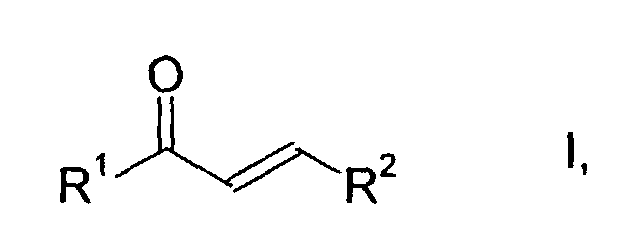
wobei die oben genannten Reste einfach oder mehrfach mit Heteroatomen wie Hal, NR3R4, PO0-3R3R4, OR3, SR3, SOR3, SO2R3, SO3R3 substituiert sein können oder Gruppen wie CO2R3, CONHR3 bzw. eine oder mehrere CH2-Gruppen durch Heteroatome wie NR3, PR3, O oder S substituiert sein können,
wobei die oben genannten Reste einfach oder mehrfach mit Hal substituiert sein können,
- R1
- bedeutet (C1-C18)-Alkyl, (C2-C18)-Alkenyl, (C6-C18)-Aryl, (C3-C18)-Heteroaryl, (C1-C8)-Alkyl-(C6-C18)-Aryl, (C1-C8)-Alkyl-(C3-C19)-Heteroaryl, (C3-C8)-Cycloalkyl, (C1-C8)-Alkyl-(C3-C8)-Cycloalkyl, wobei die oben genannten Reste einfach oder mehrfach mit Hal oder NR3R4 substituiert sein können und
- R2
- bedeutet (C1-C18) -Alkyl, (C2-C18) -Alkenyl, (C6-C18) -Aryl, (C3-C18)-Heteroaryl, (C1-C8)-Alkyl-(C6-C18)-Aryl, (C1-C8)-Alkyl-(C3-C19)-Heteroaryl, (C3-C8)-Cycloalkyl, (C1-C8)-Alkyl-(C3-C8)-Cycloalkyl, wobei die oben genannten Reste einfach oder mehrfach mit Hal oder NR3R4 substituiert sein können sowie
- R3 und R4
- die oben angegebene Bedeutung annehmen.

| Schema 2: | ||||
| Chalconmenge pro 100 mg Kat. | 2-phasig | erfindungsgemäß | ||
| Ausbeute (%) | ee (%) | Ausbeute (%) | ee (%) | |
| 50 mg | 98 | 97 | 99 | 95 |
| 300 mg | 92 | 88 | 87 | 95 |

Claims (13)
- Verfahren zur enantioselektiven Epoxidierung von Verbindungen der allgemeinen Formel (I)worin
 mittels einer diastereomeren- und enantiomerenangereicherten Homopolyaminosäure und einem Oxidans,R1 und R2 unabhängig voneinander bedeuten (C1-C18)-Alkyl, (C2-C18)-Alkenyl, (C2-C18)-Alkinyl, (C6-C18)-Aryl, (C7-C19)-Aralkyl, (C3-C18)-Heteroaryl, (C4-C19)-Heteroaralkyl, (C1-C8)-Alkyl-(C6-C18)-Aryl, (C1-C8)-Alkyl-(C3-C19)-Heteroaryl, (C3-C8)-Cycloalkyl, (C1-C8)-Alkyl-(C3-C8)-Cycloalkyl, (C3-C8)-Cycloalkyl-(C1-C8)-Alkyl,
wobei die oben genannten Reste einfach oder mehrfach mit Heteroatomen wie Hal, NR3R4, PO0-3R3R4, OR3, SR3, SOR3, SO2R3, SO3R3 substituiert sein können oder Gruppen wie CO2R3, CONHR3 bzw. eine oder mehrere CH2-Gruppen durch Heteroatome wie NR3, PR3, O oder S substituiert sein können,R3 und R4 unabhängig voneinander bedeuten H, (C1-C18)-Alkyl, (C2-C18)-Alkenyl, (C6-C18)-Aryl, (C3-C18)-Heteroaryl, (C1-C8)-Alkyl-(C6-C18)-Aryl, (C1-C8)-Alkyl-(C3-C19)-Heteroaryl, (C3-C8)-Cycloalkyl, (C1-C8)-Alkyl-(C3-C8)-Cycloalkyl,
wobei die oben genannten Reste einfach oder mehrfach mit Hal substituiert sein können,
dadurch gekennzeichnet,
daß man die Epoxidierung in Gegenwart von Wasser und einem oder mehreren mit Wasser mischbaren organischen Lösungsmitteln durchführt. - Verfahren nach Anspruch 1,
dadurch gekennzeichnet,
daß man als organisches Lösungsmittel DMF, Acrylnitril, DMSO, wasserlösliche Alkohole oder wasserlösliche Ethern, vorzugsweise DME, verwendet. - Verfahren nach Anspruch 1 und/oder 2,
dadurch gekennzeichnet,
daß das Verhältnis von Wasser zu DME bei 10 : 1 bis 1 : 10, vorzugsweise 5 : 1 bis 1 : 8, liegt. - Verfahren nach einem oder mehreren der Ansprüche 1 bis 3,
dadurch gekennzeichnet,
daß man Verbindungen der allgemeinen Formel (I) worinR1 bedeutet (C1-C18)-Alkyl, (C2-C18)-Alkenyl, (C6-C18)-Aryl, (C3-C18)-Heteroaryl, (C1-C8)-Alkyl-(C6-C18)-Aryl, (C1-C8)-Alkyl-(C3-C19)-Heteroaryl, (C3-C8)-Cycloalkyl, (C1-C8)-Alkyl-(C3-C8)-Cycloalkyl,
wobei die oben genannten Reste einfach oder mehrfach mit Hal oder NR3R4 substituiert sein können undR2 bedeutet (C1-C18)-Alkyl, (C2-C18)-Alkenyl, (C6-C18)-Aryl, (C3-C18)-Heteroaryl, (C1-C8)-Alkyl-(C6-C18)-Aryl, (C1-C8)-Alkyl-(C3-C19)-Heteroaryl, (C3-C8)-Cycloalkyl, (C1-C8)-Alkyl-(C3-C8)-Cycloalkyl,
wobei die oben genannten Reste einfach oder mehrfach mit Hal oder NR3R4 substituiert sein können und R3 und R4 die oben angegebene Bedeutung annehmen, umsetzt. - Verfahren nach einem oder mehreren der Ansprüche 1 bis 4,
dadurch gekennzeichnet,
daß man als Homopolyaminosäure eine Verbindung der Gruppe Polyneopentylglycin, Polyleucin, Polyisoleucin, Polyvalin, Polyphenylalanin und Polyalanin benutzt. - Verfahren nach einem oder mehreren der Ansprüche 1 bis 5,
dadurch gekennzeichnet,
daß die Homopolyaminosäure eine Kettenlänge von 5 bis 100 Aminosäuren, vorzugsweise 7 bis 50, besitzt. - Verfahren nach einem oder mehreren der Ansprüche 1 bis 6,
dadurch gekennzeichnet,
daß die Homopolyaminosäure bei der Epoxidierung frei, vernetzt, mit Polymeren vergrößert oder auf immobilisierten Trägern adsorbiert vorliegt. - Verfahren nach einem oder mehreren der Ansprüche 1 bis 7,
dadurch gekennzeichnet,
daß man als Oxidantien Peroxide, Persäuren, eine wäßrige Lösung von H2O2 oder anorganische Oxidantien, wie z.B. Natriumpercarbonat, Natriumperborat, benutzt. - Verfahren nach einem oder mehreren der Ansprüche 1 bis 8,
dadurch gekennzeichnet,
daß das Katalysatorverhältnis in einem Intervall von 1 : 1 bis 0,005 : 1, vorzugsweise 0,5 : 1 bis 0,05 : 1, bezogen auf das umzusetzende Substrat, liegt. - Verfahren nach einem oder mehreren der Ansprüche 1 bis 9,
dadurch gekennzeichnet,
daß die Temperatur bei der Epoxidierung zwischen 15°C und 30 °C liegt. - Verfahren nach einem oder mehreren der Ansprüche 1 bis 10,
dadurch gekennzeichnet,
daß man die Epoxidierung in einem pH-Intervall von 7 bis 14, vorzugsweise 7,5 bis 13, ausführt. - Verfahren nach einem oder mehreren der Ansprüche 1 bis 11,
dadurch gekennzeichnet,
daß man zum Epoxidierungsgemisch aufweisend Substrat, Oxidans, Polyaminosäure und Lösungsmittelgemisch ein Phasentranferkatalysator zusetzt. - Verwendung der gemäß einem oder mehrerer der Ansprüche 1 bis 12 hergestellten Epoxide als chirale Intermediate in der organischen Synthese.
Applications Claiming Priority (2)
| Application Number | Priority Date | Filing Date | Title |
|---|---|---|---|
| DE19855858 | 1998-12-03 | ||
| DE19855858A DE19855858A1 (de) | 1998-12-03 | 1998-12-03 | Verfahren zur enantioselektiven Epoxidierung von C-C-Doppelbindungen |
Publications (2)
| Publication Number | Publication Date |
|---|---|
| EP1006111A2 true EP1006111A2 (de) | 2000-06-07 |
| EP1006111A3 EP1006111A3 (de) | 2000-06-28 |
Family
ID=7889892
Family Applications (1)
| Application Number | Title | Priority Date | Filing Date |
|---|---|---|---|
| EP99123642A Withdrawn EP1006111A3 (de) | 1998-12-03 | 1999-11-27 | Verfahren zur enantioselektiven Epoxidierung von C=C-Doppelbindungen |
Country Status (6)
| Country | Link |
|---|---|
| US (1) | US6225482B1 (de) |
| EP (1) | EP1006111A3 (de) |
| JP (1) | JP2000169464A (de) |
| AU (1) | AU754968B2 (de) |
| CA (1) | CA2291462A1 (de) |
| DE (1) | DE19855858A1 (de) |
Cited By (4)
| Publication number | Priority date | Publication date | Assignee | Title |
|---|---|---|---|---|
| EP1279671A1 (de) * | 2001-07-27 | 2003-01-29 | Bayer Ag | Polyaminosäure-katalysiertes Verfahren zur enantioselektiven Epoxidierung von alpha,beta-ungesättigten Enonen und alpha,beta-ungesättigten-Sulfonen |
| EP1279672A1 (de) * | 2001-07-27 | 2003-01-29 | Bayer Ag | Polyaminosäure-katalysiertes Verfahren zur enantioselektiven Epoxidierung von alpha,beta-ungesättigten Enonen und alpha,beta-ungesättigten Sulfonen |
| EP1279670A1 (de) * | 2001-07-27 | 2003-01-29 | Bayer Ag | Polyaminosäure-katalysiertes Verfahren zur enantioselektiven Epoxidierung vom alpha,beta-ungesättigten Enonen und alpha,beta-ungesättigten Sulfonen |
| US6559283B2 (en) | 2000-06-15 | 2003-05-06 | Degussa Ag | Poly-β-amino acids, preparation and use |
Families Citing this family (8)
| Publication number | Priority date | Publication date | Assignee | Title |
|---|---|---|---|---|
| US6369245B1 (en) * | 1999-08-13 | 2002-04-09 | Colorado State University Research Foundation | Epoxidation of olefins |
| US6686483B2 (en) | 1996-10-08 | 2004-02-03 | Colorado State University Research Foundation | Catalytic asymmetric epoxidation |
| EP1071676A4 (de) | 1998-04-16 | 2004-09-29 | Univ Colorado State Res Found | Kinetische aufloesung von olefinen |
| IT1313572B1 (it) * | 1999-07-27 | 2002-09-09 | Enichem Spa | Procedimento per la preparazione di epossidi. |
| JP3920020B2 (ja) * | 1999-12-24 | 2007-05-30 | 株式会社日本触媒 | 含酸素有機化合物製造用触媒および含酸素有機化合物の製造方法 |
| KR100371086B1 (ko) * | 2000-05-10 | 2003-02-06 | 한국화학연구원 | 고체 지지체에 연결된 탄소-탄소 이중결합 화합물의고효율 에폭시화 방법 |
| CN104262295B (zh) * | 2014-08-29 | 2016-05-11 | 浙江工业大学 | 一种环氧查尔酮及其衍生物的合成方法 |
| DE102015202681A1 (de) * | 2015-02-13 | 2016-08-18 | Friedrich-Alexander-Universität Erlangen-Nürnberg | Verfahren zur Durchführung einer chemischen Synthese |
Family Cites Families (2)
| Publication number | Priority date | Publication date | Assignee | Title |
|---|---|---|---|---|
| US5110959A (en) * | 1989-06-14 | 1992-05-05 | Smithkline Beckman Corp. | Process for preparation of epoxy esters and intermediates prepared thereby |
| AU705806B2 (en) * | 1995-04-20 | 1999-06-03 | Chirotech Technology Limited | Asymmetric epoxides, their synthesis and use |
-
1998
- 1998-12-03 DE DE19855858A patent/DE19855858A1/de not_active Withdrawn
-
1999
- 1999-11-27 EP EP99123642A patent/EP1006111A3/de not_active Withdrawn
- 1999-11-30 US US09/451,100 patent/US6225482B1/en not_active Expired - Fee Related
- 1999-12-01 AU AU63068/99A patent/AU754968B2/en not_active Ceased
- 1999-12-02 CA CA002291462A patent/CA2291462A1/en not_active Abandoned
- 1999-12-03 JP JP11345364A patent/JP2000169464A/ja active Pending
Cited By (8)
| Publication number | Priority date | Publication date | Assignee | Title |
|---|---|---|---|---|
| US6559283B2 (en) | 2000-06-15 | 2003-05-06 | Degussa Ag | Poly-β-amino acids, preparation and use |
| EP1279671A1 (de) * | 2001-07-27 | 2003-01-29 | Bayer Ag | Polyaminosäure-katalysiertes Verfahren zur enantioselektiven Epoxidierung von alpha,beta-ungesättigten Enonen und alpha,beta-ungesättigten-Sulfonen |
| EP1279672A1 (de) * | 2001-07-27 | 2003-01-29 | Bayer Ag | Polyaminosäure-katalysiertes Verfahren zur enantioselektiven Epoxidierung von alpha,beta-ungesättigten Enonen und alpha,beta-ungesättigten Sulfonen |
| EP1279670A1 (de) * | 2001-07-27 | 2003-01-29 | Bayer Ag | Polyaminosäure-katalysiertes Verfahren zur enantioselektiven Epoxidierung vom alpha,beta-ungesättigten Enonen und alpha,beta-ungesättigten Sulfonen |
| US6700004B2 (en) | 2001-07-27 | 2004-03-02 | Bayer Aktiengesellschaft | Polyamino acid-catalyzed process for the enantioselective epoxidation of α,β-unsaturated enones and α,β-unsaturated sulfones |
| US6770766B2 (en) | 2001-07-27 | 2004-08-03 | Bayer Chemicals Ag | Polyamino acid-catalyzed process for the enantioselective epoixdation of α,β-unsaturated enones and α,β-unsaturated sulfones |
| US6822053B2 (en) | 2001-07-27 | 2004-11-23 | Bayer Aktiengesellschaft | Polyamino acid-catalyzed process for the enantioselective epoxidation of α, β-unsaturated enones and α, β-unsaturated sulfones |
| US7208447B2 (en) | 2001-07-27 | 2007-04-24 | Lanxess Deutschland Gmbh | Polyamino acid-catalyzed process for the enantioselective epoxidation of α,β-unsaturated enones and α,β-unsaturated sulfones |
Also Published As
| Publication number | Publication date |
|---|---|
| JP2000169464A (ja) | 2000-06-20 |
| US6225482B1 (en) | 2001-05-01 |
| EP1006111A3 (de) | 2000-06-28 |
| CA2291462A1 (en) | 2000-06-03 |
| AU754968B2 (en) | 2002-11-28 |
| DE19855858A1 (de) | 2000-06-08 |
| AU6306899A (en) | 2000-06-08 |
Similar Documents
| Publication | Publication Date | Title |
|---|---|---|
| EP1006111A2 (de) | Verfahren zur enantioselektiven Epoxidierung von C=C-Doppelbindungen | |
| EP3710437B1 (de) | Enantiomerentrennung von racemischem nicotin durch zugabe eines o,o'-disubstituierten weinsäureenantiomeres mit niedriger optischer reinheit | |
| EP3927712B1 (de) | Verfahren zur herstellung von cannabidiol | |
| EP0288764B1 (de) | Optisch aktive alpha-Aminoaldehyde, Verfahren zu ihrer Herstellung und ihre Verwendung zur stereoselektiven Herstellung optisch aktiver beta-Aminoalkohole | |
| EP2086952A2 (de) | Verfahren zur stereoselektiven synthese von chiralen epoxiden durch adh-reduktion von alpha-abgangsgruppen-substituierten ketonen und cyclisierung | |
| DE19855859A1 (de) | Katalysatoren für die enantioselektive Epoxidierung von C=C-Doppelbindungen | |
| DE10136131B4 (de) | Polyaminosäure-katalysiertes Verfahren zur enantioselektiven Epoxidierung von α,β-ungesättigten Enonen und α,β-ungesättigten Sulfonen | |
| EP0810204B1 (de) | Dendritische stickstoffhaltige organische Verbindungen mit planar-chiralen oder axial-chiralen Endgruppen, ihre Herstellung und Verwendung | |
| EP1870390B1 (de) | Aufarbeitung von Reaktionslösungen aus Ganzzell-Biotransformationen | |
| DE10136485C1 (de) | Polyaminosäure-katalysiertes Verfahren zur enantioselektiven Epoxidierung von alpha,ß-ungesättigten Eonen und alpha,ß-ungesättigten Sulfonen | |
| EP1252327A1 (de) | Verfahren zur enzymatischen racematspaltung von aminomethyl-aryl-cyclohexanol-derivaten | |
| EP1279672B1 (de) | Polyaminosäure-katalysiertes Verfahren zur enantioselektiven Epoxidierung von alpha,beta-ungesättigten Enonen und alpha,beta-ungesättigten Sulfonen | |
| DE60007835T2 (de) | Verfahren zur herstellung von chiralen aminosäuren | |
| DE69613830T2 (de) | Asymmetrische epoxide, ihre synthese und ihre verwendung | |
| EP0651736B1 (de) | VERFAHREN ZUR HERSTELLUNG ENANTIOMERENREINER beta-SUBSTITUIERTER gamma-AMINOBUTTERSÄUREDERIVATE, NEUE ENANTIOMERENREINE ZWISCHENSTUFEN DIESES VERFAHRENS UND DEREN VERWENDUNG | |
| DE3734219A1 (de) | Optisch aktive 2,3-epoxyalkylammoniumsulfonate, verfahren zu ihrer herstellung und verwendung | |
| DE60029493T2 (de) | Neues verfahren zur herstellung von 1-phenyl-2-(2-pyridyl)ethanamin | |
| DE3530885A1 (de) | 16-oxa-bicyclo(13.1.0)-hexadec-7-en, verfahren zu dessen herstellung und dessen verwendung als riechstoff | |
| WO1996015095A1 (de) | Verfahren zur herstellung von weinsäure | |
| EP1478680B1 (de) | Polyaminosäuren und verfahren zu deren herstellung | |
| WO2001056976A1 (de) | Epoxidierungskatalysatoren auf paracyclophanbasis | |
| DE19536658C2 (de) | Verfahren zur kontinuierlichen Herstellung von basischen, cyclischen, optisch aktiven alpha-Aminosäuren | |
| DE19827046A1 (de) | Chirale Molybdän-Katalysatoren, Verfahren zu ihrer Herstellung und Verfahren zur Herstellung von Epoxiden durch stereoselektive Epoxidation von Alkenen mit chiralen Molybdän-Katalysatoren | |
| DE19911198A1 (de) | Tetrahydropyran-2,4-diole, Verfahren zu deren Herstellung und Verwendung | |
| DE2242629A1 (de) | Verfahren zur herstellung von aroxypropanolamin-derivaten |
Legal Events
| Date | Code | Title | Description |
|---|---|---|---|
| PUAI | Public reference made under article 153(3) epc to a published international application that has entered the european phase |
Free format text: ORIGINAL CODE: 0009012 |
|
| PUAL | Search report despatched |
Free format text: ORIGINAL CODE: 0009013 |
|
| 17P | Request for examination filed |
Effective date: 19991127 |
|
| AK | Designated contracting states |
Kind code of ref document: A2 Designated state(s): AT BE CH CY DE DK ES FI FR GB GR IE IT LI LU MC NL PT SE |
|
| AX | Request for extension of the european patent |
Free format text: AL;LT;LV;MK;RO;SI |
|
| AK | Designated contracting states |
Kind code of ref document: A3 Designated state(s): AT BE CH CY DE DK ES FI FR GB GR IE IT LI LU MC NL PT SE |
|
| AX | Request for extension of the european patent |
Free format text: AL;LT;LV;MK;RO;SI |
|
| AKX | Designation fees paid |
Free format text: AT BE CH CY DE DK ES FI FR GB GR IE IT LI LU MC NL PT SE |
|
| RAP1 | Party data changed (applicant data changed or rights of an application transferred) |
Owner name: DEGUSSA AG |
|
| 17Q | First examination report despatched |
Effective date: 20030829 |
|
| GRAP | Despatch of communication of intention to grant a patent |
Free format text: ORIGINAL CODE: EPIDOSNIGR1 |
|
| STAA | Information on the status of an ep patent application or granted ep patent |
Free format text: STATUS: THE APPLICATION IS DEEMED TO BE WITHDRAWN |
|
| 18D | Application deemed to be withdrawn |
Effective date: 20050127 |