EP1006192B1 - Verfahren zur fermentativen Herstellung von D-Pantothensäure durch Verstärkung des panD-Gens in Mikroorganismen - Google Patents
Verfahren zur fermentativen Herstellung von D-Pantothensäure durch Verstärkung des panD-Gens in Mikroorganismen Download PDFInfo
- Publication number
- EP1006192B1 EP1006192B1 EP99122650A EP99122650A EP1006192B1 EP 1006192 B1 EP1006192 B1 EP 1006192B1 EP 99122650 A EP99122650 A EP 99122650A EP 99122650 A EP99122650 A EP 99122650A EP 1006192 B1 EP1006192 B1 EP 1006192B1
- Authority
- EP
- European Patent Office
- Prior art keywords
- gene
- pnd
- microorganisms
- pantothenic acid
- pand
- Prior art date
- Legal status (The legal status is an assumption and is not a legal conclusion. Google has not performed a legal analysis and makes no representation as to the accuracy of the status listed.)
- Expired - Lifetime
Links
- GHOKWGTUZJEAQD-UHFFFAOYSA-N pantothenic acid Chemical compound OCC(C)(C)C(O)C(=O)NCCC(O)=O GHOKWGTUZJEAQD-UHFFFAOYSA-N 0.000 title claims abstract description 54
- 244000005700 microbiome Species 0.000 title claims abstract description 31
- 238000000034 method Methods 0.000 title claims abstract description 24
- 101150076071 panD gene Proteins 0.000 title claims description 57
- 230000003321 amplification Effects 0.000 title claims description 4
- 238000003199 nucleic acid amplification method Methods 0.000 title claims description 4
- 238000012262 fermentative production Methods 0.000 title description 6
- 241001485655 Corynebacterium glutamicum ATCC 13032 Species 0.000 claims abstract description 17
- 239000002773 nucleotide Substances 0.000 claims abstract description 12
- 125000003729 nucleotide group Chemical group 0.000 claims abstract description 12
- 239000013600 plasmid vector Substances 0.000 claims abstract description 10
- 241000186216 Corynebacterium Species 0.000 claims abstract description 9
- 241000588722 Escherichia Species 0.000 claims abstract description 4
- 230000004151 fermentation Effects 0.000 claims abstract description 4
- 238000000855 fermentation Methods 0.000 claims abstract description 3
- 102100026278 Cysteine sulfinic acid decarboxylase Human genes 0.000 claims abstract 3
- 108010002447 aspartate-alpha-decarboxylase Proteins 0.000 claims abstract 3
- GHOKWGTUZJEAQD-ZETCQYMHSA-N (D)-(+)-Pantothenic acid Chemical compound OCC(C)(C)[C@@H](O)C(=O)NCCC(O)=O GHOKWGTUZJEAQD-ZETCQYMHSA-N 0.000 claims description 74
- 108090000623 proteins and genes Proteins 0.000 claims description 73
- 235000019161 pantothenic acid Nutrition 0.000 claims description 45
- 239000011713 pantothenic acid Substances 0.000 claims description 45
- 229940055726 pantothenic acid Drugs 0.000 claims description 26
- 239000013598 vector Substances 0.000 claims description 20
- 101150081585 panB gene Proteins 0.000 claims description 19
- 229940014662 pantothenate Drugs 0.000 claims description 19
- 150000001413 amino acids Chemical group 0.000 claims description 18
- UCMIRNVEIXFBKS-UHFFFAOYSA-N beta-alanine Chemical compound NCCC(O)=O UCMIRNVEIXFBKS-UHFFFAOYSA-N 0.000 claims description 16
- 230000015572 biosynthetic process Effects 0.000 claims description 13
- 238000004519 manufacturing process Methods 0.000 claims description 10
- 229940000635 beta-alanine Drugs 0.000 claims description 8
- 230000014509 gene expression Effects 0.000 claims description 8
- CKLJMWTZIZZHCS-REOHCLBHSA-N L-aspartic acid Chemical compound OC(=O)[C@@H](N)CC(O)=O CKLJMWTZIZZHCS-REOHCLBHSA-N 0.000 claims description 7
- 230000035772 mutation Effects 0.000 claims description 6
- 108020003551 pantothenate synthetase Proteins 0.000 claims description 6
- 230000009466 transformation Effects 0.000 claims description 6
- 108010036575 3-methyl-2-oxobutanoate hydroxymethyltransferase Proteins 0.000 claims description 5
- 230000001965 increasing effect Effects 0.000 claims description 5
- 101150019254 panC gene Proteins 0.000 claims description 4
- QHKABHOOEWYVLI-UHFFFAOYSA-N 3-methyl-2-oxobutanoic acid Chemical compound CC(C)C(=O)C(O)=O QHKABHOOEWYVLI-UHFFFAOYSA-N 0.000 claims description 3
- FWMNVWWHGCHHJJ-SKKKGAJSSA-N 4-amino-1-[(2r)-6-amino-2-[[(2r)-2-[[(2r)-2-[[(2r)-2-amino-3-phenylpropanoyl]amino]-3-phenylpropanoyl]amino]-4-methylpentanoyl]amino]hexanoyl]piperidine-4-carboxylic acid Chemical compound C([C@H](C(=O)N[C@H](CC(C)C)C(=O)N[C@H](CCCCN)C(=O)N1CCC(N)(CC1)C(O)=O)NC(=O)[C@H](N)CC=1C=CC=CC=1)C1=CC=CC=C1 FWMNVWWHGCHHJJ-SKKKGAJSSA-N 0.000 claims description 3
- 230000000340 anti-metabolite Effects 0.000 claims description 3
- 229940100197 antimetabolite Drugs 0.000 claims description 3
- 239000002256 antimetabolite Substances 0.000 claims description 3
- 230000002068 genetic effect Effects 0.000 claims description 3
- 239000002243 precursor Substances 0.000 claims description 3
- 238000011144 upstream manufacturing Methods 0.000 claims description 3
- PKVVTUWHANFMQC-UHFFFAOYSA-N 2-dehydropantoic acid Chemical compound OCC(C)(C)C(=O)C(O)=O PKVVTUWHANFMQC-UHFFFAOYSA-N 0.000 claims description 2
- 229940009098 aspartate Drugs 0.000 claims description 2
- 239000002207 metabolite Substances 0.000 claims description 2
- 230000037353 metabolic pathway Effects 0.000 claims 2
- OTOIIPJYVQJATP-BYPYZUCNSA-M (R)-pantoate Chemical compound OCC(C)(C)[C@@H](O)C([O-])=O OTOIIPJYVQJATP-BYPYZUCNSA-M 0.000 claims 1
- 230000002759 chromosomal effect Effects 0.000 claims 1
- 238000002955 isolation Methods 0.000 claims 1
- 108020004511 Recombinant DNA Proteins 0.000 abstract 1
- 238000002360 preparation method Methods 0.000 abstract 1
- 239000013612 plasmid Substances 0.000 description 43
- 101100242684 Mesorhizobium japonicum (strain LMG 29417 / CECT 9101 / MAFF 303099) panD1 gene Proteins 0.000 description 35
- 241000588724 Escherichia coli Species 0.000 description 33
- 241000186226 Corynebacterium glutamicum Species 0.000 description 27
- 108091008146 restriction endonucleases Proteins 0.000 description 24
- 108020004414 DNA Proteins 0.000 description 21
- 239000000047 product Substances 0.000 description 18
- 239000012634 fragment Substances 0.000 description 17
- 239000002609 medium Substances 0.000 description 16
- 101100028493 Haloferax volcanii (strain ATCC 29605 / DSM 3757 / JCM 8879 / NBRC 14742 / NCIMB 2012 / VKM B-1768 / DS2) pan2 gene Proteins 0.000 description 14
- 239000000203 mixture Substances 0.000 description 12
- 238000012163 sequencing technique Methods 0.000 description 12
- 235000001014 amino acid Nutrition 0.000 description 11
- 229940024606 amino acid Drugs 0.000 description 10
- WQZGKKKJIJFFOK-GASJEMHNSA-N Glucose Natural products OC[C@H]1OC(O)[C@H](O)[C@@H](O)[C@@H]1O WQZGKKKJIJFFOK-GASJEMHNSA-N 0.000 description 9
- 239000008103 glucose Substances 0.000 description 9
- 102000004190 Enzymes Human genes 0.000 description 8
- 108090000790 Enzymes Proteins 0.000 description 8
- 238000010367 cloning Methods 0.000 description 8
- 230000000875 corresponding effect Effects 0.000 description 8
- 230000008569 process Effects 0.000 description 8
- 108091028043 Nucleic acid sequence Proteins 0.000 description 7
- 238000005516 engineering process Methods 0.000 description 7
- 229930027917 kanamycin Natural products 0.000 description 7
- 229960000318 kanamycin Drugs 0.000 description 7
- SBUJHOSQTJFQJX-NOAMYHISSA-N kanamycin Chemical compound O[C@@H]1[C@@H](O)[C@H](O)[C@@H](CN)O[C@@H]1O[C@H]1[C@H](O)[C@@H](O[C@@H]2[C@@H]([C@@H](N)[C@H](O)[C@@H](CO)O2)O)[C@H](N)C[C@@H]1N SBUJHOSQTJFQJX-NOAMYHISSA-N 0.000 description 7
- 229930182823 kanamycin A Natural products 0.000 description 7
- 108020004707 nucleic acids Proteins 0.000 description 7
- 150000007523 nucleic acids Chemical class 0.000 description 7
- 102000039446 nucleic acids Human genes 0.000 description 7
- 235000018102 proteins Nutrition 0.000 description 7
- 102000004169 proteins and genes Human genes 0.000 description 7
- 238000011160 research Methods 0.000 description 7
- LFQSCWFLJHTTHZ-UHFFFAOYSA-N Ethanol Chemical compound CCO LFQSCWFLJHTTHZ-UHFFFAOYSA-N 0.000 description 6
- PEDCQBHIVMGVHV-UHFFFAOYSA-N Glycerine Chemical compound OCC(O)CO PEDCQBHIVMGVHV-UHFFFAOYSA-N 0.000 description 6
- 239000006142 Luria-Bertani Agar Substances 0.000 description 6
- 108700026244 Open Reading Frames Proteins 0.000 description 6
- WQZGKKKJIJFFOK-VFUOTHLCSA-N beta-D-glucose Chemical compound OC[C@H]1O[C@@H](O)[C@H](O)[C@@H](O)[C@@H]1O WQZGKKKJIJFFOK-VFUOTHLCSA-N 0.000 description 6
- 230000000694 effects Effects 0.000 description 6
- 239000001963 growth medium Substances 0.000 description 6
- 102100038750 Myc-associated zinc finger protein Human genes 0.000 description 5
- 101710146400 Myc-associated zinc finger protein Proteins 0.000 description 5
- 210000004027 cell Anatomy 0.000 description 5
- 238000004520 electroporation Methods 0.000 description 5
- 238000011534 incubation Methods 0.000 description 5
- 238000010369 molecular cloning Methods 0.000 description 5
- 235000015097 nutrients Nutrition 0.000 description 5
- 238000003752 polymerase chain reaction Methods 0.000 description 5
- 150000003839 salts Chemical class 0.000 description 5
- IJGRMHOSHXDMSA-UHFFFAOYSA-N Atomic nitrogen Chemical compound N#N IJGRMHOSHXDMSA-UHFFFAOYSA-N 0.000 description 4
- 241001646716 Escherichia coli K-12 Species 0.000 description 4
- XSQUKJJJFZCRTK-UHFFFAOYSA-N Urea Chemical compound NC(N)=O XSQUKJJJFZCRTK-UHFFFAOYSA-N 0.000 description 4
- 229960000723 ampicillin Drugs 0.000 description 4
- AVKUERGKIZMTKX-NJBDSQKTSA-N ampicillin Chemical compound C1([C@@H](N)C(=O)N[C@H]2[C@H]3SC([C@@H](N3C2=O)C(O)=O)(C)C)=CC=CC=C1 AVKUERGKIZMTKX-NJBDSQKTSA-N 0.000 description 4
- 238000004458 analytical method Methods 0.000 description 4
- 239000013604 expression vector Substances 0.000 description 4
- 238000001502 gel electrophoresis Methods 0.000 description 4
- 230000002906 microbiologic effect Effects 0.000 description 4
- 230000002018 overexpression Effects 0.000 description 4
- 239000000126 substance Substances 0.000 description 4
- OTOIIPJYVQJATP-BYPYZUCNSA-N (R)-pantoic acid Chemical compound OCC(C)(C)[C@@H](O)C(O)=O OTOIIPJYVQJATP-BYPYZUCNSA-N 0.000 description 3
- QTBSBXVTEAMEQO-UHFFFAOYSA-N Acetic acid Chemical compound CC(O)=O QTBSBXVTEAMEQO-UHFFFAOYSA-N 0.000 description 3
- QGZKDVFQNNGYKY-UHFFFAOYSA-N Ammonia Chemical compound N QGZKDVFQNNGYKY-UHFFFAOYSA-N 0.000 description 3
- 101100364969 Dictyostelium discoideum scai gene Proteins 0.000 description 3
- 241000644323 Escherichia coli C Species 0.000 description 3
- 240000006024 Lactobacillus plantarum Species 0.000 description 3
- 101100364971 Mus musculus Scai gene Proteins 0.000 description 3
- KWYUFKZDYYNOTN-UHFFFAOYSA-M Potassium hydroxide Chemical compound [OH-].[K+] KWYUFKZDYYNOTN-UHFFFAOYSA-M 0.000 description 3
- HEMHJVSKTPXQMS-UHFFFAOYSA-M Sodium hydroxide Chemical compound [OH-].[Na+] HEMHJVSKTPXQMS-UHFFFAOYSA-M 0.000 description 3
- 241001408728 Vallaris Species 0.000 description 3
- 150000007513 acids Chemical class 0.000 description 3
- 238000013459 approach Methods 0.000 description 3
- KRKNYBCHXYNGOX-UHFFFAOYSA-N citric acid Chemical compound OC(=O)CC(O)(C(O)=O)CC(O)=O KRKNYBCHXYNGOX-UHFFFAOYSA-N 0.000 description 3
- 239000003814 drug Substances 0.000 description 3
- 235000019441 ethanol Nutrition 0.000 description 3
- 239000013613 expression plasmid Substances 0.000 description 3
- 239000000499 gel Substances 0.000 description 3
- 239000011435 rock Substances 0.000 description 3
- 238000012360 testing method Methods 0.000 description 3
- 229940088594 vitamin Drugs 0.000 description 3
- 229930003231 vitamin Natural products 0.000 description 3
- 235000013343 vitamin Nutrition 0.000 description 3
- 239000011782 vitamin Substances 0.000 description 3
- YBJHBAHKTGYVGT-ZKWXMUAHSA-N (+)-Biotin Chemical compound N1C(=O)N[C@@H]2[C@H](CCCCC(=O)O)SC[C@@H]21 YBJHBAHKTGYVGT-ZKWXMUAHSA-N 0.000 description 2
- OWEGMIWEEQEYGQ-UHFFFAOYSA-N 100676-05-9 Natural products OC1C(O)C(O)C(CO)OC1OCC1C(O)C(O)C(O)C(OC2C(OC(O)C(O)C2O)CO)O1 OWEGMIWEEQEYGQ-UHFFFAOYSA-N 0.000 description 2
- OPIFSICVWOWJMJ-AEOCFKNESA-N 5-bromo-4-chloro-3-indolyl beta-D-galactoside Chemical compound O[C@@H]1[C@@H](O)[C@@H](O)[C@@H](CO)O[C@H]1OC1=CNC2=CC=C(Br)C(Cl)=C12 OPIFSICVWOWJMJ-AEOCFKNESA-N 0.000 description 2
- 229920001817 Agar Polymers 0.000 description 2
- GUBGYTABKSRVRQ-XLOQQCSPSA-N Alpha-Lactose Chemical compound O[C@@H]1[C@@H](O)[C@@H](O)[C@@H](CO)O[C@H]1O[C@@H]1[C@@H](CO)O[C@H](O)[C@H](O)[C@H]1O GUBGYTABKSRVRQ-XLOQQCSPSA-N 0.000 description 2
- NLXLAEXVIDQMFP-UHFFFAOYSA-N Ammonia chloride Chemical compound [NH4+].[Cl-] NLXLAEXVIDQMFP-UHFFFAOYSA-N 0.000 description 2
- 108091093088 Amplicon Proteins 0.000 description 2
- 241000894006 Bacteria Species 0.000 description 2
- OKTJSMMVPCPJKN-UHFFFAOYSA-N Carbon Chemical compound [C] OKTJSMMVPCPJKN-UHFFFAOYSA-N 0.000 description 2
- 241000588921 Enterobacteriaceae Species 0.000 description 2
- 241000660147 Escherichia coli str. K-12 substr. MG1655 Species 0.000 description 2
- 229930091371 Fructose Natural products 0.000 description 2
- 239000005715 Fructose Substances 0.000 description 2
- RFSUNEUAIZKAJO-ARQDHWQXSA-N Fructose Chemical compound OC[C@H]1O[C@](O)(CO)[C@@H](O)[C@@H]1O RFSUNEUAIZKAJO-ARQDHWQXSA-N 0.000 description 2
- DHMQDGOQFOQNFH-UHFFFAOYSA-N Glycine Chemical compound NCC(O)=O DHMQDGOQFOQNFH-UHFFFAOYSA-N 0.000 description 2
- DGAQECJNVWCQMB-PUAWFVPOSA-M Ilexoside XXIX Chemical compound C[C@@H]1CC[C@@]2(CC[C@@]3(C(=CC[C@H]4[C@]3(CC[C@@H]5[C@@]4(CC[C@@H](C5(C)C)OS(=O)(=O)[O-])C)C)[C@@H]2[C@]1(C)O)C)C(=O)O[C@H]6[C@@H]([C@H]([C@@H]([C@H](O6)CO)O)O)O.[Na+] DGAQECJNVWCQMB-PUAWFVPOSA-M 0.000 description 2
- 235000013965 Lactobacillus plantarum Nutrition 0.000 description 2
- GUBGYTABKSRVRQ-QKKXKWKRSA-N Lactose Natural products OC[C@H]1O[C@@H](O[C@H]2[C@H](O)[C@@H](O)C(O)O[C@@H]2CO)[C@H](O)[C@@H](O)[C@H]1O GUBGYTABKSRVRQ-QKKXKWKRSA-N 0.000 description 2
- CSNNHWWHGAXBCP-UHFFFAOYSA-L Magnesium sulfate Chemical compound [Mg+2].[O-][S+2]([O-])([O-])[O-] CSNNHWWHGAXBCP-UHFFFAOYSA-L 0.000 description 2
- GUBGYTABKSRVRQ-PICCSMPSSA-N Maltose Natural products O[C@@H]1[C@@H](O)[C@H](O)[C@@H](CO)O[C@@H]1O[C@@H]1[C@@H](CO)OC(O)[C@H](O)[C@H]1O GUBGYTABKSRVRQ-PICCSMPSSA-N 0.000 description 2
- NBIIXXVUZAFLBC-UHFFFAOYSA-N Phosphoric acid Chemical compound OP(O)(O)=O NBIIXXVUZAFLBC-UHFFFAOYSA-N 0.000 description 2
- 240000004808 Saccharomyces cerevisiae Species 0.000 description 2
- 238000012300 Sequence Analysis Methods 0.000 description 2
- 229920002472 Starch Polymers 0.000 description 2
- CZMRCDWAGMRECN-UGDNZRGBSA-N Sucrose Chemical compound O[C@H]1[C@H](O)[C@@H](CO)O[C@@]1(CO)O[C@@H]1[C@H](O)[C@@H](O)[C@H](O)[C@@H](CO)O1 CZMRCDWAGMRECN-UGDNZRGBSA-N 0.000 description 2
- 229930006000 Sucrose Natural products 0.000 description 2
- QAOWNCQODCNURD-UHFFFAOYSA-N Sulfuric acid Chemical compound OS(O)(=O)=O QAOWNCQODCNURD-UHFFFAOYSA-N 0.000 description 2
- 239000004098 Tetracycline Substances 0.000 description 2
- 239000002253 acid Substances 0.000 description 2
- 239000008272 agar Substances 0.000 description 2
- 239000011543 agarose gel Substances 0.000 description 2
- 238000000246 agarose gel electrophoresis Methods 0.000 description 2
- 235000019728 animal nutrition Nutrition 0.000 description 2
- 230000000692 anti-sense effect Effects 0.000 description 2
- 238000003556 assay Methods 0.000 description 2
- QVGXLLKOCUKJST-UHFFFAOYSA-N atomic oxygen Chemical compound [O] QVGXLLKOCUKJST-UHFFFAOYSA-N 0.000 description 2
- 238000010923 batch production Methods 0.000 description 2
- GUBGYTABKSRVRQ-QUYVBRFLSA-N beta-maltose Chemical compound OC[C@H]1O[C@H](O[C@H]2[C@H](O)[C@@H](O)[C@H](O)O[C@@H]2CO)[C@H](O)[C@@H](O)[C@@H]1O GUBGYTABKSRVRQ-QUYVBRFLSA-N 0.000 description 2
- 238000010364 biochemical engineering Methods 0.000 description 2
- 239000011575 calcium Substances 0.000 description 2
- 239000004202 carbamide Substances 0.000 description 2
- 239000001913 cellulose Substances 0.000 description 2
- 235000010980 cellulose Nutrition 0.000 description 2
- 229920002678 cellulose Polymers 0.000 description 2
- 238000005119 centrifugation Methods 0.000 description 2
- 238000006243 chemical reaction Methods 0.000 description 2
- 239000013611 chromosomal DNA Substances 0.000 description 2
- 238000003776 cleavage reaction Methods 0.000 description 2
- 230000000295 complement effect Effects 0.000 description 2
- 238000010276 construction Methods 0.000 description 2
- 239000002537 cosmetic Substances 0.000 description 2
- 230000007547 defect Effects 0.000 description 2
- 238000004925 denaturation Methods 0.000 description 2
- 230000036425 denaturation Effects 0.000 description 2
- 235000014113 dietary fatty acids Nutrition 0.000 description 2
- 238000000605 extraction Methods 0.000 description 2
- 229930195729 fatty acid Natural products 0.000 description 2
- 239000000194 fatty acid Substances 0.000 description 2
- 150000004665 fatty acids Chemical class 0.000 description 2
- 238000001914 filtration Methods 0.000 description 2
- IPCSVZSSVZVIGE-UHFFFAOYSA-N hexadecanoic acid Chemical compound CCCCCCCCCCCCCCCC(O)=O IPCSVZSSVZVIGE-UHFFFAOYSA-N 0.000 description 2
- 229940072205 lactobacillus plantarum Drugs 0.000 description 2
- 239000008101 lactose Substances 0.000 description 2
- 238000005259 measurement Methods 0.000 description 2
- 235000013379 molasses Nutrition 0.000 description 2
- 229910052757 nitrogen Inorganic materials 0.000 description 2
- 235000016709 nutrition Nutrition 0.000 description 2
- 230000035764 nutrition Effects 0.000 description 2
- 239000001301 oxygen Substances 0.000 description 2
- 229910052760 oxygen Inorganic materials 0.000 description 2
- OTOIIPJYVQJATP-UHFFFAOYSA-N pantoic acid Chemical compound OCC(C)(C)C(O)C(O)=O OTOIIPJYVQJATP-UHFFFAOYSA-N 0.000 description 2
- 229920001184 polypeptide Polymers 0.000 description 2
- 102000004196 processed proteins & peptides Human genes 0.000 description 2
- 108090000765 processed proteins & peptides Proteins 0.000 description 2
- 238000011002 quantification Methods 0.000 description 2
- YGSDEFSMJLZEOE-UHFFFAOYSA-N salicylic acid Chemical compound OC(=O)C1=CC=CC=C1O YGSDEFSMJLZEOE-UHFFFAOYSA-N 0.000 description 2
- 230000007017 scission Effects 0.000 description 2
- 239000013605 shuttle vector Substances 0.000 description 2
- 239000011734 sodium Substances 0.000 description 2
- 229910052708 sodium Inorganic materials 0.000 description 2
- 239000008107 starch Substances 0.000 description 2
- 235000019698 starch Nutrition 0.000 description 2
- 239000005720 sucrose Substances 0.000 description 2
- 239000006228 supernatant Substances 0.000 description 2
- 238000003786 synthesis reaction Methods 0.000 description 2
- 229960002180 tetracycline Drugs 0.000 description 2
- 229930101283 tetracycline Natural products 0.000 description 2
- 235000019364 tetracycline Nutrition 0.000 description 2
- 150000003522 tetracyclines Chemical class 0.000 description 2
- 238000012546 transfer Methods 0.000 description 2
- 150000003722 vitamin derivatives Chemical class 0.000 description 2
- YYLQUHNPNCGKJQ-NHYDCYSISA-N (3R)-3-hydroxy-L-aspartic acid Chemical compound OC(=O)[C@@H](N)[C@@H](O)C(O)=O YYLQUHNPNCGKJQ-NHYDCYSISA-N 0.000 description 1
- SERHXTVXHNVDKA-BYPYZUCNSA-N (R)-pantolactone Chemical compound CC1(C)COC(=O)[C@@H]1O SERHXTVXHNVDKA-BYPYZUCNSA-N 0.000 description 1
- PAWQVTBBRAZDMG-UHFFFAOYSA-N 2-(3-bromo-2-fluorophenyl)acetic acid Chemical compound OC(=O)CC1=CC=CC(Br)=C1F PAWQVTBBRAZDMG-UHFFFAOYSA-N 0.000 description 1
- TYEYBOSBBBHJIV-UHFFFAOYSA-N 2-oxobutanoic acid Chemical compound CCC(=O)C(O)=O TYEYBOSBBBHJIV-UHFFFAOYSA-N 0.000 description 1
- GHOKWGTUZJEAQD-SSDOTTSWSA-N 3-[[(2s)-2,4-dihydroxy-3,3-dimethylbutanoyl]amino]propanoic acid Chemical compound OCC(C)(C)[C@H](O)C(=O)NCCC(O)=O GHOKWGTUZJEAQD-SSDOTTSWSA-N 0.000 description 1
- 101710184601 Acetolactate synthase 2, chloroplastic Proteins 0.000 description 1
- 240000006108 Allium ampeloprasum Species 0.000 description 1
- 235000005254 Allium ampeloprasum Nutrition 0.000 description 1
- QGZKDVFQNNGYKY-UHFFFAOYSA-O Ammonium Chemical compound [NH4+] QGZKDVFQNNGYKY-UHFFFAOYSA-O 0.000 description 1
- ATRRKUHOCOJYRX-UHFFFAOYSA-N Ammonium bicarbonate Chemical compound [NH4+].OC([O-])=O ATRRKUHOCOJYRX-UHFFFAOYSA-N 0.000 description 1
- 239000004254 Ammonium phosphate Substances 0.000 description 1
- 241000908115 Bolivar Species 0.000 description 1
- OYPRJOBELJOOCE-UHFFFAOYSA-N Calcium Chemical compound [Ca] OYPRJOBELJOOCE-UHFFFAOYSA-N 0.000 description 1
- 206010061765 Chromosomal mutation Diseases 0.000 description 1
- 241000186145 Corynebacterium ammoniagenes Species 0.000 description 1
- 241000807905 Corynebacterium glutamicum ATCC 14067 Species 0.000 description 1
- XFXPMWWXUTWYJX-UHFFFAOYSA-N Cyanide Chemical compound N#[C-] XFXPMWWXUTWYJX-UHFFFAOYSA-N 0.000 description 1
- 101150097493 D gene Proteins 0.000 description 1
- 241000192125 Firmicutes Species 0.000 description 1
- 241000233866 Fungi Species 0.000 description 1
- 108700039691 Genetic Promoter Regions Proteins 0.000 description 1
- WHUUTDBJXJRKMK-UHFFFAOYSA-N Glutamic acid Natural products OC(=O)C(N)CCC(O)=O WHUUTDBJXJRKMK-UHFFFAOYSA-N 0.000 description 1
- 239000004471 Glycine Substances 0.000 description 1
- AMIMRNSIRUDHCM-UHFFFAOYSA-N Isopropylaldehyde Chemical compound CC(C)C=O AMIMRNSIRUDHCM-UHFFFAOYSA-N 0.000 description 1
- QNAYBMKLOCPYGJ-REOHCLBHSA-N L-alanine Chemical compound C[C@H](N)C(O)=O QNAYBMKLOCPYGJ-REOHCLBHSA-N 0.000 description 1
- KZSNJWFQEVHDMF-BYPYZUCNSA-N L-valine Chemical compound CC(C)[C@H](N)C(O)=O KZSNJWFQEVHDMF-BYPYZUCNSA-N 0.000 description 1
- 108090000364 Ligases Proteins 0.000 description 1
- 102000003960 Ligases Human genes 0.000 description 1
- FYCWLJLGIAUCCL-DMTCNVIQSA-N O-methyl-L-threonine Chemical compound CO[C@H](C)[C@H](N)C(O)=O FYCWLJLGIAUCCL-DMTCNVIQSA-N 0.000 description 1
- 108091034117 Oligonucleotide Proteins 0.000 description 1
- 241001524178 Paenarthrobacter ureafaciens Species 0.000 description 1
- 235000021314 Palmitic acid Nutrition 0.000 description 1
- 235000019483 Peanut oil Nutrition 0.000 description 1
- 239000001888 Peptone Substances 0.000 description 1
- 108010080698 Peptones Proteins 0.000 description 1
- OAICVXFJPJFONN-UHFFFAOYSA-N Phosphorus Chemical compound [P] OAICVXFJPJFONN-UHFFFAOYSA-N 0.000 description 1
- 241000607142 Salmonella Species 0.000 description 1
- 235000019764 Soybean Meal Nutrition 0.000 description 1
- 235000021355 Stearic acid Nutrition 0.000 description 1
- 235000019486 Sunflower oil Nutrition 0.000 description 1
- 108010006785 Taq Polymerase Proteins 0.000 description 1
- JZRWCGZRTZMZEH-UHFFFAOYSA-N Thiamine Natural products CC1=C(CCO)SC=[N+]1CC1=CN=C(C)N=C1N JZRWCGZRTZMZEH-UHFFFAOYSA-N 0.000 description 1
- KZSNJWFQEVHDMF-UHFFFAOYSA-N Valine Natural products CC(C)C(N)C(O)=O KZSNJWFQEVHDMF-UHFFFAOYSA-N 0.000 description 1
- 240000008042 Zea mays Species 0.000 description 1
- 235000005824 Zea mays ssp. parviglumis Nutrition 0.000 description 1
- 235000002017 Zea mays subsp mays Nutrition 0.000 description 1
- JLCPHMBAVCMARE-UHFFFAOYSA-N [3-[[3-[[3-[[3-[[3-[[3-[[3-[[3-[[3-[[3-[[3-[[5-(2-amino-6-oxo-1H-purin-9-yl)-3-[[3-[[3-[[3-[[3-[[3-[[5-(2-amino-6-oxo-1H-purin-9-yl)-3-[[5-(2-amino-6-oxo-1H-purin-9-yl)-3-hydroxyoxolan-2-yl]methoxy-hydroxyphosphoryl]oxyoxolan-2-yl]methoxy-hydroxyphosphoryl]oxy-5-(5-methyl-2,4-dioxopyrimidin-1-yl)oxolan-2-yl]methoxy-hydroxyphosphoryl]oxy-5-(6-aminopurin-9-yl)oxolan-2-yl]methoxy-hydroxyphosphoryl]oxy-5-(6-aminopurin-9-yl)oxolan-2-yl]methoxy-hydroxyphosphoryl]oxy-5-(6-aminopurin-9-yl)oxolan-2-yl]methoxy-hydroxyphosphoryl]oxy-5-(6-aminopurin-9-yl)oxolan-2-yl]methoxy-hydroxyphosphoryl]oxyoxolan-2-yl]methoxy-hydroxyphosphoryl]oxy-5-(5-methyl-2,4-dioxopyrimidin-1-yl)oxolan-2-yl]methoxy-hydroxyphosphoryl]oxy-5-(4-amino-2-oxopyrimidin-1-yl)oxolan-2-yl]methoxy-hydroxyphosphoryl]oxy-5-(5-methyl-2,4-dioxopyrimidin-1-yl)oxolan-2-yl]methoxy-hydroxyphosphoryl]oxy-5-(5-methyl-2,4-dioxopyrimidin-1-yl)oxolan-2-yl]methoxy-hydroxyphosphoryl]oxy-5-(6-aminopurin-9-yl)oxolan-2-yl]methoxy-hydroxyphosphoryl]oxy-5-(6-aminopurin-9-yl)oxolan-2-yl]methoxy-hydroxyphosphoryl]oxy-5-(4-amino-2-oxopyrimidin-1-yl)oxolan-2-yl]methoxy-hydroxyphosphoryl]oxy-5-(4-amino-2-oxopyrimidin-1-yl)oxolan-2-yl]methoxy-hydroxyphosphoryl]oxy-5-(4-amino-2-oxopyrimidin-1-yl)oxolan-2-yl]methoxy-hydroxyphosphoryl]oxy-5-(6-aminopurin-9-yl)oxolan-2-yl]methoxy-hydroxyphosphoryl]oxy-5-(4-amino-2-oxopyrimidin-1-yl)oxolan-2-yl]methyl [5-(6-aminopurin-9-yl)-2-(hydroxymethyl)oxolan-3-yl] hydrogen phosphate Polymers Cc1cn(C2CC(OP(O)(=O)OCC3OC(CC3OP(O)(=O)OCC3OC(CC3O)n3cnc4c3nc(N)[nH]c4=O)n3cnc4c3nc(N)[nH]c4=O)C(COP(O)(=O)OC3CC(OC3COP(O)(=O)OC3CC(OC3COP(O)(=O)OC3CC(OC3COP(O)(=O)OC3CC(OC3COP(O)(=O)OC3CC(OC3COP(O)(=O)OC3CC(OC3COP(O)(=O)OC3CC(OC3COP(O)(=O)OC3CC(OC3COP(O)(=O)OC3CC(OC3COP(O)(=O)OC3CC(OC3COP(O)(=O)OC3CC(OC3COP(O)(=O)OC3CC(OC3COP(O)(=O)OC3CC(OC3COP(O)(=O)OC3CC(OC3COP(O)(=O)OC3CC(OC3COP(O)(=O)OC3CC(OC3COP(O)(=O)OC3CC(OC3CO)n3cnc4c(N)ncnc34)n3ccc(N)nc3=O)n3cnc4c(N)ncnc34)n3ccc(N)nc3=O)n3ccc(N)nc3=O)n3ccc(N)nc3=O)n3cnc4c(N)ncnc34)n3cnc4c(N)ncnc34)n3cc(C)c(=O)[nH]c3=O)n3cc(C)c(=O)[nH]c3=O)n3ccc(N)nc3=O)n3cc(C)c(=O)[nH]c3=O)n3cnc4c3nc(N)[nH]c4=O)n3cnc4c(N)ncnc34)n3cnc4c(N)ncnc34)n3cnc4c(N)ncnc34)n3cnc4c(N)ncnc34)O2)c(=O)[nH]c1=O JLCPHMBAVCMARE-UHFFFAOYSA-N 0.000 description 1
- 238000009825 accumulation Methods 0.000 description 1
- 235000004279 alanine Nutrition 0.000 description 1
- GZCGUPFRVQAUEE-SLPGGIOYSA-N aldehydo-D-glucose Chemical compound OC[C@@H](O)[C@@H](O)[C@H](O)[C@@H](O)C=O GZCGUPFRVQAUEE-SLPGGIOYSA-N 0.000 description 1
- 229910000147 aluminium phosphate Inorganic materials 0.000 description 1
- 229910021529 ammonia Inorganic materials 0.000 description 1
- 239000001099 ammonium carbonate Substances 0.000 description 1
- 235000012501 ammonium carbonate Nutrition 0.000 description 1
- 235000019270 ammonium chloride Nutrition 0.000 description 1
- 229910000148 ammonium phosphate Inorganic materials 0.000 description 1
- 235000019289 ammonium phosphates Nutrition 0.000 description 1
- BFNBIHQBYMNNAN-UHFFFAOYSA-N ammonium sulfate Chemical compound N.N.OS(O)(=O)=O BFNBIHQBYMNNAN-UHFFFAOYSA-N 0.000 description 1
- 229910052921 ammonium sulfate Inorganic materials 0.000 description 1
- 235000011130 ammonium sulphate Nutrition 0.000 description 1
- 238000000137 annealing Methods 0.000 description 1
- 239000003242 anti bacterial agent Substances 0.000 description 1
- 229940088710 antibiotic agent Drugs 0.000 description 1
- 235000003704 aspartic acid Nutrition 0.000 description 1
- 239000012911 assay medium Substances 0.000 description 1
- 230000001580 bacterial effect Effects 0.000 description 1
- 150000007514 bases Chemical class 0.000 description 1
- 230000009286 beneficial effect Effects 0.000 description 1
- 230000008901 benefit Effects 0.000 description 1
- OQFSQFPPLPISGP-UHFFFAOYSA-N beta-carboxyaspartic acid Natural products OC(=O)C(N)C(C(O)=O)C(O)=O OQFSQFPPLPISGP-UHFFFAOYSA-N 0.000 description 1
- 229960002685 biotin Drugs 0.000 description 1
- 235000020958 biotin Nutrition 0.000 description 1
- 239000011616 biotin Substances 0.000 description 1
- 229910052791 calcium Inorganic materials 0.000 description 1
- 229940041514 candida albicans extract Drugs 0.000 description 1
- 150000001720 carbohydrates Chemical class 0.000 description 1
- 235000014633 carbohydrates Nutrition 0.000 description 1
- 229910052799 carbon Inorganic materials 0.000 description 1
- 230000015556 catabolic process Effects 0.000 description 1
- 238000004113 cell culture Methods 0.000 description 1
- 230000001413 cellular effect Effects 0.000 description 1
- 230000008859 change Effects 0.000 description 1
- 210000000349 chromosome Anatomy 0.000 description 1
- 239000003240 coconut oil Substances 0.000 description 1
- 235000019864 coconut oil Nutrition 0.000 description 1
- 150000001875 compounds Chemical class 0.000 description 1
- 235000005822 corn Nutrition 0.000 description 1
- 239000013601 cosmid vector Substances 0.000 description 1
- 238000012364 cultivation method Methods 0.000 description 1
- 239000012228 culture supernatant Substances 0.000 description 1
- 238000012258 culturing Methods 0.000 description 1
- 238000006731 degradation reaction Methods 0.000 description 1
- 230000001419 dependent effect Effects 0.000 description 1
- MNNHAPBLZZVQHP-UHFFFAOYSA-N diammonium hydrogen phosphate Chemical compound [NH4+].[NH4+].OP([O-])([O-])=O MNNHAPBLZZVQHP-UHFFFAOYSA-N 0.000 description 1
- 230000029087 digestion Effects 0.000 description 1
- AIUDWMLXCFRVDR-UHFFFAOYSA-N dimethyl 2-(3-ethyl-3-methylpentyl)propanedioate Chemical class CCC(C)(CC)CCC(C(=O)OC)C(=O)OC AIUDWMLXCFRVDR-UHFFFAOYSA-N 0.000 description 1
- ZPWVASYFFYYZEW-UHFFFAOYSA-L dipotassium hydrogen phosphate Chemical compound [K+].[K+].OP([O-])([O-])=O ZPWVASYFFYYZEW-UHFFFAOYSA-L 0.000 description 1
- 229940079593 drug Drugs 0.000 description 1
- 238000001962 electrophoresis Methods 0.000 description 1
- 230000007613 environmental effect Effects 0.000 description 1
- 230000002255 enzymatic effect Effects 0.000 description 1
- 108010052305 exodeoxyribonuclease III Proteins 0.000 description 1
- 238000002474 experimental method Methods 0.000 description 1
- 239000000284 extract Substances 0.000 description 1
- 238000005187 foaming Methods 0.000 description 1
- 239000007789 gas Substances 0.000 description 1
- 238000010353 genetic engineering Methods 0.000 description 1
- 235000013922 glutamic acid Nutrition 0.000 description 1
- 239000004220 glutamic acid Substances 0.000 description 1
- 239000003102 growth factor Substances 0.000 description 1
- 230000001939 inductive effect Effects 0.000 description 1
- 238000011081 inoculation Methods 0.000 description 1
- 150000002484 inorganic compounds Chemical class 0.000 description 1
- 229910010272 inorganic material Inorganic materials 0.000 description 1
- 238000003780 insertion Methods 0.000 description 1
- 230000037431 insertion Effects 0.000 description 1
- 230000003834 intracellular effect Effects 0.000 description 1
- 229910000358 iron sulfate Inorganic materials 0.000 description 1
- BAUYGSIQEAFULO-UHFFFAOYSA-L iron(2+) sulfate (anhydrous) Chemical compound [Fe+2].[O-]S([O-])(=O)=O BAUYGSIQEAFULO-UHFFFAOYSA-L 0.000 description 1
- -1 linoleic acid, alcohols Chemical class 0.000 description 1
- 229910052943 magnesium sulfate Inorganic materials 0.000 description 1
- 235000019341 magnesium sulphate Nutrition 0.000 description 1
- 238000013507 mapping Methods 0.000 description 1
- 235000013372 meat Nutrition 0.000 description 1
- 229910052751 metal Inorganic materials 0.000 description 1
- 239000002184 metal Substances 0.000 description 1
- 150000002739 metals Chemical class 0.000 description 1
- WSFSSNUMVMOOMR-NJFSPNSNSA-N methanone Chemical compound O=[14CH2] WSFSSNUMVMOOMR-NJFSPNSNSA-N 0.000 description 1
- 238000012986 modification Methods 0.000 description 1
- 230000004048 modification Effects 0.000 description 1
- 229910000402 monopotassium phosphate Inorganic materials 0.000 description 1
- 235000019796 monopotassium phosphate Nutrition 0.000 description 1
- WQEPLUUGTLDZJY-UHFFFAOYSA-N n-Pentadecanoic acid Natural products CCCCCCCCCCCCCCC(O)=O WQEPLUUGTLDZJY-UHFFFAOYSA-N 0.000 description 1
- 230000007935 neutral effect Effects 0.000 description 1
- QIQXTHQIDYTFRH-UHFFFAOYSA-N octadecanoic acid Chemical compound CCCCCCCCCCCCCCCCCC(O)=O QIQXTHQIDYTFRH-UHFFFAOYSA-N 0.000 description 1
- OQCDKBAXFALNLD-UHFFFAOYSA-N octadecanoic acid Natural products CCCCCCCC(C)CCCCCCCCC(O)=O OQCDKBAXFALNLD-UHFFFAOYSA-N 0.000 description 1
- 235000014593 oils and fats Nutrition 0.000 description 1
- 230000003287 optical effect Effects 0.000 description 1
- 150000007524 organic acids Chemical class 0.000 description 1
- 235000005985 organic acids Nutrition 0.000 description 1
- 125000001477 organic nitrogen group Chemical group 0.000 description 1
- SERHXTVXHNVDKA-UHFFFAOYSA-N pantolactone Chemical compound CC1(C)COC(=O)C1O SERHXTVXHNVDKA-UHFFFAOYSA-N 0.000 description 1
- FJKROLUGYXJWQN-UHFFFAOYSA-N papa-hydroxy-benzoic acid Natural products OC(=O)C1=CC=C(O)C=C1 FJKROLUGYXJWQN-UHFFFAOYSA-N 0.000 description 1
- 239000000312 peanut oil Substances 0.000 description 1
- 235000019319 peptone Nutrition 0.000 description 1
- 229940066779 peptones Drugs 0.000 description 1
- 230000002093 peripheral effect Effects 0.000 description 1
- PJNZPQUBCPKICU-UHFFFAOYSA-N phosphoric acid;potassium Chemical compound [K].OP(O)(O)=O PJNZPQUBCPKICU-UHFFFAOYSA-N 0.000 description 1
- 229910052698 phosphorus Inorganic materials 0.000 description 1
- 239000011574 phosphorus Substances 0.000 description 1
- 238000013492 plasmid preparation Methods 0.000 description 1
- 229920002401 polyacrylamide Polymers 0.000 description 1
- 229920001522 polyglycol ester Polymers 0.000 description 1
- XAEFZNCEHLXOMS-UHFFFAOYSA-M potassium benzoate Chemical compound [K+].[O-]C(=O)C1=CC=CC=C1 XAEFZNCEHLXOMS-UHFFFAOYSA-M 0.000 description 1
- 238000000746 purification Methods 0.000 description 1
- 230000008929 regeneration Effects 0.000 description 1
- 238000011069 regeneration method Methods 0.000 description 1
- 230000001105 regulatory effect Effects 0.000 description 1
- 230000003252 repetitive effect Effects 0.000 description 1
- 230000010076 replication Effects 0.000 description 1
- 238000012552 review Methods 0.000 description 1
- 229960004889 salicylic acid Drugs 0.000 description 1
- 230000035945 sensitivity Effects 0.000 description 1
- 239000004455 soybean meal Substances 0.000 description 1
- 239000003549 soybean oil Substances 0.000 description 1
- 235000012424 soybean oil Nutrition 0.000 description 1
- 241000894007 species Species 0.000 description 1
- 239000008117 stearic acid Substances 0.000 description 1
- 238000005728 strengthening Methods 0.000 description 1
- 238000006467 substitution reaction Methods 0.000 description 1
- 235000000346 sugar Nutrition 0.000 description 1
- 150000008163 sugars Chemical class 0.000 description 1
- 239000002600 sunflower oil Substances 0.000 description 1
- 230000009469 supplementation Effects 0.000 description 1
- 239000000725 suspension Substances 0.000 description 1
- 235000019157 thiamine Nutrition 0.000 description 1
- KYMBYSLLVAOCFI-UHFFFAOYSA-N thiamine Chemical compound CC1=C(CCO)SCN1CC1=CN=C(C)N=C1N KYMBYSLLVAOCFI-UHFFFAOYSA-N 0.000 description 1
- 229960003495 thiamine Drugs 0.000 description 1
- 239000011721 thiamine Substances 0.000 description 1
- 230000002103 transcriptional effect Effects 0.000 description 1
- 230000001131 transforming effect Effects 0.000 description 1
- 239000004474 valine Substances 0.000 description 1
- 239000012138 yeast extract Substances 0.000 description 1
Images


Classifications
-
- C—CHEMISTRY; METALLURGY
- C12—BIOCHEMISTRY; BEER; SPIRITS; WINE; VINEGAR; MICROBIOLOGY; ENZYMOLOGY; MUTATION OR GENETIC ENGINEERING
- C12N—MICROORGANISMS OR ENZYMES; COMPOSITIONS THEREOF; PROPAGATING, PRESERVING, OR MAINTAINING MICROORGANISMS; MUTATION OR GENETIC ENGINEERING; CULTURE MEDIA
- C12N15/00—Mutation or genetic engineering; DNA or RNA concerning genetic engineering, vectors, e.g. plasmids, or their isolation, preparation or purification; Use of hosts therefor
- C12N15/09—Recombinant DNA-technology
- C12N15/10—Processes for the isolation, preparation or purification of DNA or RNA
-
- C—CHEMISTRY; METALLURGY
- C12—BIOCHEMISTRY; BEER; SPIRITS; WINE; VINEGAR; MICROBIOLOGY; ENZYMOLOGY; MUTATION OR GENETIC ENGINEERING
- C12N—MICROORGANISMS OR ENZYMES; COMPOSITIONS THEREOF; PROPAGATING, PRESERVING, OR MAINTAINING MICROORGANISMS; MUTATION OR GENETIC ENGINEERING; CULTURE MEDIA
- C12N9/00—Enzymes; Proenzymes; Compositions thereof; Processes for preparing, activating, inhibiting, separating or purifying enzymes
- C12N9/88—Lyases (4.)
-
- C—CHEMISTRY; METALLURGY
- C12—BIOCHEMISTRY; BEER; SPIRITS; WINE; VINEGAR; MICROBIOLOGY; ENZYMOLOGY; MUTATION OR GENETIC ENGINEERING
- C12N—MICROORGANISMS OR ENZYMES; COMPOSITIONS THEREOF; PROPAGATING, PRESERVING, OR MAINTAINING MICROORGANISMS; MUTATION OR GENETIC ENGINEERING; CULTURE MEDIA
- C12N15/00—Mutation or genetic engineering; DNA or RNA concerning genetic engineering, vectors, e.g. plasmids, or their isolation, preparation or purification; Use of hosts therefor
- C12N15/09—Recombinant DNA-technology
- C12N15/11—DNA or RNA fragments; Modified forms thereof; Non-coding nucleic acids having a biological activity
- C12N15/52—Genes encoding for enzymes or proenzymes
-
- C—CHEMISTRY; METALLURGY
- C12—BIOCHEMISTRY; BEER; SPIRITS; WINE; VINEGAR; MICROBIOLOGY; ENZYMOLOGY; MUTATION OR GENETIC ENGINEERING
- C12P—FERMENTATION OR ENZYME-USING PROCESSES TO SYNTHESISE A DESIRED CHEMICAL COMPOUND OR COMPOSITION OR TO SEPARATE OPTICAL ISOMERS FROM A RACEMIC MIXTURE
- C12P13/00—Preparation of nitrogen-containing organic compounds
- C12P13/02—Amides, e.g. chloramphenicol or polyamides; Imides or polyimides; Urethanes, i.e. compounds comprising N-C=O structural element or polyurethanes
Definitions
- Pantothenic acid is a commercially important vitamin used in cosmetics, medicine, human nutrition and animal nutrition.
- Pantothenic acid can be prepared by chemical synthesis or biotechnologically by fermentation of suitable microorganisms in suitable nutrient solutions.
- chemical synthesis DL-pantolactone is an important intermediate. It is produced in a multi-stage process from formaldehyde, isobutyl aldehyde and cyanide. In further process steps, the racemic mixture is separated and D-pantolactone is condensed with ⁇ -alanine and D-pantothenic acid is obtained.
- the advantage of fermentative production by microorganisms lies in the direct formation of the desired stereoisomeric D-form which is free of L-pantothenic acid.
- B. Escherichia coli Arthrobacter ureafaciens, Corynebacterium erythrogenes, Brevibacterium ammoniagenes and also yeasts such.
- B. Debaromyces castellii can as in EP-A 0 493 060 shown to produce D-pantothenic acid in a broth containing glucose, DL-pantoic acid and ⁇ -alanine.
- EP-A 0 493 060 further shows that in Escherichia coli by amplification of pantothenic acid biosynthesis genes from E. coli contained on the plasmids pFV3 and pFV5, in a broth containing glucose, DL-pantoic acid and ⁇ -alanine, the formation of D-pantothenic acid is improved.
- EP-A 0 590 857 and U.S. Patent 5,518,906 describe mutant Escherichia coli strain IFO3547-derived mutants such as FV5714, FV525, FV814, FV521, FV221, FV6051 and FV5069 which carry resistance to various antimetabolites such as salicylic acid, ⁇ -ketobutyric acid, ⁇ -hydroxyaspartic acid, O-methylthreonine and ⁇ -ketoisovaleric acid and in a nutrient solution , which contains glucose pantoic acid and in a nutrient solution containing glucose and ⁇ -alanine to produce D-pantothenic acid.
- Patent 5,518,906 is further shown that after amplification of the pantothenic acid biosynthesis genes contained on the plasmid pFV31, in the above strains in a nutrient solution, the glucose contains the production of D-pantoic acid and in a nutrient solution, the glucose and ⁇ -alanine contains the production is improved by D-pantothenic acid.
- pantothenic acid production in pantothenic acid producing strains of Escherichia coli by increasing the activity of the enzyme acetohydroxy acid synthase II, an enzyme of valine biosynthesis, pantothenic acid production can be further increased.
- the inventors have set themselves the task of providing new bases for improved processes for the fermentative production of pantothenic acid.
- the vitamin pantothenic acid is a commercially significant product used in cosmetics, medicine, human nutrition and animal nutrition. There is therefore a general interest in providing novel processes for the production of pantothenic acid.
- D-pantothenic acid or pantothenic acid or pantothenate not only the free acids but also the salts of D-pantothenic acid, e.g. meant the calcium, sodium, ammonium or potassium salt.
- the invention relates inter alia to a process for the fermentative production of D-pantothenic acid using microorganisms which in particular already produce D-pantothenic acid and in which the panD protein coding for L-aspartate-1-decarboxylase (EC 4.1.1.11) Gene is overexpressed individually or in combination with the genes panB and / or panC.
- the invention further relates to nucleotide sequences of the pan D gene as set out in the claims.
- the invention also provides methods for the fermentative production of D-pantothenic acid, which are carried out using the improved, D-pantothenic acid-producing Mikroorgainsmen according to claims 3, 4 and 8 to 14 and 18, 19.
- enhancement in this context describes the enhancement of the intracellular activity of one or more enzymes in a microorganism which are encoded by the corresponding DNA, for example by increasing the copy number of the gene (s), using a strong promoter or a gene used which codes for a corresponding enzyme with a high activity and optionally combines these measures.
- the microorganisms which are the subject of the present invention can produce pantothenic acid from glucose, sucrose, lactose, fructose, maltose, molasses, starch, cellulose or from glycerol and ethanol. It may be fungi or yeasts or gram-positive bacteria z.
- B. the genus Corynebacterium or Gram-negative bacteria such.
- B. act the Enterobacteriaceae. In the family of Enterobacteriaceae especially the genus Escherichia with the species Escherichia coli is mentioned. Within the species Escherichia coli, the so-called K-12 strains such.
- microorganisms produce pantothenic acid in an improved manner after overexpression of the novel panD gene coding for L-aspartate-1-decarboxylase (E.C. 4.1.1.11), in particular from Corynebacterium glutamicum.
- panD gene overexpression of the panD gene is beneficial in strains in which, in addition, the panB and panC genes encoding ketopantoate hydroxymethyltransferase and pantothenate synthetase are individually or co-overexpressed.
- the copy number of the corresponding genes can be increased, or the promoter and regulatory region located upstream of the structural gene can be mutated.
- expression cassettes act, which are installed upstream of the structural gene.
- inducible promoters it is additionally possible to increase expression in the course of fermentative D-pantothenate formation. Measures to extend the lifetime of m-RNA also improve expression.
- enzyme activity is also enhanced.
- the genes or gene constructs may either be present in different copy number plasmids or be integrated and amplified in the chromosome. Alternatively, overexpression of the genes in question can be achieved by changing the composition of the medium and culture.
- panD gene or other genes such as genes panB and panC of C. glutamicum
- a gene bank of this microorganism is first created in E. coli.
- the creation of gene banks is written down in well-known textbooks and manuals. As an example, see the textbook von Winnacker: Genes and Clones, An Introduction to Genetic Engineering (Publisher Chemistry, Weinheim, Germany, 1990 ) or the manual by Sambrook et al .: Molecular Cloning, A Laboratory Manual (Cold Spring Harbor Laboratory Press, 1989 ) called.
- a known gene bank is that of the E. coli K-12 strain W3110, the by Kohara et al. (Cell 50, 495-508 (1987 )) in ⁇ vectors. Bathe et al.
- E. coli strains that are restriction and recombination-defective.
- An example of this is the strain DH5 ⁇ mcr, the by Grant et al. (Proceedings of the National Academy of Sciences USA, 87 (1990) 4645-4649 ) has been described.
- the gene bank is then transformed into an indicator strain by transformation ( Hanahan, Journal of Molecular Biology 166, 557-580, 1983 ) or electroporation ( Tauch et al., 1994, FEMS Microbiological Letters, 123: 343-347 ) built-in.
- the indicator strain is characterized by having a mutation in the gene of interest that causes a detectable phenotype, eg, auxotrophy.
- the E. coli mutant DV9 ( Vallari and Rock, Journal of Bacteriology 1985, 164: 136-142 ), which carries a mutation in the panD gene of particular interest.
- Another example of one Pantothenic acid-requiring E. coli mutant is the strain SJ2 that carries a mutation in the panB gene and from the Genetic Stock Center of Yale University (New Haven, Connecticut, USA).
- the indicator strain is prototrophic with respect to the corresponding property such as pantothenic acid neediness.
- the thus isolated gene or DNA fragment can be determined by determining the sequence, such as Sanger et al. (Proceedings of the United States of America of the United States of America, 74: 5463-5467, 1977 ) are characterized. Subsequently, the degree of identity to known genes found in databases such as GenBank ( Benson et al., 1998, Nuleic Acids Research, 26: 1-7 ), with published methods ( Altschul et al., 1990, Journal of Molecular Biology 215: 403-410 ) to be analyzed.
- the novel gene coding for the gene panD DNA sequence of C. glutamicum was obtained, which is as SEQ ID NO 1 part of the present invention. Furthermore, the amino acid sequences of the corresponding enzymes were derived from the present DNA sequence with the methods described above. SEQ ID NO 2 shows the resulting amino acid sequence of the panD gene product namely L-aspartate-1-decarboxylase. Furthermore, the DNA sequences of C. glutamicum coding for the genes panB and panC were obtained in this way, which is part of the present description as SEQ ID NO 3.
- SEQ ID NO 4 shows the resulting amino acid sequence of the panB gene product namely ketopantoate hydroxymethyltransferase and in SEQ ID NO 5 shows the resulting amino acid sequence of the panC gene product namely pantothenate synthetase.
- Coding DNA sequences which result from the degeneracy of the genetic code from SEQ ID NO 1 are likewise part of the invention.
- DNA sequences which hybridize with SEQ ID NO 1 and / or SEQ ID NO 3 are part of the description.
- Conservative amino acid substitutions such as replacement of glycine for alanine or aspartic acid for glutamic acid in proteins, are also known in the art as "sense mutations", which do not lead to a fundamental change in the activity of the protein, ie are functionally neutral.
- sense mutations which do not lead to a fundamental change in the activity of the protein, ie are functionally neutral.
- changes at the N- and / or C-terminus of a protein can not significantly affect or even stabilize its function. Information on this is the expert, among others Ben-Bassat et al.
- the gene characterized in this way can then be expressed individually or in combination with others in a suitable microorganism.
- a known method of expressing or overexpressing genes is to amplify them with the aid of plasmid vectors, which may also be equipped with expression signals.
- Suitable plasmid vectors are those which replicate in the corresponding microorganisms can.
- Escherichia coli for example, the vectors pSC101 ( Vocke and Bastia, Proceedings of the National Academy of Sciences USA 80 (21), 6557-6561 (1983 )) or pKK223-3 ( Brosius and Holy, Proceedings of the National Academy of Sciences USA 81, 6929 (1984 )), for Corynebacterium glutamicum eg the vector pEKEx1 ( Eikmanns et al., Gene 102: 93-98 (1991 )) or pZ8-1 (European Patent 0 375 889 ) for the present invention in question. Examples of such microorganisms are the C.
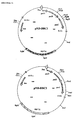
- Plasmid pND-D2 is an E. coli C based on plasmid pZ8-1.
- glutamicum shuttle vector carrying the panD gene of C. glutamicum.
- Plasmid pND-DBC2 is an E. coli C based on plasmid pZ8-1.
- glutamicum shuttle vector that carries the genes panD, panB and panC of C. glutamicum.
- the microorganisms produced according to the invention can be cultivated continuously or discontinuously in the batch process (batch culturing) or in the fed batch (feed process) or repeated fed batch process (repetitive feed process) for the purpose of producing pantothenic acid.
- a summary of known cultivation methods are in the textbook by Chmiel (Bioprocessing Technology 1. Introduction to Bioprocess Engineering (Gustav Fischer Verlag, Stuttgart, 1991 )) or in the textbook von Storhas (bioreactors and peripheral facilities (Vieweg Verlag, Braunschweig / Wiesbaden, 1994 )).
- the culture medium to be used must suitably satisfy the requirements of the respective microorganisms. Descriptions of culture media of various microorganisms are in the Manual of Methods for General Bacteriology of the American Society for Bacteriology (Washington DC, USA, 1981 ) contain.
- sugars and carbohydrates such as glucose, sucrose, lactose, fructose, maltose, molasses, starch and cellulose, oils and fats such.
- soybean oil, sunflower oil, peanut oil and coconut oil fatty acids such.
- palmitic acid, stearic acid and linoleic acid alcohols such.
- glycerol and ethanol and organic acids such.
- acetic acid can be used. These substances can be used individually or as a mixture.
- organic nitrogen-containing compounds such as peptones, yeast extract, meat extract, malt extract, corn steep liquor, soybean meal and urea, or inorganic compounds such as ammonium sulfate, ammonium chloride, ammonium phosphate, ammonium carbonate and ammonium nitrate can be used.
- the nitrogen sources can be used singly or as a mixture.
- potassium dihydrogen phosphate or dipotassium hydrogen phosphate or the corresponding sodium-containing salts can be used.
- the culture medium must further contain salts of metals such as magnesium sulfate or iron sulfate, which are necessary for growth.
- essential growth factors such as amino acids and vitamins can be added to those above be used.
- precursors of pantothenic acid may be added to the culture medium to further increase pantothenic acid production such as aspartate, ⁇ -alanine, ketoisovalerate, ketopantoic acid or pantoic acid and optionally their salts are added.
- the said feedstocks may be added to the culture in the form of a one-time batch or fed in a suitable manner during the cultivation.
- plasmids For pH control of the culture, basic compounds such as sodium hydroxide, potassium hydroxide, ammonia or acidic compounds such as phosphoric acid or sulfuric acid are suitably used.
- antifoams such as e.g. Fatty acid polyglycol esters are used.
- suitable selective substances may be added to the medium, e.g. Antibiotics are added.
- oxygen or oxygen containing gas mixtures e.g. Air entered into the culture.
- the temperature of the culture is usually 20 ° C to 50 ° C, and preferably 25 ° C to 45 ° C.
- the culture is continued until a maximum of pantothenic acid has formed. This goal is usually reached within 10 hours to 160 hours. Subsequently, the pantothenic acid is isolated.
- L-aspartate 1-decarboxylase can also be used for the production of ⁇ -alanine from L-aspartate.
- fermentative processes, enzymatic conversion reactions or combinations of both can be used.
- the concentration of formed pantothenic acid can be determined by known methods ( Velisek; Chromatographic Science 60, 515-560 (1992 )).
- Chromosomal DNA from C. glutamicum ATCC 13032 was as in Tauch et al. (1995, Plasmid, 33: 168-179 ), isolated and partially digested with the restriction enzyme Sau3A (Pharmacia Biotech (Freiburg, Germany), product description Sau3A, Code no. 27-0913-02). DNA fragments in the size range of 7-9 kb were analyzed using the " Nucleotide Extraction Kit for Nucleic Acids "(Macherey and Nagel, Düren, Germany; Cat ) and into the dephosphorylated BamHI site of the vector pUC19 (FIG.
- Norrander et al., 1982, Gene, 26: 101-106 purchased from MBI Fermentas (Vilnius, Lithuania). The ligation was like that of Sambrook et al. (1989, Molecular Cloning: A laboratory Manual, Cold Spring Harbor ), wherein the DNA mixture was incubated with T4 ligase (Pharmacia Biotech, Freiburg, Germany) overnight. This ligation mixture was then transformed into E.
- Plasmid pNIC-1.3 contains an insertion of 7 kbp in length.
- the complementation ability of pNIC-1.3 was verified by further transformation of the panD mutant DV9. The obtained transformants were in turn able to grow in ⁇ -alanine-free medium E under the conditions given above.
- the subcloning of the 7 kb insert was carried out by cleavage of the plasmid pNIC-1.3 with the restriction enzymes BamHI (Pharmacia Biotech (Freiburg, Germany), product description BamHI, code no. 27-0868-03), EcoRI (Pharmacia Biotech (Freiburg, Germany), Product Description EcoRI, Code no. 27-0884-03) and BglII (Pharmacia Biotech (Freiburg, Germany), product description BglII, Code no. 27-0946-02) and subsequent ligation into the appropriately restriction digested vector pK18mob ( Schafer, 1994, Gene, 145: 69-73 ).
- the resulting ligation mixture was electroporated into the E. coli panD mutant DV9; Selection for complemented transformants was as described above, in which case the agar plates contained 50 ⁇ g / ml kanamycin.
- the plasmids of complemented single clones were isolated and characterized by restriction analysis. An EcoRI subclone, hereinafter called pNIC-10, with an approximately 3 kb DNA insert was selected for the following sequence analysis.
- Chromosomal DNA of C. glutamicum ATCC13032 was as in Schwarzer and Pühler (Bio / Technology 9 (1990) 84-87 ) and cut with the restriction endonuclease Sau3A. After gel electrophoretic separation, DNA fragments in the size range from 3 to 7 kb or from 9 to 20 kb were extracted and subsequently ligated into the singular BamHI site of the vector pBR322. With the ligation mixtures, the E. coli strain DH5 ⁇ mcr ( Grant et al., Proceedings of the National Academy of Sciences of the United States of America, USA, 87 (1990) 4645-4649 ) ( Hanahan, Journal of Molecular Biology 166 (1983) 557-580 ).
- Insert-bearing colonies were identified by their tetracycline sensitivity after inoculation into LB agar plates containing 10 ⁇ g / ml tetracycline.
- plasmid preparations Sambrook et al., Molecular cloning. A laboratory manual (1989) Cold Spring Harbor Laboratory Press ) of pooled clones were 8 groups, each containing 400 plasmids with an insert size of 9 to 20 kb and 9 groups, each containing 500 plasmids with an insert size of 3 to 7 kb, isolated.
- the E. coli panB mutant SJ2 Cronan et al.
- pUR1 Restriction mapping was performed on these 8 plasmids.
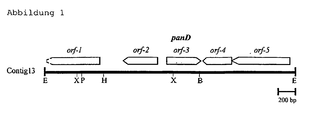
- One of the investigated plasmid vectors hereinafter called pUR1, contained an insert of 9.3 kb ( Figure 2 ). Transformation of the E. coli panC mutant DV39 ( Vallari and Rock 1985, Journal of Bacteriology 164: 136-142 ) revealed that the vector pUR1 was also able to complement the panC defect of this mutant.
- a 2.2 kb fragment of the insert ( Figure 2 ) of pUR1 was after the dideoxy chain termination method by Sanger et al. Sequenced (Proceedings of the National Academy of Sciences of the United States of America USA (1977) 74: 5463-5467 ). For this purpose, subclones were first generated by means of exonuclease III, which were sequenced using standard primers (universal and reverse primer from Boehringer Mannheim, Germany). The gel electrophoretic analysis of the sequencing approaches was carried out with the automatic laser fluorescence sequencer (ALF) from Amersham Pharmacia Biotech (Uppsala, Sweden).
- ALF automatic laser fluorescence sequencer
- the obtained nucleotide sequence was analyzed with the program package HUSAR (Release 4.0, EMBL, Cambridge, GB).
- the nucleotide sequence is shown as SEQ ID NO 3.
- the analysis revealed the identification of two open reading frames.
- An open reading frame of 813 bp in length, identified as a panB gene encodes a polypeptide of 271 amino acids and is represented as SEQ ID NO 4.
- the second open reading frame, identified as the panC gene comprises 837 base pairs. It encodes a polypeptide of 279 amino acids, represented as SEQ ID NO 5.
- pantothenate biosynthesis genes from C. glutamicum and E. coli were amplified using polymerase chain reaction (PCR) as well as synthetic oligonucleotides.
- PCR polymerase chain reaction
- the PCR experiments were carried out with the Taq DNA polymerase from Gibco-BRL (Eggestein, Germany) in a "PCT-100 thermocycler” (MJ Research Inc., Watertown, Mass., USA).
- panD SEQ ID NO 1
- panBC SEQ ID NO 3
- C. glutamicum ATCC 13032 and E. coli K12 WK Merkel and BP Nichols, 1993, GenBank: L17086
- PCR primers were synthesized (MWG Biotech, Ebersberg, Germany). These primers were chosen so that the amplified fragments contain the genes as well as their native ribosome binding sites, but not possible promoter regions. In addition, suitable restriction sites have been included which allow cloning into the target vector.
- the in Figure 3 represented E. coli C. glutamicum shuttle expression vector pZ8-1 (European Patent 0 375 889 ) used.
- the previously cloned into the vector pCR ® 2.1 amplicons were ligated by means of the primer-inserted restriction cleavage sites into the similarly treated expression vector pZ8-1 and thus placed under the control of the contained on this plasmid tac promoter. Only exception the amplicon panD Ec , here the EcoRI-BglII fragment was cloned into the compatible EcoRI-BamHI restriction ends of the vector pZ8-1.
- the respective plasmid designations for the thus constructed expression plasmids are given in Table 2.
- the expression vector pZ8-1 with the gene panD Ec of E. coli is called pND-D1 and pZ8-1 with the gene panD Cg of C. glutamicum is called pND-D2.
- the expression plasmids containing panBC Ec and panBC Cg are referred to as pND-BC1 and pND-BC2, respectively.
- pND-BC1 and pND-BC2 the expression plasmids containing panBC Ec and panBC Cg are referred to as pND-BC1 and pND-BC2, respectively.
- Is exemplary in the Figure 3 the cloning strategy for the genes panD Ec and panD Cg are shown in the vector pZ8-1. The correct cloning of all expression plasmids was checked by sequencing the respective inserts.
- panDBC operon was constructed with both the E. coli and the C. glutamicum panD genes.
- E. coli operon the vector pCR2.1 containing panD Ec was digested with EcoRI, the DNA is separated in agarose gel and the panD fragment was, as already described in Example 1.1 (using "Nucleotrap Extraction Kit for Nucleic Acids” Macherey and Nagel, Düren, Germany) from the gel. Subsequently, the fragment was ligated into the EcoRI digested plasmid pND-BC1. Plasmids with a correct orientation of the panD gene were obtained by transforming the ligation mixture into the panD auxotrophic E.
- Plasmid DNA of the complemented mutants was isolated and the correct gene assembly was confirmed by sequencing the insert of the plasmid called pND-DBC1 ( Figure 4 ).
- the construction of the C. glutamicum panDBC operon was similar.
- the panD Cg contained vector pCR2.1 was digested EcoRI, which the panD Cg gene on the one hand via the primer internal and on the other via an EcoRI interface of the vector was split out of this.
- This gene fragment was cloned after purification into the EcoRI digested vector pZ8-1 and plasmids with the correct panD orientation, called pND-D4, were obtained and tested as described above.
- the plasmid pND-D4 was cleaved with the restriction enzyme SalI and with the purified panBC fragment, which by SalI digestion (Pharmacia Biotech (Freiburg, Germany), product description SalI code no.
- the expression vector pZ8-1 and the constructs based on this plasmid pND-D1, pND-D2 and pND-DBC1 were transformed into E. coli strain MG1655 and transformants on LB agar (Lennox, 1955, Virology, 1: 190) + 50 ⁇ g / ml kanamycin selected.
- the strains obtained were named MG1655 / pZ8-1, MG1655 / pND-D1, MG1655 / pND-D2 and MG1655 / pND-DBC1.
- D-pantothenate was quantitated by the Lactobacillus plantarum pantothenate assay (Assay strain: Lactobacillus plantarum ATCC 8014, Cat No.3211-30-3, culture medium: Bacto Pantothenate Assay Medium (DIFCO Laboratories, Michigan, USA), Cat. No. 0604-15-3)
- This indicator strain can grow only in the presence of pantothenate in the indicated culture medium and shows a photometrically measurable, linear dependence of the growth on the pantothenate concentration of the medium.
- the hemicalcium salt of pantothenate was used for the calibration (Sigma, product name P 2250).
- the optical density was determined on a LKB Biochrom photometer from Pharmacia Biotech (Freiburg, Germany) at a measurement wavelength of 580 nm (OD 580 ).
- test medium medium E with 50 ⁇ g / ml kanamycin
- 50 ml of test medium medium E with 50 ⁇ g / ml kanamycin
- the cells were pelleted by centrifugation at 5000 xg for 10 minutes.
- the resulting cell-free supernatant was sterile filtered and stored at 4 ° C until pantothenate quantification.
- pantothenate by the C. glutamicum strains ATCC13032 / pZ8-1, ATCC13032 / pND-D1, ATCC13032 / pND-D2 and C. glutamicum ATCC13032 / pND-DBC2 were in medium CGXII ( Keilhauer et al., 1993, Journal of Bacteriology, 175: 5595-5603 ; Table 4) supplemented with 25 ⁇ g / ml kanamycin. This medium is referred to below as the C. glutamicum test medium.
- Each 50 ml of C. glutamicum test medium was inoculated from a 16 hour old culture of the same medium with an OD 580 of 0.1.
- pantothenate concentration determined as described in Example 4.
- Table 5 The results of pantothenate production by the various strains of C. glutamicum are summarized in Table 5.
- ATCC13032 / pZ8-1 - 21 0.19 ATCC13032 / pND-D1 panD Ec 20 0.32 ATCC 13032 / pND-D2 panD Cg 19 1.78 ATCC 13032 / pND-DBC2 panDBC Cg 20 2.60
Landscapes
- Health & Medical Sciences (AREA)
- Life Sciences & Earth Sciences (AREA)
- Genetics & Genomics (AREA)
- Engineering & Computer Science (AREA)
- Chemical & Material Sciences (AREA)
- Organic Chemistry (AREA)
- Zoology (AREA)
- Wood Science & Technology (AREA)
- Bioinformatics & Cheminformatics (AREA)
- Biomedical Technology (AREA)
- Biotechnology (AREA)
- General Engineering & Computer Science (AREA)
- Microbiology (AREA)
- Biochemistry (AREA)
- General Health & Medical Sciences (AREA)
- Molecular Biology (AREA)
- Plant Pathology (AREA)
- Biophysics (AREA)
- Physics & Mathematics (AREA)
- Chemical Kinetics & Catalysis (AREA)
- General Chemical & Material Sciences (AREA)
- Medicinal Chemistry (AREA)
- Crystallography & Structural Chemistry (AREA)
- Preparation Of Compounds By Using Micro-Organisms (AREA)
- Micro-Organisms Or Cultivation Processes Thereof (AREA)
- Fodder In General (AREA)
- Coloring Foods And Improving Nutritive Qualities (AREA)
Description
- Die Pantothensäure stellt ein kommerziell bedeutendes Vitamin dar, das in der Kosmetik, der Medizin, der Humanernährung und in der Tierernährung Anwendung findet.
- Pantothensäure kann durch chemische Synthese oder biotechnisch durch Fermentation geeigneter Mikroorganismen in geeigneten Nährlösungen hergestellt werden. Bei der chemischen Synthese ist das DL-Pantolacton eine wichtige Zwischenstufe. Es wird in einem mehrstufigen Verfahren aus Formaldehyd, Isobutylaldehyd und Cyanid hergestellt. In weiteren Verfahrensschritten wird das racemische Gemisch aufgetrennt und D-Pantolacton mit β-Alanin kondensiert und man erhält D-Pantothensäure.
- Der Vorteil der fermentativen Herstellung durch Mikroorganismen liegt in der direkten Bildung der gewünschten stereoisomeren D-Form die frei von L-Pantothensäure ist.
- Verschiedene Arten von Bakterien, wie z. B. Escherichia coli, Arthrobacter ureafaciens, Corynebacterium erythrogenes, Brevibacterium ammoniagenes und auch Hefen, wie z. B. Debaromyces castellii können wie in
EP-A 0 493 060 gezeigt, in einer Nährlösung, die Glucose, DL-Pantoinsäure und β-Alanin enthält, D-Pantothensäure produzieren.EP-A 0 493 060 zeigt weiterhin, daß bei Escherichia coli durch Amplifikation von Pantothensäure-Biosynthesegenen aus E.coli, die auf den Plasmiden pFV3 und pFV5 enthalten sind, in einer Nährlösung, die Glucose, DL-Pantoinsäure und β-Alanin enthält, die Bildung von D-Pantothensäure verbessert wird. -
EP-A 0 590 857 undUS-Patent 5,518,906 beschreiben von Escherichia coli Stamm IFO3547 abgeleitete Mutanten wie FV5714, FV525, FV814, FV521, FV221, FV6051 und FV5069 die Resistenzen gegen verschiedene Antimetabolite wie Salizylsäure, α-Ketobuttersäure, β-Hydroxyasparaginsäure, O-Methylthreonin und α-Ketoisovaleriansäure tragen und in einer Nährlösung, die Glucose enthält Pantoinsäure und in einer Nährlösung, die Glucose und β-Alanin enthält, D-Pantothensäure produzieren. InEPA 0 590 857 undUS-Patent 5,518,906 wird weiterhin gezeigt, daß nach Amplifikation der Pantothensäure-Biosynthesegene, die auf dem Plasmid pFV31 enthalten sind, in den oben genannten Stämmen in einer Nährlösung die Glucose enthält die Produktion von D-Pantoinsäure und in einer Nährlösung die Glucose und β-Alanin enthält die Produktion von D-Pantothensäure verbessert wird. - In
WO 97/10340 - Die Erfinder haben sich zur Aufgabe gestellt neue Grundlagen für verbesserte Verfahren zur fermentativen Herstellung von Pantothensäure bereitzustellen.
- Das Vitamin Pantothensäure stellt ein kommerziell bedeutendes Produkt dar, das in der Kosmetik, der Medizin, der Humanernährung und in der Tierernährung Anwendung findet. Es besteht daher ein allgemeines Interesse daran neue Verfahren zur Herstellung von Pantothensäure bereitzustellen.
- Wenn im Folgenden D-Pantothensäure oder Pantothensäure oder Pantothenat erwähnt werden, sind damit nicht nur die freien Säuren, sondern auch die Salze der D-Pantothensäure wie z.B. das Calcium-, Natrium-, Ammonium- oder Kaliumsalz gemeint.
- Gegenstand der Erfindung ist unter anderem ein Verfahren zur fermentativen Herstellung von D-Pantothensäure unter Verwendung von Mikroorganismen, die insbesondere bereits D-Pantothensäure produzieren, und in denen das für die L-Aspartat-1-Decarboxylase (E.C. 4.1.1.11) kodierende panD-Gen einzeln oder in Kombination mit den Genen panB und/oder panC überexprimiert wird. Die Erfindung betrifft weiter Nukleotidsequenzen des pan D-gens, wie sie in den Ansprüchen niedergelegt sind. Gegenstand der Erfindung sind ebenso Verfahren zur fermentativen Herstellung von D-Pantothensäure, die unter Verwendung der verbesserten, D-Pantothensäure erzeugenden Mikroorgainsmen gemäß den Ansprüchen 3, 4 und 8 bis 14 und 18, 19 durchgeführt werden.
- Der Begriff "Verstärkung" beschreibt in diesem Zusammenhang die Erhöhung der intrazellulären Aktivität eines oder mehrerer Enzyme in einem Mikroorganismus, die durch die entsprechende DNA kodiert werden, indem man beispielsweise die Kopienzahl des Gens bzw. der Gene erhöht, einen starken Promotor verwendet oder ein Gen verwendet, das für ein entsprechendes Enzym mit einer hohen Aktivität kodiert und gegebenenfalls diese Maßnahmen kombiniert.
- Die Mikroorganismen, die Gegenstand der vorliegenden Erfindung sind, können Pantothensäure aus Glucose, Saccharose, Lactose, Fructose, Maltose, Melasse, Stärke, Cellulose oder aus Glycerin und Ethanol herstellen. Es kann sich um Pilze oder Hefen oder Gram-positive Bakterien z. B. der Gattung Corynebacterium oder um Gram-negative Bakterien wie z. B. die der Enterobacteriaceae handeln. Bei der Familie der Enterobacteriaceae ist besonders die Gattung Escherichia mit der Art Escherichia coli zu nennen. Innerhalb der Art Escherichia coli sind die sogenannten K-12 Stämme wie z. B. die Stämme MG1655 oder W3110 (Neidhard et al.: Escherichia coli and Salmonella. Cellular and Molecular Biology (ASM Press, Washington D.C.)) oder der Escherichia coli Wildtypstamm IFO3547 (Institut für Fermentation, Osaka, Japan) und davon abgeleitete Mutanten zu nennen. Bei der Gattung Corynebacterium ist insbesondere die Art Corynebacterium glutamicum zu nennen, die in der Fachwelt für ihre Fähigkeit bekannt ist Aminosäuren zu produzieren. Zu dieser Art gehören Wildtypstämme wie z. B. Corynebacterium glutamicum ATCC13032, Brevibacterium flavum ATCC14067, Corynebacterium melassecola ATCC17965 und davon abgeleitete Mutanten.
- Die Erfinder fanden heraus, daß Mikroorganismen nach Überexpression des neuen für die L-Aspartat-1-Decarboxylase (E.C. 4.1.1.11) kodierenden panD-Gens, insbesondere aus Corynebacterium glutamicum in verbesserter Weise Pantothensäure produzieren.
- Die Erfinder haben darüberhinaus herausgefunden, daß die Überexpression des panD-Gens sich in Stämmen vorteilhaft auswirkt, in denen zusätzlich die für Ketopantoathydroxymethyltransferase und Pantothenatsynthetase kodierenden Gene panB und panC einzeln oder gemeinsam überexprimiert vorliegen.
- Zur Erzielung einer Überexpression kann die Kopienzahl der entsprechenden Gene erhöht werden, oder es kann die Promotor- und Regulationsregion, die sich stromaufwärts des Strukturgens befindet, mutiert werden. In gleicher Weise wirken Expressionskassetten, die stromaufwärts des Strukturgens eingebaut werden. Durch induzierbare Promotoren ist es zusätzlich möglich die Expression im Verlaufe der fermentativen D-Pantothenatbildung zu steigern. Durch Maßnahmen zur Verlängerung der Lebensdauer der m-RNA wird ebenfalls die Expression verbessert. Weiterhin wird durch Verhinderung des Abbaus des Enzymproteins ebenfalls die Enzymaktivität verstärkt. Die Gene oder Genkonstrukte können entweder in Plasmiden mit unterschiedlicher Kopienzahl vorliegen oder im Chromosom integriert und amplifiziert sein. Alternativ kann weiterhin eine Überexpression der betreffenden Gene durch Veränderung der Medienzusammensetzung und Kulturführung erreicht werden.
- Anleitungen hierzu findet der Fachmann unter anderem bei Martin et al. (Bio/Technology 5, 137-146 (1987)), bei Guerrero et al. (Gene 138, 35-41 (1994)), Tsuchiya und Morinaga (Bio/Technology 6, 428-430 (1988)), bei Eikmanns et al. (Gene 102, 93-98 (1991)), in der Europäischen Patentschrift
EPS 0 472 869 US Patent 4,601,893 , bei Schwarzer und Pühler (Bio/Technology 9, 84-87 (1991), bei Reinscheid et al. (Applied and Environmental Microbiology 60, 126-132 (1994)), bei LaBarre et al. (Journal of Bacteriology 175, 1001-1007 (1993)), in der PatentanmeldungWO 96/15246 PCT/US97/13359 - Zur Isolierung des panD-Gens oder anderer Gene wie z.B. der Gene panB und panC von C. glutamicum wird zunächst eine Genbank dieses Mikrorganismus in E. coli angelegt. Das Anlegen von Genbanken ist in allgemein bekannten Lehrbüchern und Handbüchern niedergeschrieben. Als Beispiel seien das Lehrbuch von Winnacker: Gene und Klone, Eine Einführung in die Gentechnologie (Verlag Chemie, Weinheim, Deutschland, 1990) oder das Handbuch von Sambrook et al.: Molecular Cloning, A Laboratory Manual (Cold Spring Harbor Laboratory Press, 1989) genannt. Eine bekannte Genbank ist die des E. coli K-12 Stammes W3110, die von Kohara et al. (Cell 50, 495 - 508 (1987)) in λ-Vektoren angelegt wurde. Bathe et al. (Molecular and General Genetics, 252:255-265, 1996) beschreiben eine Genbank von C. glutamicum ATCC13032, die mit Hilfe des Cosmidvektors SuperCos I (Wahl et al., 1987, Proceedings of the National Academy of Sciences USA, 84:2160-2164) im E.coli K-12 Stamm NM554 (Raleigh et al., 1988, Nucleic Acids Research 16:1563-1575) angelegt wurde. Zur Herstellung einer Genbank von C. glutamicum in E. coli können auch Plasmide wie pBR322 (Bolivar, Life Sciences, 25, 807-818 (1979)) oder pUC9 (Viera et al., 1982, Gene, 19:259-268) verwendet werden. Als Wirte eignen sich besonders solche E. coli-Stämme, die restriktions- und rekombinationsdefekt sind. Ein Beispiel hierfür ist der Stamm DH5αmcr, der von Grant et al. (Proceedings of the National Academy of Sciences USA, 87 (1990) 4645-4649) beschrieben wurde.
Die Genbank wird anschließend in einen Indikatorstamm durch Transformation (Hanahan, Journal of Molecular Biology 166, 557-580, 1983) oder Elektroporation (Tauch et.al., 1994, FEMS Microbiological Letters, 123:343-347) eingebaut. Der Indikatorstamm zeichnet sich dadurch aus, dass er eine Mutation in dem interessierenden Gen besitzt, die einen detektierbaren Phänotyp z.B. eine Auxotrophie hervorruft. Im Rahmen der vorliegenden Erfindung ist die E. coli Mutante DV9 (Vallari und Rock, Journal of Bacteriology 1985, 164:136-142), die eine Mutation im panD-Gen trägt von besonderem Interesse. Ein anderes Beispiel für eine Pantothensäure-bedürftige E. coli Mutante ist der Stamm SJ2, der eine Mutation im panB-Gen trägt und vom Genetic Stock Center der Yale University (New Haven, Connecticut, USA) bezogen werden kann. Nach Transformation des Indikatorstammes wie z.B. der panD-Mutante DV9 mit einem rekombinanten Plasmid, welches das interessierende Gen wie z.B. das panD-Gen trägt und Expression des betreffenden Gens, wird der Indikatorstamm bezüglich der entsprechenden Eigenschaft wie z.B. der Pantothensäure-Bedürftigkeit prototroph. Das dergestalt isolierte Gen bzw. DNA-Fragment kann durch Bestimmung der Sequenz, wie z.B. bei Sanger et al. (Proceedings of the National of Sciences of the United States of America USA, 74:5463-5467, 1977) beschrieben, charakterisiert werden. Anschließend kann der Grad an Identität zu bekannten Genen, die in Datenbanken wie z.B. der GenBank (Benson et el., 1998, Nuleic Acids Research, 26:1-7) enthalten sind, mit publizierten Methoden (Altschul et al., 1990, Journal of Molecular Biology 215:403-410) analysiert werden. - Auf diese Weise wurde die neue für das Gen panD kodierende DNA-Sequenz von C. glutamicum erhalten, die als SEQ ID NO 1 Bestandteil der vorliegenden Erfindung ist. Weiterhin wurden aus der vorliegenden DNA-Sequenz mit den oben beschriebenen Methoden die Aminosäuresequenzen der entsprechenden Enzyme abgeleitet. In SEQ ID NO 2 ist die sich ergebende Aminosäuresequenz des panD-Genproduktes nämlich der L-Aspartat-1-Decarboxylase dargestellt. Weiterhin wurden auf diese Weise die für die Gene panB und panC kodierenden DNA-Sequenzen von C. glutamicum erhalten, die als SEQ ID NO 3 Bestandteil der vorliegenden Beschreibung ist. In SEQ ID NO 4 ist die sich ergebende Aminosäuresequenz des panB-Genproduktes nämlich der Ketopantoathydroxymethyltransferase dargestellt und in SEQ ID NO 5 die sich ergebende Aminosäuresequenz des panC-Genproduktes nämlich der Pantothenatsynthetase dargestellt.
- Kodierende DNA-Sequenzen, die sich aus SEQ ID NO 1 durch die Degeneriertheit des genetischen Codes ergeben, sind ebenfalls Bestandteil der Erfindung. In gleicher Weise sind DNA-Sequenzen, die mit SEQ ID NO 1 und/oder SEQ ID NO 3 hybridisieren Bestandteil der Beschreibung. In der Fachwelt sind weiterhin konservative Aminosäureaustausche wie z.B. Austausch von Glycin gegen Alanin oder von Asparaginsäure gegen Glutaminsäure in Proteinen als "Sinnmutationen" (sense mutations) bekannt, die zu keiner grundsätzlichen Veränderung der Aktivität des Proteins führen, d. h. funktikonsneutral sind. Weiterhin ist bekannt, daß Änderungen am N- und/oder C-Terminus eines Proteins dessen Funktion nicht wesentlich beeinträchtigen oder sogar stabilisieren können. Angaben hierzu findet der Fachmann unter anderem bei Ben-Bassat et al. (Journal of Bacteriology 169:751-757 (1987)), bei O'Regan et al. (Gene 77:237-251 (1989)), bei Sahin-Toth et al. (Protein Sciences 3:240-247 (1994)), bei Hochuli et al. (Bio/Technology 6:1321-1325 (1988)) und in bekannten Lehrbüchern der Genetik und Molekularbiologie. Aminosäuresequenzen, die sich in entsprechender Weise aus SEQ ID NO 2, SEQ ID NO 4 und/oder SEQ ID NO 5 ergeben sind ebenfalls Bestandteil der Erfindung.
- Das auf diese Weise charakterisierte Gen kann anschließend einzeln oder in Kombination mit anderen in einem geeigneten Mikroorganismus zur Expression gebracht werden. Eine bekannte Methode Gene zu exprimieren bzw. überzuexprimieren besteht darin diese mit Hilfe von Plasmidvektoren zu amplifizieren, die überdies mit Expressionssignalen ausgestattet sein können. Als Plasmidvektoren kommen solche in Frage, die in den entsprechenden Mikroorganismen replizieren können. Für Escherichia coli kommen z.B. die Vektoren pSC101 (Vocke and Bastia, Proceedings of the National Academy of Sciences USA 80 (21), 6557-6561 (1983)) oder pKK223-3 (Brosius and Holy, Proceedings of the National Academy of Sciences USA 81, 6929 (1984)), für Corynebacterium glutamicum z.B. der Vektor pEKEx1 (Eikmanns et al., Gene 102:93-98 (1991)) oder pZ8-1 (Europäische Patentschrift
0 375 889 ) für die vorliegende Erfindung in Frage. Beispiele für derartige Mikroorganismen sind die C. glutamicum-Stämme ATCC13032/pND-D2 und ATCC13032/pND-DBC2 und der E. coli-Stamm MG1655/pND-D2, die die Plasmide pND-D2 und pND-DBC2 enthalten. Plasmid pND-D2 ist ein auf dem Plasmid pZ8-1 basierender E. coli-C. glutamicum Pendelvektor der das panD-Gen von C. glutamicum trägt. Plasmid pND-DBC2 ist ein auf dem Plasmid pZ8-1 basierender E. coli-C. glutamicum Pendelvektor der die Gene panD, panB und panC von C. glutamicum trägt. - Es ist dem Fachmann klar, daß chromosomale Mutationen, die Resistenz gegen Metabolite und Antimetabolite bewirken oder die das Abfliessen von Vorstufen der Pantothensäure verhindern, in vorteilhafter Weise mit den Massnahmen die Gegenstand der Erfindung sind kombiniert werden können.
- Die erfindungsgemäß hergestellten Mikroorganismen können kontinuierlich oder diskontinuierlich im batch - Verfahren (Satzkultivierung) oder im fed batch (Zulaufverfahren) oder repeated fed batch Verfahren (repetitives Zulaufverfahren) zum Zwecke der Pantothensäure-Produktion kultiviert werden. Eine Zusammenfassung über bekannte Kultivierungsmethoden sind im Lehrbuch von Chmiel (Bioprozesstechnik 1. Einführung in die Bioverfahrenstechnik (Gustav Fischer Verlag, Stuttgart, 1991)) oder im Lehrbuch von Storhas (Bioreaktoren und periphere Einrichtungen (Vieweg Verlag, Braunschweig/Wiesbaden, 1994)) beschrieben.
- Das zu verwendende Kulturmedium muß in geeigneter Weise den Ansprüchen der jeweiligen Mikroorganismen genügen. Beschreibungen von Kulturmedien verschiedenener Mikroorganismen sind im Handbuch "Manual of Methods for General Bacteriology" der American Society for Bacteriology (Washington D.C., USA, 1981) enthalten. Als Kohlenstoffquelle können Zucker und Kohlehydrate wie z.B. Glucose, Saccharose, Lactose, Fructose, Maltose, Melasse, Stärke und Cellulose, Öle und Fette wie z. B. Sojaöl, Sonnenblumenöl, Erdnussöl und Kokosfett, Fettsäuren wie z. B. Palmitinsäure, Stearinsäure und Linolsäure, Alkohole wie z. B. Glycerin und Ethanol und organische Säuren wie z. B. Essigsäure verwendet werden. Diese Stoffe können einzeln oder als Mischung verwendet werden. Als Stickstoffquelle können organische Stickstoff haltige Verbindungen wie Peptone, Hefeextrakt, Fleischextrakt, Malzextrakt, Maisquellwasser, Sojabohnenmehl und Harnstoff oder anorganische Verbindungen wie Ammoniumsulfat, Ammoniumchlorid, Ammoniumphosphat, Ammoniumcarbonat und Ammoniumnitrat verwendet werden. Die Stickstoffquellen können einzeln oder als Mischung verwendet werden. Als Phosphorquelle können Kaliumdihydrogenphosphat oder Dikaliumhydrogenphosphat oder die entsprechenden Natrium haltigen Salze verwendet werden. Das Kulturmedium muß weiterhin Salze von Metallen enthalten wie z.B. Magnesiumsulfat oder Eisensulfat, die für das Wachstum notwendig sind. Schließlich können essentielle Wuchsstoffe wie Aminosäuren und Vitamine zusätzlich zu den oben genannten Stoffen eingesetzt werden. Dem Kulturmedium können überdies zur zusätzlichen Steigerung der Pantothensäure-Produktion Vorstufen der Pantothensäure wie Aspartat, β-Alanin, Ketoisovalerat, Ketopantoinsäure oder Pantoinsäure und gegebenenfalls deren Salze zugesetzt werden. Die genannten Einsatzstoffe können zur Kultur in Form eines einmaligen Ansatzes hinzugegeben oder in geeigneter Weise während der Kultivierung zugefüttert werden.
- Zur pH - Kontrolle der Kultur werden basische Verbindungen wie Natriumhydroxid, Kaliumhydroxid, Ammoniak oder saure Verbindungen wie Phosphorsäure oder Schwefelsäure in geeigneter Weise eingesetzt. Zur Kontrolle der Schaumentwicklung können Antischaummittel wie z.B. Fettsäurepolyglykolester eingesetzt werden. Zur Aufrechterhaltung der Stabilität von Plasmiden können dem Medium geeignete selektiv wirkende Stoffe z.B. Antibiotika hinzugefügt werden. Um aerobe Bedingungen aufrechtzuerhalten werden Sauerstoff oder Sauerstoff haltige Gasmischungen wie z.B. Luft in die Kultur eingetragen. Die Temperatur der Kultur liegt normalerweise bei 20°C bis 50°C und vorzugsweise bei 25°C bis 45°C. Die Kultur wird solange fortgesetzt bis sich ein Maximum an Pantothensäure gebildet hat. Dieses Ziel wird normalerweise innerhalb von 10 Stunden bis 160 Stunden erreicht. Anschließend wird de Pantothensäure isoliert.
- Stämme, die eine hohe Aktivität des Enzyms L-Aspartat 1-Decarboxylase besitzen, können auch für die Herstellung von β-Alanin aus L-Aspartat eingesetzt werden. Hierzu können fermentative Verfahren, enzymatische Umwandlungsreaktionen oder Kombinationen beider eingesetzt werden.
- Die Konzentration an gebildeter Pantothensäure kann mit bekannten Verfahren (Velisek; Chromatographic Science 60, 515-560 (1992)) bestimmt werden.
- Folgende Mikroorganismen wurden bei der Deutschen Sammlung für Mikroorganismen und Zellkulturen (DSMZ, Braunschweig, Deutschland) gemäß Budapester Vertrag hinterlegt:
- Corynebacterium glutamicum ATCC13032/pND-D2 als DSM12438
- Corynebacterium glutamicum ATCC13032/pND-DBC2 als DSM12437
- Die vorliegende Erfindung wird im folgenden anhand von Ausführungsbeispielen näher erläutert.
- Chromosomale DNA aus C. glutamicum ATCC 13032 wurde wie bei Tauch et al. (1995, Plasmid, 33:168-179) beschrieben, isoliert und mit der Restriktionsenzym Sau3A (Pharmacia Biotech (Freiburg, Deutschland), Produktbeschreibung Sau3A, Code no. 27-0913-02) partiell gespalten. DNA-Fragmente in einem Größenbereich von 7-9 kb wurden mit Hilfe des "Nucleotrap Extraction Kit for Nucleic Acids" (Macherey und Nagel, Düren, Deutschland; Cat. No. 740584) isoliert und in die dephosphorylierte BamHI-Schnittstelle des Vektors pUC19 (Norrander et al., 1982, Gene, 26:101-106), der von der Firma MBI Fermentas (Vilnius,Litauen) bezogen wurde, ligiert. Die Ligation wurde wie von Sambrook et al. (1989, Molecular Cloning: A laboratory Manual, Cold Spring Harbor) beschrieben durchgeführt, wobei das DNA-Gemisch mit T4-Ligase (Pharmacia Biotech, Freiburg, Deutschland) über Nacht inkubiert wurde. Dieses Ligationsgemisch wurde anschließend in den E. coli Stamm DH5αMCR (Grant, 1990, Proceedings of the National Acadamies of Sciences USA, 87:4645-4649) elektroporiert (Tauch, 1994, FEMS Microbiological Letters, 123:343-347) und auf LB-Agar (Lennox, 1955, Virology, 1:190) + 100 µg/ml Ampicillin ausplattiert. Nach Inkubation für 24 Stunden bei 37°C konnte die C. glutamicum Genbank durch Reisolierung der Plasmid-DNA nach der "Alkalischen-Lyse-Methode" von Birnboim und Doly (Nucleic Acids Research, 7: 1513-1523, 1997) aus den Transformanten gewonnen werden. Mit dieser Genbank wurden kompetente Zellen des E. coli Stamms DV9 (Vallari und Rock, 1985, Journal of Bacteriology, 164:136-142), welcher eine Mutation im panD-Gen trägt, elektroporiert. Der Elektroporationsansatz wurde im Anschluß an die Regenerationsphase (Tauch et.al., 1994, FEMS Microbiological Letters, 123:343-347) zweimal mit Medium E (Vogel and Bonner, 1956, Journal of Biolgical Chemistry, 218:97-106) gewaschen. Die Zusammensetzung des Mediums E ist in Tabelle 1 dargestellt. Mit diesen Zellen wurden 50 ml Medium E + 100 µg/ml Ampicillin, die in einem 250 ml Erlenmeyerkolben vorlagen, inocculiert und in einem Luftschüttler bei 250 U/min und 39°C inkubiert. Nach zweitägiger Inkubation wurde die Bakteriensuspension verdünnt und auf LB-Agar (Lennox, 1955, Virology, 1:190) ausgestrichen, der mit 100 µg/ml Ampicillin supplementiert worden war.
Tabelle 1 Substanz Menge pro Liter Bemerkung K2HPO4 10 g NaNH4HPO4*4 H2O 3,5 g Zitronensäure 2 g MgSO4 * 7 H2O 0,2 g Glukose 4 g separat sterilisieren Thiamin 0,2 µg sterilfiltrieren - Die Plasmid-DNA einer DV9-Transformante wurde isoliert, als pNIC-1.3 bezeichnet und mittels Agarosegelelektrophorese (Sambrook et al., Molecular cloning. A laboratory manual (1989) Cold Spring Harbour Laboratory Press) und Vergleich mit Standard-DNA-Fragmenten bekannter Länge charakterisiert. Plasmid pNIC-1.3 enthält eine Insertion von 7 kbp Länge. Die Komplementationsfähigkeit von pNIC-1.3 wurde durch erneute Transformation der panD Mutante DV9 überprüft. Die erhaltenen Transformanten waren wiederum fähig, in β-Alanin-freiem Medium E unter den oben angegebenen Bedingungen zu wachsen.
- Die Subklonierung des 7 kb Inserts erfolgte durch Spaltung des Plasmids pNIC-1.3 mit den Restriktionsenzymen BamHI (Pharmacia Biotech (Freiburg, Deutschland), Produktbeschreibung BamHI, Code no. 27-0868-03), EcoRI (Pharmacia Biotech (Freiburg, Deutschland), Produktbeschreibung EcoRI, Code no. 27-0884-03) und BglII (Pharmacia Biotech (Freiburg, Deutschland), Produktbeschreibung BglII, Code no. 27-0946-02) und anschließender Ligation in den entsprechend restriktionsverdauten Vektor pK18mob (Schäfer, 1994, Gene, 145:69-73). Der erhaltene Ligationsansatz wurde in die E. coli panD Mutante DV9 elektroporiert; die Selektion auf komplementierte Transformanten erfolgte wie oben beschrieben wobei die Agarplatten in diesem Fall 50 µg/ml Kanamycin enthielten. Die Plasmide von komplementierten Einzelklonen wurden isoliert und mittels Restriktionsanalysen charakterisiert. Ein EcoRI-Subklon, im Folgenden pNIC-10 genannt, mit einem ungefähr 3 kb großen DNA-Insert wurde für die folgende Sequenzanalyse ausgewählt.
- Für die doppelsträngige Sequenzierung des 3 kb Fragments von pNIC-10 wurde dieses mit verschiedenen Restriktionsenzymen gespalten und die Fragmente in die Plasmide pUC19 oder pK18mob subkloniert. Die zum Sequenzieren eingesetzte Plasmid-DNA wurde nach Herstellerangaben mit dem "QIAGEN Plasmid Mini kit" (Qiagen, Inc., Chatsworth, Ca., USA) isoliert und die Bestimmung der Plasmidgrößen mittels Agarosegelelektrophorese durchgeführt.
- Die Sequenzierung erfolgte nach der Dideoxy-KettenabbruchMethode von Sanger et al. (Proceedings of the National Academies of Sciences USA, 74:5463-5467, 1977) mit Modifikationen nach Zimmermann et al. (Nucleic Acids Research, 18:1067, 1990). Es wurde der "Cy5-AutoRead Sequencing kit" von Pharmacia (Product No. 27-2690-02, Freiburg, Germany) angewandt. Die gelelektrophoretische Auftrennung und Analyse der Sequenzierreaktion erfolgte in einem "Long Ranger Gel Solution"-Polyacrylamidgel (FMC BioProducts, Rockland, Me., USA) mit dem "automatischen Laser-Fluoreszenz (A.L.F.) Express DNA Sequenziergerät" von Amersham Pharmacia Biotech (Uppsala, Schweden). Die erhaltenen Roh-Sequenzdaten wurden anschließend unter Anwendung des Staden-Programpakets (Nucleic Acids Research, 14:217-231, 1986) Version 97-0 prozessiert. Sämtliche Einzelsequenzen der pNIC-10 Subklone wurden zu einem zusammenhängenden 3060 bp langen Contig assembliert, der als Contig13 bezeichnet wurde. Die computergestützte Kodierbereichsanalyse mit dem Programm XNIP (Staden, 1986, Nucleic Acids Research, 14:217-231) des gesamten DNA-Fragments ergab die Identifizierung von fünf offenen Leseraster (ORFs).
InAbbildung 1 ist eine Restriktionskarte von Contig13 sowie die Lage der als orf- bis orf-5 bezeichneten ORFs dargestellt. Homologieanalysen wurden mit den "BLAST search programs" (Gish and States, 1993, Nature of Genetics, 3:266-272; Altschul et al., 1990, Journal of Molecular Biology, 215:403-410), welche über den Online-Service des NCBI-Servers der "National Library of Medicine" (Bethesda, MD, USA) zur Verfügung gestellt wurde, durchgeführt. Die Analyse von Contig13 ergab, daß orf-3 das panD-Gen ist. Im Folgenden wird orf-3 als panD bezeichnet. Die Nukleotidsequenz des das panD-Gen tragenden DNA-Fragmentes ist als SEQ ID NO 1 wiedergegeben. Die Aminosäuresequenz des sich mit obigen Methoden ergebenden panD-Genproduktes nämlich der L-Aspartat 1-Decarboxylase ist als SEQ ID NO 2 wiedergegeben. - Chromosomale DNA von C. glutamicum ATCC13032 wurde wie bei Schwarzer und Pühler (Bio/Technology 9 (1990) 84-87) beschrieben isoliert und mit der Restriktionsendonuklease Sau3A geschnitten. Nach gelektrophoretischer Auftrennung wurden DNA-Fragmente in einem Größenbereich von 3 bis 7 kb bzw. von 9 bis 20 kb extrahiert und nachfolgend in die singuläre BamHI Schnittstelle des Vektors pBR322 ligiert. Mit den Ligationsansätzen wurde der E. coli Stamm DH5αmcr (Grant et al., Proceedings of the National Academy of Sciences of the United States of America USA, 87 (1990) 4645-4649) transformiert (Hanahan, Journal of Molecular Biology 166 (1983) 557-580). Inserttragende Kolonien wurden anhand ihrer Tetracyclinsensitivität nach Überimpfen auf 10 µg/ml Tetracyclin enthaltende LB-Agarplatten identifiziert. Durch Plasmidpräparationen (Sambrook et al., Molecular cloning. A laboratory manual (1989) Cold Spring Harbour Laboratory Press) von vereinigten Klonen wurden 8 Gruppen, welche je 400 Plasmide mit einer Insertgröße von 9 bis 20 kb und 9 Gruppen, welche je 500 Plasmide mit einer Insertgröße von 3 bis 7 kb, enthielten isoliert. Die E. coli panB Mutante SJ2 (Cronan et al. 1982, Journal of Bacteriology 149: 916-922) wurde mit dieser Genbank mittels Elektroporation (Wehrmann et al. 1994, Microbiology 140: 3349-3356) transformiert. Die Transformationsansätze wurden direkt auf CGXII-Medium mit 15 g/l Agar (Keilhauer et al., Journal of Bacteriology (1993) 175: 5595-5603) ausplattiert. Von Klonen, welche in der Lage waren ohne Pantothenatsupplementation zu wachsen, wurde Plasmid-DNA isoliert (Sambrook et al., Molecular cloning. A laboratory manual (1989) Cold Spring Harbour Laboratory Press). Bei 8 Plasmiden konnte durch Retransformation die Fähigkeit, den panB-Defekt der E. coli Mutante SJ2 heterolog zu komplementieren, bestätigt werden.
- Mit diesen 8 Plasmiden wurde eine Restriktionskartierung durchgeführt. Einer der untersuchten Plasmidvektoren, im Folgendem pUR1 genannt enthielt ein Insert von 9,3 kb (
Abbildung 2 ). Die Transformation der E. coli panC Mutante DV39 (Vallari und Rock 1985, Journal of Bacteriology 164: 136-142) ergab, daß der Vektor pUR1 ebenfalls in der Lage war den panC Defekt dieser Mutante zu komplementieren. - Ein 2,2 kb großes Fragment des Inserts (
Abbildung 2 ) von pUR1 wurde nach der Dideoxy-Kettenabbruchmethode von Sanger et al. sequenziert (Proceedings of the National Academy of Sciences of the United States of America USA (1977) 74: 5463-5467). Hierzu wurden zunächst mittels Exonuklease III Subklone erzeugt, die mit Hilfe von Standard Primern (Universal und reverse primer der Firma Boehringer Mannheim, Deutschland) sequenziert wurden. Die gelelektrophoretische Analyse der Sequenzieransätze erfolgte mit dem automatischem Laser-Fluoreszenz Sequenziergerät (A.L.F.) von Amersham Pharmacia Biotech (Uppsala, Schweden). Die erhaltene Nukleotidsequenz wurde mit dem Programmpaket HUSAR (Release 4.0, EMBL, Cambridge, GB) analysiert. Die Nukleotidsequenz ist als SEQ ID NO 3 wiedergegeben. Die Analyse ergab die Identizierung von zwei offenen Leserastern. Ein offenes Leseraster von 813 bp Länge, das als panB-Gen identifiziert wurde, kodiert für ein Polypeptid von 271 Aminosäuren und ist als SEQ ID NO 4 wiedergegeben. Das zweite offene Leseraster, das als panC-Gen identifiziert wurde, umfaßt 837 Basenpaare. Es kodiert für ein Polypeptid von 279 Aminosäuren, das als SEQ ID NO 5 wiedergegeben ist. - Die Pantothenatbiosynthese-Gene aus C. glutamicum und E. coli wurden unter Anwendung der Polymerase-Kettenreaktion (PCR) sowie synthetischen Oligonucleotiden amplifiziert. Die PCR-Experimente wurden mit der Taq DNA polymerase der Firma Gibco-BRL (Eggestein, Deutschland) in einem "PCT-100 Thermocycler" (MJ Research Inc., Watertown, Mass., USA) durchgeführt. Auf einen einmaligen Denaturierungsschritt von 2 Minuten bei 94°C folgte ein Denaturierungsschritt von 90 Sekunden bei 94°C, ein Annealingschritt für 90 Sekunden bei einer Primerabhängigen Temperatur von T=(2AT+4GC) -5 °C (Suggs, et al., 1981, S. 683-693, In: D. D. Brown, and C. F. Fox (Eds.), Developmental biology using purified genes. Academic Press, New York, USA) sowie ein 90 Sekunden dauernder Extensionsschritt bei 72°C. Die letzten drei Schritte wurden 35 mal zyklisch wiederholt und die Reaktion wurde mit einem finalen Extensionsschritt von 10 Minuten bei 72°C beendet. Die so amplifizierten Produkte wurden, nachdem sie im Agarosegel elektrophoretisch geprüft worden sind, den Herstellerangaben zufolge in den Vektor pCR®2.1 (Original TA Clonong Kit, Invitrogene (Leek, Niederlande), Produktbeschreibung Original TA Cloning® Kit, Cat. no. KNM2030-01).) ligiert und anschließend in den E. coli Stamm TOP10F' transformiert. Die Selektion auf Transformanten erfolgte durch Inkubation bei 37°C für 24 Stunden auf LB-Agarplatten mit 100 µg/ml Ampicillin und 40 µg/ml X-Gal (5-Bromo-4-Chloro-3-Indolyl-β-D-Galaktosid).
- Ausgehend von den Nucleotidsequenzen der Pantothenatbiosynthese-Gene panD (SEQ ID NO 1) und panBC (SEQ ID NO 3) von C. glutamicum ATCC 13032 und von E. coli K12 (W.K. Merkel and B.P. Nichols, 1993, GenBank: L17086) wurden PCR-Primer synthetisiert (MWG Biotech, Ebersberg, Deutschland). Diese Primer wurden so ausgewählt, daß die amplifizierten Fragmente die Gene sowie deren native Ribosomen-Bindestellen, nicht aber mögliche Promotor-Regionen enthalten. Zusätzlich wurden geeignete Restriktionsschnittstellen eingefügt, die das Klonieren in den Zielvektor ermöglichen. Die Sequenzen der PCR-Primer, die eingefügten Schnittstellen (Sequenz unterstrichen) sowie das amplifizierte Gen (Fragmentgröße in bp ist in Klammern angegeben) sind in der folgenden Tabelle 2 aufgelistet.
Tabelle 2 Primer Sequenz mit Restriktionsschnittstelle Produkt Plasmid panD-Ec1 
panDE.c. (462 bp) pND-D1 panD-Ec2 
panD-Cg1 
panDC.g. (405 bp) pND-D2 panD-Cg2 
panBC-E1 
panBCE.c. (1700 bp) pND-BC1 panBC-E2 
panBC-C1 
panBCC.g. (1700 bp) pND-BC2 panBC-C2 
- Als Basisvektor zur Expression sowohl in C. glutamicum als auch in E. coli wurde der in
Abbildung 3 dargestellte E. coli-C. glutamicum-Shuttle-Expressionsvektor pZ8-1 (Europäische Patentschrift0 375 889 ) eingesetzt. Die zuvor in den Vektor pCR®2.1 klonierten Amplifikate wurden mittels der Primer-inserierten Restriktionsschnittstellen in den ebenso behandelten Expressionsvektor pZ8-1 ligiert und somit unter die Kontrolle des auf diesem Plasmid enthaltenen tac-Promotors gebracht. Einzige Ausnahme stellt das Amplifikat panDE.c. dar, hier wurde das EcoRI-BglII-Fragment in die kompatiblen EcoRI-BamHI-Restriktionsenden des Vektors pZ8-1 kloniert. Die jeweiligen Plasmidbezeichnungen für die so konstruierten Expressionsplasmide sind in der Tabelle 2 angegeben. Der Expressionsvektor pZ8-1 mit dem Gen panDE.c. von E. coli wird pND-D1 und pZ8-1 mit dem Gen panDC.g. von C. glutamicum wird pND-D2 genannt. Entsprechend werden die Expressionsplasmide, die panBCE.c. und panBCC.g. enthalten als pND-BC1 bzw. pND-BC2 bezeichnet. Beispielhaft ist in derAbbildung 3 die Klonierungsstrategie für die Gene panDE.c. und panDC.g. in den Vektor pZ8-1 dargestellt. Die korrekte Klonierung aller Expressionsplasmide wurde durch Sequenzierung der jeweiligen Inserts überprüft. - Weiterhin wurden sowohl mit den E. coli als auch mit den C. glutamicum panD-Genen ein künstliches panDBC-Operon konstruiert. Für das E. coli Operon wurde der panDE.c. enthaltende Vektor pCR2.1 mit EcoRI gespalten, die DNA im Agarosegel aufgetrennt und das panD-Fragment wurde, wie schon in Beispiel 1.1 beschrieben, mittels "Nucleotrap Extraction Kit for Nucleic Acids" (Macherey und Nagel, Düren, Deutschland) aus dem Gel aufgereinigt. Anschließend wurde das Fragment in das EcoRI gespaltene Plasmid pND-BC1 ligiert. Plasmide mit einer korrekten Orientierung des panD-Gens wurden dadurch erhalten, daß das Ligationsgemisch in den panD auxothrophen E. coli Stamm DV9 transformiert und dieser wie in Beispiel 1 beschrieben auf Komplementation der Auxothrophie hin selektioniert wurde. Plasmid-DNA der komplementierten Mutanten wurde isoliert und die korrekte Genanordnung wurde durch Ansequenzierung des Inserts des pND-DBC1 genannten Plasmids bestätigt (
Abbildung 4 ). - Für die Konstruktion des C. glutamicum panDBC-Operons wurde ähnlich verfahren. Der panDC.g. enthaltene Vektor pCR2.1 wurde EcoRI gespalten, wodurch das panDC.g.-Gen zum einen über die Primer-interne und zum anderen über eine EcoRI-Schnittstelle des Vektors aus diesem herausgespalten wurde. Dieses Gen-Fragment wurde nach Aufreinigung in den EcoRIgespaltenen Vektor pZ8-1 kloniert und Plasmide mit der korrekten panD-Orientierung, pND-D4 genannt, wurden wie oben beschrieben erhalten und überprüft. Anschließend wurde das Plasmid pND-D4 mit dem Restriktionsenzym SalI gespalten und mit dem aufgereinigten panBC-Fragment, welches durch SalI-Verdau (Pharmacia Biotech (Freiburg, Deutschland), Produktbeschreibung SalI Code no. 27-0882-01) des Plasmids pND-BC2 erhalten wurde, ligiert. Das Elektroporationsgemisch wurde in den E. coli Stamm DH5αMCR elektroporiert und die 10 Plasmide mit der Genanordnung panDBC wurden durch Restriktionsanalysen ermittelt. Die korrekte Genanordnung eines dieser Plasmide, das als pND-DBC2 (
Abbildung 4 ) bezeichnet wurde, wurde durch Sequenzanalyse verifiziert. - Der Expressionsvektor pZ8-1 sowie die auf diesem Plasmid beruhenden Konstrukte pND-D1, pND-D2 und pND-DBC1 wurden in den E. coli Stamm MG1655 transformiert und Transformanten auf LB-Agar (Lennox, 1955, Virology, 1:190) + 50 µg/ml Kanamycin selektioniert. Die erhaltenen Stämme wurden MG1655/pZ8-1, MG1655/pND-D1, MG1655/pND-D2 und MG1655/pND-DBC1 genannt.
- Durch Elektroporation der Plasmide pZ8-1, pND-D1, pND-D2 und pND-DBC2 in den C. glutamicum Stamm ATCC13032 und anschließender Selektion auf LB-Agar (Lennox, 1955, Virology, 1:190) + 25 µg/ml Kanamycin wurden die Stämme ATCC13032/pZ8-1, ATCC13032/pND-D1, ATCC13032/pND-D2 und ATCC13032/pND-DBC2 erhalten.
- Die quantitative Bestimmung von D-Pantothenat erfolgte mittels des Lactobacillus plantarum Pantothenat-Assays (Teststamm: Lactobacillus plantarum ATCC 8014, Cat. No.3211-30-3; Kulturmedium: Bacto Pantothenate Assay Medium (DIFCO Laboratories, Michigan, USA), Cat. No. 0604-15-3) Dieser Indikatorstamm kann nur bei Anwesenheit von Pantothenat im angegebenen Kulturmedium wachsen und zeigt eine photometrisch meßbare, lineare Abhängigkeit des Wachstums von der Pantothenat-Konzentration des Mediums. Für die Kalibrierung wurde das Hemicalciumsalz von Pantothenat eingesetzt (Sigma, Produktbezeichnung P 2250). Die optische Dichte wurde an einem LKB Biochrom Photometer der Firma Pharmacia Biotech (Freiburg, Deutschland) bei einer Messwellenlänge von 580 nm (o.D.580)bestimmt.
- Für die Pantothenat-Produktion der E. coli Stämme MG1655/pZ8-1, MG1655/pND-D1, MG1655/pND-D2 und MG1655/pND-DBC1 wurden 50 ml Testmedium (Medium E mit 50 µg/ml Kanamycin) aus einer 16 Stunden alten Kultur des gleichen Mediums mit einer o.D.580 von 0,1 angeimpft. Nach 5 und 72stündiger Inkubation dieser Kulturen bei 37°C und 250 U/min wurden die Zellen durch 10minütige Zentrifugation bei 5000 x g pelletiert. Der erhaltene zellfreie Überstand wurde sterilfiltriert und bis zur Pantothenat-Quantifizierung bei 4°C gelagert.
- Die Quantifizierung des D-Pantothenats im Kulturüberstand erfolgte mittels L. plantarum ATCC 8014 nach Angaben des Handbuchs der Firma DIFCO (DIFCO MANUAL, 10th Edition, S. 1100-1102; Michigan, USA). Die Ergebnisse dieser Messungen sind in der Tabelle 3 dargestellt.
Tabelle 3 Stamm Gen oD580 und Pantothenat-Akkumulation (µg/ml) 5 Std. 72 Std. oD580 Pan. oD580 Pan. MG1655/pZ8-1 - 2,0 0,30 2,3 1,47 MG1655/pND-D1 panDE.c. 2,3 0,90 2,5 6,95 MG1655/pND-DBC1 panDBCE.c. 2,0 0,96 2,0 6,96 MG1655/pND-D2 panDC.g. 2,2 4,07 2,3 9,66 - Die Bildung von Pantothenat durch die C. glutamicum Stämme ATCC13032/pZ8-1, ATCC13032/pND-D1, ATCC13032/pND-D2 und C. glutamicum ATCC13032/pND-DBC2 wurden in Medium CGXII (Keilhauer et al., 1993, Journal of Bacteriology, 175:5595-5603; Tabelle 4), das mit 25 µg/ml Kanamycin supplementiert wurde, geprüft. Dieses Medium wird im Folgenden als C. glutamicum-Testmedium bezeichnet. Je 50 ml C. glutamicum-Testmedium wurden aus einer 16 Stunden alten Kultur des gleichen Mediums mit einer o.D.580 von 0,1 angeimpft. Nach 48stündiger Inkubation bei 30°C und 150 U/min wurden die Zellen durch 10minütige Zentrifugation bei 5000 x g entfernt, der Überstand sterilfiltriert und die Pantothenat-Konzentration wie in Beispiel 4 beschrieben bestimmt. Die Ergebnisse der Pantothenat-Produktion durch die verschiedenen Stämme von C. glutamicum sind in Tabelle 5 zusammengefasst.
Tabelle 4 Substanz Menge pro Liter Bemerkung (NH4)2 SO2 20 g Harnstoff 5 g KH2PO4 1 g K2HPO4 1 g MgSO4 * 7 H2O 0.25 g MOPS 42 g CaCl2 10 mg FeSO4 * 7 H2O 10 mg MnSO4 * H2O 10 mg ZnSO4 * 7 H2O 1 mg CuSO4 0.2 mg NiCl2 * 6 H2O 0.02 mg Biotin 0.5 mg Glukose 40 g separat autoklavieren Protocatechusäure 0.03 mg sterilfiltrieren Tabelle 5 Stamm Gen Pantothenat (µg/ml) oD580 Pan. ATCC13032/pZ8-1 - 21 0,19 ATCC13032/pND-D1 panDE.c. 20 0,32 ATCC13032/pND-D2 panDC.g. 19 1,78 ATCC13032/pND-DBC2 panDBCC.g. 20 2,60 - Folgende Abbildungen sind beigefügt:
-
Abbildung 1 : Karte des Contig13 mit orf-1-orf-5 -
Abbildung 2 : Karte des in pUR1 enthaltenen, klonierten DNA-Fragmentes und Lageangabe des sequenzierten DNA-Abschnittes -
Abbildung 3 : Karte der Plasmide pZ8-1, pND-D1 und pND-D2 -
Abbildung 4 : Karte der Plasmide pND-DBC1 und pND-DBC2 - Die in den Abbildungen verwendeten Abkürzungen haben folgende Bedeutung:
- rrnBT1T2:
- Transkriptions-Terminator des rrnB-Gens
- Ptac:
- tac Promotor
- panB:
- Kodierbereich des panB Gens
- panC:
- Kodierbereich des panC Gens
- panD:
- Kodierbereich des panD Gens
- rep-C.g.:
- DNA-Region für Replikation in C. glutamicum
- oriV-E.c.:
- Ursprung für vegetativen Transfer in E. coli
- kan:
- Resistenzgen für Kanamycin
- EcoRI:
- Schnittstelle des Restriktionsenzyms EcoRI
- E:
- Schnittstelle des Restriktionsenzyms EcoRI
- BamHI:
- Schnittstelle des Restriktionsenzyms BamHI
- B
- Schnittstelle des Restriktionsenzyms BamHI
- BglII:
- Schnittstelle des Restriktionsenzyms BglII
- ClaI:
- Schnittstelle des Restriktionsenzyms ClaI
- H:
- Schnittstelle des Restriktionsenzyms HindIII
- NcoI:
- Schnittstelle des Restriktionsenzyms NcoI
- NruI:
- Schnittstelle des Restriktionsenzyms NruI
- NsiI:
- Schnittstelle des Restriktionsenzyms NsiI
- P:
- Schnittstelle des Restriktionsenzyms PstI
- PstI:
- Schnittstelle des Restriktionsenzyms PstI
- PvuI:
- Schnittstelle des Restriktionsenzyms PvuI
- SacI:
- Schnittstelle des Restriktionsenzyms SacI
- SalI:
- Schnittstelle des Restriktionsenzyms SalI
- ScaI:
- Schnittstelle des Restriktionsenzyms ScaI
- SphI:
- Schnittstelle des Restriktionsenzyms SphI
- X:
- Schnittstelle des Restriktionsenzyms XbaI
- XhoI:
- Schnittstelle des Restriktionsenzyms XhoI
-
- (1) ALLGEMEINE ANGABEN:
- (i) ANMELDER:
- (A) NAME: Degussa Aktiengesellschaft
- (B) STRASSE: Weissfrauenstr. 9
- (C) ORT: Frankfurt am Main
- (D) BUNDESLAND: Hessen
- (E) LAND: Deutschland
- (F) POSTLEITZAHL: D-60311
- (ii) BEZEICHNUNG DER ERFINDUNG: Verfahren zur fermentativen Herstellung von D-Pantothensaeure durch Verstaerkung des panD-Gens in Mikroorganismen
- (iii) ANZAHL DER SEQUENZEN: 5
- (iv) COMPUTER-LESBARE FASSUNG:
- (A) DATENTRAEGER: Floppy disk
- (B) COMPUTER: IBM PC compatible
- (C) BETRIEBSSYSTEM: PC-DOS/MS-DOS
- (D) SOFTWARE: PatentIn Release #1.0, Version #1.30 (EPA)
- (i) ANMELDER:
- (2) ANGABEN ZU SEQ ID NO: 1:
- (i) SEQUENZKENNZEICHEN:
- (A) LAENGE: 540 Basenpaare
- (B) ART: Nucleotid
- (C) STRANGFORM: Doppelstrang
- (D) TOPOLOGIE: linear
- (ii) ART DES MOLEKUELS: Genom-DNA
- (iii) HYPOTHETISCH: NEIN
- (iv) ANTISENSE: NEIN
- (vi) URSPRUENGLICHE HERKUNFT:
- (A) ORGANISMUS: Corynebacterium glutamicum
- (B) STAMM: ATCC13032
- (ix) MERKMAL:
- (A) NAME/SCHLUESSEL: CDS
- (B) LAGE:77..484
- (D) SONSTIGE ANGABEN:/codon_start= 77 /EC_number= 4.1.1.11 /product= "L-Aspartat-1-decarboxylase" /gene= "panD"
- (xi) SEQUENZBESCHREIBUNG: SEQ ID NO: 1:

- (i) SEQUENZKENNZEICHEN:
- (2) ANGABEN ZU SEQ ID NO: 2:
- (i) SEQUENZKENNZEICHEN:
- (A) LAENGE: 136 Aminosaeuren
- (B) ART: Aminosaeure
- (D) TOPOLOGIE: linear
- (ii) ART DES MOLEKUELS: Protein
- (xi) SEQUENZBESCHREIBUNG: SEQ ID NO: 2:

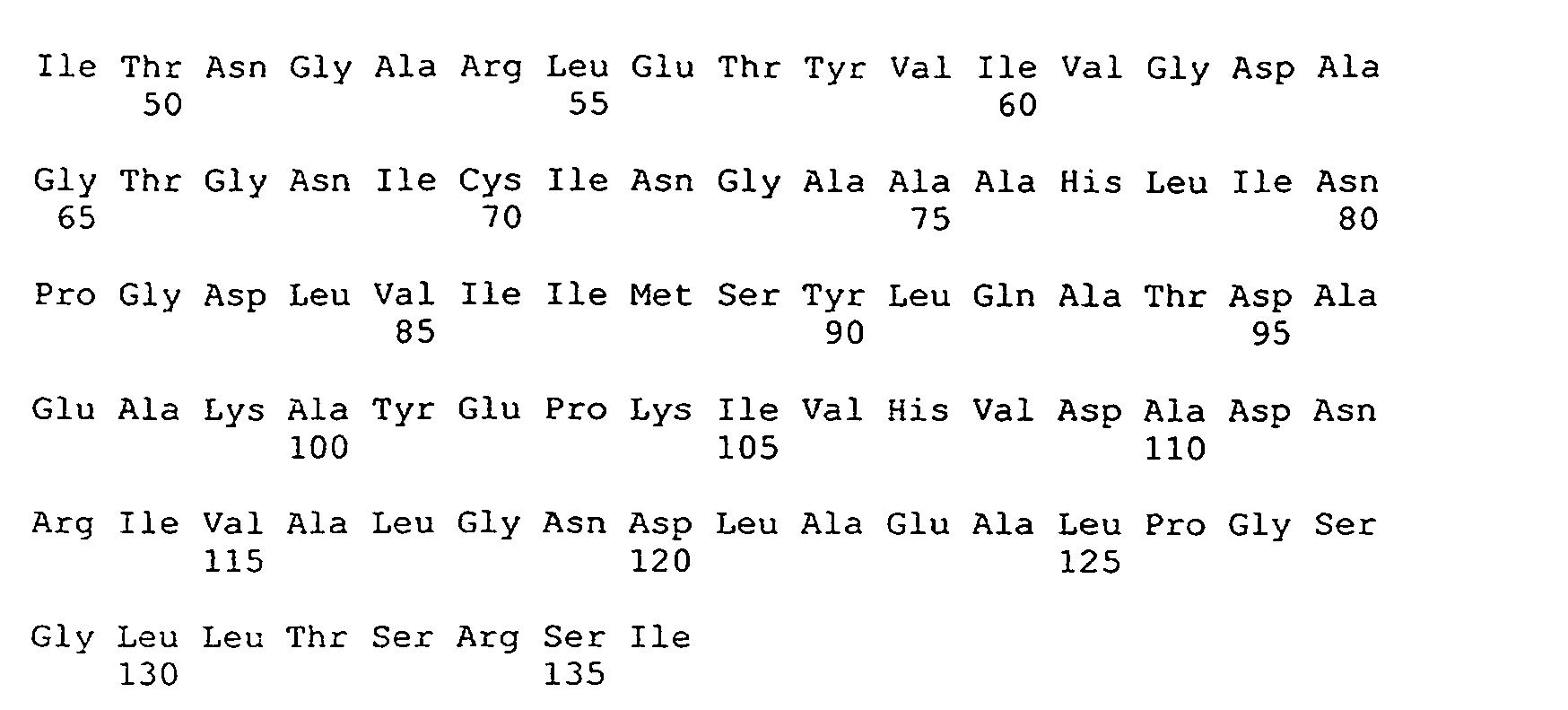
- (i) SEQUENZKENNZEICHEN:
- (2) ANGABEN ZU SEQ ID NO: 3:
- (i) SEQUENZKENNZEICHEN:
- (A) LAENGE: 2164 Basenpaare
- (B) ART: Nucleotid
- (C) STRANGFORM: Doppelstrang
- (D) TOPOLOGIE: linear
- (ii) ART DES MOLEKUELS: Genom-DNA
- (iii) HYPOTHETISCH: NEIN
- (iv) ANTISENSE: NEIN
- (vi) URSPRUENGLICHE HERKUNFT:
- (A) ORGANISMUS: Corynebacterium glutamicum
- (B) STAMM: ATCCl3032
- (ix) MERKMAL:
- (A) NAME/SCHLUESSEL: CDS
- (B) LAGE:351..1163
- (D) SONSTIGE ANGABEN:/codon_start= 351 /EC_number= 4.1.2.12 /product= "Ketopantoathydroxymethyltransferase" /gene= "panB"
- (ix) MERKMAL:
- (A) NAME/SCHLUESSEL: CDS
- (B) LAGE:1166..2002
- (D) SONSTIGE ANGABEN:/codon_start= 1166 /EC_number= 6.3.2.1 /product= "Pantothenatsynthetase" /gene= "panC"
- (xi) SEQUENZBESCHREIBUNG: SEQ ID NO: 3:


- (i) SEQUENZKENNZEICHEN:
- (2) ANGABEN ZU SEQ ID NO: 4:
- (i) SEQUENZKENNZEICHEN:
- (A) LAENGE: 271 Aminosaeuren
- (B) ART: Aminosaeure
- (D) TOPOLOGIE: linear
- (ii) ART DES MOLEKUELS: Protein
- (xi) SEQUENZBESCHREIBUNG: SEQ ID NO: 4:


- (i) SEQUENZKENNZEICHEN:
- (2) ANGABEN ZU SEQ ID NO: 5:
- (i) SEQUENZKENNZEICHEN:
- (A) LAENGE: 279 Aminosaeuren
- (B) ART: Aminosaeure
- (D) TOPOLOGIE: linear
- (ii) ART DES MOLEKUELS: Protein
- (xi) SEQUENZBESCHREIBUNG: SEQ ID NO: 5:


- (i) SEQUENZKENNZEICHEN:
Claims (19)
- PanD-Gen, das eine für Aspartat-1-decarboxylase codierende Nucleotidsequenz enthält, ausgewählt aus der Gruppe, bestehend aus:a) der Nukleotidsequenz, gezeigt in SEQ.-ID.-Nr. 1, oderb) einer Nukleotidsequenz, die der Sequenz (i) innerhalb des Bereichs der Degeneration des genetischen Codes entspricht;
- Aspartat-1-decarboxylase mit einer Aminosäuresequenz gemäß SEQ ID NO: 2.
- Mikroorganismen der Gattungen Corynebacterium oder Escherichia in denen man das für die L-Aspartat-1-decarboxylase codierende panD-Gen gemäß Anspruch 1 überexprimiert, wobei die Kopienzahl des panD-Gens durch Transformation einem mit dieses Gen tragenden Plasmidvektor oder durch chromosomale Amplifikation erhöht, vorliegt.
- Mikroorganismen gemäß Anspruch 3, in denen zusätzlich das für die Ketopantoathydroxymethyltransferase kodierende panB-Gen und das für die Pantothenatsynthetase kodierende panC-Gen gemäß der SEQ ID NO: 3 überexprimiert vorliegt.
- Vektor enthaltend DNA mit der Nukleotidsequenz, gezeigt in SEQ ID NO: 1 und gegebenenfalls die Nukleotidsequenz, gezeigt in SEQ ID NO: 3.
- Plasmidvektor gemäß Anspruch 5, hinterlegt in Corynebacterium glutamicum ATCC 13032/pND-D2 unter der Bezeichnung DSM 12438.
- Plasmidvektor gemäß Anspruch 5, hinterlegt in Corynebacterium glutamicum ATCC 13032/pND-DBC2 unter der Bezeichnung DSM12437.
- Mikroorganismen gemäß Anspruch 3, in die zur Erzielung der Überexpression stromaufwärts des Strukturgens Expressionskassetten eingebaut sind.
- Mikroorganismen gemäß den Anspruch 3, die weitere Metabolit- bzw. Antimetabolit-Resistenzmutationen aufweisen.
- Mikroorganismen gemäß den Ansprüche 3, 8 und 9, in denen die Stoffwechselwege zumindest teilweise ausgeschaltet sind, die die Pantothenat-(Pantothensäure)-bildung verringern.
- Mikroorganismen gemäß den Ansprüchen 3, 8 bis 10, in denen man zusätzlich zum panD-Gen die übrigen Gene des Stoffwechselweges der Pantothensäurebildung, einzeln oder gemeinsam überexprimiert.
- Mikroorganismen gemäß den Ansprüchen 3, 8 bis 11, in denen man eines der Gene, die für die Enzyme Ketopantoat-Hydroxymethyltransferase (EC 4.1.2.12), und Pantothenat-Synthetase (EC 6.3.2.1) kodieren, mit der Herkunft Corynebacterium überexprimiert.
- Mikroorganismen gemäß den Ansprüchen 11 und 12, mit verschiedenen kompatiblen, die genannten Gene einzeln enthaltenden Plasmidvektoren transformiert sind.
- Mikroorganismen gemäß den Ansprüchen 1, 11 und 12, welche einen Plasmidvektor enthalten und der Plasmidvektor eines oder mehrere der genannten Gene einschließlich des panD-Gens trägt, in dem die Gene nacheinander angeordnet und unter die Kontrolle eines gemeinsamen Promotors oder getrennt voneinander angeordnet unter die Kontrolle verschiedener Promotoren gestellt werden.
- Verfahren zur Herstellung von Pantothensäure, bei dem man folgende Schritte durchführt:a) Fermentation von Mikroorganismen gemäß einem oder mehreren der Ansprüche 3, 4, 8 bis 14,b) Anreicherung der Pantothensäure im Medium oder in den Zellen der Mikroorganismen, undc) Isolieren der Pantothensäure
- Verfahren gemäß Anspruch 15, bei dem man die überexprimierten Gene aus Mikroorganismen der Gattung Corynebacterium stammen.
- Verfahren gemäß den Ansprüchen 15 oder 16, bei dem man in Stufe a) eine Vorstufe der Pantothensäure zusetzt, ausgewählt aus der Gruppe Aspartat, β-Alanin, Ketoisovalerat, Ketopantoat oder Pantoat.
- Stamm von Corynebacterium glutamicum ATCC 13032/pND-D2 hinterlegt als DSM 12438 bei der DSMZ, Braunschweig.
- Stamm von Corynebacteriumglutamicum ATCC 13032/pND-DBC2 hinterlegt als DSM 12437 bei der DSMZ, Braunschweig.
Applications Claiming Priority (2)
| Application Number | Priority Date | Filing Date | Title |
|---|---|---|---|
| DE19855313 | 1998-12-01 | ||
| DE19855313A DE19855313A1 (de) | 1998-12-01 | 1998-12-01 | Verfahren zur fermentativen Herstellung von D-Pantothensäure durch Verstärkung des panD-Gens in Mikroorganismen |
Publications (3)
| Publication Number | Publication Date |
|---|---|
| EP1006192A2 EP1006192A2 (de) | 2000-06-07 |
| EP1006192A3 EP1006192A3 (de) | 2003-09-17 |
| EP1006192B1 true EP1006192B1 (de) | 2009-09-09 |
Family
ID=7889569
Family Applications (1)
| Application Number | Title | Priority Date | Filing Date |
|---|---|---|---|
| EP99122650A Expired - Lifetime EP1006192B1 (de) | 1998-12-01 | 1999-11-13 | Verfahren zur fermentativen Herstellung von D-Pantothensäure durch Verstärkung des panD-Gens in Mikroorganismen |
Country Status (14)
| Country | Link |
|---|---|
| US (1) | US6184007B1 (de) |
| EP (1) | EP1006192B1 (de) |
| JP (1) | JP2000228990A (de) |
| KR (1) | KR20000047829A (de) |
| CN (1) | CN1256314A (de) |
| AT (1) | ATE442443T1 (de) |
| BR (1) | BR9905776A (de) |
| DE (2) | DE19855313A1 (de) |
| HU (1) | HUP9904447A2 (de) |
| ID (1) | ID24149A (de) |
| IL (1) | IL133214A0 (de) |
| SK (1) | SK163399A3 (de) |
| YU (1) | YU61799A (de) |
| ZA (1) | ZA997406B (de) |
Families Citing this family (39)
| Publication number | Priority date | Publication date | Assignee | Title |
|---|---|---|---|---|
| DE19855312A1 (de) * | 1998-12-01 | 2000-06-08 | Degussa | Verfahren zur fermentativen Herstellung von D-Pantothensäure unter Verwendung coryneformer Bakterien |
| DE19855314A1 (de) * | 1998-12-01 | 2000-06-08 | Degussa | Verfahren zur fermentiven Herstellung von D-Pantothensäure unter Verwendung von Stämmen der Familie Enterobacteriaceae |
| US8232081B2 (en) | 1999-09-21 | 2012-07-31 | Basf Se | Methods and microorganisms for production of panto-compounds |
| BRPI0014115B8 (pt) * | 1999-09-21 | 2021-05-25 | Basf Ag | métodos de produzir um panto-composto, pantotenato e beta-alanina, de aumentar a produção de um panto-composto e de edentificar compostos que modulam a atividade da pantotenato cinase, micro-organismo recombinante, vetor recombinante, e, vetor |
| DE10030702A1 (de) * | 2000-06-23 | 2002-01-03 | Degussa | Verfahren zur fermentativen Herstellung von D-Pantothensäure unter Verwendung coryneformer Bakterien |
| EP1320543A2 (de) | 2000-09-02 | 2003-06-25 | Degussa AG | Sigc gen von corynebacterium glutamicum |
| DE10136986A1 (de) * | 2000-09-03 | 2002-03-21 | Degussa | Für Gene cysD, cysN, cysK, cysE und cysH kodierende Nukleotidsequenzen |
| DE10046623A1 (de) * | 2000-09-20 | 2002-03-28 | Degussa | Neue für das dps-Gen kodierende Nukleotidsequenzen |
| CZ20031886A3 (cs) * | 2001-01-19 | 2003-10-15 | Basf Aktiengesellschaft | Způsob přípravy pantothenátu ve vyšším výtěžku a mikroorganizmy používané při tomto způsobu |
| DE10108223A1 (de) * | 2001-02-21 | 2002-10-10 | Basf Ag | Verfahren zur Herstellung von D-Pantothensäure und/oder deren Salze als Zusatz zu Tierfuttermitteln |
| DE10108225A1 (de) | 2001-02-21 | 2002-10-10 | Basf Ag | Verfahren zur Herstellung von D-Pantothensäure und/oder deren Salze als Zusatz zu Tierfuttermitteln |
| WO2002066664A2 (de) * | 2001-02-21 | 2002-08-29 | Basf Aktiengesellschaft | Verfahren zur herstellung von d-pantothensäure und/oder salze als zusatz zu tierfuttermitteln |
| AU2002246094A1 (en) | 2001-02-21 | 2002-09-04 | Basf Aktiengesellschaft | Method for producing D-pantothenic acid and/or salts thereof as an additive for animal feed |
| EP1247868A3 (de) * | 2001-04-03 | 2002-10-30 | Degussa AG | Verfahren zur fermentativen Herstellung von D-Pantothensäure und/oder deren Salzen |
| DE10116519A1 (de) * | 2001-04-03 | 2002-10-17 | Degussa | Verfahren zur fermentativen Herstellung von D-Pantothensäure und/oder deren Salze |
| EP1402046A1 (de) * | 2001-07-03 | 2004-03-31 | Degussa AG | Verfahren zur fermentativen herstellung von pantothensäure und/oder ihren salzen |
| US20040197878A1 (en) * | 2001-07-03 | 2004-10-07 | Daniela Kruse | Process for the fermentative preparation of d-pantothenic acid and/or salts thereof |
| DE10132178A1 (de) * | 2001-07-03 | 2003-01-23 | Degussa | Verfahren zur fermantativen Herstellung von D-Pantothensäure und/oder deren Salzen |
| AU2002316940A1 (en) * | 2001-07-07 | 2003-01-29 | Degussa Ag | Process for the preparation of d-pantothenic acid and/or salts thereof |
| DE10147960A1 (de) * | 2001-09-28 | 2003-04-10 | Degussa | Verfahren zur fermentativen Herstellung von D-Panthothensäure und/oder deren Salzen |
| CA2491145A1 (en) * | 2002-07-03 | 2004-01-15 | Basf Aktiengesellschaft | Microorganisms and processes for enhanced production of pantothenate |
| US20070180585A1 (en) * | 2004-03-17 | 2007-08-02 | Bala Rathinasabapathi | Increased stress tolerance and enhanced yield in plants |
| DE102005048818A1 (de) | 2005-10-10 | 2007-04-12 | Degussa Ag | Mikrobiologische Herstellung von 3-Hydroxypropionsäure |
| CN101421411B (zh) | 2006-04-13 | 2015-06-03 | 中外制药株式会社 | 牛磺酸转运蛋白基因 |
| WO2008114673A1 (ja) * | 2007-03-15 | 2008-09-25 | Chugai Seiyaku Kabushiki Kaisha | ポリペプチドの製造方法 |
| DE102007015583A1 (de) | 2007-03-29 | 2008-10-02 | Albert-Ludwigs-Universität Freiburg | Ein Enzym zur Herstellung von Methylmalonyl-Coenzym A oder Ethylmalonyl-Coenzym A sowie dessen Verwendung |
| ES2591284T3 (es) | 2007-08-07 | 2016-11-25 | Chugai Seiyaku Kabushiki Kaisha | Método para la producción de proteínas heterogéneas |
| WO2009051109A1 (ja) * | 2007-10-15 | 2009-04-23 | Chugai Seiyaku Kabushiki Kaisha | 異種タンパク質を高生産する細胞の作製方法 |
| AU2008314973C1 (en) * | 2007-10-24 | 2014-05-08 | Chugai Seiyaku Kabushiki Kaisha | A cell for use in production of heteroproteins and production method using the same |
| US8741601B2 (en) | 2009-04-22 | 2014-06-03 | Chugai Seiyaku Kabushiki Kaisha | Method for producing a cell capable of high-yield production of heteroproteins |
| CN107354142A (zh) * | 2017-09-14 | 2017-11-17 | 精晶药业股份有限公司 | 一种L‑天门冬氨酸‑α‑脱羧酶酶液处理方法 |
| CN109593748B (zh) * | 2017-10-01 | 2022-03-04 | 宁波酶赛生物工程有限公司 | 工程化脱羧酶多肽及其在制备β-丙氨酸中的应用 |
| CN113122486B (zh) * | 2019-12-31 | 2023-06-13 | 江南大学 | 一种丙二酸的全生物合成的方法 |
| KR102389327B1 (ko) * | 2020-07-01 | 2022-04-20 | 씨제이제일제당 (주) | 3-메틸-2-옥소뷰타노에이트 하이드록시 메틸트랜스퍼라아제의 활성이 강화된 미생물, 및 이의 용도 |
| KR102589135B1 (ko) | 2021-05-10 | 2023-10-12 | 씨제이제일제당 (주) | 3-메틸-2-옥소뷰타노에이트 하이드록시 메틸트랜스퍼라아제의 활성이 강화된 미생물, 및 이의 용도 |
| CN113789307B (zh) * | 2021-09-10 | 2023-08-18 | 浙江工业大学 | 一种泛酸合成酶突变体、编码基因、载体及应用 |
| KR102838362B1 (ko) * | 2022-03-18 | 2025-07-23 | 씨제이제일제당 (주) | 거짓쌀도둑거저리 유래 아스파테이트 1-디카복실라아제의 활성이 강화된 미생물, 및 이의 용도 |
| KR102880263B1 (ko) * | 2022-12-28 | 2025-11-03 | 씨제이제일제당 (주) | 음이온 수송 단백질의 활성이 강화된 미생물 및 이의 용도 |
| KR102931740B1 (ko) * | 2023-04-04 | 2026-02-26 | 씨제이제일제당 (주) | 코리네박테리움 스테이셔니스 유래 음이온 수송 단백질 변이체 및 이를 포함하는 미생물 |
Family Cites Families (7)
| Publication number | Priority date | Publication date | Assignee | Title |
|---|---|---|---|---|
| EP0493060A3 (en) * | 1990-12-25 | 1993-04-14 | Takeda Chemical Industries, Ltd. | Production method of d-pantothenic acid and plasmids and microorganisms thereof |
| JP3710497B2 (ja) | 1992-09-25 | 2005-10-26 | ビーエーエスエフ アクチェンゲゼルシャフト | D−パント酸、d−パントテン酸およびそれらの塩の製造法 |
| WO1997010340A1 (en) | 1995-09-13 | 1997-03-20 | Takeda Chemical Industries, Ltd. | Process for producing d-pantoic acid and d-pantothenic acid or salts thereof |
| DE19846499A1 (de) * | 1998-10-09 | 2000-04-20 | Degussa | Verfahren zur Herstellung von Pantothensäure durch Verstärkung von für Ketopantoat-Reduktase kodierenden Nukleotidsequenzen |
| DE19855314A1 (de) * | 1998-12-01 | 2000-06-08 | Degussa | Verfahren zur fermentiven Herstellung von D-Pantothensäure unter Verwendung von Stämmen der Familie Enterobacteriaceae |
| MXPA01013123A (es) * | 1999-06-25 | 2002-06-21 | Basf Ag | Genes de corynebacterium glutamicum que codifican proteinas de via metabolica. |
| EP1083225A1 (de) * | 1999-09-09 | 2001-03-14 | Degussa-Hüls Aktiengesellschaft | Verfahren zur fermentativen Herstellung von D-Pantothensäure unter Verwendung coryneformer Bakterien |
-
1998
- 1998-12-01 DE DE19855313A patent/DE19855313A1/de not_active Ceased
-
1999
- 1999-05-26 US US09/318,793 patent/US6184007B1/en not_active Expired - Fee Related
- 1999-11-13 DE DE59915077T patent/DE59915077D1/de not_active Expired - Fee Related
- 1999-11-13 EP EP99122650A patent/EP1006192B1/de not_active Expired - Lifetime
- 1999-11-13 AT AT99122650T patent/ATE442443T1/de not_active IP Right Cessation
- 1999-11-26 YU YU61799A patent/YU61799A/sh unknown
- 1999-11-29 ID IDP991098A patent/ID24149A/id unknown
- 1999-11-30 HU HU9904447A patent/HUP9904447A2/hu unknown
- 1999-11-30 ZA ZA9907406A patent/ZA997406B/xx unknown
- 1999-11-30 SK SK1633-99A patent/SK163399A3/sk unknown
- 1999-11-30 JP JP11340840A patent/JP2000228990A/ja not_active Ceased
- 1999-11-30 IL IL13321499A patent/IL133214A0/xx unknown
- 1999-12-01 CN CN99120980A patent/CN1256314A/zh active Pending
- 1999-12-01 KR KR1019990054167A patent/KR20000047829A/ko not_active Withdrawn
- 1999-12-01 BR BR9905776-0A patent/BR9905776A/pt not_active Application Discontinuation
Also Published As
| Publication number | Publication date |
|---|---|
| HU9904447D0 (en) | 2000-01-28 |
| ZA997406B (en) | 2000-06-08 |
| CN1256314A (zh) | 2000-06-14 |
| DE19855313A1 (de) | 2000-06-08 |
| EP1006192A2 (de) | 2000-06-07 |
| KR20000047829A (ko) | 2000-07-25 |
| YU61799A (sh) | 2003-02-28 |
| HUP9904447A2 (hu) | 2000-11-28 |
| DE59915077D1 (de) | 2009-10-22 |
| ATE442443T1 (de) | 2009-09-15 |
| BR9905776A (pt) | 2001-04-24 |
| ID24149A (id) | 2000-07-13 |
| IL133214A0 (en) | 2001-03-19 |
| EP1006192A3 (de) | 2003-09-17 |
| US6184007B1 (en) | 2001-02-06 |
| SK163399A3 (en) | 2000-07-11 |
| JP2000228990A (ja) | 2000-08-22 |
Similar Documents
| Publication | Publication Date | Title |
|---|---|---|
| EP1006192A2 (de) | Verfahren zur fermentativen Herstellung von D-Pantothensäure durch Verstärkung des panD-Gens in Mikroorganismen | |
| EP1155139B2 (de) | Verfahren zur mikrobiellen herstellung von l-valin | |
| EP1001027B2 (de) | Verfahren zur Herstellung von Pantothensäure durch Verstärkung von für Ketopantoat-Reduktase kodierende Nukleotidsequenzen | |
| EP1006189A2 (de) | Verfahren zur fermentativen Herstellung von D-Pantothensäure unter Verwendung coryneformer Bakterien | |
| DE10031999A1 (de) | Verfahren zur fermentativen Herstellung von D-Pantothensäure unter Verwendung coryneformer Bakterien | |
| EP1006193A2 (de) | Verfahren zur fermentativen Herstellung von D-Pantothensäure unter Verwendung von Stämmen der Familie Enterobacteriaceae | |
| DE60206499T2 (de) | Verfahren zur herstellung von d-pantothensäure und/oder salzen davon | |
| DE60207820T2 (de) | Verfahren zur fermentativen herstellung von d-pantothensäure und/oder deren salzen | |
| DE10112102A1 (de) | Verfahren zur fermentativen Herstellung von D-Pantothensäure und/oder deren Salzen | |
| EP1083225A1 (de) | Verfahren zur fermentativen Herstellung von D-Pantothensäure unter Verwendung coryneformer Bakterien | |
| DE60211357T2 (de) | Verfahren zur herstellung von d-pantothensäure und/oder ihren salzen | |
| DE60208015T2 (de) | Verfahren zur fermentativen herstellung von d-pantothensäure und/oder deren salzen | |
| EP1167520A2 (de) | Verfahren zur fermentativen Herstellung von D-Pantothensäure unter Verwendung coryneformer Bakterien | |
| DE10026758A1 (de) | Verfahren zur fermentativen Herstellung von D-Pantothensäure unter Verwendung corymeformer Bakterien | |
| US7824891B2 (en) | Method for producing D-pantothenic acid and/or salts thereof via purification by electrodialysis as an additive for animal feed | |
| DE10047142A1 (de) | Verfahren zur fermentativen Herstellung von D-Pantothensäure unter Verwendung coryneformer Bakterien | |
| DE10101501A1 (de) | Verfahren zur fermentativen Herstellung von Pantothensäure | |
| DE60105182T2 (de) | Verfahren zur fermentativen Herstellung von D-Pantothensäure unter Verwendung coryneformer Bakterien | |
| MXPA99010876A (en) | Fermentation process for the preparation of d-pantothenic acid using strains of the family enterobacteriaceae | |
| CZ427799A3 (cs) | Fermentativní způsob výroby D-pantothenové kyseliny využívající kmenů bakterií z čeledi Enterobacteriacae | |
| CZ428199A3 (cs) | Fermentativní způsob výroby D-pantothenové kyseliny využívající zvýšené exprese genu panD v mikroorganismech |
Legal Events
| Date | Code | Title | Description |
|---|---|---|---|
| PUAI | Public reference made under article 153(3) epc to a published international application that has entered the european phase |
Free format text: ORIGINAL CODE: 0009012 |
|
| 17P | Request for examination filed |
Effective date: 19991113 |
|
| AK | Designated contracting states |
Kind code of ref document: A2 Designated state(s): AT BE CH CY DE DK ES FI FR GB GR IE IT LI LU MC NL PT SE |
|
| AX | Request for extension of the european patent |
Free format text: AL;LT;LV;MK;RO;SI PAYMENT 19991113 |
|
| RAP1 | Party data changed (applicant data changed or rights of an application transferred) |
Owner name: DEGUSSA AG |
|
| PUAL | Search report despatched |
Free format text: ORIGINAL CODE: 0009013 |
|
| AK | Designated contracting states |
Kind code of ref document: A3 Designated state(s): AT BE CH CY DE DK ES FI FR GB GR IE IT LI LU MC NL PT SE |
|
| AX | Request for extension of the european patent |
Extension state: AL LT LV MK RO SI |
|
| RIC1 | Information provided on ipc code assigned before grant |
Ipc: 7C 12R 1:19 Z Ipc: 7C 12R 1:15 Z Ipc: 7C 12N 1/21 - Ipc: 7C 12N 9/88 B Ipc: 7C 12P 13/02 B Ipc: 7C 12N 15/77 B Ipc: 7C 12N 15/54 B Ipc: 7C 12N 15/60 A |
|
| AKX | Designation fees paid |
Designated state(s): AT BE CH CY DE DK ES FI FR GB GR IE IT LI LU MC NL PT SE |
|
| AXX | Extension fees paid |
Extension state: SI Payment date: 19991113 |
|
| 17Q | First examination report despatched |
Effective date: 20060828 |
|
| RAP1 | Party data changed (applicant data changed or rights of an application transferred) |
Owner name: DEGUSSA GMBH |
|
| RAP1 | Party data changed (applicant data changed or rights of an application transferred) |
Owner name: EVONIK DEGUSSA GMBH |
|
| RAP1 | Party data changed (applicant data changed or rights of an application transferred) |
Owner name: EVONIK DEGUSSA GMBH |
|
| GRAP | Despatch of communication of intention to grant a patent |
Free format text: ORIGINAL CODE: EPIDOSNIGR1 |
|
| RIC1 | Information provided on ipc code assigned before grant |
Ipc: C12N 9/88 20060101ALI20090326BHEP Ipc: C12P 13/02 20060101ALI20090326BHEP Ipc: C12N 15/77 20060101ALI20090326BHEP Ipc: C12N 15/54 20060101ALI20090326BHEP Ipc: C12N 15/60 20060101AFI20090326BHEP |
|
| GRAS | Grant fee paid |
Free format text: ORIGINAL CODE: EPIDOSNIGR3 |
|
| GRAA | (expected) grant |
Free format text: ORIGINAL CODE: 0009210 |
|
| AK | Designated contracting states |
Kind code of ref document: B1 Designated state(s): AT BE CH CY DE DK ES FI FR GB GR IE IT LI LU MC NL PT SE |
|
| AX | Request for extension of the european patent |
Extension state: SI |
|
| REG | Reference to a national code |
Ref country code: GB Ref legal event code: FG4D Free format text: NOT ENGLISH |
|
| REG | Reference to a national code |
Ref country code: CH Ref legal event code: EP |
|
| REG | Reference to a national code |
Ref country code: IE Ref legal event code: FG4D |
|
| REF | Corresponds to: |
Ref document number: 59915077 Country of ref document: DE Date of ref document: 20091022 Kind code of ref document: P |
|
| PG25 | Lapsed in a contracting state [announced via postgrant information from national office to epo] |
Ref country code: SE Free format text: LAPSE BECAUSE OF FAILURE TO SUBMIT A TRANSLATION OF THE DESCRIPTION OR TO PAY THE FEE WITHIN THE PRESCRIBED TIME-LIMIT Effective date: 20090909 Ref country code: FI Free format text: LAPSE BECAUSE OF FAILURE TO SUBMIT A TRANSLATION OF THE DESCRIPTION OR TO PAY THE FEE WITHIN THE PRESCRIBED TIME-LIMIT Effective date: 20090909 |
|
| NLV1 | Nl: lapsed or annulled due to failure to fulfill the requirements of art. 29p and 29m of the patents act | ||
| PG25 | Lapsed in a contracting state [announced via postgrant information from national office to epo] |
Ref country code: NL Free format text: LAPSE BECAUSE OF FAILURE TO SUBMIT A TRANSLATION OF THE DESCRIPTION OR TO PAY THE FEE WITHIN THE PRESCRIBED TIME-LIMIT Effective date: 20090909 |
|
| PG25 | Lapsed in a contracting state [announced via postgrant information from national office to epo] |
Ref country code: CY Free format text: LAPSE BECAUSE OF FAILURE TO SUBMIT A TRANSLATION OF THE DESCRIPTION OR TO PAY THE FEE WITHIN THE PRESCRIBED TIME-LIMIT Effective date: 20090909 |
|
| REG | Reference to a national code |
Ref country code: IE Ref legal event code: FD4D |
|
| PG25 | Lapsed in a contracting state [announced via postgrant information from national office to epo] |
Ref country code: PT Free format text: LAPSE BECAUSE OF FAILURE TO SUBMIT A TRANSLATION OF THE DESCRIPTION OR TO PAY THE FEE WITHIN THE PRESCRIBED TIME-LIMIT Effective date: 20100111 Ref country code: IE Free format text: LAPSE BECAUSE OF FAILURE TO SUBMIT A TRANSLATION OF THE DESCRIPTION OR TO PAY THE FEE WITHIN THE PRESCRIBED TIME-LIMIT Effective date: 20090909 Ref country code: ES Free format text: LAPSE BECAUSE OF FAILURE TO SUBMIT A TRANSLATION OF THE DESCRIPTION OR TO PAY THE FEE WITHIN THE PRESCRIBED TIME-LIMIT Effective date: 20091220 |
|
| BERE | Be: lapsed |
Owner name: EVONIK DEGUSSA G.M.B.H. Effective date: 20091130 |
|
| PG25 | Lapsed in a contracting state [announced via postgrant information from national office to epo] |
Ref country code: MC Free format text: LAPSE BECAUSE OF NON-PAYMENT OF DUE FEES Effective date: 20091130 |
|
| REG | Reference to a national code |
Ref country code: CH Ref legal event code: PL |
|
| PLBE | No opposition filed within time limit |
Free format text: ORIGINAL CODE: 0009261 |
|
| STAA | Information on the status of an ep patent application or granted ep patent |
Free format text: STATUS: NO OPPOSITION FILED WITHIN TIME LIMIT |
|
| PG25 | Lapsed in a contracting state [announced via postgrant information from national office to epo] |
Ref country code: DK Free format text: LAPSE BECAUSE OF FAILURE TO SUBMIT A TRANSLATION OF THE DESCRIPTION OR TO PAY THE FEE WITHIN THE PRESCRIBED TIME-LIMIT Effective date: 20090909 |
|
| 26N | No opposition filed |
Effective date: 20100610 |
|
| GBPC | Gb: european patent ceased through non-payment of renewal fee |
Effective date: 20091209 |
|
| REG | Reference to a national code |
Ref country code: FR Ref legal event code: ST Effective date: 20100730 |
|
| PG25 | Lapsed in a contracting state [announced via postgrant information from national office to epo] |
Ref country code: LI Free format text: LAPSE BECAUSE OF NON-PAYMENT OF DUE FEES Effective date: 20091130 Ref country code: GR Free format text: LAPSE BECAUSE OF FAILURE TO SUBMIT A TRANSLATION OF THE DESCRIPTION OR TO PAY THE FEE WITHIN THE PRESCRIBED TIME-LIMIT Effective date: 20091210 Ref country code: FR Free format text: LAPSE BECAUSE OF NON-PAYMENT OF DUE FEES Effective date: 20091130 Ref country code: CH Free format text: LAPSE BECAUSE OF NON-PAYMENT OF DUE FEES Effective date: 20091130 Ref country code: BE Free format text: LAPSE BECAUSE OF NON-PAYMENT OF DUE FEES Effective date: 20091130 |
|
| PG25 | Lapsed in a contracting state [announced via postgrant information from national office to epo] |
Ref country code: DE Free format text: LAPSE BECAUSE OF NON-PAYMENT OF DUE FEES Effective date: 20100601 |
|
| PG25 | Lapsed in a contracting state [announced via postgrant information from national office to epo] |
Ref country code: GB Free format text: LAPSE BECAUSE OF NON-PAYMENT OF DUE FEES Effective date: 20091209 |
|
| PG25 | Lapsed in a contracting state [announced via postgrant information from national office to epo] |
Ref country code: AT Free format text: LAPSE BECAUSE OF NON-PAYMENT OF DUE FEES Effective date: 20091113 |
|
| PG25 | Lapsed in a contracting state [announced via postgrant information from national office to epo] |
Ref country code: IT Free format text: LAPSE BECAUSE OF FAILURE TO SUBMIT A TRANSLATION OF THE DESCRIPTION OR TO PAY THE FEE WITHIN THE PRESCRIBED TIME-LIMIT Effective date: 20090909 |
|
| PG25 | Lapsed in a contracting state [announced via postgrant information from national office to epo] |
Ref country code: LU Free format text: LAPSE BECAUSE OF NON-PAYMENT OF DUE FEES Effective date: 20091113 |