EP1007579B1 - Verfahren zur maskierung von in emulsion vorliegenden polyisocyanaten - Google Patents
Verfahren zur maskierung von in emulsion vorliegenden polyisocyanaten Download PDFInfo
- Publication number
- EP1007579B1 EP1007579B1 EP98942794A EP98942794A EP1007579B1 EP 1007579 B1 EP1007579 B1 EP 1007579B1 EP 98942794 A EP98942794 A EP 98942794A EP 98942794 A EP98942794 A EP 98942794A EP 1007579 B1 EP1007579 B1 EP 1007579B1
- Authority
- EP
- European Patent Office
- Prior art keywords
- advantageously
- isocyanate
- emulsion
- composition
- surfactant
- Prior art date
- Legal status (The legal status is an assumption and is not a legal conclusion. Google has not performed a legal analysis and makes no representation as to the accuracy of the status listed.)
- Expired - Lifetime
Links
- 239000000839 emulsion Substances 0.000 title claims abstract description 113
- 238000000034 method Methods 0.000 title claims abstract description 74
- 230000000873 masking effect Effects 0.000 title claims description 80
- 239000005056 polyisocyanate Substances 0.000 title claims description 53
- 229920001228 polyisocyanate Polymers 0.000 title claims description 53
- 239000000203 mixture Substances 0.000 claims abstract description 138
- 239000012948 isocyanate Substances 0.000 claims abstract description 114
- 150000002513 isocyanates Chemical class 0.000 claims abstract description 112
- 239000004094 surface-active agent Substances 0.000 claims abstract description 75
- IQPQWNKOIGAROB-UHFFFAOYSA-N isocyanate group Chemical group [N-]=C=O IQPQWNKOIGAROB-UHFFFAOYSA-N 0.000 claims abstract description 72
- 230000008569 process Effects 0.000 claims abstract description 54
- 239000008346 aqueous phase Substances 0.000 claims abstract description 44
- 239000002245 particle Substances 0.000 claims abstract description 31
- 239000006185 dispersion Substances 0.000 claims abstract description 20
- 239000003795 chemical substances by application Substances 0.000 claims description 84
- XLYOFNOQVPJJNP-UHFFFAOYSA-N water Substances O XLYOFNOQVPJJNP-UHFFFAOYSA-N 0.000 claims description 54
- 238000006243 chemical reaction Methods 0.000 claims description 51
- 239000002904 solvent Substances 0.000 claims description 36
- 150000001875 compounds Chemical class 0.000 claims description 29
- 125000000129 anionic group Chemical group 0.000 claims description 24
- 239000012071 phase Substances 0.000 claims description 24
- OKTJSMMVPCPJKN-UHFFFAOYSA-N Carbon Chemical group [C] OKTJSMMVPCPJKN-UHFFFAOYSA-N 0.000 claims description 19
- 239000012634 fragment Substances 0.000 claims description 19
- 229910052739 hydrogen Inorganic materials 0.000 claims description 19
- 239000001257 hydrogen Substances 0.000 claims description 19
- -1 alkyl phosphates Chemical class 0.000 claims description 18
- 229920005862 polyol Polymers 0.000 claims description 18
- 150000003077 polyols Chemical class 0.000 claims description 18
- 239000002202 Polyethylene glycol Substances 0.000 claims description 17
- 229920001223 polyethylene glycol Polymers 0.000 claims description 17
- 125000003118 aryl group Chemical group 0.000 claims description 16
- 125000004435 hydrogen atom Chemical group [H]* 0.000 claims description 16
- NBIIXXVUZAFLBC-UHFFFAOYSA-K phosphate Chemical group [O-]P([O-])([O-])=O NBIIXXVUZAFLBC-UHFFFAOYSA-K 0.000 claims description 13
- 239000004215 Carbon black (E152) Substances 0.000 claims description 12
- UFHFLCQGNIYNRP-UHFFFAOYSA-N Hydrogen Chemical compound [H][H] UFHFLCQGNIYNRP-UHFFFAOYSA-N 0.000 claims description 12
- OAICVXFJPJFONN-UHFFFAOYSA-N Phosphorus Chemical group [P] OAICVXFJPJFONN-UHFFFAOYSA-N 0.000 claims description 12
- 125000000217 alkyl group Chemical group 0.000 claims description 12
- 125000003827 glycol group Chemical group 0.000 claims description 12
- 229930195733 hydrocarbon Natural products 0.000 claims description 12
- 238000009434 installation Methods 0.000 claims description 12
- 238000010008 shearing Methods 0.000 claims description 11
- 238000002347 injection Methods 0.000 claims description 10
- 239000007924 injection Substances 0.000 claims description 10
- 229910052698 phosphorus Inorganic materials 0.000 claims description 10
- 239000011574 phosphorus Substances 0.000 claims description 10
- 230000015572 biosynthetic process Effects 0.000 claims description 9
- 229910019142 PO4 Inorganic materials 0.000 claims description 8
- 235000021317 phosphate Nutrition 0.000 claims description 8
- 239000011541 reaction mixture Substances 0.000 claims description 8
- 238000003756 stirring Methods 0.000 claims description 8
- 230000009471 action Effects 0.000 claims description 7
- 150000001412 amines Chemical group 0.000 claims description 7
- 239000003153 chemical reaction reagent Substances 0.000 claims description 7
- 238000000576 coating method Methods 0.000 claims description 6
- 230000000903 blocking effect Effects 0.000 claims description 5
- 239000003054 catalyst Substances 0.000 claims description 5
- 150000003512 tertiary amines Chemical class 0.000 claims description 5
- 239000011248 coating agent Substances 0.000 claims description 4
- 238000002156 mixing Methods 0.000 claims description 4
- 239000010452 phosphate Substances 0.000 claims description 4
- LFQSCWFLJHTTHZ-UHFFFAOYSA-N Ethanol Chemical compound CCO LFQSCWFLJHTTHZ-UHFFFAOYSA-N 0.000 claims description 3
- 239000002563 ionic surfactant Substances 0.000 claims description 3
- 150000003951 lactams Chemical class 0.000 claims description 3
- 230000001105 regulatory effect Effects 0.000 claims description 3
- 238000003786 synthesis reaction Methods 0.000 claims description 3
- 125000005600 alkyl phosphonate group Chemical group 0.000 claims description 2
- 238000001816 cooling Methods 0.000 claims description 2
- 239000003995 emulsifying agent Substances 0.000 claims description 2
- 238000010438 heat treatment Methods 0.000 claims description 2
- 238000004064 recycling Methods 0.000 claims 7
- 229920001451 polypropylene glycol Polymers 0.000 claims 4
- ACVYVLVWPXVTIT-UHFFFAOYSA-M phosphinate Chemical compound [O-][PH2]=O ACVYVLVWPXVTIT-UHFFFAOYSA-M 0.000 claims 3
- UEZVMMHDMIWARA-UHFFFAOYSA-M phosphonate Chemical group [O-]P(=O)=O UEZVMMHDMIWARA-UHFFFAOYSA-M 0.000 claims 2
- 125000003107 substituted aryl group Chemical group 0.000 claims 2
- XMTQQYYKAHVGBJ-UHFFFAOYSA-N 3-(3,4-DICHLOROPHENYL)-1,1-DIMETHYLUREA Chemical compound CN(C)C(=O)NC1=CC=C(Cl)C(Cl)=C1 XMTQQYYKAHVGBJ-UHFFFAOYSA-N 0.000 claims 1
- DNIAPMSPPWPWGF-UHFFFAOYSA-N Propylene glycol Chemical group CC(O)CO DNIAPMSPPWPWGF-UHFFFAOYSA-N 0.000 claims 1
- 230000007717 exclusion Effects 0.000 claims 1
- 239000007764 o/w emulsion Substances 0.000 claims 1
- 239000002981 blocking agent Substances 0.000 abstract description 10
- 238000002360 preparation method Methods 0.000 abstract description 4
- ZMANZCXQSJIPKH-UHFFFAOYSA-N Triethylamine Chemical compound CCN(CC)CC ZMANZCXQSJIPKH-UHFFFAOYSA-N 0.000 description 37
- DKPFZGUDAPQIHT-UHFFFAOYSA-N Butyl acetate Natural products CCCCOC(C)=O DKPFZGUDAPQIHT-UHFFFAOYSA-N 0.000 description 16
- 125000004429 atom Chemical group 0.000 description 14
- 229910052799 carbon Inorganic materials 0.000 description 14
- 125000005442 diisocyanate group Chemical group 0.000 description 13
- 239000000047 product Substances 0.000 description 13
- 150000003254 radicals Chemical class 0.000 description 11
- 125000001261 isocyanato group Chemical group *N=C=O 0.000 description 10
- 238000012360 testing method Methods 0.000 description 10
- XSQUKJJJFZCRTK-UHFFFAOYSA-N Urea Chemical compound NC(N)=O XSQUKJJJFZCRTK-UHFFFAOYSA-N 0.000 description 9
- 239000004202 carbamide Substances 0.000 description 9
- 150000002430 hydrocarbons Chemical group 0.000 description 9
- 239000002609 medium Substances 0.000 description 9
- 239000000178 monomer Substances 0.000 description 9
- 239000012429 reaction media Substances 0.000 description 9
- 239000000243 solution Substances 0.000 description 9
- KBPLFHHGFOOTCA-UHFFFAOYSA-N 1-Octanol Chemical compound CCCCCCCCO KBPLFHHGFOOTCA-UHFFFAOYSA-N 0.000 description 8
- 125000001931 aliphatic group Chemical group 0.000 description 8
- OHJMTUPIZMNBFR-UHFFFAOYSA-N biuret Chemical class NC(=O)NC(N)=O OHJMTUPIZMNBFR-UHFFFAOYSA-N 0.000 description 7
- 230000000694 effects Effects 0.000 description 7
- FUZZWVXGSFPDMH-UHFFFAOYSA-M hexanoate Chemical compound CCCCCC([O-])=O FUZZWVXGSFPDMH-UHFFFAOYSA-M 0.000 description 7
- VGGSQFUCUMXWEO-UHFFFAOYSA-N Ethene Chemical compound C=C VGGSQFUCUMXWEO-UHFFFAOYSA-N 0.000 description 6
- 239000000084 colloidal system Substances 0.000 description 6
- 125000001570 methylene group Chemical group [H]C([H])([*:1])[*:2] 0.000 description 6
- WHIVNJATOVLWBW-UHFFFAOYSA-N n-butan-2-ylidenehydroxylamine Chemical compound CCC(C)=NO WHIVNJATOVLWBW-UHFFFAOYSA-N 0.000 description 6
- 230000003068 static effect Effects 0.000 description 6
- 238000012546 transfer Methods 0.000 description 6
- NBIIXXVUZAFLBC-UHFFFAOYSA-N Phosphoric acid Chemical compound OP(O)(O)=O NBIIXXVUZAFLBC-UHFFFAOYSA-N 0.000 description 5
- 239000002253 acid Substances 0.000 description 5
- 238000013019 agitation Methods 0.000 description 5
- 238000004945 emulsification Methods 0.000 description 5
- 125000002887 hydroxy group Chemical group [H]O* 0.000 description 5
- 239000003973 paint Substances 0.000 description 5
- 229920000642 polymer Polymers 0.000 description 5
- ALQLPWJFHRMHIU-UHFFFAOYSA-N 1,4-diisocyanatobenzene Chemical compound O=C=NC1=CC=C(N=C=O)C=C1 ALQLPWJFHRMHIU-UHFFFAOYSA-N 0.000 description 4
- IJGRMHOSHXDMSA-UHFFFAOYSA-N Atomic nitrogen Chemical compound N#N IJGRMHOSHXDMSA-UHFFFAOYSA-N 0.000 description 4
- CURLTUGMZLYLDI-UHFFFAOYSA-N Carbon dioxide Chemical compound O=C=O CURLTUGMZLYLDI-UHFFFAOYSA-N 0.000 description 4
- LYCAIKOWRPUZTN-UHFFFAOYSA-N Ethylene glycol Chemical group OCCO LYCAIKOWRPUZTN-UHFFFAOYSA-N 0.000 description 4
- 239000005058 Isophorone diisocyanate Substances 0.000 description 4
- NINIDFKCEFEMDL-UHFFFAOYSA-N Sulfur Chemical compound [S] NINIDFKCEFEMDL-UHFFFAOYSA-N 0.000 description 4
- QGZKDVFQNNGYKY-UHFFFAOYSA-O ammonium group Chemical group [NH4+] QGZKDVFQNNGYKY-UHFFFAOYSA-O 0.000 description 4
- 150000001449 anionic compounds Chemical class 0.000 description 4
- QVGXLLKOCUKJST-UHFFFAOYSA-N atomic oxygen Chemical compound [O] QVGXLLKOCUKJST-UHFFFAOYSA-N 0.000 description 4
- 150000001768 cations Chemical class 0.000 description 4
- 150000001787 chalcogens Chemical class 0.000 description 4
- 239000000470 constituent Substances 0.000 description 4
- 230000001804 emulsifying effect Effects 0.000 description 4
- 150000002148 esters Chemical class 0.000 description 4
- NIMLQBUJDJZYEJ-UHFFFAOYSA-N isophorone diisocyanate Chemical compound CC1(C)CC(N=C=O)CC(C)(CN=C=O)C1 NIMLQBUJDJZYEJ-UHFFFAOYSA-N 0.000 description 4
- 229910052760 oxygen Inorganic materials 0.000 description 4
- 239000001301 oxygen Substances 0.000 description 4
- 238000000518 rheometry Methods 0.000 description 4
- 239000000126 substance Substances 0.000 description 4
- 125000001424 substituent group Chemical group 0.000 description 4
- 239000013638 trimer Substances 0.000 description 4
- RFFLAFLAYFXFSW-UHFFFAOYSA-N 1,2-dichlorobenzene Chemical compound ClC1=CC=CC=C1Cl RFFLAFLAYFXFSW-UHFFFAOYSA-N 0.000 description 3
- XDTMQSROBMDMFD-UHFFFAOYSA-N Cyclohexane Chemical compound C1CCCCC1 XDTMQSROBMDMFD-UHFFFAOYSA-N 0.000 description 3
- 239000005977 Ethylene Substances 0.000 description 3
- IAYPIBMASNFSPL-UHFFFAOYSA-N Ethylene oxide Chemical compound C1CO1 IAYPIBMASNFSPL-UHFFFAOYSA-N 0.000 description 3
- SJRJJKPEHAURKC-UHFFFAOYSA-N N-Methylmorpholine Chemical compound CN1CCOCC1 SJRJJKPEHAURKC-UHFFFAOYSA-N 0.000 description 3
- 239000000654 additive Substances 0.000 description 3
- 150000001298 alcohols Chemical class 0.000 description 3
- 125000002877 alkyl aryl group Chemical group 0.000 description 3
- 125000003710 aryl alkyl group Chemical group 0.000 description 3
- 125000004432 carbon atom Chemical group C* 0.000 description 3
- 229910052798 chalcogen Inorganic materials 0.000 description 3
- 238000009833 condensation Methods 0.000 description 3
- 230000005494 condensation Effects 0.000 description 3
- 235000014113 dietary fatty acids Nutrition 0.000 description 3
- 238000009826 distribution Methods 0.000 description 3
- 229930195729 fatty acid Natural products 0.000 description 3
- 239000000194 fatty acid Substances 0.000 description 3
- 150000004665 fatty acids Chemical class 0.000 description 3
- 239000012530 fluid Substances 0.000 description 3
- 238000000265 homogenisation Methods 0.000 description 3
- 229910052500 inorganic mineral Inorganic materials 0.000 description 3
- 150000008040 ionic compounds Chemical class 0.000 description 3
- 239000011707 mineral Substances 0.000 description 3
- 235000010755 mineral Nutrition 0.000 description 3
- 238000013021 overheating Methods 0.000 description 3
- 150000002989 phenols Chemical class 0.000 description 3
- 229920000768 polyamine Polymers 0.000 description 3
- 230000009257 reactivity Effects 0.000 description 3
- 230000002829 reductive effect Effects 0.000 description 3
- 238000007670 refining Methods 0.000 description 3
- 229920006395 saturated elastomer Polymers 0.000 description 3
- 239000007787 solid Substances 0.000 description 3
- 238000003860 storage Methods 0.000 description 3
- 229910052717 sulfur Inorganic materials 0.000 description 3
- 239000011593 sulfur Substances 0.000 description 3
- 239000002966 varnish Substances 0.000 description 3
- XSCLFFBWRKTMTE-UHFFFAOYSA-N 1,3-bis(isocyanatomethyl)cyclohexane Chemical compound O=C=NCC1CCCC(CN=C=O)C1 XSCLFFBWRKTMTE-UHFFFAOYSA-N 0.000 description 2
- CSCPPACGZOOCGX-UHFFFAOYSA-N Acetone Chemical compound CC(C)=O CSCPPACGZOOCGX-UHFFFAOYSA-N 0.000 description 2
- QGZKDVFQNNGYKY-UHFFFAOYSA-N Ammonia Chemical compound N QGZKDVFQNNGYKY-UHFFFAOYSA-N 0.000 description 2
- PMPVIKIVABFJJI-UHFFFAOYSA-N Cyclobutane Chemical compound C1CCC1 PMPVIKIVABFJJI-UHFFFAOYSA-N 0.000 description 2
- PXGOKWXKJXAPGV-UHFFFAOYSA-N Fluorine Chemical compound FF PXGOKWXKJXAPGV-UHFFFAOYSA-N 0.000 description 2
- AEMRFAOFKBGASW-UHFFFAOYSA-N Glycolic acid Chemical compound OCC(O)=O AEMRFAOFKBGASW-UHFFFAOYSA-N 0.000 description 2
- JVTAAEKCZFNVCJ-UHFFFAOYSA-N Lactic Acid Natural products CC(O)C(O)=O JVTAAEKCZFNVCJ-UHFFFAOYSA-N 0.000 description 2
- DBMJMQXJHONAFJ-UHFFFAOYSA-M Sodium laurylsulphate Chemical compound [Na+].CCCCCCCCCCCCOS([O-])(=O)=O DBMJMQXJHONAFJ-UHFFFAOYSA-M 0.000 description 2
- 241000897276 Termes Species 0.000 description 2
- XSTXAVWGXDQKEL-UHFFFAOYSA-N Trichloroethylene Chemical compound ClC=C(Cl)Cl XSTXAVWGXDQKEL-UHFFFAOYSA-N 0.000 description 2
- VYGUBTIWNBFFMQ-UHFFFAOYSA-N [N+](#[C-])N1C(=O)NC=2NC(=O)NC2C1=O Chemical compound [N+](#[C-])N1C(=O)NC=2NC(=O)NC2C1=O VYGUBTIWNBFFMQ-UHFFFAOYSA-N 0.000 description 2
- 230000001476 alcoholic effect Effects 0.000 description 2
- 125000002947 alkylene group Chemical group 0.000 description 2
- 229910000147 aluminium phosphate Inorganic materials 0.000 description 2
- 238000009835 boiling Methods 0.000 description 2
- 150000001721 carbon Chemical class 0.000 description 2
- 239000001569 carbon dioxide Substances 0.000 description 2
- 229910002092 carbon dioxide Inorganic materials 0.000 description 2
- 150000007942 carboxylates Chemical class 0.000 description 2
- 239000000969 carrier Substances 0.000 description 2
- 239000007859 condensation product Substances 0.000 description 2
- 230000007423 decrease Effects 0.000 description 2
- 150000005690 diesters Chemical class 0.000 description 2
- XPPKVPWEQAFLFU-UHFFFAOYSA-N diphosphoric acid Chemical compound OP(O)(=O)OP(O)(O)=O XPPKVPWEQAFLFU-UHFFFAOYSA-N 0.000 description 2
- 238000002474 experimental method Methods 0.000 description 2
- 230000002349 favourable effect Effects 0.000 description 2
- 239000010419 fine particle Substances 0.000 description 2
- 235000019000 fluorine Nutrition 0.000 description 2
- 239000006260 foam Substances 0.000 description 2
- 230000002209 hydrophobic effect Effects 0.000 description 2
- 239000004816 latex Substances 0.000 description 2
- 229920000126 latex Polymers 0.000 description 2
- 239000007788 liquid Substances 0.000 description 2
- 229910052752 metalloid Inorganic materials 0.000 description 2
- 229910052757 nitrogen Inorganic materials 0.000 description 2
- 239000012299 nitrogen atmosphere Substances 0.000 description 2
- 238000006384 oligomerization reaction Methods 0.000 description 2
- 150000002892 organic cations Chemical class 0.000 description 2
- 239000003960 organic solvent Substances 0.000 description 2
- 150000002923 oximes Chemical class 0.000 description 2
- 230000036961 partial effect Effects 0.000 description 2
- 230000000737 periodic effect Effects 0.000 description 2
- 150000003003 phosphines Chemical class 0.000 description 2
- 150000003013 phosphoric acid derivatives Chemical class 0.000 description 2
- 238000006068 polycondensation reaction Methods 0.000 description 2
- 239000002243 precursor Substances 0.000 description 2
- 230000000750 progressive effect Effects 0.000 description 2
- 125000006239 protecting group Chemical group 0.000 description 2
- 239000003223 protective agent Substances 0.000 description 2
- 229940005657 pyrophosphoric acid Drugs 0.000 description 2
- 239000000376 reactant Substances 0.000 description 2
- 230000003134 recirculating effect Effects 0.000 description 2
- 230000036633 rest Effects 0.000 description 2
- 239000012265 solid product Substances 0.000 description 2
- 125000000547 substituted alkyl group Chemical group 0.000 description 2
- 239000013589 supplement Substances 0.000 description 2
- 239000000725 suspension Substances 0.000 description 2
- 231100000331 toxic Toxicity 0.000 description 2
- 230000002588 toxic effect Effects 0.000 description 2
- 238000005292 vacuum distillation Methods 0.000 description 2
- JNYAEWCLZODPBN-JGWLITMVSA-N (2r,3r,4s)-2-[(1r)-1,2-dihydroxyethyl]oxolane-3,4-diol Chemical class OC[C@@H](O)[C@H]1OC[C@H](O)[C@H]1O JNYAEWCLZODPBN-JGWLITMVSA-N 0.000 description 1
- 229940008841 1,6-hexamethylene diisocyanate Drugs 0.000 description 1
- AZHFJNDCNVLWNM-UHFFFAOYSA-N 1-propoxyethane-1,2-diol Chemical compound CCCOC(O)CO AZHFJNDCNVLWNM-UHFFFAOYSA-N 0.000 description 1
- ZRPAUEVGEGEPFQ-UHFFFAOYSA-N 2-[4-[2-(2,3-dihydro-1H-inden-2-ylamino)pyrimidin-5-yl]pyrazol-1-yl]-1-(2,4,6,7-tetrahydrotriazolo[4,5-c]pyridin-5-yl)ethanone Chemical compound C1C(CC2=CC=CC=C12)NC1=NC=C(C=N1)C=1C=NN(C=1)CC(=O)N1CC2=C(CC1)NN=N2 ZRPAUEVGEGEPFQ-UHFFFAOYSA-N 0.000 description 1
- UPMLOUAZCHDJJD-UHFFFAOYSA-N 4,4'-Diphenylmethane Diisocyanate Chemical compound C1=CC(N=C=O)=CC=C1CC1=CC=C(N=C=O)C=C1 UPMLOUAZCHDJJD-UHFFFAOYSA-N 0.000 description 1
- JOYRKODLDBILNP-UHFFFAOYSA-N Ethyl urethane Chemical compound CCOC(N)=O JOYRKODLDBILNP-UHFFFAOYSA-N 0.000 description 1
- 238000005684 Liebig rearrangement reaction Methods 0.000 description 1
- MTKLMAGWSTVQPY-UHFFFAOYSA-N N(=C=O)C1(C2CCC1(CC2)C)N=C=O Chemical compound N(=C=O)C1(C2CCC1(CC2)C)N=C=O MTKLMAGWSTVQPY-UHFFFAOYSA-N 0.000 description 1
- NQTADLQHYWFPDB-UHFFFAOYSA-N N-Hydroxysuccinimide Chemical compound ON1C(=O)CCC1=O NQTADLQHYWFPDB-UHFFFAOYSA-N 0.000 description 1
- ISWSIDIOOBJBQZ-UHFFFAOYSA-N Phenol Chemical compound OC1=CC=CC=C1 ISWSIDIOOBJBQZ-UHFFFAOYSA-N 0.000 description 1
- 229920003171 Poly (ethylene oxide) Polymers 0.000 description 1
- GOOHAUXETOMSMM-UHFFFAOYSA-N Propylene oxide Chemical group CC1CO1 GOOHAUXETOMSMM-UHFFFAOYSA-N 0.000 description 1
- 241001080024 Telles Species 0.000 description 1
- 240000008042 Zea mays Species 0.000 description 1
- NIXOWILDQLNWCW-UHFFFAOYSA-N acrylic acid group Chemical group C(C=C)(=O)O NIXOWILDQLNWCW-UHFFFAOYSA-N 0.000 description 1
- 229920000180 alkyd Polymers 0.000 description 1
- 125000005529 alkyleneoxy group Chemical group 0.000 description 1
- 150000001408 amides Chemical class 0.000 description 1
- 229910021529 ammonia Inorganic materials 0.000 description 1
- 239000002280 amphoteric surfactant Substances 0.000 description 1
- 239000003945 anionic surfactant Substances 0.000 description 1
- 239000012736 aqueous medium Substances 0.000 description 1
- 239000007864 aqueous solution Substances 0.000 description 1
- 239000003849 aromatic solvent Substances 0.000 description 1
- 239000012298 atmosphere Substances 0.000 description 1
- 230000033228 biological regulation Effects 0.000 description 1
- 239000012455 biphasic mixture Substances 0.000 description 1
- 239000007853 buffer solution Substances 0.000 description 1
- 230000003139 buffering effect Effects 0.000 description 1
- 125000002091 cationic group Chemical group 0.000 description 1
- 239000003093 cationic surfactant Substances 0.000 description 1
- 239000007795 chemical reaction product Substances 0.000 description 1
- 238000004140 cleaning Methods 0.000 description 1
- 239000008199 coating composition Substances 0.000 description 1
- 230000001268 conjugating effect Effects 0.000 description 1
- 238000007796 conventional method Methods 0.000 description 1
- 239000003431 cross linking reagent Substances 0.000 description 1
- 150000003983 crown ethers Chemical class 0.000 description 1
- 150000004292 cyclic ethers Chemical group 0.000 description 1
- 238000011161 development Methods 0.000 description 1
- 238000010586 diagram Methods 0.000 description 1
- 238000009792 diffusion process Methods 0.000 description 1
- 238000010790 dilution Methods 0.000 description 1
- 239000012895 dilution Substances 0.000 description 1
- 238000006471 dimerization reaction Methods 0.000 description 1
- CZZYITDELCSZES-UHFFFAOYSA-N diphenylmethane Chemical compound C=1C=CC=CC=1CC1=CC=CC=C1 CZZYITDELCSZES-UHFFFAOYSA-N 0.000 description 1
- 238000004090 dissolution Methods 0.000 description 1
- 238000004821 distillation Methods 0.000 description 1
- 230000008030 elimination Effects 0.000 description 1
- 238000003379 elimination reaction Methods 0.000 description 1
- 150000002170 ethers Chemical class 0.000 description 1
- 239000003925 fat Substances 0.000 description 1
- 150000002191 fatty alcohols Chemical class 0.000 description 1
- 150000002193 fatty amides Chemical class 0.000 description 1
- 239000000945 filler Substances 0.000 description 1
- 229910052731 fluorine Inorganic materials 0.000 description 1
- 239000011737 fluorine Substances 0.000 description 1
- 125000001153 fluoro group Chemical group F* 0.000 description 1
- 238000005187 foaming Methods 0.000 description 1
- 238000005194 fractionation Methods 0.000 description 1
- 125000000524 functional group Chemical group 0.000 description 1
- 238000007306 functionalization reaction Methods 0.000 description 1
- 159000000011 group IA salts Chemical class 0.000 description 1
- 125000005843 halogen group Chemical group 0.000 description 1
- RRAMGCGOFNQTLD-UHFFFAOYSA-N hexamethylene diisocyanate Chemical compound O=C=NCCCCCCN=C=O RRAMGCGOFNQTLD-UHFFFAOYSA-N 0.000 description 1
- 239000008240 homogeneous mixture Substances 0.000 description 1
- 238000009396 hybridization Methods 0.000 description 1
- 150000002429 hydrazines Chemical class 0.000 description 1
- WGCNASOHLSPBMP-UHFFFAOYSA-N hydroxyacetaldehyde Natural products OCC=O WGCNASOHLSPBMP-UHFFFAOYSA-N 0.000 description 1
- 150000002443 hydroxylamines Chemical class 0.000 description 1
- 150000002462 imidazolines Chemical class 0.000 description 1
- 150000003949 imides Chemical class 0.000 description 1
- 230000006872 improvement Effects 0.000 description 1
- 238000011065 in-situ storage Methods 0.000 description 1
- 125000003010 ionic group Chemical group 0.000 description 1
- 150000002576 ketones Chemical class 0.000 description 1
- 239000000787 lecithin Substances 0.000 description 1
- 235000010445 lecithin Nutrition 0.000 description 1
- 238000003760 magnetic stirring Methods 0.000 description 1
- 150000002690 malonic acid derivatives Chemical class 0.000 description 1
- 238000002844 melting Methods 0.000 description 1
- 230000008018 melting Effects 0.000 description 1
- 238000012986 modification Methods 0.000 description 1
- 230000004048 modification Effects 0.000 description 1
- 125000001971 neopentyl group Chemical group [H]C([*])([H])C(C([H])([H])[H])(C([H])([H])[H])C([H])([H])[H] 0.000 description 1
- 230000007935 neutral effect Effects 0.000 description 1
- 238000006386 neutralization reaction Methods 0.000 description 1
- QJGQUHMNIGDVPM-UHFFFAOYSA-N nitrogen group Chemical group [N] QJGQUHMNIGDVPM-UHFFFAOYSA-N 0.000 description 1
- 239000002736 nonionic surfactant Substances 0.000 description 1
- UMRZSTCPUPJPOJ-KNVOCYPGSA-N norbornane Chemical compound C1C[C@H]2CC[C@@H]1C2 UMRZSTCPUPJPOJ-KNVOCYPGSA-N 0.000 description 1
- 239000012038 nucleophile Substances 0.000 description 1
- 239000012074 organic phase Substances 0.000 description 1
- 125000006353 oxyethylene group Chemical group 0.000 description 1
- 238000010422 painting Methods 0.000 description 1
- 230000003071 parasitic effect Effects 0.000 description 1
- 229940083254 peripheral vasodilators imidazoline derivative Drugs 0.000 description 1
- 238000005191 phase separation Methods 0.000 description 1
- CTYRPMDGLDAWRQ-UHFFFAOYSA-N phenyl hydrogen sulfate Chemical compound OS(=O)(=O)OC1=CC=CC=C1 CTYRPMDGLDAWRQ-UHFFFAOYSA-N 0.000 description 1
- XYFCBTPGUUZFHI-UHFFFAOYSA-O phosphonium Chemical compound [PH4+] XYFCBTPGUUZFHI-UHFFFAOYSA-O 0.000 description 1
- 239000000049 pigment Substances 0.000 description 1
- 229920000728 polyester Polymers 0.000 description 1
- 229920005906 polyester polyol Polymers 0.000 description 1
- 238000006116 polymerization reaction Methods 0.000 description 1
- 229920001296 polysiloxane Polymers 0.000 description 1
- 239000004814 polyurethane Substances 0.000 description 1
- 229920002635 polyurethane Polymers 0.000 description 1
- 150000003138 primary alcohols Chemical class 0.000 description 1
- QQONPFPTGQHPMA-UHFFFAOYSA-N propylene Natural products CC=C QQONPFPTGQHPMA-UHFFFAOYSA-N 0.000 description 1
- 125000004805 propylene group Chemical group [H]C([H])([H])C([H])([*:1])C([H])([H])[*:2] 0.000 description 1
- 230000001012 protector Effects 0.000 description 1
- 238000005086 pumping Methods 0.000 description 1
- 150000003217 pyrazoles Chemical class 0.000 description 1
- 125000001453 quaternary ammonium group Chemical group 0.000 description 1
- 230000005855 radiation Effects 0.000 description 1
- 230000035484 reaction time Effects 0.000 description 1
- 230000009467 reduction Effects 0.000 description 1
- 239000011347 resin Substances 0.000 description 1
- 229920005989 resin Polymers 0.000 description 1
- 150000003839 salts Chemical class 0.000 description 1
- 239000007858 starting material Substances 0.000 description 1
- 239000001957 sucroglyceride Substances 0.000 description 1
- 235000010964 sucroglyceride Nutrition 0.000 description 1
- BDHFUVZGWQCTTF-UHFFFAOYSA-M sulfonate Chemical compound [O-]S(=O)=O BDHFUVZGWQCTTF-UHFFFAOYSA-M 0.000 description 1
- RWSOTUBLDIXVET-UHFFFAOYSA-O sulfonium Chemical compound [SH3+] RWSOTUBLDIXVET-UHFFFAOYSA-O 0.000 description 1
- 150000003467 sulfuric acid derivatives Chemical class 0.000 description 1
- 229940042055 systemic antimycotics triazole derivative Drugs 0.000 description 1
- 230000008719 thickening Effects 0.000 description 1
- 150000004072 triols Chemical class 0.000 description 1
- AAAQKTZKLRYKHR-UHFFFAOYSA-N triphenylmethane Chemical compound C1=CC=CC=C1C(C=1C=CC=CC=1)C1=CC=CC=C1 AAAQKTZKLRYKHR-UHFFFAOYSA-N 0.000 description 1
- 238000011144 upstream manufacturing Methods 0.000 description 1
- AVWRKZWQTYIKIY-UHFFFAOYSA-M urea-1-carboxylate Chemical compound NC(=O)NC([O-])=O AVWRKZWQTYIKIY-UHFFFAOYSA-M 0.000 description 1
- 239000002888 zwitterionic surfactant Substances 0.000 description 1
Images


Classifications
-
- C—CHEMISTRY; METALLURGY
- C08—ORGANIC MACROMOLECULAR COMPOUNDS; THEIR PREPARATION OR CHEMICAL WORKING-UP; COMPOSITIONS BASED THEREON
- C08G—MACROMOLECULAR COMPOUNDS OBTAINED OTHERWISE THAN BY REACTIONS ONLY INVOLVING UNSATURATED CARBON-TO-CARBON BONDS
- C08G18/00—Polymeric products of isocyanates or isothiocyanates
- C08G18/06—Polymeric products of isocyanates or isothiocyanates with compounds having active hydrogen
- C08G18/70—Polymeric products of isocyanates or isothiocyanates with compounds having active hydrogen characterised by the isocyanates or isothiocyanates used
- C08G18/72—Polyisocyanates or polyisothiocyanates
- C08G18/80—Masked polyisocyanates
- C08G18/8061—Masked polyisocyanates masked with compounds having only one group containing active hydrogen
- C08G18/807—Masked polyisocyanates masked with compounds having only one group containing active hydrogen with nitrogen containing compounds
- C08G18/8077—Oximes
-
- C—CHEMISTRY; METALLURGY
- C08—ORGANIC MACROMOLECULAR COMPOUNDS; THEIR PREPARATION OR CHEMICAL WORKING-UP; COMPOSITIONS BASED THEREON
- C08G—MACROMOLECULAR COMPOUNDS OBTAINED OTHERWISE THAN BY REACTIONS ONLY INVOLVING UNSATURATED CARBON-TO-CARBON BONDS
- C08G18/00—Polymeric products of isocyanates or isothiocyanates
- C08G18/06—Polymeric products of isocyanates or isothiocyanates with compounds having active hydrogen
- C08G18/70—Polymeric products of isocyanates or isothiocyanates with compounds having active hydrogen characterised by the isocyanates or isothiocyanates used
- C08G18/703—Isocyanates or isothiocyanates transformed in a latent form by physical means
- C08G18/705—Dispersions of isocyanates or isothiocyanates in a liquid medium
- C08G18/706—Dispersions of isocyanates or isothiocyanates in a liquid medium the liquid medium being water
-
- C—CHEMISTRY; METALLURGY
- C08—ORGANIC MACROMOLECULAR COMPOUNDS; THEIR PREPARATION OR CHEMICAL WORKING-UP; COMPOSITIONS BASED THEREON
- C08G—MACROMOLECULAR COMPOUNDS OBTAINED OTHERWISE THAN BY REACTIONS ONLY INVOLVING UNSATURATED CARBON-TO-CARBON BONDS
- C08G18/00—Polymeric products of isocyanates or isothiocyanates
- C08G18/06—Polymeric products of isocyanates or isothiocyanates with compounds having active hydrogen
- C08G18/70—Polymeric products of isocyanates or isothiocyanates with compounds having active hydrogen characterised by the isocyanates or isothiocyanates used
- C08G18/72—Polyisocyanates or polyisothiocyanates
- C08G18/80—Masked polyisocyanates
- C08G18/8061—Masked polyisocyanates masked with compounds having only one group containing active hydrogen
- C08G18/8083—Masked polyisocyanates masked with compounds having only one group containing active hydrogen with compounds containing at least one heteroatom other than oxygen or nitrogen
-
- C—CHEMISTRY; METALLURGY
- C08—ORGANIC MACROMOLECULAR COMPOUNDS; THEIR PREPARATION OR CHEMICAL WORKING-UP; COMPOSITIONS BASED THEREON
- C08G—MACROMOLECULAR COMPOUNDS OBTAINED OTHERWISE THAN BY REACTIONS ONLY INVOLVING UNSATURATED CARBON-TO-CARBON BONDS
- C08G18/00—Polymeric products of isocyanates or isothiocyanates
- C08G18/06—Polymeric products of isocyanates or isothiocyanates with compounds having active hydrogen
- C08G18/70—Polymeric products of isocyanates or isothiocyanates with compounds having active hydrogen characterised by the isocyanates or isothiocyanates used
- C08G18/72—Polyisocyanates or polyisothiocyanates
- C08G18/80—Masked polyisocyanates
- C08G18/8061—Masked polyisocyanates masked with compounds having only one group containing active hydrogen
- C08G18/8096—Masked polyisocyanates masked with compounds having only one group containing active hydrogen with two or more compounds having only one group containing active hydrogen
-
- C—CHEMISTRY; METALLURGY
- C08—ORGANIC MACROMOLECULAR COMPOUNDS; THEIR PREPARATION OR CHEMICAL WORKING-UP; COMPOSITIONS BASED THEREON
- C08L—COMPOSITIONS OF MACROMOLECULAR COMPOUNDS
- C08L75/00—Compositions of polyureas or polyurethanes; Compositions of derivatives of such polymers
- C08L75/04—Polyurethanes
-
- C—CHEMISTRY; METALLURGY
- C08—ORGANIC MACROMOLECULAR COMPOUNDS; THEIR PREPARATION OR CHEMICAL WORKING-UP; COMPOSITIONS BASED THEREON
- C08L—COMPOSITIONS OF MACROMOLECULAR COMPOUNDS
- C08L2207/00—Properties characterising the ingredient of the composition
- C08L2207/20—Recycled plastic
-
- Y—GENERAL TAGGING OF NEW TECHNOLOGICAL DEVELOPMENTS; GENERAL TAGGING OF CROSS-SECTIONAL TECHNOLOGIES SPANNING OVER SEVERAL SECTIONS OF THE IPC; TECHNICAL SUBJECTS COVERED BY FORMER USPC CROSS-REFERENCE ART COLLECTIONS [XRACs] AND DIGESTS
- Y10—TECHNICAL SUBJECTS COVERED BY FORMER USPC
- Y10T—TECHNICAL SUBJECTS COVERED BY FORMER US CLASSIFICATION
- Y10T428/00—Stock material or miscellaneous articles
- Y10T428/31504—Composite [nonstructural laminate]
- Y10T428/31551—Of polyamidoester [polyurethane, polyisocyanate, polycarbamate, etc.]
Definitions
- the subject of the present invention is a method of synthesis in emulsion of masked (poly) isocyanates, the emulsions thus obtained, their use for making compositions useful for surface coating and the coatings thus obtained.
- the grain size characteristics often refer to notations of the type d n where n is a number from 1 to 99. This notation is well known in many technical fields, but is a little more rare in chemistry, too may it be useful to recall its meaning. This notation represents the particle size such that n% (by weight, or more exactly by mass), of the particles is less than or equal to said size.
- diisocyanates including alkylene diisocyanates (especially those sold under the Tolonate® brand) and their biuret derivatives or their trimers.
- the mixture of dispersions may also contain pigments and fillers is then deposited on a support in the form of a film with using conventional techniques for using industrial paints.
- the preparation contains masked isocyanates (sometimes the term of blocked)
- the film plus support assembly is baked at a temperature sufficient to ensure release of isocyanate functions and condensation of these with reactive hydrogen groups, most often the polyols of polyol particles.
- Emulsification is itself often difficult and has led to develop specific techniques for obtaining emulsions physically stable (see in particular PCT patent application N ° PCT / FR94 / 00353 published under No. WO 94/22935).
- the effective masking efficiency is generally only around 90% (i.e. a 10% loss of isocyanate function), but still, it is acquired at the cost of significant drawbacks, namely slow kinetics, use of a surfactant in enormous quantity (50% by mass), which surfactant is both nonionic and grafted.
- isocyanates aromatic i.e. the isocyanate function is directly grafted onto aromatic ring
- isocyanates aliphatic the reactivity of isocyanates aromatic (i.e. the isocyanate function is directly grafted onto aromatic ring) differs quite appreciably from that of isocyanates aliphatic.
- one of the aims of the present invention is to provide a process which allows masking of functions in one step isocyanates and the aqueous emulsion of the product or products obtained.
- Another object of the present invention is to provide a method of previous type which uses little or no solvent.
- Another object of the present invention is to provide a method of previous type which uses surfactants in relatively proportion low, preferably at most about 20%, preferably at most about 15 %, more preferably at most about 10%, more preferably at plus approximately 8% by mass relative to the mass of the isocyanate composition.
- Another object of the present invention is to provide a composition capable of being obtained by a process of the above type, composition whose solvent content is less than 1/5, advantageously at 1/10, by mass of the said composition.
- Another object of the present invention is to provide an emulsion likely to be obtained by a process of the above type which has a water content (i.e. water plus non-grafted surfactants) expressed in mass of at most 60%, advantageously at most 50%; preferably in plus 40%.
- a water content i.e. water plus non-grafted surfactants
- Another object of the present invention is to provide an emulsion of the previous type which does not disturb the subsequent operations prior to coating.
- the diameter of Sauter is defined as being the size such that ⁇ n i d i 3 / ⁇ n i d i 2 of the particles are less than or equal to said size, n i being the number of particles and d i being the corresponding diameter
- the surfactant can be added in the aqueous phase or in the polyisocyanate composition, in accordance with the invention. However, we prefer add the surfactant in the polyisocyanate composition, rather than in the aqueous phase so as to avoid foaming.
- the surfactant is added to the aqueous phase, choose this one so as to avoid or at least minimize the formation of foam.
- Said surfactant is a pure agent or a mixture of agents.
- an agent is used surfactant forming a self-emulsifying mixture.
- surfactant is not bound chemically with isocyanate, the application properties of the compositions then being better.
- the polyisocyanate composition can comprise various groups carriers of isocyanate function (s) and its components will be further defined detail later.
- phase separation for at least 15 days, preferably monthly one month, preferably two months at room temperature.
- the emulsion obtained is also chemically stable, which means that less than 10% of the functions masked isocyanates exhibit a chemical reaction with water after a storage period of at least 15 days, at least one month, preferably at at least two months at room temperature.
- the isocyanate composition so as to avoid too large a proportion of free isocyanate functions in the reaction mixture.
- This limit varies with the other reaction parameters.
- the content of free isocyanate functions is at most equal to 2 equivalents per kg (i.e. approximately 8% by mass of isocyanate function), advantageously at approximately 1 equivalent per kg (i.e. about 4% by mass), preferably 0.8.
- the quantity of isocyanate composition introduced into the aqueous phase by unit of time obviously depends on the capabilities of the device at high rate shear and heat transfer.
- a low flow rate value ensures progressive emulsification and indirectly increases the number of recirculations in the shear zone.
- phase c) of the process according to the invention in particular during the recirculation regime, care will also be taken to ensure that the content of free isocyanate functions is at most equal to 5 to 6% by mass, of preferably 2% by mass, relative to the total of the isocyanate functions (free and hidden).
- the reaction of masking of the polyisocyanate mainly took place in the shear.
- the method according to the invention also makes it possible to obtain polyisocyanate emulsions blocked (or masked) by groups protectors of a different nature by reacting in the same manner as described above the polyisocyanates with a mixture of protective agents.
- the method makes it possible to make emulsions of mixtures of polyisocyanates of various natures, the isocyanate functions of which may be masked by identical or different protecting groups.
- said composition having an isocyanate function perhaps a pure product or more generally a mixture of several constituents;
- the constituents of said composition on the one hand are one, or more generally a mixture of molecules carrying isocyanate functions, some of which can be masked, and on the other hand, optionally substantially additives inert under operating conditions; they are most often solvents.
- the molecules carrying isocyanate functions possibly partially masked are oligomers of compounds considered to be monomers with varying degrees of polymerization.
- composition having free isocyanate functions comprises in average more than one and up to five isocyanate functions (masked or not) per molecule carrying isocyanate function (s).
- Said composition having an isocyanate function comprises preferably and on average, 4/3 to 4 isocyanate functions (masked or not) per molecule carrying isocyanate function (s).
- compositions according to the present invention statistically showing more than 2 isocyanate functions (masked or not).
- these molecules carrying isocyanate functions can already be globally partially hidden and thus present part of their functions masked isocyanates.
- the average number of free isocyanate functions per carrier molecule varies from 10 -2 to 20, more specifically from 0.1 to 3. But it is above all of economic interest for values greater than 1, advantageously at least equal to 2 .
- a masking agent is an agent which reacts with the isocyanate functions at low temperature and releases them high enough that the co-reactant (usually polyol or polyamine) can condense on the masked isocyanate function.
- Said masking agent has at least one function carrying a mobile hydrogen, or more precisely reactive, function for which we can define a pKa which corresponds to either the ionization of an acid [including the hydrogen of the ols functions (in the present description, the term "ol (s)" is intended phenols and alcohols), or with the acid associated with a base (generally nitrogenous).
- said pKa (or one of them if one can define more than one) of the function presenting hydrogen is at least equal to 4, advantageously to 5, preferably to 6 and is at most equal to 14, advantageously to 13, preferably to 12, and so more preferred to 10, an exception to be made for lactams whose pKa is greater than these values and which constitute masking agents nevertheless acceptable although not preferred for the invention.
- masking agents according to the invention there may be mentioned derivatives of hydroxylamine such as hydroxysuccinimide and (oximes such as methyl ethyl ketoxime; hydrazine derivatives such as pyrazoles, triazole derivatives, derived from phenols or the like, derivatives of amides such as imides and lactams, as well as malonates or ketoesters and hydroxamates.
- hydroxylamine such as hydroxysuccinimide and (oximes such as methyl ethyl ketoxime; hydrazine derivatives such as pyrazoles, triazole derivatives, derived from phenols or the like, derivatives of amides such as imides and lactams, as well as malonates or ketoesters and hydroxamates.
- the masking agent (s) useful for the protection reaction of the isocyanate function can be water-soluble or not. This water solubility makes the process according to the present invention easy, even if this solubility is only partial.
- solid products which are only partially water-soluble at the reaction temperature, they can generally be used as which or, if necessary, make the reaction medium more easily agitable by adding either a small amount of solvent to dissolve the protective agent (this which brings us back to the question above of liquid masking agents), i.e. third-party solvent (substantially inert under operational conditions), where still use them in hot melted or aqueous form.
- solvent this which brings us back to the question above of liquid masking agents
- third-party solvent substantially inert under operational conditions
- the masking agent can be introduced all at once into the bottom of the reactor with water and possibly the surfactant. He can be also continuously introduced into the reaction medium by co-injection with the polyisocyanate. In the latter case, we will work from preferably with an amount of blocking (or masking) agent in the reaction medium always sufficient to be able to mask the function isocyanate, possibly as it is introduced when this the latter is progressive, and so that the content of isocyanate functions true in recirculation is not greater than the limits indicated above.
- the masking agent can be used as (co) solvent and that it is compatible with the emulsion
- the upper limit of the ratio is much greater than 2 and the excess which has not reacted with the functions isocyanates can constitute up to 1/4 by mass of the final emulsion.
- the surfactant useful for the formation of the emulsion is chosen from standard surfactants known to those skilled in the art for their forming properties emulsions.
- the surfactant can either be foreign to the isocyanate or be it even an isocyanate and result from the reaction of an isocyanate on a precursor having a reactive hydrogen function (said precursor is having a significant hydrophilicity either being itself already amphiphilic) or being a mixture of the two. This synthesis either may have been carried out prior to masking, or be performed simultaneously.
- the surfactant (s) (B) used can be non-ionic HLB greater than 10, preferably on the order of about 10 to about 20, anionic, cationic, zwitterionic or amphoteric advantageously with an HLB greater than approximately 10.
- the nonionic surfactants can be chosen from alkoxylated fatty acids, polyalkoxylated alkylphenols, fatty alcohols polyalkoxylated, polyalkoxylated or polyglycerolated fatty amides, alcohols and Polyglycerolated alphadiols, ethylene oxide block polymers propylene. as well as alkylglucosides, alkylpolyglucosides, sucroethers, sucroesters, sucroglycerides, sorbitan esters, and ethoxylated compounds of these sugar derivatives advantageously having a HLB of at least about 10.
- the anionic surfactants can be chosen from alkylbenzenesulfonates, monoalkyl sulfates, alkylethersulfates, alkylarylethersulfates, dialkoylsulfosuccinates, alkylphosphates, well dissociated etherphosphates such as those constituting alkaline salts, of ammonia, advantageously quaternary, advantageously having a HLB of at least about 10.
- cationic surfactants there may be mentioned the amines aliphatic or aromatic fats, aliphatic fatty amides, derivatives of quaternary ammonium advantageously having an HLB of at least around 10.
- zwitterionic or amphoteric surfactants we may include betaines and their derivatives, sultaines and their derivatives, lecithins, imidazoline derivatives, glycinates and their derivatives, amidopropionates, the fatty amine oxides advantageously having an HLB of at least about 10.
- the (mixture of) surfactant (s) is chosen according to the nature of oil and / or gum and / or resin with a (poly) isocyanate group; advantageously an HLB of the order of 11 to 15 is generally chosen for emulsify an oil or (poly) isocyanate gum; however agents ionic surfactant of HLB at least equal to about 20 (in the present description the term "approximately” is used to highlight the fact that, when the rightmost digit (s) of a number are zeros, these zeros are position zeros and not significant digits, except heard if specified otherwise) also agree.
- these surfactants are non-surfactants ionic, they have hydrophilic groups such as, for example, sufficient ethylene oxide groups, generally greater than about 10, to allow easy emulsification of the polyisocyanates, masked or not.
- hydrophilic groups such as, for example, sufficient ethylene oxide groups, generally greater than about 10, to allow easy emulsification of the polyisocyanates, masked or not.
- These surfactants also have a hydrophobic part which can be chosen from aromatic groups carrying chains aliphatic or simply among aliphatic chains with number of carbons between 8 and 50. Other hydrophobic units such as units silicones or fluorines can also be used for applications special.
- esters examples include polyoxyalkylene fatty acids, ethoxylated alkyl phenols, esters. polyalkyloxy alkylene glycol chain phosphates (such as polyoxy and / or propoxy ethylene glycol, for example), and chain tristyryl phenols polyethylene oxides.
- Said surfactant can also consist of an agent (or a agent mixture) neutral or having an anionic function. These latter are preferred.
- Said surfactant (or one of its constituents) is advantageously based on a compound which has an anionic function.
- said surfactant compound can be used alone, or in mixture with one or more other surfactants.
- These the latter may be agents also meeting the above obligation to include an anionic function and advantageously a fragment of chain polyethylene glycol preferably at least 5 oxyethylene units and / or oxypropylene.
- aryl sulfate or phosphate (s) and / or alkyl (s) (of course aryl in particular includes alkylaryl and alkyl includes in particular aralkyls), aryl- or alkyl-phosphonate, -phosphinate, sulfonate, salt of fatty acid and / or zwitterionic] and among non-ionic compounds blocked at the end of the chain or not (however the non-ionic compounds having alcoholic functions on at least one chains seem to have a slightly unfavorable effect on the (auto) emulsion even if they have a favorable effect on other aspects of the composition for painting ; in view of this it is preferable that the content of this type of compound represents at most a third, advantageously at most a fifth, preferably at most one tenth by mass of said anionic compounds according to the invention).
- said compound comprises a hydrophilic part formed of said anionic function, of said (if any) fragment of chain polyethylene glycol and a lipophilic part based on a hydrocarbon radical.
- Said lipophilic part is generally chosen from alkyl groups [in the present description ALCO- yl is taken in its ethymological sense of hydrocarbon residue of an ALCO-Ol after ignorance of the alcohol (or ol) function]; and aryles.
- the simple alkyls are advantageously branched, advantageously from C 8 to C 12
- the aralkyls C 12 to C 16
- the alkyl aryls from C 10 to C 14
- the simple aryls are from C 10 to C 16 .
- the lipophilic part can vary widely, especially when the number of ethylene glycol units is greater than 10, it can thus constitute a hydrocarbon radical of at least 1, advantageously at least 3 and comprising at most advantageously at most 20 atoms of carbon.
- said compound corresponds to the following formula l: where q represents zero or 1; where p represents an integer between 1 and 2 (closed intervals, that is to say including the limits); where m represents zero or an integer between 1 and 2 (closed intervals, that is to say including the limits); where X and X ', similar or different, represents an arm comprising at most two carbon chains; where s is zero or an integer chosen between 1 and 30, advantageously between 5 and 25, preferably between 9 and 20 (closed intervals, ie including the limits.); where n is zero or an integer chosen between 1 and 30 advantageously between 5 and 25, preferably between 9 and 20 (closed intervals, that is to say including the limits); where E is an element chosen from carbon and metalloid elements of atomic rank at least equal to that of phosphorus and belonging to column VB or to chalcogens of atomic rank at least equal to that of sulfur; where R 1 and R 2 , which are similar or different, represent a hydrocarbon radical, advantageously chosen from aryls and optional
- R 1 and / or R 2 are C 8 to C 12 alkyls, advantageously branched, or C 12 to C 16 aralkyls or C 10 to C 14 alkylaryl.
- One of the divalent radicals X and X ′ can also be a radical of the type ([EO m (O - ) p ]) so as to form pyroacids such as the diesters symmetrical or not of pyrophosphoric acid.
- the total carbon number of the anionic compounds covered by the the present invention is advantageously at most about 100, preferably at most about 50.
- alkylenes and in particular methylenes is carried out by hydrophilic functions (tertiary amines and other anionic functions including those which are described above [EO m (O-) p ]).
- the counter-cation is advantageously monovalent and is chosen among mineral cations and organic cations advantageously not nucleophiles and consequently of a quaternary or tertiary nature (in particular oniums from column V such as phosphonium, ammoniums, or even column VI such as sulfonium, Vietnamese) and their mixtures, most often ammoniums, generally from an amine, advantageously tertiary.
- oniums from column V such as phosphonium, ammoniums, or even column VI such as sulfonium, ...)
- their mixtures most often ammoniums, generally from an amine, advantageously tertiary.
- tertiary amines advantageously monovalent and is chosen among mineral cations and organic cations advantageously not nucleophiles and consequently of a quaternary or tertiary nature (in particular oniums from
- Mineral cations can be sequestered by agents phase transfer like crown ethers.
- the pKa of the cations is advantageously between 8 and 12.
- the cations and in particular the amines corresponding to ammoniums advantageously do not have a surfactant property but it is desirable that they have good solubility, in any case sufficient to ensure that of said compounds comprising an anionic function and advantageously a fragment of polyethylene glycol chain, in aqueous phase and this at the employment concentration.
- Tertiary amines with at most 12 atoms, advantageously at most 10 atoms, preferably at most 8 atoms of carbon by "onium" function (remember that it is preferred that there is none than one per molecule) are preferred.
- Amines can include other functions and in particular the functions corresponding to the functions of acids amines and cyclic ether functions such as N-methylmorpholine, or not. These other functions are advantageously in a form which does not react with the isocyanate functions and do not significantly alter the solubility in aqueous phase.
- anionic compounds according to the present invention are in a neutralized form such as the pH induced during dissolution or contact in water is at least 3, advantageously 4, preferably 5 and at most equal to 12, advantageously to 11, preferably to 10.
- mixtures monoester and diester in a molar ratio of between 1/10 and 10, advantageously between 1/4 and 4.
- Such mixtures can also comprise from 1% to about 20% (however it is preferable that this does not exceed about 10%) by mass of phosphoric acid (which will advantageously be salified at least in part so as to be in the recommended pH zones) and 0 5% of esters of pyrophosphoric acid.
- the ratio of surfactant or mixture of surfactants to polyisocyanate (s) starting material is advantageously at least equal to 0.5%; of preferably at least 1%, more preferably 5%.
- This report is advantageously ⁇ (at most equal to) about 20%, preferably about 10%, more preferably 10% (2 significant figures).
- the ratio is between 3% and 8%, a particularly preferred ratio being understood between 4.5% and 5.5%.
- the surfactant can also be generated in situ during the masking reaction by reaction of a molecule having a function reactive with the isocyanate function and having a number of ethylene oxide sufficient for the final molecule to have emulsifying capacities.
- the reactive function of the molecule has a reactive hydrogen function meeting the same criteria as those defined above for the functions of masking agents.
- first surfactant which facilitates the dispersion of said composition before masking according to the present invention, in the reaction medium and a second surfactant which stabilizes the emulsion of polyisocyanate (s) after the masking reaction according to the present invention.
- Isocyanates in particular aliphatic, react with certain anionic compounds targeted by the invention, they react with hydroxyl acid functions not or badly neutralized.
- At least one of the organic substituents comprises a polyethylene glycol chain fragment advantageously at least 5, preferably at least 7 ethylenyloxide units.
- at least one of the organic substituents to correspond to the same formula as the substituents of E in the general formula
- at least one of the organic substituents (R 10; R 11; R 10 ) responds to the formula: where R 5 represents an arm comprising at most two carbon chains (with the same preferred values as X 'and X); where n is an integer chosen between 0 and 30 advantageously between 5 and 25, preferably between 9 and 20 (closed intervals, that is to say including the limits); where R 1 represents a hydrocarbon radical, advantageously chosen from aryls and optionally substituted alkyls.
- compositions according to the present invention have compounds derived from the reaction set out above in an overall proportion, relative to a volume of a liter of isocyanate, of 0.01 to 1, advantageously from 0.05 to 0.5, preferably from 0.05 to 0.3 equivalent of function:
- radical Iso provides mainly or in all an aliphatic link with the same preferences as those set out above about isocyanates.
- radical Iso provides mainly or in all an aliphatic link with the same preferences as those set out above about isocyanates.
- the mass ratio between the isocyanates to be suspended and the surfactant compound comprising an anionic function and a fragment of polyethylene glycol chain is most often at most equal to 1/3 advantageously at most equal to approximately 20%, preferably to approximately 10% (in this description the term "approximately” is used to highlight highlights the fact that when the rightmost digit (s) of a number are zeros, these zeros are position zeros and not significant digits, unless of course if specified otherwise).
- the mass ratio between the isocyanates to be suspended and said compound comprising an anionic function and a chain fragment polyethylene glycol is advantageously greater than 1%, preferably 2%.
- the mass ratio between the isocyanates to be used suspension and said compound comprising an anionic function and a fragment polyethylene glycol chain is advantageously between 2% and 20%, preferably between 4 and 10%.
- Iso wears in addition to the function shown on the formula at least one, preferably at least two isocyanate functions, of which, preferably, at least one is not masked, and of which, more preferably. at least two are not hidden.
- the aqueous phase can comprise various agents, in particular thickening polymers.
- the aqueous phase can also comprise a polyol or a blend of polyacrylic or polyester polyols in emulsion form or solution.
- the pH of the aqueous phase is maintained for the duration of the reaction to a value at most equal to 12, advantageously at 11, preferably at 10.
- the pH of the aqueous phase is maintained during the reaction time at a value at least equal to the value (pKa -2), advantageously at least equal to the value (pKa -1), preferably at least equal to the value of the pKa of, or of one of the masking agent (s).
- the masking reaction takes place with all of the masking agents of the mixture.
- phosphates provides a buffering effect which promotes reaction of the masking agent with respect to that of water.
- buffer solutions and especially phosphate solutions to surfactants promotes the reaction of the isocyanate with the masking agent rather than with water.
- the reaction temperature is at most equal to 50 ° C, preferably at 40 ° C, and at least equal to about 0 ° C (melting temperature beginning of the aqueous phase) and preferably at about 20 ° C. of the temperature gradients can also be adapted to optimize the process.
- reaction be conducted at a temperature at most equal to the cloud point temperature (for non-ionic) surfactant or mixture of surfactant used, advantageously a temperature at least 5 ° C lower, preferably at least 10 ° C below that of the trouble point.
- composition having an isocyanate function When said composition having an isocyanate function is not fluid enough, it may be useful to add a solvent; so said composition having an isocyanate function will then comprise a solvent, including including a mixture of solvents.
- the masking reaction is carried out with stirring.
- agitation is carried out by means of a device mixer under conditions ensuring that 90% by mass, advantageously 95% by mass of the particles (droplets) are between 0.005 and 50 micrometers (between 0.005 and 50 ⁇ m), advantageously between 0.05 micrometer and 20 micrometers preferably between 0.1 and 10 micrometers.
- agitation used is chosen in such a way that it brings a sufficient shear rate so that the particle size is sufficiently weak and leads to a stable emulsion.
- Other types of grinder mixers can also be used.
- the isocyanate composition unblocked or partially blocked possibly containing the agent surfactant and / or solvent is gradually introduced into the line supplying the previously mentioned high shear device, containing the aqueous phase in which is dissolved, emulsified and / or dispersed the blocking agent or the mixture of blocking agents, and optionally the agent surfactant if it is not added to the isocyanate composition.
- the polyisocyanate composition not blocked or partially blocked is introduced into the supply line of the high shear device containing a polyisocyanate emulsion base blocked containing masking agent.
- the aqueous phase containing the blocking agent or mixture of agents blockers, and possibly the surfactant, is advantageously used circulation on a stirred tank having a homogenization and Thermal transfer.
- the initial supply temperature is room temperature.
- the phase containing the (poly) isocyanate is gradually added to the aqueous phase at a constant flow upstream of the shear device Student.
- the duration of supply of the dispersed phase depends on the rate of concentration of the emulsion.
- Step b) is advantageously carried out in a grinder, preferably colloidal.
- the residence time in the grinder i.e. the duration of shear is preferably at least 10 seconds, advantageously at least plus 5 seconds.
- the rise in temperature of the medium beyond a certain temperature may cause the inversion of the emulsion.
- This temperature depends on the surfactant. She is generally above 50 ° C.
- step c) is implemented by recirculation of the aqueous phase in which the isocyanate composition is emulsified under blocked form.
- step c) is continued after the end of the addition of the isocyanate composition until a stable emulsion having the grain size characteristics mentioned above.
- the isocyanate composition is subjected before step b) to a prior step (b1) of shearing at a rate (speed gradient) of less than 20,000 s -1 , preferably less than 10,000 s -1, in order to d '' obtaining a predispersion of the polyisocyanate particles after contacting with the masking agent and before the high shear step b).
- a mixer of the type is used for this purpose.
- static which is chosen for its mixing and shearing performance.
- Step c) is carried out by passing the emulsion obtained through several high shear rate devices arranged in series, or, more advantageously by recirculating the emulsion in a single rate device high shear, in order to limit the emulsion residence time in the high shear rate device to avoid an increase important temperature above the inversion temperature of the emulsion.
- the residence time is such that the temperature does not exceed 50 ° C, preferably 40 ° C.
- step b) At the end of step b), that is to say before the emulsion passes obtained at the end of step b) in the high shear rate device next, in case these are arranged in series, or in the same device in the case of recirculation, the emulsion is preferably cooled thanks to the minus a means of heat transfer which may consist of one (a series of) static mixer (s) arranged downstream of the shear rate device Student.
- a means of heat transfer which may consist of one (a series of) static mixer (s) arranged downstream of the shear rate device Student.
- This type of mixer will be chosen this time for its thermal transfer performance.
- temperature regulation is also ensured, the if necessary, by the recirculation loop which further improves the mixture of products (aqueous phase, blocked polyisocyanate surfactant) of complex rheology.
- the (poly) isocyanate in some cases, or may dilute the (poly) isocyanate in a solvent so as to reduce its viscosity and facilitate its injection into the medium reaction.
- the amount of solvent will depend on the intended application but also the capacity of the solvent to dissolve said composition having free isocyanate functions (before, during or after the reaction).
- the residual amount of solvent used in the final emulsion will generally be at most equal to ( ⁇ ) 50% by mass of the total of the emulsion, preferably less than 10% by mass relative to the total amount of the emulsion.
- Another equally advantageous way of doing this is to mixing the surfactant with said composition having functions free isocyanates and to inject the mixture into the reaction medium consisting of water and masking agent; however, care should be taken to avoid the formation of foam during the high rate shearing operation.
- Another way of doing this is to co-inject said composition having free isocyanate functions, alone or in solution and / or in mixture with the surfactant, with the masking agent on a foot of water.
- the solvents selected for the application are chosen from the class esters, aromatic solvents, ethers, ketones, without this list is not exhaustive.
- the boiling point of the solvents used will depend on the intended application and will be between 20 ° C and 300 ° C, preferably between 50 ° C and 225 ° C.
- a low point solvent may be used of boiling in a quantity greater than those indicated above to dissolve the polyisocyanate, but in this case, we will eliminate part of this solvent either by conventional distillation either by partial vacuum distillation or by another process known to those skilled in the art.
- the polyisocyanate or the mixture can be preheated as defined above.
- Parallel injections of isocyanates or its solution and masking agents can be used.
- the debits of each of partners will therefore be set so that the molar amount, in the reaction medium, the masking agent is preferably always slightly greater than the molar amount of isocyanate function to be masked.
- the process according to the invention is of the batch / semi-batch type, or of continuous type (continuous introduction of polyisocyanate into the aqueous phase, continuous withdrawal of aqueous emulsion of masked polyisocyanate).
- the concentration of isocyanate or masked polyisocyanate in the final emulsion, after possible dilution, is between 10 and 90% of preferably between 40 and 80%, and advantageously 55 and 75% (weight / weight).
- the present invention makes it possible to obtain concentrations of masked isocyanate function related to the water mass of the emulsion very high.
- the present invention allows the preparation of emulsions which, related to the body of water used, have a high functionality. of the values of more than 3 isocyanate equivalents (in particular aliphatic) per kg of water used or even 4 equivalents are easily obtained.
- the examples demonstrate that values at least 5 can be commonly obtained.
- a precondensation is carried out under the action of a compound having at least one mobile hydrogen function (For example water in the case of biuret, polyols or polyamines) or to a prepolymerization (for example dimerization or oligomerization as in the case of the formation isocyanuric rings).
- a compound having at least one mobile hydrogen function For example water in the case of biuret, polyols or polyamines
- a prepolymerization for example dimerization or oligomerization as in the case of the formation isocyanuric rings.
- skeletons can result from both condensation with a single type of monomer (generally diisocyanate) and several types of monomers. It is preferable that there be at least one monomer of which at least one of the isocyanate functions is aliphatic [carbon carrying the isocyanate hybridization function (sp 3 ) and advantageously carrying at least one, preferably two, hydrogen ( s)]. It is above all these aliphatic functions that it is preferable to mask by the techniques of the invention, the other isocyanate functions being able to be masked by techniques already known in themselves.
- the polyisocyanates whose NCOs are intended to be protected by radicals masks are chosen from homo- or hetero-condensation products of alkylene diisocyanate, comprising in particular products of the "BIURET” type and of the “TRIMERES” type. or even “PREPOLYMERS” with isocyanate function comprising in particular urea, urethane, allophanate, ester amide functions, and among the mixtures containing it.
- TOLONATE polyisocyanates marketed by the Applicant Company under the name "TOLONATE”.
- emulsions comprising other component (s), especially those of the coating formulations such as those for paint (s) and varnish, they can be introduced, as soon as they do not interfere with the reaction (and vice versa), in the aqueous phase (by example in the base), in the emulsion or / and in the organic phase, before or during the reaction.
- other component (s) especially those of the coating formulations such as those for paint (s) and varnish
- the pKa of ol (s) functions of the polyol or polyols has (s) one pKa at most equal to that of the masking agent (or, if there is more than one agent masking, the highest pKa of the masking agents) increased by two, advantageously 3, preferably 4 units.
- the composition can additionally include an advantageously latent catalyst (releasable by action external agents, for example visible or UV radiation, oxygen).
- the mill 1 is preferably a colloid mill. These measures advantageously takes the form of a set of conical jaws and includes a rotor and a stator separated by a very small air gap. He has preferably crossed teeth to increase the shear rate.
- the geometry of the cones, the air gap, the speed of rotation of the mill are chosen according to the range of shear rate sought and therefore of the desired particle size.
- Means for injecting a polyisocyanate composition advantageously comprise a premix tank 2 in which the polyisocyanate is mixed with the surfactant, if applicable and possibly with one or more solvents.
- the premix tray is preferably connected to a nitrogen source 3.
- They also include a line 4 arriving from the polyisoyanate composition in contact with the masking agent in the aqueous phase, here to the recirculation loop 5, and a pump 6 intended to regulate the flow of injecting the polyisocyanate composition onto the recirculation loop.
- the recirculation means include a loop of recirculation 5 supplied with water added with at least part of the agent blocker and, if necessary, surfactant by means of a tank (or tank) agitated 7. This is in turn supplied by an agent storage tank 8 blocker and is optionally connected to an agent supply source surfactant (not shown).
- the tank 8 containing the blocking agent is placed under a nitrogen atmosphere using a nitrogen source 9.
- the tank 7 advantageously comprises stirring means planned on two stages, the lower stage comprising a turbine with four blades inclined 10 and the upper stage a Mixel TT 11 type turbine.
- This particular arrangement is adapted to the variable rheology of the medium (initially Newtonian medium, then non-Newtonian medium for the final emulsion).
- the stirring means 10 and 11 produce moderate stirring so as to achieve homogenization of the aqueous phase at the start of the process and the aqueous emulsion of masked (poly) isocyanate when the process has reached a steady state.
- the tank 7 is connected to a source
- the tank 7 also comprises a double envelope 13 intended to ensure a heat exchange.
- the recirculation loop 5 also comprises downstream of the grinder 1 advantageously a static mixer 15 whose function is essentially heat exchange.
- the feed rate of the mill is regulated by means of a pump 16 placed at the outlet of the agitated tank 6.
- the objective of pump 16 is to regulate the flow through the colloid mill 1
- the pumping effect of colloid mill 1 remains weak than that of a pump.
- very large flow variations significant may exist between the initial solution, having approximately the viscosity of water, and the final emulsion whose rheology is a function of the rate of solids concentration and grain size.
- the pump 16 has for function of overcoming these significant differences which would otherwise lead to significant differences in the frequency of recirculation, therefore in shear of the product.
- the static mixer 15 installed downstream of the colloid mill 1 a to overcome the development of overheating points in the loop recirculation.
- the water contained in the tank 7 added with part of the masking agent contained in the storage tank and possibly part of the surfactant 7 is circulate in the recirculation loop 5.
- the polyisocyanate composition added with the surfactant and solvent is then injected into the recirculation loop 5 by means of the line 4 and pump 6.
- the emulsion is again recirculated in the loop recirculation 5 where it is gradually enriched in masked polyisocyanate under the shearing action of the colloid mill 1, which also has the effect that the droplets which constitute it see their size and their index of dispersion reduced until the final emulsion is obtained, which is then withdrawn from installation discontinuously or continuously.
- the subject of the invention is also a composition comprising a masked polyisocyanate (s) emulsion, characterized in that it is likely to be obtained by implementing the method according to the invention and by the fact that it has at most 60%, advantageously at most 50% in body of water.
- s masked polyisocyanate
- composition according to the invention is also characterized by a viscosity of the final emulsion less than 5,500 mPa.s at least 68% extract dry, at 25 ° C, and advantageously less than 1000 mPa.s at least 60% dry extract, at 25 ° C.
- composition according to the present invention can comprise various additives useful for paints; these additives as well as mentioned above can be introduced into the reaction mixture but are more often introduced after the masking operation.
- the isocyanate composition according to the invention may contain, after dispersion or emulsion in an aqueous phase, a water content of 10 to 90 % and is generally of the oil in water type, which is advantageous.
- the aqueous phase of the emulsion generally serves as a vector for polycondensable co-reagents with isocyanate functions and then comprises compounds having reactive hydrogen functions, in general one or several polyols, which can be added to the aqueous phase before the reaction masking and emulsification simultaneous, or added at a later stage.
- This polyol is a polymer that contains at least 2 groups hydroxyls (phenol or alcohol) advantageously having a hydroxyl level between 0.5 and 5, advantageously between 1 and 3% (by mass).
- the polymer backbone can be of diverse chemical nature especially acrylic, polyester, alkyd, polyurethane.
- It can contain carboxylic or sulfonic groups or no ionic grouping.
- the polyol can already be in an aqueous or water-soluble medium or dispersible.
- It can be an aqueous solution (which can in particular be obtained after neutralization of the ionic groups) or of an emulsion of polymer in water or a latex type dispersion.
- the molar ratio between the free isocyanate functions and the hydroxyl functions is between 0.5 and 2.5, advantageously between 0.8 and 1.6, advantageously between 1 and 1.4.
- the mass ratio between the isocyanates to be suspended and said compound comprising an anionic function and a chain fragment polyethylene glycol is most often at most equal to 1/3, advantageously at more equal to about 20%, preferably about 10% (in the present description the term "approximately” is used to highlight the fact that, when the rightmost digit (s) of a number are zeros, these zeros are position zeros and not significant digits, except heard if specified otherwise).
- the mass ratio between the isocyanates to be suspended and said compound comprising an anionic function and a chain fragment polyethylene glycol is advantageously greater than 1%, preferably 2%.
- the mass ratio between the isocyanates to be used suspension and said compound comprising an anionic function and a fragment polyethylene glycol chain is advantageously between 2% and 20%, preferably between 4 and 10%.
- the sum of the contents by mass of the isocyanate (s), the emulsifier (s) and the polyol (s) in water ranges from 30 to 70%.
- These polyols can also constitute surfactants.
- Release temperature this is the lowest temperature at which the masking agent for the masked isocyanate is displaced up to 9/10 (mathematical rounding) by a primary monoalcohol (the primary alcohol is generally octanol).
- shelf life To ensure a good shelf life, it is preferable to choose masked isocyanate functions, the octanol test of which shows a "release” at 80 ° C., advantageously at 90 ° C., at most equal to 90%. . Progress of the reaction It is considered that the reaction is complete if it is carried out at more than 90%.
- reaction medium is then brought to the temperature tested. We then heats for 6 h at the temperature tested, so as to unlock and thus make the isocyanate functions reactive.
- the solvent is removed by vacuum distillation, and the residue is analyzed by NMR, mass and infra red.
- composition according to the present invention can also comprise a catalyst for the release of the masking group, advantageously latent, and which will only be activated during the polycondensation reaction of the (poly) isocyanate masked with compounds having functional groups reactive hydrogen, in particular under the effect of the temperature of polycondensation.
- a catalyst for the release of the masking group advantageously latent, and which will only be activated during the polycondensation reaction of the (poly) isocyanate masked with compounds having functional groups reactive hydrogen, in particular under the effect of the temperature of polycondensation.
- the invention finally relates to a coating obtained by the process defined above.
- the addition is made, to constant flow over an hour and a half period.
- the kinetics of blocking is of order 1 and in the case of the meko in the first half of the addition on can estimate that in one minute 10 to 20% of the isocyanate initially present has reacted. We can therefore estimate that the quantity of free isocyanate is at most equal at the amount introduced for ten minutes.
- Rhodafac® RE610 surfactant (including the major components meet formula 1) is a phosphated ethoxylated alkiphenol and Antarox® 461P is an ethoxylated propoxylated alkylphenol.
- the masked polyisocyanate emulsion thus obtained is a direct emulsion characterized by an average particle size of 1.56 ⁇ m. She does not contain residual urea and it contains an excess of 1.55%.
- the emulsion obtained is a direct emulsion characterized by a average particle size of 1.62 ⁇ m. It does not contain residual urea and contains an excess of 1.38% blocking agent.
- the emulsion obtained is a direct emulsion characterized by a average particle size of 3 ⁇ m containing multiple emulsion drops water / oil / water. It does not contain residual urea and contains an excess of agent 1.2% blocker.
- the emulsion obtained is a direct emulsion characterized by a strong polydispersity around two average values of 1.56 ⁇ m and 15 ⁇ m. Of plus this emulsion contains multiple water / oil / water emulsion drops. She contains a little urea.
- the emulsion obtained is a direct emulsion characterized by a average particle size of 1.5 ⁇ m containing a small population of particles with a diameter greater than 10 ⁇ m. It does not contain residual urea and contains an excess of blocking agent of 1.43%.
- the emulsion obtained is a direct emulsion characterized by a average particle size of 2.5 ⁇ m with a population having a diameter greater than 10 ⁇ m. It does not contain residual urea and contains an excess 0.95% blocking agent.
- a mixture A is prepared with the following composition: 13 g of Rhodafac RE610®, 3.7 g of NEt3, 153.05 g of MEKO and 216.5 g of water.
- mixture A 120 g are poured into the reactor which is thermostatically controlled at 25 ° C.
- 324 g of HDT and 16.2 g of butyl acetate (AcOBu) are mixed beforehand. This mixture is added gradually in the reactor. Simultaneously 266.25 g of mixture A are added gradually in the reactor (1 hour 50 min).
- the speed of the Ultraturrax® is 8,000 rpm.
- the emulsion obtained is a direct emulsion characterized by a average particle size of 1.41 ⁇ m. It does not contain residual urea and contains an excess of 2.19% masking agent.
- the pilot plant consists of a GRC bottom stirred tank with a capacity of 100 l with a recirculation loop as illustrated on the Figure 1 attached.
- the tank is placed under an inert nitrogen atmosphere.
- the loop includes, in the direction of flow of the fluid, a booster pump 6, the point for injecting the phase to be dispersed, a colloid mill 1, a series of static mixers for heat transfer 15.
- Suction loop recirculation is central at the bottom of the tank. Its repression is located on the dome.
- Another tank 2 also placed under an inert atmosphere, contains the phase to disperse.
- the pilot is provided with temperature measuring instruments, pressure, flow rates and pressure / temperature alarms.
- the polyisocyanate phase consists of HDT, of solvent (5% butyl acetate by weight relative to HDT), surfactant (RHODAFAC® RE610, polyoxyethylene nonylphenyl ether phosphate, neutralized with triethylamine).
- the continuous phase consists of demineralized water and agent blocker (MEKO).
- MEKO demineralized water and agent blocker
- MEKO is at most in excess of 0.6% by weight. She is partially soluble in water.
- the initial solution is supersaturated.
- the initial viscosity is close to that of water. It gradually increases during the process when the emulsion is concentrated. The final rheology depends the concentration rate and the particle size distribution of the emulsion.
- the recirculation rate can vary between 400 and 1500 kg / h.
- the feed rate of the phase to be dispersed is between 10 and 60 kg / h.
- the feeding time of the dispersed phase depends on the concentration rate of the emulsion.
- the total mass of the batch is 80 kg.
- the final concentration of masked polyisocyanates is of the order of 65% by weight.
- the supply temperature of the phase to be dispersed is approximately 20 ° C (room temperature).
- the medium temperature varies between 15-20 ° and 40 ° C maximum. Its air gap rises from 50 to 200 ⁇ m.
- the suction pressure of the mill is maintained above 0.2 bar (2.10 4 Pa).
- the back pressure is fixed by the pressure drops in the first tests.
- the installation is cleaned with water for the loop part recirculation and emulsion tank, and solvent (acetone, butyl acetate) for the Premix tank part and supply line. After each test, the pilot is inspected to assess the effectiveness of cleaning.
- the diameter d 10 decreases very slightly during the refining (it is fixed by the maximum shear of the system).
- the diameter d 90 (diameter at 90% of the population) presents strong variations. It is responsible for reducing the dispersion width and the diameter of Sauter d 32 .
- the recirculation of the emulsion in the shear zone ensures a fractionation of the large droplets. This phenomenon thus causes a homogenization of the particle size distribution. After a period of approximately 65 to 70 minutes, the particle size no longer changes. These variations point towards a better stability of the emulsion (reduced dispersion width).
- the final emulsion has a residual MEKO level greater than the initial excess. Urea therefore forms very slightly in the medium.
- the rate of Residual MEKO decreases during the post-feeding agitation period.
- the blocking reaction ends during the refining period of the emulsion.
Landscapes
- Chemical & Material Sciences (AREA)
- Health & Medical Sciences (AREA)
- Chemical Kinetics & Catalysis (AREA)
- Medicinal Chemistry (AREA)
- Polymers & Plastics (AREA)
- Organic Chemistry (AREA)
- Dispersion Chemistry (AREA)
- Polyurethanes Or Polyureas (AREA)
- Paints Or Removers (AREA)
- Processes Of Treating Macromolecular Substances (AREA)
- Organic Low-Molecular-Weight Compounds And Preparation Thereof (AREA)
Claims (60)
- Verfahren zur Synthese maskierter (Poly)Isocyanate in Emulsion, umfassend den Schritt bestehend aus:a) Zusammenbringen einer freie Isocyanatfunktionen aufweisenden Isocyanatzusammensetzung mit wenigstens einem Maskierungsmittel A in Gegenwart eines Tensids B und einer wäßrigen Phase, wobei die Isocyanatzusammensetzung nach und nach zu mindestens einem Teil der wäßrigen Phase und mindestens einem Teil des Maskierungsmittels und auf eine solche Weise zugefügt wird, daß der Gehalt an freien Isocyanatfunktionen in der Isocyanatphase größer als 2 Äquivalente je kg ist.
- Verfahren gemäß Anspruch 1, dadurch gekennzeichnet, daß bei der eine Isocyanatfunktion aufweisenden Zusammensetzung ein (eine) Isocyanatfunktion(en) tragendes Molekül im Mittel 1 bis 5 Isocyanatfunktionen umfaßt.
- Verfahren gemäß den Ansprüchen 1 und 2, dadurch gekennzeichnet, daß bei der eine Isocyanatfunktion aufweisenden Zusammensetzung ein (eine) Isocyanatfunktion(en) tragendes Molekül im Mittel 4/3 bis 4 Isocyanatfunktionen umfaßt.
- Verfahren gemäß den Ansprüchen 1 bis 3, dadurch gekennzeichnet, daß das Maskierungsmittel mindestens einen beweglichen Wasserstoff aufweist.
- Verfahren gemäß den Ansprüchen 1 bis 4, dadurch gekennzeichnet, daß das Maskierungsmittel mindestens einen beweglichen Wasserstoff aufweist und dadurch, daß der pKa der reaktionsfähigen Wasserstoffe mindestens 4, vorteilhafterweise 5 und bevorzugt 6 ist und dadurch, daß der pKa größer als 14, vorteilhafterweise 13, bevorzugt 12 und bevorzugter 10 ist, wobei Lactame ausgeschlossen sind.
- Verfahren gemäß den Ansprüchen 1 bis 5, dadurch gekennzeichnet, daß der pH der wäßrigen Phase während der Reaktionsdauer bei einem größeren Wert als 12, vorteilhafter 11 und vorzugsweise 10 gehalten wird.
- Verfahren gemäß den Ansprüchen 1 bis 6, dadurch gekennzeichnet, daß der pH der wäßrigen Phase während der Reaktionsdauer bei mindestens dem Wert (pKa-2), vorteilhafterweise mindestens dem Wert (pKa-1), bevorzugt mindestens dem pKa-Wert des oder eines der Maskierungsmittel(s) gehalten wird.
- Verfahren gemäß den Ansprüchen 1 bis 7, dadurch gekennzeichnet, daß die Reaktion bei einer Temperatur über dem Trübungspunkt des verwendeten Tensids oder Tensidgemisches ausgeführt wird.
- Verfahren gemäß den Ansprüchen 1 bis 8, dadurch gekennzeichnet, daß die eine Isocyanatfunktion aufweisende Zusammensetzung ein Lösungsmittel umfaßt, wobei ein Lösungsmittelgemisch inbegriffen ist.
- Verfahren gemäß den Ansprüchen 1 bis 9, dadurch gekennzeichnet, daß das Zusammenbringen unter Rühren mittels einer Mischvorrichtung unter Bedingungen durchgeführt wird, bei denen sichergestellt ist, daß 90 Gew.-%, vorteilhafterweise 95 Gew.-% der Teilchen von einer Größe zwischen 0,005 und 50 Mikrometer sind.
- Verfahren gemäß Anspruch 10, dadurch gekennzeichnet, daß das Rühren mittels eines Mischzerkleinerers ausgeführt wird.
- Verfahren gemäß den Ansprüchen 1 bis 11, dadurch gekennzeichnet, daß das Reaktionsgemisch einer Rückführung unterzogen wird.
- Verfahren gemäß den Ansprüchen 1 bis 12, dadurch gekennzeichnet, daß das Reaktionsgemisch einer Rückführung unterzogen wird, während derer das Reaktionsgemisch der Wirkung eines Mischzerkleinerers unterzogen wird.
- Verfahren gemäß den Ansprüchen 1 bis 13, dadurch gekennzeichnet, daß das Zusammenbringen durch Zugabe eines Reagenzes (von Reagenzien) zu wenigstens einer wäßrigen Phase und wenigstens einem Teil des (der) Maskierungsmittel(s) durchgeführt wird.
- Verfahren gemäß den Ansprüchen 1 bis 14, dadurch gekennzeichnet, daß das Zusammenbringen durch Zugabe eines Reagenzes (von Reagenzien) zu einem wenigstens eine wäßrige Phase, wenigstens einen Teil des (der) Tensids (Tenside) und wenigstens einen Teil des (der) Maskierungsmittel(s) enthaltenden Medium durchgeführt wird.
- Verfahren gemäß einem der Ansprüche 1 bis 15, das außerdem die Schritte umfaßt, bestehend aus:b) dem Unterziehen des in a) erhaltenen Gemisches einem Scheren (Geschwindigkeitsgefälle) über 1000 s-1, bevorzugt über 20 000 s-1 und unter 1 000 000 s-1 und bevorzugt unter 200 000 s-1 undc) dem Wiederholen von Schritt b) gegebenenfalls nachdem Schritt a) wiederholt worden ist, bis zum Erhalt einer stabilen Emulsion, deren Teilchen einen Sauter-Durchmesser über 0,1 µm, vorzugsweise 0,2 µm und unter 5 µm, bevorzugt unter 2 µm und eine Dispersionsbreite unter 5 µm aufweisen.
- Verfahren gemäß Anspruch 16, dadurch gekennzeichnet, daß Schritt c) nach dem Ende der Zugabe der Isocyanatzusammensetzung durchgeführt wird.
- Verfahren gemäß Anspruch 17, dadurch gekennzeichnet, daß Schritt c) durch Rückführung der am Ende von Schritt b) erhaltenen Emulsion ausgeführt wird.
- Verfahren gemäß einem der Ansprüche 16 bis 18, dadurch gekennzeichnet, daß das Reaktionsgemisch einer Rückführung in einer Kolloidmühle unterzogen wird.
- Verfahren gemäß Anspruch 19, dadurch gekennzeichnet, daß die der Isocyanatzusammensetzung zugefügte wäßrige Phase, die gegebenenfalls das Tensid und/oder ein Lösungsmittel enthält, nachdem sie mit dem Maskierungsmittel zusammengebracht worden ist und vor dem Schritt b) des starken Scherens einem ersten Scheren (Geschwindigkeitsgefälle) unter 20 000 s-1, bevorzugt unter 10 000 s-1 unterzogen wird.
- Verfahren gemäß einem der Ansprüche 1 bis 20, dadurch gekennzeichnet, daß es bei einer Temperatur unter 50°C, bevorzugt unter 40°C durchgeführt wird.
- Verfahren gemäß einem der Ansprüche 1 bis 21, dadurch gekennzeichnet, daß das Tensid der Isocyanatzusammensetzung in einem Anteil von unter 20 Gew.-%, bevorzugt unter 10 Gew.-% bezogen auf das Gewicht der zu maskierenden Isocyanatzusammensetzung zugefügt wird.
- Verfahren gemäß den Ansprüchen 1 bis 22, dadurch gekennzeichnet, daß das Tensid ein Mittel ist, das eine anionische Funktion aufweist.
- Verfahren gemäß den Ansprüchen 1 bis 23, dadurch gekennzeichnet, daß das Tensid ein anionisches Mittel ist, das mindestens eine aus den Aryl- und/oder Alkylphosphaten und den Aryl- oder Alkylphosphonaten und -phosphinaten ausgewählte Funktion aufweist.
- Verfahren gemäß den Ansprüchen 1 bis 24, dadurch gekennzeichnet, daß das Tensid eine Verbindung ist, die eine anionische Funktion und ein Fragment einer Polyethylenglykol- und/oder Polypropylenglykolkette aus mindestens 1, vorteilhafterweise mindestens 5, bevorzugt mindestens 7 Ethylenoxy- und/oder Propylenoxyeinheiten umfaßt.
- Verfahren gemäß den Ansprüchen 1 bis 25, dadurch gekennzeichnet, daß die Verbindung einen hydrophilen Teil, der durch die anionische Funktion, das Fragment der Polyethylenglykol- und/oder Polypropylenglykolkette gebildet wird, und einen auf einem Kohlenwasserstoffrest beruhenden lipophilen Teil umfaßt.
- Verfahren gemäß dem Anspruch 26, dadurch gekennzeichnet, daß der lipophile Teil aus Alkyl- und Arylgruppen ausgewählt ist.
- Verfahren gemäß den Ansprüchen 1 bis 27, dadurch gekennzeichnet, daß das Tensid anionisch ist, wobei der anionische Teil der folgenden Formel entspricht:worin q null oder 1 darstellt;
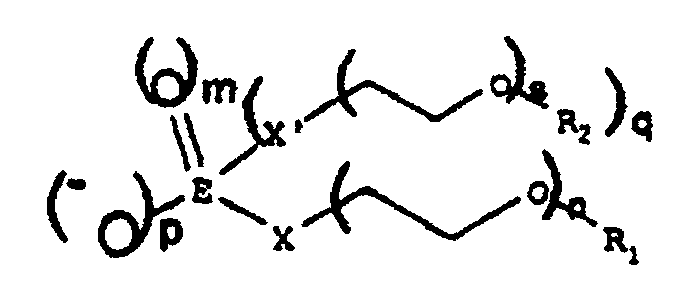
worin p eine ganze Zahl zwischen 1 und 2 darstellt (geschlossene Intervalle, das heißt die Grenzen umfassend);
worin m null oder eine ganze Zahl zwischen 1 und 2 darstellt (geschlossene Intervalle, das heißt die Grenzen umfassend);
worin X und X', die gleich oder verschieden sind, einen Seitenarm darstellen, der mehr als zwei Kohlenstoffketten umfaßt;
worin s null oder eine zwischen 1 und 30, vorteilhafterweise zwischen 5 und 25, bevorzugt zwischen 9 und 20 (geschlossene Intervalle, das heißt die Grenzen umfassend) ausgewählte ganze Zahl ist;
worin n null oder eine zwischen 1 und 30, vorteilhafterweise zwischen 5 und 25, bevorzugt zwischen 9 und 20 (geschlossene Intervalle, das heißt die Grenzen umfassend) ausgewählte ganze Zahl ist;
worin E Phosphor ist und
worin R1 und R2, die gleich oder verschieden sind, einen Kohlenwasserstoffrest darstellen, der vorteilhafterweise unter gegebenenfalls substituiertem Aryl und Alkyl ausgewählt ist. - Verwendung eines ionischen Tensids zum Blockieren von Isocyanaten in Emulsion, dadurch gekennzeichnet, daß das Tensid einen hydrophilen Teil, der aus einer anionischen Funktion, die aus Phosphat-, Phosphonat- und Phosphinatgruppen ausgewählt ist, und einem Fragment einer Polyethylenglykolund/öder Polypropylenglykolkette gebildet ist, und einen lipophilen Teil umfaßt, der aus Alkyl- und Arylgruppen ausgewählt ist.
- Verwendung gemäß Anspruch 29, dadurch gekennzeichnet, daß sie eine Verbindung umfaßt, die eine anionische Funktion und ein Fragment einer Polyethylenglykol- und/oder Polypropylenglykolkette aus mindestens 5, vorteilhafterweise mindestens 7 Ethylenoxyeinheiten umfaßt.
- Verwendung gemäß den Ansprüchen 29 und 30, dadurch gekennzeichnet, daß die Verbindung einen hydrophilen Teil, der aus der anionischen Funktion und dem möglichen Fragment der Polyethylenglykolkette gebildet ist, und einen auf einem Kohlenwasserstoffrest beruhenden, lipophilen Teil umfaßt.
- Verwendung gemäß Anspruch 31, dadurch gekennzeichnet, daß der lipophile Teil aus Alkyl- und Arylgruppen ausgewählt ist.
- Verwendung gemäß Anspruch 32, dadurch gekennzeichnet, daß der anionische Teil der Tensidverbindung der folgenden Formel I entspricht:worin q null oder 1 darstellt;
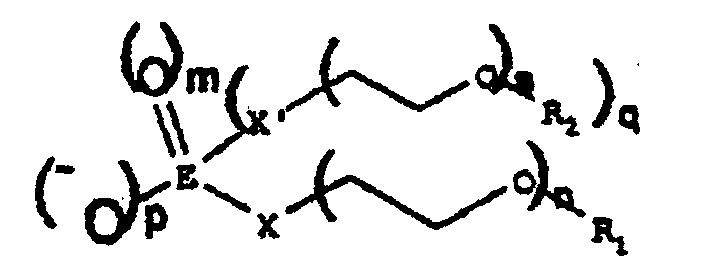
worin p eine ganze Zahl zwischen 1 und 2 darstellt (geschlossene Intervalle, das heißt die Grenzen umfassend);
worin m null oder eine ganze Zahl zwischen 1 und 2 darstellt (geschlossene Intervalle, das heißt die Grenzen umfassend);
worin X und X', die gleich oder verschieden sind, einen Seitenarm darstellen, der mehr als zwei Kohlenstoffketten umfaßt;
worin s null oder eine zwischen 1 und 30, vorteilhafterweise zwischen 5 und 25, bevorzugt zwischen 9 und 20 (geschlossene Intervalle, das heißt die Grenzen umfassend) ausgewählte ganze Zahl ist;
worin n null oder eine zwischen 1 und 30, vorteilhafterweise zwischen 5 und 25, bevorzugt zwischen 9 und 20 (geschlossene Intervalle, das heißt die Grenzen umfassend) ausgewählte ganze Zahl ist;
worin E Phosphor ist und
worin R1 und R2, die gleich oder verschieden sind, einen Kohlenwasserstoffrest darstellen, der vorteilhafterweise unter gegebenenfalls substituiertem Aryl und Alkyl ausgewählt ist. - Verwendung gemäß den Ansprüchen 29 bis 33, dadurch gekennzeichnet, daß das Gegenkation des Tensids ein vorteilhafterweise tertiäres Amin ist.
- Verwendung gemäß den Ansprüchen 29 bis 34, dadurch gekennzeichnet, daß bei der eine Isocyanatfunktion aufweisenden Zusammensetzung ein (eine) Isocyanatfunktion(en) aufweisendes Molekül im Mittel 1 bis 5 Isocyanatfunktionen trägt.
- Verwendung gemäß den Ansprüchen 29 bis 35, dadurch gekennzeichnet, daß bei der eine Isocyanatfunktion aufweisenden Zusammensetzung ein (eine) Isocyanatfunktion(en) aufweisendes Molekül im Mittel 4/3 bis 4 Isocyanatfunktionen trägt.
- Verwendung gemäß den Ansprüchen 29 bis 36, dadurch gekennzeichnet, daß das Maskierungsmittel mindestens einen beweglichen Wasserstoff aufweist.
- Verwendung gemäß den Ansprüchen 29 bis 37, dadurch gekennzeichnet, daß das Maskierungsmittel mindestens einen beweglichen Wasserstoff aufweist und dadurch, daß der pKa der reaktionsfähigen Wasserstoffe mindestens 2, vorteilhafterweise 3 und bevorzugt 5 ist und dadurch, daß der pKa größer als 11, vorteilhafterweise 10 und bevorzugt 9 ist.
- Verwendung gemäß den Ansprüchen 29 bis 38, dadurch gekennzeichnet, daß der pH der wäßrigen Phase während der Reaktionsdauer bei einem größeren Wert als 12, vorteilhafterweise 11 und bevorzugt 10 gehalten wird.
- Verwendung gemäß den Ansprüchen 29 bis 39, dadurch gekennzeichnet, daß der pH der wäßrigen Phase während der Reaktionsdauer bei mindestens dem Wert (pKa-2), vorteilhafterweise mindestens dem Wert (pKa-1), bevorzugt mindestens dem pKa-Wert des oder eines der Masklerungsmittel(s) gehalten wird.
- Verwendung gemäß den Ansprüchen 29 bis 40, dadurch gekennzeichnet, daß das Gewichtsverhältnis zwischen dem Tensid und den Isocyanaten unter 20% und über 2%, vorteilhafterweise zwischen 4 und 10% beträgt.
- Vorrichtung zur Durchführung des Verfahrens gemäß einem der Ansprüche 16 bis 41, dadurch gekennzeichnet, daß sie mindestensein Schermittel, vorzugsweise eine Mühle, vorteilhafterweise eine Kolloidmühle, die ein Schergefälle (Geschwindigkeitsgefälle) über 1000 s-1, bevorzugt über 20 000 s-1 und unter 1 000 000 s-1 und bevorzugt unter 200 000 s-1 erzeugen kann, undMittel zum Einspritzen einer Isocyanatzusammensetzung in eine wäßrige Phase und gegebenenfalls ein oder mehrere folgende Mittel umfaßt:Mittel zum Rückführen der wäßrigen Phase in Form einer Emulsion aus maskiertem Polyisocyanat;Mittel zum Steuern der Einspritzrate der Isocyanatzusammensetzung in die wäßrige Phase;Mittel zur Homogenisierung der Emulsion;Mittef zur Kühlung des Systems undMittel zum Austrag der wäßrigen Emulsion des maskierten Polyisocyanats.
- Vorrichtung gemäß Anspruch 42, dadurch gekennzeichnet, daß das Schermittel eine Kolloidmühle ist.
- Vorrichtung gemäß Anspruch 42 oder 43, dadurch gekennzeichnet, daß die Mittel zum Einspritzen der Polyisocyanatzusammensetzungeinen Behälter zum Vormischen des Polyisocyanats mit dem ganzen oder einem Teil des Tensids und/oder dem Lösungsmittel undeine Zuführungsleitung für die Polyisocyanatzusammensetzung zum Kontakt mit dem Maskierungsmittel umfassen.
- Vorrichtung gemäß einem der Ansprüche 42 bis 44, dadurch gekennzeichnet, daß die Mittel zur Rückführung eine Rückführschleife enthalten.
- Zusammensetzung umfassend eine Emulsion aus maskiertem (maskierten) Polyisocyanat(en), dadurch gekennzeichnet, daß sie einen hydrophilen Teil, der aus einer anionischen Funktion, die aus Phosphat-, Phosphonat- und Phosphinatgruppen ausgewählt ist, und einem Fragment einer Polyethylenglykolund/oder Polypropylenglykolkette gebildet ist, und einen lipophilen Teil, der aus Alkyl- und Arylgruppen ausgewählt ist, enthält und dadurch, daß diese Zusammensetzung mehr als 50 Gew.-% Wasser bezogen auf das Gewicht der Emulsion enthält.
- Zusammensetzung gemäß Anspruch 46, dadurch gekennzeichnet, daß die Menge des (der) maskierten Polyisocyanats (Polyisocyanate) in der Emulsion mindestens 55 Gew.-% bezogen auf das Gesamtgewicht der Emulsion beträgt.
- Zusammensetzung gemäß einem der Ansprüche 46 oder 47, dadurch gekennzeichnet, daß die Emulsion aus Teilchen gebildet ist, die einen Sauter-Durchmesser von 5 µm oder kleiner und eine Dispersionsbreite von 5 µm oder kleiner aufweisen.
- Zusammensetzung gemäß einem der Ansprüche 47 bis 48, dadurch gekennzeichnet, daß sie mehr als 10 Gew.-% Tensid bezogen auf das Gewicht der Isocyanatzusammensetzung umfaßt.
- Zusammensetzung gemäß einem der vorangehenden Ansprüche, dadurch gekennzeichnet, daß das Tensid wie in Anspruch 28 definiert ist.
- Zusammensetzung gemäß einem der vorangehenden Ansprüche, dadurch gekennzeichnet, daß das Tensid der folgenden Formel entspricht:und wenn q null ist:
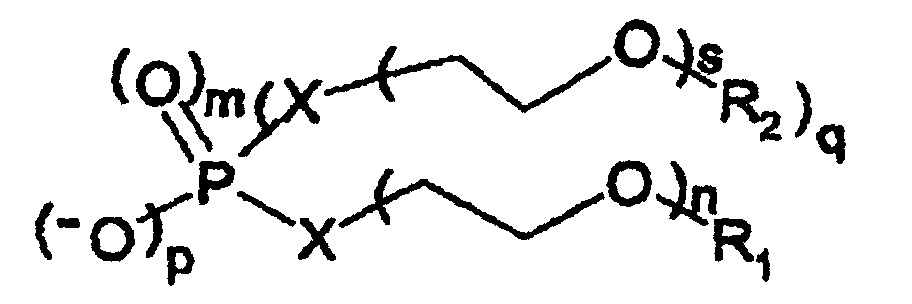 worin p null oder eine ganze Zahl zwischen 1 und 2 darstellt (geschlossene Intervalle, das heißt die Grenzen umfassend);
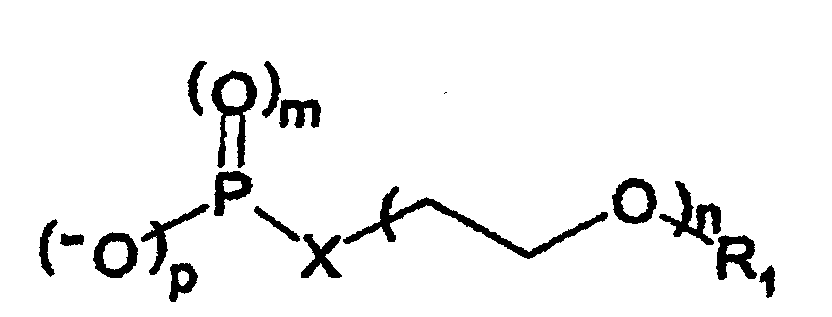
worin m null oder eine ganze Zahl zwischen 1 und 2 darstellt (geschlossene Intervalle, das heißt die Grenzen umfassend);
worin die Summe p + m + q größer als 3 ist;
worin die Summe 1 + p + 2m + q drei oder fünf ist;
worin X und X', die gleich oder verschieden sind, einen Seitenarm darstellen, der mehr als zwei Kohlenstoffketten umfaßt;
worin n und s, die gleich oder verschieden sind, eine zwischen 5 und 30, vorteilhafterweise zwischen 5 und 25, bevorzugt zwischen 9 und 20 (geschlossene Intervalle, das heißt die Grenzen umfassend) ausgewählte ganze Zahl darstellen und
worin R1 und R2, die gleich oder verschieden sind, einen Kohlenwasserstoffrest darstellen. - Zusammensetzung gemäß einem der Ansprüche 46 bis 51, dadurch gekennzeichnet, daß sie eine Viskosität unter 5500 mPa.s mit weniger als 68% Trockenextrakt bei 25°C und vorteilhafterweise eine Viskosität unter 1000 mPa.s mit weniger als 60% Trockenextrakt bei 25°C aufweist.
- Zusammensetzung gemäß einem der Ansprüche 46 bis 52, dadurch gekennzeichnet, daß sie außerdem einen vorteilhafterweise latenten Freisetzungskatalysator umfaßt.
- Zusammensetzung gemäß einem der Ansprüche 46 bis 53, dadurch gekennzeichnet, daß sie wenigstens ein Polyol umfaßt.
- Zusammensetzung gemäß einem der Ansprüche 46 bis 54, dadurch gekennzeichnet, daß das Polyol ein Nanolatex ist, dessen d80 über 1 Mikrometer beträgt.
- Zusammensetzung gemäß einem der Ansprüche 46 bis 55, dadurch gekennzeichnet, daß sie eine Isocyanatemulsion umfaßt, deren d80 größer als 10 Mikrometer ist.
- Zusammensetzung gemäß einem der Ansprüche 55 bis 56, dadurch gekennzeichnet, daß der Wassergehalt zwischen 10 und 70% (Öl-in-Wasser-Emulsion) beträgt.
- Zusammensetzung gemäß einem der Ansprüche 46 bis 57, dadurch gekennzeichnet, daß der Gehalt an Isocyanat + Emulgator + Alkohol zwischen 30 und 70% beträgt.
- Verfahren zur Durchführung von Beschichtungen, dadurch gekennzeichnet, daß es die folgenden Schritte umfaßt:Aufbringen der Zusammensetzung gemäß einem der Ansprüche 46 bis 54 in Form einer Schicht mit einer Dicke zwischen 20 µm und 200 µm undErhitzen auf eine Temperatur von mindestens 80°C.
- Beschichtung, dadurch gekennzeichnet, daß sie durch Ausführen des Verfahrens gemäß Anspruch 59 erhalten werden kann.
Applications Claiming Priority (7)
| Application Number | Priority Date | Filing Date | Title |
|---|---|---|---|
| FR9710717A FR2772385B1 (fr) | 1997-08-27 | 1997-08-27 | Synthese en emulsion de (poly)isocyanates masques, emulsion ainsi obtenue, utilisation des emulsions en vue de faire des compositions utiles pour le revetement et revetement ainsi obtenu |
| FR9710716A FR2767836B1 (fr) | 1997-08-27 | 1997-08-27 | Utilisation de tensioactif anionique pour la synthese en emulsion de(poly)isocyanates masques, emulsion ainsi obtenue, utilisation des emulsions dans des compositions pour revetement et revetement ainsi obtenu |
| FR9710716 | 1997-08-27 | ||
| FR9710717 | 1997-08-27 | ||
| FR9714059A FR2770846B1 (fr) | 1997-11-07 | 1997-11-07 | Procede de masquage en emulsion de polyisocyanates |
| FR9714059 | 1997-11-07 | ||
| PCT/FR1998/001862 WO1999010402A1 (fr) | 1997-08-27 | 1998-08-27 | Procede de masquage en emulsion de polyisocyanates |
Publications (2)
| Publication Number | Publication Date |
|---|---|
| EP1007579A1 EP1007579A1 (de) | 2000-06-14 |
| EP1007579B1 true EP1007579B1 (de) | 2003-06-04 |
Family
ID=27253362
Family Applications (1)
| Application Number | Title | Priority Date | Filing Date |
|---|---|---|---|
| EP98942794A Expired - Lifetime EP1007579B1 (de) | 1997-08-27 | 1998-08-27 | Verfahren zur maskierung von in emulsion vorliegenden polyisocyanaten |
Country Status (10)
| Country | Link |
|---|---|
| US (1) | US6858668B2 (de) |
| EP (1) | EP1007579B1 (de) |
| KR (1) | KR100358553B1 (de) |
| AT (1) | ATE242282T1 (de) |
| AU (1) | AU757895B2 (de) |
| BR (1) | BR9812031A (de) |
| CA (1) | CA2303133A1 (de) |
| DE (1) | DE69815358T2 (de) |
| ES (1) | ES2205540T3 (de) |
| WO (1) | WO1999010402A1 (de) |
Families Citing this family (10)
| Publication number | Priority date | Publication date | Assignee | Title |
|---|---|---|---|---|
| US20010021746A1 (en) * | 1996-02-29 | 2001-09-13 | Minou Nabavi | Isocyanate-based compositions, their process for utilization, their utilization for producing coatings and coating thus obtained |
| FR2797204B1 (fr) * | 1999-07-20 | 2002-04-05 | Rhodia Chimie Sa | Procede pour conferer a un substrat un revetement ayant des proprietes de resistance elevee au choc mettant en oeuvre la reticulation d'(poly)isocyanate et d'un polyol |
| FR2814171B1 (fr) * | 2000-09-18 | 2003-08-29 | Rhodia Chimie Sa | Procede pour conferer a des substrats en bois une resistance elevee a l'attaque des produits chimiques |
| FR2853662B1 (fr) * | 2003-04-08 | 2008-07-04 | Rhodia Chimie Sa | Compositions a base d'isocyanate, leur procede d'utilisation pour realiser des adhesifs et joints de colle aromatique ainsi obtenus |
| FR2853661B1 (fr) * | 2003-04-08 | 2008-07-04 | Rhodia Chimie Sa | Compositions a base d'isocyanate, leur utilisation pour realiser des adhesifs et joints de colle aliphatique ainsi obtenus |
| US20070043152A1 (en) * | 2003-05-21 | 2007-02-22 | Jean-Marie Bernard | Isocyanate-based compositions, process for using them, use thereof for making direct-to-metal coatings and coatings thus obtained |
| EP1652893B1 (de) * | 2004-10-21 | 2011-11-02 | Dainichiseika Color & Chemicals Mfg. Co. Ltd. | Herstellungsverfahren sowie -Vorrichtung für unloesliche Azopigmente |
| JP5563864B2 (ja) * | 2010-03-30 | 2014-07-30 | 三井化学株式会社 | 水分散型ブロックイソシアネート組成物 |
| DE102015120526B4 (de) | 2015-11-26 | 2017-07-13 | Webasto SE | Vorrichtung und Verfahren zur Aufbereitung eines flüssigen Polymergemisches |
| PL4074805T3 (pl) * | 2021-04-15 | 2024-01-22 | SWISS KRONO Tec AG | Kompozycja spoiwa i sposób produkcji tworzywa drewnopochodnego i tworzywo drewnopochodne |
Family Cites Families (13)
| Publication number | Priority date | Publication date | Assignee | Title |
|---|---|---|---|---|
| DE2816815A1 (de) | 1978-04-18 | 1979-10-31 | Bayer Ag | In wasser dispergierbare oder loesliche polyurethane, sowie ein verfahren zu ihrer herstellung |
| US4396738A (en) * | 1982-05-24 | 1983-08-02 | Ashland Oil, Inc. | Aqueous adhesive compositions |
| CA1304869C (en) * | 1986-10-21 | 1992-07-07 | Peter H. Markusch | Continuous process for the production of aqueous polyurethane-urea dispersions |
| US5037934A (en) | 1988-10-28 | 1991-08-06 | Kyowa Hakko Kogyo Co., Ltd. | Magnetic coating formulations and magnetic recording media |
| US5037864A (en) * | 1989-07-11 | 1991-08-06 | The Dow Chemical Company | Semi-continuous process for the preparation of polyurethane-urea aqueous dispersions |
| JP2528741B2 (ja) * | 1991-01-09 | 1996-08-28 | ファイザー製薬株式会社 | オキサゾ―ル、チアゾ―ルおよびイミダゾ―ル化合物 |
| CA2072931C (en) * | 1991-07-23 | 2003-12-30 | Robin E. Tirpak | A process for the preparation of aqueous dispersions containing both blocked polyisocyanates and polyhydroxyl compounds |
| US5296160A (en) * | 1991-07-23 | 1994-03-22 | Miles Inc. | Aqueous dispersions of blocked polyisocyanates |
| DE4213527A1 (de) * | 1992-04-24 | 1993-10-28 | Bayer Ag | Wäßrige Überzugsmittel für elastische Einbrennlackierungen |
| DE69429857T2 (de) | 1993-03-31 | 2002-09-26 | Rhodia Chimie, Courbevoie | Verfahren zur herstellung von wässrigen emulsionen von ölen und/oder gummi und/oder vorzugsweise maskierten (poly)isocyanatharzen, und resultierende emulsionen |
| FR2714669B1 (fr) | 1993-12-31 | 1996-03-15 | Rhone Poulenc Chimie | Nouveaux polyisocyanates masqués, l'un de leurs procédés d'obtention et procédé de préparation de polymères à partir desdits polyisocyanates masqués. |
| GB9520317D0 (en) * | 1995-10-05 | 1995-12-06 | Baxenden Chem Ltd | Water dispersable blocked isocyanates |
| FR2745577B1 (fr) * | 1996-02-29 | 2004-09-24 | Rhone Poulenc Chimie | Compositions a base d'isocyanate, leur procede d'utilisation leur utilisation pour realiser des revetements et revetement ainsi obtenu |
-
1998
- 1998-08-27 EP EP98942794A patent/EP1007579B1/de not_active Expired - Lifetime
- 1998-08-27 AU AU90797/98A patent/AU757895B2/en not_active Ceased
- 1998-08-27 CA CA002303133A patent/CA2303133A1/fr not_active Abandoned
- 1998-08-27 AT AT98942794T patent/ATE242282T1/de not_active IP Right Cessation
- 1998-08-27 ES ES98942794T patent/ES2205540T3/es not_active Expired - Lifetime
- 1998-08-27 KR KR1020007002014A patent/KR100358553B1/ko not_active Expired - Fee Related
- 1998-08-27 BR BR9812031-0A patent/BR9812031A/pt not_active Application Discontinuation
- 1998-08-27 WO PCT/FR1998/001862 patent/WO1999010402A1/fr not_active Ceased
- 1998-08-27 DE DE1998615358 patent/DE69815358T2/de not_active Expired - Lifetime
- 1998-08-27 US US09/486,343 patent/US6858668B2/en not_active Expired - Fee Related
Also Published As
| Publication number | Publication date |
|---|---|
| DE69815358T2 (de) | 2004-04-29 |
| AU757895B2 (en) | 2003-03-13 |
| DE69815358D1 (de) | 2003-07-10 |
| EP1007579A1 (de) | 2000-06-14 |
| BR9812031A (pt) | 2000-09-26 |
| KR20010023375A (ko) | 2001-03-26 |
| KR100358553B1 (ko) | 2002-10-25 |
| US20030149168A1 (en) | 2003-08-07 |
| ES2205540T3 (es) | 2004-05-01 |
| ATE242282T1 (de) | 2003-06-15 |
| US6858668B2 (en) | 2005-02-22 |
| WO1999010402A1 (fr) | 1999-03-04 |
| AU9079798A (en) | 1999-03-16 |
| CA2303133A1 (fr) | 1999-03-04 |
Similar Documents
| Publication | Publication Date | Title |
|---|---|---|
| EP0815153B1 (de) | Isocyanatzusammensetzungen, verfahren zu deren verwendung, deren verwendung zur herstellung von beschichtungen und beschichtungen so erhalten | |
| CA2745471C (fr) | Procede de preparation d'allophanate, allophanate et composition de faible viscosite comprenant l'allophanate | |
| EP2064258B1 (de) | Verwendung von polyisocyanat-zusammensetzungen für hochglanzbeschichtungen | |
| WO1999010402A1 (fr) | Procede de masquage en emulsion de polyisocyanates | |
| CA2158747A1 (fr) | Procede de preparation d'emulsions aqueuses d'huiles et/ou de gommes et/ou de resines (poly)isocyanates avantageusement masques et emulsions obtenues | |
| EP1003802B1 (de) | Verfahren zur herstellung einer polyisocyanat-zusammensetzung mit verringerter viskosität | |
| EP0973782A1 (de) | Modifizierte isocyanate mit tensideigenschaften, diese enthaltende zusammensetzungen und daraus hergestellte beschichtungen | |
| EP2144943B1 (de) | Gemisch auf basis eines polyisocyanats und eines ether-/ester-lösungsmittels, wässrige emulsion aus diesem gemisch und verwendung dieser emulsion zur herstellung von beschichtungen und haftmitteln | |
| CA2326235A1 (fr) | Procede de preparation d'isocyanates polyfonctionnels tricondensats de faible viscosite | |
| FR2770846A1 (fr) | Procede de masquage en emulsion de polyisocyanates | |
| FR2772385A1 (fr) | Synthese en emulsion de (poly)isocyanates masques, emulsion ainsi obtenue, utilisation des emulsions en vue de faire des compositions utiles pour le revetement et revetement ainsi obtenu | |
| WO2001005861A1 (fr) | Procede pour conferer a un substrat un revetement ayant des proprietes de resistance elevee au choc | |
| FR2767836A1 (fr) | Utilisation de tensioactif anionique pour la synthese en emulsion de(poly)isocyanates masques, emulsion ainsi obtenue, utilisation des emulsions dans des compositions pour revetement et revetement ainsi obtenu | |
| EP1611179B1 (de) | Zusammensetzung aus isocyanaten, ihre verwendung zur herstellung von klebstoffen, und die damit hergestellten aromatischen klebefugen | |
| WO2004103543A2 (fr) | Compositions a base d'isocyanate, leur procede d'utilisation, leur utilisation pour realiser des revêtements a adherence directe et revêtements ainsi obtenus | |
| EP1611178B1 (de) | Zusammensetzung aus isocyanaten, ihre verwendung zur herstellung von klebstoffen, und die damit hergestellten aromatischen klebefugen | |
| FR2855768A1 (fr) | Compositions a base d'isocyanate, leur procede d'utilisation pour realiser des vetements et revetements ainsi obtenus | |
| FR2703357A1 (fr) | Procédé de préparation d'émulsions aqueuses d'huiles et/ou de gommes (poly)isocyanates masqués et émulsions obtenues. | |
| EP1406938A1 (de) | Polykondensierbare zusammensetzung die eine sauerstoff enthaltende heterozyklische verbindung und ein isocyanat enthält und verfahren zur polykondensation | |
| EP0998511A1 (de) | Zusammensetzung die gemischte maskierte isocyanate enthält und ihre verwendung für pulverlacke |
Legal Events
| Date | Code | Title | Description |
|---|---|---|---|
| PUAI | Public reference made under article 153(3) epc to a published international application that has entered the european phase |
Free format text: ORIGINAL CODE: 0009012 |
|
| 17P | Request for examination filed |
Effective date: 20000214 |
|
| AK | Designated contracting states |
Kind code of ref document: A1 Designated state(s): AT BE CH CY DE DK ES FI FR GB GR IE IT LI LU MC NL PT SE |
|
| 17Q | First examination report despatched |
Effective date: 20010209 |
|
| GRAG | Despatch of communication of intention to grant |
Free format text: ORIGINAL CODE: EPIDOS AGRA |
|
| GRAG | Despatch of communication of intention to grant |
Free format text: ORIGINAL CODE: EPIDOS AGRA |
|
| GRAG | Despatch of communication of intention to grant |
Free format text: ORIGINAL CODE: EPIDOS AGRA |
|
| GRAH | Despatch of communication of intention to grant a patent |
Free format text: ORIGINAL CODE: EPIDOS IGRA |
|
| GRAH | Despatch of communication of intention to grant a patent |
Free format text: ORIGINAL CODE: EPIDOS IGRA |
|
| GRAA | (expected) grant |
Free format text: ORIGINAL CODE: 0009210 |
|
| AK | Designated contracting states |
Designated state(s): AT BE CH CY DE DK ES FI FR GB GR IE IT LI LU MC NL PT SE |
|
| PG25 | Lapsed in a contracting state [announced via postgrant information from national office to epo] |
Ref country code: IE Free format text: LAPSE BECAUSE OF FAILURE TO SUBMIT A TRANSLATION OF THE DESCRIPTION OR TO PAY THE FEE WITHIN THE PRESCRIBED TIME-LIMIT Effective date: 20030604 Ref country code: FI Free format text: LAPSE BECAUSE OF FAILURE TO SUBMIT A TRANSLATION OF THE DESCRIPTION OR TO PAY THE FEE WITHIN THE PRESCRIBED TIME-LIMIT Effective date: 20030604 Ref country code: AT Free format text: LAPSE BECAUSE OF FAILURE TO SUBMIT A TRANSLATION OF THE DESCRIPTION OR TO PAY THE FEE WITHIN THE PRESCRIBED TIME-LIMIT Effective date: 20030604 |
|
| REG | Reference to a national code |
Ref country code: GB Ref legal event code: FG4D Free format text: NOT ENGLISH |
|
| REG | Reference to a national code |
Ref country code: CH Ref legal event code: EP |
|
| REG | Reference to a national code |
Ref country code: IE Ref legal event code: FG4D Free format text: FRENCH |
|
| REF | Corresponds to: |
Ref document number: 69815358 Country of ref document: DE Date of ref document: 20030710 Kind code of ref document: P |
|
| PG25 | Lapsed in a contracting state [announced via postgrant information from national office to epo] |
Ref country code: LU Free format text: LAPSE BECAUSE OF NON-PAYMENT OF DUE FEES Effective date: 20030827 Ref country code: CY Free format text: LAPSE BECAUSE OF FAILURE TO SUBMIT A TRANSLATION OF THE DESCRIPTION OR TO PAY THE FEE WITHIN THE PRESCRIBED TIME-LIMIT Effective date: 20030827 |
|
| PG25 | Lapsed in a contracting state [announced via postgrant information from national office to epo] |
Ref country code: MC Free format text: LAPSE BECAUSE OF NON-PAYMENT OF DUE FEES Effective date: 20030831 |
|
| PG25 | Lapsed in a contracting state [announced via postgrant information from national office to epo] |
Ref country code: SE Free format text: LAPSE BECAUSE OF FAILURE TO SUBMIT A TRANSLATION OF THE DESCRIPTION OR TO PAY THE FEE WITHIN THE PRESCRIBED TIME-LIMIT Effective date: 20030904 Ref country code: PT Free format text: LAPSE BECAUSE OF FAILURE TO SUBMIT A TRANSLATION OF THE DESCRIPTION OR TO PAY THE FEE WITHIN THE PRESCRIBED TIME-LIMIT Effective date: 20030904 Ref country code: GR Free format text: LAPSE BECAUSE OF FAILURE TO SUBMIT A TRANSLATION OF THE DESCRIPTION OR TO PAY THE FEE WITHIN THE PRESCRIBED TIME-LIMIT Effective date: 20030904 Ref country code: DK Free format text: LAPSE BECAUSE OF FAILURE TO SUBMIT A TRANSLATION OF THE DESCRIPTION OR TO PAY THE FEE WITHIN THE PRESCRIBED TIME-LIMIT Effective date: 20030904 |
|
| PGFP | Annual fee paid to national office [announced via postgrant information from national office to epo] |
Ref country code: BE Payment date: 20031010 Year of fee payment: 6 |
|
| GBT | Gb: translation of ep patent filed (gb section 77(6)(a)/1977) |
Effective date: 20031018 |
|
| REG | Reference to a national code |
Ref country code: IE Ref legal event code: FD4D |
|
| PLBE | No opposition filed within time limit |
Free format text: ORIGINAL CODE: 0009261 |
|
| STAA | Information on the status of an ep patent application or granted ep patent |
Free format text: STATUS: NO OPPOSITION FILED WITHIN TIME LIMIT |
|
| REG | Reference to a national code |
Ref country code: ES Ref legal event code: FG2A Ref document number: 2205540 Country of ref document: ES Kind code of ref document: T3 |
|
| 26N | No opposition filed |
Effective date: 20040305 |
|
| PG25 | Lapsed in a contracting state [announced via postgrant information from national office to epo] |
Ref country code: BE Free format text: LAPSE BECAUSE OF NON-PAYMENT OF DUE FEES Effective date: 20040831 |
|
| BERE | Be: lapsed |
Owner name: *RHODIA CHIMIE Effective date: 20040831 |
|
| BERE | Be: lapsed |
Owner name: *RHODIA CHIMIE Effective date: 20040831 |
|
| REG | Reference to a national code |
Ref country code: FR Ref legal event code: TP Ref country code: FR Ref legal event code: CD Ref country code: FR Ref legal event code: CA |
|
| PGFP | Annual fee paid to national office [announced via postgrant information from national office to epo] |
Ref country code: CH Payment date: 20100811 Year of fee payment: 13 |
|
| REG | Reference to a national code |
Ref country code: FR Ref legal event code: CD Owner name: PERSTORP FRANCE, FR Effective date: 20120103 Ref country code: FR Ref legal event code: CA Effective date: 20120103 |
|
| REG | Reference to a national code |
Ref country code: CH Ref legal event code: PL |
|
| PG25 | Lapsed in a contracting state [announced via postgrant information from national office to epo] |
Ref country code: LI Free format text: LAPSE BECAUSE OF NON-PAYMENT OF DUE FEES Effective date: 20110831 Ref country code: CH Free format text: LAPSE BECAUSE OF NON-PAYMENT OF DUE FEES Effective date: 20110831 |
|
| REG | Reference to a national code |
Ref country code: GB Ref legal event code: 732E Free format text: REGISTERED BETWEEN 20120830 AND 20120905 |
|
| REG | Reference to a national code |
Ref country code: NL Ref legal event code: SD Effective date: 20120927 |
|
| REG | Reference to a national code |
Ref country code: DE Ref legal event code: R082 Ref document number: 69815358 Country of ref document: DE Representative=s name: VIERING, JENTSCHURA & PARTNER MBB PATENT- UND , DE Effective date: 20121220 Ref country code: DE Ref legal event code: R082 Ref document number: 69815358 Country of ref document: DE Representative=s name: VIERING, JENTSCHURA & PARTNER PATENT- UND RECH, DE Effective date: 20121220 Ref country code: DE Ref legal event code: R082 Ref document number: 69815358 Country of ref document: DE Representative=s name: VIERING, JENTSCHURA & PARTNER, DE Effective date: 20121220 Ref country code: DE Ref legal event code: R081 Ref document number: 69815358 Country of ref document: DE Owner name: PERSTORP FRANCE, FR Free format text: FORMER OWNER: RHODIA CHIMIE, COURBEVOIE, FR Effective date: 20121220 Ref country code: DE Ref legal event code: R081 Ref document number: 69815358 Country of ref document: DE Owner name: VENCOREX FRANCE, FR Free format text: FORMER OWNER: RHODIA CHIMIE, COURBEVOIE, FR Effective date: 20121220 |
|
| REG | Reference to a national code |
Ref country code: ES Ref legal event code: PC2A Owner name: PERSTORP FRANCE Effective date: 20130527 |
|
| REG | Reference to a national code |
Ref country code: DE Ref legal event code: R082 Ref document number: 69815358 Country of ref document: DE Representative=s name: VIERING, JENTSCHURA & PARTNER, DE Ref country code: FR Ref legal event code: CD Owner name: VENCOREX FRANCE, FR Effective date: 20130603 |
|
| REG | Reference to a national code |
Ref country code: NL Ref legal event code: TD Effective date: 20130729 |
|
| REG | Reference to a national code |
Ref country code: DE Ref legal event code: R082 Ref document number: 69815358 Country of ref document: DE Representative=s name: VIERING, JENTSCHURA & PARTNER MBB PATENT- UND , DE Effective date: 20130705 Ref country code: DE Ref legal event code: R082 Ref document number: 69815358 Country of ref document: DE Representative=s name: VIERING, JENTSCHURA & PARTNER PATENT- UND RECH, DE Effective date: 20130705 Ref country code: DE Ref legal event code: R082 Ref document number: 69815358 Country of ref document: DE Representative=s name: VIERING, JENTSCHURA & PARTNER, DE Effective date: 20130705 Ref country code: DE Ref legal event code: R081 Ref document number: 69815358 Country of ref document: DE Owner name: VENCOREX FRANCE, FR Free format text: FORMER OWNER: PERSTORP FRANCE, SAINT-PRIEST, FR Effective date: 20130705 |
|
| REG | Reference to a national code |
Ref country code: ES Ref legal event code: PC2A Owner name: VENCOREX FRANCE Effective date: 20131107 |
|
| REG | Reference to a national code |
Ref country code: FR Ref legal event code: PLFP Year of fee payment: 18 |
|
| PGFP | Annual fee paid to national office [announced via postgrant information from national office to epo] |
Ref country code: NL Payment date: 20150820 Year of fee payment: 18 |
|
| PGFP | Annual fee paid to national office [announced via postgrant information from national office to epo] |
Ref country code: GB Payment date: 20150826 Year of fee payment: 18 Ref country code: DE Payment date: 20150824 Year of fee payment: 18 Ref country code: ES Payment date: 20150811 Year of fee payment: 18 |
|
| PGFP | Annual fee paid to national office [announced via postgrant information from national office to epo] |
Ref country code: FR Payment date: 20150831 Year of fee payment: 18 |
|
| PGFP | Annual fee paid to national office [announced via postgrant information from national office to epo] |
Ref country code: IT Payment date: 20150820 Year of fee payment: 18 |
|
| REG | Reference to a national code |
Ref country code: DE Ref legal event code: R119 Ref document number: 69815358 Country of ref document: DE |
|
| REG | Reference to a national code |
Ref country code: NL Ref legal event code: MM Effective date: 20160901 |
|
| GBPC | Gb: european patent ceased through non-payment of renewal fee |
Effective date: 20160827 |
|
| REG | Reference to a national code |
Ref country code: FR Ref legal event code: ST Effective date: 20170428 |
|
| PG25 | Lapsed in a contracting state [announced via postgrant information from national office to epo] |
Ref country code: NL Free format text: LAPSE BECAUSE OF NON-PAYMENT OF DUE FEES Effective date: 20160901 |
|
| PG25 | Lapsed in a contracting state [announced via postgrant information from national office to epo] |
Ref country code: DE Free format text: LAPSE BECAUSE OF NON-PAYMENT OF DUE FEES Effective date: 20170301 Ref country code: FR Free format text: LAPSE BECAUSE OF NON-PAYMENT OF DUE FEES Effective date: 20160831 Ref country code: GB Free format text: LAPSE BECAUSE OF NON-PAYMENT OF DUE FEES Effective date: 20160827 |
|
| PG25 | Lapsed in a contracting state [announced via postgrant information from national office to epo] |
Ref country code: IT Free format text: LAPSE BECAUSE OF NON-PAYMENT OF DUE FEES Effective date: 20160827 |
|
| PG25 | Lapsed in a contracting state [announced via postgrant information from national office to epo] |
Ref country code: ES Free format text: LAPSE BECAUSE OF NON-PAYMENT OF DUE FEES Effective date: 20160828 |
|
| REG | Reference to a national code |
Ref country code: ES Ref legal event code: FD2A Effective date: 20180626 |