EP1009993B1 - Procede et dispositif correspondant permettant de mesurer la concentration en produits chimiques durant une operation de blanchiment - Google Patents
Procede et dispositif correspondant permettant de mesurer la concentration en produits chimiques durant une operation de blanchiment Download PDFInfo
- Publication number
- EP1009993B1 EP1009993B1 EP97951421A EP97951421A EP1009993B1 EP 1009993 B1 EP1009993 B1 EP 1009993B1 EP 97951421 A EP97951421 A EP 97951421A EP 97951421 A EP97951421 A EP 97951421A EP 1009993 B1 EP1009993 B1 EP 1009993B1
- Authority
- EP
- European Patent Office
- Prior art keywords
- sample
- bleaching
- measurement
- container
- content
- Prior art date
- Legal status (The legal status is an assumption and is not a legal conclusion. Google has not performed a legal analysis and makes no representation as to the accuracy of the status listed.)
- Expired - Lifetime
Links
- 238000004061 bleaching Methods 0.000 title claims abstract description 45
- 239000000126 substance Substances 0.000 title claims abstract description 42
- 238000000034 method Methods 0.000 title claims abstract description 41
- 238000005259 measurement Methods 0.000 claims abstract description 65
- 102000016938 Catalase Human genes 0.000 claims abstract description 39
- 108010053835 Catalase Proteins 0.000 claims abstract description 39
- MYMOFIZGZYHOMD-UHFFFAOYSA-N Dioxygen Chemical compound O=O MYMOFIZGZYHOMD-UHFFFAOYSA-N 0.000 claims abstract description 17
- 239000003054 catalyst Substances 0.000 claims abstract description 17
- 229910001882 dioxygen Inorganic materials 0.000 claims abstract description 17
- 239000000725 suspension Substances 0.000 claims abstract description 12
- 229920003043 Cellulose fiber Polymers 0.000 claims abstract description 5
- 238000004422 calculation algorithm Methods 0.000 claims abstract description 3
- 150000002978 peroxides Chemical class 0.000 claims description 51
- 239000007788 liquid Substances 0.000 claims description 17
- 238000006243 chemical reaction Methods 0.000 claims description 15
- 238000000354 decomposition reaction Methods 0.000 claims description 12
- 238000013019 agitation Methods 0.000 claims description 7
- 230000000694 effects Effects 0.000 claims description 7
- 239000007789 gas Substances 0.000 claims description 4
- 230000015572 biosynthetic process Effects 0.000 claims description 2
- 238000002156 mixing Methods 0.000 claims description 2
- 230000008569 process Effects 0.000 description 16
- XLYOFNOQVPJJNP-UHFFFAOYSA-N water Substances O XLYOFNOQVPJJNP-UHFFFAOYSA-N 0.000 description 8
- 239000000706 filtrate Substances 0.000 description 7
- 230000008901 benefit Effects 0.000 description 5
- 238000004448 titration Methods 0.000 description 5
- MHAJPDPJQMAIIY-UHFFFAOYSA-N Hydrogen peroxide Chemical compound OO MHAJPDPJQMAIIY-UHFFFAOYSA-N 0.000 description 4
- KFSLWBXXFJQRDL-UHFFFAOYSA-N Peracetic acid Chemical compound CC(=O)OO KFSLWBXXFJQRDL-UHFFFAOYSA-N 0.000 description 4
- 239000007844 bleaching agent Substances 0.000 description 4
- 229920001131 Pulp (paper) Polymers 0.000 description 3
- QVGXLLKOCUKJST-UHFFFAOYSA-N atomic oxygen Chemical compound [O] QVGXLLKOCUKJST-UHFFFAOYSA-N 0.000 description 3
- 238000011109 contamination Methods 0.000 description 3
- 239000000835 fiber Substances 0.000 description 3
- 239000001301 oxygen Substances 0.000 description 3
- 229910052760 oxygen Inorganic materials 0.000 description 3
- 239000000047 product Substances 0.000 description 3
- 238000004458 analytical method Methods 0.000 description 2
- 230000027455 binding Effects 0.000 description 2
- 238000009739 binding Methods 0.000 description 2
- 238000002848 electrochemical method Methods 0.000 description 2
- 230000007613 environmental effect Effects 0.000 description 2
- AMWRITDGCCNYAT-UHFFFAOYSA-L hydroxy(oxo)manganese;manganese Chemical compound [Mn].O[Mn]=O.O[Mn]=O AMWRITDGCCNYAT-UHFFFAOYSA-L 0.000 description 2
- 238000012423 maintenance Methods 0.000 description 2
- 238000004519 manufacturing process Methods 0.000 description 2
- 239000000463 material Substances 0.000 description 2
- BASFCYQUMIYNBI-UHFFFAOYSA-N platinum Chemical compound [Pt] BASFCYQUMIYNBI-UHFFFAOYSA-N 0.000 description 2
- 239000011949 solid catalyst Substances 0.000 description 2
- 238000003756 stirring Methods 0.000 description 2
- GDOPTJXRTPNYNR-UHFFFAOYSA-N CC1CCCC1 Chemical compound CC1CCCC1 GDOPTJXRTPNYNR-UHFFFAOYSA-N 0.000 description 1
- ZAMOUSCENKQFHK-UHFFFAOYSA-N Chlorine atom Chemical compound [Cl] ZAMOUSCENKQFHK-UHFFFAOYSA-N 0.000 description 1
- 235000002595 Solanum tuberosum Nutrition 0.000 description 1
- 244000061456 Solanum tuberosum Species 0.000 description 1
- 230000009471 action Effects 0.000 description 1
- 230000004913 activation Effects 0.000 description 1
- 239000013043 chemical agent Substances 0.000 description 1
- 239000000460 chlorine Substances 0.000 description 1
- 229910052801 chlorine Inorganic materials 0.000 description 1
- 239000004927 clay Substances 0.000 description 1
- 238000010411 cooking Methods 0.000 description 1
- 238000013480 data collection Methods 0.000 description 1
- 230000003247 decreasing effect Effects 0.000 description 1
- 230000007547 defect Effects 0.000 description 1
- 230000001419 dependent effect Effects 0.000 description 1
- 230000001627 detrimental effect Effects 0.000 description 1
- 238000010586 diagram Methods 0.000 description 1
- 239000000945 filler Substances 0.000 description 1
- 238000011049 filling Methods 0.000 description 1
- 238000001914 filtration Methods 0.000 description 1
- 239000012467 final product Substances 0.000 description 1
- 230000000977 initiatory effect Effects 0.000 description 1
- 239000000976 ink Substances 0.000 description 1
- 229920005610 lignin Polymers 0.000 description 1
- WPBNNNQJVZRUHP-UHFFFAOYSA-L manganese(2+);methyl n-[[2-(methoxycarbonylcarbamothioylamino)phenyl]carbamothioyl]carbamate;n-[2-(sulfidocarbothioylamino)ethyl]carbamodithioate Chemical compound [Mn+2].[S-]C(=S)NCCNC([S-])=S.COC(=O)NC(=S)NC1=CC=CC=C1NC(=S)NC(=O)OC WPBNNNQJVZRUHP-UHFFFAOYSA-L 0.000 description 1
- PPNAOCWZXJOHFK-UHFFFAOYSA-N manganese(2+);oxygen(2-) Chemical group [O-2].[Mn+2] PPNAOCWZXJOHFK-UHFFFAOYSA-N 0.000 description 1
- 238000000691 measurement method Methods 0.000 description 1
- 229910021645 metal ion Inorganic materials 0.000 description 1
- 230000002906 microbiologic effect Effects 0.000 description 1
- 244000005700 microbiome Species 0.000 description 1
- 239000000203 mixture Substances 0.000 description 1
- 230000003647 oxidation Effects 0.000 description 1
- 238000007254 oxidation reaction Methods 0.000 description 1
- 229910052697 platinum Inorganic materials 0.000 description 1
- 239000002574 poison Substances 0.000 description 1
- 231100000614 poison Toxicity 0.000 description 1
- 238000003969 polarography Methods 0.000 description 1
- 239000012286 potassium permanganate Substances 0.000 description 1
- 235000012015 potatoes Nutrition 0.000 description 1
- 238000004886 process control Methods 0.000 description 1
- 102000004169 proteins and genes Human genes 0.000 description 1
- 108090000623 proteins and genes Proteins 0.000 description 1
- 238000004076 pulp bleaching Methods 0.000 description 1
- 230000035484 reaction time Effects 0.000 description 1
- 230000004044 response Effects 0.000 description 1
- 238000013215 result calculation Methods 0.000 description 1
- 238000005070 sampling Methods 0.000 description 1
- 230000035945 sensitivity Effects 0.000 description 1
- 239000007787 solid Substances 0.000 description 1
- 230000002269 spontaneous effect Effects 0.000 description 1
- 239000007921 spray Substances 0.000 description 1
- 239000004753 textile Substances 0.000 description 1
- 230000001960 triggered effect Effects 0.000 description 1
- 238000004832 voltammetry Methods 0.000 description 1
- 238000005406 washing Methods 0.000 description 1
- 239000002699 waste material Substances 0.000 description 1
Images

Classifications
-
- D—TEXTILES; PAPER
- D21—PAPER-MAKING; PRODUCTION OF CELLULOSE
- D21C—PRODUCTION OF CELLULOSE BY REMOVING NON-CELLULOSE SUBSTANCES FROM CELLULOSE-CONTAINING MATERIALS; REGENERATION OF PULPING LIQUORS; APPARATUS THEREFOR
- D21C9/00—After-treatment of cellulose pulp, e.g. of wood pulp, or cotton linters ; Treatment of dilute or dewatered pulp or process improvement taking place after obtaining the raw cellulosic material and not provided for elsewhere
- D21C9/10—Bleaching ; Apparatus therefor
- D21C9/16—Bleaching ; Apparatus therefor with per compounds
- D21C9/163—Bleaching ; Apparatus therefor with per compounds with peroxides
-
- D—TEXTILES; PAPER
- D21—PAPER-MAKING; PRODUCTION OF CELLULOSE
- D21C—PRODUCTION OF CELLULOSE BY REMOVING NON-CELLULOSE SUBSTANCES FROM CELLULOSE-CONTAINING MATERIALS; REGENERATION OF PULPING LIQUORS; APPARATUS THEREFOR
- D21C9/00—After-treatment of cellulose pulp, e.g. of wood pulp, or cotton linters ; Treatment of dilute or dewatered pulp or process improvement taking place after obtaining the raw cellulosic material and not provided for elsewhere
- D21C9/10—Bleaching ; Apparatus therefor
- D21C9/1026—Other features in bleaching processes
- D21C9/1052—Controlling the process
-
- G—PHYSICS
- G01—MEASURING; TESTING
- G01N—INVESTIGATING OR ANALYSING MATERIALS BY DETERMINING THEIR CHEMICAL OR PHYSICAL PROPERTIES
- G01N7/00—Analysing materials by measuring the pressure or volume of a gas or vapour
- G01N7/14—Analysing materials by measuring the pressure or volume of a gas or vapour by allowing the material to emit a gas or vapour, e.g. water vapour, and measuring a pressure or volume difference
- G01N7/18—Analysing materials by measuring the pressure or volume of a gas or vapour by allowing the material to emit a gas or vapour, e.g. water vapour, and measuring a pressure or volume difference by allowing the material to react
Definitions
- the present invention relates to a method and a device for measuring the content of chemicals in connection with bleaching carried out with the use of bleaching agents, preferably cellulose fibres in a pulp suspension.
- the object is to provide a better and more uniform product quality and to prevent overdosing of the bleaching chemical used.
- the bleaching of cellulose fibres is essential to the final product quality. Principally, the bleaching has two aims, namely first to create a continuation of the lignin-separating process, which consists of cooking in the manufacture of chemical pulps, and second to remove the dark colour given to the pulp by certain organic substances so that a certain brightness is created.
- chemicals based on chlorine were extensively used as bleaching agents.
- law changes partly triggered by a massive public opinion concerning influcence on the environment, have enforced chlorine-free bleaching processes, in which context e.g. peroxide bleaching has been used to an increasing extent both for chemical and mechanical pulp as well as for recycled fibres.
- Peroxide is a relatively expensive chemical, for which reason a better control of the bleaching process would mean substantial savings in terms of chemical consumption and, at the same time, provide a better and more uniform product quality.
- residual peroxide A condition for a good bleaching result is that there always exists a certain content of residual peroxide, the amount of which in turn depends on the type of pulp and the type of bleaching process.
- too high contents of residual peroxide mean economical losses since it is caused by an overdosing of the bleaching chemical, or bleaching agent, used in the process.
- Document EP 0052834 discloses a method for determining the concentration of hydrogen peroxide in a solution by adding a catalyst and measuring the pressure increase caused by oxygen formed. This method relates to a power generator where the build-up of hydrogen peroxide must be maintained within prescribed limits and not to the control of a pulp bleaching process.
- the content of residual peroxide is measured for the reason that the content of bleaching agent can vary from a few ppm up to several thousand ppm.
- the content is usually determined in the laboratory by means of a titration method.
- To carry out the analysis in a laboratory is normally advisable in connection with automatic process control because the results are not available after a sufficiently short delay and also because the laboratory analysis requires much staff work.
- a better supervision of e.g. the residual peroxide content acccordingly requires access to an instrument for continuous (on-line) measurements during the process.
- the necessary measurement frequency may, depending on the bleaching process used, vary between approximately 3 and 10 minutes.
- the measurement is then carried out on a filtration sample from the bleached pulp suspension, the concentration of which may be 15% and higher.
- the sample can be derived either by means of a special sampler, extracting a fibre-free sample from the pulp suspension, or directly out of the reject from a press which can be located after the bleaching tower.
- the properties of the filtrate vary with the bleaching process and with the sampling position. Normally, peroxide bleaching is carried out at a pH value of 8,5-11,5 and at a temperature between 85° and 120°C (lower temperatures are to be used for recycled pulp).
- the filtrate can contain inter alia chemicals used to stabilize peroxide and complex binding of metal ions and to adjust the pH value.
- there can in the filtrate also be found suspended material in the form of fine fibre material, filling agents (clay, chalk ...), collodial lignin, printing inks, etc.
- Instruments based on electro-chemical methods such as polarography or voltametry, have low selectivity when used together with bleaching filtrates derived from pulp from the forest industry, because such filtrates have a complex composition resulting in unsatisfactory accuracy and reproducibility.
- those instruments are relatively insensitive at low residual peroxide contents.
- the object of the present invention is to provide a method and a device of the type mentioned above, by means of which method and device the disadvantages above referred to are eliminated.
- the features characterizing the invention appear from the subsequent patent claims.
- a further advantage is that the method is selective, peroxide only showing up in the result. Also, the character of the sample does not disturb the measurement result.
- the method according to the invention is based on utilizing the instability of the bleaching chemical causing decomposition, oxygen being formed during that process, in combination with use of a catalyst constituted by the enzyme catalase, the content of the bleaching chemical being determined according to a manometric or other method during decomposition of the chemical.
- catalase has the significant advantage that its activity is independent of the pH value existing in normal bleaching processes and a measurement can take place within a relatively wide temperature range.
- the method also covers a wide measurement interval, 0-3000 ppm. Throughout all of that range the measurement can be carried out with a good accuracy and reproducibility maintaining the same measurement instrument arrangement and calibration. Further, the chemical used is completely harmless, the instrument structure can be simple and reliable and its calibration need is minimal.
- the new measurement method is based on the well-known instability of the bleaching chemical meaning that, during certain conditions, it does easily decompose, oxygen being generated in the process. Measurement of the oxygen gas content then represents the bleaching chemical content in the sample.
- Spontaneous decomposition may occur already at reasonably high temperatures and does accelerate in the presence of a catalyst, which can be manganese, platinum, etc.
- the catalyst can either be inside the measurement container in a solid, heterogenous state or dosed in liquid form for each measurement.
- the decomposition of the bleaching chemical e.g. peroxide, then takes place according to
- the oxygen gas content can suitably be determined according to a manometric method, e.g. by registration of the pressure build-up, inside a closed measurement container.
- the method to determine the peroxide content according to the description above does not constitute a novelty per se but it has not before been used for an on-line determination of the residual peroxide content in water from the forest industry or from other industries.
- the method according to the inventon exhibits especially two essential features, namely: selection of a catalyst and the way in which the oxygen gas measurement is carried out.
- selection of a catalyst it is more difficult to realize the principle involving a solid catalyst in the measurement than to use a liquid catalyst dosed at each individual measurement. This is inter alia due to the varying activity of the solid catalyst, in its turn depending on changing surface properties due to oxidation and contamination.
- the liquid catalysts discussed in the literature generally have various drawbacks making it difficult to base a commercial on-line instrument on the use of those substances.
- the disadvantages can be long reaction times or a low sensitivity, a pronounced pH dependency, the formation of deposits in the measurement vessel or the dangerous properties of the substances as seen from a handling and environmental point of view.
- E.g. potassium permanganate is a substance, which yields a very good and quick reaction in terms of the decomposition of the peroxide.
- the measurement container formed deposits of manganese oxide, which are very difficult to remove by a simple washing procedure.
- the manganese oxide functions as an extra catalyst for the decomposition of the peroxide and disturbs the measurement, especially at low residual peroxide contents. Also, such deposits jeopardize the function of the nozzle for dosing the catalyst.
- catalase is according to the present invention used as a catalyst and catalase is a protein chain and is found in e.g. potatoes and is completely harmless from a handling and environmental point of view. It is known that catalase does at a high effectiveness decompose peroxide and it is used in other connections, e.g. within the textile industry for the process of removing peroxide by decomposing it into water and oxygen gas. Compared with other catalysts catalase has the great advantage that its activity exists at all pH values appearing in connection with normal bleaching (pH 8,5-11,5) and within a relatively wide temperature range. The sample must be cooled down at temperatures above approximately 70°C.
- the catalase has the great advantage that it can be used in exactly the same way for measuring the content of peracetic acid, which will to an increasing extent be used in the future as a standard bleaching chemical within the pulp and paper industry. Bleaching with peracetic acid takes place within the pH interval 3-4,5. This does not cause any problems in connection with the use of catalase but it is essential that the equipment can tolerate the low pH value.
- the high-active catalase recently developed also permits the dosage of catalase per sample to be kept at a very low volume meaning that a relatively low supply volume of catalase at the instrument will suffice for at least two weeks before the staff must make a refilling. From a maintenance point of view this is most essential.
- the sample When the oxygen gas content is to be measured the sample is normally enclosed in a measurement container, the catalyst is dosed and the overpressure caused by the oxygen gas generation is measured. This calls for a very tight container having inter alia expensive special valves. However, due to decomposition of the sample there always exists a risk that the valves will leak due to contamination or jamming fibres. This can naturally cause considerable measurement errors.
- Another disadvantage accompanying overpressure measurement is that the solubility of the liquid varies in response to the pressure. It is difficult to check this and to compensate for it and at low contents of residual peroxide high magnitude errors may occur. For those reasons overpressure measuring is less accurate in the low content range. For that reason, according to the invention another method is used to measure the oxygen gas content.
- the gas volume is caused to push a corresponding amount of the liquid (the sample) into an open vessel communicating with the measurement vessel.
- the liquid level in the communicating vessel will then be the measure of the peroxide content.
- the liquid level is measured by means of a pressue sensor installed at the bottom of the level vessel.
- the vessel can be given such a shape that the level is e.g. a logarithmic signal representing the peroxide content. This means that the instrument can operate within a wide measurement range maintaining, as a matter of principle, the same accuracy without the need of any changes in the instrument. This is important inter alia in processes involving different pulp qualities having very different residual peroxide contents.
- Another advantage of using a communicating measurement vessel is that it will become simpler automatically to diagnose a defect in the measurement signal and to carry out an automatic calibration of the pressure sensor and hence of the peroxide content.
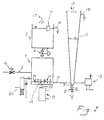
- Fig. 1 does diagrammatically show the structure of the measurement system according to a preferred embodiment of the invention. It does diagrammatically explain the mode of operation of an instrument which can be used, based on the method according to the invention, for measurement of the content of a bleaching chemical, e.g. residual peroxide.
- the device for carrying out a measurement according to the invention comprises a measurement container 1 and a container 2, the container 1 serving as a reaction chamber and the container 2 as an overflow vessel.
- the sample on which the measurement is to be made enters the container 1 through a pipe 3 via a valve 4.
- the containers 1 and 2 are interconnected by a pipe 5, which likewise is provided with a valve 6 for cutting off the connection between the containers 1 and 2.
- valves 4 and 6 When a measurement is to be made the valves 4 and 6 are opened, whereupon the sample in question flows into the containers 1 and 2 up to the activation level for a switch 7 in the container 2 so that the valves 4 and 6 are again closed.
- a valve 8 is closed, which is connected in an outlet pipe 9 below a level vessel 11, which via a pipe 10 communicates with the container 1. This means that also the communicating level vessel 11 will be filled with sample liquid.
- the valve 8 When the valve 8 is opened the vessel 11 is emptied, whereupon the valve 8 is closed.
- the emptying of the level vessel 11 does not affect the contents of the container 1. This is due to the relatively small, about 6 mm, cross-section of the pipe 10 between the container 1 and the vessel 11.
- the catalase is mixed with the sample by means of a special agitator 13 located below the container 1 and comprising a rod supporting a disc 15, the diameter of which is slightly less than the inner diameter of the container 1.
- the disc 15 has a number of through holes 16 and can reciprocate up and down inside the container 1 thus initiating decomposition of the peroxide into water and oxygen gas.
- the oxygen gas thus formed pushes a corresponding sample volume out from the container 1 and into the level vessel 11 and the changed liquid column level is indicated via the pressure sensor 12. Normally, the reaction is rather rapid initially when most of the perioxide is deposed.
- the liquid level in the vessel 11 has a constant position and the pressure signal is in a simple algorithm converted to a value for the peroxide content expressed in ppm or mg/l.
- the measurement system is then emptied in the way that the valves 6 and 8 are opened after which the system is cleaned by means of special spray nozzles 17 for clean water, whereupon the next measurement can be started. All of the measuring sequence is controlled by a micro processor system (not shown in the drawing) also handling data collection, result calculation, result presentation and self-diagnostics with an alarm function.
- the reaction chamber, or the measurement container 1 preferably has a volume of about 400 ml.
- the height of the container 1 roughly equals its diameter. This has a certain significance as far as the agitation is concerned.
- the container volume can naturally be varied but it should be borne in mind that the volume should not be that small that the accuracy and the resolution of the measuring method are lost due to the small amounts of oxygen gas generated when the peroxide is decomposed. A greater volume gives a more robust structure, which furthermore is less sensitive to contamination etc.
- Another aspect is the amount of dosed catalase, meaning that a greater reaction chamber volume entails a higher catalase consumption. This does only means higher operational costs for the instrument but also that the catalase supply at the instrument must be refilled more often, which is looked upon as a negative factor by the worker staff and by the laboratory staff.
- the second measurement container 2 and the level vessel 11 are each provided with an overflow outlet 18, 19, respectively, so that the sample liquid can be diverted to sewer in case of system failure.
- the volume of the level vessel 11 should match the volume of the reaction chamber or the measurement container 1 in order to get maximum resolution within a certain measurement range, e.g. 0-3000 ppm.
- the dosage pump for the catalase can consist of a commercially available equipment.
- the dosage amount is not critical in terms of the measurement result as long as a certain catalase overdosage is made.
- a normal catalase dosage is about 2 ml at a recision chamber volume of about 400 ml.
- the equipment should include a temperature sensor correcting gas volume changes.
- the pressure sensor 12 at the level vessel 11 could be a standard sensor having a good temperature compensation.
- Fig. 2 In order to illustrate the result of measurements according to the invention using a device in accordance with to Fig. 1 there are in Fig. 2 shown typical results when peroxide is used and for different agitation conditions. It is obvious that an intensive mixing yields a more rapid reaction in terms of the decomposition of the peroxide. In this graphic presentation the curves A and B relate to vivid and slow agitation, respectively.
- the diagram in Fig. 3 presents the results obtained at the use of peroxide and an instrument according to the invention.
- the measurement result is here presented as a function of the content of peroxide as determined in the laboratory by titration.
- the level vessel was arranged to give a logarithmic measuring signal within the range 0-3000 ppm.
Landscapes
- Life Sciences & Earth Sciences (AREA)
- Engineering & Computer Science (AREA)
- Wood Science & Technology (AREA)
- Physics & Mathematics (AREA)
- Health & Medical Sciences (AREA)
- Chemical & Material Sciences (AREA)
- Analytical Chemistry (AREA)
- Biochemistry (AREA)
- General Health & Medical Sciences (AREA)
- General Physics & Mathematics (AREA)
- Immunology (AREA)
- Pathology (AREA)
- Investigating Or Analyzing Non-Biological Materials By The Use Of Chemical Means (AREA)
- Measuring Or Testing Involving Enzymes Or Micro-Organisms (AREA)
- Investigating Or Analysing Materials By The Use Of Chemical Reactions (AREA)
- Paper (AREA)
Claims (7)
- Procédé de mesure de la teneur de substances chimiques en relation avec leur utilisation pour le blanchiment de fibres de cellulose, dans une suspension de pâte, dans le but de fournir une qualité de produit améliorée et plus uniforme et d'empêcher une sur-dose de la substance de blanchiment utilisée, caractérisé en ce qu'un échantillon ayant un volume prédéterminé est prélevée dans la suspension de pâte après ou pendant le blanchiment, en ce qu'un catalyseur sous la forme d'une enzyme catalase est ajouté à l'échantillon, en ce que l'échantillon est agité pour provoquer une décomposition de la substance de blanchiment et la formation d'oxygène gazeux, de sorte que de l'oxygène gazeux ainsi formé par l'échantillon dégagera un certain volume d'échantillon, qui sera converti, directement ou indirectement, par l'intermédiaire d'un simple algorithme, en une valeur représentant la teneur de la substance de blanchiment utilisée.
- Procédé selon la revendication 1, caractérisé en ce qu'à l'échantillon un composé chimique de blanchiment, de préférence un peroxyde, est ajouté dans une quantité dosée.
- Procédé selon la revendication 1, caractérisé en ce que le volume d'échantillon dégagé par l'échantillon est recueilli dans une cuve de niveau en communication avec un récipient de mesure contenant l'échantillon.
- Dispositif de mesure de la teneur de substances chimiques ou de la quantité/activité de l'enzyme catalase en relation avec un blanchiment, au moyen desdites substances chimiques, de fibres de cellulose, en particulier dans une suspension de pâte, dans le but de fournir une qualité de produit améliorée et plus uniforme et d'empêcher une sur-dose de la substance de blanchiment utilisée ou, en variante, une dose correcte de substance de blanchiment utilisée pendant le blanchiment, caractérisé en ce qu'une chambre de réaction, ou un récipient de mesure (1), comprenant un dispositif de dosage (20) pour l'addition de la catalase ou d'une quantité déterminée d'une substance chimique de blanchiment, est disposée de façon à recevoir un échantillon prélevé dans la suspension de pâte, le récipient de mesure (1) étant relié à une cuve (11) en communication avec celui-ci et étant adapté pour recevoir la quantité de liquide d'échantillon correspondant au volume de gaz, qui est généré lors de la décomposition de la substance de blanchiment et qui expulse le liquide d'échantillon hors du récipient (1), qui comprend un moyen d'agitation (13) pour réaliser un mélange de l'échantillon avec la catalase qui y est ajoutée dans une quantité dosée, ou avec la substance chimique de blanchiment.
- Dispositif selon la revendication 4, caractérisé en ce que le moyen d'agitation (13) est constitué d'un disque (15), dont le diamètre est légèrement inférieur au diamètre intérieur du récipient de mesure (1), ledit disque (15) ayant un certain nombre de trous de passage (16) et pouvant se déplacer à l'intérieur du récipient (1) vers le haut et vers le bas.
- Dispositif selon la revendication 4, caractérisé en ce qu'un capteur de mesure de pression (12) est relié à la cuve de niveau (11) dans le but d'indiquer les changements de niveau de la colonne de liquide dans la cuve de niveau 11), qui apparaît pendant la mesure.
- Dispositif selon la revendication 4, caractérisé en ce que la cuve de niveau de communication (11) communique avec le récipient de mesure par l'intermédiaire d'un tuyau de connexion (10) ayant une ouverture relativement petite qui, en raison respectivement de la tension superficielle du liquide d'échantillon réel et de la pression négative dans le récipient de mesure (1), n'affecte pas le contenu du récipient (1) lorsque la cuve de niveau (11) est vidée.
Applications Claiming Priority (3)
| Application Number | Priority Date | Filing Date | Title |
|---|---|---|---|
| SE9604829A SE506420C2 (sv) | 1996-12-23 | 1996-12-23 | Förfarande och anordning för mätning av halten kemikalier vid blekning |
| SE9604829 | 1996-12-23 | ||
| PCT/SE1997/002210 WO1998030884A1 (fr) | 1996-12-23 | 1997-12-23 | Procede et dispositif correspondant permettant de mesurer la concentration en produits chimiques durant une operation de blanchiment |
Publications (2)
| Publication Number | Publication Date |
|---|---|
| EP1009993A1 EP1009993A1 (fr) | 2000-06-21 |
| EP1009993B1 true EP1009993B1 (fr) | 2008-08-06 |
Family
ID=20405178
Family Applications (1)
| Application Number | Title | Priority Date | Filing Date |
|---|---|---|---|
| EP97951421A Expired - Lifetime EP1009993B1 (fr) | 1996-12-23 | 1997-12-23 | Procede et dispositif correspondant permettant de mesurer la concentration en produits chimiques durant une operation de blanchiment |
Country Status (8)
| Country | Link |
|---|---|
| US (1) | US6332951B1 (fr) |
| EP (1) | EP1009993B1 (fr) |
| JP (1) | JP3419466B2 (fr) |
| AT (1) | ATE403854T1 (fr) |
| CA (1) | CA2275751C (fr) |
| DE (1) | DE69738889D1 (fr) |
| SE (1) | SE506420C2 (fr) |
| WO (1) | WO1998030884A1 (fr) |
Families Citing this family (8)
| Publication number | Priority date | Publication date | Assignee | Title |
|---|---|---|---|---|
| SE512126C2 (sv) * | 1997-12-23 | 2000-01-31 | Btg Kaelle Inventing Ab | Förfarande för bestämning av mängden/aktiviteten katalas före eller i samband med blekning av företrädesvis i en massasuspension ingående cellulosafibrer |
| SE523933C2 (sv) * | 2002-09-04 | 2004-06-01 | Btg Kaelle Inventing Ab | Förfarande för mätning av ditionitkoncentration |
| FI122238B (fi) * | 2006-02-09 | 2011-10-31 | Metso Automation Oy | Menetelmä ja laitteisto massasuspension kokonaisperoksidipitoisuuden määrittämiseksi |
| CN101446054B (zh) * | 2008-12-23 | 2010-04-14 | 华南理工大学 | 年产5万吨以上纸浆生产线的全无氯漂白方法 |
| CN106086157A (zh) * | 2016-06-21 | 2016-11-09 | 俞率成 | 过氧化氢酶活性测定仪及其使用方法 |
| WO2018017672A1 (fr) * | 2016-07-19 | 2018-01-25 | Chemtreat, Inc. | Procédés et systèmes de détection et de quantification de peroxyacide et de peroxyde dans des fluides |
| TWI841582B (zh) | 2018-08-13 | 2024-05-11 | 美商伊芙卡水科技有限公司 | 用於量測水組成之系統及方法 |
| CN115868655B (zh) * | 2022-12-23 | 2025-03-14 | 福建中烟工业有限责任公司 | 一种烟草样品漂白处理方法 |
Family Cites Families (6)
| Publication number | Priority date | Publication date | Assignee | Title |
|---|---|---|---|---|
| US1874339A (en) * | 1929-05-22 | 1932-08-30 | Solvay Process Co | Analytical method and apparatus therefor |
| US4192708A (en) * | 1974-09-05 | 1980-03-11 | Mo Och Domsjo Aktiebolag | Method for controlling the addition of active chemical for delignifying and/or bleaching cellulose pulp suspended in a liquor containing chemicals reactive with the delignifying and/or bleaching chemical |
| JPS5753649A (en) * | 1980-09-18 | 1982-03-30 | Oriental Yeast Co Ltd | Measuring apparatus of concentration of hydrogen peroxide |
| EP0052834A2 (fr) * | 1980-11-24 | 1982-06-02 | The Continental Group, Inc. | Capteur mécanique de peroxyde basé sur une mesure de pression |
| US5081045A (en) * | 1989-07-18 | 1992-01-14 | Mcgill Errol | Chemical concentration pressure analyzing apparatus and process |
| SE512126C2 (sv) * | 1997-12-23 | 2000-01-31 | Btg Kaelle Inventing Ab | Förfarande för bestämning av mängden/aktiviteten katalas före eller i samband med blekning av företrädesvis i en massasuspension ingående cellulosafibrer |
-
1996
- 1996-12-23 SE SE9604829A patent/SE506420C2/sv not_active IP Right Cessation
-
1997
- 1997-12-23 US US09/331,462 patent/US6332951B1/en not_active Expired - Lifetime
- 1997-12-23 AT AT97951421T patent/ATE403854T1/de not_active IP Right Cessation
- 1997-12-23 CA CA002275751A patent/CA2275751C/fr not_active Expired - Lifetime
- 1997-12-23 WO PCT/SE1997/002210 patent/WO1998030884A1/fr not_active Ceased
- 1997-12-23 DE DE69738889T patent/DE69738889D1/de not_active Expired - Fee Related
- 1997-12-23 JP JP52948198A patent/JP3419466B2/ja not_active Expired - Fee Related
- 1997-12-23 EP EP97951421A patent/EP1009993B1/fr not_active Expired - Lifetime
Also Published As
| Publication number | Publication date |
|---|---|
| US6332951B1 (en) | 2001-12-25 |
| SE9604829D0 (sv) | 1996-12-23 |
| CA2275751C (fr) | 2008-07-08 |
| DE69738889D1 (de) | 2008-09-18 |
| JP2001500581A (ja) | 2001-01-16 |
| WO1998030884A1 (fr) | 1998-07-16 |
| SE506420C2 (sv) | 1997-12-15 |
| EP1009993A1 (fr) | 2000-06-21 |
| SE9604829L (sv) | 1997-06-24 |
| JP3419466B2 (ja) | 2003-06-23 |
| CA2275751A1 (fr) | 1998-07-16 |
| ATE403854T1 (de) | 2008-08-15 |
Similar Documents
| Publication | Publication Date | Title |
|---|---|---|
| US4427772A (en) | Apparatus having automatic calibration for determining hydrogen peroxide concentration | |
| US20030102094A1 (en) | Method in the bleaching of pulp and a device for the bleaching of pulp | |
| CA1170430A (fr) | Methode de regulation pour les produits chimiques lors d'un traitement au gaz | |
| US6332951B1 (en) | Method for measuring the content of bleaching chemicals used for bleaching cellulose fibers | |
| EP1007934B1 (fr) | Dispositif pour analyser des echantillons de liquides | |
| US6124111A (en) | Method and an arrangement for measuring the amount/activity of catalase before or in connection with bleaching of preferably cellulose fibres included in a pulp suspension | |
| US6458213B1 (en) | Method and device for automatic cleaning of opto-electronic sensor systems for substance analysis | |
| JPS5828215Y2 (ja) | 滴定装置 | |
| SE520297C2 (sv) | Förfarande och apparatursystem för utvinning av vätska för analysändamål ur cellulosamassa med hög massakoncentration | |
| EP1240384B1 (fr) | Procede electrochimique permettant de determiner le contenu de lignine dans la pate | |
| EP0232939B1 (fr) | Méthode et dispositif pour la détermination de la quantité de matières solides dispersées dans un liquide | |
| EP1982015B1 (fr) | Procede et appareil destines a determiner la teneur totale en peroxyde d'une suspension de pate | |
| FI76642B (fi) | Foerfarande och apparat foer bestaemning av cellulosamassaegenskaper. | |
| EP1396723A1 (fr) | Procédé de mesure de la concentration de dithionite de sodium | |
| FI118430B (fi) | Menetelmä massan valkaisussa ja massan valkaisulaitteisto | |
| Thomas | The development of on-line paper machine wet-end analysers | |
| Paterson et al. | Potentiometric determination of chlorine in microliter water samples | |
| NL8401558A (nl) | Inrichting voor het nemen en onderzoeken van monsters van fluida tijdens bedrijf in gesloten reactorvaten. |
Legal Events
| Date | Code | Title | Description |
|---|---|---|---|
| PUAI | Public reference made under article 153(3) epc to a published international application that has entered the european phase |
Free format text: ORIGINAL CODE: 0009012 |
|
| 17P | Request for examination filed |
Effective date: 19990616 |
|
| AK | Designated contracting states |
Kind code of ref document: A1 Designated state(s): AT DE FI FR GB |
|
| GRAP | Despatch of communication of intention to grant a patent |
Free format text: ORIGINAL CODE: EPIDOSNIGR1 |
|
| GRAS | Grant fee paid |
Free format text: ORIGINAL CODE: EPIDOSNIGR3 |
|
| GRAA | (expected) grant |
Free format text: ORIGINAL CODE: 0009210 |
|
| AK | Designated contracting states |
Kind code of ref document: B1 Designated state(s): AT DE FI FR GB |
|
| REG | Reference to a national code |
Ref country code: GB Ref legal event code: FG4D |
|
| REF | Corresponds to: |
Ref document number: 69738889 Country of ref document: DE Date of ref document: 20080918 Kind code of ref document: P |
|
| PG25 | Lapsed in a contracting state [announced via postgrant information from national office to epo] |
Ref country code: AT Free format text: LAPSE BECAUSE OF FAILURE TO SUBMIT A TRANSLATION OF THE DESCRIPTION OR TO PAY THE FEE WITHIN THE PRESCRIBED TIME-LIMIT Effective date: 20080806 |
|
| PLBE | No opposition filed within time limit |
Free format text: ORIGINAL CODE: 0009261 |
|
| STAA | Information on the status of an ep patent application or granted ep patent |
Free format text: STATUS: NO OPPOSITION FILED WITHIN TIME LIMIT |
|
| 26N | No opposition filed |
Effective date: 20090507 |
|
| GBPC | Gb: european patent ceased through non-payment of renewal fee |
Effective date: 20081223 |
|
| REG | Reference to a national code |
Ref country code: FR Ref legal event code: ST Effective date: 20090831 |
|
| PG25 | Lapsed in a contracting state [announced via postgrant information from national office to epo] |
Ref country code: DE Free format text: LAPSE BECAUSE OF NON-PAYMENT OF DUE FEES Effective date: 20090701 |
|
| PG25 | Lapsed in a contracting state [announced via postgrant information from national office to epo] |
Ref country code: GB Free format text: LAPSE BECAUSE OF NON-PAYMENT OF DUE FEES Effective date: 20081223 |
|
| PG25 | Lapsed in a contracting state [announced via postgrant information from national office to epo] |
Ref country code: FR Free format text: LAPSE BECAUSE OF NON-PAYMENT OF DUE FEES Effective date: 20081231 |
|
| PGFP | Annual fee paid to national office [announced via postgrant information from national office to epo] |
Ref country code: FI Payment date: 20161212 Year of fee payment: 20 |