EP1013779A2 - Procédé pour le traitement et le lissage des surfaces de glissement - Google Patents
Procédé pour le traitement et le lissage des surfaces de glissement Download PDFInfo
- Publication number
- EP1013779A2 EP1013779A2 EP99124957A EP99124957A EP1013779A2 EP 1013779 A2 EP1013779 A2 EP 1013779A2 EP 99124957 A EP99124957 A EP 99124957A EP 99124957 A EP99124957 A EP 99124957A EP 1013779 A2 EP1013779 A2 EP 1013779A2
- Authority
- EP
- European Patent Office
- Prior art keywords
- sliding member
- surface roughness
- counter
- sliding
- treating
- Prior art date
- Legal status (The legal status is an assumption and is not a legal conclusion. Google has not performed a legal analysis and makes no representation as to the accuracy of the status listed.)
- Withdrawn
Links
Images



Classifications
-
- B—PERFORMING OPERATIONS; TRANSPORTING
- B23—MACHINE TOOLS; METAL-WORKING NOT OTHERWISE PROVIDED FOR
- B23P—METAL-WORKING NOT OTHERWISE PROVIDED FOR; COMBINED OPERATIONS; UNIVERSAL MACHINE TOOLS
- B23P9/00—Treating or finishing surfaces mechanically, with or without calibrating, primarily to resist wear or impact, e.g. smoothing or roughening turbine blades or bearings; Features of such surfaces not otherwise provided for, their treatment being unspecified
-
- C—CHEMISTRY; METALLURGY
- C21—METALLURGY OF IRON
- C21D—MODIFYING THE PHYSICAL STRUCTURE OF FERROUS METALS; GENERAL DEVICES FOR HEAT TREATMENT OF FERROUS OR NON-FERROUS METALS OR ALLOYS; MAKING METAL MALLEABLE, e.g. BY DECARBURISATION OR TEMPERING
- C21D7/00—Modifying the physical properties of iron or steel by deformation
- C21D7/02—Modifying the physical properties of iron or steel by deformation by cold working
- C21D7/04—Modifying the physical properties of iron or steel by deformation by cold working of the surface
- C21D7/06—Modifying the physical properties of iron or steel by deformation by cold working of the surface by shot-peening or the like
-
- C—CHEMISTRY; METALLURGY
- C23—COATING METALLIC MATERIAL; COATING MATERIAL WITH METALLIC MATERIAL; CHEMICAL SURFACE TREATMENT; DIFFUSION TREATMENT OF METALLIC MATERIAL; COATING BY VACUUM EVAPORATION, BY SPUTTERING, BY ION IMPLANTATION OR BY CHEMICAL VAPOUR DEPOSITION, IN GENERAL; INHIBITING CORROSION OF METALLIC MATERIAL OR INCRUSTATION IN GENERAL
- C23C—COATING METALLIC MATERIAL; COATING MATERIAL WITH METALLIC MATERIAL; SURFACE TREATMENT OF METALLIC MATERIAL BY DIFFUSION INTO THE SURFACE, BY CHEMICAL CONVERSION OR SUBSTITUTION; COATING BY VACUUM EVAPORATION, BY SPUTTERING, BY ION IMPLANTATION OR BY CHEMICAL VAPOUR DEPOSITION, IN GENERAL
- C23C8/00—Solid state diffusion of only non-metal elements into metallic material surfaces; Chemical surface treatment of metallic material by reaction of the surface with a reactive gas, leaving reaction products of surface material in the coating, e.g. conversion coatings, passivation of metals
- C23C8/02—Pretreatment of the material to be coated
-
- C—CHEMISTRY; METALLURGY
- C23—COATING METALLIC MATERIAL; COATING MATERIAL WITH METALLIC MATERIAL; CHEMICAL SURFACE TREATMENT; DIFFUSION TREATMENT OF METALLIC MATERIAL; COATING BY VACUUM EVAPORATION, BY SPUTTERING, BY ION IMPLANTATION OR BY CHEMICAL VAPOUR DEPOSITION, IN GENERAL; INHIBITING CORROSION OF METALLIC MATERIAL OR INCRUSTATION IN GENERAL
- C23C—COATING METALLIC MATERIAL; COATING MATERIAL WITH METALLIC MATERIAL; SURFACE TREATMENT OF METALLIC MATERIAL BY DIFFUSION INTO THE SURFACE, BY CHEMICAL CONVERSION OR SUBSTITUTION; COATING BY VACUUM EVAPORATION, BY SPUTTERING, BY ION IMPLANTATION OR BY CHEMICAL VAPOUR DEPOSITION, IN GENERAL
- C23C8/00—Solid state diffusion of only non-metal elements into metallic material surfaces; Chemical surface treatment of metallic material by reaction of the surface with a reactive gas, leaving reaction products of surface material in the coating, e.g. conversion coatings, passivation of metals
- C23C8/80—After-treatment
Definitions
- the present invention relates to a method of treating and smoothing a surface of a sliding member and a counter member such as a shim and a cam for driving a valve of an engine.
- intake valves and exhaust valves of an engine are driven by cams on camshafts.
- a cam moves keeping in contact with a cam follower such as a tappet at the top of the valve and a shim or a rocker arm attached to the tappet. Since frictional resistance between these cam and cam follower is one of causes of engine output loss, it is preferred to make a sliding surface of the member as smooth like a minor surface as possible so as to lower its frictional resistance against the counter member.
- surface roughness ( ⁇ mRa) as used hereafter shall mean and refer to an arithmetic average roughness Ra measured in ⁇ m.
- ⁇ mRa surface roughness
- the foregoing object of the present invention is achieved by applying surface treatment to a sliding member, such as a cam follower installed in a valve drive system of an engine, cooperative to slide on a counter member, such as a valve drive cam, with the surface kept in contact with a surface of the counter member which is finished by pressurized particle containing fluid blasting to a sliding surface with surface roughness ranging approximately 0.01 to 1.0 ⁇ mRa so as to provide the sliding member with surface higher than surface hardness of the counter member.
- a sliding member such as a cam follower installed in a valve drive system of an engine
- a counter member such as a valve drive cam
- the surface treating method of the present invention comprises the steps of pre-finishing the sliding member to a surface with surface roughness lower than surface roughness of the counter member, blasting pressurized fluid containing particles harder than the surface of the sliding member on the surface of the sliding member to finish the sliding member to a surface with surface roughness ranging approximately 0.01 to 1.0 ⁇ mRa, and hardening the surface of the sliding member to surface hardness higher than surface hardness of the counter member.
- the sliding member is pre-finished by, for instance grinding and polishing, to a relatively smooth surface with surface roughness lower than the surface roughness of the counter member.
- the surface of the sliding member with relatively low surface roughness is formed with a number of minute projections that are separately and approximately uniformly distributed over the surface of the sliding member. If the lower limit surface roughness 0.01 ⁇ mRa is exceeded, it is difficult to smooth sufficiently a sliding surface of the counter member during running-in operation and, on the other hand, if the upper limit surface roughness 1.0 ⁇ mRa is exceeded, it is difficult to smooth the sliding member.
- the sliding member at the sliding surface is hardened. Since the projections are harder than the counter member, they polish and smooth the surface of the counter member during running-in operation. At the same time, since the projections, which are minute and distributed separately from one another, are below in hardness than 1500 Hv although harder than the counter member, they are easily rent apart from the sliding member and smoothed during running-in operation. As a result, the sliding frictional resistance between the sliding member and the counter member becomes very low. In addition, since it is possible to form and distribute the projections uniformly over the surface of the sliding member through a simple treatment, a certain drop in sliding frictional resistance between the sliding member and the counter member is realized constantly at low costs.
- the sliding member is preferably pre-finished to a surface with surface roughness lower than 0.2 ⁇ mRa with an effect of forming more uniform projections by the pressurized particle containing fluid blasting and providing a more smooth surface of the sliding member through sunning-in operation.
- the surface of the sliding member is preferably treated and finished by the pressurized particle containing fluid blasting to a surface roughness ranging approximately 0.02 to 0.7 ⁇ mRa. This leads to a further drop in sliding frictional resistance between the sliding member and the counter member.
- Hardening the surface of the sliding member to surface hardness lower than 1500 Hv realizes creation of a well smoothed surface of the counter member and creation of a certainly smoothed surface of the sliding member during running-in operation.
- the hardening of sliding member is accomplished by penetrating and diffusing an element in a surface layer of the sliding member, i.e. diffusion metalizing, so as thereby to form a hard surface layer of a compound of the element which has surface hardness higher than surface hardness of the counter member.
- Nitriding, carburizing or boronizing may be employed to penetrate and diffuse an element, namely nitrogen, carbon or boron, as the element in the surface layer of the sliding member.
- the sliding member may be further treated by carburizing and quenching and thereafter polished to a surface with surface roughness lower than that of the surface of the counter member.
- the carburizing and quenching provides an increased total case depth and increased hardness of the surface layer. In consequence, the sliding member keeps the hardness of surface layer even when polished after the treatment by carburizing and quenching. In the event where the sliding member is provided with specified surface hardness by carburizing and quenching, it is not necessary to apply diffusion metalizing tot he sliding member additionally.
- the pressurized particle containing fluid blasting may be applied to the sliding member after the application of diffusion metalizing so as to provide different hardness at the surface and in the surface layer of the sliding member.
- the surface treating method comprises the steps of blasting pressurized fluid containing particles harder than the surface of the sliding member on the surface of the sliding member to finish the sliding member to a surface with surface roughness ranging approximately 0.02 to 0.7 ⁇ mRa after pre-finishing the sliding member to a surface with surface roughness lower than a lower one of 1.0 ⁇ mRa and surface roughness of the counter member, and penetrating and diffusing an element in a surface layer of said sliding member so as thereby to form a hard compound surface layer whose hardness is higher than said surface hardness of said counter member but lower than 1500 Hv.
- the minute projections which are formed separately and uniformly over the surface of the sliding member by the pressurized particle containing fluid blasting, are hardened by the diffusion metalizing. Since an element is penetrated and diffused in a surface layer of the sliding member during application of the diffusion metalizing, it has no effect on the surface of the sliding member. As a result, the projections on the surface of the sliding member do not cause any change in shape and keep the surface roughness provided by the pressurized particle containing fluid blasting. In the event where the diffusion metalizing is applied to the sliding member before the pressurized particle containing fluid blasting, there is a possibility that the pressurized particle containing fluid blasting shaves off partly the hard compound surface layer if the hard compound surface layer is thin.
- the diffusion metalizing after the pressurized particle containing fluid blasting effectively increases hardness of the projections on the sliding member.
- the projections of the sliding member polish and smooth the surface of the counter member and are simultaneously shaved off by the counter member to form a smooth surface on the sliding member. This provides frictional resistance between these sliding member and counter member controlled to a lowest limit.
- a surface smoothing method of smoothing surfaces of a sliding member and a counter member which slide on each other with the surfaces thereof kept in contact with each other comprises the steps of providing a sliding member by pre-finishing it to a surface with surface roughness lower than surface roughness of the counter member, blasting pressurized fluid containing particles harder than the surface of the sliding member on the surface of the sliding member to finish the sliding member to a surface with surface roughness ranging approximately 0.01 to 1.0 ⁇ mRa, and hardening the surface of the sliding member to surface hardness higher than surface hardness of the counter member, installing the sliding member and the counter member with the surfaces thereof in contact with each other; and driving both members so as to slide on each other for running-in, thereby smoothing the surfaces of both members.
- the surfaces of the sliding member and the counter member are finished so as to gain resultant surface roughness of both members smaller than 0.2 ⁇ mRa after initial running-in operation. This provides frictional resistance between these sliding member and counter member controlled to a lowest limit.
- Figure 1 which shows a cylinder head 1 equipped with a direct driving type of exhaust valve system in which a shim 7 on the top of a tappet 6 and a cam 12 are installed
- the cylinder head 1 has a valve seat 3 at an extreme end of an exhaust port 2.
- An exhaust valve head 4a at its valve face is situated and forced against the valve seat 3 by means of a valve spring 5.
- the shim 7 on the top of the tappet 6 is installed to adjust a clearance between the tappet 6 and the cam 12.
- a camshaft 11 on which there is one cam 12 for each valve in the engine is turned at one-half crankshaft speed by a gear or pulley and a timing chain or a toothed timing belt (not shown).
- the cam 12 pushes the exhaust valve 4 against the valve spring 5 through the shim 7 and tappet 6 to close the exhaust port 2.
- the cam 12 is kept in sliding contact with the shim 7. That is to say, the shim 7 works as a cam follower that is referred to as a sliding member in regard to the cam 12 as a counter member and the contact surfaces of the shim 7 and the cam 12 from sliding surfaces.
- the cylinder head 1 is equipped with an intake valve system that is the same in construction and operation as the exhaust valve system. Both shim 7 and the cam 12 are finished to smooth sliding surfaces so as to be as small in frictional resistance between them as possible. In order to make the sliding surface smooth, it is necessary to apply an appropriate surface treat such as described below on the shim 7 first.
- Figure 2 shows a process comprising steps (a) - (g) of surface treatment of a chrome molybdenum steel shim 7 as a sliding member cooperative with, for example, a chilled iron cam 12 that has been finished without applying any surface treatment to a smooth surface with surface roughness ranging approximately 0.5 to 0.7 ⁇ mRa and surface hardness ranging approximately 520 to 560 Hv.
- the chrome molybdenum steel shim 7A (step (a)) that has a surface roughness higher than the chilled iron cam 12 is pre-finished by surface grinding or surface polishing to a smooth surface whose surface roughness is lower than the chilled iron cam 12 (step (b)), e.g. lower than approximately 0.2 ⁇ mRa, desirably.
- a surface treatment is applied to the surface the chrome molybdenum steel shim 7A by blasting a pressurized fluid, such as pressurized air and pressurized water, containing hard particles that is harder than the surface hardness of the chrome molybdenum steel shim 7A so as to finish it to a smooth surface with a surface roughness (center line mean surface roughness) ranging 0.01 to 1.0 ⁇ mRa (step (c)).
- a pressurized fluid such as pressurized air and pressurized water
- the pressurized particle containing fluid blasting forms a number of minute projections 7a that are separately and approximately uniformly distributed over the surface of the chrome molybdenum steel shim 7A that has been pre-finished so as to have a relatively low surface roughness.
- Figure 3 shows a surface of the chrome molybdenum steel shim 7A in profile finished by shot blasting by way of example. If the lower limit of the center line mean surface roughness is exceeded, it is impossible to smooth the pre-finished surface of the cam 12 as required when the chrome molybdenum steel shim 7A is firstly run in with the cam 12 as will be described later.
- the center line surface roughness of the chrome molybdenum steel shim 7A after the pressurized particle containing fluid blasting is limited to a range between 0.01 and 1.0 ⁇ mRa and, more preferably to a range between 0.02 and 0.7 ⁇ mRa.
- nitriding such as salt-bath nitrocarburizing and gas nitrocarburizing, carburizing, and boronizing are appropriate.
- step (f) After first installation of the shim 7A and the cam 12 thus prepared to the cylinder head 1, the engine is operated to drive the valve drive system for running-in of the shim 7A and the cam 12 thus prepared (step (f)).
- the minute projections 7a on the surface shim 7A has hardness higher than the surface of cam 12
- the minute projections 7a on the surface shim 7A grind and polish the surface of shim 7A to form a smooth surface on the shim 7A since they have hardness higher than the surface of cam 12 and, on the other hand, are easily rent apart from the shim 7 and smoothed since they are below in hardness than 1500 Hv although harder than the cam 12 and distributed separately and uniformly over the surface.
- the compound surface roughness of the shim 7 and the cam 12 is preferably less than 0.2 ⁇ mRa, which provides significantly small frictional resistance between them.
- the shim 7 at its surface is hardened by diffusion metalizing treatment such as nitrocarburizing to form a hard compound surface layer that is harder than the cam 12, during initial operation of the valve drive system in which the shim 7 and the cam 12 are installed, the surfaces of the shim 7 and the cam 12 kept in sliding contact with each other are smoothed.
- the diffusion metalizing does not cause a significant change in form of the surface of the shim 7, so that it is realized an ensured drop and stabilization of the frictional resistance between the shim 7 and the cam 12
- the diffusion metalizing may be applied to the surface of the shim 7 not after but before execution of the pressurized particle containing fluid blasting. In such a case, however, since the hard compound surface layer of the shim 7 that is formed by the diffusion metalizing is possibly partly striped off, there is the necessity of making the hard compound surface layer thicker. Moreover, carburizing and quenching may be carried out before grinding and polishing the sliding surface of the shim 7 so as to make the surface layer of the shim 7 harder than the surface of the cam 12. In such a case, the shim 7 is increased in hardness not only at the sliding surface but also in the inside, in other words, can have an increased total case depth.
- the diffusion metalizing may or may not be carried out subsequently to the pressurized particle containing fluid blasting.
- the surface treating method of the invention may b applied to the tappet 6 as a cam follower when the cam clearance is adjusted between the tappet 6 itself and the cam 12 or to a rocker arm as a cam follower in the rocker arm type of valve drive system.
- the surface treating method of the invention can be applied to various types of sliding members which make sliding movement on another member.
- Sample shims according to the above described embodiment and comparative shims were prepared and tested to verify a change in surface roughness with operating time.
- a test cam was made of a chilled iron and finished to a smooth sliding surface with surface roughness ranging approximately 0.5 to 0.7 ⁇ mRa and surface hardness ranging approximately 520 to 560 Hv.
- Sample shims SS-I to SS-IV and comparative shims CS-I to CS-VI were made of a molybdenum steel and surface treated by carburizing and quenching so as to have surface hardness ranging 700 to 750 Hv.
- sample shims SS-I to SS-VI were treated by shot-blasting after pre-finished to sliding surfaces with surface roughness lower than that of the test cam and, thereafter, further treated by salt-bath nitrocarburizing as diffusion metalizing. No diffusion metalizing was not applied to the sample shim SS-II.
- each sample shim was made harder than the test cam.
- the comparative shims CS-I and CS-III were pre-finished by grinding and polishing or rapping to sliding surfaces with surface roughness lower than that of the test cam.
- the comparative shim CS-I was similar to shims of valve systems used in gasoline engines.
- the comparative shims CS-II and CS-IV were treated by salt-bath nitrocarburizing only after pre-finished to sliding surfaces with surface roughness lower than that of the test cam.
- the treatment applied to the comparative shim CS-II was similar to what is generally applied to shims of valve systems used in diesel engines in order to improve wear resistance.
- the comparative shim CS-V was pre-finished to a sliding surface with surface roughness higher than that of the test cam and thereafter treated by shot-blasting so as to have surface roughness higher than 1.0 ⁇ mRa.
- the comparative shim CS-VI was treated by shot-blasting metalizing so as to have surface roughness higher than 1.
- Figure 4 shows the result of investigation which was made on various surface roughness of sliding surface of shims before and after nitrocarburizing treatment to figure out how the surface roughness changed due to the salt-bath nitrocarburizing treatment.
- Figure 4 apparently demonstrates that a very slight increase in surface roughness occurs due to the nitrocarburizing treatment but is almost negligible (double-doffed line shows no change in surface roughness before and after the nitrocarburizing treatment).
- the reason for the occurrence of such a slight increase in surface roughness due to the nitrocarburizing treatment is generation of a very thin layer of oxide on the surface of the shim. However, since the layer of oxide is soft, it does not affect on a polishing effect against the cam.
- the surface profile of the shim is evaluated to be unchanged before and after nitrocarburizing treatment.
- the shim having the lowest surface roughness in Figure 4 was not treated by shot-blasting but treated by salt-bath nitrocarburizing only, and the remaining shims were treated by shot-blasting and thereafter by salt-bath nitrocarburizing.
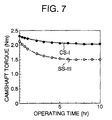
- both sample shims and cam cause greater increases in surface roughness than the comparative shims and become stable but no change after a 10 hours duration of operation thereof. This means that both sliding surfaces of each shim and cam are smoothed through an approximately 10 hours duration of initial operation thereof.
- Cam Shim SS-I Caused the greatest drop in surface roughness among the eight Surface roughness after a drop in surface roughness was lower than CS-I SS-II Caused drop in surface roughness greater than CS-I
- Surface roughness after a drop in surface roughness was similar to SS-I SS-III
- CS-II causesd drop in surface roughness greater than CS-II
- CS-I causesd the greatest drop in surface roughness among CS-I to CS-V
- Surface roughness was slightly dropped
- CS-II Caused drop in surface roughness smaller than CS-I
- CS-II Caused drop in surface roughness similar to CS-II Showed a tendency to increase surface roughness during operation
- CS-IV causesd drop in surface roughness similar to CS-II Showed a tendency to increase surface roughness during operation CS-V Test was suspended due to an occurrence of s
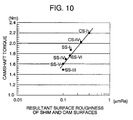
- the resultant surface roughness is in a one-to-one relationship to camshaft torque as will be described later, and the camshaft torque, and hence sliding frictional resistance becomes smaller with a drop in resultant surface roughness of the shim and cam.
- the shim when using a shim finished by shot-blasting to a sliding surface with a surface roughness lower than 1.0 ⁇ mRa, the shim definitely provides a greater drop in resultant surface roughness, and hence in sliding frictional resistance, than the comparative shim CS-I.
- the shim reduces its sliding frictional resistance to a significantly lower level.
- camshaft torque drops with a drop in the resultant surface roughness and when the resultant surface roughness is lower than 0.2 ⁇ mRa and, when using a shim with a resultant surface roughness lower than 0.2 ⁇ mRa, the camshaft torque is lowered to a significantly low level.
Landscapes
- Chemical & Material Sciences (AREA)
- Engineering & Computer Science (AREA)
- Mechanical Engineering (AREA)
- Materials Engineering (AREA)
- Metallurgy (AREA)
- Organic Chemistry (AREA)
- Chemical Kinetics & Catalysis (AREA)
- Crystallography & Structural Chemistry (AREA)
- Valve-Gear Or Valve Arrangements (AREA)
- Solid-Phase Diffusion Into Metallic Material Surfaces (AREA)
- Sliding-Contact Bearings (AREA)
- Chemical Treatment Of Metals (AREA)
Applications Claiming Priority (4)
| Application Number | Priority Date | Filing Date | Title |
|---|---|---|---|
| JP36653098 | 1998-12-24 | ||
| JP36653098 | 1998-12-24 | ||
| JP31207899A JP4269443B2 (ja) | 1998-12-24 | 1999-11-02 | 摺動部材の表面処理方法及び該方法を用いた摺動部材の表面平滑化方法 |
| JP31207899 | 1999-11-02 |
Publications (2)
| Publication Number | Publication Date |
|---|---|
| EP1013779A2 true EP1013779A2 (fr) | 2000-06-28 |
| EP1013779A3 EP1013779A3 (fr) | 2002-07-31 |
Family
ID=26567023
Family Applications (1)
| Application Number | Title | Priority Date | Filing Date |
|---|---|---|---|
| EP99124957A Withdrawn EP1013779A3 (fr) | 1998-12-24 | 1999-12-14 | Procédé pour le traitement et le lissage des surfaces de glissement |
Country Status (3)
| Country | Link |
|---|---|
| US (1) | US6294029B1 (fr) |
| EP (1) | EP1013779A3 (fr) |
| JP (1) | JP4269443B2 (fr) |
Cited By (5)
| Publication number | Priority date | Publication date | Assignee | Title |
|---|---|---|---|---|
| EP1167825A3 (fr) * | 2000-06-30 | 2004-03-24 | Eaton Corporation | Surfaces d'engrenage polies |
| WO2007064336A1 (fr) * | 2005-12-02 | 2007-06-07 | United Technologies Corporation | Procedes et systemes permettant d'ameliorer l'efficacite des systemes de transmission de puissance contenant des lubrifiants ayant une viscosite plus elevee |
| WO2008031663A1 (fr) * | 2006-09-14 | 2008-03-20 | Robert Bosch Gmbh | Entraînement de l'arbre à came, en particulier pour une pompe à injection diesel, avec un galet de roulement entraîné de manière à pouvoir se soulever |
| DE102007020413A1 (de) * | 2007-04-27 | 2008-11-06 | Schunk Ingenieurkeramik Gmbh | Gleitkörper für Lager- oder Dichtungsanordnungen |
| EP1691040A3 (fr) * | 2005-02-02 | 2009-05-27 | Kabushiki Kaisha Riken | Poussoir de soupape |
Families Citing this family (17)
| Publication number | Priority date | Publication date | Assignee | Title |
|---|---|---|---|---|
| DE10139123A1 (de) * | 2000-09-06 | 2002-03-14 | Luk Lamellen & Kupplungsbau | Laschenkette |
| JP3745971B2 (ja) | 2001-03-21 | 2006-02-15 | 本田技研工業株式会社 | 鋼材料 |
| CA2441276C (fr) | 2001-03-21 | 2009-10-06 | Honda Giken Kogyo Kabushiki Kaisha | Materiau en acier et procede de fabrication correspondant |
| JP3930420B2 (ja) * | 2002-11-20 | 2007-06-13 | 愛三工業株式会社 | チタン部材の表面処理方法 |
| WO2004081252A1 (fr) * | 2003-03-10 | 2004-09-23 | Kabushiki Kaisha Riken | Poussoir de soupape nitrure et son procede de fabrication |
| DE10313737B4 (de) * | 2003-03-27 | 2007-01-04 | Robert Bosch Gmbh | Nitrocarburierschicht zur Reibungs- und Verschleißminimierung und Verfahren zu deren Herstellung |
| NL1029042C2 (nl) * | 2005-05-13 | 2006-11-14 | Gear Chain Ind Bv | Inrichting voor het tot voorbij de elasticiteitsgrens oprekken van de schalmen van een transmissieketting. |
| DE102007016643A1 (de) * | 2007-04-05 | 2008-10-09 | Geislinger Gmbh | Kraftschlüssige Spannverbindung und Verfahren zu deren Herstellung |
| US10309457B2 (en) | 2012-03-27 | 2019-06-04 | Senju Metal Industry Co., Ltd. | Sliding member |
| US9956613B2 (en) | 2012-10-25 | 2018-05-01 | Senju Metal Industry Co., Ltd. | Sliding member and production method for same |
| WO2014125621A1 (fr) | 2013-02-15 | 2014-08-21 | 千住金属工業株式会社 | Élément coulissant et procédé de production pour élément coulissant |
| JP5713074B2 (ja) * | 2013-09-27 | 2015-05-07 | 千住金属工業株式会社 | 摺動部材 |
| JP5713073B2 (ja) * | 2013-09-27 | 2015-05-07 | 千住金属工業株式会社 | 摺動部材及び摺動部材の製造方法 |
| US9260088B2 (en) * | 2013-10-16 | 2016-02-16 | Ford Global Technologies, Llc | Hybrid brake pedal feel system |
| US11007572B2 (en) | 2015-08-17 | 2021-05-18 | Ntn Corporation | Sliding member and method for producing same |
| DE102017115175A1 (de) * | 2017-07-06 | 2019-01-10 | Brückner Maschinenbau GmbH & Co. KG | Gleitelement insbesondere für eine Reckanlage und/oder Transportkette sowie eine zugehörige Reckanlage oder Transportkette |
| JP7820766B2 (ja) * | 2022-03-17 | 2026-02-26 | 株式会社河端製作所 | 機械要素の製造方法及び機械要素 |
Family Cites Families (12)
| Publication number | Priority date | Publication date | Assignee | Title |
|---|---|---|---|---|
| JPS63109151A (ja) * | 1986-10-27 | 1988-05-13 | Hitachi Ltd | 高硬度複合材およびその製造方法 |
| JPH03111551A (ja) * | 1989-09-25 | 1991-05-13 | Mazda Motor Corp | 歯車の製造方法 |
| US5217931A (en) * | 1990-01-30 | 1993-06-08 | Mazda Motor Corporation | Ceramic sliding member and method of manufacturing the same |
| DE69330509T2 (de) * | 1992-03-31 | 2002-04-11 | Sumitomo Electric Industries, Ltd. | Gleitbauteil und seine herstellung |
| GB2268901B (en) * | 1992-07-23 | 1995-07-05 | Nsk Ltd | A rolling/sliding part |
| JPH0754050A (ja) * | 1993-08-11 | 1995-02-28 | Kobe Steel Ltd | 歯元曲げ疲労強度および歯面耐ピッチング性に優れた高強度歯車並びにその製造方法 |
| JP3252565B2 (ja) | 1993-10-20 | 2002-02-04 | トヨタ自動車株式会社 | 摺動部材およびその製造方法 |
| JPH07243308A (ja) * | 1994-03-01 | 1995-09-19 | Toyota Motor Corp | 金属部材同士の摺動装置及び内燃機関の動弁装置 |
| JPH0853711A (ja) * | 1994-08-11 | 1996-02-27 | Kobe Steel Ltd | 表面硬化処理方法 |
| KR100246703B1 (ko) * | 1994-11-14 | 2000-04-01 | 구라우치 노리타카 | 세라믹 미끄름 부품 |
| WO1997019279A1 (fr) * | 1995-11-21 | 1997-05-29 | Koyo Seiko Co., Ltd. | Piece mecanique |
| JPH09302454A (ja) * | 1996-05-13 | 1997-11-25 | Toyota Central Res & Dev Lab Inc | 浸炭焼入れ材の前処理方法及び浸炭焼入れ材の製造方法 |
-
1999
- 1999-11-02 JP JP31207899A patent/JP4269443B2/ja not_active Expired - Fee Related
- 1999-12-14 EP EP99124957A patent/EP1013779A3/fr not_active Withdrawn
- 1999-12-20 US US09/468,387 patent/US6294029B1/en not_active Expired - Lifetime
Cited By (6)
| Publication number | Priority date | Publication date | Assignee | Title |
|---|---|---|---|---|
| EP1167825A3 (fr) * | 2000-06-30 | 2004-03-24 | Eaton Corporation | Surfaces d'engrenage polies |
| EP1691040A3 (fr) * | 2005-02-02 | 2009-05-27 | Kabushiki Kaisha Riken | Poussoir de soupape |
| WO2007064336A1 (fr) * | 2005-12-02 | 2007-06-07 | United Technologies Corporation | Procedes et systemes permettant d'ameliorer l'efficacite des systemes de transmission de puissance contenant des lubrifiants ayant une viscosite plus elevee |
| WO2008031663A1 (fr) * | 2006-09-14 | 2008-03-20 | Robert Bosch Gmbh | Entraînement de l'arbre à came, en particulier pour une pompe à injection diesel, avec un galet de roulement entraîné de manière à pouvoir se soulever |
| DE102007020413A1 (de) * | 2007-04-27 | 2008-11-06 | Schunk Ingenieurkeramik Gmbh | Gleitkörper für Lager- oder Dichtungsanordnungen |
| DE102007020413B4 (de) * | 2007-04-27 | 2014-12-24 | Schunk Ingenieurkeramik Gmbh | Gleitkörper für Lager- oder Dichtungsanordnungen |
Also Published As
| Publication number | Publication date |
|---|---|
| JP2000303161A (ja) | 2000-10-31 |
| US6294029B1 (en) | 2001-09-25 |
| EP1013779A3 (fr) | 2002-07-31 |
| JP4269443B2 (ja) | 2009-05-27 |
Similar Documents
| Publication | Publication Date | Title |
|---|---|---|
| US6294029B1 (en) | Method of treating and smoothing sliding surface | |
| US7246586B2 (en) | Wear-resistant coating and process for producing it | |
| US20070224349A1 (en) | Wear-Resistant Coating and Method for Producing Same | |
| US20080066703A1 (en) | Nitrided valve lifter | |
| US5611250A (en) | Rolling/sliding part | |
| JP2002031212A (ja) | 転がり摺動部品 | |
| JP3939431B2 (ja) | 内燃機関の動弁機構 | |
| JP3794255B2 (ja) | 摺動部品及びその製造方法 | |
| JP2003013710A (ja) | 摺動装置及び内燃機関の動弁機構 | |
| EP2078831A2 (fr) | Gaine de culbuteur à surface traitée | |
| JP2006009080A (ja) | 摺動部材及び該摺動部材の表面処理方法 | |
| JP3146696B2 (ja) | エンジンの動弁機構用カムフォロア装置の外輪 | |
| JP3639901B2 (ja) | ラッシュアジャスタ | |
| JP2736631B2 (ja) | 摺動面とその表面処理方法 | |
| JP2002266983A (ja) | 動弁機構の摺動部材及びその表面処理方法 | |
| JPH05163909A (ja) | 内燃機関の動弁機構のカム接触部構造 | |
| JP2841422B2 (ja) | 溶射膜の形成方法 | |
| JP3146697B2 (ja) | エンジンの動弁機構用カムフォロア装置の外輪 | |
| JP4037143B2 (ja) | 摺動部材及びその製造方法 | |
| JPH0378507A (ja) | エンジンの動弁機構用カムフォロア装置の外輪とその加工方法 | |
| JP3546933B2 (ja) | シムレスバルブリフタとその製造方法 | |
| JPH05141212A (ja) | エンジンバルブの製造方法 | |
| JP3123258B2 (ja) | アジャスティングシム及びその製造方法 | |
| JPH05195723A (ja) | バルブアジャスティングシムとカムの組合せ | |
| JPH1190829A (ja) | 歯車の製造方法 |
Legal Events
| Date | Code | Title | Description |
|---|---|---|---|
| PUAI | Public reference made under article 153(3) epc to a published international application that has entered the european phase |
Free format text: ORIGINAL CODE: 0009012 |
|
| AK | Designated contracting states |
Kind code of ref document: A2 Designated state(s): AT BE CH CY DE DK ES FI FR GB GR IE IT LI LU MC NL PT SE |
|
| AX | Request for extension of the european patent |
Free format text: AL;LT;LV;MK;RO;SI |
|
| PUAL | Search report despatched |
Free format text: ORIGINAL CODE: 0009013 |
|
| AK | Designated contracting states |
Kind code of ref document: A3 Designated state(s): AT BE CH CY DE DK ES FI FR GB GR IE IT LI LU MC NL PT SE |
|
| AX | Request for extension of the european patent |
Free format text: AL;LT;LV;MK;RO;SI |
|
| RIC1 | Information provided on ipc code assigned before grant |
Free format text: 7C 21D 7/06 A, 7C 23C 8/02 B, 7B 24C 1/08 B |
|
| AKX | Designation fees paid | ||
| REG | Reference to a national code |
Ref country code: DE Ref legal event code: 8566 |
|
| STAA | Information on the status of an ep patent application or granted ep patent |
Free format text: STATUS: THE APPLICATION IS DEEMED TO BE WITHDRAWN |
|
| 18D | Application deemed to be withdrawn |
Effective date: 20030201 |