EP1014149B1 - Rasterabtastvorrichtung - Google Patents
Rasterabtastvorrichtung Download PDFInfo
- Publication number
- EP1014149B1 EP1014149B1 EP99309973A EP99309973A EP1014149B1 EP 1014149 B1 EP1014149 B1 EP 1014149B1 EP 99309973 A EP99309973 A EP 99309973A EP 99309973 A EP99309973 A EP 99309973A EP 1014149 B1 EP1014149 B1 EP 1014149B1
- Authority
- EP
- European Patent Office
- Prior art keywords
- polygon mirror
- light beams
- lens group
- optical path
- cylindrical
- Prior art date
- Legal status (The legal status is an assumption and is not a legal conclusion. Google has not performed a legal analysis and makes no representation as to the accuracy of the status listed.)
- Expired - Lifetime
Links
- 230000003287 optical effect Effects 0.000 claims description 37
- 238000000926 separation method Methods 0.000 claims description 6
- 238000011109 contamination Methods 0.000 claims description 5
- 238000003384 imaging method Methods 0.000 claims description 5
- 230000001427 coherent effect Effects 0.000 claims description 4
- 230000009977 dual effect Effects 0.000 description 28
- 108091008695 photoreceptors Proteins 0.000 description 9
- 230000003750 conditioning effect Effects 0.000 description 3
- 239000011521 glass Substances 0.000 description 3
- 238000000034 method Methods 0.000 description 2
- 230000004075 alteration Effects 0.000 description 1
- 238000003491 array Methods 0.000 description 1
- 230000002238 attenuated effect Effects 0.000 description 1
- 238000006073 displacement reaction Methods 0.000 description 1
- 239000004519 grease Substances 0.000 description 1
- 238000005286 illumination Methods 0.000 description 1
Images
Classifications
-
- G—PHYSICS
- G02—OPTICS
- G02B—OPTICAL ELEMENTS, SYSTEMS OR APPARATUS
- G02B26/00—Optical devices or arrangements for the control of light using movable or deformable optical elements
- G02B26/08—Optical devices or arrangements for the control of light using movable or deformable optical elements for controlling the direction of light
- G02B26/10—Scanning systems
- G02B26/12—Scanning systems using multifaceted mirrors
- G02B26/125—Details of the optical system between the polygonal mirror and the image plane
-
- G—PHYSICS
- G02—OPTICS
- G02B—OPTICAL ELEMENTS, SYSTEMS OR APPARATUS
- G02B26/00—Optical devices or arrangements for the control of light using movable or deformable optical elements
- G02B26/08—Optical devices or arrangements for the control of light using movable or deformable optical elements for controlling the direction of light
- G02B26/10—Scanning systems
- G02B26/12—Scanning systems using multifaceted mirrors
- G02B26/124—Details of the optical system between the light source and the polygonal mirror
Definitions
- the present invention relates to a raster scanning system and, more particularly, to a dual infrared beam, double pass raster scanning system with overfilled rotating polygon mirror facets, only cylindrical scan optical elements and independently moveable lens pairs.
- ROS raster output scanners
- a beam is emitted from a coherent light source such as a diode laser.
- the light is directed through pre-polygon conditioning optics, modulated according to an input signal, onto the rotating polygon surfaces.
- the high speed rotation of the polygon typically in 3 to 15 krpm range, then scans the beam through a post-polygon conditioning lens and images the laser spot across the full process width of a photosensitive image plane.
- the pre-polygon conditioning optics typically are incorporated in an underfilled facet design; e.g. the light beam directed against the rotating polygon illuminates only a portion of each rotating facet.
- the light beam completely illuminates each facet and a small portion of adjacent facets.
- the requirement for facet size required to produce a given spot size at the image medium is greatly reduced allowing many more facets to be accommodated on the same diameter polygon. This, in turn, permits the scan system to form more scan lines per second with a given polygon motor, or, alternatively, to permit the use of less powerful and less expensive polygon motor drives.
- the overfilled design has several disadvantages.
- the throughput efficiency is relatively low (20%), compared to the 50% efficiency of the underfilled design, and the illumination of the imaging facet is not as uniform as the underfilled design. In order to tolerate the low efficiency, a higher powered laser diode is required.
- laser diodes it is well known in the scanning art to use laser diodes to generate a coherent laser beam which is optically shaped and used to scan in a ROS system. It is also known to use multiple laser diodes to create multiple beams, each individual beam independently modulated by video signals, and the multiple beams scanned onto the recording surface as modulated beams. For these multiple beam applications, it has been found advantageous to use arrays of closely spaced laser diodes. Closely spaced diodes allow for multiple beam processing and thus improve data throughput as compared with systems that employ continuous wave, single beam gas or laser diodes. Typically, the laser diodes in a multiple beam system are individually addressable with a separate current source that drives or modulates the diode.
- EP-A-0713323 discloses a dual beam raster output scanner comprising a source of two light beams; a scanning polygon mirror; pre-scanning optics including a collimator, an aperture and a cross-scan cylinder lens; and post-scanning optics including a dual element f-theta scan lens and a wobble correcting element.
- US-A-5469290 discloses a dual beam raster output scanner comprising a scanning polygon mirror and a pre-scanning zoom system which comprises two axially adjustable lenses.
- a raster output scanner (ROS) imaging system comprises:
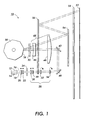
- FIG. 1 wherein there is illustrated a raster output scanning (ROS) system 10 as an embodiment of the present invention.
- the design specifications for the preferred optical system 10 require a resolution of 600 pixels per inch, (24 per mm) over a scan line of 12.2 inches (310 mm).
- a pair of laser diodes 12 and 14 emit a pair of modulated light beams 16 and 18 in the infrared wavelength range of 780 nanometers.
- the dual diodes are separated by a distance of approximately 25 ⁇ m and are oriented in the optical system so that they are offset in the cross scan direction.
- the light beams 16 and 18 pass through a flat FK5 Schott glass window 20 of the laser diodes 12 and 14.
- the dual beams 16 and 18 are next collimated by a plano-convex aspherical S-TIM35 O'Hara lens 22.
- the dual beams are then passed through an aperture or rectangular stop 24, where a portion of each beam's intensity may be attenuated.
- the aperture 24 controls the F/#, which in turn controls the spot size created by the dual beams.
- the major axis of the rectangle is in the scan plane and the minor axis of the rectangle is in the cross-scan plane.
- the collimator lens can be moved laterally in the optical path of the dual beams to allow maximum optical throughput through the aperture.
- Cylindrical lens group 26 consists of a first concave-plano S-TIM35 aspheric lens 28, a second plano-convex BK7 Schott lens 30, a third cylindrical plano-convex BK7 Schott lens 32 and a fourth cylindrical plano-convex BK7 Schott lens 34.
- the focal length and position of the cylinder lens group 26 focuses the dual beams in the cross scan plane at the overfilled facet 36 of the rotating polygon mirror 38.
- the dual beams remain collimated by the cylinder lens group 26 in the scan plane at the facet 36.
- the first aspheric lens 28 after the collimator lens 22 allows for spherical aberration correction in the tangential direction.
- the first two lenses 28 and 30 of the four lens element cylindrical lens group 26 can be moved together laterally along the optical path for optimum tangential focus correction of the dual beams.
- the third lens 32 of the four lens element cylindrical lens group 26 can be independently rotated for optimum sagittal focus correction and beam separation compensation of the dual beams.
- the fourth lens 34 of the four lens element cylindrical lens group 26 can be independently rotated for optimum sagittal focus correction and beam separation compensation of the dual beams.
- the dual beams are the reflected off the planar surface of the first folding mirror 40, and are then reflected off the planar surface of the second folding mirror 42, in the direction of the facet 36.
- the f-theta lens group consists of a first cylindrical concave-plano F2 Schott scan lens 46 and a second cylindrical plano-convex SF10 Schott scan lens 48.
- the dual beams will traverse the second f-theta scan lens 48 first from the convex side and then the first f-theta scan lens 46 from the plano side.
- the dual beams are then transmitted through a flat BK7 Schott glass window 50 to overfill the facet 36 of the rotating polygon mirror 38.
- the window 50 serves to eliminate air turbulence and contamination by foreign objects caused by the rotating polygon mirror from effecting the other optical elements of the ROS system 10.
- the dual beams 16 and 18 are reflected by the overfilled facet 36.
- the rotation of the polygon facet surface causes the dual beams to be scanned across the photoreceptor surface 52.
- the dual beams 16 and 18 then pass back through the flat window 50 and then the f-theta lens group 44 a second time, in the opposite direction, in a double pass.
- Light beams 16 and 18 are then focussed and linearized by the two element f-theta lens group 44 as the beams are transmitted, in-sequence, through the first cylindrical concave-plano F2 Schott scan lens 46 and the second cylindrical plano-convex SF10 Schott scan lens 48.
- the post-polygon f-theta lens group 44 is designed to provide a linear relationship between the rotation of the polygon mirror 38 and the deflection of the scanned beams 16 and 18 in the scan direction at the photoreceptor surface 52.
- the photoreceptor 52 moves in a process direction.
- the main function of the f-theta lens group is to control the scan linearity, in terms of uniform spot displacement per unit angle of polygon rotation.
- the dual beams 16 and 18 are reflected by a first cylindrical mirror 54, and then reflected by a second cylindrical wobble correction mirror 56, prior to passing through a flat BK7 Schott glass exit window 58.
- the exit window 58 isolates the ROS system 10 from the remainder of the xerographic engine, keeping ink, grease, dirt and other foreign objects out of the ROS optical elements.
- the dual beams 16 and 18 After passing through exit window 58, the dual beams 16 and 18 impinge upon the surface of photoreceptor 52 forming two spots.
- the two spots each produce a scan line of at least 12 inches (300 mm) (i.e., at least a page width) when scanned across the photoreceptor surface 52 by the rotating polygon mirror 38.
- the f-theta scan lens group 44 and the two cylindrical mirrors 54 and 56 focus the collimated reflected light beams 16 and 18 in the fast scan direction onto the image plane of the photoreceptor surface 52, and re-image the light focussed on the facet 36 in the cross scan direction, onto the image plane of the photoreceptor surface 52.
- the mirror 56 provides wobble correction or motion compensating optics for the dual beams.
- the two cylindrical mirrors 54 and 56 provide a telecentric condition for the dual light beams to correct for differential bow.
- the infrared laser diodes of the present invention will provide 10 erg/cm 2 energy density at the image plane of the photoreceptor. This energy density is needed for a 100 pages per minute capability at 600 dots per inch (24 dots per mm) resolution.
- the overfilled facets of the present ROS allows for a smaller polygon mirror with more facets, higher duty cycles for maximum use of diode power and lower jitter.
- the sagittal offset of the dual laser diodes coupled with a double pass ROS allows for more uniform tangential spot size at the photoreceptor.
Landscapes
- Physics & Mathematics (AREA)
- General Physics & Mathematics (AREA)
- Optics & Photonics (AREA)
- Mechanical Optical Scanning Systems (AREA)
- Laser Beam Printer (AREA)
- Facsimile Scanning Arrangements (AREA)
Claims (1)
- Ein Rasterabtastvorrichtungs(ROS)-Abbildungssystem, das umfasst:Eine Lichtquelle aus einem Paar von Laserdioden (12, 14), das in die Querabtastungsebene (cross-scan plane) versetzt ist, um zwei kohärente Lichtstrahlen im Infrarot-Wellenlängenbereich zu erzeugen, wobei die beiden Stahlen entlang eines optischen Pfades ausgesandt werden;eine fotoempfindliche Bild-Ebene (52);einen drehbaren mehrfachfacettierten Polygon-Spiegel (38), der in den optischen Pfad zwischen die Lichtquelle (12, 14) und die photoempfindliche Bild-Ebene (52) platziert wird, um die Lichtstrahlen, die auf die Facetten (36) des Polygon-Spiegels (38) gerichtet sind in einer schnellen Abtast-Richtung über die photoempfindliche Bild-Ebene (52) zu rastern, wobei die Lichtstrahlen, die auf den rotierenden Polygon-Spiegel (38) gerichtet sind jede Facette (36) auf eine überbesetzte (overfilled) Weise beleuchten;ein optisches System nach dem Polygon-Spiegel, um die Lichtstrahlen, die von dem Polygon-Spiegel (38) reflektiert werden in Schnellabtastungs- und Querabtastungsrichtung auf die photoempfindliche Bild-Ebene (52) zu fokussieren, wobei das optische System nach dem Polygon-Spiegel eine f-Theta Linsengruppe (44) mit 2 zylindrischen Linsen (46, 48), positioniert zwischen dem Polygon-Spiegel (38) und der fotoempfindlichen Bild-Ebene (52), um die Abtastlinearität der Lichtstrahlen auf der photoempfindlichen Bild-Ebene (52) zu kontrollieren, einen ersten zylindrischen Spiegel (54), einen zweiten zylindrischen Spiegel (56) zur Wobble-Korrektur der Lichtstrahlen entlang der Linien-Abtastung auf der photoempfindlichen Bild-Ebene, positioniert zwischen der f-Theta Linsengruppe (44) und der photoempfindlichen Bild-Ebene (52), ein Austrittsfenster (58), positioniert im optischen Pfad zwischen dem zweiten zylindrischen Spiegel (56) und der photoempfindlichen Bild-Ebene (52), um eine Verschmutzung des Abbildungssystems der Rasterabtastvorrichtung zu verhindern einschließt; und,ein optisches System vor dem Polygon-Spiegel, das eine asphärische Kollimatorlinse (22), positioniert in dem optischen Pfad zwischen der Lichtquelle (12, 14) und dem Polygon-Spiegel (38), eine Blende (24), positioniert in dem optischen Pfad zwischen der Kollimatorlinse (22) und dem Polygon-Spiegel (38), wobei die Kollimatorlinse (22) beweglich ist, um den optischen Durchsatz der Lichtstrahlen durch die Blende (24) maximal zu gestalten und eine Gruppe zylindrischer Linsen (26), die vier Linsen, positioniert in dem optischen Pfad zwischen der Blende (24) und dem Polygon-Spiegel (38) besitzt, wobei die Gruppe zylindrischer Linsen (26) nur in der Querabtastungsrichtung wirksam ist, wobei Kollimatorlinse (22) und die Gruppe zylindrischer Linsen (26) die Lichtstrahlen in der Querabtastungsrichtung auf jede Facette (36) des Polygon-Spiegels (38) fokussieren, während sie die Kollimation des Strahls in der Abtastungsrichtung bei jeder Facette (36) des Polygon-Spiegels (38) aufrechterhalten, wobei die erste Linse (28) und die zweite Linse (30) der Gruppe zylindrischer Linsen (26) in dem optischen Pfad zur tangentialen Brennpunktkorrektur der beiden Lichtstrahlen gemeinsam beweglich sind, die dritte Linse (32) der Gruppe zylindrischer Linsen (26) drehbar ist zur sagittalen Brennpunktkorrektur der beiden Lichtstrahlen und zur Strahltrennungskompensation der beiden Lichtstrahlen und die vierte Linse (34) der Gruppe zylindrischer Linsen (26) drehbar ist zur sagittalen Brennpunktkorrektur und Stahltrennungskompensation der beiden Lichtstrahlen, zwei Klappspiegel (40, 42), positioniert in dem optischen Pfad zwischen der Gruppe zylindrischer Linsen (26) und dem Polygon-Spiegel (38) und ein Abtast-Fenster (50), positioniert in dem optischen Pfad zwischen den Klappspiegeln (40, 42) und dem Polygon-Spiegel, um Verunreinigung und Turbulenz an dem Polygon-Spiegel (38) zu verhindern, wobei die Lichtstrahlen durch die f-Theta Linsengruppe (44), positioniert in dem optischen Pfad zwischen den beiden Klappspiegeln (40, 42) und dem Abtast-Fenster (50) hindurchtreten einschließt.
Applications Claiming Priority (2)
| Application Number | Priority Date | Filing Date | Title |
|---|---|---|---|
| US218853 | 1980-12-22 | ||
| US09/218,853 US6057953A (en) | 1998-12-21 | 1998-12-21 | Dual beam double pass raster output scanner |
Publications (2)
| Publication Number | Publication Date |
|---|---|
| EP1014149A1 EP1014149A1 (de) | 2000-06-28 |
| EP1014149B1 true EP1014149B1 (de) | 2002-08-07 |
Family
ID=22816760
Family Applications (1)
| Application Number | Title | Priority Date | Filing Date |
|---|---|---|---|
| EP99309973A Expired - Lifetime EP1014149B1 (de) | 1998-12-21 | 1999-12-10 | Rasterabtastvorrichtung |
Country Status (4)
| Country | Link |
|---|---|
| US (1) | US6057953A (de) |
| EP (1) | EP1014149B1 (de) |
| JP (1) | JP2000180761A (de) |
| DE (1) | DE69902433T2 (de) |
Families Citing this family (32)
| Publication number | Priority date | Publication date | Assignee | Title |
|---|---|---|---|---|
| US6369927B2 (en) * | 1998-02-13 | 2002-04-09 | Ricoh Company, Ltd. | Optical scanning apparatus |
| JP3397765B2 (ja) * | 1999-12-10 | 2003-04-21 | キヤノン株式会社 | マルチビーム光走査光学系及びそれを用いた画像形成装置 |
| JP2002040349A (ja) * | 2000-07-26 | 2002-02-06 | Sharp Corp | 光走査装置 |
| US6967908B2 (en) * | 2000-09-07 | 2005-11-22 | Pioneer Corporation | Optical pickup device with focus error detecting optical element and method for focus error detection |
| JP3902933B2 (ja) * | 2001-09-27 | 2007-04-11 | キヤノン株式会社 | マルチビーム光走査光学系及びそれを用いた画像形成装置 |
| JP2003172874A (ja) * | 2001-12-05 | 2003-06-20 | Samsung Electro Mech Co Ltd | 光照射装置とそれを備えた光ピックアップ装置及び光照射装置の調整方法 |
| JP3607255B2 (ja) * | 2002-03-25 | 2005-01-05 | 株式会社リコー | 光走査装置および画像形成装置 |
| US7474286B2 (en) * | 2005-04-01 | 2009-01-06 | Spudnik, Inc. | Laser displays using UV-excitable phosphors emitting visible colored light |
| US7791561B2 (en) * | 2005-04-01 | 2010-09-07 | Prysm, Inc. | Display systems having screens with optical fluorescent materials |
| US7733310B2 (en) * | 2005-04-01 | 2010-06-08 | Prysm, Inc. | Display screens having optical fluorescent materials |
| US8000005B2 (en) * | 2006-03-31 | 2011-08-16 | Prysm, Inc. | Multilayered fluorescent screens for scanning beam display systems |
| US8089425B2 (en) * | 2006-03-03 | 2012-01-03 | Prysm, Inc. | Optical designs for scanning beam display systems using fluorescent screens |
| US7994702B2 (en) * | 2005-04-27 | 2011-08-09 | Prysm, Inc. | Scanning beams displays based on light-emitting screens having phosphors |
| US7466331B2 (en) * | 2005-12-07 | 2008-12-16 | Palo Alto Research Center Incorporated | Bow-free telecentric optical system for multiple beam scanning systems |
| CN101000306B (zh) * | 2006-01-09 | 2010-11-17 | 深圳迈瑞生物医疗电子股份有限公司 | 细胞分析仪 |
| US7884816B2 (en) * | 2006-02-15 | 2011-02-08 | Prysm, Inc. | Correcting pyramidal error of polygon scanner in scanning beam display systems |
| US8451195B2 (en) | 2006-02-15 | 2013-05-28 | Prysm, Inc. | Servo-assisted scanning beam display systems using fluorescent screens |
| US20080068295A1 (en) * | 2006-09-19 | 2008-03-20 | Hajjar Roger A | Compensation for Spatial Variation in Displayed Image in Scanning Beam Display Systems Using Light-Emitting Screens |
| US8013506B2 (en) * | 2006-12-12 | 2011-09-06 | Prysm, Inc. | Organic compounds for adjusting phosphor chromaticity |
| US9525850B2 (en) * | 2007-03-20 | 2016-12-20 | Prysm, Inc. | Delivering and displaying advertisement or other application data to display systems |
| US7697183B2 (en) * | 2007-04-06 | 2010-04-13 | Prysm, Inc. | Post-objective scanning beam systems |
| US8169454B1 (en) | 2007-04-06 | 2012-05-01 | Prysm, Inc. | Patterning a surface using pre-objective and post-objective raster scanning systems |
| JP2010527464A (ja) | 2007-05-17 | 2010-08-12 | プリズム インコーポレイテッド | ビームディスプレイシステム走査用の発光ストライプを有する多層スクリーン |
| US8556430B2 (en) * | 2007-06-27 | 2013-10-15 | Prysm, Inc. | Servo feedback control based on designated scanning servo beam in scanning beam display systems with light-emitting screens |
| US7878657B2 (en) * | 2007-06-27 | 2011-02-01 | Prysm, Inc. | Servo feedback control based on invisible scanning servo beam in scanning beam display systems with light-emitting screens |
| US8217975B2 (en) * | 2008-04-01 | 2012-07-10 | Xerox Corporation | Apparatus for forming an image and corresponding methods |
| US7869112B2 (en) * | 2008-07-25 | 2011-01-11 | Prysm, Inc. | Beam scanning based on two-dimensional polygon scanner for display and other applications |
| JP5079060B2 (ja) * | 2010-08-02 | 2012-11-21 | シャープ株式会社 | 光走査装置および画像形成装置 |
| USD723561S1 (en) * | 2013-07-30 | 2015-03-03 | Makerbot Industries, Llc | Three-dimensional scanner |
| USD720352S1 (en) * | 2014-01-07 | 2014-12-30 | Matter and Form Inc. | Object scanner |
| KR20170040911A (ko) * | 2015-10-06 | 2017-04-14 | 삼성전자주식회사 | 멀티-빔 스캐너 및 이를 포함하는 공초점 광학계 |
| KR102714998B1 (ko) * | 2016-11-10 | 2024-10-10 | 엘지이노텍 주식회사 | 광출력 모듈 및 이를 포함하는 라이다 모듈 |
Family Cites Families (7)
| Publication number | Priority date | Publication date | Assignee | Title |
|---|---|---|---|---|
| JP2563260B2 (ja) * | 1986-04-11 | 1996-12-11 | 松下電器産業株式会社 | 光ビ−ム走査装置 |
| JPH07199109A (ja) * | 1993-10-14 | 1995-08-04 | Xerox Corp | ラスタースキャニングシステム |
| US5512949A (en) * | 1993-12-29 | 1996-04-30 | Xerox Corporation | Multiple beam raster output scanner optical system having telecentric chief exit rays |
| US5469290A (en) * | 1994-06-06 | 1995-11-21 | Xerox Corporation | Two-element zoom lens for beam separation error correction |
| US5550668A (en) * | 1994-11-21 | 1996-08-27 | Xerox Corporation | Multispot polygon ROS with maximized line separation depth of focus |
| JP3545115B2 (ja) * | 1995-09-22 | 2004-07-21 | 大日本スクリーン製造株式会社 | 像面湾曲の補正方法および該方法に使用する光ビーム走査装置 |
| JP3104618B2 (ja) * | 1996-05-10 | 2000-10-30 | 富士ゼロックス株式会社 | 光学走査装置及び光学レンズ |
-
1998
- 1998-12-21 US US09/218,853 patent/US6057953A/en not_active Expired - Fee Related
-
1999
- 1999-12-10 EP EP99309973A patent/EP1014149B1/de not_active Expired - Lifetime
- 1999-12-10 DE DE69902433T patent/DE69902433T2/de not_active Expired - Fee Related
- 1999-12-17 JP JP11358347A patent/JP2000180761A/ja not_active Withdrawn
Also Published As
| Publication number | Publication date |
|---|---|
| US6057953A (en) | 2000-05-02 |
| EP1014149A1 (de) | 2000-06-28 |
| JP2000180761A (ja) | 2000-06-30 |
| DE69902433T2 (de) | 2002-12-12 |
| DE69902433D1 (de) | 2002-09-12 |
Similar Documents
| Publication | Publication Date | Title |
|---|---|---|
| EP1014149B1 (de) | Rasterabtastvorrichtung | |
| EP1111435B1 (de) | Optischer Rasterabtaster mit reduzierter Bauhöhe erreicht durch mehrere Schwankungskorrekturelemente | |
| US6459520B1 (en) | Optical scanning apparatus and image forming apparatus using it | |
| US5526166A (en) | Optical system for the correction of differential scanline bow | |
| US5550668A (en) | Multispot polygon ROS with maximized line separation depth of focus | |
| US7486426B2 (en) | Two-dimensional optical scan system using a counter-rotating disk scanner | |
| EP1014148B1 (de) | Aufzeichnungsabtaster mit voll ausgeleuchtetem Polygonspiegel und zylindrischen optischen Elementen | |
| EP0454503B1 (de) | Optische Abtaster | |
| EP1046939A1 (de) | Verfahren und Vorrichtung zur Aufnahme eines Flachfeldbildes | |
| US6061080A (en) | Aperture for multiple reflection raster output scanning system to reduce bow | |
| EP0857991B1 (de) | Optisches Abtastsystem | |
| EP0637770B1 (de) | Kompakte Rasterabtastvorrichtung für Abbildungsystem | |
| US5142403A (en) | ROS scanner incorporating cylindrical mirror in pre-polygon optics | |
| US5650871A (en) | Single element optics for passive facet tracking | |
| KR20050110687A (ko) | 후치-대물 스캐닝 디바이스 | |
| US5381259A (en) | Raster output scanner (ROS) using an overfilled polygon design with minimized optical path length | |
| JP4632751B2 (ja) | 光走査装置 | |
| EP0806691A2 (de) | Achromatisches, telezentrisches F-Theta optisches Abtastsystem | |
| JPH02129614A (ja) | 光走査装置 | |
| JPH01200220A (ja) | 光ビーム走査光学系 | |
| KR100193596B1 (ko) | 주사광학장치용 애너모르픽 렌즈 | |
| JP2983666B2 (ja) | 多重波長、多重ダイオードレーザros | |
| JPH08220457A (ja) | 光走査装置 | |
| JPH10268215A (ja) | マルチレーザ光学装置 | |
| WO2005076053A9 (en) | Scanner systems |
Legal Events
| Date | Code | Title | Description |
|---|---|---|---|
| PUAI | Public reference made under article 153(3) epc to a published international application that has entered the european phase |
Free format text: ORIGINAL CODE: 0009012 |
|
| AK | Designated contracting states |
Kind code of ref document: A1 Designated state(s): DE FR GB |
|
| AX | Request for extension of the european patent |
Free format text: AL;LT;LV;MK;RO;SI |
|
| 17P | Request for examination filed |
Effective date: 20001228 |
|
| AKX | Designation fees paid |
Free format text: DE FR GB |
|
| 17Q | First examination report despatched |
Effective date: 20010227 |
|
| GRAG | Despatch of communication of intention to grant |
Free format text: ORIGINAL CODE: EPIDOS AGRA |
|
| GRAG | Despatch of communication of intention to grant |
Free format text: ORIGINAL CODE: EPIDOS AGRA |
|
| GRAH | Despatch of communication of intention to grant a patent |
Free format text: ORIGINAL CODE: EPIDOS IGRA |
|
| GRAH | Despatch of communication of intention to grant a patent |
Free format text: ORIGINAL CODE: EPIDOS IGRA |
|
| GRAA | (expected) grant |
Free format text: ORIGINAL CODE: 0009210 |
|
| AK | Designated contracting states |
Kind code of ref document: B1 Designated state(s): DE FR GB |
|
| REG | Reference to a national code |
Ref country code: GB Ref legal event code: FG4D |
|
| REF | Corresponds to: |
Ref document number: 69902433 Country of ref document: DE Date of ref document: 20020912 |
|
| ET | Fr: translation filed | ||
| PLBE | No opposition filed within time limit |
Free format text: ORIGINAL CODE: 0009261 |
|
| STAA | Information on the status of an ep patent application or granted ep patent |
Free format text: STATUS: NO OPPOSITION FILED WITHIN TIME LIMIT |
|
| 26N | No opposition filed |
Effective date: 20030508 |
|
| PGFP | Annual fee paid to national office [announced via postgrant information from national office to epo] |
Ref country code: GB Payment date: 20061206 Year of fee payment: 8 |
|
| PGFP | Annual fee paid to national office [announced via postgrant information from national office to epo] |
Ref country code: DE Payment date: 20061207 Year of fee payment: 8 |
|
| PGFP | Annual fee paid to national office [announced via postgrant information from national office to epo] |
Ref country code: FR Payment date: 20061208 Year of fee payment: 8 |
|
| GBPC | Gb: european patent ceased through non-payment of renewal fee |
Effective date: 20071210 |
|
| PG25 | Lapsed in a contracting state [announced via postgrant information from national office to epo] |
Ref country code: DE Free format text: LAPSE BECAUSE OF NON-PAYMENT OF DUE FEES Effective date: 20080701 |
|
| REG | Reference to a national code |
Ref country code: FR Ref legal event code: ST Effective date: 20081020 |
|
| PG25 | Lapsed in a contracting state [announced via postgrant information from national office to epo] |
Ref country code: GB Free format text: LAPSE BECAUSE OF NON-PAYMENT OF DUE FEES Effective date: 20071210 |
|
| PG25 | Lapsed in a contracting state [announced via postgrant information from national office to epo] |
Ref country code: FR Free format text: LAPSE BECAUSE OF NON-PAYMENT OF DUE FEES Effective date: 20071231 |