EP1014427A2 - Appareil de traitement ayant un système de pompage intégré - Google Patents
Appareil de traitement ayant un système de pompage intégré Download PDFInfo
- Publication number
- EP1014427A2 EP1014427A2 EP99310475A EP99310475A EP1014427A2 EP 1014427 A2 EP1014427 A2 EP 1014427A2 EP 99310475 A EP99310475 A EP 99310475A EP 99310475 A EP99310475 A EP 99310475A EP 1014427 A2 EP1014427 A2 EP 1014427A2
- Authority
- EP
- European Patent Office
- Prior art keywords
- pump
- chamber
- gas
- inlet
- pressure
- Prior art date
- Legal status (The legal status is an assumption and is not a legal conclusion. Google has not performed a legal analysis and makes no representation as to the accuracy of the status listed.)
- Withdrawn
Links
Images





Classifications
-
- H—ELECTRICITY
- H10—SEMICONDUCTOR DEVICES; ELECTRIC SOLID-STATE DEVICES NOT OTHERWISE PROVIDED FOR
- H10P—GENERIC PROCESSES OR APPARATUS FOR THE MANUFACTURE OR TREATMENT OF DEVICES COVERED BY CLASS H10
- H10P95/00—Generic processes or apparatus for manufacture or treatments not covered by the other groups of this subclass
-
- H—ELECTRICITY
- H10—SEMICONDUCTOR DEVICES; ELECTRIC SOLID-STATE DEVICES NOT OTHERWISE PROVIDED FOR
- H10P—GENERIC PROCESSES OR APPARATUS FOR THE MANUFACTURE OR TREATMENT OF DEVICES COVERED BY CLASS H10
- H10P72/00—Handling or holding of wafers, substrates or devices during manufacture or treatment thereof
- H10P72/04—Apparatus for manufacture or treatment
- H10P72/0451—Apparatus for manufacturing or treating in a plurality of work-stations
- H10P72/0462—Apparatus for manufacturing or treating in a plurality of work-stations characterised by the construction of the processing chambers, e.g. modular processing chambers
-
- F—MECHANICAL ENGINEERING; LIGHTING; HEATING; WEAPONS; BLASTING
- F04—POSITIVE - DISPLACEMENT MACHINES FOR LIQUIDS; PUMPS FOR LIQUIDS OR ELASTIC FLUIDS
- F04D—NON-POSITIVE-DISPLACEMENT PUMPS
- F04D17/00—Radial-flow pumps, e.g. centrifugal pumps; Helico-centrifugal pumps
- F04D17/08—Centrifugal pumps
- F04D17/16—Centrifugal pumps for displacing without appreciable compression
- F04D17/168—Pumps specially adapted to produce a vacuum
-
- F—MECHANICAL ENGINEERING; LIGHTING; HEATING; WEAPONS; BLASTING
- F04—POSITIVE - DISPLACEMENT MACHINES FOR LIQUIDS; PUMPS FOR LIQUIDS OR ELASTIC FLUIDS
- F04D—NON-POSITIVE-DISPLACEMENT PUMPS
- F04D19/00—Axial-flow pumps
- F04D19/02—Multi-stage pumps
- F04D19/04—Multi-stage pumps specially adapted to the production of a high vacuum, e.g. molecular pumps
-
- F—MECHANICAL ENGINEERING; LIGHTING; HEATING; WEAPONS; BLASTING
- F04—POSITIVE - DISPLACEMENT MACHINES FOR LIQUIDS; PUMPS FOR LIQUIDS OR ELASTIC FLUIDS
- F04D—NON-POSITIVE-DISPLACEMENT PUMPS
- F04D27/00—Control, e.g. regulation, of pumps, pumping installations or pumping systems specially adapted for elastic fluids
- F04D27/02—Surge control
- F04D27/0261—Surge control by varying driving speed
-
- F—MECHANICAL ENGINEERING; LIGHTING; HEATING; WEAPONS; BLASTING
- F04—POSITIVE - DISPLACEMENT MACHINES FOR LIQUIDS; PUMPS FOR LIQUIDS OR ELASTIC FLUIDS
- F04D—NON-POSITIVE-DISPLACEMENT PUMPS
- F04D29/00—Details, component parts, or accessories
- F04D29/60—Mounting; Assembling; Disassembling
- F04D29/601—Mounting; Assembling; Disassembling specially adapted for elastic fluid pumps
-
- H—ELECTRICITY
- H10—SEMICONDUCTOR DEVICES; ELECTRIC SOLID-STATE DEVICES NOT OTHERWISE PROVIDED FOR
- H10P—GENERIC PROCESSES OR APPARATUS FOR THE MANUFACTURE OR TREATMENT OF DEVICES COVERED BY CLASS H10
- H10P72/00—Handling or holding of wafers, substrates or devices during manufacture or treatment thereof
- H10P72/04—Apparatus for manufacture or treatment
- H10P72/0402—Apparatus for fluid treatment
-
- H—ELECTRICITY
- H10—SEMICONDUCTOR DEVICES; ELECTRIC SOLID-STATE DEVICES NOT OTHERWISE PROVIDED FOR
- H10P—GENERIC PROCESSES OR APPARATUS FOR THE MANUFACTURE OR TREATMENT OF DEVICES COVERED BY CLASS H10
- H10P72/00—Handling or holding of wafers, substrates or devices during manufacture or treatment thereof
- H10P72/04—Apparatus for manufacture or treatment
- H10P72/0451—Apparatus for manufacturing or treating in a plurality of work-stations
- H10P72/0452—Apparatus for manufacturing or treating in a plurality of work-stations characterised by the layout of the process chambers
- H10P72/0454—Apparatus for manufacturing or treating in a plurality of work-stations characterised by the layout of the process chambers surrounding a central transfer chamber
-
- H—ELECTRICITY
- H10—SEMICONDUCTOR DEVICES; ELECTRIC SOLID-STATE DEVICES NOT OTHERWISE PROVIDED FOR
- H10P—GENERIC PROCESSES OR APPARATUS FOR THE MANUFACTURE OR TREATMENT OF DEVICES COVERED BY CLASS H10
- H10P72/00—Handling or holding of wafers, substrates or devices during manufacture or treatment thereof
- H10P72/04—Apparatus for manufacture or treatment
- H10P72/0451—Apparatus for manufacturing or treating in a plurality of work-stations
- H10P72/0461—Apparatus for manufacturing or treating in a plurality of work-stations characterised by the presence of two or more transfer chambers
-
- H—ELECTRICITY
- H10—SEMICONDUCTOR DEVICES; ELECTRIC SOLID-STATE DEVICES NOT OTHERWISE PROVIDED FOR
- H10P—GENERIC PROCESSES OR APPARATUS FOR THE MANUFACTURE OR TREATMENT OF DEVICES COVERED BY CLASS H10
- H10P72/00—Handling or holding of wafers, substrates or devices during manufacture or treatment thereof
- H10P72/04—Apparatus for manufacture or treatment
- H10P72/0451—Apparatus for manufacturing or treating in a plurality of work-stations
- H10P72/0464—Apparatus for manufacturing or treating in a plurality of work-stations characterised by the construction of the transfer chamber
-
- Y—GENERAL TAGGING OF NEW TECHNOLOGICAL DEVELOPMENTS; GENERAL TAGGING OF CROSS-SECTIONAL TECHNOLOGIES SPANNING OVER SEVERAL SECTIONS OF THE IPC; TECHNICAL SUBJECTS COVERED BY FORMER USPC CROSS-REFERENCE ART COLLECTIONS [XRACs] AND DIGESTS
- Y02—TECHNOLOGIES OR APPLICATIONS FOR MITIGATION OR ADAPTATION AGAINST CLIMATE CHANGE
- Y02B—CLIMATE CHANGE MITIGATION TECHNOLOGIES RELATED TO BUILDINGS, e.g. HOUSING, HOUSE APPLIANCES OR RELATED END-USER APPLICATIONS
- Y02B30/00—Energy efficient heating, ventilation or air conditioning [HVAC]
- Y02B30/70—Efficient control or regulation technologies, e.g. for control of refrigerant flow, motor or heating
-
- Y—GENERAL TAGGING OF NEW TECHNOLOGICAL DEVELOPMENTS; GENERAL TAGGING OF CROSS-SECTIONAL TECHNOLOGIES SPANNING OVER SEVERAL SECTIONS OF THE IPC; TECHNICAL SUBJECTS COVERED BY FORMER USPC CROSS-REFERENCE ART COLLECTIONS [XRACs] AND DIGESTS
- Y10—TECHNICAL SUBJECTS COVERED BY FORMER USPC
- Y10T—TECHNICAL SUBJECTS COVERED BY FORMER US CLASSIFICATION
- Y10T137/00—Fluid handling
- Y10T137/8593—Systems
- Y10T137/85978—With pump
- Y10T137/86035—Combined with fluid receiver
-
- Y—GENERAL TAGGING OF NEW TECHNOLOGICAL DEVELOPMENTS; GENERAL TAGGING OF CROSS-SECTIONAL TECHNOLOGIES SPANNING OVER SEVERAL SECTIONS OF THE IPC; TECHNICAL SUBJECTS COVERED BY FORMER USPC CROSS-REFERENCE ART COLLECTIONS [XRACs] AND DIGESTS
- Y10—TECHNICAL SUBJECTS COVERED BY FORMER USPC
- Y10T—TECHNICAL SUBJECTS COVERED BY FORMER US CLASSIFICATION
- Y10T137/00—Fluid handling
- Y10T137/8593—Systems
- Y10T137/85978—With pump
- Y10T137/86083—Vacuum pump
-
- Y—GENERAL TAGGING OF NEW TECHNOLOGICAL DEVELOPMENTS; GENERAL TAGGING OF CROSS-SECTIONAL TECHNOLOGIES SPANNING OVER SEVERAL SECTIONS OF THE IPC; TECHNICAL SUBJECTS COVERED BY FORMER USPC CROSS-REFERENCE ART COLLECTIONS [XRACs] AND DIGESTS
- Y10—TECHNICAL SUBJECTS COVERED BY FORMER USPC
- Y10T—TECHNICAL SUBJECTS COVERED BY FORMER US CLASSIFICATION
- Y10T137/00—Fluid handling
- Y10T137/8593—Systems
- Y10T137/85978—With pump
- Y10T137/86131—Plural
- Y10T137/86139—Serial
-
- Y—GENERAL TAGGING OF NEW TECHNOLOGICAL DEVELOPMENTS; GENERAL TAGGING OF CROSS-SECTIONAL TECHNOLOGIES SPANNING OVER SEVERAL SECTIONS OF THE IPC; TECHNICAL SUBJECTS COVERED BY FORMER USPC CROSS-REFERENCE ART COLLECTIONS [XRACs] AND DIGESTS
- Y10—TECHNICAL SUBJECTS COVERED BY FORMER USPC
- Y10T—TECHNICAL SUBJECTS COVERED BY FORMER US CLASSIFICATION
- Y10T137/00—Fluid handling
- Y10T137/8593—Systems
- Y10T137/85978—With pump
- Y10T137/86131—Plural
- Y10T137/86163—Parallel
Definitions
- the present invention relates to an apparatus for processing substrates that has a pumping system for evacuating gas.
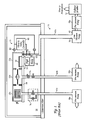
- An apparatus 15 for processing a substrate 20 comprises process chambers 25a , transfer chambers 25b , and load-lock chambers 25c mounted contiguously on a platform 28 with openings for transferring substrates between the chambers, as shown in Figure 1.
- a process gas or plasma is used to etch features, deposit layers of material on a substrate 20 , or clean the chamber.
- the apparatus 15 is in a clean or semi-clean room 30 , and a pumping system 35 used to evacuate gas and maintain the chambers at a low pressure is in an adjacent room or basement.
- the pumping system 35 typically comprises a high vacuum pump 40 , such as a turbo molecular pump; a low vacuum pump 45 , such as a rotary blower pump; and a pre-vacuum pump 50a-c , such as a dry vacuum pump.
- a high vacuum pump 40 such as a turbo molecular pump
- a low vacuum pump 45 such as a rotary blower pump
- a pre-vacuum pump 50a-c such as a dry vacuum pump.
- the inlet 55 of the high vacuum pump 40 is connected to the process chamber 25 , and its outlet 60 to a foreline 65 that extends from the chamber to the intake 70 of the low vacuum pump 45 , which in turn, is coupled to the intake of the pre-vacuum pump 50a .
- the pre-vacuum pump 50a exhausts to an exhaust scrubber 72 .
- the pre-vacuum pump 50a reduces the pressure of the process chamber 25a from atmospheric pressure (760 Torr) down to a pressure of about 0.01 Torr; the low vacuum pump 45 drops the chamber pressure down to about 0.0005 Torr; and only when the chamber pressure is below 0.1 Torr is the high vacuum pump 40 operated to achieve a high vacuum below 0.1 Torr down to 10 7 Torr,
- Another type of high vacuum pump is the cryo pump, which is used alone or in conjunction with the turbomolecular pump.
- a pre-vacuum pump 50 is also used in conjunction with cryo pump (not shown) to pump down the process chambers fast.
- Pre-vacuum pumps 50 and low vacuum pumps 45 are most commonly used in semiconductor processing apparatus; however, some semiconductor processing apparatus also use high vacuum pumps or cryo pumps in conjunction with the pre-vacuum and low vacuum pumps.
- a low vacuum pump 50 is essentially a pre-vacuum pump 45 whose pumping performance is enhanced, for example, a pre-vacuum pump with an added blower can operate as a low vacuum pump 50 .
- the forelines 65a-c between the pumps 40, 45, 50a-c and the chambers 25a-c have a large diameter to provide a high conductance pathway that has a reduced pumping load and resistance.
- the low vacuum pump 45 and the pre-vacuum pumps 50 are large sized pumps that occupy volumes of from 0.5 to 1 m 3 , large footprint 0.5m 2 , and they are noisy and vibrate excessively during operation. That is why these pumps are typically located in a separate room below or adjacent to the clean room to save clean room space and to mechanically isolate the pump vibrations from the sensitive processing equipment. The distance between the two rooms can often require a 50 to 100 feet length of foreline 65a-c .
- the forelines 65a-c have a large diameter and low conductance to operate the low and pre-vacuum pumps with any reasonable efficiency.
- the foreline 65a-c is a stainless steel pipe, which resists corrosion from the process gas, having a diameter of 50 to 100 mm (2 to 4 inches).
- the large diameter stainless steel pipe is expensive and a long length of pipe can cost as much as the pump itself.
- the large number of elbow joints and connections in the long foreline extending from the clean room to a separate room have to be carefully sealed with non-corrodible gas seals to avoid leaks and releasing hazardous and toxic gases during operation, which further adds to large capital costs in semiconductor fabrication facilities.
- the pipes are often heated to reduce the deposition of condensates on the inside surfaces of the pipes which wastes energy.
- the efficiency of the low and pre-vacuum pumps 45, 50a-c is often decreased by a factor of 2 to 4 because of the loss in pumping efficiency caused by the large length of intervening pipeline. This is especially true when the chambers are pumped down to a low pressure mTorr range, where an increase in length of the forelines 65a-c results in a large reduction in conductance.
- Another problem is that the large diameter and long length of the forelines 65a-c provide a large surface area that serves as a heat sink upon which condensates are deposited from the process gas flowing in the lines. These condensates are dislodged and loosened by vibrations from the pumps 45 , 50a-c and back diffuse into the chambers 25a-c to contaminate and reduce the yield of the substrates 20 .
- the chamber pressure is measured by the pressure gauge 80 which feeds a pressure signal to a throttle valve controller 90 which opens or closes the throttle valve 75a,b to control the pressure of gas in the chamber 25a-c .
- this system is slow to respond to pressure fluctuations caused by entry of substrates 20 in the chambers 25a-c , transfer of substrates, or changes in a gas flow rate.
- the pressure reduction time obtained from "soft start" valves 76 are too slow. The soft gradual pressure reduction is used to prevent moisture condensation when lowering chamber pressure from atmospheric pressures to the mTorr range, by using two different size valves 76 .
- a smaller valve opening having a low conductance is opened when pumping the chamber down from one atmosphere to about 100 to 300 Torr, and a large sized valve is opened when pumping the chamber down to lower pressures.
- the two-cycle process provides a soft or gradual reduction in chamber pressure in stages that minimizes moisture condensate in the chambers 25a-c .
- the time for pressure reduction during the small valve opening step of the process is often excessively long for high throughout fabrication processes.
- a semiconductor processing apparatus having a pumping system that does not require excessively long forelines with large diameters to operate efficiently. It is also desirable to have a small pump having reduced vibrations and noise for use in a clean room environment. It is further desirable to reduce the diameter, surface area, and length of the forelines between the chambers and the pumping system. It is also desirable to control the pressure in the chamber by means other than valves to increase response time and reduce particles. It is also desirable to more closely follow the pressure reduction versus time curve in the chamber to reduce pump down time. It is also desirable to reduce power consumption, cooling water consumption, and the release of heat within the clean room environment. It is also desirable to achieve all of the above with a small pump operating with a rotational speed of less than 10,000 revolutions per minute in order to minimize time for pressure adjustment; minimize noise, vibration, and power consumption, and maximize bearing lifetime and pump reliability.
- the present invention is to a semiconductor processing apparatus for processing a semiconductor substrate, having a pumping system with high operating efficiency, small size, and low vibrational and noise levels.
- the present invention comprises an apparatus for processing a substrate using a chamber, such as a load-lock chamber, transfer chamber, or process chamber.
- a pump is adjacent to the chamber, the pump having an inlet connected to the chamber for evacuating gas in the chamber and an outlet that exhausts the evacuated gas to atmospheric pressure.
- a foreline can extend between the inlet of the pump and the chamber, the foreline preferably having a length of less than about 2 m and a diameter of less than about 80 mm.
- the apparatus is substantially absent a foreline between the inlet of the pump and the chamber.
- the pump comprises a pre-vacuum or low vacuum pump.
- the present invention comprises an apparatus for processing a substrate, the apparatus comprising a chamber, a pump, and a pressure controller for controlling a gas pressure in the chamber by providing a signal in relation to the gas pressure to a pump controller that changes the speed of the pump in relation to the signal.
- gas is evacuated from a chamber by the pump and the pressure of the gas in the chamber is regulated by adjusting a speed of the pump.
- a substrate is placed on a support in the evacuated chamber, gas is introduced into the chamber and optionally energized to process the substrate, and the pressure of the gas in the chamber is regulated by adjusting a speed of the pump.
- the present invention comprises an apparatus for processing a substrate, comprising a pump having a plurality of inlet ports, a first inlet port provided to evacuate gas from a first chamber or first pump, and a second inlet port provided to evacuate gas from a second chamber or second pump.
- the first and second inlet ports are connected to one or more inlet stages of the pump.
- the apparatus comprises a plurality of chambers having enclosures shaped and sized to hold one or more substrates, and a pump having a first inlet port in a first inlet stage, and a second inlet port in a second inlet stage, the first inlet port provided to evacuate gas from one chamber or pump, and the second inlet port provided to evacuate gas from another chamber or pump.
- the plurality of chambers are mounted on a single platform, and the pump abuts the platform.
- the apparatus 100 comprises a platform 105 having a plurality of chambers each of which are shaped and sized to hold or enclose one ore more substrates 20 .
- the chambers are interfaced to one another and typically include load-lock chambers 110 , a transfer chambers 115 , and process chambers 120 , that are mounted contiguously with openings to transfer substrates therebetween.
- the load-lock chambers 110 hold cassettes that contain batches of substrates 20 .
- the centrally located transfer chamber 115 comprises a robot arm 118 which picks up and transfer substrates 20 from the cassette in the load-lock chamber 110 into a process chamber 120 , and after processing of the substrate in the chamber 120 , transfers the substrate to other process chambers (not shown) on the platform 105 .
- the robot 118 picks it up from the last process chamber and transfers it to another load-lock chamber (not shown) reserved for unloading.
- the present invention is illustrated by an apparatus for processing substrates, such as semiconductor wafers, the invention can also be used for processing other substrates, such as flat panel displays, circuit boards, and liquid crystal displays, and in other chambers as apparent to those skilled in the art and without deviating from the scope of the invention.
- the process chamber 120 forms an enclosure for a support 125 for supporting a substrate 20 , such as a semiconductor wafer.
- the substrate 20 is held on the support 125 by an electrostatic chuck 130 .
- Metals commonly used to fabricate the process chamber are for example, anodized aluminum, stainless steel, INCONELTM, silicon oxide, boron carbide, or aluminum oxide.
- the support 125 is typically made from aluminum with an anodized coating resistant to corrosion in the process gas.
- a process gas distributor 135 comprises a plurality of nozzles that are spaced apart and distributed to flow process gas around the substrate 20 .
- the process gas is supplied from one or more process gas supplies 136 via process gas lines 138 and their flow rate regulated by flow control valves 140 .
- the process gas is energized to process a substrate by a process gas energizer that couples electromagnetic RF or microwave energy to the process gas to form an energized process gas or plasma.
- the process gas can be activated in the chamber 120 by inductive coupling by applying an RF current to an inductor coil (not shown) encircling the chamber.
- the process gas is energized by capacitive coupling RF energy to process electrodes in the chamber 120 .
- at least a portion of the support 125 comprises an electrically conductive metal electrode that is chargeable to serve as the process electrode.
- a partially facing conducting or semiconducting portion of a ceiling 145 of the chamber serves as the other process electrode.
- the frequency of the RF applied to the process electrodes is typically about 50 KHz to about 60 MHZ, and more typically about 13.56 MHZ.
- the RF voltage applied to the process electrodes is at a power level of from about 100 to about 2000 Watts; and/or an RF current at a power level of from about 750 to about 2000 Watts is applied to the inductor coil.
- one or more substrates are placed in the process chamber 120 which is evacuated by a pumping system 155 .
- the process chamber 120 can be used to deposit material on a substrate 20 such as by chemical or physical vapor deposition or etch layers on the substrate.
- Chemical vapor deposition processes that can be performed in the apparatus 100 to deposit coatings on the substrate are generally described in VLSI Technology, 2nd Ed., Ed. by Sze, McGraw-Hill Publishing Co., New York, which is incorporated herein by this reference.
- typical CVD processes for depositing SiO 2 use a silicon source gas, for example SiH 4 or SiCl 2 H 2 , and an oxygen source process gas such as CO 2 and H 2 O, or N 2 O; or a process gas containing both silicon and oxygen such as Si(OC 2 H 5 ) 4 .
- Si 3 N 4 is deposited from gases such as SiH 4 and NH 3 or N 2 .
- Other commonly used process gases include NH 3 , WF 6, and SiH 4 .
- the apparatus can also be used for etching dielectric and metal layers, as generally described in VLSI Technology by S.M. Sze, McGraw-Hill Publishing Company (1988), which is also incorporated herein by reference.
- Typical metal etching processes use gases such as HBr, BCl 3 , Cl 2 , HCl, SF 6 , CF 4 , and CHF 3 .
- Resist stripping processes use O 2 and other gases to strip resist from the substrate.
- Cleaning gases for cleaning the chamber include NF 3 and CF 4 .
- An integrated and locally positioned pumping system 155 evacuates and exhausts the gas from one or more of the chambers.
- the load-lock chamber 110 is evacuated each time a new batch of substrates is placed in or removed from the chamber.
- the transfer chamber 115 containing the robot arm 118 is maintained at a low pressure during the entire processing sequence.
- the process chamber 120 is evacuated before introducing process gas in the chamber to process the substrate 20 , after processing of the substrate, and during cleaning by cleaning gas.
- the pumping system 155 can comprise separate pumps for each chamber, assemblies or sets of pumps, or a single pump for multiple chambers, as described below.
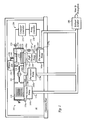
- a preferred integrated pumping system 155 for the process chamber 120 comprises a high vacuum pump 160 and a pre-vacuum pump 165a - both of which are positioned locally in the immediate environment around the chambers, as shown in Figure 2, and not in a separate or distal environment.
- the pumping system 155 comprises a pre-vacuum pump 165a adjacent to or abutting the chamber, having an inlet 170a connected to the chamber to evacuate gas from the chamber, and having an outlet 175a that exhausts the evacuated gas to atmospheric pressure via an exhaust scrubber 180 .
- the pre-vacuum pump 165a is capable of evacuating the gas in the chamber 120 from atmospheric pressure to a pressure of less than about 102 Torr range.
- the high vacuum pump 160 is provided to drop the chamber pressure down from the low pressure range to high vacuum of 10 3 Torr range.
- the high vacuum pump 160 has an inlet 182 connected to the chamber and an outlet 185 that exhausts directly to the pre-vacuum pump 165a.
- the high vacuum pump 160 is capable of evacuating the chamber from a pressure of about 10 -2 Torr to a pressure as low as about 10 -9 Torr, and it cannot exhaust gas to atmospheric pressure.
- the high vacuum pump 160 can only operate within a narrow and low pressure range and cannot pump down the chamber from atmospheric pressure. Only after the pre-vacuum pump 165a pumps down the chamber to a low pressure can the high vacuum pump 160 be operated to further reduce the chamber pressure to ultra-low pressures.
- the load-lock chamber 110 and the transfer chamber 115 do not need a high vacuum pump 160 because they do not need to be pumped down to a high vacuum.
- these chambers have only a pre-vacuum pump 165b,c having an inlet 170b,c connected to one of the chambers 110, 115 for evacuating the gas from the chamber and an outlet 175b,c that exhausts the process gas directly to atmospheric pressure via the exhaust scrubber 180.
- the transfer chamber 115 has a short length of foreline 190b or has no forelines between the inlet 170b of the pre-vacuum pump 165b and the chamber 115 .
- the load-lock chamber 110 has a short length of foreline or does not have any forelines 190a,b between the inlet 170c of the pre-vacuum pump 165c and the chamber 110 because the pump is connected directly to and abutting the load-lock chamber 110 .
- the apparatus of the present invention comprises a short length of foreline 190a,b , or no foreline at all, between the chambers 110, 115, 120 and their associated pumps 165b,c or set of pumps 160, 165a .
- a foreline having a length of about 0.5-2.0 m extends from the pre-vacuum pump 165a to the process chamber.
- the inlet of the high vacuum pump 182 is connected to the chamber, and its outlet to the foreline.
- the pump is connected directly to the transfer chamber with or without a foreline having a short length of 0-2.0 m.
- the pre-vacuum pump 165c is coupled to the chamber with or without any foreline.
- the inlet between the pump feeds to the chamber through a short foreline having a length of less than about 2.0 m, and more preferably less than 0.5 m.
- Figure 3 shows the specific conductance of foreline pipes for increasing gas pressure in a chamber and for different foreline pipe diameters. For a given foreline pipe diameter, as the gas pressure increases, the specific conductance of the foreline does not change from gas pressures of about 0.1 to about 1-10 mTorr and thereafter, the specific conductance increases sharply for increasing gas pressure.
- the conductance of a foreline with 10 m length and 40 mm diameter is 25 l/s, and the conductance of a foreline with 10 m length and 100 mm diameter is 900 l/s. Therefore, the length and diameter of the foreline has a substantial impact on conductance.
- the total pumping conductance loss increases in more than simply an additive function of the conductance loss from the foreline and that from the chamber and valve.
- Figure 4 shows the total conductance (line 192) in relation to the chamber and valve conductance (line 194) and the foreline conductance (line 196) for increasing flow of gas in a chamber.
- the total conductance C T is always smaller than the chamber/valve conductance C C/V and is always smaller than the foreline conductance C F and, in fact, is smaller than the smaller of the two.
- Table I shows calculated foreline losses which are the losses in pump capacity or pumping speed that arise because of the length of the foreline between the pump and chamber, as a function of the length and diameter of the foreline. For example, for a foreline having a constant length of 20 meters, the foreline losses increase from 37% to 65% - as the foreline diameter decreases from 100 to 40 mm. Similarly, for a foreline having a constant diameter of 40 mm, the foreline losses increase from 48% to 65%-as the length of the foreline increases from 10 to 20 m. Thus, the shorter the length of the foreline, the higher the conductance of the foreline and the lower are the pumping losses of the pumping system 155 .
- the integrated pumping system 155 illustrated in Figure 2 operates far more efficiently than the remote pumping system 35 illustrated in Figure 1, because of the absence of low conductance pipelines, forelines, and valves and also because much smaller capacity pumps can be substituted for the larger capacity remote pumps that are used in conventional apparatus 15 .
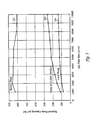
- Figure 5 shows the required pump capacity (or pumping speed) as a function of process gas flow rate for a remotely located pump, a closely located pump with a short foreline, and an abutting pump.
- Line 202 shows the pumping speed of a conventional remote pump with a long 50-foot foreline 65a-c , and that is located in remote environment from a processing apparatus 15 , for example, as shown in Figure 1.
- Line 204 shows the pumping speed of a pump 165a,b having a short foreline 190a,b which demonstrates a substantial increase in pumping efficiency, as shown in Figure 2.
- Line 206 shows the even higher efficiency of a local abutting pump 165c having no foreline, also as shown in Figure 2.
- the difference in height between lines 202 and 206 represents the increase in pump capacity arising from the higher conductance between the pump and the chamber.
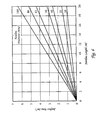
- Figure 6 shows the increasing deposition area provided by the internal surfaces of forelines having increasing diameters of 16 to 100 mm and foreline lengths.
- a foreline having a diameter of 40 mm and a length of 1 m has a surface area of approximately 0.128 m 2
- a foreline having a diameter of 100 mm and a length of 20 m has a surface area of 6.4 m 2 , which is about 50 times larger.
- the larger area provides a much bigger surface for condensates to be deposited upon from the process gas flowing in the foreline 190a . Therefore, it is desirable to have a foreline with a diameter of less than about 80 mm, and more preferably less than about 50 mm. These smaller diameters reduce the foreline surface area by a factor of 10 from an average of about 4 m 2 to less than about 0.4 m 2 .
- Figure 7 is a graph showing the change in pressure in a chamber as a function of increasing gas flow showing the improved processing window obtained by the integrated pumping system 155 as compared to a remote pumping system 35 .
- Line 208 is the pressure versus gas flow curve for a remote set of pumps comprising a 80 m 3 /hr pre-vacuum pump and a 500 m 3 /hr low vacuum pump.
- Line 212 is the curve for an integrated pumping system 155 comprising a single 100 m 3 /hr pre-vacuum pump. Both pumping systems 35, 155 used a 2000 l/s turbo molecular high vacuum pump 160 .
- the integrated pumping system 155 had two advantages over the remote pumping system 35 .
- the dual pumps having capacities of 80/500 were replaced by a single pump having a capacity of 100 m 3 /hr.
- the pump with the large capacity of 500 m 3 /hr which used a lot of energy, was expensive and had a large footprint, was eliminated by the much smaller capacity pump of 100 m 3 /hr.
- the integrated pumping system 155 obtained wider process window in the flow range of 200 to 400 sccm, which is a commonly used flow range for many processes with lower pressures of 6 to 10 mTorr.
- a pre-vacuum pump 165c is connected directly to a chamber 110 without any length of foreline at all. Eliminating the foreline provides increased pump capacity and reduced contamination from the forelines and valves. This embodiment is especially useful for load-lock chambers 110 that often require rapid cycling between atmospheric pressure and low vacuum pressures of 100 to 300 mTorr.
- the pump 165c should have a low-level of vibrations during operation, a relatively small size, and not be excessively noisy.
- low level of vibration it is meant a vibrational level of less than about 2.5 m/s2, and more preferably less than about 1.5 m/s 2 .
- the small size of the pump 165c is typically less than about 65 liters, and more preferably less than about 40 liters. These small pump sizes are achieved by higher rotational speed, optimal pumping stages, and motor design.
- the pump 165c should not be excessively noisy to allow operation within the clean or grey room.
- a sufficiently low noise level is below 65 dB, and more preferably less than about 55 dB. This is achieved by reducing mechanical vibrations and gas compression noises.
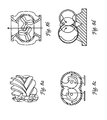
- the pre-vacuum pumps 165a-c can be a roots, screw, hook and claw, tongue and groove, or similar principle.
- the pre-vacuum pump 165a is a screw, roots, hook and claw, or tongue and groove pump that comprises one or more evacuating members that rotate to evacuate gas from a chamber.
- Figure 8a shows a schematic of a screw pump having a plurality of screw augers that have interlacing blades. The size of the screw augers and the speed of the shaft controls the pump capacity or speed which is a rate of which the pump evacuates gas from a chamber.
- Figure 8b shows a schematic of a roots-type pump which has two or more rotors also with interdigited blades.
- the pump comprises a plurality of parallel shafts, each having a hook and claw mechanism that interact with one another to evacuate gas from the chamber.
- the pump comprises a rotating member comprising a tongue and groove mechanism on a plurality of shafts. Combinations of these pump mechanisms are also possible.
- the pressure of the gas in one or all of the chambers is controlled by an open or a closed loop pressure controller 220 that adjusts a speed of the pump to change the pressure of gas in a chamber.
- a pressure controller 220 comprising at least one pressure gauge 225 connected to the chamber 120 for providing a pressure signal P S in relation to the pressure of the gas in the chamber 120 .
- the analog or digital pressure signal P S is transmitted to a pump controller 230 , such as a P, PI, or PID or similar controller and/or a computer system 235 , that compares the signal P S to a target pressure P T , and changes the speed of a motor 240 of the pump 165a in relation to the difference ⁇ P between the measured and target pressures.
- a set of rules such as proportional-integral-derivative rules, are used to adjust the speed or the pump 165a in proportion to ⁇ P.
- ⁇ P becomes larger, the increase in pump speed is set to be correspondingly higher, as ⁇ P is reduced, the pump speed is set to be correspondingly lowered.
- the internal and exhaust pressures of the pump 165a can also be measured using additional gauges and sensors (not shown).
- the pump controller 230 can be a single controller or a set of controllers that cooperate to perform the pressure measurement, comparison of measured and set-point pressures, and adjustment of the pump speed.
- the pump controller 230 changes a rotational speed of the pump 165a .
- the rotational speed of the pump controls the pump capacity which is the rate of which the pump evacuates a volume of gas from the chamber.
- the pre-vacuum pump 165a has a low rotational speed that is less than about 10,000 rpm, and more preferably less than about 7,000 rpm. The low rpm is advantageous because it reduces the vibration of the pump during use and reduces power consumption and response time during speeding up and down for pressure control.
- a variable speed pump is operated by a programmable speed controller (now shown) to closely match an optimal complex-shaped curve of pressure reduction versus time in a chamber.
- the modeled pressure reduction versus time curve for a chamber is used to rapidly reduce the pressure of gas in the chamber and avoid ice condensation.
- the complex-shaped smooth curve cannot be closely matched by the step) changes in opening size of a two-stage or conventional soft-start valve.
- by adjusting the rotational speed of the pump through a predetermined range of speeds that can be continuously varied through an entire range of rpm, it is possible to closely trace and match the optimal pressure/time curve.
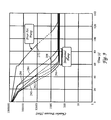
- Figure 9 shows the pressure reduction curves obtained for different configurations of remote and the integrated pumping systems 35, 155 .
- pre-vacuum pumps 165a-c were oositioned in both remote and integrated positions to compare the reduction in pump-down time achieved by the integrated pumps. Both sets of pumps were operated to evacuate a load-lock chamber. The pumps had different pumping capacities and were operated at different rotational speeds to optimize their pump-down process cycle.
- line 272 shows pump-down pressure/time cycles for a remote pump, which has a pump-down time of about 135 seconds.
- lines 284 to 294 are pump-down pressure/time cycles of integrated pumps that were positioned abutting the platform and chambers and with a short foreline having a length of 2 m and a diameter of 50 mm.
- the local pumps had an average pump-down speed of about 65 seconds, which is twice as fast as the remote pumps.
- a soft-start valve or a two-step speed adjustment was used in the foreline 76 to control the rate of pressure reduction in the chamber.
- Some of the pumps used soft-start valves having two opening sizes comprising a small opening size that was initially opened to bring the chamber down from atmospheric pressure to a pressure of 200-300 Torr, and a large opening used to reduce the chamber pressure down to about 0.1 Torr.
- the change in slopes of the pump down cycles was obtained by either changing from the small to the large valve in the case of the remote pumps, or from one rotational speed to another in the case of the variable speed integrated pumps.
- the rotational speeds of the pumps were set at one or more of 20, 30, 40, 45, 60, 80, and 100 Hz.
- Pairs of rotational speeds were used for each integrated pump, including a lower speed and a higher speed, to achieve optimal fast and soft pump down. It is seen that an optimal pump-down cycle was obtained for an integrated pump having a capacity of 100 m 3 /hr operated at rotational speeds of 40/100 Hz, 290, 294 .
- Figure 10 shows a computer-generated model of a pressure reduction curve for a process chamber that can be used to rapidly reduce the pressure of gas in the chamber without ice condensation.
- the computer simulation model was generated for a chamber having a volume of about 6 liters.
- the rotational speed of an integrated pump mounted on a process chamber was varied through a selected set of increasing speeds to closely match the pressure reduction curve.
- the set of pump speeds were selected to closely trace the pump capacity or speed to the maximum allowable capacity denoted by the modeled pressure reduction curve, as shown by line 300.
- line 302 shows the measured pressure reduction curve obtained in the chamber, when the pump was run at 30 m 3 /hr during the initial pressure reduction from atmospheric pressure to 200 Torr, and thereafter, run at 90 m 3 /hr for pressure reduction down to 0.1 Torr.
- Line 302 took the longest time of about 13 seconds to reach 0.1 Torr without ice condensation in the chamber and did not closely match the pressure reduction curve.
- Line 304 shows the reduction in pressure obtained in the chamber, when the pump was first run at 27 m 3 /hr during the initial pressure reduction from atmospheric pressure to 200 Torr, and thereafter, run at 90 m 3 /hr for pressure reduction down to 0.1 Torr.
- Line 306 shows optimal results in which the pump was operated through a set of speeds of 8, 27, 90, and 250 m 3 /hr, which more closely followed the modeled pressure reduction curve and reduced pump down time from atmospheric pressure to 0.1 Torr in less than about 9 seconds without ice condensation.
- a series of continuous or step changes in the effective or rotational speed of the pump provides an optimal pump down cycle that avoids ice condensation in the chamber. The number of step changes depends on the shape of the modeled ice condensation curve, pump capacity, and the volume of the chamber.
- the reduction in pump down time is particularly important for the load-lock chamber 110 which is often pumped down from atmospheric pressure to low vacuum pressures.
- the load-lock chamber 110 is pumped down every time a new batch of substrates is inserted into the load-lock or a processed batch of substrates is removed from the load-lock chamber.
- the load-lock chamber 110 is often cycled between atmospheric pressure (during loading and unloading of substrates) and low pressures during processing or transferring of the substrates 20 from the load-lock chamber 110 to a process chamber 120 .
- the large number of pump-down cycles, relative to the process chamber 120 which remains at low pressures throughout processing, require fast pump down cycles from atmospheric to low pressure levels of less than about 0.1 Torr.
- the pumping system 155 of the present invention also provides considerable energy conservation over conventional pumping systems 35 .
- the variable speed, integrated, pre-vacuum pump 165a-c can also be operated more efficiently by reducing the high speed maintained during the operational mode to a low speed or power saving idle mode.
- Figure 11 is a graph of the electrical power used by the pumping system 155 versus time showing the energy savings obtained during pump-down of a load-lock chamber 110 . Initially, from 0 about 18 seconds, the pre-vacuum pump is operated at a relatively low speed of about 30 Hz from atmospheric pressure down to about 200 Torr - during which time the pump uses a relatively small amount of energy of 500 to 750 watts.
- the pump speed is accelerated from 30 to 100 Hz over a period of 11 to 2 seconds to achieve a vacuum of about 0.1 Torr in the chamber - the peak energy used during this time is about 3000 watts.
- the pump is operated in a power saving idle mode at about 30 Hz to use a very small amount of energy of about 500 watts.
- Conventional pumps operate at continuous maximum speed of 50 Hz and 60 Hz, depending on the country network frequency, and use from 3,000 to 8,000 watts.
- the variable speed pump operates at a much lower average energy level of about 500 to 1500 watts, thereby consuming about 6 times less energy than conventional pumps.
- the pre-vacuum pump 325 comprises a plurality of inlet ports 330a,b , each connected to an inlet stage 380a,b of the pump 325 .
- each pump 355a,b had one inlet port 360a,b in a single inlet stage 362a,b , respectively.
- the inlet ports 360a,b were each connected to a separate chamber 350a,b on the platform 352 .
- a multiple inlet pump 325 comprises multiple inlet ports 330a,b , each of which are connected to a chamber 355a,b (or a pump) to evacuate the gas in that chamber or pump.
- a single pump 325 can perform the work of a multiple set of prior art pumps 355a,b .
- the platform 340 comprises a plurality of chambers 335a,b mounted contiguously to one another, a single multiple inlet stage pump 325 is used to pump down one or more of the chambers 325a,b, and thereby increase pumping efficiency, reduce capital costs by eliminating a number of pumps, and save valuable space in the clean room.
- the multiple inlet pump 325 comprises a first inlet 330a connected to a first chamber 335a or high vacuum pump (not shown) and a second inlet 330b connected to a second chamber 335b or another high vacuum pump (not shown).
- the first inlet 330a can be connected to a process chamber
- the second inlet 330b connected to the load-lock or transfer chamber, or both the first and second inlets 330a,b can be connected to separate process chambers.
- the multiple inlet pump 325 has a vacuum capacity that is capable of evacuating the plurality of chambers from a pressure of one atmosphere down to a pressure of about 0.1 Torr.
- the multiple inlet pump 325 comprises one or more rotatable shafts 370a,b in separate gas evacuating stages 380-384 .
- Each stage 380-384 comprises one or more shafts 370a,b having a plurality of interdigited stages or lobes 385 that interlace each other to form the gas evacuating means within that stage.
- the low-pressure end 380a,b of the pump 325 comprises a plurality of inlet ports 330a,b , each of which are connected to a single chamber 335a,b , respectively.
- the first and second inlet ports 330a,b can be on a single manifold that terminates to a single inlet stage (not shown) or they can be connected to separate inlet stages 380a,b (as shown).
- the inlet ports 380a,b terminate at one or more separate inlet stages 380a,b that are connected in a parallel arrangement, by which it is meant that the outlets of these two stages do not feed into one another, but instead are combined to feed directly to a second stage 381 .
- the second stage 381 feeds to the third stage 382
- the third stage 382 feeds to the fourth stage 383
- the fourth stage 383 feeds to the fifth stage 384 , all in series arrangement.
- the fifth stage 384 comprises a high pressure exhaust outlet 390 that exhausts the evacuated gas to atmosphere.
- the plurality of stages 380-384 in a series arrangement serve to increase the pumping efficiency or total pressure reduction achievable by the pump. For example, if each of the first, second, third, fourth, and fifth stages has a compression ratio of about 2, a total of five stages in series arrangement will provide a total compression ration of 2 5 which is about 1000, and the pump can pump down from atmospheric pressure (about 760 Torr) to a thousand times lower or less than about 1 mTorr. Typically each stage of the pump has a compression ratio of from about 2 to about 20.
- the multiple inlet pump 325 provides significant cost savings by reducing the total number of pumps, valves, and pressure control systems, that are used on a multi-chamber platform 340 .
- the footprint of the apparatus 115 is substantially reduced by use of a single pump to perform the task of multiple pumps.
- the pumping efficiency is increased by reducing the total length of foreline piping and other pipeline obstructions, such as valves 500 , which only increase losses.
- a pump 325 having a relatively low capacity can be used to evacuate more than one chamber, efficiently, and with good pressure control.
- the pre-vacuum pump can comprise a non-rotating mechanism that operates in an equivalent manner to a rotating mechanism
- the chambers can be used to process substrates other than semiconductor wafers.
- the apparatus, chamber, pumping system 155 , and methods according to the present invention should not be limited to the illustrative embodiments of the invention described herein. Therefore, the spirit and scope of the appended claims should not be limited to the description of the preferred versions contained herein.
Landscapes
- Engineering & Computer Science (AREA)
- Mechanical Engineering (AREA)
- General Engineering & Computer Science (AREA)
- Compressors, Vaccum Pumps And Other Relevant Systems (AREA)
- Drying Of Semiconductors (AREA)
- Physical Vapour Deposition (AREA)
- Applications Or Details Of Rotary Compressors (AREA)
Applications Claiming Priority (2)
| Application Number | Priority Date | Filing Date | Title |
|---|---|---|---|
| US220153 | 1994-03-30 | ||
| US09/220,153 US7077159B1 (en) | 1998-12-23 | 1998-12-23 | Processing apparatus having integrated pumping system |
Publications (2)
| Publication Number | Publication Date |
|---|---|
| EP1014427A2 true EP1014427A2 (fr) | 2000-06-28 |
| EP1014427A3 EP1014427A3 (fr) | 2005-01-12 |
Family
ID=22822288
Family Applications (1)
| Application Number | Title | Priority Date | Filing Date |
|---|---|---|---|
| EP99310475A Withdrawn EP1014427A3 (fr) | 1998-12-23 | 1999-12-23 | Appareil de traitement ayant un système de pompage intégré |
Country Status (5)
| Country | Link |
|---|---|
| US (3) | US7077159B1 (fr) |
| EP (1) | EP1014427A3 (fr) |
| JP (1) | JP2000254480A (fr) |
| KR (1) | KR100696020B1 (fr) |
| TW (1) | TW448476B (fr) |
Cited By (10)
| Publication number | Priority date | Publication date | Assignee | Title |
|---|---|---|---|---|
| US6701972B2 (en) | 2002-01-11 | 2004-03-09 | The Boc Group, Inc. | Vacuum load lock, system including vacuum load lock, and associated methods |
| EP1126508A3 (fr) * | 2000-02-16 | 2005-03-30 | Applied Materials, Inc. | Appareil de traitement ayant un système de pompage intégré |
| US7021903B2 (en) | 2003-12-31 | 2006-04-04 | The Boc Group, Inc. | Fore-line preconditioning for vacuum pumps |
| US7077159B1 (en) | 1998-12-23 | 2006-07-18 | Applied Materials, Inc. | Processing apparatus having integrated pumping system |
| US7219692B2 (en) * | 2000-04-20 | 2007-05-22 | Alcatel | Apparatus for conditioning the atmosphere in a chamber |
| WO2007099491A1 (fr) * | 2006-02-28 | 2007-09-07 | Nxp B.V. | Ensemble de traitement et procede de traitement d'une tranche dans un tel ensemble de traitement |
| US7278831B2 (en) | 2003-12-31 | 2007-10-09 | The Boc Group, Inc. | Apparatus and method for control, pumping and abatement for vacuum process chambers |
| US7500822B2 (en) | 2004-04-09 | 2009-03-10 | Edwards Vacuum, Inc. | Combined vacuum pump load-lock assembly |
| CN101783280B (zh) * | 2009-01-16 | 2012-09-19 | 联华电子股份有限公司 | 半导体机台的清洁方法 |
| US9366560B2 (en) | 2013-08-01 | 2016-06-14 | John Cacciola | Detector for detecting a change in a fluid level and generating a digital signal |
Families Citing this family (46)
| Publication number | Priority date | Publication date | Assignee | Title |
|---|---|---|---|---|
| US20050189074A1 (en) * | 2002-11-08 | 2005-09-01 | Tokyo Electron Limited | Gas processing apparatus and method and computer storage medium storing program for controlling same |
| WO2002079080A1 (fr) * | 2001-03-29 | 2002-10-10 | Kabushiki Kaisha Toyota Chuo Kenkyusho | Dispositif et procede de production d'une structure a base de silicium |
| US7006888B2 (en) * | 2002-01-14 | 2006-02-28 | Applied Materials, Inc. | Semiconductor wafer preheating |
| JP2003233080A (ja) * | 2002-02-05 | 2003-08-22 | Lg Phillips Lcd Co Ltd | 合着装置及びこれを用いた液晶表示装置の製造方法 |
| FR2839331B1 (fr) * | 2002-05-02 | 2004-07-16 | Cit Alcatel | Installation de fabrication de composants semi-conducteurs a faux-plancher ventile |
| JP2004035971A (ja) * | 2002-07-05 | 2004-02-05 | Ulvac Japan Ltd | 薄膜製造装置 |
| JP4388287B2 (ja) * | 2003-02-12 | 2009-12-24 | 東京エレクトロン株式会社 | プラズマ処理装置及び高周波電力供給装置 |
| GB0401396D0 (en) * | 2004-01-22 | 2004-02-25 | Boc Group Plc | Pressure control method |
| JP4633370B2 (ja) * | 2004-02-17 | 2011-02-16 | 財団法人国際科学振興財団 | 真空装置 |
| GB0412623D0 (en) | 2004-06-07 | 2004-07-07 | Boc Group Plc | Method controlling operation of a semiconductor processing system |
| US20060176928A1 (en) | 2005-02-08 | 2006-08-10 | Tokyo Electron Limited | Substrate processing apparatus, control method adopted in substrate processing apparatus and program |
| US20060196023A1 (en) * | 2005-03-02 | 2006-09-07 | Min-Lyul Lee | Reduced cost process modules |
| CN101208463A (zh) * | 2005-06-29 | 2008-06-25 | Nxp股份有限公司 | 用于保持工艺腔内的近大气压力的设备和方法 |
| JP4711185B2 (ja) * | 2006-02-27 | 2011-06-29 | 株式会社デンソー | 半導体装置の異物除去装置及び異物除去方法 |
| US20070251585A1 (en) * | 2006-04-28 | 2007-11-01 | David Paul Edwards | Fluid distribution system |
| KR100870322B1 (ko) * | 2007-02-09 | 2008-11-25 | 주식회사 하이닉스반도체 | 반도체 소자의 소자 분리막 형성 방법 |
| KR101012045B1 (ko) * | 2007-07-23 | 2011-01-31 | 코바렌트 마테리얼 가부시키가이샤 | 감압 장치 및 이것에 이용하는 무기 재료질 다공체 |
| US7964040B2 (en) * | 2007-11-08 | 2011-06-21 | Applied Materials, Inc. | Multi-port pumping system for substrate processing chambers |
| JP2009290177A (ja) * | 2008-06-02 | 2009-12-10 | Japan Steel Works Ltd:The | 半導体処理装置 |
| KR101252948B1 (ko) * | 2008-08-05 | 2013-04-15 | 가부시키가이샤 알박 | 진공 처리 장치, 진공 처리 방법 |
| EP2399272A1 (fr) * | 2009-02-22 | 2011-12-28 | Mapper Lithography IP B.V. | Procédé et agencement pour obtenir un vide dans une chambre à vide |
| GB2472638B (en) * | 2009-08-14 | 2014-03-19 | Edwards Ltd | Vacuum system |
| US8454756B2 (en) * | 2010-04-30 | 2013-06-04 | Applied Materials, Inc. | Methods for extending the lifetime of pressure gauges coupled to substrate process chambers |
| US8839876B2 (en) * | 2010-07-13 | 2014-09-23 | Rom Acquisition Corporation | Hydraulic system and method for delivering electricity, water, air, and foam in a firefighting apparatus |
| US10428807B2 (en) * | 2011-12-09 | 2019-10-01 | Applied Materials, Inc. | Pump power consumption enhancement |
| US20130239889A1 (en) * | 2012-03-14 | 2013-09-19 | Taiwan Semiconductor Manufacturing Co., Ltd. | Valve purge assembly for semiconductor manufacturing tools |
| US20150295124A1 (en) * | 2012-04-02 | 2015-10-15 | Koji Matsumaru | Manufacturing equipment for photovoltaic devices and methods |
| SG10201807846WA (en) | 2012-06-28 | 2018-10-30 | Universal Instruments Corp | Flexible assembly machine, system and method |
| TW201530041A (zh) * | 2013-10-11 | 2015-08-01 | Applied Materials Inc | 促進對於多腔室的系統單點連接之緊密危險性氣體線分配 |
| US9575494B2 (en) * | 2013-11-14 | 2017-02-21 | Taiwan Semiconductor Manufacturing Co., Ltd. | Mechanisms for processing wafer |
| US10269537B2 (en) * | 2013-12-16 | 2019-04-23 | Varian Semiconductor Equipment Associates, Inc. | Vacuum assembly for an ion implanter system |
| DE112015000672T5 (de) | 2014-02-07 | 2016-10-20 | Universal Instruments Corp. | Pick-and-Place-Bestückungskopf mit interner Unterdruck- und Luftdruckzuführung, System und Verfahren |
| JP6495707B2 (ja) * | 2015-03-25 | 2019-04-03 | 株式会社Screenホールディングス | 露光装置および基板処理装置 |
| JP6616611B2 (ja) * | 2015-07-23 | 2019-12-04 | エドワーズ株式会社 | 排気システム |
| KR101804162B1 (ko) | 2016-11-17 | 2017-12-04 | 주식회사 엔유씨전자 | 블렌더 |
| JP6484601B2 (ja) | 2016-11-24 | 2019-03-13 | 株式会社Kokusai Electric | 処理装置及び半導体装置の製造方法 |
| JP7391869B2 (ja) | 2018-05-15 | 2023-12-05 | エヴァテック・アーゲー | 基板真空処理装置及び方法 |
| GB2579360A (en) * | 2018-11-28 | 2020-06-24 | Edwards Ltd | Multiple chamber vacuum exhaust system |
| KR102329548B1 (ko) * | 2019-10-17 | 2021-11-24 | 무진전자 주식회사 | 챔버 배기량 자동 조절 시스템 |
| GB2592346B (en) * | 2020-01-09 | 2022-11-02 | Edwards Ltd | Vacuum pump and vacuum pump set for evacuating a semiconductor processing chamber |
| GB2592043A (en) * | 2020-02-13 | 2021-08-18 | Edwards Ltd | Axial flow vacuum pump |
| KR102424601B1 (ko) * | 2021-02-04 | 2022-07-25 | 에스케이실트론 주식회사 | 웨이퍼 제조장치 및 상기 웨이퍼 제조장치의 운영방법 |
| CN116110814A (zh) * | 2021-11-11 | 2023-05-12 | 细美事有限公司 | 基板处理装置 |
| FR3148460A1 (fr) * | 2023-05-02 | 2024-11-08 | Pfeiffer Vacuum | Pompe à vide |
| FR3164314A1 (fr) * | 2024-07-03 | 2026-01-09 | Pfeiffer Vacuum | Equipement et procédé de fabrication |
| US20260096386A1 (en) * | 2024-09-30 | 2026-04-02 | Applied Materials, Inc. | Load lock chamber improvement |
Family Cites Families (41)
| Publication number | Priority date | Publication date | Assignee | Title |
|---|---|---|---|---|
| US4179244A (en) * | 1977-05-31 | 1979-12-18 | Hargraves Aerobic Systems, Inc. | Rotary low pressure air displacement pump |
| US4539822A (en) * | 1984-02-27 | 1985-09-10 | National Electrostatics Corporation | Vibration isolator for cryopump |
| US4534314A (en) * | 1984-05-10 | 1985-08-13 | Varian Associates, Inc. | Load lock pumping mechanism |
| US5882165A (en) * | 1986-12-19 | 1999-03-16 | Applied Materials, Inc. | Multiple chamber integrated process system |
| DE3786917D1 (de) * | 1987-05-15 | 1993-09-09 | Leybold Ag | Ein- oder mehrstufige zweiwellenvakuumpumpe. |
| ZA884511B (en) * | 1987-07-15 | 1989-03-29 | Boc Group Inc | Method of plasma enhanced silicon oxide deposition |
| US5076205A (en) | 1989-01-06 | 1991-12-31 | General Signal Corporation | Modular vapor processor system |
| JP2566308B2 (ja) | 1989-01-12 | 1996-12-25 | 東京エレクトロン株式会社 | ロードロック装置を備えた処理装置 |
| JPH0793348B2 (ja) * | 1989-05-19 | 1995-10-09 | アプライド マテリアルズ インコーポレーテッド | 多重チャンバ真空式処理装置及び多重チャンバ真空式半導体ウェーハ処理装置 |
| US5186718A (en) * | 1989-05-19 | 1993-02-16 | Applied Materials, Inc. | Staged-vacuum wafer processing system and method |
| US5174827A (en) * | 1989-07-26 | 1992-12-29 | Consorzio Ce.Te.V Centro Tecnologie Del Vuoto | Double chamber vacuum apparatus for thin layer deposition |
| JPH07110991B2 (ja) * | 1989-10-02 | 1995-11-29 | 株式会社日立製作所 | プラズマ処理装置およびプラズマ処理方法 |
| US5186594A (en) | 1990-04-19 | 1993-02-16 | Applied Materials, Inc. | Dual cassette load lock |
| KR0155572B1 (ko) * | 1991-05-28 | 1998-12-01 | 이노우에 아키라 | 감압처리 시스템 및 감압처리 방법 |
| JP3067842B2 (ja) | 1991-06-05 | 2000-07-24 | 東京エレクトロン株式会社 | 真空容器の排気方法 |
| JPH0629367A (ja) | 1992-07-07 | 1994-02-04 | Nec Yamagata Ltd | 真空装置のバルブ制御方法 |
| US5733104A (en) * | 1992-12-24 | 1998-03-31 | Balzers-Pfeiffer Gmbh | Vacuum pump system |
| KR100261532B1 (ko) * | 1993-03-14 | 2000-07-15 | 야마시타 히데나리 | 피처리체 반송장치를 가지는 멀티챔버 시스템 |
| JP2990003B2 (ja) | 1993-12-14 | 1999-12-13 | 山形日本電気株式会社 | 高真空排気装置 |
| JP3501524B2 (ja) * | 1994-07-01 | 2004-03-02 | 東京エレクトロン株式会社 | 処理装置の真空排気システム |
| TW295677B (fr) * | 1994-08-19 | 1997-01-11 | Tokyo Electron Co Ltd | |
| US5730801A (en) * | 1994-08-23 | 1998-03-24 | Applied Materials, Inc. | Compartnetalized substrate processing chamber |
| JPH0874041A (ja) | 1994-09-02 | 1996-03-19 | Mitsubishi Electric Corp | 真空成膜装置及び方法並びに該装置における圧力センサの交換方法 |
| US5685963A (en) * | 1994-10-31 | 1997-11-11 | Saes Pure Gas, Inc. | In situ getter pump system and method |
| IL117775A (en) * | 1995-04-25 | 1998-10-30 | Ebara Germany Gmbh | Inhalation system with gas exhaust cleaner and operating process for it |
| TW283250B (en) * | 1995-07-10 | 1996-08-11 | Watkins Johnson Co | Plasma enhanced chemical processing reactor and method |
| US5709753A (en) * | 1995-10-27 | 1998-01-20 | Specialty Coating Sysetms, Inc. | Parylene deposition apparatus including a heated and cooled dimer crucible |
| JPH09251981A (ja) | 1996-03-14 | 1997-09-22 | Toshiba Corp | 半導体製造装置 |
| US5718563A (en) * | 1996-10-03 | 1998-02-17 | Ingersoll-Rand Company | Portable compressor with system for optimizing temperature in compressor housing and method |
| US5928389A (en) * | 1996-10-21 | 1999-07-27 | Applied Materials, Inc. | Method and apparatus for priority based scheduling of wafer processing within a multiple chamber semiconductor wafer processing tool |
| US5718029A (en) * | 1996-11-06 | 1998-02-17 | Vanguard International Semiconductor Corporation | Pre-installation of pumping line for efficient fab expansion |
| JPH09168732A (ja) | 1996-12-02 | 1997-06-30 | Hitachi Ltd | 真空処理装置 |
| EP1012478A2 (fr) | 1997-04-18 | 2000-06-28 | SAES PURE GAS, Inc. | Systeme de pompe getter in situ et methode |
| JP2942239B2 (ja) * | 1997-05-23 | 1999-08-30 | キヤノン株式会社 | 排気方法及び排気装置、それを用いたプラズマ処理方法及びプラズマ処理装置 |
| US5944049A (en) * | 1997-07-15 | 1999-08-31 | Applied Materials, Inc. | Apparatus and method for regulating a pressure in a chamber |
| JPH11230036A (ja) * | 1998-02-18 | 1999-08-24 | Ebara Corp | 真空排気システム |
| SE512070C2 (sv) * | 1998-03-18 | 2000-01-24 | Tetra Laval Holdings & Finance | Anordning för högtryckspumpning eller homogenisering av vätskor |
| DE19819726A1 (de) * | 1998-05-02 | 1999-11-04 | Leybold Systems Gmbh | Vakuumbehandlungsanlage zum Aufbringen dünner, harter Schichten |
| US7077159B1 (en) | 1998-12-23 | 2006-07-18 | Applied Materials, Inc. | Processing apparatus having integrated pumping system |
| SG97943A1 (en) * | 1999-10-04 | 2003-08-20 | Ebara Corp | Vacuum exhaust system |
| US6397883B1 (en) * | 1999-12-16 | 2002-06-04 | The Boc Group, Inc. | Equipment skid |
-
1998
- 1998-12-23 US US09/220,153 patent/US7077159B1/en not_active Expired - Fee Related
-
1999
- 1999-12-14 TW TW088121928A patent/TW448476B/zh not_active IP Right Cessation
- 1999-12-23 EP EP99310475A patent/EP1014427A3/fr not_active Withdrawn
- 1999-12-23 KR KR1019990060922A patent/KR100696020B1/ko not_active Expired - Fee Related
- 1999-12-24 JP JP11367244A patent/JP2000254480A/ja active Pending
-
2000
- 2000-02-16 US US09/505,580 patent/US6817377B1/en not_active Expired - Fee Related
-
2004
- 2004-09-21 US US10/945,727 patent/US7051759B2/en not_active Expired - Fee Related
Cited By (11)
| Publication number | Priority date | Publication date | Assignee | Title |
|---|---|---|---|---|
| US7077159B1 (en) | 1998-12-23 | 2006-07-18 | Applied Materials, Inc. | Processing apparatus having integrated pumping system |
| EP1126508A3 (fr) * | 2000-02-16 | 2005-03-30 | Applied Materials, Inc. | Appareil de traitement ayant un système de pompage intégré |
| US7219692B2 (en) * | 2000-04-20 | 2007-05-22 | Alcatel | Apparatus for conditioning the atmosphere in a chamber |
| US6701972B2 (en) | 2002-01-11 | 2004-03-09 | The Boc Group, Inc. | Vacuum load lock, system including vacuum load lock, and associated methods |
| US7021903B2 (en) | 2003-12-31 | 2006-04-04 | The Boc Group, Inc. | Fore-line preconditioning for vacuum pumps |
| US7278831B2 (en) | 2003-12-31 | 2007-10-09 | The Boc Group, Inc. | Apparatus and method for control, pumping and abatement for vacuum process chambers |
| EP1553303A3 (fr) * | 2003-12-31 | 2009-12-30 | Edwards Vacuum, Inc. | Appareil pour évacuer une pluralité de chambres à vide |
| US7500822B2 (en) | 2004-04-09 | 2009-03-10 | Edwards Vacuum, Inc. | Combined vacuum pump load-lock assembly |
| WO2007099491A1 (fr) * | 2006-02-28 | 2007-09-07 | Nxp B.V. | Ensemble de traitement et procede de traitement d'une tranche dans un tel ensemble de traitement |
| CN101783280B (zh) * | 2009-01-16 | 2012-09-19 | 联华电子股份有限公司 | 半导体机台的清洁方法 |
| US9366560B2 (en) | 2013-08-01 | 2016-06-14 | John Cacciola | Detector for detecting a change in a fluid level and generating a digital signal |
Also Published As
| Publication number | Publication date |
|---|---|
| US7077159B1 (en) | 2006-07-18 |
| KR20000048366A (ko) | 2000-07-25 |
| TW448476B (en) | 2001-08-01 |
| JP2000254480A (ja) | 2000-09-19 |
| EP1014427A3 (fr) | 2005-01-12 |
| US6817377B1 (en) | 2004-11-16 |
| US20050034767A1 (en) | 2005-02-17 |
| KR100696020B1 (ko) | 2007-03-15 |
| US7051759B2 (en) | 2006-05-30 |
Similar Documents
| Publication | Publication Date | Title |
|---|---|---|
| US7077159B1 (en) | Processing apparatus having integrated pumping system | |
| US6896764B2 (en) | Vacuum processing apparatus and control method thereof | |
| JP3501524B2 (ja) | 処理装置の真空排気システム | |
| US6736606B1 (en) | Vacuum apparatus | |
| US6474949B1 (en) | Evacuating unit with reduced diameter exhaust duct | |
| CN101297063B (zh) | 处理气体的方法 | |
| US6589023B2 (en) | Device and method for reducing vacuum pump energy consumption | |
| RU2421632C2 (ru) | Способ работы насосной системы | |
| JPWO2000053928A1 (ja) | 真空装置 | |
| JPH0525040B2 (fr) | ||
| CN100520503C (zh) | 抽真空系统及其驱动方法、具有此系统的装置和使用此系统转移基板的方法 | |
| TW201139851A (en) | Vacuum exhaust device and vacuum exhaust method, and substrate treatment device | |
| JPH07321047A (ja) | 真空処理装置 | |
| KR101140695B1 (ko) | 펌프 세정 | |
| JP2004218648A (ja) | 真空装置 | |
| US20080295867A1 (en) | Method of cleaning turbo pump and chamber/turbo pump clean process | |
| TW202326907A (zh) | 具有水蒸氣及氧分壓之快速與選擇性控制的基板處理工具 | |
| EP1126508A2 (fr) | Appareil de traitement ayant un système de pompage intégré | |
| JP2003161281A (ja) | 真空処理装置 | |
| JPH10238462A (ja) | 真空排気装置及びそのメンテナンス方法 | |
| JP2003229417A (ja) | 真空処理装置及びその制御方法 | |
| JP4107364B2 (ja) | 真空装置 | |
| US6395100B1 (en) | Method of improving vacuum quality in semiconductor processing chambers | |
| JP2002257040A (ja) | 真空排気装置 | |
| JP2008144766A (ja) | 真空装置 |
Legal Events
| Date | Code | Title | Description |
|---|---|---|---|
| PUAI | Public reference made under article 153(3) epc to a published international application that has entered the european phase |
Free format text: ORIGINAL CODE: 0009012 |
|
| AK | Designated contracting states |
Kind code of ref document: A2 Designated state(s): AT BE CH CY DE DK ES FI FR GB GR IE IT LI LU MC NL PT SE |
|
| AX | Request for extension of the european patent |
Free format text: AL;LT;LV;MK;RO;SI |
|
| PUAL | Search report despatched |
Free format text: ORIGINAL CODE: 0009013 |
|
| AK | Designated contracting states |
Kind code of ref document: A3 Designated state(s): AT BE CH CY DE DK ES FI FR GB GR IE IT LI LU MC NL PT SE |
|
| AX | Request for extension of the european patent |
Extension state: AL LT LV MK RO SI |
|
| 17P | Request for examination filed |
Effective date: 20050712 |
|
| AKX | Designation fees paid |
Designated state(s): DE FR GB |
|
| 17Q | First examination report despatched |
Effective date: 20060829 |
|
| STAA | Information on the status of an ep patent application or granted ep patent |
Free format text: STATUS: THE APPLICATION IS DEEMED TO BE WITHDRAWN |
|
| 18D | Application deemed to be withdrawn |
Effective date: 20070109 |