EP1014540A1 - Dispositif pour l'enrobage des bobinages de champ pour machines électriques rotatives - Google Patents
Dispositif pour l'enrobage des bobinages de champ pour machines électriques rotatives Download PDFInfo
- Publication number
- EP1014540A1 EP1014540A1 EP98310758A EP98310758A EP1014540A1 EP 1014540 A1 EP1014540 A1 EP 1014540A1 EP 98310758 A EP98310758 A EP 98310758A EP 98310758 A EP98310758 A EP 98310758A EP 1014540 A1 EP1014540 A1 EP 1014540A1
- Authority
- EP
- European Patent Office
- Prior art keywords
- field windings
- stator
- sleeve
- vehicle
- bore
- Prior art date
- Legal status (The legal status is an assumption and is not a legal conclusion. Google has not performed a legal analysis and makes no representation as to the accuracy of the status listed.)
- Withdrawn
Links
- 238000004804 winding Methods 0.000 title claims abstract description 83
- 238000000034 method Methods 0.000 claims abstract description 27
- 239000007788 liquid Substances 0.000 claims description 8
- 238000005538 encapsulation Methods 0.000 claims description 7
- 239000007787 solid Substances 0.000 claims description 6
- 239000000945 filler Substances 0.000 claims description 5
- 229920005989 resin Polymers 0.000 claims description 5
- 239000011347 resin Substances 0.000 claims description 5
- 229920000647 polyepoxide Polymers 0.000 claims description 4
- 239000004033 plastic Substances 0.000 claims description 3
- 229920003023 plastic Polymers 0.000 claims description 3
- 238000013021 overheating Methods 0.000 abstract description 2
- 230000008439 repair process Effects 0.000 abstract description 2
- 239000011343 solid material Substances 0.000 abstract description 2
- 230000008569 process Effects 0.000 description 10
- 238000000576 coating method Methods 0.000 description 8
- XEEYBQQBJWHFJM-UHFFFAOYSA-N Iron Chemical compound [Fe] XEEYBQQBJWHFJM-UHFFFAOYSA-N 0.000 description 7
- VYPSYNLAJGMNEJ-UHFFFAOYSA-N Silicium dioxide Chemical compound O=[Si]=O VYPSYNLAJGMNEJ-UHFFFAOYSA-N 0.000 description 7
- -1 alumina Chemical compound 0.000 description 5
- 239000011248 coating agent Substances 0.000 description 5
- 208000015943 Coeliac disease Diseases 0.000 description 4
- 239000011236 particulate material Substances 0.000 description 4
- 238000006243 chemical reaction Methods 0.000 description 3
- 230000006872 improvement Effects 0.000 description 3
- 229910052742 iron Inorganic materials 0.000 description 3
- 238000000465 moulding Methods 0.000 description 3
- 239000004576 sand Substances 0.000 description 3
- VTYYLEPIZMXCLO-UHFFFAOYSA-L Calcium carbonate Chemical compound [Ca+2].[O-]C([O-])=O VTYYLEPIZMXCLO-UHFFFAOYSA-L 0.000 description 2
- MCMNRKCIXSYSNV-UHFFFAOYSA-N Zirconium dioxide Chemical compound O=[Zr]=O MCMNRKCIXSYSNV-UHFFFAOYSA-N 0.000 description 2
- PNEYBMLMFCGWSK-UHFFFAOYSA-N aluminium oxide Inorganic materials [O-2].[O-2].[O-2].[Al+3].[Al+3] PNEYBMLMFCGWSK-UHFFFAOYSA-N 0.000 description 2
- 239000011230 binding agent Substances 0.000 description 2
- 230000000694 effects Effects 0.000 description 2
- 229910052500 inorganic mineral Inorganic materials 0.000 description 2
- 239000010445 mica Substances 0.000 description 2
- 229910052618 mica group Inorganic materials 0.000 description 2
- 239000011707 mineral Substances 0.000 description 2
- 239000000377 silicon dioxide Substances 0.000 description 2
- FRWYFWZENXDZMU-UHFFFAOYSA-N 2-iodoquinoline Chemical compound C1=CC=CC2=NC(I)=CC=C21 FRWYFWZENXDZMU-UHFFFAOYSA-N 0.000 description 1
- 229930185605 Bisphenol Natural products 0.000 description 1
- RYGMFSIKBFXOCR-UHFFFAOYSA-N Copper Chemical compound [Cu] RYGMFSIKBFXOCR-UHFFFAOYSA-N 0.000 description 1
- 239000004743 Polypropylene Substances 0.000 description 1
- 229920002472 Starch Polymers 0.000 description 1
- 239000000440 bentonite Substances 0.000 description 1
- 229910000278 bentonite Inorganic materials 0.000 description 1
- SVPXDRXYRYOSEX-UHFFFAOYSA-N bentoquatam Chemical compound O.O=[Si]=O.O=[Al]O[Al]=O SVPXDRXYRYOSEX-UHFFFAOYSA-N 0.000 description 1
- LTPBRCUWZOMYOC-UHFFFAOYSA-N beryllium oxide Inorganic materials O=[Be] LTPBRCUWZOMYOC-UHFFFAOYSA-N 0.000 description 1
- 230000015572 biosynthetic process Effects 0.000 description 1
- IISBACLAFKSPIT-UHFFFAOYSA-N bisphenol A Chemical compound C=1C=C(O)C=CC=1C(C)(C)C1=CC=C(O)C=C1 IISBACLAFKSPIT-UHFFFAOYSA-N 0.000 description 1
- 229910000019 calcium carbonate Inorganic materials 0.000 description 1
- 239000003795 chemical substances by application Substances 0.000 description 1
- 238000004140 cleaning Methods 0.000 description 1
- 238000001816 cooling Methods 0.000 description 1
- 229910052802 copper Inorganic materials 0.000 description 1
- 239000010949 copper Substances 0.000 description 1
- 239000003431 cross linking reagent Substances 0.000 description 1
- 229920003020 cross-linked polyethylene Polymers 0.000 description 1
- 230000006378 damage Effects 0.000 description 1
- 238000007598 dipping method Methods 0.000 description 1
- 230000007613 environmental effect Effects 0.000 description 1
- 238000001704 evaporation Methods 0.000 description 1
- 230000008020 evaporation Effects 0.000 description 1
- 235000013312 flour Nutrition 0.000 description 1
- 238000005470 impregnation Methods 0.000 description 1
- 238000003780 insertion Methods 0.000 description 1
- 230000037431 insertion Effects 0.000 description 1
- 239000000395 magnesium oxide Substances 0.000 description 1
- CPLXHLVBOLITMK-UHFFFAOYSA-N magnesium oxide Inorganic materials [Mg]=O CPLXHLVBOLITMK-UHFFFAOYSA-N 0.000 description 1
- AXZKOIWUVFPNLO-UHFFFAOYSA-N magnesium;oxygen(2-) Chemical compound [O-2].[Mg+2] AXZKOIWUVFPNLO-UHFFFAOYSA-N 0.000 description 1
- 239000000463 material Substances 0.000 description 1
- 229910052751 metal Inorganic materials 0.000 description 1
- 239000002184 metal Substances 0.000 description 1
- 239000000203 mixture Substances 0.000 description 1
- 238000012986 modification Methods 0.000 description 1
- 230000004048 modification Effects 0.000 description 1
- 229920003986 novolac Polymers 0.000 description 1
- 230000003647 oxidation Effects 0.000 description 1
- 238000007254 oxidation reaction Methods 0.000 description 1
- 239000002245 particle Substances 0.000 description 1
- 239000012466 permeate Substances 0.000 description 1
- 239000002985 plastic film Substances 0.000 description 1
- 229920000515 polycarbonate Polymers 0.000 description 1
- 239000004417 polycarbonate Substances 0.000 description 1
- 229920000728 polyester Polymers 0.000 description 1
- 238000006116 polymerization reaction Methods 0.000 description 1
- 229920001155 polypropylene Polymers 0.000 description 1
- 239000011148 porous material Substances 0.000 description 1
- 239000011342 resin composition Substances 0.000 description 1
- 239000010454 slate Substances 0.000 description 1
- 239000007921 spray Substances 0.000 description 1
- 239000008107 starch Substances 0.000 description 1
- 235000019698 starch Nutrition 0.000 description 1
- 239000000454 talc Substances 0.000 description 1
- 229910052623 talc Inorganic materials 0.000 description 1
- 239000002966 varnish Substances 0.000 description 1
- 229920002554 vinyl polymer Polymers 0.000 description 1
Images

Classifications
-
- H—ELECTRICITY
- H02—GENERATION; CONVERSION OR DISTRIBUTION OF ELECTRIC POWER
- H02K—DYNAMO-ELECTRIC MACHINES
- H02K15/00—Processes or apparatus specially adapted for manufacturing, assembling, maintaining or repairing of dynamo-electric machines
- H02K15/12—Impregnating, moulding insulation, heating or drying of windings, stators, rotors or machines
-
- B—PERFORMING OPERATIONS; TRANSPORTING
- B29—WORKING OF PLASTICS; WORKING OF SUBSTANCES IN A PLASTIC STATE IN GENERAL
- B29C—SHAPING OR JOINING OF PLASTICS; SHAPING OF MATERIAL IN A PLASTIC STATE, NOT OTHERWISE PROVIDED FOR; AFTER-TREATMENT OF THE SHAPED PRODUCTS, e.g. REPAIRING
- B29C70/00—Shaping composites, i.e. plastics material comprising reinforcements, fillers or preformed parts, e.g. inserts
- B29C70/68—Shaping composites, i.e. plastics material comprising reinforcements, fillers or preformed parts, e.g. inserts by incorporating or moulding on preformed parts, e.g. inserts or layers, e.g. foam blocks
- B29C70/70—Completely encapsulating inserts
-
- B—PERFORMING OPERATIONS; TRANSPORTING
- B29—WORKING OF PLASTICS; WORKING OF SUBSTANCES IN A PLASTIC STATE IN GENERAL
- B29L—INDEXING SCHEME ASSOCIATED WITH SUBCLASS B29C, RELATING TO PARTICULAR ARTICLES
- B29L2031/00—Other particular articles
- B29L2031/30—Vehicles, e.g. ships or aircraft, or body parts thereof
- B29L2031/3055—Cars
- B29L2031/3061—Number plates
Definitions
- This invention relates to rotary electric machines, also termed dynamoelectric machines, which convert electrical energy to mechanical energy or mechanical energy to electrical energy.
- Contemplated are electric motors, generators, alternators and the like, in which the stator is the type which includes a stator core carrying field windings and having a bore or cylindrical cavity in its center to receive a rotor or armature.
- a submersible can-type electric motor stated to be well-known, is the subject of U.S. 4,496,866.
- the bore of the stator core has a cylindrical can inserted therein to cover its inner wall.
- a vehicle is then inserted to be molded completely about the external surface of the stator core including the end portions of the coils.
- a rotary machine which results in insulated and cooler operating field windings.
- Means are provided for embedding in a solid vehicle field windings of stators of rotary electric machines in order to insulate and cool electric machines in which the stators are used.
- the stator is the type having a stator core provided with a central cylindrical bore adapted to receive a rotor.
- the stator core carries field windings held in channels in the face of the cylindrical bore.
- the field windings are looped outside those channels to form top and bottom field windings as they pass from one channel to another.
- means are provided for encapsulating these top and bottom field windings, and for embedding In a solidified vehicle the field windings In the channels therebetween.
- Cylindrical sleeve means are adapted to surround the top and bottom field windings so that they are each within a sleeve.
- a space holding cylinder fitting slidably in the stator bore is locked in the bore to occupy the bore space.
- Closure means are adapted to accept a cylindrical sleeve means end as well as the space saving cylinder when the stator is on an end. This structure forms a closed lower annular area, and an open upper annular area connected by the channels which allow air to escape.
- An inlet port opens into the lower annular area.
- Pressure means force a liquid vehicle which solidifies on standing through the inlet port, into the annular area, and throughout the bottom field windings, and then up the field windings channels to cover the upper field windings. This encapsulates both lower and upper field windings, embedding them in the vehicle which later solidifies.
- motors, generators, alternators, and the like are old and well-described in the prior art, they need not be lengthily described herein except to point out that in these rotary electric machines practically all of the electro/mechanical energy conversion takes place in the air gap between the stator and the rotor or armature.
- the energy conversion in the air gap is a result of a magnetic field set up by current-carrying windings in motors, or by windings moving in a magnetic field in the case of generators and alternators.
- stator windings also termed field windings, primary windings, or stator coils; thus, are the key to any rotary electric machine. Little wonder, then, that from their inception these windings have been protected in same way.
- rotors or armatures are very well known, and they are not the essence of this invention. Rather, members of rotary electric machines with which this invention is concerned are illustrated.
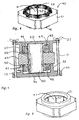
- Fig. 1 include a stator 2 consisting of an iron stator core 4, and top and bottom field windings 6 and 7, termed top and bottom coil heads in U.S. 5,474,799, along with central cavity or stator bore 8 in the stator core.
- Fig. 2 Other components of the invention are depicted in Fig. 2.
- Iron core 4 has a series of internal axially extending channels 10, termed slots in U.S. 5,474,799.
- Each channel 10 usually lined with an insulating paper referred to as a top stick, accommodates copper wires which are wound through the channels to form the stator coils.
- the stator coils protrude axially from both ends to form top and bottom field windings 6 and 7 which loop from one channel to another. It is these top and bottom stator coils, or field windings 6 and 7, which are protected and mechanically stabilized against vibrations.
- an expedient means for protecting field windings is provided.
- the essential elements utilized in the process include a sleeve 11, a space holding cylinder 12, and a closure means 22, whose functions will be described subsequently in connection with the operation or method of the invention.
- space holding cylinder 12 is a strong plastic or metal cylindrical element. It is adapted to fit snugly in the central cavity 8 within the stator core which a rotor or armature usually occupies.
- the size of the cylinder thus, depends upon the rotary electric machine size, actually on the size of bore 8 in stator core 4.
- the space holding cylinder 12 should be at least as long as the distance from the tops of the top and bottom field windings 6 and 7 so that the field windings are in an annular space between the sleeve 11 and the space holding cylinder 12.
- the space holding cylinder is slidable in the stator core bore to confine a vehicle which later will rise through the channels.
- the sleeve 11 is an open-ended cylinder or tube. Its size is also related to the size of the stator. Sleeve 11, seen in Fig. 2, should slide over the outside of the stator core (4) as shown in that figure, fitting closely around the outside of the stator as illustrated.
- a closure means 22 adapted to close off one of the open ends of sleeve 11.
- Various closure means can be used.
- the means which closes one end of sleeve 11 is in the form of a sleeve bottom when the sleeve is stood on one of its ends.
- This closure means is structured as a base plate 22 having an upwardly projecting retainer plate or disk 14 mounted thereon. Retaining disk 14 is provided with a tapered edge to accept sleeve 11 and to provide a seal therebetween.
- This structure makes it easier to separate the two after treating the stator.
- stator 2 is contained in a cylindrical vessel or container. The reason for the container will be appreciated given the method of utilizing components of the invention.
- stator 2 is inserted in sleeve 11, and the sleeve and stator are stood on one end so that they can be rested on disk 14 on closure plate 22 as shown in Fig. 2.
- Sleeve 11 is then seated on retaining disk 14 on base plate 22 so that the stator is, in effect, in a container which is open at the top.
- the space holding cylinder is then inserted in the stator bore (8) so that the stator and accompanying field windings are in an annular space between space holding cylinder 12 and sleeve 11 as shown in Fig. 2.
- a quantity of a vehicle sufficient so that the stator core and windings will be embedded in it to the extent desired is determined by any known means. From a source under pressure, or using pressure, this vehicle, which may or may not contain a filler, is forced into the stator and its windings through one or more tubes or inlet ports such as port 28.
- a hold-down means is utilized to lock the space holding cylinder in the bore.
- Various clamping means such as ski boot clamps and offset hinges can be used for the purpose. Illustrated herein for simplicity are studs 13 and hold down strap or straps 24. Studs 13, which can be bolts, pass through holes in the base plate 22 upon which the stator 2 rests. The studs then pass through matching holes in hold down strap 24, which rests against space holding cylinder 12. The strap will also keep the stator, and possibly the sleeve, from being lifted by the vehicle.
- tabs 25 can be provided which will rest against the iron stator core to protect the windings. Wing nuts 23 are then tightened to hold the structure in place, yet the hold down straps will allow air to be readily forced out of the stator by the vehicle.
- the vehicle will eliminate air bubbles and voids, and impregnate the lower field windings 7. After these lower field windings become embedded in vehicle, the vehicle will be driven up channels 10 in order to encapsulate upper field windings 6. After impregnation, when the vehicle is partially cured, sleeve 11 and space holding cylinder 12 are withdrawn and the vehicle is permitted to completely cure.
- the stator looks like that illustrated in Fig. 3 rather than that in Fig. 1. It resembles a large cylindrical ring with thick walls 30 and with field windings encapsulated in an annulus 31. Using this stator the rotary electric machine is then fabricated in the conventional manner.
- vehicle is utilized herein as it is used in the coatings industry wherein a vehicle is a liquid binder which changes from a liquid to a solid state by evaporation, oxidation, polymerization or reaction with a cross linking agent, commonly referred to as a curing agent.
- a cross linking agent commonly referred to as a curing agent.
- These compositions are will known in the art, and they are exemplified in such patents as U.S. 3,874,073 noted In the background of the invention. Included are various resins, for example, bisphenol-derived polyepoxides, novolacs, and polyesters.
- stators are generally cylindrical so that a sleeve such as sleeve 11 can be snugly disposed over them.
- a rectangular sleeve could be employed according to the teachings of the invention, but it would be impractical to fill the entire area between field coils 44 and 46 and the edge of core 47 with the vehicle. Rather, a two-part sleeve, smaller than the stator core, is employed in the form of upper and lower sleeve sections. Referring to Fig. 5, the upper sleeve section is designated 50 and the lower section 52.
- field windings 44 are covered with a liquid vehicle in a manner that minimizes or eliminates air bubbles and voids as the top and bottom field windings 44 are being embedded in that vehicle.
- stator 40 As previously described stator 40 is stood on one end. It is then rested on lower sleeve section 52 with seal 56 in place. Upper sleeve section 50, carrying seal 58, rests against the top surface of stator core 47 (Fig. 5. As explained hereinbefore the stator is again, in effect, in a container which is open at the top. Space holding cylinder 60 is then inserted in bore 41 to form an annular space for the field windings. The vehicle, with or without a filler is forced through an inlet port 45 to impregnate the top and bottom field windings 44 as described hereinbefore. Also the hold-down means is used as discussed hereinbefore. As illistrated in Fig. 5, studs 13 pass through holes in base plate 54. The studs then pass through matching holes in hold-down strap 43 which rests against space holding cylinder 60. Although strap 43 is shown as an integral part of the upper sleeve it can be a separate component.
- the vehicle is forced up the internal axially extending channels 42 to the area containing the top field windings.
- the space holding cylinder confines the liquid vehicle to the channels and to the field windings anular spaces.
- the open top allows air bubbles to escape and eliminates voids in the resulting encapsulation.
- the stator looks like that illustrated in Fig. 6 with its field windings encapsulated in ring 31 as in Fig. 3. Using this stator the rotary electric machine is fabricated in the usual manner.
- field windings or coil heads can be encapsulated by means superior to prior art methods.
- By embedding the field windings in a solid rather than merely coating the windings a more effective means of protecting the windings is provided.
- holes around the base of a mold as in the prior art rather than in an open top are not as effective in preventing air entrapment.
- molding methods as vehicle fills a mold it is difficult for the vehicle to fill all of the interstices in the field windings and thus avoid the creation of voids if the air in them cannot rise to escape.
- This invention greatly improves present means for protecting field windings in stators to be used in rotary electric machines.
- a base plate is integral with the lower sleeve section separate sleeve closing means can be utilized for easier cleaning.
- a lid can be screwed on or otherwise placed over the open end of the lower sleeve section.
- a stand can then be used to secure the hold-down strap during the pressure step.
- a mold release to render it easier to remove the sleeve and the piston after the vehicle is partially cured.
- a particularly important variation of the invention involves the use of a piston liner.
- the piston Prior to its insertion in the stator bore the piston can be provided with a plastic wrapper in the form of a plastic sheet which is disposed around the outside of the piston.
- the piston can then readily be withdrawn from the core after the binder partially cures. This has been found to be more effective than the use of a mold release.
Landscapes
- Engineering & Computer Science (AREA)
- Chemical & Material Sciences (AREA)
- Composite Materials (AREA)
- Mechanical Engineering (AREA)
- Manufacturing & Machinery (AREA)
- Power Engineering (AREA)
- Insulation, Fastening Of Motor, Generator Windings (AREA)
- Manufacture Of Motors, Generators (AREA)
Priority Applications (2)
| Application Number | Priority Date | Filing Date | Title |
|---|---|---|---|
| US08/613,713 US5939102A (en) | 1996-03-11 | 1996-03-11 | Apparatus for encapsulating field windings of rotary electric machines |
| EP98310758A EP1014540A1 (fr) | 1996-03-11 | 1998-12-24 | Dispositif pour l'enrobage des bobinages de champ pour machines électriques rotatives |
Applications Claiming Priority (2)
| Application Number | Priority Date | Filing Date | Title |
|---|---|---|---|
| US08/613,713 US5939102A (en) | 1996-03-11 | 1996-03-11 | Apparatus for encapsulating field windings of rotary electric machines |
| EP98310758A EP1014540A1 (fr) | 1996-03-11 | 1998-12-24 | Dispositif pour l'enrobage des bobinages de champ pour machines électriques rotatives |
Publications (1)
| Publication Number | Publication Date |
|---|---|
| EP1014540A1 true EP1014540A1 (fr) | 2000-06-28 |
Family
ID=26151545
Family Applications (1)
| Application Number | Title | Priority Date | Filing Date |
|---|---|---|---|
| EP98310758A Withdrawn EP1014540A1 (fr) | 1996-03-11 | 1998-12-24 | Dispositif pour l'enrobage des bobinages de champ pour machines électriques rotatives |
Country Status (2)
| Country | Link |
|---|---|
| US (1) | US5939102A (fr) |
| EP (1) | EP1014540A1 (fr) |
Cited By (3)
| Publication number | Priority date | Publication date | Assignee | Title |
|---|---|---|---|---|
| WO2005041390A1 (fr) * | 2003-10-03 | 2005-05-06 | Franklin Electric Company, Inc. | Procede et appareil permettant d'encapsuler des moteurs |
| JP2010239674A (ja) * | 2009-03-30 | 2010-10-21 | Aisin Aw Co Ltd | 回転電機用ステータのワニス含浸装置及びワニス含浸方法 |
| EP4503408A4 (fr) * | 2022-03-24 | 2025-07-23 | Nhk Spring Co Ltd | Procédé de fabrication de stator |
Families Citing this family (14)
| Publication number | Priority date | Publication date | Assignee | Title |
|---|---|---|---|---|
| US7078843B2 (en) | 2003-09-05 | 2006-07-18 | Black & Decker Inc. | Field assemblies and methods of making same |
| US7233091B2 (en) | 2003-09-05 | 2007-06-19 | Black & Decker Inc. | Electric motor with field assemblies having core pieces with mating features |
| US7211920B2 (en) | 2003-09-05 | 2007-05-01 | Black & Decker Inc. | Field assemblies having pole pieces with axial lengths less than an axial length of a back iron portion and methods of making same |
| US7205696B2 (en) | 2003-09-05 | 2007-04-17 | Black & Decker Inc. | Field assemblies having pole pieces with ends that decrease in width, and methods of making same |
| EP2562912A1 (fr) | 2005-03-07 | 2013-02-27 | Black & Decker Inc. | Outils électriques avec moteur présentant un stator constitué de plusieurs pièces |
| AU2011264367B2 (en) | 2010-06-08 | 2016-08-18 | Bc New Energy (Tianjin) Co., Ltd. | Flywheel energy system |
| WO2013155598A1 (fr) | 2012-04-16 | 2013-10-24 | Temporal Power Ltd. | Procédé et système pour réguler la puissance d'un réseau électrique |
| US10508710B2 (en) | 2012-11-05 | 2019-12-17 | Bc New Energy (Tianjin) Co., Ltd. | Cooled flywheel apparatus having a stationary cooling member to cool a flywheel annular drive shaft |
| US9083207B1 (en) | 2014-01-10 | 2015-07-14 | Temporal Power Ltd. | High-voltage flywheel energy storage system |
| JP2019075963A (ja) * | 2017-10-19 | 2019-05-16 | トヨタ自動車株式会社 | モータの製造装置 |
| CN109968694B (zh) * | 2019-01-15 | 2023-09-29 | 北京金风科创风电设备有限公司 | 电机转子的真空辅助树脂灌注方法 |
| KR102890023B1 (ko) * | 2023-03-17 | 2025-11-27 | 에이치엘만도 주식회사 | 모터 및 모터의 제조 방법 |
| KR102767961B1 (ko) * | 2023-04-28 | 2025-02-19 | 주식회사 비엠씨 | 스테이터 코일 와인딩의 바니쉬 함침 방법 |
| KR102767958B1 (ko) | 2023-04-28 | 2025-02-19 | 주식회사 비엠씨 | 스테이터 코일 와인딩의 바니쉬 함침 장치 |
Citations (6)
| Publication number | Priority date | Publication date | Assignee | Title |
|---|---|---|---|---|
| EP0243875A2 (fr) * | 1986-04-24 | 1987-11-04 | Reinhold Langbein | Procédé et dispositif d'injection pour la fabrication d'un rotor pour moteurs électriques |
| US4922604A (en) * | 1989-03-13 | 1990-05-08 | Pacific Scientific Company | Method of fabricating an encapsulated motor |
| JPH0393446A (ja) * | 1989-09-06 | 1991-04-18 | Mitsubishi Electric Corp | モールドモータの成形金型及びその成形方法 |
| JPH0556611A (ja) * | 1991-02-15 | 1993-03-05 | Mitsubishi Electric Corp | モールドモータ及びその製造方法 |
| JPH05260709A (ja) * | 1992-03-09 | 1993-10-08 | Toshiba Corp | モールドモータの成形装置 |
| US5759589A (en) * | 1996-03-11 | 1998-06-02 | P. D. George Company | Apparatus for encapsulating field windings of rotary electric machines |
Family Cites Families (10)
| Publication number | Priority date | Publication date | Assignee | Title |
|---|---|---|---|---|
| US3543349A (en) * | 1967-03-10 | 1970-12-01 | Drymit Sa | Mould for use in an injection moulding process |
| US3758799A (en) * | 1972-01-06 | 1973-09-11 | Gen Electric | Dynamoelectric machine |
| US3874073A (en) * | 1972-01-06 | 1975-04-01 | Gen Electric | Method of manufacturing dynamoelectric machines |
| IT951375B (it) * | 1972-04-13 | 1973-06-30 | Elettromeccanica Valentini Snc | Stampo contenitore articolato per l iniezione di poliuretano nei frigoriferi e congelatori |
| JPS5720154A (en) * | 1980-07-11 | 1982-02-02 | Hitachi Ltd | Molding device of rotary electric machine stator |
| US4496866A (en) * | 1981-01-17 | 1985-01-29 | Mitsubishi Denki Kabushiki Kaisha | Submersible electric motor and method of manufacturing the same |
| JPS641448A (en) * | 1987-06-22 | 1989-01-05 | Fanuc Ltd | Mold forming method for motor stator |
| US4966538A (en) * | 1988-06-01 | 1990-10-30 | Buehler, Ltd. | Mounting press |
| US5474799A (en) * | 1992-10-13 | 1995-12-12 | Reliance Electric Industrial Company | Apparatus and method for coating an electromagnetic coil |
| US5597523A (en) * | 1994-02-22 | 1997-01-28 | Mitsubishi Denki Kabushiki Kaisha | Molding apparatus and method in which a mold cavity gasket is deformed by separately applied pressure |
-
1996
- 1996-03-11 US US08/613,713 patent/US5939102A/en not_active Expired - Fee Related
-
1998
- 1998-12-24 EP EP98310758A patent/EP1014540A1/fr not_active Withdrawn
Patent Citations (6)
| Publication number | Priority date | Publication date | Assignee | Title |
|---|---|---|---|---|
| EP0243875A2 (fr) * | 1986-04-24 | 1987-11-04 | Reinhold Langbein | Procédé et dispositif d'injection pour la fabrication d'un rotor pour moteurs électriques |
| US4922604A (en) * | 1989-03-13 | 1990-05-08 | Pacific Scientific Company | Method of fabricating an encapsulated motor |
| JPH0393446A (ja) * | 1989-09-06 | 1991-04-18 | Mitsubishi Electric Corp | モールドモータの成形金型及びその成形方法 |
| JPH0556611A (ja) * | 1991-02-15 | 1993-03-05 | Mitsubishi Electric Corp | モールドモータ及びその製造方法 |
| JPH05260709A (ja) * | 1992-03-09 | 1993-10-08 | Toshiba Corp | モールドモータの成形装置 |
| US5759589A (en) * | 1996-03-11 | 1998-06-02 | P. D. George Company | Apparatus for encapsulating field windings of rotary electric machines |
Non-Patent Citations (3)
| Title |
|---|
| PATENT ABSTRACTS OF JAPAN vol. 015, no. 277 (E - 1089) 15 July 1991 (1991-07-15) * |
| PATENT ABSTRACTS OF JAPAN vol. 017, no. 371 (E - 1396) 13 July 1993 (1993-07-13) * |
| PATENT ABSTRACTS OF JAPAN vol. 018, no. 029 (E - 1492) 17 January 1994 (1994-01-17) * |
Cited By (3)
| Publication number | Priority date | Publication date | Assignee | Title |
|---|---|---|---|---|
| WO2005041390A1 (fr) * | 2003-10-03 | 2005-05-06 | Franklin Electric Company, Inc. | Procede et appareil permettant d'encapsuler des moteurs |
| JP2010239674A (ja) * | 2009-03-30 | 2010-10-21 | Aisin Aw Co Ltd | 回転電機用ステータのワニス含浸装置及びワニス含浸方法 |
| EP4503408A4 (fr) * | 2022-03-24 | 2025-07-23 | Nhk Spring Co Ltd | Procédé de fabrication de stator |
Also Published As
| Publication number | Publication date |
|---|---|
| US5939102A (en) | 1999-08-17 |
Similar Documents
| Publication | Publication Date | Title |
|---|---|---|
| US5939102A (en) | Apparatus for encapsulating field windings of rotary electric machines | |
| US5759589A (en) | Apparatus for encapsulating field windings of rotary electric machines | |
| EP0581966B1 (fr) | Moteur equipe d'un moyen de refroidissement du stator | |
| US20060232143A1 (en) | Over molded stator | |
| US3710437A (en) | Method of preparing insulated coil in slotted core | |
| US6181038B1 (en) | Electric motor or generator | |
| US3151260A (en) | Arrangement for insulating coil leads and spacing end turns in a dynamoelectric machine | |
| JP4091422B2 (ja) | 回転電気装置と、その製造方法 | |
| EP0327338B1 (fr) | Générateur à courant alternatif de véhicule et procédé de fabrication | |
| US20140015349A1 (en) | Interlocking coil isolators for resin retention in a segmented stator assembly | |
| US20080042498A1 (en) | Method for manufacturing an electric machine and electric machine manufactured according to said method | |
| US2831991A (en) | Dynamoelectric machine armatures | |
| CN111327166B (zh) | 用于完全灌封具有转子绕组的电机转子的方法 | |
| JPH0744798B2 (ja) | 大形回転電機のための導体巻線装置 | |
| JP7607201B2 (ja) | モールドモータの製造方法及びモールドモータ | |
| WO2022128632A1 (fr) | Procédé d'imprégnation de bobines de rotor | |
| US4553320A (en) | Rotor for a dynamo-electric machine and method of making same | |
| US5053658A (en) | Electrical machine, such as rotary current generator, having improved cooling | |
| US20240039379A1 (en) | Method for Encapsulating or Embedding Components by Resin Transfer Molding, Electrical Machine, and Resin Transfer Molding Device | |
| US20040201292A1 (en) | Electric motor with improved cooling system | |
| HK1027224A (en) | Apparatus for encapsulating field windings of rotary electric machines | |
| US12424913B2 (en) | Aircraft electrical machine with improved heat transfer by means of a phase change material and associated method | |
| US12549078B2 (en) | Stator for an electric machine and method for manufacturing a stator for an electric machine | |
| CN105281469A (zh) | 旋转的电动机的定子及其制造方法 | |
| US7242126B1 (en) | Encapsulated armature assembly and method of encapsulating an armature assembly |
Legal Events
| Date | Code | Title | Description |
|---|---|---|---|
| PUAI | Public reference made under article 153(3) epc to a published international application that has entered the european phase |
Free format text: ORIGINAL CODE: 0009012 |
|
| AK | Designated contracting states |
Kind code of ref document: A1 Designated state(s): DE ES FR GB IT |
|
| AX | Request for extension of the european patent |
Free format text: AL;LT;LV;MK;RO;SI |
|
| 17P | Request for examination filed |
Effective date: 20001011 |
|
| AKX | Designation fees paid |
Free format text: DE ES FR GB IT |
|
| 17Q | First examination report despatched |
Effective date: 20030716 |
|
| STAA | Information on the status of an ep patent application or granted ep patent |
Free format text: STATUS: THE APPLICATION IS DEEMED TO BE WITHDRAWN |
|
| 18D | Application deemed to be withdrawn |
Effective date: 20041015 |
|
| REG | Reference to a national code |
Ref country code: HK Ref legal event code: WD Ref document number: 1027224 Country of ref document: HK |