EP1015397B1 - Utilisation de debris de verre dans du beton - Google Patents
Utilisation de debris de verre dans du beton Download PDFInfo
- Publication number
- EP1015397B1 EP1015397B1 EP98910137A EP98910137A EP1015397B1 EP 1015397 B1 EP1015397 B1 EP 1015397B1 EP 98910137 A EP98910137 A EP 98910137A EP 98910137 A EP98910137 A EP 98910137A EP 1015397 B1 EP1015397 B1 EP 1015397B1
- Authority
- EP
- European Patent Office
- Prior art keywords
- glass
- chromium
- cement
- concrete composition
- weight
- Prior art date
- Legal status (The legal status is an assumption and is not a legal conclusion. Google has not performed a legal analysis and makes no representation as to the accuracy of the status listed.)
- Expired - Lifetime
Links
- 239000011521 glass Substances 0.000 title claims abstract description 123
- 239000004567 concrete Substances 0.000 title description 34
- 239000002699 waste material Substances 0.000 title description 6
- VYZAMTAEIAYCRO-UHFFFAOYSA-N Chromium Chemical compound [Cr] VYZAMTAEIAYCRO-UHFFFAOYSA-N 0.000 claims abstract description 96
- 239000011651 chromium Substances 0.000 claims abstract description 94
- 229910052804 chromium Inorganic materials 0.000 claims abstract description 94
- 239000000203 mixture Substances 0.000 claims abstract description 60
- 239000004568 cement Substances 0.000 claims abstract description 51
- 239000011383 glass concrete Substances 0.000 claims abstract description 32
- 238000006243 chemical reaction Methods 0.000 claims abstract description 31
- 239000002245 particle Substances 0.000 claims description 59
- VYPSYNLAJGMNEJ-UHFFFAOYSA-N silicon dioxide Inorganic materials O=[Si]=O VYPSYNLAJGMNEJ-UHFFFAOYSA-N 0.000 claims description 35
- 239000003365 glass fiber Substances 0.000 claims description 25
- WGLPBDUCMAPZCE-UHFFFAOYSA-N Trioxochromium Chemical compound O=[Cr](=O)=O WGLPBDUCMAPZCE-UHFFFAOYSA-N 0.000 claims description 23
- 229910000423 chromium oxide Inorganic materials 0.000 claims description 23
- 239000000377 silicon dioxide Substances 0.000 claims description 19
- QCWXUUIWCKQGHC-UHFFFAOYSA-N Zirconium Chemical compound [Zr] QCWXUUIWCKQGHC-UHFFFAOYSA-N 0.000 claims description 16
- 229910052726 zirconium Inorganic materials 0.000 claims description 16
- 238000000034 method Methods 0.000 claims description 14
- XLYOFNOQVPJJNP-UHFFFAOYSA-N water Substances O XLYOFNOQVPJJNP-UHFFFAOYSA-N 0.000 claims description 8
- 238000002156 mixing Methods 0.000 claims description 7
- 230000001627 detrimental effect Effects 0.000 abstract description 17
- 238000010348 incorporation Methods 0.000 abstract description 2
- 239000000463 material Substances 0.000 description 16
- 239000000835 fiber Substances 0.000 description 8
- 239000003513 alkali Substances 0.000 description 7
- 239000004570 mortar (masonry) Substances 0.000 description 7
- 239000004576 sand Substances 0.000 description 7
- WMFOQBRAJBCJND-UHFFFAOYSA-M Lithium hydroxide Chemical compound [Li+].[OH-] WMFOQBRAJBCJND-UHFFFAOYSA-M 0.000 description 6
- 239000011152 fibreglass Substances 0.000 description 6
- 239000000945 filler Substances 0.000 description 6
- 239000011159 matrix material Substances 0.000 description 6
- 238000006467 substitution reaction Methods 0.000 description 6
- 239000004615 ingredient Substances 0.000 description 5
- 239000011398 Portland cement Substances 0.000 description 3
- HEMHJVSKTPXQMS-UHFFFAOYSA-M Sodium hydroxide Chemical compound [OH-].[Na+] HEMHJVSKTPXQMS-UHFFFAOYSA-M 0.000 description 3
- 239000003086 colorant Substances 0.000 description 3
- 239000011211 glass fiber reinforced concrete Substances 0.000 description 3
- NLYAJNPCOHFWQQ-UHFFFAOYSA-N kaolin Chemical compound O.O.O=[Al]O[Si](=O)O[Si](=O)O[Al]=O NLYAJNPCOHFWQQ-UHFFFAOYSA-N 0.000 description 3
- 239000005361 soda-lime glass Substances 0.000 description 3
- HUAUNKAZQWMVFY-UHFFFAOYSA-M sodium;oxocalcium;hydroxide Chemical compound [OH-].[Na+].[Ca]=O HUAUNKAZQWMVFY-UHFFFAOYSA-M 0.000 description 3
- 241000920471 Lucilia caesar Species 0.000 description 2
- 230000015556 catabolic process Effects 0.000 description 2
- 238000006731 degradation reaction Methods 0.000 description 2
- 239000011404 masonry cement Substances 0.000 description 2
- 238000002844 melting Methods 0.000 description 2
- 230000008018 melting Effects 0.000 description 2
- RVTZCBVAJQQJTK-UHFFFAOYSA-N oxygen(2-);zirconium(4+) Chemical compound [O-2].[O-2].[Zr+4] RVTZCBVAJQQJTK-UHFFFAOYSA-N 0.000 description 2
- 239000011150 reinforced concrete Substances 0.000 description 2
- 230000002787 reinforcement Effects 0.000 description 2
- 229910001928 zirconium oxide Inorganic materials 0.000 description 2
- 239000000654 additive Substances 0.000 description 1
- 239000011230 binding agent Substances 0.000 description 1
- AXCZMVOFGPJBDE-UHFFFAOYSA-L calcium dihydroxide Chemical compound [OH-].[OH-].[Ca+2] AXCZMVOFGPJBDE-UHFFFAOYSA-L 0.000 description 1
- 239000000920 calcium hydroxide Substances 0.000 description 1
- 229910001861 calcium hydroxide Inorganic materials 0.000 description 1
- 235000011116 calcium hydroxide Nutrition 0.000 description 1
- BRPQOXSCLDDYGP-UHFFFAOYSA-N calcium oxide Chemical compound [O-2].[Ca+2] BRPQOXSCLDDYGP-UHFFFAOYSA-N 0.000 description 1
- 239000000292 calcium oxide Substances 0.000 description 1
- ODINCKMPIJJUCX-UHFFFAOYSA-N calcium oxide Inorganic materials [Ca]=O ODINCKMPIJJUCX-UHFFFAOYSA-N 0.000 description 1
- 150000001844 chromium Chemical class 0.000 description 1
- UOUJSJZBMCDAEU-UHFFFAOYSA-N chromium(3+);oxygen(2-) Chemical class [O-2].[O-2].[O-2].[Cr+3].[Cr+3] UOUJSJZBMCDAEU-UHFFFAOYSA-N 0.000 description 1
- 238000010276 construction Methods 0.000 description 1
- 238000007796 conventional method Methods 0.000 description 1
- 238000005336 cracking Methods 0.000 description 1
- 230000002939 deleterious effect Effects 0.000 description 1
- 230000001419 dependent effect Effects 0.000 description 1
- QDOXWKRWXJOMAK-UHFFFAOYSA-N dichromium trioxide Chemical compound O=[Cr]O[Cr]=O QDOXWKRWXJOMAK-UHFFFAOYSA-N 0.000 description 1
- KZHJGOXRZJKJNY-UHFFFAOYSA-N dioxosilane;oxo(oxoalumanyloxy)alumane Chemical compound O=[Si]=O.O=[Si]=O.O=[Al]O[Al]=O.O=[Al]O[Al]=O.O=[Al]O[Al]=O KZHJGOXRZJKJNY-UHFFFAOYSA-N 0.000 description 1
- 239000000428 dust Substances 0.000 description 1
- 238000005516 engineering process Methods 0.000 description 1
- 239000010922 glass waste Substances 0.000 description 1
- -1 gravel Substances 0.000 description 1
- 239000005337 ground glass Substances 0.000 description 1
- 238000010438 heat treatment Methods 0.000 description 1
- 238000004519 manufacturing process Methods 0.000 description 1
- 239000006060 molten glass Substances 0.000 description 1
- 229910052863 mullite Inorganic materials 0.000 description 1
- 230000003647 oxidation Effects 0.000 description 1
- 238000007254 oxidation reaction Methods 0.000 description 1
- 230000001590 oxidative effect Effects 0.000 description 1
- 239000000843 powder Substances 0.000 description 1
- 238000004064 recycling Methods 0.000 description 1
- 239000005368 silicate glass Substances 0.000 description 1
- HBMJWWWQQXIZIP-UHFFFAOYSA-N silicon carbide Chemical compound [Si+]#[C-] HBMJWWWQQXIZIP-UHFFFAOYSA-N 0.000 description 1
- 229910010271 silicon carbide Inorganic materials 0.000 description 1
- 238000010583 slow cooling Methods 0.000 description 1
- 239000004575 stone Substances 0.000 description 1
- 230000001629 suppression Effects 0.000 description 1
Images

Classifications
-
- C—CHEMISTRY; METALLURGY
- C04—CEMENTS; CONCRETE; ARTIFICIAL STONE; CERAMICS; REFRACTORIES
- C04B—LIME, MAGNESIA; SLAG; CEMENTS; COMPOSITIONS THEREOF, e.g. MORTARS, CONCRETE OR LIKE BUILDING MATERIALS; ARTIFICIAL STONE; CERAMICS; REFRACTORIES; TREATMENT OF NATURAL STONE
- C04B14/00—Use of inorganic materials as fillers, e.g. pigments, for mortars, concrete or artificial stone; Treatment of inorganic materials specially adapted to enhance their filling properties in mortars, concrete or artificial stone
- C04B14/02—Granular materials, e.g. microballoons
- C04B14/04—Silica-rich materials; Silicates
- C04B14/22—Glass ; Devitrified glass
-
- C—CHEMISTRY; METALLURGY
- C03—GLASS; MINERAL OR SLAG WOOL
- C03C—CHEMICAL COMPOSITION OF GLASSES, GLAZES OR VITREOUS ENAMELS; SURFACE TREATMENT OF GLASS; SURFACE TREATMENT OF FIBRES OR FILAMENTS MADE FROM GLASS, MINERALS OR SLAGS; JOINING GLASS TO GLASS OR OTHER MATERIALS
- C03C13/00—Fibre or filament compositions
- C03C13/001—Alkali-resistant fibres
-
- C—CHEMISTRY; METALLURGY
- C04—CEMENTS; CONCRETE; ARTIFICIAL STONE; CERAMICS; REFRACTORIES
- C04B—LIME, MAGNESIA; SLAG; CEMENTS; COMPOSITIONS THEREOF, e.g. MORTARS, CONCRETE OR LIKE BUILDING MATERIALS; ARTIFICIAL STONE; CERAMICS; REFRACTORIES; TREATMENT OF NATURAL STONE
- C04B14/00—Use of inorganic materials as fillers, e.g. pigments, for mortars, concrete or artificial stone; Treatment of inorganic materials specially adapted to enhance their filling properties in mortars, concrete or artificial stone
- C04B14/38—Fibrous materials; Whiskers
- C04B14/42—Glass
-
- C—CHEMISTRY; METALLURGY
- C04—CEMENTS; CONCRETE; ARTIFICIAL STONE; CERAMICS; REFRACTORIES
- C04B—LIME, MAGNESIA; SLAG; CEMENTS; COMPOSITIONS THEREOF, e.g. MORTARS, CONCRETE OR LIKE BUILDING MATERIALS; ARTIFICIAL STONE; CERAMICS; REFRACTORIES; TREATMENT OF NATURAL STONE
- C04B2111/00—Mortars, concrete or artificial stone or mixtures to prepare them, characterised by specific function, property or use
- C04B2111/10—Compositions or ingredients thereof characterised by the absence or the very low content of a specific material
-
- C—CHEMISTRY; METALLURGY
- C04—CEMENTS; CONCRETE; ARTIFICIAL STONE; CERAMICS; REFRACTORIES
- C04B—LIME, MAGNESIA; SLAG; CEMENTS; COMPOSITIONS THEREOF, e.g. MORTARS, CONCRETE OR LIKE BUILDING MATERIALS; ARTIFICIAL STONE; CERAMICS; REFRACTORIES; TREATMENT OF NATURAL STONE
- C04B2111/00—Mortars, concrete or artificial stone or mixtures to prepare them, characterised by specific function, property or use
- C04B2111/20—Resistance against chemical, physical or biological attack
- C04B2111/2023—Resistance against alkali-aggregate reaction
Definitions
- the present invention relates generally to a concrete composition which comprises pieces of glass which act as a suppressant of a detrimental chemical reaction between reactive aggregate and cement Alternatively, the pieces of glass suppress a detrimental chemical reaction between themselves and cement.
- the present invention relates to a concrete composition having pieces of a glass which comprises chromium (hereinafter "chromium glass”).
- European patent Application No. EP 0,686,133 B1 discloses a method of producing concrete comprising a mixture of cement, water and ballast and a filler consisting of Soda-lime-silicate glass, 95% of the glass fiber having a particle size, of less than 300 ⁇ m.
- ASR alkali-silica reaction
- Fyles disclose alkali-resistant glass fibers for use as reinforcement in concrete articles.
- the glass fibers disclosed in Fyles comprise 6 to 22% zirconium oxide and 0.1 to 1% chromium oxide.
- Alkali-resistant glass fibers comprising calcium oxide and zirconium oxide are also known. Such fibers have proven to be somewhat successful in avoiding ASR. However, these fibers are disadvantageous because they must contain a relatively high amount of zirconium, which is costly.
- Another object of the invention is to provide a set glass-concrete composition wherein the glass particles or fibers act to suppress a detrimental chemical reaction in the concrete.
- Another object of the invention is to provide a glass fiber-reinforced concrete composition wherein said glass fibers do not contain levels of zirconium which are sufficiently high to impart enhanced alkali-resistant properties to the glass fibers.
- Yet another object of the invention is to provide a process for making a set glass-concrete composition wherein ASR is suppressed within the concrete.
- the objects of the invention are obtained by providing a set glass-concrete composition which does not possess the shortcomings of the prior art and offers the advantages of providing a glass-concrete composition which successfully incorporates inexpensive recycled glass.
- the objects of the invention are obtained by incorporating chromium glass particles dispersed in concrete. These chromium glass particles do not contain levels of zirconium which are sufficiently high to impart alkali-resistant properties to the glass. However, zirconium need not be intentionally removed, and therefore the chromium glass particles used in the set glass-concrete composition may contain trace amounts of zirconium.
- the chromium glass may be ordinary green bottle glass.
- a chromium glass fiber-reinforced concrete composition wherein the glass fibers comprise chromium glass, but do not contain an amount of zirconium which is sufficient to impart significantly enhanced alkali resistant properties to the glass fiber.
- the chromium glass fiber is advantageous because ordinary fibers may cause ASR in the concrete, and therefore will not function as an effective reinforcement for concrete compositions. However, the chromium glass avoids ASR. Moreover, the chromium glass fiber is superior to alkali-resistant glasses which contain high levels of zirconium because such glasses are relatively costly.
- An aspect of the invention provides a set glass-concrete composition which comprises chromium glass particles and reactive aggregate in hydrated cement, wherein said chromium glass particles have an average particle size of #50 sieve or finer and comprise from 0.5 to 10% by weight of chromium oxide to suppress alkali-silica reaction between the hydrated cement and the reactive aggregats, wherein the chromium glass particles contain no more than trace amounts of zirconium.
- descriptions of particle sizes in terms of sieve number mean that the particles are sufficiently fine not to pass through a particular sieve size but through the next larger sieve in the series #8, #16, #30, #50, #100, and #400 (e.g., #50 sieve particles would have a diameter less than about 300 ⁇ m).
- a minus sign prefix indicates that the particles are sufficiently fine to pass through the particular sieve size.
- reactive aggregate refers to a filler material which is dispersed in the cement matrix in a concrete article, and which causes a detrimental chemical reaction if no material is present to suppress the detrimental chemical reaction.
- the reactive aggregate may be a silica-containing reactive aggregate, but does not necessarily contain silica. If the reactive aggregate is a silica-containing reactive aggregate, ASR is typically the dominant detrimental chemical reaction.
- reactive aggregate does not include chromium glass particles.
- set glass-concrete composition refers to a material comprising a matrix of hydrated cement and chromium glass particles. Set glass-concrete compositions may also include reactive aggregates, nonreactive aggregates other than chromium glass particles and further ingredients.
- the term "detrimental chemical reaction” refers to a chemical reaction between a cement matrix and another ingredient in concrete which weakens the concrete.
- ASR is a type of detrimental chemical reaction which occurs when silica-containing reactive aggregate is used.
- the present invention provides a set glass-concrete composition which resists detrimental chemical reactions and a method of making said composition.
- the composition comprises chromium glass particles dispersed in concrete.
- the finely ground ASR-suppressing chromium glass particles preferably comprise from 0.1 % to 10%, and more preferably from 0.50% to 2% by weight of chromium oxide added to conventional glass such as soda-lime glass.
- a typical ASR-resistant set glass-concrete composition having such fine chromium glass particles would comprise from about 0.5% to 20%, and more preferably more than 5% by weight chromium glass particles by weight of cement.
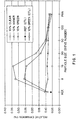
- chromium glass is ground to an average particle size greater than #50 sieve it will not, by itself, cause substantial ASR. (See Figure 1). However, these larger chromium glass particles may not substantially reduce ASR between concrete and other reactive aggregate.
- the chromium glass particles having an average size greater than #50 sieve preferably comprise from 0.1% to 2.0% by weight of chromium oxide substituted into conventional soda-lime bottle glass.
- a typical ASR-resistant set glass-concrete composition containing the above-described relatively large chromium glass particles may optionally further comprise reactive aggregate. Many typical aggregate materials which contain silica are prone to ASR.
- the amount of chromium glass particles comprises from about 0.5% to 100% by total weight of the aggregate and the chromium glass particles. More preferably, such compositions comprise a sufficient percentage of chromium glass particles such that they have an expansion value of less than 0.1% according to ASTM test C-1260 94.
- the chromium glass may be first used as a primary material for bottles and all other commercial glass applications before recycling the glass by grinding it into pieces suitable for incorporation in concrete. Glasses containing substantial amounts of chromium typically have a green color characteristic of chromium in a high oxidation state. The glass may be ground using conventional methods.
- the concrete compositions according to the invention preferably comprise pieces of chromium glass and a suitable type of cement such as masonry cement, Portland cement, mixtures of masonry cement and Portland cement, and mixtures of the above with hydrated lime.
- the concrete composition may also contain conventional fillers such as gravel, sand, natural or manufactured aggregates or crushed stone.
- the filler may be any type of reactive concrete aggregate or a nonreactive concrete aggregate.
- the cement to aggregate weight ratio typically between about 1:2.25 to about 1:8.
- the glass-concrete composition comprises a suitable dry cement, an amount of water sufficient to fully hydrate the cement, and chromium glass particles as described above.
- a filler other than chromium glass particles may also be added.
- the typical percentage by weight of cement is 0.5% to 10%.
- the chromium glass fibers preferably have a diameter of less than 0.5 mm, and therefore would be expected to act as an ASR suppressor for reactive aggregate. However, larger diameter fibers may also be used.
- the length of the chromium glass fibers typically averages from 1 ⁇ 2 inch to 1 inch.
- ASTM test C 1260-94 was performed to determine the degree of ASR compositions made according to the present invention.
- This test generally involves producing mortar test bars of specified composition which comprise a test material.
- the test bars are termed "mortar" test bars because the aggregate to be tested is ground finely to increase the surface area so that ASR may be observed in a compressed time. The results are predictive of the ASR which would occur in concrete over a longer time.
- the mortar test bars are placed in an aqueous sodium hydroxide solution, and their length expansion, which is indicative of the degree of ASR, is measured at precise times over sixteen days.
- ASTM test C 1260-94 specifies that expansion values less than 0.10% at sixteen days represent an innocuous degree of ASR, while expansion values greater than 0.20% represent a potentially deleterious degree of ASR.
- a control test sample containing 100% (weight percentage relative to the total weight of sand) Barrasso sand produced an expansion value of about 0.1%.
- Figure 1 shows the values for percent relative expansion at day 16 of the test verses particle size for test bars prepared using glass of three different colors.
- Figure 1 also shows two data points reported by Construction Technology Laboratory of Skokie, Illinois (hereinafter "CTL"), an independent laboratory which ran the ASTM C 1260-94 procedure by preparing reference test bars (100% Barrasso sand) and test bars containing 10% green glass of size #16 (i.e., chromium glass) using materials supplied by the inventors. It is apparent from Figure 1 that the chromium glass, unlike the other tested glasses, avoids ASR even when ground to relatively course sizes. The results also show that acceptable levels of ASR are observed throughout the tests for all three colors of glass ground to a size #50 sieve or finer.
- CTL Construction Technology Laboratory of Skokie, Illinois
- Metakaolin, lithium hydroxide, and finely ground green glass were tested.
- Metakaolin and lithium hydroxide are inferior to ASR suppressants compared with chromium glass because they are more expensive and do not typically use recycled materials.
- the Cr 2 O 3 glasses listed in Table I were formed by melting soda-lime glass at 2400° in the presence of appropriate amounts of chromium oxides followed by slow cooling. Specifically, the mixtures were placed in a one liter mullite crucible and heated in an electric furnace under oxidizing conditions (i.e. vented to air). The temperature was held at maximum for about 2 hours before the furnace was allowed to cool back to room temperature. After the furnace cooled, the crucible was removed from the furnace and broken off the glass, which remained in a single lump. Any remaining crucible material was ground off the surface with a silicon carbide grinding wheel.
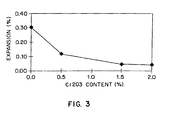
- Figure 3 depicts the percent expansion versus Cr 2 O 3 content of the glass powder in mortar test bars prepared as describe above. Figure 3 shows that a Cr 2 O 3 content of greater than 0.5% is necessary to effectively suppress ASR.
- a 1.5% chromium oxide substituted glass is prepared as described above in Example 1.
- This chromium glass is made into fiberglass via heating and drawing fibers by hand.
- the fibers have an average length of 3/4 inch and an average diameter of 10-40 microns.
- the fiberglass reinforced cement is prepared by mixing together the following: 440 g Portland cement 990 g Blue Circle aggregate sand graded as described in ASTM test C 1260-94 16 g chromium oxide substituted fiberglass 206.8 g water.
- the above mixture is allowed to set.
- the reinforced concrete produced is thought to have improved mechanical properties compared with an analogous glass fiber-reinforced concrete using conventional soda-lime fiberglass because conventional soda-lime fiberglass reacts with the cement.
- the chromium fiberglass does not undergo ASR.
Landscapes
- Chemical & Material Sciences (AREA)
- Engineering & Computer Science (AREA)
- Ceramic Engineering (AREA)
- Materials Engineering (AREA)
- Organic Chemistry (AREA)
- Civil Engineering (AREA)
- Structural Engineering (AREA)
- Chemical Kinetics & Catalysis (AREA)
- Life Sciences & Earth Sciences (AREA)
- General Chemical & Material Sciences (AREA)
- Geochemistry & Mineralogy (AREA)
- Curing Cements, Concrete, And Artificial Stone (AREA)
- Processing Of Solid Wastes (AREA)
- Glass Compositions (AREA)
- Aftertreatments Of Artificial And Natural Stones (AREA)
- Nitrogen And Oxygen Or Sulfur-Condensed Heterocyclic Ring Systems (AREA)
Claims (14)
- Composition fixe de béton translucide comprenant des particules de verre contenant du chrome et un agrégat réactif dispersés dans du ciment hydraté, dans laquelle lesdites particules de verre contenant du chrome ont la taille moyenne de particules du tamis N° 50 ou plus fine et comprennent de 0,5 % à 10 % en poids d'oxyde de chrome afin de supprimer l'alcali-réaction entre le ciment hydraté et l'agrégat réactif, dans laquelle les particules de verre contenant du chrome ne contiennent pas plus que des traces de zirconium.
- Composition fixe de béton translucide comprenant des particules de verre contenant du chrome dispersées dans du ciment hydraté, dans laquelle lesdites particules de verre contenant du chrome ont une taille moyenne de particules supérieure à celle du tamis N° 50 et comprennent de 0,1 % à 2,0 % en poids d'oxyde de chrome afin de supprimer l'alcali-réaction entre le ciment hydraté et les particules de verre contenant du chrome, dans laquelle les particules de verre contenant du chrome ne contiennent pas plus que des.traces de zirconium.
- Composition fixe de béton translucide selon la revendication 1, dans laquelle la composition comprend entre 0,5 % en poids et 20 % en poids de particules de verre contenant du chrome en poids total de ciment.
- Composition fixe de béton translucide selon la revendication 2, dans laquelle la combinaison de l'agrégat réactif et des particules de verre contenant du chrome comprend entre 0,5 % en poids et 100 % en poids de particules de verre contenant du chrome.
- Composition fixe de béton translucide comprenant des fibres de verre contenant du chrome et un agrégat réactif dispersés dans du ciment hydraté, dans laquelle lesdites fibres de verre contenant du chrome ont un diamètre moyen inférieur à 0,5 mm et contiennent de 0,1 % à 10 % en poids d'oxyde de chrome afin de supprimer l'alcali-réaction entre le ciment hydraté et l'agrégat réactif, dans laquelle les fibres de verre contenant du chrome ne contiennent pas plus que des traces de zirconium.
- Composition fixe de béton translucide comprenant des fibres de verre contenant du chrome dans du ciment hydraté, dans laquelle lesdites fibres de verre contenant du chrome contiennent de 0,1 % à 2,0 % en poids d'oxyde de chrome afin de supprimer l'alcali-réaction entre le ciment hydraté et les fibres de verre contenant du chrome, dans laquelle les fibres de verre contenant du chrome ne contiennent pas plus que des traces de zirconium.
- Procédé pour la fabrication d'une composition fixe de béton translucide comprenant le mélange de ciment sec, d'eau, d'un agrégat réactif et de particules de verre contenant du chrome ayant la taille moyenne de particules du tamis N° 50 ou plus fine et comprennent de 0,1 % à 10 % en poids d'oxyde de chrome afin de supprimer l'alcali-réaction entre le ciment et l'agrégat réactif, dans lequel les particules de verre contenant du chrome ne contiennent pas plus que des traces de zirconium.
- Procédé pour la fabrication d'une composition fixe de béton translucide comprenant le mélange de ciment sec, d'eau et de particules de verre contenant du chrome ayant une taille moyenne de particules supérieure à celle du tamis N° 50 et comprennent de 0,1 % à 2,0 % en poids d'oxyde de chrome afin de supprimer l'alcali-réaction entre le ciment et les particules de verre contenant du chrome, dans lequel les particules de verre contenant du chrome ne contiennent pas plus que des traces de zirconium.
- Procédé pour la fabrication d'une composition fixe de béton translucide comprenant le mélange de ciment sec, d'eau, d'un agrégat réactif et de fibres de verre contenant du chrome ayant un diamètre moyen inférieur à 0,5 mm et comprenant de 0,1 % à 10 % en poids d'oxyde de chrome afin de supprimer l'alcali-réaction entre le ciment et l'agrégat réactif, dans lequel les fibres de verre contenant du chrome ne contiennent pas plus que des traces de zirconium.
- Procédé pour fabriquer une composition fixe de béton translucide comprenant le mélange de ciment sec, d'eau et de fibres de verre contenant du chrome ayant un diamètre moyen supérieur à 0,5 mm et comprenant de 0,1 % à 2,0 % en poids d'oxyde de chrome afin de supprimer l'alcali-réaction entre le ciment et les fibres de verre contenant du chrome, dans lequel les fibres de verre contenant du chrome ne contiennent pas plus que des traces de zirconium.
- Composition fixe de béton translucide obtenue par le procédé selon la revendication 7.
- Composition fixe de béton translucide obtenue par le procédé selon la revendication 8.
- Composition fixe de béton translucide obtenue par le procédé selon la revendication 9.
- Composition fixe de béton translucide obtenue par le procédé selon la revendication 10.
Applications Claiming Priority (3)
| Application Number | Priority Date | Filing Date | Title |
|---|---|---|---|
| US08/810,558 US5810921A (en) | 1997-03-03 | 1997-03-03 | Use of waste glass in concrete |
| US810558 | 1997-03-03 | ||
| PCT/US1998/004113 WO1998039266A1 (fr) | 1997-03-03 | 1998-03-03 | Utilisation de debris de verre dans du beton |
Publications (3)
| Publication Number | Publication Date |
|---|---|
| EP1015397A1 EP1015397A1 (fr) | 2000-07-05 |
| EP1015397A4 EP1015397A4 (fr) | 2000-10-25 |
| EP1015397B1 true EP1015397B1 (fr) | 2004-12-15 |
Family
ID=25204109
Family Applications (1)
| Application Number | Title | Priority Date | Filing Date |
|---|---|---|---|
| EP98910137A Expired - Lifetime EP1015397B1 (fr) | 1997-03-03 | 1998-03-03 | Utilisation de debris de verre dans du beton |
Country Status (9)
| Country | Link |
|---|---|
| US (1) | US5810921A (fr) |
| EP (1) | EP1015397B1 (fr) |
| JP (1) | JP2001510436A (fr) |
| KR (1) | KR20000075908A (fr) |
| AT (1) | ATE284849T1 (fr) |
| DE (1) | DE69828180D1 (fr) |
| ES (1) | ES2230678T3 (fr) |
| PT (1) | PT1015397E (fr) |
| WO (1) | WO1998039266A1 (fr) |
Families Citing this family (25)
| Publication number | Priority date | Publication date | Assignee | Title |
|---|---|---|---|---|
| US5837315A (en) * | 1996-03-06 | 1998-11-17 | Fmc Corporation | Compositions and processes for remediating hardened cementitious materials |
| US6296699B1 (en) | 1999-01-27 | 2001-10-02 | Weihua Jin | Inorganic binders employing waste glass |
| US6344081B1 (en) | 1999-11-10 | 2002-02-05 | Glasflo Products, Inc. | Concrete composition |
| US6699321B2 (en) | 1999-11-10 | 2004-03-02 | Glasflo Products, Inc. | Concrete composition |
| NO312758B1 (no) * | 2000-02-08 | 2002-07-01 | Norsk Glassgjenvinning As | Betong med tilslag omfattende knust glass |
| US6776838B2 (en) | 2001-03-02 | 2004-08-17 | Albacem, Llc | White pozzolan composition and blended cements containing same |
| US20040106704A1 (en) * | 2001-09-18 | 2004-06-03 | Christian Meyer | Admixture to improve rheological property of composition comprising a mixture of hydraulic cement and alumino-silicate mineral admixture |
| US6749679B2 (en) | 2002-01-23 | 2004-06-15 | Advanced Materials Technologies, Llc | Composition of materials for production of acid resistant cement and concrete and methods thereof |
| US7700017B2 (en) * | 2003-08-25 | 2010-04-20 | Icestone Llc | Method for producing materials from recycled glass and cement compositions |
| US20060100345A1 (en) * | 2004-10-28 | 2006-05-11 | Wyatt Bain | Synthetic gravel |
| US7364615B1 (en) | 2004-11-30 | 2008-04-29 | Bryant Fulton L | Method of forming pavers containing waste glass particles |
| US20090286902A1 (en) * | 2004-12-16 | 2009-11-19 | Grasso Jr Louis P | Cast Solid Surface Materials Manufactured From Polymers and Post-Consumer Waste Glass |
| US20080308659A1 (en) * | 2004-12-16 | 2008-12-18 | Grasso Jr Louis P | Pozzolan Manufactured from Post-Consumer Waste Glass, Products Incorporating the Same, and Methods of Manufacturing the Same |
| US7413602B2 (en) * | 2004-12-16 | 2008-08-19 | Empire Resource Recovery Llc | Production of glass powder from waste glass, and products made using the same, especially concrete |
| EP1705165A1 (fr) * | 2005-03-25 | 2006-09-27 | I.C.R.S. Industrial Ceramic Reinforcement Solution S.r.L. | Matériau à base de ciment et procédé de sa préparation |
| US7651966B2 (en) | 2006-04-18 | 2010-01-26 | Mo-Sci Corporation | Alkaline resistant phosphate glasses and method of preparation and use thereof |
| US7727327B2 (en) * | 2008-04-29 | 2010-06-01 | James Glessner | Low embodied energy concrete mixture |
| US8308863B2 (en) | 2008-04-29 | 2012-11-13 | Glessner Jr James | Low embodied energy concrete mixture |
| US7931220B2 (en) * | 2008-05-15 | 2011-04-26 | Empire Resource Recovery, Llc | White pozzolan manufactured from post-consumer waste glass, products incorporating the same and methods of manufacturing the same |
| US20110000402A1 (en) * | 2009-07-06 | 2011-01-06 | Grasso Jr Louis P | System and Method for Handling Recyclable Materials and Products Manufactured Therefrom |
| US20110269615A1 (en) | 2010-04-28 | 2011-11-03 | The Catholic University Of America | Compositions and methods for converting hazardous waste glass into non-hazardous products |
| US9464000B2 (en) | 2014-07-10 | 2016-10-11 | Board Of Trustees Of Michigan State University | Augmented cementitious binder compositions and related methods |
| US10590038B1 (en) | 2019-07-01 | 2020-03-17 | Maw-Tien Lee | Producing cementitious materials with improved hydrophobicity and strength using reclaimed waste substances |
| US11760690B2 (en) | 2020-07-19 | 2023-09-19 | KLAW Industries LLC | Recycled glass pozzolan for concrete |
| US11976237B2 (en) | 2021-10-08 | 2024-05-07 | Halliburton Energy Services, Inc. | Alkali-silica reaction for expanding cement in a wellbore |
Family Cites Families (11)
| Publication number | Priority date | Publication date | Assignee | Title |
|---|---|---|---|---|
| US3823021A (en) * | 1972-06-19 | 1974-07-09 | A Jansen | Cement compositions containing soda lime glass |
| US4090882A (en) * | 1973-03-30 | 1978-05-23 | Dyckerhoff Zementwerke Aktiengesellschaft | Glassy calcium silicate fibers made from phosphorus slag |
| US4002482A (en) * | 1975-02-14 | 1977-01-11 | Jenaer Glaswerk Schott & Gen. | Glass compositions suitable for incorporation into concrete |
| US4062689A (en) * | 1975-04-11 | 1977-12-13 | Asahi Glass Company Ltd. | Glass composition which is resistant to alkali |
| US4090883A (en) * | 1977-05-23 | 1978-05-23 | Dyckerhoff Zementwerke Aktiengesellschaft | Building material reinforced with fibers of glassy calcium silicate |
| US4090884A (en) * | 1976-07-16 | 1978-05-23 | W. R. Bonsal Company | Inhibitors for alkali-glass reactions in glass fiber reinforced cement products |
| FR2447891A1 (fr) * | 1979-01-30 | 1980-08-29 | Saint Gobain | Fibres de verre pour le renforcement du ciment |
| IE50727B1 (en) * | 1980-02-27 | 1986-06-25 | Pilkington Brothers Ltd | Alkali resistant glass fibres and cementitious products reinforced with such glass fibres |
| FR2634558B1 (fr) * | 1988-07-13 | 1992-10-30 | Saint Gobain Vetrotex | Methode de selection d'un metakaolin destine a etre incorpore dans un materiau composite comprenant du ciment et du verre |
| SE501419C2 (sv) | 1993-02-25 | 1995-02-13 | Svensk Glasaatervinning Ab | Förfarande för framställning av betong innefattande glasfiller samt användning av glasfiller vid framställning av betong |
| AU715970B2 (en) * | 1995-09-08 | 2000-02-10 | Fmc Corporation | Concrete compositions and processes for controlling alkali-silica reaction in same |
-
1997
- 1997-03-03 US US08/810,558 patent/US5810921A/en not_active Expired - Fee Related
-
1998
- 1998-03-03 ES ES98910137T patent/ES2230678T3/es not_active Expired - Lifetime
- 1998-03-03 DE DE69828180T patent/DE69828180D1/de not_active Expired - Lifetime
- 1998-03-03 PT PT98910137T patent/PT1015397E/pt unknown
- 1998-03-03 JP JP53869098A patent/JP2001510436A/ja active Pending
- 1998-03-03 KR KR1019997007988A patent/KR20000075908A/ko not_active Ceased
- 1998-03-03 WO PCT/US1998/004113 patent/WO1998039266A1/fr not_active Ceased
- 1998-03-03 AT AT98910137T patent/ATE284849T1/de not_active IP Right Cessation
- 1998-03-03 EP EP98910137A patent/EP1015397B1/fr not_active Expired - Lifetime
Also Published As
| Publication number | Publication date |
|---|---|
| US5810921A (en) | 1998-09-22 |
| ATE284849T1 (de) | 2005-01-15 |
| ES2230678T3 (es) | 2005-05-01 |
| PT1015397E (pt) | 2005-02-28 |
| DE69828180D1 (de) | 2005-01-20 |
| EP1015397A4 (fr) | 2000-10-25 |
| KR20000075908A (ko) | 2000-12-26 |
| WO1998039266A1 (fr) | 1998-09-11 |
| EP1015397A1 (fr) | 2000-07-05 |
| JP2001510436A (ja) | 2001-07-31 |
Similar Documents
| Publication | Publication Date | Title |
|---|---|---|
| US5810921A (en) | Use of waste glass in concrete | |
| EP0964837B1 (fr) | Formule de verre permettant d'eviter une reaction silico-alcaline | |
| US7070131B2 (en) | White pozzolan composition and blended cements containing same | |
| US5383967A (en) | Natural silica-containing cement and concrete composition | |
| EP2337769B1 (fr) | Mélanges de ciment pouzzolanique à haute résistance initiale | |
| EP2651846B1 (fr) | Composite géopolymère pour béton à ultra hautes performances | |
| EP1325897B1 (fr) | Composition de ciment | |
| CN110104997A (zh) | 一种再生混凝土及其生产工艺 | |
| KR900003320B1 (ko) | 세라믹 발포체 및 그 제조법 | |
| US20210261461A1 (en) | Recycled powder concrete for 3d printing construction and preparation method therefor | |
| KR20120066769A (ko) | 페로니켈슬래그를 사용한 고강도 콘크리트 조성물 및 그 제조방법 | |
| US4662941A (en) | Mineral wool waste cement | |
| FI112205B (fi) | Menetelmä betonin valmistamiseksi ja sen käyttö | |
| US5735947A (en) | Cement with air-cooled slag and silica fume | |
| KR20010023430A (ko) | 반응성 메타카올린 첨가제를 포함하는 내화 시스템 | |
| EP3577088B1 (fr) | Produit à base de ciment contenant des pigments inorganiques amélioré et procédé de son preparation | |
| WO1990013524A1 (fr) | Article faconne ayant une matrice cimentee, ainsi qu'un procede et une composition servant a la preparation de celui-ci | |
| Halbiniak et al. | The use of waste glass for cement production | |
| EP1373159B1 (fr) | Composition de pouzzolane blanche | |
| JP2003137618A (ja) | 無機混和材を含有する高炉スラグ微粉末、高炉セメント、および、それらの製造方法 | |
| KR20040065100A (ko) | 재생골재콘크리트의 제조방법 | |
| GB2615847A (en) | Concrete composition and mineral additive therefor | |
| RU2111189C1 (ru) | Сырьевая смесь для изготовления керамических изделий | |
| EP4534513A2 (fr) | Composition de verre, procédé de formation d'une composition de verre et utilisations d'une composition de verre | |
| AU2010328360B2 (en) | Chloride ingress-resistant concrete and articles formed therewith |
Legal Events
| Date | Code | Title | Description |
|---|---|---|---|
| PUAI | Public reference made under article 153(3) epc to a published international application that has entered the european phase |
Free format text: ORIGINAL CODE: 0009012 |
|
| 17P | Request for examination filed |
Effective date: 19990906 |
|
| AK | Designated contracting states |
Kind code of ref document: A1 Designated state(s): AT BE CH DE DK ES FI FR GB GR IE IT LI LU MC NL PT SE |
|
| A4 | Supplementary search report drawn up and despatched |
Effective date: 20000908 |
|
| AK | Designated contracting states |
Kind code of ref document: A4 Designated state(s): AT BE CH DE DK ES FI FR GB GR IE IT LI LU MC NL PT SE |
|
| 17Q | First examination report despatched |
Effective date: 20011120 |
|
| TPAD | Observations filed by third parties |
Free format text: ORIGINAL CODE: EPIDOS TIPA |
|
| GRAP | Despatch of communication of intention to grant a patent |
Free format text: ORIGINAL CODE: EPIDOSNIGR1 |
|
| GRAS | Grant fee paid |
Free format text: ORIGINAL CODE: EPIDOSNIGR3 |
|
| GRAA | (expected) grant |
Free format text: ORIGINAL CODE: 0009210 |
|
| AK | Designated contracting states |
Kind code of ref document: B1 Designated state(s): AT BE CH DE DK ES FI FR GB GR IE IT LI LU MC NL PT SE |
|
| PG25 | Lapsed in a contracting state [announced via postgrant information from national office to epo] |
Ref country code: NL Free format text: LAPSE BECAUSE OF FAILURE TO SUBMIT A TRANSLATION OF THE DESCRIPTION OR TO PAY THE FEE WITHIN THE PRESCRIBED TIME-LIMIT Effective date: 20041215 Ref country code: LI Free format text: LAPSE BECAUSE OF FAILURE TO SUBMIT A TRANSLATION OF THE DESCRIPTION OR TO PAY THE FEE WITHIN THE PRESCRIBED TIME-LIMIT Effective date: 20041215 Ref country code: FR Free format text: LAPSE BECAUSE OF FAILURE TO SUBMIT A TRANSLATION OF THE DESCRIPTION OR TO PAY THE FEE WITHIN THE PRESCRIBED TIME-LIMIT Effective date: 20041215 Ref country code: FI Free format text: LAPSE BECAUSE OF FAILURE TO SUBMIT A TRANSLATION OF THE DESCRIPTION OR TO PAY THE FEE WITHIN THE PRESCRIBED TIME-LIMIT Effective date: 20041215 Ref country code: CH Free format text: LAPSE BECAUSE OF FAILURE TO SUBMIT A TRANSLATION OF THE DESCRIPTION OR TO PAY THE FEE WITHIN THE PRESCRIBED TIME-LIMIT Effective date: 20041215 Ref country code: BE Free format text: LAPSE BECAUSE OF FAILURE TO SUBMIT A TRANSLATION OF THE DESCRIPTION OR TO PAY THE FEE WITHIN THE PRESCRIBED TIME-LIMIT Effective date: 20041215 Ref country code: AT Free format text: LAPSE BECAUSE OF FAILURE TO SUBMIT A TRANSLATION OF THE DESCRIPTION OR TO PAY THE FEE WITHIN THE PRESCRIBED TIME-LIMIT Effective date: 20041215 |
|
| REG | Reference to a national code |
Ref country code: GB Ref legal event code: FG4D Ref country code: CH Ref legal event code: EP |
|
| REG | Reference to a national code |
Ref country code: IE Ref legal event code: FG4D |
|
| REF | Corresponds to: |
Ref document number: 69828180 Country of ref document: DE Date of ref document: 20050120 Kind code of ref document: P |
|
| REG | Reference to a national code |
Ref country code: PT Ref legal event code: SC4A Free format text: AVAILABILITY OF NATIONAL TRANSLATION Effective date: 20041230 |
|
| PG25 | Lapsed in a contracting state [announced via postgrant information from national office to epo] |
Ref country code: LU Free format text: LAPSE BECAUSE OF NON-PAYMENT OF DUE FEES Effective date: 20050303 Ref country code: IE Free format text: LAPSE BECAUSE OF NON-PAYMENT OF DUE FEES Effective date: 20050303 |
|
| PG25 | Lapsed in a contracting state [announced via postgrant information from national office to epo] |
Ref country code: SE Free format text: LAPSE BECAUSE OF FAILURE TO SUBMIT A TRANSLATION OF THE DESCRIPTION OR TO PAY THE FEE WITHIN THE PRESCRIBED TIME-LIMIT Effective date: 20050315 Ref country code: GR Free format text: LAPSE BECAUSE OF FAILURE TO SUBMIT A TRANSLATION OF THE DESCRIPTION OR TO PAY THE FEE WITHIN THE PRESCRIBED TIME-LIMIT Effective date: 20050315 Ref country code: GB Free format text: LAPSE BECAUSE OF NON-PAYMENT OF DUE FEES Effective date: 20050315 Ref country code: DK Free format text: LAPSE BECAUSE OF FAILURE TO SUBMIT A TRANSLATION OF THE DESCRIPTION OR TO PAY THE FEE WITHIN THE PRESCRIBED TIME-LIMIT Effective date: 20050315 |
|
| PG25 | Lapsed in a contracting state [announced via postgrant information from national office to epo] |
Ref country code: DE Free format text: LAPSE BECAUSE OF FAILURE TO SUBMIT A TRANSLATION OF THE DESCRIPTION OR TO PAY THE FEE WITHIN THE PRESCRIBED TIME-LIMIT Effective date: 20050316 |
|
| PGFP | Annual fee paid to national office [announced via postgrant information from national office to epo] |
Ref country code: PT Payment date: 20050322 Year of fee payment: 8 |
|
| PG25 | Lapsed in a contracting state [announced via postgrant information from national office to epo] |
Ref country code: MC Free format text: LAPSE BECAUSE OF NON-PAYMENT OF DUE FEES Effective date: 20050331 |
|
| PGFP | Annual fee paid to national office [announced via postgrant information from national office to epo] |
Ref country code: ES Payment date: 20050407 Year of fee payment: 8 |
|
| REG | Reference to a national code |
Ref country code: ES Ref legal event code: FG2A Ref document number: 2230678 Country of ref document: ES Kind code of ref document: T3 |
|
| NLV1 | Nl: lapsed or annulled due to failure to fulfill the requirements of art. 29p and 29m of the patents act | ||
| REG | Reference to a national code |
Ref country code: CH Ref legal event code: PL |
|
| PLBE | No opposition filed within time limit |
Free format text: ORIGINAL CODE: 0009261 |
|
| STAA | Information on the status of an ep patent application or granted ep patent |
Free format text: STATUS: NO OPPOSITION FILED WITHIN TIME LIMIT |
|
| GBPC | Gb: european patent ceased through non-payment of renewal fee |
Effective date: 20050315 |
|
| 26N | No opposition filed |
Effective date: 20050916 |
|
| REG | Reference to a national code |
Ref country code: IE Ref legal event code: MM4A |
|
| EN | Fr: translation not filed | ||
| PG25 | Lapsed in a contracting state [announced via postgrant information from national office to epo] |
Ref country code: ES Free format text: LAPSE BECAUSE OF NON-PAYMENT OF DUE FEES Effective date: 20060304 |
|
| PGFP | Annual fee paid to national office [announced via postgrant information from national office to epo] |
Ref country code: IT Payment date: 20060331 Year of fee payment: 9 |
|
| PG25 | Lapsed in a contracting state [announced via postgrant information from national office to epo] |
Ref country code: PT Free format text: LAPSE BECAUSE OF NON-PAYMENT OF DUE FEES Effective date: 20060904 |
|
| REG | Reference to a national code |
Ref country code: PT Ref legal event code: MM4A Effective date: 20060904 |
|
| REG | Reference to a national code |
Ref country code: ES Ref legal event code: FD2A Effective date: 20060304 |
|
| PG25 | Lapsed in a contracting state [announced via postgrant information from national office to epo] |
Ref country code: IT Free format text: LAPSE BECAUSE OF NON-PAYMENT OF DUE FEES Effective date: 20070303 |