EP1015457B1 - Derives de 1,3-dioxolo/4,5-h//2,3/benzodiazepine utilises comme inhibiteurs des recepteurs ampa/kainate - Google Patents
Derives de 1,3-dioxolo/4,5-h//2,3/benzodiazepine utilises comme inhibiteurs des recepteurs ampa/kainate Download PDFInfo
- Publication number
- EP1015457B1 EP1015457B1 EP98939782A EP98939782A EP1015457B1 EP 1015457 B1 EP1015457 B1 EP 1015457B1 EP 98939782 A EP98939782 A EP 98939782A EP 98939782 A EP98939782 A EP 98939782A EP 1015457 B1 EP1015457 B1 EP 1015457B1
- Authority
- EP
- European Patent Office
- Prior art keywords
- formula
- group
- dioxolo
- benzodiazepine
- compound
- Prior art date
- Legal status (The legal status is an assumption and is not a legal conclusion. Google has not performed a legal analysis and makes no representation as to the accuracy of the status listed.)
- Expired - Lifetime
Links
- 0 *C(C1)NN=C(c(cc2)ccc2[N+]([O-])=O)c2c1cc1OCOc1c2 Chemical compound *C(C1)NN=C(c(cc2)ccc2[N+]([O-])=O)c2c1cc1OCOc1c2 0.000 description 4
- DJXIVFHYOLZSBW-UHFFFAOYSA-N CC(Cc1c2)NN=C(c(cc3)ccc3[N+]([O-])=O)c1cc1c2OCO1 Chemical compound CC(Cc1c2)NN=C(c(cc3)ccc3[N+]([O-])=O)c1cc1c2OCO1 DJXIVFHYOLZSBW-UHFFFAOYSA-N 0.000 description 1
Classifications
-
- C—CHEMISTRY; METALLURGY
- C07—ORGANIC CHEMISTRY
- C07D—HETEROCYCLIC COMPOUNDS
- C07D491/00—Heterocyclic compounds containing in the condensed ring system both one or more rings having oxygen atoms as the only ring hetero atoms and one or more rings having nitrogen atoms as the only ring hetero atoms, not provided for by groups C07D451/00 - C07D459/00, C07D463/00, C07D477/00 or C07D489/00
- C07D491/02—Heterocyclic compounds containing in the condensed ring system both one or more rings having oxygen atoms as the only ring hetero atoms and one or more rings having nitrogen atoms as the only ring hetero atoms, not provided for by groups C07D451/00 - C07D459/00, C07D463/00, C07D477/00 or C07D489/00 in which the condensed system contains two hetero rings
- C07D491/04—Ortho-condensed systems
- C07D491/056—Ortho-condensed systems with two or more oxygen atoms as ring hetero atoms in the oxygen-containing ring
-
- A—HUMAN NECESSITIES
- A61—MEDICAL OR VETERINARY SCIENCE; HYGIENE
- A61P—SPECIFIC THERAPEUTIC ACTIVITY OF CHEMICAL COMPOUNDS OR MEDICINAL PREPARATIONS
- A61P25/00—Drugs for disorders of the nervous system
-
- A—HUMAN NECESSITIES
- A61—MEDICAL OR VETERINARY SCIENCE; HYGIENE
- A61P—SPECIFIC THERAPEUTIC ACTIVITY OF CHEMICAL COMPOUNDS OR MEDICINAL PREPARATIONS
- A61P25/00—Drugs for disorders of the nervous system
- A61P25/08—Antiepileptics; Anticonvulsants
-
- A—HUMAN NECESSITIES
- A61—MEDICAL OR VETERINARY SCIENCE; HYGIENE
- A61P—SPECIFIC THERAPEUTIC ACTIVITY OF CHEMICAL COMPOUNDS OR MEDICINAL PREPARATIONS
- A61P25/00—Drugs for disorders of the nervous system
- A61P25/22—Anxiolytics
-
- A—HUMAN NECESSITIES
- A61—MEDICAL OR VETERINARY SCIENCE; HYGIENE
- A61P—SPECIFIC THERAPEUTIC ACTIVITY OF CHEMICAL COMPOUNDS OR MEDICINAL PREPARATIONS
- A61P25/00—Drugs for disorders of the nervous system
- A61P25/24—Antidepressants
-
- A—HUMAN NECESSITIES
- A61—MEDICAL OR VETERINARY SCIENCE; HYGIENE
- A61P—SPECIFIC THERAPEUTIC ACTIVITY OF CHEMICAL COMPOUNDS OR MEDICINAL PREPARATIONS
- A61P25/00—Drugs for disorders of the nervous system
- A61P25/28—Drugs for disorders of the nervous system for treating neurodegenerative disorders of the central nervous system, e.g. nootropic agents, cognition enhancers, drugs for treating Alzheimer's disease or other forms of dementia
Definitions
- the invention refers to novel 1,3-dioxolo/4,5-h//2,3/benzodiazepine derivatives, a pharmaceutical composition containing the same, and a process for the preparation of the active ingredient as well as the use of the above compounds.
- the invention refers to novel 1,3-dioxolo/4,5-h//2,3/benzodiazepine derivatives of the formula I
- Tofisopam i.e. 1-(3,4-dimethoxyphenyl)--5-ethyl-7,8-dimethoxy-4-methyl-5H-2,3--benzodiazepine having anxiclytic effect is known from HU-P Nc. 155 572 and GB-P No. 1 202 579, respectively.
- the known compound does not comprise the ring system 1,3-dioxolo/4,5-h//2,3/benzodiazepine.
- a novel process for the preparation of partly new 8-methyl-9H-1,3-dioxolo/4,5-h//2,3/benzodiazepine derivatives having antiaggressive activity is known from HU-P No. 191 702. According to the novel process, the suitably substituted 2-acetonyl-4,5--methylenedioxybenzophenone is reacted with an excess of hydratine hydrate.
- AMPA/kainate receptors play an important role in the acute and chronic diseases of the central nervous system. Through the inhibition of these receptors, muscle relaxant, neuro-protective and anticonvulsive effects can be achieved /Vizi, E.S. et al., CNS Drug Reviews, 2 , 91-126 (1996); Lees, G.L., CNS Drugs, 5 , 51-74 (1996)/.
- R 1 und R 2 are identical or different and mean hydrogen, C 1 -C 6 -alkyl, nitro, halogen, the group -NR 8 R 9 or O-C 1-4 -alkyl or -CF 3
- R 3 stands for the group
- R 4 represents C 1 -C 6 -alkyl, optionally substituted
- R 5 means hydrogen or C 1 -C 6 -alkyl, optionally substituted
- R 6 and R 7 are identical or different and stand for hydrogen, C 1 -C 6 -alkyl, optionally substituted, or aryl, optionally substituted
- R 8 and R 9 are identical or different and represent hydrogen, C 1 -C 6 -alkyl or the group
- R 10 means hydrogen, C 1 -C 6 -alkyl, optionally substituted, aryl, optionally substituted, the group -NR 11 R 12 , -O
- R is an acyl group, substituted by an amino or di-(alkyl)-amino group
- R 1 is a hydrogen
- R 2 is a C 1-3 alkyl group
- R 3 and R 4 are hydrogen atoms.
- the aim of the invention is to prepare novel 2,3-benzodiazepine derivatives that are more effective and less toxic, respectively, than the known 2,3-benzodiazepine derivatives.
- novel 1,3-dioxolo/4,5-h//2,3/benzodiazepine derivatives which have - due to their non-competitive AMPA/kainate effect - considerable muscle relaxant, neuroprotective and anticonvulsive activities.
- the novel compounds can be employed for the treatment of any diseases (such as epilepsy, diseases resulting in muscle spasm, various neurodegenerative diseases. stroke,) in which the inhibition of the AMPA/kainate receptors is favourable.
- halo atom primarily a fluoro, chloro, bromo or iodo atom, preferably a fluoro or a chloro atom is meant.
- a C 1-4 alkyl group is a methyl, ethyl, n-propyl, isopropyl, n-butyl, sec.-butyl, tert.-butyl or isobutyl group.
- a C 1-4 alkyl group is a methyl, an ethyl or an isopropyl group.
- a C 1-4 alkoxy group is, primarily, a methoxy, ethoxy, n-propoxy, isopropoxy or n-butoxy group, preferably a methoxy group.
- a C 3-6 cycloalkyl group is a cyclopropyl, cyclobutyl, cyclopentyl or cyclohexyl group, preferably a cyclopropyl group.
- a saturated heterocyclic group having 5 or 6 members and comprising 1 nitrogen atom or a nitrogen atom and an oxygen atom as the heteroatom is preferably a morpholino group.
- an acid addition salt formed with a pharmaceutically suitable inorganic acid such as hydrochloric acid, hydrobromic acid, sulfuric acid, phosphoric acid, or with a pharmaceutically suitable organic acid such as formic acid, acetic acid, fumaric acid, maleic acid, lactic acid, malic acid, tartaric acid, succinic acid, citric acid, methanesulfonic acid, is meant.
- a pharmaceutically suitable inorganic acid such as hydrochloric acid, hydrobromic acid, sulfuric acid, phosphoric acid
- a pharmaceutically suitable organic acid such as formic acid, acetic acid, fumaric acid, maleic acid, lactic acid, malic acid, tartaric acid, succinic acid, citric acid, methanesulfonic acid
- the invention includes any isomers of the compounds of the formula I and the mixtures thereof.
- a preferred subgroup of the compounds of the formula I consists of the 7,8-dihydro-8-methyl-9H-1,3--dioxolo/4,5-h//2,3/benzodiazepine derivatives, wherein
- Suitable 7,8-dihydro-8-methyl-9H-1,3-dioxolo/4,5-h//2,3/benzodiazepine derivatives are the following compounds of the formula I, wherein
- the especially preferred 7,8-dihydro--8-methyl-9H-1,3-dioxolo/4,5-h//2,3/benzodiazepine derivatives are the following compounds of the formula I, wherein
- Another preferred subgroup of the compounds of the invention consists of the 8-methyl-7H-1,3-clioxolo/4,5-h//2,3/benzodiazepine derivatives of the formula I, wherein
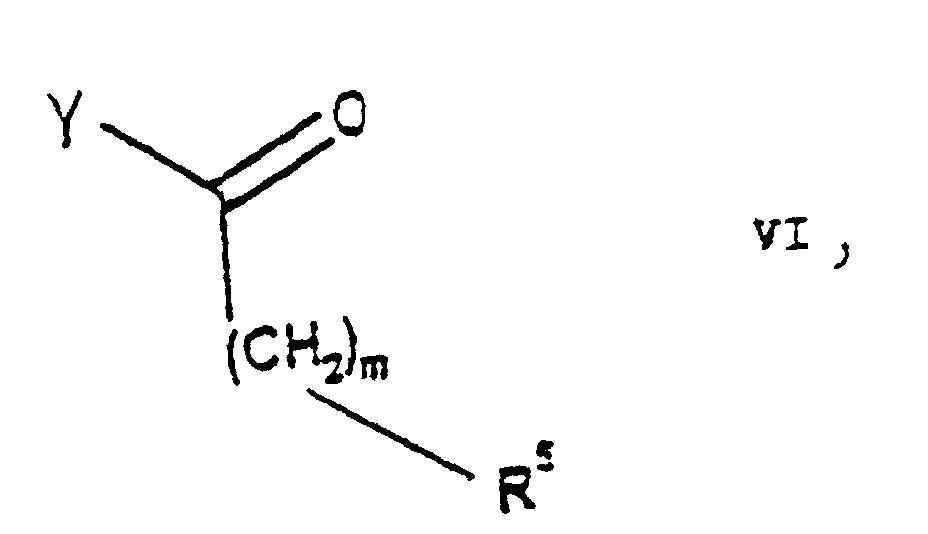
- the reagent of the formula VI is an acylating agent, such as a carboxylic halide, a carboxylic anhydride, a carbonate ester, carbonyldiimidazole, an omega-halocarboxylic halide or an omega-halocarbonate ester.
- the acylation is carried out in the presence or absence of an acid binding agent and/or pyridine, at a temperature of -20 to +150 °C, in the presence or absence of an organic solvent.
- the nitro compounds of the formula I can be reduced in a manner known in itself to obtain the corresponding amino compound.
- the reduction can be carried out for example with tin(II) chloride or in the presence of a catalyse using a hydrogen source.
- the catalyse can be Raney nickel, palladium or platinum oxide
- the hydrogen source is, for example, hydrazine, hydrazine hydrate, formic acid, a trialkylammonium formate or an alkali metal formate.
- a base of the formula I is reacted with an inorganic or organic acid to transform it into a pharmaceutically suitable acid addition salt, or the base of the formula I is libereted from the acid addition salt using a stronger base.
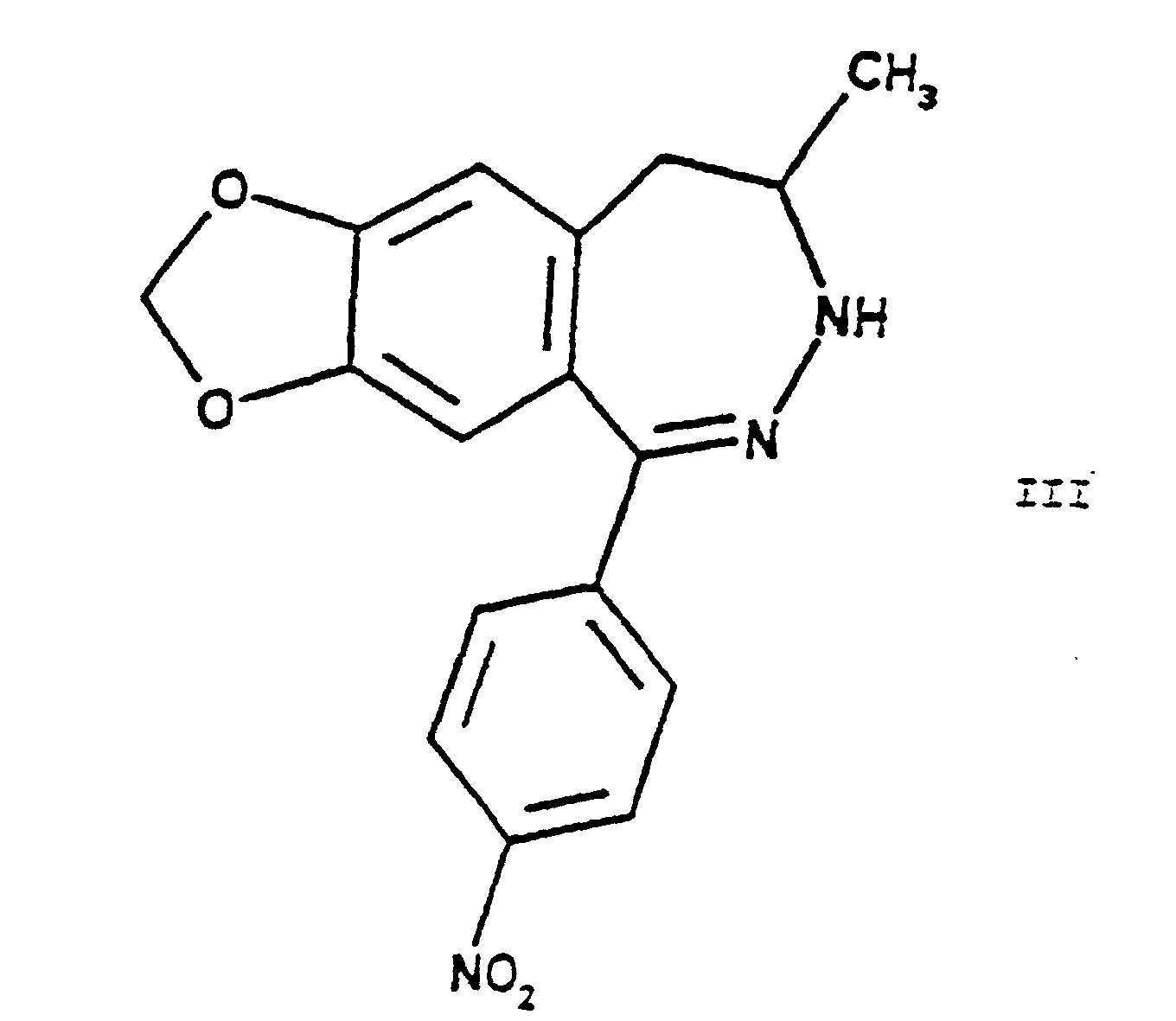
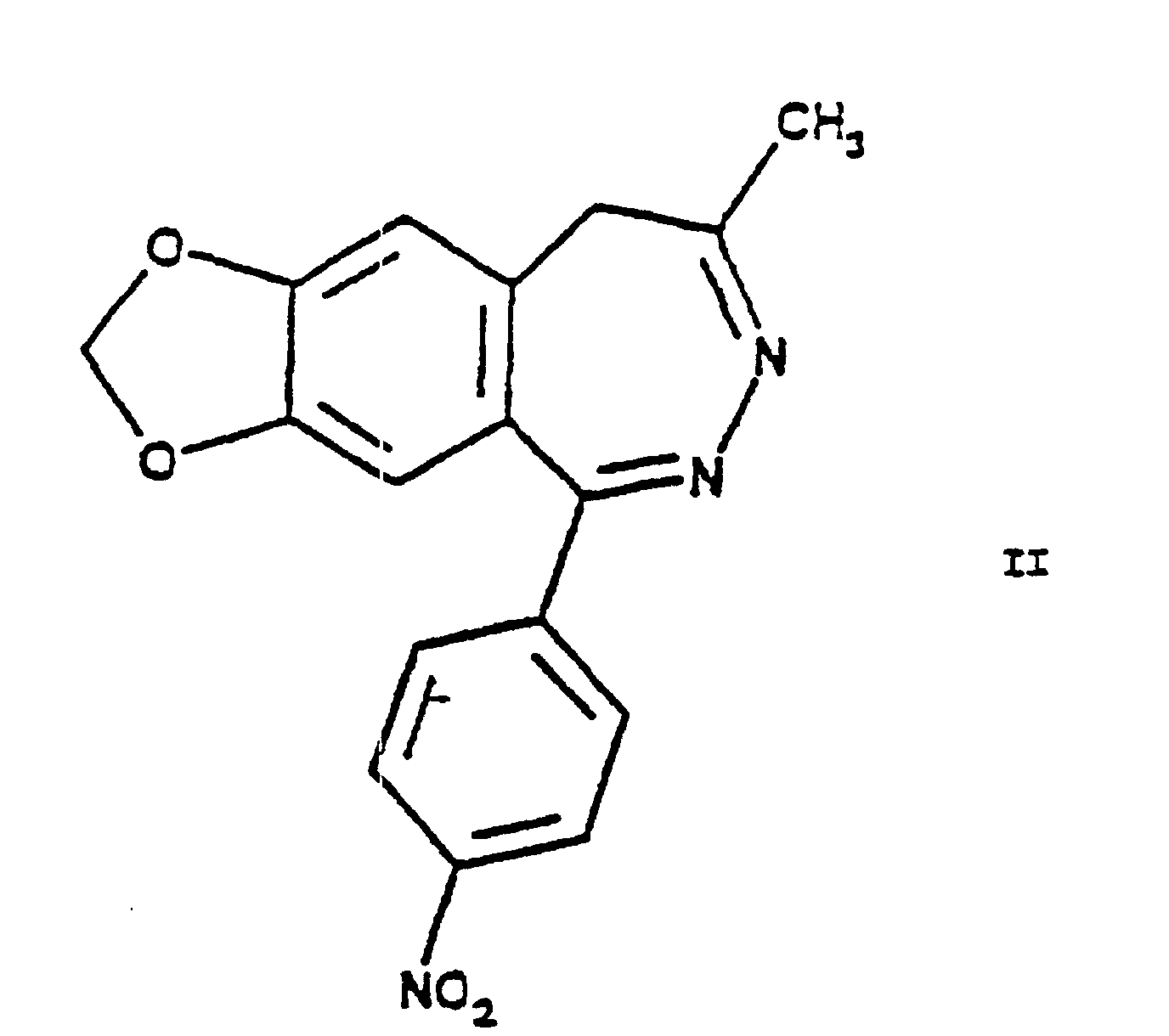
- the starting compound 7,8-dihydro-8--methyl-5-(4-nitrophenyl)-9H-1,3-dioxolo/4,5-h//2,3/benzodiazepine of the formula III can be prepared by reducing 8-methyl--5-(4-nitrophenyl)-9H-1,3-dioxolo/4,5-h//2,3/benzodiazepine of the formula II in an analogous manner as described in the literature /Houben-Weyl: Methoden der Organischen Chemie, Band IV, Redutechnisch, G. Thieme Verlag, Stuttgart, 1989/ or using the processes known from HU-P No. 186 760.
- the compound of the formula II can be prepared by the process known from HU-P No. 191 702.
- the field potentials (population spike) evoked by electric stimulation of the Shaffer collateral comissural pathway were measured in the CAl neurones of rat hippocampus.
- the population spike can be inhibited by AMPA/kainate antagonists.
- the non-cumulative IC 50 values are shown in Table I. /Tarnawa, I., Molnár, P., Gaál, L., Andrási, F.: Inhibition of hippocampal field potentials by GYKI 52466 in vitro and in vivo, Acta Physiol. Hung., 79 (2), 163-9 (1992)/.
- the method is based on the phenomenon of spreading depression evoked by kainate in isolated retinal preparation of the chicken.
- the formation of spreading depression is inhibited (delayed) by AMPA/kainate antagonists.
- the obtained IC 50 values are shown in Table I. Results obtained in tests suitable for the determination of in vitro AMPA antagonist effect Compound (No. of Example) Percent inhibition of population spike (10 micron) SD IC 50 in microM 2 100 1.3 3 95 1.5 4 95 no data 6 no data 6.5 11 no data 2.8 "A" 58 9.5
- the assay was done according to Hoppe in male NMRI mice weighing 20 to 25 g, with 10 animals in each group /Hoppe, J.O., J . Pharmacol. Exp. Ther., 100 , 333 (1950)/. Following the ip. treatment of animals, the number of mice showing muscle weakness were recorded at every 10 minutes in the first hour and at half hour intervals afterwards. The animals falling off the 60° inclined screen within 30 seconds were considered positive. ED 50 values of the given compounds were determined at each time. The duration of effect was defined as the time of last reading when the effect was at least 30 %. The results obtained are summarized in Table II. Muscle relaxant effect Compound (No. of Example) Muscle relaxant ED 50 ip, in mg/kg effect duration in hr 2 21.1 higher than 2 3 18.1 4 "A" 24.5 1
- mice Male NMRI mice weighing 20 to 30 g were used for the method of Swinyard et al. /Swinyard, E.A., Brown, W.C. and Goodman, L.S.: Comparative assays of antiepileptic drugs in mice and rats, J. Pharmacol., 106 , 319 (1952)/.
- the animals, 10 in each group were treated ip. either with various doses of the test substance or with vehicle. After 30 minutes, a 50 Hz, 40 mA electroshock was applied for 0.4 s through corneal electrodes.
- the maximum response during the 60 s exposure was recorded for each animal. Lethality was also noted.
- the ED 50 values were determined by the method of Litchfield and Wilcoxon concerning the inhibition of clonic seizures and tonic extensor convulsions. The results are summarized in Table III.
- novel compounds are significantly more effective at the inhibition of maximal electroshock and audiogenic seizure than the reference compound "A" as shown in Table III.
- the compound of Example 6 has an approximate anticonvulsive ED 50 value of 10 mg/kg ip. in the MES test (not shown in Table III), while in 60 mg/kg dose it has no muscle relaxant effect in the inclined screen.
- the anticonvulsive ED 50 value of the reference compound "A" is 6.9 mg/kg, however, at about 4.5 times higher dose, the reference compound produces about 50 % muscle relaxant effect, and at 60 mg/kg dose all the treated animals showed muscle relaxation. Since strong muscle relaxation may seriously limit the therapeutic application of a drug, the lack of muscle relaxant effect of some novel compounds of the invention provides potential advantage over reference compound "A" in the clinical use.
- novel 8-substituted-9H--1,3-dioxolo/4,5-h//2,3/benzodiazepine derivatives of the formula I can be used as active ingredients of pharmaceutical compositions.
- the novel compounds of the invention due to their competitive AMPA/kainate antagonist property - have considerable muscle relaxant, neuroprotective and anticonvulsive effects. Consequently, the novel compounds can be used for the treatment of any disease such as epilepsy, diseases resulting in muscle spasm, neurodegenerative diseases, multitudes after stroke, migraine and vomiting, wherein the inhibition of the AMPA/kainate receptors may have a favourable effect.
- Some compounds of the invention which possess considerable anticonvulsive and neuroprotective activities, while they have no or weak muscle relaxant effect, can be primarily applied as antiepileptics. In the course of their application, the lack of muscle relaxant action provides notable benefit over the known AMPA/kainate antagonist 2,3-benzodiazepine derivatives.
- compositions of the invention contain a therapeutically active amount of a compound of the formula I or a pharmaceutically suitable acid addition salt thereof and one or more conventional carrier(s).
- compositions of the invention are suitable for peroral, parenteral or rectal administration or for local treatment, and can be solid or liquid.
- the solid pharmaceutical compositions suitable for peroral administration may be such as powders, capsules, tablets, film-coated tablets and microcapsules, and can comprise binding agents such as gelatine, sorbitol and poly (vinylpyrrolidone); filling agents such as lactose, glucose, starch and calcium phosphate; auxiliary substances for tabletting such as magnesium stearate, talc, poly (ethyleneglycol) and silica; wetting agents such as sodium laurylsulfate, as the carrier.
- binding agents such as gelatine, sorbitol and poly (vinylpyrrolidone)
- filling agents such as lactose, glucose, starch and calcium phosphate
- auxiliary substances for tabletting such as magnesium stearate, talc, poly (ethyleneglycol) and silica
- wetting agents such as sodium laurylsulfate, as the carrier.
- the liquid pharmaceutical compositions suitable for peroral administration may be solutions, suspensions or emulsions and can comprise e.g. suspending agents such as gelatine and carboxymethylcellulose; emulsifiers such as sorbitane monooleate; solvents such as water, oils, glycerol, propyleneglycol and ethanol; preservatives such as methyl p-hydroxybenzoate, as the carrier.
- suspending agents such as gelatine and carboxymethylcellulose
- emulsifiers such as sorbitane monooleate
- solvents such as water, oils, glycerol, propyleneglycol and ethanol
- preservatives such as methyl p-hydroxybenzoate
- compositions suitable for parenteral administration consist of sterile solutions of the active ingredient, in general.
- Dosage forms listed above as well as other dosage forms are known per se, see e.g. Remington's Pharmaceutical Sciences, 18th Edition, Mack Publishing Co., Easton, USA (1990).
- compositions of the invention contain, in general, 0.1 to 95.0 per cent by mass of a compound of the formula I or a pharmaceutically suitable acid addition salt thereof.
- a typical dose for adult patients amounts to 0.1 to 20 mg of the compound of the formula I or a pharmaceutically suitable acid addition salt thereof, daily.
- the above dose can be administered in one or more portions. The actual dosage depends on many factors and is determined by the doctor.
- compositions of the invention are prepared by admixing a compound of the formula I or a pharmaceutically suitable acid addition salt thereof to one or more carrier(s), and converting the mixture obtained to a pharmaceutical composition in a manner known per se.
- Useful methods are known from the literature, e.g. Remington's Pharmaceutical Sciences.
- the invention refers to the use of the above 1,3-dioxolo[4,5-h][2,3]-benzodiazepines for preparing medicaments for the treatment of epilepsy or a neurodegenerative disease or a state after stroke.
- 5.0 mmoles of the nitro compound are dissolved in a mixture of 100 cm 3 of dichloromethane and 100 cm 3 of methanol, and the solution is hydrogenized in the presence of 0.10 g of 10 % palladium/carbon catalyst at room temperature and 5.065x10 5 Pa pressure. Following the hydrogenization, the catalyst is filtered, the solvent is evaporated under reduced pressure, and the crude product is recrystallized.
- the starting compound ( ⁇ )-7-(N-Cyclopropylcarbamoyl)-7,8-dihydro-8--methyl-5-(4-nitrophenyl)-9H-1,3-dioxolo/4,5-h//2,3/benzodiazepine has been prepared as follows.
- the starting compound ( ⁇ )-7,8-Dihydro-8-methyl-7-(N-methoxycarbamoyl)-5-(4-nitrophenyl)-9H-1,3-dioxolo/4,5-h//2,3/benzodiazepine has been prepared as follows.
- the starting compound ( ⁇ )-7-(N-Aminocarbamoyl)-7,8-dihydro-8-methyl-5-(4-nitrophenyl)-9H-1,3-dioxolo/4,5-h//2,3/benzodiazepine has been prepared as follows.
- the reaction mixture is stirred at room temperature for 10 hours, then washed three times using 30 cm 3 of water each time, dried over anhydrous magnesium sulfate, and evaporated under reduced pressure.
- the crude product is crystallized from 45 cm 3 of ethanol, and the crystals are washed with 10 cm 3 of diethyl ether.
- reaction mixture is stirred at room temperature for 2 hours, then again a solution of 2.00 g (23.8 mmoles) of potassium formate in 2.0 cm 3 of water are added, drop by drop.
- the catalyst is filtered, washed with a large quantity of ethanol, the solvent is evaporated under reduced pressure, and the residue is suspended in 100 cm 3 of diethyl ether.
- the crystals obtained are filtered, and the crude product is recrystallized from a mixture of acetonitrile and water.
- the starting compound ( ⁇ )-7,8-Dihydro-8-methyl-7-morpholinoacetyl--5-(4-nitrophenyl)-9H-1,3-dioxolo/4,5-h//2,3/benzodiazepine has been prepared as follows.
- the filtrate is evaporated under reduced pressure, and, to the residue, 120 cm 3 of water are added. After an hour's stirring, the crystals are filtered, and washed with water.
- the crude product is transferred to a silica gel column that is eluted with a mixture of chloroform and methanol. The adequate fraction is evaporated, and the evaporation residue is crystallized from diethyl ether. The crystals obtained are filtered, and washed with diethyl ether.
- the starting compound 8-Methyl-5-(4-nitrophenyl)-7H-1,3-dioxolo/4,5-h//2,3/benzodiazepine-7-carboxylic acid-(2-morpholino-4-ylethyl)amide has been prepared as follows.
- the evaporation residue is stirred in 400 cm 3 of water for 5 hours, then extracted three times using 200 cm 3 of chloroform each time.
- the organic phase is dried over anhydrous magnesium sulfate, and evaporated under reduced pressure.
- the 8.0 g of evaporation residue are transferred to a silica gel column that is eluted with a mixture of chloroform and methanol. The adequate fraction is evaporated, the evaporation residue is stirred in 50 cm 3 of diisopropyl ether for an hour. The crystals are filtered, and washed with diisopropyl ether.
- the mixture is stirred at 25 °C for 100 hours, then further 2.4 g of 10 % palladium/carbon catalyst and 12.0 cm 3 (242 mmoles) of 98 % hydrazine hydrate are added. After further 72 hours' stirring, the catalyst is filtered, washed with methanol, and the filtrate is evaporated under reduced pressure. To the residue, 100 cm 3 of water and 150 cm 3 of dichloromethane are added. After 5 minutes' stirring, the phases are separated, the aqueous phase is still extracted twice with 150 cm 3 of dichloromethane each time. The organic phase is dried, and evaporated under reduced pressure.
- the evaporation residue is transferred to a silica gel column that is eluted with a mixture of chloroform and methanol. The adequate fraction is evaporated, and the evaporation residue is crystallized from diisopropyl ether. The crystals obtained are filtered, and washed with diisopropyl ether.
- the starting compound 7-[2-/N-Benzyl-(2-morpholinoethyl)amino/acetyl ]-8-methyl-5-(4-nitrophenyl)-7H--1,3-dioxolo/4,5-h//2,3/benzodiazepine has been prepared as follows.
- the evaporation residue (11.4 g) is transferred to a silica gel column that is eluted with a mixture of chloroform and methanol. The adequate fraction is evaporated under reduced pressure, then treated at a pressure of 0.1 mm Hg.
- the catalyst is filtered, washed with methanol, and the filtrate is evaporated under reduced pressure.
- 100 cm 3 of water and 150 cm 3 of dichloromethane are added. After 5 minutes' stirring, the phases are separated, and the aqueous phase is still twice extracted with 150 cm 3 of dichloromethane each time.
- the organic phase is dried, evaporated under reduced pressure, and the evaporation residue is transferred to a silica gel column that is eluted with a mixture of chloroform and methanol. The appropriate fraction is evaporated, and the evaporation residue is crystallized from diisopropyl ether. The crystals obtained are filtered, and washed with diisopropyl ether.
- the starting compound 7-[3-/N-Benzyl-(2-morpholinoethyl)amino/propionyl]-8-methyl-5-(4-nitrophenyl)-7H--1,3-dioxolo/4,5-h//2,3/- benzodiazepine has been prepared as follows.
- the crude product (10.8 g) is transferred to a silica gel column that is eluted with a mixture of chloroform and methanol. The adequate fraction is evaporated under reduced pressure, and treated at a pressure of 0.1 mm Hg. The crystals are collected.
- the combined dichloromethane layers are washed twice with 30 cm 3 of 5 % aqueous sodium hydroxide solution each time, and twice with 150 cm 3 of water each time, then dried, and evaporated under reduced pressure. To the evaporation residue, 50 cm 3 of diisopropyl ether are added. After 30 minutes' stirring, the crystals are filtered.
- the mixture is extracted five times using 200 cm 3 of dichloromethane each time.
- the combined dichloromethane layers are washed twice with 250 cm 3 of water each time, dried over anhydrous magnesium sulfate, and evaporated under reduced pressure.
- 100 cm 3 of diisopropyl ether are added. After 60 minutes' stirring, the crystals are filtered, and washed with diisopropyl ether.
- the crude product is recrystallized from ethanol.
- the mixture is extracted three times using 300 cm 3 of dichloromethane each time.
- the combined dichloromethane layers are dried over anhydrous magnesium sulfate, and evaporated under reduced pressure.
- 30 cm 3 of diisopropyl ether are added. After 60 minutes' stirring, the crystals are filtered, and washed with diisopropyl ether.
- the starting compound 8-Methyl-7-methylcarbamoyl-5-(4-nitrophenyl)-7H-1,3-dioxolo-/4,5-h//2,3/benzodiazepine has been prepared as follows.
- Phenyl 8-methyl-5-(4-nitrophenyl)-7H-1,3-dioxolo/4,5-h//2,3/benaodiacenine-7-carboxylate used above as starting substance has been prepared as follows.
Landscapes
- Health & Medical Sciences (AREA)
- Organic Chemistry (AREA)
- Chemical & Material Sciences (AREA)
- Neurosurgery (AREA)
- Engineering & Computer Science (AREA)
- Bioinformatics & Cheminformatics (AREA)
- Biomedical Technology (AREA)
- Neurology (AREA)
- Public Health (AREA)
- Life Sciences & Earth Sciences (AREA)
- Chemical Kinetics & Catalysis (AREA)
- General Chemical & Material Sciences (AREA)
- Medicinal Chemistry (AREA)
- Nuclear Medicine, Radiotherapy & Molecular Imaging (AREA)
- Pharmacology & Pharmacy (AREA)
- Veterinary Medicine (AREA)
- Animal Behavior & Ethology (AREA)
- General Health & Medical Sciences (AREA)
- Psychiatry (AREA)
- Pain & Pain Management (AREA)
- Hospice & Palliative Care (AREA)
- Pharmaceuticals Containing Other Organic And Inorganic Compounds (AREA)
- Nitrogen Condensed Heterocyclic Rings (AREA)
- Plural Heterocyclic Compounds (AREA)
Claims (8)
- Dérivé de 1,3-dioxolo/4,5-h//2,3/benzodiazépine de formule Idans laquelle
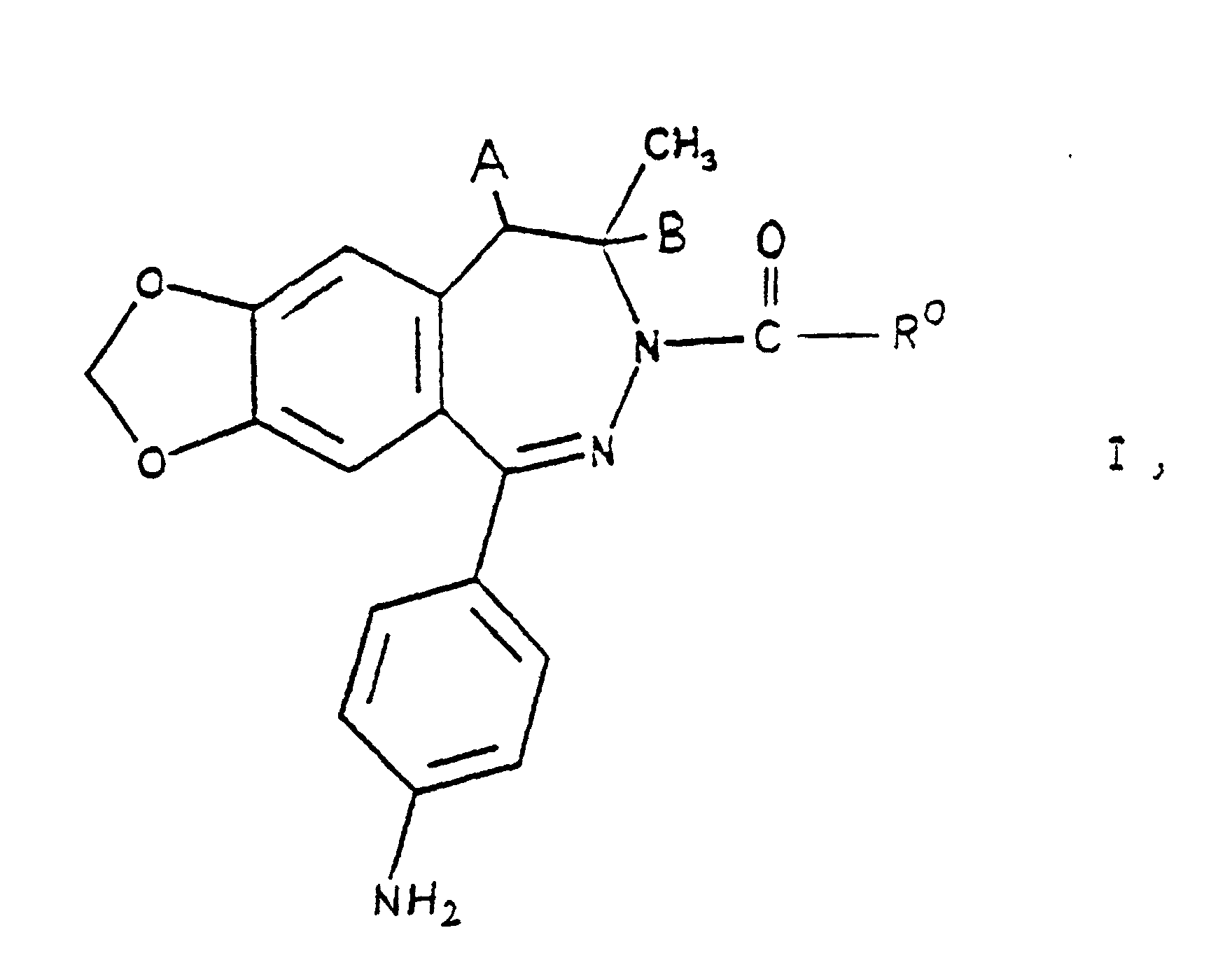 et leurs sels d'addition acides pharmaceutiquement acceptables.a) A et B représentent un hydrogène ou forment ensemble une liaison de valence
etR0 correspond à un groupe de formule -(CH2)m-R,
dans laquelleR représente un atome d'halogène ou un groupe de formule -NR3R4,
dans laquelleR3 représente un hydrogène etR4 signifie un cycloalkyle en C3 à C6, un alcoxy en C1 à C4, un amino ou un alkyle en C1 à C4, qui est plus tard substitué par un groupe hétérocyclique saturé ayant 5 ou 6 membres et comprenant 1 atome d'azote ou 1 atome d'azote et 1 atome d'oxygène comme hétéroatome(s),R3 et R4 signifient, indépendamment l'un de l'autre, un cycloalkyle en C3 à C6, un alcoxy en C1 à C4, un amino ou un alkyle en C1 à C4, qui est substitué plus tard par un groupe hétérocyclique saturé ayant 5 ou 6 membres et comprenant 1 atome d'azote ou 1 atome d'azote et 1 atome d'oxygène comme hétéroatome(s),
ouR3 et R4 forment ensemble avec l'atome d'azote adjacent et éventuellement avec un atome d'oxygène, un groupe hétérocyclique saturé ayant 5 ou 6 membres
etm vaut 0, 1 ou 2
oub) A et B forment ensemble une liaison de valence, R0 correspond à un groupe de formule -(CH2)m-R,
dans laquelleR, en plus des significations définies en a) représente en variante un groupe de formule -NR3R4,
dans laquelleR3 et R4 signifient, indépendamment l'un de l'autre, un hydrogène ou un alkyle en C1 à C4 non substitué
etm vaut 0
ouc) A et B représentent un hydrogène,R0 correspond à un groupe de formule -(CH2)m-R,
dans laquelleR, en plus des significations définies en a), représente en variante un groupe de formule -NR3R4, dans laquelleR3 signifie un atome d'hydrogène et R4 correspond à un groupe alkyle en C2 à C4 non substitué
etm vaut 0, - Un dérivé de 1,3-dioxolo/4,5-h//2,3/benzodiazépine selon la revendication 1, dans lequel
A et B représentent des atomes d'hydrogène
et
l'atome d'halogène qui peut être représenté par R est un atome chloro
ou
le groupe cycloalkyle pour lequel
R3 et/ou R4 peuvent correspondre, est/sont un(des) groupe(s) isopropyle et
m est tel que défini dans la revendication 1,
et leurs sels d'addition acides pharmaceutiquement acceptables. - Dérivé de 1,3-dioxolo/4,5-h//2,3/benzodiazépine selon la revendication 1, dans lequel
A et B représentent des atomes d'hydrogène,
le(s) groupe(s) alkyle pour le(s)quel(s) R3 et/ou R4 peuvent correspondre, est/sont un(des) groupe(s) alkyle en C1 à C2
et
le groupe hétérocyclique par lequel le(s) groupe(s) alkyle, pour le(s)quel(s) R3 et/ou R4 peuvent correspondre, peut être substitué ou le groupe hétérocyclique qui peut être formé par R3 et/ou R4 avec l'atome d'azote adjacent et avec un atome d'oxygène est un groupe morpholino
et
m a une valeur de 0 ou 1,
et leurs sels d'addition acides pharmaceutiquement acceptables. - Dérivé de 1,3-dioxolo/4,5-h//2,3/benzodiazépine selon la revendication 3, dans lequel
A et B représentent des atomes d'hydrogène,
R3 représente un atome d'hydrogène,
R4 correspond à un groupe cyclopropyle ou à un groupe amino
et
m a une valeur de 0
et leurs sels d'addition acides pharmaceutiquement acceptables. - Dérivé de 8-méthyl-7H-1,3-dioxolo/4,5-h//2,3/benzodiazépine selon la revendication 1, dans lequel
A et B forment ensemble une liaison de valence,
et
l'atome d'halogène qui peut être représenté par R est un atome chloro
ou
le(s) groupe(s) alkyle pour le(s)quel(s) le(s) groupe(s) hétérocyclique(s), par le(s)quel(s) le(s) groupe(s) alkyle, pour le(s)quel(s) R3 et/ou R4 peuvent correspondre, peut être substitué, est/sont un (des) groupe(s) morpholino
et m a une valeur de 0, 1 ou 2,
et leurs sels d'addition acides pharmaceutiquement acceptables. - Procédé pour la préparation d'un dérivé de 1,3-dioxolo/4,5-h//2,3/benzodiazépine de formule I, dans laquelle A, B et R0 sont tels que définis dans la revendication 1, selon la revendication 1, et leurs sels d'addition acides pharmaceutiquement acceptables, caractérisé en ce quedans laquelle R0 correspond à un groupe de formule -(CH2)m-R, dans laquelle R représente un groupe de formule -NR3R4, dans laquelle R3, R4 et m sont tels que définis en rapport avec la formule I et A forme ensemble avec B une liaison de valence, la 8-méthyl-5-(4-nitrophényl)-9H-1,3-dioxolo/4,5-h//2,3/benzodiazépine de formule II est mise à réagir avec un agent acylant de formule IX, dans laquelle chacun de Y et X' représentent, indépendamment l'un de l'autre, un groupe partant et m est tel que défini ci-dessus, et le composé acylé obtenu de formule VIIIa) pour la préparation d'un composé de formule I, dans laquelle R0 représente un groupe de formule -(CH2)m-R, dans laquelle R correspond à un atome d'halogène, m a une valeur de 0, 1 ou 2 et A et B représentent des atomes d'hydrogène, la 7,8-dihydro-8-méthyl-5-(4-nitrophényl)-9H-1,3-dioxolo/4,5-h//2,3/benzodiazépine de formule IIIest mise à réagir avec un réactif de formule VI
 dans laquelle Y représente un groupe partant et R5 est un atome d'halogène, et le composé obtenu dans lequel à la place du groupe amino sur le cycle phényle de la formule I, il y a un groupe nitro et R0, A et B sont tels que définis en rapport avec la formule I, est transformé en un composé de formule I par réduction ;
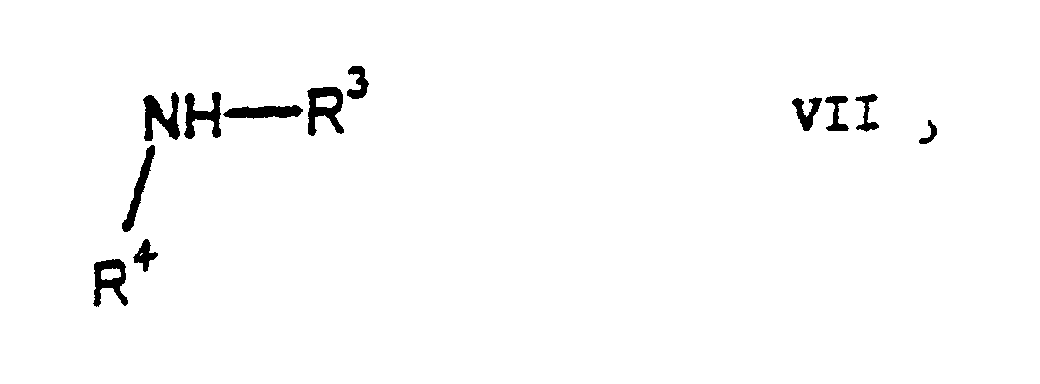
oub) pour la préparation d'un composé de formule I, dans laquelle R0 représente un groupe, de formule -(CH2)m-R, dans laquelle R correspond à un groupe de formule -NR3R4, dans laquelle R3, R4 et m sont tels que définis en rapport avec la formule I, et A et B représentent des atomes d'hydrogène, la 7,8-dihydro-8-méthyl-5-(4-nitrophenyl)-9H-1,3-dioxolo/4,5-h//2,3/ benzodiazépine de formule III est mise à réagir avec un réactif de formule VI, dans laquelle Y et R5 représentent, indépendamment, un groupe partant et m est comme établi ci-dessus, et le dérivé de benzodiazépine obtenu, de formule IV,dans laquelle X correspond à un groupe partant, m est comme présenté ci-dessus, est mise à réagir avec une amine de formule VII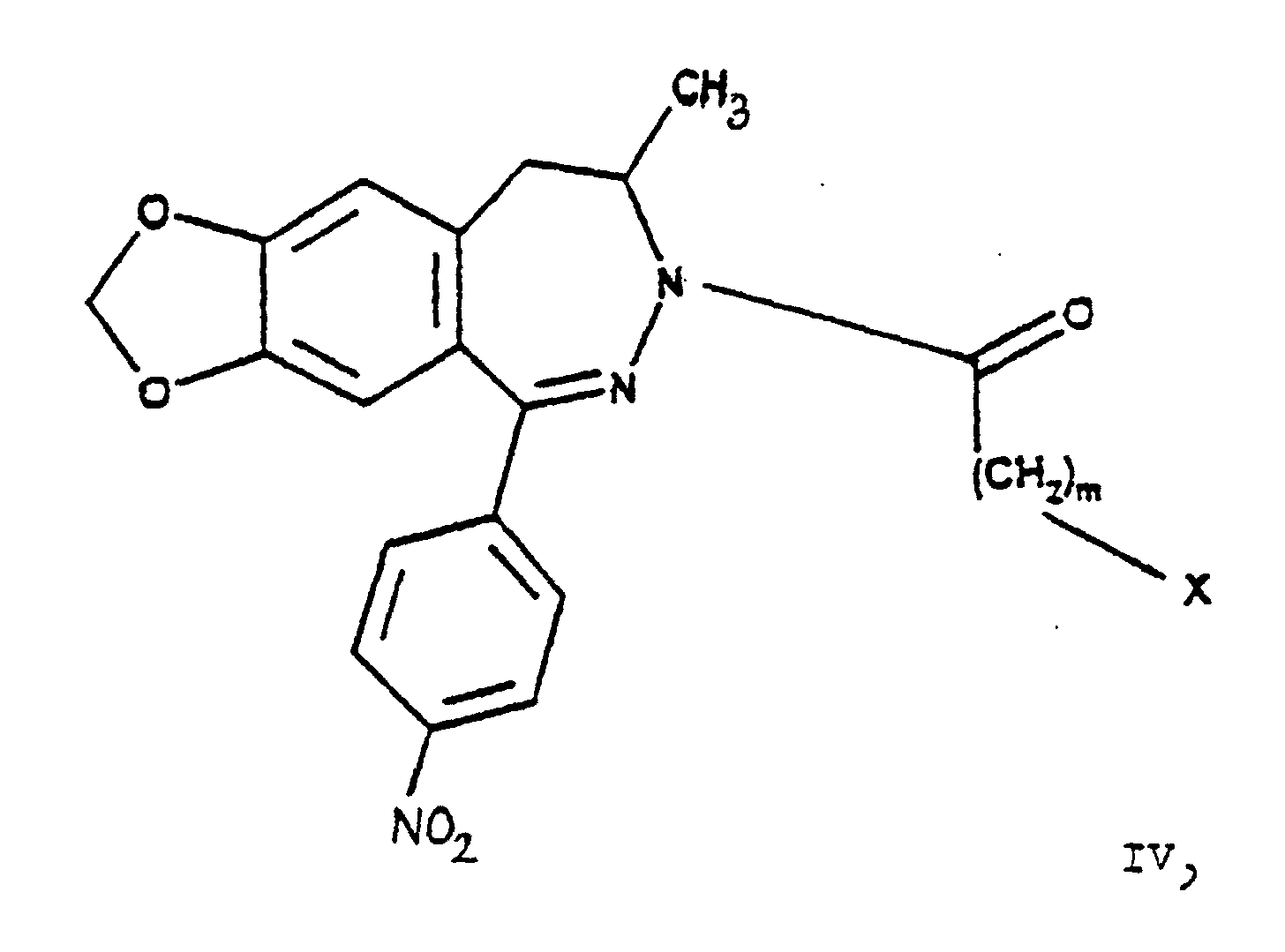 dans laquelle R3 et R4 sont comme présentés ci-dessus et le composé obtenu dans lequel à la place du groupe amino sur le cycle phényle de formule I, il y a un groupe nitro et R0, A et B sont tels que définis en rapport avec la formule I, est transformé en un composé de formule I par réduction ;
 c) pour la préparation d'un composé de formule I, dans laquelle R0 correspond à un groupe de formule -(CH2)m-R, dans laquelle R représente un atome d'halogène, m a une valeur de 0, 1 ou 2 et A forme ensemble avec B une liaison de valence, la 8-méthyl-5-(4-nitrophényl)-9H-1,3-dioxolo/4,5-h//2,3/benzodiazépine de formule IIest mise à réagir avec un agent acylant de formule IX
 dans laquelle Y représente un groupe partant, X' correspond à un atome d'halogène et m a une valeur de 0, 1 ou 2, et le composé obtenu dans lequel à la place du groupe amino sur le cycle phényle de formule I, il y a un groupe nitro et R0, A et B sont tels que définis en rapport avec la formule I, est transformé en un composé de formule I par réduction ;

oud) pour la préparation d'un composé de formule I,dans laquelle X' et m sont tels que définis ci-dessus, est mis à réagir avec une amine de formule HNR3R4, dans laquelle R3 et R4 sont tels que définis ci-dessus ; et le composé obtenu, dans lequel à la place du groupe amino sur le cycle phényle de formule I, il y a un groupe nitro, et R0, A et B sont tels que définis en rapport avec la formule I, est transformé en un composé de formule I par réduction ;
et, si on le souhaite, une base obtenue de formule I est convertie en un sel d'addition acide pharmaceutiquement acceptable ou libérée du sel d'addition acide. - Composition pharmaceutique comprenant un dérivé de 1,3-dioxolo/4,5-h//2,3/benzodiazépine selon l'une des revendications 1 à 5 comme ingrédient actif et un ou plusieurs porteurs conventionnels.
- Utilisation des 1,3-dioxolo/4,5-h//2,3/benzodiazépines selon la revendication 1, pour préparer des médicaments pour le traitement de l'épilepsie ou d'une maladie neurodégénérative ou d'un état postérieur à un accident vasculaire cérébral.
Applications Claiming Priority (7)
| Application Number | Priority Date | Filing Date | Title |
|---|---|---|---|
| HU1300082 | 1997-08-12 | ||
| HU9701383A HUP9701383A3 (en) | 1997-08-12 | 1997-08-12 | New 8-methyl-7h-1,3-dioxolo[4,5-h][2,3]-benzodiazepine derivatives, pharmaceutical compositions containing them as active component, and process for producing them |
| HU9701382 | 1997-08-12 | ||
| HU1300083 | 1997-08-12 | ||
| HU9701383 | 1997-08-12 | ||
| HU9701382A HUP9701382A3 (en) | 1997-08-12 | 1997-08-12 | New 7,8-dihydro-8-methyl-9h-1,3-dioxolo-[4,5-h][2,3]-benzodiazepine derivatives, pharmaceutical compositions containing them as active component and process for producing them |
| PCT/HU1998/000076 WO1999007708A1 (fr) | 1997-08-12 | 1998-08-07 | Derives de 1,3-dioxolo/4,5-h//2,3/benzodiazepine utilises comme inhibiteurs des recepteurs ampa/kainate |
Publications (2)
| Publication Number | Publication Date |
|---|---|
| EP1015457A1 EP1015457A1 (fr) | 2000-07-05 |
| EP1015457B1 true EP1015457B1 (fr) | 2003-11-26 |
Family
ID=89995503
Family Applications (1)
| Application Number | Title | Priority Date | Filing Date |
|---|---|---|---|
| EP98939782A Expired - Lifetime EP1015457B1 (fr) | 1997-08-12 | 1998-08-07 | Derives de 1,3-dioxolo/4,5-h//2,3/benzodiazepine utilises comme inhibiteurs des recepteurs ampa/kainate |
Country Status (15)
| Country | Link |
|---|---|
| EP (1) | EP1015457B1 (fr) |
| JP (1) | JP2001512731A (fr) |
| KR (1) | KR20010022856A (fr) |
| CN (1) | CN1271360A (fr) |
| AT (1) | ATE255112T1 (fr) |
| AU (1) | AU748801B2 (fr) |
| BR (1) | BR9812119A (fr) |
| CA (1) | CA2300142A1 (fr) |
| DE (1) | DE69820081D1 (fr) |
| NO (1) | NO20000654L (fr) |
| NZ (1) | NZ503301A (fr) |
| PL (1) | PL338681A1 (fr) |
| RU (1) | RU2208014C2 (fr) |
| SK (1) | SK1792000A3 (fr) |
| WO (1) | WO1999007708A1 (fr) |
Families Citing this family (6)
| Publication number | Priority date | Publication date | Assignee | Title |
|---|---|---|---|---|
| HUP9900354A3 (en) * | 1999-02-15 | 2001-02-28 | Egyt Gyogyszervegyeszeti Gyar | Use of condensed 2,3-benzodiazepine derivatives for the preparation of pharmaceutical compositions treating and preventing diseases related with the inhibition of lipide peroxidation |
| HU227128B1 (en) * | 1999-07-07 | 2010-07-28 | Egyt Gyogyszervegyeszeti Gyar | New 2,3-benzodiazepine derivatives |
| US6858605B2 (en) | 2003-02-04 | 2005-02-22 | Ivax Drug Research Institute, Ltd. | Substituted 2,3-benzodiazepine derivatives |
| EP2338492A1 (fr) | 2009-12-24 | 2011-06-29 | Universidad del Pais Vasco | Procédés et compositions pour le traitement de la maladie d'Alzheimer |
| FR2972454B1 (fr) * | 2011-03-08 | 2013-03-01 | Servier Lab | Nouveaux derives dihydro-oxazolobenzodiazepinones, leur procede de preparation et les compositions pharmaceutiques qui les contiennent |
| HU230684B1 (hu) * | 2014-01-21 | 2017-08-28 | Egis Gyogyszergyar Nyilvanosan Muekoedoe Reszvenytarsasag | Új dihidro-oxazino-benzodiazepin vegyületek és eljárás ezek elõállítására, illetve az ezeket tartalmazó gyógyászati készítmények |
Family Cites Families (6)
| Publication number | Priority date | Publication date | Assignee | Title |
|---|---|---|---|---|
| HU219778B (hu) * | 1990-12-21 | 2001-07-30 | Gyógyszerkutató Intézet Közös Vállalat | Eljárás N-acil-2,3-benzodiazepin-származékok, savaddíciós sóik és az ezeket tartalmazó gyógyászati készítmények előállítására, valamint a vegyületek egy csoportja, és az ezeket tartalmazó gyógyászati készítmények |
| HU206719B (en) * | 1990-12-21 | 1992-12-28 | Gyogyszerkutato Intezet | Process for producing 1-/4-acylamino-phenyl/-7,8-methylenedioxy-5h-2,3-benzodiazepine derivatives, acid addicional salts and pharmaceutical compositions containing them |
| HU219777B (hu) * | 1993-07-02 | 2001-07-30 | Gyógyszerkutató Intézet Kft. | Optikailag aktív 1-(4-nitro-fenil)-4-metil-7,8-metiléndioxi-3,4-dihidro-5H-2,3-benzodiazepin és eljárás előállítására |
| DE4428835A1 (de) * | 1994-08-01 | 1996-02-08 | Schering Ag | Neue 3-substituierte 3H-2,3-Benzodiazepinderivate, deren Herstellung und Verwendung als Arzneimittel |
| TR199501071A2 (tr) * | 1994-08-31 | 1996-06-21 | Lilly Co Eli | Dihidro-2,3-benzodiazepin türevlerinin üretilmesi icin stereoselektif islem. |
| TR199501070A2 (tr) * | 1994-08-31 | 1996-06-21 | Lilly Co Eli | Dihidro-2,3-benzodiazepin türevinin kristalli bicimi. |
-
1998
- 1998-08-07 KR KR1020007001458A patent/KR20010022856A/ko not_active Ceased
- 1998-08-07 AT AT98939782T patent/ATE255112T1/de not_active IP Right Cessation
- 1998-08-07 DE DE69820081T patent/DE69820081D1/de not_active Expired - Lifetime
- 1998-08-07 RU RU2000106061/04A patent/RU2208014C2/ru not_active IP Right Cessation
- 1998-08-07 CN CN98809317A patent/CN1271360A/zh active Pending
- 1998-08-07 SK SK179-2000A patent/SK1792000A3/sk unknown
- 1998-08-07 NZ NZ503301A patent/NZ503301A/xx unknown
- 1998-08-07 WO PCT/HU1998/000076 patent/WO1999007708A1/fr not_active Ceased
- 1998-08-07 CA CA002300142A patent/CA2300142A1/fr not_active Abandoned
- 1998-08-07 JP JP2000506211A patent/JP2001512731A/ja active Pending
- 1998-08-07 BR BR9812119-7A patent/BR9812119A/pt not_active IP Right Cessation
- 1998-08-07 AU AU88182/98A patent/AU748801B2/en not_active Ceased
- 1998-08-07 EP EP98939782A patent/EP1015457B1/fr not_active Expired - Lifetime
- 1998-08-07 PL PL98338681A patent/PL338681A1/xx unknown
-
2000
- 2000-02-09 NO NO20000654A patent/NO20000654L/no not_active Application Discontinuation
Non-Patent Citations (1)
| Title |
|---|
| SOLYOM, PHARMAZIE, vol. 56, 2001, pages 62 - 66 * |
Also Published As
| Publication number | Publication date |
|---|---|
| ATE255112T1 (de) | 2003-12-15 |
| NZ503301A (en) | 2002-09-27 |
| RU2208014C2 (ru) | 2003-07-10 |
| CA2300142A1 (fr) | 1999-02-18 |
| DE69820081D1 (de) | 2004-01-08 |
| PL338681A1 (en) | 2000-11-20 |
| NO20000654D0 (no) | 2000-02-09 |
| CN1271360A (zh) | 2000-10-25 |
| AU8818298A (en) | 1999-03-01 |
| WO1999007708A1 (fr) | 1999-02-18 |
| SK1792000A3 (en) | 2000-09-12 |
| BR9812119A (pt) | 2004-06-22 |
| AU748801B2 (en) | 2002-06-13 |
| EP1015457A1 (fr) | 2000-07-05 |
| NO20000654L (no) | 2000-04-10 |
| KR20010022856A (ko) | 2001-03-26 |
| JP2001512731A (ja) | 2001-08-28 |
Similar Documents
| Publication | Publication Date | Title |
|---|---|---|
| US5519019A (en) | N-acyl-2,3-benzoidazepine derivatives, pharmaceutical compositions containing them and process for preparing same | |
| CA1277660C (fr) | Derives de la 5-h-2, 3-benzodiazepine, procede pour leur preparation et produits pharmaceutiques en contenant | |
| NO310512B1 (no) | 5H-Tiazolo [3,2-a] pyrimidinderivater | |
| NZ526150A (en) | Serotonergic agents | |
| US5639751A (en) | N-acyl-2,3-benzodiazepine derivatives for treating acute and chronic neurodegenerative disorders | |
| US6562810B1 (en) | 8-substituted-9H-1,3-dioxolo/4,5-h//2,3/benzodiazepine derivatives, as AMPA/kainate receptor inhibitors | |
| EP0216247A2 (fr) | Utilisation des antagonistes du récepteur alpha-2-adrénergique pour la production de compositions pharmaceutiques pour le traitement du spasme du côlon, du syndrome des intestins irritables et constipation, et procédé de préparation de telles compositions pharmaceutiques | |
| US5521174A (en) | N-acyl-2,3-benzodiazepine derivatives and a method of treating spasms of the skeletal musculature therewith | |
| US4710504A (en) | Anti-depressant spiro hexahydro arylquinolizine derivatives, composition, and method of use therefor | |
| AU748801B2 (en) | 1,3-dioxolo/4,5-H//2,3/benzodiazepine derivatives as ampa/kainate receptor inhibitors | |
| IE60265B1 (en) | Condensed diazepinones | |
| EP0162592B1 (fr) | Composés hétérocycliques de groupe amine | |
| AU612495B2 (en) | Condensed diazepinones | |
| US4235901A (en) | 1-Hydroxyalkanamine pyrano(3,4-b)indole compositions and use thereof | |
| HRP20020015A2 (en) | New 2,3-benzodiazepine derivatives | |
| MXPA00001487A (en) | 1,3-dioxolo/4,5-h//2,3/benzodiazepine derivatives as ampa/kainate receptor inhibitors | |
| AU2004261491B2 (en) | 8-chloro-2,3-benzodiazepine derivatives | |
| CZ2000433A3 (cs) | Deriváty 1,3-dioxolo(4,5-H)(2,3)benzodiazepinu, farmaceutické kompozice je obsahující a způsob přípravy účinné složky | |
| PL211495B1 (pl) | Pochodne 2,3-benzodiazepiny, kompozycja farmaceutyczna zawierająca te pochodne jako składnik aktywny i ich zastosowanie | |
| MXPA00001486A (en) | 8-SUBSTITUTED-9H-1,3-DIOXOLO/4,5-h//2,3/BENZODIAZEPINE DERIVATIVES, AS AMPA/KAINATE RECEPTOR INHIBITORS | |
| CZ2000434A3 (cs) | Deriváty 8-substituovaného-9H-l,3-dioxoIo-(4,5- h)(2,3)benzodiazepinu jako inhibitory receptorů AMPA/kainatu |
Legal Events
| Date | Code | Title | Description |
|---|---|---|---|
| PUAI | Public reference made under article 153(3) epc to a published international application that has entered the european phase |
Free format text: ORIGINAL CODE: 0009012 |
|
| 17P | Request for examination filed |
Effective date: 20000306 |
|
| AK | Designated contracting states |
Kind code of ref document: A1 Designated state(s): AT BE CH CY DE DK ES FI GB GR LI NL PT SE |
|
| AX | Request for extension of the european patent |
Free format text: LT PAYMENT 20000306;LV PAYMENT 20000306;RO PAYMENT 20000306;SI PAYMENT 20000306 |
|
| 17Q | First examination report despatched |
Effective date: 20020528 |
|
| GRAH | Despatch of communication of intention to grant a patent |
Free format text: ORIGINAL CODE: EPIDOS IGRA |
|
| GRAS | Grant fee paid |
Free format text: ORIGINAL CODE: EPIDOSNIGR3 |
|
| RBV | Designated contracting states (corrected) |
Designated state(s): AT BE CH DE DK ES FI GB GR LI NL PT SE |
|
| GRAA | (expected) grant |
Free format text: ORIGINAL CODE: 0009210 |
|
| AK | Designated contracting states |
Kind code of ref document: B1 Designated state(s): AT BE CH DE DK ES FI GB GR LI NL PT SE |
|
| AX | Request for extension of the european patent |
Extension state: LT LV RO SI |
|
| PG25 | Lapsed in a contracting state [announced via postgrant information from national office to epo] |
Ref country code: NL Free format text: LAPSE BECAUSE OF FAILURE TO SUBMIT A TRANSLATION OF THE DESCRIPTION OR TO PAY THE FEE WITHIN THE PRESCRIBED TIME-LIMIT Effective date: 20031126 Ref country code: LI Free format text: LAPSE BECAUSE OF FAILURE TO SUBMIT A TRANSLATION OF THE DESCRIPTION OR TO PAY THE FEE WITHIN THE PRESCRIBED TIME-LIMIT Effective date: 20031126 Ref country code: FI Free format text: LAPSE BECAUSE OF FAILURE TO SUBMIT A TRANSLATION OF THE DESCRIPTION OR TO PAY THE FEE WITHIN THE PRESCRIBED TIME-LIMIT Effective date: 20031126 Ref country code: ES Free format text: LAPSE BECAUSE OF FAILURE TO SUBMIT A TRANSLATION OF THE DESCRIPTION OR TO PAY THE FEE WITHIN THE PRESCRIBED TIME-LIMIT Effective date: 20031126 Ref country code: CH Free format text: LAPSE BECAUSE OF FAILURE TO SUBMIT A TRANSLATION OF THE DESCRIPTION OR TO PAY THE FEE WITHIN THE PRESCRIBED TIME-LIMIT Effective date: 20031126 Ref country code: BE Free format text: LAPSE BECAUSE OF FAILURE TO SUBMIT A TRANSLATION OF THE DESCRIPTION OR TO PAY THE FEE WITHIN THE PRESCRIBED TIME-LIMIT Effective date: 20031126 Ref country code: AT Free format text: LAPSE BECAUSE OF FAILURE TO SUBMIT A TRANSLATION OF THE DESCRIPTION OR TO PAY THE FEE WITHIN THE PRESCRIBED TIME-LIMIT Effective date: 20031126 |
|
| REG | Reference to a national code |
Ref country code: GB Ref legal event code: FG4D |
|
| REG | Reference to a national code |
Ref country code: CH Ref legal event code: EP |
|
| REF | Corresponds to: |
Ref document number: 69820081 Country of ref document: DE Date of ref document: 20040108 Kind code of ref document: P |
|
| PG25 | Lapsed in a contracting state [announced via postgrant information from national office to epo] |
Ref country code: SE Free format text: LAPSE BECAUSE OF FAILURE TO SUBMIT A TRANSLATION OF THE DESCRIPTION OR TO PAY THE FEE WITHIN THE PRESCRIBED TIME-LIMIT Effective date: 20040226 Ref country code: GR Free format text: LAPSE BECAUSE OF FAILURE TO SUBMIT A TRANSLATION OF THE DESCRIPTION OR TO PAY THE FEE WITHIN THE PRESCRIBED TIME-LIMIT Effective date: 20040226 Ref country code: DK Free format text: LAPSE BECAUSE OF FAILURE TO SUBMIT A TRANSLATION OF THE DESCRIPTION OR TO PAY THE FEE WITHIN THE PRESCRIBED TIME-LIMIT Effective date: 20040226 |
|
| PG25 | Lapsed in a contracting state [announced via postgrant information from national office to epo] |
Ref country code: DE Free format text: LAPSE BECAUSE OF FAILURE TO SUBMIT A TRANSLATION OF THE DESCRIPTION OR TO PAY THE FEE WITHIN THE PRESCRIBED TIME-LIMIT Effective date: 20040227 |
|
| NLV1 | Nl: lapsed or annulled due to failure to fulfill the requirements of art. 29p and 29m of the patents act | ||
| LTIE | Lt: invalidation of european patent or patent extension |
Effective date: 20031126 |
|
| REG | Reference to a national code |
Ref country code: CH Ref legal event code: PL |
|
| PG25 | Lapsed in a contracting state [announced via postgrant information from national office to epo] |
Ref country code: GB Free format text: LAPSE BECAUSE OF NON-PAYMENT OF DUE FEES Effective date: 20040807 |
|
| PLBE | No opposition filed within time limit |
Free format text: ORIGINAL CODE: 0009261 |
|
| STAA | Information on the status of an ep patent application or granted ep patent |
Free format text: STATUS: NO OPPOSITION FILED WITHIN TIME LIMIT |
|
| 26N | No opposition filed |
Effective date: 20040827 |
|
| GBPC | Gb: european patent ceased through non-payment of renewal fee |
Effective date: 20040807 |
|
| PG25 | Lapsed in a contracting state [announced via postgrant information from national office to epo] |
Ref country code: PT Free format text: LAPSE BECAUSE OF NON-PAYMENT OF DUE FEES Effective date: 20040426 |