EP1016654A2 - Verfahren zur Herstellung von substituierten aromatischen und heteroaromatischen Aldehyden und Carbonsäuren - Google Patents
Verfahren zur Herstellung von substituierten aromatischen und heteroaromatischen Aldehyden und Carbonsäuren Download PDFInfo
- Publication number
- EP1016654A2 EP1016654A2 EP99124309A EP99124309A EP1016654A2 EP 1016654 A2 EP1016654 A2 EP 1016654A2 EP 99124309 A EP99124309 A EP 99124309A EP 99124309 A EP99124309 A EP 99124309A EP 1016654 A2 EP1016654 A2 EP 1016654A2
- Authority
- EP
- European Patent Office
- Prior art keywords
- formula
- acid
- hydroperoxide
- aldehyde
- salt
- Prior art date
- Legal status (The legal status is an assumption and is not a legal conclusion. Google has not performed a legal analysis and makes no representation as to the accuracy of the status listed.)
- Withdrawn
Links
- 238000000034 method Methods 0.000 title claims abstract description 17
- -1 heteroaromatic aldehydes Chemical class 0.000 title claims abstract description 12
- 125000003118 aryl group Chemical group 0.000 title claims abstract description 8
- 150000001735 carboxylic acids Chemical class 0.000 title claims abstract description 8
- 238000002360 preparation method Methods 0.000 title claims abstract description 6
- 230000003647 oxidation Effects 0.000 claims abstract description 10
- 238000007254 oxidation reaction Methods 0.000 claims abstract description 10
- 229910052739 hydrogen Inorganic materials 0.000 claims abstract description 9
- 229910052799 carbon Inorganic materials 0.000 claims abstract description 8
- 150000001732 carboxylic acid derivatives Chemical class 0.000 claims abstract description 8
- 125000000896 monocarboxylic acid group Chemical group 0.000 claims abstract description 8
- 125000002485 formyl group Chemical group [H]C(*)=O 0.000 claims abstract description 5
- 125000006297 carbonyl amino group Chemical group [H]N([*:2])C([*:1])=O 0.000 claims abstract description 4
- 229910052736 halogen Inorganic materials 0.000 claims abstract description 4
- 150000002367 halogens Chemical class 0.000 claims abstract description 4
- 125000000217 alkyl group Chemical group 0.000 claims abstract description 3
- 238000002955 isolation Methods 0.000 claims abstract 3
- MHAJPDPJQMAIIY-UHFFFAOYSA-N Hydrogen peroxide Chemical compound OO MHAJPDPJQMAIIY-UHFFFAOYSA-N 0.000 claims description 33
- 150000001299 aldehydes Chemical class 0.000 claims description 21
- 150000003839 salts Chemical class 0.000 claims description 18
- XLYOFNOQVPJJNP-UHFFFAOYSA-N water Substances O XLYOFNOQVPJJNP-UHFFFAOYSA-N 0.000 claims description 14
- 150000001875 compounds Chemical class 0.000 claims description 12
- CBENFWSGALASAD-UHFFFAOYSA-N Ozone Chemical compound [O-][O+]=O CBENFWSGALASAD-UHFFFAOYSA-N 0.000 claims description 11
- 239000011734 sodium Substances 0.000 claims description 11
- 239000000203 mixture Substances 0.000 claims description 9
- 229910052708 sodium Inorganic materials 0.000 claims description 9
- 125000001424 substituent group Chemical group 0.000 claims description 9
- 238000000354 decomposition reaction Methods 0.000 claims description 8
- SCVFZCLFOSHCOH-UHFFFAOYSA-M potassium acetate Chemical compound [K+].CC([O-])=O SCVFZCLFOSHCOH-UHFFFAOYSA-M 0.000 claims description 8
- 239000002253 acid Substances 0.000 claims description 7
- 230000002378 acidificating effect Effects 0.000 claims description 7
- 239000007800 oxidant agent Substances 0.000 claims description 7
- KIHAMCBHCNQCST-UHFFFAOYSA-N 2-formyl-5-nitrobenzenesulfonic acid Chemical compound OS(=O)(=O)C1=CC([N+]([O-])=O)=CC=C1C=O KIHAMCBHCNQCST-UHFFFAOYSA-N 0.000 claims description 6
- WCUXLLCKKVVCTQ-UHFFFAOYSA-M Potassium chloride Chemical compound [Cl-].[K+] WCUXLLCKKVVCTQ-UHFFFAOYSA-M 0.000 claims description 6
- MHAJPDPJQMAIIY-UHFFFAOYSA-M hydroperoxide group Chemical group [O-]O MHAJPDPJQMAIIY-UHFFFAOYSA-M 0.000 claims description 6
- 235000021286 stilbenes Nutrition 0.000 claims description 6
- 238000002425 crystallisation Methods 0.000 claims description 5
- 230000008025 crystallization Effects 0.000 claims description 5
- LCOPFDUKOIUDFD-UHFFFAOYSA-N 4-nitro-2-sulfobenzoic acid Chemical compound OC(=O)C1=CC=C([N+]([O-])=O)C=C1S(O)(=O)=O LCOPFDUKOIUDFD-UHFFFAOYSA-N 0.000 claims description 4
- PJANXHGTPQOBST-VAWYXSNFSA-N Stilbene Natural products C=1C=CC=CC=1/C=C/C1=CC=CC=C1 PJANXHGTPQOBST-VAWYXSNFSA-N 0.000 claims description 4
- KKEYFWRCBNTPAC-UHFFFAOYSA-N Terephthalic acid Chemical compound OC(=O)C1=CC=C(C(O)=O)C=C1 KKEYFWRCBNTPAC-UHFFFAOYSA-N 0.000 claims description 4
- 125000004433 nitrogen atom Chemical group N* 0.000 claims description 4
- 235000011056 potassium acetate Nutrition 0.000 claims description 4
- BWHMMNNQKKPAPP-UHFFFAOYSA-L potassium carbonate Substances [K+].[K+].[O-]C([O-])=O BWHMMNNQKKPAPP-UHFFFAOYSA-L 0.000 claims description 4
- KWYUFKZDYYNOTN-UHFFFAOYSA-M Potassium hydroxide Chemical compound [OH-].[K+] KWYUFKZDYYNOTN-UHFFFAOYSA-M 0.000 claims description 3
- 239000005708 Sodium hypochlorite Substances 0.000 claims description 3
- 150000007513 acids Chemical class 0.000 claims description 3
- 150000004965 peroxy acids Chemical class 0.000 claims description 3
- 239000001103 potassium chloride Substances 0.000 claims description 3
- 235000011164 potassium chloride Nutrition 0.000 claims description 3
- SUKJFIGYRHOWBL-UHFFFAOYSA-N sodium hypochlorite Chemical compound [Na+].Cl[O-] SUKJFIGYRHOWBL-UHFFFAOYSA-N 0.000 claims description 3
- ZMPRRFPMMJQXPP-UHFFFAOYSA-N 2-sulfobenzoic acid Chemical compound OC(=O)C1=CC=CC=C1S(O)(=O)=O ZMPRRFPMMJQXPP-UHFFFAOYSA-N 0.000 claims description 2
- ALYNCZNDIQEVRV-PZFLKRBQSA-N 4-amino-3,5-ditritiobenzoic acid Chemical compound [3H]c1cc(cc([3H])c1N)C(O)=O ALYNCZNDIQEVRV-PZFLKRBQSA-N 0.000 claims description 2
- MYMOFIZGZYHOMD-UHFFFAOYSA-N Dioxygen Chemical compound O=O MYMOFIZGZYHOMD-UHFFFAOYSA-N 0.000 claims description 2
- DGAQECJNVWCQMB-PUAWFVPOSA-M Ilexoside XXIX Chemical compound C[C@@H]1CC[C@@]2(CC[C@@]3(C(=CC[C@H]4[C@]3(CC[C@@H]5[C@@]4(CC[C@@H](C5(C)C)OS(=O)(=O)[O-])C)C)[C@@H]2[C@]1(C)O)C)C(=O)O[C@H]6[C@@H]([C@H]([C@@H]([C@H](O6)CO)O)O)O.[Na+] DGAQECJNVWCQMB-PUAWFVPOSA-M 0.000 claims description 2
- 229910019142 PO4 Chemical class 0.000 claims description 2
- 150000001805 chlorine compounds Chemical class 0.000 claims description 2
- 238000001816 cooling Methods 0.000 claims description 2
- 229910001882 dioxygen Inorganic materials 0.000 claims description 2
- 229910000027 potassium carbonate Inorganic materials 0.000 claims description 2
- WFIZEGIEIOHZCP-UHFFFAOYSA-M potassium formate Chemical compound [K+].[O-]C=O WFIZEGIEIOHZCP-UHFFFAOYSA-M 0.000 claims description 2
- 159000000001 potassium salts Chemical class 0.000 claims description 2
- 229960001922 sodium perborate Drugs 0.000 claims description 2
- YKLJGMBLPUQQOI-UHFFFAOYSA-M sodium;oxidooxy(oxo)borane Chemical compound [Na+].[O-]OB=O YKLJGMBLPUQQOI-UHFFFAOYSA-M 0.000 claims description 2
- BZFGKBQHQJVAHS-UHFFFAOYSA-N 2-(trifluoromethyl)pyridine-4-carboxylic acid Chemical class OC(=O)C1=CC=NC(C(F)(F)F)=C1 BZFGKBQHQJVAHS-UHFFFAOYSA-N 0.000 claims 1
- 229910002651 NO3 Inorganic materials 0.000 claims 1
- NHNBFGGVMKEFGY-UHFFFAOYSA-N Nitrate Chemical class [O-][N+]([O-])=O NHNBFGGVMKEFGY-UHFFFAOYSA-N 0.000 claims 1
- QAOWNCQODCNURD-UHFFFAOYSA-L Sulfate Chemical class [O-]S([O-])(=O)=O QAOWNCQODCNURD-UHFFFAOYSA-L 0.000 claims 1
- 150000001447 alkali salts Chemical class 0.000 claims 1
- 238000000605 extraction Methods 0.000 claims 1
- TWBYWOBDOCUKOW-UHFFFAOYSA-N isonicotinic acid Natural products OC(=O)C1=CC=NC=C1 TWBYWOBDOCUKOW-UHFFFAOYSA-N 0.000 claims 1
- NBIIXXVUZAFLBC-UHFFFAOYSA-K phosphate Chemical class [O-]P([O-])([O-])=O NBIIXXVUZAFLBC-UHFFFAOYSA-K 0.000 claims 1
- 239000010452 phosphate Chemical class 0.000 claims 1
- 238000005949 ozonolysis reaction Methods 0.000 abstract description 5
- PJANXHGTPQOBST-UHFFFAOYSA-N stilbene Chemical class C=1C=CC=CC=1C=CC1=CC=CC=C1 PJANXHGTPQOBST-UHFFFAOYSA-N 0.000 abstract description 4
- 239000000243 solution Substances 0.000 description 19
- QTBSBXVTEAMEQO-UHFFFAOYSA-N Acetic acid Chemical compound CC(O)=O QTBSBXVTEAMEQO-UHFFFAOYSA-N 0.000 description 15
- 239000011541 reaction mixture Substances 0.000 description 13
- RSPISYXLHRIGJD-UHFFFAOYSA-N OOOO Chemical compound OOOO RSPISYXLHRIGJD-UHFFFAOYSA-N 0.000 description 11
- 238000006243 chemical reaction Methods 0.000 description 8
- 150000002978 peroxides Chemical class 0.000 description 7
- 239000007787 solid Substances 0.000 description 7
- 239000007858 starting material Substances 0.000 description 7
- FAPWRFPIFSIZLT-UHFFFAOYSA-M Sodium chloride Chemical compound [Na+].[Cl-] FAPWRFPIFSIZLT-UHFFFAOYSA-M 0.000 description 6
- HEMHJVSKTPXQMS-UHFFFAOYSA-M Sodium hydroxide Chemical compound [OH-].[Na+] HEMHJVSKTPXQMS-UHFFFAOYSA-M 0.000 description 6
- 239000000047 product Substances 0.000 description 6
- 239000007795 chemical reaction product Substances 0.000 description 5
- SBJASJOPVGMIFF-UHFFFAOYSA-L disodium;4-nitro-2-sulfonatobenzoate Chemical compound [Na+].[Na+].[O-]C(=O)C1=CC=C([N+]([O-])=O)C=C1S([O-])(=O)=O SBJASJOPVGMIFF-UHFFFAOYSA-L 0.000 description 5
- 239000012452 mother liquor Substances 0.000 description 5
- 229910052757 nitrogen Inorganic materials 0.000 description 5
- WPYMKLBDIGXBTP-UHFFFAOYSA-N benzoic acid Chemical compound OC(=O)C1=CC=CC=C1 WPYMKLBDIGXBTP-UHFFFAOYSA-N 0.000 description 4
- BDAGIHXWWSANSR-UHFFFAOYSA-N methanoic acid Natural products OC=O BDAGIHXWWSANSR-UHFFFAOYSA-N 0.000 description 4
- 229910052700 potassium Inorganic materials 0.000 description 4
- 238000001644 13C nuclear magnetic resonance spectroscopy Methods 0.000 description 3
- 238000005160 1H NMR spectroscopy Methods 0.000 description 3
- 239000005711 Benzoic acid Substances 0.000 description 3
- 238000004519 manufacturing process Methods 0.000 description 3
- 239000011780 sodium chloride Substances 0.000 description 3
- UETHPMGVZHBAFB-OWOJBTEDSA-N 4,4'-dinitro-trans-stilbene-2,2'-disulfonic acid Chemical compound OS(=O)(=O)C1=CC([N+]([O-])=O)=CC=C1\C=C\C1=CC=C([N+]([O-])=O)C=C1S(O)(=O)=O UETHPMGVZHBAFB-OWOJBTEDSA-N 0.000 description 2
- OSWFIVFLDKOXQC-UHFFFAOYSA-N 4-(3-methoxyphenyl)aniline Chemical compound COC1=CC=CC(C=2C=CC(N)=CC=2)=C1 OSWFIVFLDKOXQC-UHFFFAOYSA-N 0.000 description 2
- KFSLWBXXFJQRDL-UHFFFAOYSA-N Peracetic acid Chemical compound CC(=O)OO KFSLWBXXFJQRDL-UHFFFAOYSA-N 0.000 description 2
- QAOWNCQODCNURD-UHFFFAOYSA-N Sulfuric acid Chemical compound OS(O)(=O)=O QAOWNCQODCNURD-UHFFFAOYSA-N 0.000 description 2
- 238000010521 absorption reaction Methods 0.000 description 2
- 239000007864 aqueous solution Substances 0.000 description 2
- QVGXLLKOCUKJST-UHFFFAOYSA-N atomic oxygen Chemical compound [O] QVGXLLKOCUKJST-UHFFFAOYSA-N 0.000 description 2
- 235000010233 benzoic acid Nutrition 0.000 description 2
- 125000004432 carbon atom Chemical group C* 0.000 description 2
- SDCDTWFAOKXZHD-SEPHDYHBSA-L disodium;5-nitro-2-[(e)-2-(4-nitro-2-sulfonatophenyl)ethenyl]benzenesulfonate Chemical compound [Na+].[Na+].[O-]S(=O)(=O)C1=CC([N+](=O)[O-])=CC=C1\C=C\C1=CC=C([N+]([O-])=O)C=C1S([O-])(=O)=O SDCDTWFAOKXZHD-SEPHDYHBSA-L 0.000 description 2
- 238000004821 distillation Methods 0.000 description 2
- 238000000921 elemental analysis Methods 0.000 description 2
- 235000019253 formic acid Nutrition 0.000 description 2
- 229910052760 oxygen Inorganic materials 0.000 description 2
- 239000001301 oxygen Substances 0.000 description 2
- GJAWHXHKYYXBSV-UHFFFAOYSA-N quinolinic acid Chemical compound OC(=O)C1=CC=CN=C1C(O)=O GJAWHXHKYYXBSV-UHFFFAOYSA-N 0.000 description 2
- 150000001629 stilbenes Chemical class 0.000 description 2
- NSMMFSKPGXCMOE-UHFFFAOYSA-N 2-[2-(2-sulfophenyl)ethenyl]benzenesulfonic acid Chemical compound OS(=O)(=O)C1=CC=CC=C1C=CC1=CC=CC=C1S(O)(=O)=O NSMMFSKPGXCMOE-UHFFFAOYSA-N 0.000 description 1
- MGFJDEHFNMWYBD-UHFFFAOYSA-N 4-(2-pyridin-4-ylethenyl)pyridine Chemical compound C=1C=NC=CC=1C=CC1=CC=NC=C1 MGFJDEHFNMWYBD-UHFFFAOYSA-N 0.000 description 1
- SBBQDUFLZGOASY-OWOJBTEDSA-N 4-[(e)-2-(4-carboxyphenyl)ethenyl]benzoic acid Chemical compound C1=CC(C(=O)O)=CC=C1\C=C\C1=CC=C(C(O)=O)C=C1 SBBQDUFLZGOASY-OWOJBTEDSA-N 0.000 description 1
- KOGDFDWINXIWHI-UHFFFAOYSA-N 4-[2-(4-aminophenyl)ethenyl]aniline Chemical compound C1=CC(N)=CC=C1C=CC1=CC=C(N)C=C1 KOGDFDWINXIWHI-UHFFFAOYSA-N 0.000 description 1
- ZDTXQHVBLWYPHS-UHFFFAOYSA-N 4-nitrotoluene-2-sulfonic acid Chemical compound CC1=CC=C([N+]([O-])=O)C=C1S(O)(=O)=O ZDTXQHVBLWYPHS-UHFFFAOYSA-N 0.000 description 1
- 238000012369 In process control Methods 0.000 description 1
- 238000005481 NMR spectroscopy Methods 0.000 description 1
- 239000003929 acidic solution Substances 0.000 description 1
- 230000015572 biosynthetic process Effects 0.000 description 1
- 229910052794 bromium Inorganic materials 0.000 description 1
- 229910052801 chlorine Inorganic materials 0.000 description 1
- 239000013078 crystal Substances 0.000 description 1
- GINSPFZBRUHFCY-UHFFFAOYSA-L dipotassium;4-nitro-2-sulfonatobenzoate Chemical compound [K+].[K+].[O-]C(=O)C1=CC=C([N+]([O-])=O)C=C1S([O-])(=O)=O GINSPFZBRUHFCY-UHFFFAOYSA-L 0.000 description 1
- 238000001035 drying Methods 0.000 description 1
- 238000002474 experimental method Methods 0.000 description 1
- 229910052731 fluorine Inorganic materials 0.000 description 1
- 239000007789 gas Substances 0.000 description 1
- 239000004009 herbicide Substances 0.000 description 1
- 125000001072 heteroaryl group Chemical group 0.000 description 1
- 238000010965 in-process control Methods 0.000 description 1
- 239000000543 intermediate Substances 0.000 description 1
- 238000011031 large-scale manufacturing process Methods 0.000 description 1
- 238000002844 melting Methods 0.000 description 1
- 230000008018 melting Effects 0.000 description 1
- 150000004682 monohydrates Chemical class 0.000 description 1
- PXHVJJICTQNCMI-UHFFFAOYSA-N nickel Substances [Ni] PXHVJJICTQNCMI-UHFFFAOYSA-N 0.000 description 1
- 229910052759 nickel Inorganic materials 0.000 description 1
- 150000002823 nitrates Chemical class 0.000 description 1
- 235000021317 phosphate Nutrition 0.000 description 1
- 150000003013 phosphoric acid derivatives Chemical class 0.000 description 1
- SIOXPEMLGUPBBT-UHFFFAOYSA-N picolinic acid Chemical class OC(=O)C1=CC=CC=N1 SIOXPEMLGUPBBT-UHFFFAOYSA-N 0.000 description 1
- 239000005648 plant growth regulator Substances 0.000 description 1
- XAEFZNCEHLXOMS-UHFFFAOYSA-M potassium benzoate Chemical compound [K+].[O-]C(=O)C1=CC=CC=C1 XAEFZNCEHLXOMS-UHFFFAOYSA-M 0.000 description 1
- 159000000000 sodium salts Chemical class 0.000 description 1
- 239000002904 solvent Substances 0.000 description 1
- 150000003467 sulfuric acid derivatives Chemical class 0.000 description 1
- 239000002699 waste material Substances 0.000 description 1
Classifications
-
- C—CHEMISTRY; METALLURGY
- C07—ORGANIC CHEMISTRY
- C07C—ACYCLIC OR CARBOCYCLIC COMPOUNDS
- C07C303/00—Preparation of esters or amides of sulfuric acids; Preparation of sulfonic acids or of their esters, halides, anhydrides or amides
- C07C303/02—Preparation of esters or amides of sulfuric acids; Preparation of sulfonic acids or of their esters, halides, anhydrides or amides of sulfonic acids or halides thereof
- C07C303/22—Preparation of esters or amides of sulfuric acids; Preparation of sulfonic acids or of their esters, halides, anhydrides or amides of sulfonic acids or halides thereof from sulfonic acids, by reactions not involving the formation of sulfo or halosulfonyl groups; from sulfonic halides by reactions not involving the formation of halosulfonyl groups
Definitions
- Aromatic and heteroaromatic aldehydes and carboxylic acids such as 4-nitro-2-sulfobenzaldehyde or -benzoic acid, are intermediates in the Manufacture of herbicides and plant growth regulators.
- the present invention accordingly relates to a process for the preparation of substituted aromatic and heteroaromatic aldehydes or carboxylic acids of the formula
- the inventive method is suitable for the production of Compounds of formula I.
- These compounds can be aromatic or heteroaromatic aldehydes or carboxylic acids.
- the substituent Z therefore means CHO or COOH.
- a C atom of the aromatic ring can be replaced by an N atom, so that X is C or N.
- R 1 and R 2 in the formula are IH, C 1 -C 4 alkyl, C 1 -C 4 alkoxy, OH, NO 2 , CN, COOH, CONH 2 , NH 2 , COOR, SO 3 H or halogen, such as Cl , Br, F.
- R can mean C 1 -C 4 alkyl. However, R 1 and R 2 do not simultaneously mean H. R 1 NO 2 and R 2 SO 3 are preferred.
- Examples of compounds which can be prepared by the process according to the invention are accordingly 2-sulfobenzoic acid, 4-nitro-2-sulfobenzoic acid, 4-nitro-2-sulfobenzaldehyde, 4-aminobenzoic acid, terephthalic acid, substituted pyridinecarboxylic acids, such as 2,3-pyridinedicarboxylic acid, etc. or the like Na or K salts.
- 4-Nitro-2-sulfobenzaldehyde or benzoic acid or the Na or K salt of 4-nitro-2-sulfobenzoic acid is preferably prepared.
- Suitable compounds of formula II are used directly or in the form of their salts. Suitable salts are, for example, Na or K salts of acids or chlorides, nitrates, sulfates, phosphates of basic groups.
- Suitable starting compounds are therefore stilbenes such as Stilbene-2,2'-disulfonic acid, 4,4'-dinitrostilbene-2,2'-disulfonic acid, 4,4'-vinylendianiline, 4,4'-vinylendipyridine, 4,4'-stilbenedicarboxylic acid, etc. respectively. Salts of these compounds.
- the starting compounds are dissolved in so much water that a 1 to 50%, preferably a 5 to 15%, solution is obtained. If the starting compound itself is not water-soluble, the aqueous solution of the corresponding salt can be prepared by adding suitable bases or acids.
- the solution thus obtained is gassed with an ozone-carrying O 2 stream until the equivalent amount of ozone or an excess is taken up.
- the end and thus the duration of the reaction is given by the consumption of the theoretical amount of ozone and can also be easily determined by a simultaneous increase in ozone breakthrough.
- the end of the reaction can also be easily determined by a suitable in-process control on the reaction of the starting compound.
- the temperature of ozonolysis is 0 to 100 ° C.
- a temperature of +5 to + 80 ° C. is preferred, particularly preferably from +15 to + 70 ° C.
- the hydroperoxide is then acid or alkaline decomposed. Accordingly, the reaction mixture is heated after the ozonolysis in aqueous acidic solution or until an aqueous solution of a base is added until no more peroxide is found in the reaction mixture. After the decomposition, either the corresponding acid or the aldehyde can form from the hydroperoxide. If the aldehyde is the desired end product, it is isolated from the mixture. The formation of aldehyde or acid from the hydroperoxide depends on the substituents of the compound of formula I. An aldehyde of formula I is preferably isolated, which has as a substituent R 1 and NO 2 as a substituent R 2 is H or SO 3 H.
- the hydroperoxide is preferably alkaline decomposed.
- Sodium hydroxide solution is particularly preferably used for this purpose, which is added until an alkaline pH, preferably above pH 8, is reached. The mixture is then cooled and the aldehyde crystallized out.
- an oxidizing agent is added to the reaction mixture which contains aldehyde and hydroperoxide compound after ozonolysis, without isolating the aldehyde.
- suitable oxidizing agents are hydrogen peroxide, peracids, ozone, molecular oxygen, sodium hypochlorite or sodium perborate. Hydrogen peroxide or a peracid is preferably used.
- the oxidizing agent is used at least in an equimolar ratio to the amount of aldehyde present in the reaction mixture, that is to say in at least 0.5 molar ratio to the room used.
- the temperature of the oxidation varies depending on the oxidizing agent used and is in a temperature range from 0 to 100 ° C.
- the acidic or basic decomposition of the hydroperoxide can take place both before and after the oxidation, but also simultaneously with the oxidation. Acidic decomposition of the hydroperoxide is preferred.
- the corresponding carboxylic acid or its salt preferably the Na or K salt, is crystallized, for example, either directly by crystallization from the aqueous reaction mixture, for example by concentration, cooling or by adding a suitable precipitant, or beforehand with an organic one Solvent extracted and the target product crystallized from the extract.
- the sodium salt of the corresponding compound is used as starting material and the K salt of the carboxylic acid is the desired end product, this is precipitated, for example, by adding potassium salts, such as potassium chloride, potassium hydroxide solution, potassium formate, potassium acetate, potassium carbonate, etc.
- the mother liquor which is obtained in the working up of the reaction mixture, can be added again after concentration in a new oxidation batch. This is particularly advantageous if the peroxide is decomposed using acetic acid, since the acetic acid is also recycled with the mother liquor.
- the desired aldehydes and carboxylic acids can be obtained in an environmentally friendly manner by the process according to the invention, since virtually no waste is obtained by using symmetrical stilbenes as the starting material.
- the target products can be obtained in high purity and in high yields.
- the process according to the invention is particularly suitable for the preparation of 4-nitro-2-sulfobenzaldehyde or benzoic acid or the sodium or potassium salt of this compound.
- An oxygen stream containing 45 g / m 3 of ozone was introduced into a solution of 300 g (0.414 mol) of 4,4'-dinitrostilbene-2,2'-disulfonic acid disodium salt in 3750 ml of water at 33 ° C.
- the absorption of ozone was ended after 38 minutes.
- 4000 ml of hydroxyperoxide (HPO) solution containing 0.47 mol of hydroperoxide were obtained. 2000 ml of the HPO solution thus obtained were then initially charged, 200 ml of acetic acid were added and 23.5 ml of 30% hydrogen peroxide were added dropwise.
- the reaction solution was heated to 90 ° C. in the course of one hour, with a slight evolution of gas starting from 85 ° C.
- Example 2 Analogously to Example 2, an HPO solution with 0.60 mol HPO was obtained, of which 1030 ml (0.30 mol PO; pH 2.6) were placed and 200 ml of formic acid were added. Then 66.6 g of 30% hydrogen peroxide were added and the reaction mixture was heated to 80 ° C. within one hour. Overall, the reaction solution was kept at 80 ° C. for 6 hours, with two further portions of hydrogen peroxide (66.6 g each) being added to the reaction mixture within these 6 hours. The peroxide content dropped to 0.052 mol. 758 ml (801 g) were distilled off at a bath temperature of 60 ° C. and 90 mbar and the distillation residue was then cooled to 10 ° C. under vacuum.
- the crystallization started at an internal temperature of 35 ° C.
- the solid was filtered off with suction and dried, giving 34.9 g of 4-nitro-2-sulfobenzoic acid sodium salt (21.6% of theory based on stilbene used).
- 532 g of mother liquor were salted out with 25 g of sodium chloride and the precipitated solid was filtered off with suction, giving a total yield of 105 g of 4-nitro-2-sulfobenzoic acid sodium salt (65% of theory, based on stilbene used).
- Example 2 Analogously to Example 2, an HPO solution containing 0.60 mol of HPO was obtained, of which 2000 ml (pH 2.6) was initially charged and 200 ml of formic acid were added. Then 132.2 g of 30% hydrogen peroxide were added and the reaction mixture was heated to 80 ° C. in the course of 45 minutes. Overall, the reaction solution was kept at 80 ° C. for 6 hours, a further portion of hydrogen peroxide (132.2 g) being added to the reaction mixture within these 6 hours. 147.2 g (1.5 mol) of potassium acetate were added at 80 ° C. and the mixture was cooled to 5 ° C. in the course of 2 hours. cooled to 10 ° C.
- Crystallization started at an internal temperature of 35 ° C - 40 ° C.
- the solid was filtered off with suction, washed with 100 ml of cold water and dried, giving 237 g of 4-nitro-2-sulfobenzoic acid potassium salt.
Landscapes
- Chemical & Material Sciences (AREA)
- Organic Chemistry (AREA)
- Chemical Kinetics & Catalysis (AREA)
- Organic Low-Molecular-Weight Compounds And Preparation Thereof (AREA)
- Pyridine Compounds (AREA)
Abstract


Description
Aus diesem Grund wird nach neuen Synthesewegen zur Herstellung von aromatischen und heteroaromatischen Carbonsäuren und Aldehyden gesucht, die die gewünschten Endprodukte auch im großtechnischen Maßstab auf umweltfreundliche Weise ermöglichen.

X C oder N und Z CHO oder COOH bedeuten, das dadurch gekennzeichnet ist, dass eine entsprechende symmetrische Stilbenverbindung der Formel
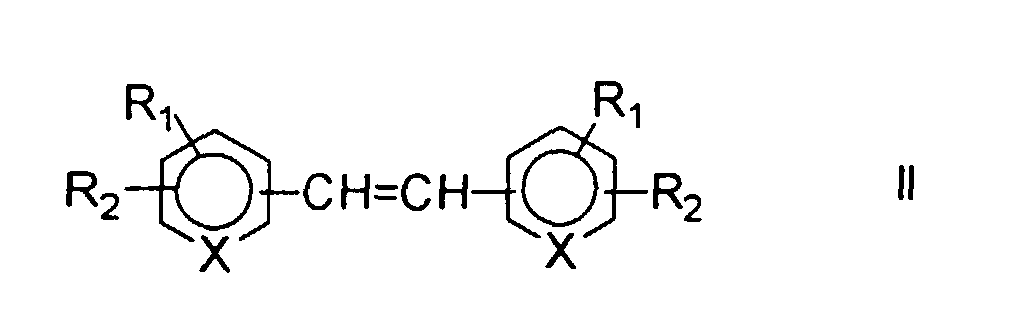
R1 und R2 bedeuten in der Formel I H, C1-C4 Alkyl, C1-C4 Alkoxy, OH, NO2, CN, COOH, CONH2, NH2, COOR, SO3H oder Halogen, wie Cl, Br, F. R kann C1 - C4 Alkyl bedeuten. R1 und R2 bedeuten jedoch nicht gleichzeitig H. Bevorzugt ist R1 NO2 und R2 SO3H.
Bevorzugt wird 4-Nitro-2-sulfobenzaldehyd oder -benzoesäure, bzw. das Na- oder K-Salz von 4-Nitro-2-sulfobenzoesäure hergestellt.
Weiters ist, wenn heteroaromatische Endprodukte hergestellt werden, jeweils ein C-Atom der Ringe durch ein N-Atom ersetzt.
Geeignete Verbindungen der Formel II werden direkt oder in Form ihrer Salze eingesetzt.
Als Salze eignen sich beispielsweise Na- oder K-Salze von Säuren oder Chloride, Nitrate, Sulfate, Phosphate von basischen Gruppen.
Ist die Ausgangsverbindung selbst nicht wasserlöslich, so kann durch Zusatz von geeigneten Basen oder Säuren die wässrige Lösung des entsprechenden Salzes hergestellt werden.
Das Ende und somit die Dauer der Reaktion ist durch den Verbrauch der theoretischen Ozonmenge gegeben und läßt sich weiters durch einen gleichzeitig auftretenden erhöhten Ozondurchbruch leicht feststellen.
Das Ende der Reaktion kann ferner leicht durch eine geeignete Inprozeßkontrolle auf das Abreagieren der Ausgangsverbindung festgestellt werden.
Die Temperatur der Ozonolyse beträgt 0 bis 100°C. Bevorzugt wird eine Temperatur von +5 bis +80°C, besonders bevorzugt von +15 bis +70°C gewählt.
Ist der Aldehyd das gewünschte Endprodukt, so wird dieser aus dem Gemisch isoliert. Die Bildung von Aldehyd oder Säure aus dem Hydroperoxid hängt von den Substituenten der Verbindung der Formel I ab.
Bevorzugt wird ein Aldehyd der Formel I isoliert, der als Substituent R1 NO2 und als Substituent R2 H oder SO3H aufweist.
Zur Isolierung des Aldehyds wird das Hydroperoxid bevorzugt alkalisch zersetzt. Besonders bevorzugt wird dazu Natronlauge verwendet, die bis zum Erreichen eines alkalischen pH-Wertes, bevorzugt über pH 8 zugesetzt wird. Anschließend wird das Gemisch abgekühlt und der Aldehyd auskristallisiert.
Als Oxidationsmittel eignen sich zum Beispiel Wasserstoffperoxid, Persäuren, Ozon, molekularer Sauerstoff, Natriumhypochlorit oder Natriumperborat. Bevorzugt wird Wasserstoffperoxid oder eine Persäure eingesetzt. Das Oxidationsmittel wird mindestens in äquimolarem Verhältnis zu der im Reaktionsgemisch vorhandenen Aldehydmenge, also in mindestens 0,5 molarem Verhältnis zum eingesetzten Stuben verwendet. Die Temperatur der Oxidation ist je nach verwendetem Oxidationsmittel unterschiedlich und liegt in einem Temperaturbereich von 0 bis 100°C.
Nach beendeter Oxidation wird die entsprechende Carbonsäure bzw. deren Salz, bevorzugt das Na- oder K-Salz, beispielsweise entweder direkt durch Kristallisation aus dem wässrigen Reaktionsgemisch, beispielsweise durch Einengen, Abkühlen oder durch Zusatz eines geeigneten Fällungsmittels, kristallisiert , oder vorher mit einem organischen Lösungsmittel extrahiert und das Zielprodukt aus dem Extrakt kristallisiert.
Wird als Edukt das Natriumsalz der entsprechenden Verbindung eingesetzt und ist das K-Salz der Carbonsäure das gewünschte Endprodukt, so wird dieses beispielsweise durch Zugabe von Kaliumsalzen, wie Kaliumchlorid, Kalilauge, Kaliumformiat, Kaliumacetat, Kaliumcarbonat u.s.w., ausgefällt.
Die Mutterlauge, die bei der Aufarbeitung des Reaktionsgemisches anfällt, kann nach Einengen wieder bei einem neuen Oxidationsansatz zugegeben werden. Dies ist insbesondere von Vorteil, wenn die Peroxidzersetzung mittels Essigsäure erfolgt, da mit der Mutterlauge auch die Essigsäure recycliert wird.
Die Zielprodukte können dabei in hoher Reinheit und in hohen Ausbeuten erhalten werden.
Besonders geeignet ist das erfindungsgemäße Verfahren zur Herstellung von 4-Nitro-2-sulfobenzaldehyd oder -benzoesäure bzw. des Natrium- oder Kaliumsalzes dieser Verbindung.
Anschließend wurde solange 4N NaOH zugegeben, bis ein konstanter pH-Wert von 9,5 erreicht war. Ein Peroxidtest ergab, daß praktisch kein Peroxid mehr in der Lösung vorhanden war.
Die Lösung wurde auf 5°C gekühlt, das auskristallisierte Produkt wurde abgesaugt und mit wenig 5°C kaltem Wasser gewaschen.
Die Mutterlauge wurde im Vakuum auf ein Volumen von 30 ml eingedampft, nochmals auf 5°C abgekühlt, das kristallisierte Produkt abgesaugt, mit kaltem Wasser gewaschen und mit dem ersten Kristallisat vereinigt. Nach dem Trocknen im Vakuum wurden 4,7 g 4-Nitro-2-sulfobenzaldehyd, Natriumsalz (85 % der Theorie) erhalten. Das Produkt liegt als Monohydrat vor.
Die Struktur wurde mittels 1H-NMR, 13C-NMR, IR und Elementaranalyse bestätigt.
- 1H-NMR:
- δ= 10,9 ppm (1H; -CHO), 8,5 ppm (1H; Ar-H), 8,3 (1H; d, J= 8 Hz, Ar-H), 8,0 (1H; d, J= 8 Hz, Ar-H)
- 13C-NMR:
- δ= 194 ppm (-CHO), 153/151/139/131/126/124 (6Ar-C)
- Elementaralnalyse: C7H6NO7SNA. H2O (271,18)
- ber. 31,0 % C; 2,2 % H; 5,2 % N 5,0 %; Na 8,5 %, H2O 6,6 %
- gef. 31,2 % C; 2,2 % H; 5,0 % N 5,2 %, Na 8,5 %, H2O 6,9 %
Es wurden 4000 ml Hydroxyperoxid (HPO)-Lösung erhalten, die 0,47 mol Hydroperoxid enthielt.
2000ml der so erhaltenen HPO-Lösung wurden sodann vorgelegt, mit 200 ml Essigsäure versetzt und 23,5ml 30%-iges Wasserstoffperoxid zugetropft. Die Reaktionslösung wurde innerhalb einer Stunde auf 90°C erhitzt, wobei ab 85° C eine leichte Gasentwicklung auftrat. Nach einer Stunde auf 90°C lag der HPO-Gehalt bei 0,35mol. Insgesamt wurde die Reaktionslösung 13h auf 90°C gehalten, wobei dem Reaktionsgemisch innerhalb dieser 13 Stunden eine 2. Portion Wasserstoffperoxid (23,5 ml) und eine Portion Peressigsäure (0,207 mol) zugesetzt wurden. Der Peroxidgehalt sank auf 0,066 mol ab.
Ausbeute 40g 4-Nitro-2-sulfobenzoesäure Natriumsalz
Der so erhaltenen Lösung mit pH 1,4 wurde konz. Schwefelsäure (72,7g) bis zum Erreichen von pH 0,2 zugegeben. Anschließend wurden 2000ml bei 60°C Badtemperatur und 90 mbar abdestilliert, worauf die Kristallisation begann. Der Destillationsrückstand wurde auf 15°C gekühlt und der ausgefallene Feststoff abgesaugt.
Ausbeute 99,4g 4-Nitro-2-sulfobenzoesäure Natriumsalz
1107g Mutterlauge wurden mit 75g Natriumchlorid ausgesalzen und der ausgefallene Feststoff abgesaugt, wodurch weitere 108,5g 4-Nitro-2-sulfobenzoesäure Natriumsalz erhalten wurden.
Insgesamt wurde die Reaktionslösung 6h auf 80°C gehalten, wobei dem Reaktionsgemisch innerhalb dieser 6 Stunden zwei weitere Portionen Wasserstoffperoxid (je 66,6g) zugesetzt wurden. Der Peroxidgehalt sank auf 0,052 mol ab.
758ml (801g) wurden bei 60°C Badtemperatur und 90 mbar abdestilliert und der Destillationsrückstand anschließend unter Vakuum auf 10°C gekühlt. Bei 35°C Innentemperatur begann die Kristallisation.
Der Feststoff wurde abgesaugt und getrocknet, wobei 34,9g 4-Nitro-2-sulfobenzoesäure Natriumsalz (21,6% d. Th. bezogen auf eingesetztes Stilben) erhalten wurden.
532g Mutterlauge wurden mit 25g Natriumchlorid ausgesalzen und der ausgefallene Feststoff abgesaugt, wodurch eine Gesamtausbeute von 105g 4-Nitro-2-sulfobenzoesäure Natriumsalz (65% d. Th. bezogen auf eingesetztes Stilben) erhalten wurden.
Insgesamt wurde die Reaktionslösung 6h auf 80°C gehalten, wobei dem Reaktionsgemisch innerhalb dieser 6 Stunden eine weitere Portion Wasserstoffperoxid (132,2g) zugesetzt wurden.
Bei 80°C wurden 147,2g (1,5mol) Kaliumacetat zugegeben und innerhalb von 2h auf 5°C gekühlt. auf 10°C gekühlt. Bei 35°C - 40°C Innentemperatur begann die Kristallisation.
Der Feststoff wurde abgesaugt, mit 100ml kaltem Wasser gewaschen und getrocknet, wobei 237g 4-Nitro-2-sulfobenzoesäure Kaliumsalz erhalten wurden.
Claims (9)
- Verfahren zur Herstellung von substituierten aromatischen und heteroaromatischen Aldehyden oder Carbonsäuren der Formelin der R1 und R2 H, C1-C4 Alkyl, C1-C4 Alkoxy, OH, NO2, CN, COOH, CONH2, COOR, NH2, SO3H oder Halogen und R C1-C4 Alkyl bedeuten, wobei R1 und R2 nicht gleichzeitig H sind,

X C oder N und Z CHO oder COOH bedeuten, dadurch gekennzeichnet, dass eine entsprechende symmetrische Stilbenverbindung der Formelin der R1, R2 und X wie oben definiert sind, entweder direkt oder als Salz in Wasser gelöst wird und bei einer Temperatur von 0 bis +100°C mit Ozon umgesetzt wird, worauf ein Gemisch bestehend aus dem entsprechenden Aldehyd der Formel I und Hydroperoxid erhalten wird, aus welchem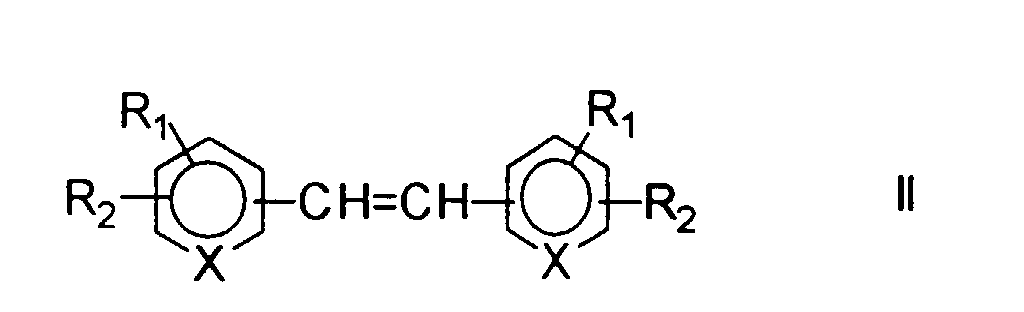 a) nach saurer oder alkalischer Zersetzung des Hydroperoxids der entsprechende Aldehyd der Formel I isoliert wird oder dasb) direkt unter saurer oder alkalischer Zersetzung des Hydroperoxids und Zugabe eines Oxidationsmittels zur entsprechenden Carbonsäure der Formel I oder deren Salz umgesetzt wird, die bzw. das anschließend isoliert wird.
 - Verfahren nach Anspruch 1, dadurch gekennzeichnet, dass sich in den Verbindungen der Formel I X, R1 und R2 in o-, m- oder p-Stellung zum Substituenten Z befinden können, mit der Maßgabe, daß falls X=N ist, das N-Atom nicht substituiert ist.
- Verfahren nach Anspruch 2, dadurch gekennzeichnet, dass als Verbindungen der Formel I 2-Sulfobenzoesäure, 4-Nitro-2-sulfobenzoesäure, 4-Nitro-2-sulfobenzaldehyd, 4-Aminobenzoesäure, Therephthalsäure oder substituierte 4-Pyridincarbonsäure oder deren Natrium- oder Kaliumsalze hergestellt werden.
- Verfahren nach Anspruch 1, dadurch gekennzeichnet, dass die Verbindungen der Formel II direkt, in Form ihrer Alkalisalze von Säuren oder in Form eines Chlorides, Nitrates, Sulfates oder Phosphates von basischen Gruppen in Wasser gelöst werden, sodass eine 1 bis 50%ige Lösung erhalten wird.
- Verfahren nach Anspruch 1, dadurch gekennzeichnet, dass zur Isolierung des Aldehydes das Gemisch auf einen alkalischen pH- Wert gestellt, das Hydroperoxid zersetzt und der Aldehyd nach Abkühlung auskristallisiert wird.
- Verfahren nach Anspruch 5, dadurch gekennzeichnet, dass als Aldehyde der Formel I, Aldehyde mit NO2 und/oder SO3H als Substituenten isoliert werden.
- Verfahren nach Anspruch 1, dadurch gekennzeichnet, dass zur Isolierung der Carbonsäuren das Gemisch mit Wasserstoffperoxid, einer Persäure, Ozon, molekularem Sauerstoff, Natriumhypochlorit oder Natriumperborat als Oxidationsmittel in mindestens äquimolaren Verhältnis zu der im Gemisch vorhandenen Aldehydmenge versetzt, das Hydroperoxid entweder vor, nach oder während der Oxidation sauer oder alkalisch zersetzt und die Carbonsäure oder deren Salz durch Extraktion oder Kristallisation isoliert wird.
- Verfahren nach Anspruch 7, dadurch gekennzeichnet, dass die Zersetzung des Hydroperoxides durch Zugabe einer Säure erfolgt.
- Verfahren nach Anspruch 7, dadurch gekennzeichnet, dass die Carbonsäure als K-Salz durch Zugabe von Kaliumchlorid, Kalilauge, Kaliumformiat, Kaliumacetat oder Kaliumcarbonat auskristallisiert wird.
Applications Claiming Priority (4)
| Application Number | Priority Date | Filing Date | Title |
|---|---|---|---|
| AT217498A ATA217498A (de) | 1998-12-28 | 1998-12-28 | Verfahren zur herstellung von substituierten aromatischen und heteroaromatischen aldehyden und carbonsäuren |
| AT217498 | 1998-12-28 | ||
| AT74899 | 1999-04-28 | ||
| AT74899 | 1999-04-28 |
Publications (2)
| Publication Number | Publication Date |
|---|---|
| EP1016654A2 true EP1016654A2 (de) | 2000-07-05 |
| EP1016654A3 EP1016654A3 (de) | 2003-04-02 |
Family
ID=25593817
Family Applications (1)
| Application Number | Title | Priority Date | Filing Date |
|---|---|---|---|
| EP99124309A Withdrawn EP1016654A3 (de) | 1998-12-28 | 1999-12-06 | Verfahren zur Herstellung von substituierten aromatischen und heteroaromatischen Aldehyden und Carbonsäuren |
Country Status (3)
| Country | Link |
|---|---|
| US (1) | US6518455B1 (de) |
| EP (1) | EP1016654A3 (de) |
| JP (1) | JP2000191628A (de) |
Cited By (1)
| Publication number | Priority date | Publication date | Assignee | Title |
|---|---|---|---|---|
| US7629375B2 (en) | 2001-07-23 | 2009-12-08 | Johnson & Johnson Consumer Companies, Inc. | Cytoprotective compounds, pharmaceutical and cosmetic formulations, and methods |
Family Cites Families (6)
| Publication number | Priority date | Publication date | Assignee | Title |
|---|---|---|---|---|
| DE115410C (de) * | ||||
| DE1271713B (de) | 1966-04-18 | 1968-07-04 | Interchem Corp | Verfahren zur Herstellung von organischen Carbonylverbindungen |
| US3799940A (en) | 1971-12-16 | 1974-03-26 | Emery Industries Inc | Process for producing aromatic aldehydes |
| US3978119A (en) * | 1975-07-11 | 1976-08-31 | Gulf Research & Development Company | Process for converting stilbene or bibenzyl to nitrobenzoic acids |
| GB8704328D0 (en) * | 1987-02-24 | 1987-04-01 | Sandoz Products Ltd | Organic compounds |
| DE19735879A1 (de) * | 1997-08-19 | 1999-02-25 | Hoechst Schering Agrevo Gmbh | Verfahren zur Herstellung von 2-Carboxy-5-nitro-benzolsulfonsäure und deren Salzen durch Oxidation |
-
1999
- 1999-12-06 EP EP99124309A patent/EP1016654A3/de not_active Withdrawn
- 1999-12-27 JP JP11370851A patent/JP2000191628A/ja not_active Withdrawn
- 1999-12-28 US US09/473,020 patent/US6518455B1/en not_active Expired - Fee Related
Cited By (1)
| Publication number | Priority date | Publication date | Assignee | Title |
|---|---|---|---|---|
| US7629375B2 (en) | 2001-07-23 | 2009-12-08 | Johnson & Johnson Consumer Companies, Inc. | Cytoprotective compounds, pharmaceutical and cosmetic formulations, and methods |
Also Published As
| Publication number | Publication date |
|---|---|
| US6518455B1 (en) | 2003-02-11 |
| EP1016654A3 (de) | 2003-04-02 |
| JP2000191628A (ja) | 2000-07-11 |
Similar Documents
| Publication | Publication Date | Title |
|---|---|---|
| EP0028028A2 (de) | Verfahren zur Herstellung einer Oxo-Verbindung und dazu benötigte neue Zwischenprodukte | |
| DE2805488C2 (de) | Tetrahydrofuran-Solvate der Magnesiumhalogenid-Komplexe der α-Brompropionsäure, Verfahren zu deren Herstellung und deren Weiterverarbeitung zur Herstellung von 2-Arylpropionsäuren | |
| EP0218076A1 (de) | Verfahren zur Herstellung der nicht-toxischen Salze des 6-Methyl-3,4-dihydro-1,2,3-oxathiazin-4-on-2,2-dioxids | |
| DE3132332C2 (de) | ||
| EP0176026B1 (de) | Verfahren zur Herstellung von 2,4-Dichlor-5-fluor-benzoesäure | |
| EP0002460B1 (de) | Verfahren zur Herstellung von 3,4-Methylendioxymandelsäure | |
| EP0048373A2 (de) | Verfahren zur Herstellung von Pyrazol | |
| DE2609015A1 (de) | Verfahren zur herstellung von benz (f)-2,5-oxazocinen | |
| EP0537592A1 (de) | Verfahren zur Herstellung von 2-Nitro-5-fluor- bzw. -5-chlor-phenol | |
| EP0053247B1 (de) | Verfahren zur Herstellung von 6-Fluor-anthranilsäurenitril oder 6-Fluor-anthranilsäure und 6-Fluor-anthranilsäurenitril | |
| US6518455B1 (en) | Process for preparing substituted aromatic and heteroaromatic aldehydes and carboxylic acids | |
| DE3838243A1 (de) | Verfahren zur herstellung von 2,3-dichlor-5-acetylpyridin | |
| EP0423595B1 (de) | Verfahren zur Herstellung von 3-Trichlormethyl-pyridin | |
| DE3323510A1 (de) | 2-ketosulfonamide und verfahren zu deren herstellung | |
| DE2619321C2 (de) | Oxalsäurederivate, ihre Herstellung und ihre Verwendung | |
| DD200795A5 (de) | Verfahren zur herstellung von diphenylaether-derivaten | |
| EP0434174A1 (de) | 3-Methylsulfonylmethyl-4-sulfomethyl-pyrrolidiniumbetaine und Verfahren zu ihrer Herstellung | |
| EP0064633B1 (de) | Verfahren zur Herstellung von 3,3-Dimethylglutarsäure | |
| CH645087A5 (en) | alpha-Hydroxycarbonyl compounds | |
| DE3637138A1 (de) | 1-aminomethylnaphthalin-6-sulfonsaeure, ihre herstellung und ihre verwendung | |
| AT367394B (de) | Verfahren zur herstellung neuer indanderivate | |
| DE1670249B2 (de) | Verfahren zur Herstellung von 4-Isothiazolcarbonsäuren | |
| DE10212885A1 (de) | Verfahren zur Herstellung von 3-Hydroxy-2-methylbenzoesäure | |
| DE1033671B (de) | Verfahren zur Herstellung von Diazomethan | |
| DE3840371A1 (de) | Verfahren zur herstellung von 2,4,5-trifluorbenzoesaeure |
Legal Events
| Date | Code | Title | Description |
|---|---|---|---|
| PUAI | Public reference made under article 153(3) epc to a published international application that has entered the european phase |
Free format text: ORIGINAL CODE: 0009012 |
|
| AK | Designated contracting states |
Kind code of ref document: A2 Designated state(s): AT BE CH CY DE DK ES FI FR GB GR IE IT LI LU MC NL PT SE |
|
| AX | Request for extension of the european patent |
Free format text: AL;LT;LV;MK;RO;SI |
|
| RAP1 | Party data changed (applicant data changed or rights of an application transferred) |
Owner name: DSM FINE CHEMICALS AUSTRIA NFG GMBH & COKG |
|
| PUAL | Search report despatched |
Free format text: ORIGINAL CODE: 0009013 |
|
| AK | Designated contracting states |
Kind code of ref document: A3 Designated state(s): AT BE CH CY DE DK ES FI FR GB GR IE IT LI LU MC NL PT SE Designated state(s): AT BE CH CY DE DK ES FI FR GB GR IE IT LI LU MC NL PT SE |
|
| AX | Request for extension of the european patent |
Extension state: AL LT LV MK RO SI |
|
| 17P | Request for examination filed |
Effective date: 20030804 |
|
| AKX | Designation fees paid |
Designated state(s): AT BE CH CY DE DK ES FI FR GB GR IE IT LI LU MC NL PT SE |
|
| 17Q | First examination report despatched |
Effective date: 20040616 |
|
| GRAP | Despatch of communication of intention to grant a patent |
Free format text: ORIGINAL CODE: EPIDOSNIGR1 |
|
| STAA | Information on the status of an ep patent application or granted ep patent |
Free format text: STATUS: THE APPLICATION IS DEEMED TO BE WITHDRAWN |
|
| 18D | Application deemed to be withdrawn |
Effective date: 20050402 |